



Abstract
In recent years, it is evident that there is a surge in photovoltaic (PV) systems installations on buildings. It is concerning that PV system related fire incidents have been reported throughout the years. Like any other electrical power system, PV systems pose fire and electrical hazards when at fault. As a consequence, PV fires compromised the safety of emergency responders. Therefore, the objective of this review is to evaluate the elements of firefighters' safety practices and subsequently collate the best safety practices for local fire rescue and firefighters in the event of PV fires. Out of 264 documents, only 20 publications were identified as ‘closely related’ and were systematically reviewed to evaluate firefighter safety practices from a scholarly perspective. Only 3% of the 20 publications reviewed, discussed the safety practices during PV fires. Thirteen safety practice key points were extracted from the reviewed documents, with nine critical findings highlighted as the hallmark of safety practices during PV fire for firefighters. The lack of academic journals discussing the fire safety aspects proves that there is a low interest in this field which is in dire need of further study and exploration to adhere with the PV population in ensuring a reliable emergency operation to minimize losses or injuries due to accidents.
Keywords: Firefighter safety, Safety practices, Firefighters, PV fire, Electrical fire, Fire suppression
Introduction
As a result of public incentives for green energy, the growth of global photovoltaic (PV) system installation is observed to escalate rapidly. This promising industry has been breaking the worldwide PV capacity growth records every year despite the difficulties arising from the global COVID-19 pandemic. Although market experts have predicted a market decrease, the PV industry remains resilient with a record-breaking 138.2 gigawatts in total installed capacity in 2020, representing year-on-year growth of 18% more than in 2019 [1]. With the medium-scenario trajectory, global installation capacity will surpass the terawatt scale by 2022 [2]. As a primary source or a backup to supply electricity, PV systems vary from small residential sizes to massive utility scales with various mounting configurations and integrated installation.
PV systems are classified into standalone/off-grid and grid-connected systems [3]. In most countries, the grid-connected mode is becoming the system of choice in contributing to their electricity generation mix [3]. The standard layout of a grid-connected system is usually perceived as two separated sides: the DC and AC lines. Various components are involved in the system, such as PV modules, junction boxes, on-grid inverters, disconnect or isolator switches, net meters, distribution boxes, connectors, and cables. PV systems should not be perceived only as modules or arrays as they comprise electrical components, charged equipment, various electronics, the network of cables, and mechanical hardware, which are subjected to electrical fire ignition.
As PV systems gain more acceptance and become more prevalent in their applications harnessing clean energy, increasing fire safety concerns will create an essential chapter in PV discussions. One of the heavily discussed topics is fire safety regarding PV systems of a building. PV fire is a term used in this paper to describe a fire incident involving PV systems installed on a building. Due to the confidentiality of PV installation companies, it is challenging to quantify cases of PV-related fires to measure the occurrences [4]. However, few statistics exist revealing cases of fire incidents involving PV systems. For instance, in Germany, from 1995 to 2012, 179 out of 400 fire incidents were identified that PV system had caused fires, with a large number failing during the first year, reflecting a 44.8% rate [5]. According to a survey by the Italian National Fire Rescue and Service (CNVVF), from 2002 to 2015, around 2,500 fire incidents occurred in nearly 550,000 PV systems, reflecting a failure rate of 0.45% [6]. In the United Kingdom, as part of the BRE National Solar Centre project, a total of 80 PV fire incidents were identified, reflecting a 0.01% rate [7]. These few exemplary statistics imply that fire involving PV systems does exist despite existing fire safety codes. As PV installation and its application proliferate, the risk and probability of a fire occurring will eventually evolve. Research conducted by Mohd Nizam Ong et al. [8] revealed that the annual incident frequency of rooftop PV fires is approximately 0.029 fires per MW, with PV connectors being the prime contributor. PV fires are also highly related to the poor installation practices by PV installers [8–10].
As a PV system is a subset of an electrical system, it will carry some degree of fire risk by its nature. Due to that, installing a PV system on a building worsens the pre-existent fire risk level and increases fire severity compared to a building without a PV system [11]. This is because the PV system generates a large direct current. Unlike alternating current that oscillates, direct current is a continuous current making them more. They are more likely to cause muscular tetanus, making them more likely to freeze the victim in a shock scenario. Besides that, PV fire also aids in fire growth and alters the fire dynamics of the roof [12]. PV systems can fail due to different faults [13]. Table 1 provides a summary and classification of faults and failures in PV systems. These failures eventually set a foundation for fire ignition and fire spreading, thus becoming a hazard. The scenarios of fire that occur are characterized in two different settings: the original fire scenario and the victim fire scenario [14]. If a fire originates from the PV system itself, for instance, due to series arcing because of a poor connection, it is categorized under the original fire scenario; otherwise, it will be categorized under the victim fire scenario, for instance, catching fire from the indoor compartment or struck by lightning [13].
Table 1.
Classification of PV Fire Scenario Based on the Faults
| PV fire scenario | ||||||
|---|---|---|---|---|---|---|
| Original | Victim | |||||
| Physical | Environmental | Electrical | Natural hazard | Manmade | ||
| Internal | External | |||||
| Cell damage | Cabling | Shading faults/dust accumulation | Hotspot | Lightning strom, etc | Catching fire from indoor compartment | |
| Mismatch | ||||||
| Arc fault | ||||||
| Inverter | ||||||
| Bypass diode fault | ||||||
| Cracks and degradation | Bridging | |||||
| Power conditioning unit fault—MPPT | ||||||
| Array | Earth fault | |||||
| Line to line | ||||||
| Open circuit | ||||||
Source: Table recreated from [13]
In a fire investigation of a large warehouse in Italy, the presence of a PV system contributed to an intense fire [15]. PV fire incidents involving large roof fires were often followed by an interior compartment fire, resulting in the loss of the structure [15]. Moreover, combustion products from burning PV components on a roof or façade interfere with the smoke and the ventilation systems, which causes fire spread to evolve outside or throughout a building [15]. A study conducted regarding PV panels installation on double-skin façade (DSF) of building-integrated photovoltaic (BIPV) by Miao and Chow [16] revealed that hot products were not only confined in the shaft wall area but spread to the whole shaft. The entire shaft increased in temperature significantly compared to the shaft without PV modules [16]. The experiment conducted by Kristensen and Jomaas [12] indicated that the flame propagation is influenced substantially by the geometry of PV installations with additional heat reflected underneath panels that fuels fire to propagate. The inclination of the PV modules also affects the flame spread rate [17].
Although fires caused by PV panels are infrequent, any building fires involving PV systems increase the risk to occupants and firefighters [18, 19]. As such, firefighters have a majority percentage of dealing with PV system fires during the firefighting process [20]. Firefighters involved in the PV fire incident were reportedly associated with increased fear of existing solar PV than the fire [21]. It was alarming when the news about two firefighters shocked by a rooftop PV panel while extinguishing a one-alarm fire in San Francisco's Bayview district [22]. In May 2013, a PV fire involving corporate headquarters in Wisconsin, USA had inhibited firefighters' suppression activity due to a disastrous fire spread on the rooftop with the presence of energized metal roof [23]. In September 2019, Japan's floating PV power plant was torn apart by typhoon Faxai. During that incident, firefighters responded that the fire was complicatedly challenging to suppress, as fire, water, and electricity were all present at once [24]. In Delanco, New Jersey, a 300,000-square-foot warehouse was let burn down with the fire chief's statement that he did not want to jeopardize his personnel's safety with the presence of nearly 700 solar panels on top of the warehouse [25].
Limited resources of operating procedures in fire suppression related to PV had caused uncertainties among firefighters contributing to burn-down scenarios [21]. New training and fire codes are supposed to make firefighters safer when they run into solar panels, but they are inconsistently applied [26]. Tackling PV fire is deemed frightening among attending firefighters who lack confidence. Even with the technology adoption of disconnection switches, according to research activities conducted by BRE National Solar Centre [27], the application is still perceived as an unproven technology. This technology has yet to prove its reliability for the whole lifetime of a PV system. The installation of such devices may give firefighters a false sense of security while damaged modules remain energized. The same conclusion can also be drawn about module-level shutdown [28].
Although, according to Aram et al. [13], no study has viewed the overall impact on the fire safety of a building, as most research on PV has mainly focused on improving modules productivity and performance, it is worth noting that Cancelliere [11], in his work did addresses the overall fire safety strategy of a building where PV systems are going to be installed. However, presently, while there is a wide discussion in terms of guidelines and publications regarding the prevention and protection of PV systems from fire, the outcome tends to associate more with the pre-incident setting, that is, before the fire occurs. Outcome examples such as installing safety devices, implementing monitoring software, design standard and regulation (e.g., NFPA 70, IEC 60364-7-712, and CEI 64-8) connote pre-incident situations. The traditional firefighter tactics for suppression, ventilation, and overhaul have been complicated, leaving firefighters vulnerable to potentially unrecognized exposure [29].
Therefore, in this systematic review work, two research questions were designed from a scholarly perspective: (a) To what extent has the topic broadened?, and (b) What are the safety practices during PV fire for firefighters under the scope of rooftop grid-connected application? This study will be beneficial to firefighters' problems and challenges with PV systems by identifying the elements of safety practices during PV fires. The findings are highly associated with local rescue teams dealing with PV fires prior to the arrival of firefighters. In addition, the products of this study will also benefit firefighters who perform suppression, extinguishment, and rescue plans in a fire attack. The gaps identified in this study will improve safety practices during PV firefighting operations from the perspective of scholars and eventually draw the attention of the fire safety community and facility managers.
Review Methodology
This research employs literature study as the primary research method. An approach of a systematic literature review by Denyer and Tranfield [30] has been advocated to identify and discuss key findings of safety practices during PV fire from the perspective of firefighters through selected discipline databases. The design of relevant queries at the beginning of the search established the direction of this research. A four-stage process was performed throughout this research, as illustrated in Figure 1.
Figure 1.

Stages of systematic literature review in this study
Figure 2 is the review process conducted in the study to gather all closely related documents and gain key findings of safety practices during PV fire for firefighters. During the identification stage, seven keywords: "photovoltaic", "fire", "safety", "department", "firefighter", "firefighting", and "emergency responder" were used to develop five query strings as presented in Table 2. In all of the queries, the mandatory keyword is "photovoltaic". The "photovoltaic" keyword was then alternately matched with the other six keywords related to fire safety practices during PV fires by firefighters/emergency responders. In the search engine, advanced search features and Boolean operators "AND" were employed to screen for the most accurate document from the selected discipline databases. It was flagged as accurate when the search string or paired keyword matched or found within a document. Table 2 below shows the number of documents representing the search outcome of each discipline database using the designed search string.
Figure 2.

Review stages performed and summary of tasks
Table 2.
Search Outcome (Number of Corresponding Documents) from Each Discipline Database During Stage 1 (Identification)
| Query No | Discipline database/search string | Scopus | IEEE Xplore | Research gate | Open access theses and dissertations (OATD) |
|---|---|---|---|---|---|
| #1 |
“photovoltaic” AND “fire” AND “safety” |
127 | 78 | 91 | 6 |
| #2 |
“photovoltaic” AND “fire” AND “department” |
10 | 163 | 12 | 3 |
| #3 |
“photovoltaic” AND “firefighter” |
16 | 13 | 10 | 0 |
| #4 |
“photovoltaic” AND “emergency” AND “responder” |
4 | 3 | 1 | 0 |
| #5 |
“photovoltaic” AND “firefighting” |
5 | 4 | 15 | 0 |
The search outcome was a result of documents from Scopus, IEEE Xplore, ResearchGate, and Open Access Theses and Dissertations (OATD), with a total of 561 documents. In the selection stage, a screening process was carried out against exclusion criteria (duplicated, publications older than the year 2010, non-English written, conference review, patent, cover page, and documents with denied access to its contents). Documents that matched these criteria were excluded, and the outcome of the selection stage is presented in Table 3. A total of 264 documents were identified at this stage to proceed to the next stage.
Table 3.
The Outcome of the Number of Documents with Corresponding Exclusion Criteria During Stage 2 (Selection)
| Exclusion criteria | Number of documents |
|---|---|
| Initial | 561 |
| Duplicated publications | − 222 |
| Publications that are older than 2010 | − 55 |
| Non-English written | − 9 |
| Type of document (conference review, patent, or cover page) | − 7 |
| Inaccessible contents | − 4 |
| Final | 264 |
Duplicated publications are documents with a similar title from multiple databases. This research was set to review publications in the last decade until today. Hence, documents dated 2009 and older were not considered. Documents written in a language other than English do not represent the author's language proficiency. Certain documents such as conference review, patent, and a cover page were excluded in the selection stage. This is because a conference review is a compilation of summaries that do not represent a valuable resource. Meanwhile, the patent is an owned intellectual property that is legally protected from external use without consent, and the cover page is a pre-thesis whose contents are yet to be published and not discoverable. Some documents do not provide public access to view contents due to payment or special access required, which were flagged as inaccessible.
Data Analysis
In the analysis stage, selected 264 documents were screened to identify associated themes that had emerged. The theme was concluded by skimming through the document's title, abstract, and conclusion during the screening process. These emerging themes were summarized in Table 4 with their corresponding number of documents.
Table 4.
The Number of Documents for Identified Emerging Themes
| Emerging themes | Number of documents |
|---|---|
| Fault detection mechanism | 56 |
| Modules manufacturing development | 54 |
| PV system installation design | 52 |
| Contents associated with firefighters or safety practices in the event of PV fire | 29 |
| PV technology application | 17 |
| PV industry development | 16 |
| Non-PV related | 13 |
| Inverter technology | 12 |
| PV performance development | 11 |
| Post-fire investigation analysis | 2 |
| Modules recycling technology | 1 |
| Disaster impact study | 1 |
| Total | 264 |
With the keywords designed and employed throughout this research, Fig. 3 presents the distribution of the selected documents over publication years. It is observed that the volume of publications increased after the year 2016 owing to the increasing interest in fire safety, subject to the growing installation of the PV system.
Figure 3.

Distribution of documents by publication period
Figure 4 displays the selected number of documents in each literature type (journal or conference) with respect to queries applied. There was no journal publication resulting from Queries #3 and #4. It is worth noting that more than half of the selected literature items have been submitted for conference proceedings, leaving behind several publications in peer-reviewed journals. This signifies that the subject area is meant to be explored and significant to stand out as a research agenda basis.
Figure 4.

Distribution of documents by literature type in each query
Results and Discussion
While this review focuses on safety practices for firefighters during PV fire, research continued by refining the identified themes with further categorization to extract the most accurate information corresponding to the research scope. Figure 5 shows the result of the categories of (a) unlikely related (b) closely related, and (c) out of context.
Figure 5.
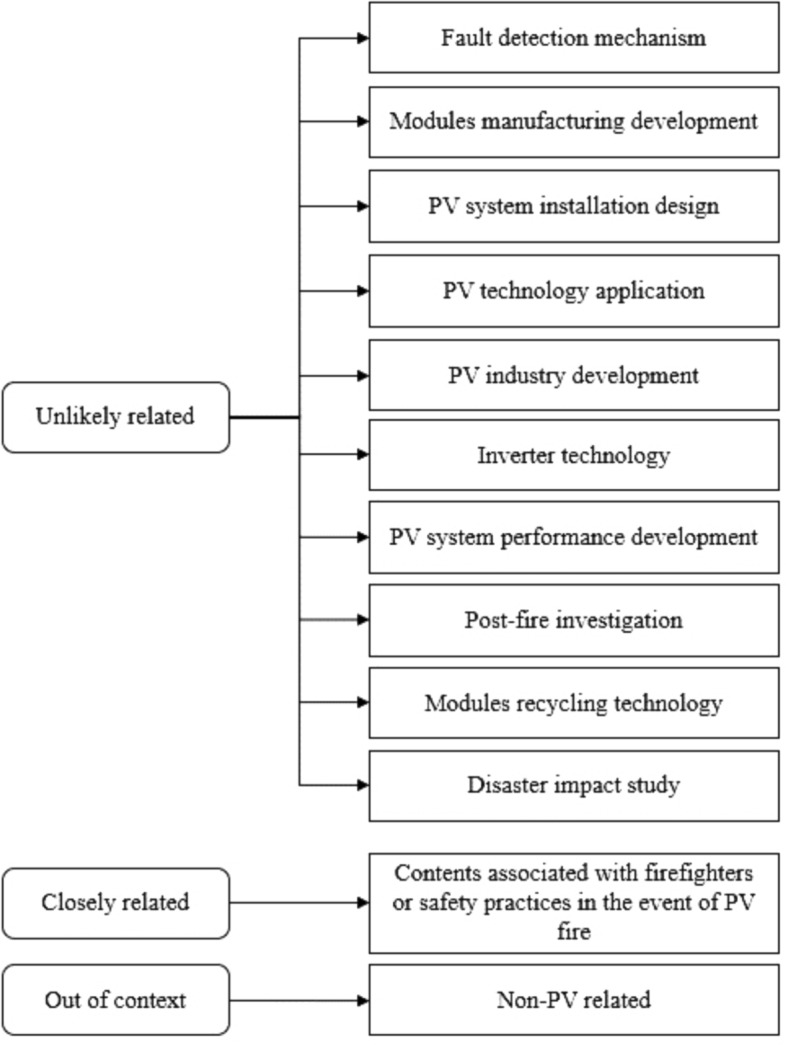
Categories resulted from the identified emerging themes
Themes not associated with firefighter safety practices during PV fire are categorized as "unlikely related", whereas documents related to firefighters or safety practices in the event of PV fire are classified as "closely related". "Out of context" refers to non-PV-related documents. The study was further extended, focusing only on "closely related" documents as a primary interest. A pie chart in Fig. 6 is developed to visualize the difference in the number of documents, highlighting a gap in the finding.
Figure 6.
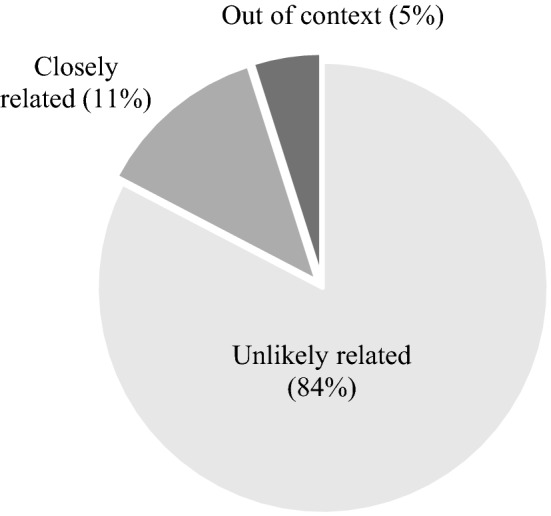
Research interest only corresponds to 11% related to safety practices for firefighters during PV fire
It is worth noting that only 11% of "closely related" represents our research interest, while 84% of "unlikely related" stands out as the largest in the finding. When employing the designed keywords in the search, most document outcomes led to a massive discussion mainly associated with the "pre-incident" setting, while our focus is on the "during fire" setting for firefighters. At this preliminary finding, it can be concluded that a low percentage of "closely related" documents signifies the field of study is still at a ground level and has not been widely adopted or entirely constructed. Hence, with the "closely related" documents currently available, the research objective is to analyze, collate and establish the best firefighter safety practices during PV fires that can serve as guidelines for firefighters. Different stages of settings were visualized in Fig. 7 to illustrate a clear picture of the designed review scope.
Figure 7.

Different stages of setting to depict a clear picture of "during fire" as research scope
Research continued with a further analysis by assessing the "closely related" comprising 29 documents. After the assessment, it was identified another three sub-topics which were (a) hazards from PV modules during fire, (b) safety practices during fire, and (c) surveys involving firefighters, as shown in Fig. 8.
Figure 8.

The three sub-topics resulted from the "closely related" category
As this review only considers critical points related to safety practices for firefighters during PV fire, it was identified that only 24% (7 documents) had delivered the key points, either explicitly or implicitly. From another perspective of a broader comparison, the topic of interest is represented by only 3% out of 264 documents. This small percentage further emphasizes the colossal gap in the finding in the field of study when selected discipline databases were assessed.
Hazards from PV Modules During a Fire
While assessing safety practices during PV fire for firefighters, it was observed that discussion about hazards associated with the PV module during the fire was significant. Fragmentation of topics originating from hazards from PV modules during the fire was identified, namely: (a) fire reaction behavior, (b) installation mode influence, (c) toxicity analysis, (d) electric shock risk analysis, (e) arcing properties, (f) explosive atmosphere evaluation, (g) parameter of electrical output, (h) fire hazard for hydrocarbon industry, and (i) mechanism of fire ignition, which is summarized in Table 5 in the following with its corresponding number of documents.
Table 5.
Fragmentation of Topics Originating from Hazards of PV Modules During a Fire with the Associated Number of Documents
| Hazards from PV modules during a fire | ||
|---|---|---|
| Fragmentation of topics (citations) | Reference documents | Number of documents |
| Fire reaction behavior | [31–37] | 7 |
| Installation mode influence | [14, 16, 38] | 3 |
| Toxicity analysis | [39, 40] | 2 |
| Electric shock risk analysis | [41, 42] | 2 |
| Arcing properties | [43, 44] | 2 |
| Explosive atmosphere evaluation | [45] | 1 |
| Parameter of electrical output | [46] | 1 |
| Fire hazard for hydrocarbon industry | [47] | 1 |
| Mechanism of fire ignition | [48] | 1 |
| Total | 20 | |
Survey Involving Firefighters
While feedback and responses analysis against fire department members are crucial in improving organizational operation, only two documents conducted firefighter surveys associated with PV were found. A survey conducted on 280 firefighters revealed only 26% of respondents were experienced in PV fire incidents, 90% of respondents are aware of significant risks in PV fire accidents, and only 30% of respondents are well perceived regarding PV fire rescue's standard operation procedures [49]. An awareness survey related to firefighters' practice was conducted where 15 firefighters participated, and their perspectives on PV fire origin, ignition factors, current equipment tools, and safety operation were quantified [50]. Further research within social science in the context of PV fire safety is a potential forte to be explored in the future.
Safety Practices During PV Fire for Firefighters
While electrical and fire dangers associated with PV systems have been known in the event of PV fire, this study has led to gathering findings of safety practices for firefighters to be examined to develop guideline solutions and safely respond. The key results are summarized in Table 6 as the basis for developing operational practices for firefighters in executing a safe operation, further reducing injury or death.
Table 6.
Key Findings of Safety Practices for Firefighters During PV Fire Operation as Extracted from Seven Documents
| Safety practice key points | [A] | [B] | [C] | [D] | [E] | [F] | [G] |
|---|---|---|---|---|---|---|---|
| Wear voltage-rated gloves and boots | X | X | X | X | |||
| Wear self-contained breathing apparatus (SCBA) | X | ||||||
| Wear personal protective equipment (PPE) | X | X | X | ||||
| Operate emergency disconnects/shutdown | X | X | X | X | X | ||
| Seek electrical professionals | X | X | |||||
| Severing conductors | X | ||||||
| Look out for warning labels and markings | X | X | |||||
| Disruption technique | X | ||||||
| Scout for stairway access to the roof | X | X | |||||
| Stay away from the roofline | X | ||||||
| Water jet stream properties | X | X | X | X | X | ||
| Safe distance in water application | X | X | X | X | X | ||
| Firefighting foams application | X |
Gloves, Boots, and Personal Protective Equipment
Most of the reference body addressed a common key point on the importance of imperative protection: to embody complete personal protective equipment (PPE) during PV emergencies. One of the safety-related work practices to protect workers from electric shock includes using appropriate PPE by wearing insulating gloves and dielectric footwear [29]. Typical firefighters' gloves and boots do not represent electrical PPE as they afford limited protection against electrical shock only when dry [29]. When the human body comes in contact with energized components, the current path is established through hand-to-hand, hand-to-foot, or foot-to-foot [29]. Wearing gloves or boots, typically made of rubber, leather, or polymeric materials, increases the total resistance. Wearing gloves and boots reduces potential current exposure due to total resistance on the skin or body is increased by gloves and boots' resistance [52].
As required by NFPA 70E Standard, electrical workers have to wear particular voltage-rated rubber insulating gloves [29]. These gloves conform to ASTM D 120 Standard Specification for Rubber Insulating Gloves, where every six months, gloves will be inspected for damage such as pinholes [54]. Leather protectors are also recommended to be worn over rubber gloves for damage protection purposes. Electrical workers may require wearing additional footwear protection that conforms to ASTM F 2412 standard test methods for foot protection, where the footwear passed 14,000 V dielectric test (AC) [55].
In the course of firefighting, gloves, and boots worn by firefighters typically conform to NFPA 1971 standard on protective ensembles for structural fire fighting and proximity fire fighting [56]. However, NFPA 1971 has no electrical requirement for gloves, while for footwear, conformance to ASTM F 2412 is applied [29]. Two examples of inadvertent contact situations where electrical insulated gloves and boots would be saving lives. A firefighter may step or fall on a PV module breaking the protective glass cover and having direct contact with exposed or cut cables during venting or overhaul operations [29]. One crucial point is that both gloves and boots must be dry and intact to protect firefighters against electric shock, up to 1000 V DC [57].
Emergency Disconnects
In authorizing the application of water stream against existing fire, as the corresponding situation is dealing with live, energized electrical equipment and components, the main critical task is to isolate all energized conductors and ensure the whole system is powered down. In accomplishing that, the location of the PV system-related components must be immediately identified and relayed to the incident commander (IC) and all personnel working at the scene [21], including all emergency disconnects and circuit breakers. At the module level of the DC line side, it is suggested to check for an individual disconnect to be operated [11].
In designing a PV system, according to Article 690 of the national electrical code (NEC), all DC conductors of a PV system must be able to be disconnected from all other conductors in a structure or building [29] to avoid electrical plants within fire compartments or building from becoming energized during emergency [11]. The disconnect switch must be accessible to the rescue operators and located in a fire-protected location. It could be outside or inside a building nearest the entrance point of system conductors. Since all disconnects must be marked, this would ease firefighters to identify and activate any load-break-rated disconnects during an emergency. Cancelliere [11] presented two possible arrangements of emergency shutdown device or disconnect switch to be known by attending firefighters.
Indeed, the process to isolate PV systems completely is inadequate for safeguarding premises. Activating disconnect would de-energize the DC power on the load side (inverter to AC distribution/panel board). However, the line side (DC combiner to PV arrays) could remain energized with sufficient illumination. The system cannot be isolated since the inverter holds charges, and electricity may flow back to PV panels. There is no single point to isolate a PV system completely. Disconnect means only partially de-energize. Additionally, even with the technology adoption of disconnection switches, according to research carried out by Pester and Coonick [27], the application is still perceived as an unproven technology. This technology has yet to prove its reliability for the whole lifetime of a PV system. As PV panels are energized when exposed to sunlight, it is suggested to cover them with a high opacity blanket during the firefighting operation to reduce the risk of being electrocuted.
Electrician Assistance
Securing utilities and ensuring it is faultlessly isolated is a precondition for firefighting activity. On that account, fire officers have to communicate with the local utility company or the associated contractor authorized to verify the electrical service disconnection task. Fire departments should communicate with PV installation companies to safely disconnect service and mitigate potential hazards [29]. According to German firefighters [21], handling of defective switches and isolation of PV modules may be done only by certified electricians. While many sources suggest requesting electrical professional attendance to verify disconnection tasks, this would consume long hours during the emergency period since nobody would like to extend waiting hours to extract information. The following recommendations would be compensating in times of emergency if done beforehand by the fire department: (a) have kept PV system installer or developer database, (b) have a readily available electrical professional within the fire response team in the corresponding district, and (c) have kept PV installation permit issuer database.
Severing Conductors
As permitted by Article 690 of the NEC regarding PV wiring systems, for one and two-family dwellings, NEC allows designing PV system voltage up to 600 V (DC) which is notably higher than typical dwelling units, which are found to operate at 120/240 V (AC) [29]. This results in even greater voltage for multi-family dwellings and other large buildings that incorporate PV systems [29]. During an emergency, firefighters sometimes use a cable cutter, axe, rotary saw, or chainsaw in clearing routes or cut an opening. Consequently, firefighters become vulnerable to electric shock hazards due to severing energized PV components or cutting through raceways containing live conductors [29]. Experiments conducted by the underwriters laboratory have concluded that severing conductors in metal and plastic conduits would result in electrical and fire hazards; therefore, close attention must be exercised during ventilation and overhaul [29]. For an exceptional case where cutting and severing are a requisite and remarkably required, the hazard duration can be shortened with a faster cut [29]. In addition, during a rescue operation, where a part of a component or conductor has to be pulled apart, the current can continue to flow in an air space creating an arc between separated conductors [11]. This can propagate over several millimeters depending on voltage level and environmental conditions [11]. The arc hazard can potentially burn skin when in contact and aids in spreading fire. Therefore, close attention must be adopted during the rescue operation if the component or conductor has to be pulled apart [11].
Warning Labels and Markings
In recognizing PV systems, warning labels and markings would be valuable for firefighters in the firefighting operations. The International Fire Code requires markings for a DC conduit and the main service disconnect [21]. In Germany, a standard was established regarding PV signage and is stated in VDE-AR-E2100-712, which requires PV signage to be visually present at the connection points of a PV system, such as the connection box and the main distribution board [58]. With the standard implemented in Germany, PV system operators must install layout diagrams showing the locations of PV system components with respect to the structural layout [58]. In Japan, a "Directive Standards for Fire Safety Measurement regarding PV Systems" which contains the requirement of specific labeling for PV signage that enables firefighters to recognize PV systems [59], was released. In the United States, identifying power sources is well instructed through Article 690.56 of national electrical codes [60], which is helpful for attending responders. Warning labels and markings are excellent practices that all PV developers should exercise across the nation for firefighters to recognize every part of the PV system in enhancing fire safety practices among emergency responders. Therefore, attending firefighters must be attentive to these labels and markings to commence PV firefighting operation.
Self-Contained Breathing Apparatus
It is highlighted that during roof operation, the use of self-contained breathing apparatus (SCBA) is of utmost importance to protect firefighters from hazardous chemicals coming off from burning PV modules [61]. During a fire or explosion, the frame of PV modules releases cadmium telluride, gallium arsenide, phosphorus fumes, and boron gases [62]. Although different materials produce different chemicals when burning, the fact that chemicals released are toxic and hazardous is undeniable. Wearing SCBAs and full PPE in a firefighting scene and overhaul operations will mitigate the inhalation hazards originating from chemicals engulfed in PV fire [61].
Disruption Technique and Foams Application
The process of turning off the array is not similar to operating a disconnect switch. When the PV array receives light or gets illuminated, the system components' parts will remain energized. This is where the method to block illumination is addressed to abolish electrical output from the PV modules. One of the methods discussed is to cover panels with 100% light-obstructive material such as salvage cover or tarpaulin or tarps. Tarps offer varying degrees of effectiveness to interrupt power generation from a PV array, independent of cost [29]. Heavy, densely woven fabric and dark plastic films reduce PV power to near zero [29]. As a general guide, if light can be seen through a tarp, it should not be used [29]. Caution should be exercised during the deployment of tarps on damaged equipment as a wet tarp may become energized and conduct hazardous current if it contacts live equipment [29]. However, the following are the thought points regarding the subject method: (a) How do firefighters adjust tarpaulin size to fit roof structure size? (b) How do firefighters maneuver a giant tarpaulin to the rooftop when there is an existing fire for a large-scale building? (c) How do firefighters maintain the position of the tarpaulin when there is a strong windblown or due to other externalities? Therefore, broader research can be explored on this account.
Firefighting foams, as an alternative disruptor, there was an experiment conducted to study its efficacy in disrupting power generation from PV modules [52]. It was determined that a foam ranging from 0. 5 to 10 cm thick could significantly reduce the open-circuit voltage of the array. Nevertheless, maximum voltages under load still represented an electrocution hazard to humans, capable of generating currents in excess of 20 milliamperes through human skin [52]. Underwriters Laboratories claimed firefighting foams should not be relied upon to block light [29]. In moving forward, a portable thin-film technology that incorporates fire-resistant and detachable properties would highlight the industry to perform complete isolation during fire scenes.
Stairway Access to Roof and Attention to Roofline
In performing roof operation safely, it is recommended to utilize stairway access to the roof as one of the safety requirements [11]. The Italian Safety and Health of the Workplaces Act (Legislative Decree 81/2008) requires PV systems to be designed with safety pathways provided on the roof [11]. In Japan, as stated in the directive by the Tokyo Fire Department, installers must design space for firefighters' passage on the rooftop for an installation area that exceeds 300 m2 and limits the distance between any passage and the center of PV array within 24 m [59]. Figure 9 illustrates the setback rule, which is essential for the water stream to reach the fire from the passageway [59]. Responding personnel must stay away from the roofline in the event of modules or sections of an array sliding off the roof [29].
Figure 9.

Setback rule of PV module installation.
Source: Figure recreated from [53]
Water Stream Properties and Safe Distance
Regardless of the mode of operation, either offensive or defensive, it is crucial to incorporate water stream application to diminish the potential of fire ignition, fire spread, thermal heat, or flash-over. However, the application of a water stream has a drawback for the firefighter, which is an electric shock hazard when water is aimed at live electrical equipment such as switch boxes or combiner boxes [29]. During water application, attention must be paid to fire-damaged components that remain energized, contributing to the potential shock hazard [29].
The safe distance is dependent mainly on the type and the diameter of the nozzle and water conductivity [51]. For PV systems of a 1000 voltage DC source, Underwriters Laboratories recommends the mandatory characteristics of water application in exempting electrical shock are as follows: (a) a minimum 10-degree fog pattern of the cone shape, (b) saltwater use is prohibited, and (c) a distance of minimum 20 feet (6 m) from energized source (1). An experiment confirmed that the safe distance to be applied increases when the bigger diameter of the nozzle is used because of the resistance reduction due to the greater jet cross-section area [51]. It was pointed out that the resistance rate is affected by the conductivity of water [51]. The higher the conductivity, the lesser the resistance. It was emphasized that the higher nozzle pressure employed, the stream becomes stronger hence more breakage of droplets forming discontinuous filaments and higher jet resistivity [51]. In fact, the Note PROTEM 622/867 of 18/02/2011 states that during firefighting operations performed by means of water suppression systems, a proper distance from live wires or other electrical components must be assured [11]. The NFPA Fire Protection Handbook states that safe distance values are not wholly consistent because the results of different tests vary [51]. Table 7 summarizes findings of stream characteristics and safe distance recommendations.
Table 7.
Findings Regarding Stream Characteristics and Safe Distance
| Organization | Source voltage | Stream pattern | Hose degree/hose type | Stream pressure/flowrate | Additional disclaimer (if exists) | Minimum distance from the energized source |
|---|---|---|---|---|---|---|
| Underwriters Laboratories | 1000 V | Fog pattern of cone shape using smooth bore | 10° (adjustable nozzle) | N/A | Saltwater is prohibited | 20 feet (6 m) |
| Japanese guideline | N/A | Fine spray, rather than a continuous stream | N/A | N/A | N/A | N/A |
| U.S. CAL FIRE | N/A | Fog pattern | 30o | 100 psi | N/A | 33 feet (10 m) |
| German Firefighters Association | 1500 V | Fine spray/full jet | N/A | N/A | N/A | 1 m/5 m |
| IEEE Standard 979–1994 | N/A | Solid stream | Large nozzle (29–38 mm) | 5–7 bars (750–950 L/min) | N/A | N/A |
Conclusions
This research commenced with two research questions on academic publication records of photovoltaic (PV) fire and safety practices in PV firefighting operations. The results of this review had answered these two research questions. The data analysis proved a gap or deficiency in publications associated with safety practices during PV fire through selected discipline databases with corresponding search strings. Only 3% constitutes discussion about safety practices during PV fire from the academic database, out of 264 documents available from the finding. Results obtained either imply the knowledge of interest has not yet been adopted in the growing development of PV, or current knowledge is at an early stage that deserves further study and exploration to adhere to the PV population.
Safety practices during PV fire for emergency responders that were studied in this review are summarized, which represent the hallmark of safety practices during PV fire for firefighters:
Wear complete PPE, including voltage-rated gloves and footwear.
Operate all emergency disconnects, rapid shutdown, and other disconnecting means when found.
The fire department to prepare a list of certified electrical professionals to be reached for isolation verification.
Severing PV components is not recommended, be cautious with inadvertent direct contact.
Look out for warning labels and markings to better understand the system encountered.
Wear SCBA during rooftop operation and interior operation.
Disrupting light from reaching modules using salvage or tarpaulin may not be a good option for large-scale rooftop PV. Firefighting foam is not recommended.
When stairway access is available, utilize the key to perform roof operation. Make use of the passageway and pay attention to the roofline.
In order to minimize the risk of shock hazard during stream application, a guideline outlined by the Underwriters Laboratories is undertaken as the conservative practice.
The gap identified in this study will be worthy of establishing or improving safety practices during PV firefighting operations and eventually supplement the fire safety community and facility managers, including decision-makers, stakeholders, and academics, emanating a reliable PV operation during an emergency. This study provides a research agenda basis to expand the knowledge field. Developing these safety practices would significantly reform the fire safety chapter within the national building code, particularly on PV. For instance, the Uniform Building By-Laws 1984 or UBBL 1984 of Malaysia comprises Part VIII—fire alarms, fire detection, fire extinguishment, and fire fighting access, which presents a special section for these safety practices to be integrated. Moreover, potential future research can be extended to explore non-scholar sources such as brochures and short articles on a webpage to investigate the consistency of content and its reliability associated with existing safety practices that have been found.
Furthermore, key findings from this review could serve to be a part of survey research among firefighters to refine the safety framework's practicality when encountering PV fire. Results from this review would stand as a guideline to enhance maturity level development of best safety practices during PV fire. Key points would be essential in identifying further gaps and providing improvement opportunities across the firefighting department in contributing to more resilient and adaptable suppression tactics. For instance, a study about the application impact of disconnection switches on firefighters' response, an experiment about PPE and SCBA efficiency in the actual PV fire incident, research about portable thin-film technology incorporating fire resistant and detachable properties to perform complete system isolation during fire scene, and an investigation about the safety of state-of-the-art firefighters' equipment used during a fire involving PV components.
Acknowledgements
This research is funded by Malaysian Electricity Supply Industries Trust Account (AAIBE) under the auspices of Ministry of Energy and Natural Resources (KeTSA) with the project code JAAIBE 3/2019/11/Bil.3 and Grant Number of 6300252-10801. This research is a collaboration between Universiti Putra Malaysia (UPM), Fire and Rescue Department of Malaysia, Energy Commission of Malaysia, and Sustainable Energy Development Authority (SEDA).
Declarations
Conflict of interest
The authors declare that there is no conflict of interest.
Footnotes
Publisher's Note
Springer Nature remains neutral with regard to jurisdictional claims in published maps and institutional affiliations.
References
- 1.Solar Power Europe (2021) Solar continues to break installation records, on track for Terawatt scale by 2022. https://www.solarpowereurope.org/solar-continues-to-break-installation-records-on-track-for-terawatt-scale-by-2022/. Accessed 15 Jan 2022
- 2.Smith T (2021) Global solar PV market is breaking all sorts of records. https://www.esi-africa.com/industry-sectors/generation/global-solar-pv-market-is-breaking-all-sorts-of-records/. Accessed 15 Jan 2022
- 3.Kumar NM, Subathra MSP, Moses JE (2018) On-grid solar photovoltaic system: components, design considerations, and case study. Paper presented at the 2018 4th International Conference on Electrical Energy Systems (ICEES)
- 4.Dhere N, Shiradkar N. Fire hazard and other safety concerns of photovoltaic systems. J Photonics Energy. 2012;2(1):022006. doi: 10.1117/1.JPE.2.022006. [DOI] [Google Scholar]
- 5.Laukamp H, Bopp G, Grab R, Wittwer C, Häberlin H, Heeckeren BV, Phillip S, Reil F, Schmidt H, Sepanski A, Thiem H, Vaassen W (2013) PV fire hazard—analysis and assessment of fire incidents. Paper presented at the 28th European Photovoltaic Solar Energy Conference and Exhibition, Paris
- 6.Bonomo P, Saretta E, Frontini F, Caccivio M, Bellenda G, Manzini G, Cancelliere P (2017) Fire safety of PV modules and buildings: overviews, bottlenecks and hints. Paper presented at the 33rd European Photovoltaic Solar Energy Conference and Exhibition, Amsterdam
- 7.Coonick C, Pester S, Acott J, Burroughs M, Clarke C, Sinclair C, Weeks C, Longfield A, Crowder D, Cotterell M, Flanagan M, Galvin J, Holland C, Mansi P, Parsons J, Shipp M, Smith S (2018) Fire and solar PV systems—investigations and evidence (P100874-1004 Issue 2.9). BRE National Solar Centre. Accessed from https://assets.publishing.service.gov.uk/government/uploads/system/uploads/attachment_data/file/786882/Fires_and_solar_PV_systems-Investigations_Evidence_Issue_2.9.pdf
- 8.MohdNizam Ong NAF, Sadiq MA, Md Said MS, Jomaas G, MohdTohir MZ, Kristensen JS. Fault tree analysis of fires on rooftops with photovoltaic systems. J Build Eng. 2021 doi: 10.1016/j.jobe.2021.103752. [DOI] [Google Scholar]
- 9.MohdNizam Ong NAF, MohdTohir MZ, Mutlak MM, Sadiq MA, Omar R, Md Said MS. BowTie analysis of rooftop grid-connected photovoltaic systems. Process Saf Prog. 2022 doi: 10.1002/prs.12338. [DOI] [Google Scholar]
- 10.MohdNizam Ong NAF, MohdTohir MZ, Md Said MS, Nasif MS, Alias AH, Ramali MR. Development of fire safety best practices for rooftops grid-connected photovoltaic (PV) systems installation using systematic review methodology. Sustain Cities Soc. 2022;78:103637. doi: 10.1016/j.scs.2021.103637. [DOI] [Google Scholar]
- 11.Cancelliere P. PV electrical plants fire risk assessment and mitigation according to the Italian national fire services guidelines. Fire Mater. 2016;40(3):355–367. doi: 10.1002/fam.2290. [DOI] [Google Scholar]
- 12.Kristensen JS, Jomaas G. Experimental study of the fire behaviour on flat roof constructions with multiple photovoltaic (PV) panels. Fire Technol. 2018;54(6):1807–1828. doi: 10.1007/s10694-018-0772-5. [DOI] [Google Scholar]
- 13.Aram M, Zhang X, Qi D, Ko Y. A state-of-the-art review of fire safety of photovoltaic systems in buildings. J Clean Prod. 2021;308:127239. doi: 10.1016/j.jclepro.2021.127239. [DOI] [Google Scholar]
- 14.Mazziotti L, Cancelliere P, Paduano G, Setti P, Sassi S. Fire risk related to the use of PV systems in building facades. MATEC Web Conf. 2016;46:05001. doi: 10.1051/matecconf/20164605001. [DOI] [Google Scholar]
- 15.Fiorentini L, Marmo L, Danzi E, Puccia V. Fire risk analysis of photovoltaic plants. A case study moving from two large fires: from accident investigation and forensic engineering to fire risk assessment for reconstruction and permitting purposes. Chem Eng Trans. 2016;48:427–432. doi: 10.3303/CET1648072. [DOI] [Google Scholar]
- 16.Miao L, Chow C-L. Investigation of burning photovoltaic panels on a double-skin facade with ejecting flame from an adjacent room fire. Indoor Built Environ. 2018;28(7):938–949. doi: 10.1177/1420326X18804591. [DOI] [Google Scholar]
- 17.Kristensen JS, Jacobs B, Jomaas G. Experimental study of the fire dynamics in a semi-enclosure formed by photovoltaic (PV) installations on flat roof constructions. Fire Technol. 2022 doi: 10.1007/s10694-022-01228-z. [DOI] [Google Scholar]
- 18.Shipp M, Holland C, Crowder D, Pester S, Holden J. Fire safety and solar electric/photovoltaic systems. International Fire Prof. 2013;6:12–17. [Google Scholar]
- 19.Velde MVD (2018) Solar panels: a new challenge for firefighters. https://axaxl.com/fast-fast-forward/articles/solar-panels-a-new-challenge-for-firefighters. Accessed 22 Nov 2021
- 20.Donald E (2017) Solar panels present firefighters with new challenges. https://www.firerescue1.com/firefighter-training/articles/solar-panels-present-firefighters-with-new-challenges-zdCn8jZwgiE2JBva/. Accessed 21 Oct 2021
- 21.Namikawa S, Kinsey G, Heath G, Wade A, Sinha P, Komoto K (2017). Photovoltaics and firefighters’ operations: best practices in selected countries (Report IEA-PVPS T12-09:2017). International Energy Agency. Accessed from https://www.nrel.gov/docs/fy19osti/68415.pdf
- 22.CBS San Francisco, Bay City News Service (2015) SF firefighters shocked by rooftop solar panels while fighting house fire. https://sanfrancisco.cbslocal.com/2015/12/23/sf-firefighters-shocked-by-rooftop-solar-panels-while-fighting-house-fire/#:~:text=SF. Accessed 20 Aug 2021
- 23.Sipe JE (2016) Fire mitigation solutions for photovoltaic (PV) Systems on building roofs—Ph. 1 (FPRF-2016-10). F. P. R. Foundation. Accessed from https://www.nfpa.org/-/media/Files/News-and-Research/Fire-statistics-and-reports/Electrical/RFDevelopmentFireMitigationSolutions.ashx
- 24.Energy Trend (2019) Typhoon Faxai destroys Japan’s biggest floating solar plant. https://www.energytrend.com/news/20190911-15190.html. Accessed 18 June 2021
- 25.Riggs M (2013) Why firefighters fear solar power. https://www.bloomberg.com/news/articles/2013-09-11/why-firefighters-fear-solar-power. Accessed 15 Apr 2021
- 26.Cummins E, Wetsman N (2017) Rooftop solar panels are great for the planet—but terrible for firefighters. https://www.wired.com/2017/05/rooftop-solar-panels-great-planet-terrible-firefighters/. Accessed 13 Sept 2021
- 27.Pester S, Coonick C (2017) Fire and solar PV systems—recommendations for the fire and rescue services. B. N. S. Centre. Accessed from Cornwall https://assets.publishing.service.gov.uk/government/uploads/system/uploads/attachment_data/file/630641/fire-solar-pv-systems-frs-recommendations.pdf
- 28.Fronius International GmbH . Fire safety of PV systems insights and recommendations. Wels: Fronius International GmbH; 2020. [Google Scholar]
- 29.Backstrom R, Dini D. Firefighter safety and photovoltaic installations research project. Bellingham: SPIE; 2012. [Google Scholar]
- 30.Denyer D, Tranfield D. The Sage handbook of organizational research methods. Thousand Oaks: SAGE Publications Ltd; 2009. Producing a systematic review; pp. 671–689. [Google Scholar]
- 31.Yin L, Jiang Y, Qiu R. Combustion behaviors of CIGS thin-film solar modules from cone calorimeter tests. Materials. 2018;11(8):1353. doi: 10.3390/ma11081353. [DOI] [PMC free article] [PubMed] [Google Scholar]
- 32.Chow CL, Han SS (2015) Studying fire behaviour of photovoltaic panels with a cone calorimeter. In: 14th International Conference and Exhibition on Fire and Materials 2015. Interscience Communications Ltd. p 53–63
- 33.Cancelliere P, Liciotti C. Fire behaviour and performance of photovoltaic module backsheets. Fire Technol. 2016;52(2):333–348. doi: 10.1007/s10694-014-0449-7. [DOI] [Google Scholar]
- 34.Ju X, Zhou X, Peng F, Wu Z, Lai D, Hu Y, Yang L. Correlation analysis of heat flux and fire behaviour and hazards of polycrystalline silicon photovoltaic panels. IOP Conf Ser. 2017;201:012036. doi: 10.1088/1757-899x/201/1/012036. [DOI] [Google Scholar]
- 35.Manzini G, Gramazio P, Guastella S, Liciotti C, Baffoni GL. The fire risk in photovoltaic installations—test protocols for fire behavior of PV modules. Energy Procedia. 2015;82:752–758. doi: 10.1016/j.egypro.2015.11.805. [DOI] [Google Scholar]
- 36.Yang H-Y, Zhou X-D, Yang L-Z, Zhang T-L. Experimental studies on the flammability and fire hazards of photovoltaic modules. Materials. 2015;8(7):4210–4225. doi: 10.3390/ma8074210. [DOI] [PMC free article] [PubMed] [Google Scholar]
- 37.Ju X, Zhou X, Zhao K, Hu Y, Mu T, Ni Y, Yang L. Experimental study on burning behaviors of photovoltaic panels with different coverings using a cone calorimeter. J Renew Sustain Energy. 2017;9(6):063502. doi: 10.1063/1.4990830. [DOI] [Google Scholar]
- 38.Ju X, Zhou X, Gong J, Zhao K, Peng Y, Zhang C, Ren X, Yang L. Impact of flat roof–integrated solar photovoltaic installation mode on building fire safety. Fire Mater. 2019;43(8):936–948. doi: 10.1002/fam.2755. [DOI] [Google Scholar]
- 39.Liciotti C, Cancelliere P, Cardinali M, Puccia V (2014) Analysis of the combustion fumes and gases released during the burning of some C-Si PV modules. Paper presented at the 29th European Photovoltaic Solar Energy Conference and Exhibition, Amsterdam
- 40.Sinha P, Balas R, Krueger L (2011) Fate and transport evaluation of potential leaching and fire risks from CdTe PV. Paper presented at the 2011 37th IEEE Photovoltaic Specialists Conference
- 41.Flicker J, Lavrova O, Quiroz J, Zgonena T, Jiang H, Whitfield K, Boyce K, Courtney P, Carr J, Brazis P (2018) Hazard analysis of firefighter interactions with photovoltaic arrays. Paper presented at the 2018 IEEE 7th World Conference on Photovoltaic Energy Conversion (WCPEC) (A Joint Conference of 45th IEEE PVSC, 28th PVSEC & 34th EU PVSEC)
- 42.Lavrova O, Quiroz JE, Flicker J, Gooding R (2017) Updated evaluation of shock hazards to firefighters working in proximity of PV systems. Paper presented at the 2017 IEEE 44th Photovoltaic Specialist Conference (PVSC)
- 43.Yokoi T, Tsusaka A, Hasegawa K, Matsumura T, Yukita K, Goto Y, Miyamoto A, Ito H (2019) An experimental study on extinguishing property of DC arc ignited with disconnection of activated PV array. Paper presented at the 2019 IEEE Third International Conference on DC Microgrids (ICDCM)
- 44.Reil F, Sepanski A, Herrmann W, Althaus J, Vaaßen W, Schmidt H (2012) Qualification of arcing risks in PV modules. Paper presented at the 2012 38th IEEE Photovoltaic Specialists Conference
- 45.Dhanasekara Pandian AV, Daniel BSS, Bansal K, Agarwala P (2012) Fire safety evaluation of photovoltaic modules in an explosive atmosphere. Paper presented at the Qatar Foundation Annual Research Forum Proceedings
- 46.Cancelliere P, Puccia V, Longobardo G, Liciotti C, Cardinali M (2013) Behavior of the Electrical Parameters of PV Modules Subject to a Flame Ignition. Paper presented at the 28th European Photovoltaic Solar Energy Conference and Exhibition
- 47.Dhanasekara Pandian AV (2017) Fire safety evaluation of solar photovoltaic modules in hydrocarbon industry. (PhD), University of Petroleum and Energy Studies. Accessed from http://hdl.handle.net/10603/224400
- 48.Cancelliere P, Puccia V, Caciolai M (2016) Fire ignition and spread analysis on photovoltaic building roofs. Paper presented at the 14th International Conference and Exhibition on Fire Science and Engineering, Royal Holloway College, Nr Windsor, UK
- 49.Lee SK, Wu CM, Hung KC (2017) A study on fire risks to firefighters in the building with photovoltaic system. Paper presented at the 2017 International Conference on Applied System Innovation (ICASI)
- 50.Nair SS (2018) A survey report of the firefighters on fire hazards of PV fire. Paper presented at the 2018 IEEE International Conference on System, Computation, Automation and Networking (ICSCAN), India, Pondicherry, Manakula Vinayagar Institute of Technology. doi:10.1109/ICSCAN.2018.8541219
- 51.Tommasini R, Pons E, Palamara F, Turturici C, Colella P. Risk of electrocution during fire suppression activities involving photovoltaic systems. Fire Saf J. 2014;67:35–41. doi: 10.1016/j.firesaf.2014.05.008. [DOI] [Google Scholar]
- 52.Bosco JP, Tanaka Z, Ott BA, Slee DT (2015) The efficacy of fire-fighting foams for disrupting power generation from silicon solar panels. Paper presented at the 2015 IEEE 42nd Photovoltaic Specialist Conference (PVSC)
- 53.White JR, Doherty M (2017) Hazards in the installation and maintenance of solar panels. Paper presented at the 2017 IEEE IAS Electrical Safety Workshop (esw)
- 54.ASTM International . ASTM D120–09 standard specification for rubber insulating gloves. West Conshohocken: ASTM International; 2009. [Google Scholar]
- 55.ASTM International . ASTM F2412–18a, standard test methods for foot protection. West Conshohocken: ASTM International; 2018. [Google Scholar]
- 56.National Fire Protection Association . NFPA 1971: Standard on protective ensembles for structural fire fighting and proximity fire fighting. Quincy: National Fire Protection Association; 2018. [Google Scholar]
- 57.McNutt P, Sekulic WR, Dreifuerst G (2018) Solar photovoltaic DC systems: basics and safety. Paper presented at the IEEE Electrical Safety Workshop, Fort Worth, Texas. Accessed from https://www.nrel.gov/docs/fy18osti/68696.pdf
- 58.VDE Verlag GmbH. (2018). VDE-AR-E 2100-712: measures for the DC area of a photovoltaic system to maintain electrical safety in the event of firefighting or technical assistance
- 59.Tokyo Fire Department (2014) Directive standards for fire safety measurement regarding PV systems
- 60.National Fire Protection Association . NFPA 70: national electric code. Quincy: National Fire Protection Association; 2020. [Google Scholar]
- 61.Brooks B, Bunting S, Cercos F, Enea D, Hostetter J, Kateley S, Kitchel W, Tyler B, Paiss M, Sakamoto V, French M. Fire operations for photovoltaic emergencies. Sacramento: CAL FIRE; 2010. pp. 1–68. [Google Scholar]
- 62.Ohde H, Hattier R (2017) Fire safety procedures for photovoltaic systems and battery storage. https://www.fireengineering.com/firefighting/fire-safety-pv-systems/#gref. Accessed 18 Oct 2021