



Key words: Chronic pain, C-reactive protein, Cross-sectional study, Fatty acids, Logistic model
Although chronic pain (CP) is classified as inflammatory or non-inflammatory, the involvement of fatty acid intake in this process has not yet been examined in detail. Therefore, the present study investigated whether the relationship between CP and fatty acid intake differs between high and low C-reactive protein (CRP) levels in middle-aged and elderly individuals in the Shika study. One-thousand and seven males and 1216 females with mean ages of 68⋅78 and 69⋅65 years, respectively, participated in the present study. CRP was quantified by blood sampling from participants who responded to a CP questionnaire. The brief-type self-administered diet history questionnaire (BDHQ) was used to assess fatty acid intake. Interactions were observed between CP and CRP on monounsaturated fatty acids (MUFA) and eicosadienoic acid in a two-way analysis of covariance adjusted for sex, age, lack of exercise, lack of sleep, current smoking and drinking status, and BMI. MUFA (OR 1⋅359) and eicosadienoic acid (OR 1⋅072) were identified as significant independent variables for CP in a multiple logistic regression analysis, but only in the low CRP group. Only a high intake of MUFA and eicosadienoic acid was associated with chronic neck/shoulder/upper limb pain without elevated CRP. In psychogenic and neuropathic pain without elevated CRP, an increased intake of MUFA and eicosadienoic acid, a family member of n-6 fatty acids, appears to affect CP. Further longitudinal studies are needed to elucidate this relationship.
Introduction
The prevalence of chronic pain (CP) ranges between 17⋅5 and 31⋅5 %, with variations being reported among surveyed countries and age groups(1–4). A cross-sectional study by Nakamura et al.(4) that investigated chronic musculoskeletal pain in Japanese subjects in their 30s to 50s reported that the most common pain sites were the lower back, neck, shoulders and knees. The role of inflammation in CP is considered to be greater in nociceptive pain(5) and less in psychogenic(6) and neuropathic pain(7). Regarding the relationship between inflammation and pain, high levels of C-reactive protein (CRP) were previously shown to increase cold pain sensitivity(8,9). Elevated CRP has also been reported in obesity, which increases pain sensitivity(10,11). On the other hand, longitudinal studies examining the relationship between CP and CRP have found no clear relationship between chronic musculoskeletal pain and high-sensitivity CRP(12). Therefore, there is currently no consensus on the relationship between CP and CRP, which warrants more detailed epidemiological studies.
Non-inflammatory factors associated with CP have been identified as professional or managerial occupations, being female, BMI > 25, and a current drinking or smoking status(13). Participants with CP also cited sleep disorders, anxiety, depression or irritable bowel as possible causes(3). Therefore, non-inflammatory factors need to be considered in investigations to clarify the cause of CP.
One of the non-inflammatory factors involved in CP is nutrients(14,15). In our previous study(16), we showed that the combination of an inadequate vitamin intake and depression was associated with CP. n-6 Fatty acids have also been suggested to play a role in both the induction and inhibition of pain(17–20). Inflammatory cytokine production(17), the involvement of complex regional pain syndrome(18) and the development of mechanical allodynia(19) have been implicated in pain induction. On the other hand, epoxyeicosatrienoic acid was found to inhibit pain(20). However, the types of fatty acids involved in the inflammatory response, particularly CRP, have yet to be examined in detail.
Therefore, the present study investigated whether the relationship between CP and fatty acid intake differs between high and low CRP in individuals older than 40 years old in the Shika study.
Materials and methods
Participants
The present study was surveyed between October 2013 and January 2018. Twenty-one thousand and sixty-one people are living in Shika Town, Ishikawa Prefecture. Of these, 8499 are 65 years old or older; therefore, the aging rate is 42⋅2 %(21). Participants in the present study were 5013 residents aged 40 years and older living in four model districts of Shika Town (Horimatsu, Higashimasuho, Tsuchida and Togi). Previously conducted Shika studies on CP examined CP and vitamin intake(16), CP and serum 25-hydroxyvitamin D concentrations(22), and the relationship between hypertension and quality of life after adjustments for CP(23). Overall, 4724 participants completed the questionnaire survey and 1176 underwent a medical check-up. Participants who did not respond to the CP questionnaire, those without CRP quantification data, those who reported energy intake on the brief-type self-administered diet history questionnaire (BDHQ) was outside the range of 600–4000 kcal, and those receiving rheumatoid arthritis treatment were excluded. Therefore, 817 subjects (386 men and 431 women) were ultimately included in the analysis.
Evaluation items
CP was defined as persistent pain for more than 3 months(24) or at least twice a week in the past month. Participants were asked about the presence of CP and its location on the body using a questionnaire.
A quantitative assessment of CRP was performed on blood samples taken from participants who consented to the medical check-up. CRP was measured by the latex agglutination immunoassay test (LZ test ‘Eiken’ CRP-HG; Eiken Kagaku Company Limited, Tokyo, Japan).
BDHQ was used to investigate fatty acid intake(25,26). The BDHQ is a four-page questionnaire with an average response time of 15 min. It is possible to calculate the intake of approximately thirty nutrients and fifty-eight foods using a dedicated nutrient calculation programme. The validity of BDHQ has been verified by Kobayashi et al.(25,26). Crude data were converted using the density method, which resulted in an intake per 1000 kcal.
Participants were asked about their sex, age, BMI, lifestyle (lack of exercise, lack of sleep, and current smoking and drinking status) and treatment of underlying diseases (diabetes and dyslipidemia) using a descriptive health questionnaire.
Statistical analysis
CP was restricted to neck/shoulder/upper limb pain and participants were classified into the non-CP and CP groups. Regarding CRP, participants were divided into low and high CRP groups based on the median of their measurements. The Student's t test was performed to examine relationships between continuous variables, while the χ2 test was used to investigate relationships between categorical variables. A two-way analysis of covariance (two-way ANCOVA) was employed to analyse the main effects and interactions of CP and CRP on fatty acid intake. We also examined which fatty acids were associated with CP using a multiple logistic regression analysis, stratified by high and low CRP levels, with CP as the dependent variable and fatty acid intake as the independent variable. The forced imputation method was performed to select independent variables. IBM SPSS Statistics 25 (IBM, Armonk, NY, USA) was used for statistical analyses. The significance level was set at 5 %. Of the 43 fatty acids analysed, we omitted from the table those that were not significantly different in any of the analyses. Supplementary Table S1 shows the list of fatty acids analysed in the present study.
Sample size and statistical power
We used the free software G-power to calculate the sample size and statistical power. For the F tests of ANCOVA, the effect size, alpha error probability, power, number of groups and number of covariates were set to 0⋅25, 0⋅05, 0⋅95, 4 and 7, respectively. The total sample size and actual power were 210 and 0⋅950, respectively. For the Z tests for logistic regression, tails, odds ratio, mull hypothesis, alpha error probability, power, X distribution, X parm π were set to Two, 1⋅75, 0⋅25, 0⋅05, 0⋅95, Binomial and 0⋅5, respectively. The total sample size and actual power were found to be 791 and 0⋅950, respectively. Therefore, the sample size of this study was confirmed to be sufficient.
Ethical standards disclosure
This study was conducted according to the guidelines laid down in the Declaration of Helsinki and all procedures involving research study participants were approved by the Ethics Committee of Kanazawa University (protocol code, 1491; date of approval, 18 December 2013). Written informed consent was obtained from all subjects involved in the study.
Results
Participant characteristics
Table 1 shows participant characteristics assessed for neck/shoulder/upper limb pain, CRP and fatty acid intake. Among 817 participants, 386 males had a mean age of 63⋅69 years (sd 0⋅13) and 431 females had a mean age of 63⋅82 years (sd 10⋅68), with no significant difference between the two groups. The proportion of current smokers (P < 0⋅001), current drinkers (P < 0⋅001) and diabetics (P = 0⋅001) were significantly higher in males than in females. BMI was also significantly higher in males than in females (P < 0⋅001). The intakes of saturated fatty acids (SFA) (P < 0⋅001), monounsaturated fatty acids (MUFA) (P < 0⋅001), polyunsaturated fatty acids (PUFA) (P < 0⋅001), n-3 fatty acids (P < 0⋅001), n-6 fatty acids (P < 0⋅001), C18:1(M) (P < 0⋅001), C18:2(n6)(P(n-6)) (P < 0⋅001), C18:3(n3)(P(n-3)) (P < 0⋅001) and C20:2(n6)(P(n-6)) (P < 0⋅001) were significantly higher in females than in males.
Table 1.
Participant characteristics
| Male (n 386) | Female (n 431) | P-value* | |||
|---|---|---|---|---|---|
| Mean/n | sd/% | Mean/n | sd/% | ||
| Age, years | 63⋅69 | 10⋅13 | 63⋅82 | 10⋅68 | 0⋅856 |
| Lack of exercise, n | 296 | 76⋅68 | 352 | 81⋅67 | 0⋅081 |
| Lack of sleep, n | 272 | 70⋅47 | 324 | 75⋅17 | 0⋅132 |
| Current smoker, n | 119 | 30⋅83 | 30 | 6⋅96 | <0⋅001 |
| Current drinker, n | 286 | 74⋅09 | 98 | 22⋅74 | <0⋅001 |
| BMI, kg/m2 | 23⋅84 | 3⋅05 | 22⋅76 | 3⋅28 | <0⋅001 |
| Diabetes treatment, n | 44 | 11⋅40 | 21 | 4⋅87 | 0⋅001 |
| Dyslipidemia treatment, n | 32 | 8⋅29 | 54 | 12⋅53 | 0⋅047 |
| Neck/shoulder/upper limb pain, n | 11 | 2⋅85 | 24 | 5⋅57 | 0⋅051 |
| CRP, mg/dl | 0⋅16 | 0⋅69 | 0⋅11 | 0⋅35 | 0⋅165 |
| SFA, % energy | 5⋅81 | 1⋅77 | 6⋅94 | 1⋅92 | <0⋅001 |
| MUFA, % energy | 7⋅98 | 2⋅29 | 9⋅18 | 2⋅28 | <0⋅001 |
| PUFA, % energy | 5⋅69 | 1⋅46 | 6⋅41 | 1⋅53 | <0⋅001 |
| n-3 fatty acids, % energy | 1⋅27 | 0⋅41 | 1⋅40 | 0⋅46 | <0⋅001 |
| n-6 fatty acids, % energy | 4⋅40 | 1⋅19 | 4⋅99 | 1⋅22 | <0⋅001 |
| C18:1(M), mg/1000 kcal | 7861⋅77 | 2351⋅00 | 9095⋅54 | 2329⋅79 | <0⋅001 |
| C18:2(n6)(P(n-6)), mg/1000 kcal | 4742⋅69 | 1298⋅81 | 5382⋅85 | 1331⋅59 | <0⋅001 |
| C18:3(n3)(P(n-3)), mg/1000 kcal | 760⋅63 | 241⋅82 | 869⋅13 | 247⋅87 | <0⋅001 |
| C20:2(n6)(P(n-6)), mg/1000 kcal | 22⋅46 | 8⋅08 | 25⋅04 | 8⋅66 | <0⋅001 |
Abbreviations: sd, standard deviation; BMI, body mass index; CRP, C-reactive protein; SFA, saturated fatty acid; MUFA, monounsaturated fatty acid; PUFA, polyunsaturated fatty acid.
P-values were calculated using the Student's t test and χ2 test for continuous and categorical variables, respectively (P-values < 0⋅05 are highlighted in bold).
Comparison of CP and non-CP
The mean ages of the 35 patients in the CP (neck/shoulder/upper limb pain) group and the 782 patients in the non-CP group were 63⋅91 and 63⋅75 years, respectively, with no significant difference (Table 2). BMI was significantly higher in the non-CP group than in the CP group (P = 0⋅007). Fatty acid intake did not significantly differ between the two groups.
Table 2.
Characteristics of CP and non-CP groups for fatty acid intake
| Neck/shoulder/upper limb | |||||
|---|---|---|---|---|---|
| CP (n 35) | Non-CP (n 782) | P-value* | |||
| Mean/n | 95 % CI/% | Mean/n | 95 % CI/% | ||
| Sex (female), n | 24 | 68⋅57 | 407 | 52⋅05 | 0⋅050 |
| Age, years | 63⋅91 | 60⋅11, 67⋅72 | 63⋅75 | 63⋅02, 67⋅72 | 0⋅927 |
| Lack of exercise, n | 30 | 85⋅71 | 618 | 79⋅03 | 0⋅286 |
| Lack of sleep, n | 29 | 82⋅86 | 567 | 72⋅51 | 0⋅128 |
| Current smoker, n | 7 | 20⋅00 | 141 | 18⋅03 | 0⋅770 |
| Current drinker, n | 15 | 42⋅86 | 369 | 47⋅19 | 0⋅616 |
| BMI, kg/m2 | 22⋅17 | 21⋅42, 22⋅92 | 23⋅32 | 23⋅09, 22⋅92 | 0⋅007 |
| Diabetes treatment, n | 2 | 5⋅71 | 63 | 8⋅06 | 0⋅617 |
| Dyslipidemia treatment, n | 2 | 5⋅71 | 84 | 10⋅74 | 0⋅231 |
| CRP, mg/dl | 0⋅14 | 0⋅05, 0⋅23 | 0⋅14 | 0⋅10, 0⋅23 | 0⋅976 |
| SFA, % energy | 6⋅93 | 6⋅21, 7⋅65 | 6⋅38 | 6⋅25, 7⋅65 | 0⋅098 |
| MUFA, % energy | 9⋅25 | 8⋅34, 10⋅17 | 8⋅58 | 8⋅42, 10⋅17 | 0⋅100 |
| PUFA, % energy | 6⋅35 | 5⋅69, 7⋅00 | 6⋅06 | 5⋅95, 7⋅00 | 0⋅406 |
| n-3 fatty acids, % energy | 1⋅37 | 1⋅21, 1⋅53 | 1⋅33 | 1⋅30, 1⋅53 | 0⋅644 |
| n-6 fatty acids, % energy | 4⋅96 | 4⋅42, 5⋅49 | 4⋅71 | 4⋅62, 5⋅49 | 0⋅370 |
| C18:1(M), mg/1000 kcal | 9180⋅13 | 8248⋅03, 10 112.23 | 8482⋅75 | 8314⋅76, 10 112.23 | 0⋅095 |
| C18:2(n6)(P(n-6)), mg/1000 kcal | 5337⋅29 | 4751⋅95, 5922⋅63 | 5068⋅90 | 4975⋅5, 5922⋅63 | 0⋅381 |
| C18:3(n3)(P(n-3)), mg/1000 kcal | 861⋅47 | 752⋅05, 970⋅89 | 815⋅92 | 798⋅62, 970⋅89 | 0⋅426 |
| C20:2(n6)(P(n-6)), mg/1000 kcal | 25⋅75 | 22⋅78, 28⋅72 | 23⋅73 | 23⋅14, 28⋅72 | 0⋅169 |
Abbreviations: CI, confidence interval; BMI, body mass index; CRP, C-reactive protein; SFA, saturated fatty acid; MUFA, monounsaturated fatty acid; PUFA, polyunsaturated fatty acid.
P-values were calculated using the Student's t test and χ2 test for continuous and categorical variables, respectively (P-values < 0⋅05 are highlighted in bold).
Comparison of high and low CRP
The mean age of 453 patients in the low CRP group (62⋅71 years) was significantly lower than that of 364 patients in the high CRP group (65⋅06 years, P = 0⋅001) (Table 3). The proportion of females was significantly higher in the low CRP group than in the high CRP group (P < 0⋅001). On the other hand, the percentage of current smokers (P = 0⋅012), BMI (P < 0⋅001) and CRP quantification (P < 0⋅001) were significantly lower in the high CRP group than in the low CRP group. Fatty acid intake did not significantly differ between the two groups.
Table 3.
Characteristics of low and high CRP groups for fatty acid intakes
| Low CRP (n 453) | High CRP (n 364) | P-value* | |||
|---|---|---|---|---|---|
| Mean/n | 95 % CI/% | Mean/n | 95 % CI/% | ||
| Sex (female), n | 266 | 58⋅72 | 165 | 45⋅33 | <0⋅001 |
| Age, years | 62⋅71 | 61⋅72, 63⋅70 | 65⋅06 | 64⋅05, 66⋅06 | 0⋅001 |
| Lack of exercise, n | 352 | 77⋅70 | 296 | 81⋅32 | 0⋅202 |
| Lack of sleep, n | 318 | 70⋅20 | 278 | 76⋅37 | 0⋅047 |
| Current smoker, n | 68 | 15⋅01 | 80 | 21⋅98 | 0⋅012 |
| Current drinker, n | 210 | 46⋅36 | 174 | 47⋅80 | 0⋅681 |
| BMI, kg/m2 | 22⋅51 | 22⋅24, 22⋅77 | 24⋅21 | 23⋅87, 24⋅56 | <0⋅001 |
| Diabetes treatment, n | 39 | 8⋅61 | 26 | 7⋅14 | 0⋅442 |
| Dyslipidemia treatment, n | 46 | 10⋅15 | 40 | 10⋅99 | 0⋅700 |
| Neck/shoulder/upper limb pain, n | 19 | 4⋅19 | 16 | 4⋅40 | 0⋅888 |
| CRP, mg/dl | 0⋅03 | 0⋅03, 0⋅03 | 0⋅27 | 0⋅19, 0⋅35 | <0⋅001 |
| SFA, % energy | 6⋅48 | 6⋅31, 6⋅65 | 6⋅31 | 6⋅10, 6⋅52 | 0⋅207 |
| MUFA, % energy | 8⋅75 | 8⋅53, 8⋅97 | 8⋅44 | 8⋅20, 8⋅68 | 0⋅064 |
| PUFA, % energy | 6⋅15 | 6⋅00, 6⋅29 | 5⋅98 | 5⋅82, 6⋅13 | 0⋅113 |
| n-3 fatty acids, % energy | 1⋅34 | 1⋅30, 1⋅38 | 1⋅33 | 1⋅28, 1⋅37 | 0⋅719 |
| n-6 fatty acids, % energy | 4⋅79 | 4⋅67, 4⋅90 | 4⋅63 | 4⋅50, 4⋅75 | 0⋅066 |
| C18:1(M), mg/1000 kcal | 8660⋅12 | 8437⋅88, 8882⋅36 | 8329⋅08 | 8080⋅96, 8577⋅19 | 0⋅052 |
| C18:2(n6)(P(n-6)), mg/1000 kcal | 5159⋅31 | 5033⋅43, 5285⋅19 | 4982⋅19 | 4845⋅31, 5119⋅07 | 0⋅063 |
| C18:3(n3)(P(n-3)), mg/1000 kcal | 832⋅46 | 808⋅68, 856⋅24 | 799⋅71 | 775⋅01, 824⋅40 | 0⋅064 |
| C20:2(n6)(P(n-6)), mg/1000 kcal | 24⋅18 | 23⋅40, 24⋅95 | 23⋅38 | 22⋅49, 24⋅26 | 0⋅182 |
Abbreviations: CI, confidence interval; BMI, body mass index; CRP, C-reactive protein; SFA, saturated fatty acid; MUFA, monounsaturated fatty acid; PUFA, polyunsaturated fatty acid.
P-values were calculated using the Student's t test and χ2 test for continuous and categorical variables, respectively (P-values < 0⋅05 are highlighted in bold).
Interaction between CP and CRP on fatty acid intake
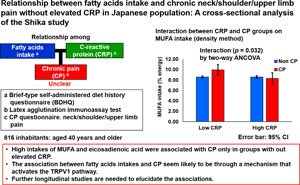
Table 4 shows the results of an analysis of the main effects and interactions of CP and CRP on fatty acid intake using a two-way ANCOVA. Covariates were adjusted for sex, age, lack of exercise, lack of sleep, current smoking or drinking status, and BMI. No fatty acids showed a main effect in the two CP groups. The fatty acids that showed a main effect in the two CRP groups were MUFA (P = 0⋅035), C18:1(M) (P = 0⋅038) and C18:3(n3)(P(n-3)) (P = 0⋅047). The fatty acids that showed an interaction between the CP and CRP groups were MUFA (P = 0⋅032), C18:1(M) (P = 0⋅037) and C20:2(n6)(P(n-6)) (P = 0⋅048). Specifically, in the high CRP group, the intakes of MUFA, C18:1(M) and C20:2(n6)(P(n-6)) were similar in the CP and non-CP groups, whereas in the low CRP group, their intakes were significantly higher in the CP group than in the non-CP group.
Table 4.
Interaction between chronic neck/shoulder/upper limb pain and CRP on fatty acid intake
| Low CRP (n 453) | High CRP (n 364) | P-value* | |||||||||
|---|---|---|---|---|---|---|---|---|---|---|---|
| Non-CP (n 434) | CP (n 19) | Non-CP (n 348) | CP (n 16) | CP | CRP | CP × CRP | |||||
| Mean | 95 % CI | Mean | 95 % CI | Mean | 95 % CI | Mean | 95 % CI | ||||
| SFA, % energy |
6⋅36 | 6⋅19 6⋅54 |
7⋅17 | 6⋅35 7⋅98 |
6⋅42 | 6⋅22 6⋅61 |
6⋅51 | 5⋅61 7⋅40 |
0⋅156 | 0⋅337 | 0⋅257 |
| MUFA, % energy |
8⋅58 | 8⋅37 8⋅80 |
9⋅96 | 8⋅95 10⋅97 |
8⋅59 | 8⋅35 8⋅84 |
8⋅30 | 7⋅19 9⋅40 |
0⋅168 | 0⋅035 | 0⋅032 |
| PUFA, % energy |
6⋅06 | 5⋅91 6⋅20 |
6⋅75 | 6⋅08 7⋅42 |
6⋅07 | 5⋅91 6⋅23 |
5⋅80 | 5⋅07 6⋅53 |
0⋅415 | 0⋅070 | 0⋅063 |
|
n-3 fatty acids, % energy |
1⋅32 | 1⋅28 1⋅37 |
1⋅44 | 1⋅25 1⋅64 |
1⋅34 | 1⋅30 1⋅39 |
1⋅27 | 1⋅06 1⋅48 |
0⋅780 | 0⋅318 | 0⋅204 |
|
n-6 fatty acids, % energy |
4⋅71 | 4⋅60 4⋅82 |
5⋅28 | 4⋅75 5⋅82 |
4⋅70 | 4⋅57 4⋅83 |
4⋅51 | 3⋅92 5⋅09 |
0⋅358 | 0⋅058 | 0⋅064 |
| C18:1(M), mg/1000 kcal |
8485⋅79 | 8265⋅73 8705⋅84 |
9876⋅09 | 8846⋅26 10 905.91 |
8485⋅73 | 8237⋅71 8733⋅74 |
8217⋅27 | 7093⋅41 9341⋅12 |
0⋅159 | 0⋅038 | 0⋅037 |
| C18:2(n6)(P(n-6)), mg/1000 kcal |
5075⋅93 | 4951⋅10 5200⋅76 |
5690⋅18 | 5105⋅98 6274⋅38 |
5060⋅87 | 4920⋅17 5201⋅56 |
4855⋅34 | 4217⋅8 5492⋅88 |
0⋅365 | 0⋅061 | 0⋅069 |
| C18:3(n3)(P(n-3)), mg/1000 kcal |
817⋅78 | 794⋅38 841⋅18 |
932⋅57 | 823⋅07 1042⋅06 |
813⋅57 | 787⋅20 839⋅94 |
767⋅88 | 648⋅38 887⋅37 |
0⋅414 | 0⋅047 | 0⋅057 |
| C20:2(n6)(P(n-6)), mg/1000 kcal |
23⋅74 | 22⋅94 24⋅55 |
28⋅25 | 24⋅50 32⋅00 |
23⋅75 | 22⋅85 24⋅66 |
22⋅54 | 18⋅44 26⋅63 |
0⋅257 | 0⋅050 | 0⋅048 |
Abbreviations: CI, confidence interval; BMI, body mass index; CRP, C-reactive protein; SFA, saturated fatty acid; MUFA, monounsaturated fatty acid; PUFA, polyunsaturated fatty acid.
Adjusted for sex, age, lack of exercise, lack of sleep, current smoker, current drinker and BMI.
A two-way analysis of covariance (P-values < 0⋅05 are highlighted in bold).
Logistic regression analysis of CP on fatty acid intake stratified by CRP
Table 5 shows multiple logistic regression results stratified by high and low CRP groups, with CP as the dependent variable. Covariates were adjusted for sex, age, lack of exercise, lack of sleep, current smoking or drinking status, and BMI, with each fatty acid imputed individually into the independent variables. Significant independent variables in the low CRP group were SFA (OR 1⋅327; 95 % CI 1⋅014, 1⋅737; P = 0⋅040), MUFA (OR 1⋅359; 95 % CI 1⋅093, 1⋅690; P = 0⋅006), PUFA (OR 1⋅399; 95 % CI 1⋅033, 1⋅897; P = 0⋅030), n-6 fatty acids (OR 1⋅560; 95 % CI 1⋅068, 2⋅279; P = 0⋅021), C18:1(M) (OR 1⋅000; 95 % CI 1⋅000, 1⋅001; P = 0⋅006), C18:2(n6)(P(n-6)) (OR 1⋅000; 95 % CI 1⋅000, 1⋅001; P = 0⋅023), C18:3(n3)(P(n-3)) (OR 1⋅002; 95 % CI 1⋅000, 1⋅004; P = 0⋅028) and C20:2(n6)(P(n-6)) (OR 1⋅072; 95 % CI 1⋅015, 1⋅132; P = 0⋅013). In the high CRP group, no fatty acid was identified as a significant independent variable for CP. In other words, a high intake of these fatty acids significantly contributed to CP in the low CRP group only.
Table 5.
Logistic regression analysis of CP and fatty acid intake stratified by CRP
| Exp(B) | 95 % Cl Lower | 96 % Cl Upper | P-value | ||
|---|---|---|---|---|---|
| Low CRP (n 452) | SFA, % energy | 1⋅327 | 1⋅014 | 1⋅737 | 0⋅040 |
| MUFA, % energy | 1⋅359 | 1⋅093 | 1⋅690 | 0⋅006 | |
| PUFA, % energy | 1⋅399 | 1⋅033 | 1⋅897 | 0⋅030 | |
| n-3 fatty acids, % energy | 1⋅814 | 0⋅675 | 4⋅875 | 0⋅238 | |
| n-6 fatty acids, % energy | 1⋅560 | 1⋅068 | 2⋅279 | 0⋅021 | |
| C18:1(M), mg/1000 kcal | 1⋅000 | 1⋅000 | 1⋅001 | 0⋅006 | |
| C18:2(n6)(P(n-6)), mg/1000 kcal | 1⋅000 | 1⋅000 | 1⋅001 | 0⋅023 | |
| C18:3(n3)(P(n-3)), mg/1000 kcal | 1⋅002 | 1⋅000 | 1⋅004 | 0⋅028 | |
| C20:2(n6)(P(n-6)), mg/1000 kcal | 1⋅072 | 1⋅015 | 1⋅132 | 0⋅013 | |
| High CRP (n 364) | SFA, % energy | 1⋅025 | 0⋅790 | 1⋅330 | 0⋅853 |
| MUFA, % energy | 0⋅926 | 0⋅734 | 1⋅170 | 0⋅520 | |
| PUFA, % energy | 0⋅821 | 0⋅561 | 1⋅201 | 0⋅309 | |
| n-3 fatty acids, % energy | 0⋅528 | 0⋅133 | 2⋅101 | 0⋅365 | |
| n-6 fatty acids, % energy | 0⋅799 | 0⋅499 | 1⋅279 | 0⋅350 | |
| C18:1(M), mg/1000 kcal | 1⋅000 | 1⋅000 | 1⋅000 | 0⋅552 | |
| C18:2(n6)(P(n-6)), mg/1000 kcal | 1⋅000 | 0⋅999 | 1⋅000 | 0⋅354 | |
| C18:3(n3)(P(n-3)), mg/1000 kcal | 0⋅999 | 0⋅996 | 1⋅001 | 0⋅288 | |
| C20:2(n6)(P(n-6)), mg/1000 kcal | 0⋅983 | 0⋅921 | 1⋅049 | 0⋅606 |
Abbreviations: Exp (B), Exponentiation of the B coefficient; CI, confidence interval; CRP, C-reactive protein; SFA, saturated fatty acid; MUFA, monounsaturated fatty acid; PUFA, polyunsaturated fatty acid.
Significant estimates are in bold.
Discussion
The main result of the present study was that higher intakes of MUFA, oleic acid (C18:1) and eicosadienoic acid (C20:2) correlated with CP in the low CRP group, but not in the high CRP group.
A cross-sectional study that examined the relationship between high-sensitivity CRP and pain in daily life by Eslami et al.(10) revealed that these two factors were related in women, but not in men; however, in a logistic regression analysis adjusted for pain-related ADL decline and BMI in women, high-sensitivity CRP was no longer associated with pain. Since the relationship between fatty acid intake and CP was influenced by CRP in the present study, this relationship appears to be complex. CRP is an indicator of inflammation(5,27), which may be related to the development of CP. Therefore, high CRP is considered to be related to nociceptive pain caused by peripheral nociceptors stimulated via pain-producing substances produced through inflammation and inducing tissue damage(5). The present results showing the absence of a relationship between fatty acid intake and CP in the high CRP group indicate the greater involvement of pain-producing substances during the inflammatory response. On the other hand, CP with low CRP may be explained by psychogenic pain(6,28) involving depression or neuropathic pain(29,30) affecting the somatosensory nervous system as pathophysiology. We speculate that a higher fatty acid intake may enhance the mechanisms involved in depression and nociceptive pathway sensitisation to CP.
n-6 Fatty acids, including eicosadienoic acid, are considered to play a crucial role in pain initiation and suppression(17). Taken together with the involvement of the production of inflammatory eicosanoids and inflammatory cytokines in pain initiation(17), elevated blood levels of n-6 highly unsaturated fatty acids appear to play a role in complex regional pain syndrome(18) and mechanical allodynia due to the potent activation of TRPV1 in the spinal cord(19). On the other hand, 14- and 15-epoxyeicosatrienoic acids have been suggested to inhibit pain(20). The present results showing that the intake of eicosadienoic acid, one of the n-6 fatty acids, was significantly higher only in the low CRP with CP group suggested that a higher intake of n-6 fatty acids is related to the development of non-inflammatory psychogenic pain(6,28) and low-inflammatory neuropathic pain(29,30). These findings indicate that a higher intake of n-6 fatty acids affects non-inflammatory CP through a mechanism that activates TRPV1.
A study by Bennett and Hayes(31), in which chemesthetic subqualities elicited by oleic acid (olive oil) and capsaicin were compared in healthy adults, proposed that an unknown TRPV1 agonist was present in olive oil. Therefore, a high intake of these fatty acids may exacerbate non-inflammatory psychogenic pain related to the existing quality of life(32) as well as depression(6) and neuropathic pain, such as trigeminal neuralgia(7). The present results showed that oleic acid intake was significantly higher in the low CRP with CP group only. Therefore, a possible cause of non-inflammatory CP is the higher intake of MUFA, such as oleic acid. However, several studies(33,34) indicated that a higher intake of MUFA, such as olive oil, was negatively associated with depression. On the other hand, very few epidemiological studies have investigated the relationship between MUFA and CP(35). Based on previous findings, including epidemiology, the relationship between MUFA and CP remains unclear. Since the present study did not evaluate the relationship between psychogenic pain and depression, the relationships among MUFA, depression and CP need to be confirmed in longitudinal studies.
An overweight BMI as a CP-related factor has been examined in epidemiological studies(10,11). A cross-sectional study that investigated elderly females without dementia revealed a relationship between obesity and pain intensity in daily life(10). Similarly, a cross-sectional study on the elderly revealed a correlation between central obesity and CP(11). Although these studies reported a relationship between BMI and CP, our BMI-corrected model verified that fatty acid intake correlated with CP with low CRP even after adjustments for BMI. Therefore, the present results showing a relationship between fatty acid intake and CP are not attributed to an overweight BMI.
The limitations of the present study are, first, its cross-sectional nature, due to which we were unable to examine the longitudinal causal relationship between fatty acid intake and CP. Second, since the number of participants (16 subjects) in the high CRP group with CP was small, a larger sample size analysis would be required. Third, we did not classify CRP according to reference values. Fourth, the self-administered BDHQ may lack objectivity. Fifth, we have not analysed the influence of medication treatment due to diabetes or dyslipidemia on the relationship between fatty acid intake and CP. Sixth, we have not investigated the implication of the TRPV1 pathway. Finally, since participants were volunteers, selection bias may exist.
Conclusion
We epidemiologically revealed a relationship between fatty acid intake and CP, stratified by low and high CRP. Only high intakes of MUFA and eicosadienoic acid were associated with chronic neck/shoulder/upper limb pain without elevated CRP. In psychogenic and neuropathic pain without elevated CRP, increased intakes of MUFA and eicosadienoic acid, a family member of n-6 fatty acids, appear to affect CP. Further longitudinal studies are needed to elucidate this relationship.
Acknowledgements
The authors thank all the participants in the Shika town study, as well as the collaborations by all of the field survey staff and experimental staff.
The present study was funded by a Grant-in-Aid for Scientific Research (B) by the Japan Society for the Promotion of Science, number 19H03882.
Conceptualisation, A. A. and H. N.; methodology, H. T., H. N.; formal analysis, H. T., M. N.; investigation, A. A., F. S., H. T., A. H., S. M., K. S., M. N., Y. S., T. T. T. N., K. O. P., T. K., S. N., K. H., A. S., T. A., H. T. and H. N.; resources, H. N.; data curation, T. K. and A. T.; writing—original draft preparation, A. A. and F. S.; writing—review and editing, H. T., A. H., S. M., T. K., K. S., M. N., Y. S., T. T. T. N., K. O. P., T. K., S. N., K. H., A. S., T. A., T. K., Y. K., H. T., A. T. and H. N.; supervision, T. K., Y. K. and H. N.; funding acquisition, H. N. All authors have read and agreed to the published version of the manuscript.
Data in the present study are available upon request from the corresponding author. Data are not publicly available due to privacy and ethical policies.
Supplementary material
For supplementary material accompanying this paper visit https://doi.org/10.1017/jns.2022.37.
click here to view supplementary material
References
- 1.Croft PR, Lewis M, Papageorgiou AC, et al. (2001) Risk factors for neck pain: a longitudinal study in the general population. Pain 93, 317–325. [DOI] [PubMed] [Google Scholar]
- 2.Kasai Y, Sakakibara T, Wang Z, et al. (2013) A comparison of chronic pain prevalence in Japan, Thailand, and Myanmar. Pain Physician 16, 603–608. [PubMed] [Google Scholar]
- 3.Yongjun Z, Tingjie Z, Xiaoqiu Y, et al. (2020) A survey of chronic pain in China. Libyan J Med 15, 1730550. doi: 10.1080/19932820.2020.1730550. [DOI] [PMC free article] [PubMed] [Google Scholar]
- 4.Nakamura M, Nishiwaki Y, Ushida T, et al. (2011) Prevalence and characteristics of chronic musculoskeletal pain in Japan. J Orthop Sci 16, 424–432. [DOI] [PMC free article] [PubMed] [Google Scholar]
- 5.Seifert O & Baerwald C (2021) Interaction of pain and chronic inflammation. Z Rheumatol 80, 205–213. [DOI] [PubMed] [Google Scholar]
- 6.Defrance J, Foucher S, Ramdani E, et al. (2019) Post-traumatic stress disorder and psychogenic pain. Soins 64, 9–11. [DOI] [PubMed] [Google Scholar]
- 7.St. John Smith E (2018) Advances in understanding nociception and neuropathic pain. J Neurol 265, 231–238. [DOI] [PMC free article] [PubMed] [Google Scholar]
- 8.Afari N, Mostoufi S, Noonan C, et al. (2011) C-reactive protein and pain sensitivity: findings from female twins. Ann Behav Med 42, 277–283. [DOI] [PMC free article] [PubMed] [Google Scholar]
- 9.Schistad EI, Stubhaug A, Furberg AS, et al. (2017) C-reactive protein and cold-pressor tolerance in the general population: the Tromsø Study. Pain 158, 1280–1288. [DOI] [PubMed] [Google Scholar]
- 10.Eslami V, Katz MJ, White RS, et al. (2017) Pain intensity and pain interference in older adults: role of gender, obesity and high-sensitivity C-reactive protein. Gerontology 63, 3–12. [DOI] [PMC free article] [PubMed] [Google Scholar]
- 11.Ray L, Lipton RB, Zimmerman ME, et al. (2011) Mechanisms of association between obesity and chronic pain in the elderly. Pain 152, 53–59. [DOI] [PMC free article] [PubMed] [Google Scholar]
- 12.Skarpsno ES, Mork PJ, Nilsen TIL, et al. (2019) The interplay between sleeplessness and high-sensitivity C-reactive protein on risk of chronic musculoskeletal pain: longitudinal data from the Tromsø Study. Sleep 4, zsz127. [DOI] [PubMed] [Google Scholar]
- 13.Nakamura M, Nishiwaki Y, Ushida T, et al. (2014) Prevalence and characteristics of chronic musculoskeletal pain in Japan: a second survey of people with or without chronic pain. J Orthop Sci 19, 339–350. [DOI] [PMC free article] [PubMed] [Google Scholar]
- 14.Helde-Frankling M & Björkhem-Bergman L (2017) Vitamin D in pain management. Int J Mol Sci 18, 2170. doi: 10.3390/IJMS18102170. [DOI] [PMC free article] [PubMed] [Google Scholar]
- 15.Fifi AC & Holton KF (2020) Food in chronic pain: friend or foe? Nutrients 12, 1–4. [DOI] [PMC free article] [PubMed] [Google Scholar]
- 16.Narukawa N, Tsujiguchi H, Hara A, et al. (2021) Relationship between vitamin intake and health-related quality of life in a Japanese population: a cross-sectional analysis of the Shika study. Nutrients 13, 1–10. [DOI] [PMC free article] [PubMed] [Google Scholar]
- 17.Tokuyama S & Nakamoto K (2011) Unsaturated fatty acids and pain. Biol Pharm Bull 34, 1174–1178. [DOI] [PubMed] [Google Scholar]
- 18.Ramsden C, Gagnon C, Graciosa J, et al. (2010) Do omega-6 and trans fatty acids play a role in complex regional pain syndrome? A pilot study. Pain Med 11, 1115–1125. [DOI] [PMC free article] [PubMed] [Google Scholar]
- 19.Kim YH, Back SK, Davies AJ, et al. (2012) TRPV1 in GABAergic interneurons mediates neuropathic mechanical allodynia and disinhibition of the nociceptive circuitry in the spinal cord. Neuron 74, 640–647. [DOI] [PubMed] [Google Scholar]
- 20.Terashvili M, Tseng LF, Wu H, et al. (2008) Antinociception produced by 14,15-epoxyeicosatrienoic acid is mediated by the activation of β-endorphin and met-enkephalin in the rat ventrolateral periaqueductal gray. J Pharmacol Exp Ther 326, 614–622. [DOI] [PMC free article] [PubMed] [Google Scholar]
- 21.Shika Town Population. Available at https://www.town.shika.lg.jp/jyuumin/shika_town_pop/heisei29/shikatown_pop_201711.html (accessed June 2022).
- 22.Suzuki K, Tsujiguchi H, Miyagi S, et al. (2020) Association between serum 25-hydroxyvitamin D concentrations and chronic pain: effects of drinking habits. J Pain Res 13, 2987–2996. [DOI] [PMC free article] [PubMed] [Google Scholar]
- 23.Kitaoka M, Mitoma J, Asakura H, et al. (2016) The relationship between hypertension and health-related quality of life: adjusted by chronic pain, chronic diseases, and life habits in the general middle-aged population in Japan. Environ Health Prev Med 21, 193–214. [DOI] [PMC free article] [PubMed] [Google Scholar]
- 24.Scholz J, Finnerup NB, Attal N, et al. (2019) The IASP classification of chronic pain for ICD-11: chronic neuropathic pain. Pain 160, 53–59. [DOI] [PMC free article] [PubMed] [Google Scholar]
- 25.Kobayashi S, Murakami K, Sasaki S, et al. (2011) Comparison of relative validity of food group intakes estimated by comprehensive and brief-type self-administered diet history questionnaires against 16 d dietary records in Japanese adults. Public Health Nutr 14, 1200–1211. [DOI] [PubMed] [Google Scholar]
- 26.Kobayashi S, Honda S, Murakami K, et al. (2012) Both comprehensive and brief self-administered diet history questionnaires satisfactorily rank nutrient intakes in Japanese adults. J Epidemiol 22, 151–159. [DOI] [PMC free article] [PubMed] [Google Scholar]
- 27.Sproston NR & Ashworth JJ (2018) Role of C-reactive protein at sites of inflammation and infection. Front Immunol 9, 754. [DOI] [PMC free article] [PubMed] [Google Scholar]
- 28.Zis P, Daskalaki A, Bountouni I, et al. (2017) Depression and chronic pain in the elderly: links and management challenges. Clin Interv Aging 12, 709–720. [DOI] [PMC free article] [PubMed] [Google Scholar]
- 29.Baron R, Binder A & Wasner G (2010) Neuropathic pain: diagnosis, pathophysiological mechanisms, and treatment. Lancet Neurol 9, 807–819. [DOI] [PubMed] [Google Scholar]
- 30.Finnerup N, Kuner R & Jensen T (2021) Neuropathic pain: from mechanisms to treatment. Physiol Rev 101, 259–301. [DOI] [PubMed] [Google Scholar]
- 31.Bennett SM & Hayes JE (2012) Differences in the chemesthetic subqualities of capsaicin, ibuprofen, and olive oil. Chem Senses 37, 471–478. [DOI] [PMC free article] [PubMed] [Google Scholar]
- 32.Mitoma J, Kitaoka M, Asakura H, et al. (2016) Prevalence of chronic pain, especially headache, and relationship with health-related quality of life in middle-aged Japanese residents. Health 8, 116–124. [Google Scholar]
- 33.Sánchez-Villegas A, Verberne L, Irala JD, et al. (2011) Dietary fat intake and the risk of depression: the SUN project. PLoS One 6, e16268. doi: 10.1371/JOURNAL.PONE.0016268. [DOI] [PMC free article] [PubMed] [Google Scholar]
- 34.Lang UE, Beglinger C, Schweinfurth N, et al. (2015) Nutritional aspects of depression. Cell Physiol Biochem 37, 1029–1043. [DOI] [PubMed] [Google Scholar]
- 35.Andreeva VA, de Edelenyi FS, Druesne-Pecollo N, et al. (2018) Macronutrient intake in relation to migraine and non-migraine headaches. Nutrients 10, 1309. doi: 10.3390/NU10091309. [DOI] [PMC free article] [PubMed] [Google Scholar]
Associated Data
This section collects any data citations, data availability statements, or supplementary materials included in this article.
Supplementary Materials
For supplementary material accompanying this paper visit https://doi.org/10.1017/jns.2022.37.
click here to view supplementary material