



The coronavirus disease (COVID)‐19 pandemic has created a substantial impact on healthcare provision worldwide. As the first UK national lockdown began on 23 March 2020, a disruption to healthcare services resulted in cancellation and limitation of face‐to‐face (FTF) appointments in both primary and secondary care. We reviewed the effect on dermatology outpatient attendance in England using National Health Service (NHS) Digital Hospital Episode Statistics (HES) data from December 2018 until October 2020. The data represent the total number of patients attending NHS dermatology outpatient appointments in England, including all telephone and virtual appointments (Fig. 1).1 To assess the impact of lockdown, analysis was undertaken for three periods: ‘pre‐lockdown’ (April 2019 to March 2020), ‘lockdown’ (April and May 2020) and ‘post‐lockdown’ (June to October 2020), as highlighted (Fig. 1). The mean values for each period are shown (Fig. 2).
Figure 1.
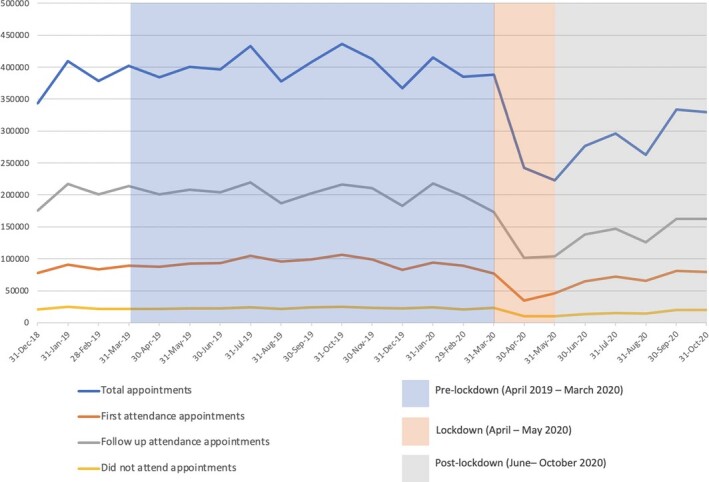
Monthly dermatology outpatient appointments in England between December 2018 and October 2020,1 and the three periods of analysis: pre‐lockdown, lockdown and post‐lockdown.
Figure 2.
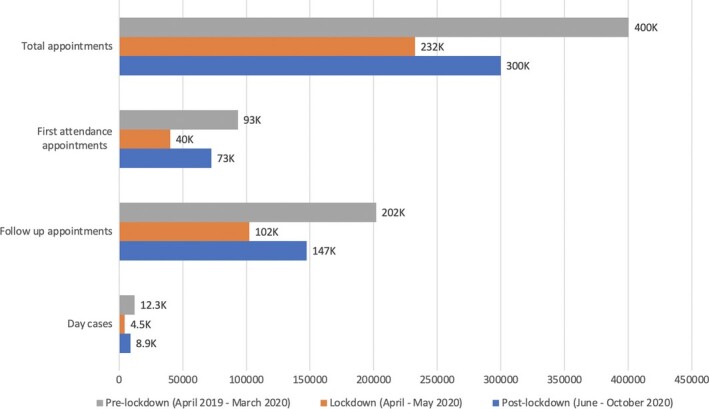
Calculated mean attendances to dermatology outpatient services in England during the periods of pre‐lockdown, lockdown and post‐lockdown.
During lockdown, total appointments reduced to 58%, first attendances to 43%, follow‐ups to 51% and day cases to 37% of pre‐lockdown values (Fig. 2). Post‐lockdown, first attendances showed the greatest recovery, increasing from 43% to 78% of pre‐lockdown values, which suggests the prioritization of new patients. Total appointments post‐lockdown remained low, representing only 75% of pre‐lockdown values. In 2020, there were 484 415 (17%) fewer total appointments between April and October compared with the same period in 2019 (Fig. 1).
Although services somewhat recovered, they did not return to pre‐lockdown values despite the widespread use of virtual appointments. Patient‐related factors include patient anxiety surrounding the risk of contracting COVID‐19 when attending general practitioners or hospitals, and socioeconomic or age‐related barriers to using virtual systems. Patients may have been reluctant to seek help due to restrictions on FTF consultations, particularly those with sensitive problems such as genital disease. In primary and secondary care, some healthcare professionals were absent due to sickness, self‐isolation, shielding or redeployment to different departments. Some dermatology facilities were reallocated to other purposes relating to the pandemic. These factors may all have disproportionately affected minority groups and elderly patients, who are at greatest risk from COVID‐19. Future qualitative studies may unveil other causes for the reduction in appointment attendance. A limitation of this study is the lack of direct access to the HES data and the inevitable human error in the collection of large amounts of real‐life NHS data.
Skin cancer accounts for a large proportion of dermatologists’ workload, with dermatology accounting for 21% of all suspected cancer referrals in 2019–20, more than any other speciality.2 Patients may also have severe inflammatory disease requiring systemic immunomodulating therapies, or diseases producing lifelong physical or psychological scarring and disability. It is of concern that NHS services did not return to baseline post‐lockdown. Therefore, the long‐term effect on skin disease morbidity and mortality caused by delayed medical attention warrants an evaluation of the impact on all communities as a consequence of the COVID‐19 pandemic.
Contributor Information
L. S. Ibrahim, Norwich Medical School University of East Anglia Norwich UK
Z. C. Venables, Department of Dermatology Norfolk and Norwich University Hospitals NHS Foundation Trust Norwich UK Public Health England Cambridge UK.
N. J. Levell, Department of Dermatology Norfolk and Norwich University Hospitals NHS Foundation Trust Norwich UK
References
- National Health Service Digital. Provisional monthly hospital episode statistics for admitted patient care and outpatient data April 2020–October 2020. 2020. Available at: https://digital.nhs.uk/data‐and‐information/publications/statistical/hospital‐episode‐statistics‐for‐admitted‐patient‐care‐outpatient‐and‐accident‐and‐emergency‐data/april‐2020‐‐‐october‐2020 (accessed 12 December 2020).
- National Health Service England. Cancer waiting times Annual Report, 2019–20. Available at: https://www.england.nhs.uk/statistics/statistical‐work‐areas/cancer‐waiting‐times/cwt‐annual‐reports/cancer‐waiting‐times‐annual‐report‐2019–20/ (accessed 12 December 2020).