



Abstract
Background:
Increased inflammation is linked to suicide risk. However, it is unclear whether increased inflammation drives suicidal crises or is a trait associated with lifetime suicidal behavior. Limited data exist on the sources of increased inflammation observed in suicidal patients and on its downstream effects.
Aims:
To examine factors associated with inflammation and with suicidal ideation severity in acutely suicidal depressed patients.
Methods:
Fifty-two adult depressed patients of both sexes hospitalized for severe suicidal ideation were characterized for suicidality, depression, anxiety, medical comorbidity, psychological and physical pain, impulsivity, verbal fluency, C-reactive protein (CRP) and interleukin (IL) 6. Two generalized linear models were performed with either CRP or suicidal ideation severity as dependent variables.
Results:
CRP levels were positively associated with age, body mass index (BMI), IL6, current physical pain and number of lifetime suicide attempts. Suicidal ideation severity was not significantly correlated with either CRP or IL6. Suicidal ideation severity was positively associated with female sex, presence of an anxiety disorder, current physical pain, number of lifetime suicide attempts and with delay discounting for medium and large losses.
Conclusions:
Increased inflammation is not associated with acute suicidal risk, but seems to represent a trait associated with lifetime suicidal behavior.
Keywords: Suicide, CRP, IL6, impulsivity, psychological pain, inpatient
Introduction
Suicide is a growing public health problem worldwide. Although risk for suicide is multifactorial, recent studies report increased inflammation and cognitive abnormalities in individuals with suicidal thoughts and actions. Inflammation is linked to psychological stress (Steptoe et al., 2007) and several psychiatric conditions (Dickerson et al., 2007; Dowlati et al., 2010; Miller et al., 2013). Different pro-inflammatory markers are noted to be elevated in serum, cerebrospinal fluid (CSF) and post-mortem brain tissue of suicidal patients, independently of psychiatric diagnosis (for review see Brundin et al., 2015). Peripheral inflammation can ultimately undermine brain function by disrupting glutamate and monoamine neurotransmission (Dantzer et al., 2008; Dunn, 2006), and increasing oxidative stress (Vargas et al., 2013), leading to prefrontal cortex (PFC) dysfunction (Pandey et al., 2012) and disruption of regulatory corticostriatal systems (Felger et al., 2016). Dysfunction of these regulatory circuits has been linked to suicide vulnerability, as well as to abnormalities in executive function (Richard-Devantoy et al., 2016), impulsivity (Dombrovski et al., 2012), hopelessness (Felger et al., 2016), emotion regulation (Wolff et al., 2018) and pain processing (Jollant et al., 2017).
Cognitive deficits have been reported amongst depressed patients with suicidal ideation and behavior (Cáceda et al., 2014; Marzuk et al., 2005; Richard-Devantoy et al., 2014). For instance, an inherent component of decision making is the ability to forecast outcomes and subsequently delay gratification. Lack of the ability to foresee life beyond the current crisis and distress is associated with suicide. Emotion dysregulation, hopelessness and anhedonia have also been linked to increased suicide risk.
Inflammatory markers have been noted to be increased in recent suicide attempters (Gibbs et al., 2016), but also in individuals with lifetime history of suicidal behavior (Courtet et al., 2015). Thus, it is unclear whether increased inflammation represents a state or trait associated with suicidal behavior. Another unresolved issue is whether a particular source of inflammation is particularly relevant for suicide vulnerability. For instance, in cardiovascular disease, inflammation is thought to derive from plaque formation in arterial walls, and therefore, other sources of inflammation are potentially irrelevant. In contrast, rodent data suggest the inflammation source may not matter for its deleterious effects on brain function (Hoogland et al., 2015).
The goal of this study was to shed light on the role of inflammation in acutely suicidal individuals. In order to avoid the confounder of inflammation caused by tissue damage as a product of suicide attempts, we focused on depressed patients with current suicidal ideation and no suicidal behavior within the last 6 months. We hypothesized that in acutely suicidal patients: (a) the contribution of psychological pain, proxy for psychological stress, to C-reactive protein (CRP) plasma levels will be higher than that of chronic medical comorbidity or physical pain; and (b) suicidal ideation severity will be more strongly associated with impulsivity and anhedonia than CRP levels.
Methods
Participants
Depressed adult patients of both sexes aged 18–62 years with current suicidal ideation were recruited between September 2016 and June 2017 (out of 75 contacted, 52 met inclusion/exclusion criteria and agreed to participate). Consecutive patients were screened from the inpatient units of the Psychiatric Research Institute at the University of Arkansas for Medical Sciences (UAMS) within 24 hours of hospital admission. Inclusion criteria were: presence of current suicidal ideation defined by the suicidal ideation severity subscale of the Columbia Suicide Severity Rating Scale (C-SSRS) (Posner et al., 2011); no suicidal behavior in the last 6 months; fulfill Diagnostic and Statistical Manual of Mental Disorders IV TR (American Psychiatric Association, 2000) criteria for Major Depressive Episode; and either Major Depressive Disorder or Bipolar Disorder. Exclusion criteria were: inability to read, write and speak English; inability to provide informed consent; history of dementia, neurovascular or neurodegenerative conditions; physical disabilities that prohibit task performance; history of non-suicidal self-harm; and involuntary hospitalization. The UAMS Institutional Review Board approved all procedures.
Procedure
After written informed consent was obtained, participants underwent an interview to obtain demographics, psychiatric and medical history, cognitive assessments, and ratings for anxiety and hopelessness, and had blood drawn for measurement of CRP and IL6 levels. The C-SSRS and Beck Depression Inventory (BDI-2) (Beck et al., 1996) were used to quantify suicidal ideation and behavior, and depression severity, respectively.
The clinical information gathered included the following. First, psychiatric diagnostic assessments were performed by or directly under the supervision of a board-certified adult psychiatrist as defined by the DSM-IV TR. Second, the presence of an anxiety disorder was established, including generalized anxiety disorder, post-traumatic stress disorder, social phobia and panic disorder. Third, the presence of an active substance use disorder other than tobacco was established, defined by a positive urine/serum drug screen or the individual endorsed current drug use. Fourth, information was obtained on psychotropic medications taken during the past 3 days and during lifetime. Fifth, we used a scoring system to quantify comorbid conditions affecting inflammatory status; the presence of each factor associated with chronic conditions present were scored either 0 or 1, based on the Charlson Comorbidity Index (Charlson et al., 1987): body mass index (BMI) >30 (obesity), eosinophil count >500/μL, glycemia >200 mg/dL, smoking, coronary artery disease, congestive heart failure, cerebrovascular disease, chronic pulmonary disease, connective tissue disease, dental disease, peptic ulcer disease, liver disease (hepatitis, cirrhosis), renal disease, diabetes, autoimmune disorder, malignancy, chronic pain, asthma, active allergies, substance use disorder, major surgery in the last month, and medically treated infections in the last 10 years.
Subjects also completed the Beck Anxiety Inventory (Beck and Steer, 1990) and Beck Hopelessness Scale (Beck, 1988) as covariates relevant to suicide risk. Trail Making Test A and B (Reitan and Wolfson, 1985), and the FAS verbal fluency test (Newcombe, 1969) were administered as general cognitive measures. Physical and psychological pain were measured with the Physical and Psychological Pain Scale (Olie et al., 2010). Pressure pain threshold was measured using standard procedures (Aweid et al., 2014). Choice impulsivity for gains and losses was evaluated with the Monetary Choice Questionnaire, which presents 27 choices between immediate smaller gains/losses and delayed larger ones (Kirby et al., 1999). We used proportional scoring for responses, based on the calculation of proportions of the delayed outcome (number of choices of a delayed gain or loss divided by the number of questions) separately for the small, medium and large amounts. This method showed that response proportions and individual estimates of discounting rates are so highly correlated that they could be assumed to be interchangeable (Myerson et al., 2014).
Biological samples processing
Following collection, whole blood was placed immediately on ice and processed within 30 minutes. Plasma was separated from the cellular components by centrifugation at 1200 rpm for 10 min at 4°C and stored at −80°C until IL6 and CRP measurement using commercially available ELISA kits (Millipore, Billerica, MA). Absorbance was read at 450 nm on a BioRad Benchmark plus microplate spectrophotometer. The concentration of CRP (mg/L) and IL6 (pg/mL) for each sample was quantified based on optical density values calculated from the standard curve.
Data analysis
Descriptive statistics were calculated. Spearman correlation analyses and generalized linear models were used for continuous variables due to violation of normality. Bivariate correlation analyses were carried between CRP level and age, IL6, BMI, number of lifetime suicide attempts, depression severity, number of drugs for depression trials, lifetime and current suicidal ideation severity, highest suicide attempt lethality, physical illness severity (comorbid conditions score), psychological pain and physical pain. We did not record lifetime severity of depression; however, we documented the total number of drugs for depression trials, lifetime suicidal ideation severity and highest suicide attempt lethality. Only age, IL6, BMI, physical pain and number of suicide attempts were significant and were included as covariates in a generalized linear model. Additionally, childhood trauma and physical illness severity were included as a fixed factor and covariate, respectively, because of their known influence on CRP levels.
Bivariate correlation analyses were also carried out between suicidal ideation severity and gender, presence of anxiety disorder substance use disorder, history of childhood trauma, age, IL6, number of lifetime suicide attempts, depression severity, physical illness severity, psychological pain, physical pain, verbal fluency, TMT-A, TMT-B, and delayed discounting for gains and losses. Only gender, presence of an anxiety disorder, physical pain, number of suicide attempts and delay discounting for medium and large losses (because they were highly correlated, only the latter was included) were significant and included as covariates in a generalized linear model. In addition, depression severity, verbal fluency and anhedonia were included, because of their previously reported association with suicidal ideation. All analyses were conducted using SPSS 24 (SPSS Inc., Chicago, IL, USA).
Results
Table 1 presents the demographic and clinical characteristics of the study sample. It was relatively young, ethnically diverse, suffering from major depression and bipolar depression in even numbers, overweight, and half were receiving drugs for depression. Given that unipolar and bipolar depression are likely different biological phenomena, we compared CRP and IL6 levels, depression, suicidal ideation severity and delay discount between patients with these two diagnoses and between those receiving or not drugs for depression. There were no significant differences between these groups (results not shown). Thus, the analysis of these groups was combined.
Table 1.
Demographic and clinical characteristics of study sample.
| N | 52 |
| Age | 36.8±12.6 |
| Gender (f) | 33 (63.5%) |
| Race | |
| White | 31 (59.6%) |
| Black | 17 (32.7%) |
| Other | 4 (7.7%) |
| Diagnosis | |
| Major depressive disorder | 27 (51.9%) |
| Bipolar disorder | 25 (50.1%) |
| Presence of anxiety disorder | 13 (25.0%) |
| Presence of substance use disorder | 25 (48.1%) |
| Medications | |
| Drugs for depression | 26 (50.0%) |
| Drugs for relapse prevention | 5 (9.6%) |
| None | 19 (36.5%) |
| Depression (BDI-2) | 38.56±10.49 |
| Anhedonia (BDI-2: 4, 12, 21) | 5.62±2.07 |
| Anxiety (BAI) | 31.83±11.95 |
| Hopelessness (BHS) | 11.04±2.50 |
| Insomnia | 27 (51.9%) |
| Lifetime drugs for depression trials | 0.52±0.67 |
| Current suicidal ideation severity | 2.46±1.71 |
| Lifetime highest suicidal ideations severity | 4.54±0.87 |
| Number of lifetime suicide attempts | 2.19±2.74 |
| Highest suicide attempt severity | 2.17±1.48 |
| Childhood trauma history | 41 (78.8%) |
| Trail making A (s) | 32.78±9.41 |
| Trail making B (s) | 74.45±31.74 |
| Verbal fluency (animals in 60 s) | 19.10±4.82 |
| Impulsivity (proportion of delayed choices) | |
| Gains for small amounts | 6.33±2.05 |
| Gains for medium amounts | 6.22±2.10 |
| Gains for large amounts | 5.96±2.32 |
| Losses for small amounts | 5.24±3.30 |
| Losses for medium amounts | 5.29±3.24 |
| Losses for large amounts | 5.35±3.26 |
| Current physical pain | 3.80±2.99 |
| Current psychological pain | 6.80±2.75 |
| Comorbidity condition score | 3.10±1.86 |
| Body mass index | 31.24±9.81 |
| Smoking | 27 (51.9%) |
| C-reactive protein (mg/L) | 6.02±6.07 |
| Interleukin 6 (pg/mL) | 4.79±4.82 |
Mean ± standard deviation.
BDI-2: Beck Depression Inventory 2; BAI; Beck Anxietory Inventory; BHS: Beck Hopelessness Scale.
A generalized linear model revealed a significant positive association between CRP and age (p < 0.001), BMI (p < 0.001), IL6 (p < 0.001), current physical pain (p = 0.004) and number of lifetime suicide attempts (p = 0.018) (Figure 1(a)). Of note, correlation of highest suicide attempt lethality with either CRP (r =0.105; p=0.468) or IL6 (r =0.001; p =0.994) was not significant.
Figure 1.
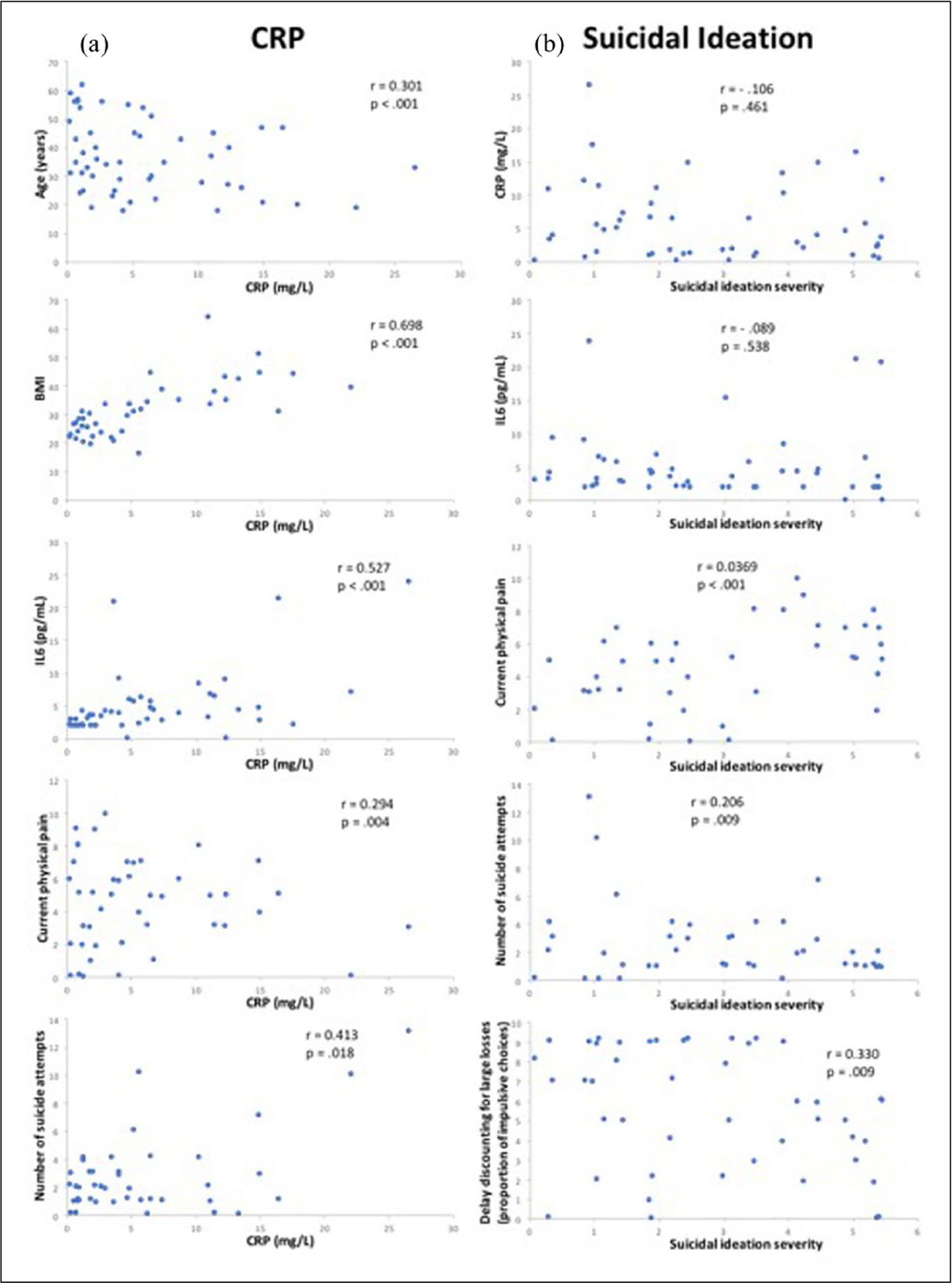
Meaningful correlations of inflammatory markers and suicidal ideation severity in adult depressed patient with suicidal ideations. (a) correlation of C-reactive protein (CRP) with age, interleukin (IL)6, body mass index (BMI), physical pain and number of lifetime suicide attempts. (b) Correlation of suicidal ideation severity with CRP, IL6, physical pain, number of lifetime suicide attempts and delay discounting for large losses.
Spearman correlation analyses showed that neither CRP (r = −0.106; p = 0.461) nor IL6 levels (r = −0.089; p = 0.538) were significantly associated with suicidal ideation severity. A second generalized linear model showed a positive association of female sex (p = 0.007), presence of an anxiety disorder (p = 0.007), current physical pain (p = 0.001), number of suicide attempts (p = 0.009), and delay discounting for medium and large losses (p = 0.009) with suicidal ideation severity (Figure 1(b)).
Discussion
Our main findings are: (a) positive association of CRP levels with age, BMI, IL6, current physical pain, and number of lifetime suicide attempts; (b) non-significant association of suicidal ideation severity with either CRP or IL6; and (c) positive association of suicidal ideation severity with female sex, presence of an anxiety disorder, current physical pain, number of lifetime suicide attempts, and delay discounting for medium and large losses.
The unexpected stronger correlation of physical factors (BMI and physical pain) than psychological pain or depression with suicidal ideation severity suggests that the elevated inflammation associated with suicide may not be driven by the acute psychosocial determinants of a suicidal crisis, but may represent a long-standing trait associated with suicide risk. Our findings add to previous studies that described increased inflammatory markers in individuals with lifetime suicidal behavior (Brundin et al., 2015; Courtet et al., 2016; Gananca et al., 2016; Serafini et al., 2013) by providing a correlation between CRP and a measure of recurrence of suicidal behavior (number of attempts). The association between CRP and number of lifetime suicide attempts, in addition to the lack of significant association with medical comorbidity or psychological pain, supports the role of elevated inflammation as a trait associated with suicidal behavior, independent of depression severity, rather than with the state of acute suicide risk. This was proposed by Courtet and collaborators, who showed association of CRP levels with lifetime history of suicide attempts, but not with number of attempts or suicidal ideation (Courtet et al., 2015). An alternative explanation for the association between CRP and number of suicide attempts could be that elevated CRP reflects the cumulative long-term sequelae of suicide attempts. However, this notion was not supported by the lack of association of highest suicide attempt lethality with either CRP or IL6 levels. Increased inflammation as a risk factor for suicidal behavior is further supported by population level findings of progressively higher suicide rates in individuals with elevated CRP levels (Batty et al., 2016), and in those with autoimmune diseases (Fredrikson et al., 2003), traumatic brain injury (Fazel et al., 2014) and systemic infections (Lund-Sorensen et al., 2016). Bay-Richter and collaborators in one of the few prospective studies of suicide attempters showed that CSF quinolinic acid, a tryptophan metabolite with NMDA receptor agonistic activity, remained elevated 18–24 months following a suicide attempt (Bay-Richter et al., 2015).
The lack of association of suicidal ideation severity with CRP or IL6 plasma levels further supports the role as a trait, rather than a state in inflammation in suicidality. Our findings are in contrast to some of the previous literature, which described an increase in different pro-inflammatory cytokines, including interferon gamma (Mendlovic et al., 1999), tumor necrosis factor alpha (Gabbay et al., 2009; Juengst et al., 2014), IL1 beta (Monfrim et al., 2014) and IL6 (Karlovic et al., 2012; Martinez et al., 2012; O’Donovan et al., 2013) in depressed patients with suicidal ideation. With a different study design, Alesci and collaborators reported a different circadian pattern in depressed patients compared with healthy controls including higher morning IL6 levels, in addition to a correlation of IL6 and suicidal thoughts (Alesci et al., 2005). Our blood collections occurred between 05:00 and 11:00 hours, thus further exploration and characterization of circadian variation of immune markers in acute suicidal patients may provide further insights. A qualitative difference with previous studies is that our population was comprised of acutely suicidal patients with severe depression who required acute inpatient care for their safety. Additionally, our measure of suicidal ideation referred to the ‘current moment’, not the past 2 weeks or lifetime. On the other hand, female sex (Kessler et al., 2005), anxiety disorders (Kessler et al., 2005), pain processing abnormalities (Caceda et al., 2017; Orbach et al., 1996), previous suicide attempts (Kessler et al., 2005) and impulsivity (Cáceda et al., 2014; Gvion et al., 2015; Klonsky et al., 2017; Wang et al., 2015) have previously been linked to suicidal ideation. A novel element of these findings lies in the association of suicidal ideation with delay discounting for losses, rather than gains. In the context of suicide, when an individual decides to forgo all future potentially enriching life experiences in order to seek relief from current overwhelming psychological pain (Baumeister, 1990), he or she is choosing between the least distressing of two losses, not the reward with the higher expected value. Our data agree with the parsimonious notion that delay discounting for losses may be an adequate construct to study the suicidal mind. In this regard, the stronger correlation of suicidal ideation with delay discounting for losses, compared with other forms of cognition, such as delay discounting for gains, verbal fluency, attention, task switching, hopelessness or even anhedonia, may suggest that within severely depressed adults, delay discounting for losses is a strong correlate, or speculatively, a proximal mediator of suicidal thoughts. The discrepancy between cognitive impulsivity toward gains and losses has previously been described in the general population (Green et al., 2014) and in depressed patients (Engelmann et al., 2013). It is possible that abnormalities in delay discounting for losses, in conjunction with cognitive rigidity and executive function deficits, may represent a vulnerable state for the development of suicidal thoughts.
The strengths of our study include recruitment of severely depressed patients with current suicidal ideation but no recent suicidal behavior, which may have further increased inflammation derived from tissue damage. Additionally, we controlled for psychiatric diagnosis, drugs for depression, medical comorbidity, smoking, substance use and BMI.
The limitations of our study include its cross-sectional design and limited sample size. Our subjects were hospitalized for imminent suicide risk and were receiving standard of care treatment; thus, they were not medication-free.
In summary, elevated inflammation does not seem to be directly related to an acute suicidal state, but rather to the trait of lifetime suicidal behavior. Elevated CRP levels may be indicative of long-term risk for suicide in a given individual. Lastly, it is possible that a certain inflammation threshold needs to be exceeded to start a cascade of events leading to suicidal behavior.
Funding
The author(s) disclosed receipt of the following financial support for the research, authorship, and/or publication of this article: This work was partially funded by the Clinician Scientist Program of the University of Arkansas for Medical Sciences, NCATS UL1TR000039, NIGMS P30 GM110702 and NIH/NIA AG12411. No funding source had any role in study design, in the collection, analysis and interpretation of data, in the writing of the report, and in the decision to submit the article for publication.
Footnotes
Declaration of conflicting interests
The author(s) declared no potential conflicts of interest with respect to the research, authorship, and/or publication of this article.
References
- Alesci S, Martinez PE, Kelkar S, et al. (2005) Major depression is associated with significant diurnal elevations in plasma interleukin-6 levels, a shift of its circadian rhythm, and loss of physiological complexity in its secretion: Clinical implications. J Clin Endocrinol Metab 90: 2522–2530. [DOI] [PubMed] [Google Scholar]
- American Psychiatric Association (2000) Diagnostic Criteria from DSM-IV-TR. Washington, DC: American Psychiatric Association. [Google Scholar]
- Aweid O, Gallie R, Morrissey D, et al. (2014) Medial tibial pain pressure threshold algometry in runners. Knee Surg Sports Traumatol Arthrosc 22: 1549–1555. [DOI] [PubMed] [Google Scholar]
- Batty GD, Bell S, Stamatakis E, et al. (2016) Association of systemic inflammation with risk of completed suicide in the general population. JAMA Psychiatry 73: 993–995. [DOI] [PubMed] [Google Scholar]
- Baumeister RF (1990) Suicide as escape from self. Psychol Rev 97: 90–113. [DOI] [PubMed] [Google Scholar]
- Bay-Richter C, Linderholm KR, Lim CK, et al. (2015) A role for inflammatory metabolites as modulators of the glutamate N-methyl-D-aspartate receptor in depression and suicidality. Brain Behav Immun 43: 110–117. [DOI] [PubMed] [Google Scholar]
- Beck AT (1988) Beck Hopelessness Scale. San Antonio: The Psychological Corporation. [Google Scholar]
- Beck AT and Steer RA (1990) Beck Anxiety Inventory: Mannual. San Antonio: Psychological Corporation/Harcourt Brace Jovanovich. [Google Scholar]
- Beck AT, Steer RA, Ball R, et al. (1996) Comparison of Beck depression inventories -IA and -II in psychiatric outpatients. J Pers Assess 67: 588–597. [DOI] [PubMed] [Google Scholar]
- Brundin L, Erhardt S, Bryleva EY, et al. (2015) The role of inflammation in suicidal behaviour. Acta Psychiatr Scand 132: 192–203. [DOI] [PMC free article] [PubMed] [Google Scholar]
- Cáceda R, Durand D, Cortes E, et al. (2014) Impulsive choice and psychological pain in acutely suicidal depressed patients. Psychosom Med 76: 445–451. [DOI] [PubMed] [Google Scholar]
- Caceda R, Kordsmeier NC, Golden E, et al. (2017) Differential processing of physical and psychological pain during acute suicidality. Psychother Psychosom 86: 116–118. [DOI] [PubMed] [Google Scholar]
- Charlson ME, Pompei P, Ales KL, et al. (1987) A new method of classifying prognostic comorbidity in longitudinal studies: Development and validation. J Chronic Dis 40: 373–383. [DOI] [PubMed] [Google Scholar]
- Courtet P, Giner L, Seneque M, et al. (2016) Neuroinflammation in suicide: Toward a comprehensive model. World J Biol Psychiatry 17: 564–586. [DOI] [PubMed] [Google Scholar]
- Courtet P, Jaussent I, Genty C, et al. (2015) Increased CRP levels may be a trait marker of suicidal attempt. Eur Neuropsychopharmacol 25: 1824–1831. [DOI] [PubMed] [Google Scholar]
- Dantzer R, O’Connor JC, Freund GG, et al. (2008) From inflammation to sickness and depression: When the immune system subjugates the brain. Nat Rev Neurosci 9: 46–56. [DOI] [PMC free article] [PubMed] [Google Scholar]
- Dickerson F, Stallings C, Origoni A, et al. (2007) Elevated serum levels of C-reactive protein are associated with mania symptoms in outpatients with bipolar disorder. Prog Neuropsychopharmacol Biol Psychiatry 31: 952–955. [DOI] [PubMed] [Google Scholar]
- Dombrovski AY, Siegle GJ, Szanto K, et al. (2012) The temptation of suicide: Striatal gray matter, discounting of delayed rewards, and suicide attempts in late-life depression. Psychol Med 42: 1203–1215. [DOI] [PMC free article] [PubMed] [Google Scholar]
- Dowlati Y, Herrmann N, Swardfager W, et al. (2010) A meta-analysis of cytokines in major depression. Biol Psychiatry 67: 446–457. [DOI] [PubMed] [Google Scholar]
- Dunn AJ (2006) Effects of cytokines and infections on brain neurochemistry. Clin Neurosci Res 6: 52–68. [DOI] [PMC free article] [PubMed] [Google Scholar]
- Engelmann JB, Maciuba B, Vaughan C, et al. (2013) Posttraumatic stress disorder increases sensitivity to long term losses among patients with major depressive disorder. PLoS One 8: e78292. [DOI] [PMC free article] [PubMed] [Google Scholar]
- Fazel S, Wolf A, Pillas D, et al. (2014) Suicide, fatal injuries, and other causes of premature mortality in patients with traumatic brain injury: A 41-year Swedish population study. JAMA Psychiatry 71: 326–333. [DOI] [PMC free article] [PubMed] [Google Scholar]
- Felger JC, Li Z, Haroon E, et al. (2016) Inflammation is associated with decreased functional connectivity within corticostriatal reward circuitry in depression. Mol Psychiatry 21: 1358–1365. [DOI] [PMC free article] [PubMed] [Google Scholar]
- Fredrikson S, Cheng Q, Jiang GX, et al. (2003) Elevated suicide risk among patients with multiple sclerosis in Sweden. Neuroepidemiology 22: 146–152. [DOI] [PubMed] [Google Scholar]
- Gabbay V, Klein RG, Guttman LE, et al. (2009) A preliminary study of cytokines in suicidal and nonsuicidal adolescents with major depression. J Child Adolesc Psychopharmacol 19: 423–430. [DOI] [PMC free article] [PubMed] [Google Scholar]
- Gananca L, Oquendo MA, Tyrka AR, et al. (2016) The role of cytokines in the pathophysiology of suicidal behavior. Psychoneuroendocrinology 63: 296–310. [DOI] [PMC free article] [PubMed] [Google Scholar]
- Gibbs HM, Davis L, Han X, et al. (2016) Association between C-reactive protein and suicidal behavior in an adult inpatient population. J Psychiatr Res 79: 28–33. [DOI] [PubMed] [Google Scholar]
- Green L, Myerson J, Oliveira L, et al. (2014) Discounting of delayed and probabilistic losses over a wide range of amounts. J Exp Anal Behav 101: 186–200. [DOI] [PMC free article] [PubMed] [Google Scholar]
- Gvion Y, Horesh N, Levi-Belz Y, et al. (2015) A proposed model of the development of suicidal ideations. Compr Psychiatry 56: 93–102. [DOI] [PubMed] [Google Scholar]
- Hoogland IC, Houbolt C, van Westerloo DJ, et al. (2015) Systemic inflammation and microglial activation: Systematic review of animal experiments. J Neuroinflammation 12: 114. [DOI] [PMC free article] [PubMed] [Google Scholar]
- Jollant F, Near J, Turecki G, et al. (2017) Spectroscopy markers of suicidal risk and mental pain in depressed patients. Prog Neuropsychopharmacol Biol Psychiatry 73: 64–71. [DOI] [PubMed] [Google Scholar]
- Juengst SB, Kumar RG, Arenth PM, et al. (2014) Exploratory associations with tumor necrosis factor-alpha, disinhibition and suicidal endorsement after traumatic brain injury. Brain Behav Immun 41: 134–143. [DOI] [PubMed] [Google Scholar]
- Karlovic D, Serretti A, Vrkic N, et al. (2012) Serum concentrations of CRP, IL-6, TNF-alpha and cortisol in major depressive disorder with melancholic or atypical features. Psychiatry Res 198: 74–80. [DOI] [PubMed] [Google Scholar]
- Kessler RC, Berglund P, Borges G, et al. (2005) Trends in suicide ideation, plans, gestures, and attempts in the United States, 1990–1992 to 2001–2003. JAMA 293: 2487–2495. [DOI] [PubMed] [Google Scholar]
- Kirby KN, Petry NM and Bickel WK (1999) Heroin addicts have higher discount rates for delayed rewards than non-drug-using controls. J Exp Psychol Gen 128: 78–87. [DOI] [PubMed] [Google Scholar]
- Klonsky ED, Qiu T and Saffer BY (2017) Recent advances in differentiating suicide attempters from suicide ideators. Curr Opin Psychiatry 30: 15–20. [DOI] [PubMed] [Google Scholar]
- Lund-Sorensen H, Benros ME, Madsen T, et al. (2016) A nationwide cohort study of the association between hospitalization with infection and risk of death by suicide. JAMA Psychiatry 73: 912–919. [DOI] [PubMed] [Google Scholar]
- Martinez JM, Garakani A, Yehuda R, et al. (2012) Proinflammatory and “resiliency” proteins in the CSF of patients with major depression. Depress Anxiety 29: 32–38. [DOI] [PubMed] [Google Scholar]
- Marzuk PM, Hartwell N, Leon AC, et al. (2005) Executive functioning in depressed patients with suicidal ideation. Acta Psychiatr Scand 112: 294–301. [DOI] [PubMed] [Google Scholar]
- Mendlovic S, Mozes E, Eilat E, et al. (1999) Immune activation in non-treated suicidal major depression. Immunol Lett 67: 105–108. [DOI] [PubMed] [Google Scholar]
- Miller BJ, Mellor A and Buckley P (2013) Total and differential white blood cell counts, high-sensitivity C-reactive protein, and the metabolic syndrome in non-affective psychoses. Brain Behav Immun 31: 82–89. [DOI] [PMC free article] [PubMed] [Google Scholar]
- Monfrim X, Gazal M, De Leon PB, et al. (2014) Immune dysfunction in bipolar disorder and suicide risk: Is there an association between peripheral corticotropin-releasing hormone and interleukin-1beta? Bipolar Disord 16: 741–747. [DOI] [PubMed] [Google Scholar]
- Myerson J, Baumann AA and Green L (2014) Discounting of delayed rewards: (A)theoretical interpretation of the Kirby questionnaire. Behav Processes 107: 99–105. [DOI] [PMC free article] [PubMed] [Google Scholar]
- Newcombe F (1969) Missile Wounds of the Brain: A Study of Psychological Deficits. London: Oxford UP. [Google Scholar]
- O’Donovan A, Rush G, Hoatam G, et al. (2013) Suicidal ideation is associated with elevated inflammation in patients with major depressive disorder. Depress Anxiety 30: 307–314. [DOI] [PubMed] [Google Scholar]
- Olie E, Guillaume S, Jaussent I, et al. (2010) Higher psychological pain during a major depressive episode may be a factor of vulnerability to suicidal ideation and act. J Affect Disord 120: 226–230. [DOI] [PubMed] [Google Scholar]
- Orbach I, Stein D, Palgi Y, et al. (1996) Perception of physical pain in accident and suicide attempt patients: Self-preservation vs self-destruction. J Psychiatr Res 30: 307–320. [DOI] [PubMed] [Google Scholar]
- Pandey GN, Rizavi HS, Ren X, et al. (2012) Proinflammatory cytokines in the prefrontal cortex of teenage suicide victims. J Psychiatr Res 46: 57–63. [DOI] [PMC free article] [PubMed] [Google Scholar]
- Posner K, Brown GK, Stanley B, et al. (2011) The Columbia-suicide severity rating scale: Initial validity and internal consistency findings from three multisite studies with adolescents and adults. Am J Psychiatry 168: 1266–1277. [DOI] [PMC free article] [PubMed] [Google Scholar]
- Reitan R and Wolfson D (1985) The Halstead-Reitan Neuropsychological Test Battery: Theory and Clinical Interpretation. Tucson: Neuropsychology Press. [Google Scholar]
- Richard-Devantoy S, Berlim MT and Jollant F (2014) A meta-analysis of neuropsychological markers of vulnerability to suicidal behavior in mood disorders. Psychol Med 44: 1663–1673. [DOI] [PubMed] [Google Scholar]
- Richard-Devantoy S, Ding Y, Lepage M, et al. (2016) Cognitive inhibition in depression and suicidal behavior: A neuroimaging study. Psychol Med 46: 933–944. [DOI] [PubMed] [Google Scholar]
- Serafini G, Pompili M, Elena Seretti M, et al. (2013) The role of inflammatory cytokines in suicidal behavior: A systematic review. Eur Neuropsychopharmacol 23: 1672–1686. [DOI] [PubMed] [Google Scholar]
- Steptoe A, Hamer M and Chida Y (2007) The effects of acute psychological stress on circulating inflammatory factors in humans: A review and meta-analysis. Brain Behav Immun 21: 901–912. [DOI] [PubMed] [Google Scholar]
- Vargas HO, Nunes SO, de Castro MR, et al. (2013) Oxidative stress and inflammatory markers are associated with depression and nicotine dependence. Neurosci Lett 544: 136–140. [DOI] [PubMed] [Google Scholar]
- Wang YY, Jiang NZ, Cheung EF, et al. (2015) Role of depression severity and impulsivity in the relationship between hopelessness and suicidal ideation in patients with major depressive disorder. J Affect Disord 183: 83–89. [DOI] [PubMed] [Google Scholar]
- Wolff JC, Davis S, Liu RT, et al. (2018) Trajectories of suicidal ideation among adolescents following psychiatric hospitalization. J Abnorm Child Psychol 46: 355–363. [DOI] [PMC free article] [PubMed] [Google Scholar]