



Abstract
The multi-dimensionality of self-compassion and its influence on college students’ adjustments have not been widely examined during the COVID-19 pandemic. The current study aims to explore profiles of self-compassion dimensions in Chinese college students and examine the predictive effects of different profiles on students’ adjustment outcomes. A longitudinal online survey of college students was conducted in mainland China. In May of 2020, college students (N = 1361) completed Neff’s Self-Compassion Scale—Short Form during the home quarantine period. Six months after the baseline assessment, students (N = 717) reported their level of anxiety symptoms, depression symptoms, insomnia symptoms, complex post-traumatic stress (CPTSD) symptoms, post-traumatic growth (PTG), and positive youth development (PYD). A latent profile analysis was adopted to identify profiles of self-compassion dimensions. A longitudinal regression mixture model was used to examine the predictive effects of different self-compassion profiles on college students’ adjustment outcomes. Three classes best characterized the self-compassion dimensions of college students: the compassionate group (54.1%), the uncompassionate group (38.6%), and the extremely uncompassionate group (7.3%). College students in the compassionate group scored significantly higher on positive adjustment indicators (PTG and PYD), and significantly lower on negative adjustment indicators (anxiety, depression, insomnia, and CPTSD symptoms) than students in the other two groups. College students in the uncompassionate group scored significantly lower on negative indicators, and higher on PYD scores than students in the extremely uncompassionate group, but did not differ in PTG levels from students in the extremely uncompassionate group. College students in the compassionate group adjusted best across groups. The limitations that using a composite score to represent the relative balance of self-compassion dimensions were highlighted. Intervention programs need to focus on improving the level of positive self-responses in college students.
Keywords: Self-compassion, Mixture regression analysis, Longitudinal design, Psychological adjustment, College students
Introduction
The COVID-19 outbreak has spread rapidly worldwide since 2020 (Lipsitch et al., 2020). As a response to the crisis, a series of epidemic preventive and controlling measures were implemented, such as school suspension, closure of local recreational venues, and travel restrictions. In effect were social distancing guidelines and increasing levels of mental health problems in college students (Bao et al., 2020; Gross et al., 2021; Li et al., 2021a). There is a high prevalence and severity of psychological symptoms in college students including anxiety symptoms (Kalkan Ugurlu et al., 2020; Li et al., 2021a; Rudenstine et al., 2021), depression symptoms (Kalkan Ugurlu et al., 2020; Li et al., 2021a; Rudenstine et al., 2021), and post-traumatic stress disorder symptoms (Karatzias et al., 2020). Accumulated evidence has pointed to the important role of positive psychological competence in influencing psychological adjustment outcomes (Berryhill & Smith, 2021; Zessin et al., 2015). Self-compassion is such an important psychological competence that has received a lot of attention (Berryhill & Smith, 2021; Zessin et al., 2015). Previous studies have used the summary score of self-compassion to achieve the relative balance across dimensions (Berryhill & Smith, 2021; Zessin et al., 2015). Little is known about how six dimensions of self-compassion function together in distinct patterns to influence psychological adjustment outcomes in college students. As self-compassion has been admitted as a multidimensional construct (Costa et al., 2016; Neff et al., 2018a, 2019; Petrocchi et al., 2018), we aimed to explore the integral contributions of different self-compassion dimensions to psychological adjustments in college students. Based on two waves of data collected in Chinese college students during the COVID-19 period, the current study firstly adopted the person-centered approach to identify the combination profiles of six self-compassion dimensions to explore its multi-dimensionality. Secondly, the study examined the predictive effects of self-compassion profiles on positive and negative psychological adjustment outcomes.
The influence of self-compassion on psychological adjustments during the pandemic
During the COVID-19, the college life of students was disrupted by the pandemic and related controlling measures. Students lived a limited life in the home environment and moved away from socializing with their peers. They may suffer from the worry about being infected and isolation loneliness which may adversely influence their psychological adjustments (Brooks et al., 2020). Under this circumstance, whether and how college students related to themselves and their own suffering experiences was particularly important for their psychological adjustments. Self-compassion could promote college students to relate to themselves and the world in a kind and mindful way. It has described a balanced attitude toward oneself as well as their emotional experience when faced with suffering situations (Berryhill & Smith, 2021; Krieger et al., 2016). In this sense, self-compassion has reflected a healthy and adaptive relationship with oneself which could alleviate negative feelings and facilitate psychological growth. (Neff, 2003a; Neff et al., 2018b, 2019). One study conducted during the pandemic revealed that self-compassion could facilitate people’s positive coping mechanisms and then enhance their level of life satisfaction (Li et al., 2021b). Another study also demonstrated the protective effects of self-compassion for emotional distress during the lockdown (Gutiérrez-Hernández et al., 2022). Therefore, it is meaningful for us to investigate the influence of self-compassion on the psychological adjustments of college students.
The multidimensional structure of self-compassion
According to Neff’s conceptual framework (Neff, 2003a; Neff et al., 2019), self-compassion is composed of three bipolar components representing compassionate and uncompassionate dimensions, respectively (Neff, 2003a; Neff et al., 2019). The first dimension concerns self-kindness which describes an attitude towards oneself with acceptance and understanding, and reducing self-judgment represented by harshness, criticism, and intolerance towards themself. The second dimension is common humanity (seeing imperfections as a part of human experience) and decreasing isolation (viewing suffering only befalls themselves). The third dimension is mindfulness (not repressing or denying present thoughts and feelings but experiencing them in a balanced way), and lessening overidentification (ignoring or overidentifying thoughts and feelings).
There has been controversy about whether we should treat self-compassion as an overall construct or as two distinguishable constructs. Originally, Neff (Neff, 2003a) used a higher-order model to justify the use of a total score. A total score has mainly been investigated in terms of how the overall level of self-compassion is linked to mental health outcomes. For example, a higher overall level of self-compassion is related to higher levels of life satisfaction (Li et al., 2021b), subjective well-being (Zessin et al., 2015), lower levels of anxiety and depression symptoms (Berryhill & Smith, 2021). In this case, researchers have largely averaged the subscales to achieve the relative balance between bipolar dimensions (Berryhill & Smith, 2021; Krieger et al., 2016; Neff, 2016a). However, this scoring method may lead us to miss important information about the relative magnitude of different dimensions (Ullrich-French & Cox, 2020). Using the method of reverse coding, we are not clear how the individual responds to suffering on the bipolar opposites in each dimension (Neff, 2003a; Neff et al., 2018b, 2019). Due to the predominant use of composite scores (Berryhill & Smith, 2021; Chang et al., 2017; Shin & Lim, 2019), minimal research has addressed the role of specific dimensions on psychological adaptation outcomes. Besides, there have been inconsistent results about the higher-order model (Williams et al., 2014). To address this issue, Muris and Petrocchi (2017) have advocated the two-dimensional perspective and suggested that the positive and negative dimensions represented protective and risk factors respectively. They proposed that the effect size of the relationships between self-compassion and maladaptive outcomes may be overestimated due to the reverse coded negative dimensions in a composite score. And thus, we should not include both of them in a composite score. Other researchers also found that the positive and negative dimensions form two distinct components (Costa et al., 2016), but a two-factor model could not be consistently replicated (Cleare et al., 2018; Neff et al., 2017).
In response, Neff (2017) has argued that a bifactor approach may be more in accordance with the systematic view of self-compassion. The bifactor model examines the relationships of each item with the six dimensions and a general factor of self-compassion simultaneously. A recent study conducted by Neff et al. (2019) has supported the 6-factor correlated and single-bifactor structure of self-compassion. In the 6-factor correlated model, self-compassion is constituted with six distinct but interrelated factors which indicated that self-compassion is not a unitary construct. In the single-bifactor structure model, the 6 distinct dimensions alongside the composite score account for the unique variance of self-compassion. The results have supported the perspective that the six specific factors provided additional information over and above the general factor. Overall, the results indicated the advantages of using 6-dimensional scores compared to the total score or 2 separate scores. Besides, there is growing evidence that self-compassion is constituted with six distinct but interrelated factors (Cleare et al., 2018; Costa et al., 2016; Neff et al., 2018a, 2019; Petrocchi et al., 2018). It is worthwhile to detail the research on the multidimensional nature of self-compassion using 6-dimensional scores (Neff et al., 2018a, 2019). However, few studies have adopted the multi-dimensional perspective to examine the predictive effects of self-compassion for psychological adjustment outcomes even though it is admitted as a multi-dimensional construct. Therefore, the first aim of the study is to investigate the multidimensionality of self-compassion in college students during the pandemic.
Adopting the person-centered approach
Notably, the studies mentioned above mainly adopted the traditional variable-centered analyses. The variable-centered approach precludes us to achieve inferences about individuals because this method draws results on the variable level but not the persons (Merz & Roesch, 2011; Phillips, 2019). To further investigate the multi-dimensional structure of self-compassion within individuals, the person-centered approach may be more appropriate than the traditional variable-centered approach (Phillips, 2019). The approach of latent profile analysis (LPA) allows us to group cases into latent distinct subgroups based on different combinations of dimension indicators (Lubke & Muthén, 2007). That is, the presentation features of six self-compassion dimension scores may be different across different latent subgroups. In this sense, the LPA approach can examine individual differences in combination patterns of self-compassion dimensions. Therefore, LPA may be appropriate to explore how distinct self-compassion dimensions are organized within individuals. This can help us to better understand whether six dimensions interacted as a balanced system to contribute to the overall self-compassion.
Besides, previous studies have shown that negative dimensions of SC were more strongly linked to negative psychological adjustments (Bluth & Blanton, 2015; Muris & Petrocchi, 2017). In contrast, positive dimensions contributed more to positive psychological adjustment (Bluth & Blanton, 2015; Muris & Petrocchi, 2017; Sun et al., 2016). However, these relationships were found on the variable level. It remains unclear whether these relationships hold on the person level. That is, whether the influence of specific dimensions depends on the level of other dimensions within individuals. It is meaningful to investigate which components mainly drive the links with positive and negative psychological adjustment outcomes within individuals (Phillips, 2019). Especially among uncompassionate individuals, this would give more targeted suggestions about how to increase the self-compassion abilities to improve their mental health. Using the person-centered approach of LPA, this study aimed to identify the multi-dimensional structure of self-compassion in college students to deeply investigate the influence of self-compassion on their psychological adjustments.
To date, as far as we are concerned, only two studies have adopted the person-centered approach to explore the multi-dimensionality of self-compassion. In two studies (Phillips, 2019; Ullrich-French & Cox, 2020), two profiles emerged consistently across the three samples namely compassionate and uncompassionate profiles. Besides, Ullrich-French has identified other profiles such as indifferent, high responding, and below average profiles, which are slightly different from those identified by Phillips (Phillips, 2019). Consistently, they have found the presence of compassionate and uncompassionate profile in college students. Therefore, we also expected to see the compassionate and uncompassionate profiles in our study.
The influence of multidimensional self-compassion on psychological adjustments
Not surprisingly, conceptually interpretable differences emerged in psychological adjustment outcomes between the compassionate and uncompassionate groups in the two studies mentioned above (Phillips, 2019; Ullrich-French & Cox, 2020). Individuals in the compassionate group reported more adaptive outcomes than those in the uncompassionate group. In one study, students in the compassionate group exhibited higher levels of life satisfaction, meaning in life, and resilience, and lower levels of depression and perceived stress compared to students in the uncompassionate group (Phillips, 2019). In the other study, compassionate students demonstrated lower levels of psychological inflexibility, depression, and perceived stress than uncompassionate students (Phillips, 2019). Therefore, we also hypothesized that college students in the compassionate group would also adjust psychologically better than students in the uncompassionate group in our study.
As a pervasive and continuing stressor for most members of our society, the pandemic has resulted in maladaptive outcomes including anxiety, depression, insomnia (Kalkan Ugurlu et al., 2020; Li et al., 2021a; Rudenstine et al., 2021), and post-traumatic stress disorder symptoms (PTSS) (Plexousakis et al., 2019; Schwartz et al., 2019). Individuals may also develop complex post-traumatic stress (CPTSD) symptoms following repeated exposure to traumatic events from which escape is difficult or impossible (Tian et al., 2020). Notably, previous literature in natural trauma survivors has shown that individuals not only experienced PTSS (Forte et al., 2020; Liu et al., 2020a; Shek et al., 2021; Tang et al., 2020) but also reported positive adjustment outcomes, such as post-traumatic growth (PTG) (Tedeschi & Calhoun, 1996a) and positive youth development (PYD). However, previous studies have mainly examined differences in negative adjustment outcomes across different self-compassion groups. It needs to be further studied about how six dimensions of self-compassion function together in distinct patterns to influence positive psychological adjustment outcomes during the pandemic.
To further understand the beneficial function of self-compassion for college students, this study examined the predictive effects of different self-compassion patterns on positive (PTG and PYD) and negative (anxiety, depression, insomnia, and CPTSD symptoms) adjustment outcomes in college students simultaneously. In this way, we aimed to deepen understanding about the role of self-compassion for college students, for example, how various self-compassion dimensions function collectively to influence students’ positive and negative adjustments, and which combination of self-compassion components is the most effective for their adjustments (Ullrich-French & Cox, 2020).
The present study
The first aim was to identify the multidimensional structure of self-compassion in college students during the pandemic. Because two previous studies (Phillips, 2019; Ullrich-French & Cox, 2020) have consistently found the presence of compassionate and uncompassionate groups in college students, we also expected to see the compassionate and uncompassionate profiles in the current study. But we did not make predictions in advance about the overall number and other possible patterns of self-compassion profiles. The second goal of this study was to examine the longitudinal influence of self-compassion profiles on positive and negative psychological adjustments in college students. We hypothesize that college students in the compassionate profile will demonstrate better adjustment outcomes.
Methods
Procedure
The first wave of data for this study was conducted in mid to late May 2020. College students were invited to participate in the present study to complete the questionnaire about socio-demographic information and self-compassion. We recruited college students as participants by using multiple online platforms. The study used a snowball sampling method with participants from over 100 colleges and universities across the country. After seeing the recruitment poster on social media platforms, interested participants will scan the QR code on the poster or click on the link to enter the questionnaire page. Before completing the questionnaire, enrolled students will be asked to sign an e-consent form. The project obtained ethical clearance from the Human Research Ethics Committee of Shenzhen University (No: 2020005). Six months later, the same subjects were invited to participate in the second wave of data collection. They were asked to report their level of anxiety symptoms, depression symptoms, insomnia symptoms, CPTSD symptoms, PTG, and PYD. Participants who completed the survey were compensated with approximately 12 RMB (approximately 1.5 USD) which was provided online.
Participants
The first sampling of data for this study was collected in mid to late May 2020, with a follow-up study conducted six months later. In the first wave of measurement, 1361 people provided valid questionnaires, and a total of 717 subjects completed the measurement after six months of participation, including 232 males (32.4%) with a mean age of 20.91 years (SD = 1.74). Each measurement was matched for tracking data based on the cell phone number filled in by the subjects. This study handled the missing values using listwise deletion. The detailed demographic information of the participants is presented in Table 1.
Table 1.
Demographic information of participants
| Variables | Follow-up | Attrition | P | ||
|---|---|---|---|---|---|
| N/M | %/SD | N/M | %/SD | ||
| Age | 20.65 | 1.85 | 20.83 | 1.92 | 0.078 |
| Gender | 0.151 | ||||
| Male | 232 | 32.4% | 233 | 36.2 | |
| Female | 485 | 67.6% | 411 | 63.8 | |
| Siblings | 0.248 | ||||
| One child | 225 | 31.4% | 222 | 34.5 | |
| More than one child | 492 | 68.6% | 422 | 65.5 | |
| Family intactness | 0.641 | ||||
| Intactness | 653 | 91.1% | 581 | 90.2 | |
| Non-intactness | 64 | 8.9% | 63 | 9.8 | |
| SES | 4.93 | 1.32 | 4.83 | 1.44 | 0.151 |
| Residence | 1.000 | ||||
| Urban | 415 | 57.9% | 372 | 57.8 | |
| Rural | 302 | 42.1% | 272 | 42.2 | |
| Self-kindness | 3.63 | 0.70 | 3.58 | 0.78 | 0.207 |
| Self-judgment | 2.89 | 0.79 | 2.89 | 0.82 | 0.867 |
| Common humanity | 3.51 | 0.69 | 3.47 | 0.79 | 0.278 |
| Isolation | 3.25 | 0.81 | 3.17 | 0.87 | 0.084 |
| Mindfulness | 3.61 | 0.70 | 3.58 | 0.79 | 0.448 |
| Overidentification | 3.54 | 0.69 | 3.35 | 0.75 | < 0.001 |
Measures
Sociodemographic characteristics
Subjects were asked to report their age, sex (male or female), family structure (intact or non-intact), residence (urban or rural area), and having a sibling(s) or not.
Subjective socioeconomic status (SES)
The subjective socioeconomic status scale was used to assess the participants' subjective SES (Ostrove et al., 2000). This scale was presented through a picture with a 10-grid ladder, ranging from 1 lowest SES to 10 highest SES in the society. Subjects were asked to choose a number that best represented the SES of their household.
Self-compassion
Participants were given the 12-item self-compassion scale which assessed six dimensions of self-compassion, including self-kindness, self-judgment, common humanity, isolation, mindfulness, and overidentification. Responses are identified on a 5-point scale from “Almost never” to “almost always”. The score of each dimension was averaged and the higher score indicates a higher level of the specific self-compassion dimension. The questionnaire has shown good reliability and validity in Chinese populations previously (Neff, 2003b). The Cronbach α coefficient of the scale in the present study was 0.80.
Anxiety symptoms
The Zung’s Self-rated Anxiety Scale (SAS) was used to assess anxiety symptoms in college students (Liu et al., 2020b). The SAS is a 20-item anxiety-symptom checklist, with each item rated from 1 (none of the time) to 4 (most of the time). Based on previous studies, the total score is summed and multiplied by 1.25, converted to a standardized score from 25 to 100, with higher scores reflecting more severe anxiety. The Cronbach alpha coefficient for this scale in this study was 0.80.
Depression symptoms
The Patient Health Questionnaire (PHQ-9) was adopted to assess depression symptoms (Levis et al. 2019). The Chinese version of PHQ-9 has been widely used and well-validated in Chinese adolescents (Li et al., 2020). Each item can be scored from 0 to 3 (0 = “not at all” to 3 = “Nearly every day”), with total scores ranging from 0 to 27. Higher scores indicated more severe depression symptoms. The Cronbach’s α coefficient for the scale was 0.88.
Insomnia symptoms
The Youth Self-Rating Insomnia Scale was adopted to appraise the subjective perception of insomnia. This scale uses a 5-point Likert scale from 1 (very good) to 5 (very poor). The scale included eight items that evaluate participants’ satisfaction with sleep, difficulty falling asleep, sleep maintenance, issues with early awakening, and the impact of insomnia on daytime functioning were assessed. For higher total scores, insomnia is more severe. The scale showed good reliability with the Cronbach α of 0.86.
Complex posttraumatic stress disorder (CPTSD) symptoms
The International Trauma Questionnaire was used to measure CPTSD symptoms (Cloitre et al., 2018), The translated Chinese version of ITQ was validated in previous research with good psychometric properties (Ho et al., 2019). CPTSD includes six symptom clusters (i.e., flashback avoidance, hypervigilance, affect dysregulation, negative self-concept, and interpersonal difficulties). ITQ adopts a five-point Likert scoring from 0 to 4 (0 = Not at all, 4 = Extremely). After summing up the scores, higher scores indicate more severe symptoms. The Cronbach α coefficient for the scale in this study was 0.93.
Posttraumatic growth
The Posttraumatic Growth Inventory (PTGI) was used to evaluate the positive changes after major stress events (Tedeschi & Calhoun, 1996b) The Chinese version of the PTGI has shown good validity in previous research (Wang et al., 2011; Zhou et al., 2014). PTGI consists of 21 items. scoring on a 6-point Likert scale ranging from 0 (did not experience this change) to 5 (very great degree). The total score was averaged in this study and a higher score indicates higher levels of PTG. The Cronbach’s α for the PTGI in the present study is 0.97.
Positive Youth Development
We adopted The Chinese version of the 5 Cs Positive Youth Development Scale – Very Short Form (PYD-VSF) revised by Huang et al. (2021) to evaluate youth thriving characteristics. This PYSD-VSF included 5 dimensions including character, confidence, competence, connection, and caring. The revised scale included 16 items, which are measured on a 5-point Likert scale ranging from 1 (Not at all like me) to 5 (Very much like me). Higher scores indicate high levels of positive development. In the current study, the Cronbach’s α for the PYD-VSF is 0.87.
Data analysis
Data analyses were conducted in three steps. First, descriptive statistics and correlation analyses were used in SPSS 23.0 to assess relationships between self-compassion and anxiety symptoms, depression symptoms, insomnia symptoms, CPTSD symptoms, PTG, and PYD. Second, the LPA approach was conducted to determine the number of subgroups of self-compassion using MPlus Version 8 (Muthen & Muthen n.d). The standardized scores of the six dimensions of self-compassion were used as indicators in the LPA analysis. The following fit statistics were used to determine the best fitting model: Bayesian information criterion (BIC), adjusted BIC (ABIC), the Vuong-Lo-Mendell-Rubin likelihood ratio test (VLMR LRT), bootstrapped likelihood ratio test (BLRT), and entropy (Collins et al., 2010; Marsh et al., 2009). Third, we adopted the three-step method (Asparouhov & Muthén, 2014; Vermunt, 2010) in the regression mixture analysis to examine the predicting effects of self-compassion profiles on college students’ psychological adjustment outcomes (Deng et al., 2020). The regression mixture analysis (Deng et al., 2020) investigates relationships between covariates and latent subgroups (i.e., differences of depression symptoms across subgroups). Therefore, this approach is appropriate to examine the different longitudinal predicting effects of self-compassion profiles on psychological adjustments.
Results
Descriptive Analysis
Tables 1, 2 shows the descriptive statistics and bivariate correlations among self-compassion dimensions and college students’ adjustment indicators.
Table 2.
Pearson Correlations and Descriptive Statistics for the Main Study Variables
| Variable | 1 | 2 | 3 | 4 | 5 | 6 | 7 | 8 | 9 | 1O | 11 | 12 |
|---|---|---|---|---|---|---|---|---|---|---|---|---|
| 1 Self-kindness | 1 | |||||||||||
| 2 Self-judgement | -0.264** | 1 | ||||||||||
| 3 Common humanity | 0.570** | -0.107** | 1 | |||||||||
| 4 Isolation | -0.121** | 0.395** | -0.118** | 1 | ||||||||
| 5 Mindfulness | 0.682** | -0.202** | 0.534** | -0.193** | 1 | |||||||
| 6 Overidentification | -0.022 | 0.357** | 0.030 | 0.507** | -0.076* | 1 | ||||||
| 7 Anxiety symptoms | -0.319** | 0.225** | -0.270** | 0.210** | -0.388** | 0.137** | 1 | |||||
| 8 Depression symptoms | -0.286** | 0.226** | -0.197** | 0.257** | -0.334** | 0.193** | 0.731** | 1 | ||||
| 9 Insomnia symptoms | -0.221** | 0.170** | -0.177** | 0.181** | -0.312** | 0.143** | 0.587** | 0.579** | 1 | |||
| 10 CPTSD symptoms | -0.294** | 0.342** | -0.220** | 0.339** | -0.346** | 0.282** | 0.665** | 0.698** | 0.565** | 1 | ||
| 11 PTG | 0.331** | -0.115** | 0.278** | -0.113** | 0.291** | -0.078* | -0.313** | -0.323** | -0.242** | -0.340** | 1 | |
| 12 PYD | 0.375** | -0.232** | 0.330** | -0.224** | 0.343** | -0.147** | -0.455** | -0.438** | -0.339** | -0.495** | 0.642** | 1 |
| M | 3.626 | 2.891 | 3.508 | 3.243 | 3.610 | 3.534 | 1.657 | 0.696 | 2.321 | 1.897 | 4.148 | 3.633 |
| SD | 0.693 | 0.790 | 0.690 | 0.813 | 0.701 | 0.688 | 0.356 | 0.499 | 0.781 | 0.715 | 0.950 | 0.479 |
Latent profile modeling dimensions of self-compassion
To identify the best fitting model, we tested models varying from a one to six-class solution. Table 3 shows the goodness-of-fit measures that we used to determine the number of classes with the best fit for our data. Based on the model fit indices and the identification of conceptually meaningful and interpretable profiles, the 3-class model was identified as the optimal model. We found that the BIC persistently declined but tended to stabilize after the 3 class model. Combined with the significant VLMR LRT p-value, we chose the 3-class model as the best fitting model.
Table 3.
Model fit indices for standardized results
| Model | Number of free parameters | H0 value | BIC | Adjusted BIC | VLMR LRT p-value | BLRT p-value | Entropy | Number of students in each class |
|---|---|---|---|---|---|---|---|---|
| 1-class | 12 | -6101.271 | 12,281.444 | 12,243.341 | ||||
| 2-class | 19 | -5814.955 | 11,754.836 | 11,694.506 | < 0.001 | < 0.001 | 0.773 | 230–487 |
| 3-class | 26 | -5720.925 | 11,612.802 | 11,530.245 | = 0.041 | < 0.001 | 0.788 | 52–277-388 |
| 4-class | 33 | -5657.412 | 11,531.802 | 11,427.019 | = 0.773 | < 0.001 | 0.719 | 262–47-129–279 |
| 5-class | 40 | -5577.564 | 11,418.130 | 11,291.119 | = 0.224 | < 0.001 | 0.764 | 17–271-39–250-140 |
| 6-class | 47 | -5526.848 | 11,362.725 | 11,213.487 | = 1.000 | < 0.001 | 0.821 | 17–230-341–33-59–37 |
The mean standardized scores of dimensions in each profile were depicted in Fig. 1. For the 3 class model, in the largest group, standardized scores for the positive dimensions (self-kindness, common humanity, mindfulness) were moderately higher than average while the standardized scores for negative dimensions (self-judgment, self-isolation, indulgence) were near to average (labeled “Compassionate group;” n = 388, 54.1% of the sample). In the second largest group, students’ standardized scores for positive dimensions were moderately lower than average while the standardized scores for negative dimensions were near to average (labeled “Uncompassionate group;” n = 277, 38.6% of the sample). In the smallest group, students’ standardized scores for positive dimensions were extremely lower than average with more than 1.5 standardized deviations while the standardized scores of negative dimensions were moderately higher than average (labeled “Extremely uncompassionate group;” n = 52, 7.3% of the sample).
Fig. 1.
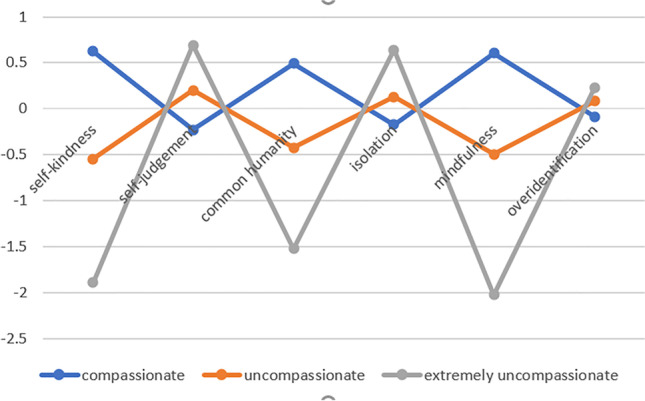
Z scores of self-compassion dimension in the 3-class model
Comparing College students’ Psychological Outcomes across Different Profiles
To examine the effects of different profiles on college students’ psychological outcomes, the RMM analyses were conducted. The results are presented in Tables 4 and 5. There were significant differences between the three latent subgroups of self-compassion in predicting college students’ adjustment indicators (p < 0.001). Further analysis found that students in the compassionate group scored significantly lower than the other two subgroups on the scale of anxiety symptoms, depression symptoms, insomnia symptoms, and CPTSD symptoms (p < 0.001), while scored significantly higher than the other two subgroups on the scale of PTG and PYD (p < 0.001). Besides, students in the uncompassionate group scored significantly lower than the extremely uncompassionate group on the scale of anxiety symptoms, depression symptoms, insomnia symptoms, and CPTSD symptoms (p < 0.05), while scored significantly higher than the extremely uncompassionate group on the scale of PYD (p < 0.001). However, there are no significant differences in the level of PTG between the uncompassionate group and the extremely uncompassionate group (p > 0.05).
Table 4.
Differences across self-compassion profiles on college students’ adjustment indicators
| CP vs UN | CP vs EU | UN vs EU | ||||
|---|---|---|---|---|---|---|
| χ2 | p | χ2 | p | χ2 | p | |
| Anxiety symptoms | 140.918 | < 0.001 | 90.208 | < 0.001 | 11.130 | < 0.001 |
| Depression symptoms | 50.744 | < 0.001 | 36.888 | < 0.001 | 5.457 | < 0.05 |
| Insomnia symptoms | 27.532 | < 0.001 | 32.578 | < 0.001 | 4.552 | < 0.05 |
| CPTSD symptoms | 27.114 | < 0.001 | 49.339 | < 0.001 | 4.484 | < 0.05 |
| PTG | 46.423 | < 0.001 | 32.496 | < 0.001 | 1.128 | > 0.05 |
| PYD | 73.542 | < 0.001 | 46.765 | < 0.001 | 5.288 | < 0.05 |
CP Compassionate group, UN Uncompassionate group, EU Extremely uncompassionate group
Table 5.
Mean scores across self-compassion profiles on college students’ adjustment indicators
| Compassionate group | Uncompassionate group | Extremely uncompassionate group | ||||
|---|---|---|---|---|---|---|
| M | SD | M | SD | M | SD | |
| Anxiety symptoms | 1.482 | 0.013 | 1.820 | 0.024 | 2.030 | 0.056 |
| Depression symptoms | 0.492 | 0.028 | 0.881 | 0.037 | 1.165 | 0.109 |
| Insomnia symptoms | 2.082 | 0.049 | 2.551 | 0.058 | 2.875 | 0.133 |
| CPTSD symptoms | 1.541 | 0.077 | 2.229 | 0.067 | 2.539 | 0.123 |
| PTG | 4.530 | 0.062 | 3.748 | 0.072 | 3.551 | 0.163 |
| PYD | 3.818 | 0.022 | 3.450 | 0.033 | 3.243 | 0.081 |
Discussion
The current study has adopted the person-centered approach to explore the multidimensional nature of self-compassion in college students and tested the predictive effects of different profiles on students’ psychological outcomes. We have identified three distinct profiles that reflected the self-compassionate, uncompassionate and extremely uncompassionate group respectively. The self-compassionate and uncompassionate profiles were replicated consistently with that previously identified by Phillips (Phillips, 2019) and Ullrich-French (Ullrich-French & Cox, 2020). In addition, we have identified another unique extremely uncompassionate profile which is characterized as extremely lower levels of positive dimensions of self-compassion and moderately higher levels of negative dimensions. Besides, we have adopted regression mixture modeling in a longitudinal design to shed light on how different self-compassion profiles exerted influence on college students’ psychological outcomes. We have found that students in the compassionate group adjusted best among the three subgroups after the home quarantine period during the COVID-19 pandemic (Phillips, 2019; Ullrich-French & Cox, 2020). In our study, more than half of the participants belonged to the compassionate group suggesting that most college students could hold a nonjudgement attitude toward the self, see their suffering as not different from others, and experience their thoughts and feelings in a balanced way (Neff, 2003a, 2016a; Neff et al., 2018a) during the COVID-19 pandemic.
Multi-dimensional structure of self-compassion
Consistent with previous studies (Phillips, 2019; Ullrich-French & Cox, 2020), the compassionate group and uncompassionate group were replicated in Chinese college students. This may indicate that the compassionate group and uncompassionate group represented two commonly self-responding patterns across cultures and subpopulations. In the current study, we also identified another unique group named as the extremely uncompassionate group which has not been identified in previous studies (Phillips, 2019; Ullrich-French & Cox, 2020). The extremely uncompassionate group was characterized as much lower levels of positive dimensions and similar levels of negative dimensions relative to the uncompassionate group. These two groups possessed a similar pattern but differed in their respective magnitude in positive and negative dimensions. Compared to the uncompassionate group, the extremely uncompassionate group demonstrated an extremely unbalanced pattern with almost an absence of positive responses relative to the negative responses. Overall, students in all groups displayed opposing levels of mean scores across dimensions. There are larger differences in the mean scores of positive dimensions of self-compassion across three groups than differences in negative dimension scores. It seems that it is particularly the positive self-responding dimensions that differentiate college students during the COVID-19 pandemic.
Our results have supported the conceptualization that self-compassion was represented by the relative balance of the six dimensions (Neff, 2003a; Neff et al., 2017, 2019). The level of mean scores across all dimensions within profiles tend to covary in unison; where the negative dimensions decreased as the positive dimensions increased, and vice versa. This is consistent with previous studies suggesting that the polar-opposite components (e.g., mindfulness and overidentification) are usually inversely related (Castilho et al., 2015; Veneziani et al., 2017). And this finding indirectly supported Neff’s proposition that a self-compassionate frame of mind is an interactive and synergistic system (Neff, 2016b; Neff et al., 2017).
The influence of multi-dimensional self-compassion on psychological adjustments
We have adopted regression mixture modeling in a longitudinal design to shed light on how different self-compassion profiles exerted influence on college students’ psychological outcomes. Conceptually consistent differences emerged across these three groups (Ullrich-French & Cox, 2020). We have found that students in the compassionate group adjusted best among groups with the highest levels on positive indicators (PTG and PYD) and the lowest levels on negative indicators (anxiety, depression, insomnia, and CPTSD symptoms) (Phillips, 2019; Ullrich-French & Cox, 2020). Even though the extremely uncompassionate group showed a significantly lower level of negative indicators and a higher level of PYD, this group did not show a significantly different level of PTG compared to the uncompassionate group.
Of note is that between these two groups, there are larger differences in the magnitude of positive dimensions relative to the differences of negative dimensions. We noted that there were no significant differences between self-judgment, isolation, and overidentification scores in the uncompassionate and extremely uncompassionate groups. This may reflect that PTG differences between these two groups were mainly driven by differences in positive dimensions. Considering the severely unbalanced pattern in the extremely uncompassionate group, it seems that it is particularly positive self-responding that determined positive psychological growth. Previous studies have highlighted the relative importance of positive dimensions on positive psychological adjustments. In a previous study (Phillips, 2019), in uncompassionate individuals, positive dimensions of self-kindness accounted for the most unique variance in positive psychological adjustments such as well-being and life satisfaction. Uncompassionate individuals who showed the lowest levels of self-kindness were most likely to experience low positive psychological adjustments. In this case, Phillips (Phillips, 2019) has suggested that training programs that promote self-kindness in vulnerable individuals may be most helpful in improving psychological wellness. Consistent with this study, our results also revealed that uncompassionate individuals with the lowest levels of positive dimensions demonstrated the lowest levels of PTG.
The results were also consistent with previous studies using a variable-centered approach about the relative importance of positive and negative dimensions for positive and negative psychological adjustments (Bluth & Blanton, 2015; Muris & Petrocchi, 2017; Sun et al., 2016). In previous studies, negative components of self-compassion demonstrated stronger relationships with negative psychological adjustments (Bluth & Blanton, 2015; Muris & Petrocchi, 2017). In contrast, positive components are more strongly linked to positive psychological adjustments. For example, researchers have found the significant effects of self-kindness, common humanity, and mindfulness on children’ positive personal growth (Sun et al., 2016). But self-judgment and overidentification could not significantly influence adolescents’ personal growth (Sun et al., 2016). Another study (Bluth & Blanton, 2015) has also found that positive dimensions were more strongly related to positive psychological adjustments. The positive dimension of common humanity played the most significant role in the associations with life satisfaction, but the negative dimension of isolation demonstrated the most consistent and strongest relationships with negative mood and perceived stress in adolescents (Bluth & Blanton, 2015).
We have explored the meaning of the relative balance among opposing dimensions for college students by investigating the longitudinal influence of self-compassion patterns on their psychological adjustments (Phillips, 2019; Ullrich-French & Cox, 2020). Although different components work together to influence psychological adjustments, they may play different roles within each self-compassion mindset. The current study highlighted the importance of exploring individual dimensions and the relative balance of opposing responses in each dimension (Phillips, 2019; Ullrich-French & Cox, 2020). Possibly to promote positive psychological growth in college students, it is not enough to only reduce the level of negative self-responding but to enhance the level of positive self-responding simultaneously (Neff et al., 2018c) and promote positive responses over negative responses as much as possible.
Implications
Our study has found that the extent that students feel kind to themselves, connected to the world, and mindful with feelings of suffering played a significant role in positive psychological growth of college students. This would provide implications for attempts to promote positive psychological adjustments in college students. It is more meaningful to focus on increasing the level of positive responses of self-compassion in college students (Ferrari et al., 2019; Neff & Germer, 2013). From our perspective, knowing the extent to which individuals display compassionate self-responses during stressful times is central to the understanding of how self-compassionate they are and facilitating their positive psychological growth overall.
Limitations and future directions
Using a longitudinal design, the current study contributes to our understanding of the multidimensionality of self-compassion and its predictive effects on psychological adjustment outcomes in college students. However, it should be acknowledged that there are also some limitations in the current study. First, the current study used a convenience sampling approach to recruit college students which may lead to possible selection biases. Future research could include clinical samples to test possible different underlying patterns of self-compassion dimensions. Second, the current study used a person-centered approach to investigate which limits the generalization of our results. Future research could adopt multiple approaches simultaneously to comprehensively explore the multidimensionality of self-compassion.
Conclusions
The current study identified unique patterns of multidimensionality of self-compassion among college students and examined the predictive effects of the profiles on college students’ psychological outcomes in a longitudinal design. The current study extends past research by identifying unique self-compassion patterns in college students during the pandemic. This study also demonstrated that different combination patterns of opposing dimensions of self-compassion could predict psychological adjustment outcomes efficiently. Previous studies have commonly used the total score to explore the association between self-compassion neglecting the relative balance between positive and negative dimensions (Muris & Petrocchi, 2017; Neff et al., 2018c; Yang, 2016; Yang et al., 2016; Zessin et al., 2015). And this may be misleading especially when referring self-compassion to the positive psychological outcomes.
Authors' contributions
Conceptualization, X.C. and Y.R.; data collection, X.C. and L.H.; formal analysis, Y.R.; writing—original draft preparation, X.C., L.H., and Y.R.; writing—review and editing, L.H., J.Z., E.W., and Y.R. All authors have read and agreed to the published version of the manuscript.
Funding
This work was supported by the Guangdong Basic and Applied Basic Research Foundation [grant number 2021A1515011330].
Data availability
The Data are part of an ongoing project. For privacy or ethical restrictions, primary data are not publicly available. The data supporting the findings of this study are available from the first author, X.C. (xinlichi@126.com) upon request.
Code availability
Not applicable.
Declarations
Conflicts of interest
Declaration of interest: none.
Ethics approval (include appropriate approvals or waivers)
This research project was approved by the Ethics Committee of Shenzhen University (No:2020005). All procedures performed in studies involving human participants were in accordance with the ethical standards of the institutional and/or national research committee and with the 1964 Helsinki Declaration and its later amendments or comparable ethical standards.
Consent to participate
Informed consent was obtained from all individual participants included in the study.
Consent for publication
Written informed consent for publication was obtained from all participants.
Footnotes
Publisher's note
Springer Nature remains neutral with regard to jurisdictional claims in published maps and institutional affiliations.
References
- Asparouhov T, Muthén B. Auxiliary variables in mixture modeling: Three-step approaches using Mplus. Structural Equation Modeling. 2014;21:329–341. doi: 10.1080/10705511.2014.915181. [DOI] [Google Scholar]
- Bao Y, et al. 2019-nCoV epidemic: Address mental health care to empower society. The Lancet. 2020;395(10224):e37–e38. doi: 10.1016/S0140-6736(20)30309-3. [DOI] [PMC free article] [PubMed] [Google Scholar]
- Berryhill MB, Smith J. College Student Chaotically-Disengaged Family Functioning, Depression, and Anxiety: The Indirect Effects of Positive Family Communication and Self-Compassion. Marriage & Family Review. 2021;57(1):1–23. doi: 10.1080/01494929.2020.1740373. [DOI] [Google Scholar]
- Bluth K, Blanton PW. The influence of self-compassion on emotional well-being among early and older adolescent males and females. The Journal of Positive Psychology. 2015;10(3):219–230. doi: 10.1080/17439760.2014.936967. [DOI] [PMC free article] [PubMed] [Google Scholar]
- Brooks SK, et al. The psychological impact of quarantine and how to reduce it: Rapid review of the evidence. The Lancet. 2020;395(10227):912–920. doi: 10.1016/S0140-6736(20)30460-8. [DOI] [PMC free article] [PubMed] [Google Scholar]
- Castilho P, Pinto-Gouveia J, Duarte J. Evaluating the Multifactor Structure of the Long and Short Versions of the Self-Compassion Scale in a Clinical Sample. Journal of Clinical Psychology. 2015;71(9):856–870. doi: 10.1002/jclp.22187. [DOI] [PubMed] [Google Scholar]
- Chang EC, et al. Understanding the Association Between Negative Life Events and Suicidal Risk in College Students: Examining Self-Compassion as a Potential Mediator. Journal of Clinical Psychology. 2017;73(6):745–755. doi: 10.1002/jclp.22374. [DOI] [PubMed] [Google Scholar]
- Cleare S, et al. An Investigation of the Factor Structure of the Self-Compassion Scale. Mindfulness (N Y) 2018;9(2):618–628. doi: 10.1007/s12671-017-0803-1. [DOI] [PMC free article] [PubMed] [Google Scholar]
- Cloitre, M. S. M., Brewin, C. R., Bisson, J. I., Roberts, N. P., Maercker, A., Karatzias, T., Hyland, P. (2018). The International Trauma Questionnaire: development of a self-report measure of ICD-11 PTSD and complex PTSD. Acta Psychiatrica Scandinavica, 138(6), 536–546. [DOI] [PubMed]
- Collins, L. M., Lanza, S. T. (2010) Latent class and latent transition analysis. With applications in the social, behavioral, and health sciences. John Wiley & Sons.
- Costa, J., et al. (2016). Validation of the psychometric properties of the Self-Compassion Scale. Testing the factorial validity and factorial invariance of the measure among borderline personality disorder, anxiety disorder, eating disorder and general populations. Clinical Psychology & Psychotherapy, 23, 460–468 [DOI] [PubMed]
- Costa J, et al. Validation of the Psychometric Properties of the Self-Compassion Scale. Clinical Psychology & Psychotherapy. 2016;23(5):460–468. doi: 10.1002/cpp.1974. [DOI] [PubMed] [Google Scholar]
- Deng, J., Wang, M.-C., Shou, Y., Lai, H., Zeng, H., & Gao, Y. (2020). Parenting behaviors and child psychopathy: A regression mixture analysis. Current Psychology. 10.1007/s12144-020-00810-4
- Ferrari M, et al. Self-Compassion Interventions and Psychosocial Outcomes: A Meta-Analysis of RCTs. Mindfulness. 2019;10:1455–1473. doi: 10.1007/s12671-019-01134-6. [DOI] [Google Scholar]
- Forte, G., Favieri, F., Tambelli, R., & Casagrande, M. (2020). COVID-19 pandemic in the Italian population: Validation of a post-traumatic stress disorder questionnaire and prevalence of PTSD symptomatology. International Journal of Environmental Research and Public Health, 17(11). 10.3390/ijerph17114151 [DOI] [PMC free article] [PubMed]
- Gross JV, Mohren J, Erren TC. COVID-19 and healthcare workers: A rapid systematic review into risks and preventive measures. British Medical Journal Open. 2021;11(1):e042270. doi: 10.1136/bmjopen-2020-042270. [DOI] [PMC free article] [PubMed] [Google Scholar]
- Gutiérrez-Hernández, M. E., Fanjul Rodríguez, L. F., Díaz Megolla, A., Oyanadel, C., & Peñate Castro, W. (2022). Analysis of the predictive role of self-compassion on emotional distress during COVID-19 lockdown. Social Sciences, 11(4). 10.3390/socsci11040151
- Ho GWK, et al. Translation and validation of the Chinese ICD-11 International Trauma Questionnaire (ITQ) for the Assessment of Posttraumatic Stress Disorder (PTSD) and Complex PTSD (CPTSD) European Journal of Psychotraumatology. 2019;10(1):1608718. doi: 10.1080/20008198.2019.1608718. [DOI] [PMC free article] [PubMed] [Google Scholar]
- Huang L, et al. Validity and reliability of the Chinese version of the 5 Cs Positive Youth Development Scale- Very Short Form. Chinese Mental Health Journal. 2021;35(8):1–7. [Google Scholar]
- Kalkan Ugurlu, Y., Mataraci Degirmenci, D., Durgun, H., & Gok Ugur, H. (2020). The examination of the relationship between nursing students’ depression, anxiety and stress levels and restrictive, emotional, and external eating behaviors in COVID-19 social isolation process. Perspect Psychiatr Care. 10.1111/ppc.12703 [DOI] [PMC free article] [PubMed]
- Karatzias T, et al. Posttraumatic Stress Symptoms and Associated Comorbidity During the COVID-19 Pandemic in Ireland: A Population-Based Study. Journal of Traumatic Stress. 2020;33(4):365–370. doi: 10.1002/jts.22565. [DOI] [PMC free article] [PubMed] [Google Scholar]
- Krieger, T., T. Berger, Holtforth M. g. (2016) The relationship of self-compassion and depression: Cross-lagged panel analyses in depressed patients after outpatient therapy. Journal of Affective Disorders, 202, 39–45. [DOI] [PubMed]
- Levis B, Benedetti A, Thombs BD. Accuracy of Patient Health Questionnaire-9 (PHQ-9) for screening to detect major depression: Individual participant data meta-analysis. BMJ. 2019;365:l1476. doi: 10.1136/bmj.l1476. [DOI] [PMC free article] [PubMed] [Google Scholar]
- Li Y, et al. Psychological survey of COVID-19 in the general public. Infection International (electronic Edition) 2020;9(2):308–310. [Google Scholar]
- Li Y, et al. Mental Health Among College Students During the COVID-19 Pandemic in China: A 2-Wave Longitudinal Survey. Journal of Affective Disorders. 2021;281:597–604. doi: 10.1016/j.jad.2020.11.109. [DOI] [PubMed] [Google Scholar]
- Li A, et al. Self-compassion and life-satisfaction among Chinese self-quarantined residents during COVID-19 pandemic: A moderated mediation model of positive coping and gender. Pers Individ Dif. 2021;170:110457. doi: 10.1016/j.paid.2020.110457. [DOI] [PMC free article] [PubMed] [Google Scholar]
- Lipsitch M, Swerdlow DL, Finelli L. Defining the Epidemiology of Covid-19 — Studies Needed. The New England Journal of Medicine. 2020;382(13):1194–1196. doi: 10.1056/NEJMp2002125. [DOI] [PubMed] [Google Scholar]
- Liu, C. H., Zhang, E., Wong, G. T. F., Hyun, S., & Hahm, H. C. (2020a). Factors associated with depression, anxiety, and PTSD symptomatology during the COVID-19 pandemic: Clinical implications for U.S. young adult mental health. Psychiatry Research, 290, 113172. 10.1016/j.psychres.2020.113172 [DOI] [PMC free article] [PubMed]
- Liu, Z., et al. (2020b). Gender Differences in Associated and Predictive Factors of Anxiety and Depression in People With Epilepsy. Frontiers in Psychiatry, 11. [DOI] [PMC free article] [PubMed]
- Lubke G, Muthén BO. Performance of Factor Mixture Models as a Function of Model Size, Covariate Effects, and Class-Specific Parameters. Structural Equation Modeling: A Multidisciplinary Journal. 2007;14(1):26–47. doi: 10.1080/10705510709336735. [DOI] [Google Scholar]
- Marsh HW, et al. Classical Latent Profile Analysis of Academic Self-Concept Dimensions: Synergy of Person- and Variable-Centered Approaches to Theoretical Models of Self-Concept. Structural Equation Modeling: A Multidisciplinary Journal. 2009;16(2):191–225. doi: 10.1080/10705510902751010. [DOI] [Google Scholar]
- Merz EL, Roesch SC. A latent profile analysis of the Five Factor Model of personality: Modeling trait interactions. Pers Individ Dif. 2011;51(8):915–919. doi: 10.1016/j.paid.2011.07.022. [DOI] [PMC free article] [PubMed] [Google Scholar]
- Muris P, Petrocchi N. Protection or Vulnerability? A Meta-Analysis of the Relations Between the Positive and Negative Components of Self-Compassion and Psychopathology. Clinical Psychology & Psychotherapy. 2017;24:373–383. doi: 10.1002/cpp.2005. [DOI] [PubMed] [Google Scholar]
- Muthen, L. K., Muthen, B. O. (n.d.) Mplus user’s guide (7th ed.). 1998–2012: Authors.
- Neff K. Self-compassion: An alternative conceptualization of a healthy attitude toward oneself. Self and Identity. 2003;2:85–102. doi: 10.1080/15298860309032. [DOI] [Google Scholar]
- Neff KD. The Development andValidation ofa Scale to Measure Self-Compassion. Self and Identity. 2003;2:223–250. doi: 10.1080/15298860309027. [DOI] [Google Scholar]
- Neff KD, Germer CK. A pilot study and randomized controlled trial of the mindful self-compassion program. Journal of Clinical Psychology. 2013;69(1):28–44. doi: 10.1002/jclp.21923. [DOI] [PubMed] [Google Scholar]
- Neff KD. Does Self-Compassion Entail Reduced Self-Judgment, Isolation, and Over-Identification? A Response to Muris, Otgaar, and Petrocchi (2016) Mindfulness. 2016;7(3):791–797. doi: 10.1007/s12671-016-0531-y. [DOI] [Google Scholar]
- Neff KD. The self-compassion scale is a valid and theoretically coherent measure of self-compassion. Mindfulness. 2016;7(1):264–274. doi: 10.1007/s12671-015-0479-3. [DOI] [Google Scholar]
- Neff KD, Whittaker TA, Karl A. Examining the factor structure of the self-compassion scale in four distinct populations: Is the use of a total scale score justified? Journal of Personality Assessment. 2017;99(6):596–607. doi: 10.1080/00223891.2016.1269334. [DOI] [PubMed] [Google Scholar]
- Neff KD, et al. The forest and the trees: Examining the association of selfcompassion and its positive and negative components with psychological functioning. Selfand Identity. 2018;17:627–645. doi: 10.1080/15298868.2018.1436587. [DOI] [Google Scholar]
- Neff KD, et al. The forest and the trees: Examining the association of self compassion and its positive and negative components with psychological functioning. Self and Identity. 2018;17:627–645. doi: 10.1080/15298868.2018.1436587. [DOI] [Google Scholar]
- Neff KD, et al. The forest and the trees: Examining the association of self-compassion and its positive and negative components with psychological functioning. Self and Identity. 2018;17(6):627–645. doi: 10.1080/15298868.2018.1436587. [DOI] [Google Scholar]
- Neff KD, et al. Examining the factor structure of the Self-Compassion Scale in 20 diverse samples: Support for use of a total score and six subscale scores. Psychological Assessment. 2019;31:27–45. doi: 10.1037/pas0000629. [DOI] [PubMed] [Google Scholar]
- Ostrove JM, et al. Objective and subjective assessments of socioeconomic status and their relationship to self-rated health in an ethnically diverse sample of pregnant women. Health Psychology. 2000;19(6):613–618. doi: 10.1037/0278-6133.19.6.613. [DOI] [PubMed] [Google Scholar]
- Petrocchi N, Dentale F, Gilbert P. Self-reassurance, not selfesteem, serves as a buffer between self-criticism and depressive symptoms. Psychology and Psychotherapy: Theory, Research and Practice. 2018;92(3):394–406. doi: 10.1111/papt.12186. [DOI] [PubMed] [Google Scholar]
- Phillips, W. J. (2019). Self-compassion mindsets: the components of the self-compassion scale operate as a balanced system within individuals. Current Psychology. Online, 1–14. 10.1007/s12144-019-00452-1
- Plexousakis SS, et al. School bullying and post-traumatic stress disorder symptoms: The role of parental bonding. Frontiers in Public Health. 2019;7:75–75. doi: 10.3389/fpubh.2019.00075. [DOI] [PMC free article] [PubMed] [Google Scholar]
- Rudenstine S, et al. Depression and Anxiety During the COVID-19 Pandemic in an Urban, Low-Income Public University Sample. Journal of Traumatic Stress. 2021;34(1):12–22. doi: 10.1002/jts.22600. [DOI] [PMC free article] [PubMed] [Google Scholar]
- Schwartz RM, et al. Examining Associations Between Hurricane Sandy Exposure and Posttraumatic Stress Disorder by Community of Residence. Journal of Traumatic Stress. 2019;32(5):677–687. doi: 10.1002/jts.22445. [DOI] [PubMed] [Google Scholar]
- Shek DTL, et al. The Impact of Positive Youth Development Attributes on Posttraumatic Stress Disorder Symptoms Among Chinese Adolescents Under COVID-19. Journal of Adolescent Health. 2021;68(4):676–682. doi: 10.1016/j.jadohealth.2021.01.011. [DOI] [PubMed] [Google Scholar]
- Shin NY, Lim YJ. Contribution of self-compassion to positive mental health among Korean university students. International Journal of Psychology. 2019;54(6):800–806. doi: 10.1002/ijop.12527. [DOI] [PubMed] [Google Scholar]
- Sun X, Chan DW, Chan L-K. Self-compassion and psychological well-being among adolescents in Hong Kong: Exploring gender differences. Personality and Individual Differences. 2016;101:288–292. doi: 10.1016/j.paid.2016.06.011. [DOI] [Google Scholar]
- Tang W, et al. Prevalence and correlates of PTSD and depressive symptoms one month after the outbreak of the COVID-19 epidemic in a sample of home-quarantined Chinese university students. Journal of Affective Disorders. 2020;274:1–7. doi: 10.1016/j.jad.2020.05.009. [DOI] [PMC free article] [PubMed] [Google Scholar]
- Tedeschi RG, Calhoun LG. The Posttraumatic Growth Inventory: Measuring the Positive Legacy of lkauma. Journal of Tmumatic Stress. 1996;9(3):455–471. doi: 10.1002/jts.2490090305. [DOI] [PubMed] [Google Scholar]
- Tedeschi RG, Calhoun LG. The posttraumatic growth inventory: Measuring the positive legacy of trauma. Journal of Traumatic Stress. 1996;9:455–471. doi: 10.1002/jts.2490090305. [DOI] [PubMed] [Google Scholar]
- Tian Y, et al. Complex posttraumatic stress disorder in Chinese young adults using the International Trauma Questionnaire (ITQ): A latent profile analysis. Journal of Affective Disorders. 2020;267:137–143. doi: 10.1016/j.jad.2020.02.017. [DOI] [PubMed] [Google Scholar]
- Ullrich-French S, Cox AE. The Use of Latent Profiles to Explore the Multi-dimensionality of Self-compassion. Mindfulness. 2020;11(6):1483–1499. doi: 10.1007/s12671-020-01365-y. [DOI] [Google Scholar]
- Veneziani CA, Fuochi G, Voci A. Self-compassion as a healthy attitude toward the self: Factorial and construct validity in an Italian sample. Personality and Individual Differences. 2017;119:60–68. doi: 10.1016/j.paid.2017.06.028. [DOI] [Google Scholar]
- Vermunt JK. Latent Class Modeling with Covariates: Two Improved Three-Step Approaches. Political Analysis. 2010;18(4):450–469. doi: 10.1093/pan/mpq025. [DOI] [Google Scholar]
- Wang J, et al. Revision of the Posttraumatic Growth Inventory and testing its reliability and validity. Chin. Journal of Nursing Science. 2011;26:26–28. [Google Scholar]
- Williams MJ, et al. Examining the factor structures of the five facet mindfulness questionnaire and the self-compassion scale. Psychological Assessment. 2014;26(2):407–418. doi: 10.1037/a0035566. [DOI] [PubMed] [Google Scholar]
- Yang X. Self-compassion, relationship harmony, versus self-enhancement: Different ways of relating to well-being in Hong Kong Chinese. Personality and Individual Differences. 2016;89:24–27. doi: 10.1016/j.paid.2015.09.006. [DOI] [Google Scholar]
- Yang Y, Zhang M, Kou Y. Self-compassion and life satisfaction: The mediating role of hope. Personality and Individual Differences. 2016;98:91–95. doi: 10.1016/j.paid.2016.03.086. [DOI] [Google Scholar]
- Zessin U, Dickhauser O, Garbade S. The Relationship Between Self-Compassion and Well-Being: A Meta-Analysis. Applied Psychology. Health and Well-Being. 2015;7(3):340–364. doi: 10.1111/aphw.12051. [DOI] [PubMed] [Google Scholar]
- Zhou X, et al. The roles of rumination and social support in the associations between core belief challenge and post-traumatic growth among adolescent survivors after the Wenchuan earthquake. Acta Psychologica Sinica. 2014;46:1509–1520. doi: 10.3724/SP.J.1041.2014.01509. [DOI] [Google Scholar]
Associated Data
This section collects any data citations, data availability statements, or supplementary materials included in this article.
Data Availability Statement
The Data are part of an ongoing project. For privacy or ethical restrictions, primary data are not publicly available. The data supporting the findings of this study are available from the first author, X.C. (xinlichi@126.com) upon request.
Not applicable.