



Abstract
African American Language (AAL) is one of the most researched varieties of American English, yet key aspects of its development and spread remain under‐theorized. For example, regional and social variation in the speech of African Americans was initially understudied in AAL as scholars sought to demonstrate the overall systematicity of the variety, often at the expense of examining variation across and within communities. More recently, scholars have begun to address this gap by examining different sources of variation in AAL phonology. For instance, the African American Vowel System (AAVS), also called the African American Vowel Shift, describes a pattern identified within AAL, including the raising of the front lax vowels and the nonfronting of the high‐ and mid‐back vowels. Aspects of the AAVS have been found in geographically widespread varieties of AAL, suggesting that shared patterns of population movement resulting from the Great Migration and subsequent social experiences may have led to the development of this system. Other more regionally limited sound patterns suggest the role of more localized processes of variation and change. We focus on three sources of variation that have contributed to the spread and realizations of the sound system in modern AAL: migration, segregation, and place and identity. Evidence from sociophonetic analyses across these three factors provides a foundation to more thoroughly document the ways in which AAL varieties developed, spread, and vary, while allowing for a more nuanced assessment of racialization and its implications for individual differences.
This article is categorized under:
Linguistics > Linguistic Theory
Psychology > Language
Keywords: African American Language, Sociophonetics, Variation, Language Contact, Migration
Demographic changes in cities like Washington, DC were due to the Great Migration, and such changes matter greatly for language variation in African American Language.

1. INTRODUCTION
The speech of African Americans, often called African American Language (AAL) or African American English (AAE), is one of the most researched varieties of American English, yet key aspects of its 20th century spread and subsequent development remain under theorized. For example, variation in the phonological systems were initially understudied in AAL as scholars sought to demonstrate the overall systematicity of AAL varieties, especially among children. Researchers overlooked and sometimes ignored variation both within and across communities and individuals (Wolfram, 2007). Such variation in AAL reveals the complex relationships between migration, segregation, and other sociohistorical forces on the development and racialization of AAL.
As a field, we have moved beyond the so‐called supraregional myth of the speech of African Americans, which Wolfram (2007, p. 4) described as the observation that “vernacular AAE revealed a kind of uniformity immune to regionality.” In reality, regional differences have always played—and continue to play—a significant role in the variety. In earlier AAL, differing linguistic ecologies across communities and economies that depended on the labor of enslaved African Americans reflected regional variation in the speech of African Americans (Mufwene, 2001a), and such variation is revealed in early recordings of formerly enslaved individuals (Bailey, Maynor, & Cukor‐Avila, 1991) as well as written communication, such as personal letters (Van Herk, 2015). Between 1915 and 1970, the period known as the Great Migration (Tolnay, 2003; Wilkerson, 2010), when African Americans moved out of the rural South, migration routes tended to be somewhat regular, leading to regional differences in destination cities that reflected the language varieties of the source states. Additionally, the migration from rural to urban contexts led to deeply segregated (de jure and de facto) cities, a level of segregation and population density of African Americans that just was not experienced in the rural South (Rothstein, 2017). These sociohistorical facts become bound up not only in the ways AAL developed, but also in the research questions asked by linguists at different historical moments, and in the ways the field thinks about and describes AAL.
At the peak of these demographic and population changes in the 1960s, sociolinguists were examining the systematicity in the speech of African Americans, particularly in urban Northern contexts like New York City (Labov, Cohen, Robins, & Lewis, 1968), Detroit (Wolfram, 1969) and Washington, DC (Fasold, 1972), field sites characterized by deep levels of segregation, dialect contact, and recent migration. With expanded access to a range of linguistic data from distinct regions, communities, and social groups, from sources such as the Corpus of Regional AAL (CORAAL; Kendall & Farrington, 2020) and the Online Resources for African American Language (ORAAL; Kendall, McLarty, & Farrington, 2020), we can now revisit these older studies in the context of what we know about long‐term population changes as a way to better understand dialect contact and the 20th century development of AAL. We can also return to newer studies to examine how this variation plays out among AAL speaking individuals and communities. The wealth of data currently available on AAL allows us to look forward and anticipate newer questions regarding how language becomes racialized and how it is taken up in the production of style. These new directions simultaneously acknowledge that shared cultural experiences and histories contribute to the establishment of varieties identified and racialized as “sounding Black,” even as variation within speakers, and across communities and regions reveals a richer picture of how individuals negotiate their way linguistically through the broad social structures that shape their everyday lives.
In the current article, we review theoretical lenses that have started to transform approaches to the study of AAL phonology and provide a review of previous work, illustrating how legacy data and studies can be reinterpreted through these lenses. We then turn to studies that employ these theoretical lenses to answer the question of how ethnicity and language interact through processes of racialization. Finally, we point to future directions that will outline both the need to encompass a larger amount of data, while not assuming homogeneity, to account for the levels of heterogeneity in AAL, while also expanding what we think of as linguistic features of AAL, so as not to focus on particularly racialized patterns, but patterns that different speakers can employ to index different kinds of identities.
2. HISTORICAL AND SOCIOLOGICAL CONTEXT OF AAL
Questions regarding how migration influenced AAL have always been a part of the field, but work that has incorporated place, demographics, and migration as theoretical lenses is neither common nor consistently incorporated across time periods. For example, migration was a key consideration in research on the origins of AAL, but tended to be overlooked in work documenting the variety in the 1960's and 1970's. These considerations influenced the ways linguists approached and talked about language variation in African American communities, shaping research designs and influencing academic narratives surrounding AAL.
Arguments about the origins of AAL have long considered the role of migration and contact in the development of the variety, dating back to the early days in the field (Dillard, 1972; Stewart, 1967). This work examined the role of source populations to evaluate whether AAL developed out of creole varieties 1 (e.g., the Creolist Hypothesis, Rickford, 2015) or whether AAL largely developed from the local regional European American varieties (e.g., the Anglicist and Neo‐Anglicist Hypotheses, Van Herk, 2015). The substrate hypothesis (Wolfram & Thomas, 2002) maintains a balance between the two hypotheses, suggesting that while AAL may have exhibited features of regional varieties of white varieties of English in America, a handful of linguistic effects have always distinguished AAL from local white varieties. At the same time, related work by Mufwene (2001b) shows how the historical ecological situation across different parts of the South contribute to linguistic outcomes. An important argument within Mufwene's work is that linguists have historically treated varieties spoken by racialized groups as exceptional, ignoring the roles that contact, demographics, and natural change processes, factors that affect all languages, play in the production of AAL. We find this critique still relevant today. These arguments about origins also fed into the convergence/divergence debates in the 1970s and 1980s (Fasold et al., 1987), which focused on whether the speech of African Americans was becoming more similar or more different from the speech of whites. Despite this early focus on demographics, contact, and migration in the investigation of the origins of AAL, the roles of 20th century migration, contact, and changing demographics of cities associated with the Great Migration were often overlooked in the study of AAL, but see Bailey and Maynor (1987, 1989).
The Great Migration was the movement of over 6 million African Americans out of the rural South between 1916 and 1970 (Tolnay, 2003). While it may have been one of the most under‐reported stories of the 20th century (Wilkerson, 2010), a wealth of historical and sociological studies over the past 50 years have contextualized this time period with census data as well as migration narratives. The critical role that the Great Migration played in American history, including “the social geography of black and white neighborhoods, the spread of the housing projects as well as the rise of a […] black middle class, along with the alternating waves of white flight and suburbanization” (Wilkerson, 2010, p. 10) can be traced to the sociopolitical outcomes of the Great Migration. As sociologists, demographers, and historians shed light on this quiet but monumental population shift, linguists have new opportunities to consider the role mass migration played in establishing modern varieties of AAL. Such work sheds light on the interplay of language, demography, and geography, illustrating how the movement of people and the shaping of communities impacts culture in concrete and measurable ways.
The relationship between the spread of AAL and the Great Migration cannot be understated. In discussing AAL vowel differences, Thomas (2001, p. 165) notes the “surprising degree of uniformity over much of the country” which is “undoubtedly linked to the relative recentness of the Great Migration.” Additionally, in a discussion of the divergence in the speech of African Americans and white Americans, Bailey and Maynor (1987, 1989) link this divergence to increasing segregation as well as the migration of African Americans out of the rural South into urban areas. They argue that the divergence in modern day vernacular AAL was due, in large part, to these demographic processes that were going on in the United States. Yet, the linguistic effects of the Great Migration, including the roles of migration, segregation, and intraethnic contact have not been fully considered by the field as such work necessitates geographically diverse datasets from a range of time periods.
The fact that many cornerstone studies of AAL took place during the Great Migration has shaped the field's view of AAL in important ways. As discussed with the early studies of AAL (Fasold, 1972; Labov et al., 1968; Wolfram, 1969), the focus on similarities might be a result of the time and places in question. Research from this time period was likely capturing linguistic processes and outcomes of new dialect formation (Dodsworth, 2017; Trudgill, Gordon, Lewis, & Maclagan, 2000), heavily influenced by migration out of the Southern United States (Farrington, 2019) and deep levels of segregation (Rothstein, 2017). Without the sociohistorical context provided by multiple decades of research into the Great Migration, linguists were less likely to interpret their results within this context. The mechanisms of the development of AAL are better understood in light of how several decades of continued migration to, between, and within segregated cities promoted the cultural and individual identity changes that resulted in what we now know of as AAL. For destination cities, the Great Migration contributed to cultural “southernizing,” where, through their presence alone, African Americans from the South transformed institutions and cultural patterns of the locations where they settled, thus “helping to reconstruct the South they had left” (Gregory, 1998, p. 136). The southernizing in these cities could also contribute to the metalinguistic commentary of sounding “country” in AAL, regardless of whether a city is actually in the geographic South or not. So, Smitherman (1977, p. 170) notes that for some speakers, “black speech is associated with being ‘country,’ down Southish.”
In addition to migration from the rural South to the urban North and West, equally important to the development of AAL is the amount of migration within the South. Hunter and Robinson (2018, p. 77) note that “internal migration within the South was an equally transformative feat” in reshaping the demographic map of America. With so many individuals moving from rural to urban areas, it is no wonder that the spread of AAL in urban contexts was particularly important (Bailey & Maynor, 1989; Wolfram, 2007) but the linguistic effects are also found in rural areas (Bailey & Maynor, 1987, 1989; Cukor‐Avila, 1995; Wolfram & Thomas, 2002) because of the cultural impact of the new urban cities as well as continued shared connections to those who left.
In addition to the focus of sociolinguists on the systematicity of AAL, the focus on a‐regionality in AAL could also be a result of linguistic outcomes, such as dialect leveling, of in‐migrants coming to cities from the rural South. Such linguistic patterns have been shown to be common in dialect contact situations and new dialect formation (Dodsworth, 2017). The patterns of migration varied by city. In Detroit, for example, Wolfram (1969, p. 24) noted that the new Black population was “largely drawn from the South Central states, primarily Alabama, Mississippi, and Georgia.” Whereas in an eastern city like Washington, DC, the paths of migration often began in South Atlantic states like Virginia, North Carolina, and South Carolina (Farrington, 2019). Presumably, any differences in the cities that were investigated would be the result of source populations, but these patterns were overlooked in favor of shared linguistic structures.
Finally, the purpose of the research shaped the kinds of questions asked and variables examined in these early studies. Most of these studies did not focus on phonological variation because their focus was on describing the “core” syntactic properties of vernacular AAL as they saw it in order to document the variety, dispel myths surrounding the variety, and address educational disparities (Wolfram, 2007; Wolfram & Kohn, 2015). This body of work did not deny that regionality existed. Indeed, like Green (2002), they often assumed that the phonological system would be a likely source of regional variation. Yet, their goals precluded the examination of this line of research, also leaving consideration of style, class, identity, and connection to place to future researchers.
3. SEGMENTAL PHONOLOGY AND REGIONAL VARIATION IN AAL
In this section, we discuss the standard view of AAL phonology, which has involved the creation of feature lists, often listed in review articles (e.g., Bailey & Thomas, 1998; Fasold & Wolfram, 1970; Rickford, 1999; Thomas, 2007, 2015; Thomas & Bailey, 2015). Work in allied fields, such as speech pathology and education, use these feature lists to create composite indices to assess the use of AAL (Craig & Washington, 2006). We discuss some more recent quantitative studies and, where available, features are discussed in terms of regional varieties and whether they have been racialized as features of AAL. This is not meant to be a comprehensive review, but provides insights into how scholars have addressed phonological variation in the past. Earlier studies often downplayed place, time, and social conditions in the discussions of phonological features of AAL as the primary goal was to establish a timeline of linguistic change from the data available to them. As such, they all provide a baseline from which we can work.
3.1. Vowels
3.1.1. Relationship to local white speech
Dialectologists often viewed AAL as indistinguishable from regional varieties of white English for individuals of similar class and education backgrounds (Kurath, 1949; Williamson, 1968). In gathering the speech of older speakers in more remote rural communities, there was likely more regionality as such speakers would not be affected by the Great Migration to the same extent as younger speakers in more urban areas. With this in mind, these conclusions reflect the time and social context under which the data was gathered (Wolfram & Thomas, 2002). Even so, later sociolinguistic analyses indicated that early evidence of phonological variation in AAL showed a more complex relationship to the speech of Southern whites than depicted by dialectologists.
Later on, there was more explicit reference to the relationship between varieties of AAL and Southern white varieties (Bailey, 2001; Bailey & Thomas, 1998; Fasold, 1981; Thomas & Bailey, 1998), illustrating how aspects of the emergence of the Southern Vowel Shift (SVS) became apparent in the speech of both African Americans and whites as part of the industrialization and subsequent population movements that occurred after the Civil War. This line of research found overlap across varieties, even as differences in both timing and participation set these groups apart.
The divergence/convergence debate, and later, Labov's (2010) statement that African Americans resist participation in regional white sound changes, sparked a series of studies examining the extent to which African Americans align their speech with regional white sound changes. The Great Migration and subsequent segregation in non‐Southern cities resulted in what Thomas (1997) called dialect islands, where one dialect exists within an area dominated by another dialect. This pattern contrasted with those found in the South, especially the rural South, where there was perhaps more integration historically, which led to similar regional sound patterns (Wolfram & Thomas, 2002). This line of research expands upon the early studies in that the role of interracial contact and geographic diversity becomes more prominent. Further, much of this work examines how speakers use different regional vowel patterns in the construction of identity, drawing focus to intracommunity differences.
Many vowel studies have been done in large urban areas that saw an increase in the African American population due to the Great Migration, such as Detroit (Anderson, 2003), New York City (Coggshall & Becker, 2010), Philadelphia (Labov, 2014), Memphis (Fridland, 2003a, 2003b), Lansing, MI (Jones & Preston, 2006), Pittsburgh (Eberhardt, 2010), Seattle (Scanlon, 2020; Scanlon & Wassink, 2010), Bakersfield, CA (King, 2016), Rochester, NY (King, 2018), and Washington, DC (Arnson & Farrington, 2017; Lee, 2016, 2018). There is additional work focusing on the connections between rural AAL vowels and rural white speech, such as Wolfram and Thomas' (2002) work in Hyde County, NC. Such research added more geographic diversity to the work on AAL, demonstrating that regional differences do indeed exist, even if there are some common trends that emerge across these studies.
These studies added complexity to our understanding of AAL, infusing nuance into the picture painted from the earliest studies of AAL. Yet, missing from this picture are discussions of the sociohistorical changes that occurred between the earliest AAL studies and the wave of vowel studies from the early part of this century. While Labov, Wolfram, and Fasold collected data during the last decade of the Great Migration, researchers such as Becker, Eberhardt, and King studied communities that grew out of the Great Migration but now had several generations of children born and raised in the communities under analysis. In terms of dialect contact, these later generations would be the ones expected to exhibit increased differentiation compared to earlier generations (Schneider, 2007). As discussed above, even rural areas saw major linguistic changes as a result of the Great Migration so that the role of this social movement cannot be ignored even within the communities most prized by dialectologists for their conservation of older variation (Bailey & Maynor, 1989; Cukor‐Avila, 1995; Wolfram & Thomas, 2002). Given this attention, we can no longer claim that vocalic variation is understudied in AAL. However, theorization of AAL vowel variation that assesses the role of modern migration, contact, and individual variation deserves additional scrutiny.
3.1.2. The African American Vowel System
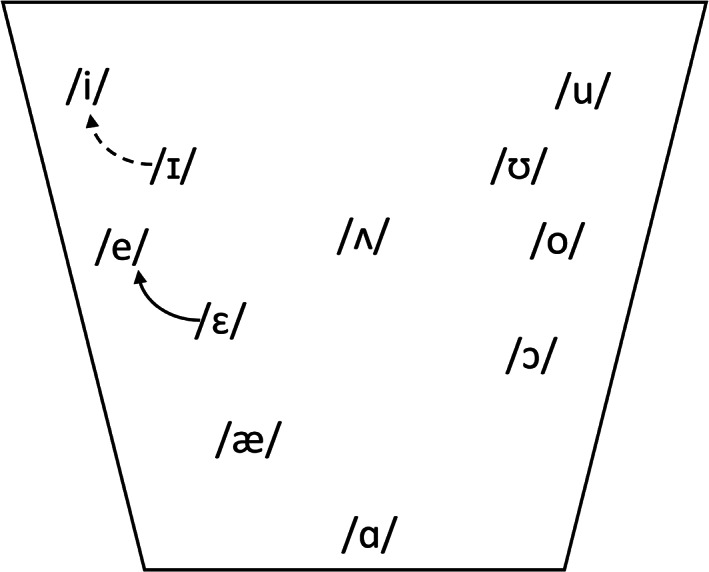
The AAVS is a heuristic model based on a comprehensive survey of the AAL sociophonetic studies produced during the waves of research presented in previous sections (Kohn, 2014; Thomas, 2007). Thomas (2007, p. 464) describe the structure of the system as having a lot vowel is fronted, which leads to many varieties of AAL not exhibiting the low back merger shift of the lot and thought vowel classes, and that the fronting of lot “appears to be part of a chain shift in AAE in which the trap and dress vowels, and perhaps (but less obviously) the kit vowel, are raised.” Figure 1 presents Thomas's version of the African American Shift. Importantly, front lax vowel raising is associated with the SVS, but for AAL, these tend to remain monophthongal as opposed to undergoing diphthongization (Risdal & Kohn, 2014). The trap vowel, among North Carolinians, is the most distinct among younger generations (Thomas & Coggshall, 2007).
FIGURE 1.

African American Vowel Shift (Adapted from Thomas (2007))
In addition to Thomas highlighting vowel plots from North Carolina and a speaker from Brooklyn, evidence for the fronting of lot and front lax vowel raising has been variably found among speakers in several geographically dispersed regions, including Rochester, NY, (King, 2018), Memphis, TN (Fridland, 2003a), Columbus, OH (Durian, Dodsworth, & Schumacher, 2010); East Palo Alto, CA (Rickford & Price, 2013), among others (Yaeger‐Dror & Thomas, 2009). 2 Kohn and Farrington (2013) and Kohn (2014) moved away from describing the African American Vowel Shift as a shift, and discussed it as vowel movements happening in the context of the entire system. In the Piedmont area of North Carolina, where their research was centered, in addition to front lax vowel raising and lot fronting, they suggest that the nonfronting of high and mid back vowels is part of this system, which Thomas (2007) also notes as a common pattern in AAL that is geographically widespread. Though, as we note below, there are varieties, such as AAL in Baltimore and Washington, DC, that exhibit back vowel fronting that is unrelated to widespread back vowel fronting sound change in white American English varieties (Arnson & Farrington, 2017). The AAVS in NC also consists of prize glide weakening, resistance to the lot‐thought merger, and retention of backed back vowels (see Figure 2). One additional feature that differentiates AAL in central NC from white varieties is the raising of the strut vowel.
FIGURE 2.
African American Vowel System in North Carolina (Reprinted with permission from Kohn (2014))
We suggest that researchers working on regional varieties of AAL vowels should think about the ways in which local varieties might share aspects of the AAVS (e.g., lax vowel raising, prize glide weakening, etc.) and the ways that they are different (e.g., strut raising in central NC, fronted back vowels in DC/Baltimore, etc.). Rather than claiming uniformity in the way the AAVS is realized across all varieties of AAL, previous work (Kohn, 2014; Thomas, 2007) instead suggested that aspects of the AAVS are common in geographically widespread areas due to the Great Migration and the resulting systemic segregation established by whites within destination cities. Farrington (2019) adds the consideration of leveling due to dialect contact and new dialect formation into the mix of possible explanations for some of these widespread phonological patterns.
Because of how geographically dispersed such communities are, not to mention variation in demographics and other social considerations, we would not expect complete uniformity across individuals and communities, even if the source dialects were from the same (or adjacent) region. Just as not all Southern white speakers participate to the same extent in the SVS, nor would we anticipate that all African Americans collectively participate in the AAVS to the same extent. Instead, this vowel system describes vocalic variables that have been associated with African American identities in perception studies (Bent & Holt, 2019; Perrachione, Chiao, & Wong, 2010; Purnell, Idsardi, & Baugh, 1999; Thomas & Reaser, 2004), 3 and appear in numerous African American communities. In other words, these are variables that have become racialized as “sounding Black,” an indexical association that we suggest likely emerged through the shared social and historical origins of aspects of this pattern. Some open questions regarding these patterns include whether they are more common in particular regions, among particular generations or class backgrounds, and the ways in which individuals may deploy these variants in the production of style.
In addition to the vowels implicated in the AAVS, there are vowel patterns and mergers that have been described as common to varieties of AAL. One of the most common patterns is pre‐/r/ front vowel centralization, also called (urr) centralization, which Blake and Shousterman (2010) described in St. Louis. In this pattern, words like mary, marry, and merry all sound more like murray. In addition to St. Louis, this pattern has been described in Memphis (Weaver, 2000) and the Washington, DC area (Arnson & Farrington, 2017; Luelsdorff, 1975; Quartey Forthcoming).
The majority of the vowels discussed in this section highlight features that exhibit unique patterns in the speech of African Americans or that differentiate local AAL from local white speech. However, in Bakersfield, California and Rochester, New York, King (2016, 2018) showed how some features (e.g., trap raising or backing) have been racialized as white, but are used by Black speakers to index different aspects of their identity.
3.2. Consonants
Some aspects of consonantal variation are well described in varieties of AAL, including r‐lessness and consonant cluster reduction (see Thomas & Bailey, 2015 for a review of that literature). These patterns are both seen as generally widespread across AAL speaking communities across the United States. Consonant cluster reduction exhibits social class and gender variation (New York City, Labov et al., 1968; Detroit, Wolfram, 1969; Philadelphia, Ash & Myhill, 1986). Importantly, as Thomas and Bailey (2015, pp. 404–406) discuss, consonant cluster reduction in AAL follows several linguistic factors, including the type of syllable, the type of cluster, and the following linguistic environment.
Historically, r‐lessness was common in both Black and white varieties in the South, but now is characteristic of many non‐Southern varieties of AAL. In addition, in areas where r‐lessness occurred in both AAL and the local white variety, AAL exhibited a higher frequency of r‐less forms in all environments (intervocalic and stressed). Thomas and Bailey suggest that it may be on decline among middle class varieties of AAL. In addition to linguistic constraints, which tend to be consistent across communities that have been investigated, there is social variation. For example, in Detroit, Wolfram (1969) showed effects for both speaking style and social class. In Philadelphia, Myhill (1988) showed that as integration with whites increased, AAL speakers were less r‐less. In an analysis of r‐lessness in Memphis, TN and Iowa, Hinton and Pollock (2000) showed that there was little to no r‐lessness in Iowa, a pattern attributed to demographics as Iowa had a small Black population compared to Memphis.
An early mention of regional variation was the labialization of interdental fricatives. Wolfram and Fasold (1974, p. 136) mention that “although most varieties of Vernacular Black English have f as a variant of the voiceless th, v as a variant of voiced th is far more common in Atlantic Coast speech than further inland. Both f and v occur less frequently in the middle of words than at the end.” This feature has been analyzed in New York City (Labov et al., 1968), Detroit (Wolfram, 1969), and Wilmington, NC (Butters & Nix, 1986), as well as a feature of Philadelphia AAL that has been borrowed by white males (Sneller, 2020).
In addition to consonant cluster reduction, there is variation in the realization of final consonants singletons. Final stop consonant devoicing is another geographically widespread phonological process in AAL, but only recently has been analyzed from a regional perspective. In AAL varieties, word final /b, d, g/ can be devoiced to their voiceless counterparts, /p, t, k/. Additionally, all six stops can be replaced or reinforced with a glottal stop. Word final /d/ is the most frequently analyzed stop because of frequency (Farrington, 2018). Farrington suggests that regional variation might be more prominent among velar stops, where glottalization of /k, g/ is most common in the Deep South. Final glottalization occurs in some white varieties, particularly Appalachian English (Wolfram & Christian, 1976), but this is limited to unstressed syllables, for example, a word like salad, whereas in AAL, glottalization occurs in both stressed and unstressed environments.
Final nasal consonants can be deleted with nasalization on the preceding vowel as a cue to nasality. This has been found in Detroit (Riley, 1967; Wolfram, 1969), Washington, DC (Wolfram, 1989), and Philadelphia (Ash & Myhill, 1986), among others. Deletion of final fricative consonants, /f, v, s, z/, has been discussed in Atlanta (Harrison, 2007). In addition to deletion of fricatives, there is variation in realization of the /s/ fricative from ongoing work in Rochester, NY and Bakersfield, CA (Calder & King Forthcoming). This work highlights the difference in regionalized and gendered productions of /s/ such that men and women do not exhibit statistically different center of gravities (COGs) for /s/ in Bakersfield, but do in Rochester. However, the COG difference between men and women in either community is not as wide as previously observed among White speakers from prominent /s/ studies.
3.3. Prosody
Prosody might be the most understudied phonological variant from a regional perspective, even as some prosodic cues may be particularly salient markers of ethnicity (Thomas, 2015), indicating their potentially prominent role in racialization. Two early studies, in particular, discuss intonation patterns in the speech of African Americans from a general perspective, but in fact, a reexamination of their analyses might highlight some unique regional patterns. For example, Loman's (1967, 1975) work on prosody in AAL focused on young speakers born in Washington, DC (for more information on sociolinguistic work on AAL in Washington, DC, see Farrington & Schilling, 2019). Tarone's (1972, 1973) dissertation project on intonation in vernacular Black and White speech was based on data collected in Seattle. Though there is some recent work on Seattle AAL (e.g., Scanlon, 2020; Scanlon & Wassink, 2010), these early audio recordings of Seattle AAL could provide a useful regional comparison to modern data, and would additionally lay the groundwork for future studies of AAL and prosody.
McLarty (2018) investigated intonation differences of earlier AAL, from the recordings of formerly enslaved individuals, compared to older contemporary speakers from Raleigh, NC, and compared both AAL groups to a cohort of white speakers across both dialects. He found that modern AAL speakers were becoming more distinct in their intonation compared to modern white speakers. Following up on this line of research, McLarty (2019) analyzed the perception of prosodic prominence for samples of speech from North Carolina. McLarty found that listeners from both North Carolina and Oregon heard more prominences in the speech of African Americans and listeners attend to similar kinds of cues despite different regional backgrounds and experiences with AAL, which may speak to the ubiquity of AAL in American society. This work might also indicate that listeners racialize certain prosodic patterns, relying on them as cues to ethnic identity.
Recent work has begun to look at linguistic style and the racialization of certain intonational patterns. For example, Holliday (2016) looked at AAL intonation in 20 biracial individuals, who, at the time of the interviews, were attending university in the Washington, DC area, though she did not control for where each individual grew up. Holliday examined how these biracial speakers used intonation to index race in different conditions, highlighting the indexical role that certain pitch accents may have in AAL varieties, while also acknowledging the importance of identity in the prosodic study of AAL.
Turning away from intonation and toward other components of prosody, Thomas and Carter (2006) examined whether or not AAL and Southern white English varieties were converging or diverging over time. The authors compared conversational speech of contemporary African Americans in North Carolina and European Americans to archival recordings of African Americans and European Americans. They demonstrated that while AAL in the past was more syllable‐timed, it became more stress‐timed and more similar to contemporary Southern white English. Kendall (2013) examined pause and articulation rate variability in American English using corpus‐based approaches. In one analysis, Kendall (2013) compared AAL to other ethnic varieties, finding significant differences between the ethnolects under investigation. The AAL speakers in this study patterned more with Latinx speakers that white speakers, noting that these differences are quite nuanced and could be a result of other social factors (such as age, region, and gender) and potentially not a result of ethnicity.
Such research highlights the complexity of AAL prosody and the need to continue to investigate the roles that this domain of language plays in indexing and constructing AAL speech and how such patterns have been racialized in different regional contexts. Further, examining how certain aspects of language become racialized and emblematic of a particular racial category could shed light on critical race theory.
4. EMERGENT RESEARCH ON AAL
Over the past 15 years, the field of sociolinguistics has seen an influx of work on regional and social variation in AAL, and researchers are much more likely to situate their work in a localized context, and with an attention to individual difference and style. In this section, we begin by addressing some sources of variation in AAL, including ongoing work on migration, segregation, and identity and how those relate to regional and social class variation, as well as style and processes of racialization.
4.1. Emergent work on migration in AAL
Processes relating to dialect contact and new dialect formation are fruitful to consider when examining the influence of migration on speech (see Dodsworth, 2017 for a review of migration and dialect contact). For urban contexts, Dodsworth (2017, p. 334) notes that “the linguistic outcomes of urban migration are thus sensitive to migration history, geographic location, social differentiation among the population, and the linguistic distance between the dialects in contact.” These factors can all influence directions and outcomes of sound change.
Bailey and Maynor (1987) argue that this kind of population shift, which also included massive intermetropolitan movement (Jones, 1980), led to a “mega speech community,” with the establishment of an urban cultural identity (see also Hunter & Robinson, 2018). The Great Migration was not a one‐time movement, but a continual movement over the course of 50 years, with the time course of migration varying by city. By 1970, 77% of African Americans lived in cities, with 34% concentrated in just New York, Chicago, Detroit, Philadelphia, Washington, DC, Los Angeles, and Baltimore, and much of this migration was to inner cities, which were heavily segregated. As such, the study of AAL in the 20th century would continue to benefit from a more integrated analysis which incorporates demography and geography that includes population demographics and mobility (Bailey & Maynor, 1987).
We would expect the Great Migration to have widespread linguistic consequences because of the sheer size and impact of the social movement, but such impacts must be considered at the local level, where population trends vary. For example, Washington, DC had a long‐standing African American population dating back to the late nineteenth century. During the first wave of the Great Migration (1915–1930), the population increased, though this increase was proportional to the increase in the white population. But during the second wave between 1940 and 1970, the population grew dramatically, and in 1970, the African American population accounted for just over 70% of the city's population. Other Great Migration cities, like Rochester, NY, saw steady increases in the Black population between 1950 and 2000. In Washington, DC, Arnson and Farrington (2017) found that the Great Migration demographic changes resulted in a movement away from a local vowel system toward a more Southeastern‐AAL like vowel system in the 1960s. This change somewhat reversed in the late 20th century, with some innovative vowel patterns, such as (urr) centralization and raised bought vowel class, while other Southeastern features, like more proximate mid‐front vowels and nonfronted back vowels were reversed. At the same time, a consonantal pattern, word final /d/ glottalization, shows a monotonic increase over time, being led in the 1960s by younger, working class females (Farrington, 2019). In an analysis of regional variation of word final /d/ glottalization, Farrington suggested that this pattern, now common in AAL, began in the rural South in unstressed environments (e.g., salad). Glottal /d/ was also found in some Southern White varieties (Wolfram & Christian, 1976), but when those rural Black residents migrated to cities, glottal /d/ in stressed environments became racialized as a feature of AAL and subsequently spread across such urban areas. Incorporating different kinds of phonological variables in the study of AAL allows for a better understanding of the role of migration and sound change.
Surprisingly, much of the work that considers the role of the Great Migration on sound change focuses on white populations. Work in the Northern Cities region has suggested a connection between the Great Migration and the spread of the Northern Cities Shift (NCS) in urban and suburban areas (D'Onofrio & Benheim, 2020; Van Herk, 2008). Van Herk (2008) utilized census and demographic data to suggest that white flight in the Inland North region led to increasing divergence between AAL varieties and white varieties, which led to the spread and intensification of the NCS. Labov (2012, p. 136) suggested that the time frames of these sound changes might be more coincidental and not as reactionary in the spread of the NCS, since the demographic changes vary in time frames, while the development of the NCS was uniform in the Inland North. At the same time, recent work in Chicago suggests that increased integration in some historically white neighborhoods has resulted in a reversal of the NCS among those white speakers (D'Onofrio & Benheim, 2020). Much of the work in the Northern Cities region has focused on white speakers, however the focus of the Great Migration should continue highlight the movement and demographic changes for African American communities, and not just white communities. It is clear that these continued processes of migration do indeed have linguistic consequences.
It is surprising that very little work has addressed the Great Migration in terms of dialect contact and new dialect formation, given the amount of work devoted to AAL and how important the Great Migration was to the development of American society in the 21st century. Following Dodsworth (2017), future work on the effects of migration in varieties of AAL must account for differing migration histories, geographic location and where migration came from, the social differentiation in the population as well as the linguistic distance between the dialects in contact, which both had to do with where in cities migration occurred and the high rates of segregation in these areas.
4.2. Emergent work on segregation in AAL
Scholars in sociolinguistics have always assumed that segregation must play some role in the development and progression of more vernacular varieties of AAL (Yaeger‐Dror & Thomas, 2009), perhaps to a point of considering the impact of segregation on language variation a foregone conclusion. Early research took place within Great Migration destination cities that government institutions and white businesses systematically built to segregate by race (Massey & Denton, 1989; Rothstein, 2017). This context prevented direct examination of segregation as it is necessary to examine a range of communities with different demographic profiles or individuals with social networks characterized by different racial compositions to fully explore the role that segregation plays in the development of racialized variants of AAL.
The more common approach to examine the intersection of language and segregation considers the relationship between vernacular AAL use and social network structures (Ash & Myhill, 1986; Fridland, 2003a; Scanlon, 2020). This line of work indicates that racialized AAL linguistic patterns often, but not always, correlate with network structure. For example, Fridland (2003a) found that more ties to the African American community correlated with more advanced participation in the SVS for the front vowels, but not the back vowels, in Memphis, TN.
Other work has more directly examined segregation at the community level, either utilizing neighborhood or school metrics. Segregation in schools has been found by several studies to correlate with a number of AAVS variables. Deser (1990) first observed that BAT and BET peripheralization was more common in more segregated schools in a reexamination of Wolfram's (1969) Detroit data. Kohn (2018) confirmed this pattern in data collected half‐way across the country and 40 years later among children in the Raleigh‐Durham‐Chapel Hill area in North Carolina.
Neighborhood comparisons have been another approach to the consideration of segregation in the production of AAL, with the predictable outcome that speakers from more segregated neighborhoods tend to be less likely to participate in white regional sound changes (Kohn, 2014, 2018; Labov, 2014; Lee, 2016). Cross‐regional comparisons also indicate that use of variants associated with Great Migration communities depend on the linguistic ecology of the community in question (Bloomquist & Gooden, 2015).
Because social network structure, school demographics, and neighborhood demographics are all highly correlated with each other within the United States, these studies capture similar patterns while raising questions about which metric is most critical for examining language variation (Duncan, 2020; Kohn, 2018). Further, few linguists have considered the intersection of age, segregation, and language use. Individuals do not experience constant levels of segregation or stable social networks across the lifespan. In fact, children typically experience higher levels of segregation and more segregated social networks than adults as schools are more segregated than the workforce in the United States (Thomas, 2019). Considering the central role of childhood and adolescence in processes of language change (e.g., Labov, 2001), this pattern may have critical consequences for language variation and change (Kohn, Wolfram, Farrington, Renn, & Van Hofwegen, 2020). Still, these studies present convincing data that racialized variants of AAL are more common among speakers in more segregated communities, neighborhoods, and schools, perhaps indicating that segregation is a factor that can influence the racialization of linguistic variables used in highly segregated communities.
Yet, while there is certainly a hefty amount of explanatory power when it comes to demographics and language variation, segregation is just one piece of the puzzle when considering variation in AAL. The speech of Muzel Bryant, as studied by Wolfram and Hazen (1996), provides a case in point: although Ms. Bryant hailed from the sole African American family in her isolated Ocracoke Island community, aspects of her speech including Consonant Cluster Reduction and rhoticity still aligned with patterns found in mainland AAL. This pattern led Rickford to conclude that “…sociopsychological and cultural considerations in the rural South can and do yield a similar result” as residential segregation (2010, p. 100).
Further, examination of a range of communities should not only be motivated by the drive to consider how segregation influences language use, but also is critical in capturing the full range of African American linguistic variation (King, in press). While early studies certainly have value for what they have revealed about AAL, continued focus on isolated urban teens can reproduce damaging discourses that certain African American linguistic identities are more core to the African American experience than others (Morgan, 1994).
4.3. Emergent work on racialization and identity in AAL
We have observed an evolution in how race has been operationalized across studies of AAL, with the ethnolect being the primary racialized object of study. That is, earlier work concerned itself with researching a fixed set of linguistic axioms (Wolfram, 2015), which were indexical of Blackness. While this research has highlighted the extent to which African Americans' across inner cities produced speech that is emblematic of the racial category, more recent work has broadened the scope of linguistic inquiry to include examining the racialization of understudied features of African Americans' speech like prosody (Holliday, 2016; McLarty, 2018; Thomas & Carter, 2006) and voice quality (Podesva, 2016). Further, sociolinguists have also discussed the social meanings of linguistic patterns beyond race (Blake & Shousterman, 2010; Bloomquist & Gooden, 2015; Coggshall & Becker, 2010; King, 2016; Mallinson & Childs, 2005; Wolfram & Kohn, 2015; and so on). These moves expand the field from studying the ethnolect as a racialized object to also studying African Americans as racialized subjects who draw from a range of linguistic resources to construct multidimensional identities.
To study African Americans as racialized subjects is to investigate what it means to be racialized. Racialization involves an assignment of speakers to a racial category and racial meanings to their linguistic practices (Charity Hudley, 2017; King, 2020). Crucially, how speakers racialize themselves or how they are racialized by others is spatially and temporally sensitive, influenced by macro level social processes like segregation, migration, or gentrification, as well as by micro level processes relating to speakers' social interactions, linguistic and nonlinguistic practices, and individuals' ideologies (King, 2020). Thus, to discuss African American racialization is to contend with the group's sociohistorical positioning in a community, while also considering how individuals have constructed their identity around these sociohistorical circumstances. In addition to understanding the multiple levels on which racialization happens, we must extend our discussions to understand how race is informed by and informs other dimensions of identity like place, class, gender, sexuality, and so on. (Alim & Reyes, 2011; King, 2018).
Emergent work, which considers multiple levels of racialization and intersectionality (Crenshaw, 1989; Levon, 2015), uses interdisciplinary approaches to more broadly study the relationship between language and African Americans' identity constructions, drawing on sociolinguistic and linguistic anthropological theoretic concepts like communities of practice (Eckert & McConnell‐Ginet, 1992; Mallinson & Childs, 2005), personae (Agha, 2003; Coupland, 2001; D'Onofrio, 2020; Kortenhoven, 2016; Podesva, 2007), indexicality (Eckert, 2008; Silverstein, 2003), and stance (Du Bois, 2007; Kiesling, 2009; Quartey & Schilling, 2019).These concepts provide a means through which to study heterogeneity and how multiple dimensions of identities are co‐constituted among African Americans by examining correlations between understudied features of African Americans' speech (or speech not characterized as AAL) and local distinctions, which are ethnographically‐informed (King, 2020). Alongside this work on communities of practice, work in Rochester, NY has shown correlations between the construction of different local personae and several local sound changes. For example, Mobile Black Professionals, oriented away from the social landscape, tended to reverse local patterns like the raised bat vowel associated with the NCS (King, in press). Additionally, the Hood Kids tended to raise and retract bought associated with NYC speech as they oriented toward local neighborhood affiliations (King, 2018). Beyond Rochester, local sound changes have been associated with personae constructions in California, with the retracted and lowered bat of the California Vowel Shift being tied to the construction of a Goth, Valley girl persona (King, 2016).
In addition to the aforementioned work, research on race and language in AAL has also highlighted the importance of relating linguistic variation to speakers' stances on matters which implicate race. These analyses have become increasingly important for understanding the social meaning of variables, alongside speakers' own ideologies about how racial categories come to be constituted. Particularly, topic‐based analyses around gentrification have not only shown the importance of when African Americans style‐shift between racialized and regionalized variables to negotiate their identities, but also that the social meaning of these variants is not restricted to indexing membership in a racial category (Becker, 2014; Grieser, 2014; Podesva, 2016; Quartey, in press). The latter is especially important for future analyses which will seek to examine the full breadth of African Americans' multidimensional identity through an intersectional lens. Collectively, an interdisciplinary approach which draws on ethnographic investigations, discourse analysis, and sociophonetic analysis, strengthen our understanding of the relationship between race and linguistic variation.
5. CONCLUSION
As studies emerge across a variety of communities with distinct social structures, demographic contexts, and communities of practice, linguists can zoom out, connect the dots, and draw broader conclusions about how historical migration and segregation trends influenced AAL, contributing to the racialization of language. At the same time, we can take a microscope to communities, studying how individuals negotiate their identities within these broader contexts. These simultaneous approaches help to demystify AAL's development and trajectory, while acknowledging speakers' construction of multidimensional identities.
There is still work to be done, however. Thomas's (2007) push to consider nonvocalic variables remains true today. We further suggest that researchers should consider a broader range of linguistic variation, from discourse features to underexplored sociophonetic variables like voice quality, prosody, and consonants. To complement such work, linguists should also consider focusing on understudied communities, including non‐urban, middle and upper class, midwestern, female, and queer identities. King and Rosa (2019, p. 287) assert, “As a means of challenging singular narratives of Black language and identity, we must identify the diverse constructions of Blackness and language practices across Black communities.” By decoupling AAL from identity, we can work to undo older discourses that place certain African American identities as more core to the African American experience, while broadening our range of what we study and how we talk about “core features of AAL.” Such work allows us to think about which “features” and “styles” emblematize Blackness and why.
From this work, we find out how important context is on all levels—from the sociohistorical to the individual. It is essential that we consider the ways in which historical influences and local community structures influence the outcomes of our research. With this in mind, our research can only benefit from the incorporation of work occurring in allied fields such as history, geography, critical race theory, and anthropology.
Despite the wealth of research on the speech of African Americans, many of the social challenges that drove linguists to study this variety remain today: linguistic discrimination, disparities in school achievement, misunderstandings about the nature and origin of AAL, and a tendency to focus on more vernacular speakers as representative of the variety. The field continues to have the obligation to bring to light the sociopolitical consequences of these regionalized constructions of race within the context of the communities in which they are produced.
CONFLICT OF INTEREST
The authors have declared no conflicts of interest for this article.
AUTHOR CONTRIBUTIONS
Charlie Farrington: Visualization; writing‐original draft; writing‐review and editing. Sharese King: Writing‐original draft; writing‐review and editing. Mary Kohn: Writing‐original draft; writing‐review and editing.
RELATED WIREs ARTICLES
Variation, race, and multiracial identity in linguistic research
Place and language: Links between speech, region, and connection to place
Farrington C, King S, Kohn M. Sources of variation in the speech of African Americans: Perspectives from sociophonetics. WIREs Cogn Sci. 2021;12:e1550. 10.1002/wcs.1550
[Correction added on 27 January 2021 after first online publication: The link to the first affiliation was removed from the second author Sharese King.]
ENDNOTES
It is important to note that the debate over whether Creoles are exceptional or are simply racialized by scholars parallels some of the considerations surrounding research on the development of AAL.
Please visit Sociophonetic Variation at the Online Resources for African American Language (https://oraal.uoregon.edu/sociophonetic-variation) for a more complete review.
Thomas and Reaser (2004), Perrachione et al. (2010), and Bent and Holt (2019) all illustrate how listeners rely on phonological features to categorize speakers by race, with speakers who do not use canonical phonological variables associated with AAL more likely to be categorized as white. We believe these findings are an indicator that such variables have become racialized as they serve as indexes to ethnicity, despite variable usage within African American communities.
REFERENCES
- Alim, H. S. , & Reyes, A. (2011). Complicating race: Articulating race across multiple social dimensions. Discourse and Society, 22(4), 379–384. 10.1177/0957926510395831 [DOI] [Google Scholar]
- Agha, A. (2003). The social life of cultural value. Language & Communication, 23(3–4), 231–273. 10.1016/S0271-5309(03)00012-0 [DOI] [Google Scholar]
- Anderson, B. L. (2003). An acoustic study of southeastern Michigan Appalachian and African American Southern Migrant vowel systems. (Ph.D. dissertation). University of Michigan.
- Arnson, S. , & Farrington, C. (2017). Twentieth Century Sound Change in Washington DC African American English. University of Pennsylvania Working Papers in Linguistics, 23(2), Article 2.
- Ash, S. , & Myhill, J. (1986). Linguistic correlates of inter‐ethnic contact. In Sankoff D. (Ed.), Diversity and Diachrony (Vol. 53, pp. 33–44). Amsterdam/Philadelphia: John Benjamins Publishing Company. 10.1075/cilt.53 [DOI] [Google Scholar]
- Bailey, G. (2001). 3. The relationship between African American Vernacular English and White Vernaculars in the American South: A sociocultural history and some phonological evidence. In Lanehart S. L. (Ed.), Sociocultural and Historical Contexts of African American English, Varieties of English around the world, (Vol. G27, p. 53–92). Amsterdam/Philadelphia: John Benjamins Publishing Company. 10.1075/veaw.g27.08bai [DOI] [Google Scholar]
- Bailey, G. , & Maynor, N. (1987). Decreolization? Language in Society, 16(4), 449–473. 10.1017/S0047404500000324 [DOI] [Google Scholar]
- Bailey, G. , & Maynor, N. (1989). The divergence controversy. American Speech, 64(1), 12. 10.2307/455110 [DOI] [Google Scholar]
- Bailey, G. , Maynor, N. , & Cukor‐Avila, P. (Eds.). (1991). The emergence of Black English: Text and commentary, Amsterdam/Philadelphia: J. Benjamins Pub. Co. [Google Scholar]
- Bailey, G. , & Thomas, E. R. (1998). Some aspects of African‐American vernacular English phonology. In Mufwene S. S., Rickford J. R., Bailey G., & Baugh J. (Eds.), African American English: Structure, history, and use (pp. 85–109). London/New York: Routledge. [Google Scholar]
- Becker, K. (2014). (r) We there yet? The change to rhoticity in New York City English. Language Variation and Change, 26(2), 141–168. 10.1017/S0954394514000064 [DOI] [Google Scholar]
- Bent, T. , & Holt, Y. (2019). The influence of regional dialect variation on race categorization. In S. Calhoun, P. Escudero, M. Tabain, & P. Warren (Eds.), Proceedings of the 19th International Congress of Phonetic Sciences, Australasian Speech Science and Technology Association Inc. pp. 1198–1202.
- Blake, R. , & Shousterman, C. (2010). Diachrony and AAE: St. Louis, hip‐hop, and sound change outside of the mainstream. Journal of English Linguistics, 38(3), 230–247. 10.1177/0075424210374955 [DOI] [Google Scholar]
- Bloomquist, J. , & Gooden, S. (2015). African American Language in Pittsburgh and the lower Susquehanna Valley. In Lanehart S. L. (Ed.), The Oxford handbook of African American Language (pp. 236–255). Oxford/New York: Oxford University Press. 10.1093/oxfordhb/9780199795390.001.0001 [DOI] [Google Scholar]
- Butters, R. R. , & Nix, R. A. (1986). The English of Blacks in Wilmington, North Carolina. In Montgomery M. B. & Bailey G. (Eds.), Language variety in the south: Perspectives in Black and White (pp. 180–201). Tuscaloosa, Alabama: The University of Alabama Press. [Google Scholar]
- Calder, J. , & King, S . (in press). Intersections between race, place, and gender in the production of /s/. University of Pennsylvania Working Papers in Linguistics, 26(2).
- Charity Hudley, A. H. (2017). Language and racialization. In García O., Flores N., & Spotti M. (Eds.), The Oxford handbook of language and society (Vol. 1, pp. 381–402). Oxford/New York: Oxford University Press. 10.1093/oxfordhb/9780190212896.013.29 [DOI] [Google Scholar]
- Coggshall, E. L. , & Becker, K. (2010). The vowel phonologies of African American and White New York City residents. Publication of the American Dialect Society, 94(1), 101–128. 10.1215/-94-1-101 [DOI] [Google Scholar]
- Coupland, N. (2001). Dialect stylization in radio talk. Language in Society, 30(3), 345–375. 10.1017/S0047404501003013 [DOI] [Google Scholar]
- Craig, H. K. , & Washington, J. A. (2006). Malik goes to school: Examining the language skills of African American students from preschool‐5th grade, Mahwah, New Jersey: Lawrence Erlbaum Associates. [Google Scholar]
- Crenshaw, K. (1989). Demarginalizing the intersection of race and sex: A Black feminist critique of antidiscrimination doctrine, feminist theory, and anti‐racist politics. Chicago Legal Forum, 1989, 139–167. [Google Scholar]
- Cukor‐Avila, P. (1995). The evolution of AAVE in a rural Texas community: An ethnolinguistic study. (Ph.D. dissertation). University of Michigan.
- Deser, T. (1990). Dialect transmission and variation: An acoustic analysis of vowels in six urban Detroit families. (Ph.D. Dissertation). Boston University.
- Dillard, J. L. (1972). Black English: Its history and usage in the United States, New York: Vintage Books. [Google Scholar]
- Dodsworth, R. (2017). Migration and dialect contact. Annual Review of Linguistics, 3(1), 331–346. 10.1146/annurev-linguistics-011516-034108 [DOI] [Google Scholar]
- D'Onofrio, A. (2020). Personae in sociolinguistic variation. WIREs Cognitive Science, 11(6), 10.1002/wcs.1543. [DOI] [PubMed] [Google Scholar]
- D'Onofrio, A. , & Benheim, J. (2020). Contextualizing reversal: Local dynamics of the Northern Cities Shift in a Chicago community. Journal of Sociolinguistics, 24(4), 469–491. 10.1111/josl.12398. [DOI] [Google Scholar]
- Du Bois, J. W. (2007). The stance triangle. In Englebretson R. (Ed.), Pragmatics & beyond new series (Vol. 164, pp. 139–182). Amsterdam/Philadelphia: John Benjamins Publishing Company. 10.1075/pbns.164.07du [DOI] [Google Scholar]
- Duncan, D. (2020). Secondary education as a group marker in St. Louis, Missouri. Language in Society, 1–28. 10.1017/S0047404520000378 [DOI] [Google Scholar]
- Durian, D. , Dodsworth, R. , & Schumacher, J. (2010). Convergence in blue‐collar Columbus, Ohio, African American and White vowel systems? Publication of the American Dialect Society, 94(1), 161–190. 10.1215/-94-1-161 [DOI] [Google Scholar]
- Eberhardt, M. (2010). African American and White vowel systems in Pittsburgh. Publication of the American Dialect Society, 94(1), 129–157. 10.1215/-94-1-129 [DOI] [Google Scholar]
- Eckert, P. (2008). Variation and the indexical field. Journal of SocioLinguistics, 12(4), 453–476. 10.1111/j.1467-9841.2008.00374.x [DOI] [Google Scholar]
- Eckert, P. , & McConnell‐Ginet, S. (1992). Communities of practice: Where language, gender, and power all live. In K. Hall, M. Bucholtz, & B. Moonwomon (Eds.), Locating Power, Proceedings of the 1992 Berkeley Women and Language Conference, Berkeley Women and Language Group. pp. 89–99.
- Farrington, C. (2018). Incomplete neutralization in African American English: The case of final consonant voicing. Language Variation and Change, 30(3), 361–383. 10.1017/S0954394518000145 [DOI] [Google Scholar]
- Farrington, C. (2019). Language variation and the Great Migration: Regionality and African American Language. (Ph.D. dissertation). University of Oregon.
- Farrington, C. , & Schilling, N. (2019). Contextualizing the corpus of regional African American language, D.C. American Speech, 94(1), 21–35. 10.1215/00031283-7308060 [DOI] [Google Scholar]
- Fasold, R. W. (1972). Tense marking in Black English: A linguistic and social analysis, Arlington, VA: Center for Applied Linguistics. [Google Scholar]
- Fasold, R. W. (1981). The relation between Black and White speech in the south. American Speech, 56(3), 163. 10.2307/454432 [DOI] [Google Scholar]
- Fasold, R. W. , Labov, W. , Vaughn‐Cooke, F. B. , Bailey, G. , Wolfram, W. , Spears, A. K. , & Rickford, J. (1987). Are Black and White Vernaculars diverging? Papers from the NWAVE XIV panel discussion. American Speech, 62(1), 3. 10.2307/454555 [DOI] [Google Scholar]
- Fasold, R. W. , & Wolfram, W. (1970). Some linguistic features of the Negro dialect. In Fasold R. W. & Shuy R. W. (Eds.), Teaching Standard English in the inner city (pp. 41–86). Washington, D.C.: Center for Applied Linguistics. [Google Scholar]
- Fridland, V. (2003a). Network strength and the realization of the southern vowel shift among African Americans in Memphis, Tennessee. American Speech, 78(1), 3–30. 10.1215/00031283-78-1-3 [DOI] [Google Scholar]
- Fridland, V. (2003b). “Tie, tied and tight”: The expansion of /ai/ monophthongization in African‐American and European‐American speech in Memphis, Tennessee. Journal of Sociolinguistics, 7(3), 279–298. 10.1111/1467-9481.00225 [DOI] [Google Scholar]
- Green, L. J. (2002). African American English: A linguistic introduction, Cambridge: Cambridge University Press. [Google Scholar]
- Gregory, J. N. (1998). Southernizing the American working class: Post‐war episodes of regional and class transformation. Labor History, 39(2), 135–154. 10.1080/00236679812331387310 [DOI] [Google Scholar]
- Grieser, J. A. (2014). The language of professional blackness: African American English at the intersection of race, place, and class in southeast. (Ph.D. dissertation). Georgetown University, Washington, DC.
- Harrison, P. (2007). The lost consonants of Atlanta. Language Sciences, 29(2–3), 237–246. 10.1016/j.langsci.2006.12.011 [DOI] [Google Scholar]
- Hinton, L. N., & Pollock, K. E. (2000). Regional Variations in the Phonological Characteristics of African American Vernacular English. World Englishes, 19(1), 59–71. 10.1111/1467-971X.00155. [DOI] [Google Scholar]
- Holliday, N. R. (2016). Intonational variation, Linguistic style and the Black/Biracial experience. (Ph.D. dissertation). New York University.
- Hunter, M. A. , & Robinson, Z. F. (2018). Chocolate cities: The black map of American life, Oakland, California: University of California Press. [Google Scholar]
- Jones, J. , & Preston, D. R. (2006). AAE and Identity: Constructing and Deploying Linguistic Resources. The Joy of Language. Proceedings of a Symposium Honoring the Colleagues of David Dwyer on the Occasion of His Retirement.
- Jones, M. E. (1980). Black migration in the United States with emphasis on selected central cities, Saratoga, CA: Century Twenty One. [Google Scholar]
- Kendall, T. (2013). Speech rate, pause and sociolinguistic variation. UK: Palgrave Macmillan. 10.1057/9781137291448 [DOI] [Google Scholar]
- Kendall, T. , & Farrington, C. (2020). The Corpus of Regional African American Language, v. 2020.05. Eugene, OR: The Online Resources of African American Language Project; Available from https://oraal.uoregon.edu/coraal [Google Scholar]
- Kendall, T. , McLarty, J. , & Farrington, C. (2020). ORAAL: The Online Resources for African American Language. Eugene, OR: The Online Resources for African American Language Project. Available from https://oraal.uoregon.edu/.
- Kiesling, S. F. (2009). Style as stance: Stance as the explanation for patterns of sociolinguistic variation. In Jaffe A. (Ed.), Stance: Sociolinguistic perspectives (pp. 171–194). Oxford/New York: Oxford University Press. 10.1093/acprof:oso/9780195331646.001.0001 [DOI] [Google Scholar]
- King, S. (2016). On negotiating racial and regional identities: Vocalic variation among African Americans in Bakersfield, California. University of Pennsylvania Working Papers in Linguistics, 22(2), Article 16.
- King, S. (2018). Exploring social and linguistic diversity across African Americans from Rochester. (Ph.D. dissertation). Stanford University.
- King, S. (2020). From African American vernacular English to African American language: Rethinking the study of race and language in African Americans' speech. Annual Review of Linguistics, 6(1), 285–300. 10.1146/annurev-linguistics-011619-030556 [DOI] [Google Scholar]
- King, S. (in press). Rethinking race and place: The role of persona in sound change reversal. Journal of Sociolinguistics. [Google Scholar]
- King, S. , & Rosa, J. (2019). Forging new ways of hearing diversity. In Blake R. & Buchstaller I. (Eds.), The Routledge Companion to the work of John R. Rickford (1st ed., pp. 281–289). New York/London: Routledge. 10.4324/9780429427886-29 [DOI] [Google Scholar]
- Kohn, M. E. (2014). “The way I communicate changes but how I speak Don't”: A longitudinal perspective on adolescent language variation and change, Durham, NC: Duke University Press. [Google Scholar]
- Kohn, M. E. (2018). (De)Segregation: The impact of de facto and de jure segregation on African American English in the New South. In Reaser J., Wilbanks E., Wojcik K., & Wolfram W. (Eds.), Language variety in the new South: Contemporary perspectives on change and variation (pp. 223–240). Chapel Hill, NC: The University of North Carolina Press. [Google Scholar]
- Kohn, M. E. , & Farrington, C. (2013). A tale of two cities: Community density and African American English vowels. University of Pennsylvania Working Papers in Linguistics, 19(2), Article 12.
- Kohn, M. E. , Wolfram, W. , Farrington, C. , Renn, J. , & Van Hofwegen, J. (2020). African American Language: Language development from infancy to adulthood, Cambridge/New York: Cambridge University Press. [Google Scholar]
- Kortenhoven, A. L. (2016). ‘ ‘What are you doing here?’ Stylistic variation in the construction of a preaching woman persona. (PhD dissertation). Stanford University.
- Kurath, H. (1949). A word geography of the eastern United States, Ann Arbor: University of Michigan Press. [Google Scholar]
- Labov, W. (2001). Principles of linguistic change. Vol. 2: Social factors, Malden/Oxford: Blackwell. [Google Scholar]
- Labov, W. (2010). Unendangered dialect, endangered people: The case of African American Vernacular English. Transforming Anthropology, 18(1), 15–27. 10.1111/j.1548-7466.2010.01066.x [DOI] [Google Scholar]
- Labov, W. (2012). Dialect diversity in America: The politics of language change, Charlottesville: University of Virginia Press. [Google Scholar]
- Labov, W. (2014). The role of African Americans in Philadelphia sound change. Language Variation and Change, 26(1), 1–19. 10.1017/S0954394513000240 [DOI] [Google Scholar]
- Labov, W. , Cohen, P. , Robins, C. , & Lewis, J. (1968). A study of the non‐standard English of Negro and Puerto Rican Speakers in New York City (Vol. 1–2, New York: Columbia University. [Google Scholar]
- Lee, S. (2016). High and mid Back vowel fronting in Washington, D.C. American Speech, 91(4), 425–471. 10.1215/00031283-3870152 [DOI] [Google Scholar]
- Lee, S. (2018). Patterns of the mainstream sound change in a liminal region: Low Back Merger in Washington DC. Journal of English Linguistics, 46(4), 267–292. 10.1177/0075424218788923 [DOI] [Google Scholar]
- Levon, E. (2015). Integrating intersectionality in language, gender, and sexuality research: Integrating intersectionality. Language and Linguistics Compass, 9(7), 295–308. 10.1111/lnc3.12147 [DOI] [Google Scholar]
- Loman, B. (Ed.). (1967). Conversations in a Negro American dialect, Washington, D.C.: Center for Applied Linguistics. [Google Scholar]
- Loman, B. (1975). Prosodic patterns in a Negro American dialect. In Ringborn H. (Ed.), Style and text: Studies presented to Nils Erik Enkvist (pp. 219–242). Stockholm: Sprakforlaget Skriptor. [Google Scholar]
- Luelsdorff, P. A. (1975). A segmental phonology of Black English, The Hague/Paris: Mouton. [Google Scholar]
- Mallinson, C. , & Childs, B. (2005). Communities of practice in sociolinguistic description: African American Women's Language in Appalachia. University of Pennsylvania Working Papers in Linguistics, 10(2), Article 2.
- Massey, D. S. , & Denton, N. A. (1989). Hypersegregation in U.S. metropolitan areas: Black and Hispanic segregation along five dimensions. Demography, 26(3), 373–391. 10.2307/2061599 [DOI] [PubMed] [Google Scholar]
- McLarty, J. (2018). African American Language and European American English intonation variation over time in the American south. American Speech, 93(1), 32–78. 10.1215/00031283-6904032 [DOI] [Google Scholar]
- McLarty, J. (2019). Prosodic prominence perception, regional background, ethnicity and experience: Naive perception of African American English and European American English. (Ph.D. dissertation), University of Oregon.
- Morgan, M. (1994). Theoretical and political arguments in African American English. Annual Review in Anthropology, 23, 325–345. [Google Scholar]
- Mufwene, S. S. (2001a). African‐American English. In Algeo J. (Ed.), The Cambridge History of the English Language (1st ed., pp. 291–324). Cambridge/New York: Cambridge University Press. 10.1017/CHOL9780521264792.009 [DOI] [Google Scholar]
- Mufwene, S. S. (2001b). The ecology of language evolution, Cambridge/New York: Cambridge University Press. 10.1017/CBO9780511612862 [DOI] [Google Scholar]
- Myhill, J. (1988). Postvocalic /r/ as an index of integration into the BEV speech community. American Speech, 63(3), 203. 10.2307/454818 [DOI] [Google Scholar]
- Perrachione, T. K. , Chiao, J. Y. , & Wong, P. C. M. (2010). Asymmetric cultural effects on perceptual expertise underlie an own‐race bias for voices. Cognition, 114(1), 42–55. 10.1016/j.cognition.2009.08.012 [DOI] [PMC free article] [PubMed] [Google Scholar]
- Podesva, R. J. (2007). Phonation type as a stylistic variable: The use of falsetto in constructing a persona. Journal of SocioLinguistics, 11(4), 478–504. 10.1111/j.1467-9841.2007.00334.x [DOI] [Google Scholar]
- Podesva, R. J. (2016). Stance as a window into the language‐race connection. In Alim H. S., Rickford J. R., & Ball A. F. (Eds.), Raciolinguistics (pp. 203–220). Oxford/New York: Oxford University Press. 10.1093/acprof:oso/9780190625696.003.0012 [DOI] [Google Scholar]
- Purnell, T. , Idsardi, W. , & Baugh, J. (1999). Perceptual and phonetic experiments on American English dialect identification. Journal of Language and Social Psychology, 18(1), 10–30. 10.1177/0261927X99018001002 [DOI] [Google Scholar]
- Quartey, M. (in press). Constructing a ‘DC Native’ identity through lexicon, phonology and narrative positioning among Washington DC‐area African American Language speakers. (PhD dissertation), Georgetown University.
- Quartey, M. , & Schilling, N. (2019). Shaping “connected” versus “disconnected” identities in narrative discourse in D.C. African American Language. American Speech, 94(1), 131–147. 10.1215/00031283-7322000 [DOI] [Google Scholar]
- Rickford, J. R. (1999). African American vernacular English: Features, evolution, educational implications, Oxford/Malden: Blackwell Publishers. [Google Scholar]
- Rickford, J. R. (2010). Geographical diversity, residential segregation, and the vitality of African American Vernacular English and its speakers. Transforming Anthropology, 18(1), 28–34. 10.1111/j.1548-7466.2010.01067.x. [DOI] [Google Scholar]
- Rickford, J. R. (2015). The creole origins hypothesis. In Lanehart S. L. (Ed.), The Oxford handbook of African American language (pp. 35–56). Oxford/New York: Oxford University Press. 10.1093/oxfordhb/9780199795390.013.4 [DOI] [Google Scholar]
- Rickford, J. R. , & Price, M. (2013). Girlz II women: Age‐grading, language change and stylistic variation. Journal of SocioLinguistics, 17(2), 143–179. 10.1111/josl.12017 [DOI] [Google Scholar]
- Riley, W. K. (1967). Socially determined variation in the nasal consonants of English in Detroit (Master's thesis). Michigan State University.
- Risdal, M. L. , & Kohn, M. E. (2014). Ethnolectal and generational differences in vowel trajectories: Evidence from African American English and the southern vowel system. University of Pennsylvania Working Papers in Linguistics, 20(2), Article 16.
- Rothstein, R. (2017). The color of law: A forgotten history of how our government segregated America (1st ed.) New York/London: Liveright publishing corporation, a division of W. Norton & Company. [Google Scholar]
- Scanlon, M. (2020). Stylistic variation in AAL: Examining the social meaning of linguistic features in a Seattle community. (PhD dissertation), University of Washington.
- Scanlon, M. , & Wassink, A. B. (2010). African American English in urban Seattle: Accommodation and intraspeaker variation in the Pacific Northwest. American Speech, 85(2), 205–224. 10.1215/00031283-2010-011 [DOI] [Google Scholar]
- Schneider, E. W. (2007). Postcolonial English: Varieties around the world, Cambridge: Cambridge University Press. 10.1017/CBO9780511618901 [DOI] [Google Scholar]
- Silverstein, M. (2003). Indexical order and the dialectics of sociolinguistic life. Language & Communication, 23(3–4), 193–229. 10.1016/S0271-5309(03)00013-2 [DOI] [Google Scholar]
- Smitherman, G. (1977). ‘Talkin and testifyin’: The language of Black America, Detroit, MI: Wayne State University Press. [Google Scholar]
- Sneller, B. (2020). Phonological rule spreading across hostile lines: (TH)‐fronting in Philadelphia. Language Variation and Change, 32(1), 25–47. 10.1017/S0954394519000140 [DOI] [Google Scholar]
- Stewart, W. A. (1967). Sociolinguistic factors in the history of American negro dialects. The Florida FL Reporter, 5(2), 1–4. [Google Scholar]
- Tarone, E. E. (1972). Aspects of intonation in vernacular White and Black English speech. (Ph.D. dissertation), University of Washington.
- Tarone, E. E. (1973). Aspects of intonation in Black English. American Speech, 48(1/2), 29. 10.2307/3087890 [DOI] [Google Scholar]
- Thomas, E. R. (1997). A rural/metropolitan split in the speech of Texas Anglos. Language Variation and Change, 9(3), 309–332. 10.1017/S0954394500001940 [DOI] [Google Scholar]
- Thomas, E. R. (2001). African Americans. An acoustic analysis of vowel variation in New World English. Publication of the American Dialect Society, 85(1), 161–184. 10.1215/-85-1-161 [DOI] [Google Scholar]
- Thomas, E. R. (2007). Phonological and phonetic characteristics of African American Vernacular English. Language and Linguistics Compass, 1(5), 450–475. 10.1111/j.1749-818X.2007.00029.x [DOI] [Google Scholar]
- Thomas, E. R. (2015). Prosodic features of African American English. In Lanehart S. L. (Ed.), The Oxford Handbook of African American Language (pp. 420–435). Oxford/New York: Oxford University Press. 10.1093/oxfordhb/9780199795390.013.12 [DOI] [Google Scholar]
- Thomas, E. R. , & Bailey, G. (1998). Parallels between vowel subsystems of African American Vernacular English and Caribbean Anglophone Creoles. Journal of Pidgin and Creole Languages, 13(2), 267–296. 10.1075/jpcl.13.2.03tho [DOI] [Google Scholar]
- Thomas, E. R. , & Bailey, G. (2015). Segmental phonology of African American English. In Lanehart S. L. (Ed.), The Oxford Handbook of African American Language (pp. 403–419). Oxford/New York: Oxford University Press. 10.1093/oxfordhb/9780199795390.013.13 [DOI] [Google Scholar]
- Thomas, E. R. , & Carter, P. M. (2006). Prosodic rhythm and African American English. English World‐Wide, 27(3), 331–355. 10.1075/eww.27.3.06tho [DOI] [Google Scholar]
- Thomas, E. R. , & Coggshall, E. L. (2007). Comparing phonetic characteristics of African American and European American speech. Linguistica Atlantica, 27, 112–116. [Google Scholar]
- Thomas, E. R. , & Reaser, J. (2004). Delimiting perceptual cues used for the ethnic labeling of African American and European American voices. Journal of SocioLinguistics, 8(1), 54–87. 10.1111/j.1467-9841.2004.00251.x [DOI] [Google Scholar]
- Thomas, R. J. (2019). Sources of friendship and structurally induced Homophily across the life course. Sociological Perspectives, 62(6), 822–843. 10.1177/0731121419828399 [DOI] [Google Scholar]
- Tolnay, S. E. (2003). The African American “Great Migration” and beyond. Annual Review of Sociology, 29(1), 209–232. 10.1146/annurev.soc.29.010202.100009 [DOI] [Google Scholar]
- Trudgill, P. , Gordon, E. , Lewis, G. , & Maclagan, M. (2000). Determinism in new‐dialect formation and the genesis of New Zealand English. Journal of Linguistics, 36(2), 299–318. 10.1017/S0022226700008161 [DOI] [Google Scholar]
- Van Herk, G. (2008). Fear of a black phonology: The Northern Cities Shift as Linguistic White Flight. University of Pennsylvania Working Papers in Linguistics, 14(2), Article 19.
- Van Herk, G. (2015). The English origins hypothesis. In Lanehart S. L. (Ed.), The Oxford Handbook of African American Language (pp. 23–34). Oxford/New York: Oxford University Press. 10.1093/oxfordhb/9780199795390.013.3 [DOI] [Google Scholar]
- Weaver, R. A. (2000). Acoustic features of /r/ variations in African American Vernacular English speaking children and adults of the Midsouth. (Ph.D. dissertation). University of Memphis.
- Wilkerson, I. (2010). The warmth of other suns: The epic story of America's Great Migration, New York: Vintage Books. [Google Scholar]
- Williamson, J . (1968). A phonological and morphological study of the speech of the Negro of Memphis, Tennessee. Publication of the American Dialect Society 50. University of Alabama Press.
- Wolfram, W. (1969). A sociolinguistic description of Detroit Negro speech. Washington, D.C.: Center for Applied Linguistics. [Google Scholar]
- Wolfram, W. (1989). Structural variability in phonological development: Final nasals in Vernacular Black English. In Fasold R. W. & Schiffrin D. (Eds.), Current issues in linguistic theory (Vol. 52, p. 301). Amsterdam/Philadelphia: John Benjamins Publishing Company. 10.1075/cilt.52.18wol [DOI] [Google Scholar]
- Wolfram, W. (2007). Sociolinguistic Folklore in the study of African American English. Language and Linguistics Compass, 1(4), 292–313. 10.1111/j.1749-818X.2007.00016.x [DOI] [Google Scholar]
- Wolfram, W. (2015). The sociolinguistic construction of African American Language. In Lanehart S. L. (Ed.), The Oxford handbook of African American Language, 338–352. Oxford, New York: Oxford University Press. 10.1093/oxfordhb/9780199795390.013.63 [DOI] [Google Scholar]
- Wolfram, W. , & Christian, D. (1976). Appalachian speech. Arlington, VA: Center for Applied Linguistics. [Google Scholar]
- Wolfram, W. , & Fasold, R. W. (1974). The study of social dialects in American English, Englewood Cliffs, NJ: Prentice Hall. [Google Scholar]
- Wolfram, W. , & Hazen, K. (1996). Isolation within isolation: The invisible outer banks dialect. University of Pennsylvania Working Papers in Linguistics, 3(1), 11.
- Wolfram, W. , & Kohn, M. E. (2015). Regionality in the development of African American English. In Lanehart S. L. (Ed.), The Oxford Handbook of African American Language (pp. 140–159). Oxford/New York: Oxford University Press. 10.1093/oxfordhb/9780199795390.001.0001 [DOI] [Google Scholar]
- Wolfram, W. , & Thomas, E. R. (2002). The development of African American English, Oxford: Blackwell Publishers. 10.1002/9780470690178 [DOI] [Google Scholar]
- Yaeger‐Dror, M. , & Thomas, E. R. (Eds.). (2009). African American English speakers and their participation in local sound changes: A comparative study. Publication of the American Dialect Society 94. Duke University Press.