



Abstract
Background
Fournier’s gangrene (FG) is a necrotizing fasciitis caused by aerobic and anaerobic bacterial infection that involves genitalia and perineum. Males, in their 60 s, are more affected with 1.6 new cases/100.000/year. Main risk factors are diabetes, malignancy, inflammatory bowel disease. FG is a potentially lethal disease with a rapid and progressive involvement of subcutaneous and fascial plane. A multimodal approach with surgical debridement, antibiotic therapy, intensive support care, and hyperbaric oxygen therapy (HBOT) is often needed.
We present the inpatient management of an FG case during the Covid-19 pandemic period. A narrative review of the Literature searching “Fournier’s gangrene”, “necrotizing fasciitis” on PubMed and Scopus was performed.
Case presentation
A 60 years old man affected by diabetes mellitus, with ileostomy after colectomy for ulcerative colitis, was admitted to our Emergency Department with fever and acute pain, edema, dyschromia of right hemiscrotum, penis, and perineal region. Computed tomography revealed air-gas content and fluid-edematous thickening of these regions. Fournier’s Gangrene Severity Index was 9. A prompt broad-spectrum antibiotic therapy with Piperacillin/Tazobactam, Imipenem and Daptomycin, surgical debridement of genitalia and perineal region with vital tissue exposure, were performed. Bedside daily surgical wound medications with fibrine debridement, normal saline and povidone-iodine solutions irrigation, iodoform and fatty gauze application, were performed until discharge on the 40th postoperative day. Every 3 days office-based medication with silver dressing, after normal saline and povidone-iodine irrigation and fibrinous tissue debridement, was performed until complete re-epithelialization of the scrotum on the 60th postoperative day.
Conclusions
FG is burdened by a high mortality rate, up to 30%. In the literature, HBOT could improve wound restoration and disease-specific survival. Unfortunately, in our center, we do not have HBOT. Moreover, one of the pandemic period problems was the patient’s displacement and outpatient hospital management. For all these reasons we decided for a conservative inpatient management. Daily cleaning of the surgical wound allowed to obtain its complete restoration avoiding surgical graft and hyperbaric oxygen chamber therapy, without foregoing optimal outcomes.
Keywords: Fournier’s gangrene, Necrotizing fasciitis, Urologic emergency, Surgical debridement
Résumé
Contexte
La gangrène de Fournier (GF) est une fasciite nécrosante causée par une infection bactérienne aérobie et anaérobie qui implique les organes génitaux et le périnée. Les hommes, dans la soixantaine, sont plus touchés avec 1,6 nouveau cas/100 000/an. Les principaux facteurs de risque sont le diabète, les tumeurs malignes, et les maladies inflammatoires de l’intestin. La GF est une maladie potentiellement mortelle avec une atteinte rapide et progressive du plan sous-cutané et fascial. Une approche multimodale, avec débridement chirurgical, antibiothérapie, soins de soutien intensif et oxygénothérapie hyperbare (OHB), est souvent nécessaire. Nous présentons la prise en charge en milieu hospitalier d’un cas de GF pendant la période de pandémie de Covid-19. Une revue narrative de la littérature, recherchant «gangrène de Fournier», «fasciite nécrosante» sur PubMed et Scopus, a été réalisée.
Cas clinque
Un homme de 60 ans, atteint d’un diabète sucré et porteur d’une iléostomie après colectomie pour colite ulcéreuse, a été admis dans notre service d’urgences, avec fièvre et des douleurs aiguës, œdème et dyschromie de l’hémiscrotum droit, du pénis et de la région périnéale. La tomodensitométrie a révélé une teneur en air-gaz et un épaississement fluide-œdémateux de ces régions. L’indice de gravité de la gangrène de Fournier était de 9. Une antibiothérapie rapide à large spectre avec Pipéracilline/tazobactam, imipénème et daptomycine, et un débridement chirurgical des organes génitaux et de la région périnéale avec exposition des tissus vitaux, ont été effectués. Ont été réalisés au chevet du patient, un traitement quotidien des plaies chirurgicales, avec débridement de la fibrine, irrigation par solution saline normale et solution de povidone-iode, et application de gaze iodoforme et grasse, jusqu’à la décharge au 40èmejour postopératoire. Tous les 3 jours, un traitement à base de médicaments d’officine avec pansement à l’argent a été réalisé après irrigation par solution saline normale et solution de povidone-iode, et débridement de la fibrine des tissus, jusqu’à la ré-épithélialisation complète du scrotum au 60ème jour postopératoire.
Conclusions
La GF est grevée d’un taux de mortalité élevé, jusqu’à 30%. Dans la littérature, l’OHB pourrait améliorer la restauration des plaies et la survie spécifique de la maladie. Malheureusement, dans notre centre, nous n’avons pas d’OHB. En outre, l’un des problèmes de la période pandémique était le déplacement du patient et la prise en charge ambulatoire des hôpitaux. Pour toutes ces raisons, nous avons opté pour une prise en charge conservatrice en milieu hospitalier. Le nettoyage quotidien de la plaie chirurgicale a permis d’obtenir sa restauration complète en évitant la greffe chirurgicale et la thérapie en chambre à oxygène hyperbare, sans renoncer à des résultats optimaux.
Mots-clés
Gangrène de Fournier, fasciite nécrosante, urgence urologique, débridement chirurgical.
Background
The Fournier’s gangrene (FG) is a necrotizing fasciitis caused by polymicrobial aerobic and anaerobic bacterial infection that involves genitalia and perineum [1]. Males, in their 60 s, are more affected with 1.6 new cases/100.000/year and the male:female ratio is 10:1. Main recognized risk factors are states of immune system impairment as oldness, alcohol and tobacco consumption, cardiovascular diseases, renal and liver impairment, diabetes mellitus, malignancy and inflammatory bowel disease [2–5].
FG is a potentially lethal disease with a rapid and progressive involvement of the skin, the subcutaneous fat tissue until fascial planes. Inflammation and oedema lead to obliterating endarteritis with thrombosis of blood subcutaneous vessels and consequent ischemia and necrosis along dartos fascial, Colle’s fascia, Scarpa’s fascia and abdominal wall [6].
FG is a potentially lethal condition with a high mortality rate of 20–30% [7]. The standard of care is a prompt multimodal approach including intravenous fluid resuscitation, broad-spectrum antibiotic therapy, surgical extensive debridement and successive wound cares [8, 9]. In this aggressive disease the time is gold.
In order to improve the knowledge on the field, we describe a case of a male affected by several predisposing conditions at high risk of death for FG, immediately treated with a successful multimodal approach during the Covid-19 pandemic period.
A narrative review of the literature was performed on PubMed and Scopus using as researching terms “Fournier’s gangrene” and “necrotizing fasciitis”. All the available English language full-text original article, case series, case report of interest, published from January 2013 until December 2021, were reported in the Table 1 [10–198]. Review articles, meeting reports and congress poster and abstracts were all excluded.
Table 1.
Narrative review of the literature about fournier’s gangrene
| Reference | Year | Gender | N. of cases | Mean age | Surgical debridement | Days of hospital stay | Sepsi / ICU | Hyperbaric oxygen therapy | Pathogen | N. of death |
|---|---|---|---|---|---|---|---|---|---|---|
| Bensardi FZ et al. [10] | 2021 |
70 M, 14 F |
84 | 49 | ND | 13 | ND | 0 | ND | 6 |
| Vargo E et al. [11] | 2021 | M | 1 | 64 | 1 | 9 | 0 | 0 | ND | 0 |
| Trama F et al. [12] | 2021 | M | 1 | 56 | 1 | ND | 0 | 1 | Escherichia coli, Bacteroides caccae | 0 |
| Elahabadi I et al. [13] | 2021 | M | 1 | 25 | 1 | 30 | 1 | ND | ND | 0 |
| De La Torre M et al. [14] | 2021 | M | 1 | 24 | 1 | 24 | 1 | ND | Streptococcus pyogenes (Group A) | 0 |
| Winyard JC et al. [15] | 2021 | M | 1 | 16 | 1 | ND | ND | ND | ND | 0 |
| Gul MO et al. [16] | 2021 |
13 M, 9 F |
22 |
56.7 ± 12.1 |
2.7 ± 2.4 | 24.1 ± 18.9 | 10 | ND |
E. Coli(5) + S. aureus (1)/ Proteus (1)/ + Corynebacterium (1)/ + Enterococcus (1)/ + Acinetobacter (2), P. Mirabilis(1), A. baumannii (1), P. Anaerobium (1), K. pneumoniae + Acinetobacter (1), S. Agalactie (1), E. faecium (3), S. Epidermidis (1), B. fragilis (1), Pseudomonas + E. Faecium (1) |
6 |
| Rivera-Alvarez F et al. [17] | 2021 | M | 1 | 65 | 1 | ND | ND | ND | E. Coli, E. Faecalis, and Bacteroides species | ND |
| Michalczyk Ł et al. [18] | 2021 | M | 35 | 58 |
3 (13) 2 (22) |
26 (13) 23 (22) |
ND | 13 | E. Coli, P. Aeruginosa, E. Faceais | 4 |
| Moon JY et al. [19] | 2021 | M | 1 | 66 | 2 | 15 | 1 | 0 | ND | 0 |
| Lahouar R et al. [20] | 2021 | M | 1 | 35 | 1 | 15 | 1 | ND | S. Aureus | 0 |
| Shah T et al. [21] | 2021 | M | 1 | 62 | 1 | 17 | 0 | 0 | ND | 0 |
| Tsuge I et al. [22] | 2021 | M | 1 | 64 | 3 | ND | 0 | 0 | E. tarda and S. anginosus, E. Coli, E. Faecalis | 0 |
| Duarte I et al. [23] | 2021 | M | 1 | 65 | 1 | ND | 1 | 0 | E. Coli, E. Faecalis, K. Pneumoniae, P. Mirabilis, C.albicans | 1 |
| Wong R et al. [24] | 2021 | 65 M, 14F | 79 | 60 | 1 (62), 2 (17) | 5 | 13 | ND | ND | 13 |
| Beecroft NJ et al. [25] | 2021 | 33 F, 110 M | 143 | 55 F, 53.5 M | 2 | 11 (M), 13 (F) | ND | ND | Gram positive, gram negative, fungal | 2 F, 8 M |
| Oyelowo N et al. [26] | 2021 | M | 31 | 60 ± 12 | 1–2 (24), 3–4 (5), > 4 (2) | 15 (2), 20–30 (19), 35–42 (8), > 42(2) | 4 | ND | Polymicrobial flora (most common: E. coli) | 3 |
| Kundan M et al. [27] | 2021 | M | 1 | 50 | > 1 | ND | ND | ND | ND | 0 |
| Parkin CJ et al. [28] | 2021 | M | 1 | 51 | > 2 | 20 | 1 | ND | ND | 0 |
| Grabińska A et al. [29] | 2021 | M | 1 | 60 | > 1 | 46 | 1 | ND | E. Coli, P. Aeruginosa | 0 |
| Sahra S et al. [30] | 2021 | M | 1 | 45 | 2 | ND | 0 | 0 | A. schaalii | 0 |
| Provenzano D et al. [31] | 2021 | M | 1 | 66 | 3 | 20 | ND | 0 | E. coli | 0 |
| Elbeddini A et al. [32] | 2021 | F | 1 | 71 | 4 | 14 | ND | ND | Gram-positive cocci (S. anginosus), bacilli Gram-negative, Gram-positive | 0 |
| Kostovski O et al. [33] | 2021 | F | 1 | 59 | 2 | 35 | 1 | ND | ND | 0 |
| El Hasbani G et al. [34] | 2021 | M | 1 | 69 | 1 | ND | ND | 0 | K. pneumoniae, C. albicans | 1 |
| Voordeckers M et al. [35] | 2020 | M | 1 | 53 | 2 | ND | ND | 0 | P. aeruginosa | 1 |
| Sihombing AT et al. [36] | 2020 | M | 1 | 80 | 2 | ND | 1 | ND | ND | 1 |
| Maghsoudi LH et al. [37] | 2020 | M | 1 | 30 | 1 | 21 | ND | ND | ND | 0 |
| Zhang N et al. [38] | 2020 | 10 M, 2 F | 12 | 60 | ND | ND | 3 | 10 | E. coli, P.aeruginosa, E. Faecalis, S.aureus, Acinetobacter | 1 |
| Rakusic Z et al. [39] | 2020 | M | 1 | 76 | 3 | 49 | ND | ND | P. mirabilis, P. aeruginosa, E. faecalis | 1 |
| Kasbawala K et al. [40] | 2020 | F | 1 | 37 | 6 | 28 | 1 | ND | ND | 0 |
| Barone M et al. [41] | 2020 | M | 1 | 80 | 1 | 7 | 1 | ND | ND | 0 |
| Batmaz O et al. [42] | 2020 | M | 1 | 70 | 3 | ND | 1 | ND | Klebsiella pneumoniae spp | 1 |
| Syllaios A et al. [43] | 2020 | M | 1 | 66 | 3 | 25 | ND | 1 | S. anginosus, S. aureus e C. koserii | 0 |
| Padilla ME et al. [44] | 2020 | M | 1 | 5 | 1 | 56 | ND | 1 | S. Marcences | 0 |
| Creta M et al. [45] | 2020 | 152 M, 9 F | 161 | 66.5 ± 15.2 | 139 | ND | ND | 72 | ND | 46 |
| Hatipoglu E et al. [46] | 2020 | 31 M, 4 F | 35 | 58.14 ± 12.71 | > 1 | ND | 12 | 2 | ND | 2 |
| Elbeddini A et al. [47] | 2020 | M | 1 | 72 | 3 | 30 | ND | 1 | Bacteroides ovatus, Prevotella denticola e Actinomyces species | 0 |
| Ellegård L et al. [48] | 2020 | F | 1 | 52 | 4 | 18 | 1 | 1 | Mixed flora (aerobi e anaerobi) | 0 |
| Lindsay PJ et al. [49] | 2020 | M | 1 | 51 | 6 | 30 | 1 | ND | ND | 0 |
| Hyun DW et al. [50] | 2020 | M | 1 | 62 | > 3 | 84 | 1 | 1 | ND | 0 |
| Dowd K et al. [51] | 2019 | M | 1 | 43 | 2 | ND | 1 | 0 | ND | 0 |
| Del Zingaro M et al. [52] | 2019 | M | 1 | 52 | 1 | 17 | 0 | ND | S.lugdunensis | 0 |
| Zhang C et al. [53] | 2019 | 13 M 3 F | 16 | 30–76 | 1 | 29.6 | ND | 16 | ND | 0 |
| Del Zingaro M et al. [6] | 2019 | M | 1 | 76 | 1 | ND | 0 | 1 | P. Putita, S. Maltophilia, S. Haemolyticus, S. Warneri | 0 |
| Amin A et al. [54] | 2019 | M | 1 | 45 | 4 | 40 | 1 | ND | S. aureus, F. magna, C. amycolatum | 0 |
| Nagano Y et al. [55] | 2019 | M | 1 | 34 | 1 | 41 | 0 | ND | Staphylococcus aureus (MRSA) | 0 |
| Kus NJ et al. [56] | 2019 | F | 1 | 84 | 1 | ND | 1 | 1 |
Mixed flora, A. europaeus and A. schaalii |
0 |
| Rodler S et al. [57] | 2019 | M | 1 | 39 | 2 | 27 | 1 | 1 |
Peptostreptococcus anaerobius, C. Albicans |
0 |
| Çalışkan S et al. [58] | 2019 | 35 M 1 F | 36 | 59.27 ± 12.91 | > 1 | 19 ± 10.44 | ND | ND | E. coli (1), E.coli e Corynebacterium (2), E.coli e C. albicans (2), A. turicensis (1), B. fragilis (1), S.aureus (MRSA. 2) | 1 |
| Magdaleno-Tapial J et al. [59] | 2019 | M | 1 | 38 | 2 | ND | ND | ND | ND | ND |
| Joury A et al. [60] | 2019 | M | 1 | 51 | 1 | ND | 1 | 1 | S. aureus (MRSA), Edwardsiella tarda, K. oxytoca, anaerobic Gram-negative bacteria, Prevotella | ND |
| Sparenborg JD et al. [61] | 2019 | 41 M 1 F | 42 | 53.45 | 3.2 | 19.6 | 11 | ND | ND | 3 |
| Elshimy Get al. [62] | 2019 | M | 1 | 57 | 2 | ND | ND | 1 | ND | ND |
| Lin HC et al. [63] | 2019 | 56 M 4 F | 60 | 53.0 ± 15.9 | 1 (51), 2(8), 3(1) | ND | ND | 2 | E. Coli, E. Faecalis, P. Mirabilis, K. Pneumoniae, Peptostreptococco, P. Aeruginosa | 1 |
| Rachana K et al. [64] | 2019 | M | 1 | 50 | 1 | 18 | 0 | ND | E. Coli, B. Fragilis, F. varium, P.aeruginosa | 0 |
| Louro JM et al. [65] | 2019 | 14 M, 1F | 15 | 66.9 | 3.3 | 46.8 | ND | ND | mixed flora (7), negative results (2). MO found: S.aureus, E.faecalis, E. coli, A. baumannii, P. aeruginosa, S.pyogenes, E. faecium, E. cloacae, K. pneumoniae, S.epidermidis, B. fragilis, Corynebacterium, Candida albicans, A.fumigatus. multidrug resistant S.aureus (1) | ND |
| Escobar-Vidarte MF et al. [66] | 2019 | F | 1 | 80 | 1 | ND | ND | 1 | ND | 0 |
| Onder CE et al. [67] | 2019 | M | 1 | 64 | 3 | 30 | ND | ND | ND | 0 |
| Heijkoop B et al. [68] | 2019 | ND | 14 | ND | 6 | 36 | 8 | 3 | ND | 1 |
| Mostaghim A et al. [69] | 2019 | M | 1 | 38 | 1 | ND | 0 | 1 | E. coli, E. faecalis, Bacteroides thetaiotaomicron, S. agalactiae, Clostridium clostridioform, Gram-positive bacilli e cocci | 0 |
| Zhou Z et al. [70] | 2019 | M | 1 | 58 | 1 | ND | 1 | ND | ND | 0 |
| Majdoub W et al. [71] | 2019 | F | 1 | 70 | 0 | 0 | 1 | 0 | E. Coli, Bacteroides spp | 1 |
| Aslan N et al. [72] | 2019 | M | 1 | 12 | 1 | 8 h | 1 | 0 | P. Aeruginosa | 1 |
| AlShehri YA et al. [73] | 2019 | M | 1 | 58 | 1 | 60 | ND | 1 | ND | 0 |
| Moussa et al. [74] | 2019 | M | 1 | 58 | 1 | 18 | 0 | 0 | S. aureus, E. coli | 0 |
| Hahn et al. [75] | 2018 | 33 M 11F | 44 | 54.4 | 3.3 | 47 | 18 | ND |
Polymicrobial flora (Escherichia coli, Enterococcus, Staphylococcus, Klebsiella) (7), Monomicrobial flora (Staphylococcus, Escherichia coli, Klebsiella, Streptococcus, Enterococcus, Candida) (22) |
9 |
| Overholt et al. [76] | 2018 | M | 1 | 44 | 2 | 13 | 0 | 0 | Escherichia coli, Enterococcus avium, Gemella morbillorum | 0 |
| Pehlivanli et al. [77] | 2018 | 19 M 4F | 23 | 65.9 | 6 | 18 | ND | ND | Escherichia coli, Klebsiella, Staphylococci, Enterobacter | 5 |
| Kranz et al.[78] | 2018 | 154 M | 154 | 62.7 | 4.2 | 26.6 | 104 | 13 | mixed flora (73), Streptococci (12), Staphylococci (10), Enterococcus (10), Citrobacter (1), Pseudomonas (1), Candida (2) | 17 |
| Kobayashi et al. [79] | 2018 | M | 1 | 68 | 1 | 59 | 1 | 0 | Escherichia coli | 0 |
| Pandey et al. [80] | 2018 | M | 1 | 65 | 1 | ND | ND | ND | ND | ND |
| Matsuura et al. [81] | 2018 | M | 1 | 88 | ND | ND | ND | 0 | ND | 1 |
| Sen et al. [82] | 2018 | M | 1 | 47 | 1 | 18 | 0 | 0 | Rhizobium radiobacter | 0 |
| Elsaket et al. [83] | 2018 | 43 M 1F | 44 | 51 | 1.33 | 26 | 6 | ND | Staphylococcus aureus, Acinetobacter, Streptococcus pyogenes, Proteus mirabilis, | 5 |
| Takano et al. [84] | 2018 | F | 1 | 44 | 1 | ND | ND | 0 | Streptococcus constellatus, Clostridium ramosum | 1 |
| Semenič et al. [85] | 2018 | M | 1 | 30 | 2 | 16 | 1 | 0 | Escherichia coli, Bacteroides fragilis, Prevotella oralis, Streptococcus anginosus | 0 |
| Abbas-Shereef et al. [86] | 2018 | M | 1 | 71 | > 1 | 30 | 1 | 0 | Pseudomonas aeruginosa, Klebsiella pneumoniae, Candida albicans, Staphylococci, Group A Streptococcus | 0 |
| Wetterauer et al. [87] | 2018 | 20 M | 20 | 66 | 4 | ND | 15 | 0 | Escherichia coli, Klebsiella, Pseudomonas aeruginosa | 3 |
| Demir et al. [88] | 2018 | 49 M 25F | 74 | 57.6 | 1.87 | 23.18 | ND | ND | Escherichia coli, Staphylococcus aureus, Streptococci, Enterobacter, Pseudomonas aeruginosa, Bacteroides, Proteus, Clostridium | 6 |
| Chen et al. [89] | 2018 | M | 1 | 29 | 2 | 11 | 1 | 0 | Streptococcus Agalactiae, Staphylococcus haemolyticus, Escherichia coli, peptostreptococci, Prevotella corporis | 0 |
| Yuan et al. [90] | 2018 | M | 1 | 62 | 1 | ND | 1 | ND | Enterococcus avium, Escherichia coli | ND |
| Katsimantas et al. [91] | 2018 | M | 1 | 68 | 2 | 17 | 0 | 0 | Enterococcus faecalis, Streptococcus gordonii, Prevotella melaninogenica | 0 |
| Althunayyan et al. [92] | 2018 | F | 1 | 36 | 2 | 31 | 1 | 0 | Escherichia coli, Acinetobacter baumannii | 0 |
| Pittaka et al. [93] | 2018 | F | 1 | 24 | > 1 | 14 | ND | ND | ND | 0 |
| Taylor et al. [94] | 2018 | F | 1 | 58 | 1 | ND | 1 | ND | Bacteroides fragilis, Clostridium ramosum, Gram positive cocci | 1 |
| Dos Santos et al. [95] | 2018 | 29 M 11F | 40 | 51.7 | 1.8 | 19.6 | 9 | ND | ND | 9 |
| Fukui et al. [96] | 2018 | M | 1 | 85 | 1 | 104 | 1 | 0 | Streptococcus dysgalactiae, Escherichia coli, Staphylococci | 0 |
| Kuzaka et al. [97] | 2018 | 13 M | 13 | 59.6 | > 1 | 31.9 | 0 | ND | Enterobacteriaceae, Bacteroides, Parabacteroides, Klebsiella, Staphylococcus, Lactobacillus acidophilus, Escherichia coli | 0 |
| Goel et al. [98] | 2018 | M | 1 | 60 | 1 | 14 | 0 | 0 | ND | 0 |
| Ghodoussipour et al. [99] | 2018 | 54 M | 54 | 49.3 | 3.9 | 37.5 | 53 | ND | ND | 3 |
| Tenório et al. [100] | 2018 | 99 M, 25F | 124 | 50.8 | ND | 21.7 | ND | 1 | Escherichia coli, Proteus, Klebsiella, Pseudomonas, Staphylococci, Enterococcus, Clostridium | 32 |
| Weimer et al. [101] | 2017 | M | 1 | 55 | > 1 | 90 | 1 | 0 | Parabacteroides distasonis, Prevotella melaninogenica, Fusobacterium nucleatum, Bacteroides | 0 |
| Wähmann et al. [102] | 2017 | F | 1 | 46 | 3 | ND | 1 | ND | Streptococci, Enterobacteria, gram + | 0 |
| Wang et al. [103] | 2017 | M | 1 | 61 | 1 | ND | ND | ND | Klebsiella pneumoniae | 0 |
| Yücel et al. [104] | 2017 | 11 M, 14F | 25 | 54.3 | 2.4 | 21.4 | ND | 0 | ND | 1 |
| Üreyen et al. [105] | 2017 | 18 M, 11F | 29 | 51.5 | 1.8 | 11.5 | 17 | ND | Escherichia coli, Acinetobacter, Streptococci, Staphylococcus aureus, Pseudomonas, Klebsiella, | 6 |
| Dell’Atti et al. [106] | 2017 | M | 1 | 75 | 1 | 28 | 1 | 0 | ND | 0 |
| Yanaral et al. [107] | 2017 | 54 M | 54 | 58.3 | 1.4 | 15.3 | ND | 0 | ND | 4 |
| Chia et al. [108] | 2017 | 42 M, 17F | 59 | 56 | > 1 | 19 | 11 | ND | Streptococci, Escherichia coli, Prevotella | 9 |
| Kordahi et al. [109] | 2017 | M | 1 | 57 | > 1 | ND | ND | ND | ND | ND |
| Hong et al. [110] | 2017 | 18 M, 2F | 20 | 61.8 | 1.55 | 36.9 | 15 | 0 | Escherichia coli, Streptococci, Proteus, Klebsiella pneumoniae, Enterococcus faecium, Pseudomonas aeruginosa, Staphylococcus aureus | 5 |
| Sanders et al. [111] | 2017 | M | 1 | 70 | 2 | ND | 1 | 0 | Escherichia coli, P. mirabilis | 0 |
| Ferretti et al. [112] | 2017 | 19 M, 1F | 20 | 56 | 4 | 31.7 | 17 | 4 | ND | 3 |
| Kumar et al. [113] | 2017 | M | 1 | 41 | 2 | 15 | 1 | 0 | Streptococcus anginosus, anaerobes, Gram - | 0 |
| Ioannidis et al. [9] | 2017 | 20 M, 4F | 24 | 58.9 | 1 | 16 | 18 | 3 | Escherichia coli (11), Klebsiella pneumoniae (3), Pseudomonas aeruginosa (3), Acinetobacter baumannii (2), Proteus mirabilis (2), Providencia stuartii (1) | 5 |
| Bocchiotti et al. [114] | 2017 | M | 1 | 40 | 3 | ND | 0 | 0 | Escherichia coli, Streptococcus pyogenes, Prevotella loescheii | 0 |
| Choi et al. [115] | 2017 | F | 1 | 31 | 1 | 17 | 0 | 0 | Streptococcus anginosus, Pseudomonas, Clostridium | 0 |
| Sawayama et al. [116] | 2017 | M | 1 | 66 | 1 | ND | 0 | 0 | ND | 0 |
| Lauerman et al. [117] | 2017 | 125 M, 43F | 168 | ND | > 1 | ND | 92 | 0 | Enterococcus faecalis, Klebsiella pneumoniae, Escherichia coli, Clostridium difficile | 6 |
| Smith et al. [118] | 2017 | M | 1 | 50 | > 1 | ND | 1 | 0 | ND | 0 |
| Baek et al. [119] | 2017 | F | 1 | 57 | 1 | ND | 1 | ND | ND | 0 |
| Huang et al. [120] | 2017 | M | 1 | 46 | 1 | ND | 1 | 0 | ND | 0 |
| Morais et al. [121] | 2017 | 12 M, 3F | 15 | 70 | ND | 32 | ND | 0 | Escherichia coli, Proteus, Staphylococcus aureus, Enterococcus faecalis | 4 |
| Okumura et al. [122] | 2017 | M | 1 | 70 | 1 | 39 | 1 | 0 | Klebsiella pneumoniae, Group G Streptococcus | 0 |
| Osbun et al. [123] | 2017 | ND | 165 | 53.4 | 1.97 | 16.6 | 43 | ND | ND | 11 |
| Kahn et al. [124] | 2017 | M | 147 | 52 | 2.5 | 19 | 112 | ND | ND | 11 |
| Misiakos et al. [125] | 2017 |
47 M, 15F |
62 | 63.7 | 4.8 | 19.7 | 32 | 0 | ND | 11 |
| Obi [126] | 2017 | 4 M | 4 | 34.3 | 1 | 17.3 | 0 | 0 | Staphylococcus aureus, Escherichia coli, Pseudomonas aeruginosa, Proteus mirabilis | 0 |
| Pernetti et al. [127] | 2016 | M | 1 | 70 | 1 | 21 | 1 | ND | ND | 0 |
| Faria et al. [128] | 2016 | M | 1 | 46 | 1 | 4 | 1 | 0 | ND | 0 |
| Ozkan et al. [129] | 2016 | 7 M, 5F | 12 | 62.4 | 5.7 | 19.6 | ND | 0 | Polymicrobial flora (6), monomicrobica (6) | 0 |
| Yoshino et al. [130] | 2016 | M | 1 | 64 | 1 | 33 | 1 | 0 | Streptococcus. alpha-emolitico | 0 |
| Crowell et al. [131] | 2016 | M | 1 | 54 | 3 | 18 | 1 | 0 | Rhizopus (zygomycosis) | 1 |
| Taken et al. [132] | 2016 | 57 M, 8F | 65 | 52.5 | 2.5 | 9.2 | 13 | 0 | Escherichia coli, Streptococcus, Staphylococcus aureus, Enterobacter, Bacteroides, Pseudomonas aeruginosa, Proteus, Clostridium | 6 |
| Wanis et al. [133] | 2016 | M | 1 | 28 | 1 | 14 | 1 | 0 | ND | 0 |
| Sheehy et al. [134] | 2016 | M | 1 | 48 | 2 | ND | 1 | 0 | Polymicrobial flora | 0 |
| Sarkut et al. [135] | 2016 |
32 M, 32F |
64 | 57 | 3 | 16.6 | ND | ND | ND | 18 |
| Sinha et al. [136] | 2015 | F | 1 | 30 | 1 | ND | 1 | ND | ND | 0 |
| Chalya et al. [137] | 2015 | 82 M, 2F | 84 | 34 | ND | 28 | ND | ND | ND | 24 |
| Namkoong et al. [138] | 2015 | M | 1 | 61 | 1 | ND | 1 | 0 | ND | 0 |
| Mohor et al. [139] | 2015 | M | 1 | 59 | > 1 | ND | 1 | 0 | ND | 0 |
| McCormack et al. [140] | 2015 | 25 M | 25 | 56.6 | 1.4 | ND | 3 | ND | Polymicrobial flora | 5 |
| Tarchouli et al. [141] | 2015 | 64 M, 8F | 72 | 51 | 3.2 | 28.7 | 17 | 56 | Polymicrobial flora (37), Monomicrobial flora (1) | 12 |
| Paonam et al. [142] | 2015 | M | 1 | 65 | 1 | ND | 1 | 0 | Escherichia coli, Enterococcus | 0 |
| Oguz et al. [143] | 2015 | 34 M, 9F | 43 | 52 | > 1 | ND | 43 | 0 | Polymicrobial flora (Escherichia coli 48%) | 6 |
| Asahata et al. [144] | 2015 | M | 1 | 70 | 1 | ND | 0 | 0 | Listeria monocytogenes, Escherichia coli | 0 |
| Ye et al. [145] | 2015 | M | 1 | 47 | 1 | 21 | 0 | 0 | Pseudomonas aeruginosa | 0 |
| Danesh et al. [146] | 2015 | 8 M | 8 | 44 | > 1 | ND | ND | 0 | Enterococcus, Pseudomonas, Staphylococcus haemolyticus, Proteus, Clostridium | 3 |
| Ossibi et al. [147] | 2015 | M | 1 | 60 | 1 | ND | 0 | 0 | ND | 0 |
| Grassi et al. [8] | 2015 | 2 M | 2 | 42.5 | 0.5 | ND | 2 | 1 | Staphylococcus warneri | 1 |
| Sarmah et al. [148] | 2015 | M | 1 | 68 | 1 | 1 | 1 | 0 | Bacteroides fragilis | 1 |
| Papadimitriou et al. [149] | 2015 | M | 1 | 56 | 1 | 90 | 1 | 0 | Polymicrobial flora | 0 |
| Ozsaker et al. [150] | 2015 | M | 1 | 69 | 1 | ND | 0 | 0 | ND | 0 |
| Toh et al. [151] | 2014 | M | 1 | 61 | 6 | ND | 1 | 0 | Polymicrobial flora | 0 |
| Parry et al. [152] | 2014 | M | 1 | 48 | 1 | ND | 0 | 0 | ND | 0 |
| Tena et al. [153] | 2014 | M | 1 | 73 | 1 | 55 | 1 | 0 | Actinomyces funkei, Clostridium hathewayi, Fusobacterium necrophorum | 0 |
| Matilsky et al. [154] | 2014 | M | 1 | 51 | 4 | 30 | 1 | 0 | Polymicrobial flora | 0 |
| Lee et al. [155] | 2014 | 3 M | 3 | 50.7 | ND | ND | ND | ND | ND | ND |
| Di Serafino et al. [156] | 2014 | M | 1 | 63 | 1 | ND | ND | ND | ND | 0 |
| Galukande et al. [157] | 2014 | 2 M | 2 | 35.5 | 2.5 | ND | 0 | 0 | ND | 0 |
| Tattersall et al. [158] | 2014 | M | 1 | 61 | 2 | 47 | 1 | ND | Escherichia coli | 0 |
| Omisanjo et al. [159] | 2014 | 11 M | 11 | 51.9 | > 1 | 22.7 | 7 | 0 | Klebsiella (10), Escherichia coli, Pseudomonas aeruginosa, no microbes (1) | 0 |
| Rubegni et al. [160] | 2014 | 2 M | 2 | 58.5 | 1 | ND | 1 | 0 | ND | 1 |
| Dinc et al. [161] | 2014 | M | 1 | 51 | > 1 | 16 | 0 | 0 | ND | 0 |
| Dayan et al. [162] | 2014 | M | 1 | 27 | > 1 | ND | 0 | 0 | ND | 0 |
| Ludolph et al. [163] | 2014 | 3 M | 3 | 48.7 | > 1 | ND | 0 | 0 | ND | 0 |
| Ozkan et al. [129] | 2014 | 7 M, 5 F | 12 | 62.4 | 5.7 | 19.6 | ND | 0 | Pseudomonas, Acinetobacter, Escherichia coli, Enterococcus, Stafilococcus aureus, Proteus, Corynebacterium, Polymicrobial flora (6) | ND |
| Shimizu et al. [164] | 2014 | M | 1 | 74 | 2 | ND | 0 | 0 | Proteus vulgaris, Prevotella denticola, Peptostreptococcus species | ND |
| Ho et al. [165] | 2014 | F | 1 | 78 | 1 | 14 | 0 | 0 | ND | 1 |
| Aslanidis et al. [166] | 2014 | F | 1 | 23 | > 1 | ND | 1 | 0 | Candida albicans, Staphylococcus epidermidis, Klebsiella pneumoniae | 0 |
| D’Arena et al. [167] | 2014 | M | 1 | 66 | 1 | ND | 0 | 0 | ND | 0 |
| Perkins et al. [168] | 2014 | M | 1 | 73 | 1 | ND | 0 | 0 | Candida albicans | 0 |
| Sliwinski et al. [169] | 2014 | M | 1 | 24 | > 1 | ND | 1 | 0 | ND | 0 |
| Agostini et al. [170] | 2014 | M | 1 | 64 | 2 | 58 | 1 | 1 | Staphylococcus epidermidis, Proteus mirabilis, Enterococcus faecalis | 0 |
| Oymaci et al. [171] | 2014 | 10 M, 6F | 16 | 61.2 | 4.44 | 25.5 | ND | 0 | Escherichia coli, Acinetobacter baumannii, Proteus mirabilis, Staphylococcus aureus, Enterococcus | 3 |
| Eskitascioglu et al. [172] | 2014 | 76 M, 4F | 80 | 53.5 | 1.55 | 34.78 | ND | 0 | Polymicrobial flora (14), Escherichia coli, Staphylococcus aureus, Enterococcus, Acinetobacter baumanii, Staphylococcus epidermidis, Proteus, etc | 3 |
| Yilmazlar et al. [173] | 2014 | 81 M, 39F | 120 | 58 | 3 | 14.5 | 48 | 0 | Escherichia coli, Streptococci, Enterococci, Staphylococci, Klebsiella, Pseudomonas, Proteus, fungi | 25 |
| Akbulut et al. [174] | 2014 | M | 1 | 77 | 1 | 20 | 0 | 0 | Escherichia coli | 0 |
| Coyne et al. [175] | 2014 | M | 1 | 48 | 1 | ND | 0 | 0 | ND | 0 |
| Li et al. [176] | 2014 | 48 M, 3 F | 51 | 49.7 | > 1 | 17 | ND | 0 | Escherichia coli, Streptococcus, Staphylococcus aureus, Pseudomonas, Proteus, Clostridium, Bacteroides | 6 |
| Oyaert et al. [177] | 2014 | M | 1 | 43 | 1 | 63 | 1 | 0 | Atopobium | 0 |
| Lee et al. [178] | 2013 | M | 1 | 47 | > 1 | ND | 0 | 0 | Enterococcus, Enterobacter | 0 |
| Abate et al. [179] | 2013 | M | 1 | 63 | 1 | 21 | 0 | 0 | Enterococcus faecalis, Citrobacter freundii, Pseudomonas aeruginosa, Escherichia coli, Bacteroides fragilis, Bacteroides ovatus | 0 |
| Anantha et al. [180] | 2013 | M | 1 | 59 | 1 | 16 | 1 | 0 | Streptococcus anginosus | 0 |
| Benjelloun et al. [181] | 2013 | 44 M, 6F | 50 | 48 | 2.5 | 21 | 11 | 0 | Escherichia coli, Klebsiella | 12 |
| Pastore et al. [182] | 2013 | M | 1 | 60 | > 1 | 34 | 0 | 1 | Streptococcus A | 0 |
| Eray et al. [183] | 2013 | 34 M, 14F | 48 | 53.7 | ND | 25.3 | ND | 0 | ND | 9 |
| Bjurlin et al. [184] | 2013 | 40 M, 1F | 41 | 49 | ND | ND | ND | ND | Polymicrobial flora (34), Bacteroides (43.9%), Escherichia coli (36.6%), Prevotella, Streptococci, Staphylococcus aureus | 2 |
| Park et al. [185] | 2013 | M | 1 | 59 | > 1 | ND | 0 | 0 | ND | 0 |
| Subramaniam et al. [186] | 2013 | M | 1 | 80 | 3 | ND | 1 | 0 | Escherichia coli, Anaerobes | 0 |
| Sabzi Sarvestani et al. [187] | 2013 | 28 M | 28 | 44.6 | 2.2 | 17.22 | ND | 0 | Escherichia coli, Bacteroides, Streptococci, Enterococci, Staphylococci, Pseudomonas, Klebsiella, Proteus | 10 |
| Katib et al. [188] | 2013 | 20 M | 20 | 55.95 | 1.7 | 22.3 | 1 | 0 | Acinetobacter spp. (most common) | 0 |
| Czymek et al. [189] | 2013 | 72 M, 14F | 86 | 57.9 | 4 | 52 | 52 | ND | Polymicrobial flora (71), Escherichia coli, Enterococci, Streptococci, Pseudomonas, Staphylococci, etc | 14 |
| Akilov et al. [190] | 2013 | 28 M | 28 | 47.1 | 3.5 | 24.4 | 8 | 0 | Monomicrobial flora (18), Staphylococci, Streptococci, Enterobacter, Pseudomonas | 0 |
| Bakari et al. [191] | 2013 | 10 M | 10 | 50.5 | ND | ND | ND | 0 | ND | ND |
| Avakoudjo et al. [192] | 2013 | ND | 72 | ND | ND | 72 | ND | ND | Escherichia coli, Staphylococci, Pseudomonas aeruginosa, Klebsiella | 7 |
| Chan et al. [193] | 2013 | M | 1 | 78 | 1 | ND | 1 | 0 | Escherichia coli | 0 |
| Chan et al. [194] | 2013 | M | 1 | 49 | 15 | ND | 0 | 0 | Escherichia coli, Streptococci, Arcanobacterium | 0 |
| Aliyu et al. [195] | 2013 | 43 M | 43 | 37.82 | > 1 | 28 | ND | 0 | Polymicrobial flora (27) | 6 |
| Ozkan et al. [196] | 2013 | F | 1 | 43 | 4 | ND | 1 | 0 | ND | 0 |
| Khan et al. [197] | 2013 | M | 1 | 47 | 3 | ND | 1 | 0 | ND | 0 |
| Kumar et al. [198] | 2013 | 30 M | 30 | 39.6 | 2.2 | 9.7 | ND | 0 | Escherichia coli, anaerobes, Streptococci, Pseudomonas, Staphylococci | 6 |
| Total |
2463 M 456 F |
3423 | - | - | - | 894 | 212 | - | 455 | |
Legend: M = male, F = female, h = hours, ICU = intensive care unit, ND = not defined.
Case presentation
A 60 years old man affected by diabetes mellitus, Leriche syndrome, with ileostomy after emicolectomy for ulcerative colitis (RCU), was admitted to our Emergency Department with fever, acute pain, oedema, dyschromia of right hemiscrotum, penis, and perineal region (Fig. 1). At the level of the scrotum a visible suppuration was present and vivid pain was evocable.
Fig. 1.
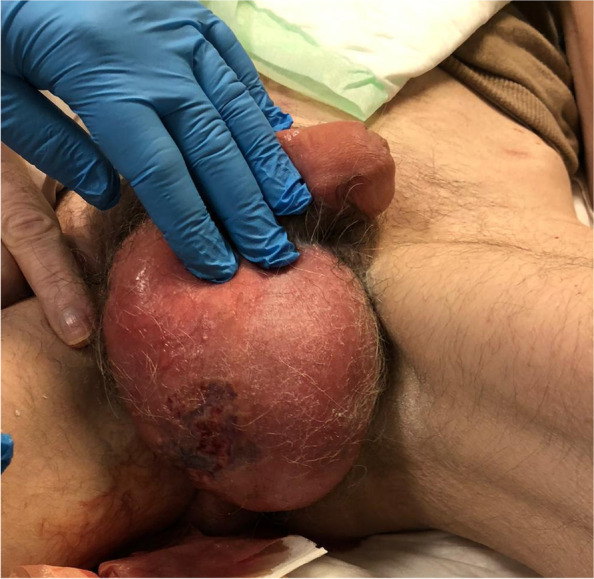
Emergency Department presentation of the case. Clinical presentation with oedema, dyschromia of right hemiscrotum, penis, and perineal region
The blood exams revealed a neutrophilic leukocytosis with 19.1 × 10⁹ white blood cells 83.2% of which neutrophiles, hemoglobin 9.3 g/dl, glucose 314 mg/dl, creatinine 1.2 mg/dl, C-reactive protein 42.7 mg/L, procalcitonin 29.44 ng/ml. The modified Laboratory Risk Indicator for Necrotizing Fasciitis score (LRINEC score) was 7, suspicion for necrotizing fasciitis [61]. The Charlson Comorbidity Index score was of 6, the Fournier’s Gangrene Severity Index was 9 with a risk of death > 75% [199, 200].
The emergency ultrasound exam revealed a marked thickening of the scrotal wall associated with intrafascial anechogen film and multiple hyperechoic spots with posterior echoes as for aerial component.
Computed Tomography revealed an abundant air-gas content in the context of the soft and peripheral tissues at the level of the right scrotal lodge reached the cutaneous plane at the lower pole and more cranially, further gas was localized at the base of the root of the penis, in the paramedian perineum homolaterally up to floor below the ischium pubic branch (Fig. 2). A marked fluid-edematous thickening of the tunics and scrotal walls were present bilaterally but more evident on the right side of the scrotum.
Fig. 2.

Title. Pre-operative CT-scan. CT-scan revealed air-gas content (green arrow) in the context of the soft and peripheral tissues at the level of the right scrotal lodge. A marked fluid-edematous thickening of the tunics and scrotal walls were present bilaterally but more evident on the right side of the scrotum
Intravenous fluid resuscitation and broad-spectrum antibiotics such as Piperacillin/Tazobactam (4.5 gr iv q8h), Imipenem/Cilastatin (500 mg iv q8h) and Daptomycin (700 mg iv q24h) were administered.
A prompt surgical debridement of genitalia and perineal region with an accurate necrotic tissue removal up to exposure of healthy tissue was performed (Fig. 3). A Penrose drain was left in place anterior to the rectum where a more destructive debridement was performed. It was removed on the 4th postoperative day after daily withdrawal due to granulated tissue formation. A single blood transfusion was performed for anemia.
Fig. 3.

Surgical debridement. Surgical extensive debridement of genitalia and perineal region with exposure of healthy tissue
Based on intra-operative scrotal ulcer swab, positive for Escherichia coli, Enterococcus faecium, Streptococcus oralis, Candida albicans, Bacteroides fragilis e Staphylococcus lugdunensis, on the 5th postoperative day, the antibiotic therapy was switched to Piperacillin/Tazobactam (4.5 gr iv q8h), Teicoplanin (600 mg iv q24H) and Fluconazole (400 mg iv q24h). Hemocultures and urinocultures were negative.
High-intensity care was carried on in the next days with a bedside daily surgical wound medications with fibrine debridement, normal saline and povidone-iodine solutions irrigation, iodoform and fatty gauze application, until discharge on the 40th postoperative day (Fig. 4).
Fig. 4.

Discharge. Clinical condition at discharge
Plastic surgeons decide to not perform a skin graft due to an excellent wound improvement with local medication. Every 3 days office-based medication with silver dressing, after normal saline and povidone-iodine irrigation and fibrinous tissue debridement, was performed until complete re-epithelialization of the scrotum on the 60th postoperative day.
Discussion
Predisposing factors to Fournier’s gangrene include all conditions with an impaired micro-circulation and immunosuppression such as diabetes mellitus, obesity, chronic alcoholism, smoking habit, renal and liver failure, malignancies, bowel inflammatory diseases and HIV infection [201–204]. In our case the patient suffered from diabetes, chronic arteriopathy, RCU for which he carried a colostomy following intestinal resection. The presence of a fecal diversion has certainly improved the wound management and therefore promoted its healing, reducing the contamination of the same with fecal material, ensuring a more accurate hygiene of the scrotal and perineal region [183]. The fact that ileostomy was already well established probably allowed to enjoy the benefits described above without exposing the patient to the typical complications of the creation of a neo-stoma, such as parastomal hernia, incisional hernia, colostomy prolapse, necrosis and stenosis which may necessitate additional surgery [183].
Once described as idiopathic, the FG is secondary to aerobic and anaerobic bacterial infection that involves genitalia and perineum and the cause is recognizable in more than 90% of the cases. In most cases the origin site infection is the ano-rectum (30–50%), uro-genitalia (20–40%) and genital surface (20%) [52]. In an immunodeficient host a polymicrobial flora are usually involved with a synergic mechanism of aggressiveness. The latter was present also in our case with several single-management not aggressive pathogens developing a synergism. Polymicrobial infection is reported as cause in 54% of cases [205].
The onset of this necrotizing fasciitis is insidious with up to 40% of cases asymptomatic. When signs and symptoms are the reason of emergency access, they are characterized by genital and perineal regions pain with little to no visible cutaneous damage in the early stage and erythematous and dusky skin, crepitus of subcutaneous tissue, maleodorant and purulent exudates of perineal and genital regions [206].
A successful management of the Fournier’s gangrene is challenging. The risk of death in about 20% of patients makes FG an emergency health condition [68, 99]. Fluid resuscitation for adequate systemic perfusion, empiric intravenous broad-spectrum antibiotic therapy to reduce the risk of septic shock and a prompt extensive surgical debridement ensured an improvement in prognosis in accordance with current guidelines [207]. The surgery plays a cardinal role because a delay in surgical debridement is associated with a significant increase in mortality [208]. From the review of the literature, a risk of death up-to-date is of 14.3% (Table).
In addition, the necrotizing fasciitis could benefit from hyperbaric oxygen therapy (HBOT) to reduce the spread of anaerobic germs, from the vacuum-assisted closure (VAC) that can be used to promote wound healing physiologically reducing the need for reconstructive surgery with skin graft in the setting of a personalized medicine [206, 209–211]. HBOT has been related to a better wound control as an adjuvant treatment by promoting wound healing. It acts as bactericide and bacteriostatic especially over anaerobic bacteria, almost always involved in this necrotizing fasciitis. HBOT increases local circulation and tissue oxygenation which prevents the progression of necrosis; furthermore, HBOT seems have synergism with certain antibiotics [18, 45, 209]. In our case the patient hospitalization was long due to the difficulties related to the COVID pandemic era, the choice to not perform a skin graft and the need for daily medications in order to obtain a natural restitutio of the lesion as possible. This type of management made it possible to avoid the use of common tools for resolving Fournier's gangrene such as HBOT, VAC and surgical graft. In our hospital there is not the HBOT so it would have been necessary to transfer the patient to another hospital and one of the COVID-19 pandemic period problem was the patient’s displacement and outpatient hospital management. For all these reasons we decided for a conservative inpatient management.
Conclusions
FG is burdened of high risk of death and a prompt multimodal approach is mandatory. This necrotizing fasciitis also needs a post-operative rigid management to reduce a risk of relapse and allow a complete restoration. In our case, for reason of necessity, an immediate multimodal approach and a daily cleaning of the surgical wound allowed to obtain its complete restoration avoiding HBOT, VAC or surgical graft without foregoing optimal outcomes.
Acknowledgements
We are thankful to the patient for his cooperation and allowing us to use his medical records in our case report.
Abbreviations
- FG
Fournier’s gangrene
- HBOT
Hyperbaric oxygen therapy
- RCU
Ulcerative colitis
- VAC
Vacuum-assisted closure
- iv q8h
Intravenously every 8 h
Authors' contributions
AP, GC and EM were responsible for conception and design. PM and MM acquired the clinical data. FP and GF independently performed online bibliographic searches in order to identify titles and abstracts of interest and GC select full-text to be included. AT, AV, AP and GC took part in either drafting the article and revising it critically for important intellectual content. All authors gave final approval of the version to be published, agree to be accountable for all aspects of the work in ensuring that questions related to the accuracy or integrity of any part of the work are appropriately investigated and resolved. All authors have read and approved the final manuscript.
Funding
This study was not supported by any external sources of funding.
Availability of data and materials
All data generated or analysed during this study are included in this published article.
Declarations
Ethics approval and consent to participate
Not applicable.
Consent for publication
The patient has given the consent for publication.
Competing interests
The authors declare that they have no competing interests.
Footnotes
Publisher's Note
Springer Nature remains neutral with regard to jurisdictional claims in published maps and institutional affiliations.
Contributor Information
Alessio Paladini, Email: alessiopaladini89@gmail.com.
Giovanni Cochetti, Email: giovannicochetti@libero.it.
Angelica Tancredi, Email: tancrediangelica@gmail.com.
Matteo Mearini, Email: matteo.mearini@studenti.unipg.it.
Andrea Vitale, Email: andrea.vitale69@yahoo.it.
Francesca Pastore, Email: fran93.p@hotmail.it.
Paolo Mangione, Email: paolo.mangione@studenti.unipg.it.
Ettore Mearini, Email: ettore.mearini@unipg.it.
References
- 1.Rad J, Foreman J. Fournier Gangrene. StatPearls [Internet]. 2021. Treasure Island (FL): StatPearls Publishing; 2022. [Google Scholar]
- 2.Chernyadyev SA, Ufimtseva MA, Vishnevskaya IF, Bochkarev YM, Ushakov AA, Beresneva TA, et al. Fournier’s Gangrene: Literature Review and Clinical Cases. Urol Int. 2018;101(1):91–97. doi: 10.1159/000490108. [DOI] [PMC free article] [PubMed] [Google Scholar]
- 3.Cochetti G, Cottini E, Cirocchi R, Pansadoro A, Lepri E, Corsi A, et al. Laparoscopic conservative surgery of colovesical fistula: is it the right way? Wideochir Inne Tech Maloinwazyjne. 2013;8(2):162–165. doi: 10.5114/wiitm.2011.32808. [DOI] [PMC free article] [PubMed] [Google Scholar]
- 4.Del Zingaro M, Cochetti G, Gaudio G, Tiezzi A, Paladini A, Rossi de Vermandois JA, et al. Robotic conservative treatment for prostatourethrorectal fistula: original technique step by step. Int Braz J Urol. 2020;46(3):481–482. doi: 10.1590/s1677-5538.ibju.2018.0584. [DOI] [PMC free article] [PubMed] [Google Scholar]
- 5.Rossi de Vermandois JA, Cochetti G, Zingaro MD, Santoro A, Panciarola M, Boni A, et al. Evaluation of surgical site infection in mini-invasive urological surgery. Open Med (Wars) 2019;14:711–718. doi: 10.1515/med-2019-0081. [DOI] [PMC free article] [PubMed] [Google Scholar]
- 6.Del Zingaro M, Boni A, Paladini A, Rossi De Vermandois JA, Ciarletti S, Felici G, et al. Fournier’s gangrene secondary to locally advanced prostate cancer: case report and review of the Literature. G Chir. 40(6):481–96. [PubMed]
- 7.Singh A, Ahmed K, Aydin A, Khan MS, Dasgupta P. Fournier’s gangrene. A clinical review. Arch Ital Urol Androl. 2016;88(3):157–164. doi: 10.4081/aiua.2016.3.157. [DOI] [PubMed] [Google Scholar]
- 8.Grassi V, Pansadoro A, Cochetti G, Barillaro F, Cottini E, D’Amico F, et al. Pneumoscrotum: report of two different cases and review of the literature. Ther Clin Risk Manag. 2015;9(11):581–587. doi: 10.2147/TCRM.S77326. [DOI] [PMC free article] [PubMed] [Google Scholar]
- 9.Ioannidis O, Kitsikosta L, Tatsis D, Skandalos I, Cheva A, Gkioti A, et al. Fournier’s Gangrene: Lessons Learned from Multimodal and Multidisciplinary Management of Perineal Necrotizing Fasciitis. Front.Sur. 2017;10(4):36. doi: 10.3389/fsurg.2017.00036. [DOI] [PMC free article] [PubMed] [Google Scholar]
- 10.Bensardi FZ, Hajri A, Kabura S, Bouali M, el Bakouri A, el Hattabi K, et al. Fournier’s gangrene: Seven years of experience in the emergencies service of visceral surgery at Ibn Rochd University Hospital Center. Ann Med Surg (Lond) 2021;30(71):102821. doi: 10.1016/j.amsu.2021.102821. [DOI] [PMC free article] [PubMed] [Google Scholar]
- 11.Vargo E, Leone G, Barat O, Yunker A, Parekh N. A case of Fournier’s gangrene following a large-volume hydrocelectomy in a diabetic patient managed with SGLT-2 inhibitor therapy. Urol Case Rep. 2021;39:101834. doi: 10.1016/j.eucr.2021.101834. [DOI] [PMC free article] [PubMed] [Google Scholar]
- 12.Trama F, Illiano E, Bertuzzi G, Chiummariello S, Costantini E. Multimodal approach in a patient with Fournier’s gangrene during the coronavirus pandemic. Urol Case Rep. 2021;39:101825. doi: 10.1016/j.eucr.2021.101825. [DOI] [PMC free article] [PubMed] [Google Scholar]
- 13.Elahabadi I, Bazmandegan G, Salehi H, Jafari A, Ahmadi J, Kamaib Z. Fournier’s gangrene after missed acute perforated appendicitis: A case report. Clin Case Rep. 2021;9(10):e04989. doi: 10.1002/ccr3.4989. [DOI] [PMC free article] [PubMed] [Google Scholar]
- 14.de La Torre M, Solé C, Fanjul M, Berenguer B, Arriaga-Redondo M, de Tomás E, et al. Neonatal Fournier’s Gangrene. Pediatr Infect Dis J. 2021;40(10):e384–e387. doi: 10.1097/INF.0000000000003224. [DOI] [PubMed] [Google Scholar]
- 15.Winyard JC, Wong A, Rashed H, Mellon JK. Undiagnosed Behçet’s Disease Presenting as Fournier’s Gangrene in a Young Male. Case Rep Urol. 2021;21(2021):1–2. doi: 10.1155/2021/6626909. [DOI] [PMC free article] [PubMed] [Google Scholar]
- 16.Gul MO, Sunamak O, Kina U, Gunay E, Akyuz C. Fournier’s Gangrene: Our Five-Year Series and the Role of Vacuum-Assisted Closure in the Treatment. Niger J Clin Pract. 2021;24(9):1277–1282. doi: 10.4103/njcp.njcp_387_20. [DOI] [PubMed] [Google Scholar]
- 17.Rivera-Alvarez F, George A, Ganti L. Massive necrotizing Fournier’s gangrene. Urol Case Rep. 2021;38:101689. doi: 10.1016/j.eucr.2021.101689. [DOI] [PMC free article] [PubMed] [Google Scholar]
- 18.Michalczyk L, Grabińska A, Banaczyk B, Braszko M, Andrychowicz A, Ząbkowski T. Efficiency of hyperbaric oxygen therapy combined with negative-pressure wound therapy in the treatment strategy of fournier’s gangrene - a retrospective study. Urol J. 2021;18i:6797. doi: 10.22037/uj.v18i.6797. [DOI] [PubMed] [Google Scholar]
- 19.Moon JY, Lee MR, Kim JH, Ha GW. Fournier Gangrene in a Patient With Type 2 Diabetes Mellitus Treated With Dapagliflozin: A Case Report. Ann Coloproctol. 2021;37(Suppl 1):S48–50. doi: 10.3393/ac.2020.06.22. [DOI] [PMC free article] [PubMed] [Google Scholar]
- 20.Lahouar R, Naouar S, Ben Khalifa B, Gazzah W, Braiek S, El Kamel R, et al. Isolated Penile Fournier’s gangrene: A very rare entity. Urol Case Rep. 2021;37:101608. doi: 10.1016/j.eucr.2021.101608. [DOI] [PMC free article] [PubMed] [Google Scholar]
- 21.Shah T, Raj Joshi B, Kumar A, Simkhada G, Kumar Gupta R. Isolated duodenal injury presenting as fournier’s gangrene: a case report. Clin Case Rep. 2021;9(6):e04232. doi: 10.1002/ccr3.4232. [DOI] [PMC free article] [PubMed] [Google Scholar]
- 22.Tsuge I, Matsui M, Kanno T, Kaisho J, Takahashi T, Yamanaka H, et al. Fournier’s Gangrene with Edwardsiella tarda: A Gas Production Case by Bacterial Synergism with Streptococcus anginosus. Plast Reconstr Surg Glob Open. 2021;9(6):e3625. doi: 10.1097/GOX.0000000000003625. [DOI] [PMC free article] [PubMed] [Google Scholar]
- 23.Duarte I, Outerelo C, Santana A, Guerra J. Fournier Gangrene as a Complication of a Perinephric Abscess After Kidney Transplant: A Case Report. Transplant Proc. 2021;53(4):1281–1283. doi: 10.1016/j.transproceed.2021.02.009. [DOI] [PubMed] [Google Scholar]
- 24.Wong R, Blachman-Braun R, Mann U, Eng A, Lother S, Patel P. Location of residence and mortality for patients diagnosed with Fournier’s gangrene. Can Urol Assoc J. 2020;15(5):E267–E271. doi: 10.5489/cuaj.6749. [DOI] [PMC free article] [PubMed] [Google Scholar]
- 25.Beecroft NJ, Jaeger CD, Rose JR, Becerra CMC, Shah NC, Palettas MS, et al. Fournier’s Gangrene in Females: Presentation and Management at a Tertiary Center. Urology. 2021;151:113–117. doi: 10.1016/j.urology.2020.05.056. [DOI] [PubMed] [Google Scholar]
- 26.Oyelowo N, Ahmed M, Lawal AT, Sudi A, Adetola Tolani AMM, Fidelis L, et al. Fournier’s gangrene: Presentation and predictors of mortality in Zaria, Nigeria. Ann Afr Med. 20(2):105–10. [DOI] [PMC free article] [PubMed]
- 27.Kundan M, Priyadarshi V, Chintamani. Sliding inguinal hernia in a case of Fournier’s gangrene: A rare case. Int J Appl Basic Med R. 2021;11(2):106. [DOI] [PMC free article] [PubMed]
- 28.Parkin CJ, Acland G, Ilie V, Clayton S, Merei J, Latif E. Sigmoid diverticulitis leading to Fournier’s gangrene. ANZ J Surg. 2021;91(3):E123–E125. doi: 10.1111/ans.16164. [DOI] [PubMed] [Google Scholar]
- 29.Grabińska A, Michalczyk Ł, Banaczyk B, Syryło T, Ząbkowski T. Management protocol for Fournier’s gangrene in sanitary regime caused by SARS-CoV-2 pandemic: A case report. World J Clin Cases. 2021;9(5):1215–1220. doi: 10.12998/wjcc.v9.i5.1215. [DOI] [PMC free article] [PubMed] [Google Scholar]
- 30.Sahra S, Jahangir A, Kandlakunta H, Glaser A. Actinotignum schaalii caught for the second time in fournier’s gangrene! Cureus. 2021;13(2):e13288. doi: 10.7759/cureus.13288. [DOI] [PMC free article] [PubMed] [Google Scholar]
- 31.Provenzano D, Lo Bianco S, Zanghì M, Campione A, Vecchio R, Zanghì G. Fournier’s gangrene as a rare complication in patient with uncontrolled type 2 diabetes treated with surgical debridement: A case report and literature review. Int J Surg Case Rep. 2021;79:462–465. doi: 10.1016/j.ijscr.2021.01.098. [DOI] [PMC free article] [PubMed] [Google Scholar]
- 32.Elbeddini A, Tayefehchamani Y, Davey M, Gallinger J, Hooda N, Aly A, et al. Fournier’s gangrene with dapagliflozin in a rural hospital: a case report. BMJ Case Rep. 2021;14(2):e237784. doi: 10.1136/bcr-2020-237784. [DOI] [PMC free article] [PubMed] [Google Scholar]
- 33.Kostovski O, Spasovska O, Trajkovski G, Antovic S, Kostovska I, Tosheska-Trajkovska K, et al. Challenging Treatment of a Female Patient with Extensive Fournier’s Gangrene – Case Report. Prague Med Rep. 2021;122(1):39–44. doi: 10.14712/23362936.2021.5. [DOI] [PubMed] [Google Scholar]
- 34.el Hasbani G, Vargas J, Rodrigue P, van Cott C, Dibartholomeo T, Assaker R. Undiagnosed metastatic ileocecal carcinoma: a rare aetiology for Fournier gangrene. ANZ J Surg. 2021;91(1–2):202–204. doi: 10.1111/ans.16065. [DOI] [PubMed] [Google Scholar]
- 35.Voordeckers M, Noels J, Brognet M, Salaouatchi MT, Mesquita M. Localized Fournier’s Gangrene in “End-Stage” Renal Failure: Multidisciplinary Approach and Integration of Palliative Care. Case Rep Nephrol. 2020;24(2020):1–5. doi: 10.1155/2020/8868993. [DOI] [PMC free article] [PubMed] [Google Scholar]
- 36.Sihombing AT, Palgunadi IN, Stefanus D. Complete urethral disruption as a complication of urethral catheterization presenting as scrotal mass: A rare case. Urol Case Rep. 2020;33:101378. doi: 10.1016/j.eucr.2020.101378. [DOI] [PMC free article] [PubMed] [Google Scholar]
- 37.Maghsoudi LH, Navab M, Pak H. A rare presentation of xanthogranulomatous pyelonephritis and emphysematous pyelonephritis complicated with necrotizing fasciitis of scrotum and perineum (fournier gangrene) Urol Case Rep. 2020;33:101299. doi: 10.1016/j.eucr.2020.101299. [DOI] [PMC free article] [PubMed] [Google Scholar]
- 38.Zhang N, Yu X, Zhang K, Liu T. A retrospective case series of Fournier’s gangrene: necrotizing fasciitis in perineum and perianal region. BMC Surg. 2020;20(1):259. doi: 10.1186/s12893-020-00916-3. [DOI] [PMC free article] [PubMed] [Google Scholar]
- 39.Rakusic Z, Krpan AM, Sjekavica I. Fulminant Fournier’s gangrene in a patient with gastric cancer treated with ramucirumab and paclitaxel. Ther Adv Drug Saf. 2020;17(11):2042098620946556. doi: 10.1177/2042098620946556. [DOI] [PMC free article] [PubMed] [Google Scholar]
- 40.Kasbawala K, Stamatiades GA, Majumdar SK. Fournier’s Gangrene and Diabetic Ketoacidosis Associated with Sodium Glucose Co-Transporter 2 (SGLT2) Inhibitors: Life-Threatening Complications. Am J Case Rep. 2020;2(21):e921536. doi: 10.12659/AJCR.921536. [DOI] [PMC free article] [PubMed] [Google Scholar]
- 41.Barone M, Grani G, Ramundo V, Garritano T, Durante C, Falcone R. Fournier’s gangrene during lenvatinib treatment: A case report. Mol Clin Oncol. 2020;12(6):588–591. doi: 10.3892/mco.2020.2031. [DOI] [PMC free article] [PubMed] [Google Scholar]
- 42.Batmaz O, Ucar M, Caylan AE, Gök İB, Vural V. Isolated Penile Fournier’s Gangrene: A Rare Case. Cureus. 2020;12(5):e7953. doi: 10.7759/cureus.7953. [DOI] [PMC free article] [PubMed] [Google Scholar]
- 43.Syllaios A, Davakis S, Karydakis L, Vailas M, Garmpis N, Mpaili E, et al. Treatment of Fournier’s Gangrene With Vacuum-assisted Closure Therapy as Enhanced Recovery Treatment Modality. In Vivo. 2020;34(3):1499–1502. doi: 10.21873/invivo.11936. [DOI] [PMC free article] [PubMed] [Google Scholar]
- 44.Padilla M, Fernández Berisso S, Vietri A, Trinitario L, Liern M, Moreno M, et al. Gangrena de Fournier en un niño con síndrome nefrótico corticorresistente. A propósito de un caso. Arch Argent Pediatr. 2020;118(2):e204–e207. doi: 10.5546/aap.2020.e204. [DOI] [PubMed] [Google Scholar]
- 45.Creta M, Longo N, Arcaniolo D, Giannella R, Cai T, Cicalese A, et al. Hyperbaric oxygen therapy reduces mortality in patients with Fournier’s Gangrene. Results from a multi-institutional observational study. Minerva Urol Nefrol. 2020;72(2):223–228. [DOI] [PubMed]
- 46.Hatipoğlu E. Fournier’s Gangrene: Five Years’ Experience from a Single Center in Turkey. Ulus Travma Acil Cerrahi Derg. 2020;26(2):235–241. doi: 10.14744/tjtes.2020.66805. [DOI] [PubMed] [Google Scholar]
- 47.Elbeddini A, Gallinger J, Davey M, Brassard S, Gazarin M, Plourde F, et al. A Case of Fournier’s Gangrene in a Patient Taking Canagliflozin for the Treatment of Type II Diabetes Mellitus. Am J Case Rep. 2020;24(21):e920115. doi: 10.12659/AJCR.920115. [DOI] [PMC free article] [PubMed] [Google Scholar]
- 48.Ellegård L, Prytz M. Fournier’s gangrene under SGLT-2 inhibitor therapy: A literature review and case report. Int J Surg Case Rep. 2020;77:692–694. doi: 10.1016/j.ijscr.2020.11.100. [DOI] [PMC free article] [PubMed] [Google Scholar]
- 49.Lindsay PJ, Gibson LE, Bittner EA, Berg S, Chang MG. Sodium-glucose cotransporter-2 (SGLT2) inhibitor-induced euglycemic diabetic ketoacidosis complicating the perioperative management of a patient with type 2 diabetes mellitus (T2DM) and Fournier’s gangrene: A case report. Int J Surg Case Rep. 2020;77:463–466. doi: 10.1016/j.ijscr.2020.11.037. [DOI] [PMC free article] [PubMed] [Google Scholar]
- 50.Hyun D woo, Lee BC, Choi JB, Park YM, Jung HJ, Jo HJ. Fournier’s gangrene in a rectal cancer patient. Int J Surg Case Rep. 2020;67:150–3. [DOI] [PMC free article] [PubMed]
- 51.Dowd K, Patel B, Blumenthal Z, Rodriguez-Unda N, Bird E. Acute management of Fournier’s gangrene in the setting of massive lymphedema. Urol Case Rep. 2020;28:101013. doi: 10.1016/j.eucr.2019.101013. [DOI] [PMC free article] [PubMed] [Google Scholar]
- 52.Del Zingaro M, Boni A, Rossi de Vermandois JA, Paladini A, Lepri E, Ursi P, et al. Fournier’s gangrene and intravenous drug abuse: an unusual case report and review of the literature. Open Med (Wars). 2019;14:694–710. [DOI] [PMC free article] [PubMed]
- 53.Zhang C, Liu Y, Sun XC, Chen LM, Xiao B, Xu CX. Management of Fournier gangrene in perineal region by negative-pressure wound therapy combined with delayed repair. Zhonghua Shao Shang Za Zhi. 2019;35(12):872–875. doi: 10.3760/cma.j.issn.1009-2587.2019.12.008. [DOI] [PubMed] [Google Scholar]
- 54.Amin A, Blazevski A. A curious case of Fournier’s gangrene. Urol Case Rep. 2019;27:101001. doi: 10.1016/j.eucr.2019.101001. [DOI] [PMC free article] [PubMed] [Google Scholar]
- 55.Nagano Y, Yakame NK, Aoki H, Yamakawa T, Kondo NI. Fournier’s Gangrene in a Patient with Type 2 Diabetes Mellitus Treated with Empagliflozin: A Case Report. Drug Saf Case Rep. 2019;6(1):11. doi: 10.1007/s40800-019-0105-8. [DOI] [PMC free article] [PubMed] [Google Scholar]
- 56.Kus NJ, Kim BJ, Ross HM. A case report of necrotizing fasciitis with growth of Actinomyces europaeus and Actinotignum schaalii. J Surg Case Rep. 2019;2019(10):rjz286. [DOI] [PMC free article] [PubMed]
- 57.Rodler S, Weig T, Finkenzeller C, Stief C, Staehler M. Fournier´s Gangrene Under Sodium-Glucose Cotransporter 2 Inhibitor Therapy as a Life-Threatening Adverse Event: A Case Report and Review of the Literature. Cureus. 2019;11(9):e5778. doi: 10.7759/cureus.5778. [DOI] [PMC free article] [PubMed] [Google Scholar]
- 58.Çalışkan S. Fournier’s Gangrene: Review of 36 Cases. Ulus Travma Acil Cerrahi Derg. 2019;25(5):479–483. doi: 10.14744/tjtes.2019.30232. [DOI] [PubMed] [Google Scholar]
- 59.Magdaleno-Tapial J, Valenzuela-Oñate C, Martínez-Doménech A, Sánchez-Carazo JL, Pérez-Ferriols A. Image Gallery: Fournier gangrene in a patient with severe hidradenitis suppurativa. Br J Dermatol. 2019;181(3):e59. doi: 10.1111/bjd.18052. [DOI] [PubMed] [Google Scholar]
- 60.Joury A, Mahendra A, Alshehri M, Downing A. Extensive necrotizing fasciitis from Fournier’s gangrene. Urol Case Rep. 2019;26:100943. doi: 10.1016/j.eucr.2019.100943. [DOI] [PMC free article] [PubMed] [Google Scholar]
- 61.Sparenborg JD, Brems JA, Wood AM, Hwang JJ, Venkatesan K. Fournier’s gangrene: a modern analysis of predictors of outcomes. Transl Androl Urol. 2019;8(4):374–378. doi: 10.21037/tau.2019.03.09. [DOI] [PMC free article] [PubMed] [Google Scholar]
- 62.Elshimy G, Correa R, Alsayed M, Jyothinagaram S. Early Presentation of a Rare Complication of Sodium-Glucose Cotransporter-2 Inhibitors 10 Days After Initiation: Case Report and Literature Review. Cureus. 2019;11(7):e5173. doi: 10.7759/cureus.5173. [DOI] [PMC free article] [PubMed] [Google Scholar]
- 63.Lin HC, Chen ZQ, Chen HX, He QL, Liu ZM, Zhou ZY, et al. Outcomes in patients with Fournier’s gangrene originating from the anorectal region with a particular focus on those without perineal involvement. Gastroenterol Rep (Oxf) 2019;7(3):212–217. doi: 10.1093/gastro/goy041. [DOI] [PMC free article] [PubMed] [Google Scholar]
- 64.K R, Biswas R, Bhat P, Sistla S, Kumari S, Kate V. Rare isolation of Fusobacterium varium from a case of Fournier’s gangrene. Anaerobe. 2019;57:82–5. [DOI] [PubMed]
- 65.Louro JM, Albano M, Baltazar J, Vaz M, Diogo C, Ramos S, et al. Fournier’s Gangrene: 10-Year Experience of a Plastic Surgery and Burns Department at a Tertiary Hospital. Acta Med Port. 2019;32(5):368–374. doi: 10.20344/amp.11003. [DOI] [PubMed] [Google Scholar]
- 66.Escobar-Vidarte MF, Hurtado-Burbano DF, Loaiza-Osorio S, Nieto-Calvache AJ. Fournier’s Necrosis Associated With Extraintestinal Amebiasis: A Rare Presentation of a Common Infection. J Obstet Gynaecol Can. 2019;41(5):577. doi: 10.1016/j.jogc.2018.01.030. [DOI] [PubMed] [Google Scholar]
- 67.Onder CE, Gursoy K, Kuskonmaz SM, Kocer U, Culha C. Fournier’s gangrene in a patient on dapagliflozin treatment for type 2 diabetes. J Diabetes. 2019;11(5):348–350. doi: 10.1111/1753-0407.12896. [DOI] [PubMed] [Google Scholar]
- 68.Heijkoop B, Parker N, Spernat D. Fournier’s gangrene: not as lethal as previously thought? A case series ANZ J Surg. 2019;89(4):350–352. doi: 10.1111/ans.14760. [DOI] [PubMed] [Google Scholar]
- 69.Mostaghim A, Dhanani M, Ingalls RR. Fournier’s gangrene as an initial manifestation of acute promyelocytic leukemia: A case report and review of the literature. SAGE Open Med Case Rep. 2019;7:2050313X19834425. [DOI] [PMC free article] [PubMed]
- 70.Zhou Z, Guo F, Huan J. Fournier’s Gangrene With Septic Shock and Multiple Organ Dysfunction Syndrome. Int J Low Extrem Wounds. 2019;18(1):94–96. doi: 10.1177/1534734618818685. [DOI] [PubMed] [Google Scholar]
- 71.Majdoub W, Mosbahi A, Bonbled F. Sudden unexpected death due to Fournier gangrene. Forensic Sci Med Pathol. 2019;15(1):155–158. doi: 10.1007/s12024-018-0030-7. [DOI] [PubMed] [Google Scholar]
- 72.Aslan N, Yildizdas D, Horoz OO, Ozden O. Fatal Agranulocytosis and Fournier’s Gangrene due to the Use of Metamizole. Indian J Pediatr. 2019;86(3):310–311. doi: 10.1007/s12098-018-2799-5. [DOI] [PubMed] [Google Scholar]
- 73.AlShehri YA, AlBurshaid H, AlBassam L, AlMutairi K. Management of Fournier’s gangrene with skin grafting by bagging technique of testes: case report. Interdiscip Plast Reconstr Surg DGPW. 2019;8:Doc02. [DOI] [PMC free article] [PubMed]
- 74.Moussa M, Abou CM. Isolated Penile Fournier’s gangrene: A case report and literature review. Int J Surg Case Rep. 2019;62:65–68. doi: 10.1016/j.ijscr.2019.08.012. [DOI] [PMC free article] [PubMed] [Google Scholar]
- 75.Hahn HM, Jeong KS, Park DH, Park MC, Lee IJ. Analysis of prognostic factors affecting poor outcomes in 41 cases of Fournier gangrene. Ann Surg Treat Res. 2018;95(6):324–332. doi: 10.4174/astr.2018.95.6.324. [DOI] [PMC free article] [PubMed] [Google Scholar]
- 76.Overholt T, Hajiran A, Ueno C, Zaslau S. Fournier’s Gangrene of the Penis following a Human Bite Wound. Case Rep Urol. 2018;25(2018):9798607. doi: 10.1155/2018/9798607. [DOI] [PMC free article] [PubMed] [Google Scholar]
- 77.Pehlivanlı F, Aydin O. Factors Affecting Mortality in Fournier Gangrene: A Single Center Experience. Surg Infect (Larchmt) 2019;20(1):78–82. doi: 10.1089/sur.2018.208. [DOI] [PubMed] [Google Scholar]
- 78.Kranz J, Schlager D, Anheuser P, Mühlstädt S, Brücher B, Frank T, et al. Desperate need for better management of Fournier’s Gangrene. Cent European J Urol. 2018;71(3):360–365. doi: 10.5173/ceju.2018.1740. [DOI] [PMC free article] [PubMed] [Google Scholar]
- 79.Kobayashi D, Masubuchi M, Takase T, Ichikawa T, Deguchi T, Yaguchi T. Fournier’s gangrene caused by penetration of a rectal cancer followed by neoadjuvant chemotherapy. Surg Case Rep. 2018;4(1):123. doi: 10.1186/s40792-018-0526-0. [DOI] [PMC free article] [PubMed] [Google Scholar]
- 80.Pandey S, Sharma D, Aggarwal A, Sharma A. Isolated Fournier’s gangrene of the penis with penile autoamputation. BMJ Case Rep. 2018;2018:bcr2018226862. [DOI] [PMC free article] [PubMed]
- 81.Matsuura H, Iwasa K. Fournier gangrene. Cleve Clin J Med. 2018;85(9):664–665. doi: 10.3949/ccjm.85a.18036. [DOI] [PubMed] [Google Scholar]
- 82.Sen V, Sen P, Sahin MO. Fournier gangrene due to Rhizobium Radiobacter. Pak J Med Sci. 2018;34(4):1027–1029. [DOI] [PMC free article] [PubMed]
- 83.Elsaket AE, Maharajh S, Urry RJ. The presentation, management and outcomes of Fournier’s gangrene at a tertiary urology referral centre in South Africa. S Afr Med J. 2018;108(8):671–676. doi: 10.7196/SAMJ.2018.v108i8.13100. [DOI] [PubMed] [Google Scholar]
- 84.Takano N, Yatabe MS, Yatabe J, Kato M, Sueoka D, Iguchi S, et al. Fatal Fournier’s gangrene caused by Clostridium ramosum in a patient with central diabetes insipidus and insulin-dependent diabetes mellitus: a case report. BMC Infect Dis. 2018;18(1):363. doi: 10.1186/s12879-018-3280-9. [DOI] [PMC free article] [PubMed] [Google Scholar]
- 85.Semenič D, Kolar P. Fournier’s Gangrene Does Not Spare Young Adults. Wounds. 2018;30(7):E73–E76. [PubMed] [Google Scholar]
- 86.Abass-Shereef J, Kovacs M, Simon EL. Fournier’s Gangrene Masking as Perineal and Scrotal Cellulitis. Am J Emerg Med. 2018;36(9):1719.e1–1719.e2. doi: 10.1016/j.ajem.2018.05.067. [DOI] [PubMed] [Google Scholar]
- 87.Wetterauer C, Ebbing J, Halla A, Kuehl R, Erb S, Egli A, et al. A contemporary case series of Fournier’s gangrene at a Swiss tertiary care center—can scoring systems accurately predict mortality and morbidity? World J Emerg Surg. 2018;22(13):25. doi: 10.1186/s13017-018-0187-0. [DOI] [PMC free article] [PubMed] [Google Scholar]
- 88.Demir CY, Yuzkat N, Ozsular Y, Kocak OF, Soyalp C, Demirkiran H. Fournier Gangrene. Plast Reconstr Surg. 2018;142(1):68e–75e. doi: 10.1097/PRS.0000000000004516. [DOI] [PubMed] [Google Scholar]
- 89.Chen Y, Wang X, Lin G, Xiao R. Successful treatment following early recognition of a case of Fournier’s scrotal gangrene after a perianal abscess debridement: a case report. J Med Case Rep. 2018;12(1):193. doi: 10.1186/s13256-018-1697-9. [DOI] [PMC free article] [PubMed] [Google Scholar]
- 90.Yuan L, Xiong Q, Wang B. Fourier’s gangrene associated with a decubitus ulcer. IDCases. 2018;17(12):149–150. doi: 10.1016/j.idcr.2018.05.010. [DOI] [PMC free article] [PubMed] [Google Scholar]
- 91.Katsimantas A, Ferakis N, Skandalakis P, Filippou D. A Rare Case of Localised Isolated Penile Fournier’s Gangrene and a Short Review of the Literature. Case Rep Urol. 2018;9(2018):5135616. doi: 10.1155/2018/5135616. [DOI] [PMC free article] [PubMed] [Google Scholar]
- 92.Althunayyan S, Karamitosos E. Fournier’s gangrene in an obese female in third trimester of pregnancy. Saudi Med J. 2018;39(4):415–418. doi: 10.15537/smj.2018.4.21780. [DOI] [PMC free article] [PubMed] [Google Scholar]
- 93.Pittaka M, Georgiou C, Polyviou P, Kountourakis P, Loizou P, Constantinou I, et al. Fournier Gangrene in a patient receiving chemo–radiation for rectal cancer. Oxf Med Case Reports. 2018;2018(2):omx101 [DOI] [PMC free article] [PubMed]
- 94.Taylor GM, Hess DV. Fournier gangrene: a rare case of necrotizing fasciitis of the entire right hemi-pelvis in a diabetic female. Oxf Med Case Reports. 2018;2018(2):omx094. doi: 10.1093/omcr/omx094. [DOI] [PMC free article] [PubMed] [Google Scholar]
- 95.Dos-Santos D, Roman U, Westphalen A, Lovison K, Spencer NF. Profile of patients with Fournier’s gangrene and their clinical evolution. Rev Col Bras Cir. 2018;45(1):e1430. doi: 10.1590/0100-6991e-20181430. [DOI] [PubMed] [Google Scholar]
- 96.Fukui K, Fujioka M, Ishiyama S. Sacral Pressure Ulcer-induced Fournier’s Gangrene Extending to the Retroperitoneum: A Case Report. Wounds. 2018;30(1):E5–E8. [PubMed] [Google Scholar]
- 97.Kuzaka B, Wróblewska MM, Borkowski T, Kawecki D, Kuzaka P, Młynarczyk G, et al. Fournier’s Gangrene: Clinical Presentation of 13 Cases. Med Sci Monit. 2018;28(24):548–555. doi: 10.12659/MSM.905836. [DOI] [PMC free article] [PubMed] [Google Scholar]
- 98.Goel A, Gupta S, Agarwal A, Shiwach N, Chawda V, Bhagat TS. Fournier’s gangrene: a rare manifestation of Chikungunya fever. Trop Doct. 2018;48(1):36–37. doi: 10.1177/0049475517699542. [DOI] [PubMed] [Google Scholar]
- 99.Ghodoussipour SB, Gould D, Lifton J, Badash I, Krug A, Miranda G, et al. Surviving Fournier’s gangrene: Multivariable analysis and a novel scoring system to predict length of stay. J Plast Reconstr Aesthet Surg. 2018;71(5):712–718. doi: 10.1016/j.bjps.2017.12.005. [DOI] [PubMed] [Google Scholar]
- 100.Tenório CEL, Lima SVC, Albuquerque AV de, Cavalcanti MP, Teles F. Risk factors for mortality in fournier’s gangrene in a general hospital: use of simplified founier gangrene severe index score (SFGSI). Int Braz J Urol. 2018;44(1):95–101. [DOI] [PMC free article] [PubMed]
- 101.Weimer SB, Matthews MR, Caruso DM, Foster KN. Retroperitoneal Necrotizing Fasciitis from Fournier’s Gangrene in an Immunocompromised Patient. Case Rep Surg. 2017;2017:5290793. doi: 10.1155/2017/5290793. [DOI] [PMC free article] [PubMed] [Google Scholar]
- 102.Wähmann M, Wähmann M, Schütz F, Sohn C, Schott S, Kremer T, et al. Severe Fournier’s gangrene—a conjoint challenge of gynaecology and plastic surgery. J Surg Case Rep. 2017;2017(12):rjx239. [DOI] [PMC free article] [PubMed]
- 103.Wang T, Zhao G, Rui YJ, Mi JY. Bilateral femoral posterior neurocutaneous perforater flap successfully treating Fournier gangrene. Medicine (Baltimore) 2017;96(46):e8720. doi: 10.1097/MD.0000000000008720. [DOI] [PMC free article] [PubMed] [Google Scholar]
- 104.Yucel M. Fournier’s gangrene: A retrospective analysis of 25 patients. Ulus Travma Acil Cerrahi Derg. 2017;23(5):400–404. doi: 10.5505/tjtes.2017.01678. [DOI] [PubMed] [Google Scholar]
- 105.Ureyen O. Predictive value of FGSİ and UFGSİ scoring systems used in the prediction of mortality in patients with fournier’s gangrene: a multi-center study. Ulus Travma Acil Cerrahi Derg. 2017;23(5):389–394. doi: 10.5505/tjtes.2017.71509. [DOI] [PubMed] [Google Scholar]
- 106.Dell’Atti L, Cantoro D, Maselli G, Galosi AB. Distant subcutaneous spreading of Fournier’s gangrene: An unusual clinical identification by preoperative ultrasound study. Arch Ital Urol Androl. 2017;89(3):238–239. doi: 10.4081/aiua.2017.3.238. [DOI] [PubMed] [Google Scholar]
- 107.Yanaral F, Balci C, Ozgor F, Simsek A, Onuk O, Aydin M, et al. Comparison of conventional dressings and vacuum-assisted closure in the wound therapy of Fournier’s gangrene. Arch Ital Urol Androl. 2017;89(3):208–211. doi: 10.4081/aiua.2017.3.208. [DOI] [PubMed] [Google Scholar]
- 108.Chia L, Crum-Cianflone NF. Emergence of multi-drug resistant organisms (MDROs) causing Fournier’s gangrene. J Infect. 2018;76(1):38–43. doi: 10.1016/j.jinf.2017.09.015. [DOI] [PubMed] [Google Scholar]
- 109.Kordahi AM, Suliman AS. A Case of Fournier’s Gangrene. Eplasty. 2017;17:ic25. [PMC free article] [PubMed]
- 110.Hong KS, Yi HJ, Lee RA, Kim KH, Chung SS. Prognostic factors and treatment outcomes for patients with Fournier’s gangrene: a retrospective study. Int Wound J. 2017;14(6):1352–1358. doi: 10.1111/iwj.12812. [DOI] [PMC free article] [PubMed] [Google Scholar]
- 111.Sanders O, Gilbert-Kawai E, Saha R. Intravenous immunoglobulin as adjunctive treatment for Fournier’s gangrene. Br J Hosp Med (Lond) 2017;78(9):530–531. doi: 10.12968/hmed.2017.78.9.530. [DOI] [PubMed] [Google Scholar]
- 112.Ferretti M, Saji AA, Phillips J. Fournier’s Gangrene: A Review and Outcome Comparison from 2009 to 2016. Adv Wound Care (New Rochelle) 2017;6(9):289–295. doi: 10.1089/wound.2017.0730. [DOI] [PMC free article] [PubMed] [Google Scholar]
- 113.Kumar S, Costello AJ, Colman PG. Fournier’s gangrene in a man on empagliflozin for treatment of Type 2 diabetes. Diabet Med. 2017;34(11):1646–1648. doi: 10.1111/dme.13508. [DOI] [PubMed] [Google Scholar]
- 114.Bocchiotti MA, Bogetti P, Parisi A, Rivarossa F, Frenello A, Baglioni EA. Management of Fournier’s gangrene non-healing wounds by autologous skin micrograft biotechnology: a new technique. J Wound Care. 2017;26(6):314–317. doi: 10.12968/jowc.2017.26.6.314. [DOI] [PubMed] [Google Scholar]
- 115.Choi H, Kim YS, Na CH, Shin BS. Fournier’s Gangrene: A Rare Complication of Sweet’s Syndrome. Ann Dermatol. 2017;29(3):387–389. doi: 10.5021/ad.2017.29.3.387. [DOI] [PMC free article] [PubMed] [Google Scholar]
- 116.Sawayama H, Miyanari N, Sugihara H, Iwagami S, Mizumoto T, Kubota T, et al. A fascia lata free flap in pelvic exenteration for Fournier gangrene due to advanced rectal cancer: a case report. Surg Case Rep. 2017;3(1):74. doi: 10.1186/s40792-017-0350-y. [DOI] [PMC free article] [PubMed] [Google Scholar]
- 117.Lauerman MH, Kolesnik O, Sethuraman K, Rabinowitz R, Joshi M, Clark E, et al. Less is more? Antibiotic duration and outcomes in Fournier’s gangrene. Trauma Acute Care Surg. 2017;83(3):443–448. doi: 10.1097/TA.0000000000001562. [DOI] [PubMed] [Google Scholar]
- 118.Smith MT, Graham JN, Levy EB, Olugbade K, Flores V, Emeruwa C, et al. Penile Preservation With Subcutaneous Transposition During Fournier’s Gangrene. Urol Case Rep. 2017;6(12):81–83. doi: 10.1016/j.eucr.2017.03.010. [DOI] [PMC free article] [PubMed] [Google Scholar]
- 119.Baek SO, Park SH, Rhie JW, Han HH. Peri-vulvar reconstruction using internal pudendal artery perforator flap in female Fournier’s gangrene. Int Wound J. 2017;14(6):1378–1381. doi: 10.1111/iwj.12744. [DOI] [PMC free article] [PubMed] [Google Scholar]
- 120.Huang CS, Sacks CA. Fournier’s Gangrene. N Engl J Med. 2017;376(12):1158. doi: 10.1056/NEJMicm1609306. [DOI] [PubMed] [Google Scholar]
- 121.Morais H, Neves J, Maciel Ribeiro H, Ferreira M, Guimarães N, Azenha N, et al. Case series of Fournier’s gangrene: Affected body surface area – The underestimated prognostic factor. Ann Med Surg (Lond) 2017;27(16):19–22. doi: 10.1016/j.amsu.2017.02.043. [DOI] [PMC free article] [PubMed] [Google Scholar]
- 122.Okumura K, Kubota T, Nishida K, Lefor AK, Mizokami K. Treatment of Complete Anal Stricture after Diverting Colostomy for Fournier’s Gangrene. Case Rep Surg. 2017;2017:2062157. doi: 10.1155/2017/2062157. [DOI] [PMC free article] [PubMed] [Google Scholar]
- 123.Osbun N, Hampson LA, Holt SK, Gore JL, Wessells H, Voelzke BB. Low-Volume vs High-Volume Centers and Management of Fournier’s Gangrene in Washington State. J Am Coll Surg. 2017;224(3):270–275.e1. doi: 10.1016/j.jamcollsurg.2016.11.012. [DOI] [PubMed] [Google Scholar]
- 124.Kahn BE, Tatem AJ, Mazur DJ, Wren J, Hehemann M, Desai AS, et al. MP79–04 CONTEMPORARY REPORT OF A MULTI-INSTITUTIONAL EXPERIENCE WITH FOURNIER’s GANGRENE. J Urol. 2017;197(4S):e1074.
- 125.Misiakos EP, Bagias G, Papadopoulos I, Danias N, Patapis P, Machairas N, et al. Early Diagnosis and Surgical Treatment for Necrotizing Fasciitis: A Multicenter Study. Front Surg. 2017;7(4):5. doi: 10.3389/fsurg.2017.00005. [DOI] [PMC free article] [PubMed] [Google Scholar]
- 126.Obi A. Isolated Fournier’s gangrene of the penis. Niger J Clin Pract. 2016;19(3):426–30. [DOI] [PubMed]
- 127.Pernetti R, Palmieri F, Sagrini E, Negri M, Morisi C, Carbone A, et al. Fournier’s gangrene: Clinical case and review of the literature. Arch Ital Urol Androl. 2016;88(3):237–238. doi: 10.4081/aiua.2016.3.237. [DOI] [PubMed] [Google Scholar]
- 128.Faria SN, Helman A. Deep tissue infection of the perineum: Case report and literature review of Fournier gangrene. Can Fam Physician. 2016;62(5):405–407. [PMC free article] [PubMed] [Google Scholar]
- 129.Ozkan OF, Koksal N, Altinli E, Celik A, Uzun MA, Cıkman O, et al. Fournier’s gangrene current approaches. Int Wound J. 2016;13(5):713–716. doi: 10.1111/iwj.12357. [DOI] [PMC free article] [PubMed] [Google Scholar]
- 130.Yoshino H, Kawakami K, Yoshino G, Sawada K. Case of anal fistula with Fournier’s gangrene in an obese type 2 diabetes mellitus patient. J Diabetes Investig. 2016;7(2):276–278. doi: 10.1111/jdi.12355. [DOI] [PMC free article] [PubMed] [Google Scholar]
- 131.Crowell W, Roberts R, Tarry S. Fungal Fourniers Gangrene in an Immunocompromised Patient. Urol Case Rep. 2015;9(4):1–3. doi: 10.1016/j.eucr.2015.09.009. [DOI] [PMC free article] [PubMed] [Google Scholar]
- 132.Taken K, Oncü MR, Ergun M, Eryılmaz R, Demir CY, Demir M, et al. Fournier’s gangrene: Causes, presentation and survival of sixty-five patients. Pak J Med Sci. 2016;32(3):746–50. [DOI] [PMC free article] [PubMed]
- 133.Wanis M, Nafie S, Mellon JK. A case of Fournier’s gangrene in a young immunocompetent male patient resulting from a delayed diagnosis of appendicitis. J Surg Case Rep. 2016;2016(4):rjw058. [DOI] [PMC free article] [PubMed]
- 134.Sheehy SA, Kelly ME, Francis EC, Sweeney KJ, Hussey A. A rare case of Fournier’s Gangrene. J Surg Case Rep. 2016;2016(5):rjw069. [DOI] [PMC free article] [PubMed]
- 135.Sarkut P, Işık Ö, Öztürk E, Gülcü B, Ercan İ, Yılmazlar T. Gender does not affect the prognosis of Fournier’s gangrene: a case-matched study. Ulus Travma Acil Cerrahi Derg. 2016;22(6):541–544. doi: 10.5505/tjtes.2016.27095. [DOI] [PubMed] [Google Scholar]
- 136.Sinha R, Arachchi A, Lee P, Marwan K. Fournier Gangrene in Pregnancy. Obstet Gynecol. 2015;125(6):1342–1344. doi: 10.1097/AOG.0000000000000678. [DOI] [PubMed] [Google Scholar]
- 137.Chalya PL, Igenge JZ, Mabula JB, Simbila S. Fournier’s gangrene at a tertiary health facility in northwestern Tanzania: a single centre experiences with 84 patients. BMC Res Notes. 2015;28(8):481. doi: 10.1186/s13104-015-1493-1. [DOI] [PMC free article] [PubMed] [Google Scholar]
- 138.Namkoong H, Ishii M, Koizumi M, Betsuyaku T. Fournier’s gangrene: a surgical emergency. Infection. 2016;44(1):143–144. doi: 10.1007/s15010-015-0816-4. [DOI] [PubMed] [Google Scholar]
- 139.Mohor GS, Schulz D, Solovan C. Unusual foreign body in the sigmoid colon, chronic alcohol abuse, and Fournier gangrene: a case report. Clin Interv Aging. 2015;31(10):673–677. doi: 10.2147/CIA.S79609. [DOI] [PMC free article] [PubMed] [Google Scholar]
- 140.McCormack M, Valiquette AS, Ismail S. Fournier’s gangrene: A retrospective analysis of 26 cases in a Canadian hospital and literature. Can Urol Assoc J. 2015;9(5–6):E407–10. [DOI] [PMC free article] [PubMed]
- 141.Tarchouli M, Bounaim A, Essarghini M, Ratbi MB, Belhamidi MS, Bensal A, et al. Analysis of prognostic factors affecting mortality in Fournier’s gangrene: A study of 72 cases. Can Urol Assoc J. 2015;9(11–12):E800–4. [DOI] [PMC free article] [PubMed]
- 142.Paonam SS, Bag S. Fournier gangrene with extensive necrosis of urethra and bladder mucosa: A rare occurrence in a patient with advanced prostate cancer. Urol Ann. 2015;7(4):507–9. [DOI] [PMC free article] [PubMed]
- 143.Oguz A, Gümüş M, Turkoglu A, Bozdağ Z, Ülger BV, Agaçayak E, et al. Fournier’s Gangrene: A Summary of 10 Years of Clinical Experience. Int Surg. 2015;100(5):934–941. doi: 10.9738/INTSURG-D-15-00036.1. [DOI] [PMC free article] [PubMed] [Google Scholar]
- 144.Asahata S, Hirai Y, Ainoda Y, Fujita T, Okada Y, Kikuchi K. Fournier’S Gangrene Caused by Listeria Monocytogenes as the Primary Organism. Can J Infect Dis Med Microbiol. 2015;26(1):44–6. [DOI] [PMC free article] [PubMed]
- 145.Ye J, Xie T, Wu M, Ni P, Lu S. Negative Pressure Wound Therapy Applied Before and After Split-Thickness Skin Graft Helps Healing of Fournier Gangrene. Medicine (Baltimore) 2015;94(5):e426. doi: 10.1097/MD.0000000000000426. [DOI] [PMC free article] [PubMed] [Google Scholar]
- 146.Danesh HA, Saboury M, Sabzi A, Saboury M, Jafary M, Saboury S. Don’t underestimate fournier’s gangrene: report of 8 cases in 10 month survey. Med J Islam Repub Iran. 2015;2(29):172. [PMC free article] [PubMed] [Google Scholar]
- 147.Ossibi PE, Souiki T, Majdoub KI, Toughrai I, Laalim SA, Mazaz K, et al. Fournier gangrene: rare complication of rectal cancer. Pan Afr Med J. 2015;24(20):288. doi: 10.11604/pamj.2015.20.288.5506. [DOI] [PMC free article] [PubMed] [Google Scholar]
- 148.Sarmah PB, Khan M, Zilvetti M. Fournier’s gangrene secondary to an acutely inflamed appendix herniating into the deep inguinal ring. J Surg Case Rep. 2015;2015(3):rjv027. [DOI] [PMC free article] [PubMed]
- 149.Papadimitriou G, Koukoulaki M, Vardas K, Grigorakis A, Vougas V, Drakopoulos S. Fournier′s gangrene due to perioperative iatrogenic colon perforation in a renal transplant recipient. Saudi J Kidney Dis Transpl. 2015;26(6):1257–1261. doi: 10.4103/1319-2442.168665. [DOI] [PubMed] [Google Scholar]
- 150.Özşaker E, Yavuz M, Altınbaş Y, Şahin Köze B, Nurülke B. The care of a patient with Fournier’s gangrene. Ulus Travma Acil Cerrahi Derg. 2015;21(1):71–74. doi: 10.5505/tjtes.2015.22735. [DOI] [PubMed] [Google Scholar]
- 151.Toh JWT, Gibson K, Vanlioglu B, Ang S, Ong E. Rapid progression of perianal abscess into Fournier’s gangrene. ANZ J Surg. 2015;85(3):192–193. doi: 10.1111/ans.12811. [DOI] [PubMed] [Google Scholar]
- 152.Parry N. Fournier gangrene. Clin Case Rep. 2015;3(3):198–199. doi: 10.1002/ccr3.186. [DOI] [PMC free article] [PubMed] [Google Scholar]
- 153.Tena D, Losa C, Medina-Pascual MJ, Sáez-Nieto JA. Fournier’s gangrene caused by Actinomyces funkei, Fusobacterium gonidiaformans and Clostridium hathewayi. Anaerobe. 2014;27:14–16. doi: 10.1016/j.anaerobe.2014.02.004. [DOI] [PubMed] [Google Scholar]
- 154.Matilsky D, Lewiss RE, Whalen M, Saul T. Fournier’s gangrene. Case report Med Ultrason. 2014;16(3):262–263. [PubMed] [Google Scholar]
- 155.Lee JY, Jung H, Kwon H, Jung SN. Extended negative pressure wound therapy-assisted dermatotraction for the closure of large open fasciotomy wounds in necrotizing fasciitis patients. World J Emerg Surg. 2014;15(9):29. doi: 10.1186/1749-7922-9-29. [DOI] [PMC free article] [PubMed] [Google Scholar]
- 156.Di Serafino M, Gullotto C, Gregorini C, Nocentini C. A clinical case of Fournier’s gangrene: imaging ultrasound. J Ultrasound. 2014;17(4):303–306. doi: 10.1007/s40477-014-0106-5. [DOI] [PMC free article] [PubMed] [Google Scholar]
- 157.Galukande M, Sekavuga DB, Muganzi A, Coutinho A. Fournier’s gangrene after adult male circumcision. Int J Emerg Med. 2014;24(7):37. doi: 10.1186/s12245-014-0037-0. [DOI] [PMC free article] [PubMed] [Google Scholar]
- 158.Tattersall TL, Thangasamy IA, Reynolds J. Bilateral adrenal haemorrhage associated with heparin-induced thrombocytopaenia during treatment of Fournier gangrene. BMJ Case Rep. 2014;2014:bcr2014206070. [DOI] [PMC free article] [PubMed]
- 159.Omisanjo O, Bioku M, Ikuerowo S, Sule G, Esho J. Clinical characteristics and outcome of management of Fournier′s gangrene at the Lagos State University Teaching Hospital, Ikeja, Lagos, Nigeria. Ann Afr Med. 2014;13(4):174–8. [DOI] [PubMed]
- 160.Rubegni P, Lamberti A, Natalini Y, Fimiani M. Treatment of two cases of Fournier’s gangrene and review of the literature. J Dermatolog Treat. 2014;25(2):189–192. doi: 10.3109/09546634.2012.751480. [DOI] [PubMed] [Google Scholar]
- 161.Dinc T, Kayilioglu SI, Sozen I, Yildiz BD, Coskun F. Fournier’s Gangrene as a Postoperative Complication of Inguinal Hernia Repair. Case Rep Surg. 2014;2014:408217. doi: 10.1155/2014/408217. [DOI] [PMC free article] [PubMed] [Google Scholar]
- 162.Dayan JH, Clarke-Pearson EM, Dayan E, Smith ML. Aesthetic scrotal reconstruction following extensive Fournier’s gangrene using bilateral island pedicled sensate anterolateral thigh flaps: A case report. Can Urol Assoc J. 2014;8(1–2):E114–7. [DOI] [PMC free article] [PubMed]
- 163.Ludolph I, Titel T, Beier JP, Dragu A, Schmitz M, Wullich B, et al. Penile reconstruction with dermal template and vacuum therapy in severe skin and soft tissue defects caused by Fournier’s gangrene and hidradenitis suppurativa. Int Wound J. 2016;13(1):77–81. doi: 10.1111/iwj.12235. [DOI] [PMC free article] [PubMed] [Google Scholar]
- 164.Shimizu T, Harada K, Akazawa S, Yamaguchi M, Inozume T, Kawamura T, et al. Identification of the cause of severe skin infection by Fournier transform infrared spectroscopy: A case of Fournier’s gangrene caused by fish bone. J Dermatol. 2014;41(6):547–550. doi: 10.1111/1346-8138.12514. [DOI] [PubMed] [Google Scholar]
- 165.Ho MP, Chou AH, Cheung WK. Fournier’s Gangrene in an Elderly Woman. J Am Geriatr Soc. 2014;62(2):402–403. doi: 10.1111/jgs.12659. [DOI] [PubMed] [Google Scholar]
- 166.Aslanidis T, Myrou A, Giannakou-Peftoulidou M. Management of a young female patient with Fournier’s gangrene and Lemierre’s syndrome. Pan Afr Med J. 2014;4(18):275. doi: 10.11604/pamj.2014.18.275.4602. [DOI] [PMC free article] [PubMed] [Google Scholar]
- 167.D’Arena G, Cammarota A, Musto P. Fournier’s gangrene complicating thrombocytopenia treated with steroids. Lancet. 2014;383(9928):1580. doi: 10.1016/S0140-6736(13)61098-3. [DOI] [PubMed] [Google Scholar]
- 168.Perkins TA, Bieniek JM, Sumfest JM. Solitary Candida albicans Infection Causing Fournier Gangrene and Review of Fungal Etiologies. Rev Urol. 2014;16(2):95–98. [PMC free article] [PubMed] [Google Scholar]
- 169.Sliwinski A, Kavanagh LE, Bolton D, Lawrentschuk N, Crock JG. Fournier’s gangrene - delayed pedicle flap based upon the anterior abdominal wall. Int Braz J Urol. 2014;40(3):423–6. [DOI] [PubMed]
- 170.Agostini T, Mori F, Perello R, Dini M, Russo G lo. Successful combined approach to a severe fournier’s gangrene. Indian J Plast Surg. 2014;47(1):132–6. [DOI] [PMC free article] [PubMed]
- 171.Oymaci E, Coskun A, Yakan S, Erkan N, Ucar AD, Yildirim M. Evaluation of factors affecting mortality in Fournier’s Gangrene: Retrospective clinical study of sixteen cases. Ulus Cerrahi Derg. 2014;30(2):85–89. doi: 10.5152/UCD.2014.2512. [DOI] [PMC free article] [PubMed] [Google Scholar]
- 172.Eskitascioglu T, Ozyazgan I, Coruh A, Gunay GK, Altiparmak M, Yontar Y, et al. Experience of 80 Cases with Fournier’s Gangrene and “Trauma” as a Trigger Factor in the Etiopathogenesis. Ulus Travma Acil Cerrahi Derg. 2014;20(4):265–274. doi: 10.5505/tjtes.2014.67670. [DOI] [PubMed] [Google Scholar]
- 173.Yilmazlar T, Isik O, Ozturk E, Ozer A, Gulcu B, Ercan I. Fournier’s Gangrene: Review of 120 Patients and Predictors of Mortality. Turkish Journal of Trauma and Emergency Surgery. Ulus Travma Acil Cerrahi Derg. 2014;20(5):333–7. [DOI] [PubMed]
- 174.Akbulut F, Kucuktopcu O, Sonmezay E, Simsek A, Ozgor F, Gurbuz ZG. Partial penectomy after debridement of a Fournier’s Gangrene progressing with an isolated penile necrosis. Ulus Travma Acil Cerrahi Derg. 2014;20(5):385–388. doi: 10.5505/tjtes.2014.93636. [DOI] [PubMed] [Google Scholar]
- 175.Coyne C, Mailhot T, Perera P. Diagnosis of Fournier’s Gangrene on Bedside Ultrasoun. West J Emerg Med. 2014;15(2):122. doi: 10.5811/westjem.2013.10.19476. [DOI] [PMC free article] [PubMed] [Google Scholar]
- 176.Li YD, Zhu W, Qiao J, Lin J. Enterostomy can decrease the mortality of patients with Fournier gangrene. World J Gastroenterol. 2014;20(24):7950–7954. doi: 10.3748/wjg.v20.i24.7950. [DOI] [PMC free article] [PubMed] [Google Scholar]
- 177.Oyaert M, Cools P, Breyne J, Heyvaert G, Vandewiele A, Vaneechoutte M, et al. Sepsis with an Atopobium-Like Species in a Patient with Fournier’s Gangrene. J Clin Microbiol. 2014;52(1):364–366. doi: 10.1128/JCM.02310-13. [DOI] [PMC free article] [PubMed] [Google Scholar]
- 178.Lee G, Hong JH. Fournier Gangrene: An Unusual Presentation Involving the Bulbous Urethra and Forming Free Gas in the Urinary Bladder. J Emerg Med. 2013;44(1):166–168. doi: 10.1016/j.jemermed.2011.05.043. [DOI] [PubMed] [Google Scholar]
- 179.Abate G, Shirin M, Kandanati V. Fournier Gangrene from a Thirty-Two-Centimeter Rectosigmoid Foreign Body. J Emerg Med. 2013;44(2):e247–e249. doi: 10.1016/j.jemermed.2012.09.018. [DOI] [PubMed] [Google Scholar]
- 180.Anantha R v, Kasper KJ, Patterson KG, Zeppa JJ, Delport J, McCormick JK. Fournier’s gangrene of the penis caused by Streptococcus dysgalactiae subspecies equisimilis: case report and incidence study in a tertiary-care hospital. BMC Infect Dis. 2013;13:381. [DOI] [PMC free article] [PubMed]
- 181.Benjelloun EB, Souiki T, Yakla N, Ousadden A, Mazaz K, Louchi A, et al. Fournier’s gangrene: our experience with 50 patients and analysis of factors affecting mortality. World J Emerg Surg. 2013;8(1):13. doi: 10.1186/1749-7922-8-13. [DOI] [PMC free article] [PubMed] [Google Scholar]
- 182.Pastore AL, Palleschi G, Ripoli A, Silvestri L, Leto A, Autieri D, et al. A multistep approach to manage Fournier’s gangrene in a patient with unknown type II diabetes: surgery, hyperbaric oxygen, and vacuum-assisted closure therapy: a case report. J Med Case Rep. 2013;3(7):1. doi: 10.1186/1752-1947-7-1. [DOI] [PMC free article] [PubMed] [Google Scholar]
- 183.Eray IC, Alabaz O, Akcam AT, Ulku A, Parsak CK, Sakman G, et al. Comparison of Diverting Colostomy and Bowel Management Catheter Applications in Fournier Gangrene Cases Requiring Fecal Diversion. Indian J Surg. 2015;77(Suppl 2):438–441. doi: 10.1007/s12262-013-0868-6. [DOI] [PMC free article] [PubMed] [Google Scholar]
- 184.Bjurlin MA, O’Grady T, Kim DY, Divakaruni N, Drago A, Blumetti J, et al. Causative Pathogens, Antibiotic Sensitivity, Resistance Patterns, and Severity in a Contemporary Series of Fournier’s Gangrene. Urology. 2013;81(4):752–759. doi: 10.1016/j.urology.2012.12.041. [DOI] [PubMed] [Google Scholar]
- 185.Park KR, Kim TG, Lee J, Ha JH, Kim YH. Single-Stage Reconstruction of Extensive Defects after Fournier’s Gangrene with an Exposed Iliac Crest and Testes. Arch Plast Surg. 2013;40(1):74–76. doi: 10.5999/aps.2013.40.1.74. [DOI] [PMC free article] [PubMed] [Google Scholar]
- 186.Subramaniam D, Hureibi K, Zia K, Uheba M. The development of Fournier’s gangrene following rubber band ligation of haemorrhoids. BMJ Case Rep. 2013;2013:bcr2013201474. [DOI] [PMC free article] [PubMed]
- 187.Sabzi Sarvestani A, Zamiri M, Sabouri M. Prognostic Factors for Fournier’s Gangrene; A 10-year Experience in Southeastern Iran. Bull Emerg Trauma. 2013;1(3):116–122. [PMC free article] [PubMed] [Google Scholar]
- 188.Katib A, Al–Adawi M, Dakkak B, Bakhsh A. A three–year review of the management of Fournier’s gangrene presenting in a single Saudi Arabian institute. Cent European J Urol. 2013;66(3):331–4. [DOI] [PMC free article] [PubMed]
- 189.Czymek R, Kujath P, Bruch HP, Pfeiffer D, Nebrig M, Seehofer D, et al. Treatment, outcome and quality of life after Fournier’s gangrene: a multicentre study. Colorectal Dis. 2013;15(12):1529–1536. doi: 10.1111/codi.12396. [DOI] [PubMed] [Google Scholar]
- 190.Akilov O, Pompeo A, Sehrt D, Bowlin P, Molina WR, Kim FJ. Early scrotal approximation after hemiscrotectomy in patients with Fournier’s gangrene prevents scrotal reconstruction with skin graft. Can Urol Assoc J. 2013;7(7–8):E481–5. [DOI] [PMC free article] [PubMed]
- 191.Bakari AA, Ali N, Gadam IA, Gali BM, Tahir C, Yawe K, et al. Fistula-in-Ano Complicated by Fournier’s Gangrene Our Experience in North-Eastern Region of Nigeria. Niger J Surg. 2013;19(2):56–60. doi: 10.4103/1117-6806.119237. [DOI] [PMC free article] [PubMed] [Google Scholar]
- 192.Avakoudjo D, Natchagandé G, Hounnasso P, Gandaho K, Hodonou F, Tore-Sanni R, et al. Fournier’S gangrene in cotonou, benin republic. J West Afr Coll Surg. 3(3):75–87. [PMC free article] [PubMed]
- 193.Chan CC, Williams M. Fournier Gangrene as a Manifestation of Undiagnosed Metastatic Perforated Colorectal Cancer. Int Surg. 2013;98(1):43–8. [DOI] [PMC free article] [PubMed]
- 194.Chan CC, Shahrour K, Collier RD, Welch M, Chang S, Williams M. Abdominal Implantation of Testicles in the Management of Intractable Testicular Pain in Fournier Gangrene. Int Surg. 2013;98(4):367–71. [DOI] [PMC free article] [PubMed]
- 195.Aliyu S, Ibrahim AG, Ali N, Waziri AM. Fournier’s Gangrene as Seen in University of Maiduguri Teaching Hospital. ISRN Urol. 2013;12(2013):673121. doi: 10.1155/2013/673121. [DOI] [PMC free article] [PubMed] [Google Scholar]
- 196.Ozkan OF, Altýnlý E, Koksal N, Senger S, Celik A. Combining Flexi-Seal and negative pressure wound therapy for wound management in Fournier’s gangrene. Int Wound J. 2015;12(3):364–365. doi: 10.1111/iwj.12103. [DOI] [PMC free article] [PubMed] [Google Scholar]
- 197.Khan F, Mukhtar S, Anjum F, Tripathi B, Sriprasad S, Dickinson IK, et al. Fournier’s Gangrene Associated with Intradermal Injection of Cocaine. J Sex Med. 2013 Apr;10(4):1184–6. 2013;10(4):1184–6. [DOI] [PubMed]
- 198.Kumar A, Kumar N, Jain A, Kumar R, Vyas H, Bhandari V. Prospective evaluation of risk factors for mortality in patients of Fournier′s gangrene: A single center experience. Indian J Urol. 2013;29(3):161–165. doi: 10.4103/0970-1591.117255. [DOI] [PMC free article] [PubMed] [Google Scholar]
- 199.Charlson ME, Pompei P, Ales KL, MacKenzie CR. A new method of classifying prognostic comorbidity in longitudinal studies: Development and validation. J Chronic Dis. 1987;40(5):373–383. doi: 10.1016/0021-9681(87)90171-8. [DOI] [PubMed] [Google Scholar]
- 200.Laor E, Palmer LS, Tolia BM, Reid RE, Winter HI. Outcome prediction in patients with Fournier’s gangrene. J Urol. 1995;154(1):89–92. doi: 10.1016/S0022-5347(01)67236-7. [DOI] [PubMed] [Google Scholar]
- 201.Hagedorn JC, Wessells H. A contemporary update on Fournier’s gangrene. Nat Rev Urol. 2017;14(4):205–214. doi: 10.1038/nrurol.2016.243. [DOI] [PubMed] [Google Scholar]
- 202.Voltolini L, Rapicetta C, Luzzi L, Paladini P, Ghiribelli C, Scolletta S, et al. Lung resection for non-small cell lung cancer after prophylactic coronary angioplasty and stenting: Short- and long-term results. Minerva Chir. 2012;67(1):77–85. [PubMed] [Google Scholar]
- 203.Cochetti G, Lepri E, Cottini E, Cirocchi R, Corsi A, Barillaro F, et al. Laparoscopic conservative treatment of colo-vesical fistulas following trauma and diverticulitis: report of two different cases. Cent Eur J Med. 2013;8(6):790–794. [Google Scholar]
- 204.Cochetti G, Abraha I, Randolph J, Montedori A, Boni A, Arezzo A, et al. Surgical wound closure by staples or sutures? : Systematic review. Medicine (Baltimore) 2020;99(25):e20573. doi: 10.1097/MD.0000000000020573. [DOI] [PMC free article] [PubMed] [Google Scholar]
- 205.Tang LM, Su YJ, Lai YC. The evaluation of microbiology and prognosis of fournier’s gangrene in past five years. Springerplus. 2015;4(1):14. doi: 10.1186/s40064-014-0783-8. [DOI] [PMC free article] [PubMed] [Google Scholar]
- 206.Lewis GD, Majeed M, Olang CA, Patel A, Gorantla VR, Davis N, et al. Fournier’s Gangrene Diagnosis and Treatment: A Systematic Review. Cureus. 2021;13(10):e18948. doi: 10.7759/cureus.18948. [DOI] [PMC free article] [PubMed] [Google Scholar]
- 207.EAU Guidelines. Edn. presented at the EAU Annual Congress Milan Italy 2021. ISBN 978–94–92671–13–4; 2021.
- 208.Kabay S, Yucel M, Yaylak F, Algin MC, Hacioglu A, Kabay B, et al. The clinical features of Fournier’s gangrene and the predictivity of the Fournier’s Gangrene Severity Index on the outcomes. Int Urol Nephrol. 2008;40(4):997–1004. doi: 10.1007/s11255-008-9401-4. [DOI] [PubMed] [Google Scholar]
- 209.Schneidewind L, Anheuser P, Schönburg S, Wagenlehner FME, Kranz J. Hyperbaric Oxygenation in the Treatment of Fournier’s Gangrene: A Systematic Review. Urol Int. 2021;105(3–4):247–256. doi: 10.1159/000511615. [DOI] [PMC free article] [PubMed] [Google Scholar]
- 210.Franco-Buenaventura D, García-Perdomo HA. Vacuum-assisted closure device in the postoperative wound care for Fournier’s gangrene: a systematic review. Int Urol Nephrol. 2021;53(4):641–653. doi: 10.1007/s11255-020-02705-6. [DOI] [PubMed] [Google Scholar]
- 211.Baldassarri M, Fallerini C, Cetta F, Ghisalberti M, Bellan C, Furini S, et al. Omic Approach in Non-smoker Female with Lung Squamous Cell Carcinoma Pinpoints to Germline Susceptibility and Personalized Medicine. Cancer Res Treat. 2018;50(2):356–365. doi: 10.4143/crt.2017.125. [DOI] [PMC free article] [PubMed] [Google Scholar]
Associated Data
This section collects any data citations, data availability statements, or supplementary materials included in this article.
Data Availability Statement
All data generated or analysed during this study are included in this published article.