



Abstract
Multiplex families have higher recurrence risk of schizophrenia compared to the families of sporadic cases, but the source of this increased recurrence risk is unknown. We used schizophrenia genome-wide association study data (N = 156,509) to construct polygenic risk scores (PRS) in 1005 individuals from 257 multiplex schizophrenia families, 2114 ancestry-matched sporadic cases, and 2205 population controls, to evaluate whether increased PRS can explain the higher recurrence risk of schizophrenia in multiplex families compared to ancestry-matched sporadic cases. Using mixed-effects logistic regression with family structure modeled as a random effect, we show that SCZ PRS in familial cases does not differ significantly from sporadic cases either with, or without family history (FH) of psychotic disorders (All sporadic cases p = 0.90, FH+ cases p = 0.88, FH− cases p = 0.82). These results indicate that increased burden of common schizophrenia risk variation as indexed by current SCZ PRS, is unlikely to account for the higher recurrence risk of schizophrenia in multiplex families. In the absence of elevated PRS, segregation of rare risk variation or environmental influences unique to the families may explain the increased familial recurrence risk. These findings also further validate a genetically influenced psychosis spectrum, as shown by a continuous increase of common SCZ risk variation burden from unaffected relatives to schizophrenia cases in multiplex families. Finally, these results suggest that common risk variation loading are unlikely to be predictive of schizophrenia recurrence risk in the families of index probands, and additional components of genetic risk must be identified and included in order to improve recurrence risk prediction.
Subject terms: Clinical genetics, Schizophrenia
Introduction
Schizophrenia (SCZ) is a severe, clinically heterogeneous psychiatric disorder with a population prevalence of ~1% [1]. Twin, family, and adoption studies consistently show a strong genetic component, with heritability estimates of around 0.75–0.80 [2–6], and family history (FH) remains the strongest risk factor for developing SCZ [7]. Despite high heritability, ~2/3 of SCZ cases report no FH of psychotic illness, and most subjects with a positive FH (FH+) report only a single affected relative [8, 9], concordant with the rates of 31% FH+ and 69% family history negative (FH−) observed in the sample of sporadic SCZ cases analyzed in this study [10].
The Irish Study of High-Density Schizophrenia Families sample (ISHDSF) [11–14] consists of 257 multiplex SCZ families with genotype data, ascertained to have two or more first-degree relatives meeting the Diagnostic and Statistical Manual of Mental Disorders (DSM-III-R) criteria for SCZ or poor-outcome schizoaffective disorder. Such multiplex families, display substantially higher recurrence risk of SCZ than reported in sporadic cases [8, 9], and this discrepancy in recurrence risk suggests that there may be important differences in the genetic architecture between familial and sporadic SCZ cases that warrant further investigation.
One explanation of this difference is that familial SCZ cases may carry a higher burden of common SCZ risk variation as measured by a higher SCZ polygenic risk score (PRS), than ancestry matched sporadic cases. Another explanation is that the increased recurrence risk in multiplex families may be attributable to segregation of rarer, higher risk variation, identifiable through exome or whole-genome sequencing likely in combination with common risk variation. Sequencing studies suggest that rare, deleterious variation in the genome is involved in the genetic etiology of SCZ and other psychiatric disorders [15–22], but the extent to which rare variation contributes to SCZ risk in multiplex families is currently unknown. A third hypothesis, not addressed here, is that familial cases may have increased exposure to environmental risks unique to the families that may explain the higher recurrence risk in multiplex families.
Mega-analyses of SCZ genome-wide association study (GWAS) data by the Psychiatric Genomics Consortium Schizophrenia Working Group (PGC-SCZ) have identified 287 loci associated with SCZ [23–25]. GWAS data from such studies are frequently used to construct PRS to index an individual’s common genetic variant risk for a disorder. Although current PRS currently lack power to predict SCZ in the general population, they have been shown to index meaningful differences in SCZ liability between individuals. For example, in the European PGC3-SCZ sample, the highest PRS centile has an OR of 44 (95% CI = 31–63) for SCZ compared to the lowest centile of PRS, and OR of 7 (95% CI = 5.8–8.3) when the top centile is compared with the remaining 99% of the individuals in the sample [25].
Common risk variation analyses in multiplex family samples smaller than ISHDSF have been performed [26–28], and we have previously used the summary statistics from the first wave of PGC-SCZ mega-analysis [23] to investigate whether the concept of the genetically influenced psychosis spectrum is supported by empirical data in multiplex SCZ families [29]. Here, we extend our previous work by using PRS profiling in multiplex SCZ families, sporadic SCZ cases and population controls, all from the population of the island of Ireland, to directly test whether common SCZ risk variation in the genome may explain the increased recurrence risk of SCZ in multiplex families. Identifying the source of the increased familial recurrence risk of SCZ is important for future research into the genetic etiology of familial SCZ, and potentially for both diagnosis and treatment of SCZ with different familial backgrounds, as it will determine the relative focus on environmental exposures, as well as common and rare genetic variation in case–control and family studies of SCZ.
Methods
Sample description
Irish study of high-density schizophrenia families (ISHDSF)
Fieldwork for the ISHDSF sample were carried out between 1987 and 1992, with probands ascertained from public psychiatric hospitals in the Republic of Ireland and Northern Ireland, with approval from local ethics committees [30]. Inclusion criteria were two or more first-degree relatives meeting DSM-III-R criteria for SCZ or poor-outcome schizoaffective disorder (PO-SAD), with all four grandparents being born in Ireland or the United Kingdom. Relatives of probands suspected of having psychotic illness were interviewed by trained psychiatrists, and trained social worked interviewed other relatives. Hospital and out-patient records were obtained and abstracted in >98% of cases with SCZ or PO-SAD diagnoses. To avoid bias and detect possible mistakes in diagnosis, independent review of all diagnostic information such as interview, family history reports, and hospital information was made blind to family assignments by two trained psychiatrists, with each psychiatrics making up to three best estimate DSM-III-R diagnoses, with high agreement between the two psychiatrists (weighted k = 0.94 ± 0.05).
The concentric diagnostic schema of the ISHDSF shown in Table 1 and Supplementary Fig 4, includes four case definitions: narrow spectrum (SCZ, PO-SAD and simple SCZ), intermediate spectrum (adding schizotypal personality disorder, schizophreniform disorder, and delusional disorder, psychosis not otherwise specified, and good-outcome schizoaffective disorder), broad spectrum (adding psychotic affective illness, paranoid, avoidant and schizoid personality disorders, and other disorders that significantly aggregate in relatives of probands based on previous epidemiological work in Ireland [12]) and very broad spectrum (adding any other psychiatric illness in the families). The ISHDSF sample also includes unaffected family members with no diagnosis of any psychiatric illness. The ISHDSF diagnostic schema is described extensively elsewhere [31].
Table 1.
Diagnostic categories present in the ISHDSF sample.
| Irish study of high-density schizophrenia families (ISHDSF) | |||||||||||||||||
|---|---|---|---|---|---|---|---|---|---|---|---|---|---|---|---|---|---|
| Very Broad | |||||||||||||||||
| Broad | |||||||||||||||||
| Intermediate | |||||||||||||||||
| Narrow | |||||||||||||||||
| Category | Description | Schizophrenia | Schizoaffective disorder1 | Psychosis NOS | Schizophreniform disorder | Delusional disorder | Schizotypal personality disorder | Avoidant personality disorder | Schizoid personality disorder | Paranoid personality disorder | Bipolar disorder | Major depressive disorder | Alcohol dependence/abuse | Generalized anxiety disorder | Panic disorder | Othera | Unaffected relatives2 |
| Narrow (N = 469) | Narrow Schizophrenia spectrum | 409 | 60 | ||||||||||||||
| Intermediate (N = 112) | Intermediate Schizophrenia spectrum | 30 | 34 | 10 | 7 | 31 | |||||||||||
| Broad (N = 52) | Disorders significantly aggregating in the relatives of probands | 9 | 2 | 2 | 17 | 22 | |||||||||||
| Very Broad (N = 140) | Any other psychiatric disorders in the relatives of probands | 4 | 80 | 27 | 21 | 6 | 2 | ||||||||||
| Unaffected (N = 232) | Unaffected relatives of probands | 232 | |||||||||||||||
| 409 | 90 | 34 | 10 | 7 | 31 | 9 | 2 | 2 | 21 | 102 | 27 | 21 | 6 | 2 | 232 | ||
The concentric diagnostic hierarchy of the ISHDSF contains four case definitions: narrow, Intermediate, Broad and Very Broad spectrums. These case definitions in the ISHDSF reflect core and periphery of the psychosis spectrum based on previous genetic epidemiology work referenced in the methods section. A visual representation is provided in Supplementary Fig. 4.
1Poor-outcome and good-outcome schizoaffective cases are represented in narrow and intermediate diagnostic category respectively.
2There are four individuals with intellectual disability in the unaffected relatives category.
aOther diagnoses include Anorexia Nervosa (1) and Cyclothymia (1) in the very-broad diagnostic category.
Irish schizophrenia genomics consortium case/control sample (ISGC)
The ISGC sample was assembled for a GWAS of SCZ in Ireland. Details of recruitment, screening and quality control (QC) methods used for the ISGC sample have been previously described in detail elsewhere [32]. Briefly, the case sample was recruited through community mental health service and inpatient units in the Republic of Ireland and Northern Ireland following protocols with local ethics approval. All participants were interviewed using a structured clinical interview for DSM-III-R or DSM-IV, were over 18 years of age and reported all four grandparents born either in Ireland or the United Kingdom. Cases were screened to exclude substance-induced psychotic disorder or psychosis due to a general medical condition. A subset of sporadic cases sampled by Virginia Commonwealth University (N = 745) have genotypic data and FH information available [10] from completion of the family history research diagnostic criteria (FH-RDC) interview [33]. This includes 233 (~31%) FH+ cases and 512 (~69%) FH− cases, in close concordance with the other large meta-analyses [8, 9]. Controls from the Irish Biobank used in ISGC were blood donors from the Irish Blood Transfusion Service recruited in the Republic of Ireland. Inclusion criteria were all four grandparents born in Ireland or the United Kingdom and no reported history of psychotic illness. Due to the relatively low lifetime prevalence of SCZ, misclassification of controls should have minimal impact on power [34].
Genotyping and QC
Samples were genotyped using three different arrays (Supplementary Table 2). 830 individuals representing 237 families from the ISHDSF sample were genotyped on the Illumina 610-Quad Array. An additional 175 ISHDSF individuals from 52 families were later genotyped on the Infinium PsychArray V.1.13 Array. For the case–control sample, 1627 sporadic cases and 1730 controls were successfully genotyped using the Affymetrix V.6.0 Array, either at the Broad Institute or by Affymetrix. An additional 487 sporadic cases and 475 controls were later genotyped on the PsychArray along with the additional ISHDSF individuals described above. The same QC protocols were applied to all three datasets and full details are described elsewhere for ISHDSF [31] and the case–control sample [32]. Exclusion criteria for samples were a call rate of <95%, more than one Mendelian error in the ISHDF sample, and difference between reported and genotypic sex. Exclusion criteria for SNPs were MAF < 1%, call rate <98%, and p < 0.0001 for deviation from Hardy-Weinberg expectation. The final ISHDSF sample included 1005 individuals from 257 pedigrees, and the final case–control sample included 4,319 individuals (2114 sporadic cases and 2205 controls), whose SNP data passed all QC filters.
Imputation
Genotypes passing QC were phased using Eagle V.2.4 [35] and phased genotypes were then imputed to the Haplotype Reference Consortium (HRC) reference panel [36] on the Michigan Imputation Server using Minimac4 [37]. The HRC reference panel includes 64,975 samples from 20 different studies that are predominantly of European ancestry, making it suitable for imputation of the samples studied here. Each of the genotype sets were imputed and the imputed genotype probabilities were extracted and used for PRS construction and downstream analyses. As part of the post-imputation QC, variants with MAF < 1% and imputation quality score of <0.3 [38] were excluded for the initial merging (Supplementary Materials and Supplementary Figs. 1–3). After imputation and all QC steps, 9,298,012 SNPs in the Illumina Array, 11,080,279 SNPs in the Affymetrix Array, and 11,081,999 SNPs in the PsychArray remained for analysis. In total, 9,008,825 SNPs were shared across all three arrays and were used for PRS construction and all downstream analyses. The mean imputation quality for the SNPs used for PRS construction and downstream analyses on each array was high (mean for all ≥0.96). Detailed information on imputation quality for the SNPs used for PRS construction is provided in Supplementary Materials and Supplementary Table 1.
Construction of polygenic risk scores
The ISGC and ISHDSF cohorts are part of the PGC3-SCZ GWAS. To avoid upward bias in PRS estimations, we acquired leave-N-out SCZ summary statistics from the PGC by excluding all cohorts containing any Irish subjects included in the current study. The leave-N-out GWAS summary statistics for PGC3-SCZ (N = 156,509) were first QC’d by excluding variants with MAF < 1% and imputation quality score of <0.9, as well as removing strand ambiguous variants and insertion deletion polymorphisms. We then constructed PRS for all subjects using a Bayesian regression framework by placing a continuous shrinkage prior on SNP effect sizes using PRS-CS with phi value of 1e-2 [39]. PRS-CS uses linkage disequilibrium (LD) information from 1000 Genomes European Phase 3 European sample [40] to estimate the posterior effect sizes for each SNP. Although p-value thresholding method have been previously used frequently [41], PRS-CS has shown substantial improvement in predictive power compared to those methods [42]. Similar to LD Score regression [43], PRS-CS limits the SNPs for PRS construction to approximately 1.2 million variants from HapMap3. By restricting the variants to HapMap3, the partitioning provides ~500 SNPs per LD block which substantially reduces memory and computational costs. The constructed PRS using PRS-CS method were normalized against the score distribution in the population control for subsequent analyses.
To show the specificity of the PRS constructed from PGC3-SCZ, an additional PRS for low density lipoprotein (LDL, N = 87,048) from the ENGAGE Consortium [44] was also constructed using the same protocols described above. Genetic correlation and Mendelian Randomization studies by PGC3-SCZ show that there is no genetic correlation or causal relationship between SCZ and LDL, making LDL an appropriate comparison phenotype in which no inflation of SCZ PRS would be expected [45, 46].
Genomic relationship matrix, principal component and statistical analyses
Statistical analyses were carried out using a mixed effects logistic regressions using GMMAT package [47] in R [48]. To account for the high degree of relatedness among individuals, we used glmm.wald() function, fitted by maximum likelihood using Nelder-Mead optimization. Family structure was modeled as a random effect with genetic relationship matrix (GRM) calculated using LDAK [49] in all family members as well as sporadic cases and population controls. Principal component analysis (PCA) of the full sample is consistent with all individuals in the sample having European ancestry (Supplementary Materials, and Supplementary Figs. 5–7). However, to account for fine-scale structure within the Irish population (Supplementary Fig. 8), the top 10 principal components (PC) were also included as covariates in the analyses. While none of the PCs showed association with genotype arrays or sites, in order to account for other possible batch effects due to genotyping carried out on different arrays or at different sites, we included platform and site as covariates in the model (Supplementary Materials). The final regression models included GRM as a random effect covariate, with the top 10 PCs, genotyping platform, site, and sex as fixed effect covariates. The final results were adjusted for multiple testing using the Holm method in R.
Results
The mean PRS across the diagnostic categories for SCZ are displayed in Fig. 1. No significant differences in LDL PRS were observed between any of the diagnostic categories compared to population controls (Supplementary Fig. 9), indicating the specificity of PGC3-SCZ PRS in this study.
Fig. 1. Mean Leave-N-Out PGC3-SCZ PRS for each of the diagnostic categories in the ISHDSF sample, sporadic SCZ cases and ancestry-matched population controls.
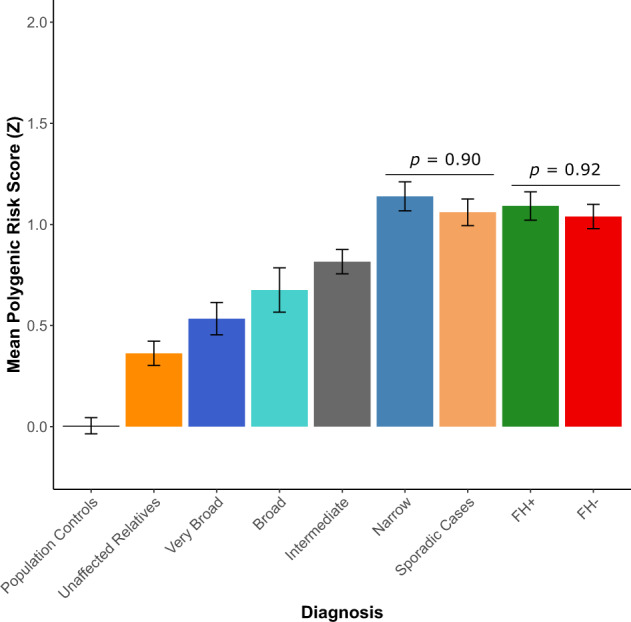
A subset of sporadic cases with family history (FH) information are further divided into FH+ (green bar) and FH− (red bar) categories. Unaffected relatives (dark orange bar) are distinct from population controls (black bar) as they represent unaffected individuals in the families. Familial SCZ cases are represented in the narrow spectrum category as described in the methods section. Error bars represent the standard error of the observed mean. X axis shows each of the diagnostic categories. Y axis shows the mean normalized Z-score for PGC3-SCZ.
PGC3-SCZ PRS results show that the Narrow spectrum category in the families, which includes familial cases of SCZ, had the highest mean PRS (Z = 1.13, SE = 0.09) followed by sporadic cases (Z = 1.06, SE = 0.09), intermediate spectrum familial cases (Z = 0.81, SE = 0.10), broad familial spectrum cases (Z = 0.67, SE = 0.11), very-broad spectrum cases (Z = 0.53, SE = 0.098), unaffected family members (Z = 0.36, SE = 0.10) and population controls (Z = 0.004, SE = 0.07).
No significant difference between familial and sporadic cases of SCZ
We observe no significant difference in PRS between familial SCZ cases and all sporadic SCZ cases, (p = 0.90), nor between familial SCZ cases and either FH+ (p = 0.88) or FH− (p = 0.82) sporadic SCZ cases. These results suggests that an increased burden of common SCZ risk variation is unlikely to account for the higher recurrence risk of SCZ in multiplex families (Fig. 1). Additionally, we show that there is no significant difference in SCZ PRS between FH+ and FH− sporadic SCZ cases (p = 0.92), suggesting that the inclusion of all sporadic cases in the comparison is unlikely to cause an upward bias in the mean PRS for the full cohort of sporadic cases, and further supporting the hypothesis that increased PRS is unlikely to account for FH of SCZ in the cohort studied here.
All family members carry a high burden of common SCZ risk variants
Familial and sporadic SCZ cases show a significantly higher mean SCZ PRS compared to all other diagnostic categories in the ISHDSF sample and ancestry-matched population controls (Figs. 1 and 2, Supplementary Table 3), underlining the important role of common risk variation in the genetic architecture of both familial and sporadic SCZ cases. All other ISHDSF diagnostic categories also show a significantly higher SCZ PRS compared to the population controls (Figs. 1 and 2). PRS comparison within the ISHDSF sample (Supplementary Table 4) shows no significant difference between mean PRS for intermediate and broad categories, indicating that individuals in both categories have a similar burden of common SCZ risk variants despite the presence of a range of diagnoses on the psychosis spectrum such as atypical psychosis and delusional disorder in the intermediate category, and disorders such as major depressive disorder with psychotic features, and bipolar disorder in the broad category. We observed no significant difference in SCZ PRS loading between the broad category and the very-broad category, which includes any other psychiatric disorder in the ISHDSF sample. The mean SCZ PRS in the very broad category is not significantly different from the unaffected members of the families, indicating a similar burden of common SCZ risk variation in these two distinct diagnostic categories. Finally, we observe a significantly higher PRS in unaffected family members compared to the population controls (P = 4.13 × 10⁻³), indicating a high baseline risk for SCZ in all members of multiplex families compared to population controls, regardless of their diagnostic status. This observation is consistent with SCZ transmission through some unaffected family members observed in the ISHDSF and other family samples.
Fig. 2. Comparison of PRS between the ISHDSF diagnostic categories and sporadic cases, versus population controls.
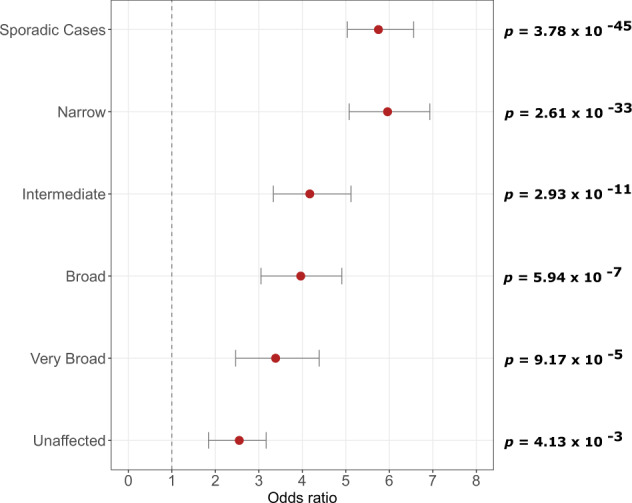
All analyses follow the hypothesis that ISHDSF members and sporadic cases have a higher PRS compared to population controls. All PRS have been normalized using Z-score standardization prior to obtaining odds ratios. The plots show odds ratios (OR, filled circles) with 95% confidence intervals (CI) for each category compared to population controls. X axis represents the odds ratios. Left side of Y axis represents each of the categories used for comparison versus population controls. Right side of the Y axis represents the p-values after multiple testing correction.
Discussion
Multiplex SCZ families represent the upper bounds of the distribution of recurrence risk for SCZ, and this study aimed to investigate the source of this increased recurrence risk. Since sporadic cases are considered to be the norm for most complex diseases including SCZ [50], this makes sporadic SCZ cases a good comparison group to assess whether elevated PRS can account for the increase in recurrence risk in familial cases. We observed that familial SCZ cases do not have a significantly increased PRS compared to sporadic SCZ cases in our modestly sized sample. We further show that this observation holds true regardless of the FH status of sporadic cases. Therefore, our finding provides empirical evidence that increased recurrence risk of SCZ in the ISHDSF sample is unlikely to be attributable to an increased burden of common SCZ risk variation as identified from genome-wide association studies. Therefore, the hypothesis that high familial recurrence risk of SCZ in multiplex families may be attributable to excess rare variation in the genome specific to SCZ, warrants further investigation. Furthermore, these results validate the concept of a genetically influenced psychosis spectrum in multiplex SCZ families as shown by a continuous increase of common SCZ risk variation burden across all members of the ISHDSF, from unaffected family members, to narrow category in the ISHDSF sample.
This analysis reveals potentially important differences in the genetic architecture of familial SCZ cases compared to familial bipolar disorder (BIP) cases. Analysis conducted by Andlauer et al [27] on BIP multiplex families have shown that unlike familial SCZ cases studied here, familial BIP cases have a significantly higher BIP PRS compared to ancestry matched, sporadic cases. These results, in addition to sparse evidence for the involvement of rare risk variation in the genetic architecture of BIP [22], demonstrates the importance of common risk variation in familial BIP, whereas whole exome sequencing studies of SCZ in both family and case–control samples have demonstrated that in addition to common variation, rare variation also plays an important role in the genetic architecture of SCZ [21, 51–53].
Although sequencing studies are only now reaching sample sizes sufficiently powered to detect individually associated rare variation and rare variant enriched genes associated with SCZ [21], earlier sequencing and rare variation studies observe consistent enrichment of rare variation in certain gene-sets and functional categories related to SCZ [51]. In addition, SNP signals from PGC3-SCZ GWAS are shown to be highly enriched in noncoding functional sequences in the genome [25], further underscoring the importance of conducting large scale whole-genome sequencing to identify rare variation in non-coding regions of the genome linked to SCZ. Results from the 1000 Genomes Project demonstrates that rare functional variation is frequent in the genome [54] and shows strong population specificity [55]. For example, using GWAS probe intensity data in the Irish case–control sample used in this study, we have previously detected a rare, novel 149 kb duplication overlapping the protein activated kinase 7 (PAK7) gene only found in the Irish population [56]. This duplication is associated with SCZ in the ISGC (p = 0.007), and a replication sample of Irish and UK case–controls with 22 carriers in 11,707 cases and 10 carriers in 21,204 controls (p = 0.0004, OR = 11.3). This duplication in PAK7 gene is in strong LD with local haplotypes (p = 2.5 × 10⁻²¹), indicating a single ancestral event and inheritance identical by descent in carriers.
We note that the liability that is captured by PRS constructed from PGC3-SCZ is currently insufficient for predicting a diagnosis of SCZ (AUC = 0.71) [25], meaning that PRS alone cannot be used as a diagnostic tool. The results of our study further suggest that current PRS alone is unlikely to be predictive of SCZ recurrence risk in the families of index probands. To address both of these predictive limitations of SCZ PRS, additional components of genetic risk must be identified and included in order to improve both identification of future cases and recurrence risk prediction in the relatives of probands.
The results presented in this study should be interpreted in the context of some limitations. First, current PGC3-SCZ PRS accounts for ~2.6% of the total variance in SCZ liability [25], and genetic risks from rare and structural variation are not represented in the PRS. As a result, some known genetic risk factors for SCZ such as the 22-q11 deletion [57] are not included in PRS construction, and such genetic risk factors are best measured through direct assessment of structural variation or whole genome sequencing studies. Despite these limitations, PRS provide the most reliable measurement of common risk variation in the genome and are suitable for indexing an individual’s risk for SCZ in this study. Second, the various diagnostic categories in the ISHDSF sample contain different number of subjects [30]. For example, the lower number of individuals satisfying broad and very broad diagnostic schema in the families, means that the power of analysis in those subgroups is lower. However, the narrow category which includes familial SCZ cases in the ISHDSF sample, has the highest number of individuals across all the diagnostic categories in the ISHDSF, making the sample suitable for the main hypothesis being tested in this study. Third, FH information is only available for a subset of sporadic cases as described in the methods. However, the ratio of FH+ (~31%) and FH− (~69%) sporadic cases studied here is in close agreement with FH data from large meta-analyses samples [8, 9], suggesting the subset of sporadic FH+ and FH− cases available are representative. Fourth, this analysis did not assess the common risk variant burden of each family separately, and the degree to which common risk variation may impact each family could vary between different families. Fifth, since the environmental factors unique to the families have also not been systematically assessed here, integrating rare genetic variation from whole sequencing studies with environmental influences in future analyses could further elucidate the role of rare variation and environmental influences on the recurrence risk of SCZ in multiplex families. Finally, as more samples from under-represented populations are collected, it is essential to replicate and show the generalizability of these findings in more diverse populations.
In conclusion, in this study, we show that differences in common risk variation as indexed by current PRS, is unlikely to account for the increased recurrence risk of SCZ in our cohort of multiplex SCZ families and ancestry matched sporadic cases. Therefore, our results suggest that both common and rare SCZ risk variation needs to be indexed to potentially improve diagnostic and familial recurrence prediction of SCZ.
Supplementary information
Author contributions
MA helped with the conceptualization, carried out the analysis and wrote the original manuscript. AEG, THN, RK, and BCV provided advice on the methodology. SAB, BTW, and BPR conceptualized the analysis. KSK collected the data for multiplex families. ISGC provided access to the full case–control sample. All authors contributed to the interpretation of the results and provided critical revisions of the manuscript.
Funding information
MA, BV, S-AB, KSK, BTW and BR were supported by R01-MH114593 (to BPR). Production of GWAS data for sporadic cases and controls was supported by R01-MH083094 (BPR) and Wellcome Trust Case Control Consortium 2 project (085475/B/08/Z and 085475/Z/08/Z), and the Wellcome Trust (072894/Z/03/Z, 090532/Z/09/Z and 075491/Z/04/B), and NIMH grant MH 41953 and Science Foundation Ireland (08/IN.1/B1916). Production of GWAS data for multiplex families was supported by R01-MH062276 and R01-MH068881 (to BPR). AEG was supported by T32-MH020030. T-HN was supported by NARSAD Young Investigator Grant 28599 and K25-AA030072.
Data availability
GWAS summary statistics for PGC3-SCZ GWAS is publicly available on the PGC website https://www.med.unc.edu/pgc/download-results/
Leave-N-out GWAS summary statistics for PGC3-SCZ GWAS was acquired from the PGC by following the appropriate guidelines and will be shared upon reasonable request.
GWAS summary statistics for LDL is publicly available on the ENGAGE Consortium website
http://diagram-consortium.org/2015_ENGAGE_1KG/
We made use of various freely available software tools in this study:
PRS-CS: https://github.com/getian107/PRScs
PLINK: https://www.cog-genomics.org/plink/2.0/
GMMAT: https://github.com/hanchenphd/GMMAT
LDAK: http://dougspeed.com/ldak/
PLINK2: https://www.cog-genomics.org/plink/2.0/
The custom scripts used in this study are available upon request.
Competing interests
The authors declare no competing interests.
Footnotes
A list of members and their affiliations are listed at the end of the paper.
Publisher’s note Springer Nature remains neutral with regard to jurisdictional claims in published maps and institutional affiliations.
Contributor Information
Brien P. Riley, Email: Brien.Riley@vcuhealth.org
Irish Schizophrenia Genomics Consortium:
Brien P. Riley, Derek W. Morris, Colm T. O’Dushlaine, Paul Cormican, Elaine M. Kenny, Brandon Wormley, Gary Donohoe, Emma Quinn, Roisin Judge, Kim Coleman, Daniela Tropea, Siobhan Roche, Liz Cummings, Eric Kelleher, Patrick McKeon, Ted Dinan, Colm McDonald, Kieran C. Murphy, Eadbhard O’Callaghan, Francis A. O’Neill, John L. Waddington, Kenneth S. Kendler, Michael Gill, and Aiden Corvin
Supplementary information
The online version contains supplementary material available at 10.1038/s41398-022-02060-3.
References
- 1.Saha S, Chant D, McGrath J. A Systematic Review of Mortality in Schizophrenia: Is the Differential Mortality Gap Worsening Over Time? Arch Gen Psychiatry. 2007;64:1123–31. doi: 10.1001/archpsyc.64.10.1123. [DOI] [PubMed] [Google Scholar]
- 2.Cardno AG, Gottesman II. Twin studies of schizophrenia: from bow‐and‐arrow concordances to Star Wars Mx and functional genomics. Am J Med Genet. 2000;97:12–7. doi: 10.1002/(SICI)1096-8628(200021)97:1<12::AID-AJMG3>3.0.CO;2-U. [DOI] [PubMed] [Google Scholar]
- 3.Heston LL. Psychiatric disorders in foster home reared children of schizophrenic mothers. Br J Psychiatry. 1966;112:819–25. doi: 10.1192/bjp.112.489.819. [DOI] [PubMed] [Google Scholar]
- 4.Cannon TD, Kaprio J, Lönnqvist J, Huttunen M, Koskenvuo M. The genetic epidemiology of schizophrenia in a Finnish twin cohort: a population-based modeling study. Arch Gen Psychiatry. 1998;55:67–74. doi: 10.1001/archpsyc.55.1.67. [DOI] [PubMed] [Google Scholar]
- 5.Tienari P, Wynne LC, Moring J, Läksy K, Nieminen P, Sorri A, et al. Finnish adoptive family study: sample selection and adoptee DSM-III-R diagnoses. Acta Psychiatr Scand. 2000;101:433–43. doi: 10.1034/j.1600-0447.2000.101006433.x. [DOI] [PubMed] [Google Scholar]
- 6.Kendler KS, Gruenberg AM, Tsuang MT. Psychiatric illness in first-degree relatives of schizophrenic and surgical control patients: a family study using DSM-III criteria. Arch Gen Psychiatry. 1985;42:770–9. doi: 10.1001/archpsyc.1985.01790310032004. [DOI] [PubMed] [Google Scholar]
- 7.Walder DJ, Faraone SV, Glatt SJ, Tsuang MT, Seidman LJ. Genetic liability, prenatal health, stress and family environment: risk factors in the Harvard Adolescent Family High Risk for Schizophrenia Study. Schizophr Res. 2014;157:142–8. doi: 10.1016/j.schres.2014.04.015. [DOI] [PubMed] [Google Scholar]
- 8.Käkelä J, Panula J, Oinas E, Hirvonen N, Jääskeläinen E, Miettunen J. Family history of psychosis and social, occupational and global outcome in schizophrenia: a meta-analysis. Acta Psychiatr Scand. 2014;130:269–78. doi: 10.1111/acps.12317. [DOI] [PubMed] [Google Scholar]
- 9.Esterberg ML, Trotman HD, Holtzman C, Compton MT, Walker EF. The impact of a family history of psychosis on age-at-onset and positive and negative symptoms of schizophrenia: a meta-analysis. Schizophr Res. 2010;120:121–30. doi: 10.1016/j.schres.2010.01.011. [DOI] [PubMed] [Google Scholar]
- 10.Riley B, Thiselton D, Maher BS, Bigdeli T, Wormley B, McMichael GO, et al. Replication of association between schizophrenia and ZNF804A in the Irish Case-Control Study of Schizophrenia sample. Mol Psychiatry. 2010;15:29–37. doi: 10.1038/mp.2009.109. [DOI] [PMC free article] [PubMed] [Google Scholar]
- 11.Kendler KS, McGuire M, Gruenberg AM, O’Hare A, Spellman M, Walsh D. The Roscommon Family Study: I. Methods, Diagnosis of Probands, and Risk of Schizophrenia in Relatives. Arch Gen Psychiatry. 1993;50:527–40. doi: 10.1001/archpsyc.1993.01820190029004. [DOI] [PubMed] [Google Scholar]
- 12.Kendler KS, McGuire M, Gruenberg AM, Spellman M, O’Hare A, Walsh D. The Roscommon Family Study: II. the risk of nonschizophrenic nonaffective psychoses in relatives. Arch Gen Psychiatry. 1993;50:645–52. doi: 10.1001/archpsyc.1993.01820200059006. [DOI] [PubMed] [Google Scholar]
- 13.Kendler KS, McGuire M, Gruenberg AM, O’Hare A, Spellman M, Walsh D. The Roscommon Family Study: III. Schizophrenia-related personality disorders in relatives. Arch Gen Psychiatry. 1993;50:781–8. doi: 10.1001/archpsyc.1993.01820220033004. [DOI] [PubMed] [Google Scholar]
- 14.Kendler KS, McGuire M, Gruenberg AM, O’Hare A, Spellman M, Walsh D. The Roscommon Family Study: IV. affective illness, anxiety disorders, and alcoholism in relatives. Arch Gen Psychiatry. 1993;50:952–60. doi: 10.1001/archpsyc.1993.01820240036005. [DOI] [PubMed] [Google Scholar]
- 15.Ament SA, Szelinger S, Glusman G, Ashworth J, Hou L, Akula N, et al. Rare variants in neuronal excitability genes influence risk for bipolar disorder. Proc Natl Acad Sci USA. 2015;112:3576–81. doi: 10.1073/pnas.1424958112. [DOI] [PMC free article] [PubMed] [Google Scholar]
- 16.Cruceanu C, Schmouth JF, Torres-Platas SG, Lopez JP, Ambalavanan A, Darcq E, et al. Rare susceptibility variants for bipolar disorder suggest a role for G protein-coupled receptors. Mol Psychiatry. 2018;23:2050–6. doi: 10.1038/mp.2017.223. [DOI] [PubMed] [Google Scholar]
- 17.Goes FS, Pirooznia M, Parla JS, Kramer M, Ghiban E, Mavruk S, et al. Exome sequencing of familial bipolar disorder. JAMA Psychiatry. 2016;73:590–7. doi: 10.1001/jamapsychiatry.2016.0251. [DOI] [PMC free article] [PubMed] [Google Scholar]
- 18.Okayama T, Hashiguchi Y, Kikuyama H, Yoneda H, Kanazawa T. Next-generation sequencing analysis of multiplex families with atypical psychosis. Transl Psychiatry. 2018;8:221. doi: 10.1038/s41398-018-0272-x. [DOI] [PMC free article] [PubMed] [Google Scholar]
- 19.Toma C, Torrico B, Hervás A, Valdés-Mas R, Tristán-Noguero A, Padillo V, et al. Exome sequencing in multiplex autism families suggests a major role for heterozygous truncating mutations. Mol Psychiatry. 2014;19:784–90. doi: 10.1038/mp.2013.106. [DOI] [PubMed] [Google Scholar]
- 20.Homann OR, Misura K, Lamas E, Sandrock RW, Nelson P, Mcdonough SI, et al. Whole-genome sequencing in multiplex families with psychoses reveals mutations in the SHANK2 and SMARCA1 genes segregating with illness. Mol Psychiatry. 2016;21:1690–5. doi: 10.1038/mp.2016.24. [DOI] [PMC free article] [PubMed] [Google Scholar]
- 21.Singh T, Poterba T, Curtis D, Akil H, Al Eissa M, Barchas JD, et al. Rare coding variants in ten genes confer substantial risk for schizophrenia. Nature. 2022;604:509–16. doi: 10.1038/s41586-022-04556-w. [DOI] [PMC free article] [PubMed] [Google Scholar]
- 22.Palmer DS, Howrigan DP, Chapman SB, et al. Exome sequencing in bipolar disorder identifies AKAP11 as a risk gene shared with schizophrenia. Nat Genet. 2022;54:541–47. doi: 10.1038/s41588-022-01034-x. [DOI] [PMC free article] [PubMed] [Google Scholar]
- 23.Ripke S, Sanders AR, Kendler KS, Levinson DF, Sklar P, Holmans PA, et al. Genome-wide association study identifies five new schizophrenia loci. Nat Genet. 2011;43:969–78. doi: 10.1038/ng.940. [DOI] [PMC free article] [PubMed] [Google Scholar]
- 24.Ripke S, Neale BM, Corvin A, et al. Biological insights from 108 schizophrenia-associated genetic loci. Nature. 2014;511:421–27. doi: 10.1038/nature13595. [DOI] [PMC free article] [PubMed] [Google Scholar]
- 25.Trubetskoy V, Pardiñas AF, Qi T, Panagiotaropoulou G, Awasthi S, Bigdeli TB, et al. Mapping genomic loci implicates genes and synaptic biology in schizophrenia. Nature. 2022;604:502–8. doi: 10.1038/s41586-022-04434-5. [DOI] [PMC free article] [PubMed] [Google Scholar]
- 26.de Jong S, Diniz MJA, Saloma A, et al. Applying polygenic risk scoring for psychiatric disorders to a large family with bipolar disorder and major depressive disorder. Commun Biol. 2018;1:163. doi: 10.1038/s42003-018-0155-y. [DOI] [PMC free article] [PubMed] [Google Scholar]
- 27.Andlauer TFM, Guzman-Parra J, Streit F, et al. Bipolar multiplex families have an increased burden of common risk variants for psychiatric disorders. Mol Psychiatry. 2021;26:1286–98. doi: 10.1038/s41380-019-0558-2. [DOI] [PMC free article] [PubMed] [Google Scholar]
- 28.Szatkiewicz J, Crowley JJ, Adolfsson AN, et al. The genomics of major psychiatric disorders in a large pedigree from Northern Sweden. Transl Psychiatry. 2019;9:60. doi: 10.1038/s41398-019-0414-9. [DOI] [PMC free article] [PubMed] [Google Scholar]
- 29.Bigdeli TB, Bacanu SA, Webb BT, Walsh D, O’Neill FA, Fanous AH, et al. Molecular validation of the schizophrenia spectrum. Schizophr Bull. 2014;40:60–5. doi: 10.1093/schbul/sbt122. [DOI] [PMC free article] [PubMed] [Google Scholar]
- 30.Kendler KS, O’Neill FA, Burke J, Murphy B, Duke F, Straub RE, et al. Irish study of high-density schizophrenia families: field methods and power to detect linkage. Am J Med Genet - Semin Med Genet. 1996;67:179–90. doi: 10.1002/(SICI)1096-8628(19960409)67:2<179::AID-AJMG8>3.0.CO;2-N. [DOI] [PubMed] [Google Scholar]
- 31.Levinson DF, Shi J, Wang K, Oh S, Riley B, Pulver AE, et al. Genome-wide association study of multiplex schizophrenia pedigrees. Am J Psychiatry. 2012;169:963–73. doi: 10.1176/appi.ajp.2012.11091423. [DOI] [PMC free article] [PubMed] [Google Scholar]
- 32.Donnelly P, Barroso I, Blackwell JM, Bramon E, Brown MA, Casas JP, et al. Genome-wide association study implicates HLA-C*01:02 as a risk factor at the major histocompatibility complex locus in schizophrenia. Biol Psychiatry. 2012;72:620–8. doi: 10.1016/j.biopsych.2012.05.035. [DOI] [PMC free article] [PubMed] [Google Scholar]
- 33.Andreasen NC, Endicott J, Spitzer RL, Winokur G. The family history method using diagnostic criteria: reliability and validity. Arch Gen Psychiatry. 1977;34:1229–35. doi: 10.1001/archpsyc.1977.01770220111013. [DOI] [PubMed] [Google Scholar]
- 34.Colhoun HM, McKeigue PM, Smith GD. Problems of reporting genetic associations with complex outcomes. Lancet. 2003;361:865–72. [DOI] [PubMed]
- 35.Loh PR, Danecek P, Palamara PF, Fuchsberger C, Reshef YA, Finucane HK, et al. Reference-based phasing using the Haplotype Reference Consortium panel. Nat Genet. 2016;48:1443–8. doi: 10.1038/ng.3679. [DOI] [PMC free article] [PubMed] [Google Scholar]
- 36.McCarthy S, Das S, Kretzschmar W, Delaneau O, Wood AR, Teumer A, et al. A reference panel of 64,976 haplotypes for genotype imputation. Nat Genet. 2016;48:1279–83. doi: 10.1038/ng.3643. [DOI] [PMC free article] [PubMed] [Google Scholar]
- 37.Das S, Forer L, Schönherr S, Sidore C, Locke AE, Kwong A, et al. Next-generation genotype imputation service and methods. Nat Genet. 2016;48:1284–7. doi: 10.1038/ng.3656. [DOI] [PMC free article] [PubMed] [Google Scholar]
- 38.Auton A, Abecasis GR, Altshuler DM, Durbin RM, Bentley DR, Chakravarti A, et al. A global reference for human genetic variation. Nature. 2015;526:68–74. doi: 10.1038/nature15393. [DOI] [PMC free article] [PubMed] [Google Scholar]
- 39.Ge T, Chen CY, Ni Y, Feng YCA, Smoller JW. Polygenic prediction via Bayesian regression and continuous shrinkage priors. Nat Commun. 2019;10:1776. doi: 10.1038/s41467-019-09718-5. [DOI] [PMC free article] [PubMed] [Google Scholar]
- 40.Clarke L, Fairley S, Zheng-Bradley X, Streeter I, Perry E, Lowy E, et al. The international Genome sample resource (IGSR): A worldwide collection of genome variation incorporating the 1000 Genomes Project data. Nucleic Acids Res. 2017;45:D854–9. doi: 10.1093/nar/gkw829. [DOI] [PMC free article] [PubMed] [Google Scholar]
- 41.Purcell SM, Wray NR, Stone JL, Visscher PM, O’Donovan MC, Sullivan PF, et al. Common polygenic variation contributes to risk of schizophrenia and bipolar disorder. Nature. 2009;460:748–52. doi: 10.1038/nature08185. [DOI] [PMC free article] [PubMed] [Google Scholar]
- 42.Ni G, Zeng J, Revez JA, et al. A Comparison of Ten Polygenic Score Methods for Psychiatric Disorders Applied Across Multiple Cohorts. Biol Psychiatry. 2021;90:611–20. doi: 10.1016/j.biopsych.2021.04.018. [DOI] [PMC free article] [PubMed] [Google Scholar]
- 43.Bulik-Sullivan BK, Neale BM. LD score regression distinguishes confounding from polygenicity in GWAS. Nat Genet. 2015;47:291–5. doi: 10.1038/ng.3211. [DOI] [PMC free article] [PubMed] [Google Scholar]
- 44.Surakka I, Horikoshi M, Mägi R, Sarin AP, Mahajan A, Lagou V, et al. The impact of low-frequency and rare variants on lipid levels. Nat Genet. 2015;47:589–97. doi: 10.1038/ng.3300. [DOI] [PMC free article] [PubMed] [Google Scholar]
- 45.Bulik-Sullivan B, Finucane HK, Anttila V, Gusev A, Day FR, Loh PR, et al. An atlas of genetic correlations across human diseases and traits. Nat Genet. 2015;47:1236–41. doi: 10.1038/ng.3406. [DOI] [PMC free article] [PubMed] [Google Scholar]
- 46.Zheng J, Erzurumluoglu AM, Elsworth BL, Kemp JP, Howe L, Haycock PC, et al. LD Hub: a centralized database and web interface to perform LD score regression that maximizes the potential of summary level GWAS data for SNP heritability and genetic correlation analysis. Bioinformatics. 2017;33:272–9. doi: 10.1093/bioinformatics/btw613. [DOI] [PMC free article] [PubMed] [Google Scholar]
- 47.Chen H, Wang C, Conomos MP, Stilp AM, Li Z, Sofer T, et al. Control for population structure and relatedness for binary traits in genetic association studies via logistic mixed models. Am J Hum Genet. 2016;98:653–66. doi: 10.1016/j.ajhg.2016.02.012. [DOI] [PMC free article] [PubMed] [Google Scholar]
- 48.R Core Team. R: A language and environment for statistical computing. R Foundation for Statistical Computing, Vienna, Austria. 2022. https://www.R-project.org/.
- 49.Speed D, Hemani G, Johnson MR, Balding DJ. Improved heritability estimation from genome-wide SNPs. Am J Hum Genet. 2012;91:1011–21. doi: 10.1016/j.ajhg.2012.10.010. [DOI] [PMC free article] [PubMed] [Google Scholar]
- 50.Yang J, Visscher PM, Wray NR. Sporadic cases are the norm for complex disease. Eur J Hum Genet. 2010;18:1039–43. doi: 10.1038/ejhg.2009.177. [DOI] [PMC free article] [PubMed] [Google Scholar]
- 51.Fromer M, Pocklington AJ, Kavanagh DH, Williams HJ, Dwyer S, Gormley P, et al. De novo mutations in schizophrenia implicate synaptic networks. Nature. 2014;506:179–84. doi: 10.1038/nature12929. [DOI] [PMC free article] [PubMed] [Google Scholar]
- 52.Rees E, Han J, Morgan J, Carrera N, Escott-Price V, Pocklington AJ, et al. De novo mutations identified by exome sequencing implicate rare missense variants in SLC6A1 in schizophrenia. Nat Neurosci. 2020;23:179–84. doi: 10.1038/s41593-019-0565-2. [DOI] [PMC free article] [PubMed] [Google Scholar]
- 53.Howrigan DP, Rose SA, Samocha KE, Fromer M, Cerrato F, Chen WJ, et al. Exome sequencing in schizophrenia-affected parent–offspring trios reveals risk conferred by protein-coding de novo mutations. Nat Neurosci. 2020;23:185–93. doi: 10.1038/s41593-019-0564-3. [DOI] [PMC free article] [PubMed] [Google Scholar]
- 54.Auton A, Abecasis GR, Altshuler DM, Durbin RM, Bentley DR, Chakravarti A, et al. A global reference for human genetic variation. Nature. 2015;526:68–74. [DOI] [PMC free article] [PubMed]
- 55.MacArthur DG, Balasubramanian S, Frankish A, Huang N, Morris J, Walter K, et al. A systematic survey of loss-of-function variants in human protein-coding genes. Science (80-) 2012;335:823–8. doi: 10.1126/science.1215040. [DOI] [PMC free article] [PubMed] [Google Scholar]
- 56.Morris DW, Pearson RD, Cormican P, Kenny EM, O’Dushlaine CT, Perreault LPL, et al. An inherited duplication at the gene p21 protein-activated Kinase 7 (PAK7) is a risk factor for psychosis. Hum Mol Genet. 2014;23:3316–26. doi: 10.1093/hmg/ddu025. [DOI] [PMC free article] [PubMed] [Google Scholar]
- 57.Marshall CR, Howrigan DP, Merico D, Thiruvahindrapuram B, Wu W, Greer DS, et al. Contribution of copy number variants to schizophrenia from a genome-wide study of 41,321 subjects. Nat Genet. 2017;49:27–35. doi: 10.1038/ng.3725. [DOI] [PMC free article] [PubMed] [Google Scholar]
Associated Data
This section collects any data citations, data availability statements, or supplementary materials included in this article.
Supplementary Materials
Data Availability Statement
GWAS summary statistics for PGC3-SCZ GWAS is publicly available on the PGC website https://www.med.unc.edu/pgc/download-results/
Leave-N-out GWAS summary statistics for PGC3-SCZ GWAS was acquired from the PGC by following the appropriate guidelines and will be shared upon reasonable request.
GWAS summary statistics for LDL is publicly available on the ENGAGE Consortium website
http://diagram-consortium.org/2015_ENGAGE_1KG/
We made use of various freely available software tools in this study:
PRS-CS: https://github.com/getian107/PRScs
PLINK: https://www.cog-genomics.org/plink/2.0/
GMMAT: https://github.com/hanchenphd/GMMAT
LDAK: http://dougspeed.com/ldak/
PLINK2: https://www.cog-genomics.org/plink/2.0/
The custom scripts used in this study are available upon request.