



Abstract
Major depressive disorder is the most common mood disorder in the United States today and the need for adequate treatment has been universally desired for over a century. Harry Harlow, famous for his research with rhesus monkeys, was heavily criticized when he undertook his controversial experiments trying to find a solution for depression in the 1960s–1970s. His research, however, did not just evolve gradually from his earlier research into learning and into love. Recently disclosed hand‐written notes show, for the first time, the severity of Harlow's depressions as he wrote in detail about his feelings and thoughts during his stay in a mental hospital in 1968. In these notes, Harlow repeatedly vowed to put every effort into finding a cure for depression. This may, for a large part, explain why he did not stop his rigorous animal experiments where critics argue he should have, and he eventually managed to book positive results.
1.
Depression or complete despair
Is life devoid of cause or care
Denying wish, or hope or feel,
A life within a wall of steel
Harry F. Harlow 1
2. INTRODUCTION
The American psychologist Harry Frederick Harlow (1905–1981) belongs to the most well‐known psychologists of the 20th century (Haggbloom et al., 2002). Working with baby rhesus monkeys and artificial mothers created from different materials, he found that baby monkeys prefer a nonfeeding soft cloth mother providing physical comfort and warmth over a wire mother providing only milk. This appeared to prove that babies have a need for love which is unconnected to their need for food, as attachment theorists were already claiming. Harlow's account of this study in an article called “The nature of love” (1958) has been cited more than 4200 times in the scientific press, has become a standard item of psychology textbooks, captured the attention of experts of wide‐ranging disciplines such as the history of science (Haraway, 1989, 2005; Vicedo, 2009, 2010, 2013), psychotherapy (Slater, 2004), primatology (Arcus, 2016), and scientific journalism (Blum, 2002, 2011; Tavris, 2014). It was even told in the form of a cartoon (Ottaviani, 2007) and overall stirred the imagination of the general public. He had firmly placed himself on the map as the scientist who had discovered “The nature of love”. However, Harlow's previous work on learning and later work on depression, although (briefly) discussed by some of the aforementioned experts, is generally much less well‐known. The existing discussions on Harlow's depression research generally regard his experiments as controversial or unnecessarily cruel but fail to provide the backdrop against which Harlow operated: the state of depression research at the time and the urgency he felt to find a solution after experiencing severe depression himself. In this article, we will fill this gap.
Even though knowledge about depression has increased over the past century, according to the World Health Organization in 2021, 5% of adults suffer from depression, which means 280 million people are affected (WHO, 2021). The progress of treatment possibilities has been slow, regularly distracted by hiccups and controversial experiments. When Harlow suffered his major depression in 1968, there were no clear‐cut solutions to this affliction. He had already done some research into depression, but after his stay in a mental hospital, the Mayo Clinic in Rochester, Minnesota, in 1968 he shifted his focus completely to studying depression. As he did so, however, Harlow's research methods became increasingly questionable (Gluck, 1997). He considered experiments with monkeys (“nonhuman animals”) justified as he believed that the findings could be generalized to humans (“human animals”) (Harlow et al., 1972; Harlow & McKinney, 1971), and so Harlow had no qualms about trying to create depression in rhesus monkeys, in order to then try to cure them. Animal rights activists, their voices being heard properly for the first time, justly protested against his methods. We argue that one of the main reasons for Harlow's perseverance was his own experience with depression at a time when no satisfying treatment was available. Different from his research into learning—which he chose to do out of interest—and his research into love—which more or less accidentally followed as part of his ongoing research—Harlow's research into depression was strongly driven by his personal experiences.
Giving an overview of Harlow's career from the beginning, we create the necessary background against which to view his research choices, in particular the choices he made regarding his depression research. Even though Harlow had suffered from bouts of depression throughout his adult life, his major depression in 1968 appears to be a turning point. Recently disclosed handwritten notes 2 from Harlow's personal archives, presented for the first time in this article, provide a unique insight into his feelings and thoughts before, during, and after his stay at the Mayo Clinic. The notes sketch a particularly bleak period in Harlow's life and add strong personal motives for trying the utmost to find a solution for depression. His research during this last part of his career contained rigorous methods that many considered unethical. Harlow, we will show, was nevertheless convinced of its necessity, and managed to book positive results in the end.
3. RESEARCH INTO LEARNING
Harry Harlow, born Harry Frederik Israel in 1905, received his PhD from Stanford University in 1930 and joined the University of Wisconsin that same year as an assistant professor of psychology. His intention was to study psychological behavior in rats but the lack of a decent laboratory forced him to move his observations to the local Vilas Park Zoo in Madison, where he studied the behavior of primates (lemurs, monkeys, and apes). Harlow was surprised at their intelligence, which led to a program of primate learning research (see, e.g., Harlow, 1932; Harlow & Settlage, 1934; Harlow et al., 1932; Harlow & Yudin, 1933; Maslow & Harlow, 1932; Yudin & Harlow, 1933). When testing the primates on learning and memory, existing tests that were normally used with other animals like pigeons, rats, or dogs turned out to be far too simple and Harlow developed the Wisconsin General Test Apparatus (WGTA), which contained an array of learning and memory tasks (Harlow & Bromer, 1938). The WGTA soon became the standardized intelligence test for primates (Sidowski & Lindsley, 1989). Together with his brother Robert Israel, a psychiatrist and head of the Warren State Hospital, Pennsylvania, he compared the test results of monkeys and apes to those of human subjects (Harlow & Israel, 1932).
When a suitable building became available on the Wisconsin campus in 1932, Harlow moved his research from the local zoo to his own primate laboratory (of which he remained director until his retirement in 1974) and his subjects changed from larger primates to mainly rhesus monkeys. Advancing their research into learning, in the late 1930s Harlow and his students began to try and locate areas in the brain responsible for specific intellectual processes in monkeys. Much like Karl Lashley (1950), they would alter the brain surgically and then observe the difference in behavior to understand where “learning” was situated (Harlow, 1939; Harlow & Dagnon, 1943; Spaet & Harlow, 1943a, 1943b). Altering the brain surgically was experimented with in different fields at this time. Treatment for depression, for instance, was attempted through frontal lobotomy or leucotomy (Kucharski, 1984). These procedures, which involved severing connections in the prefrontal cortex, were regularly executed in the USA between 1935 and 1955. However, Harlow was not yet involved in this—he would not start his research into depression until the second half of the 1960s.
Harlow and his students continued to study problem solving in monkeys through various methods (see, e.g., Harlow, 1943, 1944a, 1944b; Harlow & Poch, 1945; Simpson & Harlow, 1944; Spaet & Harlow, 1943a, 1943b; Young & Harlow, 1943a, 1943b; Zable & Harlow, 1946). When researching intelligence in primates, Harlow moved away from Clarke Hull's (1943) ideas on drive reduction. According to drive reduction theory, primates are motivated by drifts and will perform a task if the reward is food to satisfy their hunger. On closer scrutiny, however, the primates appeared not to be primarily motivated by hunger, but instead by curiosity. Even without food as a reward, they would try to solve the puzzles put in front of them (see Figure 1). Feeding before the testing actually improved performance in many cases (Davis et al., 1950; Harlow et al., 1950; Moss & Harlow, 1947). In addition, Harlow discovered how primates learned to learn, which he called “learning sets” (Harlow, 1949). He was the first to demonstrate that animals (monkeys) are capable of abstract thinking, research important enough to lead to Harlow becoming the first psychologist to be elected member of the National Academy of Sciences in 1951 (Gluck, 1997; “Lab Notes,” Harlow's personal papers). His 1949 study on learning sets has been cited more than 2800 times, making it his second most cited article (after The nature of love, 1958).
Figure 1.
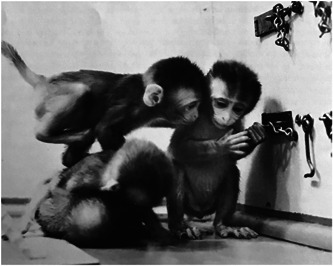
Young rhesus monkeys in a test situation
4. RESEARCH INTO LOVE
During the 1950s Harlow's Primate Lab was expanded a few times to house the growing colony necessary for studying the development of learning in monkeys from birth onwards. Harlow's shift from studying learning to studying love—or, to be more precise, social relationships in primates—was more or less serendipitous (cf. Callahan & Berrios, 2005). An outbreak of tuberculosis in Harlow's laboratory in 1955 caused him to lose almost his entire colony of rhesus monkeys. To prevent this from happening again, Harlow started to separate baby monkeys from their mothers 12 h after birth and placed them in separate cages to prevent contamination of disease. This did indeed prevent diseases from spreading, but as a result, the baby monkeys started to exhibit strange and pathological behavior (Sidowski & Lindsley, 1989). Presumably looking for a substitute for the motherly warmth they were lacking, the baby monkeys clung to the towel cloth that was covering the bottom of their cages. Harlow's friend and colleague from the United Kingdom, John Bowlby, pointed out during a visit to the Primate Lab in 1958 that this behavior was probably the result of the lack of mother‐love (Suomi et al., 2008; Van der Horst et al., 2008; Van Rosmalen et al., 2020). Bowlby, who would become famous for developing attachment theory together with Mary Ainsworth (Van Rosmalen et al., 2016), was trained in psychoanalysis. He would, however, challenge psychoanalytical ideas after studying the relationship between (human) mothers and their children for decades. He had specifically been studying the effect of separation experiences, where children were separated from their mother for a longer period through hospitalization, war evacuation, and so forth (cf. Bowlby, 1952, 1958, 1959, 1961). Bowlby's meeting with Harlow would strengthen their understanding of the effects of separation and they would refer to each other's work (Van der Horst et al., 2008), even though Harlow would move away from some of Bowlby's ideas later on in his career (Vicedo, 2009, 2010).
Intrigued by the monkeys' behavior Harlow created his now world‐famous surrogate monkey mothers made of cloth and put them next to surrogate mothers made of metal wire, the latter ones providing milk through a feeding bottle. Contrary to popular belief and going against the so‐called cupboard‐love theory (stating that an infant loves his mother primarily as the result of her supplying food), the monkeys preferred the contact comfort of the soft cloth nonfeeding mother over the cold, metal, feeding one (Harlow, 1958; Harlow & Zimmermann, 1959). The need for warmth and bodily contact appeared to be innate. Again, Harlow's findings contradicted conventional ideas in psychoanalysis and drive reduction theory (Suomi et al., 2008). When he was elected President of the American Psychological Association for 1958, Harlow's presidential address, “The nature of love,” consisted of the findings of this study and caused widespread publicity.
By this time, Harlow had become one of the most popular professors at the University of Wisconsin. Helen LeRoy, Harlow's assistant from 1958 onwards, describes him as down to earth, unassuming, and with a great sense of humor (LeRoy, 2008; personal communication, May 5, 2018; Suomi & Leroy, 1982). Following the enormous interest in artificial mother studies, Harlow's research changed focus and turned from learning to social development in monkeys. Initially, Harlow was enthusiastic about his artificial mother findings and even suggested that real mothers could possibly be replaced by surrogate mothers (Vicedo, 2009). However, once the monkeys that had been raised by artificial mothers became adults, they turned out to be mentally disturbed. They did not interact sexually with other monkeys, and females that became mothers after being impregnated were abusive to their young (Harlow, 1961; Seay et al., 1964). Somehow, the monkeys reared by surrogate mothers lacked elementary social skills.
When continuing his experiments, Harlow started to suspect that it was not the surrogate mothers who were to blame, but the fact that the monkeys had had no contact with other monkeys whatsoever. This led to an increased interest in the effects of different social environments—from smaller to larger social groups consisting of adults, adolescents, and infants (Harlow & Harlow, 1965). These studies led Harlow to posit what he called affectional systems: “the idea that each monkey develops specific social relationships with its mother, its peers, its sexual partners, and eventually, with its own offspring” (“Lab Notes,” Harlow's personal papers). The effects of the different affectional systems were compared with the effects of growing up socially isolated. The consequences of the monkeys being deprived of social contact were all too obvious and seemed similar to what Bowlby (1952) and Spitz (1945, 1946) had found in deprived children in hospitals and orphanages: physical care alone was not enough to grow up psychologically healthy (Figure 2).
Figure 2.
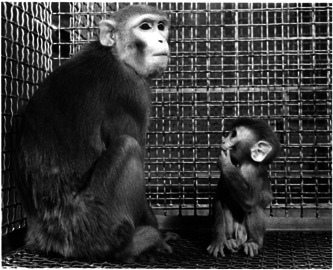
Mother raised by surrogate with a young infant monkey
As Harlow continued to study the social causes of psychopathology, he simultaneously became increasingly interested in finding solutions. To enable him to experiment with different cures, however, he first had to find ways to systematically induce psychopathology or depression in his monkeys. Investigating the subject of depression may seem far removed from investigating the subject of love, but for Harlow, these were two sides of the same coin. He noted that “depression rarely leads to love, but love frequently leads to depression as we all know” (“The autobiography of a laboratory,” undated manuscript, Harlow's personal papers). Convinced of the importance of mother love, to induce depression he experimented with “evil” artificial mothers (see Figure 3): one that would shake to try and get the baby off, one which comprised a hidden catapult that would throw off the infant unexpectedly, one that blasted the baby monkey away with compressed air, and one which had hidden spikes that would appear suddenly.
Figure 3.
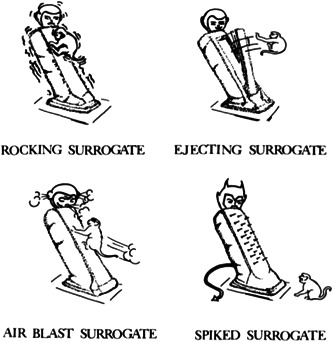
“Evil” artificial mothers
Even though these evil surrogate mothers temporarily disturbed the infants, the disturbance did not last (Harlow et al., 1971). Familiar with the research on the effects of mother–child separation, Harlow tried to induce depression through social isolation (Harlow et al., 1966; Harlow & McKinney, 1971; Seay et al., 1962; Seay & Harlow, 1965). This turned out to have stronger effects, especially when age‐mate or peer separation was used—Harlow had found that the peer affectional system was of great importance for healthy development, maybe even more so than the mother–child bond (Harlow & Harlow, 1965; cf. Vicedo, 2010). By the late 1960s, Harlow finally managed to induce depression by totally isolating monkeys from their mothers and peers (Harlow et al., 1965, 1964; Suomi et al., 1970). The monkeys were now ready to help Harlow try to find ways to resolve the induced psychopathology. This cycle, which Harlow referred to as “Love created, love destroyed, and love regained” (“Lab history,” Harlow's personal papers), emphasizes his view of a close connection between love and depression.
But while Harlow's career was booming, his private life was at an all‐time low. In 1967 his (second) wife Margaret was diagnosed with breast cancer, and in 1968 Harlow suffered from a major depression which caused him to be committed to the Mayo Clinic for psychiatric treatment. During his stay on the ward he corresponded with his wife and with his brother Robert, and after being discharged he wrote down his experiences. The hand‐written notes start with a prelude to the depression, continue to describe in detail how he felt during his stay at the clinic, and give a thorough insight into Harlow's thoughts and feelings during his depression and treatment. Harlow, a scientist in heart and soul, apparently considered these experiences important enough to describe them extensively and intimately, and they clearly spurred him on to continue his research into adepression on his return, determined to find a solution.
5. “MAN IN A MADHOUSE” 3
Harlow had suffered from minor short‐term depressions throughout his life, but usually, they would last for no more than a few days. “When my moods swing toward gaiety I feel ‘wealthy' and secure, and when they swing toward depression I become convinced that I will die after long lingering poverty” (Harlow in a letter to his brother Delmer Israel, January 6, 1970). Strangely enough, even though Harlow was enormously successful in the academic world, one of the triggers for these short‐term depressions would be the winning of awards—the recurring thought that this would be the last ever scientific honor he might be awarded caused Harlow to be depressed:
I was obsessed by the idea that I would lose the “creative touch” that had enabled me to achieve the last one and that this was the end of my scientific career… When I was elected president of my scientific society 4 I was depressed for some days…
However, Harlow never thought of himself as being “mentally disturbed” and could not see himself being hospitalized for anything related to his depressions. He often used to whisper “I wish I were dead” although he quickly added that in reality, he suspected that he had no real wish to die. Even though Harlow claimed that “I did not believe I would ever really shoot myself unless I became depressed when intoxicated,” he described at length the ways he would commit suicide if he decided to do so:
The way I would achieve it was by shooting a .35 caliber revolver bullet, hopefully through my midbrain… An overdose of sleeping pills has always seemed to me as a socially accepted way to achieve euthanasia… A combination of C2H5OH and sodium amytal 5 or any other relatively long‐active barbiturate is an effective way of looking into the future—particularly when you don't believe you have one anymore.
Probably linked to these bouts of depression, as a coping strategy, Harlow had developed a drinking problem that had progressively become more serious over the years. He describes this extensively in his notes and tells of two occasions in which he drank too much, took sleeping pills, and collapsed unconscious on the floor. Both times, his children found him and called for help, and he was taken to hospital by ambulance.
At the age of 62, Harlow's worst depression set in after winning “the most significant national award that can be given in America” (i.e., National Medal of Science in 1967, presented at the White House by President Lyndon B. Johnson). In that same period, Harlow was trying to prepare a presentation on “Depression in subhuman animals” he had agreed to give at the National Institutes of Health. For a year he had put off its preparation, but he was not concerned, because he felt he was, “like many others, a confirmed procrastinator.” However, some weeks before the actual presentation Harlow found himself increasingly incapable of outlining the speech, reading the necessary literature, and assembling the slides. He started to show the external physical symptoms of depression, like walking slowly and talking to fewer people. His anxiety about the speech was growing. Harlow's wife Margaret tried to urge him to pick himself up but to no avail. He became more and more depressed, and in the end, he had what he called “a little nervous breakdown” but what turned out to be a depression serious enough for Harlow to be committed to hospital.
In March and April 1968, Harlow was treated for depression at the Mayo Clinic. Some of his notes describe his stay, the staff, and the way he spent his days. Harlow mentions “… the adverse effects of social isolation, but this has been a historical blind spot for physicians…” He was decidedly unhappy with the activities organized by the clinic: “Since I disliked all or almost all of the events which the hospital arranged to fill up time, the minutes, hours and days dragged on infinitely monotonously.” He did not think group therapy was beneficial at all and stated that “one of the few advantages of being on the closed ward lay in the fact that all of the patients in the open ward were being subjected [five] days a week to group therapy sessions,” which seemed to Harlow to cause them to “become more deeply depressed.” Of the group therapy he had to take part in every other day he said he
thoroughly believed, and [sic] did most of the patients, that it was a mistake… I never saw group therapy conducted by an expert but it seemed to me that it was a combination of nondirected therapy and an attempt to get the patients to reply to two standardized questions: “How do you feel?” and “How do you relate to other people?” If Mayo had created a third question I never heard it in 2 months.
More important to Harlow was the frequent correspondence with his wife, who wrote to him almost daily. Harlow himself would write when he was able—sometimes one or more long letters in 1 day, at other times he did not manage to write for days.
After 2 weeks Harlow was told that he would have to undergo a treatment of electroconvulsive shock therapy (ECT). This worried Harlow, because he was “an anti‐[ECT] 6 advocate and believe[d] that there [wa]s not enough scientific knowledge about [ECT] to justify using it except as a condition of desperation.” In the late 1930s and early 1940s, the first reports on the effects of electroshock were published (e.g., Cerletti, 1938; Kalinowsky & Barrera, 1940; cf. Rzesnitzek, 2015) and showed that inducing seizures (as had been done before with insulin shock to treat schizophrenia) could relieve symptoms of affective disorders such as depression. ECT became one of the prominent treatment methods in the 1950s and 1960s. However, Harlow had been an editor for the Journal of Comparative and Physiological Psychology for 12 years and been on the editorial board of Science. During that time, of the more than 50 papers on the subject of ECT, only 2 that dealt with human subjects were accepted for publication, both of which were subsequently retracted by the authors. Nevertheless, since his personal physician, the Mayo staff, his wife, and his brother Robert, who himself was a psychiatrist by training, all thought ECT would be best for him, he “submitted as best [he] could.” Being a scientist, he naturally considered the available research:
Also, in deference to the intellectual demands of my profession, they gave me unilateral [ECT] treatments instead of bilateral treatments… Before entering the hospital I had read the two best and most recent psychiatric reports of the effects of unilateral versus bilateral [ECT] treatments. One of the papers was so badly planned and presented that I was surprised to see it published in a journal of clinical medicine. The other paper was much better but the measures used to determine cortical hemispheral dominance were naïve and the statistical treatment of the data left much to be desired, even though my knowledge of statistics leaves much to be desired. I doubt if either of the papers would have been accepted by a really scientific journal.
After receiving the ECT treatments Harlow nevertheless admitted that recovery was generally good and looking back on it he stated: “I am convinced that my own treatment gave me transient help. It made the early days of hospitalism more endurable.”
After 59 days at the Mayo Clinic Harlow returned home (Figure 4)
Figure 4.
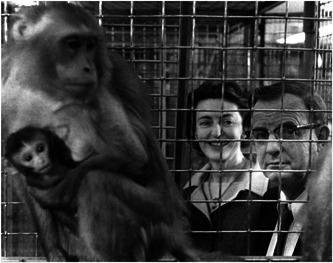
Harry and Margaret in the Primate Lab
6. RESEARCH INTO DEPRESSION
Even though it is often suggested that Harlow's 2 months at the Mayo Clinic instigated his depression research (Blum, 2002), it was actually set in motion well before then. His social deprivation studies (e.g., Harlow, 1964) had led to experimenting with inducing depression in monkeys through social isolation, and the presentation he was trying to prepare leading up to his own depression was titled “Depression in subhuman animals.”
From Harlow's personal notes, we now know that he had suffered from bouts of depression for as long as he could remember, but it was specifically his major depression in 1968 which strongly increased his efforts to find a solution. In his notes he stated:
There may be some forms of mental illness in which the staff or family suffer more than the patient but I doubt that this can be true when the patient is in deep depression and one assumes that the staff and family are not themselves critically ill at the same time. One of my few motivations to recover during the darkest hours was to have a chance to tell the world how deeply the patient had suffered… I hoped to partially recover so that I would tell the world about the agonies that a depressed person undergoes. I can say that the mental torment of depression is extreme…
Remembering a textbook description of depression, Harlow said: “The man who wrote these charmingly objective words never underwent a true depression himself. These are just words put on paper and do not convey the hours of endured torment.” That Harlow felt a deep need to find a solution also becomes clear from an undated manuscript from Harlow's personal papers, titled “Depressions: Facts or Fantasies” in which he stated:
The outlook of most people who have a psychotic depression is grim but for about 5% (?) the outlook is not grim but grave because they will find surcease and sorrow in suicide, and the percentage of recovery from a well‐planned suicide is negligible… Depression has been recognized as a clinical syndrome for over 2,000 years which is a long time to find out nothing about a disease entity… essentially nothing so far has been achieved and everything remains to be done. In part, this will be obtained by the use of human subjects and in part by subhuman subjects as stable, psychotic positions may be instituted into them.
As Harlow correctly pointed out, the treatment possibilities were only developing very slowly. Until the 1940s medical doctors viewed mental illness as irreversible. As a result, most doctors chose to use sedative‐hypnotics such as barbiturates or bromides to treat depression (Callahan & Berrios, 2005). An alternative for the use of sedative‐hypnotics was frontal lobotomy or leucotomy (Kucharski, 1984), used between 1935 and 1955, followed by ECT in the 1950s and 1960s (which would fall into disrepute by the mid‐1970s).
Another problem, apart from the slow speed at which treatment possibilities were being explored, was the confusion about the diagnostic criteria for depression, with as many as 12 different classification systems in place (Kendell, 1976). Only from the 1980s, and the publication of DSM‐III were experts beginning to make sense of what we now conceptualize as “depression,” which caused the current, more scientific, and medical treatment paradigm to be installed. This paradigm involves the four pillars of criteria‐based diagnosis, measures of severity of illness, articulation of a biomedical framework, and a better understanding of the epidemiology of affective and emotional disorders (Callahan & Berrios, 2005).
According to Harlow, in the late 1960s, only time (“if the hospital staff can keep the patient from suicide for a reasonable period of time there is a good chance that the patient will recover”), ECT, and the recently discovered antidepressant drugs were available to possibly (partly) alleviate depression. Even though he felt ECT had helped him along the road to recovery, he considered the scientific evidence to be meager, and the antidepressant drugs still had too many side effects. He felt there was a lot of work to be done, especially in the area of therapeutic techniques, which he knew worked in some cases of other human psychotics (Harlow et al., 1972).
As Harlow intensified his research into depression, he looked for valid and rigorous study designs. To him, it was clear that humans and monkeys showed enough parallels in their normal social development to be able to draw important conclusions from monkey research (Harlow et al., 1965; Harlow & McKinney, 1971; Seay et al., 1964). When designing his research, Harlow did not first create an experiment in monkeys to then determine if the results could be generalized to humans but worked the other way around: he would start with data obtained from humans and see if they could be replicated in monkeys. As his first and third wife, Clara Mears Harlow (1986) stated:
The monkey, and especially the rhesus monkey, gave clear evidence of being able to replicate many human behaviors. This fact was of the utmost importance since it solidified and established the formula used by Harlow in his experiments: if human behavior could be replicated in the monkey, the results of the study would generalize to human behavior (p. xxii).
According to Harlow, animal studies into depression would be of enormous interest to clinicians, especially:
1) the nature of the bonds that, when broken, lead to depression; 2) the kinds of separation experiences that in themselves are most likely to lead to depression; 3) the effect of age on the response to separation; and 4) the effects of reunion at varying stages of separation (McKinney et al., 1971, p. 1319).
Even though Harlow was convinced that many biologically trained scientists would agree with him that generalization from nonhuman behavioral data to man was justifiable (Harlow et al., 1972), he felt the addition of clinical psychiatrist William McKinney to the Primate Center in 1969 to be of enormous value. According to Harlow, he brought “clinical insight and psychiatric respectability” (Harlow et al., 1971). The combination of scientists studying animals in a laboratory and clinicians observing human patients causes reinforcement and greater understanding on both sides (Löwy, 2003). McKinney had previously published on depression research in animals (McKinney & Bunney, 1969) and would become one of the driving forces behind the depression research at the Primate Center in the early 1970s (Helen LeRoy, personal communication, October 18, 2007).
Harlow, together with Stephen Suomi, who at the time was working as a research assistant to Harlow, had been experimenting with different apparatuses designed to produce depression in monkeys. The Quad Cage (see Figure 5) was a combined experimental living cage where the animals could be repetitively isolated by sliding in various types of screens, but it took at least 6 months to induce depression this way. To speed up the process, they designed the much‐criticized pit of despair and the tunnel of terror. When the monkeys were subjected to total isolation for about 30 days in a vertical chamber (called the pit of despair; see Figure 6)—a stainless steel trough, the sides of which sloped down inwards to prevent the monkeys from climbing up to the open‐top—it was enough to induce depression (Harlow & Suomi, 1971b, 1974; Harlow et al., 1970; Suomi & Harlow, 1969, 1972a). About the pit, Harlow and Suomi wrote:
Depressed human beings report that they are in the depths of despair or sunk in a well of loneliness and hopelessness. Therefore, we built an instrument that would meet these criteria and euphemistically called it the pit, or the vertical chamber for those who find the term “pit” psychologically unacceptable (Suomi & Harlow, 1969, p. 247).
It is clear that the vertical chamber has enormous potential for rapid production of psychopathological behavior in monkeys… While we did not ask our subjects if they felt helpless and/or hopeless, their posture and lack of activity seemed to indicate an attitude of “giving up” (Harlow & Suomi, 1971a, p. 253).
Figure 5.
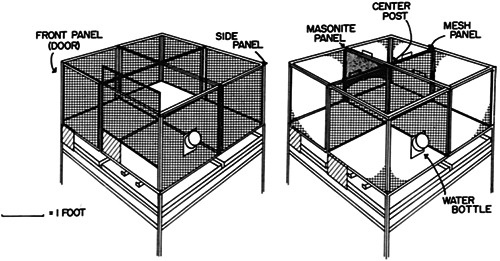
Quad Cage: A living cage designed to induce depression
Figure 6.
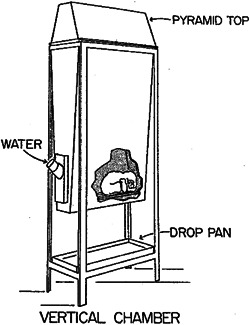
Vertical chamber or pit of despair
Harlow confirmed that “all three human developmental stages described by Spitz and Bowlby unfolded in infant monkeys” (Harlow et al., 1972; McKinney et al., 1973). The tunnel of terror, which could be used in combination with the pit of despair, consisted of a tunnel in which something scary like a battery‐powered toy robot would be moving towards the monkey to intensify depression.
Animal protection activists justly protested against the use of these apparatuses, but the animal rights movement had not quite come into its own as yet—the Laboratory Animal Welfare Act had only recently passed in 1966, and the movement would not be clearly heard until the late 1970s, after publications like Richard Ryder's Victims of science (Ryder, 1975) and Peter Singer's (1975) Animal Liberation, placing speciesism next to racism and sexism (Franco, 2013). Nevertheless, even though animal research for medical purposes was still considered morally acceptable by the majority of the public, criticism grew as Harlow continued his experiments. At the same time, the overall treatment of the monkeys in Harlow's Primate Lab was considered to be above contemporary standards for laboratory animals (Blum, 2002; Helen LeRoy, personal communication, May 5, 2018), which may have made it easier for those involved to justify the rigorous experiments. When Harlow received letters from the public, criticizing his research, he would always write back communicating his reasons:
[M]y brilliant and beloved wife, Dr. Margaret Harlow, lost a long hard battle with cancer. Cancer probably causes almost as much human suffering as depression, and I would certainly be opposed—adamantly opposed—to blocking medical research in either of these areas. I believe the long‐term goal to alleviate human suffering justifies the utilization of subhuman animals in trying to find cures. I would like to emphasize the fact that we employ the most humane measures possible in caring for our animals… I believe we are sincerely interested in working toward the resolution of human problems (Harlow in a letter to A. C. Whitaker, November 11, 1971).
The experiments using the vertical chamber were also criticized from within the scientific community (as a result of which Suomi and Gluck later distanced themselves from this type of research). However, in his articles Harlow also explained how he felt justified using these controversial methods: “The theoretical linkages between monkey and human psychopathology, including psychoses in childhood, merit exploration” (Harlow & Suomi, 1971a, p. 254); and “Depression destroys more people than any other disease entity. With subhuman help depression may be eradicated” (Harlow & Suomi, 1971c, “Generalization of behavior from men to monkeys,” Harlow's personal papers, p. 3). Mary Ainsworth, in a discussion of papers by Suomi and Bowlby, stated that
it is evident that, with a few minor exceptions, there is such a striking congruity between the findings for human and nonhuman primates in regard to responses to separation and to the subsequent reunion that it can only be gratifying to all who have devoted time and energy to the explorations relevant to this problem (Ainsworth, 1976, p. 40).
The real objective, of course, was to find successful treatments for induced depression. Different treatments were considered, including ECT and antidepressant drugs (Harlow et al., 1971). However, apart from Harlows' personal reservations, by this time ECT was falling into disrepute. Antidepressants were becoming the standard treatment method in combination with psychotherapy, but the success of the use of antidepressants such as iproniazid and imipramine (from the 1950s), lithium, monoamine oxidase inhibitors, and chlorpromazine (from the 1970s) was helped much by pharmaceutical companies that successfully used marketing strategies to make their products the predominant psychotropic medication in a “therapeutic vacuum” (Callahan & Berrios, 2005). Chlorpromazine was tried in some monkeys but as soon as the medication was stopped, abnormal behaviors came back. Some other antidepressants available at the time also did not have lasting effects (McKinney in an interview with T. A. Ban, 2001).
Harlow, having focused on relationships for decades, felt that too much attention was paid to antidepressant drugs, and research into therapeutic techniques to alleviate symptoms of depression was sorely lacking (Harlow et al., 1972). He had not been enthusiastic about the type of group therapy he himself had received at the Mayo Clinic but was nevertheless drawn to the idea that social relationships could alleviate depression. Harlow, therefore, started focusing on social manipulation—initially reversing the isolation process which had induced the depression. In the beginning, Harlow was pessimistic (Harlow & Novak, 1973). In a letter, he wrote:
We have studied the effects of extremely deprived environments on the social, sexual, and maternal behavior of monkeys, and we have found that such deprivation maintained for the first six months of life or longer completely destroys the monkey as a social animal—and destroys it forever. We doubt very much if any remedial process would be of avail, although we intend to make some small effort to find out within the next year (Harlow in a letter to Jessie Crane, Educational Coordinator of Head Start, June 9, 1969).
Not long after, however, he was relieved to be able to admit that he had been wrong: “[We have] successfully rehabilitated a group of 6‐month total social isolates and… 12‐month total isolate monkeys. Since I had stated for a long time that rehabilitation of these monkeys was impossible, I was both chastened and educated” (in a letter to Betty Flint, University of Toronto, May 16, 1974). Harlow and Suomi (later joined by Novak) found that monkeys could be (partly) cured of depression by joining them with so‐called therapist monkeys—socially and mentally healthy monkeys that were younger than the depressed monkeys (Harlow, 2019; Harlow & McKinney, 1971; Harlow & Suomi, 1971a; Suomi & Harlow, 1972b). The age difference was considered important because same‐age peers had been seen to exhibit aggressive behavior towards monkeys raised in isolation (Harlow et al., 1965). Harlow had previously seen infants of motherless mothers endlessly struggle to try and contact their dysfunctional mothers—maybe young monkeys would show the same behavior towards older depressed peers. It worked: the young therapist monkeys were joined with the depressed monkeys most days a week for a few hours and would approach the depressed monkey and cling to it, from time to time attempting to play at an elementary level (Figure 7). The depressed monkeys initially just huddled in a corner but after a while reciprocated the clinging. In due course, the depressed monkeys joined in playing, and later still, initiated play. Eventually, the (formerly) depressed monkeys appeared to behave relatively normally (Novak, 1979; Novak & Harlow, 1975; Suomi et al., 1976; Suomi & Harlow, 1972b; Suomi et al., 1972, 1974). According to Harlow, “this rehabilitation method was successful and may provide experimental support for the group treatment of some childhood psychotic states” (Harlow & McKinney, 1971). Harlow felt that, because depression was induced as an early experience in the monkey, this meant that reversal of psychopathological behavior might generalize to humans whose depression had been caused by inadequate early experience like trauma after separation (Suomi & Harlow, 1972b; Young et al., 1973). He was excited about
the implications for the process of therapy that these data raise… that social recovery can be achieved in subjects whose social deficits were once considered irreversible… and by the nature of the therapeutic procedure itself (Suomi et al., 1972, p. 931).
Figure 7.
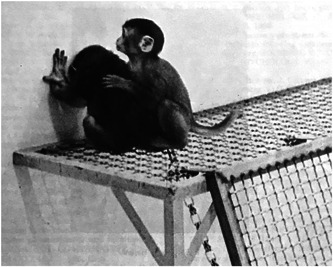
Patient and therapist in clinging position
Harlow was now becoming increasingly optimistic about the development of therapeutic techniques for treating depression in people by the generalization of the research findings to human therapists: “The psychotherapeutic principles of avoidance of social fears and the inculcation of gradual stepwise social interaction will doubtless eventually be discovered by the psychiatrists” (“The autobiography of a laboratory,” undated manuscript, Harlow's personal papers). In his experiments, Harlow clearly showed the importance and therapeutic effect of social relations (Vicedo, 2010). Harlow considered both social relations and the understanding, accepting attitude of the monkey therapists important aspects of the successful treatment of depression, which he hypothesized to be helpful in the treatment of deprived or depressed infants and children (Blum, 2002; Harlow in Analysis Analyzed, undated manuscript, Harlow's personal papers). Responding to the controversy around his research, he would later state that:
If you're going to work with love you're going to have to work with all of its aspects. Some of the work is in a sense cruel, but remember for every mistreated monkey there exist a million mistreated children. If my work will point this out and save only one million human children, I can't get overly concerned about 10 monkeys. Besides, we successfully rehabilitated our depressed monkeys anyway. The techniques are probably applicable to human beings (August 3, 1978, The Capital Times P.M., Madison, WI).
Today, general guidelines for the treatment of depression in adolescents and adults 7 suggest a combination of pharmacotherapy and psychotherapy (American Psychological Association, 2019). According to these APA guidelines, the first choice for psychotherapeutic treatment is either cognitive behavioral therapy (CBT) or interpersonal psychotherapy (IPT). CBT is a psychosocial intervention that includes the behavioral activation of a patient into his social environment, much like Harlow's monkeys were thrust back into the social environment. IPT is attachment‐focused psychotherapy that concentrates on resolving interpersonal problems and is based on the idea that healthy relationships affect mood. Just as Harlow's experiments had shown, therapists can teach victims of depression to have better social relations.
With the encouraging results of the therapist monkeys, Harlow felt he was finally getting some answers:
In our study of psychopathology, we began as sadists trying to produce abnormality. Today we are psychiatrists trying to achieve normality and equanimity. …Three years ago the idea of using monkeys to unravel the behavioral and biochemical intricacies of an affliction suffered in some form, and at some time, by virtually every human being and fully understood by no human mind, seemed to be little more than a desperate dream or humble hope. Today we are finally and firmly on the road to success (Harlow et al., 1971, p. 548).
Margaret Harlow died of cancer in 1971, and in 1972 Harlow remarried his first wife, Clara Mears. Harlow formally retired from the University of Wisconsin in 1974 but continued to coauthor publications on the subject of depression for some years. His research was continued by Suomi and colleagues.
7. CONCLUSION
In this paper, we focused on a lesser‐known but nevertheless heavily criticized period in Harry Harlow's research career: his study of depression and its possible cure. Depression has affected many for centuries, and the need for adequate treatment is universally desired. However, the progress of treatment possibilities has been slow over the past century, moving through trial and error, from sedation to lobotomy or leucotomy, followed by ECT and later still, medication combined with psychotherapy. While Harlow's interest in studying depression had started well before his hospitalization, his search intensified after his own experience of severe depression. The severity of his feelings and his proposed determination to find a cure for depression become clear from recently disclosed hand‐written notes. Harlow is famous for his research into “love,” but the last part of his career included cruel experiments that appeared to be far removed from love. For Harlow, however, love and depression were merely two sides of the same coin—take love away and one finds depression. Having felt the gravity of a major depression himself caused him to disregard any criticism against his rigorous experiments which he felt were needed to find a solution at a time when science had not managed to come up with an effective treatment for depression, and eventually Harlow managed to book some positive results. Considering Harlow's own experience of depression combined with the lack of a proper solution at the time adds a different angle from which to view the cruel experiments Harlow undertook to find a cure for what he called “a life within a wall of steel.”
ACKNOWLEDGMENT
This study was made possible by grants awarded to the first and third author by the Köhler‐Stiftung (no. S112/10210/16) and the Dr. J. L. Dobberke Stichting voor Vergelijkende Psychologie (no. 3819).
Rosmalen, L. , Luijk, M. P. C. M. , & Horst, F. C. P. (2022). Harry Harlow's pit of despair: Depression in monkeys and men. Journal of the History of the Behavioral Sciences, 58, 204–222. 10.1002/jhbs.22180
ENDNOTES
Undated manuscript from Harlow's personal archives; Harry Harlow Papers, Harlow Primate Laboratory, University of Wisconsin‐Madison, Madison, WI.
These notes were recovered from the Harry Harlow Papers, Primate Laboratory, University of Wisconsin‐Madison, Madison, WI, and were made available to us by Harlow's former assistant Mrs. Helen LeRoy. We are grateful to Mrs. LeRoy for her assistance and hospitality.
This is the title of one of Harlow's writings about his time at the Mayo Clinic; Harlow's personal archives, Madison, Wisconsin, USA.
Harlow was president of the APA, 1958–1959.
A combination of alcohol and barbiturates has led to many cases of suicide, including those of celebrities, especially before the introduction of benzodiazepines as an alternative (López‐Muñoz et al., 2005).
Harlow used the then‐prevailing acronym “ECS” for electroconvulsive shock therapy. For reasons of clarity, we changed this to the currently used acronym “ECT.”
For treatment of child patients with depressive disorders there was insufficient evidence to make a recommendation (American Psychological Association, 2019).
DATA AVAILABILITY STATEMENT
Data sharing is not applicable to this article as no new data were created or analyzed in this study.
REFERENCES
- Ainsworth, M. D. S. (1976). Discussion of papers by Suomi and Bowlby. In Serban G. & Kling A. (Eds.), Animal models in human psychobiology (pp. 37–47). Springer. [Google Scholar]
- American Psychological Association . (2019). Clinical practice guideline for the treatment of depression across three age cohorts. https://www.apa.org/depression-guideline/guideline.pdf
- Arcus, D. (2016). Harlow, Harry. In Fuentes A. (Ed.), The international encyclopedia of primatology. John Wiley & Sons. [Google Scholar]
- Blum, D. (2002). Love at Goon Park: Harry Harlow and the science of affection. Merloyd Lawrence Books. [Google Scholar]
- Blum, D. (2011). Love according to Harry Harlow. APS Observer, 25(1).https://www.psychologicalscience.org/observer/love-according-to-harry-harlow/comment- [Google Scholar]
- Bowlby, J. (1952). Maternal care and mental health. World Health Organization. [PMC free article] [PubMed] [Google Scholar]
- Bowlby, J. (1958). The nature of the child's tie to his mother. International Journal of Psycho‐Analysis, 39, 350–373. [PubMed] [Google Scholar]
- Bowlby, J. (1959). Separation anxiety. International Journal of Psycho‐Analysis, XLI, 1025. [PubMed] [Google Scholar]
- Bowlby, J. (1961). Separation anxiety: A critical review of the literature. Journal of Child Psychology & Psychiatry, 1(4), 251–269. [Google Scholar]
- Callahan, C. M. , & Berrios, G. E. (2005). Reinventing depression: A history of the treatment of depression in primary care, 1940–2004. Oxford University Press. [Google Scholar]
- Cerletti, U. (1938). Un nuevo metode di shockterapie" L'elettro‐shock". Boll Accad Med Roma, 64, 136–138. [Google Scholar]
- Davis, R. T. , Settlage, P. H. , & Harlow, H. F. (1950). Performance of normal and brain‐operated monkeys on mechanical puzzles with and without food incentive. The Pedagogical Seminary and Journal of Genetic Psychology, 77(2), 305–311. [DOI] [PubMed] [Google Scholar]
- Franco, N. H. (2013). Animal experiments in biomedical research: A historical perspective. Animals, 3(1), 238–273. [DOI] [PMC free article] [PubMed] [Google Scholar]
- Gluck, J. P. (1997). Harry F. Harlow and animal research: reflection on the ethical paradox. Ethics & Behavior, 7(2), 149–161. [DOI] [PubMed] [Google Scholar]
- Haggbloom, S. J. , Warnick, R. , Warnick, J. E. , Jones, V. K. , Yarbrough, G. L. , Russell, T. M. , Borecky, C. M. , McGahhey, R. , Powell, J. L. , Beavers, J. , & Monte, E. (2002). The 100 most eminent psychologists of the 20th century. Review of General Psychology, 6(2), 139–152. [Google Scholar]
- Haraway, D. J. (1989). Primate visions: Gender, race, and nature in the world of modern science. Routledge. [Google Scholar]
- Haraway, D. (2005). Primate experiments: Harry Harlow and the technology of love. In Classen C. (Ed.), The book of touch (pp. 134–143). Routledge. [Google Scholar]
- Harlow, H. F. (1932). Comparative behavior of primates. III. Complicated delayed reaction tests on primates. Journal of Comparative Psychology, 14(2), 241–252. [Google Scholar]
- Harlow, H. F. (1939). Recovery of pattern discrimination in monkeys following unilateral occipital lobectomy. Journal of Comparative Psychology, 27(3), 467–489. [Google Scholar]
- Harlow, H. F. (1943). Solution by rhesus monkeys of a problem involving the Weigl principle using the matching‐from‐sample method. Journal of Comparative Psychology, 36(3), 217–227. [Google Scholar]
- Harlow, H. F. (1944a). Studies in discrimination learning by monkeys: I. The learning of discrimination series and the reversal of discrimination series. The Journal of General Psychology, 30(1), 3–12. [Google Scholar]
- Harlow, H. F. (1944b). Studies in discrimination learning by monkeys: II. Discrimination learning without primary reinforcement. The Journal of General Psychology, 30(1), 13–21. [DOI] [PubMed] [Google Scholar]
- Harlow, H. F. (1949). The formation of learning sets. Psychological Review, 56(1), 51–65. [DOI] [PubMed] [Google Scholar]
- Harlow, H. F. (1958). The nature of love. American Psychologist, 13(12), 673–685. [DOI] [PubMed] [Google Scholar]
- Harlow, H. F. (1964). Early social deprivation and later behavior in the monkey. In Abrams A., Gurner H. H., & Toman J. E. P. (Eds.), Unfinished tasks in the behavioral sciences (pp. 154–173). Lippincott Williams & Wilkins. [Google Scholar]
- Harlow, H. F. (1961). The development of affectional patterns in infant monkeys. In Foss B. M. (Ed.), Determinants of infant behavior (pp. 75–97). Methuen. [Google Scholar]
- Harlow, H. (2019). 12. Induction and alleviation of depressive states in monkeys. In White N. (Ed.), Ethology and psychiatry (pp. 197–208). University of Toronto Press. [Google Scholar]
- Harlow, H. F. , & Bromer, J. A. (1938). A test apparatus for monkeys. The Psychological Record, 2, 434–436. [Google Scholar]
- Harlow, H. F. , & Dagnon, J. (1943). Problem solution by monkeys following bilateral removal of the prefrontal areas. I. The discrimination and discrimination‐reversal problems. Journal of Experimental Psychology, 32(4), 351–356. [DOI] [PubMed] [Google Scholar]
- Harlow, H. F. , Dodsworth, R. O. , & Harlow, M. K. (1965). Total social isolation in monkeys. Proceedings of the National Academy of Sciences of the United States of America, 54(1), 90–97. [DOI] [PMC free article] [PubMed] [Google Scholar]
- Harlow, H. F. , Gluck, J. P. , & Suomi, S. J. (1972). Generalization of behavioral data between nonhuman and human animals. American Psychologist, 27(8), 709–716. [Google Scholar]
- Harlow, H. F. , & Harlow, M. K. (1965). The affectional systems. In Schrier A. M., Harlow H. F., & Stollnitz F. (Eds.), Behavior of nonhuman primates (Vol. 2, pp. 287–334). Academic Press. [Google Scholar]
- Harlow, H. F. , Harlow, M. K. , Dodsworth, R. O. , & Arling, G. L. (1966). Maternal behavior of rhesus monkeys deprived of mothering and peer association in infancy. Proceedings of the Philosophical Society, 110, 58–66. [Google Scholar]
- Harlow, H. F. , Harlow, M. K. , & Meyer, D. R. (1950). Learning motivated by a manipulation drive. Journal of Experimental Psychology, 40(2), 228–234. [DOI] [PubMed] [Google Scholar]
- Harlow, H. , Harlow, M. D. , & Suomi, S. J. (1971). From thought to therapy. American Scientist, 59, 538–549. [PubMed] [Google Scholar]
- Harlow, H. F. , & Israel, R. H. (1932). Comparative behavior of primates. IV. Delayed reaction tests on subnormal humans. Journal of Comparative Psychology, 14(2), 253–262. [Google Scholar]
- Harlow, H. F. , & McKinney, W. T. (1971). Nonhuman primates and psychoses. Journal of Autism and Childhood Schizophrenia, 1(4), 368–375. [DOI] [PubMed] [Google Scholar]
- Harlow, H. F. , & Novak, M. A. (1973). Psychopathological perspectives. Perspectives in Biology and Medicine, 16(3), 461–478. [DOI] [PubMed] [Google Scholar]
- Harlow, H. F. , & Poch, S. (1945). Discrimination generalization by macaque monkeys to unidimensional and multidimensional stimuli. Journal of Comparative Psychology, 38(6), 353–365. [DOI] [PubMed] [Google Scholar]
- Harlow, H. F. , Rowland, G. L. , & Griffin, G. A. (1964). The effect of total social deprivation on the development of monkey behavior. Psychiatric Research Reports, 19, 116–135. [PubMed] [Google Scholar]
- Harlow, H. F. , & Settlage, P. H. (1934). Comparative behavior of primates. VII. Capacity of monkeys to solve patterned string tests. Journal of Comparative Psychology, 18(3), 423–435. [Google Scholar]
- Harlow, H. F. , & Suomi, S. J. (1971a). Production of depressive behaviors in young monkeys. Journal of Autism and Childhood Schizophrenia, 1(3), 246–255. [DOI] [PubMed] [Google Scholar]
- Harlow, H. F. , & Suomi, S. J. (1971b). Social recovery by isolation‐reared monkeys. Proceedings of the National Academy of Sciences, 68(7), 1534–1538. [DOI] [PMC free article] [PubMed] [Google Scholar]
- Harlow, H. F. , & Suomi, S. J. (1971c). Generalization of behavior from men to monkeys. University of Wisconsin.
- Harlow, H. F. , & Suomi, S. J. (1974). Induced depression in monkeys. Behavioral Biology, 12(3), 273–296. [DOI] [PubMed] [Google Scholar]
- Harlow, H. F. , Suomi, S. J. , & McKinney, W. T. (1970). Experimental production of depression in monkeys. Mainly Monkeys, 1, 6–12. [Google Scholar]
- Harlow, H. F. , Uehling, H. , & Maslow, A. H. (1932). Comparative behavior of primates. I. Delayed reaction tests on primates from the lemur to the orang‐outan. Journal of Comparative Psychology, 13(3), 313–343. [Google Scholar]
- Harlow, H. F. , & Yudin, H. C. (1933). Social behavior of primates. I. Social facilitation of feeding in the monkey and its relation to attitudes of ascendance and submission. Journal of Comparative Psychology, 16(2), 171–185. [Google Scholar]
- Harlow, H. F. , & Zimmermann, R. R. (1959). Affectional responses in the infant monkey: Orphaned monkeys develop a strong and persistent attachment to inanimate surrogate mothers. Science, 130, 421–432. [DOI] [PubMed] [Google Scholar]
- Hull, C. L. (1943). Principles of behavior: An introduction to behavior theory. Appleton‐Century‐Crofts. [Google Scholar]
- Kalinowsky, L. , & Barrera, E. (1940). Electric convulsion therapy in mental disorders. Psychiatric Quarterly, 14, 719–730. [Google Scholar]
- Kendell, R.E. (1976). The classification of depressions: A review of contemporary confusion. British Journal of Psychiatry, 129, 15–28. [DOI] [PubMed] [Google Scholar]
- Kucharski, A. (1984). History of frontal lobotomy in the United States, 1935‐1955. Neurosurgery, 14(6), 765–772. [DOI] [PubMed] [Google Scholar]
- Lashley, K. S. (1950). In search of the engram. Symposia of the Society for Experimental Biology, 4, 454–482. [Google Scholar]
- LeRoy, H. A. (2008). Harry Harlow: From the other side of the desk. Integrative Psychological and Behavioral Science, 42(4), 348–353. [DOI] [PubMed] [Google Scholar]
- López‐Muñoz, F. , Ucha‐Udabe, R. , & Alamo, C. (2005). The history of barbiturates a century after their clinical introduction. Neuropsychiatric Disease and Treatment, 1(4), 329–343. [PMC free article] [PubMed] [Google Scholar]
- Löwy, I. (2003). The experimental body. In Cooter R. & Pickstone J. (Eds.), Companion to medicine in the twentieth century (pp. 435–449). Routledge. [Google Scholar]
- Maslow, A. H. , & Harlow, H. F. (1932). Comparative behavior of primates. II. Delayed reaction tests on primates at Bronx Park Zoo. Journal of Comparative Psychology, 14(1), 97–107. [Google Scholar]
- McKinney, W. T. , & Bunney, W. E. (1969). Animal model of depression: I. Review of evidence: Implications for research. Archives of General Psychiatry, 21(2), 240–248. [DOI] [PubMed] [Google Scholar]
- McKinney, W. T., Jr. , Suomi, S. J. , & Harlow, H. F. (1971). Depression in primates. American Journal of Psychiatry, 127(10), 1313–1320. [DOI] [PubMed] [Google Scholar]
- McKinney, W. T. , Suomi, S. J. , & Harlow, H. F. (1973). New models of separation and depression in rhesus monkeys. In Senay E. & Scott J. P. (Eds.), Separation and depression: Clinical and research aspects (pp. 53–69). American Association for the Advancement of Science. [Google Scholar]
- Mears Harlow, C. (Ed.). (1986). From learning to love: The selected papers of H. F. Harlow. Praeger. [Google Scholar]
- Moss, E. M. , & Harlow, H. F. (1947). The role of reward in discrimination learning in monkeys. Journal of Comparative and Physiological Psychology, 40(5), 333–342. [DOI] [PubMed] [Google Scholar]
- Novak, M. A. (1979). Social recovery of monkeys isolated for the first year of life: II. Long‐term assessment. Developmental Psychology, 15(1), 50–61. [Google Scholar]
- Novak, M. A. , & Harlow, H. F. (1975). Social recovery of monkeys isolated for the first year of life: I. Rehabilitation and therapy. Developmental Psychology, 11(4), 453–465. [Google Scholar]
- Ottaviani, J. (2007). Wire mothers: Harry Harlow and the science of love. GT Labs. [Google Scholar]
- Ryder, R. D. (1975). Victims of science: The use of animals in research. Davis‐Poynter. [Google Scholar]
- Rzesnitzek, L. (2015). 'A Berlin psychiatrist with an American passport': Lothar Kalinowsky, electroconvulsive therapy and international exchange in the mid‐twentieth century. History of Psychiatry, 26(4), 433–451. [DOI] [PubMed] [Google Scholar]
- Seay, B. , Alexander, B. K. , & Harlow, H. F. (1964). Maternal behavior of socially deprived Rhesus monkeys. The Journal of Abnormal and Social Psychology, 69(4), 345–354. [DOI] [PubMed] [Google Scholar]
- Seay, B. , Hansen, E. , & Harlow, H. F. (1962). Mother‐infant separation in monkeys. Journal of Child Psychology and Psychiatry, 3(3‐4), 123–132. [DOI] [PubMed] [Google Scholar]
- Seay, B. , & Harlow, H. F. (1965). Maternal separation in the rhesus monkey. Journal of Nervous and Mental Disease, 140, 434–441. [DOI] [PubMed] [Google Scholar]
- Sidowski, J. B. , & Lindsley, D. B. (1989). Harry Frederick Harlow: October 31, 1905‐December 6, 1981. Biographical Memoirs, National Academy of Sciences, 58, 219–257. [PubMed] [Google Scholar]
- Simpson, M. M. , & Harlow, H. F. (1944). Solution by rhesus monkeys of a non‐spatial delayed response to the color or form attribute of a single stimulus (Weigl principle delayed reaction). Journal of Comparative Psychology, 37(4), 211–220. [Google Scholar]
- Singer, P. (1975). Animal liberation: A new ethics for the treatment of animals. HarperCollins. [Google Scholar]
- Slater, L. (2004). Great psychological experiments of the twentieth century. W. W. Norton & Company. [Google Scholar]
- Spaet, T. , & Harlow, H. F. (1943a). Problem solution by monkeys following bilateral removal of the prefrontal areas. II. Delayed reaction problems involving use of the matching‐from‐sample method. Journal of Experimental Psychology, 32(5), 424–434. [Google Scholar]
- Spaet, T. , & Harlow, H. F. (1943b). Solution by rhesus monkeys of multiple sign problems utilizing the oddity technique. Journal of Comparative Psychology, 35(2), 119–132. [Google Scholar]
- Spitz, R. A. (1945). Hospitalism: An inquiry into the genesis of psychiatric conditions in early childhood. The Psychoanalitic Study of the Child, 1, 113–117. [PubMed] [Google Scholar]
- Spitz, R. A. (1946). Anaclitic depression: An inquiry into the genesis of psychiatric conditions in early childhood, II. The Psychoanalytic Study of the Child, 2, 313–342. [PubMed] [Google Scholar]
- Suomi, S. J. , Delizio, R. , & Harlow, H. F. (1976). Social rehabilitation of separation‐induced depressive disorders in monkeys. The American Journal of Psychiatry, 133(11), 1279–1285. [DOI] [PubMed] [Google Scholar]
- Suomi, S. J. , & Harlow, H. F. (1969). Apparatus conceptualization for psychopathological research in monkeys. Behavior Research Methods & Instrumentation, 1(7), 247–250. [Google Scholar]
- Suomi, S. J. , & Harlow, H. F. (1972a). Depressive behavior in young monkeys subjected to vertical chamber confinement. Journal of Comparative and Physiological Psychology, 80(1), 11–18. [DOI] [PubMed] [Google Scholar]
- Suomi, S. J. , & Harlow, H. F. (1972b). Social rehabilitation of isolate‐reared monkeys. Developmental Psychology, 6(3), 487–496. [Google Scholar]
- Suomi, S. J. , Harlow, H. F. , & Domek, C. J. (1970). Effect of repetitive infant‐infant separation of young monkeys. Journal of Abnormal Psychology, 76(2), 161–172. [DOI] [PubMed] [Google Scholar]
- Suomi, S. J. , Harlow, H. F. , & McKinney, W. T., Jr. (1972). Monkey psychiatrists. American Journal of Psychiatry, 128(8), 927–932. [DOI] [PubMed] [Google Scholar]
- Suomi, S. J. , Harlow, H. F. , & Novak, M. A. (1974). Reversal of social deficits produced by isolation rearing in monkeys. Journal of Human Evolution, 3(6), 527–534. [Google Scholar]
- Suomi, S. J. , & Leroy, H. A. (1982). In memoriam: Harry F. Harlow (1905–1981). American Journal of Primatology, 2(4), 319–342. [DOI] [PubMed] [Google Scholar]
- Suomi, S. J. , Van der Horst, F. C. P. , & Van der Veer, R. (2008). Rigorous experiments on monkey love: An account of Harry F. Harlow's role in the history of attachment theory. Integrative Psychological and Behavioral Science, 42(4), 354–369. [DOI] [PubMed] [Google Scholar]
- Tavris, C. (2014). Thinking critically about psychology's classic studies: revisiting studies by Milgram, Harlow, Mischel, Sherif and others and what they mean today. Skeptic, 19(4), 38–44. [Google Scholar]
- Van der Horst, F. C. P. , LeRoy, H. A. , & Van der Veer, R. (2008). “When strangers meet”: John Bowlby and Harry Harlow on attachment behavior. Integrative Psychological and Behavioral Science, 42(4), 370–388. [DOI] [PubMed] [Google Scholar]
- Van Rosmalen, L. , Van der Horst, F. C. , & Van der Veer, R. (2016). From secure dependency to attachment: Mary Ainsworth's integration of Blatz's security theory into Bowlby's attachment theory. History of Psychology, 19(1), 22–39. [DOI] [PubMed] [Google Scholar]
- Van Rosmalen, L. , Van der Veer, R. , & Van der Horst, F. C. P. (2020). The nature of love: Harlow, Bowlby and Bettelheim on affectionless mothers. History of Psychiatry, 31, 227–231. [DOI] [PMC free article] [PubMed] [Google Scholar]
- Vicedo, M. (2009). Mothers, machines, and morals: Harry Harlow's work on primate love from lab to legend. Journal of the History of the Behavioral Sciences, 45(3), 193–218. [DOI] [PubMed] [Google Scholar]
- Vicedo, M. (2010). The evolution of Harry Harlow: from the nature to the nurture of love. History of Psychiatry, 21(2), 190–205. [DOI] [PubMed] [Google Scholar]
- Vicedo, M. (2013). The nature and nurture of love: From imprinting to attachment in Cold War America. The University of Chicago Press. [Google Scholar]
- World Health Organization (2021, September 13). Depression. https://www.who.int/news-room/fact-sheets/detail/depression
- Young, M. L. , & Harlow, H. F. (1943a). Solution by rhesus monkeys of a problem involving the Weigl principle using the oddity method. Journal of Comparative Psychology, 35(2), 205–217. [Google Scholar]
- Young, M. L. , & Harlow, H. F. (1943b). Generalization by rhesus monkeys of a problem involving the Weigl principle using the oddity method. Journal of Comparative Psychology, 36(3), 201–216. [Google Scholar]
- Young, L. D. , Suomi, S. S. , Harlow, H. F. , & McKinney, Jr., W. T. (1973). Early stress and later response to separation in rhesus monkeys. American Journal of Psychiatry, 130(4), 400–405. [DOI] [PubMed] [Google Scholar]
- Yudin, H. C. , & Harlow, H. F. (1933). Comparative behavior of primates. V. Delayed reactions in primates in horizontal and vertical planes. Journal of Comparative Psychology, 16(1), 143–148. [Google Scholar]
- Zable, M. , & Harlow, H. F. (1946). The performance of rhesus monkeys on series of object‐quality and positional discriminations and discrimination reversals. Journal of Comparative Psychology, 39(1), 13–23. [DOI] [PubMed] [Google Scholar]
Associated Data
This section collects any data citations, data availability statements, or supplementary materials included in this article.
Data Availability Statement
Data sharing is not applicable to this article as no new data were created or analyzed in this study.