



Abstract
Background
Little is known about how to evaluate relationships and sex education (RSE) delivered to students with intellectual disability and what stakeholders perceive are important outcomes. The present study aimed to systematically review existing studies on outcomes of RSE, as the first step in the development of a core outcome set (COS) for students with intellectual disability.
Method
A systematic literature process included two stages: (1) searching for studies reporting on RSE outcomes for students with intellectual disability and (2) studies reporting on measurement properties (e.g. validity, reliability and responsiveness) of standardised instruments identified in stage 1.
Results
A total of 135 RSE outcomes were extracted from 42 studies: 43 outcomes for students in secondary education and 92 outcomes for students in further education. No RSE outcomes were reported for primary education. Outcomes referred to the human body, hygiene, relationships, sexuality, sex and its consequences, inappropriate and appropriate social and sexual behaviour, keeping safe, emotional vocabulary and positive self‐esteem. Outcomes were predominantly knowledge‐based, rather than relating to skills and attitudes development. Students with intellectual disability, parents and teachers perceive different RSE outcomes meaningful. Five instruments were used to measure the outcomes, but none have established psychometric properties with this population.
Conclusions
The comprehensive list of RSE outcomes for students with intellectual disability will be used to inform the next steps of a Core Outcome Set needed for RSE evaluations in research and education settings. There is an urgent need to develop standardised instruments validated for students with intellectual disability.
Keywords: Core Outcome Set, intellectual disability, relationships and sex education
Introduction
Current evidence suggests that individuals with intellectual disability have limited knowledge and skills regarding sexuality and relationships (Galea et al. 2004; Jahoda and Pownall 2014; Borawska‐Charko et al. 2017; Baines et al. 2018). They are twice as likely to experience unintended pregnancies, sexually transmitted diseases, and sexual abuse than people in the general population (Jahoda and Pownall 2014; Baines et al. 2018).
In 2020, relationships and sex education (RSE) became compulsory in English schools for all students including those with intellectual disability (Department for Education [DfE] 2019). The aim of RSE is to equip all students with knowledge, attitudes, and skills about ‘the emotional, social and physical aspects of growing up, relationships, sex, human sexuality and sexual health’ (Sex Education Forum 2020). The new policy indicates that all students including those with intellectual disability must receive Relationships Education in primary schools (when students are 5–11 years) and RSE in secondary schools (when students are 11–16 years) (DfE 2019). Schools can adapt the content to meet individual needs and developmental levels and RSE frequency, duration, and mode of delivery is not specified (DfE 2019). Across the UK, there is lack of standardisation of RSE delivery and content (Lafferty et al. 2012). For example, RSE is not compulsory in Scotland whereas in Northern Ireland this education is compulsory (although parents have a right to withdraw their children from parts of this education in primary schools and schools can develop their own content of RSE lessons to match the schools' ethos) and from 2022 RSE became compulsory in Wales (The Scottish Government 2014; Council for the Curriculum, Examinations and Assessments 2019; Welsh Government 2021). However, little is known how to deliver RSE effectively to students with intellectual disability, and, importantly, how to measure the impact of RSE in schools. Families are very concerned about children's safety, and teachers are unclear on what RSE should achieve in the school environment, and how to get parents on board with its aims and objectives (Todd 2009; Lafferty et al. 2012; Pownall et al. 2012).
Existing systematic reviews on RSE have focused on its content, delivery, and effectiveness for people with intellectual disability of any age and have only included academic papers written in English (Schaafsma et al. 2015; McCann et al. 2019; Sala et al. 2019; Brown et al. 2020). These reviews have suggested that existing RSE programmes lack specific outcome goals and that outcomes measured are heterogeneous (e.g. some studies measured knowledge of sexuality topics and some self‐protection skills). This inconsistent use of RSE outcomes in the literature hinders the comparison of the effectiveness of RSE curricula across studies which in turn could affect the development of appropriate RSE for this vulnerable population. In addition, researchers highlight that people with intellectual disability are rarely involved in the development of RSE and thus their needs and concerns are not considered (Schaafsma et al. 2015; McCann et al. 2019; Sala et al. 2019). Instead, researchers are the ones to decide what outcomes to select in their evaluation studies to assess the effectiveness of RSE for students with intellectual disability.
Given these important limitations, there is an urgent need to clearly map the outcomes of RSE for students with intellectual disability whilst also achieving engagement by all stakeholders (students with intellectual disability, parents, teachers, policy makers, and researchers) in this process. The development of a Core Outcome Set (COS) involves identifying ‘what’ to measure and includes stakeholders' opinions on what constitutes meaningful outcomes (Williamson et al. 2012). The COS provides a minimum standard of outcomes that all trials, evaluation studies and practice‐based audits should measure and report within a specific health or social care area (Williamson et al. 2012). The Core Outcome Measures in Effectiveness Trials (COMET) Initiative proposes a standardised process, where the first step of COS development, the systematic review, aims to identify outcomes measured in quantitative studies and to identify stakeholders' perspectives on outcomes reported in qualitative studies (Williamson et al. 2017). These outcomes will then form an inclusive ‘long list’ of potential outcomes for later parts of the process (Williamson et al. 2017). An important aspect of such a systematic review involves identifying all outcome measurement instruments used in the literature and evaluating their psychometric properties (Prinsen et al. 2016). The COnsensus‐based Standards for the selection of health Measurement Instruments (COSMIN) Initiative has developed criteria for evaluating instruments' measurement properties (reliability, validity, and responsiveness) that help to select the most reliable instruments to measure outcomes (Mokkink et al. 2018).
To date, there is no published COS of RSE for students with intellectual disability. The development of such a COS will help to develop consensus in this sensitive area and would also provide, for the first time, a standardised set of outcomes to be used in research and educational practice to assess RSE delivery and develop effective education for this population. Therefore, we aim to develop a COS for RSE for students with intellectual disability for use in English educational and research settings. This paper reports findings of a systematic review that was carried out as a first step in this COS development. The objectives of the review were (1) to identify outcomes of RSE for students with intellectual disability reported in existing studies; (2) to identify measurement instruments used to measure RSE outcomes; (3) to evaluate the identified instruments' measurement properties (validity, reliability and responsiveness) using COSMIN criteria (Mokkink et al. 2018).
Methods
The systematic review was registered with PROSPERO (registration number: 1787) and carried out following PRISMA guidelines (Liberati et al. 2009). The entire COS study is registered prospectively in the COMET database (registration number: CRD42021243176).
Search strategy
The search consisted of two stages. The first stage of the search was carried out in March 2021 to identify all outcomes of RSE and their measurement instruments using the electronic databases and grey sources listed in Table 1. Citation and reference searching was also performed. The search included a combination of controlled and free‐text terms related to intellectual disability, the age of the population and RSE, which were combined using the Boolean operator ‘AND’ and adapted for each database (see Table S1 in the supporting information).
Table 1.
Sources used
| Sources | |
|---|---|
| Electronic databases | MEDLINE (Ovid provider), Embase (Ovid provider), PsychINFO (Ovid provider), Social Science Citation Index in the Web of Science database, ERIC (EBSCO provider), BEI (British Education Index; EBSCO provider), ASSIA (Applied Social Sciences Index and Abstracts; ProQuest provider), IBSS (International Bibliography of the Social Sciences; ProQuest provider) and SCOPUS. |
| Grey sources | Research gate, Google Scholar (first 10 pages), Google (first 10 pages), NICE Evidence Search, The Kings Fund, Zetoc, WorldCat, OpenGrey and EThoS. |
| Other sources | Cochrane Library and Clinicaltrials.gov websites. |
The second stage of the search was carried out in August 2021 to retrieve studies on identified instruments' measurement properties using the same databases and grey sources as in the first stage. For each instrument the search was carried out separately and included the name of the instrument and terms on intellectual disability which were combined with the Boolean operator ‘AND’ and adapted for each database (see Table S1 in the supporting information). We also planned to include in the search the COSMIN filter (Terwee et al. 2009) developed to support retrieval of studies on instruments' measurement properties but in the end it was not included in the final search as no studies were retrieved using this filter.
Inclusion and exclusion criteria
In the first stage of the review, articles were eligible for inclusion if they met the following criteria:
at least 75% of participants were students with intellectual disability aged 5–25 years or parents, teachers, and school staff of students with intellectual disability aged 5–25 years. Studies were included if intellectual disability was administratively defined as well as studies that defined intellectual disability using standardised assessments of IQ and/or adaptive functioning. Students with co‐occurring conditions (e.g. autism) in addition to intellectual disability were eligible for inclusion. The upper age limit of 25 years was selected to include young adults still in education (e.g. special schools that serve students until the age of 25);
the study was about any type of RSE that is delivered in schools, home, and social care settings. Studies that focused on clinical interventions to treat clinical problems related to sexuality that are not part of an educational curriculum were excluded;
contained information on outcomes measured after RSE delivery or stakeholders' views of RSE content;
used any qualitative, quantitative, observational, and mixed‐methods study designs. Secondary research, for example, systematic reviews were excluded.
published from 1999 in any language. Searches were from 1999 onwards because most of the development of RSE policies in Europe took place at this time (Ketting and Ivanova 2018) as well as their integration in education (Department for Education and Employment 2000).
In the second stage of the review, articles were eligible for inclusion if (1) at least 75% of the sample consisted of students with intellectual disability aged 5–25 years and (2) the study provided information on the instrument's development or measurement properties (e.g. reliability and validity) or evaluated the interpretability of scores (e.g. distribution of scores or floor and ceiling effects).
Study selection and data extraction
In both stages of the review, retrieved studies were stored in EPPI‐Reviewer 4 (Thomas et al. 2020) and checked for duplicates. Screening of titles/abstracts and full‐texts was performed by the main reviewer (LP). Twenty per cent of titles and full‐text records were independently screened by a second reviewer (AP). We recorded numbers and reasons for excluding studies. Any disagreements or discrepancies were resolved through discussion with the senior review team (CV and VT). Studies written in non‐English languages that had an abstract written in English were screened against the inclusion criteria; we did not exclude any studies based on whether they had an English abstract or not. The full text of articles written in a non‐English language where the abstract appeared to meet the criteria or where there was no abstract were screened by the review team who were proficient or native‐level fluent in the relevant language. Other researchers and PhD students (mentioned in the acknowledgments section) helped to screen studies written in a language the review team was not fluent in. We also used professional translation services for some studies that the core review team was unable to translate.
Data were extracted by the main reviewer (LP) and 10% of the data were also independently extracted by the second reviewer (AP) to check reliability. In the first stage of the review, data were extracted on study characteristics, sample, data collection method, RSE, outcomes and outcome measurement instruments. In the second stage of the review, we planned to extract data on: 1) study characteristics; 2) results on the instruments' measurement properties (validity, reliability, and responsiveness) and 3) information on the interpretability of scores (such as the distribution of scores or floor and ceiling effects) and instruments' feasibility characteristics (e.g. cost of the instrument, required equipment or training). However, this was not possible as no studies retrieved met the inclusion criteria.
Risk of Bias
In the first stage of the review, a risk of bias assessment was not planned as it was not relevant to the research question. In the second stage of the review, we planned to use the COSMIN Risk of Bias checklist (Mokkink 2017) to evaluate risk of bias, but this was not performed as no study retrieved met the inclusion criteria.
Outcome categorisation
We used the COMET Handbook (Williamson et al. 2017) for categorising the extracted outcomes into a long list. An ‘outcome’ was defined as: any construct measured following RSE delivery, stakeholders' views of RSE content, any RSE‐related construct that was part of the education delivered to students with intellectual disability.
First, outcomes were extracted verbatim from the papers with their definitions (if available) and compiled into a list. The main reviewer (LP) grouped the verbatim outcomes by educational stage into three separate lists. RSE outcomes reported for/by students aged 5–10 years were grouped into a list of outcomes for primary education, outcomes reported for/by students aged 11–16 years were grouped into a list of outcomes for secondary education and outcomes reported for/by students aged 16–25 years were grouped in a list of outcomes for further education. Then, the outcomes in those three lists that were overlapping or had the same definitions were merged under the same outcome name by the main reviewer (LP), recording the frequency this outcome was reported in the studies and who reported this outcome (e.g. students with intellectual disability, parents, teachers and/or whether it was measured by researchers). The outcomes that were considered semantically related by the main reviewer (LP) were presented to the senior review team (CV and VT) for evaluation and after that were grouped into outcome domains. The senior review team (CV and VT) also reviewed the lists and outcome categorisation. The feasibility and measurability of identified outcomes was also reviewed independently by each core reviewer (LP, CV, and VT) (see Table 2 for the criteria). Any disagreements or discrepancies about outcomes were resolved by consensus through discussion with another reviewer.
Table 2.
Criteria used for assessing feasibility and measurability of identified outcomes
| Outcomes rated by two reviewers independently as one of the following options were not included in the lists: |
|---|
| (1) This outcome does not have a definition, we cannot provide one, and it is unclear what this outcome is referring to. |
| (2) This outcome is not a directly relevant outcome of RSE (meaning that the identified outcome is not related to the RSE topic, for example, a clinical outcome such as an incidence of hyperactivity during the RSE teaching). |
| (3) This outcome is not student centred (meaning the identified outcome does not refer to aspects associated with students attitudes, knowledge or skills development but relates to other aspects, for example, school environment or teachers characteristics). |
| (4) This outcome is not a feasible outcome to be used in the educational setting (meaning that there are contextually insurmountable logistic barriers to implementation, for example, follow‐up period does not allow to be measured in educational settings). |
Evaluation of measurement properties of identified instruments
In the second stage of the review, we planned to apply the COSMIN criteria for content validity (Terwee et al. 2018) to appraise studies on the development of an instrument and content validity evaluations by two reviewers independently. The COSMIN criteria for good measurement properties (Mokkink et al. 2018) would have been applied to rate the other measurement properties of identified studies by two reviewers independently as well. However, this was not performed because none of the retrieved studies met the inclusion criteria as discussed in detail in the results section.
Results
First stage of the review
The search retrieved 2219 unique articles of which 326 articles were screened on full text. A total of 284 articles were excluded as not meeting the inclusion criteria. Out of those papers that did not meet the criteria, 17 were not written in English, for example, French, Arabic, Turkish, Polish, Portuguese and Spanish. A total of 42 articles were included in the review. Please see Figure 1 for the PRISMA flow diagram.
Figure 1.
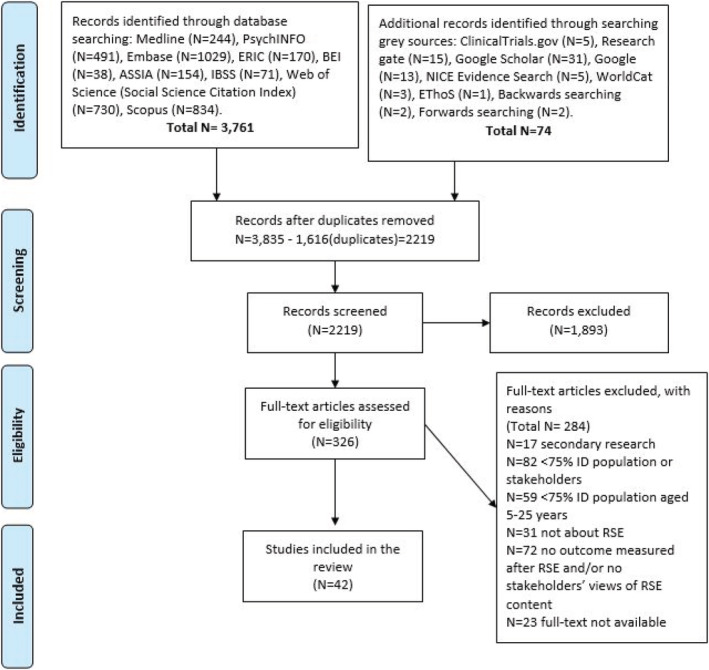
PRISMA flow diagram. [Colour figure can be viewed at wileyonlinelibrary.com]
Study characteristics
Table 3 provides a description of the 42 included studies. Out of these, 27 studies provided qualitative data, six quantitative data and nine mixed‐methods data. Studies were conducted in the UK, USA, Africa, Turkey, Australia, Sweden, Ireland, Spain, Greece, Cyprus, Lithuania, Iran, India, Israel, Japan, and Republic of North Macedonia. Papers were written in English, Lithuanian, and Spanish.
Table 3.
Characteristics of the included studies grouped by type of data provided
| Study reference | Study location, language of report | Aim | Data collection method | Sample | Setting |
|---|---|---|---|---|---|
| Qualitative data | |||||
| Aderemi (2014) |
Location: Nigeria (South Africa) Language: English |
Explore educators opinions of sexuality and sexuality education for learners with ID. | Semi‐structured interviews |
12 teachers (3 male and 9 female) aged 29–55 years of students with ID. ID: age, gender, level of ID not reported. |
Special schools |
| Finlay et al. (2015) |
Location: UK Language: English |
Examine how Sexual Health Education is delivered to people with ID. | Semi‐structured interviews and observations of SHE sessions |
4 teachers (age and gender not reported) of students with ID. ID: students aged 16–19 years with mild–moderate ID, gender not reported. |
Youth club and special school |
| Frawley and Wilson (2016) |
Location: Australia Language: English |
Explore views of people with ID of sex education. | Focus groups |
25 individuals with ID (14 male and 11 female), aged 17–20 years (Mean age = 18.6 years). ID: level of ID not reported. |
Community transition program |
| Gokgoz et al. (2021) |
Location: Turkey Language: English |
Explore experiences of mothers providing sexual education to their children with Down syndrome. | Semi‐structured interviews |
7 mothers of children with Down syndrome. ID: 3 male and 5 female children with Down syndrome aged 16–30 years (Mean age = 23.7 years) with mild to moderate ID. |
Special education and rehabilitation centre |
| Garwood and McCabe (2000) |
Location: Australia Language: English |
Evaluate the effectiveness of 2 different sex education programs delivered to people with ID. | Questionnaires |
6 males with ID: 3 in Co‐Care program aged 12–25 years (Mean age = 19 years, SD = 6.5) and 3 in Family Planning Victoria program aged 28–32 (Mean age = 31.6 years, SD = 3.2). ID: mild ID. |
Community service |
| Study reference | Study location, language of report | Aim | Data collection method | Sample | Setting |
|---|---|---|---|---|---|
| Girgin‐Büyükbayraktar et al. (2017) |
Location: Turkey Language: English |
Explore teachers opinions of providing sex education for mentally handicapped students. | Semi‐structured interviews |
25 teachers (18 female and 7 male) aged 25–40 years of students with ID. ID: age and level of ID not reported. |
Special education and rehabilitation centres |
| Goli et al. (2020) |
Location: Iran Language: English |
Explore experiences of girls with ID, parents, teachers, and service providers of the sexual and reproductive health of girls with ID. | Semi‐structured interviews and a focus group |
52 participants: 4 girls with ID, 23 parents, 7 teachers, 16 healthcare providers and 2 school managers. ID: Girls aged 14–18 years, level of ID not reported. |
Special schools |
| Hanass‐Hancock et al. (2018) |
Location: South Africa Language: English |
Explore experiences of teachers of implementing sex education for learners with ID. | Interviews (type of interviews not reported) |
8 teachers (age and gender not reported) of students with ID. ID: age, gender and level of ID not reported. |
Special schools |
| Karellou (2017) |
Location: Greece Language: English |
Explore attitudes of individuals with ID towards sexuality. | Structured interviews |
66 people with ID (48 male and 18 female), 78.8% aged 15–25 years and 21.2% aged 26–30 years. ID: 36 (54.5%) moderate ID, 19 (28.8%) mild and 11 (16.6%) borderline ID. |
Vocational training facility |
| Kostigen (2020) |
Location: USA Language: English |
Explore policies and teaching practices of sexuality education for students with ASD and ID. | Participant observations, semi‐structured interviews, and document reviews of policies at school |
11 special school staff (2 male and 9 female): 7 behaviour therapists, 3 administrators and 1 clinician (works in special school). Participants age not reported. ID: school staff serve 45 students with ASD and ID, 7 girls (15%) and 38 (85%) boys, aged 7–21 years (75% aged 14–21 years). ID level is reported as ‘low cognitive functioning’. |
Special school |
| Study reference | Study location, language of report | Aim | Data collection method | Sample | Setting |
|---|---|---|---|---|---|
| Kürtüncü and Kurt (2020) |
Location: Turkey Language: English |
Examine the opinions of mothers of sexual education of children with ID. | Semi‐structured interviews and a questionnaire |
14 mothers (Mean age = 39.2 years) of children with ID. ID: children (71.4% males and 28.6% females) aged 10–15 years (Mean age = 12.3 years). 42.9% had Down Syndrome, 57.1% had ID, ASD, speech, hearing and physical disabilities. |
Education and rehabilitation centre |
| Lafferty et al. (2012) |
Location: Northern Ireland (UK) Language: English |
Examine the attitudes of family carers, direct care staff and trained professionals of the provision of RSE for teenagers and adults with ID. | Focus groups and semi‐structured interviews |
Focus groups: 26 carers (fathers, sisters, brothers, and sisters‐in‐law) and 24 staff members (23 female and 1 male) from day centres and supported accommodation services. Interviews: 22 carers and 24 staff members (15 female and 9 male). ID: teenagers and young adults with ID, gender and level of ID not reported. |
Community service |
| Löfgren‐Mårtenson (2012) |
Location: Sweden Language: English |
Explore experiences of adolescents with ID receiving of sex education. | Interviews (type of interviews not reported) |
16 students with ID (7 male and 9 female) aged 16–21 years. ID: level of ID reported as ‘varying degrees of ID’. |
Special schools |
| Menon and Sivakami (2019) |
Location: India Language: English |
Explore parents perceptions and concerns about the sexuality and reproductive health of their child with IDD. | Semi‐structured interviews |
14 primary caregivers (9 mothers and 1 guardian) of individuals with IDD. ID: 4 children had ASD, 2 had ASD and ID, 5 had ID and mutism and 2 had Down Syndrome. 1 child was aged <10 years, 7 aged 10–20 years and 5 aged 21–30 years. |
Special schools |
| Study reference | Study location, language of report | Aim | Data collection method | Sample | Setting |
|---|---|---|---|---|---|
| Nelson et al. (2020) |
Location: Sweden Language: English |
Explore teachers experiences of teaching Sexual and Reproductive Health and Rights Education to students with ID. | Semi‐structured interviews |
10 teachers (6 female and 4 male) aged 24–55 years (Mean age = 39 years) of students with ID. ID: students aged 16–20 years with mild–severe ID. |
Special schools |
| Peters (2007) |
Location: USA Language: English |
Explore attitudes of teachers towards the teaching of sexuality education to students with mental retardation. | Survey |
90 special education teachers (73 female and 7 male) of students with mental retardation. ID: Teachers taught students aged 5–19 years. Students had mild–severe ID and other disabilities: autism, speech and language impairments, visual impairments and specific learning disabilities. |
Special school |
| Phasha and Runo (2017) |
Location: Kenya (Africa) Language: English |
Explore sexuality education offered to learners with ID. | Semi‐structured interviews and focus groups |
56 students with ID (32 male and 24 female) aged 16–22 years and 15 school staff: 5 head teachers and 10 teachers (gender not reported). ID: mild ID. |
Special school |
| Pownall et al. (2011) |
Location: Scotland (UK) Language: English |
Explore mothers experiences of dealing with the sexuality of offspring with and without ID. | Semi‐structured interviews |
8 mothers aged 46–53 years (Mean age = 48 years, SD = 2.4) of children with ID and without ID. ID: 4 males and 4 females with ID aged 17–19 years (Mean age = 18 years, SD = 0.8); 1 had Cerebral palsy, 2 Down syndrome; 1 Visual‐perceptual and spatial disability; 3 Global developmental delay and 1 ASD. |
Participants home |
| Pryde and Jahoda (2018) |
Location: Scotland (UK) Language: English |
Explore views of mothers on sexuality and sexual development of their sons with ASD and ID. | Semi‐structured interviews |
5 mothers of children with ID and ASD. ID: 5 males with moderate–severe ID and ASD aged 16–24 years. |
Not specified |
| Study reference | Study location, language of report | Aim | Data collection method | Sample | Setting |
|---|---|---|---|---|---|
| Todd (2009) |
Location: UK Language: English |
Observe the delivery of sex education in a special school. | Observations of a classroom (type of observation is not reported) and interviews (type of interviews not reported) |
Observations: a class of children with ID aged 15–16 years in a special school for students with severe ID, physical disabilities, and sensory impairments. Level of ID varied in the class and not all had severe ID. Interviews‐ teachers (no other information provided). |
Special school |
| Ustilaitė and Petrauskienė (2018) |
Location: Lithuania Language: Lithuanian |
Explore parents experiences and needs when providing sex education to their children with ID. | Focus group |
8 mothers aged 36–58 years of children with ID. ID: moderate level of ID, aged 12–21 years (5 male and 3 female). |
Community service |
| Wilkenfeld and Ballan (2011) |
Location: USA Language: English |
Explore educators attitudes and beliefs of the sexuality of individuals with developmental disabilities. | Semi‐structured interviews |
5 teachers (1 male and 4 female) aged 42–57 years (Mean age = 50.2 years) from special schools, 5 instructors (1 male and 4 females) aged 30–50 years, Mean age = 37 years) from adult day services. ID: teachers of middle‐high school aged students with ID, with ID level ranging from <12 months (i.e. sensory level of function) to IQs < 70. All students had multiple physical disabilities in addition to ID, for example, Cerebral Palsy and ‘various genetic disorders’ (which are not specified). |
Special schools and adult day services |
| Study reference | Study location, language of report | Aim | Data collection method | Sample | Setting |
|---|---|---|---|---|---|
| Williams et al. (2014) |
Location: Scotland (UK) Language: English |
Identify experiences of people with ID about sexual health services. | Structured interviews |
34 people with ID (17 male and 17 female) aged 16–35 years (64% aged 16–17 years). ID: level of ID not reported. |
Special schools, colleges, day, and residential services |
| Williamson (2017) |
Location: USA Language: English |
Explore experiences of women with ID about sexuality and sex education. | Semi‐structured interviews and focus groups |
6 women with ID and ASD aged 19–21 years. ID: mild to moderate ID (IQ = 54–70). |
Special school |
| Wiseman and Ferrie (2020) |
Location: Scotland (UK) Language: English |
Explore experiences of women with ID of receiving Relationship Sexual Health and Parenthood Education. | Focus groups and a questionnaire |
21 women with ID completed the questionnaire and 12 women with ID in focus groups, aged 18–25 years (the sample involved older women; however, results for this age group were extracted). ID: level of ID not reported. |
Questionnaire‐online; focus groups‐ not specified. |
| Wright (2011) |
Location: UK Language: English |
Explore whether young people with ID receive sex education. | Semi‐structured interviews and focus groups |
7 people with ID aged 11–16 years (gender not reported) without physical impairments or ASD, 7 parents, 12 teachers and 2 nurses from a special school. ID: level of ID not reported. |
Special school |
| Yektaoglu‐Tomgüsehan and Akçamete (2018) |
Location: Cyprus Language: English |
Examine the opinions of teachers of sex education for students with mental deficiencies. | Semi‐structured interviews |
6 teachers (5 female and 1 male) aged 26–30 years of students with ID. ID: level of ID and students age not reported. |
Special school |
| Quantitative data | |||||
| Study reference | Study location, language of report | Aim | Data collection method | Sample | Setting |
|---|---|---|---|---|---|
| Dukes and McGuire (2009) |
Location: Ireland Language: English |
Evaluate a sex education intervention for people with ID. |
Design: Single subject multiple baseline Method: Questionnaires |
4 adults with ID (2 male and 2 female) aged between 22 and 23 years. ID: moderate level of ID (IQ = 41–45; Adaptive behaviour composite = 37–54). Diagnostic tools used: Vineland Adaptive Behaviour Scales and the Stanford‐Binet Intelligence Scale. |
Community group homes |
| Holmes and Himle (2014) |
Location: USA Language: English |
Understand what topics were the most frequently discussed by parents when providing sex education to children with ASD based on the level of the childs functioning. |
Design: Cross‐sectional Method: Survey |
36 parents of children with ID and ASD (that meet the inclusion criteria in terms of child having ID). ID: children aged 12–18 years (Mean age = 15.5 years, SD = 1.9) with mild‐profound ID and ASD. |
Online |
| Howard‐Barr et al. (2005) |
Location: USA Language: English |
Explore teachers opinions of what are the most and least important RSE topics to provide to students with ID. |
Design: Cross‐sectional Method: Questionnaires |
26 teachers of students with ID. 49% of teachers taught elementary school, 32% middle school and 19% high school. ID: level of ID not reported. |
Special school |
| Luque and Lugo (2015) |
Location: Spain Language: Spanish |
Evaluate Emotional‐Sexual Education for students with ID. |
Pre‐post evaluation Method: Questionnaires |
8 students with ID (5 male and 3 female) aged 16–22 years from a special school (that meet the inclusion criteria). ID: level is not reported. |
Special Education Centre |
| Plaks et al. (2010) |
Location: Israel Language: English |
Evaluate Social Sexual Group Education Program delivered to adolescents with ID and their parents. |
Design: Single group pre‐post evaluation Method: Questionnaires |
10 adolescents with neurogenetic conditions (5 male and 5 female) aged 15–24 years (Mean age = 19.5 years, SD = 2.6) and 14 parents (age, gender not reported). ID: level of ID not reported; 5 had Williams Syndrome, 3 Velocardiofacial syndrome, 1 neurofibromatosis, and 1 idiopathic ID. |
Behavioural Neurogenetics Centre |
| Tsutsumi (2009) |
Location: Japan Language: English |
Explore teachers and parents opinions about sex education for mentally retarded pupils. |
Design: Cross‐sectional Method: Survey |
235 teachers (149 female and 86 male) and 312 parents (166 female and 43 male) of mentally retarded pupils. ID: level of ID not reported, students were aged 7–16 years. |
Special classes in mainstream schools |
| Study reference | Study location, language of report | Aim | Data collection method | Sample | Setting |
|---|---|---|---|---|---|
| Mixed methods data | |||||
| Bleazard (2010) |
Location: Western Cape (South Africa) Language: English |
Explore attitudes of women with ID, teachers, and mothers towards the sexuality of women with ID. | Semi‐structured interviews, focus group and questionnaire (quantitative questions) |
21 women with ID aged 16–25 years with visual, motor, speech, and growth difficulties in the interviews; 10 out of 21 women with ID also took part in a focus group, 10 parents in separate interviews and 12 teachers completed a questionnaire. ID: level of ID is not reported. |
Special schools |
| Box and Shawe (2014) |
Location: UK Language: English |
Evaluate a sexuality and relationship programme delivered to adults with ID and explore their experiences of attending the attending the programme.. |
Semi‐structured interviews, participant observations, and pre‐post evaluation using a questionnaire. |
2 male adults with ID (that meet the inclusion criteria) aged 20–24 years. ID: mild to moderate ID. 1 participant had mild ID, Aspergers syndrome, and ADHD. The other participant had moderate ID and ASD. |
Community ID Service |
| Graff et al. (2018) |
Location: USA Language: English |
Evaluate sex education curriculum delivered to students with ID. |
Questionnaires and open‐ended questions |
53 students with IDD aged 18–27 years (Mean age = 20.7 years). 1st intervention group: 13 students (46.2% males and 53.8% female), Mean age = 20.7 years, SD = 1.4, 76.9% had ID and 23.1% had ASD. 2nd intervention group: 12 students (66% males and 33% females), Mean age = 20.8 years, SD = 1.7, 50% had ID and 50% ASD. 4th intervention group: 16 participants (43% males and 56% females), Mean age = 19.3 years, SD 4.6, 71% had ID and 29% ASD. The control group: 12 students with IDD (33.3% males and 66.6% females), Mean age = 22.1 years, SD = 21.9. 83.3% had ID and 16.7% other disabilities. ID: level of ID not reported. | Post‐secondary program for students with IDD at a university |
| Study reference | Study location, language of report | Aim | Data collection method | Sample | Setting |
|---|---|---|---|---|---|
| Kammes (2019) |
Location: USA Language: English |
Examine how parental attitudes and experiences towards sexuality differ for their children with ID and without ID. | Semi‐structured interviews and survey (quant questions) |
50 parents (46 mothers, 4 fathers) of children with and without ID in the survey and 20 of parents (1 father and 17 mothers) in the interview. ID: 50 adult children with ID (30 male and 20 female) aged 18–33 years, Mean age = 23.9 years, SD = 3.7 with other co‐morbidities, for example, Down syndrome, ASD, WS, physical, mental health and speech problems. |
Online survey and phone or video interview |
| Pownall et al. (2012) |
Location: Scotland (UK) Language: English |
Explore mothers experiences of providing sex education to children with ID and without ID. | Questionnaire with quant and qual questions |
30 mothers (Mean age = 48.8 years, SD = 6.5) of young people (15 males and 15 female) with ID (Mean age = 18.8 years, SD = 1.9). ID: children were aged 16–24 years (Mean age = 18.8 years, SD = 1.9) and had mild ID. 4 children had physical disability (not specified) in addition to ID. |
Participants homes |
| Rohleder et al. (2012) |
Location: Western Cape (South Africa) Language: English |
Explore the extent to which safe sex education is being provided to young people with disabilities. | Survey (quant questions), semi‐structured interviews, and a focus group |
55 teachers of students with various disabilities ID: 76.5% of teachers served students with ID, level of ID not reported. |
Special schools |
| Study reference | Study location, language of report | Aim | Data collection method | Sample | Setting |
|---|---|---|---|---|---|
| Scottish Commission for Learning Disability (2018) |
Location: Scotland (UK) Language: English |
Gather information about RSHPE provision in secondary schools for students with ID. | Survey (quant and qual questions) |
130 school staff members that serve students with ID: 71.8% worked in mainstream school with additional support need unit, 25.2% worked in additional support need school, 1.9% worked in residential schools. ID: ID level is not reported. |
Secondary mainstream schools and special schools for students with ID |
| Sheppard (2006) |
Location: Australia Language: English |
Evaluate the effectiveness of ‘Growing Pains’ program for students with ID and to explore parents and teachers views about the program. | Pre‐post evaluation using a checklist and questionnaires with quant and qual questions |
68 students with ID (48 male and 20 female), 12 teachers and 13 parents. ID: mild to moderate ID, aged 11–15 years. |
Special school |
| Stankova and Trajkovski (2021) |
Location: Republic of North Macedonia Language: English |
Assess the effects of the use of Social Stories to implement sexuality education with participants with ASD and cognitive difficulties. | Pre‐post evaluation and semi‐structured interviews |
1 boy with ID, ASD and speech delay (that meets the inclusion criteria and results reported separately) aged 11 years. ID: level is reported as ‘low’. |
Special school |
ID, intellectual disability, ASD, autism spectrum disorder, IDD, intellectual and developmental disability, RSHPE, relationships, sexual health and parenting education, SHE, sexual health education.
A total of 1767 participants participated in the included studies: 38% (678) were teachers and school staff, 34% (612) were parents and caregivers, 23% (413) were students with intellectual disability and 3% (64) were staff members from community intellectual disability services. Out of 413 students with intellectual disability included, 211 were male and 202 were female, aged 5–25 years (73% were aged 16–25 years), 51% had mild to moderate intellectual disability. Two studies focused on students with genetic conditions (e.g. Down syndrome, Williams Syndrome, Velocardiofacal syndrome and neurofibromatosis) (Plaks et al. 2010; Gokgoz et al. 2021) and 4 studies involved students with intellectual disability with co‐occurring conditions (e.g. autism, ADHD, speech delay and physical disabilities) (Bleazard 2010; Box & Shawe 2014; Williamson 2017; Stankova & Trajkovski 2021).
RSE characteristics
Out of 42 included studies, 12 studies reported some RSE intervention characteristics (e.g. information on the population it was developed for, content, delivery, setting and/or providers) delivered to students with intellectual disability (Garwood & McCabe 2000; Sheppard 2006; Dukes & McGuire 2009; Todd, 2009; Plaks et al. 2010; Box & Shawe 2014; Finlay et al. 2015; Luque & Lugo 2015; Williamson 2017; Graff et al. 2018; Kostigen 2020; Stankova & Trajkovski 2021) (see Table 4). The aim of the RSE programme was only reported in four studies (Sheppard 2006; Todd, 2009; Plaks et al. 2010; Graff et al. 2018). Only four studies specified that RSE was based on resources developed specifically for people with intellectual disability (Sheppard 2006; Dukes & McGuire 2009; Box & Shawe 2014; Williamson 2017). In the retrieved studies RSE coverage included: the human body (private parts for males and females), puberty, hygiene, sexual activities and their consequences, contraception, different types of relationships, appropriate and inappropriate social and sexual behaviours, information on abuse and keeping safe. Across the studies, the content mainly focused on protection and managing risks rather than being more comprehensive with a balance of risk management and other skill development.
Table 4.
RSE characteristics reported in the studies
| Reference | RSE characteristics |
|---|---|
| Box and Shawe (2014) |
Name: Sexuality and Relationships group based on programmes developed for people with ID (McCarthy & Thompson 1998; Craft 2003; Kerr‐Edwards & Scott 2003) Aim: Not reported. Population: Adult males with mild–moderate ID and ASD and ADHD aged 20–24 years. Content: Basic anatomy and body differences, puberty, hygiene, menstruation, menopause, sexual activities including same‐sex relationships, conception, contraception, safe sex including abstinence, masturbation, wet dreams, self‐examination, attractions, different types of relationships, forming and managing relationships, emotions, attitudes including stereotyping, good and bad touch, consent, public and private places, abuse, and assertiveness. Delivery: 10 group sessions of 2 h session once per week. Setting: Day centre for adults with ID. Parent involvement: Not reported. Providers: 1 male and 1 female community ID nurse. |
| Dukes and McGuire (2009) |
Name: Sex Education based on the ‘Living Your Life – The Sex Education and Personal Development Resource for Special Education Needs’ (Bustard 2003) book. Aim: Not reported. Population: Adults (male and female) with moderate ID aged 22–23 years. Content: Sexual safety practices, physical self, sexual functioning, choices, and consequences in sexual matters. Delivery: Individual sessions of 45 min per session delivered twice per week. Setting: Group homes for adults with ID Parent involvement: Not reported. Providers: Researchers. |
| Finlay et al. (2015) |
Name: Sex and Health Education. Aim: Not reported. Population: Adolescents (males and females) with mild–moderate ID aged 16–19 years. Content: Sexual behaviour, contraception, norms, and relationships. Delivery: Weekly group sessions (4–8 people) of 1 h per session (total number of sessions not reported). Setting: Youth club and special schools Parent involvement: Not reported. Providers: 4 (male and female) youth service workers |
| Garwood and McCabe (2000) |
Name: Co‐Care. Aim: Not reported. Population: Males with mild ID aged 12–25 years (Mean age = 19 years, SD = 6.5). Content: Feelings, body language, social skills, the human life cycle, puberty, body awareness ‘private’ and ‘public’ behaviour, sexual relationships, conception, pregnancy, childbirth, contraception (including safe sex, STDs), menstruation and protective behaviours. Delivery: Total number of sessions not reported. Sessions were delivered twice per week for 45 min per session. Setting: Community health service Parent involvement: Not reported. Providers: 2 (male and female) educators. |
| Graff et al. (2018) |
Name: Relationships and Sexuality Education. Aim: Teach skills and increase judgement about healthy relationships, sexuality, and safe boundaries. Population: Adults (male and female) with IDD (some had ID, and some had ASD) aged 18–27 years (Mean age = 20.7 years, SD = 1.4). Level of ID not reported. Content: Relationships and self‐awareness, maturation, the life cycle, sexual health, being strong, staying safe and hygiene. Delivery: Group sessions (total number of sessions and length of the session not reported). Setting: Inclusive postsecondary program for students with IDD at a university. Parent involvement: The curriculum was developed with guidance from parents. Providers: Teachers (gender not reported). |
| Kostigen (2020) |
Name: Health and Sexuality Education. Aim: Not provided. Population: Students with ID and ASD aged 7–21 years (75% 14–21 years). Level of ID not reported. Content: Concepts of privacy, body part identification, hygiene skills, respecting personal space, and requesting another to stop an aversive activity. Delivery: Group sessions (total number of sessions and length of the session not reported). Setting: Special school. Parent involvement: Not provided. Providers: Teachers. |
| Luque and Lugo (2015) |
Name: Emotional‐Sexual Education based on Affective Sex Education materials (Bolaños et al. 1994; Colectivo Harimaguada 2007). Not specified if these materials were developed for people with ID. Aim: Not reported. Population: Students with ID (5 male and 3 female) aged 16–22 years (level of ID not reported). Content: the education contained 6 parts: 1) ‘body’ which involved private body parts, understanding the anatomy and physiology of the genitals, body changes during adolescence, body differences between males and females; 2) ‘social skills’ which involved active listening, assertiveness, empathy, respect for other people and their desires; 3) ‘emotional’ which included work on relational skills and abilities such as recognition and expression of emotions, self‐esteem; 4) ‘affective‐sexual’ which focused on learning about different ways people express affection and feelings, understanding of contraceptive methods and masturbation; 5) ‘private/public context’ which includes awareness of the difference between public and private spaces; 6) ‘abuse or sexual abuse’ which included information on appropriate and inappropriate physical contact, learning to say ‘no’ and what to do in case of abuse. Delivery: Group sessions of 1 h per session, two sessions per week delivered over 4 months. Setting: Special Education Centre. Parent involvement: Not reported. Providers: Teachers. |
| Plaks et al. (2010) |
Name: Social Sexual Education Aim: Adolescents self‐identification, acceptance of the developmental disability, independence in social life, establishment of friendship and intimate relationship, sexual knowledge and sexual development, safety skills and assertiveness skills. Population: Adolescents (male and female) with genetic conditions (WS, VCFS, ID) aged 15–24 years (Mean age = 19.5 years, SD = 2.6). Level of ID not reported. Content: Anatomic parts of the sexual system, differences between males and females sexual organs, sexual development, changes occurring in the body during adolescence, appropriate sexual behaviour (e.g. masturbation is something one does in private). Delivery: 10 group sessions (length per session not reported). Setting: Behavioural Neurogenetics Centre. Parent involvement: Parents participated in a separate Social Sexual Education group. Providers: Not reported. |
| Sheppard (2006) |
Name: Growing Pains Program (based on variety of resources). Aim: Skills and knowledge acquisition in these areas: socialisation, personal hygiene, protective behaviours, sexuality, assertiveness, and substance abuse. Population: Adolescents with mild–moderate ID, aged 11–15 years. Content: Social skills: self‐esteem, anger, conflict management, peer interaction, rights and responsibilities, decision‐making; drug education; relationships and sexuality; protective behaviours: safe behaviours, public/private, body parts; grieving and loss; human life cycle; personal hygiene. Delivery: Group sessions delivered over 20 weeks (45–65 min per session). Setting: Special school Parent involvement: Not reported. Providers: Teachers (gender not reported). |
| Stankova and Trajkovski (2021) |
Name: Sex Education curriculum using Social Stories. Aim: Not reported. Population: An adolescent male with ASD and low level of intellectual functioning aged 11 years with speech and developmental delay. ID level not reported. Content: 14 Social Stories: My body; Private and Public Space; My intimate parts of the body; Why do I wear clothes; Where can I be naked; How do I grow and change; Wet dreams; Masturbation; What is pleasant; What is unpleasant; Pleasant touches; Unpleasant touches; Types of relationships. Content was personalised based on individual needs and cognitive level. Delivery: Individual sessions of 45 min over 6 months (total number of sessions not reported). Setting: Special school. Parent involvement: Parents were asked about the perceived benefits in their children after they received the education. Providers: Teacher (gender not reported). |
| Todd (2009) |
Name: Personal Relationships and Health Education. Aim: Develop respect for self and others, build up a positive self‐concept, encourage the concept of loving relationships within the context of the family and encourage socially acceptable behaviour. Population: Class of adolescents aged 15–16 years in a special school for children with severe ID. Level of ID varied in the class. Content: ‘Range of topics, from health to appropriate greeting patterns, and a brief biological tour of the body and sex education’. Delivery: Group sessions of 90 min delivered over 13 weeks. Setting: Special School. Parent involvement: Not reported. Providers: Teachers. |
| Williamson (2017) |
Name: Sex Education curriculum based on ‘positive choices programme for people with ID’ (Duguay 2009) Aim: Not reported. Population: Women with ID and ASD aged 19–21 years with mild–moderate ID (IQ = 54–70). Content: Not reported. Delivery: Group sessions of 1.5 h per session delivered over 32 weeks (one per week). Setting: Special school. Parent involvement: Not reported. Providers: Teachers |
Some studies reported delivering RSE in small groups whilst other studies delivered RSE on an individual basis for a period ranging between 10 weeks to 6 months. RSE was delivered in special schools, group homes, students' homes and community intellectual disability services (e.g. day centres, youth clubs and health services) by teachers, parents, youth service workers, community intellectual disability nurses and researchers. Only two studies reported that parents were involved in the development of RSE content delivered in schools (Sheppard 2006; Graff et al. 2018). None of the studies reported that parents were involved in the delivery of RSE in schools (e.g. asked to deliver after‐school activities to their children at home).
Outcomes
A total of 135 individual outcomes were extracted from the studies. Outcomes were grouped by educational stage (e.g. secondary education and further education). Seven studies reported RSE outcomes for students with intellectual disability but did not specify their age (Howard‐Barr et al. 2005; Rohleder et al. 2012; Aderemi 2014; Girgin‐Büyükbayraktar et al. 2017; Hanass‐Hancock et al. 2018; Scottish Commission for Learning Disability 2018; Yektaoglu‐Tomgüsehan and Akçamete 2018). These outcomes were not included in the tables presented here but will still be included in the later stages of the COS process (see Table S2 in the supporting information for these outcomes).
Outcomes for students in primary education
No studies reported outcomes specifically for students with intellectual disability in primary education (aged 5–10 years). However, three studies reported outcomes for students aged 5–25 years and the lower age of participants was in the primary education age range (see Table 5) (Peters 2007; Tsutsumi 2009; Menon & Sivakami 2019). Outcomes in these studies were: understanding of hygiene, the human body (e.g. what menstruation and wet dreams are), relationships (e.g. what dating, love and marriage is), human sexuality (heterosexuality, homosexuality and bisexuality), sex and its consequences (e.g. sexual intercourse and sexually transmitted diseases), appropriate social behaviour and ability to protect yourself from sexual abuse.
Table 5.
RSE outcomes where the lower age of the sample involves students in primary education (5–10 years)
| Outcome domain | Outcome | Age range | Reference | Who reported |
|---|---|---|---|---|
| Understanding of hygiene | Understanding of what personal hygiene is | 7–16 years | Tsutsumi (2009) | Teachers and parents |
| Understanding of human body | Understanding of what menstruation is | 5–19 years | Peters (2007) | Teachers |
| Understanding of what wet dreams are | 5–19 years | Peters (2007) | Teachers | |
| Understanding of relationships | Understanding of what dating is | 7–16 years | Tsutsumi (2009) | Teachers and parents |
| Understanding of what marriage is | 5–19 years | Tsutsumi (2009); Peters (2007) | Teachers and parents | |
| Understanding of love is | 5–19 years | Peters (2007) | Teachers | |
| Understanding of what parenting is | 5–19 years | Peters (2007) | Teachers | |
| Understanding of human sexuality | Understanding of different sexualities (what heterosexuality, homosexuality, and bisexuality is) | 5–19 years | Peters (2007) | Teachers |
| Understanding of sex and its consequences | Understanding of what pregnancy is | 7–16 years | Tsutsumi (2009) | Teachers and parents |
| Understanding of what contraception is | 5–19 years | Tsutsumi (2009); Peters (2007) | Teachers and parents | |
| Understanding of what sexual intercourse is* | 5–19 years | Tsutsumi (2009); Peters (2007) | Teachers and parents | |
| Understanding of what STDs are | 7–16 years | Tsutsumi (2009) | Teachers and parents | |
| Understanding of appropriate behaviour | Understanding of socially acceptable public behaviour | 10–25 years | Menon and Sivakami (2019) | Parents |
| Understanding of sexual abuse | Ability to protect yourself from sexual abuse | 5–19 years | Peters (2007) | Teachers |
STDs, sexually transmitted diseases.
Outcomes for students in secondary education
Table 6 provides 43 individual outcomes for students with intellectual disability in secondary education (aged 11–16 years) extracted from 15 studies and grouped under 11 outcome domains: understanding of the human life cycle, the human body, relationships, hygiene, keeping safe, appropriate and inappropriate behaviours, human sexuality, sex and its consequences, rights and responsibilities, emotional vocabulary, and positive self‐esteem.
Table 6.
RSE outcomes reported for students in secondary education (11–16 years)
| Outcome domain | Outcome | Frequency of reporting and study reference | Who reported/measured |
|---|---|---|---|
| Understanding of human life cycle | Able to identify the stages of the human life cycle (e.g. birth, baby, child, teenager, adult, elderly and death) | 2 studies: Sheppard (2006); Stankova and Trajkovski (2021) | Measured by researchers |
|
Understanding of human body |
Understanding of private body parts for females and males | 5 studies: Kürtüncü and Kurt (2020); Stankova and Trajkovski (2021); Sheppard (2006); Holmes and Himle (2014); Kostigen (2020) | Parents, school staff and measured by researchers |
| Understanding of puberty related body changes for males and females | 2 studies: Stankova and Trajkovski (2021); Karellou (2017) | Students with ID and measured by researchers | |
| Understanding of what wet dreams are | 2 studies: Stankova and Trajkovski (2021); Peters (2007) | Teachers and measured by researchers | |
| Understanding of what erection is | 1 study: Stankova and Trajkovski (2021) | Measured by researchers | |
| Understanding of what menstruation is † | 1 study: Peters (2007) | Teachers | |
| Understanding of hygiene | Understanding of what personal hygiene is | 2 studies: Tsutsumi (2009); Holmes and Himle (2014) | Parents, teachers |
| Hygiene skills (able to: dress self, undress self, wash hands and face, menstrual care, showering, toileting, grooming, e.g. hair and teeth) | 2 studies: Kostigen (2020); Sheppard (2006); | School staff and measured by researchers | |
| Understanding of relationships | Understanding of different type of relationships | 3 studies: Wright (2011); Ustilaitė and Petrauskienė (2018); Stankova and Trajkovski (2021) | Students with ID and parents, measured by researchers |
| Appropriate greeting patterns | 1 study: Todd (2009) | Content of RSE | |
| Friendship skills | 1 study: Sheppard (2006) | Measured by researchers | |
| Understanding of how to make close friends | 1 study: Wright (2011) | Students with ID | |
| Understanding of how to socialise with girls/boys | 1 study: Ustilaitė and Petrauskienė (2018) | Parents | |
| Understanding of what dating is | 1 study: Tsutsumi (2009) | Teachers | |
| Understanding as to why people kiss | 1 study: Ustilaitė and Petrauskienė (2018) | Parents | |
| Understanding of what love is | 2 studies: Peters (2007); Ustilaitė and Petrauskienė (2018) | Teachers, parents | |
| Understanding of what marriage is | 2 studies: Tsutsumi (2009); Peters (2007) | Teachers | |
| Understanding of what parenting is | 1 study: Peters (2007) | Teachers | |
| Understanding of what sexual relationships are | 1 study: Sheppard (2006) | Measured by researchers | |
| Ability to identify elements of peer pressure | 1 study: Sheppard (2006) | Measured by researchers | |
| Ability to distinguish appropriate and inappropriate behaviour in different type of relationships | 1 study: Stankova and Trajkovski (2021) | Measured by researchers | |
| Respecting yourself in romantic relationships (not sleeping with everyone) | 1 study: Ustilaitė and Petrauskienė (2018) | Parents | |
| Understanding how to keep safe | Understanding a concept of privacy | 1 study: Kostigen (2020) | School staff |
| Understanding of areas of a body that should not be touched by others | 5 studies: Kürtüncü and Kurt (2020); Holmes and Himle (2014); Lafferty et al. (2012); Kostigen (2020); Stankova and Trajkovski (2021); | Parents, teachers, school staff and measured by researchers | |
| Understanding of what abuse is | 1 study: Kürtüncü and Kurt (2020) | Parents | |
| Understanding of how to protect yourself from sexual abuse | 2 studies: Peters (2007); Menon and Sivakami (2019) | Parents, teachers | |
| Protective behaviours (recognises safe/unsafe situations/environments, avoids of unsafe situations such as isolation, dark places, recognises threatening behaviour of others and knows what to do when someone shows threatening behaviour) | 1 study: Sheppard (2006) | Measured by researchers | |
| Ability to request another to stop an aversive activity | 1 study: Kostigen (2020) | School staff | |
| Understanding of appropriate and inappropriate behaviour | Understanding public and private places | 4 studies: Stankova and Trajkovski (2021); Holmes and Himle (2014); Lafferty et al. (2012); Sheppard (2006) | Parents and teachers and measured by researchers |
| Ability to recognise public and private behaviour | 1 stud: Sheppard (2006) | Measured by researchers | |
| Understanding as to why people wear clothes | 1 study: Stankova and Trajkovski (2021) | Measured by researchers | |
| Understanding of appropriate sexual behaviour | 1 study: Karellou (2017) | Students with ID | |
| Understanding of appropriate social behaviour | 2 studies: Menon and Sivakami (2019); Wilkenfeld and Ballan (2011) | Parents, teachers | |
| Understanding of human sexuality | Understanding of different sexualities (what heterosexuality, homosexuality, and bisexuality is) | 1 study: Peters (2007) | Teachers |
| Understanding of sex and its consequences | Understanding of what masturbation is ‡ | 3 studies: Stankova and Trajkovski (2021); Holmes and Himle (2014); Lafferty et al. (2012) | Parents, teachers |
| Understanding of what pregnancy is | 5 studies: Tsutsumi (2009); Lafferty et al. (2012); Ustilaitė and Petrauskienė (2018); Wilkenfeld and Ballan (2011) | Teachers, parents. | |
| Understanding of what contraception is | 4 studies: Tsutsumi (2009); Karellou (2017); Lafferty et al. (2012); Peters (2007) | Teachers, parents, and students with ID | |
| Understanding of what sexual intercourse is § | 4 studies: Tsutsumi (2009); Karellou (2017); Peters (2007); Ustilaitė and Petrauskienė (2018) | Teachers, parents, students with ID | |
| Understanding of what STDs are | 3 studies: Tsutsumi (2009); Lafferty et al. (2012); Wilkenfeld and Ballan (2011) | Teachers, parents | |
| Understanding of consequences of sexual activities | 2 studies: Ustilaitė and Petrauskienė (2018); Wilkenfeld and Ballan (2011) | Parents, teachers | |
| Understanding of rights and responsibilities | Understanding of rights and responsibilities (demonstrates understanding of rights of self, demonstrates understanding of rights or others) | 1 study: Sheppard (2006) | Measured by researchers |
| Emotional vocabulary | Understanding of different feelings and emotions (identifies feelings and emotions) | 2 studies: Sheppard (2006); Lafferty et al. (2012) | Teachers and measured by researchers |
| Positive self‐esteem | Able to identify positive self‐attributes | 1 study: Sheppard (2006) | Measured by researchers |
The most reported outcomes of RSE for students aged 11–16 years were: understanding of private body parts, understanding of areas of a body that should not be touched by others, and understanding what pregnancy is. Out of 43 extracted outcomes, 85% (36) of outcomes were knowledge based (e.g. understanding of what contraception is), 4% (2) of outcomes were skills based (e.g. friendship skills and hygiene skills), 9% (4) of outcomes were behaviour based (e.g. protective behaviour) and 2% (1) of outcomes were attitudes based (e.g. positive self‐esteem).
Out of the 15 studies, only two studies provided information about how some of the extracted outcomes were measured (Sheppard 2006; Stankova & Trajkovski 2021). In Stankova and Trajkovski (2021), understanding of sexuality was assessed before and after RSE delivery using pictures and asking students to say what pictures depicted or point to the correct pictures when asked. For example, students' understanding of areas of the body that should not be touched by others was assessed by presenting illustrations of people touching each other and asking students to say if this is appropriate touch or inappropriate touch based on people's facial expressions in the pictures. In Sheppard (2006), outcomes were measured based on teachers' reports of students' behaviour before and after RSE delivery. Teachers were asked to rate the frequency (always, regularly, occasionally, seldom, or never) students demonstrated friendship skills, understanding of what sexual relationships are, ability to identify elements of peer pressure, understanding of rights and responsibilities, understanding of different emotions and feelings, and ability to identify positive self‐attributes. However, what teachers were considering when evaluating these outcomes (e.g. what rights of self and rights of others actually involve and what specific skills were considered when evaluating friendship skills) and how these evaluations were conducted were not reported in the paper (e.g. whether teachers asked students to verbally describe positive self‐attributes or point to pictures).
Outcomes reported by parents, teachers, and students in secondary education
There was an overlap between 13 (46%) out of 28 RSE outcomes reported by parents and teachers for students with intellectual disability in secondary education: understanding of personal hygiene, appropriate and inappropriate social and sexual behaviour, consequences of sexual activities, contraception, and protection from sexual abuse. Outcomes that were reported only by parents or teachers closely correspond. However, in three retrieved studies (Todd 2009; Menon & Sivakami 2019; Goli et al. 2020) parents and teachers did not agree that understanding of menstruation, masturbation, and sexual intercourse should be outcomes of RSE for students with intellectual disability.
Students with intellectual disability in secondary education (aged 11–16 years) reported six RSE outcomes: understanding of puberty‐related body changes for males and females, understanding of relationships (e.g. how to make close friends), and understanding of sexual intercourse (e.g. understanding of appropriate sexual behaviour and contraception).
Outcomes for students in further education
A total of 92 individual outcomes for students in further education (aged 16–25 years) were extracted from 37 studies and grouped under 13 domains: understanding of the human body, hygiene, menstruation, human sexuality, sex and its consequences, appropriate and inappropriate behaviours, relationships, keeping safe, assertiveness skills, social skills, positive self‐esteem, emotional vocabulary, improvement in attitudes towards sexuality topics (see Table 7). The most reported outcomes across the studies were understanding of private body parts for males and females and understanding of what contraception is, both reported in 13 studies. Out of 92 outcomes, 78.2% (72) were knowledge‐based (e.g. understanding of what sexual intercourse is), 8.6% (8) of outcomes were skills based (e.g. social skills, assertiveness skills), 9.7% (9) of outcomes were about attitudes and feelings (e.g. positive self‐esteem, improvement in attitudes towards homosexuality) and 3.5% (3) of outcomes were behaviour‐based (e.g. engagement in inappropriate sexual behaviour).
Table 7.
RSE outcomes reported for students in further education (16–25 years)
| Outcome domain | Outcome | Frequency of reporting and study reference | Who reported/measured |
|---|---|---|---|
| Understanding of human body | Understanding of private body parts for males and females |
13 studies: Finlay et al. (2015); Gokgoz et al. (2021); Kammes (2019); Pownall et al. (2012); Williamson (2017); Löfgren‐Mårtenson (2012); Dukes and McGuire (2009) ; Graff et al. (2018); Garwood and McCabe (2000); Plaks et al. (2010); Box and Shawe (2014); Kostigen (2020); Luque and Lugo (2015) |
Teachers and school staff, parents, students with ID, measured by researchers |
| Understanding of puberty related body changes | 4 studies: Pownall et al. (2012); Box and Shawe (2014); Karellou (2017); Luque and Lugo (2015) | Parents, students with ID and content of RSE | |
| Understanding of what wet dreams are | 3 studies: Frawley and Wilson (2016); Box and Shawe (2014); Peters (2007) | Students with ID, teachers | |
| Understanding of what self‐examination is for cancer screening (includes checking private body parts for cancer, e.g. breasts) | 1 study: Box and Shawe (2014) | Content of RSE | |
| Understanding of hygiene | Understanding of personal hygiene for males and females | 4 studies: Nelson et al. (2020); Phasha and Runo (2017); Wiseman and Ferrie (2020); Graff et al. (2018) | Teachers, students with ID |
| Hygiene skills | 1 study: Kostigen (2020) | School staff | |
| Understanding of sexual hygiene (e.g. knowing to clean yourself after masturbation) | 1 study; Kammes (2019) | Parents | |
| Understanding of menstruation | Understanding of what menstruation is † | 6 studies: Gokgoz et al. (2021); Graff et al. (2018); Box and Shawe (2014); Wiseman and Ferrie (2020); Garwood and McCabe (2000); Peters (2007) | Parents, teachers, students with ID, and measured by researchers |
| Understanding physiology of menstruation | 1 study: Bleazard (2010) | Students with ID | |
| Understanding of how to manage menstruation pain | 1 study: Wiseman and Ferrie (2020) | Students with ID | |
| Understanding of how to identify problems with menstruation | 1 study: Wiseman and Ferrie (2020) | Students with ID | |
| Understanding of how menstruation cycle is linked to pregnancy | 1 study: Wiseman and Ferrie (2020) | Students with ID | |
| Understanding of how long the menstruation last over the life course and what the end of menstruation means | 2 studies: Wiseman and Ferrie (2020); Box and Shawe (2014) | Students with ID and content of RSE | |
| Understanding of how to choose, use menstrual products and the right times to change them | 2 studies: Phasha and Runo (2017); Wiseman and Ferrie (2020) | Teachers, students with ID | |
| Knowing how to identify changes in menstruation and possible issues that warrant medical attention | 1 study: Wiseman and Ferrie (2020) | Students with ID | |
| Understanding of human sexuality | Able to identify own gender |
1 study: Dukes and McGuire (2009) |
Measured by researchers |
| Understanding of what different sexualities are (homosexuality, bisexuality, and heterosexuality) | 3 studies: Pownall et al. (2012); Garwood and McCabe (2000); Peters (2007) | Parents, teachers and measured by researchers | |
| Understanding sex and its consequences | Understanding of what sexual intercourse is ‡ | 7 studies: Nelson et al. (2020); Bleazard (2010); Garwood and McCabe (2000); Karellou (2017); Peters (2007); Ustilaitė and Petrauskienė (2018); Luque and Lugo (2015) | Teachers, parents, students with ID and measured by researchers |
| Knowledge of sexual behaviour (includes things you do by yourself and things you do with others) | 2 studies: Plaks et al. (2010); Box and Shawe (2014) | Measured by researchers | |
| Understanding of what homosexual sexual experiences are | 2 studies: Löfgren‐Mårtenson (2012); Box and Shawe (2014) | Students with ID and measured by researchers | |
| Understanding of what happens when men and women have an orgasm | 1 study: Garwood and McCabe (2000) | Measured by researchers | |
| Understanding of how to have sex | 2 studies: Phasha and Runo (2017); Frawley and Wilson (2016) | Students with ID | |
| Understanding of how to enjoy sex | 1 study: Phasha and Runo (2017) | Students with ID | |
| Understanding of what contraception is (including different options of contraception, its side effects, that sometimes contraception does not work, e.g. condoms can break, how to use it and how it fits in with family planning for the future) | 13 studies: Phasha and Runo (2017); Kammes (2019); Pownall et al. (2012); Löfgren‐Mårtenson (2012); Wiseman and Ferrie (2020); Graff et al. (2018); Frawley and Wilson (2016); Box and Shawe (2014); Garwood and McCabe (2000); Karellou (2017); Lafferty et al. (2012); Peters (2007); Luque and Lugo (2015) | Students with ID, parents, teachers and measured by researchers | |
| Understanding what STDs are | 8 studies: Nelson et al. (2020); Phasha and Runo (2017); Pownall et al. (2012); Löfgren‐Mårtenson (2012); Williams et al. (2014); Wiseman and Ferrie (2020); Lafferty et al. (2012); Wilkenfeld and Ballan (2011) | Teachers, parents, students with ID | |
| Understanding consequences of sexual activity | 4 studies: Williamson (2017); Plaks et al. (2010); Ustilaitė and Petrauskienė (2018); Wilkenfeld and Ballan (2011) | Students with ID, parents and measured by researchers | |
| Understanding consequences of having multiple sexual partners or ‘one‐night stand’ (e.g. STDs) | 2 studies: Phasha and Runo (2017); Williamson (2017) | Teachers, students with ID | |
| Understanding of what pregnancy is | 8 studies: Nelson et al. (2020); Phasha and Runo (2017); Löfgren‐Mårtenson (2012); Pownall et al. (2011); Garwood and McCabe (2000); Lafferty et al. (2012); Ustilaitė and Petrauskienė (2018); Wilkenfeld and Ballan (2011) | Teachers, students with ID, parents and measured by researchers | |
| Understanding that is hard to be a parent when you are young | 1 study: Löfgren‐Mårtenson (2012) | Students with ID | |
| Understanding of how to take care of baby | 2 studies: Graff et al. (2018); Box and Shawe (2014) | Students with ID and measured by researchers | |
| Understanding of how child develops | 1 study: Williamson (2017) | Students with ID | |
| Understanding what abortion is | 1 study: Garwood and McCabe (2000) | Measured by researchers | |
| Understanding what masturbation is § | 5 studies: Pownall et al. (2012); Box and Shawe (2014); Garwood and McCabe (2000); Lafferty et al. (2012); Luque and Lugo (2015) | Parents, teachers and measured by researchers | |
| Understanding what kiss is and why people kiss | 2 studies: Box and Shawe (2014); Ustilaitė and Petrauskienė (2018) | Parents and measured by researchers | |
| Understanding appropriate and inappropriate behaviours | Understanding of appropriate and inappropriate sexual behaviours | 5 studies: Finlay et al. (2015); Pownall et al. (2011); Pownall et al. (2012); Pryde and Jahoda (2018); Karellou (2017) | Teachers, parents, students with ID |
| Understanding of appropriate ways to express sexual needs and desires | 1 study: Phasha and Runo (2017) | Teachers | |
| Understanding the differences between public and private places (e.g. where you can be naked and where you cannot be naked) | 4 studies: Pryde and Jahoda (2018); Graff et al. (2018); Box and Shawe (2014); Luque and Lugo (2015) | Parents, measured by researchers, and content of RSE | |
| Understanding of appropriate and inappropriate places for sexual activity (e.g. appropriate places to masturbate and not appropriate places to masturbate) | 1 study: Pryde and Jahoda (2018) | Parents | |
| Not engaging in inappropriate sexual behaviour (actual behaviour was measured) |
1 study: Dukes and McGuire (2009) ; Plaks et al. (2010) |
Measured by researchers and content of RSE | |
| Understanding a concept of privacy | 1 study: Kostigen (2020) | School staff | |
| Understanding of appropriate social behaviour | 2 studies: Menon and Sivakami (2019); Wilkenfeld and Ballan (2011) | Parents, teachers | |
| Understanding of relationships | Understanding of different relationships (e.g. friends, family, romantic relationships) | 7 studies: Nelson et al. (2020); Phasha and Runo (2017); Löfgren‐Mårtenson (2012); Graff et al. (2018); Box and Shawe (2014); Graff et al. (2018); Luque and Lugo (2015) | Teachers, students with ID and measured by researchers |
| Understanding of a concept of a friend | 2 studies: Plaks et al. (2010); Garwood and McCabe (2000) | Measured by researchers | |
| Understanding of what marriage is | 4 studies: Williamson (2018); Box and Shawe (2014); Garwood and McCabe (2000); Peters (2007) | Students with ID, teachers and measured by researchers | |
| Understanding of what is like being with someone in romantic relationship (including what is like living with a partner) | 2 studies: Löfgren‐Mårtenson (2012); Nelson et al. (2020) | Students with ID, teachers | |
| Knowing how to flirt | 1 study: Löfgren‐Mårtenson (2012) | Students with ID | |
| Understanding of how to express affection in different relationships and contexts | 1 study: Luque and Lugo (2015) | Measured by researchers | |
| Able to identify abusive and healthy relationships | 2 studies: Phasha and Runo (2017); Williamson (2017) | Teachers, students with ID | |
| Understanding of what dating is | 2 studies: Pownall et al. (2012); Garwood and McCabe (2000) | Parents and measured by researchers | |
| Understanding of what attraction is | 2 studies: Pownall et al. (2012); Box and Shawe (2014) | Parents, measured by researchers | |
| Understanding of what love is | 3 studies: Löfgren‐Mårtenson (2012); Peters (2007); Ustilaitė and Petrauskienė (2018) | Students with ID, teachers, parents | |
| Understanding of what sexual relationships are | 1 study: Phasha and Runo (2017) | Teachers | |
| Understanding how to have a relationship with a girlfriend/boyfriend | 1 study: Frawley and Wilson (2016) | Students with ID | |
| Ability to make choices in relationships | 1 study: Williams et al. (2014) | Students with ID | |
| Understanding of what girls/boys want in relationships | 1 study: Frawley and Wilson (2016) | Students with ID | |
| Understanding of how to keep romantic relationships long‐term | 1 study: Frawley and Wilson (2016) | Students with ID | |
| Understanding of how to break up in romantic relationships | 1 study: Löfgren‐Mårtenson (2012) | Students with ID | |
| Understanding of what commitment in relationships means | 1 study: Williamson (2017) | Students with ID | |
| Understanding of boundaries in relationships | 1 study: Williamson (2017) | Students with ID | |
| Understanding what consent is | 2 studies: Graff et al. (2018); Box and Shawe (2014) | Measured by researchers | |
| Understanding of consent in relationships (including how it is related to their current relationships) | 1 study: Williamson (2017) | Students with ID | |
| Understanding of what peer pressure is | 1 study: Pownall et al. (2012) | Parents | |
| Respecting yourself in romantic relationships (not sleeping with everyone) | 1 study: Ustilaitė and Petrauskienė (2018) | Parents | |
| Understanding of how to keep safe | Safety skills (keeping distance with strangers, not accepting gifts, money, or car rides from strangers, reporting when strangers call them) |
8 studies: Finlay et al. (2015); Gokgoz et al. (2021); Kammes (2019); Pownall et al. (2012); Pryde and Jahoda (2018); Dukes and McGuire (2009) |
Teachers, parents, students with ID and measured by researchers |
| Understanding of appropriate and inappropriate touch | 3 studies: Pryde and Jahoda (2018); Box and Shawe (2014); Luque and Lugo (2015) | Parents, and content of RSE | |
| Understanding of what people are allowed to see you naked | 2 studies: Graff et al. (2018); Kostigen (2020) | School staff and measured by researchers | |
| Understanding of what rape is | 1 study: Phasha and Runo (2017) | Students with ID | |
| Understanding what to do in case of abuse | 2 studies: Phasha and Runo (2017); Luque and Lugo (2015) | Students with ID, content of RSE | |
| Understanding of what sexual abuse is | 3 studies: Bleazard (2010); Pownall et al. (2011); Box and Shawe (2014) | Parents and content of RSE | |
| Understanding of how to protect yourself from sexual abuse | 1 study: Peters (2007) | Teachers | |
| Understanding of different types of abuse | 2 studies: Graff et al. (2018); Box and Shawe (2014) | Students with ID and content of RSE | |
| Knowing the risks of being on the internet | 1 study: Löfgren‐Mårtenson (2012) | Students with ID | |
| Assertiveness skills | Able to communicate (with behaviour, e.g. pushing) or say ‘no’ to people if they (students) do not agree with something or do not want to participate in activity |
5 studies: Box and Shawe (2014); Finlay et al. (2015); Dukes and McGuire (2009) |
Teachers, students with ID and content of RSE |
| Social skills | Social skills | 3 studies: Nelson et al. (2020); Pownall et al. (2012); Plaks et al. (2010) | Teachers, parents, and content of RSE |
| Listening to and respecting your peers | 1 study: Luque and Lugo (2015) | Measured by researchers | |
| Respecting other peoples private space | 1 study: Luque and Lugo (2015), Kostigen (2020) | School staff, measured by researchers | |
| Understanding of what a term ‘empathy’ means | 1 study: Graff et al. (2018) | Measured by researchers | |
| How to communicate, socialise with opposite sex (e.g. what is appropriate for boys to say to girls and what is not appropriate) | 1 study: Frawley and Wilson (2016); Ustilaitė and Petrauskienė (2018) | Students with ID, parents | |
| How to deal with other people (e.g. people you like or do not like) | 1 study: Williamson (2017) | Students with ID | |
| Respecting peoples differences and different opinions | 1 study: Williamson (2017) | Students with ID | |
| Positive self‐esteem | Understanding of what is like being a woman or a man with disability | 1 study: Williamson (2017) | Students with ID |
| Loving and accepting yourself | 2 studies: Williamson (2017); Plaks et al. (2010) | Students with ID and content of RSE | |
| Being comfortable and confident in yourself | 2 studies: Williamson (2017); Luque and Lugo (2015) | Students with ID, content of RSE | |
| Understanding of what a term “self‐esteem” means | 1 study: Graff et al. (2018) | Measured by researchers | |
| Emotional vocabulary | Ability to recognise and express emotions | 1 study: Luque and Lugo (2015); Lafferty et al. (2012) | Teachers and content of RSE |
| Improvement in attitudes towards sexuality topics | Improvement in attitudes towards friendships | 1 study: Garwood and McCabe (2000) | Measured by researchers |
| Improvement in attitudes towards dating and intimacy | 1 study: Garwood and McCabe (2000) | Measured by researchers | |
| Improvement in attitudes towards sexual interaction | 1 study: Garwood and McCabe (2000) | Measured by researchers | |
| Improvement in attitudes towards masturbation | 1 study: Garwood and McCabe (2000) | Measured by researchers | |
| Improvement in attitudes towards homosexuality | 1 study: Garwood and McCabe (2000) | Measured by researchers |
STDs, sexually transmitted diseases; ID, intellectual disability.
One study contradict that this should be an outcome of RSE (Goli et al. 2020).
One study contradicts that this should be an outcome of RSE (Menon and Sivakami 2019).
One study contradict that this should be an outcome of RSE (Menon and Sivakami 2019).
Only one of 37 studies (Graff et al. 2018) reported how some of the extracted outcomes were measured. In this study, students' understanding of what consent is, public and private places, terms such as ‘self‐esteem’ and ‘empathy’ were assessed by asking students to match a word (e.g. consent) with a correct definition out of several possible definitions on a paper questionnaire developed for the study. Understanding of private body parts for males and females was assessed by asking students to draw an ‘X’ on private parts on pictures of male and female bodies. Five studies (Garwood & McCabe 2000; Dukes & McGuire 2009; Plaks et al. 2010; Box & Shawe 2014) only mentioned the names of the instruments used to evaluate the outcomes. For example, in the Dukes and McGuire (2009) study, researchers administered the Sexual Consent and Education Assessment (SCEA) (Kennedy 1993), an interview schedule, to students with intellectual disability to measure students' understanding of sexuality topics (e.g. private body parts, ability to identify own gender). Students' engagement in inappropriate sexual behaviour and understanding of safety practices was assessed by administering the SCEA instrument to students' carers. However, authors did not report specific questions students and carers might have been asked.
In Luque and Lugo's (2015) study, students' understanding of private body parts, how to express affection in different relationships, and ability to listen and respect your peers was assessed based on students' reports (e.g. whether they think they are able respect their peers), teacher's and parents' reports of student's behaviour. However, what specific behaviours teachers and parents were considering when evaluating these outcomes nor how students' understanding of private body parts was assessed (e.g. not showing private body parts in public or asking students to describe it verbally) were not specified in the paper.
Outcomes reported by parents, teachers, and students in further education
There was an overlap between 14 (31%) out of 44 RSE outcomes reported by parents and teachers for students with ID in further education. These outcomes relate to private body parts, understanding of sex and its consequences, relationships, different sexualities, appropriate and inappropriate behaviours, social skills and how to keep safe. We also looked at whether outcomes that were reported only by parents and only by teachers were different. We found that outcomes identified by each stakeholder group separately tended to be similar to outcomes reported by both stakeholder groups together, suggesting that RSE outcomes reported by teachers and parents tend to converge. For example, parents reported an outcome of RSE ‘understanding of what menstruation is’, whereas teachers reported an outcome of RSE ‘understanding of how to choose, use menstrual products’. It is likely that when parents discuss what menstruation is with their children, parents also discuss how to choose menstrual products, but this information was not specified in the papers. However, in two studies (Menon and Sivakami 2019; Goli et al. 2020) parents and teachers did not agree that understanding of menstruation, masturbation, and sexual intercourse should be an outcome of RSE for students with intellectual disability.
Students with intellectual disability reported 52 individual outcomes of RSE that they perceive as important. The most frequently reported outcomes of RSE by students with intellectual disability were understanding of contraception and what sexually transmitted diseases are, both reported in four studies (Löfgren‐Mårtenson 2012; Williams et al. 2014; Phasha and Runo 2017; Wiseman and Ferrie 2020). However, students with intellectual disability reported different outcomes as meaningful which were not mentioned by other stakeholders in the studies. Students reported that in RSE they would like to learn how to identify problems with menstruation, how to have sex and enjoy it, how to use contraception (e.g. how to apply condoms), how to take care of a baby, what are homosexual sexual experiences, what it is like living with a partner, how to flirt, how to break up in relationships, how to love and accept yourself, and what to do in case of abuse. On the other hand, outcomes reported by parents and teachers were about how to protect yourself and appropriate and inappropriate behaviours.
Characteristics of the outcome measurement instruments
Five instruments were used to measure RSE outcomes in the retrieved studies (see Table 8).
Table 8.
Characteristics of the outcome measurement instruments
| Where located | Instrument |
|---|---|
| Box and Shawe (2014) |
Name: “Not a Child Anymore” (Fraser 1987). Constructs: Knowledge of social behaviour: kissing, sexual assault, marriage and caring for children. Knowledge of sexual topics: masturbation, menstruation, and contraception. Target population: not reported. Intended contexts of use: not reported. Mode of administration: self‐report questionnaire administered to people with ID. When administered: before and after program (specific timings not reported). No. of items and subscales: 111 questions over 16 sections (which are not specified). Response options: not reported. Original language: not reported. Available translations: not reported |
| Dukes and McGuire (2009) |
Name: The Sexual Consent and Education Assessment (SCEA) (Kennedy 1993) Constructs: knowledge of safety practices; knowledge of human sexuality that contained: knowledge of the physical self, knowledge of sexual functioning, knowledge of choices and consequences in sexual activities; inappropriate sexual behaviour. Target population: cognitively impaired individuals (ID and traumatic brain damage). Intended contexts of use: not reported. Mode of administration: interview based. The knowledge of human sexuality scale delivered in 1 interview (of 20–60 min) with the person with cognitive impairment and the knowledge of safety practices and inappropriate behaviour scales delivered in separate interviews (of 15–25 min each) with a caregiver. When administered: pre intervention, after each session and at 6 months follow‐up. No. of items and subscales: 35‐item instrument with three scales: Knowledge of Human Sexuality (K‐Scale) (only first 4 questions were administered), Safety Practices (S‐Scale) and Inappropriate Sexual Behaviour Scale. Response options: Questions in the Knowledge and Safety Practices scale are scored as 0 (fail) and 1 (pass). Questions in the Inappropriate Sexual Behaviour scale are scored on 5‐point Likert scale (ranging from 1 to 5) with responses “never, rarely, occasionally, frequently, almost always”. Original language: English. Available translations: not reported. |
| Garwood and McCabe (2000); Plaks et al. (2010) |
Name: The Sexuality Knowledge, Experience, Feelings and Needs Scale for people with Intellectual Disability (Sex Ken‐ID) (McCabe 1994). Constructs: Knowledge of sexual topics: friendship, dating and intimacy, marriage, body part identification, sex education, menstruation, sexual interaction, contraception, pregnancy, abortion and childbirth, STDs, masturbation, and homosexuality. Feelings towards sexuality topics: friendship, dating and intimacy, marriage, body part identification, sex education, menstruation, sexual interaction, contraception, pregnancy, abortion and childbirth, STDs, masturbation, and homosexuality. Target population: people with mild ID. Intended contexts of use: not reported. Mode of administration: interviews with people with ID (3 separate interviews lasting of 1–1.5 h). When administered: before and after program (specific timings not reported). No. of items and subscales: 248 item interview schedule classified into Knowledge, Experience, Feelings and Needs areas (only knowledge and feelings scales used in the study). Response options: The knowledge questions are open‐ended questions, with responses scored as 0, 1 or 2. The feelings questions are the yes‐no type (responses scored as 1 to 2) or scored on a 5‐point Likert scale (ranging from 1 to 5): “very bad, bad, neutral, good, very good”. 2. A total score is obtained for each of the sub‐areas (knowledge or feelings) within each subscale (e.g. friendship, STDs). Original language: English. Available translations: not reported. |
| Plaks et al. (2010) |
Name: The Skills and Independent Activities Questionnaire (Argaman 2003). Constructs: social skills and engagement in independent activities at home. Target population: not reported. Intended contexts of use: not reported. Mode of administration: parent‐report questionnaire. When administered: pre‐post education. No. of items and subscales: 19 items “Social Entertainment” (9 items) and “Independent Activities” (10 items). Response options: not reported. Original language: not reported. Available translations: not reported. |
| Plaks et al. (2010) |
Name: The assessment of the understanding of the concept of a friend (Argaman 2003). Constructs: not reported. Target population: not reported. Intended contexts of use: not reported. Mode of administration: self‐report questionnaire administered to people with ID. When administered: pre‐post education. No. of items and subscales: not reported. Response options: not reported. Original language: not reported. Available translations: not reported. |
ID, intellectual disability.
The Not a Child Anymore (Fraser 1987) instrument was administered in Box and Shawe's (2014) study with people with intellectual disability aged 20–24 years to assess their knowledge of sexual behaviour (e.g. kissing and sexual assault) and knowledge of sexual topics (e.g. masturbation and contraception). The authors reported that this is a self‐report questionnaire that contains 111 questions, and no other information about the instrument was provided (e.g. whether it was developed for people with intellectual disability or measurement properties).
The Sexual Consent and Education Assessment (SCEA) (Kennedy 1993) is an interview schedule developed to assess individuals' with cognitive impairment (e.g. intellectual disability or traumatic brain injury) capacity to consent to sexual activities and identify areas where individuals need further education. This instrument was administered in Dukes and McGuire's (2009) study before the RSE delivery, at the end of each session and at 6 months' follow‐up to students with intellectual disability aged 22–23 years. It contained 35 questions distributed over three scales: Knowledge of Human Sexuality Scale (only the first 4 items of the scale were delivered to students in an interview lasting 20–50 min), Safety Practices Scale, and Inappropriate Sexual Behaviour Scale (the former two scales delivered in a separate interview to students' carers). Dukes and McGuire (2009) reported that the instrument ‘has high internal stability and inter‐rater reliability and satisfactory test–retest reliability’ without providing data to support these statements.
The Sexuality Knowledge, Experience, Feelings and Needs Scale for people with Intellectual Disability (Sex Ken‐ID) (McCabe 1994) is an interview schedule developed for people with mild intellectual disability to assess their knowledge, experiences, feelings and needs over 12 sexuality topics: Friendship, Dating and Intimacy, Marriage, Body Part Identification, Sex and Sex Education, Menstruation, Sexual Interaction, Contraception, Pregnancy, Abortion and Childbirth, Sexually Transmitted Diseases, Masturbation, and Homosexuality. The instrument contains 248 questions administered in three separate interviews each lasting 1–1.5 h. This instrument was administered in two studies (Garwood and McCabe 2000; Plaks et al. 2010) to students with intellectual disability aged 12–25 years before and after RSE delivery. In Garwood and McCabe (2000) only the Knowledge and Feelings scales were administered. Authors reported that the instrument has ‘moderate to high’ internal consistency within each of 12 sexuality topics. In their paper, authors provided Cronbach's alpha for selected scales: 0.47 for Knowledge of Dating and Intimacy; 0.79 for the Feelings of Dating and Intimacy scale; 0.79 for Knowledge of Sexual Interaction scale and 0.46 for Feelings of Sexual Interaction scale. The authors reported that the feelings scale was less reliable as it has only 2–3 questions within each of 12 sexuality topics.
The Skills and Independent Activities Questionnaire (Argaman 2003), a parent‐report scale, was administered in Plaks et al. (2010) to assess social skills and engagement in independent activities at home before and after RSE delivery for students with intellectual disability aged 15–25 years. The assessment of the understanding of the concept of a friend (Argaman 2003), a self‐report questionnaire, was also administered in Plaks et al. (2010) to students with intellectual disability. No other information about these two instruments was provided in the paper (e.g. whether the instruments were developed for people with intellectual disability and instruments' measurement properties).
Second stage of the review
A separate systematic search was conducted for each of the five instruments: the Not a Child Anymore (Fraser 1987); the SCEA (Kennedy 1993); the Sex Ken‐ID (McCabe 1994); the Skills and Independent Activities Questionnaire (Argaman 2003) and the assessment of the understanding of the concept of a friend (Argaman 2003). For three instruments‐ the Not a Child Anymore (Fraser 1987), the SCEA (Kennedy 1993) and the Sex Ken‐ID (McCabe 1994) ‐ the searches retrieved studies additional to the ones retrieved in the first stage of the review (see supporting information for PRISMA flow diagrams).
The search of studies on the SCEA (Kennedy 1993) retrieved eight individual articles which were screened on title and abstract. Four papers were screened on full text, but they did not meet the inclusion criteria: one did not evaluate measurement properties of the instrument; one was a duplicate and two provided information on the instrument's development, internal consistency, criterion validity and construct validity, but evaluations were carried out involving people with intellectual disability aged above 25 years.
The search on the Sex Ken‐ID (McCabe 1994) retrieved six individual studies which were screened on title and abstract. Three studies were screened on full‐text, but they did not meet the inclusion criteria: two did not evaluate the instrument and one provided information on the instrument's development, internal consistency, and test–retest reliability, but evaluations were carried out with people with intellectual disability aged above 25 years.
The search on the Not a Child Anymore (Fraser 1987) retrieved two individual articles which were screened on title and abstract and full‐text, but these studies did not meet the inclusion criteria: one did not evaluate the instrument and one full‐text was not available.
Discussion
This review identified 135 RSE outcomes for students with intellectual disability aged 5–25 years that were reported as important by stakeholders across 42 studies. The majority of outcomes (92) related to students with intellectual disability in further education (aged 16–25 years), 43 outcomes were extracted for students in secondary education (aged 11–16 years) and there were no outcomes reported for students with intellectual disability in primary education (aged 5–10 years).
Outcomes were predominantly knowledge based and focused on improving understandings of the human body, hygiene, relationships, sexual intercourse and its consequences, how to protect yourself from potential abuse, and appropriate and inappropriate behaviours rather than pertaining to skills and attitudes. However, many students with intellectual disability have difficulties understanding abstract and complex sexuality concepts (e.g. consent in relationships) and applying the new knowledge in practice (Finlay et al. 2015; Bundock & Hewitt 2017). This also possibly explains why students with intellectual disability in the retrieved studies reported that in RSE lessons they want to develop skills (e.g. how to apply condoms) to learn how to have romantic relationships, enjoy sex, embrace their sexuality. In contrast, outcomes reported by the parents and teachers focused on developing knowledge of appropriate and inappropriate behaviours and how to keep safe.
Most of the outcomes were extracted from qualitative data and only eight studies reported outcomes measured following RSE delivery. However, RSE evaluation studies included in the present review were reported in ways that suggest they were not developed systematically; the aim of RSE programmes was rarely specified, none of the studies mentioned theoretical underpinnings of their programmes and only two studies delivered RSE based on materials developed for people with intellectual disability. Studies also lacked detail on what specific outcomes were measured, why these outcomes were selected and how the measurement was performed.
These represent some significant limitations as RSE programmes without clearly specified aims and theoretically linked outcomes cannot be robustly evaluated to determine the effects of their implementation (Fernandez et al. 2019). Without a theory of change, an understanding of what ‘active ingredients’ may bring about change is also hindered (O'Cathain et al. 2019). Conclusions drawn from such studies are of limited value and it is very challenging to replicate the findings in different settings without additional information.
In addition, RSE programme aims should have been developed based on needs assessment and stakeholders' views (Fernandez et al. 2019; Skivington et al. 2021). However, we found that none of the studies reported including the views of students with intellectual disability in the development of RSE programmes. This is a significant limitation as learner‐centred teaching that incorporates students' interests and individual needs is associated with higher students' motivation, achievement, and skills development (Meece et al. 2003; Alfassi 2004; Dano‐Hinosolango and Vedua‐Dinagsao 2014). Thus, these RSE programmes are likely to be less relevant and effective for students with intellectual disability.
RSE content delivered to students with intellectual disability was only briefly mentioned in the papers and focused mainly on protection and managing risks. Compared with the suggested topics of comprehensive sexuality education by the World Health Organization (2010), the content of RSE in the studies did not seem to include topics on sexual identity, sexual pleasure, how to seek help and information on sexuality topics (e.g. how to access sexual health services), how to express needs and wishes within relationships and information on their sexual rights (including the right to marriage and choosing romantic partners). This gap also contrasts with the RSE statutory guidance for English schools (DfE 2019).
Our review identified that no instruments have been validated to measure outcomes of RSE for students with intellectual disability aged 5–25 years. Searches carried out on measurement properties of the five identified instruments revealed that only two instruments (the Sex Ken‐ID and SCEA) had been evaluated. However, the evaluations had not been performed involving students with intellectual disability aged 5–25 years. For example, the Sex Ken‐ID instrument was administered in 2 studies (Garwood and McCabe 2000; Plaks et al. 2010) to students with intellectual disability aged 12–25 years, but the piloting of the instrument was performed with people with intellectual disability aged above 27 years (McCabe et al. 1999). Further, the measure's reported internal reliability was low (e.g. Cronbach's alpha for Knowledge of Dating and Intimacy and Feelings of Sexual Interaction scales are below 0.60) (Garwood and McCabe 2000) and we found no studies on its content validity.
Neither instrument was designed to be used across the intellectual disability spectrum, and their content is likely outdated (both developed in the 1990s). The SCEA instrument was designed for people with cognitive impairments such as people with traumatic brain injury and people with intellectual disability. However, those two populations are not the same and the instrument might fail to capture relevant aspects for people with intellectual disability. The administration of the Sex Ken‐ID requires three individual interviews of 1–1.5 h and is not feasible with students more severe intellectual disability and verbal communication difficulties. Therefore, additional studies are needed to evaluate these instruments' validity, reliability and feasibility with students with intellectual disability.
Strengths and limitations
To our knowledge, this is the first systematic review on RSE outcomes for students with intellectual disability. This is also the first systematic review with the aim of evaluating RSE outcome measurement instruments' measurement properties. We used a comprehensive search strategy that involved searching nine electronic databases and grey literature and including studies published in any language. Thus, we were able to capture a range of stakeholders' perspectives of meaningful outcomes.
Although the review included studies from several countries, the majority of studies were carried out in Western countries. Therefore, the identified list of outcomes might be less generalisable to non‐Western countries.
Outcomes identified this review also do not represent RSE outcomes for all students with intellectual disability. Our review identified that there were no RSE outcomes reported specifically for students with intellectual disability in primary education (5–10 years). It is likely that RSE outcomes for younger students would differ from the outcomes extracted for older students with intellectual disability. Further, outcomes reported by students with intellectual disability were extracted from studies that carried out interviews with verbal students. There were no studies that had included the views of students with more severe intellectual disability and verbal communication difficulties.
We were not able to retrieve full‐texts of 23 papers (7%) to see if they would meet our inclusion criteria and there is the possibility that we missed some RSE outcomes.
Implications for research and practice
Our review identified that there is a discrepancy of RSE outcomes perceived as important between students with intellectual disability and their parents and teachers. Therefore, it is essential to include students with intellectual disability in the development of RSE. Our findings suggest a need for RSE programmes to focus on skills development rather than solely providing facts for this population. This could be carried out by including activities that allow students with intellectual disability to practise skills (e.g. using role plays in schools or asking students to complete ethically sensitive activities such as applying condoms at home) and embedding the new skills learned in everyday life (e.g. asking a student's consent before touching a student).
RSE programme developers could consult available guidelines more closely such as the Information Mapping toolkit (Fernandez et al. 2019) or the UK Medical Research Council guidance on developing complex interventions (Skivington et al. 2021) to ensure that programmes developed are comprehensive and reflect the needs and priorities of students with intellectual disability. Findings here clearly highlighted the need to develop validated instruments to assess the effectiveness of RSE with students with different levels of intellectual disability and verbal abilities in school settings.
The list of outcomes resulting from the current review could be used to guide research and school‐based evaluations in Western countries. This list of outcomes could also be used as a starting point for researchers interested in developing a stakeholder consensus‐based COS of RSE for students with intellectual disability in different cultural contexts.
Source of funding
This work is supported by the Economic and Social Research Council PhD studentship awarded to LP: ES/P000592/1. The funder had no role in the design of the study, writing the manuscript, and the decision to submit the article for publication.
Conflict of interest
The authors declare that they have no conflicts of interest.
Ethics approval statement
Ethical approval for this systematic review was not obtained as it does not involve primary data collection from participants.
Supporting information
Table S1: Example of search strategy used in the 1st and 2nd stage of review
Table S2: RSE outcomes for students with intellectual disability that age was not specified
Figure S1: PRISMA Flow Diagram: study selection process on the Sexual Consent and Education Assessment (SCEA)
Figure S2: PRISMA Flow Diagram: study selection process on the Sexuality Knowledge, Experience, Feelings and Needs Scale for people with Intellectual Disability (Sex Ken‐ID)
Figure S3: PRISMA Flow Diagram: study selection process on the Not a Child Anymore
Acknowledgements
The authors would like to thank Miss Fernanda Ahumada Medina and Mr Antonio Ferraz for their help translating papers written in non‐English languages.
Paulauskaite, L. , Rivas, C. , Paris, A. , and Totsika, V. (2022) A systematic review of relationships and sex education outcomes for students with intellectual disability reported in the international literature. Journal of Intellectual Disability Research, 66: 577–616. 10.1111/jir.12952.
Data availability statement
Data sharing is not applicable to this article as no new data were created or analysed in this study.
References
References
References of studies included in the review (N=42)
- Aderemi T. J. (2014) Teachers’ perspectives on sexuality and sexuality education of learners with intellectual disabilities in Nigeria. Sexuality and Disability 32, 247–58. [Google Scholar]
- Bleazard A. V. (2010) Sexuality and intellectual disability: perspectives of young women with intellectual disability (Doctoral dissertation. University of Stellenbosch), Stellenbosch. [Google Scholar]
- Bolaños M. C., González M. D., Jiménez M., Ramos M. E. & y Rodríguez M. I. (1994) Carpetas didácticas de educación afectivo‐sexual. Consejería de Educación, Culturatura y Deporte. Gobierno de Canarias, Tenerife. [Google Scholar]
- Box M. & Shawe J. (2014) The experiences of adults with learning disabilities attending a sexuality and relationship group: “I want to get married and have kids.”. Journal of Family Planning and Reproductive Health Care 40, 82–88. [DOI] [PubMed] [Google Scholar]
- Bustard S. (2003) LivingYour Life:The Sex Education and Personal Development Resource for Special Needs Education, revised edn. Brook Publications, London, The Ann Craft Trust U.K. [Google Scholar]
- Colectivo Harimaguada (2007) Sexpresan. Multimedia para la educación afectivo‐sexual. Recuperado de http://www.harimaguada.org/sexpresan/.
- Craft A. (2003) Living Your Life: The Sex Education and Personal Development Resource for Special Education Needs. Brook Publications, London, UK. [Google Scholar]
- Duguay L. M. (2009) Positive choices: A program on healthy relationships, sexuality, and safe boundaries. The Oak Hill CRSE, Hartford, CT. [Google Scholar]
- Dukes E. & Mcguire B. E. (2009) Enhancing capacity to make sexuality‐related decisions in people with an intellectual disability. Journal of Intellectual Disability Research 53, 727–34. [DOI] [PubMed] [Google Scholar]
- Finlay W. M. L., Rohleder P., Taylor N. & Culfear H. (2015) “Understanding” as a practical issue in sexual health education for people with intellectual disabilities: A study using two qualitative methods. Health Psychology 34, 328–338. [DOI] [PubMed] [Google Scholar]
- Frawley P. & Wilson N. J. (2016) Young People with Intellectual Disability Talking About Sexuality Education and Information. Sexuality and Disability 34, 469–84. [Google Scholar]
- Garwood M. & McCabe M. P. (2000) Impact of sex education programs on sexual knowledge and feelings of men with a mild intellectual disability. Education and training in mental retardation and developmental disabilities, 269–83. [Google Scholar]
- Girgin‐Büyükbayraktar Ç., Konuk‐Er R. & Kesici S. (2017) According to the Opinions of Teachers of Individuals with Intellectual Disabilities: What are the Sexual Problems of Students with Special Education Needs? How Should Sexual Education be Provided for Them? Journal of Education and Practice 8, 107–115. [Google Scholar]
- Gokgoz C., Deliktas Demirci A. & Kabukcuoglu K. (2021) Sexual behaviours and education in adolescents and young adults with Down syndrome: A grounded theory study of experiences and opinions of their mothers in Turkey. Research in Developmental Disabilities 112, 103907. [DOI] [PubMed] [Google Scholar]
- Goli S., Noroozi M. & Salehi M. (2020) Parental experiences about the sexual and reproductive health of adolescent girls with intellectual disability: A qualitative study. Iranian Journal of Nursing and Midwifery Research 25, 254–9. [DOI] [PMC free article] [PubMed] [Google Scholar]
- Graff H. J., Moyher R. E., Bair J., Foster C., Gorden M. E. & Clem J. (2018) Relationships and Sexuality: How is a Young Adult with an Intellectual Disability Supposed to Navigate? Sexuality and Disability 36, 175–83. [Google Scholar]
- Hanass‐Hancock J., Chappell P., Johns R. & Nene S. (2018) Breaking the silence through delivering comprehensive sexuality education to learners with disabilities in South Africa: educators experiences. Sexuality and Disability 36, 105–21. [Google Scholar]
- Holmes L. G. & Himle M. B. (2014) Brief report: Parent–child sexuality communication and autism spectrum disorders. Journal of autism and developmental disorders 44, 2964–70. [DOI] [PubMed] [Google Scholar]
- Howard‐Barr E. M., Rienzo B. A., Pigg R. M., Jr. & James D. (2005) Teacher beliefs, professional preparation, and practices regarding exceptional students and sexuality education. Journal of School Health 75, 99–104. [PubMed] [Google Scholar]
- Kammes, R. R. (2019). Parental Roles and Attitudes regarding Sexuality and Intimate Relationships: Comparing Adult Children with an Intellectual Disability to Their Typically Developing Siblings. (Doctoral dissertation, Michigan State University; ). Available at: http://ovidsp.ovid.com/ovidweb.cgi?T=JS&PAGE=reference&D=psyc17&NEWS=N&AN=2020‐31101‐044 [Google Scholar]
- Karellou I. (2017) “It Is Only Natural….”: Attitudes of Young People With Intellectual Disabilities Toward Sexuality in Greece. Journal of Mental Health Research in Intellectual Disabilities 10, 217–36. [Google Scholar]
- Kerr‐Edwards L. & Scott L. (2003) Talking Together … About Sex and Relationships. A Practical Resource for Schools and Parents Working with Young People with Learning Disabilities. Family Planning Association, London, UK. [Google Scholar]
- Kostigen E. (2020) Human Sexuality Instruction for Individuals with Autism Spectrum Disorders: A Case Study (Doctoral dissertation. Northeastern University. [Google Scholar]
- Kürtüncü M. & Kurt A. (2020) Sexual Education and Development in Children with Intellectual Disability: Mothers’ Opinions. Sexuality and Disability 38, 455–68. [Google Scholar]
- Lafferty A., McConkey R. & Simpson A. (2012) Reducing the barriers to relationships and sexuality education for persons with intellectual disabilities. Journal of Intellectual Disabilities 16, 29–43. [DOI] [PubMed] [Google Scholar]
- Löfgren‐Mårtenson L. (2012) “I want to do it right!” A pilot study of swedish sex education and young people with intellectual disabilities. Sexuality and Disability 30, 209–225. [Google Scholar]
- Luque L. V. & Lugo R. A. D. M. (2015) Valoración de una experiencia de educación afectivo‐sexual para personas con discapacidad intelectual. Siglo Cero Revista Española sobre Discapacidad Intelectual 46, 45–58. [Google Scholar]
- Menon P. & Sivakami M. (2019) Exploring Parental Perceptions and Concerns About Sexuality and Reproductive Health of Their Child With Intellectual and Developmental Disability (IDD) in Mumbai. Frontiers in Sociology 4, 1–13. [DOI] [PMC free article] [PubMed] [Google Scholar]
- Nelson, B. , Odberg Pettersson, K. , & Emmelin, M. (2020) Experiences of teaching sexual and reproductive health to students with intellectual disabilities. Sex Education, 20(4), 398–412. [Google Scholar]
- Peters J. E. (2007) An exploration of the attitudes and perspectives of special education teachers towards the teaching of human sexuality education (Doctoral dissertation. Temple University. [Google Scholar]
- Phasha T. N. & Runo M. (2017) Sexuality Education in Schools for Learners with Intellectual Disabilities in Kenya: Empowerment or Disempowerment? Sexuality and Disability 35, 353–70. [Google Scholar]
- Plaks M., Argaman R., Stawski M., Qwiat T., Polak D. & Gothelf D. (2010) Social‐sexual education in adolescents with behavioral neurogenetic syndromes. Israel Journal of Psychiatry and Related Sciences 47, 28–34. [PubMed] [Google Scholar]
- Pownall J. D., Jahoda A., Hastings R. & Kerr L. (2011) Sexual understanding and development of young people with intellectual disabilities: Mothers’ perspectives of within‐family context. American Journal on Intellectual and Developmental Disabilities 116, 205–19. [DOI] [PubMed] [Google Scholar]
- Pownall J. D., Jahoda A. & Hastings R. P. (2012) Sexuality and sex education of adolescents with intellectual disability: Mothers’ attitudes, experiences, and support needs. Intellectual and Developmental Disabilities 50, 140–54. [DOI] [PubMed] [Google Scholar]
- Pryde R. & Jahoda A. (2018) A qualitative study of mothers’ experiences of supporting the sexual development of their sons with autism and a n accompanying intellectual disability. International Journal of Developmental Disabilities 64, 166–74. [DOI] [PMC free article] [PubMed] [Google Scholar]
- Rohleder P., Swartz L., Schneider M. & Eide A. H. (2012) Challenges to providing HIV prevention education to youth with disabilities in South Africa. Disability and Rehabilitation 34, 619–24. [DOI] [PubMed] [Google Scholar]
- Scottish Commission for Learning Disability (2018) Safe and Healthy Relationships. Empowering & Supporting People with Learning Disabilities through Education. Available at: https://www.scld.org.uk/wp‐content/uploads/2018/07/Safe‐and‐Healthy‐Relationships‐UPDATED_SCLD_130618.pdf
- Sheppard L. (2006) Growing pains: A personal development program for students with intellectual and developmental disabilities in a specialist school. Journal of Intellectual Disabilities 10, 121–42. [DOI] [PubMed] [Google Scholar]
- Stankova T. & Trajkovski V. (2021) Sexual Education of Persons with Autistic Spectrum Disorders: Use of the Technique: ‘Social Stories. Sexuality and Disability 39, 377–93. [Google Scholar]
- Todd S. (2009) Learning to take the world seriously. Journal of Intellectual Disabilities 13, 221–38. [DOI] [PubMed] [Google Scholar]
- Tsutsumi A. A. (2009) Sexual Health and Behavior of Mentally Retarded Pupils in Japan. Online Submission 6, 61–66. [Google Scholar]
- Ustilaitė S. & Petrauskienė A. (2018) Sexual Education of Adolescents with Moderate Intellectual Disability in Family: Experience of Mothers. Pedagogika 129, 94‐111. [Google Scholar]
- Wilkenfeld B. F. & Ballan M. S. (2011) Educators’ attitudes and beliefs towards the sexuality of individuals with developmental disabilities. Sexuality and Disability 29, 351–61. [Google Scholar]
- Williams F., Scott G. & McKechanie A. (2014) Sexual health services and support: The views of younger adults with intellectual disability. Journal of Intellectual and Developmental Disability 39, 147–56. [Google Scholar]
- Williamson A. (2017) Sex education in schools for students with disabilities: a qualitative study (Doctoral dissertation. The University of Alabama. [Google Scholar]
- Wiseman P. & Ferrie J. (2020) Reproductive (In)justice and inequality in the lives of women with intellectual disabilities in scotland. Scandinavian Journal of Disability Research 22, 318–29. [Google Scholar]
- Wright R. (2011) Young People with Learning Disabilities and the Development of Sexual Relationships. Mental Health and Learning Disabilities Research and Practice 8, 63–77. [Google Scholar]
- Yektaoglu‐Tomgüsehan T. & Akçamete G. (2018) Examining the opinions of teachers of adolescent students with mental deficiencies towards sexual education. Eurasia Journal of Mathematics, Science and Technology Education 14, 323–335. [Google Scholar]
Additional references
- Alfassi M. (2004) Effects of a learner‐centred environment on the academic competence and motivation of students at risk. Learning Environments Research 7, 1–22. [Google Scholar]
- Argaman R. (2003) Predicting factors of sexual abuse in people with Learning Disabilities living in institutions. Tel Aviv University, Tel Aviv, Israel. [Google Scholar]
- Baines S., Emerson E., Robertson J. & Hatton C. (2018) Sexual activity and sexual health among young adults with and without mild/moderate intellectual disability. BMC Public Health 18, 1–13. [DOI] [PMC free article] [PubMed] [Google Scholar]
- Bundock K. E. & Hewitt O. (2017) A review of social skills interventions for adults with autism and intellectual disability. Tizard Learning Disability Review 22, 148–58. [Google Scholar]
- Borawska‐Charko M., Rohleder P. & Finlay W. M. L. (2017) The Sexual Health Knowledge of People with Intellectual Disabilities: a Review. Sexuality Research and Social Policy 14, 393–409. [Google Scholar]
- Brown M., McCann E., Truesdale M., Linden M. & Marsh L. (2020) The design, content and delivery of relationship and sexuality education programmes for people with intellectual disabilities: A systematic review of the international evidence. International Journal of Environmental Research and Public Health 17, 1–16. [DOI] [PMC free article] [PubMed] [Google Scholar]
- Council for the Curriculum, Examinations and Assessments (2019) Relationships and Sexuality Education Guidance An Update for Post‐Primary Schools. Available at: https://ccea.org.uk/downloads/docs/ccea‐asset/Curriculum/Relationships and Sexuality Education Guidance An Update for Post‐Primary Schools.pdf
- Dano‐Hinosolango M. A. & Vedua‐Dinagsao A. (2014) The Impact of Learner‐Centered Teaching on Students ’ Learning Skills and Strategies. International Journal for Cross‐Disciplinary Subjects in Education (IJCDSE) 5, 1813–7. [Google Scholar]
- Department for Education . (2019) Relationships Education, Relationships and Sex Education (RSE) and Health Education. Available at: https://www.gov.uk/government/publications/relationships‐education‐relationships‐and‐sex‐education‐rse‐and‐health‐education
- Department for Education and Employment . (2000) Sex and Relationship Education Guidance (Circular 0116/2000). Available at: http://www.educationengland.org.uk/documents/dfee/2000‐sex‐education.pdf
- Fraser J. (1987) Not a child anymore. Brook Publications, Birmingham, UK. [Google Scholar]
- Fernandez M. E., Ruiter R. A. C., Markham C. M. & Kok G. (2019) Intervention mapping: theory‐and evidence‐based health promotion program planning: perspective and examples. Frontiers in Public Health 209, 1‐8. [DOI] [PMC free article] [PubMed] [Google Scholar]
- Galea J., Butler J., Iacono T. & Leighton D. (2004) The assessment of sexual knowledge in people with intellectual disability. Journal of Intellectual and Developmental Disability 29, 350–65. [Google Scholar]
- Jahoda A. & Pownall J. (2014) Sexual understanding, sources of information and social networks; the reports of young people with intellectual disabilities and their non‐disabled peers. Journal of Intellectual Disability Research 58, 430–441. [DOI] [PubMed] [Google Scholar]
- Kennedy C. H. (1993) Sexual consent and education assessment. Drexel University, Philadelphia. [Google Scholar]
- Ketting E. & Ivanova O. (2018) Sexuality Education in Europe and Central Asia: State of the Art and Recent Developments, p. 232. [Google Scholar]
- Liberati A., Altman D. G., Tetzlaff J., Mulrow C., Gøtzsche P. C., Ioannidis J. P. A. et al. (2009) The PRISMA statement for reporting systematic reviews and meta‐analyses of studies that evaluate health care interventions: Explanation and elaboration. PLoS Medicine 6, 1‐28. [DOI] [PMC free article] [PubMed] [Google Scholar]
- McCabe M. (1994) Sexuality knowledge, experience and needs scale, for people with intellectual disability: Sex ken‐ID. Deakin University, School of Psychology. [Google Scholar]
- McCabe M. P., Cummins R. A. & Deeks A. A. (1999) Construction and psychometric properties of sexuality scales: sex knowledge, experience, and needs scales for people with intellectual disabilities (SexKen‐ID), people with physical disabilities (SexKen‐PD), and the general population (SexKen‐GP). Research in Developmental Disabilities 20, 241–54. [DOI] [PubMed] [Google Scholar]
- McCann E., Marsh L. & Brown M. (2019) People with intellectual disabilities, relationship and sex education programmes: A systematic review. Health Education Journal 78, 885–900. [Google Scholar]
- McCarthy M. & Thompson D. (1998) Sex and the 3Rs. Rights, Responsibilities and Risks. A Sex Education Package for Working with People with Learning Difficulties, Revised edn. Pavilion, Brighton, UK. [Google Scholar]
- Meece J. L., Herman P. & McCombs B. L. (2003) Relations of learner‐centered teaching practices to adolescents’ achievement goals. International Journal of Educational Research, 39(4–5), 457–475. [Google Scholar]
- Mokkink L. B. (2017) COSMIN Risk of Bias checklist. Amsterdam Public Health Research Institute, 1–37. Available at: https://www.cosmin.nl/tools/checklists‐assessing‐methodological‐study‐qualities/ [Google Scholar]
- Mokkink, L. B. , Prinsen, C. A. , Patrick, D. L. , Alonso, J. , Bouter, L. M. , de Vet, H. C. et al. (2018) COSMIN manual for systematic reviews of PROMs, user manual. February, 1–78. Available at: https://www.cosmin.nl/wp‐content/uploads/COSMIN‐syst‐review‐for‐PROMs‐manual_version‐1_feb‐2018.pdf
- O’Cathain A., Croot L., Duncan E., Rousseau N., Sworn K., Turner K. M. et al. (2019) Guidance on how to develop complex interventions to improve health and healthcare. BMJ Open 9, 1–9. [DOI] [PMC free article] [PubMed] [Google Scholar]
- Prinsen C. A. C., Vohra S., Rose M. R., Boers M., Tugwell P., Clarke M. et al. (2016) How to select outcome measurement instruments for outcomes included in a “Core Outcome Set” – a practical guideline. Trials 17. [DOI] [PMC free article] [PubMed] [Google Scholar]
- Sala G., Hooley M., Attwood T., Mesibov G. B. & Stokes M. A. (2019) Autism and Intellectual Disability: A Systematic Review of Sexuality and Relationship Education. Sexuality and Disability 37, 353–82. [Google Scholar]
- Schaafsma D., Kok G., Stoffelen J. M. T. & Curfs L. M. G. (2015) Identifying effective methods for teaching sex education to individuals with intellectual disabilities: A systematic review. Journal of Sex Research 52, 412–432. [DOI] [PMC free article] [PubMed] [Google Scholar]
- Sex Education Forum . (2020) RSE for disabled pupils and pupils with special educational needs. Available at: https://www.sexeducationforum.org.uk/sites/default/files/field/attachment/RSE for disabled pupils and pupils with SEN ‐ SEF.pdf
- Skivington K., Matthews L., Simpson S. A., Craig P., Baird J., Blazeby J. M. et al. (2021) Framework for the development and evaluation of complex interventions: Gap analysis, workshop and consultation‐informed update. Health Technology Assessment 25, i–132. [DOI] [PMC free article] [PubMed] [Google Scholar]
- Terwee, C. B. , Prinsen, C. A. , Chiarotto, A. , Cw De Vet, H. , Bouter, L. M. , Marjan, J. A. et al. (2018) COSMIN methodology for assessing the content validity of PROMs: User manual. Circulation, 120(9), 0–70. [Google Scholar]
- Terwee C. B., Jansma E. P., Riphagen I. I. & De Vet H. C. W. (2009) Development of a methodological PubMed search filter for finding studies on measurement properties of measurement instruments. Quality of Life Research 18, 1115–23. [DOI] [PMC free article] [PubMed] [Google Scholar]
- The Scottish Government (2014) Conduct of Relationships. Sexual Health and Parenthood Education in Schools, 1‐22. Available at: https://www.gov.scot/publications/conduct‐relationships‐sexual‐health‐parenthood‐education‐schools/ [Google Scholar]
- Thomas J., Graziosi S., Brunton J., Ghouze Z., O'Driscoll P. & Bond M. (2020) EPPI‐Reviewer: advanced software for systematic reviews, maps and evidence synthesis. EPPI‐Centre Software. UCL Social Research Institute, London. [Google Scholar]
- Welsh Government (2021) Consultation ‐ summary of responses to the RSE guidance. November. Available at: https://gov.wales/sites/default/files/consultations/2021‐11/consultation‐feedback‐from‐children‐and‐young‐people.pdf
- World Health Organization (WHO) (2010) WHO Regional office for Europe and BZgA ‐ Standards for Sexuality Education in Europe: A framework for policy makers, educational and health authorities and specialists. Federal Centre for Health Education, Cologne: Germany. [Google Scholar]
- Williamson P. R., Altman D. G., Bagley H., Barnes K. L., Blazeby J. M., Brookes S. T. et al. (2017) The COMET Handbook: Version 1.0. Trials 18, 1–50. [DOI] [PMC free article] [PubMed] [Google Scholar]
- Williamson P. R., Altman D. G., Blazeby J. M., Clarke M., Devane D., Gargon E. et al. (2012) Developing core outcome sets for clinical trials: Issues to consider. Trials 13, 1–8. [DOI] [PMC free article] [PubMed] [Google Scholar]
Associated Data
This section collects any data citations, data availability statements, or supplementary materials included in this article.
Supplementary Materials
Table S1: Example of search strategy used in the 1st and 2nd stage of review
Table S2: RSE outcomes for students with intellectual disability that age was not specified
Figure S1: PRISMA Flow Diagram: study selection process on the Sexual Consent and Education Assessment (SCEA)
Figure S2: PRISMA Flow Diagram: study selection process on the Sexuality Knowledge, Experience, Feelings and Needs Scale for people with Intellectual Disability (Sex Ken‐ID)
Figure S3: PRISMA Flow Diagram: study selection process on the Not a Child Anymore
Data Availability Statement
Data sharing is not applicable to this article as no new data were created or analysed in this study.