



James Parkinson, a Hoxton apothecary provided the first satisfying description of the shaking palsy and speculated. Recognizing that his description introduced the concept of a new single entity, Charcot coined the term “maladie de Parkinson.” There are, however, several descriptions prior to Parkinson's work suggestive of Parkinson's Disease (PD). In Caraka Samhita, a treatise of Ayurevedic medicine written in 1000 BC, PD is referred to as kampavata. During the Jin dynasty in China, Zhang Zihe (1151–1231 AD) described a patient with bradykinesia, rest tremor and mask facies in the book Ru Men Shi Quin. In the Western world, it is likely that Leonardo da Vinci was the first author to provide a description of the malady. 1 The aim of this article is to bring attention to a section of the Brazilian poem “Marília de Dirceu” by Tomás António Gonzaga that was published in Lisbon in 1792 and contains the description of a man with characteristics suggestive of Parkinsonism.
Gonzaga was born in Oporto (1744), Portugal, and read law at Coimbra University. After some time working in Portugal, in 1782 he was sent to Brazil, then a Portuguese colony. The most important economic activity of the colony was gold exploration, concentrated in an area that now includes the state of Minas Gerais. The main town of the region was Vila Rica (Rich Village in the Portuguese language, later renamed Ouro Preto). Gonzaga was nominated to be “Ouvidor Geral” in Vila Rica, overseeing the judicial system. 2 He was a talented poet whose verses were rooted in the classical Arcadian tradition, adopting the classical pastoral subjects of this literary movement, describing shepherds and shepherdesses in an idyllic landscape. Gonzaga had an original voice, describing the malaise of Brazil: the violence and the outcasts that included not just many slaves but also a multitude of miserable poor people that roamed around the dirty streets of Vila Rica. His poetry, though, is mostly remembered for the love verses written to his fiancée, Maria Doroteia Joaquina de Seixas Brandão, a member of one of the most important local families. In the work, “Marília de Dirceu,” she is referred as Marília, and he is disguised as Dirceu. He embraced libertarian views of the Enlightenment, becoming one of the leaders of a rebellion against Portuguese rule, known as Inconfidência Mineira (Minas Gerais Rebellion). The movement aimed not only to declare the Brazilian independence from Portugal but to replace the monarchy with a republic. 2 The movement was discovered by the Portuguese authorities and Gonzaga was arrested in 1789. All his properties were confiscated, and he was imprisoned in Rio de Janeiro. After his release 3 years later, he was sent to exile in Mozambique in 1792, where he died in 1807 or 1810. His engagement to “Marília” was broken off after his arrest and she never married. In Ilha de Moçambique he married a local lady, the daughter of a slave trader.
“Marília de Dirceu” consists of three sections. Section 1 was published in 1792 and the two others in, respectively, 1799 and 1812 3 (Fig. 1). The part of the poem that is of interest here is found in Lyre XVIII of section 1 in translation by the authors (original verses in the Data S1):
FIG. 1.
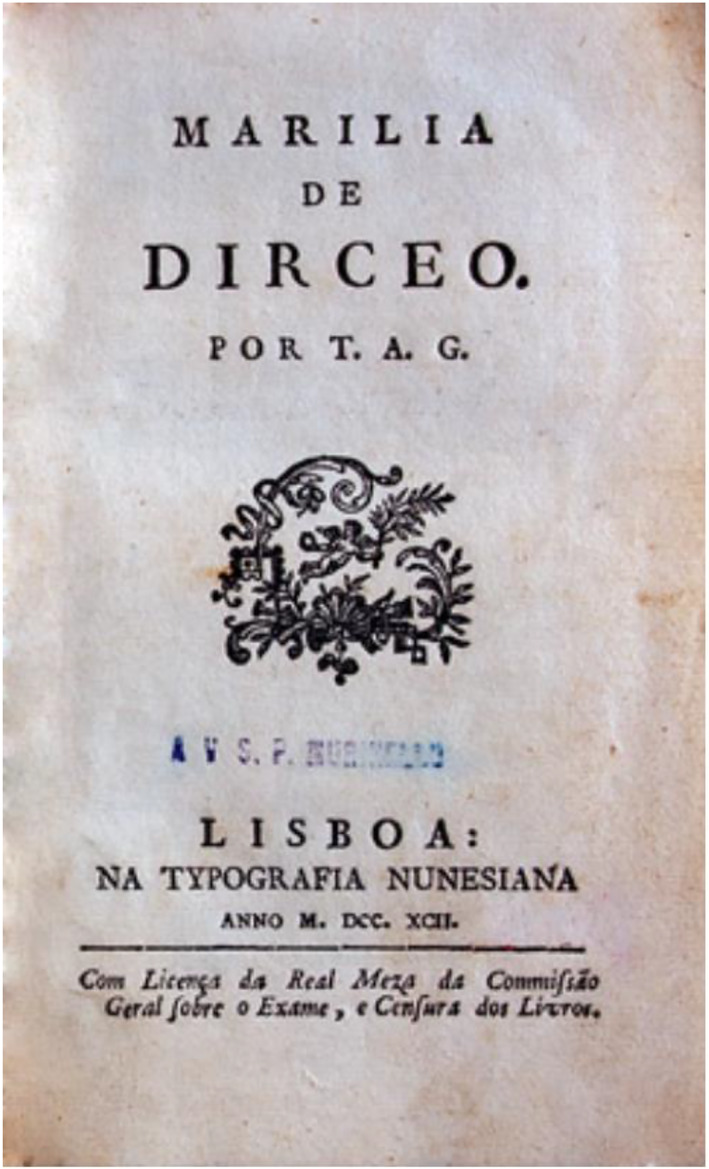
Facsimile reproduction of the first edition of the poem “Marília de Dirceu” (12). Source: Google image.
Do not you see that respectful elderly man
Who leaning on his crutchCan barely move, and barely drag himself around?
Oh! how much harm to him did time!
The snatched time,
That wears down even bronze.
Wrinkled is his face,
His eyes with their lost liveliness;his hair turned into white snow:
Already tremble the head, hand, and the chin,
He no longer has the beauty
That he once had.
Gonzaga's poetry captured images and people of his surroundings in Vila Rica. This feature was already present in his first work, the satirical “Cartas Chilenas” (Chilean Letters). Although written before “Marília de Dirceu,” it was published posthumously. 2 The man he describes in his opus magnum is certainly not a fictional character and it is likely that he fell upon this person while wandering the streets of Vila Rica or perhaps watched him from the balcony of his house (Fig. 2). The poem suggests that the old man was slow in all his movements forcing him to use crutches when he tried to walk. The description of a possible hypomimia (“Wrinkled is his face, His eyes with their lost liveliness”) further supports the diagnosis of parkinsonism. Wrinkles in the face may be a sign of aging but combined with the loss of facial expression, they suggest the man had a mask facies. The man also had a rest tremor, of his hands and chin. Common causes of tremor of the head, not usually found in PD or other causes of parkinsonism, are essential tremor and dystonic tremor. However, they seem to be an unlikely explanation given the presence of chin tremor, hypomimia and bradykinesia. It is likely, though, that it may result from transmission of upper limb tremor. It is not possible, however, to establish the etiology of the parkinsonism of the person depicted in the poem. The presence of rest tremor, with involvement of the chin, suggests the possibility of PD. The other common cause of this phenomenon, drug‐induced parkinsonism, 4 was a condition unlikely to exist in the XVIIIth century. There remains the remote possibility of mercury toxicity, a metal used in artisanal gold extraction, the most important economic activity in Vila Rica at that time. However, parkinsonism is not a complication of exposure to mercury. 5
FIG. 2.
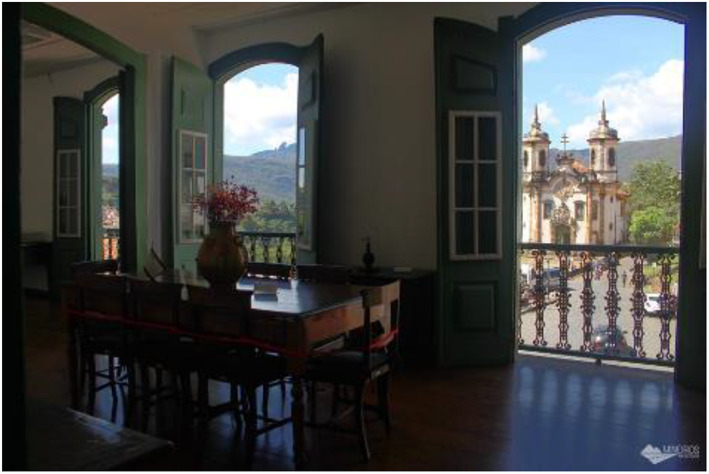
The house of Tomás António Gonzaga in Ouro Preto, Minas Gerais, Brazil (with permission from http://www.mineirosnaestrada.com.br/casa‐de‐tomas‐antonio‐gonzaga‐ouro‐preto/).
The old gentleman described in “Marília de Dirceu” may be the first person with parkinsonism, possibly caused by PD, described in the American continent. This case adds to the literature indicating that the shaking palsy is not a disease of the Industrial Revolution, with probable cases being reported in Asia, Europe and now, America.
Author Roles
(1) Research project: A. Conception, B. Organization, C. Execution; Francisco Cardoso: 1A, 1B, 1C. Leonardo Cruz de Souza: 1C; Andrew John Lees: 1C.
Disclosures
Ethical Compliance Statement
This study did not require review by the Ethics Committee of our institutions. Informed patient consent was not necessary for this work. We confirm that we have read the Journal's position on issues involved in ethical publication and affirm that this work is consistent with those guidelines.
Funding Sources and Conflicts of Interest
The authors declare that there are no conflicts of interest relevant to this work.
Financial Disclosures for the Previous 12 Months
The authors declare that there are no financial disclosures for the 12 previous months to report.
Supporting information
Data S1. Original Version of the poem Marília de Dirceu.
References
- 1. Raudino F. Parkinson disease before James Parkinson. Neurol Sci 2012;33:945–948. [DOI] [PubMed] [Google Scholar]
- 2. Schwarcz LM, Starling HM. Brasil: uma biografia. São Paulo: Companhia das Letras; 2015:808. [Google Scholar]
- 3. Gonzaga TA. de Dirceu Marília. Lisboa: Typografia Nunesiana, 1792. [Google Scholar]
- 4. Barbosa MT, Caramelli P, Maia DP, Cunningham MC, Guerra HL, Lima‐Costa MF, Cardoso F. Parkinsonism and Parkinson's disease in the elderly: a community‐based survey in Brazil (the Bambuí study). Mov Disord 2006;21:800–808. [DOI] [PubMed] [Google Scholar]
- 5. Ganguly J, Kulshreshtha JM. Mercury and movement disorders: the toxic legacy continues. Can J Neurol Sci 2021;48:1–9. 10.1017/cjn.2021.146. [DOI] [PubMed] [Google Scholar]
Associated Data
This section collects any data citations, data availability statements, or supplementary materials included in this article.
Supplementary Materials
Data S1. Original Version of the poem Marília de Dirceu.