



Abstract
Complexities of crises force supply chains managers to formulate crisis-induced strategies, which contrast with the conventional strategies that give precedence to competitive priorities. Recent crises, such as the coronavirus outbreaks, large-scale product recalls, and financial crises, underscore the increasing regularity and severity of crises with imperatives for introspective and retrospective socio-economic insights on the contexts, priorities, and themes of supply chain management in times of crisis. The purpose of this article is to review the literature on supply chain management in times of crisis, systematically coalescing the related body of scholarly work; outlining current methods applied by researchers; capturing strategic priorities and themes of complexities in research studies; and highlighting potentials for future studies. Using a systematic review of 250 journal articles published between 1996 and 2021, the review finds four dimensions for restorative priorities that reflect operations strategy during crisis: (i) critical supplies with essential services, (ii) timely response with recovery, (iii) safety with security, and (iv) traceability with transparency. The review also finds that operational complexities during crises originate from network configurations and business cycle complexities, optimal selections and provisioning system complexes, and complex learning processes and demand predictions. Insights from the review aid in the proposal of build-to-cycle, organic capabilities, and operational mindfulness framings for supply chain management in times of crisis. The article concludes by recommending future research studies on supply chain upgrades, diagnosis, solidarity, mapping, temporariness, and thresholds, as well as optimal selection problems on linking crisis systems investments with liabilities and on linking crisis network allotments with cross-functionalities.
Keywords: Supply chain management, Crisis, Operations strategy, Complexity, Systematic review
Introduction
Crises1 plague modern supply chains. Examples of crises include the Deepwater Horizon oil spill (2010) that discharged an estimated 4.9 million barrels of crude oil into the Gulf of Mexico, the Savar building collapse (2013) that caused 1129 human fatalities, and Samsung’s Galaxy Note 7 recall (2016) estimated to have cost $5.3 billion in losses. More recently, the pervasive influences of the Coronavirus Disease 2019 (COVID-19) pandemic on every fabric of society reinforces the chaotic state of affairs of global crises that warrant a rethinking of supply chain management (SCM) (Sharma et al. 2020; Sarkis 2021; Yagi and Managi 2021). Noticeably, regularity in the occurrences of global crises specifically sheds the spotlight on state-of-the-art supply chains because these crises make material dependencies more apparent and raise political and societal debates on dealing with demands and supplies during crises (Dewick et al. 2021). Such spotlights stem from increasing awareness that crises tend to be ‘black swan’ events that expose ‘black holes’ in institutions, leading to the emergence of new ‘black markets’ that exploit panicked customers along with potential tests to ‘black spots’ of socioeconomic systems. Accordingly, efficacy of supply chains becomes paramount as organisations consider evolutions or revolutions in practice for resilience and survival.
Considering the influence of crisis vis-à-vis supply chains gives rise to interesting SCM issues for further exploration. For a start, there are research problems to explain SCM strategies in times of crisis for the efficacy of coordination mechanisms and the optimisation of centralised decisions. In this context, SCM literature contains accounts on the evaluation of orchestration strategies for supply stability and for innovative and value-added services that harness the specialisation and expertise of supply chain actors (Bian et al. 2021; Sumukadas 2021). There are also expositions on the importance of agility and flexibility for addressing volatility issues of demand based on SCM lessons learnt from dealing with previous crises (Do et al. 2021; Harland 2021). However, the dominant theoretical and practical challenge remains to understand SCM complexities in times of crisis for improving supply chain resilience, with debates concerning a range of management issues such as the prioritisation of localisation (or regionalisation) over globalisation and inshoring over offshoring (Dewick et al. 2021). In the quest for resilience, there are consistent appeals by SCM scholars for studies of crises (Remko 2020; Al-Omoush et al. 2022) and an awareness of the strategic needs and many-sided complexities of SCM for crises (Siebert et al. 2020; Moretto and Caniato 2021). Yet, an analysis of the literature suggests that despite the renewed and continuing research interest on SCM in times of crisis, little is known about the range of complexities confronting supply chain managers and the array of strategic needs that motivate SCM reactions to crises. This gap in knowledge motivates our study.
The aim of this study is to review the literature on SCM in times of crisis, systematically coalescing the related body of scholarly work; outlining current methods applied by researchers; capturing strategic priorities and themes of complexities in research studies; and highlighting potentials for future studies. The systematic review methodology (Jesson et al. 2011; Gough et al. 2012) guides the study and aids in developing theoretical foundations for SCM in times of crisis with insights from the literature.
This review contributes to existing SCM theory in two unique ways. Firstly, the review provides new critical insights into uncertainties associated with SCM in times of crises. Secondly, and with close links to the first contribution, the research analyses the priorities of SCM during times of crisis. In so doing, the study offers crisis-oriented theoretical insights on current research trends and discourse to advance current SCM understanding, and develops theoretical foundations for future SCM studies. The target group for the review is an international community of researchers and practitioners of SCM strategy, and driven by the aim and focus, the main research question for the review is:
What are the main strategies, priorities, and complexities of SCM in times of crisis in literature?
The remainder of the article presents the terminological foundation, methodology, and findings of the review. The article concludes with a discussion on theoretical foundations, managerial implications, and future scholarship for SCM research.
Supply chain management in times of crisis: terminological foundation and motivation
Defining supply chain crisis
Despite significant interests in previous SCM literature (e.g., Baldini et al. (2012); Hittle and Leonard (2011); Jüttner and Maklan (2011); Natarajarathinam et al. (2009); Pfohl et al. (2010); and Wagner et al. (2017)), an analysis of the literature suggests the lack of an inclusive definition for the supply chain crisis concept. However, in crisis management literature (Hermann 1963; Pearson and Clair 1998; Weick and Sutcliffe 2001; Wagner et al. 2017), an organisational crisis means a low-probability, high-consequence event that threatens organisational viability due to complexity and unpredictability in understanding the causes, consequences, and means of resolution. In contrast, an institutional crisis is a serious threat and state of flux that gradually or abruptly destroys the legitimacy of institutional structures (Boin et al. 2004). Closely related is a state crisis that threatens the basic values of regions with a high probability of involving military hostilities and demands for response within a time frame (Brecher 1979). Though these forms of crises demand routine and crisis-induced flow of resources from supply chains (Mode 1), the notion of crisis within a supply chain (Mode 2 and Mode C), i.e. supply chain crisis and supply chain crisis in crisis times, shown by Fig. 1, is unique because it relates to SCM chaos, complications, and complexities that directly pertain to a supply chain (Sawyerr and Harrison 2019). Hence, a supply chain crisis pertains to supply chains but the scope of SCM in times of crisis is far-reaching due to organisational, institutional, and regional reliance on supply chains for sustaining socio-economic systems and establishing the foundations of economic growth.
Fig. 1.
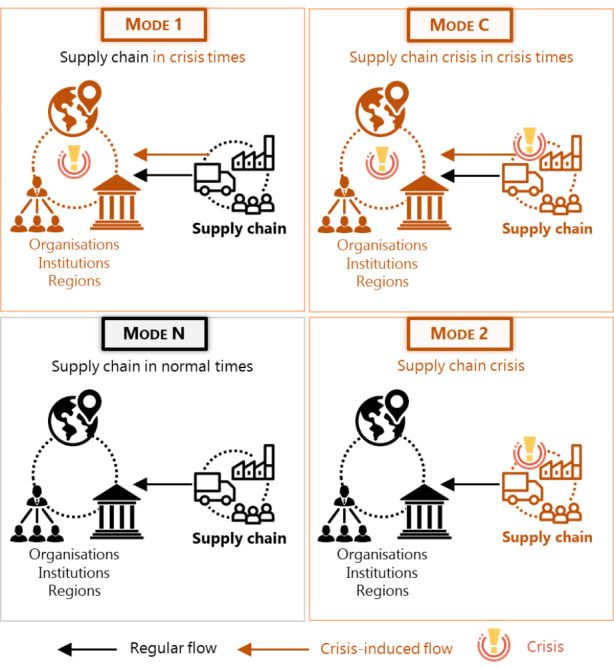
Comparing supply chains in normal times (Mode N) with possible permutations for supply chain management in times of crisis (Mode 1, 2, and C)
Viewed as ‘complex systems’ (Childerhouse and Towill 2004) and ‘complex networks’ (Van Der Vorst and Beulens 2002), supply chains: (i.) interlink suppliers, manufacturers, and distributors across multiple organisations, (ii.) involve supply chain partners that may be parts of other supply chains in different regions, (iii.) display variations in operations according to institutional conditions, and (iv.) contain differing objectives of partners (Blackhurst et al. 2004). From this perspective, a supply chain crisis stems from organisational, institutional, and state (or regional) causes and conditions facing suppliers, manufacturers, and distributors. Accordingly, this article puts forward an inclusive view of supply chain crisis as.
a supply chain state or situation triggered by a low-probability, high-impact incident that emerged gradually or abruptly from organisational, institutional and state (or regional) causes and conditions, threatening the values and viability of suppliers, manufacturers, and distributors, and imposing time pressures for supply chain decisions under high uncertainty.
Thus, supply chain crisis invariably has a negative connotation – demanding reaction cycles during pre-crisis phases of supply chain preparation and preparedness, intra-crisis phases of supply chain response and relief, and post-crisis phases of supply chain recovery and restoration, as shown by Fig. 2. Within these cycles, SCM complexities stem from fragilities (Levine 2012; O’Leary 2020) and vulnerabilities (Hitzman et al. 2009; Merz et al. 2009; Kurniawan and Zailani 2010; Jüttner and Maklan 2011; Johnson et al. 2013; Armani et al. 2020) of complex networks and systems for resource distribution and coordination mechanisms. Potentials for damages, destruction, or disruptions, also create insecurities among supply chain partners (Taylor et al. 2014) with unpredictability in global business environments (Tan and Enderwick 2006). These insecurities underscore the need for supply chain crisis signals (Banterle and Stranieri 2008; Gao et al. 2012; Yuen et al. 2020) to ease recognition. These signals aid partners enact collective (Chandes and Paché 2010), holistic (Aviso et al. 2018), inclusive (Smith 2010), resilient (Wang et al. 2016; Tan et al. 2016), or diversified (Chong et al. 2014; Calabrese and Vervaeke 2017; Koilo and Grytten 2019) SCM strategies. The cycle of Fig. 2 also reflects various constructs from the SCM literature related to general crisis management (Barnes and Oloruntoba 2005; Pearson et al. 2007; Ponis and Koronis 2012), humanitarian logistics management (Tomasini and Van Wassenhove 2009), and disaster management (Miller et al. 2006; Carter 2008; Cozzolino et al. 2012).
Fig. 2.

Overview of crisis reaction phases for supply chains
Management motives for supply chains in times of crisis
Motivations for dedicated SCM to deal with crises2 stem from at least two main imperatives. The first imperative is the definitiveness of crisis events because “it is no longer a question of ‘if’ a business will face a crisis; it is, rather, a question of ‘when’, ‘what type’ and ‘how prepared’ the company is to deal with it” (Kash and Darling 1998; p. 179). Due to the increasing occurrences and on-going threats of crises, e.g. pandemic outbreaks, regional conflicts, and industrial accidents, researchers argue for a wider viability- and integrity-based view of SCM in times of crisis Rong and Grunow 2010; Cozzolino et al. 2012; Adem et al. 2018; Ivanov and Dolgui 2020; Ivanov 2020; Poberschnigg et al. 2020). Supply chains in times of crisis tend to experience the usual supply, demand, control and logistical risks (Remko 2020; Raj et al. 2022a) associated with the regular flow shown by Fig. 1. However, unlike recurring operational disruptions, a crisis triggers extreme demand- and supply-shocks such as panic buying and changes in purchasing behaviour (Burgos and Ivanov 2021; Do et al. 2021) along with severe shortages of essential resources and labour (Dubey et al. 2021; Ozdemir et al. 2022; Raj et al. 2022a).
The second imperative is the competitiveness of crisis management practices that sheds the spotlight on opportunities for supply chains (Remko 2020; Chen and Biswas 2021). According to Paul Romer, a Nobel Laureate and former Chief Economist of the World Bank, ‘ a crisis is a terrible thing to waste’ implying socioeconomic rewards for businesses that fine-tune their operations during crises (Panwar et al. 2012), such as firms providing telecommunications services for remote work during a pandemic (Overby et al. 2004). Additionally, the PricewaterhouseCoopers (PwC) 2019 Global Crisis survey of 2084 senior executives suggests that crisis preparedness could become a basis for competitiveness of firms and supply chains. In SCM literature, preparedness for crisis tends to exist as a function of desirable supply chain abilities, summarised by Table 1, with some authors melding concepts to create higher-order constructs such transiliency from resiliency and transformability (Craighead et al. 2020), and leagility from leanness and agility (Ivanov 2020). Some studies posit on construct likes viability and survivability as encompassing agility, resilience, and sustainability (Ivanov 2020) while others examine abilities of abilities e.g. the integrity of quality (Schröder and Mceachern 2002). Although varied in focus, there is somewhat of a consensus on the nature of operational complexity (Adem et al. 2018) associated with desirable abilities, irrespective of the presence of a crisis, and in relation to issues such as loss of knowledge, falling demand, volatile exchange rates, unsatisfactory terminal productivity, and excessive shelf-life stocks. In consonance with strategic design for supply chain abilities, there is a need for strategic decisiveness3 for resolving supply chain crisis situations (Barnes and Oloruntoba 2005; Burns and Marx 2014), particularly for supply chain crisis in crisis times (Mode C), as shown by Fig. 1. Such decisiveness requires firms to make urgent and swift decisions with high uncertainty (i.e., incomplete information) in high-pressure situations that tend to persist during the lifespan of a crisis, shown by Fig. 2. Thus, crisis-driven decision-making tends to be centralised due to the severe threat, time pressure, and high uncertainty associated with crisis (Rosenthal et al. 2001; Bian et al. 2021; Harland 2021). Such centralisation thesis underpins the coordination of high reliability organisations (HROs) and crisis-driven agencies (e.g. the police, the emergency medical services, and the armed forces).
Table 1.
Overview of desirable supply chain abilities during crises
| Desirable supply chain ability | Overview | Sample sources |
|---|---|---|
| Adaptability | ability to adjust to environmental changes | (Jüttner and Maklan 2011; Narasimha et al. 2021; Notteboom et al. 2021; Thompson and Anderson 2021; Yang et al. 2021) |
| Availability | ability to provide easy access | (Leitner and Stehrer 2013; Mohanty and Chakravarty 2013; Salehi et al. 2019; Zhu et al. 2020) |
| Flexibility | ability to support modifications and changes | (Kurniawan and Zailani 2010; Vo and Thiel 2011; Jüttner and Maklan 2011; Johnson et al. 2013; Kim and Zhao 2021; Narasimha et al. 2021) |
| Integrity | ability to maintain principles and operate as a whole | (Schröder and Mceachern 2002; Kumar and Budin 2006; Rong and Grunow 2010) |
| Interconnectivity | ability to link parts | (Sojamo et al. 2012) |
| Quality | ability to meet customer requirements and be free from error | (Schröder and Mceachern 2002; Mora and Menozzi 2005; Rong and Grunow 2010; Kassahun et al. 2014; Grinberga-Zalite et al. 2021; Kim and Zhao 2021; Lu and Navas 2021) |
| Reliability | ability to perform consistently and with trustworthiness | (Zhang et al. 2019; Ghorashi et al. 2020) |
| Resiliency | ability to recover from damage or disruption | (Li et al. 2011; Jüttner and Maklan 2011; Johnson et al. 2013; Wang et al. 2016, 2018; Sprecher et al. 2017; Pashapour et al. 2019; Chang and Lin 2019; Quayson et al. 2020; Remko 2020; Zhu and Krikke 2020; Fertier et al. 2021; Grinberga-Zalite et al. 2021; Kaeo-Tad et al. 2021; Notteboom et al. 2021; Bastani et al. 2021) |
| Safety | ability to protect from threats, dangers, and risks | (Mora and Menozzi 2005; Rong and Grunow 2010; Kassahun et al. 2014; Nassar et al. 2020; Zhu et al. 2020; Iftekhar and Cui 2021) |
| Security | ability to maintain safeguards against deliberate efforts to cause harm and damage | (Han et al. 2018; Ihle et al. 2020; Nassar et al. 2020; Wannaprasert and Choenkwan 2021) |
| Stability | ability to endure and maintain firmness | (Vo and Thiel 2011; Kwon et al. 2021; Thompson and Anderson 2021) |
| Substitutability | ability to support replacements and exchanges | (Sprecher et al. 2017; Salehi et al. 2019) |
| Sustainability | ability to balance and address economic, social, and environmental demands | (Babazadeh et al. 2017; Han et al. 2018; Zhu and Krikke 2020; Sarkis 2021; Zhang et al. 2021) |
| Survivability | ability to continue operations | (Sheng and Saide 2021) |
| Traceability | ability to track and trace origins and progress | (Kumar and Budin 2006; Rong and Grunow 2010; Zhu et al. 2020; Iftekhar and Cui 2021; Sarkis 2021) |
| Transformability | ability to change | (Craighead et al. 2020; Thompson and Anderson 2021) |
| Transiliency | (resiliency and transformability) ability to simultaneously restore some processes and change | (Craighead et al. 2020) (Harland 2021) |
| Transparency | ability to be open and accountable (i.e. accountability) | (Kassahun et al. 2014; Francis 2020; Zhu et al. 2020; Narasimha et al. 2021; Sarkis 2021; Sumukadas 2021) |
| Velocity | ability to maintain course of action | (Jüttner and Maklan 2011; Johnson et al. 2013) |
| Viability | ability to survive and thrive with success | Babazadeh et al. 2017; Francis 2020; Ivanov 2020) |
| Visibility | ability to view and make actions prominent | (Kurniawan and Zailani 2010; Jüttner and Maklan 2011; Johnson et al. 2013) |
Recent related reviews that analyse humanitarian operations strategy (Goldschmidt and Kumar 2016; Jahre 2017), disruption recovery in supply chains (Ivanov et al. 2017), and supply chain resilience (Han et al. 2020), further reinforce the importance and need for on-going reviews of SCM in times of crisis. Although a previous critical review captures practices and research trends of SCM in a crisis (Natarajarathinam et al. 2009) – this is not the focus for our research. Rather, the interest in this research lies in the strategies and complexities of SCM and a systematic approach underpins our focus in this review. In so doing, this research methodically seeks to provide better understanding of the management practices for facilitating viability- and integrity-based views of SCM in times of crisis and to advance discourse on supply chain crisis preparedness and decisiveness.
Methodology
Guided by the systematic review methodology (Torgerson 2003; Tranfield et al. 2003), this study intends to learn lessons on strategic decisiveness from literature on SCM in times of crisis. The methodology suits this study because it involves using explicit algorithms to minimise bias and to provide an audit trail for drawing conclusions from focused findings. For this study, the review adopts the consecutive stages prescribed in Tranfield et al. (2003) i.e. planning, executing and reporting, shown by Fig. 3.
Fig. 3.

Overview of process for the systematic literature review (Durugbo 2020)
Planning involves developing and applying a review protocol (Torgerson 2003) detailing the purpose and scope of the review. In the protocol, the research aim acts as a guide for formulating the search strategy and identifying search strings. One main inclusion criterion informs the search and screening for review sources – empirical and theoretical peer-reviewed journal articles. This review’s focus on journal articles is deliberate and intends to limit the scope. Concentrating on peer-to-peer reviewed scientific articles is common practice in high-quality SCM reviews (e.g. Jahre (2017) and Han et al. (2020)) for propagating academic rigour, relevance, and quality. The planning for the review also involves selecting Scopus (accessible at www.scopus.com) (owned by Elsevier the Dutch publishing company) as the electronic database for finding, screening, and accumulating scientific articles. Scopus serves as the database for this review because it is the world’s largest online database for peer-reviewed scientific publications. The Scopus database is also widely accepted by the academic community due to the high relevance and scientific quality of content.
Executing entails searching for literature on the chosen database, i.e. Scopus, using a combination of keyword terms as search strings. The review applies “supply chain”, “crisis”, and “crises”, with Boolean Operators ‘AND’ and ‘OR’ to clarify logical relationships between terms and to combine search terms. The combination of terms creates the main search string for the review i.e. ‘“supply chain” AND “crisis”’ OR “supply chain” AND “crises”’, for use in scanning the titles, abstracts and keywords of English language publications to select relevant sources. Although the review excludes duplicates and articles with limited focus on supply chain crisis, the main exclusion criteria and omissions by the review are book chapters, conference papers, masters’ theses, doctoral dissertations, textbooks, and unpublished working papers. Initial search produced 1747 outcomes, and limiting the search to English language journal articles, generated 943 results. Following screening, scanning, and cross-referencing for duplicates and relevance, the executing phase identifies 250 unique articles for use in the review.
Reporting concerns conveying the findings of the review and follows a synthesis of the main findings from retrieved articles into an analytical and critical coherent statement. The comprehensive analysis of the accumulated body of literature of journal articles published from 1996 to 2021, shown by Fig. 4, follows access and retrieval of these sources and precedes the synthesis.
Fig. 4.
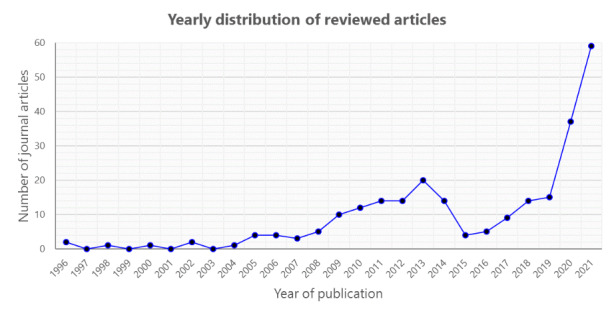
Breakdown of published articles according to year of publication
In keeping with the systematic review methodology (Jesson et al. 2011; Gough et al. 2012), thematic analysis (Guest et al. 2012; Nowell et al. 2017) guides the synthesis and its use in the review centres on scrutinising, categorising, and detailing concepts in studies. This process involves reading and analysing the body of literature in line with the research questions, using triangulation and tabulation tools to develop concepts, and co-opting a group of eight SCM researchers to assess the reliability and validity of proposed themes. Sub-themes and themes emerge from this process during the assessment of research similarities and disparities of concepts. Through steps for data reduction involving reading, familiarising, and generating initial codes, the review clusters and reports themes on SCM strategies, priorities, and complexities.
Findings
Table 2 summarises the methodologies used in reviewed studies and the distributions are as follows: 74 (29.6%) decision and systems model, 57 (22.8%) interview-based and case studies, 48 (19.2%) theoretical and conceptual studies, 23 (9.2%) econometric and statistical analysis-based studies, 19 (7.6%) secondary, historical, and literature analysis-based studies, 18 (7.2%) survey-based studies, and 11 (4.4%) mixed methodology studies. Similarly, Table 3 provides an overview of theories in the review according to of behaviour-, context-, decision-, performance-, resource- and systems-oriented groupings. This section begins by analysing contexts of supply chains in times of crisis before outlining priorities for SCM strategies and themes of complexities in times of crisis.
Table 2.
Overview of research methodologies in review
| Methodology | Description | Use in reviewed articles |
|---|---|---|
| Decision and systems models | Modelling uncertainty in systems using quantitative and qualitative tools |
• Agent-based simulation and multi-agent modelling (Kaddouci et al. 2009; Resende-Filho and Hurley 2012; Comba et al. 2013; Kaddoussi et al. 2013; Chaturvedi et al. 2014; Iannone et al. 2014; Upton and Nuttall 2014; Chong et al. 2014; Colon et al. 2021; Dulam et al. 2021) • Data Envelopment Analysis (DEA) models (Babazadeh et al. 2017; Azghandi et al. 2018; Pashapour et al. 2019) • Discrete event simulation (Burgos and Ivanov 2021; Fertier et al. 2021) • Fuzzy logic (Lau et al. 2008; Tan et al. 2016; Drakaki et al. 2018; Yan et al. 2019; Xia et al. 2020) • Input-output analysis (Aviso et al. 2018; Han et al. 2018; Meng et al. 2020; Fan and Liu 2021) • Mixed-integer, non-linear, and stochastic programming (Ozbay and Ozguven 2007; Rong and Grunow 2010; Dabbene and Gay 2011; Manenti et al. 2013; Roshan et al. 2019; Salehi et al. 2019; Goodarzian et al. 2020; Bian et al. 2021; Lu and Navas 2021) • Multi-Objective Optimisation Methods (Hale and Moberg 2005; Merz et al. 2009; Benaïcha and Hadj-Alouane 2013; Memon et al. 2015; Zhang et al. 2019; Laguna-Salvadó et al. 2019; Ghorashi et al. 2020; Khalilpourazari et al. 2020; Malmir and Zobel 2021; Mosallanezhad et al. 2021; Wang and Hu 2021) • Network analysis (Pinior et al. 2012a, b; Liu 2013) • Requirements analysis (Kassahun et al. 2014; Vybornova and Luc 2019) • System dynamics modelling (Sanchez-Ramirez et al. 2011; Vo and Thiel 2011; Thiel et al. 2014; Udenio et al. 2015; Chang and Lin 2019; Zhu and Krikke 2020) • Scenario planning and evaluation (Meuwissen et al. 2009; Mazzarino 2012) • System architecture design (Baldini et al. 2012; Iftekhar and Cui 2021) • Others include decision-making trial and evaluation laboratory (DEMATEL) (Miao et al. 2014), Delphi (von der Gracht and Darkow 2013), dynamic programming (Zhang et al. 2021), entropy analysis (Lu et al. 2019), equilibrium displacement model (Xiao 2010), event sequence analysis (Sprecher et al. 2017), fault tree analysis (Kumar and Havey 2013), failure mode, effects, and criticality analysis (FMECA) (Raab et al. 2013), flow modelling (Lehmann et al. 2011), fuzzy quality function deployment (Tamtam and Tourabi 2021), genetic algorithm and multi-choice goal programming (Razavi et al. 2021), inductive case-based reasoning ensemble (ICBRE) (Li et al. 2012), Petri-nets (Wang et al. 2016), Pugh matrix approach and Monte Carlo simulation (Baležentis et al. 2021), and Theory of Constraints (Yang et al. 2009) |
| Interviews and case studies | Analysing cases using interviews and observations |
• In-depth and unstructured interviews (Shaw 1996; Kurniawan and Zailani 2010; Allal-Chérif and Maira 2011; Singleton and Cormican 2013; Chanaron 2013; Taylor et al. 2014; Gelli and Suwa 2014; Calabrese and Vervaeke 2017; McDermott and Hayes 2018; Adem et al. 2018; Handfield et al. 2020; Remko 2020; Wilhelm et al. 2020; Dibben et al. 2020; Grinberga-Zalite et al. 2021; Harland et al. 2021; Harpring et al. 2021; Jung and Jeon 2021; Kaeo-Tad et al. 2021; Kwon et al. 2021; Mańkowska et al. 2021; Bassett et al. 2021; Morales-Contreras et al. 2021; Schiele et al. 2021; Cole 2021; Dewick et al. 2021; Do et al. 2021; Fearne et al. 2021) • Case analyses (Fearne 1998; Mora and Menozzi 2005; Gorton et al. 2006; Tan and Enderwick 2006; Gessner et al. 2007; Grando 2008; Kovács et al. 2010; Ergun et al. 2010; Blome and Schoenherr 2011; Li et al. 2011; Hittle and Leonard 2011; Sojamo et al. 2012; Ponis and Koronis 2012; Fiset and Dostaler 2013; Johnson et al. 2013; Urciuoli et al. 2014; Meehan et al. 2017; Desoutter and Lavissière 2018; Piotrowicz 2018; Koutsou and Sergaki 2019; Poberschnigg et al. 2020) • Field, retrospective, longitudinal, and best practice case investigations (Lamming 2000; Chandes and Paché 2010; Gatignon et al. 2010; Jüttner and Maklan 2011; Cozzolino et al. 2012; Wilson and Grammich 2020) • Grounded theory (Bastani et al. 2021) • Focus groups (Moretto and Caniato 2021) |
| Theoretical and conceptual framings | Developing concepts using theories and discussions |
• Theoretical analysis and development Mazé 2002; Barnes and Oloruntoba 2005; Kumar and Budin 2006; Richey 2009; Hitzman et al. 2009; Smith 2010; Svensson 2010; Benson 2011; Mackey and Liang 2011; Domański et al. 2013; Boyce 2016; Madichie and Yamoah 2017; Armani et al. 2020; Nagoev et al. 2020; Yu et al. 2020; O’Leary 2020; Abd Razak et al. 2020; Ivanov 2020; Baveja et al. 2020; Craighead et al. 2020; Spash 2021) • Critiques and discussions (Loader and Hobbs 1996; Schröder and Mceachern 2002; Manning 2007; Lee and Marsden 2009; Meyer-Larsen et al. 2012; Panwar et al. 2012; Parry and Roehrich 2013; Stephens 2013; Alcalde-Heras et al. 2019; Deconinck et al. 2020; Quayson et al. 2020; Siebert et al. 2020; Fonseca and Azevedo 2020; Francis 2020; Larrañeta et al. 2020; Dey et al. 2020; Zhu et al. 2020; Mollenkopf et al. 2021; Natarajan and Prasad 2021; Sarkis 2021; Sumukadas 2021; Harland 2021; Kim and Zhao 2021; Kovács and Sigala 2021) • Essay and opinions (Manenti 2009; Sass and Szalavetz 2013) • Content analysis (Chen and Biswas 2021) |
| Econometric and statistical analysis | Modelling economic trends using statistical methods |
• Econometric techniques Park et al. 2008; Levine 2012; Schulte in den Bäumen et al. 2014; Gawande et al. 2015; Lamieri and Sangalli 2019; Fasan et al. 2021; Yagi and Managi 2021; Koppenberg et al. 2021; Lin et al. 2021; Notteboom et al. 2021; Khidil et al. 2021) • Regression analysis (Brandenburg 2016; Wagner et al. 2017; Vaillancourt et al. 2018; Koniagina et al. 2019; Doan and Bui 2020; Zhang 2020; Sakas et al. 2021) • Others include comparative analysis (Sans et al. 2005), correlation analysis (Min and Kim 2011), distress analysis (Thangaraj and Chan 2012), likelihood-based method (Kaufman et al. 2014), and multivariate analysis (Ortas et al. 2014) |
| Secondary, historical and literature analysis | Analysing phenomena based on secondary data |
• Reviews (Raspor 2008; Natarajarathinam et al. 2009; Pfohl et al. 2010; Andrews et al. 2011; VanVactor 2011; Gereffi and Lee 2012; Fischbacher-Smith and Smith 2015; Chammem et al. 2018; Sawyerr and Harrison 2019; Yuen et al. 2020) • Historical analysis (Wales et al. 2006; Li et al. 2017; Arcidiacono 2018; Ihle et al. 2020) • Others include analysis of annual reports (Koilo and Grytten 2019), desk-based studies (Teresa et al. 2018), document analysis (Kuokkanen et al. 2017), newspaper (Thompson and Anderson 2021), and twitter data (Sharma et al. 2020) |
| Survey-based studies | Administering questionnaires to draw inferences about populations |
• Questionnaire-based surveys (Banterle and Stranieri 2008; Hanna et al. 2010; Gao et al. 2012; Leitner and Stehrer 2013; Montague et al. 2013; Burns and Marx 2014; Nassar et al. 2020; Nurieva et al. 2020; Veselovská 2020; Butu et al. 2020; Sheng and Saide 2021; Chiu et al. 2021; Dubey et al. 2021; Gupta et al. 2021; Larios-Gómez et al. 2021; Yang et al. 2021; Al Zoubi et al. 2021) • Attribute-based repeated choice-experiments (Steiner and Yang 2010) |
| Mixed approaches | Combining quantitative and qualitative approaches to study cases and concepts | • Varied combinations of content analysis, statistical analysis, fieldwork, simulation, survey, focus groups, secondary data, and expert interviews with retrospective cohorts (Beresford and Pettit 2009; Mohanty and Chakravarty 2013; Storoy et al. 2013; Li et al. 2016; Siekmans et al. 2017; Dufour et al. 2018; Ferrer-Pérez et al. 2019; Aigbedo 2021; Wannaprasert and Choenkwan 2021; Narasimha et al. 2021; Ma et al. 2021) |
Table 3.
Main management theories in review
| Theory grouping | Theory examples | Overview | Sample sources |
|---|---|---|---|
| Behaviour-oriented theories | Power dependency theory | Emphasises the role of power in relationships | (Madichie and Yamoah 2017; Craighead et al. 2020) |
| Agency theory | Models relationships and resolves issues between agents and principals | (Smith 2010) | |
| Relationship management theory | Argues for ethical, effective, and efficient management of organisation-stakeholder relationships | (Richey 2009) | |
| Field theory | Elaborates on interaction patterns between individuals and environments | (Xia et al. 2020) | |
| Communication theory | Explains the generation and transmission of information | (Richey 2009) | |
| Network theory | Phenomena can be explained through entities and ties between entities (relies on graph theory) | (Pinior et al. 2012a, b; Wang et al. 2018; Lu et al. 2019) | |
| Social capital theory | Predicts that social relationships are resources that shape how far an individual establishes power and influence | (Johnson et al. 2013) | |
| Social exchange theory | Posits that tangible and intangible benefits motivate individuals to reciprocate actions from others | (Madichie and Yamoah 2017) | |
| Transaction cost economics | Proposes that governance structures are determined by relative costs for managing transactions | (Loader and Hobbs 1996; Mazé 2002; Banterle and Stranieri 2008; Allal-Chérif and Maira 2011; Blome and Schoenherr 2011) | |
| Attribution theory | Posits that individuals apply feelings and beliefs to understand the behaviour of others | (Gao et al. 2012) | |
| Theory of planned behaviour and theory of reasoned action | Predicts intention to use based on attitude towards behaviour, subjective norms, and perceived behavioural control. | (Upton and Nuttall 2014; Gupta et al. 2021; Larios-Gómez et al. 2021) | |
| Structuration theory | Posits on social structure and human agency as a mutually constitutive duality that is generated by social behaviour | (Johnson et al. 2013) | |
| Context-oriented theories | Competing values theory | Posits on organisational focus and preference for structure | (Richey 2009) |
| Contingency theory | Effective actions are reliant on contexts and situations | (Richey 2009; Hanna et al. 2010; Dubey et al. 2021; Moretto and Caniato 2021) | |
| Situational communication theory | Heterogeneity of contexts induces disparities in responses during crisis | (Desoutter and Lavissière 2018) | |
| Structural inertia theory | Argues that environmental conditions determine organisational survival as organisations strive to maintain the status quo | (Craighead et al. 2020) | |
| Institutional theory | Homogeneity of firm strategies tend to be the net effect of institutional pressures | (Li et al. 2016; Xia et al. 2020; Craighead et al. 2020) | |
| Transition theory | Socio-economic transition of a sector is the outcome of changes at three main levels that affect each other: socio-technical regimes, landscape, and niche innovations | (Koutsou and Sergaki 2019) | |
| Cultural dimensions | Posits on differences in culture according to individualism/collectivism, power distance, uncertainty avoidance and masculinity/femininity | (Larios-Gómez et al. 2021) | |
| Decision-oriented theories | Game theory | Decisions can be mathematically modelled with respect to goals and choices | (Chong et al. 2014; Craighead et al. 2020; Bian et al. 2021; Lu and Navas 2021) |
| Prospect theory | Posits that people tend to place a higher value on avoiding loss than on realising gains | (Xia et al. 2020; Craighead et al. 2020) | |
| Random utility theory | Posits that random factors influence decisions in the absence of preferential options | (Steiner and Yang 2010) | |
| Real options theory | Proposes options for investments under uncertainty | (Craighead et al. 2020) | |
| Tournament theory | Models decisions in terms of rewards shared among winners and losers | (Craighead et al. 2020) | |
| High reliability theory | Accidents and failures can be prevented by making continuous minor modifications that prevent error accumulation | (Sawyerr and Harrison 2019) | |
| Performance-oriented theories | Corporate finance and valuation theory | Explains the difference between profitability and company value | (Brandenburg 2016) |
| Ecological modernisation theory | Posits on economic value of environmental sustainability | (Li et al. 2016) | |
| Stakeholder theory | Posits that a key role of firms is to deliver value for stakeholders | (Manning 2007; Ortas et al. 2014; Xia et al. 2020) | |
| Good management theory | Suggests correlations between social performance, environmental performance, and good management practices | (Ortas et al. 2014) | |
| Resource-oriented theories | Resource-based view | Heterogeneity of firm level capabilities induces disparities in competitiveness | (Richey 2009; Allal-Chérif and Maira 2011; Meehan et al. 2017; Chang and Lin 2019; Aigbedo 2021; Chen and Biswas 2021) |
| Dynamic capabilities theory | Dynamism of firm level capabilities induces disparities in competitiveness | (Do et al. 2021) (Dubey et al. 2021) | |
| Resource dependency theory | Argues that external entities exert power and control over organisations and that organisations take actions to mitigate this exertion | (Madichie and Yamoah 2017; Ma et al. 2021) | |
| Resource orchestration theory | Extends resource-based view by considering the role of managers | (Craighead et al. 2020; Moretto and Caniato 2021) | |
| Slack resources theory | Argues that knowledge of resource value requires knowledge of the generation of slack and its availability for operations | (Ortas et al. 2014) | |
| Systems-oriented theories | Complex adaptive system theory | Posits interactions and relationships of entities in systems as driven and shaped by the systems | (Svensson 2010) |
| Information processing theory | Elaborates on the encoding of information | (Yang et al. 2021) | |
| Dissipative structure theory | Examines deterministic nonlinear systems and their potential for producing unpredictable behaviour | (Svensson 2010) | |
| Dynamic systems theory | Proposes that behaviour stems from interactions between multiple subsystems | (Ivanov 2020) | |
| Event systems theory | Proposes that novel, disruptive, and critical events meaningfully impact organisational behaviour | (Craighead et al. 2020) | |
| Fuzzy control theory | Models decision-making based on approximate reasoning | (Lau et al. 2008; Tan et al. 2016; Drakaki et al. 2018) | |
| Complexity theory | Elaborates on complex systems and complexity in tasks | (Barnes and Oloruntoba 2005; Svensson 2010; Vo and Thiel 2011) | |
| General systems theory | Order naturally emerges in organisations as resources are exchanged with their environments | (Han et al. 2018) | |
| Systems dynamics theory | Models systems with focus on regulation flows | (Thiel et al. 2014) |
Supply chains in times of crisis
Literature suggests four main contexts for supply chains that trigger reactions in times of crisis: (i) widespread product-related contamination and compromised production (PCCP), (ii) severe process-related shortages and suspended production (PSSP), (iii) severe supplier-related debt and depressed sales (SDDS), and (iv) widespread deep tensions and trade-related disputes (DTTD), as presented by Table 4. These contexts threaten reputation capital among consumers (Ponis and Koronis 2012; Thangaraj and Chan 2012; Matopoulos et al. 2019), evaporate consumer confidence in suppliers (Wales et al. 2006), make consumers feel a betrayal of their trust in brands (Gao et al. 2012), but afford customers with opportunities to switch over a finite time horizon (Madichie and Yamoah 2017).
Table 4.
Main indicators and signals of supply chain crisis
| Supply chain crisis indicators | Overview | Main scenarios | Samples sources |
|---|---|---|---|
| Product-related contamination and compromised production (PCCP) | Intentional or non-intentional introduction of threats (e.g. tainted ingredients and pollutants) into products and the production process. |
Unintentional contamination usually through worker errors Intentional contamination or sabotage from violations, abusive practices, fraudulent and unethical practice Counterfeiting and product terrorism |
(Gessner et al. 2007; Mackey and Liang 2011; Chaturvedi et al. 2014; Madichie and Yamoah 2017; Wilhelm et al. 2020; Abd Razak et al. 2020; Wilson and Grammich 2020) |
| Process-related shortages and suspended production (PSSP) | Deficiencies and insufficiencies of resources and capabilities. Such lack of resources and supplies mainly account for suspended products |
Resource, stock and capacity shortages Workforce, equipment and capability shortages Breaks and deteriorations in supply chains Substantial fails, delayed or complete stop to production |
(Shaw 1996; Andrews et al. 2011; Benson 2011; Hittle and Leonard 2011; Fiset and Dostaler 2013; Boyce 2016; Piotrowicz 2018; Azghandi et al. 2018; Dey et al. 2020) |
| Supplier-related debt and depressed sales (SDDS) | Economic and financial upheaval of firms due to sales and debt issues with threats of insolvencies and bankruptcies |
Significantly halted and lost sales Global sales crash Financially distressed suppliers |
(Blome and Schoenherr 2011; Benaïcha and Hadj-Alouane 2013; Calabrese and Vervaeke 2017; Madichie and Yamoah 2017) |
| Deep tensions and trade-related disputes (DTTD) | Disharmony and anxiety in the state of minds of stakeholders due to deep tense trade relationships |
Tense supplier relationships – upstream-downstream and direct-indirect Regionalisation-globalisation tensions |
(Gawande et al. 2015; Arcidiacono 2018; Desoutter and Lavissière 2018) |
Mainly considered an industry-wide problem, widespread PCCP characterises the product-harm crisis (Gao et al. 2012) and recall crisis (Andrews et al. 2011; Dabbene and Gay 2011) that corrode trust in supply chains. Recognising the increased occurrences of high-profile contamination-related events (Kaufman et al. 2014) and their significant impact on product integrity (e.g. halalan toyyiban integrity) (Abd Razak et al. 2020), SCM researchers study widespread PCCP in a variety of contexts. Examples include supply chains for food (Meuwissen et al. 2009; Gao et al. 2012), drugs (Li et al. 2017; Azghandi et al. 2018), automobiles (Andrews et al. 2011), and consumer goods (Kumar and Budin 2006; Memon et al. 2015). In contrast, the emergence of severe PSSP reflect concerns for an on-going “shortage syndrome” (Shaw 1996) that triggers shortage crises (Azghandi et al. 2018; Cole 2021) and capacity crises (Boyce 2016). For some authors, shortages induce complex emergencies such as societal breakdown, technology failure, and economic crisis (Piotrowicz 2018) or when suppliers fall foul of the law (Madichie and Yamoah 2017), while the joint occurrence of such emergencies tend to cause serious losses, injuries, and fatalities (Johnson et al. 2013; Yan et al. 2019). It is for this reason that in some industries like the food sector, severe PSSP (along with widespread PCCP) are considered the main challenges for supply chains (Abd Razak et al. 2020).
Severe SDDS pertains to dire economic situations and halted sales that trigger corporate insolvencies and supplier bankruptcies with significant impacts on partners who have limited contingency plans (Blome and Schoenherr 2011). With roots mainly in funding, financial and economic crises, literature notes that during these crises, firms typically file for bankruptcy for protection due to various reasons. Examples include business failure (Li et al. 2012), global sales crash and significant sales dips e.g. for cars during the 2008 to 2009 global financial crisis (Domański et al. 2013; Calabrese and Vervaeke 2017), or product price falls e.g. for oil and gas prices from the summer of 2014 and onwards (Koilo and Grytten 2019). Another indicator of supply chain crisis is the widespread DTTD that stems from the deep tense relationships in climates of distrust, e.g. between farmers, food companies, and retailers in food supply chains (Arcidiacono 2018; Desoutter and Lavissière 2018). The literature also notes regionalisation (protectionism) and globalisation tensions (Gawande et al. 2015) that impact support levels for firms from home governments (Fiset and Dostaler 2013). Such tensions and disputes render port and trade routes vulnerable (Barnes and Oloruntoba 2005) with insecurities in trade network structures concerning vertical and horizontal trade relationships, as well as direct and indirect trade connections (Pinior et al. 2012a, b). Widespread DTTD uniquely accounts for the competitiveness crisis (Dibben et al. 2020) that forces suppliers to engage in regional cooperation for closely-knit industrial districts.
Literature also captures a range of compounding effects characterising crises and this review categorises these effects according to cumulative, combinative, complicating, and cascading forms, as shown by Fig. 5. Negatively, these effects tend to extend durations and impacts (direct and indirect) of crises (Meuwissen et al. 2009; Adem et al. 2018). However, these effects also fortuitously or coincidentally generate benefits for new businesses such as the short-lived gains by the pork supply chains during the AI/BSE incidents (Park et al. 2008) and private-jet travel during the SARS outbreak (Overby et al. 2004). Cumulative effects reflect supply chain swings and amplification of crisis from incidents with linkages to predecessors (e.g. several food crises or disease outbreaks). These effects strongly affect production (Sans et al. 2005) and have greater impact on global business environments (Tan and Enderwick 2006). Combinative effects indicate supply chain shifts and aggregation of crisis consequences with increased peril due to the combination of multiple exogenous crisis incidents (Desoutter and Lavissière 2018) that lead to changing attitudes of society towards production systems (Lehmann et al. 2011). For instance, a subprime mortgage crisis combined with the credit crunch of an economic recession (Smith 2010) or the Covid-19 pandemic compounding an uncontrollable humanitarian crisis (Baveja et al. 2020). Complicating effects magnify crisis consequences due to the unexpected occurrences and sometimes deliberate activities that worsen crisis states e.g. network failures that exacerbate public crisis (Roshan et al. 2019) or media coverage that overstate and inflate scares (Loader and Hobbs 1996) or undermine belief in competence and trustworthiness (Wales et al. 2006). Cascading effects are contagion (Lamieri and Sangalli 2019), ripple (Hale and Moberg 2005), and multiplier (Levine 2012) effects of independent shocks on value chains. Here, the suggestion is that linkages between partners and processes heighten the vulnerability and susceptibility of supply chains with disruptions to individual links triggering a cascade of supplier-, internally- and customer-induced operational disruptions (Tan et al. 2016; Wagner et al. 2017).
Fig. 5.
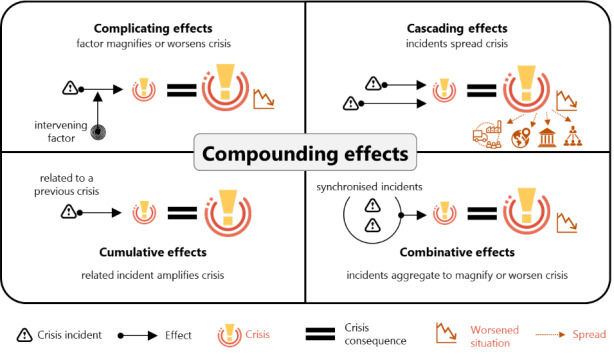
Overview of compounding effects on a supply chain crisis
Supply chain management strategies in times of crisis
Table 5 provides a range of SCM strategies during crisis identified by the review. These strategies include framing, technological solutions, management systems, institutional standards and regulations, network designs, decision models, regional and organisational policies, and management programs and practices. Inevitably, the focus of these strategies is to deliver solutions for preparedness and responsiveness that is, for some scholars, workable (Dey et al. 2020) with swift turnarounds on a global scale supported by standby infrastructure, and for others, ambidextrous (Fiset and Dostaler 2013) with support for crisis and calm modes that transition seamlessly through integration to design.
Table 5.
Strategies for SCM in times of crisis
| Strategy | Overview | Key examples of focus in literature |
|---|---|---|
| Crisis-driven strategic framings | Concepts and perspective to initiate dialogue and development of new strategies |
• anticipatory and coping mechanisms such as risk mitigation inventories, subcontracting capacities, backup supply and transportation infrastructures, omnichannel and data-driven, real-time monitoring and visibility systems (Ivanov 2020) • brand-protection efforts such as legal responses to enforce contractual agreements (Wilson and Grammich 2020) • corporate location strategy (Domański et al. 2013) • countermeasures to manage disruptions (Urciuoli et al. 2014) • disruption management strategies, including portfolio diversification, flexible contracts, transport capacity planning, and safety stocks (Urciuoli et al. 2014) • emergency mobilisation strategies including buffer inventory strategy, additional production strategy, and relief supply reserve strategy (Zhang et al. 2019) • horizontal and vertical integration strategies (Smith 2010) • Internet of Things strategies (Xia et al. 2020) • logistic strategies (Iannone et al. 2014) • manufacturing strategies (Wang et al. 2016) • outsourcing strategies (Manenti 2009) • proactive measures to preserve food safety (Yu et al. 2020) • quality strategy (Grando 2008) • risk communication strategies (Steiner and Yang 2010) • strategies for procurement (Montague et al. 2013; Dewick et al. 2021) • strategies of segmentation (Sans et al. 2005) • supply chain objectives (Siebert et al. 2020) • suppression measures such as lockdowns and community quarantines in pandemics (Yu et al. 2020) |
| Crisis-driven technological solutions | Applying technological responses for managing complexity |
• artificial intelligence and big data (Sheng and Saide 2021; Chen and Biswas 2021) • blockchain (Quayson et al. 2020; Iftekhar and Cui 2021) • digital twins (Burgos and Ivanov 2021) • digitalisation of production (Calabrese and Vervaeke 2017) • electric vehicles (Miao et al. 2014) • harnessing ‘low-tech’ solutions (Armani et al. 2020) • information infrastructures (Lehmann et al. 2011) • information services for European pork chains (Lehmann et al. 2011) • investment in detection technology (Madichie and Yamoah 2017) • IT-enabled integration in public organisations (Li et al. 2017) • radio frequency identification (RFID) technology for secured tracking and tracing (Kumar and Budin 2006; Baldini et al. 2012; Meyer-Larsen et al. 2012) • smart manufacturing, internet of things and industry 4.0 (Wang et al. 2018) • virtual community (Chaturvedi et al. 2014) |
| Crisis-driven management systems | Value-based management and control systems for embedding intelligence into supply chains |
• alarm system with critical and cautious-alerting criteria to detect crises (Svensson 2010; Desoutter and Lavissière 2018) • early warning signals (Gao et al. 2012) • enterprise information systems (Lehmann et al. 2011) • financial network system (Liu 2013) • fully autonomous deployment (Vybornova and Luc 2019) • global monitoring systems and databases (Raab et al. 2013) • hybrid push-pull systems to manage production and inventory according to customer orders (Vo and Thiel 2011; Thiel et al. 2014; Brandenburg 2016) • innovation system to guarantee supplies (Shaw 1996) • multi-modal transportation system (Goodarzian et al. 2020) • national control systems for operational, control and cooperation in communities (Manning 2007) • rapid identification of contaminated products (Kaufman et al. 2014) • real-time intelligent systems for delivery schedule (Kaddoussi et al. 2013; O’Leary 2020) |
| Crisis-driven institutional standards and regulations | Adopting clearly defined specifications to promote supply chain viability and integrity |
• accounting standards to confront the credit crunch (Zhang 2020) • command and control regulation for due diligence (Lee and Marsden 2009) • environmental regulations (Upton and Nuttall 2014) • import and export regulations for medicines, medical devices and healthcare equipment (Kovács and Sigala 2021; Morales-Contreras et al. 2021) • international product standards for safety and labelling (Schröder and Mceachern 2002; Nurieva et al. 2020) • quality assurance schemes, audits and labelling (compulsory and voluntary) regulations to address misperceptions about food risks (Fearne 1998; Schröder and Mceachern 2002; Mora and Menozzi 2005; Steiner and Yang 2010; Kassahun et al. 2014; Ferrer-Pérez et al. 2019) • risk management regulations for testing biological, chemical and physical risks to consumers (Raab et al. 2013) |
| Crisis-driven network designs | Approaches for analysing and creating pertinent network designs |
• coalescing around approved designs (Armani et al. 2020) • comprehensive analysis of fossil fuel consumption (Meng et al. 2020) • contract designing (Mora and Menozzi 2005) • logistic flows demonstrator (Kaddouci et al. 2009) • logistics and transport network design (Mazzarino 2012; Colon et al. 2021) • multi-echelon design (Chang and Lin 2019) • policy design (Wagner et al. 2017) • product defence training and analysis (Chaturvedi et al. 2014) • relief network (Mosallanezhad et al. 2021) • re-purposed pre-existing networks (Bassett et al. 2021) • risk analyses of contaminations (Meuwissen et al. 2009) • strategic refugee settlement design (Drakaki et al. 2018) • subcontractor involvement in design (Singleton and Cormican 2013) |
| Crisis-driven decision models | Proposing decision models to minimise risks |
• allocation models for reduced human resources (Aviso et al. 2018) • cluster models for service and logistics delivery (Chandes and Paché 2010; Sanchez-Ramirez et al. 2011; Gelli and Suwa 2014; Koilo and Grytten 2019) • diffused model of prevailing forces or macro drivers for production and consumption (Mazzarino 2012) • governance model for measuring and managing operational disruptions (Wagner et al. 2017) • institutional and regulatory frameworks (Chammem et al. 2018) • knowledge management and activity models (Ponis and Koronis 2012) • models of co-decisions between hierarchical levels (Allal-Chérif and Maira 2011) • new buyer profile (Allal-Chérif and Maira 2011) • requirements-based inventory management model for disaster planning (Ozbay and Ozguven 2007) • collaborative purchasing and replenishment model (Iannone et al. 2014) • resilience model (Burgos and Ivanov 2021; Bastani et al. 2021) • supply chain reference framework (Lee and Marsden 2009; Gelli and Suwa 2014) • system integrator business model (Fiset and Dostaler 2013) • valid and reliable predictions and forecasts (Svensson 2010) |
| Crisis-driven regional and organisational policies | Foresight-based based guidelines for safeguarding regions and organisations |
• climate change adaptation policies (Tan et al. 2016) • consumer-oriented quality policies to restore consumer confidence (Sans et al. 2005) and to avert malicious product tampering and accidental contamination (Kumar and Budin 2006) • cross-national relocation of industrial activities (Armani et al. 2020; Fan and Liu 2021) • economic stimulus packages, subsidies and government support (Xiao 2010; Thangaraj and Chan 2012; Koniagina et al. 2019) • ethical recruitment policies (Wilhelm et al. 2020) • international cooperation zones (Nurieva et al. 2020) • inventory management policies for managing inventory levels and shortages (Hale and Moberg 2005; Azghandi et al. 2018) • national economic policies to support domestic industries (Domański et al. 2013; Stephens 2013) • national safety policy to secure regional supply chains (Abd Razak et al. 2020) • procurement policy (Gorton et al. 2006) • rapid response policies (Deconinck et al. 2020) • regional advisory groups and industry representation through cooperatives (Stephens 2013; Koutsou and Sergaki 2019) |
| Crisis-driven management programs and practices | Adopting value-based management approaches for boosting preparedness and responsiveness |
• contingency programs (Richey 2009) • customer incentives programs (Andrews et al. 2011) • foreign direct investment (Sojamo et al. 2012) • foresight-based procurement practices (Allal-Chérif and Maira 2011) • good life practices for manufacturing, research, education and training (Raspor 2008) • human resource management for supply chains (Dibben et al. 2020) • open source practices (Larrañeta et al. 2020) • operational initiatives for key actions (Nagoev et al. 2020) • quality certified marketing chain programs (Ferrer-Pérez et al. 2019) • recall management labelling and packaging (Kumar and Budin 2006) • school feeding programs (Gelli and Suwa 2014) • sustainability programs (Li et al. 2016) • viable sourcing alternatives and alternative supply chain (Grando 2008; Min and Kim 2011) • working capital management (Brandenburg 2016) |
The synthesis of the literature also identifies four main dimensions for restorative priorities of crisis-induced operations, as compared by Fig. 6 in relation to competitive priorities. These dimensions relate to aspirational, conditional, and preferential emphasis in the range of strategies, captured by Table 5, and guide actions towards re-establishing normality in the aftermath of a crisis incident (Dey et al. 2020) to the ‘world out of balance’ (von der Gracht and Darkow 2013).
Fig. 6.

Dimensions for competitive priorities of routines operations vs. dimensions for restorative priorities of crisis-induced operations
Critical supplies with essential services
Critical supplies with essential services is the first operational priority for the fulfilment of strategic commodities (e.g. providing essential drugs during pandemics or in the aftermath of natural disasters) (Mohanty and Chakravarty 2013; Goodarzian et al. 2020; Zhu et al. 2020; Natarajan and Prasad 2021). Literature also notes imperatives for the sustainment of strategic industries (Han et al. 2018; Pashapour et al. 2019), especially the transportation, warehousing, and utilities (TWU) super sectors (Boyce 2016) that provide essential services like electricity supply and water management. Failure in these fulfilment and sustainment imperatives tend to exacerbate crisis states, compound crises, and worsen crisis management performance outcomes by triggering production downtimes and socio-economic and environmental damages to organisations, institutions, and regions. The importance of this priority underpins strategic use of super facilities that manage demands and mitigate failure of dedicated facilities for TWU and service delivery (Benaïcha and Hadj-Alouane 2013). This priority also demands strategic investments in information-driven service value chains for mitigating stresses on sectoral systems and for using critical supplies to control and contain crises within administrative zones (Siekmans et al. 2017; Li et al. 2017; Baveja et al. 2020). Thus, critical supplies along with essential services conceivably denote the foundational restorative priority.
Timely response with recovery
Timely response with recovery is the next priority involving the fast deployment of capacities (e.g. mobile units and logistic support) for rapid responses that prevent crisis propagation (Vybornova and Luc 2019) and for the coordination of upstream/downstream transactions (Resende-Filho and Hurley 2012; Yan et al. 2019). Rapid disaster and emergency response often make the difference between fatality and recovery rates of humanitarian relief operations in conflict and disaster zones (Zhang et al. 2019; Kovács and Sigala 2021) or during disease outbreaks (Thompson and Anderson 2021) and public health emergencies (e.g. widespread product contamination with harmful health consequences) (Iftekhar and Cui 2021; Mollenkopf et al. 2021). Timeliness is also central for deploying recovery mechanisms (Hale and Moberg 2005; Lin et al. 2021; Fan and Liu 2021) and for risk communications with stakeholders (Benson 2011) determined by macroeconomic rapid response decision policies and coordinated response programs (Thangaraj and Chan 2012; Chaturvedi et al. 2014; Deconinck et al. 2020). Due to this priority, crisis managers strategically need to consider time scarcity (Raspor 2008), teleology (i.e. directive principles) for timely responses (Svensson 2010), and time frames (i.e. short-term, medium-term, and long-term) (Kumar and Havey 2013) that usually depend on context-specific interventions and configurations.
Safety with security
Safety with security, as an operational priority, represents protection from dangers and threats as a guiding and precautionary principle for crisis. On the one hand, security as a concept means deliberate interventions to guard against premeditated attempts to contaminate or cause damages. On the other hand, safety is more encompassing of protective statuses by virtue of intentional and unintentional supply chain practices (Loader and Hobbs 1996). Both constructs represent significant endogenous and exogenous risk levels (Rong and Grunow 2010) with sabotage issues that trigger massive product recalls (Memon et al. 2015) driven by hypothetical standalone and compounding effects. Thus, safety along with security potentially represent the foremost restorative priority in times of crisis. Yet, safety exists as a multi-layered construct for strategists as per through-life considerations for supply chains (Raspor 2008; Benson 2011) and occurrences of safety crises and incidents of major defects in production processes and materials (Resende-Filho and Hurley 2012). Mainly advanced by food and health supply chains (Sans et al. 2005; Storoy et al. 2013; Raab et al. 2013), the loci of crisis-driven security and safety centres on agencies (e.g. the United Nations and the World Health Organisation) that provide safeguards, e.g., product labelling legislation (Lee and Marsden 2009) and social safety nets (Deconinck et al. 2020). Additionally, security uniquely represents a governance concern for the supply chains of public services (Sojamo et al. 2012), for supplier safety stocks (Zhu et al. 2020), and for company security threats such as piracy, terrorism, and wars (Hale and Moberg 2005; Urciuoli et al. 2014).
Traceability with transparency
Traceability with transparency, the final priority, involves tracking and tracing technologies and policies for crisis management systems that promote accountability. Traceability systems precisely and deeply log histories and locations of resources along supply chains (Banterle and Stranieri 2008; Dabbene and Gay 2011; Resende-Filho and Hurley 2012; Storoy et al. 2013; Iftekhar and Cui 2021) and transparency systems accurately and clearly communicate regulatory, business, consumer, and technological requirements for supply chains (Kassahun et al. 2014). Tracking follows the downstream flow of resources in a forward top-down approach while tracing identifies product origins within supply chin partners in a backward bottom-up approach.
Internal (Comba et al. 2013) and network (Lu et al. 2019; Zhu et al. 2020) traceability offer areas of concerns for strategists that motivate decisiveness in the adoption of tracking and authentication-based information technology (IT) instruments such as radio frequency identification (RFID) tags bar codes, and recently, artificial intelligence, big data, blockchain, and digital twins. Other viewpoints for strategy involve real-time transparency (Burgos and Ivanov 2021), using third-party transparency service providers (Kassahun et al. 2014), and traceability capabilities based on trade and governance structures (Gereffi and Lee 2012; Pinior et al. 2012a). Asymmetric, inaccurate, and incomplete information within supply chains in times of crisis (Gorton et al. 2006; Steiner and Yang 2010; Zhang 2020) also motivates prioritisation of supply chain mapping (Desoutter and Lavissière 2018) and supply chain records (Gessner et al. 2007). Although these technologies and capabilities support other priorities by fostering decisiveness through industry statistics on operational control metrics (Rong and Grunow 2010), particular benefits for traceability with transparency remain a driving force for specific SCM strategies. The strategies include effective product recalls (Rong and Grunow 2010; Memon et al. 2015), identifying contaminants in production and distribution networks (Gessner et al. 2007), enhancing redistribution of liability among partners through quality signalling (Banterle and Stranieri 2008), and boosting sustainability of production (Lehmann et al. 2011).
Supply chain management complexities in times of crisis
Broadly speaking, six themes (CPS2) of operational complexity, as summarised by Table 6, account for the generation and perception of uncertainty for SCM in times of crisis. Viewed from a perspective of crisis-driven transitions, these themes mainly relate to the necessary structural changes that trigger shifts mainly in production and upgrade policies (Kumar and Budin 2006; Sass and Szalavetz 2013; Notteboom et al. 2021; Schiele et al. 2021). Additional shifts due to these changes include product positioning (Grando 2008), risk-sharing (Fiset and Dostaler 2013), IT use (O’Leary 2020), and reforms to institutions and regions for enhanced collaboration and equity (Tan and Enderwick 2006; Dey et al. 2020; Spash 2021). The themes also concern behavioural changes that reflect attitudes and beliefs to ease adoption of structural changes (Gao et al. 2012; Baveja et al. 2020) and to advance negotiations over crisis-induced litigations (Singleton and Cormican 2013).
Table 6.
CPS2 complexity themes of SCM in times of crisis
| Complexities | Overview | Focus within literature | Sample sources |
|---|---|---|---|
| Network configuration (C1) complexities | Organising resources and distribution networks to avert critical supply flow disruption |
• cross-functional integration in times of crisis • capacity cooperation and collaboration • real-time control with coordination and governance |
(Lau et al. 2008; Kaddouci et al. 2009; Andrews et al. 2011; Fischbacher-Smith and Smith 2015; Adem et al. 2018; Wannaprasert and Choenkwan 2021; Bassett et al. 2021; Bian et al. 2021; Colon et al. 2021; Harland 2021; Harland et al. 2021; Harpring et al. 2021) |
| Business cycle (C2) complexities | Harnessing financial networks to mitigate corporate distress |
• supply chain financing in times of crisis • cost management • crisis contracting |
(Loader and Hobbs 1996; Mazé 2002; Mora and Menozzi 2005; Gorton et al. 2006; Yang et al. 2009; Dabbene and Gay 2011; Vo and Thiel 2011; Min and Kim 2011; Li et al. 2012; Taylor et al. 2014; Memon et al. 2015; McDermott and Hayes 2018; Moretto and Caniato 2021; Schiele et al. 2021; Khidil et al. 2021) |
| Complex learning processes (P1) | Acquiring and harnessing knowledge for proactive crisis plans |
• proactivity in times of crisis • mutual learning within and beyond the supply chain • holistic risk management and business environment monitoring |
(Mazé 2002; Raspor 2008; Merz et al. 2009; Ergun et al. 2010; Gatignon et al. 2010; Hanna et al. 2010; VanVactor 2011; Cozzolino et al. 2012; Burns and Marx 2014; Siekmans et al. 2017; Sawyerr and Harrison 2019; Deconinck et al. 2020; Francis 2020; Handfield et al. 2020; Wilson and Grammich 2020; Zhu et al. 2020; Natarajan and Prasad 2021; Sumukadas 2021; Kovács and Sigala 2021) |
| Complex demand predictions (P2) | Mitigating critical demand uncertainty for decisive procurement and enhanced performance |
• taxonomies and profiles of consumers in times of crisis • value-based procurement • supply chain performance improvement and restoration |
(Hanna et al. 2010; Allal-Chérif and Maira 2011; Min and Kim 2011; Blome and Schoenherr 2011; Gereffi and Lee 2012; Stephens 2013; Miao et al. 2014; Ortas et al. 2014; Taylor et al. 2014; Brandenburg 2016; Li et al. 2016; Meehan et al. 2017; Sprecher et al. 2017; Chammem et al. 2018; Dufour et al. 2018; Laguna-Salvadó et al. 2019; Butu et al. 2020; Larios-Gómez et al. 2021; Chiu et al. 2021; Al Zoubi et al. 2021) |
| Optimal selection (S1) complexes | Selecting critical operational resources optimally |
• decision-making requirements in times of crisis • selecting production and distribution sites • stock management decisions |
(Hale and Moberg 2005; Pfohl et al. 2010; Steiner and Yang 2010; Blome and Schoenherr 2011; Mackey and Liang 2011; Benaïcha and Hadj-Alouane 2013; Parry and Roehrich 2013; Manenti et al. 2013; Babazadeh et al. 2017; Dufour et al. 2018; Drakaki et al. 2018; Nagoev et al. 2020; Xia et al. 2020; Goodarzian et al. 2020; Burgos and Ivanov 2021; Do et al. 2021) |
| Provisioning system (S2) complexes | Maintaining critical systems that deliver services and promote sustainable consumption and production |
• sustainable consumption and production in times of crisis • regular and emergency goods delivery • sustainable SCM for services |
(Yang et al. 2009; Panwar et al. 2012; Mazzarino 2012; Parry and Roehrich 2013; Miao et al. 2014; Ortas et al. 2014; Sprecher et al. 2017; Kuokkanen et al. 2017; Laguna-Salvadó et al. 2019; Wilhelm et al. 2020; Larrañeta et al. 2020; Kim and Zhao 2021; Bastani et al. 2021) |
Network configurations for collaborations and control
The network configuration theme characterises crisis-induced complexities and challenges for practically and robustly (re)configuring resources (e.g., super facilities) (Benaïcha and Hadj-Alouane 2013; Chang and Lin 2019), distribution networks to harness downstream and upstream processes (Jüttner and Maklan 2011), formal and informal supply channels (Gorton et al. 2006), and internal and external flows (Poberschnigg et al. 2020). Due to the complex dynamics of supply chains in times of crisis, researchers note two main network configuration constructs. First, capacity cooperation and collaboration (Yan et al. 2019; Harland 2021; Harland et al. 2021) for relationship management and cross-functional integration that facilitates competitive and cooperative negotiations (Kaddouci et al. 2009). Second, real-time control with coordination and governance to maintain security and quality of tiered-suppliers (Lau et al. 2008; Andrews et al. 2011; Fischbacher-Smith and Smith 2015), and to manage power imbalances due to the activities of non-governmental organisations (NGOs) (Adem et al. 2018). Complexities of crisis-induced collaboration and control also causes supply chain managers to revisit risk management practices (Madichie and Yamoah 2017) for coping with situation dependent decisiveness that generates temporary or permanent network solutions (Richey 2009; Zhu et al. 2020; Thompson and Anderson 2021). Literature also notes complexities in SCM concerning adjustable autonomy of agents (Lau et al. 2008), rebalancing of power relationship between Original Equipment Manufacturers (OEMs) and suppliers (Chanaron 2013), and reinforcing the role of local production systems and domestic manufacturers (Domański et al. 2013; Butu et al. 2020; Handfield et al. 2020; Bassett et al. 2021).
Business cycles for costs and contracts
The business cycle theme reflects the complex interplay of supply chains and financial networks required to mitigate corporate distress, maintain economic activities during expansion and recession, or sustain business operations during routine or crisis-induced situations. For SCM scholars, crisis poses quandaries of cash-to-cash cycle orientation to boost financial flows in supply chains (Leitner and Stehrer 2013; Liu 2013; Brandenburg 2016), and dilemmas of supply chain financing that concern investments to support survival and growth (Zhang et al. 2019; Doan and Bui 2020). Broadly, there are global challenges of business cycle orientation to harness financial and credit market knowledge (Panwar et al. 2012; Wagner et al. 2017) and business cycle synchronisation for economic growth amongst countries (Khidil et al. 2021). Unique challenges also exist to confront financial and liquidity imbalances that propagate along supply chains (Udenio et al. 2015; Lamieri and Sangalli 2019; Koilo and Grytten 2019), capital adequacy of banks (Koniagina et al. 2019), credit channels (Smith 2010), and financial reporting that includes conditional conservatism – a trait of customers preferred by suppliers (Zhang 2020). Here, the practical concerns range from toxic debts and late payments by supply chain entities (e.g. suppliers and customers) with pressures for supply chain mangers, in spite of the existence of a crisis, to improve balance sheets and financial positions of companies (Thangaraj and Chan 2012).
Within the business cycle theme, two main constructs dominate the SCM discourse. First, research highlights crisis costs in regards to recall costs (e.g. for repairing or destroying recalled products and cost of notification) (Dabbene and Gay 2011; Memon et al. 2015), spikes in transportation costs (Burgos and Ivanov 2021), and hidden transaction costs for reverse logistics and traceability (Loader and Hobbs 1996; Yang et al. 2009; Min and Kim 2011). There are also unexpected costs due to the complex behaviour of reconfigured networks during crisis (Vo and Thiel 2011) – aside from routine labour, production, service, and operational costs. Second, crisis contracting is a multi-faceted concern to consider the nuances and niceties of developing and applying self-enforcing (Gorton et al. 2006) multi-tier coordination contracts that facilitate risk- and revenue-sharing among supply chain partners (McDermott and Hayes 2018; Bian et al. 2021). Additional SCM focus entails contractual innovation (e.g. tripartite contracts between retailers, producers, and industry associations) (Mazé 2002), competence to formalise and fulfil contracts (Mazé 2002; Li et al. 2012), and competitive tendering processes (McDermott and Hayes 2018; Morales-Contreras et al. 2021). Evidence from post-crisis analyses frequently note the need for new forms of contracts to address different sectoral concerns e.g. ‘care and rules’ to improve safety in food supply chains (Mora and Menozzi 2005) and ‘extensification’ of work time for suppliers following financial crises (Taylor et al. 2014).
Learning processes for plans and proactivity
Complex learning process denotes difficulties associated with acquiring and harnessing knowledge for proactive crisis plans. Literature suggests that the sophisticated interdependencies in supply chains warrant comprehensive advanced plans for involving crisis management teams in the face of adversity to promote business continuity (Merz et al. 2009) and emergency preparedness (Cozzolino et al. 2012). Due to SCM complexities of network configurations, researchers recommend ‘data-driven’ forward and contingency plans. These plans entail integrated learning processes to understand risks and benefits, anticipate crisis situations, deliver effective responses, document alternative responses, and prepare partners to react accordingly (Gatignon et al. 2010; Hanna et al. 2010; VanVactor 2011; Burns and Marx 2014; Siekmans et al. 2017; Remko 2020; Fearne et al. 2021; Sumukadas 2021). Critical factors noted in these plans include the importance and intricacies of strong leadership, effective communication, trade-offs, talent management, multi-sourcing, diverse capacity including alternatives and back-ups, and access to funds for survival during crisis. Wider SCM challenges from lessons learnt include balancing aspects of standardisation, nationalisation, regulation, digitalisation, collaboration, and innovation for supply chains (Quayson et al. 2020; Zhu et al. 2020; Harland et al. 2021; Kovács and Sigala 2021; Sarkis 2021).
Learning from mistakes remains a core SCM challenge irrespective of the state of affairs and despite evidence (Svensson 2010) suggesting that backlashes sooner or later emerge following a period of prosperity and growth or just plain normality. Thus, capturing data to prompt preparedness for future crisis is a critical area of concern for proactivity in times of crisis (Natarajarathinam et al. 2009; Craighead et al. 2020). This capability aids in responding to ongoing and emergent public and supply chain concerns (Overby et al. 2004), monitoring the business environment (Panwar et al. 2012), identifying crisis sources (Lu et al. 2019), and holistically managing risks (Pfohl et al. 2010; Blome and Schoenherr 2011; Hittle and Leonard 2011; Fischbacher-Smith and Smith 2015; Schiele et al. 2021). The literature also indicates that tapping into knowledge from organisational silos (Andrews et al. 2011) and experiences of HROs boosts the proactivity of mindful organisations and affords supply chains with the ability to circumvent disruptions and sustain operation under continuously precarious and complex conditions (Sawyerr and Harrison 2019). Studies observe that mutual learning from entities within and beyond the supply chain and learning through years of experience provide the foundation for pre-positioning capabilities (Mazé 2002; Ergun et al. 2010) and generating operational principles for better public health protection (Raspor 2008) and total-business-solution approaches to brand protection (Wilson and Grammich 2020).
Demand predictions for procurement and performance
Complex demand prediction offers another theme describing challenges related to variabilities, volatilities, and vulnerabilities of demand and how crisis-driven uncertainties perturbs decisiveness for procurement with impacts on the performance of supply chains. Fundamentally, demand patterns and buying behaviours are different in a crisis (O’Leary 2020; Gupta et al. 2021). Demands may emerge transiently (e.g. in a fuel panic) (Upton and Nuttall 2014), surge sporadically (e.g. in a pandemic) (Butu et al. 2020; Yuen et al. 2020; Kim and Zhao 2021; Kovács and Sigala 2021; Dulam et al. 2021; Al Zoubi et al. 2021), or evolve dynamically (e.g. in a financial crisis) (Udenio et al. 2015; Ferrer-Pérez et al. 2019).
Focus on value during demand predictions spurs interest in value-based procurement for collaborative relationships (Meehan et al. 2017; Fearne et al. 2021), reviews of existing contracts (Allal-Chérif and Maira 2011), and maximising utility via recovering and regenerating products and materials (Sprecher et al. 2017). The interplay of local procurement with other forms of crisis-induced sourcing and resource flow also preoccupies SCM researchers (Dewick et al. 2021; Harland et al. 2021) with varying interests. For instance, there are research interests in reviewing the direct and indirect spending by manufacturing and service firms (Blome and Schoenherr 2011). Other interests include supporting in-kind donations alongside cash transfers during emergencies and disasters (Piotrowicz 2018), and case-by-case sourcing strategies (e.g. outsourcing, offshoring, and global sourcing) (Hanna et al. 2010; Min and Kim 2011; Taylor et al. 2014; Dufour et al. 2018; Dewick et al. 2021).
Ultimately, SCM scholars argue that the challenges for demand predictions remain to improve or restore supply chain performance even during crisis periods (Brandenburg 2016). Practical dilemmas for supply chain performance include integrating sustainability performance measurement in master plans (Ortas et al. 2014; Laguna-Salvadó et al. 2019) and curbing the cascading effects of poor performance by major, dominant, and exemplar corporations on regional supply chains (Sanchez-Ramirez et al. 2011). An additional performance-related challenge concerns maintaining the joint stability, resilience, sustainability, and viability of global supply chains by striking a balance between quality, safety, and costs (Vo and Thiel 2011; Thiel et al. 2014; Nassar et al. 2020; Kaeo-Tad et al. 2021; Sarkis 2021).
Optimal selections for sites and stock
The optimal selection theme characterises a critical decisiveness challenge for optimally locating, allocating, and using critical operational resources. Within the literature, optimal selection in times of crisis is subject to complex decision-making requirements for deploying capacities (Vybornova and Luc 2019), to shake outs of installed surplus regional capacity intended to fulfil higher demands (Lamming 2000), and to partnership diagnosis for contracts and collaboration (Li et al. 2012). In pursuant of SCM efficacy during crisis, researchers particularly note the importance of agile and lean thinking principles (Yang et al. 2009; Hanna et al. 2010; Cozzolino et al. 2012; Roshan et al. 2019; Fearne et al. 2021) and transdisciplinary SCM (Sarkis 2021).
Generally, optimality in light of supply chain crises is a challenge foremost for selecting production and distribution sites to properly position facilities like super facilities, and collection and distribution centres (Benaïcha and Hadj-Alouane 2013; Manenti et al. 2013; Babazadeh et al. 2017; Dufour et al. 2018). The next optimality challenge involves selecting site capacities to optimise staff headcount and emergency resources for total quality management (Hale and Moberg 2005; Nagoev et al. 2020), and selecting optimal distribution methods (Goodarzian et al. 2020). Other optimality challenges entail stock (and inventory) management to establish and maintain minimal stock levels of inventory for continuous resource flow despite crisis-driven disruptions, escalations, urgent needs, widespread stockouts, and crisis predicaments. Interests in crisis stocks span objectives to establish minimal levels for cyclic, seasonal, safety, preparedness, and contingency forms of stocks (VanVactor 2011; Azghandi et al. 2018; Zhu et al. 2020; Kovács and Sigala 2021) along with destocking (Udenio et al. 2015), buffering (Vo and Thiel 2011; Thiel et al. 2014), and stock rotation processes (Ozbay and Ozguven 2007). These complex site and stock considerations support the optimisation of push-pull supply chains for build-to-stock (BTS) and build-to-order (BTO) approaches (Pfohl et al. 2010; Parry and Roehrich 2013).
General areas for optimal selection in the literature include optimising the autonomy of supply chain agents (Lau et al. 2008), selecting and managing suppliers (Blome and Schoenherr 2011; Xia et al. 2020; Fasan et al. 2021; Fearne et al. 2021), and business model selection (Chen and Biswas 2021). There are also specific optimal selection complexities for refugee sites (Drakaki et al. 2018), credence attributes associated with product labels (Steiner and Yang 2010), and for counterfeits in essential drug stocks (Mackey and Liang 2011).
Provisioning systems for services and sustainability
The provisioning system theme is a crucial operational challenge to maintain critical systems that deliver services and promote sustainable consumption and production. In times of crisis, maintaining sustainable services requires management systems that improve traceability (Lu et al. 2019; Iftekhar and Cui 2021), regional systems that protect local producers against foreign competition (Kuokkanen et al. 2017; Arcidiacono 2018), and global systems with comprehensive conventions that cultivate international cooperation and collaboration capacity for resilience, sustainability, and security (Lee and Marsden 2009). Here, managers of supply chains strive to reduce system complexity to boost distribution channels that deliver regular and emergency goods to consumers (Han et al. 2018) and vulnerable people (Vaillancourt et al. 2018), and to support reconstruction during the post-crisis phase (Kovács et al. 2010; Kovács and Sigala 2021).
With on-going supply chain imperatives for climate change mitigation (Meng et al. 2020) and for achievement of the triple bottom line of economic, environmental, and societal prosperity (Mazzarino 2012; Parry and Roehrich 2013), supply chain crisis managers confront complexities for sustainability along two main perspectives. First, as an anchor of crisis response through sustainable SCM that evaluates and enhances supply chain performance in times of crisis, e.g., business operations during financial crises (Ortas et al. 2014), pandemic events (Sarkis 2021), or distribution of emergency goods during humanitarian crises (Laguna-Salvadó et al. 2019). Second, as a matter of crisis that adopts an industrial ecology to transition away from stand-alone, once-through operations to complex network configurations (Sprecher et al. 2017) and conservation-based paradigm (Panwar et al. 2012). Here, the challenge varies with some focus on harnessing energy sources (e.g. nuclear, hydro, solar or wind) with minimal pollutants (Miao et al. 2014), and curbing excessive dumps of synthetic material (e.g. synthetic fertilizers) from production systems (Kuokkanen et al. 2017). Added attention is on limiting the exclusive use of virgin materials for production (Yang et al. 2009), and connecting environmental quandaries to social problems like social inequality and injustice (Wilhelm et al. 2020).
Discussion
Conventionally, SCM offers network orchestration (Bian et al. 2021) of interlinkages (Lu et al. 2019) between heterogeneous participants (mainly suppliers and customers) within complex systems and networks for routine flow of resources (Mode N), as shown by Fig. 1. However, in times of crisis, SCM confronts potential Mode 1 crisis in organisations, institutions and regions, Mode 2 crisis within supply chains, or a combination of both modes in a Mode C crisis with potential compounding effects, as illustrated by Fig. 5. Times of crisis also trigger the involvement of unique sectoral participants (e.g. health care centres, governments, NGOs, and military personnel) in restorative supply chains that facilitate crisis containment and mitigate potential compounding effects to far-off supply chain, organisational, institutional, or regional links (Ergun et al. 2010; Baldini et al. 2012; Adem et al. 2018; Harland et al. 2021).
This study reviews the literature on SCM in times of crisis (related to Modes 1, 2, and C), and this section discusses the theoretical foundations and some of the managerial implications due to the conducted review. The section also sets an agenda of potential areas for future research.
Theoretical foundations for management research
Findings from this review advance scholarship through a multi-level model of SCM in times of crisis, as shown by Fig. 7, which amalgamates the key review insights. The model presents contexts for a supply chain crisis and the main strategies and complexities associated with SCM in times of crisis. The model also emphasises restorative priorities for operations strategy in times of crisis, and theoretical foundations of crisis-driven models for mitigating supply chain fragility, vulnerability and insecurity discussed in the next subsections, particularly in relation to key crisis conundrums.
Fig. 7.
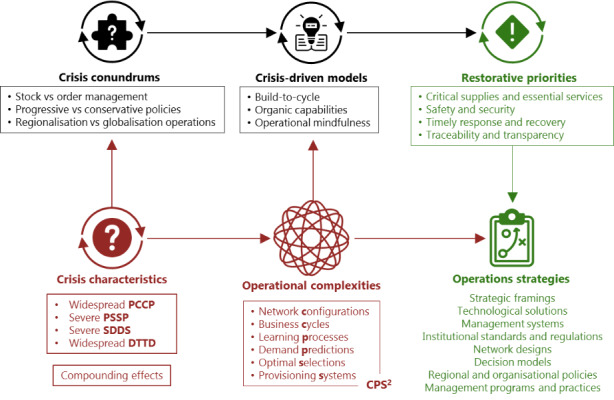
Summary of review findings and multi-level model of supply chain management in times of crisis
Build-to-cycle for business
Literature suggests a SCM conundrum involving the prioritisation of BTS or BTO (Pfohl et al. 2010; Parry and Roehrich 2013), in line with decision- and systems-oriented theories of Table 3. Here, SCM contends with cyclic inventory for supporting routine operations and with seasonal inventory for anticipating predictable increases in market demand (Natarajarathinam et al. 2009). BTS highlights stock capacity with forecasts that minimise production delay while BTO emphasises customer demand with production practices that minimise inventory waste. However, a crisis triggers specific demands, i.e., crisis-induced demands and buying behaviours, along with associated crisis contracting and costs, and accompanied by considerations for business cycle orientations, as suggested by this review. Thus, there is a need for alternative SCM frames that reflect such considerations.
‘Build-to-cycle’ (BTC) systems and decision framing of SCM stresses knowledge management with network configuration and business cycle intelligence that minimises potential additional costs due to crisis incidents and impending deviant situations. Knowledge management, in the context of BTC, pertains to proactive SCM plans and preparedness that embed and prioritise timely response with recovery protocols for crises through accumulating knowledge capabilities, models, and intelligence on markets, trade, and governance structures (Gereffi and Lee 2012; Panwar et al. 2012; Ponis and Koronis 2012), in line with event systems theory. In addition, there are unique needs for supply chains to formulate knowledge-intensive business functions with crisis-driven upgrades (Sass and Szalavetz 2013) and organisational silos (Andrews et al. 2011), prioritising loss avoidance during crisis, in keeping with prospect theory. Such considerations contribute to organisational-wide public-private perspectives within a BTC framing – beyond inventory and production of BTS and BTO – for optimal selection and reconfiguration of super facilities, and collection and distribution centres that act as stores for supporting traceability and surge management.
Organic capabilities for provisioning
Globalisation that motivates transboundary exchange environments is often cited as magnifying the severity and shock of crisis incidents (Overby et al. 2004; Tan and Enderwick 2006). Regionalisation advanced by advisory groups (Stephens 2013; Koutsou and Sergaki 2019) offers an alternative operations perspective with SCM scholars noting proactive crisis management approaches through production relocation based on regional economic integration (Fan and Liu 2021). Such global-regional conundrum has implications for regional and public sector supply chains in terms of provisioning for critical supplies with essential services, consistent with resource- and performance-oriented theories of Table 3. Therefore, prospects exist for studies to reframe the debate and discourse on how regional environments explain the nature of strategies and complexities during crisis.
Organic capabilities framing of operational resources offers a radical perspective of SCM in times of crisis, altering the focus from exogenous to endogenous constructs and emphasising organic wholes in contrast to dynamism in complex settings. With awareness that provisioning capabilities may be a matter or anchor of crisis (Kuokkanen et al. 2017; Laguna-Salvadó et al. 2019), an organic capabilities viewpoint underscores innate and evolving resources along with mind-sets attuned to the specific restorative needs of regional supply chains. This viewpoint contrast with closely linked theorisations of resource-based, resource dependency, resource orchestration, and slack resources that call attention to power, control, management roles, competitiveness, and slack. In keeping with good management theory, the organic capabilities framing also promotes good practice needed during crisis (Raspor 2008) by reflecting unique socio-economic contexts that underpin collaboration and compliance for enhanced traceability with transparency.
Operational mindfulness for learning
Conundrums also exist for strategic decisiveness that favours progressive (aggressive) (Dey et al. 2020) or conservative (Koniagina et al. 2019) policies, against a backdrop of confusions over thresholds for safety, significantly accounting for variances in policies (Benson 2011). Both policies reflect how, even though crisis has a negative connotation, as earlier noted, the situations posed by crises trigger unique behaviours and contexts for strategists as opportunists seeking to harness demand prospects, as protectionists seeking to safeguard provisioning services, and as determinists seeking to model future networks. Although behaviour-oriented theories such as agency theory, communication theory and attribution theory offer perspectives for studying SCM relationships and links, current discourse is limited in coverage of framings that explain how supply chains not only learn from mistakes (Svensson 2010) but also pre-position SCM capabilities for responding to future disasters and emergencies (Ergun et al. 2010).
Operational mindfulness framing of supply chains involves unravelling processes and perspectives on how managers learn, make sense, scrutinise, and pay close attention to incidents and situations associated with supply chains. In accordance with context-oriented theories, the mindfulness focus is on SCM realities, preferences, contexts, disparities, conditions, and pressures for learning from the sophisticated interdependencies of network configurations. The perspective here suggests that more mindfulness will have greater preparedness and responsiveness, and that ceteris paribus the resulting SCM strategy will lead to enhanced restorative capabilities for safety with security protocols. Insights from this review suggest mindfulness in relation to path-creation (Kuokkanen et al. 2017) and the role of models like HROs (Sawyerr and Harrison 2019). Yet, the peripheries and potentials for conceptualisations and contributions to SCM scholarship appear promising with opportunities to use mindfulness as a lens in studying proactivity, predictability, and performance in supply chains.
Managerial implications
The review has some managerial implications and relevance for SCM practice. For a start, the review has specific implications for SCM strategy in terms of defining objectives for SCM in times of crisis. Unlike routine operations and flows in conventional supply chains that warrant competitive priorities, SCM in times of crisis demands different priorities primarily for ensuring the efficacy of response and relief efforts. Table 1 summarises some core abilities of supply chains in support of such efficacy and the review finds a set of dimensions for restorative priorities, shown by Fig. 6, where the focus is on fulfilment, deployment, protection, and accountability via crisis management systems, programs and practices. Focus on practices like just-in-time inventory management support routine flows with objectives of low cost with timely delivery (Raj et al. 2022b) but in times of crisis there are additional requirements that underpin rapid response decision policies where the objectives are the delivery of critical supplies with timely response.
Additionally, the review puts forward a broad view of SCM in times of crisis that reflects the ever-increasing mandates for supply chain reactions to organisational, institutional, regional, and supply chain crises, as identified by Mode 1, 2, and C of Fig. 1. Preparedness and decisiveness of SCM in times of crisis is a core implication of this review, and the review identifies a range of complexities related to uncertainties that perturb decisions by supply chain managers. Uncertainty is characteristic of crisis times (Harland 2021) and insights from this review shed light on the complexities of supply chains that account for uncertainties associated with SCM in times of crisis. These insights are our attempt to rise to the challenge of supporting industry efforts for improved supply chain resilience and viability due to increasing occurrences of crises (Remko 2020). Due to these uncertainties, this review recommends business-, provisioning-, and learning-based framings for crises that also imply shifts in mind-sets for supply chain managers. Such SCM mind-sets could inform the development of innovative and proactive crisis management systems, tools, network designs, and decision-making frameworks and models.
Future directions for management scholarship
From a methodological perspective, the literature on SCM in times of crisis shows preference for case studies, decision analysis, and conceptual models, with some treatment of econometric and secondary analysis, and limited coverage of survey-based studies, as summarised by Table 2. Further questionnaire-based surveys could enhance current discourse and the SCM field could benefit from widening the methodological space to include experiments, action research, and problem structuring studies, ethnography, and systems development. From a theoretical perspective, Table 3 shows depth and breadth in the range of theories proposed and applied in literature. However, critical reflection on this coverage offers unique BTC, organic capabilities and operational mindfulness framings for SCM, as presented in the previous subsection, and warrants considerations for additional theoretical framings. Examples of such framings include leadership-oriented theories (e.g. contextual leadership and transformational leadership), population-oriented theories (e.g. population ecology and demographic transition), and technology-oriented theories (e.g. technology acceptance and technology threat avoidance). From a topical perspective, there are also opportunities for advancing SCM discourse and research, as shown by Fig. 8. The next subsections discuss these opportunities using related interests in current literature with potential paradoxes for SCM scholars, and we consider these opportunities in light of BTC, organic capabilities, and operational mindfulness framings.
Fig. 8.

Future topics for supply chain management research with proposed paradoxes to study crisis problems
Supply chain upgrades for crisis-induced services
Current SCM literature emphasises the importance of upgrading global value chains (Gereffi and Lee 2012; Meyer-Larsen et al. 2012; Sass and Szalavetz 2013). Premised mainly on globalisation and the potentials for connecting businesses in a global network, SCM studies argue for upgrading products, processes, functions, and sectors in low-cost locations, promoting competitiveness of operations. Yet, regions require critical supplies and essential services with regional SCM central to the maintenance of the TWU super sectors and super facilities. Thus, minimisation of the fragility, vulnerability, and insecurity of critical infrastructure (Barnes and Oloruntoba 2005; Notteboom et al. 2021), represents an on-going regionalisation (or localisation) priority for securing local physical and cyber systems. Consequently, the balancing of regionalisation and globalisation operations poses a Wollheim’s paradox for regional SCM particularly with sourcing and financing pressures to deliver crisis support and capabilities. Due to the increasing occurrences of crises (Pashapour et al. 2019), such balance requires assessments and investigations of the upgrading requirements. Considering these points, this review recommends studies of supply chain upgrading with focus on regional SCM and crisis-induced services that sustain geographical and temporal needs in times of crisis.
Supply chain diagnosis for crisis-induced timeliness
With potentials for diversification, collectivism, holism, inclusivity, and resiliency as survivability in times of crisis, there is a plethora of ideas for framing SCM strategy in times of crisis, as shown by this review. Yet, this review suggests a paucity in framings of supply chain diagnosis that embodies these potentials. Although, a related study offers supply chain partnership diagnosis (Li et al. 2012), the context revolves around business failure. Importantly, decisiveness in adopting progressive and conservative policies, poses an Icarus paradox for organisations in supply chains concerning how firms apply operational mindfulness to harness business or public value associated with timely response with recovery from crises. With such implications, this review recommends lines of research to examine supply chain diagnosis for teleology and enhanced SCM timeframes spanning the pre-, intra- and post-crisis phases.
Supply chain solidarity for crisis-induced security
Empirical evidence in the literature suggests government and intergovernmental agency involvement, legislation, and governance play major roles in securing supply chains in times of crisis. Though prospects exist for these mechanisms to promote safety, the nature of solidarity as a socio-behavioural construct in securing supply chains remains unclear. Behavioural factors play important roles for SCM in times of crisis as suggested by scapegoating studies examining behaviours that isolate and blame individuals and groups for crises or crisis situations (Gao et al. 2012). Solidarity concerns mutual support and agreement from stakeholders, and involves munificent contributions, compliance, and commitment beyond the support offered by expert systems (Drakaki et al. 2018) and financial arrangements (Fiset and Dostaler 2013). Thus, establishing solidarity from SCM capabilities through stakeholder collaborations exists with the backdrop of a Mandeville’s paradox for SCM to implement the potential aggressive actions and contributions of stakeholders required for security in times of crisis. Consequently, this review recommends studies of supply chain solidarity with attention on through-life considerations, public services, and company security threats.
Supply chain mapping for crisis-induced traceability
Closely-related to the diagnosis challenge for timeliness in response with recovery, is the need for supply chain mapping to guide crisis management (Desoutter and Lavissière 2018). Optimisation (Memon et al. 2015; Aviso et al. 2018) and simulation models (Azghandi et al. 2018) are common within current literature with the interests of crisis modellers ranging from building synthetic communities (Chaturvedi et al. 2014) to estimating production relocation (Fan and Liu 2021). Although, the spectrum of coverage remains vast, there are fundamental limits on mappings that support traceability with transparency within a SCM context. With trends towards digitalisation in supply chains, industry and society (Calabrese and Vervaeke 2017), the Solow paradox persists for SCM to use IT for optimising inventory, production and organisation processes, through mechanisms like BTS and BTO. Since current studies mainly offer food-related expositions on traceability with attention paid to labelling (Banterle and Stranieri 2008) and management costs (Dabbene and Gay 2011), the challenge is for complementary studies to shed light on traceability in crisis situations for other sectors with mappings that unravel potential sectoral and inter-sectoral supply chain fragility, vulnerability and insecurity. This review also recommends future studies of tag use and audit trails for supply chain crisis, control performance indicators, and traceability contracts for SCM in times of crisis.
Linking crisis systems investments with liabilities
Exiting studies cover a broad spectrum of investment-related SCM themes for detection technology (Madichie and Yamoah 2017), mobilisation (Zhang et al. 2019), diversification (Koilo and Grytten 2019), community-based services (Siekmans et al. 2017), and so on. Here, research interests tend to consist of establishing tolerance zones, guaranteeing access, and minimising investment costs for crisis management systems. Concurrently, literature notes the need for crisis liability coverage and distribution among supply chain partners, although most of the studies focus on meat supply chains (Banterle and Stranieri 2008; Meuwissen et al. 2009). Since the Abilene paradox regarding actual and perceived needs bounds decisiveness in crisis investments and liability, this review recommends future studies of optimal systems selection problems linking supply chain investments and liabilities as well as path analyses of constructs for actual and perceived supply chain resources in relation to decisiveness in times of crisis. Other lines of research may explore SCM for legacy and obsolete systems and the withdrawal or renewal of crisis-induced support systems.
Linking crisis network allotments with cross-functionalities
Due to the regular rebalancing of power, price, and partnership relationships, research notes that allotments (or allocations) assume a major role in strengthening the hands and shaping the dynamics of stakeholders in crisis networks (Teresa et al. 2018). Areas of interests range from curbing inefficiencies and misallocation (Laguna-Salvadó et al. 2019), allocation strategies under human and supply constraints (Aviso et al. 2018; Yu et al. 2020), and minimising allocation costs (Benaïcha and Hadj-Alouane 2013). Concomitantly, the literature sheds spotlights on cross-functional teams and processes (von der Gracht and Darkow 2013; Poberschnigg et al. 2020) that boost resilience and deter discontinuities in crisis networks. Motivated by the need to expound crisis-induced operations, this review proposes further research on optimal network selection problems linking supply chain allotments and cross-functionalities in addition to path analyses of interdependency and intermediary variables with regard to supply chain effectiveness for capacity cooperation and real-time control. With varying effectiveness of allotments implied by the Scitovsky paradox, this review also recommends future studies of SCM allotment strategies in multi-tier, multi-agency, multi-period, multi-product, multi-sector, multi-region, multi-directional, and multi-agent network configurations.
Supply chain temporariness and crisis thresholds
Literature captures the essence of contexts, presence of complexities, and pertinence of strategies for SCM in times of crisis, as shown throughout this review. Nonetheless, a fundamental challenge for SCM researchers is to model the finite and transitionary nature of crisis management networks and systems, under uncertainty of sudden shocks and significant deviant events. In this context, the recommendation is for two future research areas. First, this review urges explorations of supply chain temporariness and the nature of policies (progressive and conservative), operations (globalisation and regionalisation), and management practices (BTS or BTO) that induce temporary supply chains. Current studies note the existence of temporary networks for crisis response (Cozzolino et al. 2012), and the charge for scholarship is to establish common threads in events (Richey 2009), enabling supply chain managers and researchers mindfully develop plans and embody proactivity. Second, this review, motivated by a Sorites paradox on risk accumulation, proposes SCM research on crisis thresholds. Although not all risks and disruptions are crises, a supply chain crisis stems from severe and critical risks and disruptions that create SCM chaos, complications, and complexities, worsened by situations involving compounding effects. This viewpoint elicits questions such as ‘what is the nature of thresholds for a supply chain crisis i.e. when does a disruption become a crisis?’ With the review capturing other signals of crisis, i.e. escalations of losses, urgent needs, fatalities, stockouts and distress, the loci of threshold definition extends to these cases, with nuanced reflections on how compounding effects not only exacerbate crisis situations but also act as thresholds for a crisis.
Conclusions
According to a Nigerian saying, ‘in times of crisis, the wise build bridges while the foolish build dams’. This quote accentuates the significance of networks and systems that connect stakeholders and manage reactions to crises, proactively and positively – not negative constructs that impede the flow of innovative ideas and resources. This article reviews literature on SCM in times of crisis, and posits on three framings for future studies. First, due to a SCM conundrum for prioritising build-to-stock or build-to-order management practices, the findings imply build-to-cycle for business framings that harness network configuration and business cycle intelligence for minimal crisis-induced costs. Second, motivated by differing globalisation and regionalisation perspectives on operations, this research posits on organic capabilities for provisioning framings that stress organic wholes in contrast to dynamism in complex settings. Third, in view of decisiveness with preferences for progressive (aggressive) or conservative policies, this review suggests operational mindfulness for learning framings to improve the analysis of proactivity, predictability, and performance by supply chains.
The review has two main limitations. First, the review confines its focus to identifying the operational strategies and complexities of SCM in times of crisis with additional insights on the contexts and restorative priorities for supply chain managers. Second, the approach for the review is restricted to a systematic methodology that applies thematic analysis with limited insights on the range of research constructs, dependencies, and links between variables within studies. Meta-syntheses and evaluations of the decision and systems model-based approaches (the most applied methodology within studies) could offer additional insights and knowledge for theory development. The search process of the review also limits review sources to journal articles with search results based on combining “supply chain”, “crisis” and “crises” as keywords. In this context, dedicated reviews of different kinds of crises in SCM contexts could provide insights that advance practice for domain-specific SCM in times of crisis.
In summary, this review advances SCM mind-sets in times of crisis for operational mindfulness that bridges gaps in operational complexities, organic capabilities that avoid burning bridges by building around operations strategies, and build-to-cycle practices that act as a bridge over troubled waters for SCM espousing restorative priorities.
Appendix
Appendix.
Forms of crisis in literature
| Crisis situations | Overview | Supply chain crisis signal | Examples of major crisis incidents and crisis states | Sample sources |
|---|---|---|---|---|
| Business crisis | Range of crisis situations confronting business |
Critical supply disruption Exponential loss escalation Urgent needs Corporate distress |
Organisational trust crisis, industrial accidents, product contamination crisis, and product-harm crisis | (Ponis and Koronis 2012) |
| Capacity crisis | Critical shortages of resources or major prolonged losses in capacities |
Urgent need to care for employee health and wellness Perceived urgent need for funding and rare resources |
Halving of employment in the Irish construction industry between 2006 and 2013, Irish beef farms ‘crisis’ levels in 2013, Longshoreman strikes at US ports in 2002, organ shortages, product shortages from outbreaks, and significant drop in trained geologists over several decades | (Shaw 1996; Hitzman et al. 2009; Merz et al. 2009; Natarajarathinam et al. 2009; Singleton and Cormican 2013; Boyce 2016; Teresa et al. 2018; Zhu and Krikke 2020; Cole 2021) |
| Corporate, financial, and economic crisis | Corporate scandal and financial predicaments due to sudden economic downturns, economic meltdown, value depreciation, localized economic fluctuation, economic and financial turmoil, collapse in trade and the contraction of output and recession | Corporate distress and bankruptcy |
2008 to 2009 financial and economic crisis The Enron scandal |
(Lamming 2000; Manenti 2009; Yang et al. 2009; Xiao 2010; Allal-Chérif and Maira 2011; Li et al. 2011, 2012, 2016; Blome and Schoenherr 2011; Min and Kim 2011; Sanchez-Ramirez et al. 2011; Gereffi and Lee 2012; Panwar et al. 2012; Ponis and Koronis 2012; Leitner and Stehrer 2013; Liu 2013; Montague et al. 2013; Parry and Roehrich 2013; Stephens 2013; Chanaron 2013; Manenti et al. 2013; Iannone et al. 2014; Ortas et al. 2014; Chong et al. 2014; Gelli and Suwa 2014; Udenio et al. 2015; Gawande et al. 2015; Meehan et al. 2017; Calabrese and Vervaeke 2017; McDermott and Hayes 2018; Wang et al. 2018; Ferrer-Pérez et al. 2019; Nurieva et al. 2020; Doan and Bui 2020; Aigbedo 2021; Kwon et al. 2021; Yagi and Managi 2021; Fan and Liu 2021) |
| Counterfeit crisis | Widespread distribution of fraudulent imitations of legitimate products | Urgent need to protect brand and supply chain disruption | Counterfeit and illegal medicines online | (Mackey and Liang 2011; Fischbacher-Smith and Smith 2015; Wilson and Grammich 2020) |
| Disease outbreak | Widespread outbreaks of diseases leading to epidemics, pandemics, and endemics. Triggers public health crisis. | Urgent healthcare logistics need for medical supplies and protective equipment | Avian influenza (AI) in 2003, Bovine spongiform encephalopathy (BSE) in 1996–2000, Foot-and-mouth outbreak (FMD) in 2001, SARS outbreaks in 2002 and 2003, H1N1 flu outbreak in 2009, Ebola outbreak in 2014 and 2015, and Coronavirus disease 2019 (COVID-19, SARS-cov-2 or SAR2) in 2019 | (Fearne 1998; Gessner et al. 2007; Park et al. 2008; Banterle and Stranieri 2008; Natarajarathinam et al. 2009; Kurniawan and Zailani 2010; Min and Kim 2011; Vo and Thiel 2011; Pinior et al. 2012a; Kaufman et al. 2014; Chammem et al. 2018; Vybornova and Luc 2019; Lu et al. 2019; Armani et al. 2020; Yu et al. 2020; O’Leary 2020; Dey et al. 2020; Baveja et al. 2020; Aigbedo 2021; Bassett et al. 2021; Spash 2021; Baležentis et al. 2021; Al Zoubi et al. 2021; Bastani et al. 2021) |
| Ecological and environmental crises | Critical environmental changes threatening sustainability | Urgent need for eco-innovation and green SCM | Climate change and greenhouse gas emissions making the earth warmer | (Tan et al. 2016; Xia et al. 2020; Spash 2021) |
| Food safety crises | Critical safety concerns due to food scandals, terrorism (agro-terrorism or bioterrorism), sabotage and contamination incidents. Triggers public health crisis. | Disruptions and major concerns for food quality |
Glass found in Gerber baby foods, Pet food poisoning in North America in March 2007, Mad cow disease, bird flu, cases of salmonella, Milk contamination crisis (China in 2008), Cucumber crisis in 2011, Repeated outbreaks of e. Coli, “horsegate” food fraud in 2013, Food fraud with meat from Brazil in 2016, Glass particles in carrot salad (at Kühne in 2007 and 2009), Poisonous groundsel in ruccola salad (at Plus in 2009), Particles of wood in baby food (at Babylove in 2009), Caustic soda in beverages (at Alpro in 2007), and Metal burrs in marshmallows (at Haribo in 2007) |
(Gessner et al. 2007; Rong and Grunow 2010; Benson 2011; Gao et al. 2012; Ponis and Koronis 2012; Comba et al. 2013; Chaturvedi et al. 2014; Chammem et al. 2018; Abd Razak et al. 2020) |
| Humanitarian crisis | Range of issues concerning critical humane issues | Urgent need for humanitarian relief | Socio-economic hardship of people living in low and middle-income countries, ‘Modern slavery’ crisis, and exposed migrants being treated like slaves in Thai fishing industry | (Vaillancourt et al. 2018; Wilhelm et al. 2020; Kovács and Sigala 2021; Malmir and Zobel 2021) |
| Industrial accidents | Unfortunate industrial incidents that cause severe damages, injuries, and losses | Accident and work-related fatalities, corporate distress, and supply chain disruptions |
Chernobyl nuclear accident, Deepwater Horizon disaster in the Mexico Gulf, Exxon Valdez oil spill, Explosion at the AZF chemical factor in Toulouse, Gas pipeline failure at Ghislenghien, Belgium in 2004, San Bruno California in 2010, and fire accident at the electronics plant in Albuquerque, New Mexico |
(Natarajarathinam et al. 2009; Ponis and Koronis 2012; McDermott and Hayes 2018) |
| Natural disaster | Catastrophic event in nature (e.g. hurricane, tsunami, volcanic eruption, earthquake, or flood) with major damage and/or fatalities | Disruption due to Regional power outages, damaged industrial production sites and Critical Infrastructures | Hurricanes in the Gulf of Mexico and Atlantic Ocean, tornados in Oklahoma and Texas, forest fires in California, Mongolia, and Central Africa, tsunamis in India and Indonesia, and earthquakes in Indonesia, China, and Haiti | (Hale and Moberg 2005; Ozbay and Ozguven 2007; Richey 2009; Beresford and Pettit 2009; Kovács et al. 2010; Chandes and Paché 2010; Ergun et al. 2010; Gatignon et al. 2010; Kurniawan and Zailani 2010; Min and Kim 2011; Baldini et al. 2012; Cozzolino et al. 2012; Schulte in den Bäumen et al. 2014; Aviso et al. 2018; Adem et al. 2018; Zhang et al. 2019; Khalilpourazari et al. 2020) |
| Organisational trust crisis | Severe and widespread distrust in the processes and products of organisations | Major loss of reputation | Critical concerns of Chinese companies, and racial discrimination case at Texaco | (Li et al. 2012; Ponis and Koronis 2012) |
| Recall crisis | Massive take back of compromised goods, devices, and equipment. Due to product-harm and product contamination events |
Critical supply disruption Exponential loss escalation Widespread stockouts Corporate distress |
Firestone tyres’ recall, and Toyota recall of 5 million vehicles in the North American market due to a fatal crash in 2009 | (Kumar and Budin 2006; Andrews et al. 2011; Ponis and Koronis 2012) |
| Refugee crisis | Massive displacements of individuals forcibly to other countries and regions |
Urgent needs for humanitarian relief and mass migration Urgent need to address overcrowding in refugee sites |
Refugees in Syrian, Palestinian, Yemeni, Burundian, Ukrainian, and South Sudanese conflicts | (Dufour et al. 2018; Drakaki et al. 2018; Adem et al. 2018; Piotrowicz 2018; Laguna-Salvadó et al. 2019) |
| Terrorist attacks and piracies | Major incidence of unlawful violence and attacks | Urgent needs for security | Terrorism in London and Cairo, terrorist attacks in Philippines and Indonesia, September 11 attacks, pirates in Somalia and on the internet, and sea piracies along the Suez Canal areas. | (Barnes and Oloruntoba 2005; Hale and Moberg 2005; Richey 2009; Kurniawan and Zailani 2010; Min and Kim 2011) |
| Wars and regional conflicts | Emergencies due to armed conflicts in states and regions | Urgent need for humanitarian relief | War and conflicts in Iraq, Syria, Cashmere, Ukraine, Burundi, and Sudan | (Overby et al. 2004; Richey 2009; Kovács et al. 2010; Cozzolino et al. 2012; Dufour et al. 2018; Piotrowicz 2018) |
Funding
The authors declare that no funds, grants, or other support were received during the preparation of this manuscript.
Availability of data and material
Not Applicable.
Declarations
Conflicts of interest/Competing interests
The authors have no relevant financial or non-financial interests to disclose.
Footnotes
Originating from the Greek word krisis, meaning judgement, choice, or decision (Desoutter and Lavissière 2018), a crisis means a crucial and unstable state of affairs “characterized by disruption of normality and steadiness of processes, thus creating chaos of various degrees” (Penuel et al. 2013, p.186).
See Appendix for a range of crises with imperatives for supply chains and SCM to aid in response, relief, and recovery activities.
Decisiveness means “being able to promptly take actions without detriment to the quality of decisions, and as determined by existing situations and available information” (Durugbo and Erkoyuncu 2016; p. 535). This decisiveness implies compromise with preference for participative action that embraces multiple perspectives of decision-making actors and options.
Publisher’s note
Springer Nature remains neutral with regard to jurisdictional claims in published maps and institutional affiliations.
References
- Abd Razak MA, Ramli MA, Jamaludin MA. The potential of food terrorism towards halal ecosystem. Food Res. 2020;4:1–11. doi: 10.26656/fr.2017.4(S1).S19. [DOI] [Google Scholar]
- Adem S, Al, Childerhouse P, Egbelakin T, Wang B. International and local NGO supply chain collaboration. J Humanit Logist Supply Chain Manag. 2018;8:295–322. doi: 10.1108/JHLSCM-05-2017-0020. [DOI] [Google Scholar]
- Aigbedo H. Impact of COVID-19 on the hospitality industry: A supply chain resilience perspective. Int J Hosp Manag. 2021;98:103012. doi: 10.1016/j.ijhm.2021.103012. [DOI] [PMC free article] [PubMed] [Google Scholar]
- Al-Omoush KS, Palacios-Marqués D, Ulrich K. The impact of intellectual capital on supply chain agility and collaborative knowledge creation in responding to unprecedented pandemic crises. Technol Forecast Soc Change. 2022;178:121603. doi: 10.1016/j.techfore.2022.121603. [DOI] [Google Scholar]
- Al Zoubi S, Gharaibeh L, Jaber HM, Al-Zoubi Z. Household Drug Stockpiling and Panic Buying of Drugs During the COVID-19 Pandemic: A Study From Jordan. Front Pharmacol. 2021;12:1–6. doi: 10.3389/fphar.2021.813405. [DOI] [PMC free article] [PubMed] [Google Scholar]
- Alcalde-Heras H, Iturrioz-Landart C, Aragon-Amonarriz C. SME ambidexterity during economic recessions: the role of managerial external capabilities. Manag Decis. 2019;57:21–40. doi: 10.1108/MD-03-2016-0170. [DOI] [Google Scholar]
- Allal-Chérif O, Maira S. Collaboration as an anti-crisis solution: The role of the procurement function. Int J Phys Distrib Logist Manag. 2011;41:860–877. doi: 10.1108/09600031111175825. [DOI] [Google Scholar]
- Andrews AP, Simon J, Tian F, Zhao J. The Toyota crisis: An economic, operational and strategic analysis of the massive recall. Manag Res Rev. 2011;34:1064–1077. doi: 10.1108/01409171111171474. [DOI] [Google Scholar]
- Arcidiacono D (2018) Promises and failures of the cooperative food retail system in Italy. Soc Sci 7. 10.3390/socsci7110232
- Armani AM, Hurt DE, Hwang D, et al. Low-tech solutions for the COVID-19 supply chain crisis. Nat Rev Mater. 2020;5:403–406. doi: 10.1038/s41578-020-0205-1. [DOI] [PMC free article] [PubMed] [Google Scholar]
- Aviso KB, Mayol AP, Promentilla MAB, et al. Allocating human resources in organizations operating under crisis conditions: A fuzzy input-output optimization modeling framework. Resour Conserv Recycl. 2018;128:250–258. doi: 10.1016/j.resconrec.2016.07.009. [DOI] [Google Scholar]
- Azghandi R, Griffin J, Jalali MS. Minimization of Drug Shortages in Pharmaceutical Supply Chains: A Simulation-Based Analysis of Drug Recall Patterns and Inventory Policies. Complexity. 2018;2018:1–14. doi: 10.1155/2018/6348413. [DOI] [Google Scholar]
- Babazadeh R, Razmi J, Rabbani M, Saman M. An integrated data envelopment analysis e mathematical programming approach to strategic biodiesel supply chain network design problem. J Clean Prod. 2017;147:694–707. doi: 10.1016/j.jclepro.2015.09.038. [DOI] [Google Scholar]
- Baldini G, Oliveri F, Braun M, et al. Securing disaster supply chains with cryptography enhanced RFID. Disaster Prev Manag. 2012;21:51–70. doi: 10.1108/09653561211202700. [DOI] [Google Scholar]
- Baležentis T, Morkūnas M, Žičkienė A, et al. Policies for Rapid Mitigation of the Crisis’ Effects on Agricultural Supply Chains: A Multi-Criteria Decision Support System with Monte Carlo Simulation. Sustainability. 2021;13:11899. doi: 10.3390/su132111899. [DOI] [Google Scholar]
- Banterle A, Stranieri S. Information, labelling, and vertical coordination: an analysis of the Italian meat supply networks. Agribusiness. 2008;24:320–331. doi: 10.1002/agr.20169. [DOI] [Google Scholar]
- Barnes P, Oloruntoba R. Assurance of security in maritime supply chains: Conceptual issues of vulnerability and crisis management. J Int Manag. 2005;11:519–540. doi: 10.1016/j.intman.2005.09.008. [DOI] [Google Scholar]
- Bassett HR, Lau J, Giordano C et al (2021) Preliminary lessons from COVID-19 disruptions of small-scale fishery supply chains. World Dev 143. 10.1016/j.worlddev.2021.105473 [DOI] [PMC free article] [PubMed]
- Bastani P, Sadeghkhani O, Ravangard R, et al. Designing a resilience model for pharmaceutical supply chain during crises: a grounded theory approach. J Pharm Policy Pract. 2021;14:115. doi: 10.1186/s40545-021-00399-4. [DOI] [PMC free article] [PubMed] [Google Scholar]
- Baveja A, Kapoor A, Melamed B. Stopping Covid-19: A pandemic-management service value chain approach. Ann Oper Res. 2020;289:173–184. doi: 10.1007/s10479-020-03635-3. [DOI] [PMC free article] [PubMed] [Google Scholar]
- Benaïcha S, Hadj-Alouane AB. Super facilities versus chaining in mitigating disruptions impacts. Comput Ind Eng. 2013;65:351–359. doi: 10.1016/j.cie.2013.03.011. [DOI] [Google Scholar]
- Benson AP. Communicating risk to consumers in domestic and internationally traded products. Food Control. 2011;22:1529–1534. doi: 10.1016/j.foodcont.2010.07.015. [DOI] [Google Scholar]
- Beresford A, Pettit S. Emergency logistics and risk mitigation in Thailand following the Asian tsunami. Int J Risk Assess Manag. 2009;13:7–21. doi: 10.1504/IJRAM.2009.026387. [DOI] [Google Scholar]
- Bian W, Yang X, Li S et al (2021) Advantages of 3PLs as healthcare supply chain orchestrators. Comput Ind Eng 161. 10.1016/j.cie.2021.107628 [DOI] [PMC free article] [PubMed]
- Blackhurst J, Wu T, O’Grady P. Network-based approach to modelling uncertainty in a supply chain. Int J Prod Res. 2004;42:1639–1658. doi: 10.1080/0020754030360001646064. [DOI] [Google Scholar]
- Blome C, Schoenherr T. Supply chain risk management in financial crises - A multiple case-study approach. Int J Prod Econ. 2011;134:43–57. doi: 10.1016/j.ijpe.2011.01.002. [DOI] [Google Scholar]
- Boin A, Kofman-Bos C, Overdijk W. Crisis Simulations: Exploring Tomorrow’s Vulnerabilities and Threats. Simul Gaming. 2004;35:378–393. doi: 10.1177/1046878104266220. [DOI] [Google Scholar]
- Boyce WS. Does truck driver health and wellness deserve more attention? J Transp Heal. 2016;3:124–128. doi: 10.1016/j.jth.2016.02.001. [DOI] [Google Scholar]
- Brandenburg M. Supply chain efficiency, value creation and the economic crisis – An empirical assessment of the European automotive industry 2002–2010. Int J Prod Econ. 2016;171:321–335. doi: 10.1016/j.ijpe.2015.07.039. [DOI] [Google Scholar]
- Brecher M. State Behavior in International Crisis. J Confl Resolut. 1979;23:446–480. doi: 10.1177/002200277902300304. [DOI] [Google Scholar]
- Burgos D, Ivanov D (2021) Food retail supply chain resilience and the COVID-19 pandemic: A digital twin-based impact analysis and improvement directions. Transp Res Part E Logist Transp Rev 152. 10.1016/j.tre.2021.102412 [DOI] [PMC free article] [PubMed]
- Burns KF, Marx TG. Crisis Management Planning among Tier 2 Automobile Suppliers: Why Suppliers Fail to Plan. J Contingencies Cris Manag. 2014;22:108–112. doi: 10.1111/1468-5973.12046. [DOI] [Google Scholar]
- Butu A, Brumă IS, Tanasă L, et al. The impact of COVID-19 crisis upon the consumer buying behavior of fresh vegetables directly from local producers. Case study: The quarantined area of Suceava County, Romania. Int J Environ Res Public Health. 2020;17:1–25. doi: 10.3390/ijerph17155485. [DOI] [PMC free article] [PubMed] [Google Scholar]
- Calabrese GG, Vervaeke M. Strategies for facing the crisis: the case of the car design/style supply chain in France and in Italy. Int J Prod Dev. 2017;22:21. doi: 10.1504/IJPD.2017.085275. [DOI] [Google Scholar]
- Carter WN. Disaster Management A Disaster Manager’s Handbook. Manila, Philippines: Asian Development Bank; 2008. [Google Scholar]
- Chammem N, Issaoui M, De Almeida AID, Delgado AM. Food Crises and Food Safety Incidents in European Union, United States, and Maghreb Area: Current Risk Communication Strategies and New Approaches. J AOAC Int. 2018;101:923–938. doi: 10.5740/jaoacint.17-0446. [DOI] [PubMed] [Google Scholar]
- Chanaron JJ. The evolution of relationships between car manufacturers and France-based component suppliers in the context of deep crisis and accelerating technical change. Int J Automot Technol Manag. 2013;13:320–337. doi: 10.1504/IJATM.2013.056859. [DOI] [Google Scholar]
- Chandes J, Paché G. Strategizing humanitarian logistics: The challenge of collective action. Probl Perspect Manag. 2010;8:99–107. [Google Scholar]
- Chang W, Lin Y. The effect of lead-time on supply chain resilience performance. Asia Pac Manag Rev. 2019;24:298–309. doi: 10.1016/j.apmrv.2018.10.004. [DOI] [Google Scholar]
- Chaturvedi A, Armstrong B, Chaturvedi R. Securing the food supply chain: Understanding complex interdependence through agent-based simulation. Health Technol (Berl) 2014;4:159–169. doi: 10.1007/s12553-014-0086-7. [DOI] [PMC free article] [PubMed] [Google Scholar]
- Chen Y, Biswas MI. Turning Crisis into Opportunities: How a Firm Can Enrich Its Business Operations Using Artificial Intelligence and Big Data during COVID-19. Sustainability. 2021;13:12656. doi: 10.3390/su132212656. [DOI] [Google Scholar]
- Childerhouse P, Towill DR. Reducing uncertainty in European supply chains. J Manuf Technol Manag. 2004;15:585–598. doi: 10.1108/17410380410555835. [DOI] [Google Scholar]
- Chiu W, Oh GE, Cho H (2021) Impact of COVID-19 on consumers’ impulse buying behavior of fitness products: A moderated mediation model. J Consum Behav 245–258. 10.1002/cb.1998 [DOI] [PMC free article] [PubMed]
- Chong YQ, Wang B, Yue Tan GL, Cheong SA. Diversified firms on dynamical supply chain cope with financial crisis better. Int J Prod Econ. 2014;150:239–245. doi: 10.1016/j.ijpe.2013.12.030. [DOI] [Google Scholar]
- Cole H. The organ supply chain: Geography and the inequalities of transplant logistics. Trans Inst Br Geogr. 2021;46:1008–1021. doi: 10.1111/tran.12458. [DOI] [Google Scholar]
- Colon C, Hallegatte S, Rozenberg J. Criticality analysis of a country’s transport network via an agent-based supply chain model. Nat Sustain. 2021;4:209–215. doi: 10.1038/s41893-020-00649-4. [DOI] [Google Scholar]
- Comba L, Belforte G, Dabbene F, Gay P. Methods for traceability in food production processes involving bulk products. Biosyst Eng. 2013;116:51–63. doi: 10.1016/j.biosystemseng.2013.06.006. [DOI] [Google Scholar]
- Cozzolino A, Rossi S, Conforti A. Agile and lean principles in the humanitarian supply chain: The case of the United Nations World Food Programme. J Humanit Logist Supply Chain Manag. 2012;2:16–33. doi: 10.1108/20426741211225984. [DOI] [Google Scholar]
- Craighead CW, Ketchen DJ, Darby JL. Pandemics and Supply Chain Management Research: Toward a Theoretical Toolbox *. Decis Sci. 2020;51:838–866. doi: 10.1111/deci.12468. [DOI] [PMC free article] [PubMed] [Google Scholar]
- Dabbene F, Gay P. Food traceability systems: Performance evaluation and optimization. Comput Electron Agric. 2011;75:139–146. doi: 10.1016/j.compag.2010.10.009. [DOI] [Google Scholar]
- Deconinck K, Avery E, Jackson LA. Food Supply Chains and Covid-19: Impacts and Policy Lessons. EuroChoices. 2020;19:34–39. doi: 10.1111/1746-692X.12297. [DOI] [Google Scholar]
- Desoutter M, Lavissière A. Handling Supply Chain Crises when everything has been done to avoid them. Supply Chain Forum An Int J. 2018;19:219–232. doi: 10.1080/16258312.2018.1484250. [DOI] [Google Scholar]
- Dewick P, Hofstetter JS, Schroeder P. From Panic to Dispassionate Rationality - Organizational Responses in Procurement after the Initial COVID-19 Pandemic Peak. IEEE Eng Manag Rev. 2021;49:45–56. doi: 10.1109/EMR.2021.3079630. [DOI] [Google Scholar]
- Dey S, Cheng Q, Tan J. All for one and one for all: Why a pandemic preparedness league of nations? Heal Policy Technol. 2020;9:179–184. doi: 10.1016/j.hlpt.2020.04.009. [DOI] [PMC free article] [PubMed] [Google Scholar]
- Dibben P, Meira J, Linhares C, et al. Vanishing value chains, industrial districts and HRM in the Brazilian automotive industry. Int J Hum Resour Manag. 2020;5192:1–18. doi: 10.1080/09585192.2016.1233446. [DOI] [Google Scholar]
- Do QN, Mishra N, Wulandhari NBI, et al. Supply chain agility responding to unprecedented changes: empirical evidence from the UK food supply chain during COVID-19 crisis. Supply Chain Manag. 2021;26:737–752. doi: 10.1108/SCM-09-2020-0470. [DOI] [Google Scholar]
- Doan TTT, Bui TN. Nonlinear impact of supply chain finance on the performance of seafood firms: A case study from Vietnam. Uncertain Supply Chain Manag. 2020;8:267–272. doi: 10.5267/j.uscm.2020.1.001. [DOI] [Google Scholar]
- Domański B, Guzik R, Gwosdz K, Dej M. The crisis and beyond: The dynamics and restructuring of automotive industry in Poland. Int J Automot Technol Manag. 2013;13:151–166. doi: 10.1504/IJATM.2013.052998. [DOI] [Google Scholar]
- Drakaki M, Gören HG, Tzionas P. An intelligent multi-agent based decision support system for refugee settlement siting. Int J Disaster Risk Reduct. 2018;31:576–588. doi: 10.1016/j.ijdrr.2018.06.013. [DOI] [Google Scholar]
- Dubey R, Bryde DJ, Blome C, et al. Facilitating artificial intelligence powered supply chain analytics through alliance management during the pandemic crises in the B2B context. Ind Mark Manag. 2021;96:135–146. doi: 10.1016/j.indmarman.2021.05.003. [DOI] [Google Scholar]
- Dufour É, Laporte G, Paquette J, Rancourt M. Logistics service network design for humanitarian response in East Africa. Omega. 2018;74:1–14. doi: 10.1016/j.omega.2017.01.002. [DOI] [Google Scholar]
- Dulam R, Furuta K, Kanno T. Consumer Panic Buying: Realizing Its Consequences and Repercussions on the Supply Chain. Sustainability. 2021;13:4370. doi: 10.3390/su13084370. [DOI] [Google Scholar]
- Durugbo C, Erkoyuncu JA. Mitigating uncertainty for industrial service operations: a multi case study. Int J Oper Prod Manag. 2016;36:532–571. doi: 10.1108/IJOPM-04-2015-0196. [DOI] [Google Scholar]
- Durugbo CM. After-sales services and aftermarket support: a systematic review, theory and future research directions. Int J Prod Res. 2020;58:1857–1892. doi: 10.1080/00207543.2019.1693655. [DOI] [Google Scholar]
- Ergun Ö, Heier Stamm JL, Keskinocak P, Swann JL. Waffle House Restaurants hurricane response: A case study. Int J Prod Econ. 2010;126:111–120. doi: 10.1016/j.ijpe.2009.08.018. [DOI] [Google Scholar]
- Fan X, Liu H. Global supply chain shifting: A macro sense of production relocation based on multi-regional input-output table. Econ Model. 2021;94:672–680. doi: 10.1016/j.econmod.2020.02.009. [DOI] [Google Scholar]
- Fasan M, Soerger Zaro E, Soerger Zaro C, et al. An empirical analysis: Did green supply chain management alleviate the effects of COVID-19? Bus Strateg Environ. 2021;30:2702–2712. doi: 10.1002/bse.2772. [DOI] [PMC free article] [PubMed] [Google Scholar]
- Fearne A. The evolution of partnerships in the meat supply chain: Insights from the British beef industry. Supply Chain Manag An Int J. 1998;3:214–231. doi: 10.1108/13598549810244296. [DOI] [Google Scholar]
- Fearne A, Wagner B, McDougall N, Loseby D. The power of purpose – lessons in agility from the Ventilator Challenge. Supply Chain Manag. 2021;26:753–766. doi: 10.1108/SCM-09-2020-0468. [DOI] [Google Scholar]
- Ferrer-Pérez H, Arfini F, Gil JM (2019) Modelling price transmission within the supply chain under a european protected designation of origin framework: The case of parmigiano reggiano in Italy. Soc Sci 8. 10.3390/socsci8030087
- Fertier A, Martin G, Barthe-Delanoë AM et al (2021) Managing events to improve situation awareness and resilience in a supply chain. Comput Ind 132. 10.1016/j.compind.2021.103488
- Fischbacher-Smith D, Smith L. Navigating the “dark waters of globalisation”: Global markets, inequalities and the spatial dynamics of risk. Risk Manag. 2015;17:179–203. doi: 10.1057/rm.2015.12. [DOI] [Google Scholar]
- Fiset J, Dostaler I. Combining old and new tricks: Ambidexterity in aerospace design and integration teams. Team Perform Manag. 2013;19:314–330. doi: 10.1108/TPM-10-2012-0031. [DOI] [Google Scholar]
- Fonseca LM, Azevedo AL. COVID-19: Outcomes for Global Supply Chains. Manag Mark. 2020;15:424–438. doi: 10.2478/mmcks-2020-0025. [DOI] [Google Scholar]
- Francis JR. COVID-19: Implications for Supply Chain Management. Front Health Serv Manage. 2020;37:33–38. doi: 10.1097/HAP.0000000000000092. [DOI] [PubMed] [Google Scholar]
- Gao H, Knight JG, Zhang H, et al. Consumer scapegoating during a systemic product-harm crisis. J Mark Manag. 2012;28:1270–1290. doi: 10.1080/0267257X.2011.645859. [DOI] [Google Scholar]
- Gatignon A, Van Wassenhove LN, Charles A. The Yogyakarta earthquake: Humanitarian relief through IFRC’s decentralized supply chain. Int J Prod Econ. 2010;126:102–110. doi: 10.1016/j.ijpe.2010.01.003. [DOI] [Google Scholar]
- Gawande K, Hoekman B, Cui Y. Global Supply Chains and Trade Policy Responses to the 2008 Crisis. World Bank Econ Rev. 2015;29:102–128. doi: 10.1093/wber/lht040. [DOI] [Google Scholar]
- Gelli A, Suwa Y. Investing in Innovation: Trade-Offs in the Costs and Cost-Efficiency of School Feeding Using Community-Based Kitchens in Bangladesh. Food Nutr Bull. 2014;35:327–337. doi: 10.1177/156482651403500305. [DOI] [PubMed] [Google Scholar]
- Gereffi G, Lee J. Why the World Suddenly Cares About Global Supply Chains. J Supply Chain Manag. 2012;48:24–32. doi: 10.1111/j.1745-493X.2012.03271.x. [DOI] [Google Scholar]
- Gessner GH, Volonino L, Fish LA. One-up, one-back ERM in the food supply chain. Inf Syst Manag. 2007;24:213–222. doi: 10.1080/10580530701404561. [DOI] [Google Scholar]
- Ghorashi SB, Hamedi M, Sadeghian R. Modeling and optimization of a reliable blood supply chain network in crisis considering blood compatibility using MOGWO. Neural Comput Appl. 2020;32:12173–12200. doi: 10.1007/s00521-019-04343-1. [DOI] [Google Scholar]
- Goldschmidt KH, Kumar S. Humanitarian operations and crisis/disaster management: A retrospective review of the literature and framework for development. Int J Disaster Risk Reduct. 2016;20:1–13. doi: 10.1016/j.ijdrr.2016.10.001. [DOI] [Google Scholar]
- Goodarzian F, Hosseini-Nasab H, Muñuzuri J, Fakhrzad M-B. A multi-objective pharmaceutical supply chain network based on a robust fuzzy model: A comparison of meta-heuristics. Appl Soft Comput. 2020;92:106331. doi: 10.1016/j.asoc.2020.106331. [DOI] [Google Scholar]
- Gorton M, Dumitrashko M, White J. Overcoming supply chain failure in the agri-food sector: A case study from Moldova. Food Policy. 2006;31:90–103. doi: 10.1016/j.foodpol.2005.08.003. [DOI] [Google Scholar]
- Gough D, Oliver S, Thomas J. An introduction to systematic reviews. London: SAGE Publications Ltd; 2012. [Google Scholar]
- Grando S. New market channels for a non-food agricultural product. The development of an alternative supply chain for the bergamot citrus in Calabria, Italy. World Rev Entrep Manag Sustain Dev. 2008;4:291–304. doi: 10.1504/WREMSD.2008.020113. [DOI] [Google Scholar]
- Grinberga-Zalite G, Pilvere I, Muska A, Kruzmetra Z. Resilience of meat supply chains during and after covid-19 crisis. Emerg Sci J. 2021;5:57–66. doi: 10.28991/esj-2021-01257. [DOI] [Google Scholar]
- Guest G, MacQueen K, Namey E. Applied Thematic Analysis. Thousand Oaks, California: SAGE Publications, Inc.; 2012. [Google Scholar]
- Gupta R, Nair K, Radhakrishnan L. Impact of COVID-19 crisis on stocking and impulse buying behaviour of consumers. Int J Soc Econ. 2021;48:1794–1809. doi: 10.1108/IJSE-03-2021-0163. [DOI] [Google Scholar]
- Hale T, Moberg CR. Improving supply chain disaster preparedness: A decision process for secure site location. Int J Phys Distrib Logist Manag. 2005;35:195–207. doi: 10.1108/09600030510594576. [DOI] [Google Scholar]
- Han MY, Chen GQ, Li YL. Global water transfers embodied in international trade: Tracking imbalanced and inefficient flows. J Clean Prod. 2018;184:50–64. doi: 10.1016/j.jclepro.2018.02.195. [DOI] [Google Scholar]
- Han Y, Chong WK, Li D (2020) A systematic literature review of the capabilities and performance metrics of supply chain resilience. Int J Prod Res 1–26. 10.1080/00207543.2020.1785034
- Handfield RB, Graham G, Burns L. Corona virus, tariffs, trade wars and supply chain evolutionary design. Int J Oper Prod Manag. 2020;40:1649–1660. doi: 10.1108/IJOPM-03-2020-0171. [DOI] [Google Scholar]
- Hanna JB, Skipper JB, Hall D. Mitigating supply chain disruption: The importance of top management support to collaboration and flexibility. Int J Logist Syst Manag. 2010;6:397–414. doi: 10.1504/IJLSM.2010.032944. [DOI] [Google Scholar]
- Harland C. Discontinuous Wefts: Weaving a More Interconnected Supply Chain Management Tapestry. J Supply Chain Manag. 2021;57:27–40. doi: 10.1111/jscm.12249. [DOI] [Google Scholar]
- Harland CM, Knight L, Patrucco AS, et al. Practitioners’ learning about healthcare supply chain management in the COVID-19 pandemic: a public procurement perspective. Int J Oper Prod Manag. 2021;41:178–189. doi: 10.1108/IJOPM-05-2021-0348. [DOI] [Google Scholar]
- Harpring R, Maghsoudi A, Fikar C, et al. An analysis of compounding factors of epidemics in complex emergencies: a system dynamics approach. J Humanit Logist Supply Chain Manag. 2021;11:198–226. doi: 10.1108/JHLSCM-07-2020-0063. [DOI] [Google Scholar]
- Hermann CF. Some Consequences of Crisis Which Limit the Viability of Organizations. Adm Sci Q. 1963;8:61. doi: 10.2307/2390887. [DOI] [Google Scholar]
- Hittle B, Leonard KM. Decision making in advance of a supply chain crisis. Manag Decis. 2011;49:1182–1193. doi: 10.1108/00251741111151208. [DOI] [Google Scholar]
- Hitzman M, Dilles J, Barton M, Boland M. Mineral resource geology in academia: An impending crisis. GSA Today. 2009;19:26. doi: 10.1130/GSATG33GW.1. [DOI] [Google Scholar]
- Iannone R, Lambiase A, Miranda S, et al. Pulling drugs along the supply chain: Centralization of hospitals’ inventory. Int J Eng Bus Manag. 2014;6:1–11. doi: 10.5772/58939. [DOI] [Google Scholar]
- Iftekhar A, Cui X (2021) Blockchain-based traceability system that ensures food safety measures to protect consumer safety and COVID-19 free supply chains. Foods 10. 10.3390/foods10061289 [DOI] [PMC free article] [PubMed]
- Ihle R, Rubin OD, Bar-Nahum Z, Jongeneel R. Imperfect food markets in times of crisis: economic consequences of supply chain disruptions and fragmentation for local market power and urban vulnerability. Food Secur. 2020;12:727–734. doi: 10.1007/s12571-020-01084-1. [DOI] [PMC free article] [PubMed] [Google Scholar]
- Ivanov D. Viable supply chain model: integrating agility, resilience and sustainability perspectives—lessons from and thinking beyond the COVID-19 pandemic. Ann Oper Res. 2020 doi: 10.1007/s10479-020-03640-6. [DOI] [PMC free article] [PubMed] [Google Scholar]
- Ivanov D, Dolgui A (2020) Viability of intertwined supply networks: extending the supply chain resilience angles towards survivability. A position paper motivated by COVID-19 outbreak. Int J Prod Res 7543. 10.1080/00207543.2020.1750727
- Ivanov D, Dolgui A, Sokolov B, Ivanova M. Literature review on disruption recovery in the supply chain. Int J Prod Res. 2017;55:6158–6174. doi: 10.1080/00207543.2017.1330572. [DOI] [Google Scholar]
- Jahre M. Humanitarian supply chain strategies – a review of how actors mitigate supply chain risks. J Humanit Logist Supply Chain Manag. 2017;7:82–101. doi: 10.1108/JHLSCM-12-2016-0043. [DOI] [Google Scholar]
- Jesson J, Matheson L, Lacey FM. Doing your systematic review - Taditional and systematic techniques. London: SAGE Publications Ltd; 2011. [Google Scholar]
- Johnson N, Elliott D, Drake P. Exploring the role of social capital in facilitating supply chain resilience. Supply Chain Manag An Int J. 2013;18:324–336. doi: 10.1108/SCM-06-2012-0203. [DOI] [Google Scholar]
- Jung K-J, Jeon B-H. The Negative Effect of the Covid-19 Pandemic on the Acceleration of Startup Innovation in the Retail Supply Chain. J Distrib Sci. 2021;19:79–90. doi: 10.15722/jds.19.9.202109.79. [DOI] [Google Scholar]
- Jüttner U, Maklan S. Supply chain resilience in the global financial crisis: An empirical study. Supply Chain Manag An Int J. 2011;16:246–259. doi: 10.1108/13598541111139062. [DOI] [Google Scholar]
- Kaddouci A, Zgaya H, Hammadi S, Bretaudeau F. PAAN: Partial agreement negotiation network based on intelligent agents in crisis situation. Int J Math Comput Simul. 2009;3:170–178. [Google Scholar]
- Kaddoussi A, Zoghlami N, Hammadi S, Zgaya H. An Agent-Based Distributed Scheduling For Crisis Management Supply Chain. Int J Comput Intell Syst. 2013;6:156–173. doi: 10.1080/18756891.2013.761774. [DOI] [Google Scholar]
- Kaeo-Tad N, Jeenanunta C, Chumnumporn K, et al. Resilient manufacturing: Case studies in Thai automotive industries during the COVID-19 pandemic. Eng Manag Prod Serv. 2021;13:99–113. doi: 10.2478/emj-2021-0024. [DOI] [Google Scholar]
- Kash TJ, Darling JR. Crisis management: prevention, diagnosis and intervention. Leadersh Organ Dev J. 1998;19:179–186. doi: 10.1108/01437739810217151. [DOI] [Google Scholar]
- Kassahun A, Hartog RJM, Sadowski T, et al. Enabling chain-wide transparency in meat supply chains based on the EPCIS global standard and cloud-based services. Comput Electron Agric. 2014;109:179–190. doi: 10.1016/j.compag.2014.10.002. [DOI] [Google Scholar]
- Kaufman J, Lessler J, Harry A, et al. A Likelihood-Based Approach to Identifying Contaminated Food Products Using Sales Data: Performance and Challenges. PLoS Comput Biol. 2014;10:e1003692. doi: 10.1371/journal.pcbi.1003692. [DOI] [PMC free article] [PubMed] [Google Scholar]
- Khalilpourazari S, Soltanzadeh S, Weber G-W, Roy SK. Designing an efficient blood supply chain network in crisis: neural learning, optimization and case study. Ann Oper Res. 2020;289:123–152. doi: 10.1007/s10479-019-03437-2. [DOI] [Google Scholar]
- Khidil N, Zaidi MAS, Abdul Karim Z. Fragmentation of International Production and Business Cycle Synchronization: New Evidence pre and during Global Financial Crises. Sustainability. 2021;13:4131. doi: 10.3390/su13084131. [DOI] [Google Scholar]
- Kim K, Zhao L (2021) Filtering facepiece respirator supply chain management framework in a disaster such as covid-19. 10.3390/soc11040136. Societies 11:
- Koilo V, Grytten OH. Maritime financial instability and supply chain management effects. Probl Perspect Manag. 2019;17:62–79. doi: 10.21511/ppm.17(4).2019.06. [DOI] [Google Scholar]
- Koniagina MN, Evstafeva IU, Manuylenko VV, et al. The development of bank crediting to trade based on supply chains in Russia in the crisis uncertainty context. Int J Supply Chain Manag. 2019;8:881–890. [Google Scholar]
- Koppenberg M, Bozzola M, Dalhaus T, Hirsch S. Mapping potential implications of temporary COVID-19 export bans for the food supply in importing countries using precrisis trade flows. Agribusiness. 2021;37:25–43. doi: 10.1002/agr.21684. [DOI] [Google Scholar]
- Koutsou S, Sergaki P. Producers’ cooperative products in short food supply chains: consumers’ response. Br Food J. 2019;122:198–211. doi: 10.1108/BFJ-05-2018-0297. [DOI] [Google Scholar]
- Kovács G, Matopoulos A, Hayes O. A community-based approach to supply chain design. Int J Logist Res Appl. 2010;13:411–422. doi: 10.1080/13675567.2010.511609. [DOI] [Google Scholar]
- Kovács G, Sigala IF. Lessons learned from humanitarian logistics to manage supply chain disruptions. J Supply Chain Manag. 2021;57:41–49. doi: 10.1111/jscm.12253. [DOI] [Google Scholar]
- Kumar S, Budin EM. Prevention and management of product recalls in the processed food industry: A case study based on an exporter’s perspective. Technovation. 2006;26:739–750. doi: 10.1016/j.technovation.2005.05.006. [DOI] [Google Scholar]
- Kumar S, Havey T. Before and after disaster strikes: A relief supply chain decision support framework. Int J Prod Econ. 2013;145:613–629. doi: 10.1016/j.ijpe.2013.05.016. [DOI] [Google Scholar]
- Kuokkanen A, Mikkilä M, Kuisma M, et al. The need for policy to address the food system lock-in: A case study of the Finnish context. J Clean Prod. 2017;140:933–944. doi: 10.1016/j.jclepro.2016.06.171. [DOI] [Google Scholar]
- Kurniawan R, Zailani S. Supply Chain Vulnerability and Mitigation Strategy of the Manufacturing Firms in Indonesia: Manager’s Perspectives. Int Bus Manag. 2010;4:116–123. doi: 10.3923/ibm.2010.116.123. [DOI] [Google Scholar]
- Kwon H, Chung SW, Lee J. South Korean first-tier suppliers in apparel global value chains: Upgrading and labour implications in the Asian context. Int Labour Rev. 2021;160:553–569. doi: 10.1111/ilr.12212. [DOI] [Google Scholar]
- Laguna-Salvadó L, Lauras M, Okongwu U, Comes T. A multicriteria Master Planning DSS for a sustainable humanitarian supply chain. Ann Oper Res. 2019;283:1303–1343. doi: 10.1007/s10479-018-2882-3. [DOI] [Google Scholar]
- Lamieri M, Sangalli I. The propagation of liquidity imbalances in manufacturing supply chains: evidence from a spatial auto-regressive approach. Eur J Financ. 2019;25:1377–1401. doi: 10.1080/1351847X.2019.1596962. [DOI] [Google Scholar]
- Lamming R. Japanese supply chain relationship in recession. Long Range Plann. 2000;33:757–778. doi: 10.1016/S0024-6301(00)00086-8. [DOI] [Google Scholar]
- Larios-Gómez E, Fischer L, Peñalosa M, Ortega-Vivanco M (2021) Purchase behavior in COVID-19: A cross study in Mexico, Colombia, and Ecuador. 10.1016/j.heliyon.2021.e06468. Heliyon 7: [DOI] [PMC free article] [PubMed]
- Larrañeta E, Dominguez-Robles J, Lamprou DA. Additive Manufacturing Can Assist in the Fight against COVID-19 and Other Pandemics and Impact on the Global Supply Chain. 3D Print Addit Manuf. 2020;7:100–103. doi: 10.1089/3dp.2020.0106. [DOI] [PMC free article] [PubMed] [Google Scholar]
- Lau HC, Agussurja L, Thangarajoo R. Real-time supply chain control via multi-agent adjustable autonomy. Comput Oper Res. 2008;35:3452–3464. doi: 10.1016/j.cor.2007.01.027. [DOI] [Google Scholar]
- Lee R, Marsden T. The globalization and re-localization of material flows: Four phases of food regulation. J Law Soc. 2009;36:129–144. doi: 10.1111/j.1467-6478.2009.00460.x. [DOI] [Google Scholar]
- Lehmann RJ, Hermansen JE, Fritz M, et al. Information services for European pork chains - Closing gaps in information infrastructures. Comput Electron Agric. 2011;79:125–136. doi: 10.1016/j.compag.2011.09.002. [DOI] [Google Scholar]
- Leitner SM, Stehrer R. Access to finance and funding composition during the crisis: A firm-level analysis of Latin American countries. Lat Am J Econ. 2013;50:1–47. doi: 10.7764/LAJE.50.1.1. [DOI] [Google Scholar]
- Levine DK. Production chains. Rev Econ Dyn. 2012;15:271–282. doi: 10.1016/j.red.2012.01.003. [DOI] [Google Scholar]
- Li H, Sun J, Wu J, Wu XJ. Supply chain trust diagnosis (SCTD) using inductive case-based reasoning ensemble (ICBRE): The case of general competence trust diagnosis. Appl Soft Comput. 2012;12:2312–2321. doi: 10.1016/j.asoc.2012.03.029. [DOI] [Google Scholar]
- Li HHJK, Tan KH, Hida A. Sustaining growth in electronic manufacturing sector: Lessons from Japanese mid-size EMS providers. Int J Prod Res. 2011;49:5415–5430. doi: 10.1080/00207543.2011.563897. [DOI] [Google Scholar]
- Li L, Du K, Xin S, Zhang W. Creating value through IT-enabled integration in public organizations: A case study of a prefectural Chinese Center for Disease Control and Prevention. Int J Inf Manage. 2017;37:1575–1580. doi: 10.1016/j.ijinfomgt.2016.07.002. [DOI] [Google Scholar]
- Li W, Chow P, Choi T, Chan H. Supplier integration, green sustainability programs, and financial performance of fashion enterprises under global financial crisis. J Clean Prod. 2016;135:57–70. doi: 10.1016/j.jclepro.2016.06.048. [DOI] [Google Scholar]
- Lin Y, Fan D, Shi X, Fu M (2021) The effects of supply chain diversification during the COVID-19 crisis: Evidence from Chinese manufacturers. Transp Res Part E Logist Transp Rev 155. 10.1016/j.tre.2021.102493 [DOI] [PMC free article] [PubMed]
- Liu Z. The co-evolution of integrated corporate financial networks and supply chain networks with insolvency risk. Comput Manag Sci. 2013;10:253–275. doi: 10.1007/s10287-013-0161-y. [DOI] [Google Scholar]
- Loader R, Hobbs JE. The hidden costs and benefits of BSE. Br Food J. 1996;98:26–35. doi: 10.1108/00070709610153669. [DOI] [Google Scholar]
- Lu L, Navas J. Advertising and quality improving strategies in a supply chain when facing potential crises. Eur J Oper Res. 2021;288:839–851. doi: 10.1016/j.ejor.2020.06.026. [DOI] [Google Scholar]
- Lu X, Horn AL, Su J, Jiang J. A Universal Measure for Network Traceability. Omega. 2019;87:191–204. doi: 10.1016/j.omega.2018.09.004. [DOI] [Google Scholar]
- Ma Q, Chang C-C, Lin C-T. Detecting the Crisis of Supply Chain Management on E-Commerce for Sustainability Using Q-Technique. Sustainability. 2021;13:9098. doi: 10.3390/su13169098. [DOI] [Google Scholar]
- Mackey TK, Liang BA. The global counterfeit drug trade: Patient safety and public health risks. J Pharm Sci. 2011;100:4571–4579. doi: 10.1002/jps.22679. [DOI] [PubMed] [Google Scholar]
- Madichie NO, Yamoah FA. Revisiting the European Horsemeat Scandal: The Role of Power Asymmetry in the Food Supply Chain Crisis. Thunderbird Int Bus Rev. 2017;59:663–675. doi: 10.1002/tie.21841. [DOI] [Google Scholar]
- Malmir B, Zobel CW. An applied approach to multi-criteria humanitarian supply chain planning for pandemic response. J Humanit Logist Supply Chain Manag. 2021;11:320–346. doi: 10.1108/JHLSCM-08-2020-0064. [DOI] [Google Scholar]
- Manenti F, Bozzano G, D’Isanto M, et al. Raising the Decision-Making Level to Improve the Enterprise-Wide Production Flexibility. AIChE J. 2013;59:1588–1598. doi: 10.1002/aic.13951. [DOI] [Google Scholar]
- Manenti P. Profitable proximity. Eng Technol. 2009;4:75. doi: 10.1049/et.2009.0114. [DOI] [Google Scholar]
- Mańkowska M, Pluciński M, Kotowska I, Filina-Dawidowicz L (2021) Seaports during the covid-19 pandemic: The terminal operators’ tactical responses to disruptions in maritime supply chains. Energies 14. 10.3390/en14144339
- Manning L. Food safety and brand equity. Br Food J. 2007;109:496–510. doi: 10.1108/00070700710761491. [DOI] [Google Scholar]
- Matopoulos A, Didonet S, Tsanasidis V, Fearne A. The role of perceived justice in buyer-supplier relationships in times of economic crisis. J Purch Supply Manag. 2019;25:100554. doi: 10.1016/j.pursup.2019.100554. [DOI] [Google Scholar]
- Mazé A. Retailers’ branding strategies: Contract design, organisational change and learning. J Chain Netw Sci. 2002;2:33–45. doi: 10.3920/JCNS2002.x016. [DOI] [Google Scholar]
- Mazzarino M. Strategic scenarios of global logistics: what lies ahead for Europe? Eur Transp Res Rev. 2012;4:1–18. doi: 10.1007/s12544-011-0069-y. [DOI] [Google Scholar]
- McDermott V, Hayes J. Risk shifting and disorganization in multi-tier contracting chains: The implications for public safety. Saf Sci. 2018;106:263–272. doi: 10.1016/j.ssci.2016.11.018. [DOI] [Google Scholar]
- Meehan J, Menzies L, Michaelides R. The long shadow of public policy; Barriers to a value-based approach in healthcare procurement. J Purch Supply Manag. 2017;23:229–241. doi: 10.1016/j.pursup.2017.05.003. [DOI] [Google Scholar]
- Memon MS, Lee YH, Mari SI. Analysis of Traceability Optimization and Shareholder’s Profit for Efficient Supply Chain Operation under Product Recall Crisis. Math Probl Eng. 2015;2015:1–8. doi: 10.1155/2015/896239. [DOI] [Google Scholar]
- Meng J, Hu X, Chen P, et al. The unequal contribution to global energy consumption along the supply chain. J Environ Manage. 2020;268:110701. doi: 10.1016/j.jenvman.2020.110701. [DOI] [PubMed] [Google Scholar]
- Merz M, Hiete M, Bertsch V. Multicriteria decision support for business continuity planning in the event of critical infrastructure disruptions. Int J Crit Infrastructures. 2009;5:156–174. doi: 10.1504/IJCIS.2009.022854. [DOI] [Google Scholar]
- Meuwissen MPM, van Andel ALA, van Asseldonk MAPM, Huirne RBM. Eliciting processing industry damage from feed crises. Br Food J. 2009;111:878–892. doi: 10.1108/00070700910980982. [DOI] [Google Scholar]
- Meyer-Larsen N, Lyridis D, Müller R, Zacharioudakis P. Improving intermodal container logistics and security by RFID. Int J RF Technol Res Appl. 2012;3:15–38. doi: 10.3233/RFT-2011-015. [DOI] [Google Scholar]
- Miao R, Xu F, Zhang K, Jiang Z. Development of a multi-scale model for customer perceived value of electric vehicles. Int J Prod Res. 2014;52:4820–4834. doi: 10.1080/00207543.2014.890757. [DOI] [Google Scholar]
- Miller HE, Engemann KJ, Yage RR. Disaster planning and management. Commun Int Inf Manag Assoc. 2006;6:25–36. [Google Scholar]
- Min H, Kim I. Measuring the risk of sourcing from low cost countries: A macro perspective. Int J Serv Oper Manag. 2011;9:308–329. doi: 10.1504/IJSOM.2011.041102. [DOI] [Google Scholar]
- Mohanty A, Chakravarty N. An epidemiological study of common drugs in the health supply chain: Where does the compass point? J Humanit Logist Supply Chain Manag. 2013;3:52–64. doi: 10.1108/20426741311328510. [DOI] [Google Scholar]
- Mollenkopf DA, Ozanne LK, Stolze HJ. A transformative supply chain response to COVID-19. J Serv Manag. 2021;32:190–202. doi: 10.1108/JOSM-05-2020-0143. [DOI] [Google Scholar]
- Montague I, Andersch A, Wiedenbeck J, Buehlmann U. Hardwood supply chain and the role of log brokers in 2012. For Prod J. 2013;63:182–189. doi: 10.13073/FPJ-D-13-00058. [DOI] [Google Scholar]
- Mora C, Menozzi D. Vertical contractual relations in the Italian beef supply chain. Agribusiness. 2005;21:213–235. doi: 10.1002/agr.20044. [DOI] [Google Scholar]
- Morales-Contreras MF, Leporati M, Fratocchi L (2021) The impact of COVID-19 on supply decision-makers: the case of personal protective equipment in Spanish hospitals. BMC Health Serv Res 21. 10.1186/s12913-021-07202-9 [DOI] [PMC free article] [PubMed]
- Moretto A, Caniato F (2021) Can Supply Chain Finance help mitigate the financial disruption brought by Covid-19? J Purch Supply Manag 27. 10.1016/j.pursup.2021.100713
- Mosallanezhad B, Chouhan VK, Paydar MM, Hajiaghaei-Keshteli M (2021) Disaster relief supply chain design for personal protection equipment during the COVID-19 pandemic. Appl Soft Comput 112. 10.1016/j.asoc.2021.107809 [DOI] [PMC free article] [PubMed]
- Nagoev AB, Grekova VA, Kovalenkova OG, et al. Development of supply chain management in Russian catering industry: Trends and prospects in post-crisis conditions. Int J Supply Chain Manag. 2020;9:724–730. [Google Scholar]
- Narasimha PT, Jena PR, Majhi R. Impact of COVID-19 on the Indian seaport transportation and maritime supply chain. Transp Policy. 2021;110:191–203. doi: 10.1016/j.tranpol.2021.05.011. [DOI] [PMC free article] [PubMed] [Google Scholar]
- Nassar S, Kandil T, Er Kara M, Ghadge A. Automotive recall risk: impact of buyer–supplier relationship on supply chain social sustainability. Int J Product Perform Manag. 2020;69:467–487. doi: 10.1108/IJPPM-01-2019-0026. [DOI] [Google Scholar]
- Natarajan KV, Prasad S. A supply chain perspective on India’s COVID-19 crisis: Lessons from the second wave and preparing for a potential third wave. J Glob Health. 2021;11:1–4. doi: 10.7189/jogh.11.03116. [DOI] [PMC free article] [PubMed] [Google Scholar]
- Natarajarathinam M, Capar I, Narayanan A. Managing supply chains in times of crisis: a review of literature and insights. Int J Phys Distrib Logist Manag. 2009;39:535–573. doi: 10.1108/09600030910996251. [DOI] [Google Scholar]
- Notteboom T, Pallis T, Rodrigue J-P. Disruptions and resilience in global container shipping and ports: the COVID-19 pandemic versus the 2008–2009 financial crisis. Marit Econ Logist. 2021;23:179–210. doi: 10.1057/s41278-020-00180-5. [DOI] [Google Scholar]
- Nowell LS, Norris JM, White DE, Moules NJ. Thematic Analysis. Int J Qual Methods. 2017;16:160940691773384. doi: 10.1177/1609406917733847. [DOI] [Google Scholar]
- Nurieva AR, Gibadullin MZ, Cheol KY, Nasretdinov IT. International cooperation relations and supply chain of the Republic of Korea in the conditions of the global economic crisis. Int J Supply Chain Manag. 2020;9:829–835. [Google Scholar]
- O’Leary DE. Evolving Information Systems and Technology Research Issues for COVID-19 and Other Pandemics. J Organ Comput Electron Commer. 2020;30:1–8. doi: 10.1080/10919392.2020.1755790. [DOI] [Google Scholar]
- Ortas E, Moneva JM, Álvarez I. Sustainable supply chain and company performance: A global examination. Supply Chain Manag An Int J. 2014;19:332–350. doi: 10.1108/SCM-12-2013-0444. [DOI] [Google Scholar]
- Overby J, Rayburn M, Hammond K, Wyld DC. The China Syndrome: The impact of the SARS epidemic in Southeast Asia. Asia Pac J Mark Logist. 2004;16:69–94. doi: 10.1108/13555850410765131. [DOI] [Google Scholar]
- Ozbay K, Ozguven EE (2007) Stochastic humanitarian inventory control model for disaster planning. Transp Res Rec 63–75. 10.3141/2022-08
- Ozdemir D, Sharma M, Dhir A, Daim T. Supply chain resilience during the COVID-19 pandemic. Technol Soc. 2022;68:101847. doi: 10.1016/j.techsoc.2021.101847. [DOI] [PMC free article] [PubMed] [Google Scholar]
- Panwar R, Vlosky R, Hansen E. Gaining competitive Advantage in the new normal. For Prod J. 2012;62:420–428. doi: 10.13073/FPJ-D-12-00104.1. [DOI] [Google Scholar]
- Park M, Jin YH, Bessler DA. The impacts of animal disease crises on the Korean meat market. Agric Econ. 2008;39:183–195. doi: 10.1111/j.1574-0862.2008.00325.x. [DOI] [Google Scholar]
- Parry G, Roehrich J. Automotive enterprise transformation: Build to order as a sustainable and innovative strategy for the automotive industry? J Enterp Transform. 2013;3:33–52. doi: 10.1080/19488289.2013.784223. [DOI] [Google Scholar]
- Pashapour S, Bozorgi-Amiri A, Azadeh A, et al. Performance optimization of organizations considering economic resilience factors under uncertainty: A case study of a petrochemical plant. J Clean Prod. 2019;231:1526–1541. doi: 10.1016/j.jclepro.2019.05.171. [DOI] [Google Scholar]
- Pearson CM, Clair JA. Reframing crisis management. Acad Manag Rev. 1998;23:59–76. doi: 10.5465/AMR.1998.192960. [DOI] [Google Scholar]
- Pearson CM, Roux-Dufort C, Clair JA. International Handbook of Organizational Crisis Management. Thousand Oaks, California: SAGE Publications Ltd; 2007. [Google Scholar]
- Penuel KB, Statler M, Hagen R. Encyclopedia of Crisis Management. London: Sage; 2013. [Google Scholar]
- Pfohl HC, Köhler H, Thomas D. State of the art in supply chain risk management research: Empirical and conceptual findings and a roadmap for the implementation in practice. Logist Res. 2010;2:33–44. doi: 10.1007/s12159-010-0023-8. [DOI] [Google Scholar]
- Pinior B, Konschake M, Platz U, et al. The trade network in the dairy industry and its implication for the spread of contamination. J Dairy Sci. 2012;95:6351–6361. doi: 10.3168/jds.2012-5809. [DOI] [PubMed] [Google Scholar]
- Pinior B, Platz U, Ahrens U, et al. The German milky way: Trade structure of the milk industry and possible consequences of a food crisis. J Chain Netw Sci. 2012;12:25–39. doi: 10.3920/JCNS2012.x001. [DOI] [Google Scholar]
- Piotrowicz WD. In-kind donations, cash transfers and local procurement in the logistics of caring for internally displaced persons. J Humanit Logist Supply Chain Manag. 2018;8:374–397. doi: 10.1108/JHLSCM-11-2017-0060. [DOI] [Google Scholar]
- Poberschnigg TFdaS, Pimenta ML, Hilletofth P. How can cross-functional integration support the development of resilience capabilities? The case of collaboration in the automotive industry. Supply Chain Manag An Int J. 2020;25:789–801. doi: 10.1108/SCM-10-2019-0390. [DOI] [Google Scholar]
- Ponis ST, Koronis E. A Knowledge Management Process-Based Approach to Support Corporate Crisis Management. Knowl Process Manag. 2012;19:148–159. doi: 10.1002/kpm.1390. [DOI] [Google Scholar]
- Quayson M, Bai C, Osei V. Digital Inclusion for Resilient Post-COVID-19 Supply Chains: Smallholder Farmer Perspectives. IEEE Eng Manag Rev. 2020;48:104–110. doi: 10.1109/EMR.2020.3006259. [DOI] [Google Scholar]
- Raab V, O’Hagan J, Stecher F, et al. A preventive approach to risk management in global fruit and vegetable supply chains. WIT Trans Ecol Environ. 2013;170:147–158. doi: 10.2495/FENV130141. [DOI] [Google Scholar]
- Raj A, Mukherjee AA, de Sousa Jabbour ABL, Srivastava SK. Supply chain management during and post-COVID-19 pandemic: Mitigation strategies and practical lessons learned. J Bus Res. 2022;142:1125–1139. doi: 10.1016/j.jbusres.2022.01.037. [DOI] [PMC free article] [PubMed] [Google Scholar]
- Raj A, Mukherjee AA, de Sousa Jabbour ABL, Srivastava SK. Supply chain management during and post-COVID-19 pandemic: Mitigation strategies and practical lessons learned. J Bus Res. 2022;142:1125–1139. doi: 10.1016/j.jbusres.2022.01.037. [DOI] [PMC free article] [PubMed] [Google Scholar]
- Raspor P. Total food chain safety: how good practices can contribute? Trends Food Sci Technol. 2008;19:405–412. doi: 10.1016/j.tifs.2007.08.009. [DOI] [Google Scholar]
- Razavi N, Gholizadeh H, Nayeri S, Ashrafi TA. A robust optimization model of the field hospitals in the sustainable blood supply chain in crisis logistics. J Oper Res Soc. 2021;72:2804–2828. doi: 10.1080/01605682.2020.1821586. [DOI] [Google Scholar]
- Remko VH. Research opportunities for a more resilient post-COVID-19 supply chain – closing the gap between research findings and industry practice. Int J Oper Prod Manag. 2020;40:341–355. doi: 10.1108/IJOPM-03-2020-0165. [DOI] [Google Scholar]
- Resende-Filho MA, Hurley TM. Information asymmetry and traceability incentives for food safety. Int J Prod Econ. 2012;139:596–603. doi: 10.1016/j.ijpe.2012.05.034. [DOI] [Google Scholar]
- Richey RG. The supply chain crisis and disaster pyramid, A theoretical framework for understanding preparedness and recovery. Int J Phys Distrib Logist Manag. 2009;39:619–628. doi: 10.1108/09600030910996288. [DOI] [Google Scholar]
- Rong A, Grunow M. A methodology for controlling dispersion in food production and distribution. OR Spectr. 2010;32:957–978. doi: 10.1007/s00291-010-0210-7. [DOI] [Google Scholar]
- Rosenthal U, Boin RA, Comfort LK. Managing Crises: Threats, Dilemmas, Opportunities. Springfield: Charles C Thomas Pub Ltd; 2001. [Google Scholar]
- Roshan M, Tavakkoli-moghaddam R, Rahimi Y. A two-stage approach to agile pharmaceutical supply chain management with product substitutability in crises. Comput Chem Eng. 2019;127:200–217. doi: 10.1016/j.compchemeng.2019.05.014. [DOI] [Google Scholar]
- Sakas DP, Kamperos IDG, Reklitis P. Estimating Risk Perception Effects on Courier Companies’ Online Customer Behavior during a Crisis. Using Crowdsourced Data Sustainability. 2021;13:12725. doi: 10.3390/su132212725. [DOI] [Google Scholar]
- Salehi F, Mahootchi M, Husseini SMM. Developing a robust stochastic model for designing a blood supply chain network in a crisis: a possible earthquake in Tehran. Ann Oper Res. 2019;283:679–703. doi: 10.1007/s10479-017-2533-0. [DOI] [Google Scholar]
- Sanchez-Ramirez C, Gastón Cedillo-Campos M, Perez-Villanueva P, Martinez-Flores JL. Global economic crisis and Mexican automotive suppliers: Impacts on the labor capital. Simulation. 2011;87:711–725. doi: 10.1177/0037549710393259. [DOI] [Google Scholar]
- Sans P, De Fontguyon G, Briz J. Meat safety as a tool of differentiation for retailers: Spanish and French examples of meat “supply chain brands”. Int J Retail Distrib Manag. 2005;33:618–635. doi: 10.1108/09590550510608403. [DOI] [Google Scholar]
- Sarkis J. Supply chain sustainability: learning from the COVID-19 pandemic. Int J Oper Prod Manag. 2021;41:63–73. doi: 10.1108/IJOPM-08-2020-0568. [DOI] [Google Scholar]
- Sass M, Szalavetz A. Crisis and Upgrading: The Case of the Hungarian Automotive and Electronics Sectors. Eur - Asia Stud. 2013;65:489–507. doi: 10.1080/09668136.2013.779463. [DOI] [Google Scholar]
- Sawyerr E, Harrison C. Developing resilient supply chains: lessons from high-reliability organisations. Supply Chain Manag An Int J. 2019;25:77–100. doi: 10.1108/SCM-09-2018-0329. [DOI] [Google Scholar]
- Schiele H, Hoffmann P, Korber T. Synchronicity Management: Mitigating Supply Chain Risks by Systematically Taking Demand Changes as Starting Point-A Lesson from the COVID-19 Crisis. IEEE Eng Manag Rev. 2021;49:55–62. doi: 10.1109/EMR.2020.3040016. [DOI] [Google Scholar]
- Schröder MJa, Mceachern MG. ISO 9001 as an audit frame for integrated quality management in meat supply chains: the example of Scottish beef. Manag Audit J. 2002;17:79–85. doi: 10.1108/02686900210412289. [DOI] [Google Scholar]
- den Schulte Bäumen H, Moran D, Lenzen M, et al (2014) How severe space weather can disrupt global supply chains. Nat Hazards Earth Syst Sci 14:2749–2759. 10.5194/nhess-14-2749-2014
- Sharma A, Adhikary A, Borah SB. Covid-19′s impact on supply chain decisions: Strategic insights from NASDAQ 100 firms using Twitter data. J Bus Res. 2020;117:443–449. doi: 10.1016/j.jbusres.2020.05.035. [DOI] [PMC free article] [PubMed] [Google Scholar]
- Shaw B. Networking in the Russian aerospace industry. R&D Manag. 1996;26:255–265. doi: 10.1111/j.1467-9310.1996.tb00960.x. [DOI] [Google Scholar]
- Sheng ML, Saide S. Supply chain survivability in crisis times through a viable system perspective: Big data, knowledge ambidexterity, and the mediating role of virtual enterprise. J Bus Res. 2021;137:567–578. doi: 10.1016/j.jbusres.2021.08.041. [DOI] [Google Scholar]
- Siebert JU, Brandenburg M, Siebert J. Defining and Aligning Supply Chain Objectives Before, During, and after the COVID-19 Pandemic. IEEE Eng Manag Rev. 2020;48:72–85. doi: 10.1109/EMR.2020.3032369. [DOI] [Google Scholar]
- Siekmans K, Sohani S, Boima T et al (2017) Community-based health care is an essential component of a resilient health system: evidence from Ebola outbreak in Liberia. BMC Public Health 1–10. 10.1186/s12889-016-4012-y [DOI] [PMC free article] [PubMed]
- Singleton T, Cormican K. The influence of technology on the development of partnership relationships in the irish construction industry. Int J Comput Integr Manuf. 2013;26:19–28. doi: 10.1080/0951192X.2012.681907. [DOI] [Google Scholar]
- Smith AD. The subprime mortgage crisis and the possible effects on supplier integration strategies. Int J Serv Oper Manag. 2010;6:38–56. doi: 10.1504/IJSOM.2010.029489. [DOI] [Google Scholar]
- Sojamo S, Keulertz M, Warner J, Allan JA. Virtual water hegemony: The role of agribusiness in global water governance. Water Int. 2012;37:169–182. doi: 10.1080/02508060.2012.662734. [DOI] [Google Scholar]
- Spash CL. ‘The economy’ as if people mattered: revisiting critiques of economic growth in a time of crisis. Globalizations. 2021;18:1087–1104. doi: 10.1080/14747731.2020.1761612. [DOI] [Google Scholar]
- Sprecher B, Daigo I, Spekkink W, et al. Novel Indicators for the Quantification of Resilience in Critical Material Supply Chains, with a 2010 Rare Earth Crisis Case Study. Environ Sci Technol. 2017;51:3860–3870. doi: 10.1021/acs.est.6b05751. [DOI] [PMC free article] [PubMed] [Google Scholar]
- Steiner BE, Yang J. How do U.S. and Canadian consumers value credence attributes associated with beef labels after the North American BSE crisis of 2003? Int J Consum Stud. 2010;34:449–463. doi: 10.1111/j.1470-6431.2010.00889.x. [DOI] [Google Scholar]
- Stephens M. Pulp & paper prospects in Australia: Looking to the future. Appita J. 2013;66:13–15. [Google Scholar]
- Storoy J, Thakur M, Olsen P. The TraceFood Framework - Principles and guidelines for implementing traceability in food value chains. J Food Eng. 2013;115:41–48. doi: 10.1016/j.jfoodeng.2012.09.018. [DOI] [Google Scholar]
- Sumukadas N. Are you ready for your next product recall crisis? Lessons from operations and supply chain management. Bus Horiz. 2021;64:211–221. doi: 10.1016/j.bushor.2020.12.001. [DOI] [Google Scholar]
- Svensson G. Teleological approaches in supply chain management: Illustrations. Supply Chain Manag An Int J. 2010;15:16–20. doi: 10.1108/13598541011018094. [DOI] [Google Scholar]
- Tamtam F, Tourabi A. Analysis of the agility of the automotive industry supply chain in times of COVID-19: A case study. EUREKA Phys Eng. 2021;2021:112–120. doi: 10.21303/2461-4262.2021.001949. [DOI] [Google Scholar]
- Tan RR, Aviso KB, Cayamanda CD, et al. A fuzzy linear programming enterprise input–output model for optimal crisis operations in industrial complexes. Int J Prod Econ. 2016;181:410–418. doi: 10.1016/j.ijpe.2015.10.012. [DOI] [Google Scholar]
- Tan W-J, Enderwick P. Managing threats in the global era: The impact and response to SARS. Thunderbird Int Bus Rev. 2006;48:515–536. doi: 10.1002/tie.20107. [DOI] [Google Scholar]
- Taylor P, D’Cruz P, Noronha E, Scholarios D. “From boom to where?”: The impact of crisis on work and employment in Indian BPO. New Technol Work Employ. 2014;29:105–123. doi: 10.1111/ntwe.12027. [DOI] [Google Scholar]
- Teresa H, Áine M-W, Olive M, et al. Co-Operation among Irish Beef Farmers: Current Perspectives and Future Prospects in the Context of New Producer Organisation (PO) Legislation. Sustainability. 2018;10:4085. doi: 10.3390/su10114085. [DOI] [Google Scholar]
- Thangaraj RK, Chan TK. The effects of the global financial crisis on the Australian building construction supply chain. Constr Econ Build. 2012;12:16–30. doi: 10.5130/AJCEB.v12i3.2641. [DOI] [Google Scholar]
- Thiel D, Le Hoa Vo T, Hovelaque V. Forecasts impacts on sanitary risk during a crisis: A case study. Int J Logist Manag. 2014;25:358–378. doi: 10.1108/IJLM-04-2012-0028. [DOI] [Google Scholar]
- Thompson DDP, Anderson R. The COVID-19 response: considerations for future humanitarian supply chain and logistics management research. J Humanit Logist Supply Chain Manag. 2021;11:157–175. doi: 10.1108/JHLSCM-01-2021-0006. [DOI] [Google Scholar]
- Tomasini RM, Van Wassenhove LN. From preparedness to partnerships: case study research on humanitarian logistics. Int Trans Oper Res. 2009;16:549–559. doi: 10.1111/j.1475-3995.2009.00697.x. [DOI] [Google Scholar]
- Torgerson C. Systematic reviews. London: Continuum; 2003. [Google Scholar]
- Tranfield D, Denyer D, Smart P. Towards a Methodology for Developing Evidence-Informed Management Knowledge by Means of Systematic Review. Br J Manag. 2003;14:207–222. doi: 10.1111/1467-8551.00375. [DOI] [Google Scholar]
- Udenio M, Fransoo JC, Peels R. Destocking, the bullwhip effect, and the credit crisis: Empirical modeling of supply chain dynamics. Int J Prod Econ. 2015;160:34–46. doi: 10.1016/j.ijpe.2014.09.008. [DOI] [Google Scholar]
- Upton E, Nuttall WJ. Fuel panics: Insights from spatial agent-based simulation. IEEE Trans Intell Transp Syst. 2014;15:1499–1509. doi: 10.1109/TITS.2014.2302358. [DOI] [Google Scholar]
- Urciuoli L, Mohanty S, Hintsa J, Boekesteijn EG. The resilience of energy supply chains: A multiple case study approach on oil and gas supply chains to Europe. Supply Chain Manag An Int J. 2014;19:46–63. doi: 10.1108/SCM-09-2012-0307. [DOI] [Google Scholar]
- Vaillancourt A, Tatham P, Wu Y, Haavisto I. Humanitarian health project supply chain costs. Supply Chain Forum An Int J. 2018;19:70–80. doi: 10.1080/16258312.2017.1394775. [DOI] [Google Scholar]
- Van Der Vorst JGAJ, Beulens AJM. Identifying sources of uncertainty to generate supply chain redesign strategies. Int J Phys Distrib Logist Manag. 2002;32:409–430. doi: 10.1108/09600030210437951. [DOI] [Google Scholar]
- VanVactor JD. Cognizant healthcare logistics management: ensuring resilience during crisis. Int J Disaster Resil Built Environ. 2011;2:245–255. doi: 10.1108/17595901111167114. [DOI] [Google Scholar]
- Veselovská L. Supply chain disruptions in the context of early stages of the global COVID-19 outbreak. Probl Perspect Manag. 2020;18:490–500. doi: 10.21511/ppm.18(2).2020.40. [DOI] [Google Scholar]
- Vo TLH, Thiel D. Economic simulation of a poultry supply chain facing a sanitary crisis. Br Food J. 2011;113:1011–1030. doi: 10.1108/00070701111153760. [DOI] [Google Scholar]
- von der Gracht HA, Darkow I. The future role of logistics for global wealth – scenarios and discontinuities until 2025. Foresight. 2013;15:405–419. doi: 10.1108/FS-05-2012-0031. [DOI] [Google Scholar]
- Vybornova O, Luc J. Structured decision-making for the management of a biological fieldable laboratory during outbreaks: a case for European Union Civil Protection Mechanism (EUCPM) Center for Applied Molecular Technologies. Environ Syst Decis. 2019;39:65–76. doi: 10.1007/s10669-018-9700-y. [DOI] [Google Scholar]
- Wagner SM, Mizgier KJ, Papageorgiou S. Operational disruptions and business cycles. Int J Prod Econ. 2017;183:66–78. doi: 10.1016/j.ijpe.2016.10.002. [DOI] [Google Scholar]
- Wales C, Harvey M, Warde A. Recuperating from BSE: The shifting UK institutional basis for trust in food. Appetite. 2006;47:187–195. doi: 10.1016/j.appet.2006.05.007. [DOI] [PubMed] [Google Scholar]
- Wang J, Dou R, Muddada RR, Zhang W. Management of a holistic supply chain network for proactive resilience: Theory and case study. Comput Ind Eng. 2018;125:668–677. doi: 10.1016/j.cie.2017.12.021. [DOI] [Google Scholar]
- Wang J, Muddada RR, Wang H, et al. Toward a resilient holistic supply chain network system: Concept, review and future direction. IEEE Syst J. 2016;10:410–421. doi: 10.1109/JSYST.2014.2363161. [DOI] [Google Scholar]
- Wang W-H, Hu J-S (2021) Optimal Strategies of Retailers Facing Potential Crisis in an Online-to-Offline Supply Chain. 10.1155/2021/9352346. Math Probl Eng 2021:
- Wannaprasert P, Choenkwan S. Impacts of the covid-19 pandemic on ginger production: Supply chains, labor, and food security in northeast thailand. For Soc. 2021;5:120–135. doi: 10.24259/fs.v5i1.11897. [DOI] [Google Scholar]
- Weick KE, Sutcliffe KM. Managing the Unexpected: Assuring High Performance in an Age of Complexity. San Francisco: Jossey- Bass; 2001. [Google Scholar]
- Wilhelm M, Kadfak A, Bhakoo V, Skattang K. Private governance of human and labor rights in seafood supply chains – The case of the modern slavery crisis in Thailand. Mar Policy. 2020;115:103833. doi: 10.1016/j.marpol.2020.103833. [DOI] [Google Scholar]
- Wilson JM, Grammich CA. Brand protection across the enterprise: Toward a total-business solution. Bus Horiz. 2020;63:363–376. doi: 10.1016/j.bushor.2020.02.002. [DOI] [Google Scholar]
- Xia W, Li B, Yin S. A Prescription for Urban Sustainability Transitions in China: Innovative Partner Selection Management of Green Building Materials Industry in an Integrated Supply Chain. Sustainability. 2020;12:2581. doi: 10.3390/su12072581. [DOI] [Google Scholar]
- Xiao S. Welfare change of China’s cotton supply chain under the shock of financial crisis. China Agric Econ Rev. 2010;2:94–106. doi: 10.1108/17561371011017522. [DOI] [Google Scholar]
- Yagi M, Managi S. Global supply constraints from the 2008 and COVID-19 crises. Econ Anal Policy. 2021;69:514–528. doi: 10.1016/j.eap.2021.01.008. [DOI] [Google Scholar]
- Yan BR, Dong QL, Li Q. Research on risk measurement of supply chain emergencies in international capacity cooperation. Sustainability. 2019;11:1–18. doi: 10.3390/su11195184. [DOI] [Google Scholar]
- Yang J, Xie H, Yu G, Liu M. Antecedents and consequences of supply chain risk management capabilities: an investigation in the post-coronavirus crisis. Int J Prod Res. 2021;59:1573–1585. doi: 10.1080/00207543.2020.1856958. [DOI] [Google Scholar]
- Yang Y, Min H, Zhou G. Theory of constraints for recycling automobile tyres in the reverse logistics system. Int J Integr Supply Manag. 2009;5:158–172. doi: 10.1504/IJISM.2009.029359. [DOI] [Google Scholar]
- Yu DEC, Razon LF, Tan RR. Can global pharmaceutical supply chains scale up sustainably for the COVID-19 crisis? Resour Conserv Recycl. 2020;159:104868. doi: 10.1016/j.resconrec.2020.104868. [DOI] [PMC free article] [PubMed] [Google Scholar]
- Yuen KF, Wang X, Ma F, Li KX. The Psychological Causes of Panic Buying Following a Health Crisis. Int J Environ Res Public Health. 2020;17:3513. doi: 10.3390/ijerph17103513. [DOI] [PMC free article] [PubMed] [Google Scholar]
- Zhang J, Wang Z, Ren F. Optimization of humanitarian relief supply chain reliability: a case study of the Ya’an earthquake. Ann Oper Res. 2019;283:1551–1572. doi: 10.1007/s10479-018-03127-5. [DOI] [Google Scholar]
- Zhang L, Ma D, Hu J. Research on the Sustainable Operation of Low-Carbon Tourism Supply Chain under Sudden Crisis Prediction. Sustainability. 2021;13:8228. doi: 10.3390/su13158228. [DOI] [Google Scholar]
- Zhang Y. Conditional conservatism and trade credit during the global financial crisis. J Acc Public Policy. 2020;39:106728. doi: 10.1016/j.jaccpubpol.2020.106728. [DOI] [Google Scholar]
- Zhu G, Chou MC, Tsai CW. Lessons Learned from the COVID-19 Pandemic Exposing the Shortcomings of Current Supply Chain Operations: A Long-Term Prescriptive Offering. Sustainability. 2020;12:5858. doi: 10.3390/su12145858. [DOI] [Google Scholar]
- Zhu Q, Krikke H. Managing a Sustainable and Resilient Perishable Food Supply Chain (PFSC) after an Outbreak. Sustainability. 2020;12:5004. doi: 10.3390/su12125004. [DOI] [Google Scholar]
Associated Data
This section collects any data citations, data availability statements, or supplementary materials included in this article.
Data Availability Statement
Not Applicable.