



Abstract
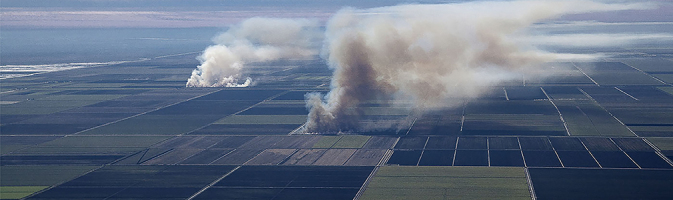
The burning of agricultural vegetation is a major source of air pollution in the United States,1 generating smoke that contains harmful fine particulate matter () and volatile chemicals such as acetone, benzene, and phenol. Exposure to is associated with health problems, including asthma, lung cancer, cardiovascular issues, and early death.2–4 In a recent study published in Environmental Health Perspectives, investigators from Florida State University (FSU) quantified emissions from the seasonal burning of sugarcane fields in South Florida and estimated their impact on premature mortality.5
The southern shores of Lake Okeechobee are home to large corporate sugarcane farms, explains Holly Nowell, first author of the study and a postdoctoral research scholar in the FSU Department of Earth, Ocean, and Atmospheric Science. “Between October and March each year, about 10,000 sugarcane fields covering over 400,000 acres are set on fire to reduce foliage before the harvest, minimize the biomass transported to mills, and streamline the sugar extraction process,” she says.
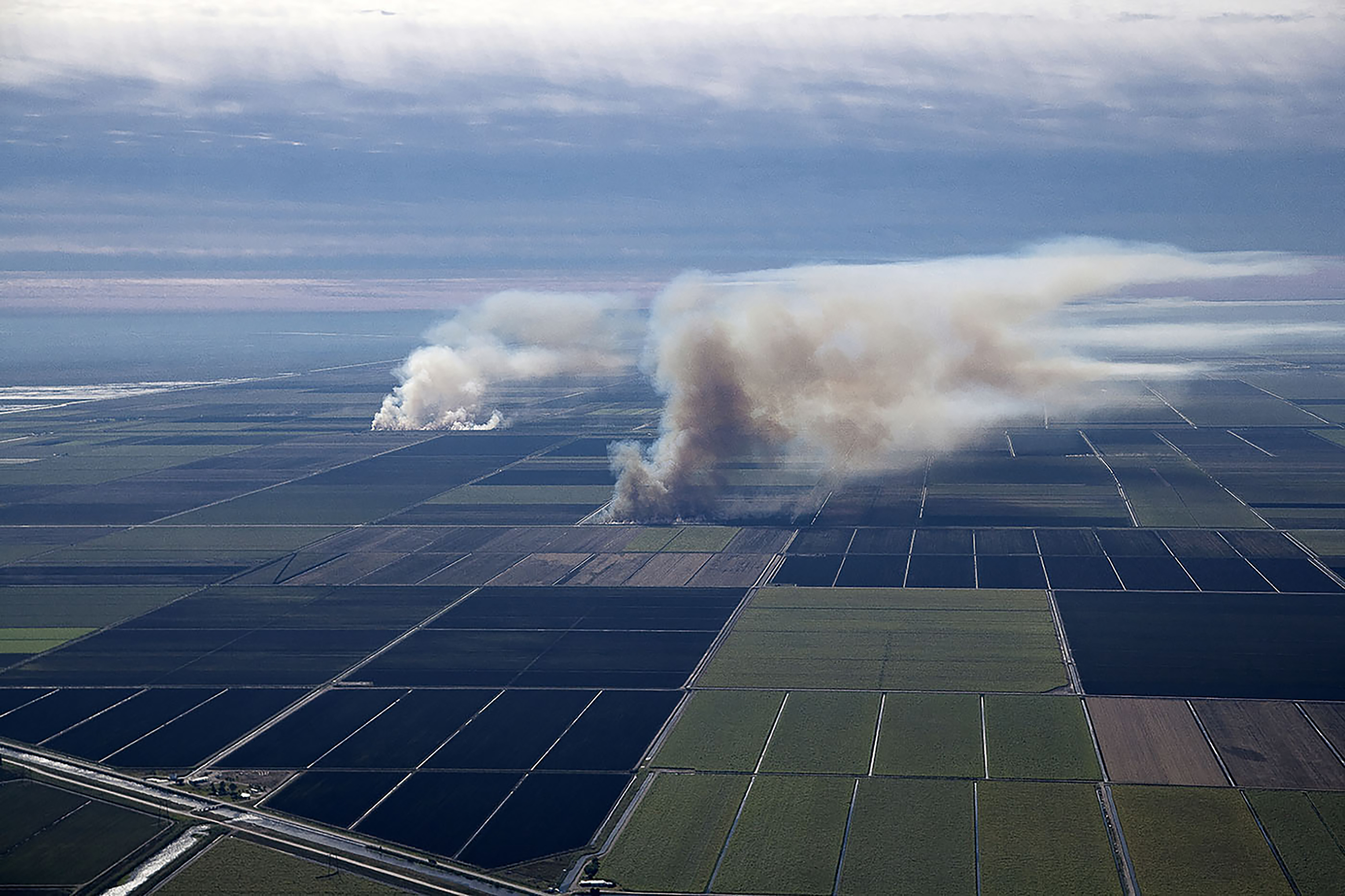
The authors estimated that burning of sugarcane fields in South Florida, such as those shown above, produces almost as much in 6 months as all the state’s vehicles emit in 1 year. Image: © iStock.com/6381380.
The authors estimated that sugarcane burning is associated with 1–6 deaths per year across South Florida, including 1 death every few years specifically in the sugarcane growing region. Although these numbers are small, the authors say they demonstrate that sugarcane burning does increase premature mortality, likely in addition to diseases such as asthma and chronic lung diseases.
“Any area that undergoes repeated, extensive burning should be examined, as it has the potential to impact public health,” Nowell adds. “While we use emissions and other variables that are specific to sugarcane in our paper, the methods we used should be applicable to other sources of burning.”
The authors used measurements from multiple sources to estimate ambient and burning-related exposures. Satellite sensors and ground-based monitoring sites provided daily measurements between 2009 and 2018, covering 10 harvest and 10 nonharvest seasons. They employed the Hybrid Single Particle Lagrangian Integrated Trajectory (HYSPLIT) model to simulate concentrations and dispersion of during the October–March harvest season. Estimates of daily sugarcane fire emissions were based on burn permits issued by the state.
Using demographic and health impact data, the researchers first estimated mortality from all sources of smoke, based on corrected satellite-derived concentrations. From that estimate, they used HYSPLIT to exclude from sugarcane smoke. They then estimated excess mortality burden due solely to sugarcane smoke exposure as the difference between these two mortality estimates.
The researchers estimated that sugarcane fires emitted approximately 5,100 metric tons of annually, concentrated over a 6-month period in a small area of the state. In comparison, all of Florida’s on-road motor vehicles emit an estimated 6,100 metric tons of across all 12 months of the year.1
Senior author Christopher Holmes, the Werner A. and Shirley B. Baum Associate Professor of Earth, Ocean, and Atmospheric Science at FSU, says episodic smoke plumes from the sugarcane fires around Lake Okeechobee’s south shore can raise concentrations by or more. Overall, the plumes increase annual mean concentrations in communities near the sugarcane fields by an estimated . The area’s annual average concentration of approximately 6 is below the current primary National Ambient Air Quality Standard of 7 but exceeds the World Health Organization (WHO) recommendation of .8 “Harmful effects of are documented at levels lower than the WHO guideline,” says Holmes.
Holmes points out that other researchers previously measured the concentrations and composition of in South Florida, showing that smoke significantly contributes to levels in Belle Glade, an important center of sugarcane farming.9,10 However, he says, “Ours is the first study to estimate the total amount of emitted from sugarcane fires and map the spatial distribution of their smoke over multiple years to estimate the health impacts.”
The researchers’ goal is to inform the public, environmental agencies, and lawmakers to help guide decision-making, according to Holmes. He adds that a 2021 amendment to Florida’s Right to Farm Act protects farms and corporations from nuisance lawsuits arising from field burning as long as they burn according to state law and follow generally accepted management practices.11
“We are not advocating for any policy,” Holmes says. “We recognize that sugarcane farming and processing is an important industry and employer around Lake Okeechobee. At the same time, citizens should be aware of the impacts that burning has on their communities.”
Antonio Gasparrini, a professor of biostatistics and epidemiology at the London School of Hygiene & Tropical Medicine, says the study is based on a sophisticated exposure assessment model that combines multiple measurement sources and analytical techniques to derive the proportion of pollution emanating from sugarcane fires and the associated health impacts. “The results depend heavily on modelling procedures that require a lot of assumptions and have not been fully validated,” he says—a limitation the authors openly acknowledge. However, he adds, it would have been difficult for them to address this limitation. Gasparrini was not involved in the study.
“This is a high-quality study of a significant local pollution problem,” says Karen Clay, a professor in Carnegie Mellon University’s Heinz College of Information Systems and Public Policy. “We need more studies like this in locations with significant local pollution problems,” says Clay, who also was not involved in the study. “They are valuable for bringing attention to local pollution’s morbidity and mortality costs.”
Biography
Oyelola Adegboye, PhD, is a biostatistics lecturer in public health and tropical medicine in the James Cook University College of Public Health, Medical and Veterinary Sciences in Townsville, Australia.
References
- 1.U.S. EPA (U.S. Environmental Protection Agency). 2021. 2017 National Emissions Inventory: January 2021 Updated Release. Technical Support Document. No. EPA-454/R-21-001. https://www.epa.gov/sites/default/files/2021-02/documents/nei2017_tsd_full_jan2021.pdf [accessed 7 July 2022].
- 2.Di Q, Dai L, Wang Y, Zanobetti A, Choirat C, Schwartz JD, et al. 2017. Association of short-term exposure to air pollution with mortality in older adults. JAMA 318(24):2446–2456, PMID: , 10.1001/jama.2017.17923. [DOI] [PMC free article] [PubMed] [Google Scholar]
- 3.Di Q, Wang Y, Zanobetti A, Wang Y, Koutrakis P, Choirat C, et al. 2017. Air pollution and mortality in the Medicare population. N Engl J Med 376(26):2513–2522, PMID: , 10.1056/NEJMoa1702747. [DOI] [PMC free article] [PubMed] [Google Scholar]
- 4.Johnston FH, Henderson SB, Chen Y, Randerson JT, Marlier M, DeFries RS, et al. 2012. Estimated global mortality attributable to smoke from landscape fires. Environ Health Perspect 120(5):695–701, PMID: , 10.1289/ehp.1104422. [DOI] [PMC free article] [PubMed] [Google Scholar]
- 5.Nowell HK, Wirks C, Martin MV, van Donkelaar A, Martin RV, Uejio CK, et al. 2022. Impacts of sugarcane fires on air quality and public health in South Florida. Environ Health Perspect, 10.1289/EHP9957. [DOI] [PMC free article] [PubMed] [Google Scholar]
- 6.Walsh H. 2021. 2018–2020 Monitored Design Values: Fine Particulate Matter— PM2.5. https://floridadep.gov/sites/default/files/2020%20PM25%20Design%20Values.pdf [accessed 7 July 2022].
- 7.U.S. EPA. 2022. NAAQS Table. https://www.epa.gov/criteria-air-pollutants/naaqs-table [accessed 7 July 2022].
- 8.World Health Organization. 2021. WHO Global Air Quality Guidelines: Particulate Matter (PM2.5 and PM10), Ozone, Nitrogen Dioxide, Sulfur Dioxide and Carbon Monoxide. Geneva. Switzerland: World Health Organization. https://apps.who.int/iris/bitstream/handle/10665/345329/9789240034228-eng.pdf [accessed 7 July 2022]. [PubMed] [Google Scholar]
- 9.Sevimoğlu O, Rogge WF. 2019. Seasonal variations of PM10—trace elements, PAHs and levoglucosan: rural sugarcane growing area versus coastal urban area in southeastern Florida, USA. Part II: elemental concentrations. Particuology 46:99–108. [Google Scholar]
- 10.Sevimoglu O, Rogge WF. 2016. Seasonal size-segregated PM10 and PAH concentrations in a rural area of sugarcane agriculture versus a coastal urban area in Southeastern Florida, USA. Particuology 28:52–59, 10.1016/j.partic.2015.09.013. [DOI] [Google Scholar]
- 11.The Florida Senate. 2021. 2014 Florida Statutes: 823.14. Florida Right to Farm Act. https://www.flsenate.gov/Laws/Statutes/2014/0823.14 [accessed 7 July 2022].