



Abstract
We report a new convenient preparation of dicarbamoylzincs of type (R1R2NCO)2Zn by the treatment of ZnCl2 and formamides R1R2NCHO with LiTMP in THF (15 °C, 15 min) or by the reaction of formamides R1R2NCHO with TMP2Zn (25 °C, 16 h). This second method tolerates sensitive groups such as an ester, ketone or nitro function. Reaction of these dicarbamoylzincs with allylic, benzylic, aryl, alkenyl bromides, acid chlorides, aldehydes or enones provided various polyfunctional amides in 47–97 % yields. 13C NMR characterization of these new carbamoylzinc derivatives is reported.
Keywords: Amides, Carbamoyl, Lithium, Metalation, Zinc
Polyfunctional dicarbamoylzincs of type (R1R2NCO)2Zn were prepared in THF by treating a mixture of formamides and ZnCl2 with LiTMP (THF, 15 °C, 15 min) or by reacting formamides with TMP2Zn (THF, 25 °C, 16 h). These zinc reagents reacted with allylic, benzylic, aryl and alkenyl bromides, acid chlorides, aldehydes or enones providing various amides in 47–97 % yields. 13C NMR data showed a characteristic carbonyl signal at 219.4 ppm for (Bu2NCO)2Zn.

Reagents displaying an umpolung of reactivity have attracted much attention. [1] Especially, acyl anion equivalents have found many synthetic applications. [2] Also, related carbamoyl organometallics of type 1 have been prepared either by reduction of the corresponding carbamoyl chloride 2 by lithium metal (pathway A), [3] by the insertion of CO to copper or lithium amides of type 3 (pathway B) [4] or by the metalation of various formamides 4 with lithium bases such as LDA or t‐BuLi at low temperature (Scheme 1).[ 5 , 6 ] Recently, Reeves used carbamoyllithiums prepared in toluene by lithiation with LDA for the addition to N‐sulfonyl imines producing α‐amino acids. [7] All these methods suffer from drawbacks such as a limited functional group compatibility, the use of a toxic gas or cryogenic reaction temperatures. Recently, we have reported that lithium amides like LiTMP (TMP=2,2,6,6‐tetramethylpiperidyl) were compatible with metallic salts such as ZnCl2⋅2 LiCl, MgCl2 and CuCN⋅2 LiCl at low temperature. [8] The stability of such Lewis pairs, which may be considered as frustrated Lewis pairs, [9] allowed in situ trapping metalations of various arenes and heteroarenes. [8] This in situ protocol was expanded by generating carbamoyllithiums of type 1 a in the presence of various electrophiles in continuous flow. [10] The Barbier procedure was essential for the success of the reaction conducted in continuous flow and allowed to prepare a wide range of products of type 5. Although this reaction represented a synthetic advance, it did not allow the performance of cross‐couplings with aryl and heteroaryl halides and required a flow apparatus. Catalytic aminocarbonylation protocols [11] involve usually highly toxic CO gas, an amine and an aryl halide. Those performed in the absence of CO gas are scarce.[ 6e , 6f , 12 ] Herein, we have reported the synthesis of a new room temperature stable dicarbamoylzinc species 6 (stable at least 16 h at 25 °C) [13] using two complementary methods (Method A and B) and their reactions with a range of electrophiles such as allylic and benzylic bromides, aldehydes, acid chlorides, enones and heteroaryl or alkenyl bromides producing functionalized amides of type 7.
Scheme 1.
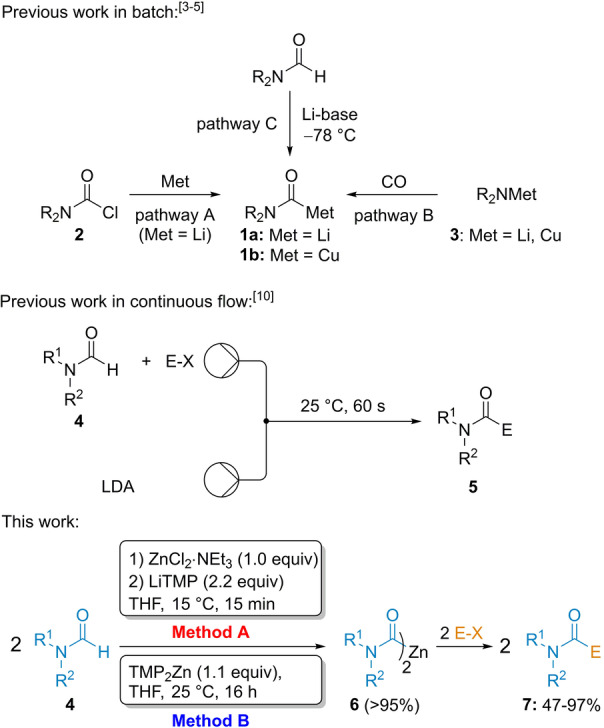
Preparations of carbamoylmetal reagents.
Thus, in preliminary experiments we have treated a THF mixture of formamides of type 4 (1.0 equiv) and ZnCl2 (0.5 equiv) in the presence (or absence) of Et3N (0.5 equiv) [14] with various lithium amide bases such as LDA, Cy2NLi (Cy=cyclohexyl) [15] and LiTMP in order to prepare the dicarbamoylzinc species 6 at temperatures between 0–25 °C for 15 min. The conversion to the zinc reagent 6 was evaluated by performing copper‐catalyzed allylations with allyl bromide on reaction aliquots. [16] These experiments showed that LiTMP (2.2 equiv; 0.5 M in THF) was the best base for achieving this lithiation (performed in the presence of ZnCl2) providing the dicarbamoylzinc 6. [17]
With these conditions in hand, we have examined the reaction scope. Thus, N,N‐dibutylformamide (4 a) was converted to the dicarbamoylzinc 6 a (LiTMP, 2.2 equiv; ZnCl2⋅NEt3, 1.0 equiv; 15 °C, 15 min). We have isolated, after a copper‐catalyzed allylation with allyl bromide, the expected amide 8 a in 94 % isolated yield (both carbamoyl moieties were reacting). Various formamides (4 b–4 h) were zincated by this procedure leading to 6 b–j, which provided the desired allylated products 8 b–8 j in 57–97 % yield (Scheme 2). Interestingly, although copper‐zinc cuprates of type RCu(CN)ZnX [18] gave usually SN2′‐substitution allylation products, we have observed the formation of only SN2‐substitution allylation products using prenyl bromide (8 h and 8 i; 61–62 % yield) or cinammyl bromide (8 j: 57 % yield, SN2/SN2′>9 : 1). [19] This unusual regioselectivity may be due to the carbonyl group coordination to the copper center resulting in a different Zn/Cu‐cluster. In contrast, with propargyl bromide, we have obtained only the SN2′ product, i.e. the allenic amide 8 k (58 % yield). Interestingly, we have also used this method for the preparation of 13C‐labeled amide 8 l from Bu2N13CHO. [20]
Scheme 2.

Allylation of dicarbamoylzincs of type 6 with allylic and propargylic bromides providing polyfunctional amides of type 8. The indicated yields refer to analytically pure isolated product.
In order to tolerate more sensitive groups such as an ester, ketone or a nitro function, we have directly treated several formamides (4 k–o) with TMP2Zn [21] in THF at 25 °C for 16 h (Method B) affording the desired zinc reagents 6 k–o which after allylation gave the desired polyfunctional products 8 m–q containing an ester, a ketone, an imide and a nitro group (Scheme 3).
Scheme 3.

Allylation of dicarbamoylzincs of type 6 with allylic bromides providing polyfunctional amides of type 8. The indicated yields refer to analytically pure isolated product.
Dicarbamoylzincs of type 6 also underwent smooth benzylations with various benzylic bromides in the presence of MgCl2⋅LiCl (1.0 equiv) affording polyfunctional arylacetamide derivatives (9 a–9 i) in 57–88 % yield (Scheme 4). In the absence of MgCl2⋅LiCl, a homo‐coupling product of benzylic bromide (1,2‐diarylethane) was observed. The positive effect of MgCl2 was also mandatory for performing addition reactions to aldehydes. [22] Thus, the reaction of 6 a and 6 e with benzaldehydes in the presence of MgCl2⋅LiCl (1.0 equiv) gave the expected α‐hydroxyamides (10 a, b) in 57–74 % yield (Scheme 5). [23]
Scheme 4.

Cu‐catalyzed benzylation of dicarbamoylzincs 6 with benzylic bromides. The indicated yields refer to analytically pure isolated product.
Scheme 5.

Mg‐mediated hydroxyalkylation of dicarbamoylzincs 6 with aldehydes. The indicated yields refer to analytically pure isolated product.
Acylation with various acid chlorides were performed in the absence of any catalyst and a complete acylation of various dicarbamoylzinc reagents of type 6 with acid chlorides at 25 °C, 16 h resulting in the formation of α‐ketoamides (11 a–11 d) in 54–84 % yield (Scheme 6). In the reaction of 6 a with diphenylphosphinic chloride N,N‐dibutyl‐1‐(diphenylphosphoryl)formamide 11 e was produced in 70 % yield.
Scheme 6.

Acylation of dicarbamoylzincs 6 with acid chlorides. The indicated yields refer to analytically pure isolated product.
Interestingly, a 1,4‐addition was achieved starting with 2‐cyclohexen‐1‐one and amide 4 a. Thus, the corresponding zinc reagent 6 a was cooled to −78 °C and treated with CuCN⋅2 LiCl (1.0 equiv) for 0.5 h followed by BF3⋅OEt2 (1.0 equiv) [24] and cyclohexenone (1.0 equiv) to give after 16 h at −78 °C the Michael adduct 12 in 54 % isolated yield (Scheme 7).
Scheme 7.

Cu‐mediated 1,4‐addition of 6 a to 2‐cyclohexen‐1‐one in the presence of BF3⋅OEt2. The indicated yields refer to analytically pure isolated product.
We have examined cross‐coupling reactions with various functionalized aryl bromides and noticed that a dual‐catalysis [25] involving a copper catalyst (4 mol % CuCN⋅2 LiCl) and a palladium catalyst (10 mol % Pd(dppf)Cl2) (dppf=1,1′‐bis(diphenylphosphino)ferrocene) was required. Using only Pd(dppf)Cl2 or a CuCN⋅2 LiCl gave almost no product. In a typical experiment, we have prepared 6 a from N,N‐dibutylformamide (2.0 equiv) with the usual procedure (Method A). Addition of 10 mol % Pd(dppf)Cl2, aryl/alkenyl bromide and 4 mol % CuCN⋅2 LiCl gave after heating the reaction mixture for 16 h at 45 °C in a sealed tube the desired cross‐coupling products 13 a–13 q in 53–93 % isolated yield (Scheme 8). Scale‐up of this procedure has been demonstrated in the preparation of 13 k (10 mmol scale; Scheme 8) with reduction of catalyst loading (2 mol % Pd(dppf)Cl2, 0.8 mol % CuCN⋅2 LiCl).
Scheme 8.

Pd‐ and Cu‐dual catalyzed cross‐couplings of dicarbamoylzincs 6 with aryl and alkenyl bromides. The indicated yields refer to analytically pure isolated product. [a] Metalation performed with TMP2Zn⋅2 MgCl2⋅2 LiCl. [b] Reaction performed from alkenyl iodides using CuCN⋅2 LiCl (1.0 equiv) without [Pd] catalyst.
A 13C NMR‐characterisation of N,N‐dibutylcarbamoylzinc reagent was done. Thus, the 13C NMR spectra of the reaction mixture obtained by treating 4 a/ZnCl2 mixture with LiTMP showed a new characteristic carbonyl signal (δ=219.4 ppm), together with a broad signal around δ=225 ppm (Figure 1a). To confirm the assigment of these resonances, we have prepared dicarbamoylzinc 6 a by an alternative method. Thus, treatment of Bu2NLi at −78 °C with CO gas led to N,N‐dibutylcarbamoyllithium[ 4d , 4e ] (1.0 equiv) which was transmetalated under CO atmosphere with ZnCl2 (0.5 equiv) to give the dicarbamoylzinc reagent 6 a. Indeed, an identical 13C NMR signal with a chemical shift for the carbonyl group δ=219.4 ppm (Figure 1b) was observed. Also, by using 0.3 equiv of ZnCl2 we obtained the zincate 14 a (Figure 1c). Finally, TMP2Zn⋅2 LiCl as a metalation reagent afforded spectroscopically pure diorganozinc reagent 6 a (Figure 1d).
Figure 1.

13C NMR spectra of dicarbamoylzinc 6 a and lithium tricarbamoylzincate 14 a generated via different methods.
In summary, we have reported a new convenient in situ lithiation with LiTMP of various formamides 4 in the presence of ZnCl2 providing new dicarbamoylzincs 6 which underwent allylations, benzylations, arylations, alkenylations, acylations, hydroxyalkylations and 1,4‐additions providing polyfunctional amides in good yields (Method A). Alternatively, we have also demonstrated that the reaction of polyfunctional formamides with TMP2Zn provides dicarbamoylzincs containing sensitive functions such as ester, ketone or nitro (Method B). 13C NMR investigations confirmed the formation of (R2NCO)2Zn and related aggregate (R2NCO)3ZnLi under these reaction conditions.
Conflict of interest
The authors declare no conflict of interest.
Supporting information
As a service to our authors and readers, this journal provides supporting information supplied by the authors. Such materials are peer reviewed and may be re‐organized for online delivery, but are not copy‐edited or typeset. Technical support issues arising from supporting information (other than missing files) should be addressed to the authors.
Supporting Information
Supporting Information
Supporting Information
Supporting Information
Supporting Information
Supporting Information
Acknowledgements
We thank the DFG and LMU for financial support. We further thank BASF, Novartis AG (Basel) and Albemarle (Frankfurt) for the generous gift of chemicals. Open Access funding enabled and organized by Projekt DEAL.
D. Djukanovic, M. A. Ganiek, K. Nishi, K. Karaghiosoff, K. Mashima, P. Knochel, Angew. Chem. Int. Ed. 2022, 61, e202205440; Angew. Chem. 2022, 134, e202205440.
Data Availability Statement
The data that support the findings of this study are available in the Supporting Information of this article.
References
- 1. Hase T. A., Umpoled Synthons, Wiley, New York, 1987. [Google Scholar]
- 2.
- 2a. Seebach D., Synthesis 1969, 1, 17; [Google Scholar]
- 2b. Seebach D., Synthesis 1977, 6, 357; [Google Scholar]
- 2c. Seebach D., Angew. Chem. Int. Ed. Engl. 1979, 18, 239; [Google Scholar]; Angew. Chem. 1979, 91, 259; [Google Scholar]
- 2d. Eger W. A., Grange R. L., Schill H., Goumont R., Clark T., Williams C. M., Eur. J. Org. Chem. 2011, 2548. [Google Scholar]
- 3.
- 3a. Ramón D. J., Yus M., Tetrahedron Lett. 1993, 34, 7115; [Google Scholar]
- 3b. Ramón D. J., Yus M., Tetrahedron 1996, 52, 13739; [Google Scholar]
- 3c.For a flow procedure on Li insertion in carbamoyl chlorides see: Nagaki A., Takahashi Y., Yoshida J.-I., Angew. Chem. Int. Ed. 2016, 55, 5327; [DOI] [PubMed] [Google Scholar]; Angew. Chem. 2016, 128, 5413. [Google Scholar]
- 4.
- 4a. Rautenstrauch V., Joyeux M., Angew. Chem. Int. Ed. Engl. 1979, 18, 83; [Google Scholar]; Angew. Chem. 1979, 91, 72; [Google Scholar]
- 4b. Rautenstrauch V., Joyeux M., Angew. Chem. Int. Ed. Engl. 1979, 18, 85; [Google Scholar]; Angew. Chem. 1979, 91, 73; [Google Scholar]
- 4c. Tsuda T., Miwa M., Saegusa T., J. Org. Chem. 1979, 44, 3734; [Google Scholar]
- 4d. Mizuno T., Nishiguchi I., Okushi T., Hirashima T., Tetrahedron Lett. 1991, 32, 6867; [Google Scholar]
- 4e. Mizuno T., Nishiguchi I., Hirashima T., Tetrahedron Lett. 1993, 49, 2403. [Google Scholar]
- 5.
- 5a. Bánhidai B., Schöllkopf U., Angew. Chem. Int. Ed. Engl. 1973, 12, 836; [Google Scholar]; Angew. Chem. 1973, 85, 860; [Google Scholar]
- 5b. Enders D., Seebach D., Angew. Chem. Int. Ed. Engl. 1973, 12, 1014; [Google Scholar]; Angew. Chem. 1973, 85, 1104; [Google Scholar]
- 5c. Fraser R. R., Hubert P. R., Can. J. Chem. 1974, 52, 185; [Google Scholar]
- 5d. Schöllkopf U., Beckhaus H., Angew. Chem. Int. Ed. Engl. 1976, 15, 293; [Google Scholar]; Angew. Chem. 1976, 88, 296; [Google Scholar]
- 5e. Seebach D., Lubosch W., Enders D., Chem. Ber. 1976, 109, 1309; [Google Scholar]
- 5f. Fletcher A. S., Smith K., Swaminathan K., J. Chem. Soc. Perkin Trans. 1 1977, 1881; [Google Scholar]
- 5g. Enders D., Lotter H., Angew. Chem. Int. Ed. Engl. 1981, 20, 795; [Google Scholar]; Angew. Chem. 1981, 93, 831. [Google Scholar]
- 6.The reports of other carbamoyl organometallics see:
- 6a. Yoshida Y., Asano S., Inoue S., Chem. Lett. 1984, 13, 1073; [Google Scholar]
- 6b. Lindsay C. M., Widdowson D. A., J. Chem. Soc. Perkin Trans. 1 1988, 569; [Google Scholar]
- 6c. Hiiro T., Mogami T., Kambe N., Fujiwara S.-I., Sonoda N., Synth. Commun. 1990, 20, 703; [Google Scholar]
- 6d. Cunico R. F., Tetrahedron Lett. 2001, 42, 2931; [Google Scholar]
- 6e. Cunico R. F., Maity B. C., Org. Lett. 2002, 4, 4357; [DOI] [PubMed] [Google Scholar]
- 6f. Cunico R. F., Maity B. C., Org. Lett. 2003, 5, 4947; [DOI] [PubMed] [Google Scholar]
- 6g. Cunico R. F., Chen J., Synth. Commun. 2003, 33, 1963; [Google Scholar]
- 6h. Chen J., Cunico R. F., J. Org. Chem. 2004, 69, 5509; [DOI] [PubMed] [Google Scholar]
- 6i. Cunico R. F., Motta A. R., Org. Lett. 2005, 7, 771; [DOI] [PubMed] [Google Scholar]
- 6j. Cunico R. F., Pandey R. K., J. Org. Chem. 2005, 70, 9048; [DOI] [PubMed] [Google Scholar]
- 6k. Cunico R. F., Motta A. R., J. Organomet. Chem. 2006, 691, 3109; [Google Scholar]
- 6l. Kambe N., Inoue T., Takeda T., Fujiwara S.-I., Sonoda N., J. Am. Chem. Soc. 2006, 128, 12650; [DOI] [PubMed] [Google Scholar]
- 6m. Ren W., Yamane M., J. Org. Chem. 2010, 75, 3017; [DOI] [PubMed] [Google Scholar]
- 6n. Yao Y., Tong W., Chen J., Mendeleev Commun. 2014, 24, 176. [Google Scholar]
- 7.
- 7a. Reeves J. T., Tan Z., Herbage M. A., Han Z. S., Marsini M. A., Li Z., Li G., Xu Y., Fandrick K. R., Gonnella N. C., Campbell S., Ma S., Grinberg N., Lee H., Lu B. Z., Senanayake C. H., J. Am. Chem. Soc. 2013, 135, 5565; [DOI] [PubMed] [Google Scholar]
- 7b. Reeves J. T., Lorenc C., Camara K., Li Z., Lee H., Busacca C. A., Senanayake C. H., J. Org. Chem. 2014, 79, 5895; [DOI] [PubMed] [Google Scholar]
- 7c. Seifert C. W., Pindi S., Li G., J. Org. Chem. 2015, 80, 447; [DOI] [PMC free article] [PubMed] [Google Scholar]
- 7d. Kerner M. J., Kuttruff C. A., Chevliakov M., Buono F. G., Gao D. A., Krawiec M., Busacca C. A., Senanayake C. H., Wipf P., Reeves J. T., Org. Lett. 2021, 23, 4396. [DOI] [PubMed] [Google Scholar]
- 8.
- 8a. Frischmuth A., Fernandez M., Barl N. M., Achrainer F., Zipse H., Berionni G., Mayr H., Karaghiosoff K., Knochel P., Angew. Chem. Int. Ed. 2014, 53, 7928; [DOI] [PubMed] [Google Scholar]; Angew. Chem. 2014, 126, 8062; [Google Scholar]
- 8b. Becker M. R., Knochel P., Angew. Chem. Int. Ed. 2015, 54, 12501; [DOI] [PubMed] [Google Scholar]; Angew. Chem. 2015, 127, 12681. [Google Scholar]
- 9. Stephan D. W., Erker G., Angew. Chem. Int. Ed. 2015, 54, 6400; [DOI] [PubMed] [Google Scholar]; Angew. Chem. 2015, 127, 6498. [Google Scholar]
- 10. Ganiek M. A., Becker M. R., Berionni G., Zipse H., Knochel P., Chem. Eur. J. 2017, 23, 10280. [DOI] [PubMed] [Google Scholar]
- 11.
- 11a. Brennführer A., Neumann H., Beller M., Angew. Chem. Int. Ed. 2009, 48, 4114; [DOI] [PubMed] [Google Scholar]; Angew. Chem. 2009, 121, 4176; [Google Scholar]
- 11b. Fang X., Jackstell R., Beller M., Angew. Chem. Int. Ed. 2013, 52, 14089; [DOI] [PubMed] [Google Scholar]; Angew. Chem. 2013, 125, 14339; [Google Scholar]
- 11c. Fang X., Li H., Jackstell R., Beller M., J. Am. Chem. Soc. 2014, 136, 16039; [DOI] [PubMed] [Google Scholar]
- 11d. Liu J., Li H., Spannenberg A., Franke R., Jackstell R., Beller M., Angew. Chem. Int. Ed. 2016, 55, 13544; [DOI] [PubMed] [Google Scholar]; Angew. Chem. 2016, 128, 13742; [Google Scholar]
- 11e. Peng J.-B., Wu X.-F., Angew. Chem. Int. Ed. 2018, 57, 1152; [Google Scholar]; Angew. Chem. 2018, 130, 1166; [Google Scholar]
- 11f. Zhao F., Ai H.-J., Wu X.-F., Angew. Chem. Int. Ed. 2022, 61, e202200062; [DOI] [PubMed] [Google Scholar]; Angew. Chem. 2022, 134, e202200062. [DOI] [PubMed] [Google Scholar]
- 12.
- 12a. Hosoi K., Nozaki K., Hiyama T., Org. Lett. 2002, 4, 2849; [DOI] [PubMed] [Google Scholar]
- 12b. Pastori N., Greco C., Clerici A., Punta C., Porta O., Org. Lett. 2010, 12, 3898. [DOI] [PubMed] [Google Scholar]
- 13.The stability of carbamoylzinc was evaluated by performing Cu-catalyzed allylations with allyl bromide in different time intervals. For full data please see Supporting Information page 7.
- 14.The addition of Et3N was performed in order to solubilize ZnCl2. However, we have verified that its presence or absence did not influence the formation of 6 as well as the subsequent trapping reactions with electrophiles.
- 15.
- 15a. Becker M. R., Ganiek M. A., Knochel P., Chem. Sci. 2015, 6, 6649; [DOI] [PMC free article] [PubMed] [Google Scholar]
- 15b. Becker M. R., Knochel P., Org. Lett. 2016, 18, 1462. [DOI] [PubMed] [Google Scholar]
- 16.See Supporting Information pages 6–10 for full optimization data and a typical procedure.
- 17.We have excluded that TMP2Zn (generated from LiTMP with ZnCl2) was the metalating species since the addition of TMP2Zn to formamides 4 did not afford comparable amount of Cu-catalyzed allylation product within the short reaction time of 15 min.
- 18.
- 18a. Knochel P., Singer R. D., Chem. Rev. 1993, 93, 2117; [Google Scholar]
- 18b. Knochel P., Rozema M. J., Tucker C. E. in Organocopper Reagents: A Practical Approach (Ed.: Taylor R. J. K.), Oxford University Press, Oxford, 1994, p. 85; [Google Scholar]
- 18c. Knochel P., Millot N., Rodriguez A. L., Tucker C. E., Org. React. 2004, 58, 417; [Google Scholar]
- 18d. Skotnitzki J., Spessert L., Knochel P., Angew. Chem. Int. Ed. 2019, 58, 1509; [DOI] [PubMed] [Google Scholar]; Angew. Chem. 2019, 131, 1523. [Google Scholar]
- 19.Deposition Numbers 2164155 (for 4m), 2164152 (for 4p), 2164153 (for 8j), 2164154 (for 11d) und 2164156 (for 13g) contain the supplementary crystallographic data for this paper. These data are provided free of charge by the joint Cambridge Crystallographic Data Centre and Fachinformationszentrum Karlsruhe Access Structures service. See Supporting Information pages 134–154 for full crystallographic data.
- 20. Ho J. Z., Elmore C. S., Wallace M. A., Yao D., Braun M. P., Dean D. C., Melillo D. G., Chen C., Helv. Chim. Acta 2005, 88, 1040. [Google Scholar]
- 21.
- 21a. Wunderlich S., Knochel P., Angew. Chem. Int. Ed. 2007, 46, 7685; [DOI] [PubMed] [Google Scholar]; Angew. Chem. 2007, 119, 7829; [Google Scholar]
- 21b. Kremsmair A., Hess A., Heinz B., Knochel P., Chem. Eur. J. 2022, 28, e202103269. [DOI] [PMC free article] [PubMed] [Google Scholar]
- 22.
- 22a. Metzger A., Bernhardt S., Manolikakes G., Knochel P., Angew. Chem. Int. Ed. 2010, 49, 4665; [DOI] [PubMed] [Google Scholar]; Angew. Chem. 2010, 122, 4769. For the effect of ZnCl2 in addition reactions of Grignard reagents see: [Google Scholar]
- 22b. Hatano M., Suzuki S., Ishihara K., J. Am. Chem. Soc. 2006, 128, 9998; [DOI] [PubMed] [Google Scholar]
- 22c. Hatano M., Ito O., Suzuki S., Ishihara K., J. Org. Chem. 2010, 75, 5008. [DOI] [PubMed] [Google Scholar]
- 23.Very slow additions to aldehydes in the absence of MgCl2⋅LiCl were observed.
- 24.
- 24a. Yamamoto Y., Angew. Chem. Int. Ed. Engl. 1986, 25, 947; [Google Scholar]; Angew. Chem. 1986, 98, 945; [Google Scholar]
- 24b. Yeh M. C. P., Knochel P., Santa L. E., Tetrahedron Lett. 1988, 29, 3887. [Google Scholar]
- 25.
- 25a. Allen A. E., MacMillan D. W. C., Chem. Sci. 2012, 3, 633; [DOI] [PMC free article] [PubMed] [Google Scholar]
- 25b. Romiti F., del Pozo J., Paioti P. H. S., Gonsales S. A., Li X., Hartrampf F. W. W., Hoveyda A. H., J. Am. Chem. Soc. 2019, 141, 17952; [DOI] [PubMed] [Google Scholar]
- 25c. Kim U. B., Jung D. J., Jeon H. J., Rathwell K., Lee S., Chem. Rev. 2020, 120, 13382. [DOI] [PubMed] [Google Scholar]
Associated Data
This section collects any data citations, data availability statements, or supplementary materials included in this article.
Supplementary Materials
As a service to our authors and readers, this journal provides supporting information supplied by the authors. Such materials are peer reviewed and may be re‐organized for online delivery, but are not copy‐edited or typeset. Technical support issues arising from supporting information (other than missing files) should be addressed to the authors.
Supporting Information
Supporting Information
Supporting Information
Supporting Information
Supporting Information
Supporting Information
Data Availability Statement
The data that support the findings of this study are available in the Supporting Information of this article.