



Abstract
The applicant Syngenta Crop Protection AG submitted a request to the competent national authority in Spain to evaluate the confirmatory data that were identified for in the framework of the maximum residue level (MRL) review under Article 12 of Regulation (EC) No 396/2005 as not available. To address the data gaps, a new storage stability study, new residues trials and a validated analytical enforcement method for the determination of the relevant residues in animal products were submitted. The data gaps were considered satisfactorily addressed for the plant commodities. The new information provided required a revision of the existing MRL for avocados. As regards the commodities of animal origin, the data gaps were only partially addressed and therefore further risk management considerations are required regarding the revision of the existing MRLs which were derived from Codex MRLs. The risk assessment performed for thiabendazole was also updated. No risk was identified.
Keywords: thiabendazole, benzimidazole, confirmatory data, pesticide, MRL review, risk assessment
Summary
In 2014, when the European Food Safety Authority (EFSA) reviewed the existing maximum residue levels (MRLs) for thiabendazole according to Article 12 of Regulation (EC) No 396/2005, EFSA identified some information as unavailable (data gaps) and derived tentative MRLs for those uses which were not fully supported by data but for which no risk to consumers was identified.
After the MRL review, thiabendazole was subsequently evaluated for renewal of approval in the framework of Commission Regulation (EC) No 1107/2009 and the toxicological reference values for the substance were lowered. EFSA therefore received on 23 December 2015, in accordance with Article 43 of Regulation (EC) No 396/2005, a mandate from the European Commission to revise the assessment of thiabendazole taking into consideration the new toxicological reference values as noted by the Standing Committee on Plants, Animals, Food and Feed (SCPAFF). After the revision of the review of the existing MRLs for thiabendazole according to Article 43, the following data gaps were finally identified:
-
1
a detailed and reproducible evaluation of the study investigating the nature of residues after pasteurisation, cooking, brewing and sterilisation in order to judge the validity of the study (data gap relevant for all authorisations reported);
-
2
final study report on storage stability data covering the entire storage period in the residues trials with potatoes and witloof;
-
3
data to address the potential for consumer exposure and toxicological properties for the metabolite benzimidazole (data gap relevant for commodities of animal origin and for the authorisations on citrus fruits, apples, potatoes and witloof);
-
4
one additional trial compliant with the Good Agricultural Practice (GAP) on avocados by spraying and further data to confirm the tentative PF derived for peeling of avocados;
-
5
the completed rotational crop residue trials for southern Europe (SEU) and data to demonstrate the efficiency of the hydrolysis step in the analytical method to release conjugated residues in order to validate the already submitted rotational crop residue trial data (data gap relevant for the seed treatment of potatoes);
-
6
a validated analytical method (with its independent laboratory validation (ILV) and a confirmatory method) for the determination of the sum of thiabendazole and 5‐hydroxythiabendazole in animal tissues and eggs;
-
7
a validated analytical method (with its ILV and a confirmatory method) for the determination of the sum of thiabendazole, 5‐hydroxythiabendazole and its sulfate conjugates in milk;
-
8
storage conditions of the livestock feeding study samples or, if it cannot be demonstrated that study samples were stored for less than 3 months under frozen conditions, a storage stability study investigating stability for longer storage intervals (data gap relevant for commodities of animal origin and for the authorisations on citrus fruits, apples and potatoes);
-
9
data to address the magnitude of potential residues of benzimidazole in animal commodities, considering dietary exposure to benzimidazole residues via feed items and benzimidazole generated in vivo upon exposure of livestock to residues of thiabendazole via feed items (data gap relevant for commodities of animal origin and for the authorisations on citrus fruits, apples and potatoes).
Tentative MRL proposals have been implemented in the MRL legislation by Commission Regulation (EU) No 2017/1164, including footnotes related to data gaps number 2, 3, 4, 6, 7, 9 indicating the type of confirmatory data that should be provided by a party having an interest in maintaining the proposed tentative MRL by 1 July 2019. Data gaps number 1, 5 and 8 were not implemented in the MRL regulation because of other risk management considerations. For citrus fruits the data gaps number 3 and 9 and for witloof the data gaps number 2 and 3 became obsolete as in the meanwhile new GAPs for thiabendazole were reported and assessed in the framework of an MRL application submitted to EFSA in 2018 under Article 10 of Regulation (EC) No 396/2005. Consequently, the related footnotes for confirmatory data have been removed by Commission Regulation (EU) 2021/1807 for these specific crops. However, the same footnotes remain applicable also to other commodities and therefore they are still present in regulation.
In accordance with the agreed procedure set out in the working document SANTE/10235/2016, Syngenta Crop Protection AG submitted an application to the competent national authority in Spain (rapporteur Member State, RMS) to evaluate the confirmatory data identified during the MRL review and the revision of the existing MRLs according to Article 43. The RMS assessed the new information in an evaluation report, which was submitted to the European Commission and forwarded to EFSA on 30 November 2021. When assessing the evaluation report, EFSA identified further points for clarification. On 19 April 2022, the EMS submitted a revised evaluation report which replaced the previously submitted evaluation report.
Following the assessment of the confirmatory data, EFSA concluded that data gaps number 2, 4, 6 and 7 were sufficiently addressed. Data gaps 3 and 9 were also addressed for what regards the plant commodities. Furthermore, although not relevant in the present assessment (and related footnotes not implemented in regulation), it was noted that data gaps number 1 and 8 were also sufficiently addressed and that data gap 5 was partially addressed. The existing MRLs for apples and potatoes were confirmed, while it is proposed to lower the existing MRL from 20 mg/kg to 7 or 15 mg/kg for avocados. Regarding commodities of animal origin, the data gaps number 3 and 9 are no longer relevant for the EU MRLs which would be derived at the limit of quantification (LOQ) from the EU PPP dietary burden. Therefore, it is proposed to lower the MRLs for all commodities of animal origin at the LOQ. EFSA also made further recommendations for risk management considerations about the uncertainty associated with the existing EU MRLs for bovine milk, muscle, fat, liver, kidney and other edible offals, and on poultry muscle and fat which were derived from Codex MRLs, as well on the MRLs defined for the veterinary uses on bovine and goat.
The summary table below provides an overview of the assessment of confirmatory data and the recommended MRL modifications to Regulation (EU) No 396/2005.
| Code (a) | Commodity | Existing MRL (b) | Data gap(s) Art.12 Review | Proposed MRL | Conclusion/recommendation |
|---|---|---|---|---|---|
| Enforcement residue definition: Thiabendazole | |||||
| 0130010 | Apples | 4(ft1) | Footnote related to data gaps No 3 and No 9 | 4 | The data gaps identified by EFSA concerning potential consumer exposure to the metabolite benzimidazole (from food and feed) have been addressed for this GAP (post‐harvest). The MRL is confirmed. No consumer intake concerns identified. The previous consumer risk assessment remains valid. |
| 0163010 | Avocados | 20 (ft2) | Footnote related to data gap No 4 | 7 or 15 (Further risk management considerations required) | The data gap identified by EFSA concerning the lack of GAP‐compliant residue trials has been addressed by means of an adjusted GAP and new residue trials. The resulting MRL (7 mg/kg) is lower than the existing tentative EU MRL of 20 mg/kg. An alternative MRL proposal based on the Codex MRL (15 mg/kg) was also identified. Risk for consumers is unlikely for the calculated MRL and for the Codex MRL. |
| 0211000 | Potatoes | 0.04 (ft3) | Footnote related to data gaps No 2, No 3 and No 9 | 0.04 | The data gap identified by EFSA concerning the storage stability of the metabolite benzimidazole has been addressed. The data gaps identified by EFSA concerning potential consumer exposure to the metabolite benzimidazole (from food and feed) have been addressed for this GAP (seed treatment). The MRL is confirmed. No consumer intake concerns identified. The previous consumer risk assessment remains valid. |
| Enforcement residue definition: Sum of thiabendazole and 5‐hydroxythiabendazole, expressed as thiabendazole | |||||
| 1011010 | Swine Muscle | 0.05* (ft4) | Footnote related to data gaps No 6, No 3 and No 9 | 0.01* |
The updated livestock dietary burden indicates that for EU PPP uses of thiabendazole no residues above the LOQ are expected. The MRL proposal at the LOQ is supported by the available data and the risk for consumers is unlikely. There are no CXLs for these commodities. The confirmatory data requirement for information on analytical methods has been addressed. The confirmatory data requirement for information on the magnitude of residues of the metabolite benzimidazole has not been addressed but is superseded by the revised livestock dietary burden calculation where no residues above the LOQ of 0.01 mg/kg are expected to occur in swine commodities. |
| 1011020 | Swine Fat | 0.05* (ft4) | Footnote related to data gaps No 6, No 3 and No 9 | 0.01* | |
| 1011030 | Swine Liver | 0.15 (ft4) | Footnote related to data gaps No 6, No 3 and No 9 | 0.01* | |
| 1011040 | Swine Kidney | 0.3 (ft4) | Footnote related to data gaps No 6, No 3 and No 9 | 0.01* | |
| 1011050 | Swine Edible offals (other than liver and kidney) | 0.3 (ft4) | Footnote related to data gaps No 6, No 3 and No 9 | 0.01* | |
| 1012010 | Bovine Muscle | 0.1 (ft4) | Footnote related to data gaps No 6, No 3 and No 9 | 0.01* or 0.1 (Further risk management considerations required) |
The updated livestock dietary burden indicates that for EU PPP uses of thiabendazole no residues above the LOQ are expected. An MRL proposal at the LOQ is supported by the available data and the risk for consumers is unlikely. The confirmatory data requirement for information on analytical methods has been addressed. The confirmatory data requirement for information on the magnitude of residues of the metabolite benzimidazole has not been addressed for the Codex MRLs of 0.1 mg/kg, on which the existing EU MRL is based. An MRL proposal reflecting the veterinary MRL of 0.1 mg/kg implemented by Commission Regulation 37/2010 can be considered by risk managers. Risk for consumers is unlikely for the Veterinary MRLs and for the Codex MRLs with regard to thiabendazole, however no risk assessment could be done for benzimidazole residues potentially associated to these MRLs. |
| 1012020 | Bovine Fat | 0.1 (ft4) | Footnote related to data gaps No 6, No 3 and No 9 | 0.01* or 0.1 (Further risk management considerations required) | |
| 1012030 | Bovine Liver | 0.3 (ft4) | Footnote related to data gaps No 6, No 3 and No 9 | 0.01* or 0.1 (Further risk management considerations required) |
The updated livestock dietary burden indicates that for EU PPP uses of thiabendazole no residues above the LOQ are expected. The MRL proposal at the LOQ is supported by the available data and the risk for consumers is unlikely. The confirmatory data requirement for information on analytical methods has been addressed. The confirmatory data requirement for information on the magnitude of residues of the metabolite benzimidazole has not been addressed for the Codex MRLs (0.3 and 1 mg/kg) on which the existing EU MRLs are based. An MRL proposal reflecting the veterinary MRL of 0.1 mg/kg implemented by Commission Regulation 37/2010 can be considered by risk managers. Risk for consumers is unlikely for the Veterinary MRLs and for the Codex MRLs with regard to thiabendazole, however no risk assessment could be done for benzimidazole residues potentially associated to these MRLs. |
| 1012040 | Bovine Kidney | 1 (ft4) | Footnote related to data gaps No 6, No 3 and No 9 | 0.01* or 0.1 (Further risk management considerations required) | |
| 1012050 | Bovine Edible offals (other than liver and kidney) | 1 (ft4) | Footnote related to data gaps No 6, No 3 and No 9 | 0.01* or 0.1 (Further risk management considerations required) | |
| 1013010 | Sheep Muscle | 0.05* (ft4) | Footnote related to data gaps No 6, No 3 and No 9 | 0.01* | The updated livestock dietary burden indicates that for EU PPP uses of thiabendazole no residues above the LOQ are expected. The MRL proposal at the LOQ is supported by the available data and the risk for consumers is unlikely. There are no CXLs for these commodities. The confirmatory data requirement for information on analytical methods has been addressed. The confirmatory data requirement for information on the magnitude of residues of the metabolite benzimidazole has not been addressed but is superseded by the revised livestock dietary burden calculation where no residues above the LOQ of 0.01 mg/kg are expected to occur in sheep commodities. |
| 1013020 | Sheep Fat | 0.05* (ft4) | Footnote related to data gaps No 6, No 3 and No 9 | 0.01* | |
| 1013030 | Sheep Liver | 0.15 (ft4) | Footnote related to data gaps No 6, No 3 and No 9 | 0.01* | |
| 1013040 | Sheep Kidney | 0.3 (ft4) | Footnote related to data gaps No 6, No 3 and No 9 | 0.01* | |
| 1013050 | Sheep Edible offals (other than liver and kidney) | 0.3 (ft4) | Footnote related to data gaps No 6, No 3 and No 9 | 0.01* | |
| 1014010 | Goat Muscle | 0.1 (ft4) | Footnote related to data gaps No 6, No 3 and No 9 | 0.01* or 0.1 (Further risk management considerations required) |
The updated livestock dietary burden indicates that for EU PPP uses of thiabendazole no residues above the LOQ are expected. An MRL proposal at the LOQ is supported by the available data and the risk for consumers is unlikely. There are no CXLs for these commodities. The confirmatory data requirement for information on analytical methods has been addressed. The confirmatory data requirement for information on the magnitude of residues of the metabolite benzimidazole has not been addressed but is superseded by the revised livestock dietary burden calculation where no residues above the LOQ of 0.01 mg/kg are expected to occur in goat commodities. An MRL proposal reflecting the veterinary MRL of 0.1 mg/kg implemented by Commission Regulation 37/2010 can be considered by risk managers. Risk for consumers is unlikely for the Veterinary MRLs with regard to thiabendazole, however no risk assessment could be done for benzimidazole residues potentially associated to these MRLs. |
| 1014020 | Goat Fat | 0.1 (ft4) | Footnote related to data gaps No 6, No 3 and No 9 | 0.01* or 0.1 (Further risk management considerations required) | |
| 1014030 | Goat Liver | 0.15 (ft4) | Footnote related to data gaps No 6, No 3 and No 9 | 0.01* or 0.1 (Further risk management considerations required) | |
| 1014040 | Goat Kidney | 0.3 (ft4) | Footnote related to data gaps No 6, No 3 and No 9 | 0.01* or 0.1 (Further risk management considerations required) | |
| 1014050 | Goat Edible offals (other than liver and kidney) | 0.3 (ft4) | Footnote related to data gaps No 6, No 3 and No 9 | 0.01* or 0.1 (Further risk management considerations required) | |
| 1015010 | Equine Muscle | 0.05* (ft4) | Footnote related to data gaps No 6, No 3 and No 9 | 0.01* | The updated livestock dietary burden indicates that for EU PPP uses of thiabendazole no residues above the LOQ are expected. The MRL proposal at the LOQ is supported by the available data and the risk for consumers is unlikely. There are no CXLs for these commodities. The confirmatory data requirement for information on analytical methods has been addressed. The confirmatory data requirement for information on the magnitude of residues of the metabolite benzimidazole has not been addressed but is superseded by the revised livestock dietary burden calculation where no residues above the LOQ of 0.01 mg/kg are expected to occur in equine commodities. |
| 1015020 | Equine Fat | 0.05* (ft4) | Footnote related to data gaps No 6, No 3 and No 9 | 0.01* | |
| 1015030 | Equine Liver | 0.15 (ft4) | Footnote related to data gaps No 6, No 3 and No 9 | 0.01* | |
| 1015040 | Equine Kidney | 0.3 (ft4) | Footnote related to data gaps No 6, No 3 and No 9 | 0.01* | |
| 1015050 | Equine Edible offals (other than liver and kidney) | 0.3 (ft4) | Footnote related to data gaps No 6, No 3 and No 9 | 0.01* | |
| 1,016,010 | Poultry Muscle | 0.05 (ft4) | Footnote related to data gaps No 6, No 3 and No 9 |
0.01* |
The updated livestock dietary burden indicates that for EU PPP uses of thiabendazole no residues above the LOQ are expected. The MRL proposal at the LOQ is supported by the available data and the risk for consumers is unlikely. The confirmatory data requirement for information on analytical methods has been addressed. The confirmatory data requirement for information on the magnitude of residues of the metabolite benzimidazole has not been addressed for the Codex MRLs of 0.05 mg/kg on which the existing EU MRL is based. Risk for consumers is unlikely for the for the Codex MRLs with regard to thiabendazole, however no risk assessment could be done for benzimidazole residues potentially associated to these MRLs. |
| 1016020 | Poultry Fat | 0.05 (ft4) | Footnote related to data gaps No 6, No 3 and No 9 | 0.01* | |
| 1016030 | Poultry Liver | 0.2 (ft4) | Footnote related to data gaps No 6, No 3 and No 9 | 0.01* | The updated livestock dietary burden indicates that for EU PPP uses of thiabendazole no residues above the LOQ are expected. The MRL proposal at the LOQ is supported by the available data and the risk for consumers is unlikely. There are no CXLs for these commodities. The confirmatory data requirement for information on analytical methods has been addressed. The confirmatory data requirement for information on the magnitude of residues of the metabolite benzimidazole has not been addressed but is superseded by the revised livestock dietary burden calculation where no residues above the LOQ of 0.01 mg/kg are expected to occur in these commodities. |
| 1016040 | Poultry Kidney | 0.2 (ft4) | Footnote related to data gaps No 6, No 3 and No 9 | 0.01* | |
| 1016050 | Poultry Edible offals (other than liver and kidney) | 0.2 (ft4) | Footnote related to data gaps No 6, No 3 and No 9 | 0.01* | |
| 1017010 | Other farmed terrestrial animals: Muscle | 0.05* (ft4) | Footnote related to data gaps No 6, No 3 and No 9 | 0.01* | |
| 1017020 | Other farmed terrestrial animals: Fat | 0.05* (ft4) | Footnote related to data gaps No 6, No 3 and No 9 | 0.01* | |
| 1017030 | Other farmed terrestrial animals: Liver | 0.15 (ft4) | Footnote related to data gaps No 6, No 3 and No 9 | 0.01* | |
| 1017040 | Other farmed terrestrial animals: Kidney | 0.3 (ft4) | Footnote related to data gaps No 6, No 3 and No 9 | 0.01* | |
| 1017050 | Other farmed terrestrial animals: Edible offals (other than liver and kidney) | 0.3 (ft4) | Footnote related to data gaps No 6, No 3 and No 9 | 0.01* | |
| Enforcement residue definition: sum of thiabendazole, 5‐hydroxythiabendazole and its sulfate conjugate, expressed as thiabendazole | |||||
| 1020010 | Milk Cattle | 0.2 (ft4) | Footnote related to data gaps No 7, No 3 and No 9 | 0.01* or 0.1 (Further risk management considerations required) |
The updated livestock dietary burden indicates that for EU PPP uses of thiabendazole no residues above the LOQ are expected. The MRL proposal at the LOQ is supported by the available data and the risk for consumers is unlikely. The confirmatory data requirement for information on analytical methods has been addressed. The confirmatory data requirement for information on the magnitude of residues of the metabolite benzimidazole has not been addressed for the Codex MRLs of 0.2 mg/kg, on which the existing EU MRL is based. An MRL proposal reflecting the veterinary MRL of 0.1 mg/kg implemented by Commission Regulation 37/2010 can be considered by risk managers. Risk for consumers is unlikely for the Veterinary MRL and for the Codex MRL with regard to thiabendazole, however no risk assessment could be done for benzimidazole residues potentially associated to these MRLs |
| 1,020,020 | Milk Sheep | 0.2 (ft4) | Footnote related to data gaps No 7, No 3 and No 9 | 0.01* | The updated livestock dietary burden indicates that for EU PPP uses of thiabendazole no residues above the LOQ are expected. The MRL proposal at the LOQ is supported by the available data and the risk for consumers is unlikely. There is no CXL for this commodity. The confirmatory data requirement for information on analytical methods has been addressed. The confirmatory data requirement for information on the magnitude of residues of the metabolite benzimidazole has not been addressed but is superseded by the revised livestock dietary burden calculation where no residues above the LOQ of 0.01 mg/kg are expected to occur in sheep milk. |
| 1020030 | Milk Goat | 0.2 (ft4) | Footnote related to data gaps No 7, No 3 and No 9 | 0.01* or 0.1 (Further risk management considerations required) |
The updated livestock dietary burden indicates that for EU PPP uses of thiabendazole no residues above the LOQ are expected. The MRL proposal at the LOQ is supported by the available data and the risk for consumers is unlikely. There is no CXL for this commodity. The confirmatory data requirement for information on analytical methods has been addressed. The confirmatory data requirement for information on the magnitude of residues of the metabolite benzimidazole has not been addressed but is superseded by the revised livestock dietary burden calculation where no residues above the LOQ of 0.01 mg/kg are expected to occur in goat milk. An MRL proposal reflecting the veterinary MRL of 0.1 mg/kg implemented by Commission Regulation 37/2010 can be considered by risk managers. Risk for consumers is unlikely for the Veterinary MRL with regard to thiabendazole, however no risk assessment could be done for benzimidazole residues potentially associated to this MRL. |
| 1020040 | Milk Horse | 0.2 (ft4) | Footnote related to data gaps No 7, No 3 and No 9 | 0.01* | The updated livestock dietary burden indicates that for EU PPP uses of thiabendazole no residues above the LOQ are expected. The MRL proposal at the LOQ is supported by the available data and the risk for consumers is unlikely. There are no CXLs for these commodities. The confirmatory data requirement for information on analytical methods has been addressed. The confirmatory data requirement for information on the magnitude of residues of the metabolite benzimidazole has not been addressed but is superseded by the revised livestock dietary burden calculation where no residues above the LOQ of 0.01 mg/kg are expected to occur in horse milk and other milks. |
| 1020990 | Milk Others | 0.2 (ft4) | Footnote related to data gaps No 7, No 3 and No 9 | 0.01* | |
| Enforcement residue definition: Sum of thiabendazole and 5‐hydroxythiabendazole, expressed as thiabendazole | |||||
| 1030000 | Birds eggs | 2 (ft4) | Footnote related to data gaps No 6, No 3 and No 9 | 0.01* |
The updated livestock dietary burden indicates that for EU PPP uses of thiabendazole no residues above the LOQ are expected. The MRL proposal at the LOQ is supported by the available data and the risk for consumers is unlikely. The confirmatory data requirement for information on analytical methods has been addressed. There is a Codex MRL of 0.1 mg/kg for this commodity but the confirmatory data requirement for information on the magnitude of residues of the metabolite benzimidazole would also apply to this CXL and it has not been addressed. Risk for consumers is unlikely for the for the Codex MRL with regard to thiabendazole, however no risk assessment could be done for benzimidazole residues potentially associated to this MRL. |
MRL: maximum residue level; NEU: northern Europe; SEU: southern Europe; GAP: Good Agricultural Practice; LOQ: limit of quantification; CXL: Codex maximum residue limit.
Commodity code number according to Annex I of Regulation (EC) No 396/2005.
Existing EU MRL and corresponding footnote on confirmatory data.
ft 1: The European Food Safety Authority identified some information on the magnitude of residues of the metabolite benzimidazole as unavailable. When re‐viewing the MRL, the Commission will take into account the information referred to in the first sentence, if it is submitted by 1 July 2019, or, if that information is not submitted by that date, the lack of it.
ft 2: The European Food Safety Authority identified some information on residue trials as unavailable. When re‐viewing the MRL, the Commission will take into account the information referred to in the first sentence, if it is submitted by 1 July 2019, or, if that information is not submitted by that date, the lack of it.
ft 3: The European Food Safety Authority identified some information on storage stability and on the magnitude of residues of the metabolite benzimidazole as unavailable. When re‐viewing the MRL, the Commission will take into account the information referred to in the first sentence, if it is submitted by 1 July 2019, or, if that information is not submitted by that date, the lack of it.
ft 4: The European Food Safety Authority identified some information on analytical methods and on the magnitude of residues of the metabolite benzimidazole as unavailable. When re‐viewing the MRL, the Commission will take into account the information referred to in the first sentence, if it is submitted by 1 July 2019, or, if that information is not submitted by that date, the lack of it.
Assessment
The review of existing maximum residue levels (MRLs) for the active substance thiabendazole according to Article 12 of Regulation (EC) No 396/2005 1 (MRL review) has been performed in 2014 (EFSA, 2014a). The European Food Safety Authority (EFSA) identified some information as unavailable (data gaps) and derived tentative MRLs for those uses not fully supported by data but for which no risk to consumers was identified. After the MRL review, thiabendazole was subsequently evaluated for renewal of approval in the framework of Commission Regulation (EC) No 1107/2009 2 (EFSA, 2014b) and the toxicological reference values for the substance were lowered. EFSA therefore received on 23 December 2015, in accordance with Article 43 of Regulation (EC) No 396/2005, a mandate from the European Commission to revise the MRL review assessment of thiabendazole taking into consideration the new toxicological reference values as noted by the Standing Committee on Plants, Animals, Food and Feed (SCPAFF). The list of Good Agricultural Practices (GAPs) not fully supported by data identified in the framework of the MRL review and updated after the revision of the review of the existing MRLs for thiabendazole according to Article 43 (EFSA, 2016), and for which finally confirmatory data were requested are listed in Appendix A.
Following the review of existing MRLs, the legal limits have been modified by Commission Regulation (EU) No 2017/1164 3 , including footnotes for tentative MRLs that specified the type of information that was identified as missing. Any party having an interest in maintaining the proposed tentative MRL was requested to address the confirmatory data by 1 July 2019.
In accordance with the specific provisions set out in the working document of the European Commission SANTE/10235/2016 (European Commission, 2020), the applicant, Syngenta Crop Protection AG, on 28 June 2019 submitted an application to the competent national authority in Spain (designated rapporteur Member State, RMS) to evaluate the confirmatory data identified during the MRL review. To address the data gaps identified by EFSA, the applicant provided a new storage stability study, new residues trials on seed potatoes and avocados, performed an updated assessment of livestock dietary burden and expected residues in commodities of animal origin as well as provided a validated analytical enforcement method for the determination of the relevant residues in animal products.
The RMS assessed the new information in an evaluation report, which was submitted to the European Commission and forwarded to EFSA on 30 November 2021 (Spain, 2021). EFSA assessed the application as requested by the European Commission in accordance with Article 10 of Regulation (EC) No 396/2005. During the detailed assessment, EFSA identified points which needed further clarifications. On 19 April 2022, the RMS submitted a revised evaluation report which replaced the previously submitted evaluation report (Spain, 2021).
EFSA based its assessment on the evaluation report submitted by the RMS, the reasoned opinion on the MRL review and the revision of it, according to Articles 12 and 43 of Regulation (EC) No 396/2005 respectively (EFSA, 2014a, 2016), and the additional assessments of thiabendazole performed after the MRL review (EFSA, 2014b, 2021, 2022).
For this application, the data requirements established in Regulation (EU) No 544/2011 4 and the relevant guidance documents at the date of implementation of the confirmatory data requirements by Regulation (EU) No 2017/1164 are applicable. The assessment is performed in accordance with the legal provisions of the Uniform Principles for the Evaluation and the Authorisation of Plant Protection Products adopted by Commission Regulation (EU) No 546/2011 5 .
An updated list of end points, including the end points of relevant studies assessed previously and the confirmatory data evaluated in this application, is presented in Appendix B.
The peer review of the renewal of approval of thiabendazole in accordance with Regulation (EC) No 1107/2009 is finalised. As a follow up, the risk assessment of the related confirmatory data in order to address data gaps identified in the peer review was also finalised by EFSA (2022).
The evaluation report submitted by the RMS (Spain, 2021) is considered a supporting document to this reasoned opinion and, thus, is made publicly available as a background document to this reasoned opinion.
1. Residues in plants
1.1. Nature of residues and methods of analysis in plants
1.1.1. Nature of residues in primary crops
Not relevant for the current assessment. EFSA concluded that the metabolic behaviour is sufficiently addressed for all uses under assessment in the present opinion:
Post‐harvest uses on apples and avocadoes.
Seed treatment on potatoes.
1.1.2. Nature of residues in rotational crops
Not relevant for the current assessment.
1.1.3. Nature of residues in processed commodities
It is noted that the effect of processing on the nature of thiabendazole was investigated in the framework of the EU pesticides peer review (EFSA, 2014b). The studies showed that thiabendazole is hydrolytically stable under standard processing conditions representative of pasteurisation, cooking, brewing and sterilisation. However, during the revised MRL review a data gap (data gap number 1 6 ) was identified regarding a detailed and reproducible evaluation of this study (EFSA, 2016). This data gap was not formally reported in the EU MRL Regulation. Therefore, this section is not deemed relevant for the current assessment.
Nevertheless, in the context of a previous MRL application for citrus fruits, bananas and witloof, an evaluation and full summary of the hydrolysis study was provided by the EMS and EFSA concluded that the data gap 1 has been addressed (EFSA, 2021).
The hydrolysis study confirmed that thiabendazole is hydrolytically stable under conditions representative of pasteurisation, baking/brewing/boiling and sterilisation.
Standard hydrolysis studies regarding the stability of the metabolite benzimidazole under conditions representative for pasteurisation, boiling/cooking and sterilisation are not available and are not triggered for the GAPs under consideration.
1.1.4. Analytical methods for enforcement purposes in plant commodities
Not relevant for the current assessment.
1.1.5. Stability of residues in plants
According to the Commission Regulation (EU) No 2017/1164, the data gap number 2 7 is still applicable to potatoes. Although this data gap has been addressed in a previous EFSA reasoned opinion (EFSA, 2021), the applicant re‐submitted for the present assessment a full study report on the stability of thiabendazole and benzimidazole in frozen samples in plant matrices.
The stability of thiabendazole was demonstrated in all plant matrices for at least 24 months when stored at −20°C. Regarding the metabolite benzimidazole, the storage stability was demonstrated in frozen samples of crops classified as matrices with dry/high protein content matrices (dry beans), dry/high starch content matrices (barley grain) and high acid content commodities (oranges) for at least 24 months when stored at −20°C. For crops classified as matrices with high water content (spinach leaves), the study demonstrated the stability of benzimidazole in frozen samples of crops stored at −20°C for periods of up to 3 months (79% recovery after 3 months and 66% recovery after 9 months in spinach leaves stored at −20°C ± 5°C).
Additionally, new trials on potatoes were provided, including the assessment of validity against the storage period (see Section 1.2.1).
EFSA concludes that the data gap number 2 identified in the framework of the MRL review is addressed.
Nevertheless, the storage stability of benzimidazole in high water content samples covering only 3 months of frozen storage might be a deficiency regarding the results for benzimidazole in some samples of the rotational studies (see Section 1.2.2). Acknowledging this, the EMS informed EFSA that a new storage stability has been initiated with a final report available in March 2023.
1.1.6. Proposed residue definitions
Based on the metabolic pattern identified in metabolism studies, the results of hydrolysis studies, the toxicological significance of metabolites and the capabilities of enforcement analytical methods, the following residue definitions were proposed in the framework of the revision of the MRL review in compliance with Article 43 of Regulation (EC) No 396/2005 (EFSA, 2016):
residue definition for enforcement (plant commodities): thiabendazole.
- residue definition for risk assessment:
-
ᴼpost‐harvest treatment crops (relevant to the existing uses on citrus fruits, apples, pears, avocados, mangoes, bananas, papayas and consumption potatoes): thiabendazole.
-
ᴼpreharvest treatment (relevant to the existing uses on seed potatoes and chicory roots prior to forcing of witloof) and rotational crops:
-
□thiabendazole.
-
□total benzimidazole (tentative, data gap; EFSA, 2016).
-
□
-
ᴼ
The same residue definitions are applicable to processed commodities. The residue definition for enforcement set in Regulation (EC) No 396/2005 is identical with the above‐mentioned residue definition for enforcement.
The residue definition for enforcement and for risk assessment for post‐harvest treatment (‘thiabendazole’) has been confirmed in a recent MRL assessment (EFSA, 2021) and is appropriate for the post‐harvest uses on apples and avocadoes under assessment.
Regarding the use on seed potatoes and witloof, two separate risk assessment residue definitions as proposed in the revision of the MRL review (see above) for preharvest treatment are applicable (residue for risk assessment: ‘thiabendazole’; ‘total benzimidazole’). The confirmatory data gap number 3 8 related to the assessment of the toxicity of benzimidazole has not been addressed. However, considering the absence of this compound in the residue trials supporting the GAP on seed potatoes (see Section 1.2.1) this data gap is no longer deemed relevant for potatoes. The same conclusion is applicable for witloof where residue trials assessed in the recent EFSA reasoned opinion indicated no presence of benzimidazole residues (EFSA, 2021).
Nevertheless, it is highlighted that for any other preharvest use that might be assessed in the future, an assessment of the toxicity of benzimidazole may be required depending on the magnitude of benzimidazole observed in the supporting residue trials.
1.2. Magnitude of residues in plants
1.2.1. Primary crops
In order to address the confirmatory data gaps for potatoes (related to magnitude of benzimidazole residues and the storage stability, data gap 3 and 2) and for avocadoes (related to a missing residue trial; data gap 4), the following data were provided by applicant in the present assessment (Spain, 2021).
Potatoes (seed treatment):
Outdoor GAPs assessed in the MRL review (northern Europe (NEU) and southern Europe (SEU) outdoor): Seed treatment with 1 application at 50 g a.s./ton.
Outdoor GAPs assessed for the confirmatory data: same as in MRL review.
The northern and southern outdoor GAPs assessed in the MRL review were supported by eight NEU trials and eight SEU trials, all analysing for thiabendazole only. The NEU data set allowed to derive an MRL of 0.04 mg/kg, which was reported in the Regulation on a tentative basis because of the lack of storage stability data for benzimidazole (data gap 2) and because trials analysing for the metabolite benzimidazole were not available (data gap 3).
In order to address data gap 3, 8 the applicant provided eight new residue trials (4 NEU + 4 SEU) performed on seed potatoes, analysing benzimidazole residues in potatoes after the preplanting seed treatment of tubers with thiabendazole.
These trials were assessed by the EMS and were deemed compliant with GAP (within 25% tolerance for the application rate and considering that a time interval between the treatment of seed tubers and planting of 1–2 months is a worst case compared to usual practice) (Spain, 2021). Samples were analysed for residues of benzimidazole using method GRM040.01A with modifications, a liquid chromatography with tandem mass spectrometry (LC–MS/MS) method with a limit of quantification (LOQ) of 0.01 mg/kg. This method has been validated for a range of crops and is considered fully valid for determination of free benzimidazole in potato tubers (Spain, 2021).
As the method GRM040.01A involves an enzyme hydrolysis, it is also supposed to release the possible benzimidazole conjugates. However, the quantitative demonstration of the efficiency of this hydrolysis step was not demonstrated. Upon EFSA request for clarifications, the applicant informed the EMS that the enzyme hydrolysis step in this method is consistent with the glucosidase hydrolysis step demonstrated in the wheat plant metabolism study. In the wheat metabolism study, it was shown that after glucosidase enzyme hydrolysis of a highly polar aqueous fraction from straw, free benzimidazole was released. The chromatography indicated a quantitative conversion of the polar conjugates to primarily benzimidazole. Therefore, there is an indication that the enzyme hydrolysis step used in the method might work to release the conjugates also from potato samples. While a formal data gap for the quantitative demonstration of the efficiency is still identified, this lack of quantitative data can be considered as a minor deficiency. This is consistent with the conclusion reached in the previous opinion on the modification of the MRL for the use of thiabendazole on witloof (EFSA, 2021).
The eight trials (4 NEU + 4 SEU) show residues of benzimidazole to remain below the LOQ (< 0.01 mg/kg). Therefore, it can be concluded that this metabolite (and its conjugates) is not expected to be present in daughter potatoes, following treatment of seed potatoes with thiabendazole.
In order to address data number 2 9 , the applicant provided the full study report on the stability of thiabendazole and benzimidazole in plant matrices (Spain, 2021). The same study report has been already made available for the EFSA previous assessment (EFSA, 2021). The storage stability of benzimidazole in frozen samples of crops classified dry/high starch content matrices was demonstrated for 24 months when stored at −20°C. For crops classified as matrices with high water content however, the stability of benzimidazole was demonstrate for 3 months only. The storage period of the samples analysed in the newly submitted residue trials ranged between 7 and 8 months. While potato was considered as a high‐water content commodity at the time of the revised MRL review, it should be noted that this crop is closer to high starch content commodities as defined in OECD guidance 506 (OECD, 2007), for which the storage stability of thiabendazole and benzimidazole is confirmed for 24 months. Therefore, the new trials are considered valid regarding the stability of benzimidazole in stored samples.
For potatoes, EFSA concludes that the data gaps number 2 and 3 identified in the framework of the revised MRL review, corresponding to the footnote number 3 of the Commission Regulation (EU) No 2017/1164, are addressed.
Avocados:
GAP assessed in the MRL review: Post‐harvest application (dipping) at 1 × 340 g a.s./hL (import tolerance).
Adjusted GAP assessed for the confirmatory data: Post‐harvest application (dipping) at 1 × 200 g a.s./hL (import tolerance – Chile).
In order to address data gap 4 10 , the applicant submitted an adjusted GAP on avocados (200 g a.s./hL instead of 340 g a.s./hL) and referred to residue trials performed on mangoes and assessed in a previous MRL application (EFSA, 2021). Eight trials performed on mangoes with an application rate of 243–250 g a.s./hL and four new trials performed with an application rate of 194 g a.s./hL are available. The residue trial data can be extrapolated to support the import tolerance on avocados (European Commission, 2017). These trials also provide data for whole fruits and edible portion separately, thus allowing to estimate the peeling factor of 0.01 (EFSA, 2021). Considering the most conservative approach with only trials performed at the highest application rate, an MRL of 7 mg/kg would be supported; considering the trials performed at 194 g a.s./hL, an MRL of 6 mg/kg would be derived. It is noted that the MRL resulting from the adjusted GAP (6 or 7 mg/kg) is lower than the existing tentative EU MRL (20 mg/kg) (EFSA, 2016) and the Codex MRL of 15 mg/kg for avocados (FAO, 2000). While the MRL of 20 mg/kg was not fully supported by data, the Codex MRL of 15 mg/kg can be identified as an alternative for risk managers.
EFSA concluded that the data gap 4 identified in the framework of the MRL review, corresponding to the footnote number 2 of the Commission Regulation (EU) No 2017/1164, was addressed.
Apples:
GAP assessed in the MRL review: Post‐harvest application (dipping) at 1 × 80–120 g a.s./hL
The Article 12 confirmatory data gap for apples according to the Commission Regulation (EU) No 2017/1164 (footnote 1), is related to the magnitude of benzimidazole residues (data gap 3). Although no new residue data were available for the metabolite benzimidazole, this metabolite is not of concern for post‐harvest uses (relevant for apples) as already concluded in previous EFSA assessments (EFSA, 2016, 2021). EFSA therefore concludes that this data gap can be considered addressed.
It is further noted that also data gap 1 11 , identified by the revised MRL review, but not implemented in the MRL legislation, has been addressed in 2021 (see Section 1.1.3) (EFSA, 2021). The residue data in apples and related details on the residue trials results and validation are presented in Appendix B.1.2.1.
1.2.2. Rotational crops
During the revised MRL review, EFSA considered the rotational crop residue trials (2 NEU and 2 SEU in spinach, carrots and wheat or barley) which were assessed in the EU peer review of the active substance. In these trials performed with applications on bare soil at 175 g a.s./ha, residues of thiabendazole and benzimidazole were found to remain the LOQ at different plant‐back intervals (PBI) of 30, 60 and 365 days (EFSA, 2016). However, the following limitations were identified by EFSA in the revised MRL review:
-
1
Results at PBI 365 days for the SEU trials were missing.
-
2
The analytical method was not sufficiently validated for the analysis of conjugates. The demonstration of efficiency of the hydrolysis step to cover conjugated residues was missing.
These deficiencies were identified to be relevant for the seed treatment of potatoes and were reported in the EFSA opinion on the MRL review as data gap number 5 12 (EFSA, 2016). However, this data gap was not formally reported in the EU MRL Regulation and this section is principle not relevant for the current assessment. Nevertheless, the applicant has provided additional information on these points and the EMS has assessed it in its evaluation report (Spain, 2021). These elements are therefore reported here for completeness.
The final report of the SEU rotational crops trials was provided. In the SEU trials, the three crops under investigation (spinach, carrots, spring wheat) were planted back at a nominal timing of 365 days after application and the results which were missing in 2016 are now available. It is noted that the crops failed to develop sufficiently in one of the two trials. Therefore, samples at PBI 365 are only available from one trial for each crop. These samples confirmed the previous findings as residues of thiabendazole and benzimidazole were found to remain the LOQ.
The data gap number 5 is deemed as partially addressed because the study is affected by the following non‐standard uncertainties:
-
1
Regarding the efficiency of the hydrolysis step of conjugates of thiabendazole or benzimidazole with the glucosidase enzyme, no further information was provided by the applicant, and this is still considered as a deficiency. However, as concluded in the previous application for the modification of the MRL for the use of thiabendazole on witloof (EFSA, 2021) and for the newly submitted trials on potatoes (see Section 1.2.1), this lack of quantitative data can be considered as a minor deficiency.
-
2
The high‐water content samples from the rotational crop studies have been stored for a period up to 8 months while for this matrix the storage stability of metabolite benzimidazole was only demonstrated for 3 months (see Section 1.1.5). The EMS informed EFSA that a new study to assess the storage stability of benzimidazole in high water content commodities for up to 8 months has been initiated. The final study report will be available in March 2023.
The deficiencies identified above regarding the rotational crop trials are not expected to affect the validity of the existing MRLs.
2. Residues in livestock
In order to address data gap number 9 13 , an update of this section is required.
EFSA updated the livestock dietary burden calculation considering the existing data (from the revised MRL review), the data assessed so far (EFSA, 2021) and the new data submitted in the present application. The livestock dietary burden was assessed for each risk assessment residue definition defined for plant commodities: (1) thiabendazole; (2) total benzimidazole (tentative). The results of the dietary burden calculation are summarised in Appendix B.2.
Regarding the dietary burden for thiabendazole, the new data provided and assessed in the present application are not expected to modify the calculation performed in the previous EFSA opinion on the setting of import tolerances for thiabendazole in various crops (EFSA, 2021). In that assessment the selected input value for citrus fruits was the STMR derived by the JMPR (FAO, 2007) supporting the existing EU MRL of 7 mg/kg. This value, multiplied by the processing factor (PF) for dried pulp is still relevant. For apples and potatoes, the input values also remain unchanged and correspond respectively to the post‐harvest drenching on apples (MRL = 4 mg/kg) and to the seed treatment on potatoes (MRL = 0.04 mg/kg). It is highlighted that the risk assessment values derived from the GAP on consumption potatoes assessed in the revised MRL review (EFSA, 2016) were more critical, but these values are not considered relevant since the MRL derived from consumption potatoes was not implemented in the Regulation. 14 The input values for the exposure calculations to thiabendazole for livestock are presented in Appendix D.1 (Risk assessment residue definition 1). The outcome of the assessment for residues of thiabendazole in livestock remains unchanged compared to the assessment performed in the previous MRL opinion (EFSA, 2021).
Regarding the dietary burden for total benzimidazole, the new data assessed in the present application allow to address the uncertainty on the livestock exposure to total benzimidazole as referred to in the confirmatory data gap number 9. The available data on seed potatoes indicate that the metabolite benzimidazole is not expected to occur at levels above the LOQ in daughter potatoes (see Section 1.2.1). Furthermore, the final report on rotational crops indicates that this metabolite is not found in succeeding crops (see Section 1.2.2). Regarding the authorised post‐harvest GAPs on citrus fruits and apples, it was already concluded in the MRL review that metabolite benzimidazole was not relevant (EFSA, 2016). Consequently, a theoretical dietary burden calculation, based on LOQ in potatoes was performed. EFSA did not consider the default PFs on potatoes process waste and potatoes dried pulp since STMR is below the LOQ and benzimidazole is therefore not expected. The input values for the exposure calculations to thiabendazole for livestock are presented in Appendix D.1 (Risk assessment residue definition 2). The results of the exposure calculation are below the trigger value for all animal species.
2.1. Nature of residues and methods of analysis in livestock
There are no new data on the nature of residues in livestock.
During the revision of the MRL review, the residue definitions for enforcement and risk assessment were defined as follows (EFSA, 2016):
In all animal tissues and eggs: ‘sum of thiabendazole and 5–hydroxythiabendazole, expressed as thiabendazole’.
In milk: ‘sum of thiabendazole, 5–hydroxythiabendazole and its sulfate conjugate, expressed as thiabendazole’.
In addition, a separate risk assessment residue definition as ‘total benzimidazole’ was also proposed on a tentative basis by the revision of the MRL review (EFSA, 2016), noting that magnitude of benzimidazole in livestock has not been investigated (data gap number 915) and that further information regarding the toxicological properties of benzimidazole was still missing (data gap number 38) (EFSA, 2016). These data gaps are discussed further in Section 2.2.2 and Section 3, respectively.
In order to address data gaps number 6 15 and number 7, 16 the applicant provided new validated analytical methods for enforcement in animal matrices.
In the context of previous assessment (EFSA, 2021), these methods were already assessed and validated:
A QuEChERS multiresidue method (and its ILV) for the determination of thiabendazole and 5‐hydroxythiabendazole was sufficiently validated in fat, muscle, liver and eggs with a LOQ of 0.01 mg/kg for each analyte (EFSA, 2021).
An LC–MS–MS method (and its ILV) for the analysis of thiabendazole, 5–hydroxythiabendazole and its sulfate conjugates in milk was sufficiently validated with a LOQ of 0.01 mg/kg for each analyte (EFSA, 2021).
A summary of these methods is reported in Appendix B.2.1.1 and the full validation data are available in the evaluation report of the EMS (Spain, 2021).
It was concluded by EFSA in the previous assessment that the confirmatory data requirement for information on analytical methods for products of animal origin as set in the footnote 4 of Commission Regulation 2017/1164 has been addressed. Therefore, the corresponding confirmatory data gaps 6 and 7 identified in the framework of the MRL review are addressed.
In addition, although data gap number 8 17 on the storage conditions of the livestock feeding study samples was not formally reported in the EU MRL Regulation, EFSA takes note that this data gap has also been addressed in the context of the previous MRL application on the modification of MRLs and setting of import tolerances for thiabendazole in various crops (EFSA, 2021).
2.2. Magnitude of residues in livestock
2.2.1. Thiabendazole
As the new data assessed in the present application do not modify the calculation performed in the previous EFSA opinion on the setting of import tolerances for thiabendazole in various crops (EFSA, 2021), the previous conclusion remains valid. EFSA concluded that, at the updated dietary burden for thiabendazole for EU livestock (see Appendix B.2), residues of thiabendazole (sum of thiabendazole and 5‐OH‐thiabendazole, also including the sulfate conjugate of 5‐OH‐thiabendazole in milk) are not expected to be present in animal matrices at levels above the LOQ of 0.01 mg/kg (EFSA, 2021). This conclusion is only applicable when considering the livestock dietary burden for thiabendazole resulting from the EU pesticide uses only. 18
It is noted that in the revised MRL review and the subsequent MRL assessments, the proposed MRLs for products of animal origin also took into consideration the existing Codex MRLs for thiabendazole and the veterinary drug MRLs established for thiabendazole in foodstuffs of animal origin by Commission Regulation No 37/2010 19 (EFSA, 2016, 2021). Therefore, some of the existing EU MRLs do not reflect the residues as expected in animal commodities from the EU plant protection uses of thiabendazole.
2.2.2. Benzimidazole
Based on the very low dietary burden for benzimidazole for EU livestock (see Appendix B.2), further investigation on the possible transfer of benzimidazole from feed to animal products is not required. Therefore, the magnitude of residues of benzimidazole in animal commodities resulting from the dietary exposure to benzimidazole residues via feed items, is addressed for the EU uses.
Further residue data addressing the potential benzimidazole residues in commodities of animal origin resulting from benzimidazole formed in vivo after exposure to thiabendazole and transferred into animal matrices were not provided. However, at the updated dietary burden for thiabendazole for EU livestock residues of thiabendazole (sum of thiabendazole and 5‐OH‐thiabendazole, also including the sulfate conjugate of 5‐OH‐thiabendazole in milk) are not expected to be present in animal matrices at levels above the LOQ of 0.01 mg/kg (see Section 2.2.1). The metabolism studies showed that thiabendazole was rapidly metabolised in animal and was a minor component of the residue in animal commodities so the absence of thiabendazole in animal tissues is not a sufficient argument to totally exclude the potential presence of benzimidazole in animal products. However, the metabolism data in ruminants and poultry also show that benzimidazole is present at lower levels than the sum of thiabendazole and 5‐hydroxythiabendazole in all tissues analysed (EFSA, 2014b). The total radioactive residue (TRR) levels for the sum of thiabendazole and 5‐hydroxythiabendazole were found to be 1.9–4.3 times higher than the ones for benzimidazole (Spain, 2013, 2014, 2021). Therefore, based on the dietary burden for thiabendazole for EU livestock, it can be concluded that benzimidazole levels resulting from benzimidazole formed in vivo after exposure to thiabendazole and transferred into animal matrices, are expected to be below the LOQ is all animal products.
Conclusion for data gap 9:
The first part of data gap 9 (‘Data to address the magnitude of potential residues of benzimidazole in animal commodities, considering dietary exposure to benzimidazole residues via feed items […]’) is addressed because of the very low EU livestock exposure to metabolite benzimidazole.
The second part of the data gap 9 (‘Data to address the magnitude of potential residues of benzimidazole in animal commodities, considering […] benzimidazole generated in vivo upon exposure of livestock to residues of thiabendazole via feed items’) is also addressed because of general very low thiabendazole residues (including the major metabolites) resulting from the EU livestock exposure to thiabendazole.
EFSA concludes that the data gap 9 identified in the framework of the revised MRL review is addressed for those EU MRLs at LOQ which reflect the EU pesticide uses of thiabendazole. However, for those commodities for which the tentative EU MRL has been set on the basis of Codex MRL – bovine milk, muscle, fat, liver, kidney and other edible offals, and poultry muscle and fat – this data gap is considered not addressed as the information on the magnitude of residues of the metabolite benzimidazole in these animal matrices is not available. Similarly, EFSA is not in position to conclude whether the veterinary use of thiabendazole may lead to significant levels of benzimidazole in bovine and goat tissues and milk. 20
In Section 3, EFSA assessed whether residues in animal commodities resulting from the intended and authorised uses at EU level and from the existing Codex MRLs and veterinary MRLs are likely to pose a consumer health risk.
3. Consumer risk assessment
The consumer risk assessment is assessed for two different expressions of the residue definitions for risk assessment:
-
1
Thiabendazole: relevant for all plant commodities and for animal commodities. For animal commodities the residue definition also includes metabolites 5‐OH‐thiabendazole (in all commodities) and its sulfate conjugate (only in milk), all expressed as thiabendazole.
-
2
Benzimidazole: potentially relevant for preharvest treatments, for rotational crops and for animal commodities.
EFSA performed the dietary risk assessment using revision 3.1 of the EFSA PRIMo (EFSA, 2018, 2019). This exposure assessment model contains food consumption data for different sub‐groups of the EU population and allows the acute and chronic exposure assessment to be performed in accordance with the internationally agreed methodology for pesticide residues (FAO, 2016).
3.1. Thiabendazole (and all metabolites expressed as thiabendazole)
The confirmatory data submitted in the context of the present application did not trigger a modification of previous consumer dietary exposure calculations performed in the framework of the most recent assessment of thiabendazole (EFSA, 2021), except for avocados for which MRL and risk assessment values are expected to be different. Therefore, the dietary exposure calculations derived in the previous opinion were updated with new input values for avocados. For this commodity, the existing EU MRL of 20 mg/kg was not confirmed by the new data and the adjusted GAP assessed in the present application was found to lead to an MRL (7 mg/kg) lower than the existing CXL of 15 mg/kg. Therefore, the CXL and its corresponding risk assessment values were used to estimate the dietary exposure. In the JMPR report, an STMR of 0.9 mg/kg and an HR of 1.8 mg/kg were derived for the edible portion of avocados (FAO, 2000). For the remaining plant commodities, the input values were as reported in the previous EFSA reasoned opinion (EFSA, 2021). For animal commodities, EFSA considered the risk assessment values resulting from the updated EU dietary burden and the tentative risk assessment values associated with Codex MRLs assessed in the revised MRL review (EFSA, 2016). For goat muscle/meat, fat, liver, kidney and milk, where the veterinary MRL (0.1 mg/kg) is higher than the EU MRL proposal (0.01 mg/kg), and for which there is no Codex MRL, the risk assessment values were replaced by the veterinary MRL for a more conservative exposure assessment.
The list of the input values used for this assessment can be found in Appendix D.2.
The toxicological reference values for thiabendazole used in the risk assessment (i.e. acceptable daily intake (ADI) of 0.1 mg/kg body weight (bw) per day and acute reference dose (ARfD) value of 0.1 mg/kg bw) were derived in the framework of the EU pesticides peer review (European Commission, 2016). The metabolite 5‐hydroxythiabendazole and its sulfate conjugate, included in the residue definitions for risk assessment for commodities of animal origin, were expected to share the toxicity potential of the parent thiabendazole, therefore the reference values of the parent are applicable to these metabolites (EFSA, 2014b).
It is further noted that in the framework of the confirmatory data assessment for the peer review of the pesticide risk assessment for the active substance thiabendazole, it was concluded that thiabendazole met the criteria for endocrine disruption for humans for the thyroid (T) modality (EFSA, 2022). Consequently, a decision shall be taken as to whether the toxicological reference values (TRVs) previously derived can be approved. In the meantime, EFSA assessed the available evidence and is of the opinion that the current TRVs for thiabendazole are expected to be protective towards the effects on thyroid, and therefore to cover the identified ED properties of the substance. Therefore, in the present opinion, the risk assessment can still be performed using the ADI value of 0.1 mg/kg bw per day and ARfD value of 0.1 mg/kg bw.
The short‐term exposure estimates for thiabendazole did not exceed the ARfD for any of the crops assessed in this application (see details in Appendix B.3). Regarding commodities not included in the present MRL application, it should be noted that the short‐term exposure was found to exceed the ARfD for papayas. This exceedance is due to differences in the revised version of PRIMo (rev. 3.1) compared to the version used in the revised MRL review (rev. 2) (EFSA, 2016). It is noted that the existing MRL of 10 mg/kg was derived in the revised MRL review and is equal to the existing CXL. In the updated MRL review and in the JMPR report, information was not available on the residue in the edible portion of papayas. Therefore, although further refinement of the exposure estimate for papayas should in principle be possible (e.g. by the use of a peeling factor) this could not be done in the absence of data. Considering this information, risk managers may decide on whether the existing MRL (equal to CXL) for papayas (10 mg/kg) needs to be modified.
The estimated long‐term dietary intake for thiabendazole residues accounted for up to 35% of the ADI (NL toddler diet). The contribution of residues expected in the commodities assessed in this application to the overall long‐term exposure is presented in more detail in Appendix B.3.
Based on these calculations, EFSA concluded that the long‐term intake resulting from the authorised uses of thiabendazole (including the ones assessed in the present application) is unlikely to present a risk to consumer health with regard to thiabendazole.
3.2. Benzimidazole
The lack of data regarding the toxicity of metabolite benzimidazole was set as a data gap after the EU pesticides peer review (EFSA, 2014b) and was also confirmed by the revised MRL review (EFSA, 2016) as a data gap number 3, although not specially mentioned in a footnote in the Commission Regulation (EU) No 2017/1164. New toxicity data on benzimidazole have not been submitted also in the framework of the present assessment.
Nevertheless, in the context of the present assessment it was concluded that this metabolite is not expected to occur at levels above the LOQ of 0.01 mg/kg in the following commodities:
Potatoes (GAP on seed potatoes): the new submitted data indicate that benzimidazole is not expected in daughter potatoes after treatment of seed potatoes according to GAP (see Section 1.2.1).
Apples and avocados (post‐harvest GAPs): for post‐harvest GAPs, it was concluded that metabolite benzimidazole was not relevant (EFSA, 2016, 2021).
Rotational crops: the final report on rotational crops indicated that benzimidazole is not found in succeeding crops, although a non‐standard uncertainty is still pending regarding the storage stability of benzimidazole in high‐water content samples (see Section 1.2.2).
Animal commodities: it was concluded that the magnitude of benzimidazole in animal commodities (considering dietary exposure to benzimidazole residues via feed items and benzimidazole generated in vivo upon exposure of livestock to residues of thiabendazole via feed items) was expected to be insignificant, with regard to the dietary burdens resulting from the EU pesticide uses of thiabendazole (see Section 2.2.2).
It is concluded that for the uses under assessment, the consumer exposure to benzimidazole is not relevant. Consequently, the data gap number 3 is considered addressed for the plant MRLs derived from the uses under assessment and for the MRLs in animal commodities calculated from the EU PPP dietary burden.
However, for those MRLs in commodities of animal origin which were derived from Codex MRLs (bovine meat, fat, liver, kidney, other edible offals; poultry meat, fat; Eggs; Cattle milk), no conclusion could be drawn as regards the potential occurrence of metabolite benzimidazole. For these commodities the argument used in Section 2.2 (based on the absence of thiabendazole and metabolite 5‐hydroxythiabendazole) does not apply to address the issue of benzimidazole. Consequently, the data gap 3 is still applicable to these existing Codex MRLs. Similarly, EFSA was not in position to conclude whether the veterinary use of thiabendazole may lead to significant levels of benzimidazole in bovine and goat tissues and milk. Lacking information on the magnitude of residues of the metabolite benzimidazole in these matrices and lacking toxicological reference values for benzimidazole, the consumer risk assessment for benzimidazole via these commodities could not be performed.
4. Conclusion and Recommendations
To address the confirmatory data gaps identified in the framework of the revision of the MRL review (EFSA, 2016) and implemented as footnotes 1, 2, 3 and 4 in the Commission Regulation (EU) No 2017/1164, the applicant has submitted a new storage stability study for the metabolite benzimidazole, new residues trials on seed potatoes analysing for the metabolite benzimidazole, an adjusted GAP on avocados and its supporting residue trials, performed an updated assessment of livestock dietary burden and expected residues in commodities of animal origin as well as provided a validated analytical enforcement method for the determination of the relevant residues in animal products.
The data gaps number 2, 4, 6 and 7 were sufficiently addressed by these new data.
Although not relevant in the present assessment and not implemented in the MRL regulation because of other risk management considerations, it was noted that data gaps number 1 and 8 were also sufficiently addressed and that data gap 5 was partially addressed.
The data gaps number 3 and 9 were only partially addressed. The toxicological properties for the metabolite benzimidazole have not been assessed.
For plant commodities, the data gaps 3 and 9 were addressed as the absence of benzimidazole has been demonstrated under the authorised conditions of use. It should be noted that for any new preharvest uses that might be assessed in the future, an assessment of the toxicity of benzimidazole may be required depending on the magnitude of benzimidazole observed in the supporting residue trials.
Regarding commodities of animal origin, the data gaps number 3 and 9 are no longer relevant for the EU MRLs which would be derived at the LOQ from EU PPP dietary burden. However, regarding the existing EU MRLs for bovine milk, muscle, fat, liver, kidney and other edible offals, and on poultry muscle and fat which were derived from Codex MRLs, no information on the magnitude of residues of the metabolite benzimidazole in animal matrices was available and therefore for these MRLs the data gaps 3 and 9 are not deemed addressed. EFSA noted that MRLs are also defined for the veterinary uses on bovine and goat. However, as it was not possible to conclude on whether the veterinary use of thiabendazole may lead to significant levels of benzimidazole in bovine and goat tissues and milk, the consumer risk assessment for benzimidazole associated with these MRLs could also not be performed. Consequently, it is proposed to lower the MRLs for all commodities of animal origin at the LOQ. For bovine and goat tissues and milk, an MRL proposal reflecting the veterinary MRL of 0.1 mg/kg implemented by Commission Regulation 37/2010 can be considered by risk managers, noting the uncertainty associated to the risk assessment of benzimidazole.
The consumer exposure assessment was performed according to the internationally agreed methodology. For thiabendazole, the risk assessment was performed using the ADI value of 0.1 mg/kg bw per day and ARfD value of 0.1 mg/kg bw. It was noted that in the framework of the confirmatory data assessment for the peer review of the pesticide risk assessment for the active substance thiabendazole, it was concluded that thiabendazole met the criteria for endocrine disruption for humans for the thyroid (T) modality. Consequently, a decision shall be taken as to whether the TRVs previously derived can be approved. In the meantime, EFSA assessed the available evidence and is of the opinion that the current TRVs for thiabendazole are expected to be protective towards the effects on thyroid, and therefore to cover the identified ED properties of the substance.
The short‐term and long‐term exposure estimates for thiabendazole did not exceed the toxicological reference values for thiabendazole. However, EFSA noted a narrow safety margin for certain plant commodities, including avocados and apples under consideration. It was found that if residues of thiabendazole occur in avocados, mangoes, apple and pears at the derived or existing MRL value, the dietary exposure of certain consumers may exceed the ARfD under certain conditions (i.e. consumption of a large portion of the product without applying procedures like washing/peeling/processing which could lead to a reduction of residues, consumption of commodity units containing higher residues than the average due to inhomogeneous distribution). Therefore, risk managers should decide whether the safety margin of the exposure assessment based on the highest residue is sufficient, considering that in practice residues in individual units/lot consumed may occur at the proposed MRL.
In addition, although not requested in the present MRL application, the short‐term exposure was found to exceed the ARfD for papayas. This exceedance is due to differences in the used version of PRIMo. Further refinement of the exposure estimate for papayas should in principle be possible (e.g. by the use of a peeling factor), but no data are available. Thus, risk managers may decide on whether the existing MRL (equal to CXL) for papayas (10 mg/kg) need to be lowered to the LOQ of 0.01 mg/kg.
The overview of the assessment of confirmatory data and the recommended MRL modifications are summarised in Appendix B.4.
Abbreviations
- a.s.
active substance
- ADI
acceptable daily intake
- ARfD
acute reference dose
- BBCH
growth stages of mono‐ and dicotyledonous plants
- bw
body weight
- CF
conversion factor for enforcement to risk assessment residue definition
- CXL
Codex maximum residue limit
- DAR
draft assessment report
- DAT
days after treatment
- DM
dry matter
- EC
emulsifiable concentrate
- EMS
evaluating Member State
- Eq
residue expressed as a.s. equivalent
- FAO
Food and Agriculture Organization of the United Nations
- GAP
Good Agricultural Practice
- HPLC‐MS/MS
high‐performance liquid chromatography with tandem mass spectrometry
- HR
highest residue
- IEDI
international estimated daily intake
- IESTI
international estimated short‐term intake
- ILV
independent laboratory validation
- InChiKey
International Chemical Identifier Key
- ISO
International Organisation for Standardisation
- IUPAC
International Union of Pure and Applied Chemistry
- JMPR
Joint FAO/WHO Meeting on Pesticide Residues
- LC–MS/MS
liquid chromatography with tandem mass spectrometry detector
- LOQ
limit of quantification
- MRL
maximum residue level
- MS
Member States
- NEU
northern Europe
- OECD
Organisation for Economic Co‐operation and Development
- PBI
plant‐back interval
- PeF
peeling factor
- PF
processing factor
- PHI
preharvest interval
- PRIMo
(EFSA) Pesticide Residues Intake Model
- QuEChERS
Quick, Easy, Cheap, Effective, Rugged, and Safe (analytical method)
- RA
risk assessment
- RAC
raw agricultural commodity
- RD
residue definition
- RMS
rapporteur Member State
- SANCO
Directorate‐General for Health and Consumers
- SC
suspension concentrate
- SCPAFF
Standing Committee on Plants, Animals, Food and Feed (formerly: Standing Committee on the Food Chain and Animal Health; SCFCAH)
- SEU
southern Europe
- STMR
supervised trials median residue
- TRR
total radioactive residue
- TRVs
toxicological reference values
- WHO
World Health Organization
Appendix A – Summary of GAPs assessed in the evaluation of confirmatory data
| Crop and/or situation | NEU, SEU, MS or country | F, G or I (a) | Pests or group of pests controlled | Preparation | Application | Application rate per treatment | PHI (days) (d) | Remarks | |||||||
|---|---|---|---|---|---|---|---|---|---|---|---|---|---|---|---|
| Type (b) | Conc.a.s. | Method kind | Range of growth stages and season (c) | Number min–max | Interval between application (min) | g a.s./hL min–max | Water L/ha min–max | Rate | Unit | ||||||
| Authorised GAPs assessed in the MRL review (EFSA, 2016) | |||||||||||||||
| Apples | BE, ES, FR, IT, PT | I | Penicillium spp., Botrytis spp., Gloeosporium spp., Rhizopus spp. | SC | 500 g/L | Post‐harvest treatment – drenching | BBCH 99 | 1 | n.a. | – | – | 80–120 | g a.s./hL | n.a. | Application method: Drenching or dipping (40 L drench/dip solution per ton). |
| Potatoes | FR (NEU/SEU) | F | Fusarium spp., Rhizoctonia solani, Phoma exigua, Helminthosporium solani, Oospora pustulans, Polysctalum pustulans | SC | 500 g/L | Seed treatment – spraying | BBCH 00 | 1 | n.a. | – | – | 50 | g a.s./ton | n.a. | Ultra low volume spraying: 1–2 L of spray solution per ton |
| Avocados | KE (non‐EU) | F | – | SC | 450 g/L | Post‐harvest treatment – general (see also comment field) | BBCH 99 | 1 | n.a. | – | – | 110–340 | g a.i./hL | n.a. | Application method: dipping (30 s) or spraying |
| Reported GAPs assessed in the confirmatory data (Spain, 2021 ) | |||||||||||||||
| Apples | BE, FR, IT, PT | I | Penecillium sp., Botrytis sp. Gloeosporium sp., Rhizopus sp. | SC | 500 g/L | Post‐harvest dip treatment | BBCH 99 prior to storage | 1 | 1 | n.a. | n.a. | 120 | g a.s./hL | n.a. | Same GAP as in MRL review |
| Potatoes (seed potatoes) | FR (NEU and SEU) | F | Fusarium sp., Rhizoctonia solani, Phoma exigua, Helminthosporium solani, Oospora pustulans, Polysctalum pustulans | SC | 500 g/L | Seed treatment | BBCH 99 prior to planting | 1 | n.a. | n.a. | n.a. | 50 | g a.s./ton | n.a. | Same GAP as in MRL review |
| Avocados | CL (non‐EU) | F | Colletotrichum spp. | SC | 500 g/L | Post‐harvest (dip treatment) | BBCH 99 prior to planting | 1 | n.a. | n.a. | n.a. | 200 | g a.s./ton | n.a. | Adjusted GAP |
NEU: northern European Union; SEU: southern European Union; MS: Member State.
Outdoor or field use (F), greenhouse application (G) or indoor application (I).
CropLife International Technical Monograph no 2, 6th Edition. Revised May 2008. Catalogue of pesticide formulation types and international coding system.
Growth stage range from first to last treatment (BBCH Monograph, Growth Stages of Plants, 1997, Blackwell, ISBN 3‐8263‐3152‐4), including, where relevant, information on season at time of application.
PHI: minimum preharvest interval.
Appendix B – List of end points
B.1. Residues in plants
B.1.1. Nature of residues and analytical methods for enforcement purposes in plant commodities
B.1.1.1. Metabolism studies, analytical methods and residue definitions in plants
| Primary crops (available studies) | Crop groups | Crop(s) | Application(s) | Sampling (DAT) | Comment/Source |
|---|---|---|---|---|---|
| Fruit crops | Orange | Post‐harvest, 200 g a.s./hL | 0, 56, 112 |
All studies were performed with phenyl‐labelled thiabendazole (EFSA, 2016). Considering the overall availability of metabolism data (including rotational crop studies), a specific study to cover the treatment of chicory roots prior to witloof forcing is not considered necessary (EFSA, 2016). |
|
| Root crops | Sugar beet | Foliar, 5 × 400 g a.s./ha | 0, 56, 90 | ||
| Cereals/grass | Wheat | Foliar, 1 × 800 g a.s./ha | 0, 7, 37, 63 | ||
| Maize | Seed, 0.09 mg a.s./seed | 81, 101 | |||
| Pulses/oilseeds | Soya bean | Foliar, 2 × 340 g a.s./ha | 0, 27, 78 | ||
| Rotational crops (available studies) | Crop groups | Crop(s) | Application(s) | PBI (DAT) | Comment/Source |
| Root/tuber crops | Turnip | Bare soil, 2 × 1.08 or 1 × 2.15 kg a.s./ha | 30, 120, 320 | Study was performed with phenyl‐labelled thiabendazole (EFSA, 2016). | |
| Leafy crops | Lettuce | Bare soil, 2 × 1.08 or 1 × 2.15 kg a.s./ha | 30, 120, 320 | ||
| Cereal (small grain) | Wheat | Bare soil, 2 × 1.08 or 1 × 2.15 kg a.s./ha | 30, 120, 320 | ||
| Processed commodities (hydrolysis study) | Conditions | Stable? | Comment/Source | ||
| Pasteurisation (20 min, 90°C, pH 4) | Yes | Thiabendazole is hydrolytically stable under conditions representative of pasteurisation, baking/brewing/boiling and sterilisation (EFSA, 2021). | |||
| Baking, brewing and boiling (60 min, 100°C, pH 5) | Yes | ||||
| Sterilisation (20 min, 120°C, pH 6) | Yes | ||||
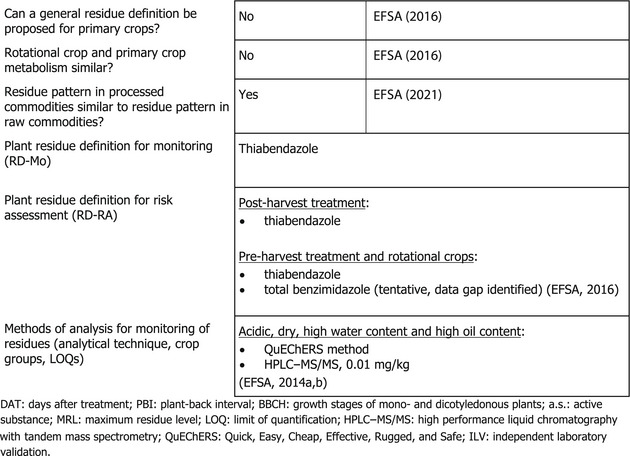
B.1.1.2. Stability of residues in plants
| Plant products (available studies) | Category | Commodity | T (°C) | Stability period | Compounds covered | Comment/Source | |
|---|---|---|---|---|---|---|---|
| Value | Unit | ||||||
| High water content | Spinach | −20 | 24 | Months | Thiabendazole | EFSA (2021) | |
| −20 | 3(a) | Months | Benzimidazole | ||||
| High oil content | Soya beans | −20 | 24 | Months | Thiabendazole | ||
| −20 | 9 | Months | Benzimidazole | ||||
| Dry/High protein content | Dry beans | −20 | 24 | Months | Thiabendazole, Benzimidazole | ||
| Dry/High starch | Barley grain | –20 | 24 | Months | Thiabendazole, Benzimidazole | ||
| High acid content | Oranges | –20 | 24 | Months | Thiabendazole, Benzimidazole | ||
The EMS informed EFSA that a new study to assess the storage stability of benzimidazole in high water content commodities for up to 8 months has been initiated. The final study report will be available in March 2023 (Spain, 2021).
B.1.2. Magnitude of residues in plants
B.1.2.1. Summary of residues data from the supervised residue trials
| Commodity | Region/Indoor (a) | Residue levels observed in the supervised residue trials (mg/kg) | Comments/Source | Calculated MRL (mg/kg) | HR (b) (mg/kg) | STMR (c) (mg/kg) | CF (d) |
|---|---|---|---|---|---|---|---|
| RD‐Mo and RD‐RA1: thiabendazole | |||||||
| Apples | Indoor (post‐harvest) |
Mo: Dipping at 110 g a.s./hL: 1.5; 1.6; 1.7; 1.7; 1.7; 1.7; 1.9; 2.0 Dipping at 120 g a.s./hL: 2.1; 2.3; 2.5; 3.0 |
8 trials on apples with dipping at 110 g a.i./hL and 4 trials on apples with dipping at 120 g a.i./hL (EFSA, 2016). | 4 | 3.0 | 1.80 | n.r. |
| Potatoes | NEU (seed treatment) | < 0.01; < 0.01; < 0.01; < 0.01; < 0.01; 0.01; 0.02; 0.02 | Residue trials on potatoes compliant with GAP (EFSA, 2016). | 0.04 | 0.02 | < 0.01 | n.r. |
| SEU (seed treatment) | < 0.01; < 0.01; < 0.01; < 0.01; < 0.01; < 0.01; < 0.01; 0.02 | Residue trials on potatoes compliant with GAP (EFSA, 2016). | 0.03 | 0.02 | < 0.01 | n.r. | |
| Avocadoes | Import tolerance (post‐harvest) |
243–250 g a.s./hL: 1.32; 2.4; 2.41, 2.6, 2.71, 3.4, 3.55, 4.5 (whole fruits) [0.08; 0.027; 0.05; 0.023; 0.16; 0.010, 0.03; 0.012 (pulp)] |
Residue trials on mangoes compliant with GAP on avocados considering the 25% tolerance (Spain, 2021; EFSA, 2021). | 7 |
4.5 [pulp: 0.16] |
2.66 [pulp: 0.03] |
n.r. |
|
194 g a.s./hL: 1.04, 1.07, 2.39, 2.75 [2 × 0.04, 2 × 0.07 (pulp)] |
Residue trials on mangoes compliant with GAP on avocados considering the 25% tolerance (Spain, 2021). | 6 |
2.75 [pulp: 0.07] |
1.73 [pulp: 0.055] |
n.r. | ||
| RD‐RA2: total benzimidazole | |||||||
| Apples | Indoor (post‐harvest) | – | Not relevant for post‐harvest GAP. | n.r. | n.r. | n.r. | n.r. |
| Potatoes | NEU (seed treatment) | 4 × < 0.01 | Residue trials on potatoes compliant with GAP and analysing for benzimidazole and its conjugates (Spain, 2021). | n.r. | < 0.01 | < 0.01 | n.r. |
| SEU (seed treatment) | 4 × < 0.01 | n.r. | < 0.01 | < 0.01 | n.r. | ||
| Avocadoes | Import tolerance (post‐harvest) |
243–250 g a.s./hL: 4 × < 0.01 |
Not relevant for post‐harvest GAP but 8 available trials confirm the absence of benzimidazole (Spain, 2021). | n.r. | n.r. | n.r. | n.r. |
|
194 g a.s./hL: 4 × < 0.01 |
n.r. | n.r. | n.r. | n.r. | |||
MRL: maximum residue level; GAP: Good Agricultural Practice; Mo: monitoring; RA: risk assessment.
Indicates that the MRL is proposed at the limit of quantification.
n.r.: not relevant (benzimidazole is not considered relevant for enforcement purposes).
In bold the values considered within the risk assessment.
NEU: Outdoor trials conducted in northern Europe, SEU: Outdoor trials conducted in southern Europe, Indoor: indoor EU trials or Country code: if non‐EU trials.
Highest residue. The highest residue for risk assessment refers to the whole commodity and not to the edible portion.
Supervised trials median residue. The median residue for risk assessment refers to the whole commodity and not to the edible portion.
Supervised trials median residue according to the residue definition for monitoring.
Conversion factor to recalculate residues according to the residue definition for monitoring to the residue definition for risk assessment.
B.1.2.2. Residues in rotational crops
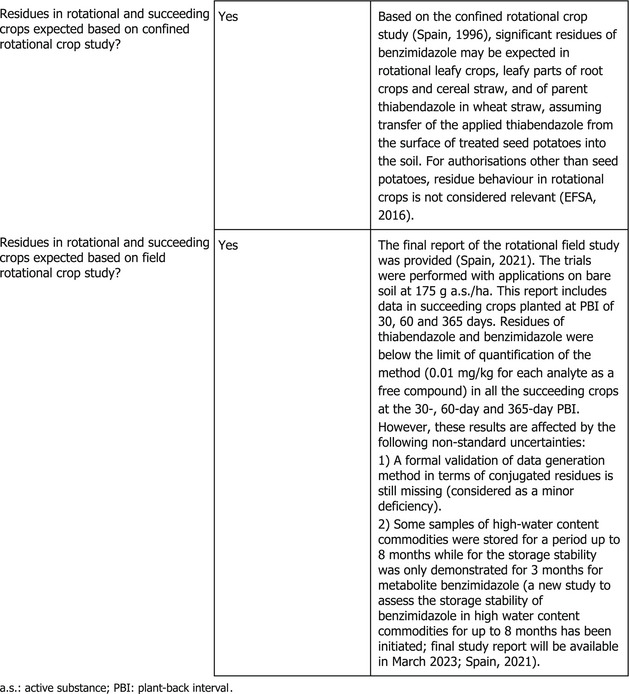
B.1.2.3. Processing factors
No new processing studies were submitted in the framework of the present MRL application.
B.2. Residues in livestock
Dietary burden calculation according to OECD, 2013.
Livestock dietary burden for thiabendazole:
| Dietary burden expressed in | Previous assessment (c) | |||||||
|---|---|---|---|---|---|---|---|---|
| Relevant groups (subgroups) | mg/kg bw per day | mg/kg DM | Most critical subgroup (a) | Most critical commodity (b) | Trigger exceeded (Y/N) | Maximum burden | ||
| Median | Maximum | Median | Maximum | Mg/kg DM | ||||
| Cattle (all) | 0.131 | 0.131 | 3.40 | 3.41 | Dairy cattle | Citrus dried pulp | Y | 3.41 |
| Cattle (dairy only) | 0.131 | 0.131 | 3.40 | 3.41 | Dairy cattle | Citrus dried pulp | Y | 3.41 |
| Sheep (all) | 0.018 | 0.018 | 0.42 | 0.44 | Lamb | Apple pomace, wet | Y | 0.44 |
| Sheep (ewe only) | 0.014 | 0.015 | 0.42 | 0.44 | Ram/Ewe | Apple pomace, wet | Y | 0.44 |
| Swine (all) | 0.059 | 0.060 | 2.56 | 2.59 | Swine (breeding) | Citrus dried pulp | Y | 2.59 |
| Poultry (all) | 0.006 | 0.007 | 0.09 | 0.10 | Poultry broiler | Potato dried pulp | N | 0.10 |
| Poultry (layer only) | 0.005 | 0.005 | 0.07 | 0.07 | Poultry broiler | Potato dried pulp | N | 0.07 |
| Fish | N/A | N/A | N/A | N/A | N/A | N/A | N/A | N/A |
bw: body weight; DM: dry matter.
When one group of livestock includes several subgroups (e.g. poultry ‘all’ including broiler, layer and turkey), the result of the most critical subgroup is identified from the maximum dietary burdens expressed as ‘mg/kg bw per day’.
The most critical commodity is the major contributor identified from the maximum dietary burden expressed as ‘mg/kg bw per day’.
Previous assessment is an EFSA opinion on the modification of the existing MRLs and setting of import tolerances for thiabendazole in various crops (EFSA, 2021).
Livestock dietary burden for benzimidazole:
| Dietary burden expressed in | |||||||
|---|---|---|---|---|---|---|---|
| Relevant groups (subgroups) | mg/kg bw per day | mg/kg DM | Most critical subgroup (a) | Most critical commodity (b) | Trigger exceeded (Y/N) | ||
| Median | Maximum | Median | Maximum | ||||
| Cattle (all) | 0.002 | 0.002 | 0.05 | 0.05 | Dairy cattle | Potato process waste | N |
| Cattle (dairy only) | 0.002 | 0.002 | 0.04 | 0.04 | Dairy cattle | Potato process waste | N |
| Sheep (all) | 0.002 | 0.002 | 0.05 | 0.05 | Ram/Ewe | Potato process waste | N |
| Sheep (ewe only) | 0.002 | 0.002 | 0.05 | 0.05 | Ram/Ewe | Potato process waste | N |
| Swine (all) | 0.001 | 0.001 | 0.04 | 0.04 | Swine (breeding) | Potato process waste | N |
| Poultry (all) | 0.001 | 0.001 | 0.01 | 0.01 | Turkey | Potato culls | N |
| Poultry (layer only) | 0.000 | 0.000 | 0.01 | 0.01 | Poultry layer | Potato culls | N |
| Fish | N/A | N/A | N/A | N/A | N/A | N/A | N/A |
bw: body weight; DM: dry matter.
When one group of livestock includes several subgroups (e.g. poultry ‘all’ including broiler, layer and turkey), the result of the most critical subgroup is identified from the maximum dietary burdens expressed as ‘mg/kg bw per day’.
The most critical commodity is the major contributor identified from the maximum dietary burden expressed as ‘mg/kg bw per day’.
B.2.1. Nature of residues and methods of analysis in livestock
B.2.1.1. Metabolism studies, methods of analysis and residue definitions in livestock
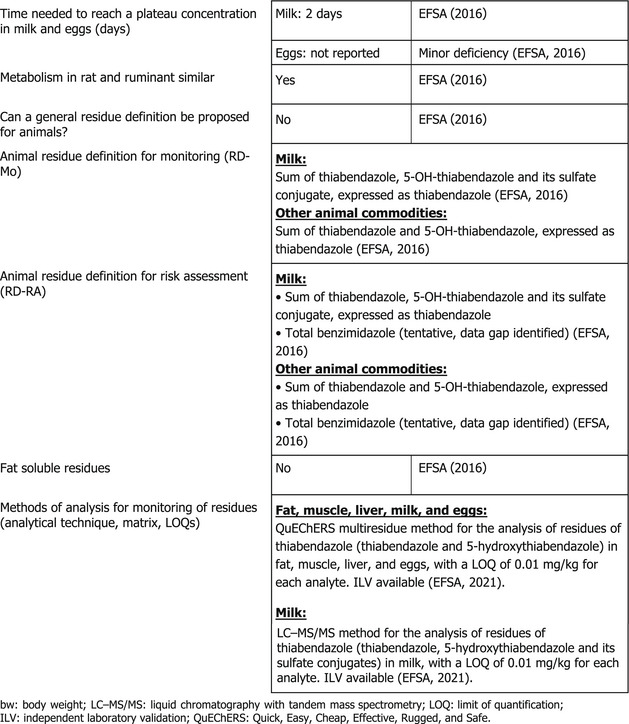
B.2.1.2. Stability of residues in livestock
| Animal products (available studies) | Animal | Commodity | T (°C) | Stability period | Compounds covered | Comment/Source | |
|---|---|---|---|---|---|---|---|
| Value | Unit | ||||||
| Bovine | Muscle | −18 | 3 | Months |
Thiabendazole 5–Hydroxythiabendazole |
Storage stability was demonstrated for thiabendazole and 5‐OH‐thiabendazole (EFSA, 2021). Available data are considered sufficient to address storage stability in all livestock commodities, including conjugates in milk. |
|
| Bovine | Liver | −18 | 3 | Months |
Thiabendazole 5–Hydroxythiabendazole |
||
| Bovine | Milk | −18 | 3 | Months |
Thiabendazole 5–Hydroxythiabendazole |
||
| Poultry | Eggs | −18 | 3 | Months |
Thiabendazole 5–Hydroxythiabendazole |
||
B.2.2. Magnitude of residues in livestock
B.2.2.1. Summary of the residue data from livestock feeding studies
Not relevant for the current assessment. For a summary of the residue data from livestock feeding see EFSA reasoned opinion on the setting of import tolerances for thiabendazole in various crops (EFSA, 2021).
Thiabendazole: the new data assessed in the present application do not modify the livestock dietary burden calculation performed in the previous EFSA opinion on the setting of import tolerances for thiabendazole in various crops. At the updated dietary burden for thiabendazole for the EU livestock, residues of thiabendazole (sum of thiabendazole and 5‐OH‐thiabendazole, also including the sulfate conjugate of 5‐OH‐thiabendazole in milk) are not expected to be present in animal matrices at levels above the LOQ of 0.01 mg/kg (EFSA, 2021).
Benzimidazole: Feeding studies with benzimidazole are not available and not required because the EU dietary burden is below the trigger value.
B.3. Consumer risk assessment
B.3.1. Thiabendazole (and all metabolites expressed as thiabendazole)


B.3.2. Benzimidazole
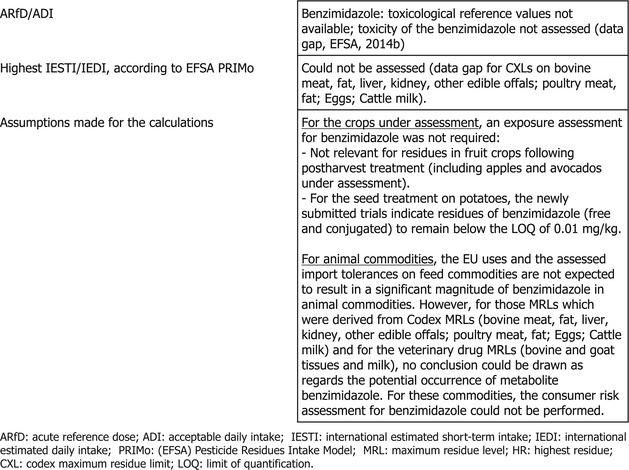
B.4. Recommended MRLs
| Code (a) | Commodity | Existing MRL (b) | Data gap(s) Art.12 Review | Proposed MRL | Conclusion/recommendation |
|---|---|---|---|---|---|
| Enforcement residue definition: Thiabendazole | |||||
| 0130010 | Apples | 4(ft1) | Footnote related to data gaps No 3 and No 9 | 4 | The data gaps identified by EFSA concerning potential consumer exposure to the metabolite benzimidazole (from food and feed) have been addressed for this GAP (post‐harvest). The MRL is confirmed. No consumer intake concerns identified. The previous consumer risk assessment remains valid. |
| 0163010 | Avocados | 20 (ft2) | Footnote related to data gap No 4 | 7 or 15 (Further risk management considerations required) | The data gap identified by EFSA concerning the lack of GAP‐compliant residue trials has been addressed by means of an adjusted GAP and new residue trials. The resulting MRL (7 mg/kg) is lower than the existing tentative EU MRL of 20 mg/kg. An alternative MRL proposal based on the Codex MRL (15 mg/kg) was also identified. Risk for consumers is unlikely for the calculated MRL and for the Codex MRL. |
| 0211000 | Potatoes | 0.04 (ft3) | Footnote related to data gaps No 2, No 3 and No 9 | 0.04 | The data gap identified by EFSA concerning the storage stability of the metabolite benzimidazole has been addressed. The data gaps identified by EFSA concerning potential consumer exposure to the metabolite benzimidazole (from food and feed) have been addressed for this GAP (seed treatment). The MRL is confirmed. No consumer intake concerns identified. The previous consumer risk assessment remains valid. |
| Enforcement residue definition: Sum of thiabendazole and 5‐hydroxythiabendazole, expressed as thiabendazole | |||||
| 1011010 | Swine Muscle | 0.05* (ft4) | Footnote related to data gaps No 6, No 3 and No 9 | 0.01* |
The updated livestock dietary burden indicates that for EU PPP uses of thiabendazole no residues above the LOQ are expected. The MRL proposal at the LOQ is supported by the available data and the risk for consumers is unlikely. There are no CXLs for these commodities. The confirmatory data requirement for information on analytical methods has been addressed. The confirmatory data requirement for information on the magnitude of residues of the metabolite benzimidazole has not been addressed but is superseded by the revised livestock dietary burden calculation where no residues above the LOQ of 0.01 mg/kg are expected to occur in swine commodities. |
| 1011020 | Swine Fat | 0.05* (ft4) | Footnote related to data gaps No 6, No 3 and No 9 | 0.01* | |
| 1011030 | Swine Liver | 0.15 (ft4) | Footnote related to data gaps No 6, No 3 and No 9 | 0.01* | |
| 1011040 | Swine Kidney | 0.3 (ft4) | Footnote related to data gaps No 6, No 3 and No 9 | 0.01* | |
| 1011050 | Swine Edible offals (other than liver and kidney) | 0.3 (ft4) | Footnote related to data gaps No 6, No 3 and No 9 | 0.01* | |
| 1012010 | Bovine Muscle | 0.1 (ft4) | Footnote related to data gaps No 6, No 3 and No 9 | 0.01* or 0.1 (Further risk management considerations required) |
The updated livestock dietary burden indicates that for EU PPP uses of thiabendazole no residues above the LOQ are expected. An MRL proposal at the LOQ is supported by the available data and the risk for consumers is unlikely. The confirmatory data requirement for information on analytical methods has been addressed. The confirmatory data requirement for information on the magnitude of residues of the metabolite benzimidazole has not been addressed for the Codex MRLs of 0.1 mg/kg, on which the existing EU MRL is based. An MRL proposal reflecting the veterinary MRL of 0.1 mg/kg implemented by Commission Regulation 37/2010 can be considered by risk managers. Risk for consumers is unlikely for the Veterinary MRLs and for the Codex MRLs with regard to thiabendazole, however no risk assessment could be done for benzimidazole residues potentially associated to these MRLs. |
| 1012020 | Bovine Fat | 0.1 (ft4) | Footnote related to data gaps No 6, No 3 and No 9 | 0.01* or 0.1 (Further risk management considerations required) | |
| 1012030 | Bovine Liver | 0.3 (ft4) | Footnote related to data gaps No 6, No 3 and No 9 | 0.01* or 0.1 (Further risk management considerations required) |
The updated livestock dietary burden indicates that for EU PPP uses of thiabendazole no residues above the LOQ are expected. The MRL proposal at the LOQ is supported by the available data and the risk for consumers is unlikely. The confirmatory data requirement for information on analytical methods has been addressed. The confirmatory data requirement for information on the magnitude of residues of the metabolite benzimidazole has not been addressed for the Codex MRLs (0.3 and 1 mg/kg) on which the existing EU MRLs are based. An MRL proposal reflecting the veterinary MRL of 0.1 mg/kg implemented by Commission Regulation 37/2010 can be considered by risk managers. Risk for consumers is unlikely for the Veterinary MRLs and for the Codex MRLs with regard to thiabendazole, however no risk assessment could be done for benzimidazole residues potentially associated to these MRLs. |
| 1012040 | Bovine Kidney | 1 (ft4) | Footnote related to data gaps No 6, No 3 and No 9 | 0.01* or 0.1 (Further risk management considerations required) | |
| 1012050 | Bovine Edible offals (other than liver and kidney) | 1 (ft4) | Footnote related to data gaps No 6, No 3 and No 9 | 0.01* or 0.1 (Further risk management considerations required) | |
| 1013010 | Sheep Muscle | 0.05* (ft4) | Footnote related to data gaps No 6, No 3 and No 9 | 0.01* | The updated livestock dietary burden indicates that for EU PPP uses of thiabendazole no residues above the LOQ are expected. The MRL proposal at the LOQ is supported by the available data and the risk for consumers is unlikely. There are no CXLs for these commodities. The confirmatory data requirement for information on analytical methods has been addressed. The confirmatory data requirement for information on the magnitude of residues of the metabolite benzimidazole has not been addressed but is superseded by the revised livestock dietary burden calculation where no residues above the LOQ of 0.01 mg/kg are expected to occur in sheep commodities. |
| 1013020 | Sheep Fat | 0.05* (ft4) | Footnote related to data gaps No 6, No 3 and No 9 | 0.01* | |
| 1013030 | Sheep Liver | 0.15 (ft4) | Footnote related to data gaps No 6, No 3 and No 9 | 0.01* | |
| 1013040 | Sheep Kidney | 0.3 (ft4) | Footnote related to data gaps No 6, No 3 and No 9 | 0.01* | |
| 1013050 | Sheep Edible offals (other than liver and kidney) | 0.3 (ft4) | Footnote related to data gaps No 6, No 3 and No 9 | 0.01* | |
| 1014010 | Goat Muscle | 0.1 (ft4) | Footnote related to data gaps No 6, No 3 and No 9 | 0.01* or 0.1 (Further risk management considerations required) |
The updated livestock dietary burden indicates that for EU PPP uses of thiabendazole no residues above the LOQ are expected. An MRL proposal at the LOQ is supported by the available data and the risk for consumers is unlikely. There are no CXLs for these commodities. The confirmatory data requirement for information on analytical methods has been addressed. The confirmatory data requirement for information on the magnitude of residues of the metabolite benzimidazole has not been addressed but is superseded by the revised livestock dietary burden calculation where no residues above the LOQ of 0.01 mg/kg are expected to occur in goat commodities. An MRL proposal reflecting the veterinary MRL of 0.1 mg/kg implemented by Commission Regulation 37/2010 can be considered by risk managers. Risk for consumers is unlikely for the Veterinary MRLs with regard to thiabendazole, however no risk assessment could be done for benzimidazole residues potentially associated to these MRLs. |
| 1014020 | Goat Fat | 0.1 (ft4) | Footnote related to data gaps No 6, No 3 and No 9 | 0.01* or 0.1 (Further risk management considerations required) | |
| 1014030 | Goat Liver | 0.15 (ft4) | Footnote related to data gaps No 6, No 3 and No 9 | 0.01* or 0.1 (Further risk management considerations required) | |
| 1014040 | Goat Kidney | 0.3 (ft4) | Footnote related to data gaps No 6, No 3 and No 9 | 0.01* or 0.1 (Further risk management considerations required) | |
| 1014050 | Goat Edible offals (other than liver and kidney) | 0.3 (ft4) | Footnote related to data gaps No 6, No 3 and No 9 | 0.01* or 0.1 (Further risk management considerations required) | |
| 1015010 | Equine Muscle | 0.05* (ft4) | Footnote related to data gaps No 6, No 3 and No 9 | 0.01* | The updated livestock dietary burden indicates that for EU PPP uses of thiabendazole no residues above the LOQ are expected. The MRL proposal at the LOQ is supported by the available data and the risk for consumers is unlikely. There are no CXLs for these commodities. The confirmatory data requirement for information on analytical methods has been addressed. The confirmatory data requirement for information on the magnitude of residues of the metabolite benzimidazole has not been addressed but is superseded by the revised livestock dietary burden calculation where no residues above the LOQ of 0.01 mg/kg are expected to occur in equine commodities. |
| 1015020 | Equine Fat | 0.05* (ft4) | Footnote related to data gaps No 6, No 3 and No 9 | 0.01* | |
| 1015030 | Equine Liver | 0.15 (ft4) | Footnote related to data gaps No 6, No 3 and No 9 | 0.01* | |
| 1015040 | Equine Kidney | 0.3 (ft4) | Footnote related to data gaps No 6, No 3 and No 9 | 0.01* | |
| 1015050 | Equine Edible offals (other than liver and kidney) | 0.3 (ft4) | Footnote related to data gaps No 6, No 3 and No 9 | 0.01* | |
| 1,016,010 | Poultry Muscle | 0.05 (ft4) | Footnote related to data gaps No 6, No 3 and No 9 |
0.01* |
The updated livestock dietary burden indicates that for EU PPP uses of thiabendazole no residues above the LOQ are expected. The MRL proposal at the LOQ is supported by the available data and the risk for consumers is unlikely. The confirmatory data requirement for information on analytical methods has been addressed. The confirmatory data requirement for information on the magnitude of residues of the metabolite benzimidazole has not been addressed for the Codex MRLs of 0.05 mg/kg on which the existing EU MRL is based. Risk for consumers is unlikely for the for the Codex MRLs with regard to thiabendazole, however no risk assessment could be done for benzimidazole residues potentially associated to these MRLs. |
| 1016020 | Poultry Fat | 0.05 (ft4) | Footnote related to data gaps No 6, No 3 and No 9 | 0.01* | |
| 1016030 | Poultry Liver | 0.2 (ft4) | Footnote related to data gaps No 6, No 3 and No 9 | 0.01* | The updated livestock dietary burden indicates that for EU PPP uses of thiabendazole no residues above the LOQ are expected. The MRL proposal at the LOQ is supported by the available data and the risk for consumers is unlikely. There are no CXLs for these commodities. The confirmatory data requirement for information on analytical methods has been addressed. The confirmatory data requirement for information on the magnitude of residues of the metabolite benzimidazole has not been addressed but is superseded by the revised livestock dietary burden calculation where no residues above the LOQ of 0.01 mg/kg are expected to occur in these commodities. |
| 1016040 | Poultry Kidney | 0.2 (ft4) | Footnote related to data gaps No 6, No 3 and No 9 | 0.01* | |
| 1016050 | Poultry Edible offals (other than liver and kidney) | 0.2 (ft4) | Footnote related to data gaps No 6, No 3 and No 9 | 0.01* | |
| 1017010 | Other farmed terrestrial animals: Muscle | 0.05* (ft4) | Footnote related to data gaps No 6, No 3 and No 9 | 0.01* | |
| 1017020 | Other farmed terrestrial animals: Fat | 0.05* (ft4) | Footnote related to data gaps No 6, No 3 and No 9 | 0.01* | |
| 1017030 | Other farmed terrestrial animals: Liver | 0.15 (ft4) | Footnote related to data gaps No 6, No 3 and No 9 | 0.01* | |
| 1017040 | Other farmed terrestrial animals: Kidney | 0.3 (ft4) | Footnote related to data gaps No 6, No 3 and No 9 | 0.01* | |
| 1017050 | Other farmed terrestrial animals: Edible offals (other than liver and kidney) | 0.3 (ft4) | Footnote related to data gaps No 6, No 3 and No 9 | 0.01* | |
| Enforcement residue definition: sum of thiabendazole, 5‐hydroxythiabendazole and its sulfate conjugate, expressed as thiabendazole | |||||
| 1020010 | Milk Cattle | 0.2 (ft4) | Footnote related to data gaps No 7, No 3 and No 9 | 0.01* or 0.1 (Further risk management considerations required) |
The updated livestock dietary burden indicates that for EU PPP uses of thiabendazole no residues above the LOQ are expected. The MRL proposal at the LOQ is supported by the available data and the risk for consumers is unlikely. The confirmatory data requirement for information on analytical methods has been addressed. The confirmatory data requirement for information on the magnitude of residues of the metabolite benzimidazole has not been addressed for the Codex MRLs of 0.2 mg/kg, on which the existing EU MRL is based. An MRL proposal reflecting the veterinary MRL of 0.1 mg/kg implemented by Commission Regulation 37/2010 can be considered by risk managers. Risk for consumers is unlikely for the Veterinary MRL and for the Codex MRL with regard to thiabendazole, however no risk assessment could be done for benzimidazole residues potentially associated to these MRLs |
| 1,020,020 | Milk Sheep | 0.2 (ft4) | Footnote related to data gaps No 7, No 3 and No 9 | 0.01* | The updated livestock dietary burden indicates that for EU PPP uses of thiabendazole no residues above the LOQ are expected. The MRL proposal at the LOQ is supported by the available data and the risk for consumers is unlikely. There is no CXL for this commodity. The confirmatory data requirement for information on analytical methods has been addressed. The confirmatory data requirement for information on the magnitude of residues of the metabolite benzimidazole has not been addressed but is superseded by the revised livestock dietary burden calculation where no residues above the LOQ of 0.01 mg/kg are expected to occur in sheep milk. |
| 1020030 | Milk Goat | 0.2 (ft4) | Footnote related to data gaps No 7, No 3 and No 9 | 0.01* or 0.1 (Further risk management considerations required) |
The updated livestock dietary burden indicates that for EU PPP uses of thiabendazole no residues above the LOQ are expected. The MRL proposal at the LOQ is supported by the available data and the risk for consumers is unlikely. There is no CXL for this commodity. The confirmatory data requirement for information on analytical methods has been addressed. The confirmatory data requirement for information on the magnitude of residues of the metabolite benzimidazole has not been addressed but is superseded by the revised livestock dietary burden calculation where no residues above the LOQ of 0.01 mg/kg are expected to occur in goat milk. An MRL proposal reflecting the veterinary MRL of 0.1 mg/kg implemented by Commission Regulation 37/2010 can be considered by risk managers. Risk for consumers is unlikely for the Veterinary MRL with regard to thiabendazole, however no risk assessment could be done for benzimidazole residues potentially associated to this MRL. |
| 1020040 | Milk Horse | 0.2 (ft4) | Footnote related to data gaps No 7, No 3 and No 9 | 0.01* | The updated livestock dietary burden indicates that for EU PPP uses of thiabendazole no residues above the LOQ are expected. The MRL proposal at the LOQ is supported by the available data and the risk for consumers is unlikely. There are no CXLs for these commodities. The confirmatory data requirement for information on analytical methods has been addressed. The confirmatory data requirement for information on the magnitude of residues of the metabolite benzimidazole has not been addressed but is superseded by the revised livestock dietary burden calculation where no residues above the LOQ of 0.01 mg/kg are expected to occur in horse milk and other milks. |
| 1020990 | Milk Others | 0.2 (ft4) | Footnote related to data gaps No 7, No 3 and No 9 | 0.01* | |
| Enforcement residue definition: Sum of thiabendazole and 5‐hydroxythiabendazole, expressed as thiabendazole | |||||
| 1030000 | Birds eggs | 2 (ft4) | Footnote related to data gaps No 6, No 3 and No 9 | 0.01* |
The updated livestock dietary burden indicates that for EU PPP uses of thiabendazole no residues above the LOQ are expected. The MRL proposal at the LOQ is supported by the available data and the risk for consumers is unlikely. The confirmatory data requirement for information on analytical methods has been addressed. There is a Codex MRL of 0.1 mg/kg for this commodity but the confirmatory data requirement for information on the magnitude of residues of the metabolite benzimidazole would also apply to this CXL and it has not been addressed. Risk for consumers is unlikely for the for the Codex MRL with regard to thiabendazole, however no risk assessment could be done for benzimidazole residues potentially associated to this MRL. |
MRL: maximum residue level; NEU: northern Europe; SEU: southern Europe; GAP: Good Agricultural Practice; LOQ: limit of quantification; CXL: Codex maximum residue limit.
Commodity code number according to Annex I of Regulation (EC) No 396/2005.
Existing EU MRL and corresponding footnote on confirmatory data.
ft 1: The European Food Safety Authority identified some information on the magnitude of residues of the metabolite benzimidazole as unavailable. When re‐viewing the MRL, the Commission will take into account the information referred to in the first sentence, if it is submitted by 1 July 2019, or, if that information is not submitted by that date, the lack of it.
ft 2: The European Food Safety Authority identified some information on residue trials as unavailable. When re‐viewing the MRL, the Commission will take into account the information referred to in the first sentence, if it is submitted by 1 July 2019, or, if that information is not submitted by that date, the lack of it.
ft 3: The European Food Safety Authority identified some information on storage stability and on the magnitude of residues of the metabolite benzimidazole as unavailable. When re‐viewing the MRL, the Commission will take into account the information referred to in the first sentence, if it is submitted by 1 July 2019, or, if that information is not submitted by that date, the lack of it.
ft 4: The European Food Safety Authority identified some information on analytical methods and on the magnitude of residues of the metabolite benzimidazole as unavailable. When re‐viewing the MRL, the Commission will take into account the information referred to in the first sentence, if it is submitted by 1 July 2019, or, if that information is not submitted by that date, the lack of it.
Appendix C – Pesticide Residue Intake Model (PRIMo)

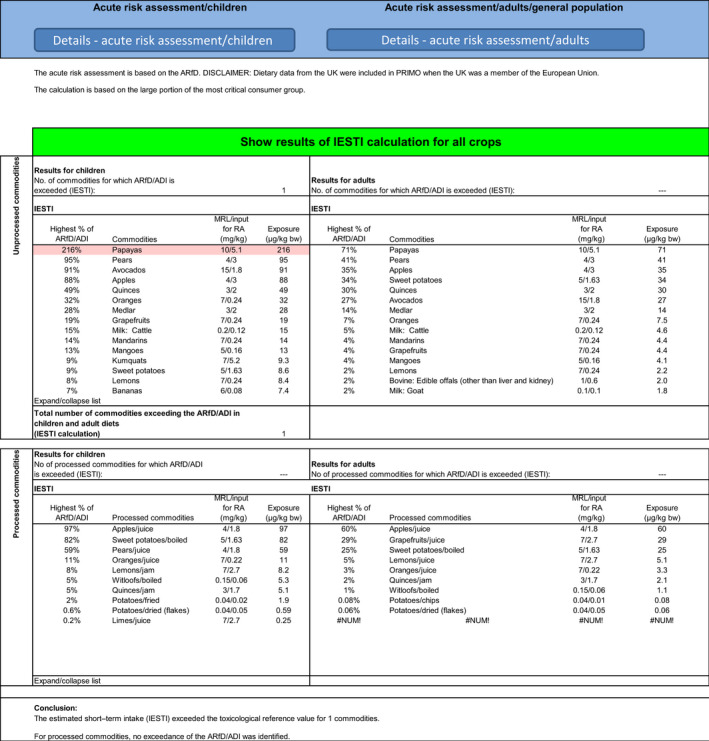
Appendix D – Input values for the exposure calculations
D.1. Livestock dietary burden calculations
| Feed commodity | Median dietary burden | Maximum dietary burden | ||
|---|---|---|---|---|
| Input value (mg/kg) | Comment | Input value (mg/kg) | Comment | |
| Risk assessment residue definition 1: thiabendazole | ||||
| Apple pomace, wet | 1.64 | STMR (1.80) × PF (0.9) (EFSA, 2016) | 1.64 | STMR (1.80) × PF (0.9) (EFSA, 2016) |
| Citrus, dried pulp | 15.39 | STMR (2.70) (FAO, 2007) × PF (5.7) (EFSA, 2021) (a) | 15.39 | STMR (2.70) (FAO, 2007) × PF (5.7) (EFSA, 2021) (a) |
| Potato culls | < 0.01 | STMR seed treatment (EFSA, 2021) | 0.02 | HR seed treatment (EFSA, 2021) |
| Potato process waste | 0.06 | STMR seed potato × PF (5.5) (EFSA, 2021) | 0.06 | STMR seed potato × PF (5.5) (EFSA, 2021) |
| Potato dried pulp | 0.38 | STMR seed potato × default PF (38) (b) (EFSA, 2021) | 0.38 | STMR seed potato × default PF (38) (b) (EFSA, 2021) |
| Risk assessment residue definition 2: total benzimidazole | ||||
| Apple pomace, wet | – | Not relevant (c) | – | Not relevant (c) |
| Citrus, dried pulp | – | Not relevant (c) | – | Not relevant (c) |
| Potato culls | < 0.01 | STMR | < 0.01 | HR |
| Potato process waste | < 0.01 | STMR (d) | < 0.01 | STMR (d) |
| Potato dried pulp | < 0.01 | STMR (d) | < 0.01 | STMR (d) |
STMR: supervised trials median residue; HR: highest residue; PF: processing factor.
For citrus fruits, the existing EU MRL of 7 mg/kg covers the CXL and therefore the STMR value derived by the JMPR (STMR = 2.7) was used as input value (EFSA, 2021).
In the absence of processing factors supported by data, the default processing factor for potatoes dried pulp was included in the calculation to consider the potential concentration of residues in this commodity.
No input values for benzimidazole are considered for apples and citrus because this metabolite is not relevant for the authorised GAP (post‐harvest use) on these crops.
For potato process waste and dried pulp, no default processing factors were applied to benzimidazole residues because this metabolite was found to be below the LOQ in this crop. Concentration of residues in these commodities is therefore not expected.
D.2. Consumer risk assessment
D.2.1. Thiabendazole (and all metabolites expressed as thiabendazole)
| Commodity | Existing/Proposed MRL (mg/kg) | Source | Chronic risk assessment | Acute risk assessment | ||
|---|---|---|---|---|---|---|
| Input value (mg/kg) | Comment | Input value (mg/kg) | Comment (a) | |||
| Risk assessment residue definition: thiabendazole | ||||||
| Grapefruits | 7 | Existing MRL (EFSA, 2016, 2021) | 0.127 | STMR‐RAC (CXL, 2.7) (FAO, 2007) × PeF (0.047) | 0.244 | HR‐RAC (CXL, 5.2) (FAO, 2007) × PeF (0.047) |
| Oranges | 7 | Existing MRL (EFSA, 2016, 2021) | 0.127 | STMR‐RAC (CXL, 2.7) (FAO, 2007) × PeF (0.047) | 0.244 | HR‐RAC (CXL, 5.2) (FAO, 2007) × PeF (0.047) |
| Oranges/juice | – | – | – | – | 0.216 | STMR‐RAC (CXL, 2.7) (FAO, 2007) × PF (0.08) (EFSA, 2016) |
| Lemons | 7 | Existing MRL (EFSA, 2016, 2021) | 0.127 | STMR‐RAC (CXL, 2.7) (FAO, 2007) × PeF (0.047) | 0.244 | HR‐RAC (CXL, 5.2) (FAO, 2007) × PeF (0.047) |
| Limes | 7 | Existing MRL (EFSA, 2016, 2021) | 0.127 | STMR‐RAC (CXL, 2.7) (FAO, 2007) × PeF (0.047) | 0.244 | HR‐RAC (CXL, 5.2) (FAO, 2007) × PeF (0.047) |
| Mandarins | 7 | Existing MRL (EFSA, 2016, 2021) | 0.127 | STMR‐RAC (CXL, 2.7) (FAO, 2007) × PeF (0.047) | 0.244 | HR‐RAC (CXL, 5.2) (FAO, 2007) × PeF (0.047) |
| Other citrus fruit | 7 | Existing MRL (EFSA, 2016, 2021) | 0.127 | STMR‐RAC (CXL, 2.7) (FAO, 2007) × PeF (0.047) | – | – |
| Apples | 4 | Existing MRL (EFSA, 2016) | 1.8 | STMR‐RAC | 3.0 |
HR‐RAC VF: 1.6 |
| Pears | 4 | Existing MRL (EFSA, 2016) | 1.8 | STMR‐RAC | 3.0 |
HR‐RAC VF: 1.6 |
| Quinces | 3 | Existing MRL (EFSA, 2016) | 1.7 | STMR‐RAC (CXL) | 2.0 | HR‐RAC (CXL) |
| Medlar | 3 | Existing MRL (EFSA, 2016) | 1.7 | STMR‐RAC (CXL) | 2.0 | HR‐RAC (CXL) |
| Loquats/Japanese medlars | 3 | Existing MRL (EFSA, 2016) | 1.7 | STMR‐RAC (CXL) | 2.0 | HR‐RAC (CXL) |
| Kumquats | 7 | Existing MRL (EFSA, 2016) | 2.7 | STMR‐RAC (CXL) | 5.2 | HR‐RAC (CXL) |
| Avocados | 15 | Codex MRL (FAO, 2000) | 0.9 | STMR‐pulp (CXL) | 1.8 | HR‐pulp (CXL) |
| Bananas | 6 | Existing MRL (EFSA, 2016, 2021) | 0.050 | STMR‐RAC × PeF (0.023) | 0.077 | HR‐RAC × PeF (0.023) |
| Mangoes | 5 | Existing MRL (EFSA, 2021) | 0.03 | STMR‐pulp | 0.16 | HR‐pulp |
| Papayas | 10 | Existing MRL (EFSA, 2016) | 3.80 | STMR‐RAC | 5.10 | HR‐RAC |
| Potatoes | 0.04 | Existing MRL (EFSA, 2016) | 0.01 | STMR‐RAC (seed treatment) | 0.02 | HR‐RAC (seed treatment) |
| Sweet potatoes | 3 | Existing MRL (EFSA, 2021) | 0.51 | STMR‐RAC | 1.63 | HR‐RAC |
| Witloofs/Belgian endives | 0.15 | Existing MRL (EFSA, 2021) | 0.03 | STMR‐RAC | 0.06 | HR‐RAC |
| Risk assessment residue definition: sum of thiabendazole and 5‐hydroxythiabendazole, expressed as thiabendazole | ||||||
| Swine: Muscle/meat | 0.01* |
Proposed MRL (b) (EFSA, 2021) |
0.01 | STMR‐RAC | 0.01 | HR‐RAC |
| Swine: Fat tissue | 0.01* |
Proposed MRL (b) (EFSA, 2021) |
0.01 | STMR‐RAC | 0.01 | HR‐RAC |
| Swine: Liver | 0.01* |
Proposed MRL (b) (EFSA, 2021) |
0.01 | STMR‐RAC | 0.01 | HR‐RAC |
| Swine: Kidney | 0.01* |
Proposed MRL (b) (EFSA, 2021) |
0.01 | STMR‐RAC | 0.01 | HR‐RAC |
| Swine: Edible offals (other than liver and kidney) | 0.01* |
Proposed MRL (b) (EFSA, 2021) |
0.01 | STMR‐RAC | 0.01 | HR‐RAC |
| Bovine: Muscle/meat | 0.1 | Existing MRL (EFSA, 2016) | 0.1 | STMR‐RAC (CXL, tentative) (c) | 0.1 | HR‐RAC (CXL, tentative) (c) |
| Bovine: Fat tissue | 0.1 | Existing MRL (EFSA, 2016) | 0.1 | STMR‐RAC (CXL, tentative) (c) | 0.1 | HR‐RAC (CXL, tentative) (c) |
| Bovine: Liver | 0.3 | Existing MRL (EFSA, 2016) | 0.2 | STMR‐RAC (CXL, tentative) (c) | 0.21 | HR‐RAC (CXL, tentative) (c) |
| Bovine: Kidney | 1 | Existing MRL (EFSA, 2016) | 0.50 | STMR‐RAC (CXL, tentative) (c) | 0.60 | HR‐RAC (CXL, tentative) (c) |
| Bovine: Edible offals (other than liver and kidney) | 1 | Existing MRL (EFSA, 2016) | 0.50 | STMR‐RAC (CXL, tentative) (c) | 0.60 | HR‐RAC (CXL, tentative) (c) |
| Sheep: Muscle/meat | 0.01* |
Proposed MRL (b) (EFSA, 2021) |
0.01 | STMR‐RAC | 0.01 | HR‐RAC |
| Sheep: Fat tissue | 0.01* |
Proposed MRL (b) (EFSA, 2021) |
0.01 | STMR‐RAC | 0.01 | HR‐RAC |
| Sheep: Liver | 0.01* |
Proposed MRL (b) (EFSA, 2021) |
0.01 | STMR‐RAC | 0.01 | HR‐RAC |
| Sheep: Kidney | 0.01* |
Proposed MRL (b) (EFSA, 2021) |
0.01 | STMR‐RAC | 0.01 | HR‐RAC |
| Sheep: Edible offals (other than liver and kidney) | 0.01* |
Proposed MRL (b) (EFSA, 2021) |
0.01 | STMR‐RAC | 0.01 | HR‐RAC |
| Goat: Muscle/meat | 0.1 | Commission Regulation No 37/2010 | 0.10 | Veterinary MRL | 0.10 | Veterinary MRL |
| Goat: Fat tissue | 0.1 | Commission Regulation No 37/2010 | 0.10 | Veterinary MRL | 0.10 | Veterinary MRL |
| Goat: Liver | 0.1 | Commission Regulation No 37/2010 | 0.10 | Veterinary MRL | 0.10 | Veterinary MRL |
| Goat: Kidney | 0.1 | Commission Regulation No 37/2010 | 0.10 | Veterinary MRL | 0.10 | Veterinary MRL |
| Goat: Edible offals (other than liver and kidney) | 0.1 | Commission Regulation No 37/2010 | 0.10 | Veterinary MRL liver, kidney | 0.10 | Veterinary MRL liver, kidney |
| Equine: Muscle/meat | 0.01* |
Proposed MRL (b) (EFSA, 2021) |
0.01 | STMR‐RAC | 0.01 | HR‐RAC |
| Equine: Fat tissue | 0.01* |
Proposed MRL (b) (EFSA, 2021) |
0.01 | STMR‐RAC | 0.01 | HR‐RAC |
| Equine: Liver | 0.01* |
Proposed MRL (b) (EFSA, 2021) |
0.01 | STMR‐RAC | 0.01 | HR‐RAC |
| Equine: Kidney | 0.01* |
Proposed MRL (b) (EFSA, 2021) |
0.01 | STMR‐RAC | 0.01 | HR‐RAC |
| Equine: Edible offals (other than liver and kidney) | 0.01* |
Proposed MRL (b) (EFSA, 2021) |
0.01 | STMR‐RAC | 0.01 | HR‐RAC |
| Poultry: Muscle/meat | 0.05 | Existing MRL (EFSA, 2016) | 0.05 | STMR‐RAC (CXL, tentative) (c) (FAO, 1997) | 0.05 | HR‐RAC (CXL, tentative) (c) (FAO, 1997) |
| Poultry: Fat tissue | 0.05 | Existing MRL (EFSA, 2016) | 0.05 | STMR‐RAC (CXL, tentative) (c) (FAO, 1997) | 0.05 | HR‐RAC (CXL, tentative) (c) (FAO, 1997) |
| Poultry: Liver | 0.01* |
Proposed MRL (b) (EFSA, 2021) |
0.01 | STMR‐RAC | 0.01 | HR‐RAC |
| Poultry: Kidney | 0.01* |
Proposed MRL (b) (EFSA, 2021) |
0.01 | STMR‐RAC | 0.01 | HR‐RAC |
| Poultry: Edible offals (other than liver and kidney) | 0.01* |
Proposed MRL (b) (EFSA, 2021) |
0.01 | STMR‐RAC | 0.01 | HR‐RAC |
| Other farmed terrestrial animals: Muscle | 0.01* |
Proposed MRL (b) (EFSA, 2021) |
0.01 | STMR‐RAC | 0.01 | HR‐RAC |
| Other farmed terrestrial animals: Fat | 0.01* |
Proposed MRL (b) (EFSA, 2021) |
0.01 | STMR‐RAC | 0.01 | HR‐RAC |
| Other farmed terrestrial animals: Liver | 0.01* |
Proposed MRL (b) (EFSA, 2021) |
0.01 | STMR‐RAC | 0.01 | HR‐RAC |
| Other farmed terrestrial animals: Kidney | 0.01* |
Proposed MRL (b) (EFSA, 2021) |
0.01 | STMR‐RAC | 0.01 | HR‐RAC |
| Other farmed terrestrial animals: Edible offals (other than liver and kidney) | 0.01* |
Proposed MRL (b) (EFSA, 2021) |
0.01 | STMR‐RAC | 0.01 | HR‐RAC |
| Eggs: Chicken | 0.1 | Codex MRL (FAO, 1997) | 0.1 | STMR‐RAC (CXL, tentative) (c) | 0.1 | HR‐RAC (CXL, tentative) (c) |
| Eggs: Duck | 0.1 | Codex MRL (FAO, 1997) | 0.1 | STMR‐RAC (CXL, tentative) (c) | 0.1 | HR‐RAC (CXL, tentative) (c) |
| Eggs: Goose | 0.1 | Codex MRL (FAO, 1997) | 0.1 | STMR‐RAC (CXL, tentative) (c) | 0.1 | HR‐RAC (CXL, tentative) (c) |
| Eggs: Quail | 0.1 | Codex MRL (FAO, 1997) | 0.1 | STMR‐RAC (CXL, tentative) (c) | 0.1 | HR‐RAC (CXL, tentative) (c) |
| Eggs: Others | 0.1 | Codex MRL (FAO, 1997) | 0.1 | STMR‐RAC (CXL, tentative) (c) | – | – |
| Risk assessment residue definition: sum of thiabendazole, 5‐hydroxythiabendazole and its sulfate conjugate, expressed as thiabendazole | ||||||
| Milk: Cattle | 0.2 | Existing MRL (EFSA, 2016) | 0.12 | STMR‐RAC (CXL, tentative) (c) (FAO, 2000) | 0.12 | STMR‐RAC (CXL, tentative) (c) (FAO, 2000) |
| Milk: Sheep | 0.01* | Proposed MRL (b) (EFSA, 2021) | 0.01 | STMR‐RAC | 0.01 | STMR‐RAC |
| Milk: Goat | 0.1 | Commission Regulation No 37/2010 | 0.1 | Veterinary MRL | 0.1 | Veterinary MRL |
| Milk: Horse | 0.01* | Proposed MRL (b) (EFSA, 2021) | 0.01 | STMR‐RAC | 0.01 | STMR‐RAC |
STMR‐RAC: supervised trials median residue in raw agricultural commodity; HR‐RAC: highest residue in raw agricultural commodity; PeF: Peeling factor.
Input values for the commodities which are not under consideration for the acute risk assessment are reported in grey.
The existing MRL was derived from a higher dietary burden, based on a more critical GAP on consumption potatoes which is not relevant anymore. Therefore, a new MRL value (lower) is proposed based on the updated (lower) EU dietary burden calculated in the context of the present assessment.
MRL and input values derived from Codex MRL are considered tentative because of the lack of information regarding the occurrence and toxicity of the metabolite benzimidazole.
D.2.2. Benzimidazole
For the uses under assessment, the consumer exposure to benzimidazole is not relevant.
Lacking information on the magnitude of residues of the metabolite benzimidazole in animal matrices and lacking toxicological reference values for benzimidazole, the risk assessment for consumer exposure to benzimidazole via commodities of animal origin could not be performed for the existing MRLs for animal commodities which were previously derived from Codex MRLs (EFSA, 2016). Similarly, the risk assessment for consumer exposure to benzimidazole via commodities of animal origin could not be performed for veterinary drug MRLs.
Appendix E – Used compound codes
| Code/trivial name (a) | IUPAC name/SMILES notation/InChiKey (b) | Structural formula (c) |
|---|---|---|
|
Thiabendazole MK 360 CGA 28020 |
2‐(1,3‐thiazol‐4‐yl)‐1H‐benzimidazole [NH]1c2ccccc2nc1c1cscn1 WJCNZQLZVWNLKY‐UHFFFAOYSA‐N |

|
|
5‐hydroxythiabendazole NOA 415696 |
2‐(1,3‐thiazol‐4‐yl)‐1H‐benzimidazol‐5‐ol Oc1cc2nc([NH]c2cc1)c1cscn1 VNENJHUOPQAPAT‐UHFFFAOYSA‐N |

|
| 5‐hydroxythiabendazole O‐sulfate conjugate |
2‐(1,3‐thiazol‐4‐yl)‐1H‐benzimidazol‐5‐yl hydrogen sulfate O=S(=O)(O)Oc1cc2nc([NH]c2cc1)c1cscn1 FYTJWBDCONMFDZ‐UHFFFAOYSA‐N |

|
|
benzimidazole CGA 18306 |
1H‐benzimidazole c1cccc2[NH]cnc12 HYZJCKYKOHLVJF‐UHFFFAOYSA‐N |

|
IUPAC: International Union of Pure and Applied Chemistry; SMILES: simplified molecular‐input line‐entry system; InChiKey: International Chemical Identifier Key.
The metabolite name in bold is the name used in the conclusion.
ACD/Name 2020.2.1 ACD/Labs 2020 Release (File version N15E41, Build 116563, 15 June 2020).
ACD/ChemSketch 2020.2.1 ACD/Labs 2020 Release (File version C25H41, Build 121153, 22 March 2021).
Suggested citation: EFSA (European Food Safety Authority) , Bellisai G, Bernasconi G, Brancato A, Carrasco Cabrera L, Castellan I, Ferreira L, Giner G, Greco L, Jarrah S, Leuschner R, Magrans JO, Miron I, Nave S, Pedersen R, Reich H, Robinson T, Ruocco S, Santos M, Scarlato AP, Theobald A and Verani A, 2022. Reasoned opinion on the evaluation of confirmatory data following the Article 12 MRL review for thiabendazole. EFSA Journal 2022;20(8):7539, 54 pp. 10.2903/j.efsa.2022.7539
Requestor European Commission
Question numbers EFSA‐Q‐2021‐00733
Declarations of interest If you wish to access the declaration of interests of any expert contributing to an EFSA scientific assessment, please contact interestmanagement@efsa.europa.eu.
Adopted: 22 July 2022
Notes
(EC) No 396/2005 of the Parliament and of the Council of 23 February 2005 on maximum residue levels of pesticides in or on food and feed of plant and animal origin and amending Council Directive 91/414/EEC. OJ L 70, 16.03.2005, p. 1–16.
Regulation (EC) No 1107/2009 of the European Parliament and of the Council of 21 October 2009 concerning the placing of plant protection products on the market and repealing Council Directives 79/117/EEC and 91/414/EEC. OJ L 309, 24.11.2009, p. 1–50.
Commission Regulation (EU) 2017/1164 of 22 June 2017 amending Annexes II and III to Regulation (EC) No 396/2005 of the European Parliament and of the Council as regards maximum residue levels for acrinathrin, metalaxyl and thiabendazole in or on certain products. C/2017/4185. OJ L 170, 1.7.2017, p. 3–30.
Commission Regulation (EU) No 544/2011 of 10 June 2011 implementing Regulation (EC) No 1107/2009 of the European Parliament and of the Council as regards the data requirements for active substances. OJ L 155, 11.6.2011, p. 1–66.
Commission Regulation (EU) No 546/2011 of 10 June 2011 implementing Regulation (EC) No 1107/2009 of the European Parliament and of the Council as regards uniform principles for evaluation and authorisation of plant protection products. OJ L 155, 11.6.2011, p. 127–175.
A detailed and reproducible evaluation of the study investigating the nature of residues after pasteurisation, cooking, brewing and sterilisation in order to judge the validity of the study.
Final study report on storage stability data covering the entire storage period in the residue trials with potatoes and witloof.
Data to address the potential for consumer exposure and toxicological properties for the metabolite benzimidazole.
Final study report on storage stability data covering the entire storage period in the residues trials with potatoes and witloof.
Data gap number 4: One additional trial compliant with the GAP on avocados by spraying and further data to confirm the tentative PF derived for peeling of avocados.
Data gap number 1: a detailed and reproducible evaluation of the study investigating the nature of residues after pasteurisation, cooking, brewing and sterilisation in order to judge the validity of the study.
The completed rotational crop residue trials for SEU and data to demonstrate the efficiency of the hydrolysis step in the analytical method to release conjugated residues in order to validate the already submitted rotational crop residue trial data.
Data to address the magnitude of potential residues of benzimidazole in animal commodities, considering dietary exposure to benzimidazole residues via feed items and benzimidazole generated in vivo upon exposure of livestock to residues of thiabendazole via feed items.
A risk to consumers could not be excluded for the critical GAP on consumer potatoes (EFSA, 2016).
A validated analytical method (with its independent laboratory validation (ILV) and a confirmatory method) for the determination of the sum of thiabendazole and 5‐hydroxythiabendazole in animal tissues and eggs.
A validated analytical method (with its ILV and a confirmatory method) for the determination of the sum of thiabendazole, 5‐hydroxythiabendazole and its sulfate conjugates in milk.
Storage conditions of the livestock feeding study samples or, if it cannot be demonstrated that study samples were stored for less than 3 months under frozen conditions, a storage stability study investigating stability for longer storage intervals.
Nota bene: The updated livestock dietary burden was calculated considering the use on seed potatoes instead of the use on consumption potatoes (which is not supported). This explains the lower livestock dietary burden compared to the one derived in the revised MRL review.
Commission Regulation No 37/2010 of 22 December 2009 on pharmacologically active substances and their classification regarding maximum residue limits in foodstuffs of animal origin. OJ L 15, 20.1.2010, p. 1–72.
A veterinary drug MRL of 0.1 mg/kg is defined for the sum of thiabendazole and 5‐hydroxythiabendazole in bovine and goat tissues and milk.
References
- EFSA (European Food Safety Authority) , 2014a. Reasoned opinion on the review of the existing maximum residue levels (MRLs) for thiabendazole according to Article 12 of Regulation (EC) No 396/2005. EFSA Journal 2014; 12(7):3750, 54 pp. 10.2903/j.efsa.2014.3750 [DOI] [Google Scholar]
- EFSA (European Food Safety Authority) , 2014b. Conclusion on the peer review of the pesticide risk assessment of the active substance thiabendazole. EFSA Journal 2014;12(11):3880, 57 pp. 10.2903/j.efsa.2014.3880 [DOI] [Google Scholar]
- EFSA (European Food Safety Authority) , 2016. Reasoned opinion on the revision of the review of the existing maximum residue levels for thiabendazole. EFSA Journal 2016;14(6):4516, 45 pp. 10.2903/j.efsa.2016.4516 [DOI] [Google Scholar]
- EFSA (European Food Safety Authority) , Brancato A, Brocca D, Ferreira L, Greco L, Jarrah S, Leuschner R, Medina P, Miron I, Nougadere A, Pedersen R, Reich H, Santos M, Stanek A, Tarazona J, Theobald A and Villamar‐Bouza L, 2018. Guidance on use of EFSA Pesticide Residue Intake Model (EFSA PRIMo revision 3). EFSA Journal 2018;16(1):5147, 43 pp. 10.2903/j.efsa.2018.5147 [DOI] [PMC free article] [PubMed] [Google Scholar]
- EFSA (European Food Safety Authority) , Anastassiadou M, Brancato A, Carrasco Cabrera L, Ferreira L, Greco L, Jarrah S, Kazocina A, Leuschner R, Magrans JO, Miron I, Pedersen R, Raczyk M, Reich H, Ruocco S, Sacchi A, Santos M, Stanek A, Tarazona J, Theobald A, Verani A, 2019. Pesticide Residue Intake Model‐ EFSA PRIMo revision 3.1 (update of EFSA PRIMo revision 3). EFSA supporting publication 2019;EN‐1605, 15 pp. 10.2903/sp.efsa.2019.EN-1605 [DOI] [Google Scholar]
- EFSA (European Food Safety Authority) , Anastassiadou M, Bellisai G, BernasconiG, Brancato A , Carrasco Cabrera L, Ferreira L, Greco L, Jarrah S, Kazocina A, Leuschner R, MagransJO, Miron I , Nave S, Pedersen R, Reich H, Santos M, Scarlato AP, Theobald A, Vagenende B and Verani A, 2021. Reasoned Opinion on the modification of the existing maximum residue levels and setting ofimport tolerances for thiabendazole in various crops. EFSA Journal 2021;19(5):6586, 57 pp. 10.2903/j.efsa.2021.6586 [DOI] [PMC free article] [PubMed] [Google Scholar]
- EFSA (European Food Safety Authority) , Alvarez, F , Arena, M , Auteri, D , Binaglia, M , Castoldi, AF , Chiusolo, A , Colagiorgi, A , Colas, M , Crivellente, F , De Lentdecker, C , Ferilli, F , Ippolito, A , Istace, F , Kardassi, D , Kienzler, A , Lanzoni, A , Linguadoca, A , Mangas, I , Molnar, T , Parra Morte, JM , Sharp, R , Szentes, C , Terron, A , Tiramani, M and Villamar‐Bouza, L , 2022. Conclusion on the peer review of the pesticide risk assessment for the active substance thiabendazole in light of confirmatory data submitted. EFSA Journal 2022;20(3):7212, 11 pp. 10.2903/j.efsa.2022.7212 [DOI] [PMC free article] [PubMed] [Google Scholar]
- European Commission , 2016. Review report for the active substance thiabendazole. Finalised in the Standing Committee on Plants, Animals, Food and Feed at its meeting on 7 December 2016 in view of the renewal of the approval of thiabendazole as active substance in accordance with Regulation (EC) No 1107/2009. SANTE/10315/2015‐Rev.3, 7 December 2016.
- European Commission , 2017. Appendix D. Guidelines on comparability, extrapolation, group tolerances and data requirements for setting MRLs. 7,525/VI/95‐rev. 10.3, 13 June 2017.
- European Commission , 2020. Commission working document on the evaluation of data submitted to confirm MRLs following the review of existing MRLs finalised in the Standing Committee on Plants, Animals, Food and Feed at its meeting on 18 February 2020. SANTE/E4/VW 10235/2016 ‐ Rev. 4, 6 pp., Brussels, 18 February 2020.
- FAO (Food and Agriculture Organization of the United Nations) , 1997. Thiabendazole in: pesticide residues in food 1997 –Joint FAO/WHO Meeting on Pesticide Residues Evaluation Part I: Residues. Rome.
- FAO (Food and Agriculture Organization of the United Nations) , 2000. Thiabendazole in: Pesticide residues in food 2000 –Joint FAO/WHO Meeting on Pesticide Residues Evaluation Part I: Residues. Rome.
- FAO (Food and Agriculture Organization of the United Nations) , 2007. Thiabendazole in: Pesticide residues in food 2007 –Joint FAO/WHO Meeting on Pesticide Residues. Rome.
- FAO (Food and Agriculture Organization of the United Nations) , 2016. Submission and evaluation of pesticide residues data for the estimation of Maximum Residue Levels in food and feed. Pesticide Residues. 3rd Ed. FAO Plant Production and Protection Paper 225, 298 pp.
- OECD (Organisation for Economic Co‐operation and Development) , 2007. Test No 506: Stability of Pesticide Residues in Stored Commodities, OECD Guidelines for the Testing of Chemicals, Section 5, OECD Publishing, Paris, 15 October 2007. 10.1787/9789264061927 [DOI]
- OECD (Organisation for Economic Co‐operation and Development) , 2013. Guidance document on residues in livestock. In: Series on Pesticides No 73. ENV/JM/MONO(2013)8, 4 September 2013. [Google Scholar]
- Spain , 1996. Draft assessment report (DAR) on the active substance thiabendazole prepared by the rapporteur Member State Spain in the framework of Council Directive 91/414/EEC, July 1996.
- Spain , 2013. Renewal assessment report (RAR) on the active substance thiabendazole prepared by the rapporteur Member State Spain in the framework of Regulation (EC) No 1141/2010, May 2013.
- Spain , 2014. Final Addendum to the Renewal Assessment Report on thiabendazole, compiled by EFSA, June 2014.
- Spain , 2021. Evaluation report on the evaluation of confirmatory data for thiabendazole following the review according to Article 12 of Regulation (EC) No 33/2008. October 2021, last revision July 2022, 211 pp.