



Abstract
Nanomaterial-based room temperature gas sensors are used as a screening tool for diagnosing various diseases through breath analysis. The stable planar structure of boron carbide (B4C3) is utilized as a base material for adsorption of human breath exhaled VOCs, namely formaldehyde, methanol, acetone, toluene along, with interfering gases of carbon dioxide and water. The adsorption energy, charge density, density of states, energy band gap variation, recovery time, sensitivity, and work function of adsorbed molecules on pristine B4C3 are analyzed by density functional theory. The computed adsorption energies of VOC are in the range of − 0.176 to − 0.238 eV, and a larger interaction distance validate the physisorption behavior of these VOCs biomarkers on pristine boron carbide monolayer. Minute changes are determined from the electronic band structure of all adsorbed systems conserving the semiconducting nature of the B4C3 monolayer. The band gap variation upon adsorption of VOCs and interfering gases is examined between 0.05 and 0.52%. The 13.63 × 10⁻⁹ s recovery time of methanol is slower among VOCs, and 0.556 × 10⁻⁹ s of carbon dioxide (CO2) is faster for desorption. The results reveal that boron carbide can be utilized as a biosensor at room temperature for the analysis of exhaled VOCs from human breath.
Graphical abstract

Keywords: Exhaled breath analysis, B4C3 monolayer, biosensor, DFT study
Introduction
Following the severe consequences of Covid-19, researchers are pursuing novel methods for early disease detection. Existing capabilities for early disease detection through efficient, simple, low-cost and noninvasive mechanisms are desperately required. Human exhaled breath offers a reasonable, inexpensive, and rapid revealing practice.1,2 Exhaled breath of human comprises of a mixture of water, carbon dioxide, oxygen, nitrogen and other traces of volatile organic compounds.3,4 Volatile organic compounds (VOCs) identification has become an important objective.5–8 The higher concentration of VOCs in indoor air is detrimental to human health. VOCs having low boiling points and higher vapor pressure, such as methanol, ethanol, formaldehyde, acetone, and ammonia, are the primary causes of indoor air pollution.9–12 Exhaled human breath can be used to examine these molecules as biomarkers for a variety of disorders, including new coronavirus, liver cirrhosis, diabetes, lung cancer, and tuberculosis.13–18 Around 870 VOCs carry information about dysfunction in the human body.3,19 More than 3500 VOCs are identified in parts per million (ppm) or parts per trillion (ppt) concentration as a part of human breathing out.20 Gas chromatography-mass spectroscopy used in clinical trials can detect VOCs concentration between 1 and 5000 parts per billion (ppb). As a screening tool, this technology requires more time and expensive equipment.21–24 So enormous efforts are being made to develop simple and efficient sensors for detecting the lower concentration of VOCs at parts per billion.
Purposefully, semiconductor gas sensors25 are extensively employed for the detection of VOCs with alteration of electronic conductivity after and before gas adsorption.26–28 To boost the sensitivity of semiconductor-based gas sensors, low dimensionality and easily adjustable features of two-dimensional (2D) materials29–31 have enchanted intensive research in inorganic32–35 and organic36–38 gas identification. 2D materials for example graphene,39–43 phosphorene,26,44,45 stanene,46–48 arsenene,49 silicone,50,51 borophene,52,53 molybdenum disulfide (MoS2),13,54–60 tungsten disulfide (WS2)61 monolayers have been investigated for the adsorption of small gas molecules and VOCs as well. Numerous compounds, elemental crystals, and atomically thin materials with exceptional electronic and mechanical properties are formed by lighter elements such as carbon (C), boron (B), and nitrogen (N).62 Experimentally synthesized a chemically inert material, boron carbide sheets with boron as a dopant possess the same structure as graphene but exorbitantly changed characteristics to utilize in electronic devices.63–65 Boron carbide (BC3) monolayer serves as a gas sensor for harmful carbonaceous pollutants66–69 and is highly selective and sensitive to acetone.70 Another 2D monolayer, BC6N, has been recently examined for human breath analysis71 and proved to be a potential candidate for ethanol.19 Among other 2D B-C compounds, a highly stable semiconducting B4C3 monolayer62 evolved from a hypothetically designed B4C3 cluster in 2000.72 The planar structure of B4C3 has been recently investigated as a toxic gas sensor for carbon monoxide (CO), sulfur dioxide (SO2), nitrogen oxide (NO), ammonia (NH3), and hydrogen sulfide (H2S).73
Inspired by the thermal and dynamic stability of the B4C3 monolayer,74 a comprehensive analysis is presented on the adsorption of various volatile organic compounds (VOCs) such as methanol (CH3OH), formaldehyde (H2CO), toluene (C7H8) and acetone (C3H6O) on B4C3 monolayer as familiar breath biomarkers. These molecules belong to aldehydes, ketones, and alcohols of different functional groups of hydrocarbons. Carbon dioxide (CO2) and water (H2O) are used as interfering gases expected to create hindrance in the detection of biomarkers. Density functional theory (DFT) is employed to explore the adsorption capabilities of VOCs. This research aims at early detection of disease by VOCs identification on B4C3 monolayer. The results explain the superior sensing properties of B4C3 adsorption energies, charge analysis, band structure, density of states, and recovery time.
Computational Methods
Based on DFT, Vienna Ab-initio Simulation Package (VASP) is adapted to carry out all calculations. The projector augmented wave method75 is employed for ion–electron interactions. Perdew-Burke-Ernzerhof with generalized gradient approximation (PBE-GGA),76,77 is implemented for exchange–correlation potential. Grimme’s DFT-D3 correction78 is being applied for the adsorption properties of VOCs. During geometry optimization, the Brillouin zones are sampled using a 3 × 3 × 1 k-point grid Monkhorst–Pack scheme.30 The plane wave basis is fixed at 500 eV. Using the quasi-Newton approach of Broyden-Fletcher-Goldfarb-Shanno (LBFGS), all of the structures with full relaxation of stress and force on each atom are evaluated to be less than 0.001 eV/Å3 and 0.01 eV/Å, respectively. The supercell size of 2 × 2 × 1 is being preserved for B4C3 monolayer.
For band structure computations, Heyd-Scuseria-Ernzerhof (HSE06) hybrid functional79 for band is being executed. The interaction between the adsorbent monolayer and adsorbed molecules is quantitatively described by the van der Waals (vdW) corrected adsorption energy and can be expressed as:
| 1 |
where Eads is the adsorption energy, Etotal is the combined energy of monolayer and molecule. Emonolayer and Emolecule are the adsorption energies of an individual monolayer and the isolated molecule. The criteria used to determine the physical adsorption of VOCs on the monolayer is exothermic adsorption (< 0 eV). Eads < 0.5 eV is an indicator of physisorption.80 Stronger gas adsorption is indicated by the larger negative value of Eads. Furthermore, the Bader charge method is obtained to analyze the behavior of charge transfer upon molecule adsorption.81 The charge density difference upon the adsorption of gas molecule is computed by the following expression.
| 2 |
whereas ∆ρ is the charge density difference. Total charge density of combined system is referred as ρtotal. The individual charge densities of monolayer and isolated molecule are represented by ρmonolayer and ρmolecule.82
Results and Discussion
Pristine B4C3
The monolayer of B4C3 is a network of B4C3 ordered patterns that are arranged to each other structurally. Each B4C3 unit accompanying a B atom at the center is enclosed by hollow B3C3 rings, and the entire unit is coupled to the nearby B4C3 array by B-C bonds, as depicted in Fig. 1a. The central boron atoms of all B4C3 formations are positioned at ca. 0.3 Å above the hexagonal rings, giving the structure a buckled appearance. Two types of coordination exist in the boron atoms (B1 and B2). One of the B atoms (B1) is placed in the middle of the hexa coordinated ring consisting of three C and three B2 atoms. While the other atom, B2 is positioned at the corner with tetra coordination comprising one B1 and three C atoms. So the structure displays the B1-B2 bond distance as 1.69 Å closer to the B4C3H6 cluster (1.77 Å) and 2D borophene (1.70 Å). Due to hyperconjugation and different geometrical positions, three types of B-C bonds appear; the first bond B2-C (1.52 Å) connects the neighboring B4C3 cluster, and another bond B2-C (1.55 Å) exists at the edge points of B3C3 ring, third bond B1-C has the bond length of 1.59 Å. These bond lengths are in accordance with the BC3 structure (1.58 Å). Additionally, the B-B bond is consistent with 2D boron. These observations suggest a strong connection between carbon and boron and carbon atoms with tetra coordination bridges B4C3 cluster. So the planar hyper coordinated (phC) carbon bonds comprising 2D materials exhibit exceptional physiochemical properties.73,74
Fig. 1.
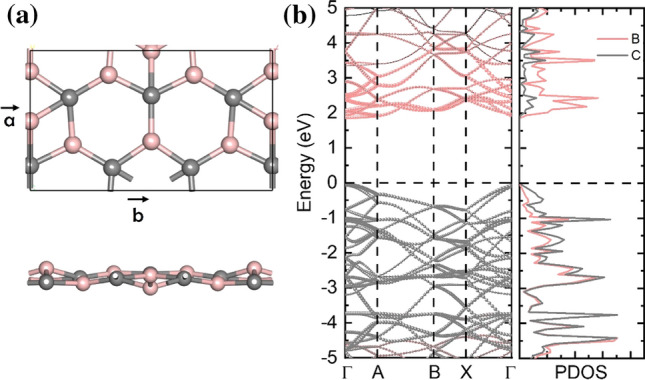
(a) The top and side views of B4C3 monolayer. (b) Band structure along with PDOS of pristine B4C3 monolayer. Grey color represents carbon and pink color represents boron (Color figure online).
Electronic Band Structure of Pristine B4C3
The B4C3 monolayer is a direct band gap semiconductor with a band gap of 1.915 eV. The band structure and partial density of states (PDOS) of B4C3 are illustrated in Fig. 1b. The valence band maximum (VBM) and conduction band minimum (CBM) lie at Γ point.73 Fermi level lies at 0 eV. The electronic configurations of B and C are [He] 2s22p1 and [He] 2s22p2. It is clear from the electronic configuration that the p orbitals of B and C form conduction and valence bands, which is consistent with PDOS of B4C3.
This work investigates the adsorption geometries of VOCs, including C3H6O, CH3OH, H2CO and C7H8, along with CO2 and H2O. Each molecule is deposited on the B4C3 monolayer with a different orientation. Adsorption energies, charge analysis, total density of states, band gap, recovery time of adsorbed gases, and work function are analyzed for each adsorbed system on B1 site and are enlisted in Table I. All the molecules show physisorption. B4C3 monolayer proves to be a good sensor for all physisorbed molecules.
Table I.
Absorption energy (Eads) in eV, band gap (Eg) in eV and charge transfer of adsorbed molecules on B4C3 (Q) and recovery time (τ) in sec and work function (Φ) in eV
| System | Eads (eV) | Eg (eV) | Q (e) | Recovery time τ (10–9 s) | Work function Φ (eV) | Nature of molecule |
|---|---|---|---|---|---|---|
| Pristine B4C3 | – | 1.915 | – | – | 4.961 | – |
| H2CO-B4C3 | − 0.194 | 1.916 | − 0.023 | 2.345 | 4.946 | Acceptor |
| CH3OH-B4C3 | − 0.238 | 1.913 | − 0.021 | 13.630 | 4.95 | Acceptor |
| C3H6O-B4C3 | − 0.176 | 1.917 | − 0.004 | 1.141 | 4.885 | Acceptor |
| C7H8-B4C3 | − 0.21 | 1.914 | − 0.005 | 4.447 | 4.806 | Acceptor |
| CO2-B4C3 | − 0.158 | 1.913 | − 0.015 | 0.556 | 4.769 | Acceptor |
| H2O-B4C3 | − 0.196 | 1.925 | − 0.013 | 2.540 | 5.071 | Acceptor |
A supercell of 3 × 3 is assumed to study the adsorption of gas molecules on the pristine B4C3 monolayer, comprising 32 B atoms and 23 C atoms. Each gas molecule prefers a specific molecular orientation. The alignment of molecules can be in a parallel or perpendicular direction with respect to B4C3 sheet.
VOCs Adsorption on B4C3 Monolayer
The most stable adsorption geometries of all adsorbed structures are being studied and illustrated in Fig. 2. Formaldehyde has a planar structure with one O atom and two H atoms connected by a central C atom83.Figure 2a displays an optimized structure of H2CO on the B4C3 monolayer taking a parallel tilted orientation of molecule with O atom away from the monolayer and H atoms facing towards the monolayer.
Fig. 2.

The optimized structures (top and side view) of (a) formaldehyde, (b) methanol, (c) acetone, (d) toluene, (e) carbon dioxide and (f) water molecules on pristine B4C3 monolayer. Grey, pink, green, and red colors represent Carbon, Boron, Hydrogen and Oxygen (Color figure online).
The preferable position of CH3OH molecule on the B4C3 surface is parallel but with a tilted axis. The H of the OH group is facing towards the monolayer while methyl group (CH3) is away from the surface, as presented in the top and side view of optimized structure in Fig. 2b. C3H6O molecule in Fig. 2c is oriented perpendicularly but tilted in such a way that one atom of H of the methyl (CH3) group gets closer to the C of B4C3 substrate, and the other CH3 group is away from the substrate. The carbonyl (C = O) group is at a distance to B2 atom and is not parallel to the surface. C7H8 prefers to adsorb in a perpendicular position with carbon hexagon skewed towards the right and away from B4C3 monolayer and H of CH3 being closer towards the surface as depicted in Fig. 2d.The position of CO2 molecule is parallel to the B4C3 surface (Fig. 2e). However, one of the O atoms is slightly tilted towards the surface. H2O prefers to adsorb on the B4C3 monolayer in the parallel orientation. O atom is pointing the monolayer surface outwards with the H atom facing toward the surface, as illustrated by the optimized structure in Fig. 2f.
For the development of efficient gas sensors, strong as well as weak interactions between the gas molecule and the substrate must exist. The strong interaction is required to retain the gas molecule on the substrate surface, and weak interaction is necessary for removing of gas molecules from the substrate without damaging the substrate’s properties.19,54
Adsorption energy provides information about the strength/extent of interaction between the sensing substrate and the adsorbed gas molecule. The Eads values of adsorption of gas molecules shLi et al., 2021ould be between − 0.40 eV (strong physisorption) to − 1.00 eV (weak chemisorption) for an efficient sensing mechanism.69 A direct relationship exists between the adsorption energy and the sensitivity of the material. A larger value of adsorption energy leads to stronger interaction between the monolayer and gas molecules, which will enhance the sensitivity of the material. On the other hand, strong interaction makes desorption of gas molecules difficult from the material for a reusable gas sensors.84–86
The adsorption energies of H2CO, CH3OH, C3H6O, C7H8, CO2 and H2O are computed to be − 0.194 eV, − 0.238 eV, − 0.176 eV, − 0.21 eV, − 0.158 eV and − 0.196 eV. These values confirm weak physical adsorption of all gas molecules onto the pristine B4C3 monolayer. These adsorption energies are lower than those reported for H2CO (− 0.228 eV), CH3OH (− 0.316), C3H6O (− 0.381 eV), C7H8 (− 0.910 eV), CO2 (− 0.253 eV) and H2O (0.263 eV) on pristine BC6N nanosheet.19 The values of adsorption energies of C3H6O (− 0.320 eV) and C7H8 (− 0.432 eV) on black phosphorus84 are also greater than calculated pristine B4C3. The interaction of H2CO (− 0.091 eV) ,87 CO2 (− 0.03 eV), and H2O (0.05 eV)88 on graphene are found to be weaker than those accomplished for pristine B4C3 monolayer. The adsorption energy of H2CO is − 0.556 eV on pristine carbon nitride (C2N) monolayer.89 The estimated adsorption energy values (i.e., − 0.18 eV, − 0.33 eV, − 0.40 eV, and − 0.60 eV) demonstrate subsistent interaction of H2CO, CH3OH, C3H6O, and C7H8 on pristine oxygen-terminated titanium carbide MXenes (Ti2CO2).90 Adsorption of alcohol molecules on germanene91 and stanene92 nanosheets is prominent and occurs due to the presence of the OH group. In this scenario, the reported values of adsorption energy are − 1.76 eV for H2CO, − 1.95 eV and − 1.65 eV for CH3OH. The adsorption energies of CH3OH (− 0.47 eV), C3H6O (− 0.69 eV), and C7H8 (− 1 eV) on oxidized molybdenum carbide MXene (Mo2CO2)93 are greater than B4C3. It shows that B4C3 monolayer performs better than pristine graphene but is less sensitive than other 2D materials.
The small value of adsorption energy and the large value of the distance between the molecule and the substrate reveal physical adsorption due to weak van der Waals interaction.94–96
After adsorption of gas molecules, B1-C bond length slightly shortens up to 1.57 Å from 1.59 Å and B2-C bond lengths slightly increase from 1.52 Å to 1.53 Å, and from 1.55 Å to 1.58 Å. The interaction distance between all the gas molecules and B4C3 monolayer is computed to be greater than 3 Å exhibiting weak physisorption of gas molecules.
Charge Density Analysis
Due to physisorption, gas molecules and monolayers exchange a minute amount of charge.19 The charge transfer is computed in terms of Bader charge analysis in order to understand the adsorption better. The Bader charge (Q) analysis determines whether the base material functions as a donor or acceptor. The charge transfer calculated between B4C3 monolayer and H2CO, CH3OH, C3H6O, C7H8, CO2 and H2O is − 0.023 e, − 0.021 e, − 0.004 e, − 0.005 e, − 0.015 e, and − 0.013 e, respectively.
The differential charge density for all six adsorbed molecules is also depicted in Fig. 3a, b, c, d, e and f. From Fig. 3, it is confirmed that all molecules acquire charge from B4C3 monolayer upon adsorption, acting as electron acceptors. The cyan color shows the depletion of charge, and the yellow color depicts the accumulation of charge. B transfers electrons to C of B4C3 framework indicating the chemical bonding between them. There also exists an ionic bonding in the framework. The cyan color in B4C3 framework shows the substrate is losing charge near the region of interaction, and the yellow color around the molecule indicates charge accumulation. O, the most electronegative atom, gains more charge from the molecule and the substrate in O containing molecules. In C7H8, C, with the electronegativity of 2.5, has greater power to attract electrons as compared to B (2.04) and H (2.20). B4C3 is an electron donor.
Fig. 3.

Differential charge density (top and side view) of (a) formaldehyde, (b) methanol, (c) acetone, (d) toluene, (e) carbon dioxide and (f) water molecules on pristine B4C3 monolayer. Cyan and yellow colors shows the charge depletion and accumulation. Colors represent Carbon (grey), Boron (pink), Hydrogen (green) and Oxygen (red) (Color figure online).
Density of States and Band Structure Analysis
Adsorption of molecules changes the electronic properties of the sensor.19,97 For this purpose, the electronic band structure and partial density of states (PDOS) of pristine and gas molecules adsorbed on B4C3 monolayer are displayed in Fig. 4. The energy band gap of pristine B4C3 is computed as 1.915 eV. Slight change in band structure is observed in the presence of H2CO, CH3OH, C3H6O, C7H8, CO2 and H2O with band gaps of 1.916 eV, 1.913 eV, 1.917 eV, 1.914 eV, 1.913 eV, and 1.925 eV. These values are in close proximity with the small adsorption energy values of adsorbed systems.
Fig. 4.

Energy band structures and density of states of (a) pristine B4C3 monolayer, (b) formaldehyde, (c) methanol, (d) acetone, (e) toluene, (f) Carbon dioxide and (g) water molecules on pristine B4C3 monolayer. The dashed line indicates the Fermi level. Grey (carbon), Pink (boron), Green (hydrogen) and Red (oxygen), (h) Comparison of work function of pristine and adsorbed gas molecules on B4C3 monolayer, P: Pristine B4C3 monolayer, F: formaldehyde, M: methanol, A: acetone, T: toluene, C: carbon dioxide and W: water pristine B4C3 monolayer (Color figure online).
In Fig. 4, the Fermi level is represented by 0 eV, and the density of states spans from − 5 to 5 eV. B2-p orbitals and C-p orbitals contribute to the VBM and CBM.74 Above 0 eV, the peaks of p states of B are more pronounced in the conduction band. The contribution of O-p states (red color) are seen below the Fermi level in the case of H2CO, CH3OH, C3H6O, CO2 and H2O (Fig. 4b, c, d, e, f and g).The p orbital of C and s orbital of H of CH3 interact with the hybridized orbitals of B4C3. The contribution of H states can be seen above 3 eV (above Fermi level) and below − 3 eV in the density of states (DOS) as depicted in Fig. 4e.
It shows that the adsorbed molecules have a minor impact on the electronic properties of pristine B4C3 monolayer. Although the adsorbed molecules contribute to the conduction and valence bands of pristine monolayer, they make no significant changes to the electronic characteristics of pristine B4C3 monolayer. The monolayer show semiconducting behavior after weak physisorption of molecules.19 Owing to larger distance and physical adsorption of molecules, orbital hybridization favors charge transfer between monolayer and gas molecules.98
In summary, generally, more adsorption energy and a greater amount of charge transfer enhance the sensitivity of a sensor. The physical adsorption perturbs the electronic states of the gas molecule and the sensor to a minimum level.99 Theoretically, sensing involves orbital interaction and charge transfer. However, from a practical perspective, more negative adsorption energy is not beneficial since it will be difficult to desorb the biomolecule for subsequent usage of the sensor.100
Sensing Explanation of the B4C3 Monolayer
The energy band gap variation for all absorbed molecules is calculated from the following expression49;
| 3 |
where is the average band gap energy, Eg(pristine) and Eg(adsorbed) represent band gap energies of pristine and adsorbed B4C3 systems. The adsorption of H2CO, CH3OH, C3H6O, C7H8, CO2 and H2O slightly alter the band gap energy. The energy band gap variation for CH3OH, C3H6O and CO2 is noticed as 0.10% and 0.05% for H2CO and C7H8, while for H2O, it is 0.52%. The variation supports the physisorption behavior of adsorbed molecules. Alteration in band gap results in the conductivity of the system, which is negligible in this case. The pristine B4C3 monolayer distinguishes the specific type of VOC based on the sensitivity. Sensitivity of the monolayer can be estimated by adsorption energy, charge transfer and band gap.19,101 The B4C3 monolayer shows moderate sensitivity towards methanol. Moreover, surface functionalization13,102 of monolayer and introduction of molecular sieve103 will be utilized to avoid the interference between target VOCs and interfering gases.
For a reusable gas sensor, the gas molecules are capable enough to desorb themselves from the sensing material after detection.31 So the performance of a gas sensor can be evaluated by its recovery time (τ).104 Using transition state theory, τ can be expressed as;
| 4 |
In the above expression, νo (1012 Hz) is the attempt frequency for visible light, k is Boltzmann constant, T is the room temperature at 300 K, and Eads is the adsorption energy of adsorbed systems. From this equation, a longer recovery time is expected for a large (more negative) value of Eads, which will slow down the desorption process of gas molecules.19 The recovery time for all molecules is listed in Table I. The calculated recovery time for H2CO, CH3OH, C3H6O, C7H8, CO2 and H2O are 2.345 × 10⁻⁹ s, 13.630 × 10⁻⁹ s, 1.141 × 10⁻⁹ s, 4.447 × 10⁻⁹ s, 0.556 × 10⁻⁹ s and 2.540 × 10⁻⁹ s. It shows that the CH3OH (τ = 13.630 × 10⁻⁹ s) and CO2 (τ = 0.556 × 10⁻⁹ s) possess the highest and lowest recovery time at a constant temperature. The Desorption process of CH3OH is slower, while the Desorption of CO2 is faster than other molecules. The reversibility of the sensor can be better achieved as the VOCs are physically adsorbed on the B4C3 monolayer with ease of desorption process.18,98
Work Function
The electrical conductivity of a system is related to its work function alteration.69 The adsorption of gases on the sensing material creates surface charge redistribution, which will alter the material’s work function (Φ). The energy required to remove an electron from Fermi level to infinity is known as the work function. It is calculated by the following expression;
| 5 |
Here, V (Φ) represents the electrostatic potential at the vacuum level, and Ef denotes the potential at the Fermi energy level. Φ is sensitive to any change that occur at the surface due to gas adsorption.105 The transmission of charge between the sensing material and gas molecules establishes a dipole moment in the physisorption process. There will be a variation in the work function, which may lead to more changes in the sensing properties of an adsorbed system. The values of work function are summarized in the Table I. The work function for pristine B4C3 monolayer is 4.961 eV. The adsorbed gas molecules of H2CO, CH3OH, C3H6O, C7H8 and CO2 show a minor decreasing trend from 4.95 eV to 4.769 eV as displayed in Fig. 4h. The work function for H2O adsorbed system is computed to be 5.071 eV, slightly greater than 4.961 eV of pristine B4C3. The greater value of work function of H2O from pristine B4C3 monolayer means the electron overflow from Fermi to vacuum level in pristine monolayer is obstructed by H2O adsorption. However the reduction in work function exhibits greater electron mobility.106 The results reveal an almost negligible change in the work function of all systems compared to pristine monolayer. This indicates a very weak physisorption of all gas molecules. Nevertheless the change in work function shows that B4C3 monolayer is favorable for gas sensing.
Conclusion
Gleaned from the framework of DFT, this proposed study computes the structural and electronic properties of human breath exhaled VOCs adsorbed onto boron carbide monolayer. The adsorption energies, charge analysis and band structure, recovery time, and work function of VOCs, including formaldehyde, methanol, acetone, Toluene and interfering gases of CO2 and H2O are being studied. When VOCs adsorb on B1 site of pristine B4C3 monolayer, their adsorption energies fall in between 0.158 eV and 0.238 eV. The results reveal physisorption nature of all molecules. Among all other molecules, methanol shows the highest adsorption energy. O functionalized VOCs display less adsorption energies. Due to very weak physisorption and large interaction distance between molecules and monolayer, less charge has transferred from boron carbide monolayer to adsorbed molecules. So, VOCs along with CO2 and H2O are exposed to be charge acceptors. The band gap of the adsorbed systems does not change and lies in the range of 1.913–1.925 eV. Less apparent changes are discovered (0.05% to 0.52%) in the electronic properties of boron carbide layer after the interaction with VOCs. The calculated work function for H2O is greater (5.071 eV) and lower for CO2 (4.769 eV) compared to pristine B4C3. The recovery time for CO2 is greater than all other considered molecules. The results conclude that pristine B4C3 monolayer can be used as a potential candidate for sensing VOCs for breath analysis.
Declarations
Conflict of interest
The authors declare no conflict of interest.
Footnotes
Publisher's Note
Springer Nature remains neutral with regard to jurisdictional claims in published maps and institutional affiliations.
References
- 1.Drmosh QA, Olanrewaju Alade I, Qamar M, Akbar S. Zinc Oxide-based Acetone Gas Sensors for Breath Analysis: a Review. Chem. - An Asian J. 2021;16:1519. doi: 10.1002/asia.202100303. [DOI] [PubMed] [Google Scholar]
- 2.Güntner AT, Pineau NJ, Chie D, Krumeich F, Pratsinis SE. Selective Sensing of Isoprene by Ti-Doped ZnO for Breath Diagnostics. J. Mater. Chem. B. 2016;4:5358. doi: 10.1039/C6TB01335J. [DOI] [PubMed] [Google Scholar]
- 3.De Lacy Costello B, Amann A, Al-Kateb H, Flynn C, Filipiak W, Khalid T, Osborne D, Ratcliffe NM. A Review of the Volatiles from the Healthy Human Body. J. Breath Res. 2014;8:014001. doi: 10.1088/1752-7155/8/1/014001. [DOI] [PubMed] [Google Scholar]
- 4.Rudnicka J, Kowalkowski T, Buszewski B. Searching for Selected Vocs in Human Breath Samples as Potential Markers of Lung Cancer. Lung Cancer. 2019;135:123. doi: 10.1016/j.lungcan.2019.02.012. [DOI] [PubMed] [Google Scholar]
- 5.Chen H, et al. NiO–ZnO Nanoheterojunction Networks for Room-Temperature Volatile Organic Compounds Sensing. Adv. Opt. Mater. 2018;6:1. doi: 10.1002/adom.201800677. [DOI] [Google Scholar]
- 6.Postica V, et al. Tuning ZnO Sensors Reactivity Toward Volatile Organic Compounds Via AG Doping and Nanoparticle Functionalization. ACS Appl. Mater. Interfaces. 2019;11:31452. doi: 10.1021/acsami.9b07275. [DOI] [PMC free article] [PubMed] [Google Scholar]
- 7.Chen X, Behboodian R, Bagnall D, Taheri M, Nasiri N. Metal-Organic-Frameworks: Low Temperature Gas Sensing and Air Quality Monitoring. Chemosensors. 2021;9:1. doi: 10.3390/chemosensors9110316. [DOI] [Google Scholar]
- 8.Zhao Y, et al. Construction of Zn/Ni Bimetallic Organic Framework Derived ZnO/NiO Heterostructure with Superior n-Propanol Sensing Performance. ACS Appl. Mater. Interf. 2021;13:9206. doi: 10.1021/acsami.0c21583. [DOI] [PubMed] [Google Scholar]
- 9.Toda K, Furue R, Hayami S. Recent Progress in Applications of Graphene Oxide for Gas Sensing: a Review. Anal. Chim. Acta. 2015;878:43. doi: 10.1016/j.aca.2015.02.002. [DOI] [PubMed] [Google Scholar]
- 10.Guo H, Lee SC, Chan LY, Li WM. Risk Assessment of Exposure to Volatile Organic Compounds in Different Indoor Environments. Environ. Res. 2004;94:57. doi: 10.1016/S0013-9351(03)00035-5. [DOI] [PubMed] [Google Scholar]
- 11.Salthammer T. Very Volatile Organic Compounds: an Understudied Class of Indoor Air Pollutants. Indoor Air. 2016;26:25. doi: 10.1111/ina.12173. [DOI] [PubMed] [Google Scholar]
- 12.Wang S, Ang HM, Tade MO. Volatile Organic Compounds in Indoor Environment and Photocatalytic Oxidation: State of the Art. Environ. Int. 2007;33:694. doi: 10.1016/j.envint.2007.02.011. [DOI] [PubMed] [Google Scholar]
- 13.Chen WY, Yen CC, Xue S, Wang H, Stanciu LA. Surface Functionalization of Layered Molybdenum Disulfide for the Selective Detection of Volatile Organic Compounds at Room Temperature. ACS Appl. Mater. Interf. 2019;11:34135. doi: 10.1021/acsami.9b13827. [DOI] [PubMed] [Google Scholar]
- 14.Li X, Zhang L, Yang Z, Wang P, Yan Y, Ran J. Adsorption Materials for Volatile Organic Compounds (VOCs) and the Key Factors for Vocs Adsorption Process: a Review. Sep. Purif. Technol. 2020;235:116213. doi: 10.1016/j.seppur.2019.116213. [DOI] [Google Scholar]
- 15.Lin T, Lv X, Hu Z, Xu A, Feng C. semiconductor Metal Oxides as Chemoresistive Sensors for Detecting Volatile Organic Compounds. Sensors. 2019;19:233. doi: 10.3390/s19020233. [DOI] [PMC free article] [PubMed] [Google Scholar]
- 16.Temel F, Kutluay S. Investigation of high-Performance Adsorption for Benzene and Toluene Vapors by Calix[4] Arene Based Organosilica (CBOS) New J. Chem. 2020;44:12949. doi: 10.1039/D0NJ02081H. [DOI] [Google Scholar]
- 17.Gouma P, Prasad A, Stanacevic S. A Selective Nanosensor Device for Exhaled Breath Analysis. J. Breath Res. 2011;5:1. doi: 10.1088/1752-7155/5/3/037110. [DOI] [PubMed] [Google Scholar]
- 18.Srimathi U, Nagarajan V, Chandiramouli R. Germanane Nanosheet as a Novel Biosensor for Liver Cirrhosis Based on Adsorption of Biomarker Volatiles – a DFT Study. Appl. Surf. Sci. 2019;475:990. doi: 10.1016/j.apsusc.2019.01.008. [DOI] [Google Scholar]
- 19.Aghaei SM, Aasi A, Farhangdoust S, Panchapakesan B. Graphene-Like BC6N Nanosheets are Potential Candidates for Detection of Volatile Organic Compounds (VOCs) in Human Breath: A DFT Study. Appl. Surf. Sci. 2021;536:147756. doi: 10.1016/j.apsusc.2020.147756. [DOI] [Google Scholar]
- 20.Rydosz A. Sensors for Enhanced Detection of Acetone as a Potential Tool for Noninvasive Diabetes Monitoring. Sensors (Switzerland) 2018;18:1. doi: 10.3390/s18072298. [DOI] [PMC free article] [PubMed] [Google Scholar]
- 21.Potter DW, Pawliszyn J. Detection of Substituted Benzenes in Water at the Pg/Ml Level Using Solid-phase Microextraction and Gas Chromatography-Ion Trap Mass Spectrometry. J. Chromatogr. A. 1992;625:247. doi: 10.1016/0021-9673(92)85209-C. [DOI] [PubMed] [Google Scholar]
- 22.Miyake T, Shibamoto T. Quantitative Analysis by Gas Chromatography of Vola tile Carbonyl Compounds in Cigarette Smoke. J. Chromatogr. A. 1995;693:376. doi: 10.1016/0021-9673(94)01179-I. [DOI] [Google Scholar]
- 23.Ebeler SE, Clifford AJ, Shibamoto T. Quantitative Analysis by Gas Chromatography of Volatile Carbonyl Compounds in Expired Air from Mice and Human. J. Chromatogr. B Biomed. Appl. 1997;702:211. doi: 10.1016/S0378-4347(97)00369-1. [DOI] [PubMed] [Google Scholar]
- 24.Sethi S, Nanda R, Chakraborty T. Clinical Application of Volatile Organic Compound Analysis for Detecting Infectious Diseases. Clin. Microbiol. Rev. 2013;26:462. doi: 10.1128/CMR.00020-13. [DOI] [PMC free article] [PubMed] [Google Scholar]
- 25.Dral AP, ten Elshof JE. 2D Metal Oxide Nanoflakes for Sensing Applications: Review and Perspective, Sensors Actuators. B Chem. 2018;272:369. [Google Scholar]
- 26.Sun S, Hussain T, Zhang W, Karton A. Blue Phosphorene Monolayers as Potential Nano Sensors for Volatile Organic Compounds under Point Defects. Appl. Surf. Sci. 2019;486:52. doi: 10.1016/j.apsusc.2019.04.223. [DOI] [Google Scholar]
- 27.Minitha CR, Anithaa VS, Subramaniam V, Rajendra Kumar RT. Impact of Oxygen Functional Groups on Reduced Graphene Oxide-based Sensors for Ammonia and Toluene Detection at Room Temperature. ACS Omega. 2018;3:4105. doi: 10.1021/acsomega.7b02085. [DOI] [PMC free article] [PubMed] [Google Scholar]
- 28.Mirzaei A, Leonardi SG, Neri G. Detection of Hazardous Volatile Organic Compounds (VOCs) by Metal Oxide Nanostructures-based Gas Sensors: a Review. Ceram. Int. 2016;42:15119. doi: 10.1016/j.ceramint.2016.06.145. [DOI] [Google Scholar]
- 29.Tyagi D, Wang H, Huang W, Hu L, Tang Y, Guo Z, Ouyang Z, Zhang H. Recent Advances in Two-dimensional-Material-based Sensing Technology Toward Health and Environmental Monitoring Applications. Nanoscale. 2020;12:3535. doi: 10.1039/C9NR10178K. [DOI] [PubMed] [Google Scholar]
- 30.M HJ, Pack JD. Special Points for Brillouin-zone Integrations. Phys. Rev. B. 1976;13(12):5188–5192. doi: 10.1103/PhysRevB.13.5188. [DOI] [Google Scholar]
- 31.Tang X, Du A, Kou L. Gas Sensing and Capturing Based on two-Dimensional Layered Materials: Overview from Theoretical Perspective. Wiley Interdiscip. Rev. Comput. Mol. Sci. 2018;8:1. doi: 10.1002/wcms.1361. [DOI] [Google Scholar]
- 32.Gao Z, Sun Y, Li M, Yang W, Ding X. Adsorption Sensitivity of fe Decorated Different Graphene Supports Toward Toxic Gas Molecules (CO and NO) Appl. Surf. Sci. 2018;456:351. doi: 10.1016/j.apsusc.2018.06.112. [DOI] [Google Scholar]
- 33.Tang H, Sacco LN, Vollebregt S, Ye H, Fan X, Zhang G. Recent Advances in 2D/Nanostructured Metal Sulfide-based Gas Sensors: Mechanisms, Applications, and Perspectives. J. Mater. Chem. A. 2020;8:24943. doi: 10.1039/D0TA08190F. [DOI] [Google Scholar]
- 34.Hao ZW, Dong MM, Zhang RQ, Wang CK, Fu XX. An Ultra-sensitive Gas Sensor based on a Two-dimensional Manganese Porphyrin Monolayer. Phys. Chem. Chem. Phys. 2021;23:11852. doi: 10.1039/D1CP00747E. [DOI] [PubMed] [Google Scholar]
- 35.Aghaei SM, Monshi MM, Calizo I. A Theoretical Study of Gas Adsorption on Silicene Nanoribbons and its Application in a Highly Sensitive Molecule Sensor. RSC Adv. 2016;6:94417. doi: 10.1039/C6RA21293J. [DOI] [Google Scholar]
- 36.Aasi A, Aghaei SM, Panchapakesan B. Pt-Decorated Phosphorene as a Propitious Room Temperature VOC Gas Sensor for Sensitive and Selective Detection of Alcohols. J. Mater. Chem. C. 2021;9:9242. doi: 10.1039/D1TC01510A. [DOI] [Google Scholar]
- 37.Perkins FK, Friedman AL, Cobas E, Campbell PM, Jernigan GG, Jonker BT. Chemical Vapor Sensing with Monolayer MoS2. Nano Lett. 2013;13:668. doi: 10.1021/nl3043079. [DOI] [PubMed] [Google Scholar]
- 38.Nagarajan V, Chandiramouli R. Novel Method to Detect the Lung Cancer Biomarker Volatiles using Hydrogen Vacant Silicane Nanosheets: A DFT Investigation. Comput. Theor. Chem. 2018;1138:107. doi: 10.1016/j.comptc.2018.06.008. [DOI] [Google Scholar]
- 39.Mawwa J, Shamim SUD, Khanom S, Hossain MK, Ahmed F. In-Plane Graphene/boron Nitride Heterostructures and their Potential Application as Toxic Gas Sensors. RSC Adv. 2021;11:32810. doi: 10.1039/D1RA06304A. [DOI] [PMC free article] [PubMed] [Google Scholar]
- 40.Yang L, Xiao W, Wang J, Li X, Wang L. Formaldehyde Gas Sensing Properties of Transition Metal-doped Graphene: a First-principles Study. J. Mater. Sci. 2021;56:12256. doi: 10.1007/s10853-021-05951-w. [DOI] [Google Scholar]
- 41.Lima KAL, Pereira Júnior ML, Monteiro FF, Roncaratti LF, Ribeiro Júnior LA. O2 Adsorption on Defective Penta-graphene Lattices: a DFT Study. Chem. Phys. Lett. 2021;763:137. doi: 10.1016/j.cplett.2020.138229. [DOI] [Google Scholar]
- 42.Singla M, Jaggi N. Synergistic Effect of Cu Decoration and N Doping in Divacancy Defected Graphene Nanoribbons on Hydrogen Gas Sensing Properties: DFT Study. Mater. Chem. Phys. 2021;273:125093. doi: 10.1016/j.matchemphys.2021.125093. [DOI] [Google Scholar]
- 43.Liang Z, Li K, Wang Z, Bu Y, Zhang J. Adsorption and Reaction Mechanisms of Single and Double H2O Molecules on Graphene Surfaces with Defects: a Density Functional Theory Study. Phys. Chem. Chem. Phys. 2021;23:19071. doi: 10.1039/D1CP02595C. [DOI] [PubMed] [Google Scholar]
- 44.Mansouri E, Karamdel J, Berahman M, Ahmadi MT. Phosphorene as H2S and CH4 Gas Sensor. Phys. Status Solidi Appl. Mater. Sci. 2019;216:1. [Google Scholar]
- 45.Zhang B, Mao Z, Wu P. Gas Sensing of Fibrous Red Phosphorene Towards Inorganic Air Pollutants: Insights from First-principles Calculations. Appl. Surf. Sci. 2021;565:150546. doi: 10.1016/j.apsusc.2021.150546. [DOI] [Google Scholar]
- 46.Abbasi A, Sardroodi JJ. Exploration of Sensing of Nitrogen Dioxide and Ozone Molecules using Novel TiO2/Stanene Heterostructures Employing DFT Calculations. Appl. Surf. Sci. 2018;442:368. doi: 10.1016/j.apsusc.2018.02.183. [DOI] [Google Scholar]
- 47.Chang YZ, Lin JN, Li SD, Liu H. Adsorption of Greenhouse Gases (Methane and Carbon Dioxide) on the Pure and Pd-adsorbed Stanene Nanosheets: a Theoretical Study. Surfaces and Interfaces. 2021;22:100878. doi: 10.1016/j.surfin.2020.100878. [DOI] [Google Scholar]
- 48.Zhang A, Yang H, Liu Q, Li W, Wang Y. DFT Insights Into the Adsorption Properties of Toxic Gas Molecules on Pure and Transition Metal Embedded Stanene Monolayers: Towards Gas Sensor Devices. Synth. Met. 2020;266:116441. doi: 10.1016/j.synthmet.2020.116441. [DOI] [Google Scholar]
- 49.Nagarajan V, Sundar S, Chandiramouli R. Interaction studies of Tuberculosis Biomarker Vapours on Novel Beta Arsenene Sheets – a DFT Insight. Comput. Theor. Chem. 2021;1205:113426. doi: 10.1016/j.comptc.2021.113426. [DOI] [Google Scholar]
- 50.Walia GK, Randhawa DKK, Malhi KS. Rise of Silicene and Its Applications in Gas Sensing. J. Mol. Model. 2021;27:107. doi: 10.1007/s00894-021-04892-0. [DOI] [PubMed] [Google Scholar]
- 51.Walia GK, Randhawa DKK. First-Principles Investigation on Defect-induced Silicene Nanoribbons — a Superior Media for Sensing NH3NO2 and NO Gas Molecules. Surf. Sci. 2018;670:33. doi: 10.1016/j.susc.2017.12.013. [DOI] [Google Scholar]
- 52.Ou M, Wang X, Yu L, Liu C, Tao W, Ji X, Mei L. The Emergence and Evolution of Borophene. Adv. Sci. 2021;8:1. doi: 10.1002/advs.202001801. [DOI] [PMC free article] [PubMed] [Google Scholar]
- 53.Hou C, Tai G, Liu Y, Liu X. Borophene Gas Sensor. Nano Res. 2022;15:2537. doi: 10.1007/s12274-021-3926-6. [DOI] [Google Scholar]
- 54.Jiang T, He Q, Bi M, Chen X, Sun H, Tao L. First-principles Calculations of Adsorption Sensitivity of Au-Doped MoS2 Gas Sensor to Main Characteristic Gases in Oil. J. Mater. Sci. 2021;56:13673. doi: 10.1007/s10853-021-06168-7. [DOI] [Google Scholar]
- 55.Li B, Zhou Q, Peng R, Liao Y, Zeng W. Adsorption of SF6 Decomposition Gases (H2S, SO2, SOF2 and SO2F2) on Sc-Doped MoS2 Surface: a DFT Study. Appl. Surf. Sci. 2021;549:146. doi: 10.1016/j.apsusc.2021.149271. [DOI] [Google Scholar]
- 56.Yang S, Liu Y, Lei G, Xie Y, Peng L, Xu H, Wang Z, Gu H. A DFT Study on the Hydrogen Storage Performance of MoS2 Monolayers Doped with Group 8B Transition Metals. Int. J. Hydrogen Energy. 2021;46:24233. doi: 10.1016/j.ijhydene.2021.04.200. [DOI] [Google Scholar]
- 57.Kumar R, Zheng W, Liu X, Zhang J, Kumar M. MoS2-Based Nanomaterials for Room-Temperature Gas Sensors. Adv. Mater. Technol. 2020;5:1. doi: 10.1002/admt.201901062. [DOI] [Google Scholar]
- 58.Shokri A, Salami N. Gas Sensor Based on MoS2 Monolayer, Sensors Actuators. B Chem. 2016;236:378. [Google Scholar]
- 59.Zhao PX, Tang Y, Mao J, Chen YX, Song H, Wang JW, Song Y, Liang YQ, Zhang XM. One-Dimensional MoS2-Decorated TiO2 Nanotube Gas Sensors for Efficient Alcohol Sensing. J. Alloys Compd. 2016;674:252. doi: 10.1016/j.jallcom.2016.03.029. [DOI] [Google Scholar]
- 60.Baildya N, Ghosh NN, Chattopadhyay AP. Environmentally Hazardous Gas Sensing Ability of MoS2-Nanotubes: an Insight from the Electronic Structure and Transport Properties. Nanoscale Adv. 2021;3:4528. doi: 10.1039/D0NA01037E. [DOI] [PMC free article] [PubMed] [Google Scholar]
- 61.Celaya CA, Boujnah M, Reina M, Muñiz J, Sansores LE. Theoretical Study of Au20/WS2 Composite Material as a Potential Candidate for the Capture of XO (X=C, N, S) Gases. Comput. Condens. Matter. 2021;28:e00580. doi: 10.1016/j.cocom.2021.e00580. [DOI] [Google Scholar]
- 62.Tian X, Xuan X, Yu M, Mu Y, Lu HG, Zhang Z, Li SD. Predicting Two-Dimensional Semiconducting Boron Carbides. Nanoscale. 2019;11:11099. doi: 10.1039/C9NR02681A. [DOI] [PubMed] [Google Scholar]
- 63.Sara Reynaud A., Fabrication and characterization of carbon and boron carbide nanostructured materials by dissertation submitted to the graduate school-New brunswick Rutgers. The State University of New Jersey in partial Fulfillment of the Requirements. (2010).
- 64.Thévenot F. Boron Carbide-a Comprehensive Review. J. Eur. Ceram. Soc. 1990;6:205. doi: 10.1016/0955-2219(90)90048-K. [DOI] [Google Scholar]
- 65.Radev DD, Zakhariev Z. Structural and Mechanical Properties of Activated Sintered Boron Carbide-based Materials. J. Solid State Chem. 1998;137:1. doi: 10.1006/jssc.1997.7550. [DOI] [Google Scholar]
- 66.Mahabal MS, Deshpande MD, Hussain T, Ahuja R. Sensing Characteristics of a Graphene-Like Boron Carbide Monolayer Towards Selected Toxic Gases. Chem. Phys. Chem. 2015;16:3511. doi: 10.1002/cphc.201500557. [DOI] [PubMed] [Google Scholar]
- 67.S. M. Aghaei, M. M. Monshi, I. Torres, and I. Calizo. Adsorption and Dissociation of Toxic Gas Molecules on Graphene-like BC3: A Search for Highly Sensitive Molecular Sensors and Catalysts, ArXiv 1 (2017).
- 68.Mehdi Aghaei S, Monshi MM, Torres I, Zeidi SMJ, Calizo I. DFT Study of Adsorption Behavior of NO, CO, NO2, and NH3 Molecules on Graphene-like BC3: a Search for Highly Sensitive Molecular Sensor. Appl Surf Sci. 2018;427:326. doi: 10.1016/j.apsusc.2017.08.048. [DOI] [Google Scholar]
- 69.Naqvi SR, Hussain T, Gollu SR, Luo W, Ahuja R. Superior Sensitivity of Metal Functionalized boron Carbide (BC3) Monolayer Towards Carbonaceous Pollutants. Appl. Surf. Sci. 2020;512:145637. doi: 10.1016/j.apsusc.2020.145637. [DOI] [Google Scholar]
- 70.Zhao Z, Yong Y, Gao R, Hu S, Zhou Q, Su X, Kuang Y, Li X. Adsorption, Sensing and Optical Properties of Molecules on BC3 Monolayer: First-principles Calculations. Mater. Sci. Eng. B Solid-State Mater. Adv. Technol. 2021;271:115266. doi: 10.1016/j.mseb.2021.115266. [DOI] [Google Scholar]
- 71.Aasi Aref, Aghaei Sadegh Mehdi, Panchapakesan Balaji. Outstanding Performance of Transition-metal-decorated Single-layer Graphene-like BC6N Nanosheets for Disease Biomarker Detection in Human Breath. ACS Omega. 2021;6(7):4696–4707. doi: 10.1021/acsomega.0c05495. [DOI] [PMC free article] [PubMed] [Google Scholar]
- 72.Malin MC, et al. Planar Hexacoord. Carbon. 2000;290:1937. [Google Scholar]
- 73.Ahmed S, Jalil A, Ilyas SZ, Hassan A, Ilahi A, Ahmed I, Khan M, Khan Q. Ab-Initio Characterization of B4C3 Monolayer as a Toxic Gases Sensing Material. Appl. Surf. Sci. 2021;544:148877. doi: 10.1016/j.apsusc.2020.148877. [DOI] [Google Scholar]
- 74.Chang H, Tu K, Zhang X, Zhao J, Zhou X, Zhang H. B4C3 Monolayer with Impressive Electronic, Optical, and Mechanical Properties: a Potential Metal-free Photocatalyst for CO2 Reduction Under Visible Light. J. Phys. Chem. C. 2019;123:25091. doi: 10.1021/acs.jpcc.9b06744. [DOI] [Google Scholar]
- 75.Joubert D. From Ultrasoft Pseudopotentials to the Projector Augmented-wave Method. Phys. Rev. B - Condens Matter. Mater Phys. 1999;59:1758. doi: 10.1103/PhysRevB.59.1758. [DOI] [Google Scholar]
- 76.Perdew JP, Burke K, Ernzerhof M. Generalized Gradient Approximation Made Simple. Phys. Rev. Lett. 1996;77:3865. doi: 10.1103/PhysRevLett.77.3865. [DOI] [PubMed] [Google Scholar]
- 77.Perdew JP, Burke K, Ernzerhof M. Perdew, Burke, and Ernzerhof Reply. Phys. Rev. Lett. 1998;80:891. doi: 10.1103/PhysRevLett.80.891. [DOI] [Google Scholar]
- 78.Grimme S, Antony J, Ehrlich S, Krieg H. A Consistent and Accurate Ab Initio Parametrization of Density Functional Dispersion Correction (DFT-D) for the 94 Elements H-Pu. J. Chem. Phys. 2010;132:154104. doi: 10.1063/1.3382344. [DOI] [PubMed] [Google Scholar]
- 79.Heyd J, Scuseria GE, Ernzerhof M. Hybrid Functionals Based on a Screened Coulomb Potential. J. Chem. Phys. 2003;118:8207. doi: 10.1063/1.1564060. [DOI] [Google Scholar]
- 80.Farmanzadeh D, Ghazanfary S. The Effect of Electric Field on the Interaction of Glycine with (6, 0) Single-walled Boron Nitride Nanotubes. J. Serbian Chem. Soc. 2013;78:75. doi: 10.2298/JSC120419046F. [DOI] [Google Scholar]
- 81.Henkelman G, Arnaldsson A, Jónsson H. A Fast and Robust Algorithm for bader Decomposition of Charge Density. Comput. Mater. Sci. 2006;36:354. doi: 10.1016/j.commatsci.2005.04.010. [DOI] [Google Scholar]
- 82.Cui Z, Wang X, Ding Y, Li E, Bai K, Zheng J, Liu T. Adsorption of CO, NH3, NO, and NO2 on Pristine and Defective g-GaN: Improved Gas Sensing and Functionalization. Appl. Surf. Sci. 2020;530:147275. doi: 10.1016/j.apsusc.2020.147275. [DOI] [Google Scholar]
- 83.Liu X, Chen Y, Zhang M, Zhang C. Adsorption Properties of Formaldehyde on Β12-Borophene Surfaces: a First-Principles Study. Chem. Phys. Lett. 2020;739:137035. doi: 10.1016/j.cplett.2019.137035. [DOI] [Google Scholar]
- 84.Ou P, Song P, Liu X, Song J. Superior Sensing Properties of Black Phosphorus as Gas Sensors: a Case Study on the Volatile Organic Compounds. Adv. Theory Simulat. 2019;2:1. doi: 10.1002/adts.201800103. [DOI] [Google Scholar]
- 85.Kim JS, Yoo HW, Choi HO, Jung HT. Tunable Volatile Organic Compounds Sensor by Using Thiolated Ligand Conjugation on MoS2. Nano Lett. 2014;14:5941. doi: 10.1021/nl502906a. [DOI] [PubMed] [Google Scholar]
- 86.Ai W, Kou L, Hu X, Wang Y, Krasheninnikov AV, Sun L, Shen X. Enhanced Sensitivity of MoSe2 Monolayer for Gas Adsorption Induced by Electric Field. J. Phys. Condens. Matter. 2019;31:445301. doi: 10.1088/1361-648X/ab29d8. [DOI] [PubMed] [Google Scholar]
- 87.Zhou Q, Yuan L, Yang X, Fu Z, Tang Y, Wang C, Zhang H. DFT Study of Formaldehyde Adsorption on Vacancy Defected Graphene Doped with B, N, and S. Chem. Phys. 2014;440:80. doi: 10.1016/j.chemphys.2014.06.016. [DOI] [Google Scholar]
- 88.Shokuhi Rad A, Pouralijan Foukolaei V. Density Functional Study of Al-Doped Graphene Nanostructure Towards Adsorption of CO, CO2 and H2O. Synth. Met. 2015;210:171. doi: 10.1016/j.synthmet.2015.09.026. [DOI] [Google Scholar]
- 89.Su Y, Ao Z, Ji Y, Li G, An T. Adsorption Mechanisms of Different Volatile Organic Compounds onto Pristine C2N and Al-Doped C2N Monolayer: A DFT Investigation. Appl. Surf. Sci. 2018;450:484. doi: 10.1016/j.apsusc.2018.04.157. [DOI] [Google Scholar]
- 90.Wu Z, Zhou J, Li D, Ao Z, An T, Wang G. Density Functional Theory Study on the Enhanced Adsorption Mechanism of Gaseous Pollutants on Al-Doped Ti2CO2 Monolayer. Sustain. Mater. Technol. 2021;29:e00294. [Google Scholar]
- 91.Chandiramouli R. Structural and Electronic Properties of Germanane Nanosheet Upon Molecular Adsorption of Alcohol and Aldehyde Molecules: DFT Comparative Analysis. J. Mol. Liq. 2017;242:571. doi: 10.1016/j.molliq.2017.07.046. [DOI] [Google Scholar]
- 92.Nagarajan V, Chandiramouli R. Interaction of Alcohols on Monolayer Stanane Nanosheet: a First-principles Investigation. Appl. Surf. Sci. 2017;419:9. doi: 10.1016/j.apsusc.2017.05.017. [DOI] [Google Scholar]
- 93.Guo W, Surya SG, Babar V, Ming F, Sharma S, Alshareef HN, Schwingenschlögl U, Salama KN. Selective Toluene Detection with Mo2CTxMXene at Room Temperature. ACS Appl. Mater. Interf. 2020;12:57218. doi: 10.1021/acsami.0c16302. [DOI] [PubMed] [Google Scholar]
- 94.Majidi R, Karami AR. Adsorption of Formaldehyde on Graphene and Graphyne. Phys. E Low-Dimens. Syst. Nanost. 2014;59:169. doi: 10.1016/j.physe.2014.01.019. [DOI] [Google Scholar]
- 95.Chi M, Zhao YP. Adsorption of Formaldehyde Molecule on the Intrinsic and Al-Doped Graphene: a first Principle Study. Comput. Mater. Sci. 2009;46:1085. doi: 10.1016/j.commatsci.2009.05.017. [DOI] [Google Scholar]
- 96.Moradi M, Noei M, Peyghan AA. DFT Studies of Si- and Al-doping Effects on the Acetone Sensing Properties of BC3 Graphene. Mol. Phys. 2013;111:3320. doi: 10.1080/00268976.2013.783720. [DOI] [Google Scholar]
- 97.Agrawal S, Kaushal G, Srivastava A. Electron Transport in C3N Monolayer: DFT Analysis of Volatile Organic Compound Sensing. Chem. Phys. Lett. 2021;762:138121. doi: 10.1016/j.cplett.2020.138121. [DOI] [Google Scholar]
- 98.Guo H, Zheng K, Cui H, Yu J, Tao LQ, Li X, Liao C, Xie L, Chen X. Tellurene Based Biosensor for Detecting DNA/RNA Nucleobases and Amino Acids: a Theoretical Insight. Appl. Surf. Sci. 2020;532:147451. doi: 10.1016/j.apsusc.2020.147451. [DOI] [Google Scholar]
- 99.W. C, O. C, S. B. on 2D M. Tan and K. W. Ang, V, Adv. Electron. Mater. 7, 1 (2021).
- 100.Vaidyanathan A, Mathew M, Radhakrishnan S, Rout CS, Chakraborty B. Theoretical Insight on the Biosensing Applications of 2D Materials. J. Phys. Chem. B. 2020;124:11098. doi: 10.1021/acs.jpcb.0c08539. [DOI] [PubMed] [Google Scholar]
- 101.Broza YY, Haick H. Nanomaterial-based Sensors for Detection of Disease by Volatile Organic Compounds. Nanomedicine. 2013;8:785. doi: 10.2217/nnm.13.64. [DOI] [PubMed] [Google Scholar]
- 102.Chen WY, Lai SN, Yen CC, Jiang X, Peroulis D, Stanciu LA. Surface Functionalization of Ti3C2TxMXene with Highly Reliable Superhydrophobic Protection for Volatile Organic Compounds Sensing. ACS Nano. 2020;14:11490. doi: 10.1021/acsnano.0c03896. [DOI] [PubMed] [Google Scholar]
- 103.Wan Q, Xu Y, Xiao H. Exhaled Gas Detection by Ir-Doped CNT for Primary Diagnosis of Lung Cancer. AIP Adv. 2018;8:105128. doi: 10.1063/1.5050435. [DOI] [Google Scholar]
- 104.Liu T, Cui Z, Li X, Cui H, Liu Y. Al-Doped Mose2 Monolayer as a Promising Biosensor for Exhaled Breath Analysis: a DFT Study. ACS Omega. 2021;6:988. doi: 10.1021/acsomega.0c05654. [DOI] [PMC free article] [PubMed] [Google Scholar]
- 105.Hussain T, Panigrahi P, Ahuja R. Enriching Physisorption of H2S and NH3 Gases on a Graphane Sheet by Doping with Li Adatoms. Phys. Chem. Chem. Phys. 2014;16:8100. doi: 10.1039/C4CP00128A. [DOI] [PubMed] [Google Scholar]
- 106.Cui H, Jia P, Peng X, Li P. Adsorption and Sensing of CO and C2H2 by S-Defected SnS2 Monolayer for DGA in Transformer Oil: A DFT Study. Mater. Chem. Phys. 2020;249:123006. doi: 10.1016/j.matchemphys.2020.123006. [DOI] [Google Scholar]