



Abstract
Background
Previous studies have revealed high malaria transmission in Bouaké, Côte d’Ivoire. The sociopolitical crisis in the country and the resulting environmental changes have raised the need to update existing knowledge on mosquito vector species and malaria transmission.
Methods
Adult mosquitoes were caught using the human landing catch (HLC) sampling method in Bouaké. They were collected in six districts representative of the diversity in urban landscapes. Sampling points were selected along the water network crossing the city and monitored from 2020 to 2021 to detect the presence of anopheline larvae. PCR techniques were used to ascertain the species of the Anopheles gambiae complex, Plasmodium falciparum sporozoite infection in a subset of Anopheles vectors, and insecticide resistance mechanisms in Anopheles arabiensis only.
Results
A total of 4599 Anopheles mosquitoes were collected and then identified. Anopheles gambiae sensu lato (s.l.) made up the majority of the whole collection (99%) while Anopheles funestus (0.7%), Anopheles ziemanni (0.2%), Anopheles pharoensis (0.2%) represented the remaining proportion of collection. Among the Anopheles gambiae complex, three species were identified namely An. gambiae sensu stricto (45.9%), Anopheles coluzzii (52.2%), and Anopheles arabiensis (1.9%). The first two species had already been collected in Bouaké, however this is the first time that An. arabiensis is reported in Côte d’Ivoire. Anopheles arabiensis was also collected during the larval surveys in a similar proportion (1.1%) in the same areas as the adults.
Conclusions
This study detected the presence of An. arabiensis for the first time in Côte d’Ivoire. This species was found quite far from its usual geographic area and its expansion could be linked to the urbanization process. Although no An. arabiensis was found to be infected by Plasmodium sp., its role in malaria transmission in Bouaké has to be explored, particularly since its exophagic behaviour raises the issue of control measures and the use of insecticide-impregnated nets. The spread of this species in Côte d'Ivoire should be assessed through further research in additional towns in the country.
Keywords: Anopheles arabiensis, Bouaké, Côte d’Ivoire
Background
Malaria remains a major public health issue worldwide with 229 million cases and 409,000 deaths reported in 2019 [1]. In the same year, the sub-Saharan African region accounted for 94% of cases and deaths. In Côte d'Ivoire, malaria is the leading cause of medical consultations, with over 5 million cases reported in 2019 [2].
Agricultural development can impact disease dynamics, particularly vector diseases by changing interactions between hosts and vectors as well as by altering vector composition [3]. In the past few years, urbanization has increased worldwide at a fast pace. The United Nations predicts that approximately 70% of the African population will be urban by 2050 [4]. In the early 2000s, medical entomologists thought that urbanization could reduce the burden of malaria because urban environments were considered unsuitable for most major malaria vectors [5, 6]. However, this assumption is now challenged by detailed studies [7]. Indeed, a large variety of Anopheles mosquito larval habitats are found in proximity to human dwellings and increase the risk of malaria transmission. These are due to fast-spreading urban or agriculture areas, the presence of standing water, the absence of drainage systems and the poor state of roads linked to unplanned urbanization. In addition, inadequate housing conditions have been recognized as risk factors in urban environments. Donnelly et al. [8] suggested taking these urban factors into account to implement adequate vector control strategies.
In Côte d’Ivoire, 41 Anopheles species have been identified to date [9]. Studies carried out in central Côte d’Ivoire by Dossou-Yovo et al. [10] report two major malaria vector species: Anopheles gambiae sensu lato (s.l.) and Anopheles funestus. Assouho et al. [11] showed that Anopheles nili is also frequently observed in central Côte d'Ivoire. In the west, Nzeyimana et al. [12] identified two malaria vector species: An. gambiae sensu stricto (s.s.) and An. funestus. According to Adja et al. [13], An. nili also plays a major role in malaria transmission in the southern and western forest areas of Côte d'Ivoire. Moreover, Anopheles coustani, Anopheles ziemanni, Anopheles pharoensis, Anopheles welcomei, Anopheles obscurus and Anopheles moucheti have also been recorded as secondary malaria vectors in the country [10, 14–16].
In Bouaké, the second largest city of Côte d'Ivoire, past and recent studies revealed the main presence of An. gambiae s.l. and more specifically An. gambiae s.s. and An. coluzzii, with An. funestus, An. coustani, An. pharoensis, An. ziemanni, An. obscurus and An. welcomei in low proportions (< 1%) [10, 16].
This study is part of research efforts whose objective is to analyse the impact of the urbanization process on malaria risk factors in Bouaké. The article aims to provide an update on the malaria vector composition in Bouaké.
Methods
Study site
The study took place in the city of Bouaké, in the central region of Côte d'Ivoire. The population of Bouaké was estimated to be approximately 540,000 people in 2014 [17]. However, this number is hardly reliable since the census was carried out at the end of a political crisis that occurred in the country between 2002 and 2012. The city spreads out on a plateau and includes a dense hydrographic network that divides in different neighbourhoods and allows both rice cultivation and market gardening in the lowlands. The rainy season runs from April to October, with a decrease in rainfall from July to August. The dry season begins in November and lasts five months. The average annual rainfall is 1200 mm. The average monthly temperatures vary from 24 °C in August to 28 °C in February.
Mosquito sampling
Adult sampling took place in the city of Bouaké, in six districts (Fig. 1), which were representative of the diversity in the urban landscape. Koko is an old central district. Air France is also an ancient urban district, although with higher house standing. Belleville is a recently urbanized district located in the northern part of the town, with a low level of equipment. Sossoribougou district is located near the centre of the city. It is an old irregular district that suffers from a lack of infrastructure. The Odiennekourani and N’Gattakro districts are populated areas along two inland valleys where rice fields and garden markets are intensively developed.
Fig. 1.

Map of the city of Bouaké showing the sites for the HLC sampling technique and the larval survey
Adult mosquitoes were sampled from 06:00 PM to 08:00 AM, using the HLC technique.
In the districts of Koko, Air France 1 & 2, Belleville 3 and Sossoribougou, sampling was performed at three selected sites per district, both indoors and outdoors, for 2 consecutive nights in March 2019, at the beginning of the rainy season, in October 2019 at the end of the rainy season, and in February 2020 during the dry season (i.e., for a total of 144 nights of HLC sampling).
In Odiennekourani and N’Gattakro, monthly sampling was performed at two sites per district, for only one night, both indoors and outdoors, from February to December 2019, except in April and May 2019 (i.e., for a total of 72 nights of HLC sampling). Two larval surveys were carried out in October 2020 and April 2021. Concentric circles at intervals of 1500 m were plotted over the entire urban area and larval sampling points were selected at the intersections between circles and lowlands. Mosquito larval collections were performed in all potential larval habitats using the dipping method in a 100 m radius at all selected sites. The ecological context (e.g., turbidity, sunlight, type of cultivation, presence of plants and predators) was recorded. The collected larvae were transferred to the insectary of the Institut Pierre Richet (IPR) for rearing.
Anopheles vector processing
Adult mosquitoes were identified morphologically using the Culicinae identification key of Mattingly [18] and the Anophelinae identification key of Gilles and Coetzee [19]. Only Anopheles vectors were individually preserved in Eppendorf tubes (1.5 ml) with silica gel.
All the adults reared from the larval surveys and a random subsample of adult Anopheles females from HLC were selected for molecular analysis. DNA extraction was performed from the head and thorax of each specimen following the procedure used by Cornel et al. [20]. The sibling species of the An. gambiae complex were identified by PCR using the protocols of Favia et al. [21] and Scott et al. [22]. Anopheles arabiensis were verified following the protocol described by Fanello et al. [23] to confirm the results. All identified mosquitoes of the An. gambiae complex from HLC were tested for the presence of Plasmodium falciparum infection using qPCR [24]. Additional PCR assays for the detection of the kdr west (L1014F), kdr-east (L1014S) and ace-1R (G119S) mutations, which confer resistance to insecticides, were performed on An. arabiensis specimens collected by HLC according to Bass et al. [25] and Bass et al. [26], respectively.
Results
Species composition and distribution
A total of 24,125 adult mosquitoes were collected in the six districts. Among these, 73.7% (n = 17,786) were identified as Culex quinquefasciatus and 19.1% (n = 4599) were identified as An. gambiae s.l. In addition, An. funestus, An. pharoensis and An. ziemanni were also collected but in very low proportions (< 1%).
Mosquitoes belonging to the An. gambiae complex were identified as An. gambiae s.s. (n = 1333; 46.0%), An. coluzzii (n = 1,517; 52.3%) and An. arabiensis (n = 48; 1.7%) (Table 1).
Table 1.
Distribution of the species within the Anopheles gambiae complex collected by HLC in each surveyed district
| District |
An. gambiae s.s N (%) |
An. coluzzii N (%) |
An. arabiensis N (%) |
Total N (%) |
|---|---|---|---|---|
| Air France 1 & 2 | 267 (20.0) | 24 (1.6) | 0 (0) | 291 (10.0) |
| Belleville 3 | 272 (20.4) | 19 (1.3) | 0 (0) | 291 (10.0) |
| Koko | 149 (11.2) | 182 (12.0) | 35 (72.9) | 366 (12.6) |
| Sossoribougou | 47 (3.5) | 167 (11.0) | 1 (2.1) | 215 (7.4) |
| N’Gattakro | 371 (27.8) | 863 (56.9) | 0 (0) | 1234 (42.6) |
| Odiennekourani | 228 (17.1) | 266 (17.5) | 12 (25.0) | 506(17.5) |
| Total | 1333 (46.0) | 1517 (52.3) | 48 (1.7) | 2898 |
An. arabiensis was found at the end of the rainy season (October 2019), except for one individual captured in March, at the beginning of the rainy season. It was identified only in the districts of Koko, Sossoribougou and Odiennekourani, in the western part of the city, around an inland valley that crosses these districts (Fig. 2).
Fig. 2.

Map of the city of Bouaké showing houses and positive larval habitats to An. arabiensis
Anopheles arabiensis was only found outdoors (48 individuals caught outdoors, i.e., 0.2 mosquito bite/man/n) and was significantly more active than An. gambiae s.s. and An. coluzzii during the second part of the night (Chi2 = 16.9; p = 0.0019) (Table 2).
Table 2.
Percentage of Anopheles gambiae complex species by time
| An. arabiensis | An. coluzzii | An. gambiae s.s | Total | |
|---|---|---|---|---|
| 06:00 PM to 12:00 PM | 10.4 | 26.2 | 26.7 | 26.1 |
| 12:00 PM to 06:00 AM | 87.5 | 69.8 | 71.4 | 70.8 |
| 06:00 AM to 08:00 AM | 2.1 | 4.0 | 1.9 | 3.0 |
Plasmodium falciparum mosquito infection status
None of the 36 mosquitoes of the An. arabiensis species tested positive for P. falciparum infection. However, 11 (0.73%) An. coluzzii and 5 (0.38%) An. gambiae s.s. were positive for P. falciparum (Table 3).
Table 3.
Plasmodium falciparum infection status of An. gambiae s.s. and An. coluzzii
| An. gambiae s.s | An. coluzzii | |||
|---|---|---|---|---|
| Tested | Infected | Tested | Infected | |
| Air France | 267 | 0 | 24 | 0 |
| Belleville | 272 | 0 | 19 | 0 |
| Koko | 148 | 1 | 178 | 1 |
| Sossoribougou | 47 | 1 | 167 | 2 |
| Odiennekourani | 228 | 0 | 266 | 1 |
| N'Gattakro | 371 | 3 | 863 | 7 |
| 1333 | 5 | 1517 | 11 | |
Detection of kdr mutation in An. arabiensis
The kdr West and East mutations were detected in 41 (85.4%) and 7 (17.1%) individuals, respectively, revealing an allelic frequency of 1 in both cases. None of the individuals carried the ace-1R mutation.
Anopheles arabiensis larval habitats
Potential larval habitats for Anopheles mosquitoes (i.e., larvae breeding grounds filled with water) were found at 35 and 40 sites (out of the 42 sampled sites) in October 2020 and April 2021, respectively. Anopheles larvae were collected in 9 of the 35 sites in October 2020, and then at 24 of the 40 sites in April 2021 (Table 4).
Table 4.
Different types of the larval habitats detected in Bouaké
| October 2020 | April 2021 | |||
|---|---|---|---|---|
| N | Positive n (%) |
N | Positive n (%) |
|
| Garden market | 8 | 4 (44.4) | 20 | 14 (58.3) |
| Rice field | 9 | 3 (33.3) | 1 | 0 (0.0) |
| Puddle | 1 | 1 (11.1) | 5 | 4 (16.7) |
| Bush | 11 | 0 (0.0) | 12 | 5 (20.8) |
| Watercourse | 6 | 1 (11.1) | 2 | 1 (4.2) |
| Total | 35 | 9 (25.7) | 40 | 24 (52.5) |
Anopheles larvae were found in 33 out of 75 sites (44%). Market gardening accounted for the most positive larval habitat both at the beginning (58.3%) and at the end of the rainy season (44.4%). In the rice fields, 33.3% of the larval habitats were positive at the end of the rainy season. In the early rainy season, positive samples were mostly found in the bush (20.8%) and in puddles (16.7%).
After identification An. coluzzii was predominant (60.6%) in the larval sampling (Table 5). Five An. arabiensis, and two hybrids of An. gambiae s.s. and An. coluzzii were found.
Table 5.
Adult species composition after rearing
| October 2020 N (%) |
April 2021 N (%) |
Total N (%) |
|
|---|---|---|---|
| An. gambiae s.s | 186 (39.6) | 66 (34.2) | 252 (38.0) |
| An. coluzzii | 277 (58.9) | 125 (64.8) | 402 (60.6) |
| An. arabiensis | 5 (1.1) | 0 | 5 (0.8) |
| An. obscurus | 2 (0 .4) | 0 | 2 (0.3 |
| An. gambiae M/S | 0 | 2 (1.0) | 2 (0.3) |
| Total | 470 (70.9) | 193 (29.1) | 663 (100.0) |
Anopheles arabiensis individuals were only found at the end of the rainy season in 2020, and at only two sites (Fig. 3). The first site was a watercourse in the Air France district (BS1, Fig. 3B) and the second was located in the lowland of Odiennekourani (BS36, Fig. 3A), near the house where adults were caught in October 2019 .
Fig. 3.
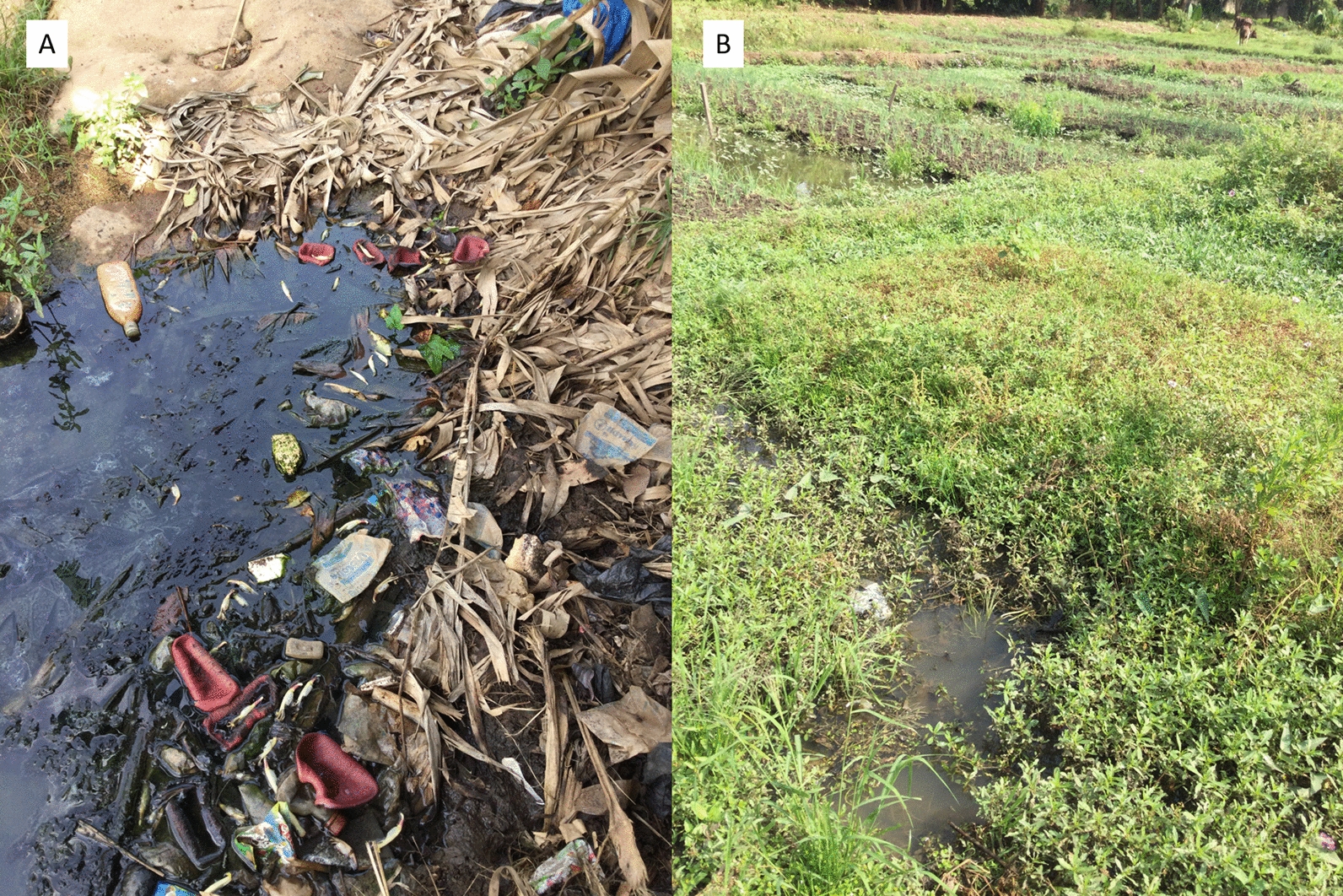
Pictures of the two positive breeding sites for An. arabiensis in the city of Bouaké. A Breeding site BS36 in a watercourse in the Air France district. B Breeding site BS1 in the Odiennekourani district, among old rice fields
Discussion
This study is the first to identify the malaria vector An. arabiensis in the city of Bouaké and in Côte d’Ivoire, both at the larval and adult stages. In West Africa, the typical distribution area of An. arabiensis was characterized by annual precipitation rates of less than 1000 mm [27, 28]. This area extends from the Atlantic coast in Senegal to the north of Cameroon. Although An. arabiensis is mostly found in rural areas, this species has been observed in urban environments to which it has well adapted. In Senegal, it can be found in the capital city, Dakar, where it was collected with Anopheles melas and An. coluzzii [29, 30].
The presence of An. arabiensis in cities has been dependent on its local adaptation to polluted breeding sites [31]. Moreover, environmental changes induced by urbanization (i.e., higher temperatures and lower relative humidity) are also expected to provide favourable environments to An. arabiensis outside its historical distribution area. In Bobo-Dioulasso, the second largest city of Burkina Faso, this species, which accounted for 3% of the Anopheles population in the 1980s [32], reached 8% in 2002 [33], and then over 90% more recently [34], although these rates vary according to the characteristics of the districts in the city [35]. In Nigeria, in the late 1970s, An. arabiensis penetrated the forest belt of the Gulf of Guinea, far from its original distribution area, through urbanized areas as observed by Coluzzii et al. [36]. This fact was confirmed in the 1990s and the 2000s [37, 38].
In Côte d’Ivoire, because of the sociopolitical crisis that occurred from 2000 to 2011, only a few studies have been conducted in the city of Bouaké. Before the 2000s, Dossou-Yovo et al. [10] identified An. gambiae s.l. as the main vector in Bouaké according to morphological tools. After the crisis, several studies were conducted in and around Bouaké [16, 39–41]. However, the species identification techniques used in these studies (morphological identification or PCR according to Favia et al. [21]) did not allow the identification of An. arabiensis. Studies conducted elsewhere in the country during the same period (for example, [11, 13, 42]) have the same limitations.
In this study, An. arabiensis individuals were found two years in a row. Livestock trade between Burkina Faso and Côte d'Ivoire is significant. It could be suggested that An. arabiensis may have been introduced in Bouaké through trucks carrying cattle from Bobo-Dioulasso, for example, especially since An. arabiensis exhibits a strong zoophilic behaviour. Genomic analyses to compare the population profile of An. arabiensis in Bouaké with those of the subregion, in particular of Bobo-Dioulasso, may help to understand the colonization process.
The biting behaviour (mostly exophilic) and biting time (in the second part of the night) of An. arabiensis collected in Bouaké is consistent with existing data [43, 44]. The first site with An. arabiensis larvae was a stream that fit the description of “low-flowing and partially shaded streams” cited by Sinka et al. [43]. It is a known type of breeding site for this species and resembles the Houet River in Bobo-Dioulasso where An. arabiensis proliferates [34]. The second larval habitat was in a garden market in an irrigated area. This is also a known type of larval habitat for this species [43], and these sites are very common in Bouaké. Indeed, Bouaké shows extensive lowland areas devoted to agriculture that have historically been associated with malaria transmission [10]. The use of these areas may have increased during the political crisis, when Bouaké was isolated from the rest of the country. There is, therefore, a high risk for An. arabiensis to proliferate in Bouaké and to increase malaria transmission even if no An. arabiensis were found to be carrying Plasmodium. Moreover, urban agriculture is usually associated with a high use of pesticides, which may result in the emergence of resistance in malaria vectors [45]. The kdr mutations L1014F and L1014S were both identified in the An. arabiensis specimens, but not the ace-1R mutation as it is observed for this species in Bobo-Dioulasso [34]. The number of individuals analysed was low but it should be noted that the L1014F kdr mutation frequency observed recently by Zoh et al. [40] in An. gambiae s.l. in Bouaké was in the same range.
Conclusion
In this study the presence of An. arabiensis is reported for the first time in Côte d’Ivoire, in the city of Bouaké. The presence of numerous potential breeding sites for this species in the area, as well as its ability to adapt to urban environments, suggest that An. arabiensis may play an important role in maintaining malaria transmission in the city in the future. These results call for entomological surveillance in the cities of Côte d’Ivoire and stress the need for alternative intervention strategies to address the expansion of this species.
Acknowledgements
We thank participants who collected mosquitoes in Bouaké as well as households that welcomed them inside their home.
Abbreviations
- DIIS
Direction de l’Informatique et de l’Information Sanitaire (Department of Information Technology and Health Information)
- Ace-1R
Acetylcholinesterase-1 gene
- Kdr
Knockdown resistance gene
- INS
Institut National de la Statistique
- WHO
World Health Organization
- HLC
Human landing catch method
Author contributions
FF and KAA designed the study. FF, KAA, KFA, MMCD, AK, KLN, MK, DDZ, BC and SC conducted field work, laboratory work, and data management. FF, KAA and NM analysed the data. FF, AMA and NM wrote the manuscript. All authors read and approved the final manuscript.
Funding
This study is funded by the Agence Nationale de la Recherche (ANR) in France through the project COHESION (ANR 17 CE 22 0007 01).
Availability of data and materials
The datasets used and/or analysed during the current study are available from the corresponding author on reasonable request.
Declarations
Ethics approval and consent to participate
The protocol of this study was reviewed and approved by the National Life Sciences and Health Ethics Committee (Agreement No. 156-18/MSHP/CNESVS-km of 14 November 2018). The participants who collected the mosquitoes and their supervisors all gave their written informed consent. They received a vaccine against yellow fever as a prophylactic measure. Participants were treated free of charge for malaria according to WHO recommendations.
Consent for publication
Not applicable.
Competing interests
The authors declare no competing interests.
Footnotes
Publisher's Note
Springer Nature remains neutral with regard to jurisdictional claims in published maps and institutional affiliations.
References
- 1.WHO. World malaria report . 20 years of global progress and challenges. Geneva: World Health Organization; 2020. p. 2020. [Google Scholar]
- 2.DIIS. Rapport annuel sur la situation sanitaire 2018. MSHP; 2019.
- 3.Gottdenker NL, Streicker DG, Faust CL, Carroll CR. Anthropogenic land use change and infectious diseases: a review of the evidence. EcoHealth. 2014;11:619–632. doi: 10.1007/s10393-014-0941-z. [DOI] [PubMed] [Google Scholar]
- 4.United Nations. World urbanization prospects: the 2018 revision: key facts. 2018.
- 5.Robert V, Macintyre K, Keating J, Trape JF, Duchemin JB, Warren M, Beier JC. Malaria transmission in urban sub-Saharan Africa. Am J Trop Med Hyg. 2003;68:169–176. doi: 10.4269/ajtmh.2003.68.169. [DOI] [PubMed] [Google Scholar]
- 6.Hay SI, Guerra CA, Tatem AJ, Atkinson PM, Snow RW. Urbanization, malaria transmission and disease burden in Africa. Nat Rev Microbiol. 2005;3:81–90. doi: 10.1038/nrmicro1069. [DOI] [PMC free article] [PubMed] [Google Scholar]
- 7.Doumbe-Belisse P, Kopya E, Ngadjeu CS, Sonhafouo-Chiana N, Talipouo A, Djamouko-Djonkam L, et al. Urban malaria in sub-Saharan Africa: dynamic of the vectorial system and the entomological inoculation rate. Malar J. 2021;20:364. doi: 10.1186/s12936-021-03891-z. [DOI] [PMC free article] [PubMed] [Google Scholar]
- 8.Donnelly MJ, McCall P, Lengeler C, Bates I, D'Alessandro U, Barnish G, et al. Malaria and urbanization in sub-Saharan Africa. Malar J. 2005;4:12. doi: 10.1186/1475-2875-4-12. [DOI] [PMC free article] [PubMed] [Google Scholar]
- 9.Irish SR, Kyalo D, Snox RW, Coetzee M. Updated list of Anopheles species (Diptera: Culicidae) by country in the Afrotropical Region and associated islands. Zootaxa. 2020;4747:401–449. doi: 10.11646/zootaxa.4747.3.1. [DOI] [PMC free article] [PubMed] [Google Scholar]
- 10.Dossou-Yovo J, Doannio JM, Diarrassouba S, Chauvancy G. Impact d'aménagements de rizières sur la transmission du paludisme dans la ville de Bouaké, Côte d'Ivoire. Bull Soc Pathol Exot. 1998;91:327–333. [PubMed] [Google Scholar]
- 11.Assouho KF, Adja AM, Guindo-Coulibaly N, Tia E, Kouadio AMN, Zoh DD, et al. Vectorial transmission of malaria in major districts of Côte d’Ivoire. J Med Entomol. 2020;57:908–914. doi: 10.1093/jme/tjz207. [DOI] [PubMed] [Google Scholar]
- 12.Nzeyimana I, Henry MC, Dossou-Yovo J, Doannio JM, Diawara L, Carnevale P. Epidémiologie du paludisme dans le sud-ouest forestier de la Côte d'Ivoire (région de Taï) Bull Soc Pathol Exot. 2002;95:89–94. [PubMed] [Google Scholar]
- 13.Adja AM, Ngoran EK, Koudou BG, Dia I, Kengne P, Fontenille D, Chandre F. Contribution of Anopheles funestus, An. gambiae and An. nili (Diptera: Culicidae) to the perennial malaria transmission in the southern and western forest areas of Côte d’Ivoire. Ann Trop Med Parasitol. 2011;105:13–24. doi: 10.1179/136485910X12851868780388. [DOI] [PMC free article] [PubMed] [Google Scholar]
- 14.Pages F, Girod R. Entomologie médicale dans les Armées. Premiers résultats de l'Unité d'entomologie médicale. Med Trop. 2004;64:431–6. [PubMed] [Google Scholar]
- 15.Betsi AN, Tchicaya ES, Koudou BG. Forte prolifération de larves d'An. gambiae et An. funestus en milieux rizicoles irrigués et non irrigués dans la région forestière ouest de la Côte-d'Ivoire. Bull Soc Pathol Exot. 2012;105:220–9. doi: 10.1007/s13149-012-0219-z. [DOI] [PubMed] [Google Scholar]
- 16.Adja AM, Zoh DD, Sagna AB, Kpan DMS, Guindo-Coulibaly N, Yapi A, et al. Diversity of Anopheles gambiae s.l., Giles (Diptera: Culicidae) larval habitats in urban areas and malaria transmission in Bouaké, Côte d'Ivoire. Vector Borne Zoonotic Dis. 2021;21:593–601. doi: 10.1089/vbz.2020.2728. [DOI] [PubMed] [Google Scholar]
- 17.INS. Rapport d’exécution et présentation des principaux résultats du Recensement Général de l’Habitat et de la Population de 2014. Institut National de la Statistique; 2014.
- 18.Mattingly PF. The mosquitoes of Ethiopian Region. London: Sutcliffe; 1971. [Google Scholar]
- 19.Gillies MT, Coetzee M. A supplement to the Anophelinae of Africa south of the Sahara (Afrotropical Region). Publication of the South African Institute for Medical Research, Johannesburg. 1987;55:141.
- 20.Cornel AJ, Collins FH. PCR of the ribosomal DNA intergenic spacer regions as a method for identifying mosquitoes in the Anopheles gambiae complex. Methods Mol Biol. 1996;50:321–332. doi: 10.1385/0-89603-323-6:321. [DOI] [PubMed] [Google Scholar]
- 21.Favia G, Lanfrancotti A, Spanos L, Sidén-Kiamos I, Louis C. Molecular characterization of ribosomal DNA polymorphisms discriminating among chromosomal forms of Anopheles gambiae s.s. Insect Biochem Mol Biol. 2001;10:19–23. doi: 10.1046/j.1365-2583.2001.00236.x. [DOI] [PubMed] [Google Scholar]
- 22.Scott JA, Broodon WG, Collins FH. Identification of single specimens of the Anopheles gambiae complex by the polymerase chain reaction. Am J Trop Med Hyg. 1993;49:520–529. doi: 10.4269/ajtmh.1993.49.520. [DOI] [PubMed] [Google Scholar]
- 23.Fanello C, Santolamazza F, Della TA. Simultaneous identification of species and molecular forms of the Anopheles gambiae complex by PCR-RFLP. Med Vet Entomol. 2002;16:461–464. doi: 10.1046/j.1365-2915.2002.00393.x. [DOI] [PubMed] [Google Scholar]
- 24.Mangold KA, Manson RU, Koay ES, Stephens L, Regner M, Thomson RB, Jr, et al. Real-time PCR for detection and identification of Plasmodium spp. J Clin Microbiol. 2005;43:2435–2440. doi: 10.1128/JCM.43.5.2435-2440.2005. [DOI] [PMC free article] [PubMed] [Google Scholar]
- 25.Bass C, Nikou D, Donnelly MJ, Williamson MS, Ranson H, Ball A, et al. Detection of knockdown resistance (kdr) mutations in Anopheles gambiae: a comparison of two new high-throughput assays with existing methods. Malar J. 2007;6:111. doi: 10.1186/1475-2875-6-111. [DOI] [PMC free article] [PubMed] [Google Scholar]
- 26.Bass C, Nikou D, Vontas J, Williamson MS, Field LM. Development of high-throughput real-time PCR assays for the identification of insensitive acetylcholinesterase (ace-1R) in Anopheles gambiae. Pestic Biochem Physiol. 2010;96:80–85. doi: 10.1016/j.pestbp.2009.09.004. [DOI] [Google Scholar]
- 27.Coetzee M, Craig M, le Sueur D. Distribution of African malaria mosquitoes belonging to the Anopheles gambiae complex. Parasitol Today. 2000;16:74–77. doi: 10.1016/S0169-4758(99)01563-X. [DOI] [PubMed] [Google Scholar]
- 28.Hamon J, Coz J. Epidémiologie générale du paludisme humain en Afrique occidentale : répartition et fréquence des parasites et des vecteurs et observations récentes sur quelques-uns des facteurs gouvernant la transmission de cette maladie. Bull Soc Path Exot. 1966;59:466–483. [PubMed] [Google Scholar]
- 29.Dia AK, Guèye OK, Niang EA, Diédhiou SM, Sy MD, Konaté A, et al. Insecticide resistance in Anopheles arabiensis populations from Dakar and its suburbs: role of target site and metabolic resistance mechanisms. Malar J. 2018;17:116. doi: 10.1186/s12936-018-2269-6. [DOI] [PMC free article] [PubMed] [Google Scholar]
- 30.Gadiaga L, Machault V, Pagès F, Gaye A, Jarjaval F, Godefroy L, et al. Conditions of malaria transmission in Dakar from 2007 to 2010. Malar J. 2011;10:312. doi: 10.1186/1475-2875-10-312. [DOI] [PMC free article] [PubMed] [Google Scholar]
- 31.Jones CM, Toé HK, Sanou A, Namountougou M, Hughes A, Diabaté A, et al. Additional selection for insecticide resistance in urban malaria vectors: DDT resistance in Anopheles arabiensis from Bobo-Dioulasso, Burkina Faso. PLoS ONE. 2012;7:e45995. doi: 10.1371/journal.pone.0045995. [DOI] [PMC free article] [PubMed] [Google Scholar]
- 32.Robert V, Gazin P, Ouédraogo V, Carnevale P. Le paludisme urbain à Bobo-Dioulasso (Burkina Faso) Cahiers ORSTOM Ser Ent Parasitol. 1986;24:121–128. [Google Scholar]
- 33.Diabaté A, Baldet T, Chandre F, Akogbeto M, Darriet F, Brengues C, et al. The role of agricultural use of insecticides in resistance to pyrethroids in Anopheles gambiae s.l. in Burkina Faso. Am J Trop Med Hyg. 2002;67:617–22. doi: 10.4269/ajtmh.2002.67.617. [DOI] [PubMed] [Google Scholar]
- 34.Dabiré RK, Namountougou M, Sawadogo SP, Yaro LB, Toé HK, Ouari A, et al. Population dynamics of Anopheles gambiae s.l. in Bobo-Dioulasso city: bionomics, infection rate and susceptibility to insecticides. Parasit Vectors. 2012;21:127. doi: 10.1186/1756-3305-5-127. [DOI] [PMC free article] [PubMed] [Google Scholar]
- 35.Soma DD, Kassié D, Sanou S, Karama FB, Ouari A, Mamai W, et al. Uneven malaria transmission in geographically distinct districts of Bobo-Dioulasso, Burkina Faso. Parasit Vectors. 2018;11(1):296. doi: 10.1186/s13071-018-2857-x. [DOI] [PMC free article] [PubMed] [Google Scholar]
- 36.Coluzzi M, Sabatini A, Petrarca V, Di Deco MA. Chromosomal differentiation and adaptation to human environments in the Anopheles gambiae complex. Trans R Soc Trop Med Hyg. 1979;73:483–497. doi: 10.1016/0035-9203(79)90036-1. [DOI] [PubMed] [Google Scholar]
- 37.Onyabe DY, Conn JE. The distribution of two major malaria vectors, Anopheles gambiae and Anopheles arabiensis, in Nigeria. Mem Inst Oswaldo Cruz. 2001;96:1081–1084. doi: 10.1590/S0074-02762001000800009. [DOI] [PubMed] [Google Scholar]
- 38.Awolola TS, Okwa O, Hunt RH, Ogunrinade AF, Coetzee M. Dynamics of the malaria-vector populations in coastal Lagos south-western Nigeria. Ann Trop Med Parasitol. 2002;96:75–82. doi: 10.1179/000349802125000538. [DOI] [PubMed] [Google Scholar]
- 39.Zoh DD, Ahoua Alou LP, Toure M, Pennetier P, Camara S, Traore DF, et al. The current insecticide resistance status of Anopheles gambiae (s.l.) (Culicidae) in rural and urban areas of Bouaké, Côte d’Ivoire. Parasit Vectors. 2018;11:118. doi: 10.1186/s13071-018-2702-2. [DOI] [PMC free article] [PubMed] [Google Scholar]
- 40.Traoré DF, Sagna AB, Adja AM, Zoh DD, Lingué KN, Coulibaly I, et al. Evaluation of malaria urban risk using an immuno-epidemiological biomarker of human exposure to Anopheles bites. Am J Trop Med Hyg. 2018;98:1353–1359. doi: 10.4269/ajtmh.17-0231. [DOI] [PMC free article] [PubMed] [Google Scholar]
- 41.Zoh DD, Yapi A, Adja MA, Guindo-Coulibaly N, Kpan DMS, Sagna AB, et al. Role of Anopheles gambiae s.s. and Anopheles coluzzii (Diptera: Culicidae) in human malaria transmission in rural areas of Bouaké, in Côte d'Ivoire. J Med Entomol. 2019;4(57):1254–1261. doi: 10.1093/jme/tjaa001. [DOI] [PubMed] [Google Scholar]
- 42.Diakité NR, Guindo-Coulibaly N, Adja AM, Ouattara M, Coulibaly JT, Utzinger J, et al. Spatial and temporal variation of malaria entomological parameters at the onset of a hydro-agricultural development in central Côte d’Ivoire. Malar J. 2015;14:340. doi: 10.1186/s12936-015-0871-4. [DOI] [PMC free article] [PubMed] [Google Scholar]
- 43.Sinka ME, Bangs MJ, Manguin S, Coetzee M, Mbogo CM, Hemingway J, et al. The dominant Anopheles vectors of human malaria in Africa, Europe and the Middle East: occurrence data, distribution maps and bionomic précis. Parasit Vectors. 2010;3:117. doi: 10.1186/1756-3305-3-117. [DOI] [PMC free article] [PubMed] [Google Scholar]
- 44.Doucoure S, Thiaw O, Bouganali C, Diagne N, Parola P, Sokhna C. Anopheles arabiensis and Anopheles funestus biting patterns in Dielmo, an area of low level exposure to malaria vectors. Malar J. 2020;19:230. doi: 10.1186/s12936-020-03302-9. [DOI] [PMC free article] [PubMed] [Google Scholar]
- 45.Yadouléton A, N'Guessan R, Allagbé H, Asidi A, Boko M, Osse R, et al. The impact of the expansion of urban vegetable farming on malaria transmission in major cities of Benin. Parasit Vectors. 2010;3:118. doi: 10.1186/1756-3305-3-118. [DOI] [PMC free article] [PubMed] [Google Scholar]
Associated Data
This section collects any data citations, data availability statements, or supplementary materials included in this article.
Data Availability Statement
The datasets used and/or analysed during the current study are available from the corresponding author on reasonable request.