



Abstract
We examined the extent to which intersectional social identities combine to shape risks of loneliness and identified the specific social clusters that are most at risk of loneliness for more precise and targeted interventions to reduce loneliness in a Swiss municipality. Based on data collected using participatory action research, we used the novel multilevel analysis of individual heterogeneity and discriminatory accuracy (MAIHDA) to estimate the predictive power of intersectional social attributes on risk of loneliness. We found that 56% of the between‐strata variance was captured by intersectional interaction but was not explained by the additive effect of social identities. We also found that nationality and education had the strongest predictive power for loneliness. Interventions to reduce loneliness may benefit from understanding the resident population's intersectional identities given that individuals with the same combinations of social identities face a common set of social exposures relating to loneliness.
Keywords: community intervention, intersectionality, multilevel modeling, participatory action research, social and emotional isolation, social identity, stratification
1. INTRODUCTION
Loneliness refers to the subjective and negative evaluation of an individual's social relationships, indicated by the perceived deficiency in the desired quantity or quality of social connections (De Jong Gierveld & Van Tilburg, 2010; Peplau & Perlman, 1982). Loneliness is associated with a cascade of negative biological, mental, behavioral, and functional health outcomes (Adam et al., 2006; Cacioppo et al., 2006; Hawkley et al., 2010; Henriksen et al., 2019; Seeman, 2000; Tomás et al., 2019; Wilson et al., 2007). In Switzerland, 38% of the population aged 15 or older experience loneliness, which is more prevalent among individuals with a migration background relative to the native Swiss population (Federal Statistical Office, 2017). While community‐based interventions can help reduce loneliness by fostering social connections and a sense of belonging (e.g., Coll‐Planas et al., 2017; Masi et al., 2011; Winningham & Pike, 2007), these interventions are often based on broad demographic categorizations (e.g., older adults or foreigners), neglecting the intersectional and multiplicative nature of social identities, thereby limiting the precision and effectiveness of community interventions. The present study addresses this gap in the literature by examining the role of intersectional social identities in loneliness among residents in a local municipality in Switzerland.
A substantial literature documents the sociodemographic patterning of loneliness. Research demonstrates a U‐shaped association between age and prevalence of loneliness, where younger and older people report more loneliness than middle‐age individuals (Lasgaard et al., 2016; Luhmann & Hawkley, 2016; Victor & Yang, 2012). Older adults being at an increased risk of loneliness is partly attributable to deteriorating health and reduced social contacts, particularly after retirement (Cacioppo & Cacioppo, 2018; De Jong Gierveld & Van Tilburg, 2010). Individuals with low levels of education are more susceptible to loneliness relative to people with higher educational attainment (Theeke, 2010). Loneliness is more prevalent among individuals with a migration background relative to natives, explained by lower satisfaction with social relationships and lower participation in social activities among migrants (Ten Kate et al., 2020). Furthermore, the gender gap in loneliness is also well documented: loneliness is more common among men than among women (Barretto et al., 2021; Maes et al., 2019), with the caveat that men may be less willing to acknowledge or report loneliness (Barretto et al., 2021). In summary, extant research demonstrates the differences on average levels of loneliness across population segments defined by broad demographic categorizations, effectively identifying a multitude of “risk factors” of loneliness (i.e., advancing age or being a migrant).
However, extant research neglects the intersecting and multiplicative nature of demographic categorizations and the within‐group individual heterogeneity of loneliness. In real life, each person simultaneously belongs to multiple demographic groups and no one is just a woman or just an older adult. A migrant is simultaneously middle‐aged, highly educated, and male. An older adult may be a Swiss citizen, having low educational attainment, and female at the same time. Yet, what prior research does not adequately show is how memberships in these groups combine to shape people's risk of loneliness. How likely is loneliness for someone who is non‐Swiss and female and aged 68 and college‐educated? This gap in the literature limits our understanding of disparities in loneliness at the intersection of social identities, restricting more precisely targeted interventions from being developed and implemented to address loneliness.
The intersectionality framework, recognized for its importance in summarizing disparities and identifying pathways for intervention (Evans et al., 2018; Merlo, 2018), helps to conceptualize intersectional identities and loneliness. Intersectionality theories originated in the literature on black feminism—the interaction between race and sex—and how the multiplicative disadvantages and discriminations experienced by black women in the job market were greater than the sum of racism and sexism (Crenshaw, 1989). Intersectionality theories suggest that inequalities are produced through interlocking systems of privilege and oppression such as classism, sexism, and ageism (Crenshaw, 1989; Yuval‐Davis, 2011), as opposed to mere advantages or disadvantages accumulated through social positions. In the context of loneliness, the intersectionality framework suggests that social identities are not only multidimensional but also interactive (Barreto et al., 2021).
The intersectionality framework has been used to understand the multiplicative impact of social categories and group memberships (e.g., race × gender × class) on health outcomes across the life span (Evans et al., 2018; Roy et al., 2020). For example, research from the Netherlands shows that the experience of multiple disadvantage among migrant and minority ethnic older adults (i.e., those of Moroccan and Turkish origins) is attributable to discrimination and stigmatization earlier in life relating to their ethnicity, gender, and social status (van der Greft & Fortuijn, 2017). Intersectional identities underpin the collective social exposures in the form of multiple advantages or disadvantages among individuals in the same social categories and condition the impact of social processes on health outcomes.
Intersectional group memberships relate to the cognitive, affective, and attitudinal aspects of social identities, and reveal the multiple advantage or disadvantages experienced by individuals sharing intersectional group memberships. Social group memberships provide people with a distinctive sense of self through association with others in the same group, which in turn influence how people think, feel, and act (Haslam et al., 2016). Programs based on social categories and group ties have been used to address cognitive health, social isolation, and affective disturbance, and are shown to be effective in improving mental and cognitive health outcomes through increased identification with social groups (e.g., Haslam et al., 2015, 2016). Greater understanding of social categories in the context of loneliness is essential for intervention development to alleviate loneliness.
The present study goes beyond the conventional approach by situating individuals within their relevant intersecting categorizations and quantitatively examining the role of multidimensional and intersectional social contexts in shaping the risk of loneliness. Instead of viewing age, gender, nationality, and education as individual characteristics, we conceptualize these four dimensions as overlapping social contexts shaped by societal systems of empowering and oppressing forces, where social processes condition the experiences—that is, the feeling of loneliness –among individuals sharing the same intersectional attributes. Intersectional contexts that consist of age, gender, nationality, and education may contribute to disparities in loneliness through such mechanisms as differential social networks and senses of a community (Berkman et al., 2000; Cacioppo et al., 2009; Glass, 2020; McLaughlin et al., 2010; Van Beek & Patulny, 2021), variable social support (Hombrados‐Mendieta et al., 2013; Stephens et al., 2011), and differing cultural values in relations to social connections (Berkman et al., 2000; Rokach, 2007), which in turn influence the subjective evaluation of social relationships.
We examine whether and to what extent intersectional identities combine to shape risks of loneliness based on intersectional social attributes shared by people in specific clusters defined by combinations of multiple social identities, by situating people within overlapping axes of identities. This study addresses two main questions: (1) whether and to what extent are disparities in loneliness explained by intersectional social identities that cut across gender, age, educational attainment, and nationality? (2) how much relative predictive power does each of the aforementioned interlocking dimensions have, relative to an analysis that does not account for any intersectional social dimension? The study identifies not only the intersectional dimensions with the highest predictive power for loneliness but also the specific intersectional social clusters that are most likely to experience loneliness, offering evidence for more precise and targeted interventions to reduce loneliness. Precision intervention, pioneered in social epidemiology, is an approach designed to deliver “the right intervention to the right person” (Khoury et al., 2016), and is shown to narrow gaps in health outcomes (Joseph et al., 2019).
This article proceeds as follows. The second and next section introduces the methods of our analysis, including a brief background of the local community project from which data were collected, measures for variables, and the analytic strategy. The third section presents the results. The final section concludes with a discussion of the results, contributions and limitations, and implications for policy and practice based on the current study.
2. METHODS
2.1. Data
Data were collected as part of the Participatory Action Research (PAR) project “Cause Commune” (i.e., common cause, or, chat in the community) from community‐dwelling adults aged 18 or older in 2019 (Plattet & Spini, 2021). PAR is an approach aimed at engaging and promoting the competencies of local residents to bring about changes in the local community (Kidd & Kral, 2005; Minkler & Wallerstein, 2008). Within the context of PAR, the Cause Commune project was developed to better understand social problems and to identify intervention pathways in Chavannes‐près‐Renens, a municipality in the Swiss canton of Vaud, bordering Lake Geneva to the south and France to the west. Chavannes‐près‐Renens has a diverse population: 52% of its 8060 inhabitants (December, 2019) are of non‐Swiss origins, representing nearly 100 nationalities spanning Africa, Asia, North and South Americas, the Middle East, and other parts of Europe (Plattet & Spini, 2021). To promote social integration and well‐being, increasing attention is paid to better understand disparities in well‐being among local residents (Plattet & Spini, 2021), and to identify intervention pathways and inform policy formulation. The Cantonal Commission on Ethics in Human Research decided that the current project did not fall within the scope of human research. The Cantonal Commission on Ethics in Human Research (CER‐VD) is a cantonal administrative body in Switzerland established by the Law on Human Research (LRH) to ensure the protection of research subjects and to assess the compliance of human research projects with ethical, legal, and scientific requirements.
The Cause Commune project involved the entire adult resident population of Chavannes‐près‐Renens. With support from the municipality administration, all 6220 adults who were eligible for the survey were contacted (Plattet & Spini, 2021). Among those contacted, 1492 individuals participated by responding to the questionnaire, yielding a participation rate of 24% (Plattet & Spini, 2021). Among the 1492 responses, 91 questionnaires were withdrawn due to incomplete responses or duplicate participations revealed by identical personal codes. Thus, the final analytic sample consisted of 1401 adult residents aged 18 or older in Chavannes‐près‐Renens.
2.2. Measures
2.2.1. Outcome
We measured perceived social and emotional loneliness with four items taken from the Scale for Overall, Emotional, and Social Loneliness (De Jong Gierveld & Van Tilburg, 2010). Like in the original scale, two items were negatively formulated: “I miss having people around me” and “I often feel rejected”, while two items were formulated positively: “There are many people I can trust completely” and “There are enough people I feel close to” (Appendix 1). Respondents were asked to indicate the extent to which they agree or disagree with each statement. A composite score was calculated by averaging the responses from the four scales after reverse‐coding the positively formulated scales so that responses ranged from 1 to 5, where 1 indicates the least feeling of loneliness and 5 the strongest. The Cronbach α showed adequate reliability (α = 0.75).
2.2.2. Dimensions of intersectional strata
We used four dimensions of social identity to construct the intersectional strata in this study: gender, age, education, and nationality. Considering data availability, we used these dimensions given their meaningful associations with loneliness shown in prior research (Barretto et al., 2021; Cacioppo & Cacioppo, 2018; De Jong Gierveld & Van Tilburg, 2010; Lasgaard et al., 2016; Luhmann & Hawkley, 2016; Ten Kate et al., 2020; Theeke, 2010). Gender was coded binary (0 = male, 1 = female). Age was categorized into three groups: 18–40, 41–64, and 65+, with attention to the differential life roles by age groups (Settersten, 2003) and the analytical benefits of distributing the sample roughly equally between these categories. Educational attainment was classified into three categories: primary, secondary, and tertiary (Federal Statistical Office, 2020). Nationality was classified into Swiss and non‐Swiss to capture the potential effect of being foreign versus native on feelings of loneliness. Respondents with dual nationalities (i.e., Swiss and another nationality) were treated as Swiss. All social identities were self‐reported. As shown in Appendix 2, the final analytical sample consists of 1360 individuals nested within 36 intersectional strata: gender (2) × age (3) × education (3) × nationality (2), after 41 cases (2.9%) were dropped due to missing data on any of the four dimensions used to construct the intersectional strata because these cases cannot be nested within any stratum.
2.3. Analytic strategy
We used the multilevel analysis of individual heterogeneity and discriminatory accuracy (MAIHDA)—a set of multilevel models that partition the total variance into between‐strata and within‐strata variances—to estimate the predictive power of intersectional social attributes on the risk of loneliness (Evans et al., 2018; Merlo, 2018). In effect, this approach nests each individual within their relevant intersection—for example, Swiss and female and aged 41–64 and university‐educated—and estimates random effects at the intersectional category level. To understand the relative predictive power of each intersectional dimension, we used the MAIHDA technique and analyzed the proportional change in variance between a reference (null) model and the model with an added dimension of interest (e.g., nationality) (Sochas, 2020). The larger the proportional change in the random intercepts' variance between the two models, the more predictive power that added dimension has.
Given our research questions on the predictive power of intersectional social identity context for loneliness, we used the MAIHDA technique to quantitatively evaluate intersectionality with respect to loneliness. Specifically, MAIHDA allows for an ecological consideration of disparities in loneliness by partitioning the total variance between individual (micro‐) and contextual (meso‐) levels, making it possible to evaluate the interlocking dimensions of privilege and oppression related to inequities (Evans et al., 2018) by situating residents of Chavannes‐près‐Renens in their intersectional social identity context. The MAIHDA technique, a novel, and innovative analytic approach, is shown to have important advantages over conventional fixed‐effect approaches when modeling overlapping social identities and health inequities, including precision‐weighted estimates, model parsimony, ease of interpretation, and reliable estimates for strata with small sample sizes, relative to the multivariate approach, and is especially useful when a very large sample is not available (Evans et al., 2018; Merlo, 2018). The theoretical foundation, empirical strategies, and advantages of this technique have been extensively documented in the social epidemiological literature (Evans et al., 2018; Merlo, 2018; Persmark et al., 2019; Sochas, 2020).
3. RESULTS
Table 1 reports the descriptive characteristics of the study sample. The mean level of loneliness was 2.3 on a composite scale where 1 indicates least lonely and 5 the strongest feeling of loneliness. Forty‐two percent of the sample were non‐Swiss. About 54% were female. Approximately 39% aged 18–40, 39% aged 41–64, and 21% aged 65 or older. In terms of educational attainment, 10% of the sample obtained primary education, 51% secondary education, and 39% obtained tertiary education, where tertiary education includes university education as well as professional training in the Swiss context. Respondents in the sample were cross‐classified into 36 intersectional strata based on their nationality, gender, age, and educational attainment (Appendix 2).
Table 1.
Descriptive characteristics of the study sample
| Mean or % | |
|---|---|
| Loneliness (SD) | 2.3 (0.8) |
| Nationality | |
| Foreign | 42.1% |
| Swiss | 57.9% |
| Gender | |
| Male | 46.4% |
| Female | 53.6% |
| Age | |
| 18–40 | 39.4% |
| 41–64 | 39.3% |
| 65+ | 21.3% |
| Education | |
| Primary | 10.2% |
| Secondary | 50.7% |
| Tertiary | 39.1% |
Note: No. of observations = 1360. Loneliness: 1 = least lonely, 5 = most lonely.
Abbreviation: SD, standard deviation.
Table 2 provides results for multilevel models on intersectional identities and loneliness. Results showed that nationality and educational attainment had the highest predictive power for loneliness given that the inclusion of nationality reduced the random intercept's variance by 15.3% (Model 2), and the inclusion of education reduced the random intercept's variance by 21.8% (Model 5), relative to the null model (Model 1) where the additive effects of intersectional dimensions were not considered. By contrast, gender and age had relatively lower predictive power for loneliness: their inclusion reduced the random intercept's variance by 1.5% (Model 3) and 5.7% (Model 4), respectively, again relative to Model 1. When all dimensions were included in the full model (Model 6), the random intercept's variance was reduced by 44%. This suggests that 56% of the between‐strata variation remains unexplained by the main additive effects, but was captured by intersectional interaction. This indicates the intersectional nature of loneliness where people with unique combinations of social attributes share a common set of social exposures such as norms, opportunities, and constraints which, although not directly observed in this study, is reflected in the non‐additive patterning of loneliness within this community context. While we acknowledge that the proportion of the between‐strata variation that remains unexplained is a significant portion of an initially small part of the total variance (intraclass correlation [ICC] = 3.4%, Model 1), it is nevertheless nontrivial and shows that intersectionality cannot be ignored.
Table 2.
Results from multilevel analysis on intersectional identities and loneliness
| Model 1 | Model 2 | Model 3 | Model 4 | Model 5 | Model 6 | |||||||||||||
|---|---|---|---|---|---|---|---|---|---|---|---|---|---|---|---|---|---|---|
| Estimate | 95% CI | Estimate | 95% CI | Estimate | 95% CI | Estimate | 95% CI | Estimate | 95% CI | Estimate | 95% CI | |||||||
| Nationality | ||||||||||||||||||
| Foreign | Ref. | Ref. | ||||||||||||||||
| Swiss | −0.101 | −0.230 | 0.027 | −0.103 | −0.221 | 0.016 | ||||||||||||
| Gender | ||||||||||||||||||
| Male | Ref. | Ref. | ||||||||||||||||
| Female | −0.052 | −0.186 | 0.081 | −0.061 | −0.176 | 0.055 | ||||||||||||
| Age | ||||||||||||||||||
| 18‐40 | Ref. | Ref. | ||||||||||||||||
| 41–64 | 0.092 | −0.061 | 0.246 | 0.070 | −0.064 | 0.204 | ||||||||||||
| 65+ | 0.097 | −0.073 | 0.267 | 0.065 | −0.094 | 0.225 | ||||||||||||
| Education | ||||||||||||||||||
| Primary | Ref. | Ref. | ||||||||||||||||
| Secondary | −0.234 | −0.412 | −0.056 | −0.215 | −0.387 | −0.042 | ||||||||||||
| Tertiary | −0.283 | −0.465 | −0.101 | −0.261 | −0.442 | −0.079 | ||||||||||||
| Variance between strata | 0.020 | 0.017 | 0.020 | 0.019 | 0.016 | 0.011 | ||||||||||||
| ICC (%) | 3.415 | 2.905 | 3.362 | 3.224 | 2.698 | 1.943 | ||||||||||||
| PCV (%) | Ref. model | −15.286 | −1.545 | −5.689 | −21.775 | −43.970 | ||||||||||||
Abbreviations: ICC, intraclass correlation; PCV, proportional change in variance.
Does the intersectional approach capture additional privilege or risk of loneliness, and if so, for whom? Figure 1 illustrates the mean stratum‐level interaction effect by nationality, education, and gender. Stratum‐level interaction effect was calculated as the difference between the total effect (additive and interactive) and the main effect (additive only). A negative interaction effect suggests that the interactive approach captured additional privilege against loneliness, whereas a positive interaction effect indicates that the interactive approach captured additional risk of loneliness based on the intersectional social identities considered, relative to the additive fixed approach. Figure 1 shows that Swiss women with tertiary education (regardless of age) enjoy considerable privilege against loneliness as captured by the interaction approach, above and beyond the additive effects. By contrast, non‐Swiss women with tertiary education have a considerable risk of loneliness, beyond what is captured by the fixed effects.
Figure 1.
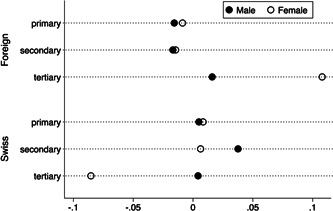
Mean stratum‐level interaction effect by nationality, education, and gender. Note: The markers indicate the average stratum‐level interaction effect calculated as the difference between the total effect (additive and interactive) and the main effect (additive only). A negative interaction effect suggests that the interactive approach captured additional privilege against loneliness, whereas a positive interaction effect indicates that the interactive approach captured additional risk of loneliness based on the intersectional social identities considered, relative to the additive fixed approach. Strata are grouped by nationality, education, and gender (regardless of age)
Who are logical intervention targets to reduce loneliness? Table 3 reports the predicted levels of loneliness by strata based on intersectional social attributes. For purpose of illustration, ten strata each with the highest and lowest predicted values are shown. There are wide disparities in the predicted level of loneliness by combined social attributes that cut across nationality, gender, age, and education. The strata with the lowest levels of loneliness are predominantly Swiss and young or middle‐aged and female and having secondary or tertiary educational attainment. Individuals sharing these intersectional social attributes are least at risk of loneliness. By contrast, the strata with the highest levels of predicted loneliness are predominantly non‐Swiss and middle‐aged or older and male and with primary educational attainment only. Individuals sharing these intersectional social identities are most at risk of loneliness and are logical intervention targets.
Table 3.
Predicted stratum‐level loneliness based on intersectional attributes (10 lowest and 10 highest strata)

|
Note: Loneliness: 1 = least lonely, 5 = most lonely. Shading: green = least at risk, red = most at risk.
4. DISCUSSION
The present study, employing a novel and innovative multilevel modeling technique to quantitatively examine intersectionality with regard to loneliness, moves beyond the conventional multivariate approach by situating individuals within their relevant intersecting categorizations and looking at the role of intersectional social identities in shaping risk of loneliness in a diverse municipality in Switzerland. Instead of identifying additive “risk factors” of loneliness based on differences on average levels of loneliness across population segments defined by broad demographic groups, this study investigates the extent to which intersectional and multiplicative memberships in these groups combine to shape experiences of loneliness. In particular, we investigated the extent to which disparities in loneliness were explained by intersectional social identities that cut across gender, age, education, and nationality, and which dimensions of intersectional identities had the strongest predictive power for loneliness. We found that the additive effect of these dimensions explained 44% of the between‐strata variance, leaving 56% of the between‐strata variance unexplained but captured by the interaction effect, indicating intersectional patterns where individuals with similar intersectional attributes potentially experience common norms, opportunities, or constraints (unobserved) that are unique to their social identities. We also found that nationality and education had the strongest predictive power while gender and age had relatively lower predictive power for loneliness.
Although substantial literature documents the association between social identities and loneliness, very little is known about the role of intersectional identities in loneliness, making it difficult to compare the results from this study to that in prior literature. Nonetheless, the findings from this paper broadly concur with the social patterning of loneliness shown in prior research. The finding that nationality and education had particularly strong predictive power concurs with research showing that being native to a country and having higher educational attainment confer privilege that may protect against loneliness (Ten Kate et al., 2020; Theeke, 2010). The finding that older men, in particular, are most at risk of loneliness is consistent with prior research showing that loneliness is more prevalent among men than among women and that older adults have an increased risk of loneliness (Barretto et al., 2021; Cacioppo & Cacioppo, 2018; De Jong Gierveld & Van Tilburg, 2010).
Importantly, the study identifies not only the intersectional dimensions that have the highest predictive power for loneliness but also the specific intersectional social clusters that are most likely to experience loneliness, offering evidence for more precise and targeted community‐based interventions to reduce loneliness. In particular, individuals who are non‐Swiss and middle‐aged or older and male and have primary education only are logical intervention targets. The study also shows that people who are Swiss and young or middle‐aged and female and have secondary or tertiary education enjoy considerable privilege when it comes to loneliness. Put simply, while we already know how the level of loneliness varies by gender, by age, by education, and by migration status, this study shows how the level of loneliness varies when these attributes are taken together and conceptualized as social clusters that correspond to people's intersecting identities.
4.1. Limitations
A few limitations merit discussion. Given data limitations, the identities used to construct intersectional strata were limited to gender, age, education, and nationality. Future research should examine the role of religiosity, language proficiency, and other attributes and their role in shaping the risk of loneliness within an intersectional framework. The multilevel modeling technique used in this study is most suited to large samples with ample diversity. The sample in the present study, although sufficiently diverse in terms of the intersectional identities considered, is relatively small and may have limited the present study's statistical power. No causal interpretations should be made from this cross‐sectional study.
Despite these limitations, the present study, a quantitative operationalization of intersectionality, establishes the extent to which overlapping social identities predict levels of loneliness, and identifies which dimensions of the intersectional social context have higher predictive power for loneliness in the context of Switzerland. Given the diverse resident population in many Swiss communities where migrants and older adults experience social and emotional isolation, and the increasing effort to promote social integration by identifying segments of the resident population most at risk of loneliness, this study offers evidence for more precise and targeted interventions based on readily identifiable intersectional attributes. Finally, this study represents a methodological contribution to the study on social context and social and emotional isolation by capturing the ecological connections between individuals and the intersectional social contexts within which they are embedded.
The study has implications for policy and practice. Although no causal inferences can be made, findings are suggestive that community interventions to alleviate loneliness may benefit from sharpened and tailored outreach efforts targeting those who are most at risk of loneliness based on their intersectional identities. In the Swiss context of this study, residents who are non‐Swiss and middle‐aged or older and male and have primary education only should be a focal target, given the elevated risk of loneliness resulting from multiple disadvantage associated with their identities. Interventions may include customized communications (e.g., brochures, websites, and magazines) delivered to target groups with information on social engagement and participation (Coll‐Planas et al., 2017). Interventions may also include more precisely targeted promotion of social support and opportunities for social interaction (e.g., customized community events, counseling) for target groups (Masi et al., 2011). Further consideration should also be given to programs that facilitate retirement transition, particularly taking into account that those who are most at risk of loneliness tend to be middle‐aged or older and are likely to have reduced social contact after retirement (Cacioppo & Cacioppo, 2018; De Jong Gierveld & Van Tilburg, 2010).
PEER REVIEW
The peer review history for this article is available at https://publons.com/publon/10.1002/jcop.22855.
ACKNOWLEDGEMENTS
The authors are grateful to the Swiss National Science Foundation for its financial assistance. The Cause Commune project is financially supported by the Leenaards Foundation, the canton of Vaud, the municipality of Chavannes‐près‐Renens, and the LIVES Center. The authors also wish to offer gratitude to the municipality of Chavannes‐près‐Renens, to its services, to its residents, and to the consultation and research platform and its researchers for their comments and support. This publication benefitted from the support of the Swiss National Centre of Competence in Research LIVES—Overcoming vulnerability: Life course perspectives (NCCR LIVES), which is financed by the Swiss National Science Foundation (grant number: 51NF40‐185901). Open access funding provided by Universite de Lausanne.
APPENDIX 1. SURVEY QUESTIONS USED TO MEASURE LONELINESS
| Strongly disagree | Disagree | More or less | Agree | Strongly agree | |
|---|---|---|---|---|---|
| I miss having people around me. | ☐ | ☐ | ☐ | ☐ | ☐ |
| I often feel rejected. | ☐ | ☐ | ☐ | ☐ | ☐ |
| There are many people I can trust completely. | ☐ | ☐ | ☐ | ☐ | ☐ |
| There are enough people I feel close to. | ☐ | ☐ | ☐ | ☐ | ☐ |
Note: De Jong Gierveld and Van Tilburg (2010).
APPENDIX 2. INTERSECTIONAL STRATA DESIGN
| Nationality | Gender | Age | Education | n |
|---|---|---|---|---|
| Swiss | Male | 18–40 | Primary | 2 |
| Swiss | Male | 18–40 | Secondary | 45 |
| Swiss | Male | 18–40 | Tertiary | 58 |
| Swiss | Male | 41–64 | Primary | 7 |
| Swiss | Male | 41–64 | Secondary | 62 |
| Swiss | Male | 41–64 | Tertiary | 55 |
| Swiss | Male | 65+ | Primary | 15 |
| Swiss | Male | 65+ | Secondary | 57 |
| Swiss | Male | 65+ | Tertiary | 25 |
| Swiss | Female | 18–40 | Primary | 3 |
| Swiss | Female | 18–40 | Secondary | 84 |
| Swiss | Female | 18–40 | Tertiary | 79 |
| Swiss | Female | 41–64 | Primary | 15 |
| Swiss | Female | 41–64 | Secondary | 86 |
| Swiss | Female | 41–64 | Tertiary | 62 |
| Swiss | Female | 65+ | Primary | 29 |
| Swiss | Female | 65+ | Secondary | 90 |
| Swiss | Female | 65+ | Tertiary | 15 |
| Foreign | Male | 18–40 | Primary | 4 |
| Foreign | Male | 18–40 | Secondary | 54 |
| Foreign | Male | 18–40 | Tertiary | 74 |
| Foreign | Male | 41–64 | Primary | 14 |
| Foreign | Male | 41–64 | Secondary | 72 |
| Foreign | Male | 41–64 | Tertiary | 54 |
| Foreign | Male | 65+ | Primary | 15 |
| Foreign | Male | 65+ | Secondary | 13 |
| Foreign | Male | 65+ | Tertiary | 5 |
| Foreign | Female | 18–40 | Primary | 7 |
| Foreign | Female | 18–40 | Secondary | 50 |
| Foreign | Female | 18–40 | Tertiary | 76 |
| Foreign | Female | 41–64 | Primary | 15 |
| Foreign | Female | 41–64 | Secondary | 61 |
| Foreign | Female | 41–64 | Tertiary | 31 |
| Foreign | Female | 65+ | Primary | 9 |
| Foreign | Female | 65+ | Secondary | 15 |
| Foreign | Female | 65+ | Tertiary | 2 |
| Total | 1360 |
Li, Y. , Spini, D. (2022). Intersectional social identities and loneliness: Evidence from a municipality in Switzerland. Journal of Community Psychology, 50, 3560–3573. 10.1002/jcop.22855
DATA AVAILABILITY STATEMENT
The data that support the findings of this study are available on request from the corresponding author. The data are not publicly available due to privacy or ethical restrictions.
REFERENCES
- Adam, E. K. , Hawkley, L. C. , Kudielka, B. M. , & Cacioppo, J. T. (2006). Day‐to‐day dynamics of experience‐cortisol associations in a population‐based sample of older adults. Proceedings of the National Academy of Sciences, 103, 17058–17063. [DOI] [PMC free article] [PubMed] [Google Scholar]
- Barreto, M. , Victor, C. , Hammond, C. , Eccles, A. , Richins, M. T. , & Qualter, P. (2021). Loneliness around the world: Age, gender, and cultural differences in loneliness. Personality and Individual Differences, 169, 110066. [DOI] [PMC free article] [PubMed] [Google Scholar]
- Van Beek, M. , & Patulny, R. (2021). 'The threat is in all of us': Perceptions of loneliness and divided communities in urban and rural areas during COVID‐19. Journal of Community Psychology. [DOI] [PMC free article] [PubMed] [Google Scholar]
- Berkman, L. F. , Glass, T. , Brissette, I. , & Seeman, T. E. (2000). From social integration to health: Durkheim in the new millennium. Social Science & Medicine, 51, 843–857. [DOI] [PubMed] [Google Scholar]
- Cacioppo, J. T. , & Cacioppo, S. (2018). The growing problem of loneliness. The Lancet, 391(10119), 426. [DOI] [PMC free article] [PubMed] [Google Scholar]
- Cacioppo, J. T. , Fowler, J. H. , & Christakis, N. A. (2009). Alone in the crowd: The structure and spread of loneliness in a large social network. Journal of Personality and Social Psychology, 97(6), 977–991. [DOI] [PMC free article] [PubMed] [Google Scholar]
- Cacioppo, J. T. , Hughes, M. E. , Waite, L. J. , Hawkley, L. C. , & Thisted, R. (2006). Loneliness as a specific risk factor for depressive symptoms: Cross sectional and longitudinal analyses. Psychology and Aging, 21, 140–151. [DOI] [PubMed] [Google Scholar]
- Coll‐Planas, L. , Gómez, delV. , Bonilla, G. , Masat, P. , Puig, T. , & Monteserin, R. (2017). Promoting social capital to alleviate loneliness and improve health among older people in Spain. Health & Social Care in the Community, 25(1), 145–157. [DOI] [PubMed] [Google Scholar]
- Crenshaw, K. (1989). Demarginalizing the intersection of race and sex: A black feminist critique of antidiscrimination doctrine, feminist theory, and antiracist politics. University of Chicago Legal Forum.
- Evans, C. R. , Williams, D. R. , Onnela, J. P. , & Subramanian, S. V. (2018). A multilevel approach to modeling health inequalities at the intersection of multiple social identities. Social Science & Medicine, 203, 64–73. [DOI] [PubMed] [Google Scholar]
- Federal Statistical Office . (2017). Integration indicators: Feelings of loneliness, Neuchâtel. Switzerland: Federal Statistical Office, Demography and Migration Section. https://www.bfs.admin.ch/bfs/en/home/statistics/population/migration-integration/integration-indicators/indicators/feeling-loneliness.html
- Federal Statistical Office . (2020). Economic and social situation of the population: Educational attainment, Neuchâtel. Switzerland: Federal Statistical Office, Demography and Migration Section. https://www.bfs.admin.ch/bfs/en/home/statistics/economic-social-situation-population/gender-equality/education/educational-attainment.html
- Glass, A. P. (2020). Sense of community, loneliness, and satisfaction in five elder cohousing neighborhoods. Journal of Women & Aging, 32(1), 3–27. [DOI] [PubMed] [Google Scholar]
- van der Greft, S. , & Fortuijn, J. D. (2017). Multiple disadvantage of older migrants and native Dutch older adults in deprived neighbourhoods in Amsterdam, the Netherlands: A life course perspective. GeoJournal, 82(3), 415–432. [Google Scholar]
- Haslam, C. , Cruwys, T. , Haslam, S. A. , Dingle, G. , & Chang, M. X. L. (2016). Groups 4 Health: Evidence that a social‐identity intervention that builds and strengthens social group membership improves mental health. Journal of Affective Disorders, 194, 188–195. [DOI] [PubMed] [Google Scholar]
- Haslam, C. , Cruwys, T. , Milne, M. , Kan, C. H. , & Haslam, S. A. (2015). Group ties protect cognitive health by promoting social identification and social support. Journal of Aging and Health, 28(2), 244–266. [DOI] [PubMed] [Google Scholar]
- Hawkley, L. , Thisted, R. , Masi, C. , & Cacciopo, J. (2010). Loneliness predicts increase blood pressure: 5‐Year cross‐lagged analyses in middle‐aged and older adults. Psychology and Aging, 25(1), 132–141. [DOI] [PMC free article] [PubMed] [Google Scholar]
- Henriksen, R. E. , Nilsen, R. M. , & Strandberg, R. B. (2019). Loneliness as a risk factor for metabolic syndrome: Results from the HUNT study. Journal of Epidemiology and Community Health, 73(10), 941–946. [DOI] [PubMed] [Google Scholar]
- Hombrados‐Mendieta, I. , García‐Martín, M. A. , & Gómez‐Jacinto, L. (2013). The relationship between social support, loneliness, and subjective well‐being in a Spanish sample from a multidimensional perspective. Social Indicators Research, 114(3), 1013–1034. [Google Scholar]
- De Jong Gierveld, J. , & Van Tilburg, T. (2010). The De Jong Gierveld short scales for emotional and social loneliness: Tested on data from 7 countries in the UN generations and gender surveys. European Journal of Ageing, 7(2), 121–130. [DOI] [PMC free article] [PubMed] [Google Scholar]
- Joseph, G. , Lee, R. , Pasick, R. J. , Guerra, C. , Schillinger, D. , & Rubin, S. (2019). Effective communication in the era of precision medicine: a pilot intervention with low health literacy patients to improve genetic counseling communication. European Journal of Medical Genetics, 62(5), 357–367. [DOI] [PMC free article] [PubMed] [Google Scholar]
- Ten Kate, R. L. , Bilecen, B. , & Steverink, N. (2020). A closer look at loneliness: Why do first‐generation migrants feel more lonely than their native Dutch counterparts? The Gerontologist, 60(2), 291–301. [DOI] [PMC free article] [PubMed] [Google Scholar]
- Khoury, M. J. , Iademarco, M. F. , & Riley, W. T. (2016). Precision public health for the era of precision medicine. American Journal of Preventive Medicine, 50(3), 398–401. [DOI] [PMC free article] [PubMed] [Google Scholar]
- Kidd, S. A. , & Kral, M. J. (2005). Practicing participatory action research. Journal of Counseling Psychology, 52(2), 187–195. [Google Scholar]
- Lasgaard, M. , Friis, K. , & Shevlin, M. (2016). “Where are all the lonely people?” A population‐based study of high‐risk groups across the life span. Social Psychiatry and Psychiatric Epidemiology, 51(10), 1373–1384. [DOI] [PubMed] [Google Scholar]
- Luhmann, M. , & Hawkley, L. C. (2016). Age differences in loneliness from late adolescence to oldest old age. Developmental Psychology, 52(6), 943–959. [DOI] [PMC free article] [PubMed] [Google Scholar]
- Maes, M. , Qualter, P. , Vanhalst, J. , Van den Noortgate, W. , & Goossens, L. (2019). Gender differences in loneliness across the lifespan: A meta–analysis. European Journal of Personality, 33(6), 642–654. [Google Scholar]
- Masi, C. M. , Chen, H. Y. , Hawkley, L. C. , & Cacioppo, J. T. (2011). A meta‐analysis of interventions to reduce loneliness. Personality and Social Psychology Review, 15(3), 219–266. [DOI] [PMC free article] [PubMed] [Google Scholar]
- McLaughlin, D. , Vagenas, D. , Pachana, N. , Begum, N. , & Dobson, A. (2010). Gender differences in social network size and satisfaction in adults in their seventies. Journal of health psychology, 16(5), 671–679. [DOI] [PubMed] [Google Scholar]
- Merlo, J. (2018). Multilevel analysis of individual heterogeneity and discriminatory accuracy (MAIHDA) within an intersectional framework. Social Science & Medicine, 203, 74–80. [DOI] [PubMed] [Google Scholar]
- Minkler, M. , & Wallerstein, N. (2008). Community‐based participatory research for health: From process to outcomes (Second Edition). Jossey‐Bass. [Google Scholar]
- Peplau, L. A. , & Perlman, D. (1982). Loneliness: A sourcebook of current theory, research and therapy. Wiley Interscience. [Google Scholar]
- Persmark, A. , Wemrell, M. , Zettermark, S. , Leckie, G. , Subramanian, S. V. , & Merlo, J. (2019). Precision public health: Mapping socioeconomic disparities in opioid dispensations at Swedish pharmacies by Multilevel Analysis of Individual Heterogeneity and Discriminatory Accuracy (MAIHDA). PLoS One, 14(8), e0220322. [DOI] [PMC free article] [PubMed] [Google Scholar]
- Plattet, A. , & Spini, D. (2021). Cause commune. Méthodologie d'un projet d'action‐recherche sociale et participative à Chavannes‐près‐Renens. LIVES Working Paper, 89(1), 1–52. 10.12682/LIVES.2296-1658.2021.89.1 [DOI] [Google Scholar]
- Rokach, A. (2007). The effect of age and culture on the causes of loneliness. Social Behavior and Personality: An International Journal, 35(2), 169–186. [Google Scholar]
- Roy, M. , Bhatta, T. , & Burnette, J. D. (2020). Intersectional effects of gender, education, and geographic region on functional health disparities among older adults in India. Journal of Aging and Health, 32(9), 1188–1197. [DOI] [PubMed] [Google Scholar]
- Seeman, T. (2000). Health promoting effects of friends and family on health outcomes in older adults. American Journal of Health Promotion, 14, 362–370. [DOI] [PubMed] [Google Scholar]
- Settersten, R. A. (2003). Age structuring and the rhythm of the life course. In Mortimer J. T., & Shanahan M. J. (Eds.), Handbook of the Life Course (pp. 81–98). Springer. [Google Scholar]
- Sochas, L. (2020). The predictive power of health system environments: a novel approach for explaining inequalities in access to maternal healthcare. BMJ Global Health, 2020(4), e002139. [DOI] [PMC free article] [PubMed] [Google Scholar]
- Stephens, C. , Alpass, F. , Towers, A. , & Stevenson, B. (2011). The effects of types of social networks, perceived social support, and loneliness on the health of older people: Accounting for the social context. Journal of Aging and Health, 23(6), 887–911. [DOI] [PubMed] [Google Scholar]
- Theeke, L. A. (2010). Sociodemographic and health‐related risks for loneliness and outcome differences by loneliness status in a sample of US older adults. Research in Gerontological Nursing, 3(2), 113–125. [DOI] [PubMed] [Google Scholar]
- Tomás, J. M. , Pinazo‐Hernandis, S. , Oliver, A. , Donio‐Bellegarde, M. , & Tomás‐Aguirre, F. (2019). Loneliness and social support: Differential predictive power on depression and satisfaction in senior citizens. Journal of Community Psychology, 47(5), 1225–1234. [DOI] [PubMed] [Google Scholar]
- Victor, C. R. , & Yang, K. (2012). The prevalence of loneliness among adults: a case study of the United Kingdom. The Journal of Psychology, 146(1‐2), 85–104. [DOI] [PubMed] [Google Scholar]
- Wilson, R. S. , Krueger, K. R. , Arnold, S. E. , Schneider, J. A. , Kelly, J. F. , Barnes, L. L. , & Bennett, D. A. (2007). Loneliness and risk of Alzheimer's disease. Archives of General Psychiatry, 64, 234–240. [DOI] [PubMed] [Google Scholar]
- Winningham, R. G. , & Pike, N. L. (2007). A cognitive intervention to enhance institutionalized older adults' social support networks and decrease loneliness. Aging & Mental Health, 11(6), 716–721. [DOI] [PubMed] [Google Scholar]
- Yuval‐Davis, N. (2011). Beyond the recognition and re‐distribution dichotomy: intersectionality and stratification. In Lutz H., Herrera Vivar M. T., & S. L. (Eds.), Framing intersectionality: Debates on a multi‐faceted concept in gender studies. Routledge. [Google Scholar]
Associated Data
This section collects any data citations, data availability statements, or supplementary materials included in this article.
Data Availability Statement
The data that support the findings of this study are available on request from the corresponding author. The data are not publicly available due to privacy or ethical restrictions.