



Abstract
This paper demonstrates, network-level performance analysis and implementation of smart city Internet of Things (IoT) system with Infrastructure as a Service (IaaS) level cloud computing architecture. The smart city IoT network topology performance is analyzed at the simulation level using the NS3 simulator by extracting most of the performance-deciding parameters. The performance-enhanced smart city topology is practically implemented in IaaS level architecture. The intended smart city IoT system can monitor the principal parameters like video surveillance with a thermal camera (to identify the virus-like COVID-19 infected people), transport, water quality, solar radiation, sound pollution, air quality (O3, NO2, CO, Particles), parking zones, iconic places, E-suggestions, PRO information over low power wide area network in 61.88 km × 61.88 km range. Primarily we have addressed the IoT network-level routing and quality of service (QoS) challenges and implementation level security challenges. The simulation level network topology analysis is performed to improve the routing and QoS. Blockchain technology-based decentralization is adopted to enrich the IoT system performance in terms of security.
Keywords: IoT technology, Smart applications, Network simulation, Blockchain technology
Introduction
Because of its impressive performance and great potential, the IoT technology's role in the design of smart systems is thrived in many fields like smart cities [1–3], medical [4–6], aquaculture [7–9], industry [10–12], and smart home [13]. Industry 4.0 is aimed at mass customization and cyber-physical cognitive systems, in that IoT technology proved its ability and significance. When compared with RFID and smart device technology IoT plays a vital role in exploring smart applications [14].
The IoT device users count is growing rapidly as shown in Fig. 1, and this is the major motivating point for many kinds of researchers to choose IoT as a major domain of research [15]. However, the major research challenges in the implementation of IoT systems are maintaining high throughput, less delay, low power consumption, low path loss, good packet receive rate, quality of service(QoS), congestion control, reliability, heterogeneity, scalability, high security, and best network routing [16, 17]. The network-level IoT topology simulation helps to make the implementation cost-effective and the incorporation of blockchain technology in IoT will make the system more secure and sturdy [18].
Fig. 1.

IoT devices usage growth in billion
(Source: Statista)
The present-day civil people are using more and more IoT devices and there is a significant demand for smart IoT systems like the design of smart transport, smart building, smart home, smart business [19], and smart grids [20]. However, the development of smart city applications using IoT is one of the potential research areas. Nowadays IoT systems for smart cities monitor viruses (like COVID-19) spread which is very essential. The vital smart city parameters are video surveillance, transport, water quality, solar radiation, sound pollution, air quality (O3, NO2, CO, Particles), parking zones, iconic places, E-suggestions, and public relational officer (PRO) information as shown in Fig. 2.
Fig. 2.

Smart city parameters
The sensor, network, and implementation level challenges of a smart city-based IoT system as listed in Table 1. Identifying the best IoT routing topology for a smart city with good quality of services (QoS) is one of the network-level potential research challenges. Before the implementation, doing network level simulation analysis by extracting the parameters like throughput, delay, path loss, packets received, the distance between the mobile nodes and station nodes to access points ratio helps to improve the quality of service(QoS) [21–23]. Maintaining the exact distance between the nodes helps to improve the throughput of the system [24–27]. Security and reliability are the two major challenges in IoT system implementation. Blockchain technology is useful to resolve the security challenges in IoT [28].
Table 1.
Network and implementation level IoT challenges
| Level | Challenges | Solution |
|---|---|---|
| Sensor | Node capturing, false data injection, eavesdropping and interference, malicious code injection, side-channel attacks, booting attacks, sleep deprivation attacks | Encryption, digital signature |
| Network | Routing, patch loss, congestion control, reliability, scalability, and quality of service (QoS) | Network level simulation analysis |
| Implementation | Sensing of physical parameter accurately, Privacy, security, storage, data analysis and visualization | Blockchain, ICN, SDN |
Blockchain technology enables the decentralization of the database over a peer-to-peer network of nodes, each of which stores a copy of the whole database [29]. IoT devices produce massive volumes of data that must be stored and analyzed. Incorporation of blockchain technology with IoT helps to detect unofficial actions on stored IoT data with this the overall system security improves, is cost-effective, and speeds up the data transmission Process. The presented IoT system can majorly monitor atmospheric, traffic conditions, and identification of virus-infected people in the city [30].
This paper is described: in Sect. 2, we holistically investigate research gaps and possible solutions related to IoT-based smart city. Section 3 describes the simulation of network routing and parametric extraction to address the network quality of service. Smart city data collection and monitoring system implementation by incorporating distributive blockchain technology which offers high security is discussed in Sect. 4 and followed by Conclusions in Sect. 5.
Literature Survey
The smart city with the IoT paradigm is the most widely discussed area by both industry people and researchers. In this paper, we have primarily demonstrated network routing, quality of service, and security aspects in the smart city data monitoring IoT system. Monitoring the smart city parameters with IoT is considerably explored by many researchers, but still, we can find potential research gaps like defining the best network routing, improving quality of service (QoS), achieving high reliability or lifetime, getting the best scalability and providing high security as listed in Table 2. The smart city network simulation performance indices are listed in Table 3.
Table 2.
Comprehensive study of smart city IoT related work
| Refs. | Topic discussed related to smart city | Strength | Simulation used (tool) | Routing topology | Protocols |
|---|---|---|---|---|---|
| [31] | Smart energy management system | Context life cycle for IoT-based smart cities | Yes (FIWARE) | – | MQTT |
| [32] | Traffic Classification | Network security and quality of service | No | Random | COAP |
| [33] | Generic IoT Networks | Hierarchical IoT network (HIoTN) | No | – |
Authentication Protocol (UAKMP) |
| [34] | IoT with Blockchain | IoT interface with blockchain | No | – | MQTT |
| [35] | Key oriented verification style for IoT devices using blockchain | Blockchain with authentication |
Yes (ns-3) |
– | MQTT |
| [36] | Bloom filters, to make compact names from node reports; data broadcast policies | DIstributed NAming Service (DINAS) |
Yes (contiki/cooja) |
– |
MAC, IPv6, RPL |
| [37] | ICN, Named Data Networking | Lightweight Authentication and Secured Routing |
Yes (ns-3) |
Hierarchical routing | Information centric networking (ICN) |
| [38] | Waste management using IoT | IoT architecture for waste management in smart city | No | – | CoAP, HTTPS, and MQTT |
| [39] |
Stable IoT Networks enabled by Confirmation |
Suggest an attestation- enabled protocol for stable and scalable routing |
Yes (cooja) |
Stable and Scalable Routing Protocol with Attestation enabled |
CoAP, HTTPS, and MQTT |
| [40] |
Objective BF-ETX Feature for RPL Routing Protocol |
Adaptation and implementation of the objective function in routing protocol RPL |
Yes (cooja) |
Random | – |
| [41] | Effect of the Reliability | Narrowband of Internet of Thing (NB-IoT) |
Yes (ns-3) |
– | MQTT |
| [42] | Multi-tier Fog Computing | ad-hoc fogs and dedicated fogs | No | – | DSDV |
| [43] |
Transmission manager style in heterogeneous WSNs |
Optimum transmission manager (OptTM) approach in WSNs where there are many implementations |
Yes (ns-3) |
Random | DSDV |
| [44] | Fog Flow | Cloud & Edge computing role in Smart Cities | No | Random | COAP |
| [45] |
The Smart Cities Full Lifecycle Technology Management System |
NB-IoT | No | – | COAP |
| [46] | ICN-IoT | IoT Smart Applications | ndnSIM an ns-3 extension | – | CoAP, HTTPS, and MQTT |
Table 3.
Basic smart city and network topology parameters
| Refs. | Topic discussed | Simulation Parameters | ||||||
|---|---|---|---|---|---|---|---|---|
| Network area | Number of nodes | Transmit data rate | Node placement | Simulation tool | Simulation time | Other | ||
| [47] |
Models to incorporate networks of wireless sensors into the Internet of Things |
100 × 100 m2 | 100–500 | 250 kbps | Random | – | 1000 s |
physical and media access control model = IEEE 802.15.4; packet size = 96 bits; electronic energy (Eelec) = 50 nJ/bit; transmission range R = 75 m; |
| [48] |
Formal Human-Assisted Smart City Emergency Response Research |
25–900 sq. units | – | – | – | – | – | City size (nxn regions) = 5 × 5 to 30 × 30; road types = MW,OR,IR; probability of volatility(pe) = 0.1–0.9; probability of congestion (pc) = 0.1–0.9; probability of workload (low/high) (pw) = 0.5; |
| [49] |
Optimal positioning of Cloudlets in SDN based Internet of Things Networks for connectivity latency minimization |
– |
Number of cloudlets = Number of IoT devices = [200, 1000]; |
Average transmission data rate of each AP = 1.0 Gbps | – | – | – |
Average request size = [20, 100] KB; Failure probability of APs = [0.05, 0.08]; Failure probability of network links = [0.02, 0.08]; Attachment rate = 2; |
| [50] |
Safe and trustworthy policy-based Sensing for the Internet of Things in Smart Cities |
600 m × 600 m | 50, 100, 200 | – | Random | – | 900 s |
Transmission range = 120 m; Num. of malicious nodes = 5, 10, 20; Node Motion Speed = 5 m/s, 10 m/s, 20 m/s; |
| [51] |
Energy and Congestion-Aware Routing Metric in Smart City for Smart Grid AMI Networks |
300 × 300 m2 | Number of nodes = 20, 40, 60, 80, 100; | – | Random | Cooja Contiki 3.0 | 2 h (7200 s) | Radio Medium = UDGM; TX Ratio = 100%; TX Range = 50 m; INT Range = 60 m; RX Ratio = 20%, 40%, 60%, 80%, 100%; Energy Model = Energest; Initial Energy = 10 J; Energy Consumption (TX) = 0.0017944 mJ; Energy Consumption (RX) = 0.00199 mJ; |
| [52] |
An Authentic-Based Smart e-Healthcare Services Privacy Preservation Protocol in IoT |
80 × 80 m2 | Communication nodes = 3–5-9, Sensor nodes = 160 | – | – | Ns 3.28 | 1800s | Network platform = ubuntu 14.04, Routing protocol = Optimized link state routing (OLSR), Traffic type = UDP/TCP, Mobility = 2 to 50 m/s |
Different technologies involved in the design of IoT systems are listed in Table 4. The mathematical expressions for the topology performance analysis are listed in Table 5. IoT technology is emerged in many fields because of its great potential and unique ability to adapt to new technologies [64, 65]. Now there is a huge demand for the IoT in a wide area network, but in wide range offering reliability, scalability, proper network routing, congestion control, security, and quality of service (QoS) is a challenging task [66–68]. In this paper, we have addressed three potential research challenges in smart city IoT wide area networks i.e., network routing, QoS, and security. The blockchains are primarily classified as permissionless (public) and permission (private). Any type of blockchain incorporation in IoT enables decentralization which makes the network more secure and scalable.
Table 4.
Comprehensive study on technologies involved in different layers of Internet of Things
| Refs. | Perception layer | Network layer | Middleware | Application layer | ||||||
|---|---|---|---|---|---|---|---|---|---|---|
| Boards/ controllers |
Things | Network Interface | protocols | Data storage | Data processing | Cloud platforms | Software and APIs | Architecture | Application | |
| [53–59] |
Arduino, Raspberry-pi, Intel Gellleo Gen, Intel Edison, Beaglebone Black, Broadcom, Netduino, Intel Edison, Flutter, Marvell, Tessel 2, Particle, Node mcu lo, Smart things, etc., |
Sensors, actuators, RDID/NFC tags, Identification (EPC,uCode,QR.), touch screen dispaly, onboard software, etc., |
3GPP, IEEE 802.15.6, Z-Wave, IEEE 802.3, RFID,NFC,UWB,IrDA,PLC,CAN, LPWA(Lora, NB-IoT, SigFox, LTE-M), cellular((2G,3G)::802.11a,802.11b,802.11 g),(4G,5G)::802.11ac,802.11ad,802.11n)short ragne(bluetooth (BLE), Zigbee(802.15.4), RFID/NFC, WPAN(802.15.4)), etc., |
Application (CoAP, MQTT, AMQP, XMPP, DDS, Websocket), Transport (TCP,UDP), Network (IPv4,IPv6), Routing (RPL),Service Discovery (mDNS,DNS-SD,SSDP,SLP…), LEACH-C, MIWIT, FCMCP, etc., |
Storage infrastructure (public,private,hybrid), DB (MongoDB, cassandra, Hadoop, HBase, CouchDB, Redls..), storage architecture, etc., |
Data mining, Big Query, Cloud Datalab, Apache Hadoop, Kafka, Storm, RapidMQ,Scribe, SPARQL,SciDB, Semantic technologies(JSON,W3C,OWL,RDF,EXI,WSDL…), etc., |
OpenIoT, Amazon, Google CLoud, BMWatson, FIWARE,Arkessa,Oneplatform,Sensorcloud, Smartthings,THinkWorks, Oracle IoT,Platly,Nimbits,Thinkspeak,Xively, etc., |
OS (LiteOS, Android, Riot OS, Cantiki, FreeRTOS), APls (JML, Web GL, RAML.), Embedded and custom apps built using a things data |
Software architectures, SOA, RESTful, etc., |
Smart cities, Industrial IoT, Helath IoT, Environmental IoT Agricuture IoT |
Table 5.
| Parameter | Mathematical equation | Variables |
|---|---|---|
| Power consumption | PRX is the receiver power, PTX is the transmitter power, Pcir, Pidle is the idle power, Pstartup is the power for the startup RF, Pamp amplifier power in communication module | |
| Path loss | PL(d0) is the path loss at a distance of d0, ξ is the path exponent, dlis the distance of the length l | |
| Delay | Contention, propagation, switching, processing, transmission, queuing delays. Software defined networks are preferable in IoT to minimize access delay | |
| Throughput | N is the number of nodes in the network, S is the packet size, T is the length of the cycle, Ps is the window size, πm(τ) is the probability of successful DATA packet transmission | |
| Sensor network life time | Einitial is initial energy of a SN and Etotal is total energy dissipated during data transmission and reception |
Network Simulation Analysis of Smart City IoT Topology
Embedded systems that communicate with transducers and involve wireless communication are composed of IoT devices. In Ubuntu 18.0, we first compared compound TCP over Wi-Fi output with NS-3 simulator experiments. The smart city IoT system protocol stack is as in Fig. 3. It is made up of wireless equipment, a PC router on which a dummy net is mounted, a connection point, and a server. The Gateway and the A 22 Mbps Ethernet links to the server. We used the slandered IEEE 802.11a. There are systems with a Wi-Fi internal 802.11b card.
Fig. 3.
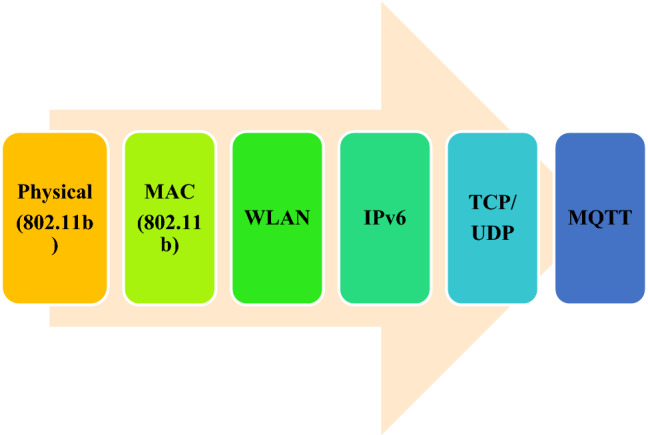
Smart city IoT system protocol stack
The smart city network scenario is framed by considering Vijayawada city located in Andhra Pradesh state, India. Here, we performed the simulation level analysis on network performance by varying the number of sensor nodes (MxN), the number of gateways (K), and the number of user counts (G). It is beneficial to build low-cost nodes to promote their large deployment, taking into account that the IoT system can monitor smart city parameters. This means saving money on the majority of the IoT architecture. The designed network parameters are listed in Table 6. The smart city model network topology is shown in Fig. 4. The smart city IoT scenario is virtually simulated in the ns-3 environment for 8000 s, it is offering a throughput of 22Mbps, Average power consumption of 2.6 mW, Delay of 80 ms, and Packet delivery ratio of 0.85%, and latency is 7.8. The network performance indices are as shown in Fig. 5.
Table 6.
Network Parameters
| Parameter | Value |
|---|---|
| Sensing model | IEEE 802.11a |
| Area | 1000 × 1000 m2 |
| Number of IoT nodes | 10–30 |
| Packet size | 96 bits |
| Simulation time | 8000 s |
| Transmission data rate | 22 Mbps |
| Throughput | 18–22 Mbps |
| Average power consumption | 2–2.6 mW |
| Delay | 80 ms |
| Packet delivery ratio | 0.85–0.74% |
| Latency | 7.8 |
Fig. 4.

Network topology for Vijayawada city, Andhra Pradesh, India
Fig. 5.

Network simulation parameters, a Throughput (MBPs), b Average Power Consumption (mW), c Delay(ms), d Packet Delivery Ratio, e Latency
Practical Realization Aspects
Monitoring the smart city paramours like air quality, sound pollution, parking zones, solar radiation, water quality, waste management, transportation, iconic places, e-suggestions, public relations officer (PRO) information, video surveillance, human flow, and emergency services really help the civil people in the process of decision making [69–71]. In this paper, we have presented a smart city IoT system that can monitor the overall 13 parameters as illustrated in Fig. 6 related to the smart city. Primarily the air quality will depend on the levels of carbon monoxide (CO), ammonia (NH3), nitrogen dioxide (NO2), ozone (O3), sulphur dioxide (SO2), and particle matter 2.5, (PM2.5), particle matter 10 (PM10). The commercially available sensor to monitor the smart city parameters are listed in Table 7.
Fig. 6.

Model structure of smart city IoT
Table 7.
| Smart city parameters | Sub category | Standard range | Effects | Commercial available sensor/actuator | |||
|---|---|---|---|---|---|---|---|
| Sensor | Range | ||||||
| Air quality | CO | 2.0 µg/m3 for 8 h | Headache, dizziness and fatigue | MQ-7 | 20–2000 ppm | ||
| NH3 | 400 µg/m3 for 24 h | Liver, kidney and spleen problems | MQ-135 | 10–300 ppm | |||
| NO2 | 80 µg/m3 for 24 h | Respiratory problems | MiCS-2714 | 0.5 to 5 ppm | |||
| O3 | 100 µg/m3 for 8 h | Chest pain, coughing, throat irritation and airway inflammation | MQ-131 | 10–1000 ppb | |||
| SO2 | 80 µg/m3 for 24 h | Coughing, wheezing, shortness of breath | 2SH12 | 10–100 ppm | |||
|
Small particles (PM2.5) |
60 µg/m3 for 24 h | Respiratory problems | nova pm sensor sds011 | 0.0–999.9 μg/m3 | |||
| Big Particles (PM10) | 100 µg/m3 for 24 h | They can get deep into your lungs | nova pm sensor sds011 | 0.0–999.9 μg/m3 | |||
| Waste management | Bin level | Semi full | Dustbin overflow leads to spilling along the roads which attracts animals | IR Sensor | 850 nm | ||
| Water quality | PH | 6.5–8.5 | Cancer | PH meter v1.0 | 0–14 | ||
| Nitrite | 0.1 mg/l | blue baby syndrome | NO3 probe | 1.4 to 2200 ppm | |||
| Weather | Relative humidity | 30–60% | The risk of cold, flu and other infections is substantially increased | DHT11 | 20%-90% | ||
| Temperature | 32–40˚C | Dehydration, Headache | DS18B20 | − 55–125 °C | |||
| Sound pollution | Sound | 0 –70 dB | Sounds between 120 and 140 dB causing pain | MAX4466 | 0 dB -70 dB | ||
| Solar radiation | solar radiation | 100 and 1 mm | Skin cancers | Solar panel | Solar panel | ||
| Traffic | spectrum | – | More traffic leads to air and sound pollution | Ultrasonic Sensor | 100 nm and 1 mm | ||
| Parking zones | – | – | Without proper parking zones in a smart city may leads to traffic congestion | Ultrasonic Sensor | 1–100 cm | ||
| Bike, LWM (car), HWM (Lorry) | 1–s100 cm | ||||||
| Video surveillance with thermal camera | Trace the human flow | – | Identifying and controlling the human flow is not possible. Now a days, there is a threat with the virus (covid-19) spread through human interaction | AMG8833 Thermal Camera | – | ||
| To identify the viral infected people | – | ||||||
Blockchain for Smart City IoT
The purpose of incorporating blockchain technology with smart city IoT is, which enables the decentralization of storage and server as shown in Fig. 7, with this the system security improves and makes it more sturdy. The smart city IoT system performance is significantly improved with blockchain. The role of blockchain in presented smart city IoT is, that at the sensor level, the data was encrypted with the public key. The IoT device maker stores the associated public key in a blockchain block [75–77]. A network node sends a random challenge message to an IoT device, to which the IoT device responds with a signature. At the network level, other than centralized cloud, here we used decentralization of cloud services. With this, the system speed increased and the system is more scalable.
Fig. 7.

Smart city, a IoT system with centralized server, b Blockchain enabled IoT system with distributed server
The smart city IoT application was designed by considering Vijayawada city in Andhra Pradesh state in India. Deployed multiple internet-enabled sensor nodes all over the city, those are capable to send the sensors data to the predefined destination API location. Eventually, an application for the smart city for better monitoring and analysis of the data as shown in Fig. 8 was designed with blockchain security. The designed smart city application specifications are listed in Table 8. The sensor nodes are designed with Raspberry pi-3 and all the sensors related to smart city parameters are interfaced. The node is connected with an LTE access point for the internet. MongoDB and WinNMP are used as databases and servers respectively. MQTT IoT protocol was incorporated into the user access side. An application program interface (API) connector mechanism was used which enables highly secure data transmission to the destination. Overall the smart city IoT system was implemented with infrastructure as a service (IaaS) architecture.
Fig. 8.

Smart city IoT application, a home page, b location based information monitoring
Table 8.
Smart city IoT system implementation parameters
| Parameter | Details |
|---|---|
| Sensor node device | Raspberry pi-3 |
| Network connection | Wi-Fi |
| Access point | LTE |
| Database | Mango DB |
| Server | WinNMP |
| IoT protocol | MQTT |
| Framework | LAREVEL |
| Security from | Cross Script Attack |
| Connector | API |
Conclusion
This article presented a smart city IoT system that helps to monitor essential parameters like video surveillance using a thermal camera, air quality, water quality, sound pollution, weather, solar radiation, waste management, parking zones, E-suggestions, and Iconic Places. Prior virtual simulation is performed on the smart city IoT network scenario using NS-3. Eventually, the IoT system is implemented with good quality of service and security. The incorporation of blockchain with the smart city makes the system more secure, highly scalable, and cost-effective.
Biographies
Samuyelu Bommu
is presently working as a Senior Assistant Professor in the department of Electronics and Communication Engineering, PVP Siddhartha Institute of Technology (Autonomous), Vijayawada. He graduated from RVR & JC College of Engineering affiliated to Nagarjuna University, Guntur. He received his M.Tech. and Ph.D. from Andhra University, Visakhapatnam. Earlier he worked in Loyola Institute of Technology and Management, Lakireddy Balireddy College of Engineering. He joined as Assistant Professor in PVP Siddhartha Institute of Technology in the year 2006. He has 19 years of teaching experience. He is member of ISTE and ISSE. His research interests are Antennas, Semiconductor Device Modelling VLSI, Signal Processing and Image Processing.
Aravind Kumar M
obtained B. Tech Degree in ECE, M.Tech Degree in VLSI System Design from JNTUH, and Ph.D. from GITAM University, Visakhapatnam. He has 15 years of teaching experience. He is a Life member of FIE, ISTE, IETE, SCIEI, UACEE, and IAENG. He Published 35 Research Papers in refereed Journals and Conferences. He is one of the Editorial Board and Reviewer board members in five international journals. He is currently working as a Principal in West Godavari Institute of science and Engineering.
Kiranmai Babburu
working as Professor Department of ECE in Lendi Institute of Engineering and Technology, did her PhD in Radar Signal Processing, research experience 20 years and published more than 30 research articles in the area of “Radar Systems, Signal Processing, Massive MIMO. She is member of IEEE, IE.
Srikanth N
is a continuous researcher, academician & Training & placement Officer at St.Peter’s Engineering College, Hyderabad. He completed his Ph.D from KL University, vaddeswaram. And he published more than 20 research papers in various international publications and participated in more than 10 conferences. He also published two patents; among them one patent is granted. His research areas are Wireless sensor networks, wireless communication, and signal processing.
Lakshmi Narayana Thalluri
was received the B.Tech., M.Tech., and Ph.D. degrees in Electronics and Communication Engineering from JNTUK-K L University, in 2009, 2012, and 2019 respectively. He is currently Associate Professor with department of Electronics and Communication Engineering, Andhra Loyola Institute of Engineering Technology (ALIET), Vijayawada-520008, A.P, India. He has co-authored more than 30 scientific journal and conference papers in the area of RF MEMS switches, the IoT, and Digital Signal processing. He is a program committee member of a number of international conferences and workshops. He is member of IEEE, IE, IACSIT.
V. Ganesh G
received the Ph.D. degree in Electronics and communication engineering from Koneru Lakshmaiah Education Foundation, India in 2020. He completed his B.Tech from Gudlavalleru JNTU and M.Tech from Andhra University in 2007 and 2009 respectively He is currently working as an Associate Professor with Koneru Lakshmaiah Education Foundation. His research interest includes Micro/Nano electronics. He has published 2 SCI journals and 23 Scopus journals.
Anitha Gopalan
is currently working as an Assistant Professor (Senior Grade) in the Department of Electronics and Communication Engineering at Saveetha School of Engineering, SIMATS, Chennai. She received her Bachelor Degree in the department of ECE from PSG College of Technology, Anna University, Chennai in 2009. She received her Master of Technology in Communication Systems from B. S. Abdur Rahman University, Chennai in 2011. She completed her Ph.D. in Electronics Engineering from Vellore Institute of Technology, Chennai in 2019. She has more than 8 years of experience in the Academics and Research field. Her research interests include Antenna Design, RF MEMS Switch, MEMS Phase shifter, Materials, image Processing, Wireless Networks and etc., She has more than 40 International Journal and Conference Publications in various journals indexed by WOS, SCIE, and Scopus to her name and also She has 4 patents, 5 book chapters, and 1 self-published book to her credit. She serves as a potential peer reviewer for prestigious journals such as Microsystem Technologies (Springer), IEEE Micromechanics and Microengineering, RF and Microwave Computer-Aided Engineering (Wiley), ECS Journal of Solid State Science and Technology, and many others. She is an IEEE Professional Member and an ISTE Lifetime Member.
Purna Kishore Mallapati
working as Associate Professor, Department of ECE in KKR & KSR Institute of Technology & Science, did his PhD in Antennas, research experience 14 years and published more than 20 research articles in the area of “Antennas, Signal Processing, Massive MIMO. He is member of IE.
Koushik Guha
received the B.Tech. degree in electronics and communication engineering from Techno India, Salt Lake, Kolkata, in 2005, under the West Bengal University of Technology, India, the M.Tech. degree in electronics and communication engineering (RF and microwaves) from Burdwan University, India, in 2007, and the Ph.D. degree from the National Institute of Technology (NIT) at Silchar in 2016, with a focus on design and modeling of RF MEMS shunt switch. From 2007 to 2010, he was a Lecturer with the Department of Electronics and Communication Engineering, Haldia Institute of Technology, India. He has been an Assistant Professor with the Department of Electronics and Communication Engineering, NIT Silchar, since 2010. From 2012 to 2014, he was a Visiting Faculty Member with NIT Mizoram. He is a member of IETE.
Hayath Rajvee Mohammad
received the Ph.D. degree in Electronics and Communication Engineering from Andhra University, Visakhapatnam, India in 2020. He completed his B.Tech from Quba College of Engineering and Technology, Nellore. He posses two PG degrees. Pursued M.Tech (VLSI) from Sathyabama University, chennai in 2008 and M.Tech VLSI Design from Nimra College of Engineering and Technology, Vijayawada in 2012 respectively. He is currently working as Professor with PBR Visvodaya Institute of Technology and Science, Kavali, A.P., India. His research interest includes Micro/Nano electronics.
S. Kiran S
working as Assistant Professor, Department of ECE in Lendi Institute of Engineering and Technology, Qualified M.Tech in VLSI Design, Area of Research interests is “Embedded Systems–ARM Based Controllers, IoT, LOW Power VLSI, Massive MMO Systems and Hybrid Electric Vehicles”and Internet of Things”.
Footnotes
Publisher's Note
Springer Nature remains neutral with regard to jurisdictional claims in published maps and institutional affiliations.
References
- 1.Rahman MA, Rashid MM, Hossain MS, Hassanain E, Alhamid MF, Guizani M (2018) Blockchain and IoT-based cognitive edge framework for sharing economy services in a smart city. IEEE Access 7:18611–18621 [Google Scholar]
- 2.Santos PM, Rodrigues JGP, Cruz SB, Lourenc T ¸ d’Orey OPM, Luis Y, Rocha C, Sousa S, Cris´ostomo S, Queir´os C, Sargento S, Aguiar A, Barros J (2018) PortoLivingLab: an IoT-based sensing platform for smart cities. IEEE Internet of Things Journal 5(2):523–532
- 3.Kumar K, Saraswat S, Jindal SK et al (2021) Experimental validation of an iot based device selective power cut mechanism using power line carrier communication for smart management of electricity. J Electr Eng Technol 16:67–77 [Google Scholar]
- 4.Xu B, Da Xu L, Cai H, Xie C, Hu J, Bu F (2014) Ubiquitous Data accessing method in IoT-based information system for emergency medical services. IEEE Tran Ind Inf 10(2)
- 5.Hebal S, Harous S, Mechta D (2021) Energy routing challenges and protocols in energy internet: a survey. J Electr Eng Technol 16:3197–3212 [Google Scholar]
- 6.André da Costaa C, Pasluostab CF, Eskofierb B, Bandeira da Silvaa D, Righia RR (2018) Internet of health things: toward intelligent vital signs monitoring in hospital wards. Artif Intel Med, 89 [DOI] [PubMed]
- 7.Aslam MM, Irshad MN, AZEEM, H. (2020) Cost effective and energy efficient intelligent smart home system based on IoT. Afyon Kocatepe Üniversitesi Uluslararası Mühendislik Teknolojileri ve Uygulamalı Bilimler Dergisi 3(1):10–20 [Google Scholar]
- 8.Y.-B. Lin, and H.-C. Tseng (2018) FishTalk: An IoT-based Mini Aquarium System. IEEE Access 7
- 9.Gao G, Xiao K, Chen M (2019) An intelligent IoT-based control and traceability system to forecast and maintain water quality in freshwater fish farms. Comput Electron Agric, 166
- 10.Tzounis A. Katsoulas N, Bartzanas T, Kittas C (2017) Internet of Things in agriculture, recent advances and future challenges. Biosyst Eng 164(31)
- 11.Zhang W, Guo W, Liu X. Liu Y, Zhou J,. Li B, Lu Q, Yang S (2017) LSTM-based analysis of industrial IoT equipment. IEEE Access 13(9)
- 12.Gronau N,. Ullrich A,. Teichmann M (2017) Development of the Industrial IoT competences in the areas of organization. Process, and interaction based on the learning factory concept. Proc Manuf 9
- 13.Boyes H, Hallaq B, Cunningham J, Watson T (2018) The industrial internet of things (IIoT): an analysis framework,". Comput Ind 101:1–12 [Google Scholar]
- 14.Hafidh B, Al Osman H, Arteaga-Falconi J, Dong H, EL Saddik A (2017) SITE: the simple internet of things enabler for smart homes. IEEE Access 5:2034–2049 [Google Scholar]
- 15.Mehta R, Sahni J, Khanna K (2018) Internet of things: vision, applications and challenges. Procedia Computer Science 132:1263–1269 [Google Scholar]
- 16.Dachyar M, Zagloel TYM, Ranjaliba Saragih L (2019) Knowledge growth and development: internet of things (IoT) research, 2006–2018. Heliyon 5 [DOI] [PMC free article] [PubMed]
- 17.Chernyshev M, Zeadally S, Baig Z, Woodward A (2018) Internet of things forensics. Theme Article: Cyberthreats And Security 20(3):40–49 [Google Scholar]
- 18.Al-Turjmana F, Malekloo A (2019) Smart parking in IoT-enabled cities: a survey. Sustain Cities Soc 49
- 19.Bello O, Zeadally S (2017) Toward efficient smartification of the internet of things (IoT) services. Futur Gener Comput Syst 92:663–673 [Google Scholar]
- 20.Srinidhi NN, Dilip Kumar SM, Venugopal KR (2019) Network optimizations in the internet of things: a review. Eng Sci Technol Int J 22:1–21 [Google Scholar]
- 21.Ranjan R et al (2018) Integrating the internet of things and data science. IEEE Cloud Comput 5(3)
- 22.Liu X,. Ansari N (2016) Green relay assisted D2D communications with dual batteries in heterogeneous cellular networks for IoT. IEEE Internet Things J x4(5)
- 23.Liu Y, Tong K-F, Wong K-K (2019) Reinforcement learning based routing for energy sensitive wireless mesh IoT networks. Electron Lett 55(17):966–968 [Google Scholar]
- 24.Pokhrel SR, Williamson C (2018) Modeling compound TCP Over WiFi for IoT. IEEE/ACM Trans Networking 26(2):864–878 [Google Scholar]
- 25.Jain B, Brar G, Malhotra J, Rani S (2017) A novel approach for smart cities in convergence to wireless sensor networks. Sustain Cities Soc 7:440-448
- 26.Kumar NM, Mallick PK (2018) Blockchain technology for security issues and challenges in IoT. Proc Comput Sci 132:1815–1823 [Google Scholar]
- 27.Li C, Palanisamy B (2018) Privacy in internet of things: from principles to technologies. IEEE Internet Things J 6(1):488–505 [Google Scholar]
- 28.Mahdavinejad MS et al (2018) Machine learning for Internet of Things data analysis: a survey. Digital Commun Netw 3(3):161–175 [Google Scholar]
- 29.Kumara NM, Mallickb PK (2018) Blockchain technology for security issues and challenges in IoT. Proc Comput Sci 132:1815–1823 [Google Scholar]
- 30.Xue M, Yang Q, Zhu G et al (2022) A position detection method for dynamic wireless inspection robots charging. J Electr Eng Technol 17:97–110 [Google Scholar]
- 31.Mirceaeremia LM (2017) The smart city concept in the 21st century. Proc Eng 181:12–19 [Google Scholar]
- 32.Araujo V, Mitra K, Saguna S, Åhlund C (2019) Performance evaluation of FIWARE: a cloud-based IoT platform for smart cities. J Parall Distrib Comput 132:250–261 [Google Scholar]
- 33.Yao H, Gao P, Wang J, Zhang P, Jiang C, Han Z (2019) Capsule network assisted IoT traffic classification mechanism for smart cities. IEEE Internet Things J 6(5):7515–7525 [Google Scholar]
- 34.Wazid M, Das AK, Odelu V, Kumar N, Conti M, Jo M (2017) Design of secure user authenticated key management protocol for generic IoT networks. IEEE Internet Things J 5(1):269–282 [Google Scholar]
- 35.Reyna A, Martín C, Chen J, Soler E, Díaz M (2018) On blockchain and its integration with IoT. Challenges and opportunities. Futur Gener Comput Syst 88:173–190 [Google Scholar]
- 36.Gan S, Rousstia D, Rifai FA (2020) Implementation of secure work from home system based on blockchain using NS3 simulation.In: International conference on electrical engineering, computer sciences and informatics (EECSI)
- 37.Kiki, MJM, Iddi I (2021) Improved LORA modulation output in LEO satellite internet of things. J Electr Eng Technol
- 38.Mick T, Tourani R, Misra S (2017) LASeR: lightweight authentication and secured routing for NDN IoT in smart cities. IEEE Internet Things J 5(2):755–764 [Google Scholar]
- 39.Marques P, Manfroi D, Deitos E, Cegoni J, Castilhos R, Rochol J, Pignaton E, Kunst R (2019) An IoT-based smart cities infrastructure architecture applied to a waste management scenario. Ad Hoc Netw 87:200–208 [Google Scholar]
- 40.Conti M, Kaliyar P, Rabbani MM, Ranise S (2019) Attestation-enabled secure and scalable routing protocol for IoT networks. Ad Hoc Netw 98(1)
- 41.Sanmartin P, Sierra R, Martinez E, Jabba D (2018) Objective Function BF-ETX for RPL Routing Protocol. IEEE Latin Am Trans 16(8)
- 42.Jia G, Zhu Y, Li Y, Zhu Z, Zhou L (2019) Analysis of the effect of the reliability of the NB-IoT network on the intelligent system. IEEE Access 7:112809–112820 [Google Scholar]
- 43.He J, Wei J, Chen K, Tang Z, Zhou Y, Zhang Y (2017) Multi-tier fog computing with large-scale IoT data analytics for smart cities. IEEE Internet Things J 5(2):677–686 [Google Scholar]
- 44.Yang J, Akyurek AS, Tilak S, Rosing TS (2017) Design of transmission manager in heterogeneous WSNs. IEEE Trans Emerg Top Comput 6(3):395–408 [Google Scholar]
- 45.Cheng B, Solmaz G, Cirillo F, Kovacs E, Terasawa K, Kitazawa A (2018) FogFlow: easy programming of iot services over cloud and edges for smart cities. IEEE Internet Things J 5(2):696–707 [Google Scholar]
- 46.Chen S, Yang C, Li J, Yu FR (2019) Full lifecycle infrastructure management system for smart cities: a narrow band IoT-Based platform. IEEE Internet Things J 6(5):8818–8825 [Google Scholar]
- 47.Arshad S, Azam MA, Rehmani MH, Loo J (2018) Recent advances in information-centric networking based internet of things (ICN-IoT). IEEE Internet Things J 6(2):2128–2158 [Google Scholar]
- 48.Abidoye AP et al (2017) Models for integrating wireless sensor networks into the Internet of Things. IET Wireless Sensor Syst 7(3):65–72 [Google Scholar]
- 49.Mohammad N, Muhammad S, Bashar A, Khan MA (2019) Formal analysis of human-assisted smart city emergency services. IEEE Access
- 50.Zhao L, Sun W, Shi Y, Liu J (2018) Optimal placement of cloudlets for access delay minimization in SDN-based internet of things networks. IEEE Internet Things J 5(2):1334–1344 [Google Scholar]
- 51.Li W, Song H, Zeng F (2017) Policy-based secure and trustworthy sensing for internet of things in smart cities. IEEE Internet Things J 5(2):716–723 [Google Scholar]
- 52.Ullah R, Faheem Y, Kim BS (2017) Energy and congestion-aware routing metric for smart grid AMI networks in smart city. IEEE Access 5:13799–13810 [Google Scholar]
- 53.Deebak BD, Al-Turjman F, Aloqaily M, Alfandi O (2019)An authentic-based privacy preservation protocol for smart e-healthcare systems in IoT. IEEE Access 7:135632–135649
- 54.Tahir Y, Yang S, McCann J (2017) BRPL: backpressure rpl for high-throughput and mobile IoTs. IEEE Trans Mob Comput 17(1):29–43 [Google Scholar]
- 55.Benayache A, Bilami A, Barkat S, Lorenz P, Taleb H (2019)MsM: A microservice middleware for smart WSN-based IoT application. J Netw Comput Appl 144:138–154
- 56.Farooq MS, Riaz S, Abid A, Abid K, Naeem MA (2019) A survey on the role of IoT in agriculture for the implementation of smart farming. IEEE Access 7:156237–156271 [Google Scholar]
- 57.Ray PP, Thapa N, Dash D (2019) Implementation and performance analysis of interoperable and heterogeneous IoT-edge gateway for pervasive wellness care. IEEE Trans Consumer Electron 65(4)
- 58.Rajpoot SC, Pandey C, Rajpoot PS et al (2021) A dynamic-SUGPDS model for faults detection and isolation of underground power cable based on detection and isolation algorithm and smart sensors. J Electr Eng Technol 16:1799–1819 [DOI] [PMC free article] [PubMed] [Google Scholar]
- 59.Shin D et al (2019) A security protocol for route optimization in DMM-based smart home IoT networks. IEEE Access 7:142531–142550 [Google Scholar]
- 60.Wazid M et al (2019) LAM-CIoT: lightweight authentication mechanism in cloud-based IoT environment. J Netw Comput Appl 150:1–9 [Google Scholar]
- 61.Zhang C, Ge J, Pan M, Gong F, Men J (2018) One stone two birds: a joint thing and relay selection for diverse IoT networks. IEEE Trans Veh Technol 67(6):5424–5434 [Google Scholar]
- 62.Hasan MZ et al (2018) Analysis of cross-layer design of qualityof-service forward geographic wireless sensor network routing strategies in green internet of things. IEEE Access 6:20371–20389 [Google Scholar]
- 63.Ramezani P, Zeng Y, Jamalipour A (2018) Optimal resource allocation for multiuser internet of things network with single wireless-powered relay. IEEE Internet Things J 6(2):3132–3142 [Google Scholar]
- 64.Uddin R, Alghamdi AS, Uddin MH et al (2019) Ethernet-based fault diagnosis and control in smart grid: a stochastic analysis via markovian model checking. J Electr Eng Technol 14:2289–2300 [Google Scholar]
- 65.van Zoest V, Osei FB, Stein A, Hoek G (2019) Calibration of low-cost NO2 sensors in an urban air quality network. Atmos Environ 210:66–75 [Google Scholar]
- 66.Collier-Oxandale A et al (2020) Field and laboratory performance evaluations of 28 gas-phase air quality sensors by the AQ-SPEC program. Atmos Environ 220 [DOI] [PMC free article] [PubMed]
- 67.Shao W, Zhang H, Zhou H (2017)Mathematical modeling and parameter optimization of fine particle sensors based on laser light scattering. IEEE Sens J 17(20)
- 68.Phila M, Sithole P, Nwulu NI, Dogo EM (2019) Dataset for a wireless sensor network based drinking-water quality monitoring and notification system. Data Brief 27 [DOI] [PMC free article] [PubMed]
- 69.Kang KD, KangH, Ilankoon IMSK, Chong CY (2020) Electronic waste collection systems using Internet of Things (IoT): household electronic waste management in Malaysia. J Clean Prod 252
- 70.Shrivastav K, Kulat KD (2020) Scalable energy efficient hexagonal heterogeneous broad transmission distance protocol in WSN-IoT networks. J Electr Eng Technol 15:95–120 [Google Scholar]
- 71.Ramos TRP et al (2018) The smart waste collection routing problem: alternative operational management approaches. Expert Syst Appl 103:146–158 [Google Scholar]
- 72.Rudniak J (2019) Comparison of local solar radiation parameters with data from a typical meteorological year. Therm Sci Eng Prog 16
- 73.Sultana T, Wahid KA (2019) Choice of application layer protocols for next generation video surveillance using internet of video things. IEEE Access 7
- 74.Sultana T, Wahid KA (2019) IoT-guard: event-driven fog-based video surveillance system for real-time security management. IEEE Access 7
- 75.Aliyu A et al (2018) Towards video streaming in IoT environments: vehicular communication perspective. Comput Commun 118:93–119 [Google Scholar]
- 76.Al-Turjman F, Malekloo A (2019) Smart parking in IoT-enabled cities: A survey. Sustain Cities Soc 49
- 77.Aggarwal A, Gaba S, Mittal M (2021) A Comparative investigation of consensus algorithms in collaboration with IoT and blockchain Transforming Cyber security Solutions using Blockchain. Springer, Berlin [Google Scholar]