



Abstract
Presented is the analysis of four cannabinoid-based products. These products were part of a case involving visual and auditory hallucinations that precipitated the commission of a felony and subsequent arrest. The products were labeled to contain ∆8-tetrahydrocannabinol (∆8-THC) or THC acetate (THC-O-A). Primary reference materials were not available for ∆8-THC-O-A, ∆10-THC-O-A, cannabidiol di-acetate (CBD-di-O-A) or respective deuterated internal standards. THC-O-A and CBD-di-O-A standards were prepared by derivatizing ∆8-THC, ∆9-THC, ∆10-THC, CBD, ∆9-THC-d3 and CBD-d3 using acetic anhydride. The cannabinoid-based products were determined to contain ∆8-THC, ∆8-THC-O-A, ∆9-THC-O-A and CBD-di-O-A and/or other phytocannabinoids using three different analytical techniques. Direct analysis in real-time–time-of-flight mass spectrometry was used for identifying exact masses. A gas chromatograph–mass spectrometer was used for the identification of compounds and to quantitate THC-O-As in the products. A liquid chromatograph–tandem mass spectrometer was used to identify and quantitate phytocannabinoids and CBD-di-O-A in the products. To the authors’ knowledge, this is the first case report involving the identification of THC-O-As and CBD-di-O-A in commercially available products. Minimal clinical/pharmacological data is available for these emerging synthetic cannabinoids/novel psychoactive substances.
Introduction
The term “synthetic cannabinoids”, sometimes shortened to “syncans”, is often associated with and used to describe man-made research chemicals that either structurally resemble ∆9-tetrahydrocannabinol (∆9-THC), the major psychoactive compound of cannabis, or mimic the pharmacological effects of ∆9-THC. The latter group may or may not resemble ∆9-THC structurally and are therefore more appropriately referred to as “cannabimimetics” or “non-classical cannabinoids” (1). The United States Centers for Disease Control and Prevention (CDC) describes synthetic cannabinoids as “various manmade chemicals that some people may use as an alternative to marijuana” (2). The United States National Institute on Drug Abuse (NIDA) describes synthetic cannabinoids as “human-made mind-altering chemicals that are either sprayed on dried, shredded plant material so they can be smoked, or sold as liquids to be vaporized and inhaled in e-cigarettes and other devices” (3). Under these classifications, the term synthetic cannabinoids can also describe compounds that are synthesized in a lab setting from other phytocannabinoids (naturally occurring cannabinoids) as a replacement or alternative for ∆9-THC.
Synthetic cannabinoids and cannabimimetics are well known to the medicolegal–toxicological community as part of a constant game of cat-and-mouse. Law enforcement and scientists strive to identify and classify new variations as they are introduced to provide legislators the required information to get the substances federally scheduled. As early as 2004, herbal incense products (HIPs) have been sold via the Internet and in various retail shops (4). These products were sold as aromatherapy incense, potpourri and/or marked “not for human consumption” and were said to produce “legal highs” (5). In December 2008, JWH-018 (Naphthalen-1-yl-(1-pentylindol-3-yl)methanone), a synthetic cannabinoid receptor (CB) agonist, was identified in one of these products by a branch of the Austrian Agency for Health and Food Safety (4). This led to the identification of multiple CB agonists in various HIPs throughout Europe and the USA. Most of these compounds were cannabimimetics that did not structurally resemble ∆9-THC, with one notable exception, HU-210 ((6aR,10aR)-9- (Hydroxymethyl)-6,6-dimethyl-3-(2-methyloctan-2-yl)-6a,7,10,10a-tetrahydrobenzo[c]chromen-1-ol). HU-210 was first synthesized in 1988 and reported to be 100 times more potent than ∆9-THC (4). This compound was first reported in HIPs in March 2009 by the United States Drug Enforcement Administration (DEA) and soon after in the UK (4).
Inclusion of synthetic cannabinoids and cannabimimetics in over-the-counter products has expanded from HIPs to edibles, vape cartridges, tinctures, crystals and a variety of other consumable forms. The federal legalization of cannabidiol (CBD) in the USA beginning with the 2018 Agricultural Improvement Act and recent decriminalization and adult-use legalization of cannabis in individual states has led to a dramatic rise of synthetic analogs that are structurally related to ∆9-THC and CBD. These synthetic cannabinoids are easily synthesized from ∆9-THC and/or CBD. The change in legislation allowing for the production of legalized cannabis and hemp has resulted in an abundance ∆9-THC and CBD. The increase in CBD production has caused prices to plummet due to an overabundance, and other uses of the surplus of CBD have been sought (6).
∆8-Tetrahydrocannabinol (∆8-THC), a naturally occurring phytocannabinoid found in minute concentrations in certain strains of cannabis or hemp plants, can be synthesized from CBD via an acid-catalyzed reaction that yields varying amounts of both synthetically derived ∆8- and ∆9-THC (7). Synthesized ∆8-THC is called “hemp-derived ∆8-THC” to impart legality, ignoring federal laws classifying synthetic THCs as Schedule 1 substances. ∆10-THC, another minor phytocannabinoid, can be synthesized from ∆9-THC by a base-catalyzed isomerization (8). THC acetate derivatives (THC-O-A, aka THCOa or ATHC) can be synthesized from ∆8-, ∆9- or ∆10-THC by an acetic anhydride reaction (9). CBD di-acetate derivatives (CBD-di-O-A) can also be synthesized from CBD by using acetic anhydride (9). These compounds are some of the latest to appear in a long list of novel psychoactive substances (NPS).
A recent study showed that public interest in ∆8-THC increased in 2018, after the 2018 Agricultural Improvement Act was enacted (10). This study identified that there was greater interest in ∆8-THC in states with legislation restricting/prohibiting the use of ∆9-THC. ∆8-THC is reported to be less potent than ∆9-THC (11), produce less anxiety and paranoia and have a shorter duration of action (12). Between 1 January 2021 and 31 July 2021, national poison control centers received 660 reports of ∆8-THC exposure. Many of these reports involved minors (39%) and/or hospitalizations (8%) (11), contradicting the idea that ∆8-THC is a “safe alternative” to the use of traditional cannabis or ∆9-THC products. Even less is known about ∆10-THC, although it too is psychoactive, but anecdotally believed to be even less potent than ∆8-THC.
∆9-THC-O-A is reported online to have twice the potency as ∆9-THC in dogs, referencing a 1984 review of the health effects from exposure to chemical agents (13). In 1942, the United States Bureau of Narcotics Laboratory synthesized and isolated a THC-O-A isomer with an unknown double-bond position in the alicyclic ring (14). It was evaluated for potency by the capacity to produce ataxia in dogs. This “natural THC acetate” potency was 14.6, and the “natural THC by hydrolysis of acetate” potency was 7.8, compared to the synthesized ∆6a,10a-THC (as drawn in the 1945 manuscript) (9). As THC with unknown double-bond location was used for the standard in these potency studies, and as the parent molecule for all other synthesized compounds, extrapolation of ∆9-THC-O-A potency is impossible. ∆9-THC-O-A is described anecdotally as being anywhere from two to four times as potent in humans (15). Clinical studies evaluating the effects of ∆9-THC-O-A in man using modern methodologies are lacking, and there is no known pharmacological data available for ∆8-THC-O-A, ∆10-THC-O-A or CBD-di-O-A. Anecdotal reports describe the effects of THC-O-As as “very spiritual, psychedelic, and introspective” (15, 16), similar to lysergic acid diethylamide or psilocybin. THC-O-As reportedly have slow onset times, 20–30 min, and the effects last between 2 and 4 h (15). Although THC-O-As were studied as early as the 1940s, public interest did not appear to spike until mid-2021, when public interest emerged, as seen by searching for “THC-O” in online search engines.
While many legislators, processors and manufacturers are striving to ensure consumer products have strict regulations and quality assurance measures, there are entities that have taken advantage of the current regulatory situation surrounding the cannabis industry. ∆9-THC and CBD are regulated at state levels, creating a patchwork of differing regulations across the country that present significant gaps and loopholes. Products often appear legitimate, with professional packaging, claims of third-party testing and mentions of certificates of analysis. In reality, there is minimal oversight. Certificates of analysis are often not available and labels are often incomplete, incorrect or altogether absent (17, 18). More nefarious and opportunistic entities use the regulatory gaps to introduce unregulated products to the market containing synthetic cannabinoids previously discussed. All of this combines into a situation that prevents consumers from truly knowing what they are purchasing and puts them at risk of ingesting unknown compounds or incorrect doses, which may lead to harmful and unexpected effects.
Presented is the analysis of four cannabinoid-based products that were part of a recent case sent to the Virginia Commonwealth University Laboratory for Forensic Toxicology Research. The authors received written permission to report case details and findings from the defendant’s attorneys. Methods were developed for the identification and quantitation of THC-O and CBD-di-O acetate derivatives in gummy matrices using in-house synthesized reference material. Standard addition was used to investigate the accuracy of non-matrix calibrators. Routinely employed methods were used to identify and quantitate other reported phytocannabinoids.
Methods and Materials
Case history and submitted products
An individual reported experiencing visual and auditory hallucinations precipitating the commission of a felony and subsequent arrest. The day before the incident, the individual’s mother reported to the police that her son was behaving erratically. Other observations made by a clinical psychologist, jail personnel or the individual’s mother included irrational thinking, delusions of influence and reference, paranoid and grandiose ideations and delusions, confusion, fragmented/disjointed speech, depersonalization and religiosity. These behaviors were reported as unique to the incident in question and inconsistent with any mental irregularities, deficiencies or feelings or thoughts described or experienced while not exposed to the submitted cannabinoid-based products. All products were already open upon receipt and were reported to have been used leading up to the described incident. The individual reported visual hallucinations comparable to being in a G.I. Joe video game. While in jail after his arrest and pre-trial, the man experienced continuing periods of psychosis that resulted in his being adjudged incompetent to proceed based on the findings of two independent court-appointed experts.
Four products found in the individual’s home were received by the Laboratory for Forensic Toxicology Research at Virginia Commonwealth University for analysis (Supplementary Data A): An Ouachita Farms “Hawaiian Haze” product containing plant material labeled as 1 g of 16.3% CBD flower; a Moon Men “Alien Cookies” jar containing plant material labeled as 3.5 g of ∆8 flower with no indication of cannabinoid concentrations; an Elysian “Delta 8 Flower ‘Secret OG – Indica’” package containing plant material labeled as CBD flower infused with ∆8-THC oil, 175 mg Delta 8 per 3.5 g, 5% D8THC, 14% CBD and 19% Total Cannabinoids; and a Palm Treez package of edible gummies, labeled as containing THC-O, 100 mg/10 mg per piece. The package, as received, contained two orange and purple gummies each, and one green, one pink, and one red gummy, for a total of seven gummies.
Material
Optima-grade ammonium formate, formic acid and methanol as well as LC–MS-grade pyridine and ACS-grade acetic anhydride were purchased from Fisher Scientific (Hanover Park, IL, USA). Ultra-pure Type 1 water was generated in-house as needed using a Millipore Direct-Q3 system. Certified reference materials for a quality assurance test mix containing amitriptyline, diazepam, fluoxetine, methadone, nicotine, nordiazepam, norfluoxetine, nortriptyline, paroxetine and trazodone were acquired from Cerilliant (Round Rock, TX, USA), as were CBD, CBD-d3, ∆9-THC, ∆9-THC-d3, ∆9-THC-O-A, cannabigerol (CBG), cannabidivarin (CBDV), cannabichromene (CBC), cannabinol (CBN) and CBN-d3. ∆9-tetrahydrocannabinolic acid (∆9-THCA), ∆8-THC, ∆10-THC, cannabidiolic acid (CBDA) and cannabigerolic acid (CBGA) were purchased from Cayman Chemical (Ann Arbor, MI, USA).
Standards preparation
At the time of analysis, the only THC-O-A reference standard commercially available was ∆9-THC-O-A. The other THC-O-A standards were synthesized in-house. Separate 10-µL aliquots of 1 mg/mL ∆8-THC, ∆9-THC, ∆10-THC and CBD reference material and 100 µL of 100 µg/mL ∆9-THC-d3 and CBD-d3 reference material were dried down to completion in test tubes using a nitrogen stream. Pyridine (50 µL) and 25 µL of acetic anhydride were added to the test tubes and vortexed. Samples were capped and allowed to incubate overnight in a heat block at 70–75°C. These samples were then dried down under nitrogen and reconstituted with 1 mL methanol, producing 10 µg/mL standards. These standards were analyzed separately to verify the synthesized reference compounds using gas chromatography–mass spectrometry (GC–MS), direct analysis in real-time–mass spectrometry (DART–MS) and liquid chromatography–tandem mass spectrometry (LC–MS-MS) methods described herein. Synthesized ∆9-THC-O-A was directly compared to the commercially available ∆9-THC-O-A reference standard using retention time, mass spectral data, National Institute of Standards and Technology (NIST) reference library and exact mass. Other compounds were initially verified by NIST library matching, expected mass spectral data and exact mass. The analysis did not indicate the presence of any impurities. LC–MS-MS was used to verify synthesized standards based on predicted transition ions. Synthesized ∆9-THC-O-A reference material and the commercially available ∆9-THC-O-A were determined to contain less than 1% parent compound based on GC–MS scan total ion chromatograph (TIC) peak area. Synthesized ∆8-THC-O-A, ∆10-THC-O-A and ∆9-THC-d3-O-A reference material were determined to contain less than 2% parent compound based on GC–MS scan TIC peak area, and CBD-di-O-A and CBD-d3 -di-O-A were determined to contain less than 5% parent compound based on GC–MS scan TIC peak area. Synthesized THC-O-A and CBD-di-O-A reference materials, corresponding synthesized internal standards, and the commercially available ∆9-THC-O-A standards were stored at 5°C. These reference materials were analyzed using the GC–MS method described herein at 1, 2 and 6 months post-preparation. The resulting chromatograms and mass spectra were then compared to the original evaluation data. Peak height/abundance, ratio of parent and product compounds and formation of degradation products were evaluated. Purity of parent compound remained consistent, and no degradation products were detected.
DART–MS analysis
DART–MS analysis was performed on a JEOL JMS T100LC Accu-TOF DART–MS operated in positive-ion mode and controlled by Mass Center software version 1.3.4 m (JEOL, Inc., Tokyo, Japan) using a previously published method (19). In brief, a small portion of the sample was introduced into the DART–MS with a helium stream temperature of 300°C, a flow rate of 2.0 L/min, a discharge electrode needle voltage of 4,000 V and a grid electrode of 250 V. The ion guide peak voltage was 400 V, reflectron voltage was 900 V, orifice 2 was set to 5 V and the ring lens was set to 3 V with orifice 1 operating in function switching mode of 20, 30, 60 or 90 V. The masses measured ranged from 40 to 1,100 Da. The data was analyzed by creating an averaged, background subtracted, centroided mass spectra that was calibrated using PEG 600. Data were evaluated using NIST and Scientific Working Group for the Analysis of Seized Drugs (SWGDRUG) libraries using Mass Mountaineer software (Diablo Analytical, Inc., Antioch, CA, USA). THC-O-As, CBD-di-O-A, phytocannabinoids, and terpenes were identified using an exact-mass in-house library for cannabinoid products. Exact masses needed to be within 5 mDa of a compound’s calculated monoisotopic mass (M + H)+.
GC–MS analysis
GC–MS analysis of the four products was performed on a Shimadzu QP-2020 GC–MS (Kyoto, Japan) controlled by GCMS Real Time Analysis version 4 (Shimadzu Corp. Kyoto, Japan). The chromatographic separation was performed on an HP-5 MS column (30 m × 0.25 mm id × 0.25 μm) (Agilent, Santa Clara, CA). The GC–MS was operated in splitless mode using 1 µL sample injections. The carrier gas was helium at a linear velocity of 35 cm/s. Untargeted analysis of the products used a previously published GC–MS method (20). In brief, this method used a temperature program starting at 70°C held for 1 min, then ramped to 300°C at 15°C/min and held for 10 min. The scan range was m/z 40–550, and the total run time was 26.33 min. Chromatography and accuracy of the method was performed by analyzing a 10-compound mix prior to samples evaluation. Contamination and carryover were assessed by injecting methanol blanks. NIST, Cayman Spectral Library, and SWGDRUG-3.9 libraries were used for identification of compounds where reference standards were not available.
Quantitation of ∆8-, ∆9-, and ∆10-THC-O-A in products was performed using a developed GC–MS method. In brief, the same instrument, software and column described above were used. The temperature program started at 150°C held for 2 min, then ramped to 300°C at 15°C/min and was held for 2 min. The scan range was m/z 40–550, and the total run time was 14.0 min. The following ions (m/z) were monitored: ∆8-THC-O-A, 231, 297 and 356; ∆9-THC-O-A, 297, 231 and 356; ∆10-THC-O-A, 297, 231 and 356; ∆9-THC-d3-O-A, 300, 234 and 359. With each analysis, calibrators were prepared using a mixture of ∆8-, ∆9- and ∆10-THC-O-A at concentrations of 50, 100, 200, 500, 1,000 and 2,000 ng/mL in methanol. Negative controls were prepared with and without deuterated internal standard (∆9-THC-d3 and ∆9-THC-d3-O). Mixed controls were prepared at 75, 300 and 1,500 ng/mL in methanol. Calibrators, controls, negative controls with and without internal standard and samples were prepared on 3 separate days in triplicate. Linear range, limit of detection (LOD), bias, precision and carryover were evaluated.
LC–MS-MS analysis
Quantitation of cannabinoids was accomplished using a Shimadzu LC–MS 8050 controlled with LabSolutions software (Shimadzu Corp., Kyoto, Japan) using an expanded previously published method (21) to also include CBD-di-O-A. In brief, chromatographic separation was performed on a Zorbax Eclipse XDBC18 column (4.6 × 75 mm, 3.5 micron, Agilent Technologies, Santa Clara, CA) held at 40°C. An isocratic method was used with a flow of 0.15 mL/min for mobile phase A (5 mM ammonium formate in water with 0.1% formic acid) and 0.85 mL/min for mobile phase B (methanol). The source temperature was set at 650°C and had a curtain gas flow rate of 30 mL/min. The ion spray voltage was 5,000 V, with the ion source gases 1 and 2 at flow rates of 60 mL/min. Transition ions (m/z) monitored in multiple reaction monitoring mode are listed in Table I. The chromatographic method resolved analytes with identical transition ions. Calibrators were prepared at 10, 20, 50, 100, 200, 500 and 1,000 ng/mL for CBD, ∆9-THC, CBG, CBC, CBN, ∆9-THCA-A, ∆8-THC, ∆10-THC, CBDA and THCV and 50, 100, 200, 500, 1,000 and 2,000 ng/mL for CBD-di-O-A in methanol. Controls were prepared at 30, 300 and 750 ng/mL for CBD, ∆9-THC, CBG, CBC, CBN, ∆9-THCA-A, ∆8-THC, ∆10-THC, CBDA and THCV and 75, 300 and 1,500 ng/mL for CBD-di-O-A in methanol. Calibrators, controls, negative controls with and without internal standard and samples were prepared on 3 separate days in triplicate. Linear range, LOD, bias, precision and carryover were evaluated.
Table I.
Cannabinoid Acquisition Parameters
| Analyte | Transition (m/z) | Q1 Prebias (V) | CE (eV) | Q3 Prebias (V) |
|---|---|---|---|---|
| CBG | 317>123 | –16 | –32 | –24 |
| 317>193 | –15 | –20 | –12 | |
| CBN | 311>223 | –30 | –21 | –23 |
| 311>241 | –15 | –20 | –11 | |
| CBD/∆8-THC/∆9-THC/ | 315>123 | –16 | –33 | –23 |
| ∆10-THC/CBC | 315>193 | –11 | –24 | –12 |
| 315>259 | –16 | –20 | –17 | |
| THCV/CBDV | 287>165 | –14 | –23 | –30 |
| 287>231 | –14 | –19 | –15 | |
| ∆9-THCA-A/CBDA | 359>219 | –30 | –39 | –23 |
| 359>341 | –15 | –17 | –11 | |
| CBD-di-O-A | 399>315 | –28 | –21 | –19 |
| 399>357 | –17 | –12 | –22 | |
| 399>193 | –17 | –44 | –11 | |
| CBD-d3a/∆9-THC-d3a | 318>126 | –16 | –33 | –23 |
| 318>196 | –11 | –24 | –12 | |
| 318>262 | –16 | –20 | –17 | |
| CBN-d3a | 314>241 | –15 | –20 | –11 |
| 314>223 | –30 | –21 | –23 | |
| CBD-d3-di-O-Aa | 402>318 | –28 | –21 | –19 |
| 402>360 | –17 | –12 | –22 | |
| 402>196 | –17 | –44 | –11 |
Internal standard.
Sample preparation
Plant materials were prepared by adding approximately 200 mg of sample to 5mL methanol and two ceramic beads. Samples were homogenized in a Bead Ruptor Elite (Omni, Inc, Nashville, TN, USA) for 1min. Serial dilutions in methanol were prepared for GC–MS and LC–MS-MS analysis. Gummy products were prepared by selecting one gummy of each color and weighing it to determine total mass. A portion (∼50 mg) was added to a microcentrifuge tube with 1 mL Type 1 water and three ceramic beads. Samples were homogenized for 1 min using the Bead Ruptor. Aliquots were dried down and reconstituted in methanol for GC–MS and LC–MS-MS analysis. Additionally, one entire gummy was weighed and homogenized in 10 mL Type 1 water. An aliquot was dried down, reconstituted in methanol and serial diluted for analysis. Finally, a portion of one gummy edge and gummy center were weighed and homogenized in 1 mL of Type 1 water. An aliquot of each was dried down, reconstituted in methanol and serial diluted for analysis. Each color gummy was also evaluated by the method of standard addition (SA) since matrix-matched controls were unavailable. For each gummy color sampled, four SA samples were prepared as 0, 100, 500 and 1,000 ng/mL for each THC-O derivative. Samples were analyzed by the methods described herein.
Results
The GC–MS method for the analysis of THC-O-A compounds was determined to have a linear range of 50–2,000 ng/mL and coefficient of determination (r2) values better than 0.9992 for each of the THC-Os. The LOD was administratively set to 50 ng/mL and was determined to have a signal-to-noise (s/n) value greater than 10 for each THC-O-A compound. The low, mid and high controls were determined to be within 15% of their expected concentrations for all THC-O-A compounds. The intra-day (n = 3) and inter-day (n = 9) precision was determined to be <12% for each THC-O-A compound. Carryover was assessed by injecting a negative control without internal standard after the highest calibrator, between each control and product samples. No carryover was detected in any negative control.
The LC–MS-MS method for the analysis of CBD-di-O-A was determined to have a linear range of 50–2,000 ng/mL and coefficient of determination (r2) values better than 0.9989 (n = 3). The LOD was administratively set to 50 ng/mL and was determined to have a s/n value greater than 10. The low, mid and high controls were determined to be within 10% of their expected concentrations. The intra-day (n = 3) and inter-day (n = 9) precision was determined to be <10%. Carryover was assessed by injecting a negative control without internal standard after the highest calibrator, between each control and product samples. No carryover was detected in any negative control.
The three plant products all contained various phytocannabinoids and terpenes (Figures 1–3). The Ouachita Farms product was determined to contain 0.81 mg/g CBD, 3.5 mg/g CBDA and 0.1 mg/g of ∆9-THC and ∆9-THCA-A. The Moon Men product was determined to contain 2.4 mg/g CBD, 19.0 mg/g CBDA, 0.7 mg/g ∆9-THC, 0.6 mg/g ∆9-THCA-A and 6.3 mg/g ∆8-THC. The Elysian product was determined to contain 18 mg/g CBD, 67.0 mg/g CBDA, 9.2 mg/g ∆9-THC, 1.1 mg/g ∆9-THCA-A and 17.0 mg/g ∆8-THC.
Figure 1.
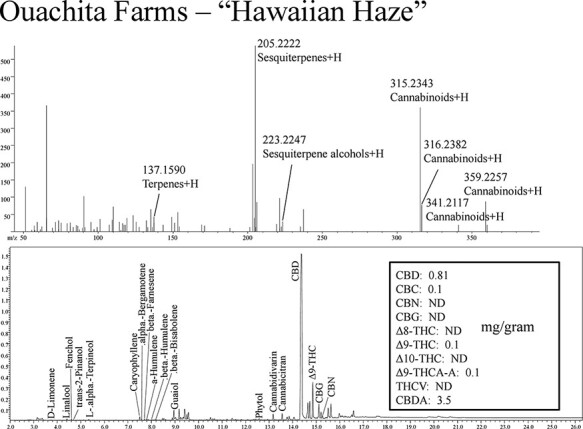
Product characterization results for Ouachita Farms “Hawaiian Haze CBD flower”. Top: DART–MS spectrum. Bottom: Total ion chromatogram. Bottom insert: quantitative results of targeted analyses.
Figure 2.
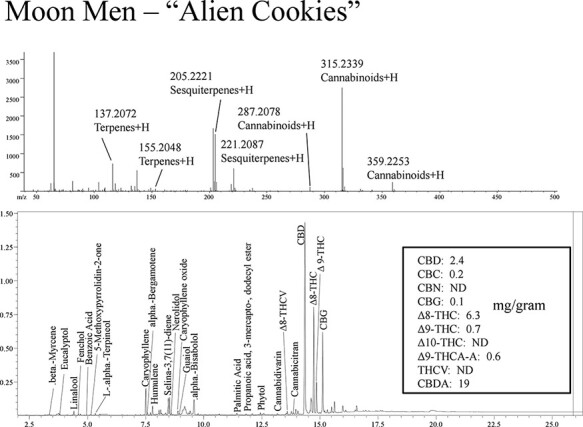
Product characterization results for Moon Men “Alien Cookies Delta 8 Flower”. Top: DART–MS spectrum. Bottom: GC--MS Total ion chromatogram. Bottom insert: quantitative results of targeted analyses.
Figure 3.
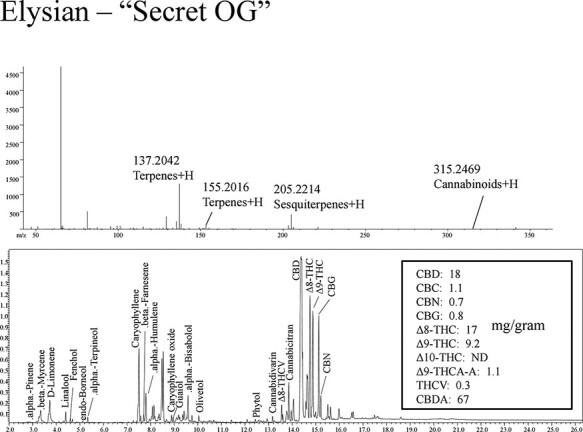
Product characterization results for Elysian “Delta 8 Flower”. Top: DART–MS spectrum. Bottom: Total ion chromatogram. Bottom insert: quantitative results of targeted analyses.
CBD, terpenes and minor phytocannabinoids were not detected in the Palm Treez gummies. ∆8-THC, ∆9-THC, ∆8-THC-O-A, ∆9-THC-O-A and CBD-di-O-A were detected in each of the different colored gummies. Concentrations determined in the whole gummy were as follows: ∆8-THC, 0.18; ∆9-THC, 0.058; ∆8-THC-O-A, 0.30; ∆9-THC-O-A, 0.45; and CBD-di-O-A, 0.19 mg/gummy. The concentrations in the outer section of the gummies were ∼30 times larger than those of the inner portions of the gummy. Results of analyses can be seen in Figures 4.
Figure 4.
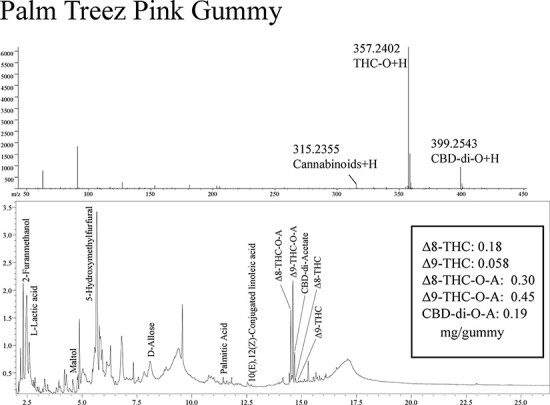
Product characterization results for Palm Treez Gummy Squares. Top: DART–MS spectrum. Bottom: GC--MS Total ion chromatogram. Bottom insert: quantitative results of targeted analyses.
SA was used to evaluate the use of non-matrix matched calibrators. The nonmatched calibration curves were within 20% of the SA derived results. The use of the non-matrix matched calibration curves was acceptable for the analysis of the THC-O derivatives in the gummy matrix.
Discussion
Preparation of unavailable primary reference material for ∆8-THC-O-A, ∆9-THC-O-A, ∆10-THC-O-A, CBD-di-O-A, and deuterated internal standards ∆9-THC-d3-O-A and CBD-d3-di-O was simple and produced approximately 100% pure derivatized standards that were stable and suitable for analysis. A variety of methods were employed to characterize the unknown products and quantify identified drugs. The DART–MS, GC–MS and LC–MS-MS methods produced matching results. A previously published LC–MS-MS method to quantify cannabinoids was successfully expanded to include CBD-di-O-A. ∆8-THC-O-A and ∆9-THC-O-A were not sufficiently resolved for quantitation. The employed GC–MS method was able to resolve, identify and quantitate the THC-O-As (Figure 5).
Figure 5.
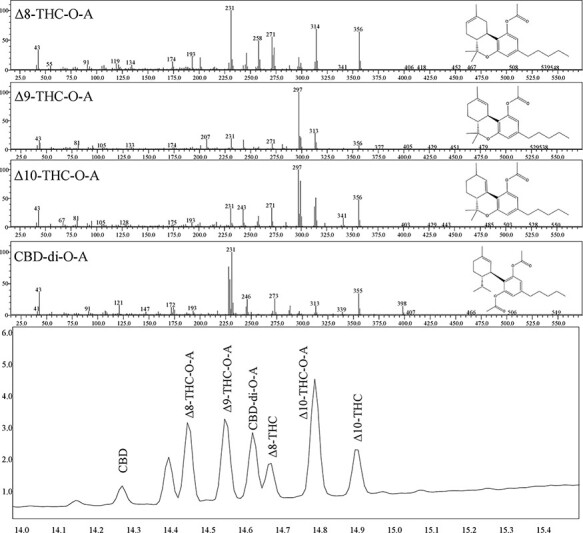
Separation of cannabinoids and cannabinoid acetate derivatives by gas chromatography–mass spectrometry, with acetate structures and mass spectrums.
Analysis of the four products identified terpenes, phytocannabinoids and synthetic cannabinoids. These first two classes of compounds would be expected in both hemp and cannabis plant material (22, 23), although abundance of cannabinoids and specific terpene profiles vary from plant to plant. The concentrations of ∆8-THC identified in the Elysian and Moon Men products suggest that ∆8-THC was added. While the webpage for the Elysian product stated this is how the product was created (24), this information was not stated on either of the package labels. The Ouachita Farms product was only determined to contain terpenes and phytocannabinoids, with CBD as its major psychoactive component, although in concentrations lower than labeled. Analysis of the gummy product identified ∆8-THC, ∆9-THC, their respective acetate ester derivatives and CBD-di-O-A. Based on the lack of terpenes and minor cannabinoids, this product was likely made using CBD isolate, rather than full-spectrum CBD material (25–27), that was derivatized to form the THC-O and CBD-di-O derivatives. The ∆8-THC was likely synthesized from CBD, while the ∆9-THC could either have been added as an isolate or generated during the ∆8-THC conversion from CBD. The parent THC compounds could then be converted to the desired acetate esters without needing to purify out other undesired cannabinoids or terpenes that could alter the flavor profile. The presence of ∆8- and ∆9-THC suggests the ester conversion may not have been allowed to react to completion, either due to insufficient reaction time or converting material.
Analysis of sample exterior (edge) versus interior (center of gummy) indicates that the drug was predominantly on the outside of the gummy, suggesting the gummy was either dipped into a solution with the substances or the substances were sprayed onto the product. Consideration of sampling technique is important when dealing with unknown products, as it can have large impacts on quantitative results and the extrapolated toxicological interpretations. Poor blending of ingredients in edible products can result in inhomogeneity throughout the product, and exterior glazes/coatings can result in further inhomogeneity. Some cannabis testing labs report performing homogeneity testing by breaking an edible into multiple pieces to sample for analysis in order to compare intra-edible homogeneity (28), others report sampling multiple edible samples from a batch to compare inter-edible homogeneity (29), and still others randomly select “servings” as indicated by product packaging and homogenize the edibles that make up the “serving” for testing (30). The current study sampled different areas of a gummy to determine if the drug was well distributed or localized to one area. Once it was determined the individual gummies were not homogenous, an entire gummy was dissolved to most accurately determine the total drug content in a labeled serving size.
The two plant products with labeled concentration claims were over-labeled. The Ouachita Farms product claimed to be 16.3% CBD, but was only found to be 0.08% CBD by weight. The Elysian product claimed 175 mg ∆8-THC per 3.5 g, but only contained 59.5 mg ∆8-THC per 3.5 g. The Palm Treez gummy product claimed each piece/serving contained 10 mg THC-O-A, but determined concentrations calculated by sampling an entire gummy totaled only 0.75 mg/gummy ∆8-THC-O-A + ∆9-THC-O-A. The analysis of the product identified the presence of CBD-di-O-A, which was not mentioned on the packaging. The package also failed to clarify what isomer(s) of THC-O-A was in the product.
Lack of federal oversight means testing requirements and quality assurance measures for legal cannabis products vary according to individual state laws, which may or may not include homogeneity testing and may differ depending on if the product is for medical or adult-use. Unregulated products can be riskier for consumers as they are only subject to testing requirements deemed necessary by the manufacturer and often have inaccurate, incomplete or altogether absent labeling (17, 18). All four products were from unregulated markets, indicated by the absence of a state regulatory identification stamp.
The products analyzed in this study were received as part of a case involving hallucinations and continued periods of psychosis. The limited pharmacological data for ∆8-THC, lack of any pharmacological data of THC-O-As currently available, and limited anecdotal reports of the effect of these substances makes it difficult to assign the described symptomology to use of submitted products. Robust clinical studies with modern methodologies are imperative to better understand the effects of cannabinoid acetates and should include dosing, potency, duration of effects and documentation of off-target effects. Raising awareness of these emerging compounds and educating the public on potential harms of consuming unregulated products with unknown ingredients and minimal knowledge as to the effects of said ingredients is crucial.
Conclusions
Synthesis of THC-O-A and CBD-di-O-A standards was simple and successful. The methods described were effective in identifying and quantitating the various cannabinoids in the submitted products. SA was used to justify the use of non-matrix matched calibrators used for the identification and quantitation of the THC-O-As in the gummy product. ∆8-THC, ∆8-THC-O-A, ∆9-THC-O-A and CBD-di-O-A were identified in the analyzed products. Labeled concentrations differed from the determined concentrations. To the authors’ knowledge, this is the first reported case where THC-O acetate derivatives were identified in cannabinoid-based edible products. Very little is known about the pharmacological effects of these products.
Supplementary Material
Contributor Information
Alaina K Holt, Department of Forensic Science, Virginia Commonwealth University, 1015 Floyd Avenue, Room 2015, Richmond, VA 23284, USA; Integrative Life Sciences Doctoral Program, Virginia Commonwealth University, PO Box 84230, Richmond, VA 23284, USA.
Justin L Poklis, Department of Pharmacology & Toxicology, Virginia Commonwealth University, PO Box 980613, Richmond, VA 23298, USA.
Michelle R Peace, Department of Forensic Science, Virginia Commonwealth University, 1015 Floyd Avenue, Room 2015, Richmond, VA 23284, USA.
Supplementary Data
Supplementary Data are available at Journal of Analytical Toxocology online.
Funding
This work was supported by the National Institute of Justice [2018–75-CX-0036 and 2019-MU-MU-007] and the National Institute on Drug Abuse [P30 DA033934]. The opinions, findings and conclusions or recommendations expressed in this publication are those of the author(s) and do not necessarily reflect those of the Department of Justice.
Data availability statement
The data underlying this article are available in the article and in its online supplementary material.
References
- 1. Thomsen R., Nielsen L.M., Holm N.B., Rasmussen H.B., Linnet K., Indices Consortium (2015) Synthetic cannabimimetic agents metabolized by carboxylesterases. Drug Testing and Analysis, 7, 565–576. [DOI] [PubMed] [Google Scholar]
- 2. United States Centers for Disease Control and Prevention . (2018) Synthetic cannabinoids: What are they? What are their effects? https://www.cdc.gov/nceh/hsb/chemicals/sc/default.html (accessed Feb 3, 2022).
- 3. National Institute on Drug Abuse . (2018) Synthetic Cannabinoids (K2/Spice) DrugFacts. https://nida.nih.gov/publications/drugfacts/synthetic-cannabinoids-k2spice (accessed Aug 4, 2021).
- 4. European Monitoring Centre for Drugs and Drug Addiction . (2009) Understanding the ‘Spice’ Phenomenon. https://www.emcdda.europa.eu/publications/thematic-papers/understanding-spice-phenomenon_en (accessed Feb 3, 2022).
- 5. United States Drug Enforcement Administration . (2020) K2/Spice - Drug Fact Sheet. https://www.dea.gov/sites/default/files/2020-06/K2-spice-2020.pdf (accessed Aug 4, 2021).
- 6. Chemical & Engineering News . (2021) Chemists sound alarms over delta-8-THC craze. https://cen.acs.org/biological-chemistry/natural-products/Delta-8-THC-craze-concerns-chemists/99/i31 (accessed Jul 7, 2021).
- 7. Daily CBD – English . (2021) How to Make Delta 8 THC: CBD to ∆8 THC Step-By-Step. https://dailycbd.com/en/how-to-make-delta-8-thc/ (accessed Feb 3, 2022).
- 8. Srebnik M., Lander N., Breuer A., Mechoulam R. (1984) Base-catalysed double-bond isomerizations of cannabinoids: structural and stereochemical aspects. Journal of the Chemical Society, Perkin Transactions 1, 1984, 2881–2886. [Google Scholar]
- 9. Adams R., Chen K.H., Loewe S. (1945) Tetrahydrocannabinol Homologs with a s-Alkyl Group in the 3-position. Journal of the American Chemical Society, 67, 1534–1537. [DOI] [PubMed] [Google Scholar]
- 10. Leas E.C., Nobles A.L., Shi Y., Hendrickson E. (2022) Public interest in ∆8-Tetrahydrocannabinol (delta-8-THC) increased in US states that restricted ∆9-Tetrahydrocannabinol (delta-9-THC) use. International Journal of Drug Policy, 101, 103557. [DOI] [PMC free article] [PubMed] [Google Scholar]
- 11. United States Centers for Disease Control and Prevention . (2021) Increases in Availability of Cannabis Products Containing Delta-8 THC and Reported Cases of Adverse Events. https://emergency.cdc.gov/han/2021/han00451.asp (accessed Nov 15, 2021).
- 12. Kruger J.S., Kruger D.J. (2022) Delta-8-THC: Delta-9-THC’s nicer younger sibling? Journal of Cannabis Research, 4, 4. [DOI] [PMC free article] [PubMed] [Google Scholar]
- 13. National Research Council . Review of available information on dibenzopyrans: dimethylheptylpyran and related compounds. In: Grossblatt, N. (ed). Possible Long-Term Health Effects of Short-Term Exposure to Chemical Agents. Vol. 2. Cholinesterase Reactivators, Psychochemicals and Irritants and Vesicants, Chapter 3. The National Academies Press: Washington, DC, 1984; pp 47–99. [Google Scholar]
- 14. Wollner H.J., Matchett J.R., Levine J., Loewe S. (1942) Isolation of a physiologically active tetrahydrocannabinol from Cannabis Sativa Resin. Journal of the American Chemical Society, 64, 26–29. [Google Scholar]
- 15. Honest Marijuana Co . (2019) THC-O-Acetate: What It Is And What You Need To Know About It. https://honestmarijuana.com/thc-o/ (accessed Aug 5, 2021).
- 16. CBD Testers . (2021) Psychedelic Cannabinoids: How THC-O Acetate is Made. https://cbdtesters.co/2021/07/15/thc-o-potency-making-thc-o-acetate/ (accessed Feb 3, 2022).
- 17. Holt A.K., Karin K.N., Butler S.N., Ferreira A.R., Krotulski A.J., Poklis J.L., et al. (2022) Cannabinoid-based vaping products and supplement formulations reported by consumers to precipitate adverse effects. Drug Testing and Analysis, doi: 10.1002/dta.3253. Epub ahead of print. [DOI] [PMC free article] [PubMed] [Google Scholar]
- 18. Bonn-Miller M.O., Loflin M.J.E., Thomas B.F., Marcu J.P., Hyke T., Vandrey R. (2017) Labeling accuracy of cannabidiol extracts sold online. JAMA, 318, 1708–1709. [DOI] [PMC free article] [PubMed] [Google Scholar]
- 19. Poklis J.L., Raso S.A., Alford K.N., Poklis A., Peace M.R. (2015) Analysis of 25I-NBOMe, 25B-NBOMe, 25C-NBOMe and Other Dimethoxyphenyl-N-[(2-Methoxyphenyl) Methyl]Ethanamine derivatives on blotter paper. Journal of Analytical Toxicology, 39, 617–623. [DOI] [PMC free article] [PubMed] [Google Scholar]
- 20. Holt A.K., Poklis J.L., Cobb C.O., Peace M.R. (2021) Identification of gamma-butyrolactone in JUUL liquids. Journal of Analytical Toxicology, 45, 892–900. [DOI] [PMC free article] [PubMed] [Google Scholar]
- 21. Holt A.K., Poklis J.L., Peace M.R. (2021) A retrospective analysis of chemical constituents in regulated and unregulated E-cigarette liquids. Frontiers in Chemistry, 9, 854. [DOI] [PMC free article] [PubMed] [Google Scholar]
- 22. Echeverry C., Reyes-Parada M., Scorza C. (2021) Constituents of Cannabis sativa. Advances in Experimental Medicine and Biology, 1297, 1–9. [DOI] [PubMed] [Google Scholar]
- 23. Andre C.M., Hausman J.-F., Guerriero G. (2016) Cannabis sativa: the plant of the thousand and one molecules. Frontiers in Plant Science, 7, 19. [DOI] [PMC free article] [PubMed] [Google Scholar]
- 24. Infused Organics, LLC . (2021) Elysian Secret OG | D8 Hemp Flower Infused Organics LLC. https://www.infusedorganicsllc.com/product/elysian-secret-og-d8-hemp-flower/225 (accessed Jul 20, 2021).
- 25. Marinotti O., Sarill M. (2020) Differentiating full-spectrum hemp extracts from CBD Isolates: implications for policy, safety and science. Journal of Dietary Supplements, 17, 517–526. [DOI] [PubMed] [Google Scholar]
- 26. Meehan-Atrash J., Rahman I. (2021) Cannabis vaping: existing and emerging modalities, chemistry, and pulmonary toxicology. Chemical Research in Toxicology, 34, 2169–2179. [DOI] [PMC free article] [PubMed] [Google Scholar]
- 27. Raber J.C., Elzinga S., Kaplan C. (2015) Understanding dabs: contamination concerns of cannabis concentrates and cannabinoid transfer during the act of dabbing. The Journal of Toxicological Sciences, 40, 797–803. [DOI] [PubMed] [Google Scholar]
- 28. American Clinical Solutions, LLC . (2021) Why Test Edibles For Homogeneity? ACS Lab Cannabis. https://acslabcannabis.com/blog/research-development/why-test-edibles-for-homogeneity/ (accessed May4, 2022). [Google Scholar]
- 29. True Labs for Cannabis . Homogeneity True Labs for Cannabis. https://www.truelabscannabis.com/homogeneity (accessed May9, 2022).
- 30. CannaSafe . (2020) Homogeneity Testing. https://csalabs.com/homogeneity-testing/ (accessed May 9, 2022).
Associated Data
This section collects any data citations, data availability statements, or supplementary materials included in this article.
Supplementary Materials
Data Availability Statement
The data underlying this article are available in the article and in its online supplementary material.