



Abstract

OBJECTIVES
Mitral valve (MV) surgery after prior cardiac surgery is conventionally performed through resternotomy and associated with increased morbidity and mortality. Alternatively, MV can be approached minimally invasively [minimally invasive mitral valve surgery (MIMVS)], but longer-term follow-up of this approach for MV surgery after prior cardiac surgery is lacking. Therefore, the aim of the current study is to evaluate short- and mid-term outcomes of MIMVS versus MV surgery through resternotomy in patients with prior sternotomy, using a nationwide registry.
METHODS
Patients undergoing isolated MV surgery after prior cardiac surgery between 2013 and 2018 were included. Primary outcomes were short-term morbidity and mortality and mid-term survival. Cox proportional hazard analysis was used to investigate the association between surgical approach and mortality. Propensity score matching was used to correct for potential confounders.
RESULTS
In total, 290 patients underwent MV surgery after prior cardiac surgery, of whom 205 patients were operated through resternotomy and 85 patients through MIMVS. No significant differences in 30-day mortality (3.4% vs 2%, P = 0.99) were observed between both groups. Five-year survival was 86.3% in the resternotomy group, compared to 89.4% in the MIMVS group (log-rank P = 0.45). In the multivariable analysis, surgical approach showed no relation with mid-term mortality [hazard ratio 0.73 (0.34–1.60); P = 0.44]. A lower incidence of prolonged intubation and new-onset arrhythmia was observed in MIMVS.
CONCLUSIONS
MV surgery after prior cardiac surgery has excellent short- and mid-term results in the Netherlands, and MIMVS and resternotomy appear to be equally efficacious. MIMVS is associated with a lower incidence of new-onset arrhythmia and prolonged intubation.
Keywords: Mitral valve surgery, Minimally invasive mitral valve surgery, Resternotomy, Reoperation, Nationwide registry
With the ageing population, mitral valve (MV) surgery after prior cardiac surgery is increasingly performed [1], currently comprising 10% of the total case load of surgical MV interventions [2].
INTRODUCTION
With the ageing population, mitral valve (MV) surgery after prior cardiac surgery is increasingly performed [1], currently comprising 10% of the total case load of surgical MV interventions [2]. Conventionally, cardiac reoperations are performed through a resternotomy with significant perioperative morbidity and mortality [3], as reflected by its incorporation in contemporary surgical risk scores. During resternotomy, dense adhesions can be encountered, which are amenable to severe bleeding, occurring in 7–9% of reoperative procedures [4, 5]. Especially in the proximity of cardiac chambers or in the presence of patent bypass grafts, such bleedings can have devastating consequences.
Alternatively, MV surgery after prior cardiac surgery can be performed using a minimally invasive approach [minimally invasive mitral valve surgery (MIMVS)], through a right-sided anterolateral thoracotomy [6, 7]. Through this access, many of the potential complications associated with resternotomy can be circumvented, as the left atrium is approached directly from the side, without the need for complete adhesiolysis of the heart. In addition, potentially patent bypass grafts are usually not in the vicinity. Some retrospective studies have demonstrated a beneficial short-term effect of MIMVS in a reoperative setting [7, 8], which was corroborated in a recent meta-analysis by our research group [9], demonstrating superiority of MIMVS in terms of early mortality. Still, these studies comprised relatively small study cohorts and expert single-centre experiences with limited follow-up. As such, longer-term outcomes of MIMVS after prior cardiac surgery remain unknown.
The aim of current study is to compare short- and mid-term outcomes of MIMVS versus conventional MV surgery through a resternotomy in patients with prior cardiac surgery, using a multicentre nationwide registry.
PATIENTS AND METHODS
Source of study data
All patients undergoing cardiac surgery in the Netherlands are collected in a prospective mandatory database: the Netherlands Heart Registration (NHR). In short, this prospective database contains a variety of data on all cardiac surgical procedures performed in the Netherlands, including demographic factors, type of intervention, parameters concerning perioperative morbidity and mortality, mid-term survival and all risk factors required for the calculation of contemporary risk scores. All data are anonymized for both patients, surgeons and centres.
Inclusion
Patients were considered for inclusion if they were 18 years and older, had previous cardiac surgery performed through a median sternotomy and underwent isolated MV surgery for new-onset or recurrent MV disease. Isolated MV surgery was defined as either isolated MV repair (MVr) or MV replacement (MVR) or MVr/MVR combined with tricuspid valve repair/replacement and/or rhythm surgery (pulmonary vein isolation/MAZE procedure) and/or atrial septal closure. Patients undergoing other concomitant interventions were excluded. As robotic surgery is a distinct area within the field of MIMVS, patients undergoing a reoperative robotic procedure were excluded as well. MIMVS was defined as right-sided anterolateral mini-thoracotomy with peripheral or central cannulation, avoiding (re)sternotomy. No distinctions were made between the length of the incision, or the use of a video-assisted or direct-vision approach.
Study design
The current study is a retrospective multicentre cohort study of prospectively collected data from 16 cardiothoracic centres in the Netherlands. Data were collected for patients with previous cardiac surgery through sternotomy, undergoing MV surgery in the period between January 2013 and December 2018.
Outcomes
Short-term outcomes, defined as early mortality (30-day mortality) and postoperative complications and duration of hospital stay, were retrieved. Definitions regarding postoperative complications are presented in Supplementary Material, S5. Mid-term outcomes were defined as mid-term survival at 5 years. Survival data were derived from the municipal administration records and was completed for all patients. Survival follow-up was completed through December 1, 2020.
Missing values
All mandatory variables for the NHR were complete. However, 2 non-mandatory variables had a relatively high proportion of missing data: cardiopulmonary bypass-time (46%) and aortic cross-clamp time (48%). Given the higher levels of missing data for these variables, which clearly exceed >10% and most likely had a non-random distribution, it was inappropriate to apply a multiple imputation method, impairing analysis of these surgical times.
Statistical analysis
Normality of the continuous variables was tested by the Shapiro–Wilk test. Continuous data are presented as mean ± SD (or as median with interquartile range in the presence of skewedness). Categorical data are expressed as frequencies and percentages (in case of <100 patients, integers were used for the reporting of percentages) and were compared using the χ2 test. Fisher’s exact test was used when the minimum expected cell-size assumption did not apply. Continuous variables were compared using the Mann–Whitney U-test. Kaplan–Meier survival curves were used to demonstrate mid-term survival. Between survival curve differences were assessed using the log-rank test. Follow-up was reported as median in months and interquartile range. The influence of the surgical approach (sternotomy versus MIMVS) on mid-term survival was assessed using the Cox proportional hazards model in the total population. Significant covariates (P < 0.10) in the univariable analysis and surgical approach (forced in the model, independent of P-value) were included in a multivariable Cox regression analysis. Hazard ratios (HRs) are reported with 95% confidence intervals (CIs). Proportionality was evaluated using a goodness-of-fit test, in which a P-value of <0.05 demonstrated violation of the proportional hazards assumption. All reported P-values were two-sided and were considered statistically significant when P < 0.05. Statistical analyses of the data were performed using SPSS software (V26; IBM, Armonk, NY, USA) and R Statistics (the R Foundation, Vienna, Austria).
Propensity score matching
Propensity score matching analyses were performed to compare sternotomy to MIMVS, while correcting for potential confounders. Propensity scores were estimated using covariates identified in binary logistic regression model. Propensity scores were matched using nearest neighbour matching in a 1:1 ratio, replacement was not allowed and calliper distance was set at 0.1, as advocated by experts in our field. Standardized mean difference was used to compare the difference in means in units of the pooled standard deviation. A value of higher than 0.10 was considered an index of residual imbalance. After matching for baseline differences, data on operative characteristics and outcomes were compared using paired tests, as advocated by experts in our field [10].
Ethical statement
No institutional review board approval was necessary. This study is in line with the institution's ethical policies and standards.
RESULTS
Baseline characteristics
NHR database contained 290 patients undergoing MV surgery after prior cardiac surgery through sternotomy, with a registered surgical approach and known previous cardiac procedure through sternotomy between 2013 and 2018. A total of 205 patients were operated through repeated median sternotomy and 85 patients using an MIMVS approach. Male gender was more frequent in MIMVS (n = 107, 52.2% vs n = 57, 67% P = 0.02). Patients operated through resternotomy were younger (66.0 [54.0–73.5] years vs 70.0 [61.5–74.0] years, P = 0.02). Patients undergoing MIMVS more frequently underwent prior primary MV surgery (n = 47, 22.9% vs n = 36, 42%, P = 0.001). Details regarding the primary procedure in the past are summarized in Supplementary Material, S4. At baseline, no difference in median EuroSCORE I was observed (resternotomy 11.85% [6.39–19.48] vs MIMVS 12.43% [5.97–17.61], P = 0.73). Baseline characteristics of the total population, repeated sternotomy group and MIMVS group are summarized in Table 1.
Table 1:
Baseline characteristics
| Resternotomy, N = 205 | MIMVS, N = 85 | P-Value | |
|---|---|---|---|
| Age, median [IQR] | 66.0 [54.0–73.5] | 70.0 [61.5–74.0] | 0.02 |
| Male sex, n (%) | 107 (52.2) | 57 (67) | 0.02 |
| Diabetes, n (%) | 33 (16.1) | 7 (8) | 0.08 |
| Chronic lung disease, n (%) | 28 (13.7) | 9 (11) | 0.48 |
| Extracardiac arteriopathy, n (%) | 23 (11.2) | 7 (8) | 0.45 |
| Recent myocardial infarction, n (%) | 4 (2.0) | 1 (1) | 0.99 |
| Active endocarditis, n (%) | 9 (4.4) | 1 (1) | 0.29 |
| Serum creatinine (>200 μm/l) | 7 (3.4) | 2 (2) | 0.99 |
| Prior cardiac proceduresa | |||
| Prior CABG, n (%) | 74 (36.1) | 42 (49) | 0.04 |
| Prior MV intervention | 47 (22.9) | 36 (42) | 0.001 |
| LVEF, median [IQR] | 55 [40–55] | 55 [40–55] | 0.75 |
| Good, n (%) | 109 (53.2) | 51 (60) | 0.29 |
| Moderate, n (%) | 89 (43.4) | 32 (38) | 0.37 |
| Poor, n (%) | 6 (2.9) | 2 (2) | 0.99 |
| Very poor, n (%) | 1 (0.5) | 0 (0.0) | 0.99 |
| PA pressure, median [IQR] | 25.0 [25.0–31.5] | 25.0 [25.0–25.0] | 0.002 |
| Normal, n (%) | 130 (63.4) | 72 (85) | <0.001 |
| Moderate increased, n (%) | 54 (26.3) | 8 (9) | 0.001 |
| Severe increased, n (%) | 21 (10.2) | 5 (6) | 0.24 |
| EuroSCORE I, median [IQR] | 11.85 [6.39–19.48] | 12.43 [5.97–17.61] | 0.73 |
Patients could have both.
Bold denotes statistical significance.
CABG: coronary artery bypass grafting; IQR: interquartile range; LVEF: left ventricular ejection fraction; MIMVS: minimally invasive mitral valve surgery; MV: mitral valve; PA: pulmonary artery.
Operative characteristics
In the total cohort (n = 290 patients), 76 patients underwent MVr, 211 patients underwent MVR and 3 patients underwent other procedures (such as paravalvular leak closure), resulting in an overall repair rate of 26.2% (n = 76). When specified for patients without previous MV surgery, the repair rate increased to 33.3% (n = 69). No significant difference in repair rate between repeated sternotomy and MIMVS was observed [n = 59 (28.8%) vs 17 (20%), P = 0.12], even when specified for patients without previous MV surgery [n = 54 (32.4%) vs n = 15 (31%), P = 0.64]. In patients with repeated sternotomy, concomitant tricuspid valve reconstruction was performed in more instances [n = 67 (33.2%) vs n = 10 (12%), P < 0.001]. Other concomitant procedures were presented in Table 2. When performing MVR, in 53.1% of cases (n = 112), a mechanical valve, and in 46.9% (n = 99), a biological valve were implanted. There were no differences in choice of prosthesis for both procedures. Operative characteristics are summarized in Table 2.
Table 2:
Procedural characteristics of the matched and unmatched groups
| Unmatched |
Matched |
||||||
|---|---|---|---|---|---|---|---|
| Resternotomy, N = 205 | MIMVS, N = 85 | P-Value | Resternotomy, N = 80 | MIMVS, N = 80 | P-Value | ||
| Type of procedure | |||||||
| MV repair, n (%) | 59 (28.8) | 17 (20) | 0.12 | 18 (23) | 15 (19) | 0.25 | |
| MV replacement, n (%) | 144 (70.2) | 67 (79) | 0.14 | 62 (78) | 64 (80) | 0.50 | |
| Other MV procedures, n (%) | 2 (1.0) | 1 (1) | 0.99 | 0 (0) | 1 (1) | 0.99 | |
| Tricuspid valve reconstruction, n (%) | 67 (33.2) | 10 (12) | <0.001 | 26 (33) | 10 (13) | 0.005 | |
| Atrial septal closure, n (%) | 4 (2.0) | 3 (4) | 0.42 | 2 (3) | 3 (4) | 0.99 | |
| Rhythm surgery, n (%) | 18 (8.8) | 4 (5) | 0.23 | 5 (6) | 3 (4) | 0.69 | |
| Type of prosthesis | 0.99 | ||||||
| Mechanical, n (%) | 80 (55.6) | 42 (48) | 0.29 | 30 (48) | 32 (50) | ||
| Biological, n (%) | 64 (44.4) | 35 (52) | 0.29 | 32 (52) | 32 (50) | ||
| Patients without previous MV surgery | N = 158 | N = 49 | N = 57 | N = 45 | |||
| MV repair, n (%) | 54 (32.4) | 15 (30.6) | 0.64 | 14 (25) | 13 (29) | 0.99 | |
Bold denotes statistical significance.
MIMVS: minimally invasive mitral valve surgery; MV: mitral valve.
Short-term outcomes
In the overall cohort, 30-day mortality was 3.1%. There were no significant differences in 30-day mortality between repeated sternotomy (n = 7, 3.4%) and MIMVS (n = 2, 2%, P = 0.99). The median length of hospital stay was 7 days ([5.0–13.0] vs 7 days [5.0–11.5] P = 0.98) for repeated sternotomy and MIMVS, respectively. A lower incidence of new-onset arrythmia (n = 79, 38.5% vs n = 18, 21%, P = 0.004) and prolonged intubation (> 24 hours) was observed in the MIMVS group (n = 14, 6.8% vs n = 0, P = 0.01). No significant differences in other postoperative complications were seen. These postoperative outcomes are depicted in Supplementary Material, S1.
Mid-term outcomes
Survival
The median follow-up of the total cohort was 3.26 [1.68–4.64] years, with a 5-year survival rate of 87.2%. Five-year survival rate was 86.3% in the repeated sternotomy group compared to 89.4% in the MIMVS group (log-rank P = 0.45).
Cox regression analysis
Univariable analysis showed no influence of surgical approach (i.e. resternotomy or MIMVS) on mid-term mortality. Univariable Cox regression analyses identified age, extra cardiac arteriopathy, recent myocardial infarction, increased serum creatinine (>200 μm/l), active endocarditis and decreased left ventricular function as predictors for late mortality. MVr was identified as protective factor for late mortality. Multivariable analysis showed no influence of surgical approach on mid-term mortality [HR 0.73 (0.34–1.60), P = 0.44]. Only extracardiac arteriopathy (HR 2.56, 95% CI 1.16–5.67, P = 0.02) and increased serum creatinine (HR 3.41, 95% CI 1.14–10.27, P = 0.03) were found to be the independent predictive risk factors for mid-term mortality in MV surgery after prior cardiac surgery. Cox regression analyses are depicted in Table 3. Of note, goodness-of-fit for all included variables indicated proportionality (P > 0.05).
Table 3:
Cox regression analysis for investigating the effect of surgical approach on mid-term mortality in the overall population
| Univariable |
Multivariable |
|||
|---|---|---|---|---|
| HR (95% CI) | P-Value | HR (95% CI) | P-Value | |
| Minimally invasive approach | 0.83 (0.40–1.70) | 0.60 | 0.73 (0.34–1.60) | 0.44 |
| Age | 1.03 (1.00–1.05) | 0.09 | 1.02 (0.99–1.05) | 0.30 |
| Male sex | 1.29 (0.67–2.48) | 0.46 | ||
| Chronic lung disease | 1.43 (0.60–3.43) | 0.42 | ||
| Extracardiac arteriopathy | 3.35 (1.57–7.14) | 0.01 | 2.56 (1.16–5.67) | 0.02 |
| Recent myocardial infarction | 4.12 (0.98–17.34) | 0.05 | 2.55 (0.44–14.80) | 0.30 |
| Serum creatinine (>200 μm/l) | 4.80 (1.69–13.65) | 0.01 | 3.41 (1.14–10.27) | 0.03 |
| Active endocarditis | 3.46 (1.05–11.43) | 0.04 | 2.11 (0.49–9.02) | 0.32 |
| Diabetes | 1.50 (0.66–3.45) | 0.34 | ||
| LVEF <50% | 2.23 (1.16–4.31) | 0.02 | 1.85 (0.95–3.61) | 0.07 |
| Pulmonary artery pressure >30 mmHg | 1.53 (0.787–2.97) | 0.21 | ||
| Prior bypass grafting | 0.89 (0.46–1.73) | 0.73 | ||
| Prior mitral valve intervention | 1.51 (0.77–2.94) | 0.23 | ||
| Mitral valve repair | 0.44 (0.17–1.12) | 0.08 | 0.53 (0.20–1.38) | 0.19 |
| Concomitant tricuspid procedure | 1.33 (0.66–2.64) | 0.43 | ||
| Concomitant rhythm surgery | 0.40 (0.05–2.92) | 0.37 | ||
Bold denotes statistical significance.
CI: confidence interval; HR: hazard ratio; LVEF: left ventricular ejection fraction.
Propensity score matching
To correct for the differences in baseline characteristics, propensity score matching was performed. Age, gender, pulmonary artery pressure, logistic EuroSCORE, and chronic obstructive pulmonary disease were used as covariates for the propensity score matching model. Eighty pairs were matched in a 1:1 ratio. After matching, a residual imbalance remained for diabetes only, which was not considered clinically relevant as diabetes did not show to be a risk factor in univariable and multivariable analyses. All other baseline characteristics showed no residual imbalance (standardized mean difference <0.10). Details on propensity score matching can be found in Supplementary Material, S3.
Comparison matched cohort
Baseline characteristics after propensity matching are summarized in Supplementary Material, S2. Prior MV intervention was more frequently performed in the MIMVS compared to repeated sternotomy [n = 35 (44%) vs n = 23 (29%), P = 0.04]. The repair rate in patients without previous MV surgery was 25% in the repeated sternotomy group and 29% in the MIMVS group respectively (P = 0.99). As seen in the unmatched population, more concomitant tricuspid valve procedures were performed in the sternotomy group (n = 26, 33% vs n = 10, 13%, P = 0.005). In the matched population, no significant difference in 30-day mortality was observed (1% vs 3%, P = 0.99). A lower incidence in prolonged intubation (>24 hours) and new-onset arrhythmia was observed in the MIMVS group (Table 4). Most importantly, regarding mid-term follow-up, no significant differences were found in 5-year survival in the propensity-matched cohorts (MIMVS 92.5% vs repeated sternotomy 90.0, log-rank P = 0.661) (Fig. 1).
Table 4:
Postoperative outcomes of matched cohort
| Resternotomy, N = 80 | MIMVS, N = 80 | P-Value | |
|---|---|---|---|
| 30-Day mortality, n (%) | 1 (1) | 2 (3) | 0.99 |
| Hospital stay in days, median [IQR] | 7 [4–14] | 7 [5–12] | 0.97 |
| Perioperative myocardial infarction, n (%) | 1 (1) | 2 (3) | 0.99 |
| Pneumonia, n (%) | 7 (9) | 3 (4) | 0.29 |
| Urinary tract infection, n (%) | 0 (0) | 0 (0) | – |
| Reintubation due to respiratory insufficiency, n (%) | 3 (4) | 0 (0) | 0.99 |
| Prolonged intubation (>24 h), n (%) | 9 (11) | 0 (0) | 0.003 |
| Readmission to ICU, n (%) | 2 (3) | 3 (4) | 0.99 |
| Stroke, n (%) | 1 (1) | 1 (1) | 0.99 |
| Stroke without neurological deficit, n (%) | 0 (0) | 1 (1) | 0.99 |
| Stroke with neurological deficit, n (%) | 1 (1) | 0 (0) | 0.99 |
| Kidney failure, n (%) | 5 (6) | 3 (4) | 0.63 |
| Gastrointestinal complications, n (%) | 2 (3) | 0 (0) | 0.50 |
| Vascular complications, n (%) | 2 (3) | 0 (0) | 0.50 |
| New-onset arrythmia, n (%) | 33 (41) | 17 (21) | 0.01 |
| Mediastinitis, n (%) | 1 (1) | 0 (0) | 0.99 |
| Reexploration (within 30 days), n (%) | 4 (5) | 8 (10) | 0.39 |
Definitions of postoperative complications are summarized in the Supplementary Material. Bold denotes statistical significance.
ICU: intensive care unit; IQR: interquartile range; MIMVS: minimally invasive mitral valve surgery.
Figure 1:
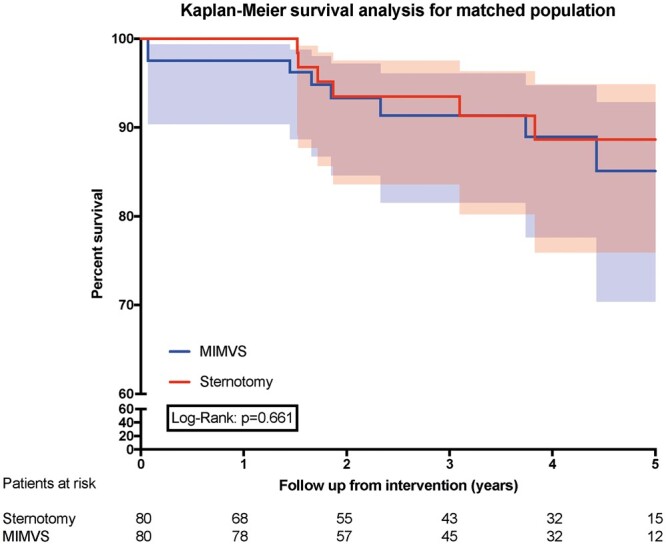
Kaplan–Meier survival analysis of the matched population. MIMVS: minimally invasive mitral valve surgery
DISCUSSION
The current study evaluated the role of a minimally invasive approach for MV surgery after prior cardiac surgery through sternotomy, compared to repeated sternotomy in a multicentre nationwide registry and is the first to establish mid-term follow-up for this procedure. In addition, as patient data were collected from all centres performing MV surgery in the Netherlands, the current results can be interpreted as contemporary ‘real-world data’. Based on these findings, some important conclusions can be drawn.
First, MV surgery, either through resternotomy or MIMVS, is an exceptionally safe reoperative cardiac surgical procedure, as reflected by both unmatched and matched cohorts, with an overall 30-day mortality rate of 3.1%. In retrospective single-centre analyses of high-volume expert institutions, mortality rates ranged between 1.2% and 3.0% [11, 12]. However, mortality is reported to range up to 11.1% in the Society of Thoracic Surgeons (STS) database [13], which is based on a multicentre registry, potentially more accurately reflecting real-world results. In accordance with a prior comparison between MIMVS and sternotomy in primary MV surgery of the Dutch national registry, no difference in 30-day mortality regarding surgical approach was observed [14]. Of note, in a previous meta-analysis by our research group, a significant early mortality benefit of the MIMVS approach in a reoperative setting was found [9]. However, the included studies comprised relatively small single-centre experiences and were subjected to potential bias. Furthermore, in the included studies in that meta-analysis, there was a markedly increased use of MVr in the MIMVS group (41% vs 17%). As MVr is associated with superior short- and long-term outcomes, especially in degenerative MV disease, this might explain the mortality differences in this prior analysis.
Interestingly, in the current study, the median preoperative logistic EuroSCORE for the overall cohort (used for the prediction of 30-day mortality) was 12.18%, contrasting the actual reported 30-day mortality rate. However, as EuroSCORE I was introduced in 1999 and the subsequent logarithmic evaluation in 2003, these risk evaluations were based on more historical data, inherently overestimating surgical risk in contemporary patients. For mortality prediction of patients undergoing MV surgery, EuroSCORE II proved superior discriminatory ability compared to both STS score and EuroSCORE I, in a recent analysis [15]. Still, in patients with degenerative mitral regurgitation (MR) operated in a high-volume centre with a high level of expertise in MVr, EuroSCORE II also significantly overestimated actual 30-day mortality [16]. Moreover, in MIMVS, EuroSCORE II overpredicted mortality, potentially limiting its value in this specific patient group [17], undergoing MVr through a minimally invasive approach, especially in a reoperative setting.
In terms of morbidity and complication rate, a low incidence of major postoperative complications for both repeated sternotomy as MIMVS was observed. As known from other large registries and a recent analysis of primary MV surgery [14], MV surgery through a minimally invasive approach is associated with a lower incidence of new-onset postoperative arrythmia compared to sternotomy. This finding is confirmed in the current analysis of patients undergoing reoperative procedures and is potentially explained by less need of adhesiolysis, less cardiac manipulation and a subsequent reduction in inflammation [18]. In addition, in the current analysis, the incidence of prolonged intubation (>24 h) was significantly increased in the matched sternotomy group compared to MIMVS, which might be related to preservation of pulmonary function due to sternal sparing in MIMVS patients. However, these findings have to be appreciated with care, because these parameters are susceptible to various confounding factors.
In the majority of patients referred for MV surgery after prior cardiac surgery, MVR was performed, with an equal distribution of mechanical and biological valve prostheses. The repair rate, when specified for patients without prior MV intervention, is considerably lower (33.3%) compared to the repair rate in primary MV surgery. In a previous analysis of patients undergoing primary MV surgery, repair rate for all-comers approached through sternotomy was 80.0%, while repair rate was 75.9% for MIMVS patients [14]. In contrast to the prior findings in primary MV surgery, we did not observe a difference in surgical approach in terms of repair rate in patients undergoing MV surgery after prior cardiac surgery through sternotomy. Unfortunately, the current study design, based on predefined parameters of the NHR, did not allow for evaluation of aetiology of MV disease. Subsequently, the proportion of patients with mitral stenosis, ischaemic MR or degenerative MR remains unknown, complicating the correct interpretation of the reported repair rate. In a 2018 analysis of the STS database for patients undergoing MV surgery after prior cardiac surgery, Mehaffey et al. [13] found a significantly higher incidence of mitral stenosis as surgical indication in redo cases compared to primary surgery (36% vs 10%, P < 0.001). Although they were also not able to differentiate between MR aetiology, they reported an overall repair rate of 12% in a cohort of 1096 all comers, which is markedly lower compared to the current study findings.
As MV surgery after prior cardiac surgery is increasingly performed [1], mostly due to the ageing population, it is more important than ever to evaluate short- and longer-term results of these different surgical approaches. As an alternative strategy, transcatheter mitral procedures have emerged rapidly, following the successful evolution of transcatheter aortic valve implantation. As MV pathology is more diverse than aortic valve disease, a plethora of devices exist which have the potential to address all different forms of MR. As such, different techniques can be used to perform transcatheter MVr, by chordal replacement or annuloplasty, or MVR in specific cases. Especially transcatheter MV replacement (TMVR) is believed to play an important role in the near future, enabling minimally invasive correction of ischaemic MR or valve-in-valve implantation in failed bioprostheses [19]. Still, both transcatheter MVr and TMVR are currently only applicable in specific subsets of MV patients and require specific conditions related to MV anatomy and left ventricular geometry [20]. Of note, especially long-term outcomes and durability of TMVR and repair are yet to be determined. Therefore, although promising, the exact role and value of transcatheter techniques in the mitral position remains to be defined. When considering such an approach, one most weigh these outcomes to the excellent short- and mid-term results of reoperative surgery, either by MIMVS or sternotomy, as presented in the current study. In that light, patients with new-onset or recurrent MV disease after a previous cardiac surgical procedure through sternotomy, warrant a personalized approach [21], based on extensive preoperative imaging, and should be evaluated in a dedicated MV heart team, incorporating surgeons, interventionalists and imaging cardiologists [22].
Limitations
The current study has several limitations mostly due the character of the database used. The NHR database was initially designed for quality evaluation (value-based healthcare) rather than for research purposes. Therefore, the retrospective review has an inherent bias, due to selection of patient, patient lost to follow-up and missing data. Of note, these missing data only comprise non-mandatory variables, such as surgical times. For the mandatory variables, data completion was exceptionally high (100%). Some important characteristics were not included, such as information on MV disease characteristics as aetiology, complexity, gradation and reason for failed repair during first procedures in patients with prior MVr. In addition, no detailed analyses could be performed regarding surgical access (direct vision vs endoscopic), mode of arterial cannulation (femoral, axillary or direct aortic cannulation) and cardiac preservation (i.e. cooling, cardioplegia). Unfortunately, the database has no information regarding mode of anaesthesia and the use of pain regiment (i.e. intercostal block, erector spinae block), either. Of note, as the database is anonymous, data cannot be traced back to individual centres and surgeons, impairing evaluation of a potential volume-outcome effect. Furthermore, the database includes all surgical procedures performed by 16 cardiothoracic centres in the Netherlands. However, not all centres perform MV surgery after prior cardiac surgery through a minimally invasive approach, therefore the data regarding a minimally invasive approach was only reported by centres with substantial expertise. In line with this, the MIMVS cohort was relatively small, increasing the risk of type 2 error. Then, perhaps most importantly, an analysis of MIMVS versus sternotomy patients is prone to selection bias, as it is possible that patient with a more favourable profile were selected for MIMVS. In an effort to correct for these issues, all consecutive patients undergoing MV surgery after prior cardiac surgery were included and matched using propensity score matching, based on the recommendations by experts in our field [10]. Although this is the least biased method to perform such analyses—matching for known confounders—only randomization can correct for unknown confounders, and results should be interpreted with caution. Finally, as data were collected starting from 2013, simultaneously with the introduction of EuroSCORE II, risk evaluation was evaluated by EuroSCORE I (log), overestimating surgical risk.
CONCLUSION
The current multicentre nationwide study showed excellent outcomes for MV surgery after prior cardiac surgery in the Netherlands, and MIMVS and resternotomy appeared to be equally efficacious. MIMVS is associated with a lower incidence of new-onset arrythmia and prolonged intubation. These excellent short- and mid-term results of MV surgery after prior cardiac surgery, regardless of the approach, should be taken into consideration when evaluating transcatheter interventions. Further investigation is necessary to develop contemporary risk score models for MV surgery after prior cardiac surgery.
SUPPLEMENTARY MATERIAL
Supplementary material is available at EJCTS online.
Conflict of interest: Peyman Sardari Nia has a consultancy agreement with Neochord Inc, Edwards Lifesciences and Fuijfilm medical and is the inventor of a MV simulator that is commercialized through a start-up (Ma-trac) of Maastricht University Medical Center+. The other authors report no conflicts of interest.
Funding
None declared.
Supplementary Material
Glossary
ABBREVIATIONS
- CIs
Confidence intervals
- HRs
Hazard ratios
- MIMVS
Minimally invasive mitral valve surgery
- MR
Mitral regurgitation
- MV
Mitral valve
- MVr
MV repair
- MVR
MV replacement
- NHR
Netherlands Heart Registration
- STS
Society of Thoracic Surgeons
- TMVR
Transcatheter MV replacement
Contributor Information
Jules R Olsthoorn, Department of Cardiothoracic Surgery, Maastricht University Medical Center, Maastricht, Netherlands; Department of Cardiothoracic Surgery, Catharina Hospital Eindhoven, Eindhoven, Netherlands.
Samuel Heuts, Department of Cardiothoracic Surgery, Maastricht University Medical Center, Maastricht, Netherlands.
Saskia Houterman, Netherlands Heart Registration, Utrecht, Netherlands.
Jos G Maessen, Department of Cardiothoracic Surgery, Maastricht University Medical Center, Maastricht, Netherlands; Cardiovascular Research Institute Maastricht (CARIM), Maastricht University, Maastricht, the Netherlands.
Peyman Sardari Nia, Department of Cardiothoracic Surgery, Maastricht University Medical Center, Maastricht, Netherlands; Cardiovascular Research Institute Maastricht (CARIM), Maastricht University, Maastricht, the Netherlands.
Cardiothoracic Surgery Registration Committee of the Netherlands Heart Registration:
S Bramer, W J P van Boven, A B A Vonk, B M J A Koene, J A Bekkers, G J F Hoohenkerk, A L P Markou, A de Weger, P Segers, F Porta, R G H Speekenbrink, W Stooker, W W L Li, E J Daeter, N P van der Kaaij, and Y Douglas
Data Availability Statement
Data will be shared on reasonable request to the corresponding author with the permission of the Netherlands Heart Registration.
Author contributions
Jules R. Olsthoorn: Conceptualization; Data curation; Formal analysis; Investigation; Methodology; Validation; Visualization; Writing—original draft; Writing—review & editing. Samuel Heuts: Data curation; Formal analysis; Investigation; Methodology; Validation; Visualization; Writing—original draft; Writing—review & editing. Saskia Houterman: Formal analysis; Writing—original draft; Writing—review & editing. Jos G. Maessen: Supervision; Validation. Peyman Sardari Nia: Conceptualization; Data curation; Formal analysis; Investigation; Methodology; Supervision; Validation; Visualization; Writing—original draft; Writing—review & editing.
Reviewer information
European Journal of Cardio-Thoracic Surgery thanks Ahmed El-eshmawi, Hunter J Mehaffey, Aditya Sengupta, harish ramakrishna and the other, anonymous reviewer(s) for their contribution to the peer review process of this article.
REFERENCES
- 1. Gammie JS, Sheng S, Griffith BP, Peterson ED, Rankin JS, O'Brien SM et al Trends in mitral valve surgery in the United States: results from the Society of Thoracic Surgeons Adult Cardiac Surgery Database. Ann Thorac Surg 2009;87:1431–7; discussion 37–9. [DOI] [PubMed] [Google Scholar]
- 2. Park CB, Suri RM, Burkhart HM, Greason KL, Dearani JA, Schaff HV. et al. Identifying patients at particular risk of injury during repeat sternotomy: analysis of 2555 cardiac reoperations. J Thorac Cardiovasc Surg 2010;140:1028–35. [DOI] [PubMed] [Google Scholar]
- 3. Rankin JS, Hammill BG, Ferguson TB, Glower DD, O’Brien SM, DeLong ER. et al. Determinants of operative mortality in valvular heart surgery. J Thorac Cardiovasc Surg 2006;131:547–57. [DOI] [PubMed] [Google Scholar]
- 4. Roselli EE, Pettersson GB, Blackstone EH, Brizzio ME, Houghtaling PL, Hauck R. et al. Adverse events during reoperative cardiac surgery: frequency, characterization, and rescue. J Thorac Cardiovasc Surg 2008;135:316–23, 323.e1–6. [DOI] [PubMed] [Google Scholar]
- 5. Ellman PI, Smith RL, Girotti ME, Thompson PW, Peeler BB, Kern JA. et al. Cardiac injury during resternotomy does not affect perioperative mortality. J Am Coll Surg 2008;206:993–7; discussion 97–9. [DOI] [PubMed] [Google Scholar]
- 6. Mohr FW, Onnasch JF, Falk V, Walther T, Diegeler A, Krakor R. et al. The evolution of minimally invasive valve surgery—2 year experience. Eur J Cardiothorac Surg 1999;15:233–8. discussion 38–9. [DOI] [PubMed] [Google Scholar]
- 7. Vallabhajosyula P, Wallen T, Pulsipher A, Pitkin E, Solometo LP, Musthaq S. et al. Minimally invasive port access approach for reoperations on the mitral valve. Ann Thorac Surg 2015;100:68–73. [DOI] [PubMed] [Google Scholar]
- 8. Burfeind WR, Glower DD, Davis RD, Landolfo KP, Lowe JE, Wolfe WG.. Mitral surgery after prior cardiac operation: port-access versus sternotomy or thoracotomy. Ann Thorac Surg 2002;74:S1323–5. [DOI] [PubMed] [Google Scholar]
- 9. Daemen JHT, Heuts S, Olsthoorn JR, Maessen JG, Sardari Nia P.. Right minithoracotomy versus median sternotomy for reoperative mitral valve surgery: a systematic review and meta-analysis of observational studies. Eur J Cardiothorac Surg 2018;54:817–25. [DOI] [PubMed] [Google Scholar]
- 10. Benedetto U, Head SJ, Angelini GD, Blackstone EH.. Statistical primer: propensity score matching and its alternatives. Eur J Cardiothorac Surg 2018;53:1112–7. [DOI] [PubMed] [Google Scholar]
- 11. Arcidi JM Jr, Rodriguez E, Elbeery JR, Nifong LW, Efird JT, Chitwood WR Jr. Fifteen-year experience with minimally invasive approach for reoperations involving the mitral valve. J Thorac Cardiovasc Surg 2012;143:1062–8. [DOI] [PubMed] [Google Scholar]
- 12. Nishida H, Fukui T, Kasegawa H, Kin H, Yamazaki M, Takanashi S.. Causes of repair failure for degenerative mitral valve disease and reoperation outcomes. Eur J Cardiothorac Surg 2018;53:1244–50. [DOI] [PubMed] [Google Scholar]
- 13. Mehaffey HJ, Hawkins RB, Schubert S, Fonner C, Yarboro LT, Quader M. et al. Contemporary outcomes in reoperative mitral valve surgery. Heart 2018;104:652–6. [DOI] [PubMed] [Google Scholar]
- 14. Olsthoorn JR, Heuts S, Houterman S, Maessen JG, Sardari Nia P, Bramer S et al; the Cardiothoracic Surgery Registration Committee of the Netherlands Heart Registration. Effect of minimally invasive mitral valve surgery compared to sternotomy on short- and long-term outcomes: a retrospective multicentre interventional cohort study based on Netherlands Heart Registration. Eur J Cardiothorac Surg 2022;61:1099–106. [DOI] [PubMed] [Google Scholar]
- 15. Ad N, Holmes SD, Patel J, Pritchard G, Shuman DJ, Halpin L.. Comparison of EuroSCORE II, Original EuroSCORE, and The Society of Thoracic Surgeons risk score in cardiac surgery patients. Ann Thorac Surg 2016;102:573–9. [DOI] [PubMed] [Google Scholar]
- 16. Carino D, Denti P, Ascione G, Del Forno B, Lapenna E, Ruggeri S. et al. Is the EuroSCORE II reliable in surgical mitral valve repair? A single-centre validation study. Eur J Cardiothorac Surg 2021;59:863–8. [DOI] [PubMed] [Google Scholar]
- 17. Moscarelli M, Bianchi G, Margaryan R, Cerillo A, Farneti P, Murzi M. et al. Accuracy of EuroSCORE II in patients undergoing minimally invasive mitral valve surgery. Interact CardioVasc Thorac Surg 2015;21:748–53. [DOI] [PubMed] [Google Scholar]
- 18. Mihos CG, Santana O, Lamas GA, Lamelas J.. Incidence of postoperative atrial fibrillation in patients undergoing minimally invasive versus median sternotomy valve surgery. J Thorac Cardiovasc Surg 2013;146:1436–41. [DOI] [PubMed] [Google Scholar]
- 19. Yoon SH, Whisenant BK, Bleiziffer S, Delgado V, Dhoble A, Schofer N et al Outcomes of transcatheter mitral valve replacement for degenerated bioprostheses, failed annuloplasty rings, and mitral annular calcification. Eur Heart J 2019;40:441–51. [DOI] [PubMed] [Google Scholar]
- 20. Alperi A, Granada JF, Bernier M, Dagenais F, Rodes-Cabau J.. Current status and future prospects of transcatheter mitral valve replacement: JACC state-of-the-art review. J Am Coll Cardiol 2021;77:3058–78. [DOI] [PubMed] [Google Scholar]
- 21. Sardari Nia P, Heuts S, Daemen J, Luyten P, Vainer J, Hoorntje J. et al. Preoperative planning with three-dimensional reconstruction of patient's anatomy, rapid prototyping and simulation for endoscopic mitral valve repair. Interact CardioVasc Thorac Surg 2017;24:163–8. [DOI] [PubMed] [Google Scholar]
- 22. Sardari Nia P, Olsthoorn JR, Heuts S, van Kuijk SMJ, Vainer J, Streukens S. et al. Effect of a dedicated mitral heart team compared to a general heart team on survival: a retrospective, comparative, non-randomized interventional cohort study based on prospectively registered data. Eur J Cardiothorac Surg 2021;60:263–73. [DOI] [PubMed] [Google Scholar]
Associated Data
This section collects any data citations, data availability statements, or supplementary materials included in this article.
Supplementary Materials
Data Availability Statement
Data will be shared on reasonable request to the corresponding author with the permission of the Netherlands Heart Registration.