



Abstract
Background:
Medical sociology is concerned with the relationship between social factors and health, and with the application of sociological theory and research techniques to questions related to health and the health care system. Considering the wide range of studies in the field that each examined different aspects, to promote health in community, bibliometrics analysis in this area is felt.
Methods:
In this descriptive-analytical study with a scientometric approach, the data about “medical sociology” were retrieved from PubMed in MEDINE format, including 1226 records over the period 1945–2018. By using Co-word analysis, clustering methods, and strategic diagram with the help of SPSS, UcInet 6 software the data were analyzed.
Results:
The keyword “Attitude to Health” and two pairs of frequently used keywords, namely “Power (Psychology)*Professional Autonomy” were the most frequent in medical sociology. The results shaped the concepts of medical sociology in 7 clusters. The clusters “Attitude of health personnel”, “Health Policy” and “Sociology of Medical Education” are topics that may be emerging or disappearing. The “Physicians”, “Models of Social Determinants of Health” and “medical philosophy” are immature clusters.
Conclusion:
This research used co-word networks that indicate the important links between keywords of research areas. Considering the frequency of keywords along with the clusters obtained, it seems that the most research approach was seen on the medical aspect rather than the sociological aspect. Despite the importance of sociological aspects such as social rooting of disease, sociability, medicine as a social institution and etiological studies, these subjects have not been sufficiently considered.
Keywords: Medical sociology, Bibliometrics, Co-word analysis
Introduction
“Medical Sociology” is a subdiscipline that draws on the methodologies and middle-range theories of substantive sociological specialties to elucidate important health, health services organization, and health care utilization issues. The fields drawn on most commonly include social stratification, organizational analysis, occupations and professions, social psychology, gender, and political sociology. Medical sociology also shares concepts and methods with related fields such as public health, health services research, medical economics, medical anthropology, social epidemiology, demography, and ecology” (1).
What makes medical sociology important is the critical role social factors play in determining or influencing the health of individuals, groups, and the larger society. Social conditions and situations not only promote and, in some cases, cause the possibility of illness and disability but also enhance prospects of disease prevention and health maintenance. Much research has been done in pursuit of the goals of medical sociology. Considering the wide range of studies in the field that each examined different aspects including concepts, factors and social aspects of patient and health, etc., to promote health in community, meta-analysis in this area is felt.
Nowadays, the emergence of scientometrics techniques, along with the use of social network analysis techniques and Visualization software has made researchers able to single out the structure of knowledge in different fields. By using co-word analysis as one of the scientometrics techniques, it is possible to examine the main topics of research and study their thematic relationships. “Co-word analysis is a content analysis technique that uses patterns of co-occurrence of pairs of items (i.e., words or noun phrases) in a corpus of texts to identify the relationships between ideas within the subject areas presented in these texts. Indexes based on the co-occurrence frequency of items, such as an inclusion index and a proximity index, are used to measure the strength of relationships between items. Based on these indexes, items are clustered into groups and displayed in network maps” (2).
This technique is a reliable way of discovering relationships and revealing links between different disciplines (3). In this context, Chen and colleagues emphasized the feature of co-lexical analysis, namely the visualization of the intellectual structure of a discipline (4).
Several studies have been carried out to extract the patterns and trends of growth and intellectual structure in medical science area, such as vitamin D (5), Oncology (6), Robotics in Surgery (7), SIRT6 epigenetics (8), choroidal neovascularization (9), tumor immunotherapy (10), Hepatitis B (11), Andrology (12), nanomedicine (13), Professional–Patient Relations (14), social media (15), infertility (16), and information behavior (17) and Laser (18). Numerous researchers have made use of Co-word analysis and cluster analysis as one of the most important methods for examining the intellectual structure of medical science fields. Moreover, co-word analysis has been able to clearly illustrate the research area and is useful in visualizing a knowledge structure.
Therefore, this study attempts to disclose the intellectual structure of knowledge in medical sociology and provides an up-to-date, complete picture of research in this field. The paper tries to answer the following question: What is the structure of the knowledge in the field of medical sociology?
Methods
The present study is a descriptive-analytical using scientometrics approach. The research population includes all scientific articles in medical sociology field that are indexed in PubMed database (www.ncbi.nlm.nih.gov/PubMed) from 1945 to 2018. PubMed is one of the best-accepted databases in medicine and biomedical topics (19). In the first step, after extracting all articles (1226 records) on Januvia 2019, the data were extracted in tab-delimited format (UTF8) in the form of a text file (Notepad). The search strategy for data mining is as follows: “Sociology, medical” [MeSH Major Topic] AND (Journal article [ptyp] AND (“1945/01/01” [PDAT]: 2018/12/31 “[PDAT])”. The data was transferred to Excel software. Since some words or phrases may be written in different forms or are synonymous, the keyword file was examined and edited at this stage. For this purpose, after obtaining expert opinion, keywords were edited, modified, deleted, and consolidated. For example, singular and plural words have become one. Moreover, the keyword “sociology, medical” which was observed in general was excluded. In the next step, based on Bradford’s law, 56 keywords with a frequency of 27 upwards were considered. Various thresholds for choosing the top keywords have been used in other research (13, 20). Following identification of basic keywords (topics), the symmetrical cooccurrence matrix of the topics was created using Ravar-PreMap. Towards, hierarchical clustering was carried out by SPSS 20 (IBM Corp., Armonk, NY, USA). Clustering analysis can show clusters of topics as well as the relations among them. the importance of mapping a strategic diagram and aforementioned in co-word studies shows the fact that a square matrix and a subsequent co-relation matrix were made for each cluster by regarding keywords included in it at the final step.
The density and centrality of each cluster were calculated by using Ucinet 6.0. Density is the internal strength of a cluster and provides a good representation of the cluster’s capacity to maintain itself and to develop over time in the field under consideration”. Whereas centrality corresponds to the weight of the external links of the cluster. In other words, Centrality is used to measure the strength of the interaction of a subject area with other subject areas (21, 22). Subsequently, a strategic diagram was drawn to present the hotspots and trends of research topics. The strategic diagram uses a two-dimensional space to plot clusters according to their centrality (x-axis) and density (y-axis). Therefore, the theme clusters located in four quadrants, with different centralities and densities, can indicate the developing status of research themes (Fig. 1).
Fig. 1:
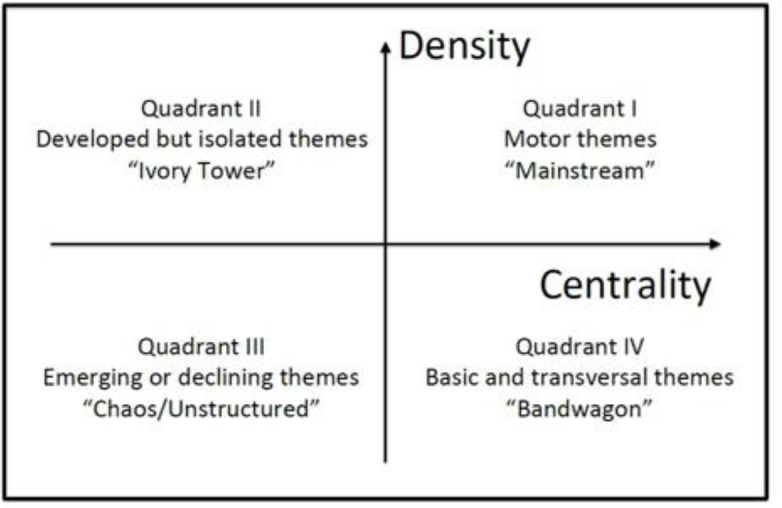
Strategic diagram classifies research themes based on density and centrality (22)
In quadrant I, research topics receive comparatively higher attention, standing at the core of the field while they have high centrality and density. In quadrant II, these themes are internally well structured and indicate that a constituted social group is active in them. Research topics in quadrant III are weakly developed with marginal interest in the global research network. Finally, the research topics in quadrant IV are weakly structured themes, but they are not considered hot research spots in recent years.
Results
The overall output of papers
This study collected and analyzed 1226 articles on medical sociology published from 1945–2018 in PubMed. Table 1 displays the geographical dispersion of scientific publications in medical sociology field. 87.51% of articles were published by these countries. Output publication of this study was published in 567 different journals. The medical sociology papers published in the top 5 journals during 1945–2018 are presented in Table 2.
Table 1:
Distribution of output of top 5 countries in medical sociology papers
| No. | Country | Frequency | Percentage |
|---|---|---|---|
| 1 | England | 487 | 39.72 |
| 2 | United States of America | 451 | 36.77 |
| 3 | Netherlands | 69 | 5.62 |
| 4 | Germany | 39 | 3.2 |
| 5 | France | 27 | 2.2 |
Table 2:
Distribution of output of top 5 journals in medical sociology papers
| No | Journal | Frequency | Percentage |
|---|---|---|---|
| 1 | Social Science & Medicine | 185 | 15.08 |
| 2 | Sociology of Health & Illness | 103 | 8.4 |
| 3 | Journal of Health and Social Behavior | 43 | 3.5 |
| 4 | International Journal of Health Services: Planning, Administration, Evaluation | 33 | 3.69 |
| 5 | Journal of Health Politics, Policy and Law | 28 | 3.28 |
About 30% of papers were published in five journals – Social Science & Medicine, Sociology of Health & Illness, and Journal of Health and Social Behavior are the top three.
Fig. 2 lists the top 20 frequently-used keywords in medical sociology area (1945–2018). In attention to the figure, frequently used words include concepts such as “Attitude to health”, “Socioeconomic factors”, etc.
Fig. 2:

High-frequency keywords used in medical sociology area
After defining a threshold for including keywords in co-word analysis, the rate of keyword co-occurrence was measured. At this stage, the rate Co-word of 56 frequently used keywords with all the keywords in the articles was obtained. Table 3 indicates the frequency distribution of 10 highly frequent co-word pairs.
Table 3:
Frequency distribution of the top 10 pairs of Co- word analysis in medical sociology field
| Frequency | Co-Words | Rank | Frequency | Co-Words | Rank |
|---|---|---|---|---|---|
| 17 | Attitude to Health*Culture | 11 | 28 | Power(Psychology)*Professional Autonomy | 1 |
| 17 | Physician-Patient relations *Patient Participation | 12 | 28 | Social Change*Power(Psychology) | 2 |
| 16 | Physician-Patient relations* Delivery of Health care | 13 | 27 | Politics*Social Change | 3 |
| 16 | Socioeconomic factors* Social Environment | 14 | 22 | Attitude to Health *Anthropology, Cultural | 4 |
| 16 | Physician-Patient relations* Pysician’ role | 15 | 22 | Physician-Patient relations *Ethics medical | 5 |
| 16 | Physician-Patient relations *Decision Making | 16 | 20 | Socioeconomic factors *Health status | 6 |
| 15 | Socioeconomic factors* Models,Theoretical | 17 | 20 | Physician-Patient relations* Physicians | 7 |
| 15 | Attitude to Health* Social Values | 18 | 19 | Health Policy*Politics | 8 |
| 14 | Physician-Patient relations *Communication | 19 | 18 | Socioeconomic factors* Social Class | 9 |
| 14 | Socioeconomic factors*HealthbStatus Disparities | 20 | 17 | Attitude of Health Personnel*Interviews | 10 |
According to Table 3, the occurrence between the two keywords Power (Psychology)*Professional Autonomy” is the highest frequency in the field of medical sociology. Two pairs of frequently used keywords namely “Social Change*Power (Psychology)” and “Politics*Social Change” are ranked second and third respectively.
Multivariate statistical analysis Hierarchical Cluster Analysis
Fig. 3 shows the dendrogram of the hierarchical cluster with Ward’s method. The first correlation matrix was transferred into SPSS, then the clusters and dendrogram of hierarchical clustering is illustrated. The 56 keywords by divided into 7 clusters, indicating that the research directions are broad and varied. The number on the vertical axis is the ranking number of the high-frequency keywords whereas the numbers on the horizontal axis represent distances between two keywords. That is, the shorter the distance where two keywords come together, the closer their relationship. For example, the relationship between keywords 38, 41, 48, and 37 (Power (Psychology), Professional Autonomy, Social Change, Politics) is the closest of all the keywords. In addition, they combine into Cluster 1: Professional Autonomy.
Fig. 3:

Hierarchical clustering by co-word (Ward’s method)
Cluster 2: Attitude of health personnel with emphasis on communication skills: seven keywords have consisted to the formation of this cluster. Such as “Attitude of Health Personnel”, “Interviews”, Complementary Therapies”, “Interprofessional Relations”, “Anthropology, Cultural”, “Organizational Culture”, and “State Medicine”.
Cluster 3: Physicians (referring to social and moral values): This cluster focuses on subjects as, “Ethics medical”, “Physicians”, “Social Values”, “Social Responsibility”, and “Bioethics”
Cluster 4: focuses on Models of Social Determinants of Health, including keywords “Health Status “, Models, Theoretical”, “Social Support”, “Health Status Disparities”, “Social Environment”, “Social Class” and “Social Environment”.
Cluster 5: medical philosophy: The existence of keywords such as “Attitude to Health”, “Culture”, “Disease”, “Health” and “Philosophy, Medical” in this cluster relates to the basic concepts of health and disease.
Cluster 6: Health Policy: The existence of keywords such as “Health Policy”, “Health Services Research”, “Public health”, “Health Behavior”, “Life Style”, “Biomedical Research” and “Research Design” are important keywords from this cluster related to medical sociology based on research and health.
Cluster 7: Sociology of Medical Education: Four keywords have contributed to the formation of this cluster. Keywords in the cluster such as “Public Policy”, “Sociology”, “Curriculum” and “Education, Medical” show that the subject of this cluster can be education in medical sociology.
Strategic diagram
We calculated the density and centrality of each cluster based on the 56*56 co-occurrence matrix (Table 4) by Ucinet 6.0. Subsequently, we drew a strategic diagram based on the centrality and density of seven clusters (Fig. 4). The strategic diagram clearly shows the research hotspots and trends by dividing these clusters into four quadrants.
Table 4:
Density and centrality of each cluster
| Cluster | Name of clusters | Centrality | Density |
|---|---|---|---|
| 1 | Professional Autonomy | 2.333 | 26.167 |
| 2 | Attitude of health personnel (emphasis on communication skills) | 4.523 | 5.036 |
| 3 | Physicians (referring to social and moral values) | 8.509 | 6.909 |
| 4 | Models of Social Determinants of Health | 10.21 | 6.556 |
| 5 | medical philosophy | 5.166 | 8.4 |
| 6 | Health Policy | 2.051 | 1.703 |
| 7 | Sociology of Medical Education | 1.666 | 4.5 |
Fig. 4:

Strategic diagram
As shown in Table 4 clusters 3 and 4 have higher centralities. The clusters have joined well with other clusters of medical sociology and clusters 6 and 7 have a lower centrality. Fig. 4 shows that there is no cluster in quadrant. The high density and centrality of clusters in quadrant I, indicate that this subject is well developed and has a powerful internal correlation and maturation. Therefore, the central topic of medical sociology has not appeared.
Cluster 2 stood in part 2 or quadrant II (upper-left quadrant). It shows high-density themes but unimportant external links and so are of only limited importance for the field (low centrality). In the lower-left quadrant are the emerging or declining themes. Low density and centrality reflect that these clusters are weakly developed internally and often indicate that these topics are at the boundary of the field. Finally, the lower-right quadrant shows the clusters 5, 3, and 4 that are basic and transversal. Which has a high degree of centrality and low density. In other words, the clusters may correspond to a newly appearing research theme.
Discussion
In this study, the methods mainly covered statistical, social network, hierarchical cluster, and strategic diagram analyses to identify major research themes and to understand how these communities and themes interact. Based on the results, we drew the following valuable conclusions.
The growth in medical sociology field over the mentioned period shows an upward trend with the highest growths seen in countries like the UK (39.72%), the United States 36.77%, and the Netherlands (5.62%). These countries are the leading country in publication output on medical sociology, a fact in other medical fields have also been presented (13, 23, 24).
The core journals were found that not are specialized in a medical sociology field, so other journals in the table are relative to social and health. This reveals the impact of the journal and its quality. Indeed, the journal holds the first position in the ranking of the Sociology of Health and medicine category in popular databases like Journal Citation Reports (or JCR) and Scimago.
“Attitude to health”, was the most frequently used word in this research. Health is according to the WHO (2013), defined as “a status of physical, mental and social comfort and it is not only the absence of an illness”. With the definition in mind, one of the three important concepts of attitude to health can be bio-psychosocial attitude stressing the interconnection of physical, mental and social components (25).
By analyzing the topics attributed to the documents (keywords), a wide range of scattered data was located in 7 clusters. The interpretation of clusters greatly depends on subjective factors, with the analysis of clusters requiring expertise in the field” (26). The topics of these clusters are: “Professional Autonomy”, “Attitude of health personnel (emphasis on communication skills)”, “Physicians (referring to social and moral values)”, “Models of Social Determinants of Health”, “medical philosophy”, “Health Policy”, “Sociology of Medical Education”.
The clusters created with common features within each group have structural relationships with each other and clusters represent a research director of the subject. The cluster analysis obtained in this study suggests that researchers generally emphasize descriptive studies.
Descriptive studies include the patient’s social behavior, the position of physicians in the construction of community medicine, and so on (27). The strategic diagram is employed to complement hierarchical clustering in the co-word analysis. As shown in Fig. 4, quadrant II includes Cluster 1, “Power (Psychology)”, Professional Autonomy, Social Change, Politics” with a low degree centrality but high density, suggesting that the clusters are close to each other, but they are specialized on one them. These topics are well-developed and mature. They themes are potential research areas in the medical sociology field.
Three clusters including “Attitude of health personnel (emphasis on communication skills)”, “Health Policy” and “Sociology of Medical Education” are located in quadrant III. Concerning the placement of these themes in the strategic diagram, one can claim that these themes did not show established internal and external relations in the field and remained underdeveloped. These clusters of keywords are not very related to the keywords in another cluster. Therefore, they are topics that can be emerging or disappearing. These topics have almost been related to each other. In other words, “health policy” is often related to death and life. In many cases, health is greatly affected by decisions that may not be directly related to health care such as attitude, health behavior and education. Health policy needs to be linked to concepts and approaches like education, funding, attitude to health and so on. Medical teaching should aim at educating socially accountable health care providers (28). This includes a patient centered orientation including communication skills and the ability to participate in teamwork.
Three clusters including “Physicians (referring to social and moral values) “Models of Social Determinants of Health” and “medical philosophy” are located in quadrant IV. As a result, they are underdeveloped or immature clusters. Although these clusters contain frequent topics, they seem to be the main clusters. The reason for this is the relatively low density in this cluster, which indicates the weak correlation of topics. The results of the strategic chart of this research are in line with Wang’s research in the field of physician-patient relations in the Internet age (14). In other words, there are no major and mature topics in this field.
Conclusion
Most research approach was seen on the medical aspect rather than the sociological aspect. In other words, the majority of research includes descriptive studies, such as medical philosophy, health policy, the functioning of the health system and the position of physicians in the construction of community medicine, and so on. Despite the importance of sociological aspects such as social rooting of disease, sociability, medicine as a social institution and etiological studies, these subjects have not been sufficiently considered. Therefore, researchers focus on marginal subjects. In addition, the other scientometric methods like citation analysis or co-authorship can complement this study. The results from a solid academic foundation gives insight to researchers and aid more discussions and questions about the field in general.
Journalism Ethics considerations
Ethical issues (Including plagiarism, informed consent, misconduct, data fabrication and/or falsification, double publication and/or submission, redundancy, etc.) have been completely observed by the authors.
Acknowledgements
The present research is a part of thesis that has been done with the support of Yazd University The authors appreciate the support of Mr. Ali Taherizadeh (MA in English literature), for editing.
Footnotes
Conflict of interest
The author declares no conflict of interest.
References
- 1.Weber Elke U. (2001). Personality and Risk Taking. In International Encyclopedia of the Social and Behavioral Sciences. ed. Smelser Neil J., Baltes Paul B. Oxford: Pergamon, 11274–11276. [Google Scholar]
- 2.He Q. (1999). Knowledge discovery through co-word analysis. Library Trends, 48: 133–159. [Google Scholar]
- 3.Ravikumar S, Agrahari A, Singh SN. (2015). Mapping the intellectual structure of scientometrics: A co-word analysis of the journal Scientometrics (2005–2010). Scientometrics, 102(1): 929–955. [Google Scholar]
- 4.Chen X, Chen J, Wu D, et al. (2016). Mapping the research trends by co-word analysis based on keywords from funded project. Procedia Computer Science, 1(91): 547–555. [Google Scholar]
- 5.Yang A, Lv Q, Chen F, et al. (2019). Identification of recent trends in research on vitamin D: A quantitative and co-word analysis. Med Sci Monit, 25: 643–55. [DOI] [PMC free article] [PubMed] [Google Scholar]
- 6.Moral-Munoz JA, Carballo-Costa L, Herrera-Viedma E, et al. (2019). Production trends, collaboration, and main topics of the integrative and complementary oncology research area: A bibliometric analysis. Integr Cancer Ther, 18: 1534735419846401. [DOI] [PMC free article] [PubMed] [Google Scholar]
- 7.Shen L, Wang S, Dai W, et al. (2019). Detecting the interdisciplinary nature and topic hotspots of robotics in surgery: social network analysis and bibliometric study. J Med Internet Res, 21(3): e12625. [DOI] [PMC free article] [PubMed] [Google Scholar]
- 8.Lu K, Yu S, Sun D, et al. (2018). Scientometric analysis of SIRT6 studies. Med Sci Monit, 24: 8357–8371. [DOI] [PMC free article] [PubMed] [Google Scholar]
- 9.Zhao F, Shi B, Liu R, et al. (2018). Theme trends and knowledge structure on choroidal neovascularization: A quantitative and co-word analysis. BMC Ophthalmol, 18(1): 86. [DOI] [PMC free article] [PubMed] [Google Scholar]
- 10.Lu K, Yu S, Yu M, et al. (2018). Bibliometric analysis of tumor immunotherapy studies. Med Sci Monit, 24: 3405–3414. [DOI] [PMC free article] [PubMed] [Google Scholar]
- 11.Zhang W, Wang YB, Zhang XZ, et al. (2017). The study of hot spots on hepatitis B dissertation based on co-word analysis in China. Studies in Health Technology and Informatics, 245: 1293. [PubMed] [Google Scholar]
- 12.Makkizadeh F, Bigdeloo E. (2018). Intellectual structure of knowledge in Andrology field (2008 to 2017): A Co-word analysis. Int J Reprod BioMed, 17: 349–360. [Google Scholar]
- 13.Makkizadeh F. (2019). Intellectual structure of knowledge in nanomedicine field (2009 to 2018): A Co-Word Analysis. Nanomedicine Research Journal, 4(2): 101–110. [Google Scholar]
- 14.Wang Z, Deng Z, Wu X. (2019). Status Quo of Professional–Patient Relations in the Internet Era: Bibliometric and Co-Word Analyses. Int J Environ Res Public Health, 16(7): 1183. [DOI] [PMC free article] [PubMed] [Google Scholar]
- 15.Leung X, Sun J, Bai B. (2017). Bibliometrics of social media research: A co-citation and co-word analysis. International Journal of Hospitality Management, 66: 35–45. [Google Scholar]
- 16.Makkizadeh F, Sa’adat F. (2017). Bibliometric and thematic analysis of articles in the field of infertility (2011–2015). Int JReprod BioMed, 15(11): 719–728. [PMC free article] [PubMed] [Google Scholar]
- 17.Soheili F, Shabani A, Khasseh AA. (2017). Intellectual structure of knowledge in Information Behavior: A Co-Word Analysis. Human Information Interaction, 4: 21–36. [Google Scholar]
- 18.Makkizadeh F. (2020). An Analysis of Laser Researches in Biomedicine Literature with a Scientometric Approach. International Journal of Information Science and Management (IJISM), 18(2):189–201. [Google Scholar]
- 19.Boudry C, Denion E, Mortemousque B, et al. (2016). Trends and topics in eye disease research in PubMed from 2010 to 2014. Peer J, 4, e1557. [DOI] [PMC free article] [PubMed] [Google Scholar]
- 20.Hu CP, Hu JM, Deng SL, et al. (2013). A co-word analysis of library and information science in China. Scientometrics, 97(2): 369–82. [Google Scholar]
- 21.Shen L, Xiong B, Hu J. (2017). Research Status, Hotspots and Trends for Information Behavior in China Using Bibliometric and Co-Word Analysis. J Doc, 73: 618–633. [Google Scholar]
- 22.Melcer E, Nguyen T.H.D, Chen Z, et al. (2015). Game sresearch today: Analyzing the academic landscape 2000–2014. In: Proceedings of the 10th. International Conference on the Foundations of Digital Games, At Pacific Grove, CA, USA 2015. [Google Scholar]
- 23.Liu Y, Goncalves J, Ferreira D, et al. (2014). Identity crisis of ubicomp? Mapping 15 years of the field’s development and paradigm change. In: Proceedings of the 2014 ACM International Joint Conference on Pervasive and Ubiquitous Computing 2014 Sep 13 (pp. 75–86). [Google Scholar]
- 24.Sweileh WM, AbuTaha AS, Sawalha AF, et al. (2016). Bibliometric analysis of worldwide publications on multi-, extensively, and totally drug–resistant tuberculosis (2006–2015). Multidiscip Respir Med, 11:45. [DOI] [PMC free article] [PubMed] [Google Scholar]
- 25.Sweileh WM, Al-Jabi SW, Sawalha AF, et al. (2016). Bibliometric profile of the global scientific research on autism spectrum disorders. Springerplus, 5(1):1480. [DOI] [PMC free article] [PubMed] [Google Scholar]
- 26.Masoud Nia E. (2014). An Introduction to Medical Sociology. Tehran: University of Tehran. [Google Scholar]
- 27.Hamzah SR, Suandi T, Ismail M, et al. (2019). Association of the personal factors of culture, attitude and motivation with health behavior among adolescents in Malaysia. International Journal of Adolescence and Youth, 24(2): 149–59. [Google Scholar]
- 28.Woollard B, Boelen C. (2012). Seeking impact of medical schools on health: meeting the challenges of social accountability. Med Educ, 46(1):21–7. [DOI] [PubMed] [Google Scholar]