



ABSTRACT
Mycobacterium gordonae is a nontuberculous mycobacterium found in diverse environments and is considered an opportunistic pathogen in immunocompromised patients. We report the draft genome sequence of a Mycobacterium gordonae strain isolated from a free-living amoeba found in a nosocomial environment in Lima, Peru.
ANNOUNCEMENT
Mycobacterium gordonae is an opportunistic nontuberculous mycobacterium (NTM) ubiquitous in water systems (1–4), where it shares a habitat with free-living amoebae (FLA) (5–8). Infections are associated with immunocompromised patients but may occur in immunocompetent hosts (9–15). Exposure to water networks and bodies poses a potential risk for disease (16, 17).
Previous reports have shown that NTM can associate with amoeba hosts in the environment (5, 8, 18). Mycobacterium gordonae isolate NTM676 was found intracellularly in an amoebal cyst previously isolated from a faucet surface biofilm in a tertiary-level hospital in Lima, Peru. After 48 h of incubation at room temperature, a positive Acanthamoeba sp. culture grown in nonnutritive agar with a lawn of Escherichia coli ATCC 25922 was observed under phase-contrast microscopy (Fig. 1A). Page’s amoeba saline solution was added to the plate for 1 h and then streaked into a 15-mL conical tube. The centrifuged sediment was placed in a new tube and left at room temperature for 30 days. Aliquots were taken weekly for Ziehl-Neelsen staining.
FIG 1.
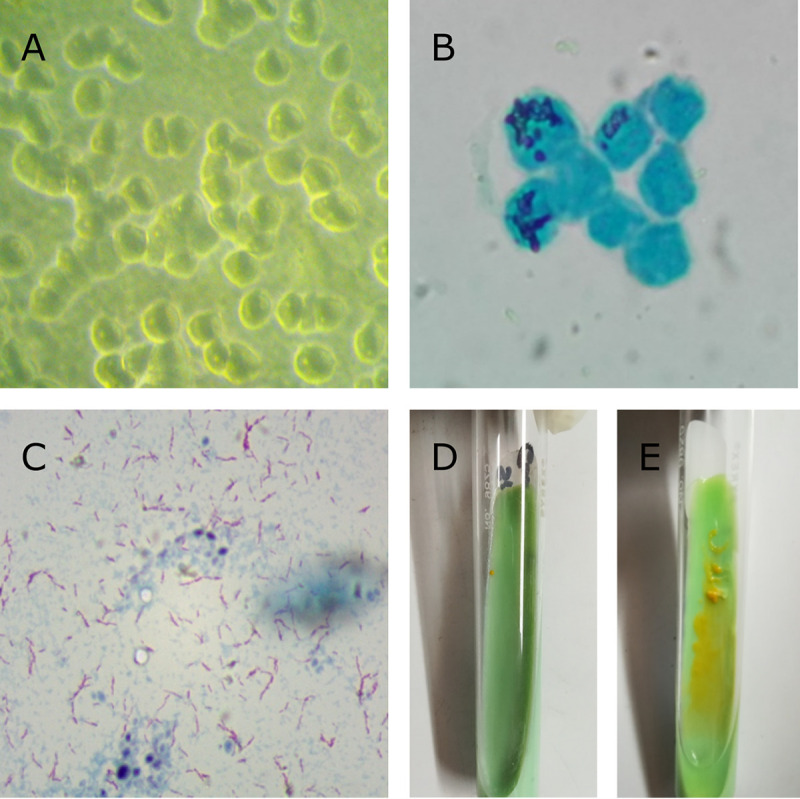
(A) Acanthamoebal trophozoites (phase-contrast microscopy, ×60 magnification). (B) Acanthamoebal cysts with acid-fast bacillus microcolonies, Ziehl-Neelsen stain (light microscopy, ×40 magnification). (C) Positive Ziehl-Neelsen-stained bacillus (light microscopy, ×100 magnification). (D) Single orange nontuberculous mycobacterium colony in Löwenstein-Jensen medium. (E) Restreaked mycobacterial colony in Löwenstein-Jensen medium.
We observed a slow-growing intracellular acid-fast bacillus (AFB) at week 4 inside amoebal trophozoites and cysts (Fig. 1B). A gentamicin and streptomycin solution (300 μg/mL) was added to the tube and incubated at room temperature until trophozoites were no longer present (Fig. 1C). The remaining cysts containing AFB were cultured in nonnutritive agar until trophozoite transformation and then lysed with sodium dodecyl sulfate (SDS) and decontaminated using modified Petroff’s method (19). The sediment was washed with phosphate buffer and inoculated in Löwenstein-Jensen (LJ) medium at 30°C for 25 days. A single small smooth orange scotochromogenic colony suggested the growth of an NTM-like organism (Fig. 1D). Further screenings were not conducted prior to whole-genome sequencing.
DNA was extracted from colonies restreaked in LJ medium (Fig. 1E) using the GeneJET DNA purification kit (Thermo Fisher Scientific, Waltham, MA). Genomic libraries were prepared using the Nextera XT kit (Illumina, San Diego, CA) and sequenced on an Illumina MiSeq instrument and a V2 kit, generating 2,082,926 250-bp paired-end raw sequences. Reads were quality checked and trimmed with FastQC v0.11.9 (20) and Trimmomatic v0.39 (21), removing reads shorter than 20 bp. De novo assembly using SPAdes v3.15.4 (22) resulted in 314 contigs, a total length of 7,266,850 bp with an N50 of 42,384 bp, mean coverage of 51×, and a GC content of 66.2%.
Resistome prediction with CARD 3.2.3 RGI 5.2.1 (23) identified genes associated with resistance to fosfomycin (murA, mutation C117D), rifamycin (rbpA; rpoB, mutations D516G, H526T, L511R), and macrolides (mtrA) with a >90% identity threshold and aminoglycosides [aac(2')-Ic] with an >80% identity threshold. PathogenFinder v1.1 (24) indicated a 75% probability of being a human pathogen, matching with 25 known virulence protein families, including ESAT-6 and others related to the ESX-5 secretion system, with a median identity threshold of 93.5%. All programs were run on default parameters.
This draft genome sequence reveals the antibiotic resistance and pathogenic potential of a nontuberculous mycobacterium found endosymbiotically in a free-living amoeba from hospital water systems.
Data availability.
The whole-genome shotgun project for M. gordonae NTM676 is available at DDBJ/ENA/GenBank under the accession number JANFXG010000000. Raw sequence reads are available in the Sequence Read Archive (SRA) under the accession number SRR14802570.
ACKNOWLEDGMENTS
This study was supported by CONCYTEC/ProCiencia grant 011-2019.
We thank Instituto de Medicina Tropical Alexander von Humboldt and Hospital Nacional Cayetano Heredia for enabling sampling of hospital surfaces and Diego Cuicapuza for curating the QC/assembly pipeline. A.M.C.V. thanks S.I.R.A.
Contributor Information
Pablo Tsukayama, Email: pablo.tsukayama@upch.pe.
Steven R. Gill, University of Rochester School of Medicine and Dentistry
REFERENCES
- 1.Johansen MD, Herrmann JL, Kremer L. 2020. Non-tuberculous mycobacteria and the rise of Mycobacterium abscessus. Nat Rev Microbiol 18:392–407. doi: 10.1038/s41579-020-0331-1. [DOI] [PubMed] [Google Scholar]
- 2.Honda JR, Virdi R, Chan ED. 2018. Global environmental nontuberculous mycobacteria and their contemporaneous man-made and natural niches. Front Microbiol 9:2029. doi: 10.3389/fmicb.2018.02029. [DOI] [PMC free article] [PubMed] [Google Scholar]
- 3.Cabello-Vílchez AM, Núñez-Ato RG. 2018. Aislamiento y caracterización molecular de micobacterias no tuberculosas en el sistema de distribución de agua en un hospital de Lima (Perú). Rev Biosalud 17:7–24. [Google Scholar]
- 4.Zulu M, Monde N, Nkhoma P, Malama S, Munyeme M. 2021. Nontuberculous mycobacteria in humans, animals, and water in Zambia: a systematic review. Front Trop Dis 2:679501. doi: 10.3389/fitd.2021.679501. [DOI] [Google Scholar]
- 5.Ovrutsky AR, Chan ED, Kartalija M, Bai X, Jackson M, Gibbs S, Falkinham JO, Iseman MD, Reynolds PR, McDonnell G, Thomas V. 2013. Cooccurrence of free-living amoebae and nontuberculous mycobacteria in hospital water networks, and preferential growth of mycobacterium avium in Acanthamoeba lenticulata. Appl Environ Microbiol 79:3185–3192. doi: 10.1128/AEM.03823-12. [DOI] [PMC free article] [PubMed] [Google Scholar]
- 6.Amissah NA, Gryseels S, Tobias NJ, Ravadgar B, Suzuki M, Vandelannoote K, Durnez L, Leirs H, Stinear TP, Portaels F, Ablordey A, Eddyani M. 2014. Investigating the role of free-living amoebae as a reservoir for Mycobacterium ulcerans. PLoS Negl Trop Dis 8:e3148. doi: 10.1371/journal.pntd.0003148. [DOI] [PMC free article] [PubMed] [Google Scholar]
- 7.Delafont V, Mougari F, Cambau E, Joyeux M, Bouchon D, Héchard Y, Moulin L. 2014. First evidence of amoebae-mycobacteria association in drinking water network. Environ Sci Technol 48:11872–11882. doi: 10.1021/es5036255. [DOI] [PubMed] [Google Scholar]
- 8.Thomas V, McDonnell G. 2007. Relationship between mycobacteria and amoebae: ecological and epidemiological concerns. Lett Appl Microbiol 45:349–357. doi: 10.1111/j.1472-765X.2007.02206.x. [DOI] [PubMed] [Google Scholar]
- 9.Jarikre LN. 1992. Mycobacterium gordonae genitourinary disease. Genitourin Med 68:45–46. doi: 10.1136/sti.68.1.45. [DOI] [PMC free article] [PubMed] [Google Scholar]
- 10.Foti C, Sforza V, Rizzo C, De Pascale G, Bonamonte D, Conserva A, Tarantino A, Stella C, Cantore S, Grassi RF, Ballini A, De Vito D, Angelini G. 2009. Cutaneous manifestations of Mycobacterium gordonae infection described for the first time in Italy: a case report. Cases J 2:6828. doi: 10.4076/1757-1626-2-6828. [DOI] [PMC free article] [PubMed] [Google Scholar]
- 11.Chen Y, Jiang J, Jiang H, Chen J, Wang X, Liu W, Chen Z, Shi Y, Zhang W, Wang H. 2017. Mycobacterium gordonae in patient with facial ulcers, nosebleeds, and positive T-SPOT.TB test result, China. Emerg Infect Dis 23:1204–1206. doi: 10.3201/eid2307.162033. [DOI] [PMC free article] [PubMed] [Google Scholar]
- 12.Pamparino S, Valente I, Tagliafico A, Dentone C, Bassetti M, Mennella S, Calabrese M, Garlaschi A. 2020. A very rare case of Mycobacterium gordonae infection of the breast. Breast J 26:2229–2232. doi: 10.1111/tbj.14086. [DOI] [PubMed] [Google Scholar]
- 13.Ustinova V, Smirnova T, Blagodatskikh K, Varlamov D, Sochivko D, Larionova E, Andreevskaya S, Andrievskaya I, Chernousova L. 2016. First draft genome sequence of a Mycobacterium gordonae clinical isolate. Genome Announc 4:6–7. doi: 10.1128/genomeA.00638-16. [DOI] [PMC free article] [PubMed] [Google Scholar]
- 14.Weinberger M, Berg SL, Feuerstein IM, Pizzo PA, Witebsky FG. 1992. Disseminated infection with Mycobacterium gordonae: report of a case and critical review of the literature. Clin Infect Dis 14:1229–1239. doi: 10.1093/clinids/14.6.1229. [DOI] [PubMed] [Google Scholar]
- 15.Mazumder SA, Hicks A, Norwood J. 2010. Mycobacterium gordonae pulmonary infection in an immunocompetent adult. N Am J Med Sci 2:205–207. [PMC free article] [PubMed] [Google Scholar]
- 16.Thomson R, Tolson C, Carter R, Coulter C, Huygens F, Hargreaves M. 2013. Isolation of nontuberculous mycobacteria (NTM) from household water and shower aerosols in patients with pulmonary disease caused by NTM. J Clin Microbiol 51:3006–3011. doi: 10.1128/JCM.00899-13. [DOI] [PMC free article] [PubMed] [Google Scholar]
- 17.Oriani A, Sierra F, Baldini M. 2018. Effect of chlorine on Mycobacterium gordonae and Mycobacterium chubuense in planktonic and biofilm state. Int J Mycobacteriol 7:122–127. doi: 10.4103/ijmy.ijmy_30_18. [DOI] [PubMed] [Google Scholar]
- 18.Gryseels S, Amissah D, Durnez L, Vandelannoote K, Leirs H, de Jonckheere J, Silva MT, Portaels F, Ablordey A, Eddyani M. 2012. Amoebae as potential environmental hosts for Mycobacterium ulcerans and other mycobacteria, but doubtful actors in Buruli ulcer epidemiology. PLoS Negl Trop Dis 6:e1764. doi: 10.1371/journal.pntd.0001764. [DOI] [PMC free article] [PubMed] [Google Scholar]
- 19.Kent P, Kubica G. 1985. Public health mycobacteriology: a guide for the level III laboratory. Centers for Disease Control, Atlanta, GA. [Google Scholar]
- 20.Andrews S. 2010. FastQC: a quality control tool for high throughput sequence data. https://www.bioinformatics.babraham.ac.uk/projects/fastqc/. Accessed 30 November 2019.
- 21.Bolger AM, Lohse M, Usadel B. 2014. Trimmomatic: a flexible trimmer for Illumina sequence data. Bioinformatics 30:2114–2120. doi: 10.1093/bioinformatics/btu170. [DOI] [PMC free article] [PubMed] [Google Scholar]
- 22.Bankevich A, Nurk S, Antipov D, Gurevich AA, Dvorkin M, Kulikov AS, Lesin VM, Nikolenko SI, Pham S, Prjibelski AD, Pyshkin AV, Sirotkin AV, Vyahhi N, Tesler G, Alekseyev MA, Pevzner PA. 2012. SPAdes: a new genome assembly algorithm and its applications to single-cell sequencing. J Comput Biol 19:455–477. doi: 10.1089/cmb.2012.0021. [DOI] [PMC free article] [PubMed] [Google Scholar]
- 23.Alcock BP, Raphenya AR, Lau TT, Tsang KK, Bouchard E, Edalatmand A, Huynh W, Nguyen A-LV, Cheng AA, Liu S, Min SY, Miroshnichenko A, Tran H-K, Werfalli RE, Nasir JA, Oloni M, Speicher DJ, Florescu A, Singh B, Faltyn M, Hernandez-Koutoucheva A, Sharma AN, Bordeleau E, Pawlowski AC, Zubyk HL, Dooley D, Griffiths E, Maguire F, Winsor GL, Beiko RG, Brinkman FS, Hsiao WW, Domselaar GV, McArthur AG. 2020. CARD 2020: antibiotic resistome surveillance with the Comprehensive Antibiotic Resistance Database. Nucleic Acids Res 48:D517–D525. doi: 10.1093/nar/gkz935. [DOI] [PMC free article] [PubMed] [Google Scholar]
- 24.Cosentino S, Voldby Larsen M, Møller Aarestrup F, Lund O. 2013. PathogenFinder–distinguishing friend from foe using bacterial whole genome sequence data. PLoS One 8:e77302. doi: 10.1371/journal.pone.0077302. [DOI] [PMC free article] [PubMed] [Google Scholar]
Associated Data
This section collects any data citations, data availability statements, or supplementary materials included in this article.
Data Availability Statement
The whole-genome shotgun project for M. gordonae NTM676 is available at DDBJ/ENA/GenBank under the accession number JANFXG010000000. Raw sequence reads are available in the Sequence Read Archive (SRA) under the accession number SRR14802570.