



Abstract
Opioid use and associated morbidity and mortality have increased in several countries during the past 20 years. We performed a study whose objective was to assess the frequency and causes of opioid‐related emergency division (ED) visits in an adult tertiary Swiss University Hospital over 9 weeks in 2018. We primarily assessed opioid‐related adverse drug reactions (ADR), secondary overdose, misuse, abuse, and insufficient pain relief. Current opioid use was identified in 1037 (8.3%) of the 12 470 included ED visits. In 64 opioid users, an ADR was identified as a contributing cause of the ED visit, representing 6.2% of opioid users, and 0.5% of the total ED visits. Moreover, we identified an overdose in 16 opioid users, misuse or abuse in 19 opioid users, and compatible withdrawal symptoms in 7 opioid users. After pooling all these events, we conclude that the ED visits could be related to opioid use in 10.2% of opioid users. Finally, in 201 opioid users, insufficient pain relief (pain not responding to the current pharmacological treatment) was identified as a contributing cause of ED visits. In these cases, other factors than simply pharmacological nonresponse may have been involved. In the context of an ever‐increasing opioid use to better control chronic pain situations, these results should reinforce emergency network epidemiological surveillance studies at a national level.
Keywords: adverse drug reaction, emergency division, opioids, pain
Our study performed in a Swiss University hospital showed that 8% of patients presenting to the emergency division took prescription opioids. In 10% of them, an opioid‐related adverse drug reaction, or other adverse events (e.g. overdose, misuse) were suspected.

Abbreviations
- ADR
adverse drug reaction
- ATC
Anatomical Therapeutic Chemical
- CNCP
chronic non‐cancer pain
- CYP
cytochrome P450
- ED
emergency division
- EHR
electronic health records
- MATOD
medication assisted treatment for opioid dependence
- OIH
opioid‐induced hyperalgesia
- SETS
Swiss Emergency Triage Scale
- WHO
World Health Organization
1. INTRODUCTION
Pain is highly prevalent, with about 20% of European adults suffering from chronic non‐cancer pain (CNCP). 1 Regarding cancer pain, it is estimated that 45% to 56% of all cancer patients will experience moderate to severe pain. 2
Analgesic drugs are commonly used. For example, US patients consulting for acute or CNCP were prescribed opioids in approximately 20% of the cases. 3 Since the 1990s, the medical use of opioids has much increased, in part due to an effort to encourage better treatment of pain by clinicians, 4 and the common use of the World Health Organization (WHO) three‐step ladder for cancer pain also for CNCP but spurred in part by aggressive promotion for some of them. 5 Between 1999 and 2015 in the US, opioid consumption tripled, increasing from 180 to 640 morphine milligram equivalent per capita. In parallel, the death rate from opioid overdoses increased almost sixfold between 1999 and 2017. 6 In 2015, opioid‐related deaths reached more than 33 000 cases in the US. 7 This crisis often referred to as the opioid epidemic mainly affects the US and Canada.
In Europe, the control over opioid prescription has been greater than in the US, making access more difficult for non‐direct beneficiaries. 8 However, analysis of the European consumption data provided by the International Narcotics Control Board showed that the use of opioids has steadily risen from the early to mid‐1990 s up to 2008 and leveled off since 2009. Opioid consumption has even declined in several Western Europe countries including Switzerland, which may suggest that not all the factors responsible for the opioid epidemic observed in the US are present, thus preventing the development of an opioid crisis. 9 However, fewer epidemiologic data than in the US are yet available. 10 Europe as a whole does not seem to be facing an opioid crisis but differences between countries might exist. 11 A retrospective, multi‐source database study conducted in the Netherlands showed that between 2008 and 2017, the number of opioid prescriptions almost doubled, and the number of hospital admissions related to opioids tripled. 12 In France between 2004 and 2017, overall strong opioid use doubled and so did opioid‐related hospitalizations. 13 In Switzerland, a study based on insurance claims showed that between 2006 and 2013, the claims per 100 000 persons doubled for strong opioids while it modestly increased by 13% for weak opioids. 14
Opioids can cause a wide range of adverse drug reactions (ADR), including drowsiness, confusion, dizziness, increased risk of a fall, 15 respiratory depression, 16 constipation, 17 withdrawal syndrome after abrupt discontinuation of long‐term therapy, addiction, abuse and misuse. 18
Given the opioid crisis that North America is currently facing, more European data are urgently needed. Our study aimed to evaluate the frequency of opioid‐associated ADR in patients visiting the emergency division (ED) of a tertiary Swiss University Hospital. A subpart of our study was conducted specifically on elderly patients. 19
2. MATERIALS AND METHODS
2.1. Study design
The study design and outcomes have been described in detail elsewhere. 19 In brief, our retrospective, monocentric, observational study was conducted in the adult ED of University Hospitals of Geneva to evaluate the frequency of ED visits considered due to opioid‐related ADR.
2.2. Setting and population
Our study was performed over 9 weeks in 2018 (May, September, and 1 week in August [heatwave]). We selected these periods to be representative of three different seasons.
The study population was defined by all consecutive patients who visited the adult ED from University Hospitals of Geneva during the chosen period. Patients aged under 18 were excluded from the analysis. The adults' ED is divided into an inpatient and outpatient emergency unit. It also includes a psychiatric emergency unit. All units are open around the clock. The classification of the patients for the inpatient and outpatient emergency unit is based on the Swiss Emergency Triage Scale (SETS). Level 1 is a life−/limb‐threatening situation where the patient must be seen by a medical doctor immediately, level 2 in the following 20 min, level 3 within 120 min, and level 4 is considered, non‐urgent. Most of level 3, all level 4, and part of level 1 and 2 are seen in the outpatient emergency unit. The evaluation of the pain by using a visual analogic scale (0 to 10) is a key point of the SETS.
We identified patients with current use of prescription opioids through the screening of patients' electronic health records (EHR), including medication assisted treatment for opioid dependence (MATOD). In Switzerland, the following drugs have marketing authorization for this indication: methadone, levomethadone, morphine, and buprenorphine. The medical records from the ED usually contain information about home treatment obtained from the patient or previous hospital data. The information technologies from our canton does not allow a full exchange of health information between hospital and community records. Patients using illicit opioids were excluded. Two clinical pharmacologists reviewed the medical records of patients on opioids to determine the causal assessment between ADR and opioid use. For this purpose, we used the system proposed by the WHO‐Uppsala Monitoring Centre system. 20
2.3. Outcomes
The primary outcome was the frequency of ED visits considered as being caused by an opioid ADR.
Secondary outcomes were the frequency of ED visits due to overdose, misuse, abuse, and insufficient pain relief. Misuse and abuse were defined according to the definitions proposed by Smith et al. 21 Misuse consists of any intentional therapeutic use of a drug product in an inappropriate way, (according to the WHO: not consistent with legal or medical guidelines). Abuse consists of any intentional, non‐therapeutic use of a drug product or substance to achieve a desirable psychological or physiological effect. We concluded to insufficient pain relief in the presence of pain in patients treated with analgesics that was sufficiently disabling or unpleasant to lead the patient to consult the ED.
2.4. Data source and variables
As previously described, 19 we collected the following data from the EHR of our institution: opioid name, dose, and indication, use of concurrent drugs, and cause of ED visit. We also evaluated the role of drug–drug interaction (DDI) by using the computerized interaction database system Lexi‐Interact® in Lexicomp. 22
2.5. Statistics
Primary and secondary outcomes were reported using descriptive statistics. We used Chi‐square and Student t‐test (for categorical and continuous variables, respectively) to compare groups. p < .05 was considered significant. We performed the analysis with the SPSS® software package, version 25 (IBM corporation).
2.6. Ethics approval
Ethical approval for the study was obtained from the local ethics committee (local study number: GE‐CCER 2017‐02217). The study was performed in accordance with the Declaration of Helsinki.
3. RESULTS
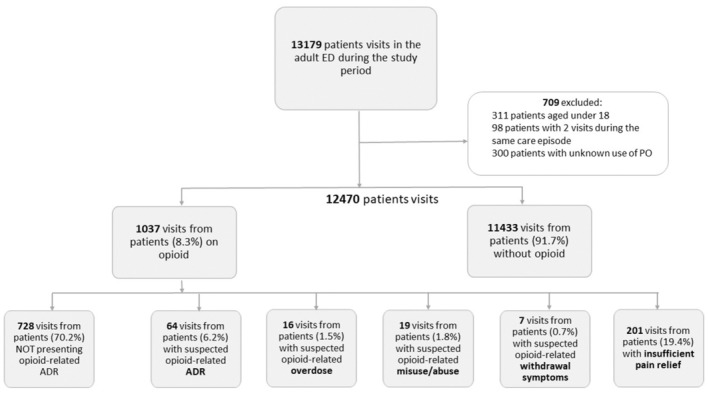
A total of 13 179 patients' visits to the adult ED occurred during the study period, 709 were excluded (Figure 1). Among the 12 470 remaining patients' visits, current opioid use was identified in 1037 (8.3%) of them. Opioid users were significantly older than opioid non‐users (59 vs. 49 years old). The proportion of female patients was greater among opioid users (52.0 vs. 46.7%) (Table 1).
FIGURE 1.
Study flow chart
TABLE 1.
Patients demographics
| All patients (n = 12 470) | Opioid users (n = 1037, 8.3%) | Opioid non‐users (n = 11 433, 91.7%) | p‐value | |
|---|---|---|---|---|
| Male, n (%) | 6596 (52.9%) | 498 (48.0%) | 6098 (53.3%) | .001 a |
| Female, n (%) | 5874 (47.1%) | 539 (52.0%) | 5335 (46.7%) | |
| Age, mean ± SD | 50.1 ± 21.1 | 59.3 ± 20.3 | 49.2 ± 21.0 | <.001 b |
Person Chi‐square, asymptomatic significance 2‐sided.
Student t test.
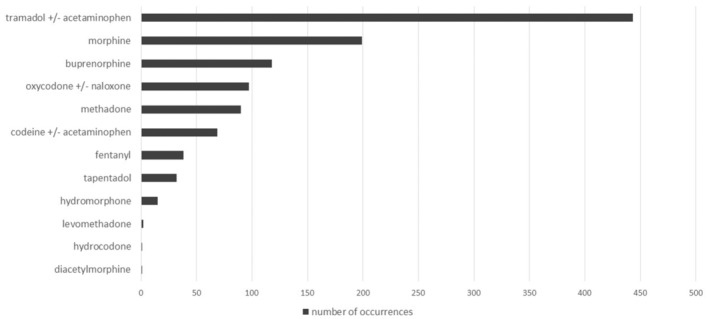
In opioid users, weak and strong opioid use represented each approximately half of the cases (n = 512 and 593 respectively). Tramadol was the most frequently used weak opioid, either alone or with acetaminophen (40.1% of all opioids). Morphine (18.0%) was the most frequently used strong opioid followed by buprenorphine (10.7%) and oxycodone, alone or as a fixed‐dose combination with naloxone (8.8%) (Figure 2). Acute and chronic non‐cancer pain was the main indication of the use of weak opioids (45.3% and 42.8% respectively). Strong opioids were mainly used for CNCP (44.2%), followed by substitution therapy (MATOD) (18.5%), cancer pain (15.2%), and acute pain (10.1%).
FIGURE 2.
Used opioids
In 64 opioid users, an ADR was identified as a potential cause of the ED visit, which represents 6.2% of opioid users, and 0.5% of the total ED visits. Moreover, we identified an overdose in 16 opioid users (8 accidental, and 8 deliberate), misuse or abuse in 19 opioid users, and withdrawal symptoms in 7 opioid users. Pooling all these adverse events represents 106 patients, 10.2% of opioid users, and 0.9% of the total ED visits. Finally, in 201 opioid users, insufficient pain relief (pain not responding to the current pharmacological treatment) was identified as a contributing cause of ED visits (Figure 1).
In the 64 opioid users presenting at least one ADR, a total of 73 ADR were found, principally represented by injury (n = 25) (fall), gastrointestinal disorders (n = 23) (mainly constipation, ileus, nausea, and vomiting), and nervous system disorders (n = 14) (mainly confusional state, dizziness). In approximately half of the cases (n = 35), a pharmacodynamic (PD) DDI was present (with 3 patients displaying both pharmacokinetic (PK) and PD DDI), involving a total of 55 co‐medications. In two‐thirds of the cases (n = 36), the other involved treatment was a central nervous system drug (Anatomical Therapeutic Chemical [ATC] first level N: antiepileptics, psycholeptics, and psychoanaleptics). The other involved therapeutic groups were ATC first level C (cardiovascular system, n = 9, 16.4%) and A (alimentary tract and metabolism, n = 6, 10.9%). One hundred and fifty‐six (156) of the 201 patients displaying insufficient pain relief were taking either codeine, tramadol or oxycodone. Twenty‐five of them were also taking a moderate cytochrome P450 (CYP) 2D6 inhibitor; none were taking a strong CYP2D6 inhibitor.
4. DISCUSSION
In our study conducted in a Swiss University Hospital, we found that 8.3% of adult patients presenting to the ED were currently using a prescription opioid. Our results are in line with a recently published Swiss study which showed a prevalence of 7.3% of opioid use in patients visiting the ED. 23 Although we did not observe a high prevalence of opioid‐related overdoses, the ED visits could be related to opioid use in approximately 10% of opioid users, mainly because of adverse drug reactions. We found that weak opioids were mainly used for non‐cancer pain (both acute and chronic) while chronic non‐cancer pain was the main indication for strong opioid use. Two other Swiss studies have also highlighted non‐cancer pain as being the primary indication of prescription opioids. 23 , 24 On the other hand, we also found that approximately 20% of opioid users presented to the ED because of pain. Several reasons can contribute to the presence of pain in opioid‐treated patients. First, some types of pain may not respond to opioids. For example, in chronic non‐cancer pain, nonopioid therapy is preferred according to recent US and European guidelines. 25 , 26 In neuropathic pain, strong opioids have a weak recommendation for use and are proposed as the third line. 27 In osteoarthritis, opioids are strongly not recommended due to the current concern about physical dependence and limited benefits. 28 In such chronic conditions, taking analgesic drugs should be part of a global approach to pain, but physical activity and participation in programs aiming at improving social and psychological functioning remain essential. 29 Even in cancer pain, the proportion of non‐responders or poor responders may be high. For example, in a phase IV trial conducted on oncological patients suffering from chronic cancer pain, a poor response was observed in approximately 25% of the studied population. 30
Secondly, the long‐term administration of opioids can result in the development of analgesic tolerance, observed as a decrease in effect and leading to dose escalation. From a mechanistic point of view, involved mechanisms include upregulation of drug metabolism, desensitization of receptor signaling, or downregulation of receptors. 31 Paradoxically, the progressive increase in opioid doses can result in opioid‐induced hyperalgesia (OIH). OIH is defined as a state of nociceptive sensitization caused by exposure to opioids where an opioid‐treated patient becomes more sensitive to painful stimuli. 32
Finally, chronic pain has been demonstrated to be a leading cause (37.7%) of highly frequent ED visits. An opioid was prescribed to approximately half of highly frequent ED users with chronic pain. 33 In a Canadian ED setting, 10% of ED visits were related to chronic pain. 34
Another cause of non‐response to opioid analgesics could be related to genetic polymorphisms with drugs needing a metabolic activation by CYP2D6 such as tramadol, codeine, or oxycodone. Therefore, poor metabolizers may produce less active metabolites leading to reduced analgesic effects. 35 We did not assess CYP2D6 genetic polymorphism in our study. Limited apparent CYP2D6 activity could also be due to drug–drug interaction. Although none of our patients on tramadol, codeine, or oxycodone was taking a strong CYP2D6 inhibitor, 16% of them were also taking a moderate CYP2D6 inhibitor. In these cases, limited active metabolite production might have contributed to insufficient analgesia.
When pooling ADR, overdose, misuse or abuse, and withdrawal symptoms, we found that 10% of ED visits from patients on opioids could be considered opioid‐related complications, and 0.9% of total ED visits. Our results add Swiss epidemiological data regarding opioid‐related morbidity to the recently published study by Woitok et al 23 with comparable values regarding overdoses (approximately 1.5% of patients on opioids). As our data do not cover the whole population, our results cannot be strictly compared to those from US studies. A US study performed in Nevada showed a rate of opioid‐associated ED visits of 767 per 100 000 ED visits in 2017. 36 Another US study reported that opioid‐related ED visits accounted for 0.23% of visits in 2013. 37 Finally, another study performed on a US cohort of adults prescribed opioids chronically reported a rate of 73 ED visits per 100 000 in 2015. 38 Our results and those from other European researchers suggest that European countries should more systematically monitor opioid consumption and patterns of opioid‐related morbidities to prevent similar epidemics such as the one observed in the US. 10 , 13 , 39 , 40
We found that 6% of patients on opioids presented to the ED because of ADR. In studies assessing ADR as a cause of hospital admission, analgesics have been frequently involved as the top implicated drugs. 41 , 42 The most frequent ADR were falls and gastrointestinal disorders such as constipation, which is in line with the findings from the other Swiss study by Woitok et al. 23 Indeed, several studies have shown an augmented risk of falls with opioid use. 43 , 44
Drug–drug interactions represent a major issue in patients with polypharmacy and were frequent in our patients presenting an ADR. For example, a large US cohort study showed that in approximately two‐thirds of patients who visited the ED because of opioid use, a benzodiazepine was also prescribed. 38 The benefit/risk ratio of such drug associations should be assessed regularly.
The retrospective design was the main limitation of our study. This did not allow us to interview patients for example to assess therapeutic adherence. In addition, we could not clarify potential inaccuracies in the EHR, therapeutic indications, or dose modifications when missing.
In conclusion, our study, providing the very first clinical results in Western Switzerland, highlights that prescription opioid use was common in adult patients visiting the ED. Although the prevalence of opioid‐related overdoses was quite low, other opioid‐related problems such as ADR and insufficiently relieved pain were common. In the context of an ever‐increasing opioid use to better control chronic pain situations, these results should reinforce emergency network epidemiological surveillance studies at a national level.
AUTHOR CONTRIBUTIONS
Participated in research design: Kuntheavy Ing Lorenzini, Laura Wainstein, Valérie Piguet, and Jules Desmeules. Conducted experiments: Kuntheavy Ing Lorenzini, Valérie Piguet, and Laura Wainstein. Performed data analysis: Kuntheavy Ing Lorenzini, Valérie Piguet, and Laura Wainstein. Wrote or contributed to the writing of the manuscript: Kuntheavy Ing Lorenzini and Laura Wainstein. Critical revision and final approval of manuscript: All authors.
FUNDING INFORMATION
No financial support was perceived to conduct this study and to prepare the manuscript.
CONFLICT OF INTEREST
The authors have no conflict of interest.
ACKNOWLEDGMENTS
The authors would like to thank Pauline Mirouse van de Leur and Ghita Benchakroun, pharmacy students, who participated to data collection.
Ing Lorenzini K, Wainstein L, Spechbach H, et al. Opioid‐related adverse drug reactions in patients visiting the emergency division of a tertiary hospital. Pharmacol Res Perspect. 2022;10:e01033. doi: 10.1002/prp2.1033
DATA AVAILABILITY STATEMENT
The data that support the findings of this study are available on request from the corresponding author, Kuntheavy Ing Lorenzini. The data are not publicly available as they contain information that could compromise the privacy of research participants.
REFERENCES
- 1. IASP . Unrelieved pain is a major global healthcare problem. 2013.
- 2. van den Beuken‐van Everdingen MH, de Rijke JM, Kessels AG, Schouten HC, van Kleef M, Patijn J. Prevalence of pain in patients with cancer: a systematic review of the past 40 years. Ann Oncol. 2007;18:1437‐1449. [DOI] [PubMed] [Google Scholar]
- 3. Daubresse M, Chang HY, Yu Y, et al. Ambulatory diagnosis and treatment of nonmalignant pain in the United States, 2000–2010. Med Care. 2013;51:870‐878. [DOI] [PMC free article] [PubMed] [Google Scholar]
- 4. Okie S. A flood of opioids, a rising tide of deaths. N Engl J Med. 2010;363:1981‐1985. [DOI] [PubMed] [Google Scholar]
- 5. Yang J, Bauer BA, Wahner‐Roedler DL, Chon TY, Xiao L. The modified WHO analgesic ladder: is it appropriate for chronic non‐cancer pain? J Pain Res. 2020;13:411‐417. [DOI] [PMC free article] [PubMed] [Google Scholar]
- 6. DeWeerdt S. Tracing the US opioid crisis to its roots. Nature. 2019;573:S10‐S12. [DOI] [PubMed] [Google Scholar]
- 7. Schuchat A, Houry D, Guy GP Jr. New data on opioid use and prescribing in the United States. JAMA. 2017;318:425‐426. [DOI] [PMC free article] [PubMed] [Google Scholar]
- 8. Soriano V. Why not an opioid epidemic in Europe like in the USA? AIDS Rev. 2019;21:234‐235. [PubMed] [Google Scholar]
- 9. Bosetti C, Santucci C, Radrezza S, Erthal J, Berterame S, Corli O. Trends in the consumption of opioids for the treatment of severe pain in Europe, 1990–2016. Eur J Pain. 2019;23:697‐707. [DOI] [PubMed] [Google Scholar]
- 10. Verhamme KMC, Bohnen AM. Are we facing an opioid crisis in Europe? Lancet Public Health. 2019;4:e483‐e484. [DOI] [PubMed] [Google Scholar]
- 11. Hauser W, Buchser E, Finn DP, et al. Is Europe also facing an opioid crisis? A survey of European pain federation chapters. Eur J Pain. 2021a;25:1760‐1769. [DOI] [PubMed] [Google Scholar]
- 12. Kalkman GA, Kramers C, van Dongen RT, van den Brink W, Schellekens A. Trends in use and misuse of opioids in The Netherlands: a retrospective, multi‐source database study. Lancet Public Health. 2019;4:e498‐e505. [DOI] [PubMed] [Google Scholar]
- 13. Chenaf C, Kabore JL, Delorme J, et al. Prescription opioid analgesic use in France: trends and impact on morbidity‐mortality. Eur J Pain. 2019;23:124‐134. [DOI] [PubMed] [Google Scholar]
- 14. Wertli MM, Reich O, Signorell A, Burgstaller JM, Steurer J, Held U. Changes over time in prescription practices of pain medications in Switzerland between 2006 and 2013: an analysis of insurance claims. BMC Health Serv Res. 2017;17:167. [DOI] [PMC free article] [PubMed] [Google Scholar]
- 15. Ping F, Wang Y, Wang J, et al. Opioids increase hip fracture risk: a meta‐analysis. J Bone Miner Metab. 2017;35:289‐297. [DOI] [PubMed] [Google Scholar]
- 16. Correa D, Farney RJ, Chung F, Prasad A, Lam D, Wong J. Chronic opioid use and central sleep apnea: a review of the prevalence, mechanisms, and perioperative considerations. Anesth Analg. 2015;120:1273‐1285. [DOI] [PubMed] [Google Scholar]
- 17. Lee AA, Hasler WL. Opioids and GI motility‐friend or foe? Curr Treat Options Gastroenterol. 2016;14:478‐494. [DOI] [PubMed] [Google Scholar]
- 18. Sullivan MD, Edlund MJ, Fan MY, Devries A, Brennan Braden J, Martin BC. Risks for possible and probable opioid misuse among recipients of chronic opioid therapy in commercial and medicaid insurance plans: the TROUP study. Pain. 2010;150:332‐339. [DOI] [PMC free article] [PubMed] [Google Scholar]
- 19. Ing Lorenzini K, Wainstein L, Curtin F, et al. Adverse drug reactions due to opioid use in oldest‐old patients visiting the emergency unit of the Geneva geriatric hospital. J Frailty Aging. 2022;11:329‐334. [DOI] [PubMed] [Google Scholar]
- 20. Uppsala Monitoring Centre . The use of the WHO‐UMC system for standardised case causality assessment.
- 21. Smith SM, Dart RC, Katz NP, et al. Classification and definition of misuse, abuse, and related events in clinical trials: ACTTION systematic review and recommendations. Pain. 2013;154:2287‐2296. [DOI] [PMC free article] [PubMed] [Google Scholar]
- 22. UpToDate . UpToDate Lexicomp® drug interactions.
- 23. Woitok BK, Buttiker P, Ravioli S, Funk GC, Exadaktylos AK, Lindner G. Patterns of prescription opioid use in swiss emergency department patients and its association with outcome: a retrospective analysis. BMJ Open. 2020;10:e038079. [DOI] [PMC free article] [PubMed] [Google Scholar]
- 24. Wertli MM, Held U, Signorell A, Steurer J, Blozik E, Burgstaller JM. Opioid prescription in Switzerland: appropriate comedication use in cancer and noncancer pain. Pain Physician. 2019;22:537‐548. [PubMed] [Google Scholar]
- 25. Dowell D, Haegerich TM, Chou R. CDC guideline for prescribing opioids for chronic pain—United States, 2016. JAMA. 2016;315:1624‐1645. [DOI] [PMC free article] [PubMed] [Google Scholar]
- 26. Hauser W, Morlion B, Vowles KE, et al. European* clinical practice recommendations on opioids for chronic noncancer pain—part 1: role of opioids in the management of chronic noncancer pain. Eur J Pain. 2021b;25:949‐968. [DOI] [PMC free article] [PubMed] [Google Scholar]
- 27. Finnerup NB, Attal N, Haroutounian S, et al. Pharmacotherapy for neuropathic pain in adults: a systematic review and meta‐analysis. Lancet Neurol. 2015;14:162‐173. [DOI] [PMC free article] [PubMed] [Google Scholar]
- 28. Bannuru RR, Osani MC, Vaysbrot EE, et al. OARSI guidelines for the non‐surgical management of knee, hip, and polyarticular osteoarthritis. Osteoarthr Cartil. 2019;27:1578‐1589. [DOI] [PubMed] [Google Scholar]
- 29. Guerriero F. Guidance on opioids prescribing for the management of persistent non‐cancer pain in older adults. World J Clin Cases. 2017;5:73‐81. [DOI] [PMC free article] [PubMed] [Google Scholar]
- 30. Corli O, Floriani I, Roberto A, et al. Cerp Study Of Pain GAre strong opioids equally effective and safe in the treatment of chronic cancer pain? A multicenter randomized phase IV ‘real life’ trial on the variability of response to opioids. Ann Oncol. 2016;27:1107‐1115. [DOI] [PubMed] [Google Scholar]
- 31. Mercadante S, Arcuri E, Santoni A. Opioid‐induced tolerance and hyperalgesia. CNS Drugs. 2019;33:943‐955. [DOI] [PubMed] [Google Scholar]
- 32. Lee M, Silverman SM, Hansen H, Patel VB, Manchikanti L. A comprehensive review of opioid‐induced hyperalgesia. Pain Physician. 2011;14:145‐161. [PubMed] [Google Scholar]
- 33. Shergill Y, Rice D, Smyth C, et al. Characteristics of frequent users of the emergency department with chronic pain. CJEM. 2020;22:350‐358. [DOI] [PubMed] [Google Scholar]
- 34. Small RN, Shergill Y, Tremblay S, et al. Understanding the impact of chronic pain in the emergency department: prevalence and characteristics of patients visiting the emergency Department for Chronic Pain at an urban academic health sciences Centre. Can J Pain. 2019;3:106‐113. [DOI] [PMC free article] [PubMed] [Google Scholar]
- 35. Crews KR, Monte AA, Huddart R, et al. Clinical pharmacogenetics implementation consortium guideline for CYP2D6, OPRM1, and COMT genotypes and select opioid therapy. Clin Pharmacol Ther. 2021;110:888‐896. [DOI] [PMC free article] [PubMed] [Google Scholar]
- 36. Kim PC, Yoo JW, Cochran CR, et al. Trends and associated factors of use of opioid, heroin, and cannabis among patients for emergency department visits in Nevada: 2009–2017. Medicine (Baltimore). 2019;98:e17739. [DOI] [PMC free article] [PubMed] [Google Scholar]
- 37. Salzman M, Jones CW, Rafeq R, Gaughan J, Haroz R. Epidemiology of opioid‐related visits to US emergency departments, 1999–2013: a retrospective study from the NHAMCS (National Hospital Ambulatory Medical Care Survey). Am J Emerg Med. 2020;38:23‐27. [DOI] [PubMed] [Google Scholar]
- 38. Kay C, Bernstein J, Fergestrom N, Jackson JL. Opioid‐related emergency department visits and hospitalizations among commercially insured individuals, 2009–2015. Clin J Pain. 2018;34:1121‐1125. [DOI] [PubMed] [Google Scholar]
- 39. van Amsterdam J, van den Brink W. The misuse of prescription opioids: a threat for Europe? Curr Drug Abuse Rev. 2015;8:3‐14. [DOI] [PubMed] [Google Scholar]
- 40. Vodovar D, Langrand J, Tournier N, Megarbane B. The American opioid overdose crisis: a threat for France? Rev Med Internet. 2019;40:389‐394. [DOI] [PubMed] [Google Scholar]
- 41. Hohl CM, Dankoff J, Colacone A, Afilalo M. Polypharmacy, adverse drug‐related events, and potential adverse drug interactions in elderly patients presenting to an emergency department. Ann Emerg Med. 2001;38:666‐671. [DOI] [PubMed] [Google Scholar]
- 42. Pirmohamed M, James S, Meakin S, et al. Adverse drug reactions as cause of admission to hospital: prospective analysis of 18 820 patients. BMJ. 2004;329:15‐19. [DOI] [PMC free article] [PubMed] [Google Scholar]
- 43. Buckeridge D, Huang A, Hanley J, et al. Risk of injury associated with opioid use in older adults. J Am Geriatr Soc. 2010;58:1664‐1670. [DOI] [PubMed] [Google Scholar]
- 44. Daoust R, Paquet J, Moore L, et al. Incidence and risk factors of long‐term opioid use in elderly trauma patients. Ann Surg. 2018;268:985‐991. [DOI] [PubMed] [Google Scholar]
Associated Data
This section collects any data citations, data availability statements, or supplementary materials included in this article.
Data Availability Statement
The data that support the findings of this study are available on request from the corresponding author, Kuntheavy Ing Lorenzini. The data are not publicly available as they contain information that could compromise the privacy of research participants.