



Abstract
Erythrodermic psoriasis (EP), clinically defined as prominent erythema and scaling affecting almost the entire skin surface, is a severe form and a rare variant of psoriasis. The treatment may require hospital admission with monitoring of vital signs and use of immunosuppressive drugs. Newer biological drugs, including anti-TNF, anti-IL- 17, and anti-IL-23 agents, even if not specifically developed for the treatment of erythrodermic psoriasis, have been used successfully in single cases or in small case series. Tildrakizumab is an IgG1ҡ monoclonal antibody that selectively binds to the p19 subunit thus inhibiting the interaction of interleukin 23 (IL-23) with its receptor and suppressing the release of IL-23 mediated proinflammatory cytokines. We present a case of EP in an obese man (Body mass index 35.2) successfully and safely treated with Tildrakizumab.
Key words: erythrodermic psoriasis, obesity, tildrakizumab
Introduction
Erythrodermic psoriasis (EP) is a severe form and a rare variant of psoriasis, with an estimated prevalence of 1-2.25% among psoriatic patients.1,2 EP is clinically defined as prominent erythema and scaling affecting almost the entire skin surface with a loss of the classical features of plaque psoriasis. 1,3 The extensive cutaneous involvement leads to the loss of the homeostatic function of the skin, and systemic symptoms such as pruritus, fever, chills, dehydration, arthralgia, asthenia and lymphadenopathy, usually accompany the cutaneous manifestations.1,3 Several triggers of EP have been identified, including infections, withdrawal of systemic corticosteroids, and severe emotional stress.2,4 The pathogenesis of EP is not well understood, however, several studies suggest that the disease is associated with a predominantly T helper 2 (Th2) phenotype.4 Many biomarkers are possibly related to the pathogenesis of EP, including higher IL-4 and IL-10 levels, elevation of serum IgE, increased Th2 response, and the presence of circulating adhesion molecules.5-8 There may be an overlap between the EP and atopic dermatitis immune phenotypes.9 Newer biological drugs, including anti- TNF, anti-IL-17, and anti-IL-23 agents have shown promising results in the therapeutic management of EP, but most of the available evidence is currently based on small case series and reports.10 Tildrakizumab, approved in 2018 for the treatment of moderate- to-severe psoriasis in adults, is an IgG1ҡ monoclonal antibody that selectively binds to the p19 subunit of interleukin 23 (IL-23) thus inhibiting the interaction with the IL-23 receptor and the release of IL-23 mediated proinflammatory cytokines.11 Recent studies show that the IL-23/IL-17 axis plays a key role in the etiopathogenesis of psoriasis.12-15
Case Report
P.L. is a 56-year-old male psoriasis patient. He is obese (weight 114 kilograms, height 180 centimeters, Body Mass Index, BMI, 35.2; abdominal circumference 115 centimeters). He is a nonsmoker, drinks wine once a week and does not take any medication. Both his father and maternal grandfather had a history of psoriasis. He began to suffer from psoriasis at the end of May 2020 starting from the elbows and scalp. He began therapy with betamethasone and calcipotriol foam in cycles of 20-30 days with good results. In August 2020 he developed acute right external otitis with high fever that was treated with amoxicillin three grams per day for six days and with ciprofloxacin 500 mg two tablets per day for eight days. Psoriasis worsened and began to extend over a large part of the skin surface accompanied by intense itching (Figure 1). In the first week of September, he was started on oral cyclosporine at a rather low dose namely 300 milligrams per day, (2,6 mg/kg/day). After 40 days of treatment, psoriasis much improved but, in the meantime, dysentery had appeared, and the dose of cyclosporine was further decreased to 200 mg per day. The patient took cyclosporine therapy for about 85 days until mid-December 2020 when he tested positive for SARS-Cov-2 infection with minimal symptoms consisting of high fever for a single day. Then, on the advice of the caregiver, he started therapy with Prednisone 25 mg per day for 10 days and progressively reduced the dose over another 5 days. At the beginning of January 2021 psoriasis relapsed with extension to a large part of the skin surface and was admitted to our outpatient service. The patient was very concerned not only about the extent of psoriasis but also about accompanying symptoms, including intense itching, insomnia, fatigue, and low fever. PASI score was 40, Body Surface Area (BSA) involved was 80%, and the Dermatology Life Quality Index (DLQI) score was 20 (Figure 2). Since the disease had worsened with a serious decrease in the patient’s quality of life, he was screened for biological therapy. We chose Tildrakizumab on consideration of its expected efficacy and safety profile, and for the dosing schedule requiring a number of injections lower than those with anti-IL-17, to meet the patient’s fears, for injections, and to improve adherence. Tildrakizumab was started on February 1st 2021, with the labeled dosage of 100 mg by subcutaneous injection at weeks 0, 4, and every 12 weeks. At 8-week follow-up visit, i.e., after two injections, PASI decreased to 7, BSA to 20% and DLQI to 3 (Figure 3). The patient experienced reduction and then disappearance of itching in a few days; the fatigue symptom also improved, albeit in a slower fashion. At week 16 the skin was completely clear with no signs of psoriasis and achievement of PASI100 (Figure 4).
Figure 1.
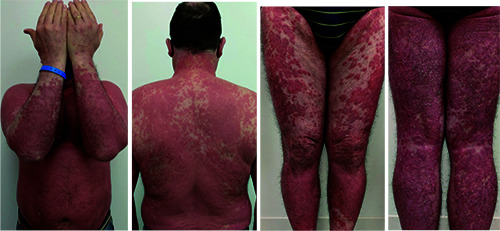
Clinical aspect of psoriasis at start of cyclosporine therapy.
Figure 2.

Clinical aspect of psoriasis at start of tildrakizumab therapy.
Figure 3.

Psoriasis at week 8 of tildrakizumab therapy.
Figure 4.

Psoriasis at week 16 of tildrakizumab therapy.
Discussion and Conclusions
EP is a rare and severe disorder that is distinct from psoriasis vulgaris. Although the exact pathogenesis of EP is not fully understood, it is thought to involve a complex interplay of the Th1, Th2, and Th17 inflammatory pathways. Evidence suggests that in contrast to psoriasis vulgaris, the Th1/Th2 imbalance of EP tends to favor Th2 differentiation and its related cytokines.4 EP is a variant of psoriasis that is more resistant to conventional treatment. In the past first line options for treatment of EP were based on traditional systemic therapy: methotrexate, acitretin and cyclosporine.16 Short course systemic corticosteroids should be reserved to EP patients during severe acute flares when cyclosporine is contraindicated.3 Biologics have revolutionized the treatment of plaque-type psoriasis, and shown promise in EP.17 Several case reports support the use of biologic therapy as first-line treatment for EP.19 Studies with positive outcomes have recently been reported in cases of EP treated with different classes of biologics, from anti-TNF-alpha to anti-IL23.3,18 To our knowledge, only one case of EP has been described successfully treated by Tildrakizumab, the latest anti-IL23 approved drug, in Europe.19 The patient had a significant improvement at 8 weeks and complete resolution of skin manifestations at 16 weeks. The treatment was successful in a patient who weighed 114 kilograms even with a dose of 100 mg, although a dose of 200 mg has been recommended for patients weighing more than 90 kg. Recent clinical experience in 26 patients followed for up to 24 weeks, including 4 patients with obesity, reports that tildrakizumab 100 mg was as effective in overweight as in non-overweight patients.20 Although further studies are needed to evaluate the efficacy and safety of tildrakizumab, it is likely that tildrakizumab can be an effective therapeutic option for patients affected by EP where other treatments have failed.
Funding Statement
Funding: None.
References
- 1.Rosenbach M, Hsu S, Korman NJ, et al. Treatment of erythrodermic psoriasis: from the medical board of the National Psoriasis Foundation. J Am Acad Dermatol 2010;62:655–62. [DOI] [PubMed] [Google Scholar]
- 2.Boyd AS, Menter A. Erythrodermic psoriasis. Precipitating factors, course, and prognosis in 50 patients. J Am Acad Dermatol 1989;21:985–91. [PubMed] [Google Scholar]
- 3.Lo Y, Tsai TF. Updates on the Treatment of Erythrodermic Psoriasis. Psoriasis (Auckl). 2021;11:59-73. [DOI] [PMC free article] [PubMed] [Google Scholar]
- 4.Singh RK, Lee KM, Ucmak D, et al. Erythrodermic psoriasis: pathophysiology and current treatment perspectives. Psoriasis (Auckl) 2016;6:93-104. [DOI] [PMC free article] [PubMed] [Google Scholar]
- 5.Zhang P, Chen H, Duan Y, et al. Analysis of Th1/Th2 response pattern for erythrodermic psoriasis. J Huazhong Univ Sci Tech Med Sci 2014;34:596–601. [DOI] [PubMed] [Google Scholar]
- 6.Li LF, Sujan SA, Yang H, Wang WH. Serum immunoglobulins in psoriatic erythroderma. Clin Exp Dermatol 2005;30:125–7. [DOI] [PubMed] [Google Scholar]
- 7.Deeva I, Mariani S, De Luca C, et al. Wide-spectrum profile of inflammatory mediators in the plasma and scales of patients with psoriatic disease. Cytokine 2010;49:163–70. [DOI] [PubMed] [Google Scholar]
- 8.Groves RW, Kapahi P, Barker JN, et al. Detection of circulating adhesion molecules in erythrodermic skin disease. J Am Acad Dermatol 1995;32:32–6. [DOI] [PubMed] [Google Scholar]
- 9.Moy AP, Murali M, Kroshinsky D, et al. Immunologic Overlap of Helper T-Cell Subtypes 17 and 22 in Erythrodermic Psoriasis and Atopic Dermatitis. JAMA Dermatol 2015;151:753–60. [DOI] [PubMed] [Google Scholar]
- 10.Shao S, Wang G, Maverakis E, Gudjonsson JE. Targeted Treatment for Erythrodermic Psoriasis: Rationale and Recent Advances. Drugs 2020;80:525-34. [DOI] [PMC free article] [PubMed] [Google Scholar]
- 11.European Medicines Agency. IlumetriTM (tildrakizumab): EU summary of product characteristics. 2018. [Google Scholar]
- 12.Puig L. The role of IL 23 in the treatment of psoriasis. Expert Rev Clin Immunol 2017;13:525-34. [DOI] [PubMed] [Google Scholar]
- 13.McGeachy MJ, Chen Y, Tato CM, et al. The interleukin 23 receptor is essential for the terminal differentiation of interleukin 17-producing effector T helper cells in vivo. [DOI] [PMC free article] [PubMed] [Google Scholar]
- 14.Lee E, Trepicchio WL, Oestreicher JL, et al. Increased expression of interleukin 23 p19 and p40 in lesional skin of patients with psoriasis vulgaris. J Exp Med 2004;199:125–30. [DOI] [PMC free article] [PubMed] [Google Scholar]
- 15.Fitch E, Harper E, Skorcheva I, et al. Pathophysiology of psoriasis: recent advances on IL-23 and Th17 cytokines. Curr Rheumatol Rep 2007. 9:461-7. [DOI] [PMC free article] [PubMed] [Google Scholar]
- 16.Rosenbach M, Hsu S, Korman NJ, et al. Treatment of erythrodermic psoriasis: from the medical board of the National Psoriasis Foundation. J Am Acad Dermatol 2010;62:655-62. [DOI] [PubMed] [Google Scholar]
- 17.Carrasquillo OY, Pabón-Cartagena G, Falto-Aizpurua LA, et al. Treatment of erythrodermic psoriasis with biologics: a systematic review. J Am Acad Dermatol 2020;83:151–8. [DOI] [PubMed] [Google Scholar]
- 18.Reynolds KA, Pithadia DJ, Lee EB, et al. A systematic review of treatment strategies for erythrodermic psoriasis. J Dermatolog Treat 2021;32:49-55. [DOI] [PubMed] [Google Scholar]
- 19.Megna M, Potestio L, Fabbrocini G, Cinelli E Tildrakizumab: A new therapeutic option for erythrodermic psoriasis? Dermatol Ther 2021;34:e15030. [DOI] [PMC free article] [PubMed] [Google Scholar]
- 20.Burlando M, Castelli R, Cozzani E., Parodi A. Treatment of moderate-tosevere- plaque psoriasis with tildrakizumab in the real-life setting. Drugs Context 2021;10:2021. [DOI] [PMC free article] [PubMed] [Google Scholar]