



Abstract
Objective: The objective of this paper is to review and analyze the current state of telemedicine and ehealth in the field of vascular surgery. Methods: This paper collects the relevant information obtained after reviewing the articles related to telemedicine in vascular surgery, published from 2012 to 2022 contained in scientific databases. In addition, the results obtained are statistically studied based on various factors, such as the year of publication or the search engine. In this way, we obtain a complete vision of the current state of telemedicine in the field of vascular surgery. Results: After performing this search and applying selection criteria, 29 articles were obtained for subsequent study and discussion, of which 20 were published in the second half of the decade, representing 70% of the results. In the analysis carried out according to the search criteria used, it can be seen that using the word telemedicine we obtained 69% of the articles while with the criteria mHealth and eHealth we only obtained 22% and 9% of the results, respectively. It can be seen that the filter with the most potential content articles was “vascular surgery AND telemedicine”. In the analysis performed according to the search engine, it was observed that the Google Scholar database contains 93% of the articles found in the massive search and the relevant articles contained therein represent 52% of the total. Conclusion: An upward trend has been observed in recent years, with a clear increase in the number of publications and much lower figures in the first years. One aspect to highlight is that 47.8% of the articles analyzed focus only on postoperative treatment, which may be due to the help provided by telemedicine in detecting surgical site infections by sending images and videos, this being one of the most common postoperative complications. The analyzed works show the importance of telemedicine in vascular surgery and identify possible future lines of research. In the analysis carried out on the origin of the selected relevant papers, an important interest of the US in this topic is demonstrated since more than 50% of the research contains authors from this country, it is also observed that there is no research from Spain, so this research would be an initial step to determine the weaknesses of telemedicine in this field of medicine and a good opportunity to open a research gap in this branch.
Keywords: Telemedicine, mHealth, eHealth, Vascular surgery, Monitoring, Diagnosis
Introduction
The concept of telemedicine emerged in the 1970s as a solution to geographical barriers, increasing accessibility to health care, especially in rural areas and developing countries [1, 2]. Over time, it has been shown that Communication Technologies (ICT) are also useful for improving the quality of healthcare delivery, support for continuity of care, efficiency of services, training of professionals, and communication between healthcare personnel and patients [1, 3, 4]. The World Health Organization (WHO) defines telemedicine as “the provision of health services (where distance is a determining factor) by health professionals through the use of ICT for the exchange of valid information for diagnosis, treatment, disease prevention, research and evaluation and for the continuing education of health professionals, all with the ultimate goal of improving the health of populations and communities” [5–7].
On the other hand, eHealth is a somewhat more complicated concept that is often confused with telemedicine. This concept, located at the intersection between medical informatics, public health and commercial interests, refers to the provision of health information and services on the Internet and has also been imbued with a philosophy implicit in these technologies: new ways of thinking, networking, global thinking, sharing as a value, etc., which has led to this new concept being increasingly developed [1, 8]. WHO defines it as: “the cost-effective and safe use of information and communication technologies in support of health and health-related fields, including health care, health surveillance and health education, knowledge and research” [9].
The number of people with access to smartphones is increasing every day. According to survey Figs. [10–12]., the two regions with the highest Internet penetration are Eastern Europe (92%) and Northern Europe (95%), closely followed by North America (88%). In contrast, the regions with the lowest Internet penetration are East Africa (23%) and West Africa (36%). In 2020, the ranking of countries with the highest Internet penetration was led by the United Arab Emirates, with 99% penetration, followed by Denmark (98%), South Korea (96%), Sweden (96%), Switzerland (96%), the United Kingdom (96%) and the Netherlands (95%). Spain ranked 14th, with an internet penetration of 91%, decreasing 2% points from the 2019 results. The countries with the lowest internet penetration were North Korea, Sudan (8.0%), Eritrea, with a penetration of 8.3% and Burundi with 9.9%.
Angiology and vascular surgery are a medical-surgical specialty dedicated to the study, prevention, clinical and instrumental diagnosis and treatment of vascular pathology. Its field of action covers organic and/or functional diseases of the arterial, venous (Phlebology) and lymphatic (Lymphology) systems [13]. After vaccination against covid-19, numerous studies have focused on the diagnosis and treatment of thrombotic events, due to the high number of thrombosis caused by the adverse effects of these vaccines [14–21]. The main objective of this work is to study the situation of telemedicine in vascular surgery in order to develop new tools and systems to aid in its detection, diagnosis and treatment. For this purpose, a systematic review of the existing articles related to the subject has been carried out, applying a PRISMA methodology. In addition, the results are analyzed statistically, clearly showing the increase in research in this field as the years go by and with them the interest of scientists. The most important ideas of the relevant articles are synthesized to group in a single work the contributions and conclusions of each one of them.
There are other publications related to this research work on telemedicine and vascular surgery that focus on the study of various mobile telemedicine systems [22]; the literature review on the effect of telemedicine on patient-physician communication [23] and telemedicine systems that have been evaluated for usability or ease of use [24]. The systematic review on the use of additive manufacturing in vascular surgery, specifically, the applications of 3D printing in endovascular surgery [25] and a summary of academic publications indexed in the MEDLINE database, concerning the use of telemedicine in vascular surgery in the pathologies of aortic disease, LEAD and carotid disease [26]. However, there is no study that performs a systematic review in the Science Direct, PubMed, Web of Science and Google Scholar databases of studies related to telemedicine in vascular surgery.
The methodology followed for this research work is described below. Subsequently, the results obtained are presented and discussed, which in turn give rise to the conclusions shown at the end of this paper.
Methods
This work is based on a systematic review of the literature in scientific databases following a prismatic methodology, the search is focused on scientific papers related to telemedicine in vascular surgery. First, the scientific databases in which the search was performed, and the terms used are presented. Then, the procedure used for the selection of the articles to be analyzed is described.
Scientific Databases
The systematic review was based on the scientific databases Science Direct, PubMed, Web of Science and Google Scholar, because these are the ones that bring together almost all the information and papers related to telemedicine in this field. Figure 1 shows the search criteria inserted in each of the search engines of these databases and the sections of the papers searched in each case. These sections are determined according to the characteristics of the advanced search engines in each of the databases. The search was carried out in the years 2012 to 2022, using papers in English and discarding books or conference abstracts.
Fig. 1.

Search criteria in different databases
Papers Selection
After performing the search, the articles to be analyzed were selected by reading the titles of the results obtained, resulting in 110 papers of interest in this step. Once these were selected, we proceeded to eliminate those that were duplicated (33). Then the abstracts of the remaining 77 papers were analyzed, eliminating those that were not sufficiently significant or that belonged to other areas of study, resulting in a total of 45 papers for complete reading. In this phase, only those that are relevant to our study are selected, finally obtaining 29 papers for analysis and evaluation. This procedure is shown in the prism diagram in Fig. 2.
Fig. 2.

Methodological Prisma for the selection of articles
The 29 resulting articles are subsequently evaluated, analyzing the results according to the year of publication and search criteria, according to the search engine where each article was found and its contribution. The results obtained are shown in the next section.
Results
Once the systematic review methodology explained above has been applied, the results of the selection of relevant papers from the databases are analyzed.
Analysis by Publication year
Figure 3 shows the results of the relevant papers obtained in the search, categorized according to the year of publication. As can be seen, most of the articles have been published in the last five years, which shows a growing interest in the subject.
Fig. 3.

Number of relevant papers for each year
Analysis by Search Engine
Figure 4 a graph showing the percentage of relevant papers selected in each database. It can be clearly seen that the most complete database for the search of articles on telemedicine applied to vascular surgery is “Google Scholar”, since more than 50% of the relevant articles selected after applying the methodology were found. The PubMed database is the next with the highest number of articles selected, with 22% of the articles chosen from here. Slightly behind are the Web of Science and Science Direct databases with 18% and 8% of the selected articles, respectively.
Fig. 4.

Graph with the percentage of results by search engine after the application of the methodology
Keyword Analysis
If we focus on the results obtained according to the search criteria used, we can see in Fig. 5 that using the word telemedicine we have obtained 69% of the articles, while with the criteria mHealth and eHealth we have only obtained 22% and 9% of the results respectively. It can be seen that the filter with the most potential content articles “vascular surgery AND telemedicine”.
Fig. 5.
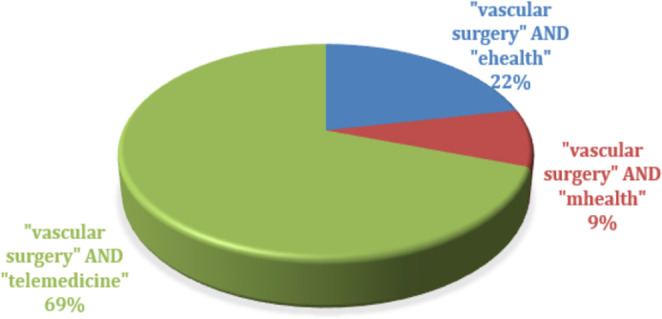
Results graph by keywords after applying the methodology
Analysis of Relevant Papers
Table 1 shows a comparison of the articles obtained in terms of publication date and contributions to obtain a clearer idea of the current state of research in telemedicine applied to vascular surgery.
Table 1.
Articles on telemedicine and eHealth applied to vascular surgery
| TITLE | YEAR | CONTRIBUTION |
|---|---|---|
| Cyber medicine enables remote neuromonitoring during aortic surgery [27]. | 2012 | Study of remote neuromonitoring of spinal cord function during open repair of descending thoracic aortic aneurysms and thoracoabdominal aortic aneurysms. |
| Multidisciplinary treatment for peripheral arterial occlusive disease and the role of eHealth and mHealth [28]. | 2012 | New treatment model for peripheral arterial occlusive disease (PAOS) using eHealth and mHealth solutions. |
| Robot-assisted fenestrated endovascular aneurysm repair (FEVAR) using the Magellan system [29]. | 2013 | Remote manipulated endovascular aneurysm repair robot. |
| Development, Implementation, and Evaluation of a Structured Reporting Web Tool for Abdominal Aortic Aneurysms [30]. | 2013 | New structured reporting system for abdominal aortic aneurysms (AAA), aimed at improving professional communication by providing clinical information in a pre-defined standard. |
| Teleconsultation in vascular surgery: a 13-year single center experience [31]. | 2013 | Analysis of the results of a medical consultation service via email carried out for 13 years in the field of vascular surgery. |
| Inter-rater agreement and checklist validation for postoperative wound assessment using smartphone images in vascular surgery [32]. | 2016 | Study of the validity of images taken with the mobile as a substitute for a medical review for the identification of postoperative infections (SSI). |
| Technology-Enabled Remote Monitoring and Self-Management - Vision for Patient Empowerment Following Cardiac and Vascular Surgery: User Testing and Randomized Controlled Trial Protocol [33]. | 2016 | Study of the efficacy of an eHealth-enabled service delivery intervention, technology-enabled remote monitoring and self-maintenance for patient treatment after cardiac and vascular surgery. |
| Evaluating Patient Usability of an Image-Based Mobile Health Platform for Postoperative Wound Monitoring [34]. | 2016 | Image-based mobile application for postoperative injury monitoring. |
| Diagnosing Surgical Site Infection Using Wound Photography: A Scenario-Based Study [35]. | 2016 | Study of the importance of providing images of postoperative lesions for the identification of surgical infections through telemedicine. |
| Feasibility of Implementing a Patient-Centered Postoperative Wound Monitoring Program Using Smartphone Images: A Pilot Protocol [36]. | 2017 | Development of a protocol for monitoring injuries in the postoperative period by means of images taken with the mobile phone and study of its viability for patients and healthcare personnel. |
| Early clinical experience using telemedicine for the management of patients with varicose vein disease [37]. | 2017 | Comparison of the results of the evaluation of patients with varicose veins in a virtual clinic by videoconference and in the traditional clinic with the same doctor. |
| Feasibility of an Image-Based Mobile Health Protocol for Postoperative Wound Monitoring [38]. | 2018 | Mobile application for sending images of surgical lesions in the postoperative period. Through this application, they are also asked a series of questions about their recovery. |
| Implementation of a virtual vascular clinic with point-of-care ultrasound in an integrated health care system [39]. | 2018 | Virtual vascular clinic for the diagnosis of arterial and venous diseases. Offers remote videoconference consultations with vascular surgeons. |
| Use of photograph-based telemedicine in postoperative wound assessment to diagnose or exclude surgical site infection [40]. | 2018 | Study of the feasibility of substituting a traditional medical check-up for postoperative image-based monitoring for the identification of surgical infections (SSI). |
| Telemonitoring of left-ventricular assist device patients-current status and future challenges [41]. | 2018 | Study of the potential of telemonitoring patients with a left ventricular assist device (LVAD) as well as the necessary requirements for its implementation. |
| Telehealth Electronic Monitoring for Post Discharge Complications and Surgical Site Infections following Arterial Revascularization with Groin Incision [42]. | 2018 | Study of the results of patients whose postoperative monitoring is carried out by telemedicine compared with those whose monitoring is carried out in a standard way. |
| Evaluation of Wound Photography for Remote Postoperative Assessment of Surgical Site Infections [43]. | 2019 | Remote medical care for the diagnosis of postoperative infections (SSI) by sending images of the lesions. |
| EHealth tool for patients with abdominal aortic aneurysm: development and initial evaluation [44]. | 2019 | EHealth tool for patients with abdominal aortic aneurysm (AAA) through a participatory design process. |
| Telemedicine in patients with peripheral arterial disease: is it worth the effort? [45]. | 2019 | Study of the current use of telemedicine for interventions in peripheral arterial disease (PAD). |
| Infrastructural needs and expected benefits of telemonitoring in left ventricular assist device therapy: Results of a qualitative study using expert interviews and focus group discussions with patients [46]. | 2019 | Study on the specific requirements of the left ventricular assist device for telemonitoring and infrastructure translation from the point of view of caregivers and patients. |
| Postoperative Remote Automated Monitoring and Virtual Hospital-to-Home Care System Following Cardiac and Major Vascular Surgery: User Testing Study [47]. | 2020 | Study of the response and acceptance of users to remote monitoring and virtual medical care from hospital to home using Philip’s Guardian and Electronic Transition to Ambulatory Care technologies. |
| Telemedicine platforms and their use in the coronavirus disease-19 era to deliver comprehensive vascular care [48]. | 2020 | Study on the use of technology and telemedicine to allow communication between doctors and health professionals and patients during the COVID-19 pandemic in the field of vascular surgery. |
| An international experience of electronic communication and implementation of eHealth solutions in a vascular surgery clinic [49]. | 2020 | Collection of international data through questionnaires given to vascular surgery patients in hospitals in Ireland and Canada. |
| Telemedicine in vascular surgery: simple and protected tools and procedures[50] | 2020 | Development of a telemedicine health care access system for vascular surgery patients for wound follow-up and postoperative consultations at home or at health care centers. |
| The Benefits of a Centralised Remote Surveillance Programme for Vascular Patients [51]. | 2022 | Study of clinical and financial benefits of a centralized remote monitoring program for vascular patients over traditional outpatient follow-up. |
| The Application of Digital Frailty Screening to Triage Nonhealing and Complex Wounds [52]. | 2022 | Study and proposal for the use of digital fragility biomarkers to predict the complexity of diabetic foot ulcer, classifying patients who require simple treatments from those who require more complex care, such as vascular surgery. |
| Utilizing Machine Learning Algorithms to Evaluate Sex-based Differences in Preoperative Hemoglobin Thresholds in Open Vascular Surgery [53]. | 2022 | Analysis of risk factors for the prediction of mortality in vascular surgery using machine learning. |
| Improved Outpatient Medical Visit Compliance with Sociodemographic Discrepancies in Vascular Telehealth Evaluations [54]. | 2022 | Demonstrates the impact of eHealth for vascular surgery patient visits, as well as, exploring the effect of sociodemographic factors on vascular surgery outpatient eHealth management during the COVID-19 pandemic. |
| Improving Access to Specialty Care Using Vascular Surgery E-consults [55] | 2022 | Evaluation of the impact, in vascular surgery patients, of electronic consultations to determine their essential components, use and impact on patients. |
Discussion and Conclusion
Finally, if we look at the content and contributions of each of the articles, we see that 65.5% of the 29 articles selected study telemedicine applied to teleconsultation and postoperative follow-up. In this case, we have seen telemedicine in virtual medical care, using images and videos of the wound to check its evolution, e-mails for patient follow-up, among other platforms that allow virtual contact between the healthcare personnel and the patient. Figure 6 shows these and other applications of telemedicine applied to vascular surgery, such as Telemonitoring by ventricular assist devices in 6.9% of the articles, for the treatment of peripheral artery disease in 10.3%, as well as Biomarkers of digital fragility and in aortic surgery representing 6.8% of the total articles. In addition, the first signs of machine learning algorithms applied to vascular surgery in the analysis of mortality risk factors are shown in one of the articles found.
Fig. 6.

Percentage of results according to content after application of the methodology
It is worth noting that 20.6% of the articles deal with the implementation of a virtual clinic focused on vascular surgery, which would not only treat postoperative problems, but would perform periodic remote consultations throughout the diagnostic and recovery process and make a comparison with a fully face-to-face treatment.
In addition, 5 of the 29 final articles deal with telemedicine tools for active participation in patient treatment, as opposed to the remaining articles that focus on an application of telemedicine for diagnosis, monitoring and communication between patients and healthcare personnel. This represents 17.2% of the articles and these are useful applications:
- Remotely manipulated endovascular aneurysm repair robot.
- Remote neuromonitoring of spinal cord function during open repair of descending thoracic and thoracoabdominal aortic aneurysms.
- Mobile application called “WalkMate”, which has an ambient location radar to search for other patients or volunteers within the network, a pre-recorded audio coach to advise and encourage walking, a global positioning system tracking device to record walking distances and speed, live coaching by (schooled) peers, and support from the coach via audio/video call system.
-The use of digital frailty biomarkers for the prediction of diabetic foot ulcer complexity, which allows the classification of patients for simple treatments from those needing more complex care or vascular surgery.
- Telemedicine system for healthcare of vascular surgery patients for wound follow-up and postoperative consultations at home or in health centers.
The relevant studies found show that the applications of telemedicine in the field of vascular surgery are multiple, from patient follow-up and early detection of complications to the performance of remote aneurysm repairs. This is why this topic is of interest to many countries around the world, as shown in Fig. 7, which shows the number of relevant publications for each country, basing this analysis on the affiliation of the authors of each paper. Several of these papers are collaborations of authors from different countries, repeating the same article for different countries in these cases. A high number of publications from the USA is observed, which shows a high interest of researchers from this country in this regard. There is also evidence of interest from other countries such as The Netherlands, Germany, Switzerland and Canada, each of which has more than two studies indexed in the databases studied during the last ten years. However, it can be observed that no relevant work has been found from Spain, so this research would be a first step to determine the weaknesses of telemedicine in this field and a good opportunity to open a research gap in this branch.
Fig. 7.

Number of relevant investigations by country of origin
In this research work, a systematic review of works related to telemedicine in vascular surgery in scientific databases has been carried out. An upward trend is observed in recent years, with a clear increase in the number of publications and much lower figures in the early years. This is not surprising given that technology is advancing by leaps and bounds, with increasing access to mobile devices with which to enjoy the benefits that telemedicine offers.
The search yielded a total of 29 relevant articles after applying the methodology. In the analysis carried out according to the search engine, it was shown that the Google Scholar database contains 93% of the articles found in the massive search and the relevant contents in it represent 52% of the total.
Another aspect to highlight is that 65.5% of the articles analyzed focus on teleconsultation and remote postoperative follow-up, which may be due to the help provided by telemedicine in the detection of surgical site infections by sending images and videos, this being one of the most common complications in the postoperative period. The studies found have shown the reduction of costs and waiting times for the patient, making it evident that telemedicine can be very interesting in cases in which traveling to the health center is a problem, as in the case of patients who live in isolated areas, with fewer resources, or even in cases of pandemic, in which traveling to a health center may pose a risk to the patient. In addition to the mobility factor, the time factor invested in these clinical visits must also be considered, as well as cost savings.
In addition to this, a possible future line of telemedicine may be the use of surgical telepresence in vascular patients. Surgical telepresence would allow more socially distant operations to be performed through telemedicine and could benefit patients who cannot risk longer trips for surgery. Although preliminary research has shown the efficacy of these types of operations in pigs, and robotic surgery is gaining acceptance in healthcare, more research would be needed to verify that the distances might be necessary for humans. As well as the development of Machine Learning and Deep Learning algorithms in order to early detect pathologies of interest within vascular surgery.
Declarations
Conflict of Interest
The authors declare that they have no conflict of interest.
Ethical Approval
This article does not contain any studies with human participants or animals performed by any of the authors.
Footnotes
The original online version of this article was revised: The original publication of this article contains duplicate text in the second and third paragraph of page 5.
Publisher’s Note
Springer Nature remains neutral with regard to jurisdictional claims in published maps and institutional affiliations.
Change history
12/30/2022
A Correction to this paper has been published: 10.1007/s10916-022-01901-4
Contributor Information
Isabel Herrera Montano, Email: isaherrera1403@gmail.com.
Elena Presencio Lafuente, Email: presencioelena@gmail.com.
Jose Breñosa Martínez, Email: josemanuel.brenosa@uneatlantico.es.
Arturo Ortega Mansilla, Email: arturo.ortega@uneatlantico.es.
Isabel de la Torre Díez, Email: isator@tel.uva.es.
María Lourdes Del Río-Solá, Email: lrio@saludcastillayleon.es.
References
- 1.Prados Castillejo JA. Telemedicina, una herramienta también para el médico de familia. Atención Primaria [Internet] 2013 Mar;45(3):129–132. [10.1016/j.aprim.2012.07.006] [DOI] [PMC free article] [PubMed]
- 2.Kreps GL, Neuhauser L. New directions in eHealth communication: Opportunities and challenges. Patient Education and Counseling [Internet] Elsevier Ireland Ltd; 2010 Mar;78(3):329–336. PMID:20202779 [DOI] [PubMed]
- 3.Marshall C, Lewis D, Whittaker M. mHealth technologies in developing countries: a feasibility assessment and a proposed framework. Building Health Information Systems 2013;(June):50. [10.13140/2.1.5032.0007]
- 4.Kakkar A, Sarma P, Medhi B. mHealth technologies in clinical trials: Opportunities and challenges. Indian Journal of Pharmacology [Internet] 2018;50(3):105. [10.4103/ijp.IJP_391_18] [DOI] [PMC free article] [PubMed]
- 5.Telemedicina [Internet]. ¿Qué es la telemedicina? Available from: http://www.atryshealth.com/es/-qué-es-la-telemedicina-_1580
- 6.Litewka S. TELEMEDICINA: UN DESAFÍO PARA AMÉRICA LATINA. Acta bioethica [Internet] 2005;11(2). [10.4067/S1726-569X2005000200003] [DOI] [PMC free article] [PubMed]
- 7.Kuzmar IE, Rizo M, Cortés E. How to create a telemedicine service: telemedicine heptagon. ACTUALIDAD MEDICA [Internet] 2014 Apr 30;99(791):44–45. [10.15568/am.2014.791.cd03]
- 8.Norman CD, Skinner HA. eHEALS: The eHealth Literacy Scale. Journal of Medical Internet Research [Internet] 2006 Nov 14;8(4):e27. [ 10.2196/jmir.8.4.e27] [DOI] [PMC free article] [PubMed]
- 9.Expertos E de, Valencia UI de. Universidad Internacional de Valencia [Internet]. Qué es eHealth. 2019. Available from: https://www.universidadviu.com/es/actualidad/nuestros-expertos/que-es-ehealth
- 10.GALEANO S. marketing4ecommerce.net [Internet]. El número de usuarios de internet en el mundo crece un 7,3% y alcanza los 4660 millones (2021). 2021. Available from: https://marketing4ecommerce.net/usuarios-de-internet-mundo/#:~:text=En 2019 el total de,por medio de su smartphone
- 11.Amez S, Baert S. Smartphone use and academic performance: A literature review. International Journal of Educational Research [Internet] 2020;103:101618. doi: 10.1016/j.ijer.2020.101618]. [DOI] [Google Scholar]
- 12.Ruiz-Ruano García AM, López-Salmerón MD, López Puga J. Evitación experiencial y uso abusivo del smartphone: un enfoque bayesiano. Adicciones [Internet] 2018 Dec 20;32(2):116. [ 10.20882/adicciones.1151] [DOI] [PubMed]
- 13.Ministerio de Sanidad y Consumo Programa oficial de la especialidad de Angiología y Cirugía. Vascular. Boe. 2007;110:19853–19859. [Google Scholar]
- 14.Sociedad Española de Angiología y Cirugía vascular (SEACV) [Internet]. Available from: https://seacv.es/
- 15.Gómez-Romero FJ, Fernández-Prada M, Navarro-Gracia JF. Prevención de la infección de sitio quirúrgico: análisis y revisión narrativa de las guías de práctica clínica. Cirugía Española [Internet] 2017 Nov;95(9):490–502. [10.1016/j.ciresp.2017.09.004] [DOI] [PubMed]
- 16.Portnoy J, Waller M, Elliott T. Telemedicine in the Era of COVID-19. The Journal of Allergy and Clinical Immunology: In Practice [Internet] 2020 May;8(5):1489–1491. [10.1016/j.jaip.2020.03.008] [DOI] [PMC free article] [PubMed]
- 17.Latz CA, Boitano LT, Png CYM, Tanious A, Kibrik P, Conrad M, Eagleton M, Dua A. Early vascular surgery response to the COVID-19 pandemic: Results of a nationwide survey. Journal of Vascular Surgery [Internet] 2021 Feb;73(2):372–380. [10.1016/j.jvs.2020.05.032] [DOI] [PMC free article] [PubMed]
- 18.Paquette S, Lin JC. Outpatient Telemedicine Program in Vascular Surgery Reduces Patient Travel Time, Cost, and Environmental Pollutant Emissions. Annals of Vascular Surgery [Internet] 2019 Aug;59:167–172. [10.1016/j.avsg.2019.01.021] [DOI] [PubMed]
- 19.Al-Thani H, Mekkodathil A, Hussain A, Sharaf A, Sadek A, Aldakhl-Allah A, Awad A, Al-Abdullah N, Zitoun A, Paul J, Pillai P, John S, El-Menyar A. Implementation of vascular surgery teleconsultation during the COVID-19 pandemic: Insights from the outpatient vascular clinics in a tertiary care hospital in Qatar. Chen RJ, editor. PLOS ONE [Internet] 2021 Sep 30;16(9):e0257458. [10.1371/journal.pone.0257458] [DOI] [PMC free article] [PubMed]
- 20.Chen AJ, Yeh SL, Delfin D, Hoal G, Barron N, Riedinger T, Kashanijou N, Lieland J, Bickel K, O’Connell JB, Ulloa JG. Telemedicine and Vascular Surgery: Expanding Access and Providing Care Through the COVID-19 Pandemic. The American Surgeon [Internet] 2022 Oct 19;88(10):2561–2564. [10.1177/00031348221109464] [DOI] [PMC free article] [PubMed]
- 21.Erben Y, Franco-Mesa C, Hamid O, Lin M, Stone W, Meltzer AJ, Hattery W, Palaj A, Wilshusen LL, Vista TL, Kalra M, Farres H, Bower TC, De Martino RR, Huang JF, Meschia JF, TerKonda SP. Telemedicine in vascular surgery during the coronavirus disease-2019 pandemic: A multisite healthcare system experience. Journal of Vascular Surgery [Internet] 2021;74(1):1–4. doi: 10.1016/j.jvs.2020.12.012]. [DOI] [PMC free article] [PubMed] [Google Scholar]
- 22.Lin C-F. Mobile Telemedicine: A Survey Study. Journal of Medical Systems [Internet] 2012 Apr 27;36(2):511–520. [10.1007/s10916-010-9496-x] [DOI] [PubMed]
- 23.Miller EA. Telemedicine and doctor-patient communication: an analytical survey of the literature. Journal of Telemedicine and Telecare [Internet] 2001 Feb 23;7(1):1–17. [10.1258/1357633011936075] [DOI] [PubMed]
- 24.Klaassen B, van Beijnum BJF, Hermens HJ. Usability in telemedicine systems—A literature survey. International Journal of Medical Informatics [Internet] 2016 Sep;93:57–69. [10.1016/j.ijmedinf.2016.06.004] [DOI] [PubMed]
- 25.Marti P, Lampus F, Benevento D, Setacci C. Trends in use of 3D printing in vascular surgery: a survey. International Angiology [Internet] 2019 Oct;38(5). [10.23736/S0392-9590.19.04148-8] [DOI] [PubMed]
- 26.Lareyre F, Chaptoukaev H, Kiang SC, Chaudhuri A, Behrendt CA, Zuluaga MA, Raffort J. Telemedicine and Digital Health Applications in Vascular Surgery. Journal of Clinical Medicine [Internet] MDPI; 2022 Oct 1 [cited 2022 Nov 21];11(20). [ 10.3390/JCM11206047] [DOI] [PMC free article] [PubMed]
- 27.Greiner A, Mess WH, Schmidli J, Debus ES, Grommes J, Dick F, Jacobs MJ. Cyber medicine enables remote neuromonitoring during aortic surgery. Journal of Vascular Surgery [Internet] Elsevier Inc.; 2012 May;55(5):1227–1233. PMID:22341581 [DOI] [PubMed]
- 28.Fokkenrood Lauret G-J, Scheltinga M, de SpreeuwenbergBie, Teijink J. Multidisciplinary treatment for peripheral arterial occlusive disease and the role of eHealth and mHealth. Journal of Multidisciplinary Healthcare [Internet] 2012;5:257. doi: 10.2147/JMDH.S35779. [DOI] [PMC free article] [PubMed] [Google Scholar]
- 29.Riga C V., Bicknell CD, Rolls A, Cheshire NJ, Hamady MS. Robot-assisted Fenestrated Endovascular Aneurysm Repair (FEVAR) Using the Magellan System. Journal of Vascular and Interventional Radiology [Internet] 2013 Feb;24(2):191–196. [10.1016/j.jvir.2012.10.006] [DOI] [PubMed]
- 30.Karim S, Fegeler C, Boeckler D, H Schwartz L, Kauczor H-U, von Tengg-Kobligk H. Development, Implementation, and Evaluation of a Structured Reporting Web Tool for Abdominal Aortic Aneurysms. JMIR Research Protocols [Internet] 2013 Aug 16;2(2):e30. [10.2196/resprot.2417] [DOI] [PMC free article] [PubMed]
- 31.Schmidt CA, Schmidt-Weitmann SH, Lachat ML, Brockes CM. Teleconsultation in vascular surgery: a 13 year single centre experience. Journal of Telemedicine and Telecare [Internet] 2014 Jan 18;20(1):24–28. [10.1177/1357633X13517356] [DOI] [PubMed]
- 32.Wiseman JT, Fernandes-Taylor S, Gunter R, Barnes ML, Saunders RS, Rathouz PJ, Yamanouchi D, Kent KC. Inter-rater agreement and checklist validation for postoperative wound assessment using smartphone images in vascular surgery. Journal of Vascular Surgery: Venous and Lymphatic Disorders [Internet] 2016 Jul;4(3):320–328.e2. [10.1016/j.jvsv.2016.02.001] [DOI] [PMC free article] [PubMed]
- 33.McGillion M, Yost J, Turner A, Bender D, Scott T, Carroll S, Ritvo P, Peter E, Lamy A, Furze G, Krull K, Dunlop V, Good A, Dvirnik N, Bedini D, Naus F, Pettit S, Henry S, Probst C, Mills J, Gossage E, Travale I, Duquette J, Taberner C, Bhavnani S, Khan JS, Cowan D, Romeril E, Lee J, Colella T, Choinière M, Busse J, Katz J, Victor JC, Hoch J, Isaranuwatchai W, Kaasalainen S, Ladak S, O’Keefe-McCarthy S, Parry M, Sessler DI, Stacey M, Stevens B, Stremler R, Thabane L, Watt-Watson J, Whitlock R, MacDermid JC, Leegaard M, McKelvie R, Hillmer M, Cooper L, Arthur G, Sider K, Oliver S, Boyajian K, Farrow M, Lawton C, Gamble D, Walsh J, Field M, LeFort S, Clyne W, Ricupero M, Poole L, Russell-Wood K, Weber M, McNeil J, Alpert R, Sharpe S, Bhella S, Mohajer D, Ponnambalam S, Lakhani N, Khan R, Liu P, Devereaux P. Technology-Enabled Remote Monitoring and Self-Management — Vision for Patient Empowerment Following Cardiac and Vascular Surgery: User Testing and Randomized Controlled Trial Protocol. JMIR Research Protocols [Internet] 2016 Aug 1;5(3):e149. [10.2196/resprot.5763] [DOI] [PMC free article] [PubMed]
- 34.Gunter R, Fernandes-Taylor S, Mahnke A, Awoyinka L, Schroeder C, Wiseman J, Sullivan S, Bennett K, Greenberg C, Kent KC. Evaluating Patient Usability of an Image-Based Mobile Health Platform for Postoperative Wound Monitoring. JMIR mHealth and uHealth [Internet] 2016 Sep 28;4(3):e113. [10.2196/mhealth.6023] [DOI] [PMC free article] [PubMed]
- 35.Sanger PC, Simianu V V., Gaskill CE, Armstrong CAL, Hartzler AL, Lordon RJ, Lober WB, Evans HL. Diagnosing Surgical Site Infection Using Wound Photography: A Scenario-Based Study. Journal of the American College of Surgeons [Internet] 2017 Jan;224(1):8–15.e1. [10.1016/j.jamcollsurg.2016.10.027] [DOI] [PMC free article] [PubMed]
- 36.Fernandes-Taylor S, Gunter RL, Bennett KM, Awoyinka L, Rahman S, Greenberg CC, Kent KC. Feasibility of Implementing a Patient-Centered Postoperative Wound Monitoring Program Using Smartphone Images: A Pilot Protocol. JMIR Research Protocols [Internet] 2017 Feb 22;6(2):e26. [10.2196/resprot.6819] [DOI] [PMC free article] [PubMed]
- 37.Kavousi Y, Al-Adas Z, Crutchfield JM, Karamanos E, Swanson C, Lin JC. Early clinical experience using telemedicine for the management of patients with varicose vein disease. Journal of Telemedicine and Telecare [Internet] 2019 Jan 2;25(1):54–58. [10.1177/1357633X17734580] [DOI] [PubMed]
- 38.Gunter RL, Fernandes-Taylor S, Rahman S, Awoyinka L, Bennett KM, Weber SM, Greenberg CC, Kent KC. Feasibility of an Image-Based Mobile Health Protocol for Postoperative Wound Monitoring. Journal of the American College of Surgeons [Internet] 2018 Mar;226(3):277–286. [10.1016/j.jamcollsurg.2017.12.013] [DOI] [PMC free article] [PubMed]
- 39.Lin JC, Crutchfield JM, Zurawski DK, Stevens C. Implementation of a virtual vascular clinic with point-of-care ultrasound in an integrated health care system. Journal of Vascular Surgery [Internet] 2018 Jul;68(1):213–218. [10.1016/j.jvs.2017.11.070] [DOI] [PubMed]
- 40.Totty JP, Harwood AE, Wallace T, Smith GE, Chetter IC. Use of photograph-based telemedicine in postoperative wound assessment to diagnose or exclude surgical site infection. Journal of Wound Care [Internet] 2018 Mar 2;27(3):128–135. [10.12968/jowc.2018.27.3.128] [DOI] [PubMed]
- 41.Reiss N, Schmidt T, Boeckelmann M, Schulte-Eistrup S, Hoffmann J-D, Feldmann C, Schmitto JD. Telemonitoring of left-ventricular assist device patients—current status and future challenges. Journal of Thoracic Disease [Internet] 2018 Jun;10(S15):S1794–S1801. [10.21037/jtd.2018.01.158] [DOI] [PMC free article] [PubMed]
- 42.Mousa AY, Broce M, Monnett S, Davis E, McKee B, Lucas BD. Results of Telehealth Electronic Monitoring for Post Discharge Complications and Surgical Site Infections following Arterial Revascularization with Groin Incision. Annals of Vascular Surgery [Internet] 2019 May;57:160–169. [10.1016/j.avsg.2018.09.023] [DOI] [PubMed]
- 43.Kummerow Broman K, Gaskill CE, Faqih A, Feng M, Phillips SE, Lober WB, Pierce RA, Holzman MD, Evans HL, Poulose BK. Evaluation of Wound Photography for Remote Postoperative Assessment of Surgical Site Infections. JAMA Surgery [Internet] 2019 Feb 1;154(2):117. [10.1001/jamasurg.2018.3861] [DOI] [PMC free article] [PubMed]
- 44.Nilsson O, Hultgren R, Letterstål A. eHealth tool for patients with abdominal aortic aneurysm: development and initial evaluation. Scandinavian Journal of Caring Sciences [Internet] 2020 Jun 17;34(2):348–356. [10.1111/scs.12736] [DOI] [PubMed]
- 45.Haveman ME, Kleiss SF, Ma KF, Vos CG, Ünlü Ç, Schuurmann RCL, Bokkers RPH, Hermens HJ, De Vries J-PPM. Telemedicine in patients with peripheral arterial disease: is it worth the effort? Expert Review of Medical Devices [Internet] 2019 Sep 2;16(9):777–786. [10.1080/17434440.2019.1649595] [DOI] [PubMed]
- 46.Walter C, Fischer F, Hanke JS, Dogan G, Schmitto JD, Haverich A, Reiss N, Schmidt T, Hoffmann J-D, Feldmann C. Infrastructural needs and expected benefits of telemonitoring in left ventricular assist device therapy: Results of a qualitative study using expert interviews and focus group discussions with patients. The International Journal of Artificial Organs [Internet] 2020 Jun 18;43(6):385–392. [10.1177/0391398819893702] [DOI] [PubMed]
- 47.McGillion M, Ouellette C, Good A, Bird M, Henry S, Clyne W, Turner A, Ritvo P, Ritvo S, Dvirnik N, Lamy A, Whitlock R, Lawton C, Walsh J, Paterson K, Duquette J, Sanchez Medeiros K, Elias F, Scott T, Mills J, Harrington D, Field M, Harsha P, Yang S, Peter E, Bhavnani S, Devereaux P. Postoperative Remote Automated Monitoring and Virtual Hospital-to-Home Care System Following Cardiac and Major Vascular Surgery: User Testing Study. Journal of Medical Internet Research [Internet] 2020 Mar 18;22(3):e15548. [10.2196/15548] [DOI] [PMC free article] [PubMed]
- 48.Lin JC, Humphries MD, Shutze WP, Aalami OO, Fischer UM, Hodgson KJ. Telemedicine platforms and their use in the coronavirus disease-19 era to deliver comprehensive vascular care. Journal of Vascular Surgery [Internet] 2021 Feb;73(2):392–398. [10.1016/j.jvs.2020.06.051] [DOI] [PMC free article] [PubMed]
- 49.Kelly A, Belchos J, Wheatcroft M, Burke PE, Abdeldaim Y, Kavanagh EG, Archer N, McKibbon A, Moloney MA. An international experience of electronic communication and implementation of eHealth solutions in a vascular surgery clinic. Irish Journal of Medical Science (1971 -) [Internet] 2021 Feb 18;190(1):291–296. [10.1007/s11845-020-02311-6] [DOI] [PubMed]
- 50.Tobiana F. Telemedicine in vascular surgery: simple and protected tools and procedures. Annals of Vascular Surgery [Internet] 2020 Oct;68:103–104. [10.1016/j.avsg.2020.08.024]
- 51.Peres P, Lupson M, Dawson J. The Benefits of a Centralised Remote Surveillance Programme for Vascular Patients. Journal of Vascular Surgery [Internet] 2022 Nov; [10.1016/j.jvs.2022.10.045] [DOI] [PubMed]
- 52.Mishra RK, Bara RO, Zulbaran-Rojas A, Park C, Fernando ME, Ross J, Lepow B, Najafi B. The Application of Digital Frailty Screening to Triage Nonhealing and Complex Wounds. Journal of Diabetes Science and Technology [Internet] 2022 Jul 20;193229682211111. [10.1177/19322968221111194] [DOI] [PMC free article] [PubMed]
- 53.Raju S, Roche-Nagle G, Olson A, Eisenberg N, Chan T. Utilizing Machine Learning Algorithms to Evaluate Sex-based Differences in Preoperative Hemoglobin Thresholds in Open Vascular Surgery. Journal of Vascular Surgery [Internet] 2022 Jun;75(6):e313. [10.1016/j.jvs.2022.03.742]
- 54.Abou Ali AN, Abdul Malak OM, Hafeez MS, Habib S, Cherfan P, Salem KM, Hager E, Avgerinos E, Sridharan N. Improved Outpatient Medical Visit Compliance with Sociodemographic Discrepancies in Vascular Telehealth Evaluations. Journal of Vascular Surgery [Internet] 2022 Nov; [10.1016/j.jvs.2022.11.039] [DOI] [PMC free article] [PubMed]
- 55.Donde NN, Kuo B, Kim M, Humphries M, Mell M. Improving Access to Specialty Care Using Vascular Surgery E-consults. Journal of Vascular Surgery [Internet] 2022 Jun;75(6):e309. [10.1016/j.jvs.2022.03.685]