



T symbol, tesla; tera-; (absolute) temperature; thymine.
- T1 in magnetic resonance imaging, a time constant; called also spin-lattice relaxation time.
- T1 recovery the time taken for about 63% of the original longitudinal tissue magnetization to recover after termination of an external radiofrequency pulse. T1 recovery times vary between different soft tissues. Fat has a shorter T1, central nervous system tissue is intermediate, and water, such as cerebrospinal fluid, has a longer T1 recovery time. By using a short time delay between energizing radiofrequency pulses, these tissue differences can be emphasized.
- T1 weighted scans achieved by setting shorter time intervals between excitation radiofrequency pulses and shorter time to receive the peak echo signal than for other MRI scans. Fat is bright, soft tissues are displayed as various shades of gray, and cerebrospinal fluid, tendons, ligaments, air, and cortical bone are dark. Gadolinium contrast agent is bright.
- T2 in magnetic resonance imaging, a time constant for the transverse tissue magnetization to decrease to 37% of the prior level. Called also spin-spin relaxation time.
- T2* decay the decay of the free induction decay signal that occurs following the removal of the radiofrequency pulse.
- T2 weighted scan achieved by using a longer time to receive the peak echo signal and longer intervals between excitation radiofrequency pulses than for other MRI scans. Fluids are bright, soft tissues are displayed as various shades of gray, and tendons, ligaments, air, and cortical bone are dark.
T2 mycotoxin a trichothecene mycotoxin (a secondary toxic metabolite) produced by a number of Fusarium spp., including F. tricinctum when growing on stored grain, usually corn. The toxin affects rapidly dividing cells, thereby causing necrosis of skin, cells lining the alimentary tract, and cells of the lymphoid and hemopoietic systems. This may result in panleukopenia and defective blood clotting. The toxin is also a teratogen and causes stillbirth, abortion, and fetal abnormalities. Clinical signs include feed refusal and vomiting in species that can vomit. Called also moldy corn disease. See also trichothecene.
T3 tri-iodothyronine.
T4 thyroxine.
free T4 see free thyroxine.
tT4 see total thyroxine.
T7 free thyroxine (T4) index.
T12 a value derived by multiplying the value for T4 by the value for T3 expressed as RT3U (resin T3 uptake).
Tm chemical symbol, thulium.
Tm tubular maximum (of the kidneys); used in reporting kidney function studies, with inferior letters representing the substance used in the test, as TmPAH (tubular maximum for para-aminohippuric acid).
Tmax in pharmacology, the time it takes to reach the maximum plasma concentration after administration of a drug; when the rate of absorption equals the rate of elimination.
2,4,5-T (2,4,5-trichlorophenoxy) acetic acid, a broad-leaf herbicide. Now banned from use in the US and some other countries.
T-1824 see Evans blue dye.
t in genetics, symbol for translocation.
t1/2 in pharmacology, the half-time or elimination half-life of a drug; the time it takes for half of the absorbed drug to be eliminated from the body.
t1/2 context in pharmacology, the context-sensitive half-time or elimination half-life of an administered drug.
θ theta, small letter; eighth letter in the Greek alphabet.
τ tau, small letter; 19th letter in the Greek alphabet. Used to designate an interval of time.
TA toxin–antitoxin.
TA Terminologia Anatomica.
T antigen tumor antigen.
T banding telomeric (or terminal) banding; a staining technique with Giemsa or acridine orange stain used in the preparation of karyotypes; stains the telomeric regions of chromosomes.
T cell see T lymphocyte.
T c. receptor antigen-specific heterodimeric proteins, either αβ or γδ, present on the surface of T lymphocytes, the specificity of which is generated by somatic mutation and somatic recombination of a relatively small number of genes similar to that responsible for the generation of antibody diversity.
T conformational state deoxy (‘tense’) conformational form of hemoglobin.
T effector cell includes large granular lymphocytes, called also natural killer cell and cytotoxic T lymphocyte.
T helper cell see helper lymphocyte.
T lymphocyte see T lymphocyte.
T tubule see transverse tubules.
t-PA tissue plasminogen activator.
t-distribution see t statistic.
t statistic, t distribution the statistical distribution of the ratio of the sample mean to its sample standard deviation for a normal random variable with zero mean. It is the basis of various t-tests used to make inferences about the mean of a normal variable.
T-strain mycoplasma see Ureaplasma.
t-test a test of statistical significance that uses a formula from which a t value is derived. The value is then compared with a set of t-distribution tables to see whether the null hypothesis should be rejected or not.
Ta chemical symbol, tantalum.
TAA tumor-associated antigen.
TAB a vaccine prepared from killed typhoid, paratyphoid A and paratyphoid B bacilli.
tabanid [tab′
 -nid] a fly of the family Tabanidae, including the genera Chrysops, Haematopota, Pangonia and Tabanus.
Tabanus [t
-ba′n
s] a genus of blood-sucking biting flies (horse flies, deer flies or march flies) in the family Tabanidae that transmit trypanosomes and anthrax to various animals and have a painful bite.tabby genetically determined coat color patterns that occur in different cat breeds and in any coat type or colors. The four variations are: mackerel, with parallel vertical stripes on the body and rings around the tail and legs; classic or blotched, with thicker, horizontal stripes forming swirls; spotted, with spots instead of stripes; and ticked, with bands of color in individual hairs and an overall uniform appearance.
t. point see points.
tabes [ta′bēz] any wasting of the body; progressive atrophy of the body or a part of it.
tabescent [t
-bes′
nt] growing emaciated; wasting away.tabetiform [t
-bet′ľ-form] resembling tabes.tablature [tab′l
-ch
r] separation of the chief cranial bones into inner and outer tables, separated by a diploë.- table [ta′b
l] a flat layer or surface, e.g., smooth surface on top of (occlusal surface of) teeth especially on the incisors of the horse, used in telling the age of the horse.
- hydraulic t. used for surgery of large animals so it can be adjusted to the appropriate height and in some cases starting from floor level to accommodate animals anesthetized on the floor, then raised.
- inner t. the inner compact layer of the bones covering the brain.
- instrument t. used to arrange instruments for ready access by the surgeon and assistants. It often overhangs the surgery table.
- outer t. the outer compact layer of the bones covering the brain.
- restraint t. of different designs and size according to their purpose. Examples are restraint tables for hoof trimming of cattle and restraint tables for collecting semen from rams. The animal is stood next to the upright table and strapped to it, or placed in a cage, and the table is then moved to a horizontal position and further restraints applied.
- statistical t. tables of values used in statistics, e.g., t-tables.
- t. ties sterilizable nylon or cotton ropes that can be used to tie a recumbent, anesthetized dog or cat firmly to an operating table.
- vitreous t. inner table.
table top technique a technique of radiography in which the use of a grid is unnecessary, and the cassette can be moved about on the table top so that it is just below the anatomic part of the patient to be radiographed.
tablespoon [ta′b
l-sp n] a unit of volume or capacity. In metric measurements, used for medicinal purposes, exactly equal to 15 ml; in the US and UK, as a household measure, slightly less; in Australia, it is 20 ml. Abbreviated as Tbsp.- tablet [tab′l
t] a solid dosage form containing a medicinal substance with or without a suitable diluent (filler).
- enteric-coated t. one coated with material that delays release of the medication until after it leaves the stomach.
- t. triturate a small, loosely packed tablet to be dissolved in water immediately before injection, e.g., apomorphine.
tabula vitrea [tă′bu-l
] inner layer of very dense bone in the bones of the cranium.tabular [tab′u-l
r] resembling a table; data presented in rows and columns.Tacazzea African genus of the plant family Apocynaceae; may contain cardiac glycoside that causes abdominal pain, vomiting, diarrhea, hepatitis. Includes T. yototacolla.
tachogram [tak′o-gram] the graphic record produced by tachography.
tachography [t
-kog′r
-fe] the recording of the movement and speed of blood flow.tachy- word element. [Gr.] rapid, swift.
- tachyarrhythmia [tak″e--rith′me-] tachycardia associated with an irregularity in the normal heart rhythm. Includes both atrial and ventricular tachycardias.
- re-entrant t. one caused by a depolarization wave crossing areas of nonuniform excitability or conduction
- tachycardia [tak″ľ-kahr′de-] abnormally rapid heart rate.
- arrhythmic t. the heart rate is faster than normal, the rhythm is irregular.
- atrial t. rapid contraction of the atrium arising from an ectopic focus with a discharge rate higher than the sinus node.
- ectopic t. rapid heart rate in response to impulses arising outside the sinoatrial node.
- idioventricular t. tachycardia arising from the ventricle. Usually of a slower rate than ventricular tachycardia.
- junctional t. that arising in response to impulses originating in the atrioventricular junction, i.e., the atrioventricular node.
- paroxysmal t. episodes of an abrupt and marked increase in heart rate not associated with exercise or excitement, with an equally sudden return to normal.
- sinus t., simple t. an increase in heart rate from heightened activity of the sinoatrial node, such as occurs with exercise, excitement, or pain.
- supraventricular t. an elevated heart rate due to either junctional or atrial tachycardia.
- ventricular t. see ventricular tachycardia.
Tachygonetria a large genus of oxyurid worms, in the superfamily Oxyuroidea, found in the large intestine of tortoises.
tachymeter [t
-kim′-t
r] an instrument for measuring rapidity of motion.tachyphagia [tak″ľ-fa′je-
] rapid eating.tachyphylaxis [tak″e-f
-lak′sis] ‘rapid protection’; acute decrease in response to a drug or other physiologically active agent as a result of either a high-intensity, prolonged stimulus or a low-intensity, repeated stimulus. The resulting desensitization may be temporary or, if immunologically mediated, persistent (e.g., serial desensitization therapy for allergic conditions).tachypnea [tak″ip-ne′
; tak″e-ne′] very rapid respirations. The rate is fast and the depth shallow, as in heat stroke, because the initiating mechanism is hyperthermia, and there is no hypercapnia. Also can reflect pain, anxiety, or restrictive lung or pleural disease that limits expansion of lungs.tachypneic respiratory failure see respiratory failure.
tachysterol [tak-is′t
-rol] an isomer of ergosterol, produced by irradiation of ergosterol.-
tachyzoite [tak″ľ-zo′īt] the motile, intracellular, rapidly multiplying zoite stage in the life cycle of Toxoplasma gondii or Neospora caninum; found in tissues.
T-01.
 Sinus tachycardia in a dog.From Ettinger, S.J., Feldman E., Textbook of Veterinary Internal Medicine, 6th ed, Saunders, 2004.
T-02.
 Tactile hairs on the head of the cat. The dots on the lips show the position of the circumoral glands. The arrows point to the buccal (tactile) hairs.Singh, B., Dyce, Sack, and Wensing’s Textbook of Veterinary Anatomy 5th ed. Saunders, 072017. VitalBook file.
 tack abbreviation for tackle; a horseman’s word for saddlery and gear generally.
tacrolimus [tak″ro-li′m
s] an immunosuppressive agent used in allogenic organ transplant to reduce the risk of rejection. It is derived from Streptomyces tsukabaensis. It selectively binds FK-binding proteins and the complex inhibits calcineurin. There is a slightly increased risk of cutaneous carcinogenesis when used topically on humans, rodents, and monkeys. It is used topically in the treatment of inflammatory and immune-mediated skin diseases of dogs and cats.tactical treatment treatment precipitated by emergence of clinical signs as opposed to strategic treatment to prevent development of the disease.
- tactile [tak′til] pertaining to touch.
- t. hair hairs particularly sensitive to touch. See also hair (1).
- t. hair organ a group of vibrissae, such as the carpal organ of cats, made up of about four vibrissae on the medial surface of the forelimbs, sensitive to vibrations that probably assist cats while stalking their prey when placing their forelimbs between potentially noisy grass stems.
- t. percussion a combination of touch and tap as in ballottement. The objective is to delineate the boundaries of a fetus or organ by a tap or thrust and allow the repelled organ to bounce back onto the fingers.
- t. placing reaction, t. reflex see placing reflex.
- t. receptors located in the skin most are connected to very fast, myelinated nerve fibers.
tactus [L.] touch.
tadpole edema virus see Ranavirus.
- Taenia [te′ne-] a genus of cyclophyllidean tapeworms of the family Taeniidae. The adult tapeworm inhabits the intestine of carnivores, the larval stage (metacestode) invades the tissues of a variety of animals, in some cases humans. They cause some economic loss due to condemnation of offal, but their greatest importance is their zoogenetic potential, and the preoccupation of humans with the danger of becoming infected. Tapeworms and their hosts are listed below, but species whose intermediate hosts are unknown are: T. bubesi (lion), T. crocutae (spotted hyena), T. erythraea (black-backed jackal), T. gongamai and T. hlosei (lion and cheetah), T. lycaontis (hunting dog), T. regis (lion). More recently, the genus has been subdivided with Hydatigera being resurrected for T. taeniaeformis and a new genus, Versteria, being erected for T. mustelae.
- T. asiatica adult tapeworm in humans, larval stage (cysticercus) in pigs. Commonly known as the Asian Taenia.
- T. brauni adult tapeworms in dogs and jackals and the larval stage (coenurus) in rats, mice, and porcupines. It is probably a subspecies of T. serialis.
- T. crassiceps adult tapeworms in foxes and coyotes, the larval stage (cysticercus) in rodents.
- T. hydatigena tapeworms in small intestine of dogs, wolves, and wild Carnivora, and the larval stage, formerly known as Cysticercus tenuicollis, found in the sheep and other ruminants, and in pigs and occasionally primates.
- T. hyenae tapeworms are in hyenas and the cysticerci in antelopes.
- T. krabbei adult tapeworms are found in the dog and in wild carnivores and the larval cestode, formerly known as Cysticercus tarandi, in the muscles of wild ruminants, especially deer.
- T. laticollis tapeworms found in carnivores and larval forms in rodents. Possibly a synonym for T. pisiformis.
- T. macrocystis adult tapeworms in lynx and coyote, and the intermediate stage in snowshoe hares (lagomorphs).
- T. martis the adult tapeworms in the marten and the cysticercus in the vole.
- T. multiceps (syn. Multiceps multiceps) the adult tapeworms are found in the dog and wild canids, the larvae, formerly known as Coenurus cerebralis, in the brain and spinal cord of sheep and goat.
- T. mustelae adult tapeworms in martens, weasels, otters, skunks, badgers, and larval stages in voles and other rodents.
- T. omissa adult tapeworms in the cougar and larvae in deer.
- T. ovis adult tapeworms are found in dogs and wild carnivores and the larval stage, formerly known as Cysticercus ovis, in the skeletal and cardiac muscles of sheep and goats.
- T. parva adult tapeworms in genets, larval stage in rodents.
- T. pisiformis adult tapeworms found in small intestine of dog, fox, some wild carnivores, and very rarely in cats. The metacestode stage, formerly known as (Cysticercus pisiformis), found in lagomorphs, in the liver and peritoneal cavity.
- T. polyacantha adults are in the intestine of foxes and the metacestodes in microtine rodents.
- T. rileyi adult tapeworms found in lynx, larvae in rodents.
- T. saginata adult tapeworms are intestinal parasites of humans, and the metacestode (Cysticercus bovis) in cattle and some wild ruminants. Cysticercosis (beef measles) is a significant cause of carcass condemnation in developed countries. Sources of infection include sewage, sludge, and night soil deposited on pasture, irrigation water containing sewage effluents used for crops fed to cattle, flooded streams containing sewage effluents, and human excreta spread with animal slurry or deposited in cattle feed troughs by impatient livestock attendants.
- T. serialis the adult tapeworm is found in dogs and foxes and the metacestode, formerly known as Coenurus serialis, in the subcutaneous and intramuscular tissues of lagomorphs.
- T. serrata see T. pisiformis (above).
- T. solium the adults are found in the small intestine of humans and some apes, the metacestode, formerly known as Cysticercus cellulosae, in the skeletal and cardiac muscle of pigs and in the brain of humans.
- T. taeniaeformis the adult is found in the small intestine of cats and other related carnivores and the metacestode, formerly known as Cysticercus fasciolaris, in the livers of rodents.
- T. twitchelli adult tapeworms found in wolverines, larvae in lungs and pleural cavity of porcupines.
taeniacide [te′ne-
-sīd″] teniacide.taeniafuge [te′ne-
-fūj″] teniafuge.Taeniorhyncus a genus of mosquitoes. Serve as vectors for filarioid nematodes and various viruses.
- tag [tag] 1. a small appendage, flap or polyp. 2. label. See ear tag, tail tag. 3. broken or dung-covered wool.
- cutaneous t. see fibrovascular papilloma.
- radioactive t. a radioisotope that has been incorporated in a chemical compound.
- skin t. common, small, benign, soft, tag-like pedunculated skin lesion on neck, axilla, and groin. Also called acrochordon.
Tagetes minuta African grass in the family Poaceae; its sharp awns cause subcutaneous abscesses, dermatitis especially of the lower limbs. Called also kakiebos, muster John Henry.
tahr short-horned, Asian goat-antelopes in the subfamily Caprinae; also introduced into New Zealand for recreational hunting.
Tahyna virus a virus of the California group of the genus Bunyavirus, family Bunyaviridae, associated with the occurrence of encephalitis in humans and for which many domestic and wild animals act as reservoirs.
- tail [tāl] the caudal terminal appendage of the vertebral column made up of the coccygeal vertebrae and their attendant tissues. See also cauda.
- t. absence an inherited defect in cattle, cats, and pigs, sometimes associated with other deformities of the vertebral column, atresia of the anus, and urogenital system defects. See also Manx.
- t. amputation see dock1.
- banged t. see bangtail.
- t. biting a vice in pigs that bite each other’s tail because of boredom initially and then as a habit, causing blood loss and frequently local abscess formation or spinal cord abscess. In dogs, seen as a vice in association with tail chasing (see below). In caged mice may be attributable to crowding.
- t. bleeding collection of blood from the ventral median coccygeal vein, e.g., in cattle; laboratory rodents are also bled from the ventral coccygeal artery or by amputation of the end of the tail.
- bob t., bobbed t. see bobtail.
- t. boot a leather sleeve that is wrapped around the butt of a horse’s tail, laced up, and secured to a harness by a retaining strap. Designed to protect the tail from wear while traveling. Nowadays bandaging is a more common method of protection.
- t. brace a device for supporting the tail in an elevated position for extended periods of time, usually as an adjunct to a surgical procedure on the tail or in the perineal region, e.g., dogs after surgery for perianal fistulae and horses after ventral myotomy (‘nicking’).
- t. carriage the way in which the tail is carried relative to the body. A high carriage of the butt of the tail with the hair streaming in the wind is the objective in show horses. See also nicking (2).
- caudal t. fold see caudal tail fold.
- t. cellulitis at the tail tip, a common sequel to unsanitary vaccination against pleuropneumonia; at the butt incidental to injury.
- t. chasing an obsessive-compulsive behavior seen occasionally in dogs, particularly Bull terriers. The dog periodically lapses into episodes of chasing its tail. Most deliberately do not catch it, but those that do can cause serious self-trauma.
- t. deformity most cases are sporadic but it is inherited as part of the inherited tail-absent syndrome in cattle and pigs.
- t. elevation posture indicative of irritation in the vagina, e.g., after irrigation of cervix and uterus with Lugol’s iodine; tail held out from the body, plus rigidity, a sure indication of the presence of tetanus.
- t. fold dermatitis see fold dermatitis.
- t. gland in the dog, an oval-shaped collection of large sebaceous glands and hepatoid cells that empty into hair follicles on the proximal dorsal one-third of the tail. In the cat, a collection of sebaceous glands on the dorsal surface along the length of the tail. In animals with primary disorders of keratinization, the site can become matted with secretions and inflammation is common. In cats the term is erroneously called ‘stud tail’, but it can occur in either sex. Called also supracaudal gland.
- ingrown t. dogs with naturally short, kinked tails (corkscrew tails), e.g., British bulldogs and Pugs, may have deep skin folds surrounding the tail that are subject to moist dermatitis and secondary infection.
- t. jack see tailing.
- limber t. a painful condition of the tailbase recognized in gundogs, mainly Labrador retrievers and pointers. Originally associated with hunting, but now known to occur under other circumstances. The affected dog holds the tail base horizontally, away from the rump, with the remainder of the tail hanging limp, and is reluctant to sit. Believed to be due to tendonitis or myositis associated with vigorous hyperextension of the tail, the condition usually recovers spontaneously. Called also frozen tail, rudder tail, cold water tail, caudal/coccygeal myopathy.
- t. and mane dystrophy see mane and tail dystrophy.
- otter t. in dogs, describes a thickly haired, medium-length tail with a thick base tapering to a rounded end; seen in Labrador retrievers.
-
t. paint special paint applied to the tailhead of cows as a heat mount detection aid. When cows stand to be mounted the paint is rubbed off.
T-03.
 Tail gland on the dorsum of the tail of a Bull terrier.
 - t. paralysis is characterized by a flaccid, anesthetized tail. Occurs with injury, myelitis, or myelomalacia of caudal segments of the spinal cord.
- t. pulse the pulse as felt in the ventral coccygeal artery in cattle. Best felt at the level of the tip of the vulva.
- t. pyoderma equine staphylococcal folliculitis.
- t. rigidity tail is stiff instead of its usual, whip-like in cattle, flexibility. Indicative of the presence of tetanus.
- t. root where the tail joins the body.
- t. setting see nicking (2).
- t. skin dehiscence the skin of the tail in gerbils is thin and easily stripped with improper handling.
- t. sore the early or mild lesions in a tail-biting problem of pigs.
- t. stock first part of the tail, of a whale or dolphin, before it divides into the flukes.
- t. switching movement of the tail, common in horses but also in cattle, from side to side, or dorsally and ventrally, with contact with the rump, usually in response to irritation by flies.
- t. tag used extensively for the identification of cattle. Made of metal or plastic in sharply contrasting colors and with identifying marks or numbers and letters on them so that animals, owners, and veterinarians can be easily identified. The tag is wrapped around the thinner, meaty part of the tail, just above the brush and fixed with one of several patented attachments. See also backtag.
- t. sucking a vice of cats, particularly Siamese, in which the tip of the tail is usually wet and becomes discolored.
- t. tie see tail-hitch.
- t. tip necrosis disease of confined cattle on slatted floors; caused by treading injury. Also occurs with ergot alkaloid ingestion in ruminants and with Salmonella dublin infection in calves.
- t. tone complete absence indicative of good outcome of epidural anesthesia; occurrence spontaneously indicative of lesion to cauda equine, in cattle usually due to mounting injury caused by a heavy bull or cow.
- t. worm equine staphylococcal dermatitis.
tail-hitch [tāl] a half-hitch applied to a horse’s tail, used in restraint for standing castration by pulling horse up on its toes to an overhead beam. Useful also in tying a cow’s tail out of the way and in applying traction to a calf in posterior presentation at a dystocia. Called also tail tie.
tailhead dorsal aspect of the root of the tail.
tailing 1. the restraint technique used in cattle; the butt of the tail is grasped with both hands and raised vertically as far as it will go without breaking. While the tail is in this position the animal is unlikely to kick and then only lightly. Called also tail jack, tail restraint, tail-hitch. 2. the addition in vitro of the same nucleotide by terminal transferase to the 3′-hydroxyl terminus of a double-stranded DNA molecule. Called also homopolymeric tailing.
taillessness see tail absence.
-
taint an unpleasant odor and flavor in a human foodstuff of animal origin. Caused by the ingestion of the substance, commonly a plant such as Melilotus indicus, Caltha palustris, Datura stramonium Euphorbia spp., or while in storage, e.g., milk stored with pineapples, or as a result of animal metabolism, e.g., boar taint.
T-04.
 Cow in the process of being restrained by tailing.From Bassert, J.M., McCurnin D.M., McCurnin’s Clinical Textbook for Veterinary Technicians, 7th ed, Saunders, 2010.
- cold store t. cut lean surfaces of chilled meat are covered with a brown slime and have a sour smell caused by growth of the bacteria Achromobacter spp.
- musty t. an unpleasant odor in poultry meat from chickens raised on litter containing wood shavings. The odor is caused by chloroanisoles generated by bacterial action on wood preservatives in the shavings.
taipan [ti-pan′] highly venomous, fast moving, large snakes in the genus Oxyuranus, found in Australia and Papua New Guinea. Envenomation of animals and humans is characterized by neurotoxicity and coagulopathy.
take-off 1. part of the horse’s jumping gait, the lifting of the forequarters off the ground and the thrust from the hindlegs at the beginning of the jump. 2. see automatic takeoff.
takin (Budorcas taxicolor) a medium-sized, Himalayan and East Asian goat-antelope with a thick, long, shaggy coat, short legs, and curved horns. The national animal of Bhutan.
talampicillin [tal-amp″ľ-sil′in] an antibiotic derived from ampicillin.
talapoin (Miopithecus spp.) the smallest of the Old World monkeys, native to central Africa.
- talc [talk] a naturally occurring hydrous magnesium silicate, sometimes with a small amount of aluminum silicate; used as a dusting powder. Called also talcum.
- t. granulomatous peritonitis talc, or starch, spilled in the peritoneal cavity provokes the development of granuloma by e.g., the serous membrane.
talcosis [tal-ko′sis] a condition due to inhalation or implantation in the body of talc.
talcum [tal′k
m] talc, talcum powder.Talfan disease see porcine viral encephalomyelitis.
talipes [tal′ľ-pēz] see dactylomegaly.
- tall higher than average.
- t. Cape honeyflower Melianthusmajor.
- t. chloris Chlorisventricosa.
- t. delphinium Delphiniumtrolliifolium.
- t. yellowtop Seneciomagnificus.
Tallebudgera horse disease see Ageratina adenophora.
tallow natural, hard fat taken from cattle or sheep. It is used in prepared animal feeds to act as a binder and reduce dust. It has a high calorific value and is palatable to pigs and poultry.
tallow tree Chinese tallow tree; see Sapium sebiferum. Called also Chinese tallow wood.
Tallqvist method a very old method for estimation of the hemoglobin content of blood in which a drop of blood is absorbed onto white paper and compared with a color chart.
talocalcaneal joint [ta″lo-kal-ka′ne-
l] see tarsal joints, Table 10.talocalcanean [ta″lo-kal-ka′ne-
n] pertaining to the talus and calcaneus.talocalcaneocentral joint the joint between the talus and central tarsal bone; see also tarsal joints, Table 10.
talocrural [ta″lo-kroo′r
l] tarsocrural.talofibular [ta″lo-fib′u-l
r] pertaining to the talus and fibula.talonavicular [ta″lo-n
-vik′u-l
r] pertaining to the talus and navicular bone.talus [ta′l
s] the most proximal of the tarsal bones. Called also the tibial tarsal bone. See also Table 9.tamandua (Tamandua spp.) nocturnal, semiarboreal anteater, native to Central and South America; they are distinguished by a cream to brown body and striking, black vest-like marking. Includes the northern tamandua (T. mexicana) and southern tamandua (T. tetrradactyla).
- tamarin a small, New World monkey in the family Callitrichidae, native to Central and South America. Many species have a prominent mustache.
- cotton-topped t.(Saquinus oedipus) distinguished by a crest of long white hair that falls over the shoulders; gold to orange, up to 20 in. long and up to 1 lb in weight. An endangered species.
- golden lion t. (Leontopithecus rosalia) a long gold to orange coat, darker around the face. An endangered species.
Tamias striatus eastern chipmunk, the only member of the subgenus Tamias, native to eastern North America. See chipmunk.
Tamm–Horsfall mucoprotein a normal product of the ascending limb of the loop of Henle and the distal renal tubules; the principal constituent of hyaline casts.
tampan [tam′pan] a tick; see Ornithodorus.
tampon [tam′pon] a pack, pad, or plug made of cotton, sponge, or other material, variously used in surgery to plug the nose, vagina, etc., for the control of hemorrhage or the absorption of secretions.
tamponade [tam″pon-ād′] 1. surgical use of a tampon. 2. pathological compression of a part.
cardiac t. compression of the heart due to collection of fluid or blood in the pericardial sac. There is impaired cardiac filling resulting in decreased stroke volume and cardiac output and ultimately congestive heart failure. The heart shadow on radiography is enlarged, the heart sounds on auscultation are muffled. See also pericardial effusion.
Tamworth a golden-red, long faced, prick-eared bacon pig produced in the UK.
tan [tan] tanbark.
Tanacetum [tan″
-se′t
m] genus in the plant family Asteraceae; reported to be associated with abortion in cattle; includes T. axillare, T. parthenium (feverfew), T. vulgare (tansy).Tanaecium exitosium South American member of the plant family Bignoniaceae; contains an unidentified toxin that causes cardiomyopathy, enteritis, frequent micturition in cattle.
Tanaisia a genus of flukes in the family Eucotylidae.
T. bragai found in the kidneys and ureters of chickens, turkeys, and pigeons but is apparently without much pathogenic effect.
T. zarudnyi found in ruffed grouse.
tanapox [tan′
-poks″] a poxvirus that infects African nonhuman primates, but may also cause disease in humans. Named after the Tana River Valley in Kenya.tanbark dry shredded residue of the tree bark used in tanning leather. Springy and absorbent and is in demand as a surface for horses to work and exercise on or to stand on if they are sorefooted.
- tank [tank] an artificial receptacle for liquids.
- horse flotation t. used to suspend horses with limb-bone injuries during repair phase. Water is warmed and filtered and the horse may be kept in the tank for periods of up to 3 months but if suspension has been almost complete and is ceased suddenly the osteoporosis due to weightlessness may cause bone fractures.
- x-ray processing t. usually in four compartments, one for developing, one for wash water, one for fixing, and one for rinsing.
tankage made from heat-digested animal abattoir residues without gut contents, hide, horn, hoof. Concentrated and dried and possessing a high biological value protein content of 60%. See also meat meal.
tannate [tan′āt] any of the salts of tannic acid, all of which are astringent.
tanner grass [tan′
r] Brachiaria
radicans.tannia see Xanthosoma.
tannic acid [tan′ik] a polyphenol obtained from the bark and fruit of many plants, used as an astringent.
tanning the process of tanning hides to make leather; tanning is by a tanning bark process or a chemical process called chrome tanning.
tannins secondary plant metabolites, probably important in anti-herbivore defense; divisible into the common condensed tannins, and less common and more toxic hydrolysable tannins, e.g., gallotannins in oak trees, punicalagin in Terminalia oblongata, capable of damaging the kidneys; condensed tannins bind to protein, interfere with the availability of proteins from feeds, and are poorly absorbed from the gut. The presence of condensed tannins in some legumes, such as vetch and trefoil, results in these legumes being less prone to cause frothy bloat in grazing ruminants.
tansy Tanacetumvulgare. See also tansy ragwort and tansy mustard.
tantalum (Ta) [tan′t
-l
m] a chemical element, atomic number 73, atomic weight 180.948. It is a noncorrosive and malleable metal used for plates or disks to repair cranial defects, for wire sutures, and for making prosthetic appliances.tanycyte [tan′ľ-sīt] special cell in the ependyma lining the third ventricle in the brain; the function is unknown.
TAP trypsinogen activation peptide.
- tap [tap] 1. a quick, light blow. 2. to drain off fluid by paracentesis.
- bone t. an instrument for cutting a screw thread inside a drill hole in bone. May have a fixed handle or come in bit form so that the bit size can be interchanged in a handle fitted with a chuck.
- peritoneal t. paracentesis of the abdominal cavity
- spinal t. lumbar puncture.
- tape [tāp] a long, narrow strip of fabric or other flexible material.
- t. closure application of tape strips across the incision can be used to hold wound edges in apposition.
- t. preparation see acetate tape preparation.
- vaginal t. special tape for use in closing the vestibulovaginal junction to prevent recurrence of cervicovaginal prolapse. See also Buhner method.
tapeinocephaly [tap″ľ-no-sef′
-le] flattening or depression of the skull.- tapetal [t-pe′t
l] emanating from or pertaining to the tapetum.
- t. aplasia failure of the tapetum to develop. A variation of normal.
- t. degeneration can occur as an inherited defect in beagles and in cats with Chediak–Higashi syndrome.
-
t. hyperreflectivity an ophthalmoscopically visible feature of retinal degeneration due to less light being absorbed by the atrophic retina.
T-05.
 Tapetum of the dog.From Maggs, D.J., Miller, P.E., Ofri R., Slatter’s Fundamentals of Veterinary Ophthalmology, 4th ed, Saunders, 2008.
T-06.
 Example of typical tapeworm with dorsoventrally flattened, ribbonlike appearance.Hendrix, C.M., Robinson E., Diagnostic Parasitology for Veterinary Technicians, 5th ed. Mosby, 2016.
 - t. rods crystalline structures in the cellular tapetum in carnivores; typically contain zinc or riboflavin..
- t. stars nonreflective dots in the tapetum lucidum of certain species (especially the cat and large herbivores) caused by choroidal blood vessels piercing through the tapetum. More commonly called stars of Winslow.
- tapetum [t-pe′t
m] pl. tapeta [L.] 1. a covering structure or layer of cells. 2. a stratum in the human brain composed of fibers from the body and splenium of the corpus callosum sweeping around the lateral ventricle. 3. common abbreviation for tapetum lucidum (see below).
- t. cellulosum a type of tapetum lucidum made of cells called iridocytes, as found in carnivores.
- t. fibrosum a type of tapetum lucidum composed predominantly of organized bundles of collagen as found in ungulates.
- t. lucidum the iridescent reflecting tissue layer of the fundus (typically the choroid) of some species of animals that gives their eyes the property of shining in the dark. It is characteristic of crepuscular animals and is believed to allow incident light two opportunities to stimulate the retinal photoreceptors.
- tapeworm [tāp′w
rm] a class of the phylum Platyhelminthes, class Eucestoda, or flatworms; includes members of the genera Taenia, Diphyllobothrium, Dipylidium, and Echinococcus. Most adult tapeworm infestations have little apparent effect on the health of farm livestock (with the exception of Anoplocephala perfoliata in horses and some of the poultry cestodes) and are mostly esthetic problems in companion animals.
- armed t. Taeniasolium.
- Asian t.Taenia asiatica.
- bass tapeworm Proteocephalusambloplitis.
- beef t. Taeniasaginata.
- broad t. Diphyllobothriumlatum.
- broad fish tapeworm Diphyllobothriumlatum.
- dog t. Dipylidiumcaninum.
- dwarf t. Hymenolepisnana.
- fish t. Diphyllobothriumlatum.
- fringed tapeworm Thysanosoma actinioides.
- hydatid t. Echinococcusgranulosus.
- pork t. Taeniasolium.
-
unarmed t. Taeniasaginata.
T-07.
 Tarantula spider.Courtesy of CDC.
tapir (Tapirus spp.) a medium- to large-sized ungulate, native to Southeastern Asia, Central and South America; it has a rounded body, thick head, and a short, prehensile proboscis.
tapotement [tah-pōt-maw′] a technique used in massage therapy in which gentle percussion is used to stimulate sensory nerves and vasodilate capillaries.
- tar [tahr] a dark-brown or black, viscid liquid obtained from various species of pine or from bituminous coal. See also wood tar derivatives.
- coal t. see coal tar.
- coal t. pitch see coal tar pitch.
- t. derivatives include phenol (carbolic acid), cresols, creosote, all potent poisons. See also wood tar derivatives.
- hot t. a cause of burns in dogs and cats, usually made more severe because it sticks tightly to the to the skin and haircoat.
- juniper t. a volatile oil obtained from wood of Juniperus oxycedrus; used topically in the treatment of skin disease.
- pine t. a product of destructive distillation of the wood of various pine trees; used as a rubefacient and treatment for skin disease.
- t. pitch see coal tar pitch.
- Stockholm t. see Stockholm tar.
Tarai a black Indian dairy buffalo with a white tail; occasionally brown in color.
tarantula [t
-ran′tu-l] a large group of hairy spiders in the family Theraphosidae. Although known for the large size and a fearsome reputation, they are also kept as pets.Taraxacum officinale [t
-rak′s-k
m] a plant in the family Asteraceae suspected to cause some incidents of stringhalt in horses in the absence of H. radicata, for example in South America. The root is used in herbal medicine as a diuretic. Called also dandelion. See Hypochaeris radicata.tarbush see Flourensia cernua.
tardive [tahr′div] late; applied to a disease in which the characteristic lesion is late in appearing.
tare [tār] 1. the weight of the container in which a substance is weighed. 2. to weigh a container that is to contain a substance in order to allow for it when the container and substance are weighed together.
Tarentaise cattle fawn to yellow, dual-purpose cattle from the French Alps.
- target [tahr′g
t] 1. an object or area toward which something is directed, e.g., target animal, population, level or nucleotide sequence. 2. the area of the anode of an x-ray tube where the electron beam collides causing the emission of x-rays. 3. a cell or organ that is affected by a particular agent, e.g., a hormone or drug.
- t. cell see target cell.
- t.–film distance the distance from the target of the x-ray tube and the plane of the x-ray film. Same as focal-film distance.
- t. lesion skin lesion consisting of annular or arciform areas of erythema with central pigmentation. Associated with bacterial folliculitis and seborrheic dermatitis. Called also bull’s eye lesion.
- performance t. in herd health programs target performances are set up in a number of production and health functions in order to provide an incentive and give some measure of performance other than an absolute one. This enables farmers to be rated on their effective performance in spite of the great variations that can occur between them in basic resources.
targeting of proteins [tahr′g
t-ing] mechanisms whereby proteins are selectively sorted and transported to particular sites in the cell.Targhee an American medium-woolled, polled, meat sheep produced by crossing sheep of Lincoln and Rambouillet breeds.
tarichatoxin [tar′ik-
-tok″sin] a neurotoxin from the newt (Taricha), identical with tetrodotoxin.- taro Colocasiaesculenta, Xanthosoma spp.
- giant t. Alocasiabrisbanensis.
tarry [tahr′e] said of feces that are black and glutinous. See also melena.
tarsadenitis [tahr″sad-
-ni′tis] inflammation of the tarsal plate and the meibomian glands of the eyelid.- tarsal [tahr′s
l] pertaining to the tarsal plate of an eyelid or of the foot. See also Table 9.
- t. adenitis see meibomian adenitis.
- central t. bone the bone of the hock that lies between the proximal and distal rows of tarsal bones. Subject to fracture-dislocation in dogs, particularly racing greyhounds.
- t. gland sebaceous follicles between the tarsal plate and conjunctiva of the eyelids. Called also meibomian gland.
- t. hydrarthrosis see bog spavin.
- t. joint see tarsus.
- t. pad see tarsal torus.
- t. plate dense fibrous layer within the eyelids providing rigidity and facilitating eyelid opening and closure. More developed in the upper lid than the lower lid of mammals.
- t. sheath the synovial sheath around the deep flexor tendon in the horse.
- t. tunnel the osseofibrous passage for the tibial nerve, and flexor tendons, formed by the flexor retinaculum and the tarsal bones.
tarsalia [tahr-sa′le-
] the bones of the tarsus.tarsalis [tahr-sa′lis] [L.] tarsal.
tarsectomy [tahr-sek′t
-me] 1. excision of one or more bones of the tarsus. 2. excision of the tarsal plate of the eyelid.tarsier small, arboreal, almost hairless, Southeast Asian carnivorous primate in the family Tarsiidae and closely related to the monkeys, apes, and humans. They have very large eyes, elongated tarsal bones, and long digits.
tarsitis [tahr-si′tis] inflammation of the connective tissue portion (tarsal plate) of the eyelid; blepharitis.
tars(o)- 1. word element. [Gr.] edge of eyelid. 2. tarsus of the foot.
tarsoclasis [tahr-sok′l
-sis] surgical fracture of the tarsus.- tarsoconjunctiva [tahr″so-kn-jnk′ti-v] the tarsal plate and palpebral conjunctiva.
- t. graft, t. transposition transposition of the tarsus and palpebral conjunctiva by a sliding graft technique; used in reconstruction of the eyelid.
- tarsocrural [tahr″so-krōōr′
l] pertaining to the tarsal bones and the tibia and fibula.
- t. joint the articulation between the tibial tarsal bone (talus) and the tibia and fibula.
tarsomalacia [tahr″so-m
-la′sh] softening of the tarsal plate of an eyelid.tarsometatarsal [tahr″so-met″
-tahr′s
l] pertaining to the tarsus and metatarsus.tarsometatarsus [tahr″so-met″
-tahr′s
s] the bone of the lower shank of birds made up of fused tarsal and metatarsal bones.tarsophyma an obsolete term for a circumscribed mass of the eyelid.
tarsoplasty [tahr′so-plas″te] plastic repair of the tarsal plate of the eyelid.
tarsorrhaphy [tahr-sor′
-fe] temporary or permanent joining with suture of a portion or the entire upper and lower eyelids for the purpose of protecting the cornea by shortening or closing the palpebral fissure.tarsotomy [tahr-sot′
-me] surgical incision of a tarsus, or the tarsal plate of an eyelid.tarsus [tahr′s
s] 1. the hock or ankle made up of up to seven bones–talus, calcaneus, navicular, medial, intermediate and lateral cuneiform, and cuboid–comprising the articulation between the cannon bone and the tibia. 2. the fibrous layer forming the framework of either (upper or lower) eyelid. See tarsal plate.- tartar [tahr′t
r] 1. the recrystallized sediment of wine casks; crude potassium bitartrate. 2. lay term for dental calculus, which is due to precipitation of minerals from saliva and gingival crevicular fluid in plaque on the teeth. See also dental calculus.
- t. emetic see antimony potassium tartrate.
- t. scraper see dental scaler.
Tarui disease [tah′roo-e] 6-phosphofructokinase 1 deficiency.
tarweed see Amsinckia.
-
Tasmanian devil (Sarcophilus harrisii) the world’s largest surviving carnivorous marsupial, once native to mainland Australia, now found only in the Australian island state, Tasmania. Numbers have declined sharply with the occurrence of Tasmanian devil facial tumor disease (see below). The size of a small dog, it is noted for its rowdy, nocturnal behavior and threatening appearance and sounds. The faunal emblem of Tasmania, well known worldwide via the Looney Tunes cartoon character Taz.
T-08.
 Dental tartar on a canine tooth in a horse.McAuliffe, S. Knottenbelt and Pascoe’s Color Atlas of Diseases and Disorders of the Horse, 2nd ed. Elsevier Health Sciences, 2013.
- T. d. facial tumor disease (DFTD) tumors of Schwann cell origin first appear in and around the mouth, face, and neck, but can be found elsewhere in the body. Large, disfiguring growths interfere with eating, and the condition is fatal. It first appeared in the mid-1990s and has spread widely, greatly reducing the population of Tasmanian devils. Tumors are infective; the disease, analogous to transmissible venereal tumor of dogs, is caused by transplantable neoplastic cells transmitted through bite wounds. At least two distinct strains of DTFD have been identified.
Tasmanian ngaio Myoporuminsulare.
tassel see caprine wattle.
tastant [tās′t
nt] any substance, e.g., salt, capable of eliciting gustatory excitation, i.e., stimulating the sense of taste.- taste [tāst] the peculiar sensation caused by the contact of soluble substances with the tongue; the sense effected by the tongue, the gustatory and other nerves, and the gustatory center. There are four basic tastes: sweet, salt, sour, and bitter. Sometimes alkaline and metallic are also included as basic tastes. All other tastes are combinations of these. The taste buds are specialized, and each responds only to the kind of basic taste that is its specialty. The location of and the number of taste buds varies between animal species. Other senses, including smell and touch, also play an important role in tasting.
- t. bud, t. organ the organ of taste; spherical nests of cells embedded in the mucosa of the mouth and tongue are composed of supporting and gustatory cells. The gustatory cells have a delicate, hair-like process that protrudes from the peripheral surface of the cell. Substances must be in solution to be tasted, solids must be chewed and mixed with saliva.
- conditioned t. aversion animals have been shown to develop aversions to foods associated with illness or other adverse experiences; see conditioned food aversion
- conditioned t. preference theoretically, the reverse of conditioned taste aversion, which is a naturally occurring phenomenon; it is not widely accepted that animals will associate recovery from illness with a specific taste or food.
- t. pore opening from the exterior to a taste bud.
- t. receptor one of the three types of cell in a taste bud; called also gustatory cells.
TAT 1. tube agglutination test. 2. tetanus antitoxin.
TATA box a eukaryotic DNA sequence usually TATAAATA, similar to the Pribnow box of Escherichia coli, occurring in the promoter region 25–35 bases upstream from the transcriptional start site that binds the general transcription factor TFIID to begin the formation of the transcription initiation complex that includes RNA polymerase.
tattooing [tă-too′ing] the introduction, by punctures, of permanent colors in the skin. Used in animals as a means of permanent identification, the symbol or number code being placed inside the ear pinna in all species except the horse in which it is placed on the inside of the upper lip. In some schemes, dogs are tattooed in the prepubic or inguinal area.
tau [tou, taw] nineteenth letter in the Greek alphabet, T or τ.
Taura syndrome virus cause of severe losses in juvenile prawns Penaeus vanammei caused by a picornavirus. Called also red tail disease.
taurindicus breeds of cattle produced by crossing Bos taurus and B. indicus cattle. Examples are Santa Gertrudis, Chinese Yellow, Sanga.
- taurine [taw′rēn] a sulfur-containing amino acid found free in mammalian tissues. Because of obligatory excretion and only limited ability to synthesize taurine, it is a dietary essential amino acid for cats. It is a conditionally essential dietary amino acid in dogs; dietary sources are usually adequate, but under some conditions deficiency can occur. Called also 2-aminoethanesulfonic acid.
- t. nutritional deficiency taurine is the predominant free amino acid in the retina, and in cats central retinal degeneration and blindness may result from diets low in animal protein. Dilated cardiomyopathy has also been associated with taurine deficiency in cats and dogs.
taurocholate [taw″ro-ko′lāt] a salt of taurocholic acid, one of the bile acids.
taurocholic acid [taw″ro-ko′lik] the bile acid, cholic acid, conjugated to taurine.
tauroconjugates primary and secondary bile acids linked to taurine in the liver and secreted into bile.
tautomer [taw′to-m
r] a chemical compound exhibiting, or capable of exhibiting, tautomerism.tautomeral [taw-tom′
r-
l] pertaining to the same part; said especially of neurons and neuroblasts sending processes to aid in formation of the white matter in the same side of the spinal cord.tautomerase [taw-tom′
r-ās] an enzyme that catalyzes tautomeric reactions.tautomeric [taw″to-mer′ik] exhibiting, or capable of exhibiting, tautomerism.
tautomerism [taw-tom′
r-iz-
m] stereoisomerism in which the compounds are mutually interconvertible, under normal conditions, forming a mixture that is in dynamic equilibration.taxel see American badger.
taxine [tak′sēn] a group of toxic diterpenoid alkaloids found in Taxus spp. Cause sudden death through depression of conduction in the myocardium and consequent heart failure and anoxia. It also causes depression of smooth muscle activity and possibly of activity of the respiratory center.
taxis [tak′sis] 1. an orientation movement of a motile organism in response to a stimulus; it may be either toward (positive) or away from (negative) the source of the stimulus; used also as a word ending, affixed to a stem denoting the nature of the stimulus. 2. exertion of force in manual replacement of a displaced organ or part.
taxon [tak′son] pl. taxa [Gr.] 1. a particular taxonomic grouping, e.g., a particular species, genus, family, order, class, phylum, or kingdom. 2. the name applied to a taxonomic grouping.
taxonomist [taks-on′
-mist] a specialist in taxonomy.taxonomy [tak-son′
-me] the orderly classification of organisms into appropriate categories (taxa), with application of suitable and correct names.- DNA t. based on the analysis of short segments of the genome, where nucleotide sequences represent a unique barcode, to identify it as belonging to a particular species.
- numerical t. a method of classifying organisms solely on the basis of the number of shared phenotypic characters, each character usually being given equal weight; used in the past in bacteriology.
Taxus [tak′s
s] genus of the Taxaceae family of cone-bearing (gymnosperm) trees and shrubs; contain the toxic diterpenoid alkaloids of the taxine group that cause abdominal pain, convulsions, vomiting, dyspnea, diarrhea in most patients, and acute heart failure and sudden death in a few cases. Includes T. baccata (common, English, Irish or churchyard yew), T. brevifolia (western or Californian yew), T. canadensis (American yew, ground hemlock), T. cuspitata (Japanese yew).-
Tay–Sachs disease [ta′ saks′] a sphingolipidosis of humans in which the inborn error of metabolism is a deficiency of the enzyme hexosaminidase A that results in accumulation of GM2 ganglioside in the brain. Similar to GM2 gangliosidosis in German shorthaired pointer and Japanese chin dogs.
T-09.
 Taxus baccata.From McAuliffe, S., Knottenbelt and Pascoe’s Color Atlas of Diseases and Disorders of the Horse, 2nd ed, Elsevier, 2014.
 - Taylorella [ta″lr-el′] a genus of fastidious, capnophilic, gram-negative rods in the family Alcaligenaceae.
- T. asinigenitalis isolated from asymptomatic male donkeys, as well as from stallions and a male onager; its pathogenicity is unknown.
- T. equigenitalis the cause of contagious equine metritis. Previously called Haemophilus equigenitalis.
tazi see Afghan hound.
tazobactam [taz″o-bak′tam] a penicillanic acid sulfone derivative, similar to sulbactam; often combined with other antibiotics to extend their spectrum of activity.
TB 1. tuberculosis. 2. thoroughbred horse.
TB tuberculosis; tubercle bacillus.
Tb chemical symbol, terbium.
TBA trichlorobenzoic acid.
TBG thyroxine-binding globulin.
TBZ thiabendazole.
Tc chemical symbol, technetium.
Tc cell cytotoxic T lymphocyte; CTL.
TCA 1. trichloroacetic acid. 2. tricarboxylic acid cycle (Krebs cycle).
tCa total (blood) calcium.
TCA cycle tricarboxylic acid cycle.
TCDD tetrachlorodibenzodioxin.
TCE trichloroethylene.
TCHM traditional Chinese herbal medicine.
TCI 1. transcervical insemination. 2. Transition Cow Index™.
TCID tissue culture infective dose; that amount of a pathogenic agent that will produce pathological change when inoculated on tissue cultures.
TCID50 median tissue culture infective dose; that amount of a pathogenic agent that will infect 50% of cell cultures inoculated. Usually expressed as TCID50/ml.
TCM traditional Chinese medicine.
TCVM traditional Chinese veterinary medicine.
TCO2 total carbon dioxide content of a plasma sample; the sum of bicarbonate, carbonic acid, and dissolved CO2.
TCR T cell receptor.
TD Tracking Dog; the first level title awarded to dogs in scent tracking tests. The next level is Tracking Dog Excellent (TDX).
TDAV Theiler’s disease-associated virus.
Td cell delayed hypersensitivity T lymphocyte. Called also TDTH cell. This cell type is not individually well characterized and is probably a Th1 cell that is functioning to produce a delayed type hypersensitivity reaction.
TDE tetrachlorodiphenylethane, a chlorinated hydrocarbon insecticide.
TDM therapeutic drug monitoring.
TDN total digestible nutrients.
TDS total dissolved solids.
t.d.s. [L.] ter die sumendum (three times a day); used in prescriptions and medical records to denote a treatment interval of every 8 hours; abbreviated t.i.d, TID, and q8h.
TDTH cell delayed-type hypersensitivity T cell. see td cell.
TDX Tracking Dog Excellent; the next higher level title after TD awarded to dogs in scent tracking competition. The higher title would be Variable Surface Tracking (VST).
TE Terminologia Embryologica.
Te chemical symbol, tellurium.
te ch’i term used for the sensation felt when an acupuncture point is stimulated by a needle. This sensation may feel like distention or throbbing or an electrical impulse in the area of the acupuncture point.
tea plant [te] see Camellia sinensis.
- tea tree [te] Melaleuca spp.
- Australian t.t. oil a volatile oil containing terpenes from Melaleuca alternifolia used widely in topical preparation, including pet shampoos, for its antiseptic and insect repellent properties; toxic if applied in large amounts to inflamed skin or if large amounts are ingested through self-grooming, producing tremors, diarrhea, and potentially fatal seizures. Called also melaleuca oil.
tear [tār] a rent in membranes, e.g., in omentum and mesentery, or mucosae, e.g., rectal tear.
mucosa-only rectal t. a tear in the rectal wall, usually along the length of the rectum, which penetrates only as far as the submucosa with minimal clinical effect. Possibly caused by any rectal penetration by a rigid object but observed mostly during manual examination by a veterinarian.
- tear1 [tār] the bilayer fluid lubricating, nourishing, protecting, and flushing the corneoconjunctival surface. Consists of a superficial lipid layer and an abundant aqueous layer with high mucin content.
- artificial t’s ophthalmic preparations formulated to replace tears when their production or retention on the ocular surface is reduced, as in keratoconjunctivitis sicca or neuroparalytic keratitis. Common preparations contain hyaluronate, polyvinylpyrrolidone, or methylcellulose.
- t. film, precorneal t. film the tears considered as a functional unit held over the corneoconjunctival surface by surface tension. Tear film deficiency may be qualitative (deficient aqueous as in keratoconjunctivitis sicca) or qualitative when one of the two critical tear film layers is absent. See tear1 (above).
- t. film breakup time an indicator of tear film stability; premature breakup results from qualitative tear film deficiency and causes keratitis, conjunctivitis, or both.
- t. gland lacrimal gland.
- red t. syndrome see sialodacryoadenitis.
- Schirmer t. test see Schirmer tear test.
- t. staining syndrome abnormal drainage of tears with consequent overflow of tears typically at the medial canthus; results in constant wetness and staining of facial hairs; common in toy breeds of dogs and brachycephalic dogs and cats.
- teart [tert] an old-English term for diarrhea in cattle grazing pastures in Southwest England subsequently found to be due to molybdenosis. Now commonly used as a term to describe pastures (teart-pastures) that have a high molybdenum content, because of the high concentrations of the mineral in the underlying soil.
- t. scours see copper nutritional deficiency.
tease [tēz] 1. to pull apart gently with fine needles to permit microscopic examination. 2. to tantalize, e.g., sexually by parading a male in front of a female, or the opposite, in the mating capacity test.
- teaser an animal used to sexually tease but not to impregnate the members of the opposite sex. Usually males, and they may be surgically prepared to ensure that they cannot mate or are not fertile. In cattle and sheep, vasectomized animals or castrates injected with testosterone are used; in horses, an entire is used but at a distance so that no act of mating can take place.
- t. buck male goat used as a teaser.
- t. bull a bull that is used to make sexual advances to cows and detect those that are on heat without being able to fertilize them; this usually means that physical mating cannot occur but vasectomized bulls are able to do so. More commonly the bull has been altered surgically so that the penis is diverted or the bull wears an interfering harness.
- t. male male animal used as a teaser.
teasing the act of parading a male before a female to see if she displays estrus, and is therefore in a state where mating is likely to be fertile.
teaspoon [te′] a unit of volume or capacity. In metric measurements, used for medicinal purposes, exactly equal to 5 ml; in the US, as a household measure, slightly less. Abbreviated as tsp.
- teat [tēt] a nipple, especially one of the large nipples of ruminants; the cavity of the mammary gland (the glandular part of the lactiferous sinus) opens into the cavity of the teat itself (the teat sinus) that in turn communicates with the exterior through the papillary duct(s) of which there may be one (cow), two (mare), or several (sow, bitch). The openings of these ducts are kept closed by a sphincter muscle. When the lactating female is stimulated to let down her milk the teat cistern fills with milk under pressure. At other times, the teat is limp. See also teat cup, teat cup liner, teat dip, teat sinus.
- accessory t. a supernumerary teat, especially a small one; very common in cows; may be attached to secreting mammary tissue; may have separate ductal systems or be offshoots from an existing, major duct.
- t. angulation teats that stick out at an angle instead of straight down are an inconvenience in a modern milking parlor especially if automatic cup placers are in use. Considered to be an inherited defect.
- t. blackpox see black spot (1).
- blind t. characterized by the obvious presence of milk in the mammary gland but no milk can be gained through the teat orifice, nor can a teat cannula or sound be passed into the mammary gland cistern. The defect may be congenital with all or any part of the teat cistern and canal not present, or the defect may be at the junction of the teat and gland cisterns. Acquired permanent blockage of the duct system is usually due to trauma, occasionally infection, and can similarly be at any point in the teat cistern or duct. See also blind quarter.
- bottle t. a cow’s teat with a very distended base tapering down to a narrow neck at the tip; resembles an inverted bottle. They are a defect because of the difficulty in putting on the teat cups.
- t. calculus mineralized concretions in the mammary ductal system; called also lactolith, milk stone.
- t. cannula short, narrow, 1-in.-diameter round-pointed metal or plastic tube used to pass from the exterior, through the teat canal and into the teat cistern. Used to relieve pressure in the gland when the teat canal is obstructed. Well-designed ones have a bulge followed by a constriction near the hub so that the tube is self-retaining. Called also teat tube.
- t. chap superficial erythema, soreness due usually to continued wetting; a sequel to use of a too concentrated or otherwise irritant teat dip.
- t. cistern the cavity inside the teat. Called also teat sinus or pars papillaris of the lactiferous sinus. It communicates with the mammary gland via the gland sinus and with the exterior via the papillary duct(s).
- congenital t. defect includes supernumerary teats, fused teats, absence of the mammary gland and teat, absence of a teat canal or cistern, imperforate udder cistern orifice, teat angulation in cows; in sows insufficient teats, teats too far posteriorly, inverted or vestigial teats.
- t. dipping the dipping of teats of dairy cows in a long-acting disinfectant at the end of each milking. It is an essential part of the NIRD 5 point mastitis control program. Premilking teat dips are also used in mastitis control. See also teat dip.
- t. fibroma rare tumor of heifer teats.
- t. fibrosarcoma rare tumor of heifer teats or udder.
- t. fistula laceration of the teat wall in a lactating cow results in a permanent leaker so that milk drains out continuously and the quarter is at great risk from infection.
- t. flora considered to be normal, i.e., without pathogenetic significance, in dairy cows-Staphylococcus hyicus, S. epidermidis, Corynebacterium bovis, coagulase negative staphylococci.
- fused t.’s two teats joined together along their length, with a common teat cistern.
- imperforate t. a congenitally obstructed teat due to failure of formation of the teat canal (lactiferous duct).
- insufficient t.’s 12 is minimal in sows.
- t. inversion the tip of the teat is inverted so that the meatus of the teat canal is in a hollow. The end of the teat may close over the sphincter and obstruct it during sucking; an inherited defect in sows. Called also inverted nipples.
- t. leak see teat fistula (above).
- t. lesions common site for lesions caused by epitheliotropic viruses, e.g., cowpox, mammillitis; trauma common cause, tread lesions in housed cows, barbed wire cuts in cows at pasture; infections, e.g., udder acne transmitted by teat cup liners or milker’s hands.
- milking machine t. injuries see black spot.
- misplaced t. e.g., too far back in sows so that piglets cannot get access when the sow is lying down.
- t. necrosis in piglets born onto rough, abrasive floors; may not be apparent until mature. Piglets with splayleg are particularly prone because of continual contact of anterior abdomen to the floor. Called also nipple necrosis.
- t. occlusion due usually to tread trauma; rarely a congenital defect in which case all teats are usually affected.
- t. orifice the opening to the papillary duct; normally held closed by the sphincter muscle in the wall of the teat and elastic tissue around the orifice. Invasion through the orifice is the primary route in the causation of most cases of mastitis.
- t. papillomas better described as fibropapillomas of the bovine teat. May be long tag-like structures, or white sessile nodules 0.5-in. diameter or rice grain nodules all caused by different strains of a papillomavirus.
- t. photosensitive dermatitis part of a generalized dermatitis characterized by localization of inflammation to lateral teat surface.
- t. polyp in teat cistern causes intermittent obstruction requiring surgical removal.
-
rudimentary t. standard equipment in males; inherited defect in cows.
T-10.
 Teat necrosis in a piglet.
 - t. sanitization cleaning and disinfection before milking; most farmers reduce this to a wash with running cold water followed, in meticulous parlors, by drying with individual paper towels.
- t. sealers, t. sealant are materials used to aid in bovine mastitis control. 1. a polyvinylpyrrolidone preparation used to put on teat skin to seal milk orifice and protect skin against infection for long periods. 2. an inert preparation to be infused into the teat at drying off to protect against new infections during the dry period.
- t. siphon see teat tube (below).
- t. slitter a surgical instrument in the form of 2-mm-diameter tube containing a sharp cutting blade concealed in its tip. The slitter is introduced into the teat cistern in the closed position, opened so that the blade protrudes, and then withdrawn so as to slit the stenosed sphincter.
- t. slough as part of gangrene of the gland.
- t. sphincter the muscle in the teat wall around the external orifice of the teat; its relaxation is necessary for the rapid expulsion of milk during ‘let-down’.
- t. sphincter contracted due usually to injury; milking is uneven with much milk left in the affected quarter; requires surgical dilation.
- t. spider membranous obstruction of the teat canal.
- t. stenosis partial obstruction of the teat canal or cistern as a result of injury or inflammation.
- t. stripping removing the last of the milk in the teat after machine milking by occluding the teat at the top between the thumb and forefinger and then pulling downward so as to express all the milk from the teat. See also machine stripping, hand stripping, handmilking.
- supernumerary t. in cows may be accompanied by a supernumerary mammary gland. May also be an adjunct to an existing teat and also share its teat cistern.
- t. tube a 1.5-mm-diameter metal or plastic tube with a tapered end for insertion in the external orifice of the cow’s teat. Exit from the lumen is via holes in the side wall of the tube. Vary in length from 1.5–4 in. depending on purpose. Used mostly for the infusion of medicament into the teat and udder, but also for clearing the teat canal and cistern of debris and for evacuating milk from a quarter with a blocked teat. Called also teat siphon, teat cannula.
- t. tuberculoid granulomas granulomas in the teat wall and lower udder contain Mycobacterium terrae. See also enzootic nodular thelitis.
- t. ulcerative dermatitis deep ulcers in cows bedded on infected straw.
- vestigial t. rudimentary non-functional teats.
- t. wart see teat papillomatosis.
- teat canal an outmoded term for the short, small-caliber duct(s) at the tip of the teat that communicates with the exterior. Called also papillary duct; formerly called streak canal. Now formally called ductus papillaris.
- t. c. absent considered to be an inherited defect.
- teat cup the solid metal cups that house the flexible teat cup liners at the end of the milk line on a milking machine. Called also teat cup shell.
- t. c. cluster four cups and a manifold, called a claw, which connects them to make a cluster; designed to milk one cow.
- t. c. crawl movement of the teat cup up the teat as internal pressure in the udder drops during milking. May pinch off the opening of the teat cistern and stop milk flow.
- t. c. disinfection the principal objective of the disinfection procedure is the teat cup liner.
- t. cup removal removal of the teat cups at the end of the milking process; performed manually or mechanically by the teat cup remover (see below).
- t. c. remover an automatic device that turns off the vacuum pressure and pulls off the teat cups when the flow of milk from the quarter falls below a critical point.
-
teat cup liner the rubber inflation in the cup of a milking machine. Made of neoprene or silicone rubber, molded to approximate the shape of a teat or made of a simple extruded tube, consisting of a mouthpiece, a tube and a short milk tube that passes out the hole at the end of the teat cup and is connected to the milk line of the milking machine. Forced to alternately constrict and relax by variation of the vacuum pressure in the milking cup.
T-11.
 Teat slitter.From Sonsthagen, T.F., Veterinary Instruments and Equipment: A Pocket Guide, 3rd ed. Mosby, 2014. (Nasco, Fort Atkinson, Wisconsin.)
- t. c. l. deflector shield a small disk in the bottom of the liner that prevents a jet of milk entering at the end of the milk line and impinging on the end of the teat; experiments show a significant reduction in mastitis new infection rates when they are installed.
- t. c. l. disinfection disinfection of the liners between cows; performed manually, especially in barns where cows are milked in their stalls, or automatically, in some parlors as part of a complete cycle of backflush, disinfect, rinse.
- t. c. l. slip the firm adhesion between the milking machine cup liner and the teat skin is lost, and the cup drops down the teat, does not milk, and squeaks or squawks as air leaks past the incomplete barrier; may cause milk droplets from the affected cup to impact on the ends of the other teats of the cow and result in the spread of mastitis infection.
- teat dip for teat dipping or spraying in mastitis control. Suitable dips are chlorhexidine 1 in 5000, iodine preparations containing 100 ppm free iodine, or chlorine solutions containing 800–1200 ppm of free chlorine, linear dodecyl benzene sulfonic acid.
- barrier t. d. application of materials, latex or rubber-based, which physically protect the teat sphincter against infection; the common disadvantage is the difficulty in removing the material when milking commences, or if used during the dry period, lack of sufficient persistence.
- teat sinus the cavity that occupies most of the volume of the teat; dorsally it is continuous with the mammary gland sinus; ventrally it leads into the papillary duct and to the exterior; its confines consist of the distensible teat wall. Called also teat cistern.
- t. s. absent congenital defect immediately branding the animal as a cull.
- technetium (Tc) [tek-ne′she-
m] a chemical element, atomic number 43, atomic weight 99.
- t.-99m (99mTc) the most frequently used radioisotope in nuclear medicine, a gamma emitter having a half-life of 6.04 hours and a primary photon energy of 140 keV.
technic [tek′nik] technique.
technician [tek-nish′
n] see veterinary technician, animal health technician, animal technician.- technique [tek-nēk′] the method of procedure and details of a mechanical or chemical process or surgical operation.
- t. chart set of rules for an x-ray machine with the objective of obtaining the same quality of performance at each operation. Includes the coordination of the variables, kilovolt peak (kVp), milliamperage and time (milliamp-seconds, mAs), and tube-to-table distance, screen-film combination, and processing.
technologist [tek-nol′
-jist] see veterinary technologist.- tectorial [tek-tor′e-
l] pertaining to tectorium; of the nature of a roof or covering.
- t. membrane a gelatinous, fibrous, tongue-like structure resting on the tactile hairs in the spiral organ of the inner ear.
tectorium [tek-tor′e-
m] Corti’s membrane.tectospinal [tek″to-spi′n
l] extending from the tectum of the midbrain to the spinal cord.- tectum [tek′t
m] a roof-like structure.
- t. of mesencephalon, t. of midbrain the dorsal portion of the midbrain.
TED threshold erythema dose.
Teddy a breed of guinea pig characterized by its short, plush coat that stands up all over the body, giving it an appearance not unlike that of a teddy bear.
Teddy Roosevelt terrier a small (8–15 in.) American farm and hunting terrier; muscular, low set with short legs, and short coat. Considered to be Rat terriers by some registration bodies.
teesdale polled longwool breed of sheep, curly forelocks with brown, black, and gray markings. Dual purpose but wool prized by home weavers.
- teeth [tēth] small, bone-like structures of the jaws for the biting and mastication of food. Plural of tooth. See also dental, tooth, dentition.
- t. abscess see alveolar1 abscess, malar abscess.
- accessional t. the permanent molars, so called because they have no deciduous predecessors in the dental arch.
- anelodont t. teeth with a limited period of growth; includes all teeth in carnivores and primates, but only the cheek teeth of mice, rats, and hamsters. Compare with elodont teeth (below).
- aradicular t. teeth without root(s).
- t. attrition see dental attrition.
- baby t. see deciduous teeth (below).
- brachyodont t. a type of tooth with short crown and well-developed root(s); seen in humans, carnivores and pigs.
- bunodont t. see bunodont.
- canine t. the long, pointed tooth in the interdental space between incisors and cheek teeth; there is one in each jaw on both sides.
- carnassial t. see carnassial tooth.
- t. cavity see dental cavity, pulp cavity.
- cheek t. premolars and molars.
- deciduous t. a primary tooth in diphyodont species that is replaced by a permanent (secondary) tooth. Occasionally, particularly in small breeds of dogs, shedding of the deciduous tooth may not occur when the permanent replacement has erupted, necessitating veterinary intervention. See retained teeth (below). Called also milk teeth, temporary teeth, baby teeth in lay terminology.
- displaced molar t. see inherited displacement of molar2 teeth.
- ectopic t. see dental cyst.
- elodont t. see elodont.
- t. eruption time see Table 18.
- fighting t. modified canine and incisor teeth on the top and lower jaws of mature male camelids. They curve slightly backward and are commonly removed or kept filed for reasons of safety. Called also fangs.
- geminous t. see gemination.
- heterodont t. see heterodont.
- homodont t. see homodont.
- hypsodont t. see hypsodont.
- impacted t. one so placed in the jaw that it is unable to erupt or to attain its normal position in occlusion.
- incisor t. the front teeth used for cropping grass or rending flesh. From two to four in each quadrant, depending on the species, except that they are missing in the upper jaw of ruminants.
- inherited molar t. displacement see inherited displacement of molar2 teeth.
- lophodont t. see lophodont.
- milk t. see deciduous teeth (above).
- molar t. permanent cheek teeth that are not preceded by premolars. They are typically big teeth used for grinding and with ridges on their occlusal surfaces (lophodont) in horses, worn rounded cusps (bunodont) in pigs, or including crescents (selenodont) in cattle, and either cutting edges or flattened areas in carnivores.
- monophyodont t. see monophyodont.
- needle t. any small sharp teeth in piglets but principally the canine teeth.
- permanent t. see permanent dentition.
- t. pigmentation see tetracycline stain.
- pink t. caused by staining with porphyrin, or by deficiency of dentin and enamel, a congenital defect.
- polyphyodont t. see polyphyodonty.
- premature t. loss reported in sheep in New Zealand and South America. Characterized by acute then chronic gingivitis, then periodontitis and loss of teeth. Cause unknown. see also cara inchada
-
premolar t. cheek teeth present in both generations of the dentition, present between the molars and canines. The first premolar is exceptional in humans because it erupts late and is never replaced. In domestic species, there are up to three or four deciduous, followed by up to four permanent premolars in both jaws and on both sides.
T-12.
 Needle teeth of piglet, commonly clipped at birth so they do not cause injury to other piglets or sow’s mammary gland.From Holtgrew-Bohling, K., Large Animal Clinical Procedures for Veterinary Technicians. 2nd ed. Mosby, 2012.
T-13.
 Pink teeth in Holstein calf with inherited osteogenesis and dysplastic dentine.
T-14.
 Retained deciduous canine tooth in a dog.
 - primary t. see deciduous teeth (above).
- t. rasp see tooth rasp.
- retained t. a persistent deciduous tooth, present when it should have exfoliated; in dogs most often canine or incisor. The deciduous crowns are likely to protrude at odd angles and cause difficult mastication, but more important is the probability that the erupting permanent teeth will be misdirected with damage to gums or palate or malocclusion. See dental interlock. Called also pseudopolyodontia.
- secodont t. see secodont.
- sectorial t. a cutting tooth. See carnassial tooth.
- selenodont t. see selenodont.
- sharp t. the edges of molar teeth in the horse that require frequent rasping because of the injury that they might cause to the oral mucosa.
- stained t. red-brown in inherited porphyrinuria in cattle, frequent dosing with tetracyclines, heavy staining with brown tartar in ruminants with a rumination and prehension problem, usually due to loss of anterior part of tongue.
- supernumerary t. presence of extra teeth; called also hyperdontia. teeth in excess of the normal complement, e.g., double row of incisors. Called also polyodontia, heterotopic polydontia.
- temporary t. see deciduous teeth (above).
- wolf t. see wolf tooth.
teething [tēth′ing] a lay term used for the eruption of deciduous teeth in immature animals; seemingly an innocuous event in domestic animals.
Teflon [tef′lon] see polytef, polytetrafluoroethylene.
- tegmen [teg′m
n] pl. tegmina [L.] a covering structure or roof.
- t. tympani 1. the thin layer of bone separating the tympanic antrum from the cranial cavity. 2. the roof of the tympanic cavity, related to part of the petrous portion of the temporal bone.
- tegmentum [tg-men′t
m] pl. tegmenta [L.] a covering.
- mesencephalic t. the part of the mesencephalon that contains the motor nuclei of the oculomotor and trochlear nerves, the red nucleus, and the reticular formation.
tegu large and powerful South American lizards of the family Teiidae, most in the genus Tupinambis. Large numbers harvested for meat and skin in Argentina, an invasive species in Florida, and also common in the pet trade.
teichoic acids [ti-ko′ik] antigenic polymers of glycerol or ribitol phosphates found attached to the cell walls or in association with membranes of gram-positive bacteria; they determine group specificity of some species, e.g., the staphylococci.
teicoplanin [ti-ko-pla′nin] a glycopeptide antibiotic, similar to vancomycin, from Actinoplanes teichomyceticus, used in the treatment of serious gram-positive infections.
- tela [te′l] pl. telae [L.] a thin web-like tissue or structure.
- t. choroidea a thin, web-like layer of connective tissue; a component of the choroid plexus.
- t. conjunctivae connective tissue.
- t. elastica elastic tissue.
- subcutaneous t. the deepest layer of the skin, between the dermis and the fascia of the muscles. Called also hypodermis.
- submucosal t. the connective tissue that supports a mucous membrane and that lines the deep surface of the tunica muscularis of viscera. The tissue serves as a framework that adapts to the changes in shape and size of the organ.
- subserosal t. the connective tissue beneath the serous layer of a viscus.
Teladorsagia [te″l
-dor-sa′j] genus of nematodes in the family Trichostrongylidae. Includes T. circumcincta (and its morphs T. davtiani, T. trifurcata), found in the abomasum of sheep and goats. All were formerly considered to be species of Ostertagia.telangiectasia [t
l-an″je-k-ta′zh] abnormal dilatation of capillaries and small venules in any tissue; may have a genetic basis.telangiectasis [t
l-an″je-ek′t
-sis] pl. telangiectases; focal dilatation of hepatic sinusoids in older cattle, secondary to atrophy and disappearance of groups of hepatocytes for reasons unknown. Without clinical significance, but causes loss due to downgrading of liver at slaughter. Seen also in older cats.telangiectatic [t
l-an″je-
k-tat′ik] pertaining to or emanating from telangiectasis.telangiosis [t
l-an″je-o′sis] any disease of the capillaries.Telazol trade name for a fixed-ratio combination of the benzodiazepine, zolazepam, with the dissociative anesthetic, tiletamine; used for injection anesthesia in domestic animals (dogs, cats, camelids), wild, and zoo animals. It produces dose-dependent sedation to general anesthesia. Called also Zoletil.
tele- word element. [Gr.] far away, operating at a distance, an end.
teleauction auction, usually of livestock, over the telephone using a conference call mode so that a number of buyers can bid after hearing a description of the produce. The animals are often on the producer’s farm. Avoids shipping and commingling.
telecanthus [tel″
-kan′th
s] abnormally increased distance between the medial canthi of the eyelids.telecardiography [tel″
-kahr″de-og′r
-fe] the recording of an electrocardiogram by transmission of impulses to a site at a distance from the patient; now commonly done via a telephone to a referral center or consultant’s office.telecardiophone [tel″
-kahr′de-o-fōn] an apparatus for making heart sounds audible at a distance from the patient.teleceptor [tel′
-sep″t
r] a nerve terminal that is sensitive to stimuli originating at a distance. Such nerve endings exist in the eyes and ears.telediagnosis [tel″
-di″
g-no′sis] determination of the nature of a disease at a site remote from the patient on the basis of electronically transmitted information.telefluoroscopy [tel″
-fl
-ros′k
-pe] electronic transmission of fluoroscopic images for study at a distant location.telegony a discredited, superstitious belief that offspring bred from one sire may also inherit characteristics from another sire to which the dam had been successfully bred on a previous occasion.
Telemark cattle rare Norwegian breed of dairy cattle subject to an inherited lethal chondrodysplastic dwarfism; red or brindle with lyre horns.
telemedicine [tel″
-med′ľ-sin] the provision of veterinary health care remotely by electronic means, observing the need for a valid Veterinarian-Client-Patient relationship, except in emergency situations.telemetry [t
-lem′
-tre] the making of measurements at a distance from the subject, the measurable evidence of phenomena under investigation being transmitted by radio signals.telencephalon [tel″en-sef′
-lon] [Gr.] endbrain. region of the brain consisting of the cerebral hemispheres. the anterior of the two vesicles formed by specialization of the forebrain in embryonic development.teleneurite [tel″
-noor′īt] an end expansion of an axon.teleneuron [tel″
-noor′on] a nerve ending.teleomitosis [te′le-o-mi-to′sis] completed mitosis.
teleomorph [te′le-o-morf″] an end-stage. The sexual reproductive form of a fungus.
teleorganic [te″le-or-gan′ik] necessary to life.
teleost [tel′e-ost] fish of the class Osteichthyes, having the skeleton completely ossified.
teleradiography [tel″
-ra″de-og′r
-fe] radiography with the x-ray tube located approximately 6 ft away from the plate in order to more nearly secure parallelism of the rays. See also telognosis.teleradiotherapy [tel″
-ra″de-o-ther′
-pe] treatment with ionizing radiation from an x-ray source located at a distance from the body.telescope the name frequently used for rigid endoscopes.
teletherapy [tel″
-ther′
-pe] treatment in which the source of the therapeutic agent, e.g., radiation, is at a distance from the body. Called also external beam radiotherapy.telluric [t
-lu′rik] 1. pertaining to tellurium. 2. pertaining to or originating from the earth.tellurium (Te) [t
-lu′re-
m] a chemical element, atomic number 52, atomic weight 127.60.tel(o)- word element. [Gr.] end.
telodendritic zones [tel″o-den′drik] one of the three functionally significant zones of neurons and their transmission of impulses; includes terminal modifications that permit transfer of information to the next element in the path.
telodendron [tel″o-den′dron] any of the fine terminal branches of an axon.
- telogen [tel′o-j
n] the quiescent or resting phase of the hair cycle, following catagen, the hair having become a club hair and not growing further.
- t. effluvium, t. defluxion, t. defluvium widespread loss of hair due to large numbers of hair follicles being in synchronized telogen. In animals, may be associated with stress, severe malnutrition, and drug therapy, particularly chemotherapy. In bitches, and less frequently queens, it is a common postpartum change.
telognosis [tel″og-no′sis] diagnosis based on interpretation of diagnostic images transmitted by electronically for viewing remotely from where they were acquired. See also teleradiography.
telolemma the covering of a motor end-plate, made up of sarcolemma and an extension of Henle’s sheath.
telomere [tel′o-mēr] a region at the end of a chromosome, containing an array of highly repeated DNA sequences, that stabilizes the end of the chromosome and protects it from fusion with any fragment from broken chromosomes. Telomeres are thought to play important roles in aging and cancer.
telomorph the sexual form of a fungus. More commonly referred to as the teleomorph.
telophase [tel′o-fāz] the last of the four stages of mitosis and of the two divisions of meiosis.
telotherapy the use of x-rays or radioactive compounds applied from a distance away from the body, as compared with brachytherapy, which delivers radiotherapy by being placed onto or into tissue.
TEM 1. transmission electron microscope. 2. triethylenemelamine. 3. transmissible encephalopathy of mink.
temazepam [t
-maz′
-pam] a benzodiazepine tranquilizer related to diazepam.TEME thromboembolic meningoencephalitis. See hemophilosis.
temephos [tem′
-fos″] an organophosphorus insecticide.temocillin a semisynthetic penicillin, very resistant to β-lactamase.
temperament [tem′p
r--m
nt] the peculiar behavioral character and mental cast of an animal.t. change can be important in animal management or indicative of disease, e.g., vicious change in mare with ovarian adenocarcinoma, assumption of male characters in cow with ovarian tumor, disengagement in dogs with brain tumor. In food animals, castration of male livestock and spaying of females is practiced to aid management with limited restraint. In companion animals desexing practiced for population control also has marked effect on temperament.
- temperateness said of climate; includes consideration of temperature, humidity, and wind speed, especially an absence of extremes of them. See also effective temperature.
- t. index comparable to comfort index in human meteorology.
- temperature [tem′pr--ch
r] the degree of sensible heat or cold, expressed in terms of a specific scale. See also hypothermia, hyperthermia.
- absolute t. that reckoned from absolute zero (−459.67°F or −273.15°C).
- air t. the temperature of the surrounding air as measured by a dry-bulb thermometer.
- ambient t. temperature of the immediate environment.
- body t. a prime technique for assessing health status of a patient. Almost always a rectal temperature. Average temperatures above which hyperthermia, pyrexia, or fever can be said to occur are listed under pyrexia.
- core t. that of the brain and major viscera.
- critical t. 1. that below which a gas may be converted to a liquid by pressure. 2. the environmental temperature at which the body is unable to maintain a constant body temperature and at which heat production must be increased (cold temperatures) or at which heat loss must be increased (high temperatures).
- effective t. the combination of air temperature, humidity, and wind speed. See also temperateness index.
- environmental t. air temperature.
- nonpermissive t. one at which a conditional gene mutation is nonfunctional. See also temperature-sensitive mutation.
- normal body t. that usually registered by a healthy animal. See pyrexia.
- permissive t. one at which a conditional gene mutation can express its normal function. See also temperature-sensitive mutation.
- phase transition t. temperature, usually between 30°C and 40°C, at which biological membranes change from a rigid gel phase to a thinner, more fluid phase.
- premortal t. fall the sudden fall in body temperature of a previously fevered animal just before death.
- rectal t. the body temperature as measured by a rectal thermometer that has been in situ and in contact with the mucosa of the rectum with the anal sphincter tightly closed for at least 30 seconds. Alternative faster equipment is a dipolar electrode in a rectal probe.
- t. stress exposure to excessively high or low environmental temperature.
- windchill t. a combination of wind velocity and air temperature. See also effective temperature (above).
temperature–humidity index [tem′p
r--ch
r] air temperature as measured by a wet-bulb thermometer and an expression of apparent temperature and comfort of animals in it.- temperature-sensitive [tem′pr--ch
r] living organisms that are sensitive to temperatures outside of a narrow range, e.g., virus vaccine that does not replicate at deep body temperature, but does replicate in the respiratory tract.
- t.-s. (ts) mutants strains of microorganisms that are able to grow at certain low temperatures, say 90°F (32°C), which is referred to as the permissive temperature, but are unable to grow at higher temperatures, say 102°F (39° C), which is referred to as the nonpermissive temperature. Such conditionally lethal mutants have been much used in the genetic analysis of microorganisms. At the nonpermissive temperature, the protein product of a particular gene is unstable, and hence nonfunctional, whereas the protein function is normal at the permissive temperature. These mutants have also been selected for use in vaccines because their inability to grow at higher temperatures limits their pathogenicity, e.g., ts strains of Mycoplasma gallisepticum, M. synoviae, and M. hyponeumoniae, which, when administered intranasally, grow in the upper, but not the lower, respiratory tract and thus do not cause serious disease.
- t.-s. proteins proteins that are functional at lower temperatures, but not at higher ones. See temperature-sensitive mutants (above).
template [tem′pl
t] the macromolecule that serves as a pattern for the synthesis of another macromolecule. In nucleic acid synthesis, the DNA from which a new strand is copied. See also deoxyribonucleic acid, PCR1.temple [tem′p
l] the lateral region on either side of the head, above the zygomatic arch; a term commonly used in humans (where it originally signified the passage of time (Latin tempus = time) because this is where the first gray hairs are often seen in men). The term is not used in animals, except with reference to the temporal bone, muscle temporomandibular joint, temporal vessels, and nerves, etc. See also temporal.tempolabile [tem″po-la′b
l] subject to change with the passage of time.- temporal [tem′p-r
l] 1. pertaining to the temple. Said of bones and muscles—see Tables 9 and 12. 2. pertaining to time; limited as to time; temporary.
- t. distribution distribution of events or population in chronological time; a suitable scatter graph may reveal clusters that have epidemiological significance.
- t. lobe the lower lateral portion of the cerebral hemisphere covered by the temporal bone of the skull.
- t. summation occurs in the transmission of nerve impulses when a volley of impulses arrives at a synapse so that the duration of the impulses is briefer than the postsynaptic potential, and their deliveries of transmitter are combined to create a larger than normal response.
temporary interim; for a short time only.
- temporomandibular [tem″p-ro-mn-dib′u-l
r] pertaining to the temporal bone and mandible.
- t. dysplasia subluxation with open-mouth jaw locking occurs in Irish setters and Basset hounds, caused by developmental abnormalities in the condyloid process of the mandible and the mandibular fossa of the temporal bone. Called also temporomandibular joint (TMJ) syndrome.
- t. joint syndrome see temporomandibular dysplasia (above).
temporomaxillary [tem″p
-ro-mak′sľ-lar″e] pertaining to the temporal bone and maxilla.temporo-occipital [tem″p
-ro-ok-sip′ľ-t
l] pertaining to the temporal and occipital bones.temporosphenoid [tem″p
-ro-sfe′noid] pertaining to the temporal and sphenoid bones.tempostabile [tem″po-sta′b
l] not subject to change with time.TEN toxic epidermal necrolysis.
ten eighty (1080) sodium fluoroacetate.
ten eighty one (1081) fluoroacetamide.
10 Point Plan see Milk and Dairy Beef Residue Prevention Protocol 10-Point Plan.
Tenacibaculum maritimum a gram-negative gliding bacterium that causes marine Flexibacter disease. Previously called Flexibacter maritimum.
tenacious [t
-na′sh
s] viscid; adhesive.tenaculum [t
-nak′u-l
m] a hook-like surgical instrument for grasping and holding parts.tenascins [ten-as′in] a family of extracellular matrix proteins that modify interactions of cells with other matrix components, as well as growth factors, and these interactions typically result in increased cell motility. They are considered to be antiadhesive or adhesion-modulating extracellular matrix proteins.
tender said of wool whose fibers break easily because of a weakness caused by an illness or feed stress.
tenderizing [ten′d
r-nis] natural tenderizing is caused by the action of enzymes already in tissues. This effect can be enhanced by quick freezing before rigor mortis sets in, and by hanging the meat at the proper temperature for the proper time, especially just before cooking. Called also conditioning. Artificial tenderizing is carried out by stretching or pounding the meat with a proper hammer with a hobnail hammer face, by electrical stimulation, or by application of one of the commercial enzyme preparations of papain (from pawpaw) or bromelin (from pineapple).- tenderness [ten′d
r-nis] a state of unusual sensitivity to touch or pressure.
- rebound t. a state in which pain is felt on the release of pressure over a part.
tenderstretch tenderizing see tenderizing.
tendinitis [ten″dľ-ni′tis] inflammation of tendons and of tendon–muscle attachments. It is one of the most common causes of lameness. Tendinitis may be associated with a calcium deposit (calcific tendinitis), which may also involve the bursa around the tendon or near the joint, causing bursitis.
tendinoplasty [ten′dľ-no-plas″te] tenoplasty.
tendinosuture [ten″dľ-no-soo′ch
r] tenorrhaphy.tendinous [ten′dľ-n
s] pertaining to, resembling, or of the nature of a tendon.- tendo [ten′do] [L.] tendon.
- t. Achilles, t. calcaneus Achilles tendon, the thick tendon of the triceps surae muscles (gastrocnemius and coleus) that inserts on the tuber calcanei; called also calcaneal tendon. Compare with tendo calcaneo communis (below).
- t. calcaneo communis the common calcaneal tendon. It is made up of the aggregated tendons in the distal part of the crus that include those of the triceps surae (gastrocnemius and soleus that make up the Achilles tendon proper), the flexor digiti superficialis m., and the hamstrings (biceps femoris and semitendinosus muscles); because the term is long-winded, often Achilles tendon is preferred even though strictly it is not the same. Animals that are hamstrung have this tendon severed and become hopelessly crippled.
tendolysis [ten-dol′
-sis] tenolysis; the freeing of a tendon from adhesions.- tendon [ten′d
n] a sheet, cord or band of strong white fibrous tissue that connects a muscle to a bone or other structure. When the muscle contracts, or shortens, it pulls on the tendon. Tendons serve to convey an action to a remote site, change the direction of pull, and focus the force. Sheet-like tendons (aponeuroses) serve to support and squeeze, cordlike ones to act on joints. See also cunean tendon.
- t. aponeuroses see aponeurosis.
- bowed t. inflammation of one or more of the tendons on palmar, or plantar, aspect of the fore- or hindlimbs, respectively. Occurring within the confines of the tendon a visibly curved, or bow-shape, to the affected region can be appreciated. The superficial flexor tendon is commonly affected, however similar damage can occur to the deep digital flexor tendon or the distal (inferior) check ligament where it is more correctly termed a desmitis. The horse is lame or inclined to lameness, the tendon is thickened and is visibly enlarged. It may be painful on palpation in the early, acute stages.
- calcaneal t. see Achilles tendon.
- t. cartilaginous metaplasia focal metaplasia with the formation of cartilage in tendons causes no apparent harm and is considered to be normal.
- common calcanean t. see Achilles tendon.
- congenital t. contracture an inherited contracture of multiple tendons is identified in cattle. The joints are fixed in extension or flexion. A cause of dystocia. See also Akabane virus disease.
- t. contracture contraction of tendon that can be congenital or acquired. Acquired flexural deformities can involve the deep digital flexor or superficial digital flexor tendons. Most commonly of the flexor tendons of the digit in foals but can affect other species (e.g., elephants, other equids). The action of the affected limb is restricted, and the limb is not fully extended at rest causing the animal to stand up on its toe. Correction is attempted by splints and casts and the parenteral administration of oxytetracycline that affects the structural organization of collagen. Called also contracted tendons.
- flexor t’s tendons of the superficial and deep flexor muscles of the digit. Commonly strained, lacerated, and separated in the racing horse.
- t. graft historically performed in horses with badly torn or ruptured flexor tendons. Autologous grafts are taken from the lateral digital extensor tendon.
- hamstring t. see hamstring.
- t. implants see carbon fiber implants.
- internal biceps t. a core of fibrous tissue within the biceps muscle of horses that serves a significant role in the stay apparatus.
- interosseous t. suspensory ligament (1).
- t. luxation slipping of the superficial flexor tendon of the hindlimb of the horse off the tuber calcis, usually laterally with disruption of the medial retinaculum; also occurs rarely in dogs and ostriches. See also perosis.
- t. osseous metaplasia an abnormal ossification within a tendon; can cause restriction of function. See also tendon ossification (below).
- t. ossification occurs extensively in gallinaceous birds in the tendons of the legs and feet, the wings, and the epaxial musculature. Although the ossification may be extensive, the birds are normal, and the reasons for the changes are unknown.
- prepubic t. the tendon of insertion of the two abdominal recti muscles on to the pubis.
-
t. sheath a fluid-filled sleeve that resembles a synovial bursa wrapped around the tendon so as to form a continuous sheath, except for the mesotendon.
T-15.
 Tendon contracture.McAuliffe, S., Knottenbelt and Pascoe’s Color Atlas of Diseases and Disorders of the Horse, 2nd ed. Elsevier Health Sciences, 2013.
 - t. splitting a surgical technique in which the affected tendon (superficial or deep digital flexor tendon) or ligament (the suspensory or patellar ligaments) are split along their long axes using a needle, scalpel blade, or specialized instrument. The objective is to decompress an acute tendon injury with a central blood clot (core-lesion) and stimulate vascularization to hasten repair. Performed on the medial patella ligament of horses affected by upward fixation of the patella. This creates inflammation and scarring that ultimately shortens the ligament preventing the condition.
- t. sprain see sprain.
- sprained t. see tendon strain (below).
- t. strain the injury caused to flexor tendons in the horse during racing. Most commonly affected is the superficial flexor tendon in the front limb. See also bowed tendon (above). Called also sprained tendon.
- symphysial t. a vertical median sheet that hangs from the pubic symphysis and provides an origin for the medial thigh muscles.
tendonectomy surgical severance of a tendon. Called also tenotomy.
tendonitis [ten″d
-ni′tis] tendinitis.tendonography radiographic study of tendons and tendon sheaths, usually accomplished by the use of a contrast agent; largely replaced by ultrasonography.
tendovaginal [ten″do-vaj′ľ-n
l] pertaining to a tendon and its synovial sheath.tendovaginitis [ten″do-vaj″ľ-ni′tis] inflammation of a tendon and its tendon sheath.
Tenebrio molitor [t
-nēb′re-o] a pest of stored grain that may attack the claws of setting hens and tissues of newly hatched birds. Other mealworm species are known to have the same effect. Called also yellow mealworm.- tenectomy [t-nek′t
-me] excision of a lesion of a tendon or of a tendon sheath.
- deep digital flexor t. cat claws remain retracted.
tenesmus [t
-nez′m
s] ineffectual and painful straining at defecation or, incorrectly, in urinating (strangury). Called also straining.- tenia [te′ne-] pl. teniae [L.] a flat band or strip of soft tissue. A concentration of external longitudinal muscle and elastic fibers, e.g., on the large intestine of horses, pigs, and some other species, dividing it into two to five longitudinal segments that are divided further into transient haustra or pockets. See tenia ceci and tenia coli (below).
- t. ceci one of the several longitudinal muscular bands on the external surface of the cecum of some species, such as the horse, pig, and rabbit, that puckers the tract into haustra.
- t. coli the bands on the surface of the colon of some species. In the horse the thickened bands (tenia libera, tenia mesocolica and tenia omentalis) formed by longitudinal fibers in the tunica muscularis of the colon, the number varying from one to four.
teniacide [te′ne-
-sīd″] 1. lethal to tapeworms. 2. an agent lethal to tapeworms.teniafuge [te′ne-
-fūj″] a medicine for expelling tapeworms.teniamyotomy [te′ne-
mi-ot′
-me] a surgical technique in which a series of transverse incisions of the teniae coli are made.teniasis [te-ni′
-sis] infection with tapeworms of the genus Taenia. The adult tapeworms do not cause a clinically recognizable disease. The larval stages may cause clinical signs described under coenurosis or cysticercosis.teniid pertaining to or emanating from cestodes in the family Taeniidae; also spelled ‘taeniid’.
-
Tennessee walking horse a horse, originating in a Standardbred stallion, and bred for show and pleasure; the breed is characterized by its showy fast walk that can lapse into a pacing gait unless care is taken. It is a fast, four-beat gliding walk reputed to be the most comfortable of all of the gaits for the rider. A robust, less elegant version of the American Saddle horse, about 15–15.2 hands high, usually black or chestnut with white markings.
T-16.
 Tenesmus.From McAuliffe, S.B., Slovis, N.M., Color Atlas of Diseases and Disorders of the Foal, Saunders, 2008.
 tennessine (Ts) element 117 was officially given the name of tennessine in November 2016 by the International Union of Pure and Applied Chemistry (IUPAC).
tennis racket spore classical shape of Clostridium tetani bacterium containing a terminal spore. Called also drumstick spore.
ten(o)- word element. [Gr.] tendon.
tenodesis [t
-nod′
-sis] suture of the end of a tendon to a bone.tenolysis [t
-nol′ľ-sis] the operation of freeing a tendon from adhesions.tenomyoplasty [ten″o-mi′o-plas″te] plastic repair of a tendon and muscle, applied especially to an operation for inguinal hernia.
tenomyotomy [ten″o-mi-ot′
-me] incision of a portion of a tendon and muscle.tenonectomy [ten″
-nek′t
-me] excision of part of a tendon to shorten it.tenonitis [ten″
-ni′tis] 1. tendinitis. 2. inflammation of Tenon’s capsule, the episcleral connective tissue surrounding the sclera; episcleritis.tenonometer [ten″
-nom′-t
r] an apparatus for measuring intraocular pressure; tonometer.Tenon’s capsule [t
-naw′] condensation of connective tissue on the outer surface of the sclera from the limbus to where it becomes continuous with the extraocular muscle fascia.tenont(o)- word element. [Gr.] relationship to tendon.
tenontography [ten″on-tog′r
-fe] a written description or delineation of the tendons.tenontology [ten″on-tol′
-je] the sum of what is known about the tendons.tenontothecitis [t
-non″to-the-si′tis] tenosynovitis.tenophyte [ten′o-fīt] a growth or concretion in a tendon.
tenoplasty [ten′o-plas″te] plastic repair of a tendon.
tenoreceptor [ten′o-re-sep″t
r] a nerve receptor in a tendon.tenorrhaphy [t
-nor′
-fe] suture of a tendon.three-loop t. a technique used for the repair of avulsion injuries of tendons, particularly the gastrocnemius tendon. It involves multiple throws of suture material through the tendon and the site of attachment. Its advantages are better closure of gaps with minimal distortion of tendon ends and disruption of blood flow.
tenositis [ten″o-si′tis] tendinitis.
tenostosis [ten″os-to′sis] osseous metaplasia of tendon.
tenosuspension surgical attachment of the head of the humerus to the acromion by a strip of tendon; carried out as a treatment for habitual dislocation of the shoulder.
tenosuture [ten″o-soo′ch
r] see tenorrhaphy.tenosynovectomy [ten″o-sin″o-vek′t
-me] excision or resection of a tendon sheath.- tenosynovitis [ten″o-sin″o-vi′tis] inflammation of a tendon and its synovial sheath. Arthritis frequently involves tendon sheaths. A less common cause of tenosynovitis is injury to the tendon sheath and subsequent infection.
- villonodular t. a condition marked by exaggerated proliferation of synovial membrane cells, producing a solid tumor-like mass, can occur in periarticular soft tissues and less frequently in joints.
- tenotomy [t-not′
-me] transection of a tendon.
- graduated t. partial transection of a tendon.
tenovaginitis [ten″o-vaj″ľ-ni′tis] tenosynovitis.
tenrec an insect-eating mammal related to the hedgehogs and shrews, belonging to the family Tenrecidae, native to Africa, Madagascar, and nearby islands. They are unusual among mammals in that they have a cloaca.
TENS transcutaneous electrical nerve stimulator.
- Tensilon [ten′sľ-lon] trademark for edrophonium chloride, a short-acting anticholineterase used in the Tensilon test (below) for the diagnosis of myasthenia gravis.
- T. test administration of edrophonium chloride intravenously to a dog or cat with myasthenia gravis usually improves muscle strength, gait and ability to swallow within seconds; acetylcholine accumulates at the neuromuscular junction, improving neuromuscular transmission. The effect wears off within minutes. A positive response may also be seen with other neuromuscular conditions. Called also edrophonium response test.
- tension [ten′sh
n] 1. the act of stretching or the condition of being stretched or strained. 2. the partial pressure of a component of a gas mixture or of a gas dissolved in a fluid, e.g., of oxygen in blood. 3. voltage.
- arterial t. blood pressure within an artery.
- t. band wires heavy-gauge wire is inserted in fracture fragments and around pins placed in the fragments in order and adjusted to create compression on the fracture site. Suited for treatment of apophyseal or epiphyseal avulsion fractures. See also tension band plate.
- intraocular t. see intraocular pressure.
- t. line the direction of pull on the skin in any given region; usually corresponding with alignment of fibrous connective tissue. Called also Langer’s line, cleavage line. A map of the body, drawn to show the various lines of pull, or tension, is useful in planning surgical closure of skin incisions, particularly ones with defects, in order to minimize forces that might cause dehiscence.
- surface t. tension or resistance that acts to preserve the integrity of a surface.
- tissue t. a state of equilibrium between tissues and cells that prevents overaction of any part.
tension–time index [ten′sh
n] a measure of myocardial oxygen consumption that is the product of ejection pressure times ejection time or, graphically, the area under the pressure-time curve- tensor [ten′sor] any muscle that stretches or makes tense.
- t. veli palatini see Table 12.1C.
- tent [tent] a conical, expansible plug of soft material for dilating an orifice or for keeping a wound open, so as to prevent its healing except at the bottom.
- t. pegging equine sport invented in India. The horse is ridden at a canter, and the rider attempts to uproot a tent peg from the ground with a sharp-pointed lance.
- sponge t. a conical plug made of compressed sponge used to dilate the os uteri.
tentacle [ten′t
-k
l] a slender, whip-like appendage in some animals, especially invertebrates, that may function in prehension and feeding or as a sense organ.tenting see skin tenting test.
- tentorial [ten-tor′e-
l] pertaining to the tentorium of the cerebellum.
- t. hernia see transtentorial herniation.
- tentorium [ten-tor′e-
m] pl. tentoria [L.] a part resembling a tent or covering.
- t. cerebelli the fold of meninges that separates the rostral or superior aspect of the cerebellum from the occipital lobes of the cerebral hemispheres. Ossifies early in life to become the osseous tentorium. Used to delineate the caudal fossa, which contains the cerebellum, pons and medulla oblongata, from the rostral fossa, which contains the cerebral hemispheres and rostral brainstem.
tenuazonic acid a beta-diketone mycotoxin produced by the fungi Alternaria spp.
tephrosis incineration or cremation.
tepor [L.] gentle heat.
tepoxalin a nonsteroidal anti-inflammatory drug for treating the pain and inflammation associated with osteoarthritis in dogs.
TEPP tetraethyl pyrophosphate.
ter- word element. [L.] three, three-fold.
ter in die [L.] three times a day; used in prescriptions and medical records to denote a treatment interval of every 8 hours; abbreviated t.i.d, TID, and q8h.
tera- (T) [Gr.] monster; a prefix used in the metric system of measurement to designate an amount 1012 (a million million or a trillion) times the unit, e.g., terabyte.
teras pl. terata [L., Gr.] a monster.
teratism [ter′
-tiz-
m] an anomaly of formation or development.terat(o)- word element. [Gr.] monster, monstrosity.
teratoblastoma [ter″
-to-blas-to′m] a neoplasm containing embryonic elements, differing from a teratoma in that its tissue does not represent all germinal layers.teratocarcinoma [ter″
-to-kahr″sľ-no′m] a malignant neoplasm consisting of elements of teratoma with those of embryonal carcinoma or choriocarcinoma, or both; occurring most often in the testis, occasionally in uterus.teratogen [ter′
-to-j
n] an agent or influence that causes physical defects in the developing embryo.teratogenesis [ter″
-to-jen′
-sis] the production of deformity in the developing embryo, or of a monster.teratogenic [ter″
-to-jen′ik] pertaining to or emanating from teratogen.- teratogenicity the capacity to act as a teratogen.
- heat t. occurs rarely as a result of high temperatures in early pregnancy. Observed defects are of the central nervous system, and of the limbs including arthrogryposis and selective shortening.
teratogenous [ter″
-toj′-n
s] developed from fetal remains.teratogeny [ter″
-toj′
-ne] teratogenesis.- teratoid [ter′
-toid] 1. resembling a monster. 2. Abnormal development.
-
t. medulloepithelioma contains elements of cartilage, skeletal muscle, and brain tissue.
T-17.
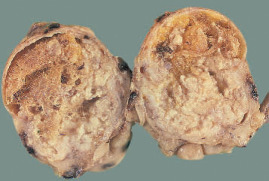 Teratoma from a dog.From van Dijk, J.E., Gruys, E., Mouwen, J.M.V.M., Color Atlas of Veterinary Pathology, 2nd ed, Saunders, 2007.
-
teratology [ter″
-tol′
-je] that division of embryology and pathology dealing with abnormal development and congenital deformations.teratoma [ter″
-to′m] germ cell tumor arising from totipotent germ cells that typically contain two to three embryonic germ layers ectoderm, mesoderm, or endoderm; usually found in the ovary or testis. Most are benign, rarely malignant.teratomatous [ter″
-to′m-t
s] pertaining to or of the nature of teratoma.teratosis [ter″
-to′sis] teratism.teratospermia [ter″
-to-spur′me-] see teratozoospermia.teratozoospermia [ter″
-to-zo″o-spur′me-] the ejaculate contains a high percentage of morphologically abnormal spermatozoa.terazosin [t
r-a′zo-sin] a uroselective α1-antagonist used to decrease internal urethral sphincter resistance in the treatment of detrusor-urethral dyssynergia.terba Chrozophoraplicata.
terbinafine [tur′bľ-n
-fēn″] a synthetic allylamine antifungal agent active against yeasts and a wide range of dermatophytes in dogs and cats. Used orally and topically.terbium (Tb) [ter′be-
m] a chemical element, atomic number 65, atomic weight 158.924.terbutaline [t
r-bu′t
-lēn] a β-adrenergic receptor antagonist used as a bronchodilator.terebration [ter″
-bra′sh
n] an act of boring or trephining.terefa, terepha Jewish classification of meat or other food meaning unsuitable for human food.
- teres [te′rēz] [L.] long and round.
- t. ligament a round ligament; those of the bladder and liver are vestiges of umbilical vessels; that of the uterus is a rounded band from the broad ligament containing some smooth muscle.
terfenadine [t
r-fen′
-dēn] a nonsedating, histamine type1 (H1)-antagonist; antihistamine. It has been withdrawn from use because of serious side effects.term [t
rm] a definite period, especially the period of gestation, or pregnancy.- terminal [tur′mľ-n
l] 1. forming or pertaining to an end. 2. a termination, end or extremity, especially a nerve ending. 3. the end-stages of a fatal illness.
- t. cisterns the SER (smooth endoplasmic reticulum) in skeletal muscle fibers is a network of cisterns and tubules; the cisterns are attachments to the tubules, and two tubules and a terminal cistern make up a triad.
- t. crossbreeding a breeding program in which crossbreds are produced by mating two sets of purebreds but without further breeding among the crossbreds; a continuing F1 generation.
- efferent t. nerve endings transmitting nerve stimuli to effector organs; include neuromuscular spindles and Golgi apparatus.
- t. ileitis see terminal ileitis.
- t. pathway see terminal complement pathway.
- t. redundancy a stretch of several hundred nucleotides that is repeated at each end of the DNA molecule.
Terminalia oblongata subsp. oblongata Australian tree in the Combretaceae family of plants. Leaves contain toxic hydrolyzable tannins (punicalagin) that cause nephrosis, hepatic necrosis in large doses. Clinically there is photosensitization, diarrhea, and edema. Chronic cases show frequent straining and dribbling of urine. Causes Mackenzie river disease. Called also T. bursarina, yellow-wood.
Terminologia Anatomica (TA) [tur″mľ-no-lo′je-
an″-tom′ľ-k] the publication of internationally accepted terminology for human gross or topographical anatomy. See also Nomina anatomica avium, Nomina anatomica veterinaria.terminatio pl. terminationes [L.] an ending; the site of discontinuation of a structure, as the free nerve endings (terminationes nervorum liberae), in which the peripheral fiber divides into fine branches that terminate freely in connective tissue or epithelium.
termination signal a specific sequence in DNA at which the RNA polymerase and the newly made RNA transcript are released from their DNA association.
Terminologia Embryologica (TE) the standardized list of words to be used in the description of pernatal human ontogeny, embryologic, and fetal structures; produced by the Federative International Committee on Anatomical Terminology.
terminology [tur″mľ-nol′
-je] 1. the vocabulary of an art or science. In medical and veterinary sciences, accurate terminology is essential for proper data storage and retrieval and requires an internationally recognized nomenclature of diseases, pathology, clinical indicants, treatments, and surgical operations. 2. the science that deals with the investigation, arrangement, and construction of terms.terminus [tur′mľ-n
s] pl. termini [L.] an ending.tern a marine bird, distributed worldwide, in the family Laridae, together with gulls. They are effortless fliers, great divers, primarily fish feeders.
ternary [ter′n
-re] 1. third in order. 2. made up of three elements or radicals.- Ternidens [ter′nľ-d
nz] a genus of strongylid worms in the family Chabertiidae.
- T. deminutus found in the large intestine of primates and occasionally humans. They cause anemia and the development of nodules in the intestinal wall similar to those of Oesophagostomum spp.
- terpin [tur′pin] a product obtained by the action of nitric acid on oil of turpentine and alcohol.
- t. hydrate an expectorant.
Terranova a genus of nematodes in the family Anisakidae that parasitize elasmobranch fish.
terrapin freshwater, semiaquatic Chelonia; see also turtle.
terrarium an aquarium or cage that contains live plants, a higher humidity, and no swimming water. See also vivarium.
terriers a group of dog breeds, most were developed as farm dogs in the British Isles for the hunting of vermin and ground-dwelling mammals, e.g., rats, badgers, foxes, and rabbits. The name is derived from the Latin terra because the dogs commonly pursue their quarry into burrows. Most have a harsh, wiry coat for the purpose. Includes such breeds as the Airedale, Australian, Bedlington, Boston, Bull, Cairn, Dandie Dinmont, English toy, Fox, Glen of Imaal, Irish, Jack Russell, Kerry blue, Lakeland, Manchester, Norfolk, Norwich, Parson Russell, Scottish, Sealyham, Silky, Skye, Soft-coated wheaten, Staffordshire, Tibetan, Welsh, West Highland white, and Yorkshire.
territoriality [ter″ľ-tor″ľ-al′ľ-te] see territorial aggression.
tertian [tur′sh
n] recurring in 3-day cycles (every third day).- tertiary [tur′she-ar-e] third in order.
- t. structure proteins unique structure made up of secondary structure elements (such as helices, β-sheets) folded in a specific way to determine the three-dimensional, biologically-active conformation of a protein.
tertigravida [t
r-tľ-grav′ľ-d] a female pregnant for the third time; gravida III.tertipara [t
r-tip′-r] a female that has had three pregnancies that resulted birth; para III.Tervuren, Tervueren see Belgian Tervuren.
Teschen disease [tesh′
n] see porcine viral encephalomyelitis.Teschovirus a genus in the family Picornaviridae, associated with porcine viral encephalomyelitis.
tesla (T) [tes′l
] the SI unit of magnetic flux density, equal to one weber per square meter.tessellated [tes′
-lāt″
d] relating to or like a mosaic, having covered a flat surface using a geometric shape with no overlaps or gaps.- test [test] 1. an examination or trial. 2. a significant chemical reaction. 3. a reagent. See also under specific names of tests.
- cis-trans t. used in microbial genetics to determine whether two mutations that have the same phenotypic effect are located in the same gene or in different genes; genetic material from one mutant may restore the wild-type phenotype in a mutant with a mutation in a different gene, but not in a mutant with a mutation in the same gene; also called a complementation test.
- critical titer t. the titer of a test at which the patient is judged to have reacted positively to the test.
- t. day day on which all lactating animals in a dairy herd have their milk weighed and sampled and data such as calving dates, dry-off dates, and breeding dates, is collected for analysis. Generally conducted once a month.
- diazo t. a group of tests for bilirubin conjugates in urine and therefore suitable for the detection of biliary and hepatic disease. Based on the combination of bilirubin with a stable diazonium compound.
- t. efficiency the percentage of the times that the test gives the correct answer compared to the total number of tests.
- exact t. a statistical test based on the exact distribution of the data under the null hypothesis, rather than on a normal approximation.
- hypothesis t. the method by which a hypothesis is judged.
- sodium sulfanilate clearance t. see sulfanilate.
- t. station set up by the government or a cooperative organization for the purpose of testing individual livestock provided by farmers for productivity in terms of egg production, milk yield, weight gain. The feeding and measurement are under the control of the station.
- statistical t. used to decide between two hypotheses.
- surrogate t. an indirect test, e.g., milk somatic cell count for evidence of mastitis.
- tolerance t. 1. an exercise test to determine the efficiency of the circulation. 2. determines the body’s ability to metabolize a substance or to endure administration of a drug, e.g., insulin tolerance test.
- triglyceride absorption t. see fat absorption test.
- urine concentration t. see water deprivation test.
- V-t. a dexamethasone suppression test followed by an ACTH response test; the name refers to the change in plasma cortisone concentrations, first depressed then elevated, which if plotted on a graph would form a V.
test and slaughter a disease control program based on selective slaughter of animals selected on the basis of evidence of disease or infection, usually chosen by an immunological test but also by other methods such as microbiological culture, PCR testing of biopsy material, or genetic analysis. Used as a method to eradicate a disease from a herd or a country.
test mating the technique of mating a suspected heterozygote with a group of animals with known genotypes for the gene in question, in order to test whether the suspect is in fact a carrier of the subject gene. The test needs an adequate number of test animals to achieve statistical significance.
- test meal a portion of food or foods given for the purpose of determining the functioning of the digestive tract.
- barium t. m. a meal containing barium sulfate as the opaque constituent. See also barium study.
- motor t. m. food or drink whose progress through the stomach, pylorus and intestinal tract is observed fluoroscopically.
- opaque t. m. a meal containing some substance opaque to x-rays, permitting visualization of the gastrointestinal tract.
test tube a tube of thin glass, closed at one end; used in chemical tests and other laboratory procedures.
testectomy [t
s-tek′t
-me] the removal of a testis. Called also orchiectomy, orchidectomy.tester population in breeding programs it is often necessary to evaluate a strain or breed; the evaluation is carried out by mating the population to be tested with a tester herd.
testes [tes′tēz] [L.] plural of testis.
testicle [tes′tľ-k
l] testis.- testicular [tes-tik′u-l
r] pertaining to the testis.
- t. agenesis absence of one or both testes, usually part of a wider range of defects.
- t. anomaly includes hypoplasia, cryptorchidism, agenesis, heterotopia, polyorchidism, cystic rete testis, and heterotopic Leydig cells and accessory adrenal cortical tissue.
- t. biopsy percutaneous sampling of tissue for laboratory examination.
- t. calcinosis a sequel to chronic inflammation and concurrent with fibrosis; common in rams and often associated with Brucella ovis infection.
- t. degeneration the most frequent cause of male infertility; many causes; regeneration and return to normal function possible provided some spermatogonia survive the insult and the basement membrane of the tubules is undamaged.
- t. descent includes the passive descent from the roof of the abdomen to near the inguinal canal, followed by the shorter, also passive, descent through the inguinal canal into the scrotum.
- t. feminization syndrome older term for androgen insensitivity syndrome, an extreme form of male pseudohermaphroditism, with female external genitalia, including secondary sex characteristics, but with the presence of testes and absence of uterus and tubes; it is due to end-organ resistance to the action of testosterone.
- t. fibrosis a sequel to inflammation or degeneration; common in old bulls.
- t. foreign body constriction malicious application of a constricting foreign body, usually an elastic band, around the base of the scrotum in dogs is an occasional cause of orchitis or necrosis of the testicles and scrotum, often necessitating castration with scrotal ablation.
- t. hypoplasia occurs as an uncomplicated state, or as part of cryptorchidism or intersex anomaly; an inherited defect in Swedish Highland cattle.
- t. inflammation see orchitis.
- t. lobuli lobules created in the testis by connective tissue septa. Formally called lobuli testis.
- t. mediastinum the central dividing plane of tissue that divides the testis and is continuous with its tunica albuginea.
- t. septuli interlobular connective tissue partitions that extend from the mediastinum testis to the tunica albuginea and that divide the testis into lobules. Formally called septula testis.
- t. torsion causes pain and swelling of the scrotum, abdominal pain and vomiting. In dogs, testicles with neoplasms are predisposed to torsion. Occurs occasionally in stallions (180°)
- t. tumors includes interstitial cell and Sertoli cell tumors and seminomas.
- testis [tes′tis] pl. testes [L.] the male gonad; either of the paired, egg-shaped glands normally situated in the scrotum; called also testicle. The testes produce the spermatozoa, the male reproductive cells, which are ejaculated into the female reproductive tract during coitus, and the male sex hormone, testosterone, which is responsible for the secondary sex characters of the male. There has been debate about whether the testes within their vaginal tunics should be regarded as residing within or outside the abdominal cavity.
- ectopic t. the testis is in an abnormal position away from the normal descent pathway.
- nonscrotal t. includes ectopic and cryptorchid testis.
- retained t. see cryptorchid.
- supernumerary t. polyorchidism.
- t. tubuli contorti seminiferous tubule.
- undescended t. see cryptorchid. Called also retained testicle.
-
testis-determining factor a factor encoded on the Y chromosome of mammals that induces testis formation and initiates male sex determination. Encoded by the SRY (human) or Sry gene (sex determining region on the Y chromosome), the Sry protein, a transcription factor, is thought to serve the function of the testis-determining factor.
T-18.
 Normal anatomy of the testis and epididymis of a dog.Ettinger, S.J., Feldman, E., Cote E. Textbook of Veterinary Internal Medicine Expert Consult, 8th ed. Elsevier (HS-US), 2016.
 testitis [tes-ti′tis] inflammation of a testis; called also orchitis.
testoid [tes′toid] a term applied to testicular hormones and other natural or synthetic compounds having a similar effect.
- testosterone [tes-tos′t
-rōn] male sex hormone (androgen) produced by the Leydig cells of the testes in response to luteinizing hormone (LH) secreted by the pituitary. Its chief function is to stimulate the development of the male reproductive organs and the secondary sex characters, such as the crest. It is necessary for the appearance of normal male sexual behavior. It encourages growth of bone and muscle, and helps maintain muscle strength. It is occasionally secreted in large amounts also by granulosa–theca cell tumors of the ovary, especially in mares.
- t. cyclopentylpropionate, t. cypionate, t. propionate esters with a long period of activity.
- t.-responsive dermatosis some cases of alopecia X respond to supplementation with testosterone, but hypoandrogenism has not been demonstrated.
Testudo genus of tortoises in the family Testudinidae, small to medium in size, native to North Africa, Asia, and Europe. Includes T. graeca (common tortoise or spur-thighed tortoise), T. hermanni (Hermann’s tortoise). See also turtle.
- tetanic [t
-tan′ik] 1. tonic. 2. pertaining to tetanus.
- t. convulsions convulsions characterized by prolonged muscle spasm without intervening periods of relaxation. The legs are extended, the neck is dorsiflexed. Seen in strychnine poisoning and tetanus.
tetaniform [t
-tan′ľ-form] resembling tetanus.tetanigenous producing tetanic spasms.
tetanization [tet″
-nľ-za′sh
n] the induction of tetanic convulsions or muscular spasms.tetanize [tet′
-nīz] to induce tetanic convulsions or muscular spasms.tetanolepsin a toxin produced by Clostridium tetani that causes lysis of erythrocytes; it is not clinically significant.
tetanolysin [tet″
-nol′ľ-sin] the hemolytic exotoxin produced by Clostridium tetani, the causative organism of tetanus; not known to play role in pathogenesis.tetanospasmin [tet″
-no-spaz′min] the neurotoxic exotoxin produced by Clostridium tetani, which inhibits release of gamma amino butyric acid by inhibitory neurons, through its action on the neurotransmitter vesicle protein, synaptobrevin, resulting in tetanic spasms.- tetanus [tet′-n
s] a highly fatal disease of all animal species caused by the neurotoxin of Clostridium tetani. The bacterial spores are deposited in tissue, usually by traumatic injury, retained placenta, or endometrial injury and, under anaerobic conditions, vegetate. Clinical features of the disease are remarkably similar in all species but there are differences in susceptibility to the disease. The muscle spasms cause a stiff gait, rigid posture (sometimes called ‘sawhorse stance’), extension or elevation of the tail, protrusion of the third eyelid and trismus (lockjaw). Horses show flaring of the nostrils. In dogs, spasms of facial muscles cause abnormally erect ears and retraction of the lips that resembles the ‘risus sardonicus’ seen in humans with tetanus. Stimulation precipitates generalized muscle contractions and tetanic spasms or convulsions. The disease can be prevented by immunization with tetanus toxoid or the use of antitoxin, but this is done routinely only in humans and horses. Usually isolated cases, but outbreaks can follow management procedures to a group of animals, such as castration.
- t. antitoxin see tetanus antitoxin.
- idiopathic t. a loosely defined syndrome of outbreaks of tetanus in young cattle without a wound being found; current practice is to refer to such outbreaks as being caused by the ingestion of pre-formed tetanus toxin.
- localized t. tetany occurs predominantly in one limb, closest to the site of entry of the organism, but then usually spreads to the opposite limb and may progress to a more generalized form. Seen in dogs and particularly cats.
- t. neonatorum tetanus resulting from infection of the umbilical cord.
- t. toxin see tetanus toxin.
- t. toxoid see toxoid.
- tetany [tet′
-ne] continuous tonic spasm of a muscle; steady contraction of a muscle without distinct twitching. It is manifested clinically by rigidity of limbs, pricking of ears, flaring of nostrils. In extreme tetany, as in tetanus, the rigidity is lead-pipe in nature in that the resistance to bending is constant. In less severe tetany, e.g., an upper motor neuron lesion, there is resistance at first, but as soon as this is overcome the limb flexes easily.
-
grass t. see lactation tetany (2).
T-19.
 A Bull terrier with tetanus. Ears are drawn together, the third eyelids protrude, and the dog’s “brow” is furrowed.Ettinger, S.J., Feldman, E., Cote Cardi. Textbook of Veterinary Internal Medicine Expert Consult, 8th ed. Elsevier (HS-US), 2016.
 - hyperventilation t. tetany produced by forced inspiration and expiration continued for a considerable time.
- hypocalcemic t. see lactation tetany, puerperal tetany (below).
- hypomagnesemic t. a highly fatal disease of calves fed solely on a milk diet and therefore lacking in magnesium. Clinically, there is muscle tremor, hypersensitivity to touch and convulsions. In between fits the calves may appear relatively normal. Death is common. Called also milk tetany. An alternate name for lactation tetany.
- lactation t. see lactation tetany.
- latent t. tetany elicited by the application of electrical and mechanical stimulation.
- magnesium-deficiency t. a product of experimental nutrition but see also lactation tetany.
- milk t. see hypomagnesemic tetany (above).
- parathyroid t., parathyroprival t. tetany due to removal or hypofunctioning of the parathyroid glands.
- t. pastures lush grass or cereal crop pastures, in the early spring when they have grown rapidly, and their magnesium content is low. The weather is also inclined to be inclement with a high wind-chill factor, and there is little or no shelter for the recently calved cows.
- puerperal t. a syndrome of hypocalcemia in bitches, usually of small breeds, typically 2–3 weeks after whelping, caused by the loss of extracellular calcium in lactation. Affected bitches show restlessness, panting, and severe muscular spasms, all of which are relieved by the administration of intravenous calcium. Also occurs infrequently in queens. Called also lactational tetany, postpartum hypocalcemia, periparturient hypocalcemia.
- recurrent t. see Scottie cramp.
- transit t. of cows, see transit tetany; of mares, see lactation tetany.
-
tether to tie an animal up by the head or neck so that it can graze but not move away. See also Barton tether.
tetmosol a topical acaricide toxic to birds if used to excess. Called also monosulfiram.
tetra any one of a number of brightly colored tropical fish in the family Characinidae, much favored for home aquariums. Includes neon tetra (Paracheirodon innesi).
tetr(a)- word element. [Gr.] four.
tetrabrachius [tet″r
-bra′ke-
s] conjoined twins having four forelimbs.tetrabromophenol test [tet″r
-bro″mo-fe″nol] an impregnated paper dip test for protein in urine. A change of color from yellow to green or even blue is a positive reaction, and the concentration of protein can be estimated by the degree of color change.tetracaine [tet′r
-kān] an ester local anesthetic used in the form of the hydrochloride salt. Can be administered by local injection but is also useful by topical application to conjunctiva, mucosa, and skin, or for spinal anesthesia. Called also amethocaine.tetrachlorodibenzodioxin [tet″r
-klor″o-di-ben″zo-di-ok′sin] a by-product in the manufacture of trichlorophenol that causes fatal centrilobular fibrosis and veno-occlusive disease in animals and humans.tetrachlorodifluorethane a fasciolicide, some samples of which cause interference with blood clotting and the development of extensive hemorrhages, myocarditis, and congestive heart failure. It is not recommended for general use. Also called Freon-112, difluorotetrachloro-ethane.
tetrachlorodiphenylethane nondegradable insecticide; relatively nontoxic; overuse in dogs causes adrenal cortical atrophy. Now seldom used.
tetrachloroethane [tet″r
-klor″o-eth′ān] has had some usage as an anthelmintic; similar activity as carbon tetrachloride with less, but still significant risk of toxicity.tetrachloroethylene [tet″r
-klor″o-eth′
-lēn] a clear, colorless liquid used extensively at one time as an anthelmintic, particularly for Fasciola, but now superseded in all species by safer and more effective drugs. Overdosing causes incoordination immediately, hepatic insufficiency later.tetrachlorvinphos an organophosphorus insecticide used to treat ectoparasites on cattle, goats, horses, and pigs, as well as being the active ingredient in some pet flea collars. Use banned in European Union.
tetracosactrin cosyntropin.
- tetracycline [tet″r
-si′klēn] an antibiotic produced by cultures of Streptomyces aureofaciens and S. rimosus. It is effective against many different microorganisms, including rickettsiae, certain viruses, and both gram-negative and gram-positive bacteria. Administration is associated with pigmentation of developing teeth and bones, and in horses, colitis is an uncommon but serious side effect.
- t. stain discoloration of dentin and enamel caused by systemic treatment with tetracycline during dental development; usually yellow to brown or green to gray.
tetrad [tet′rad] a group of four similar or related entities, as (1) any element or radical having a valence, or combining power, of four; (2) a group of four chromosomal elements formed in the pachytene stage of the first meiotic prophase; (3) a square of cells produced by division into two planes of certain cocci (sarcina).
tetradactyly [tet″r
-dak′t
-le] the presence of four digits on a foot.tetradecapeptide a polypeptide that contains 14 amino acids.
tetradifon an pesticide used in horticulture; minimally toxic and only if taken in over a long period. The liver is the principal target.
Tetradymia North American genus in plant family Asteraceae; contain an unidentified hepatotoxin that causes secondary photosensitization. Includes T. canescens (spineless horsebrush), T. glabrata (spring rabbitbush, little leaf horsebrush, coal oil bush).
tetraethyl lead [tet″r
-eth′il] the additive in leaded petrol. See also lead1 poisoning.tetraethyl pyrophosphate [tet″r
-eth′il pi″ro-fos′fāt] an insecticide used industrially and in agriculture and not to be used on animals. Accidental administration can cause death within an hour. Called also TEPP.Tetragonia tetragonioides plant in the family Aizoaceae; contains soluble oxalates capable of causing oxalate poisoning. Called also T. expansa, New Zealand spinach, warrigal green.
tetrahydrobiopterin [tet″r
-hi″dro-bi-op′t
r-in] pterin cofactor for the 3 mixed-function oxygenases that catalyze the hydroxylation of aromatic amino acids and for nitric oxide synthase. Hereditary deficiency of phenylalanine hydroxylase that catalyzes the conversion of phenylalanine to tyrosine is responsible for phenylketonuria (PKU) in humans. Such enzymes are also important for the biosynthesis of neurotransmitters such as serotonin and dopamine.tetrahydrocannabinol (THC) [tet″r
-hi″dro-k
-nab′ľ-nol] the active principle of cannabis, occurring in two isomeric forms, both considered psychomimetically active.tetrahydrofolate [tet″r
-hi″dro-fo′lāt] H4 folate; a coenzyme derived from the reduction of folic acid through dihydrofolate; involved in the metabolism of single carbon units in all redox states except CO2; an important cofactor in the synthesis of purines.tetrahydronorharmane toxic carboline found in Peganum spp. plants.
tetrahydropteroylglutamate [tet″r
-hi″dro-ter″o-l-gloo′t
-māt] see tetrahydrofolate.tetrahydropyrimidines a group of broad-spectrum anthelmintics including pyrantel and morantel.
tetrahymena [tet″r
-hi′m-n] free-living, freshwater ciliate sometimes capable of infecting and causing disease in fish.tetraiodophenolphthalein [tet″r
-i″o-do-fe″nol-thal′ēn] a contrast agent used in radiography of the gallbladder and bile duct. Called also iodophthalein. No longer used.tetraiodothyronine thyroxine; see thyroid hormones. Called also T4.
- tetralogy [tě-tral′
-je] a group or series of four.
- t. of Fallot a congenital heart defect characterized by failure of conotruncal septal development. It includes pulmonic stenosis, a ventricular septal defect, overriding aorta, and right ventricular hypertrophy. Sometimes call trilogy of Fallot.
tetramastigote 1. having four flagella. e.g., Tetratrichomonas 2. a protozoan with four flagella.
Tetrameres [tě-tram′
r-ēz] a genus of roundworms in the family Tetrameridae. They show marked sexual dimorphism, the female being globular and the male slender and filiform. They inhabit the proventriculus of birds and may kill young birds. Includes T. americana (fowl and turkey), T. confusa (fowl and pigeon), T. crami (domestic and wild ducks), T. fissispina (fowl, duck, turkey, pigeon, and wild aquatic birds), T mohtedai (fowl) and T. pattersoni (quail).tetrameres [tě-tram′
r-ēz] spiruroid nematodes in the family Tetrameridae found in the proventriculus of birds, primarily waterfowl.tetrameriasis infestation with species of the genus Tetrameres, spirurid nematodes parasitic in the gizzards of birds.
tetrameric [tet″r
-mer′ik] having four parts.tetramethylthiuram disulfide relatively nontoxic acaricide. Experimentally rams show testicular degeneration, hen birds lay soft-shelled eggs and eggs with other abnormalities. Called also thiram.
tetramine [tet′r
-mēn] 2,2,2,-tetramine (trientine) and 2,3,2-tetramine are copper-chelating agents used to remove copper in chronic hepatobiliary disease, particularly Bedlington terrier copper-associated hepatopathy.tetramisole [tě-tram′ľ-sōl] a mixture of dextro- and levo isomers used as an anthelmintic. It is effective with a broad spectrum but a narrow safety margin; it has been superseded by the isomer levamisole. Signs of toxicity include lip-licking, salivation, head shaking, tremor, excitement.
l-tetramisole levamisole.
tetranortriterpenes a class of plant toxins, e.g., the meliatoxins found in the plant Melia azaderach var. australasica.
Tetraodontidae [tet″r
-o-don′tľ-de] the family of marine fish known as toadfish or pufferfish. They are extremely poisonous and ingestion causes severe illness and often death due to tetrodotoxin.tetraparesis [tet″r
-p
-re′sis] muscular weakness affecting all four extremities most commonly as a result of neurological disease.tetrapeptide [tet″r
-pep′tīd] a peptide that, on hydrolysis, yields four amino acids.Tetrapetalonema currently a sub-genus within Mansonella; a filarioid nematode found in the peritoneal cavity of primates in central and South America. Even very large numbers appear not to be pathogenic.
tetraplegia [tet″r
-ple′j] paralysis of all four extremities; quadriplegia.tetraploid [tet′r
-ploid] 1. characterized by tetraploidy. 2. an individual or cell having four sets of chromosomes.tetraploidy [tet′r
-ploi-de] the state of having four sets of chromosomes (4n).tetrapod although appearing to be synonymous with quadruped, i.e., a four-limbed, four-footed vertebrate animal, it is more properly restricted to the taxonomic superclass that includes amphibia, reptiles, birds, and mammals, i.e., all animals that dwell on land or have descended from ancestors that once lived on land; accordingly tetrapods include all vertebrates except fish, even snakes and whales, because they are descended from tetrapods. Compare with quadruped and an amniote.
Tetrapterys tropical American plant genus in family Malpighiaceae; contains unidentified cardiotoxin that causes cardiac irregularity, congestive heart failure, abortion and neonatal mortality. Includes T. acutifolia, T. multiglandulosa.
tetrasomy [tet′r
-so″me] a form of aneuploidy characterized by the presence of two extra chromosomes (=four copies) of one type in an otherwise diploid cell.tetraster a figure in mitosis produced by quadruple division of the nucleus.
tetrathyridium a metacestode or larval cestode in the life cycle Mesocestoides spp., cestodes of the intestine of domestic and wild carnivores.
- Tetratrichomonas a genus of protozoa with four anterior and one trailing flagella, a pelta, and a discoid parabasal body; in the family Trichomonadidae. Formerly part of the genus Trichomonas.
- T. anatis found in ducks but not pathogenic.
- T. anseris found in the cecum of geese; not pathogenic.
- T. bovis see T. pavlovi (below).
- T. buttreyi found in the cecum and colon of pigs; no evidence of pathogenicity.
- T. gallinarum found in fowl, duck, guinea fowl, quail, pheasant, partridge, and probably Canada goose. Causes hepatic lesions similar to those caused by Histomonas meleagridis.
-
T. ovis found in the cecum of sheep; not pathogenic.
T-20.
 Texas longhorn cattle.From Sambraus, H.H., Livestock Breeds, Mosby, 1992.
T-21.
 Texel meat sheep.From Sambraus, H.H., Livestock Breeds, Mosby, 1992.
 - T. pavlovi (syn. T. bovis) found in the cecum of calves with diarrhea.
tetravalent [t
t-r-va′l
nt] having a valence of four.tetrodotoxin [tet′ro-do-tok″sin] a highly lethal neurotoxin present in numerous species of puffer and toadfish (suborder Tetraodontoidea) and in newts of the genus Taricha (tarichatoxin). In humans, ingestion results, within minutes, in malaise, dizziness, and tingling about the mouth, which may be followed by ataxia, convulsions, respiratory paralysis, and death. Dogs and cats are occasionally poisoned after eating these fish at the seashore and are similarly affected.
Texas fever see babesiosis.
Texas longhorn a breed of beef cattle, of all colors but mostly red, and any pattern of marking; accoutred with a formidable spread of horns.
Texel 1. a Dutch marsh type of long-woolled, polled, meat sheep. 2. a breed of guinea pigs characterized by its long, curly coat.
textiform [teks′tľ-form] formed like a network.
textoblastic [teks″to-blas′tik] forming adult tissue; regenerative; said of cells.
texture [teks′ch
r] the structure or constitution of tissues.TF transfer factor.
tetroxoprim a folate antagonist used in the treatment of toxoplasmosis. Called also piritrexin.
TG 1. thyroglobulins. 2. triacylglycerol.
TGE transmissible gastroenteritis.
TGEV transmissible gastroenteritis virus.
TGFβ transforming growth factor beta.
TGH abbreviation for to go home; used in medical records.
Th chemical symbol, thorium.
Th cell helper T lymphocyte.
Th1 cell type 1 helper T lymphocyte. When stimulated produces specific cytokines (interferon-γ and TNG-β) resulting in a strong cytotoxic immune response.
Th2 cell type 2 helper T lymphocyte. When stimulated produces specific cytokines (IL-4, IL-10) resulting in a strong humoral immune response.
Thai a cat breed native to Thailand; shorthaired with points resembling the (modern) Siamese, but with a broader head, smaller ears, and rounded body. Called the ‘old style’ Siamese.
Thai ridgeback a medium-sized, muscular dog with erect ears and short coat. It has a distinctive ‘ridge’ of hair along the spine that grows in a reverse direction; occurs in eight different patterns. Considered a native breed of Thailand. See also Rhodesian ridgeback.
thalamencephalon [thal″
-mn-sef′
-lon] that part of the diencephalon including the thalamus, metathalamus, and epithalamus.thalamocoele the third ventricle of the brain.
thalamocortical [thal″
-mo-kor′tľ-k
l] pertaining to the thalamus and cerebral cortex.thalamolenticular [thal″
-mo-ln-tik′u-l
r] pertaining to the thalamus and lenticular nucleus.thalamus [thal′
-m
s] pl. thalami [L.] either of two large ovoid structures composed of gray matter and situated at the base of the cerebrum. The thalamus functions as a relay station in which sensory pathways from the spinal cord and brainstem form synapses on their way to the cerebral cortex. Specific locations in the thalamus are related to specific areas on the body surface and in the cerebral cortex. A sensory impulse from the body surface travels to the thalamus, where it is received as a primitive sensation and then is sent on to the cerebral cortex for interpretation as to location, character, and duration. The thalamus has numerous connections to other areas of the brain as well, and these are thought to be important in the integration of cerebral, cerebellar, and brainstem activity.thalassoposia the drinking of sea water.
Thalictrum European member of the plant family Ranunculaceae; contains the toxin protoanemonin; causes abdominal pain, diarrhea, salivation. Called also meadow rue.
- thallium (Tl) [thal′e-
m] a chemical element, atomic number 81, atomic weight 204.37. Its salts are active poisons. See thallotoxicosis.
- t.-201 201Tl) a radioactive isotope of thallium having a half-life of 73.5 hours; the principal emission is 71 keV x-rays.
- t. poisoning see thallotoxicosis.
- t. scan a scintillation scan involving the use of thallium-201 that localizes in the myocardium after intravenous injection. Areas of inadequate perfusion pinpoint the site of coronary artery occlusions.
thallotoxicosis [thal″o-tok″sľ-ko′sis] thallium salts, especially the acetate and sulfate that have been used as rat baits, are very poisonous. Acute poisoning is manifested by severe abdominal pain, vomiting, and hemorrhagic gastritis. Chronic poisoning causes characteristic hyperkeratosis, and alopecia, plus tremors and convulsions, vomiting, diarrhea and respiratory difficulty.
- thallous [thal′
s] pertaining to thallium.
- t. acetate a rodenticide. See thallotoxicosis.
- t. chloride (Tl-201) the form in which thallium-201 is injected intravenously for myocardial perfusion imaging.
- t. sulfate a rodenticide. See thallotoxicosis.
thallus 1. a simple plant body not differentiated into root, stem, and leaf, characteristic of mycelial fungi and some algae. 2. the actively growing vegetative organism as distinguished from reproductive or resting portions, as in fungi. A fungal colony on agar medium.
THAM salt tromethamine, an alkalizing agent used in the manufacture of pharmaceuticals.
Thamnosma North American plant genus in the family Rutaceae; contains furanocoumarins; causes primary photosensitization. Includes T. montana, T. texana. Called also turpentinebroom, Texas desert rue.
thanatobiological pertaining to life and death.
thanatognomonic indicating the approach of death.
thanatoid resembling death.
THC tetrahydrocannabinol.
Thea sinensis see Camellia.
- thebesian named after Adam Christian Thebesius (1686–1732), a German physician and anatomist.
- t. foramina minute openings in the walls of the heart, especially the right atrium, through which the smallest cardiac veins empty into the heart.
- t. valve the valve of the coronary sinus as it enters the right atrium.
- t. veins smallest cardiac veins: numerous small veins arising in the muscular walls and draining independently into the cavities of the heart, and most readily seen in the atria.
- theca pl. thecae [L.] a case or sheath.
- t. cell an epithelioid cell of the corpus luteum.
- t. cordis pericardium.
- t. externa cells surrounding the theca interna cells of the ovarian follicle. Preovulatory LH surge induces prostaglandin F2α secretion, part of the ovulatory process.
- t. folliculi an envelope of condensed connective tissue surrounding a vesicular ovarian follicle, comprising an internal vascular layer (theca interna) and an external fibrous layer (theca externa).
- granulosa t. cell tumor may secrete estrogen and progesterone in dogs and cause persistent or irregular estrus, alopecia, enlargement of nipples and vulva. Uterine changes range from cystic endometrial hyperplasia to pyometra.
- t. interna cells of the ovarian follicular wall on the opposite side (“outside”) of the basement membrane from the granulosa cells. Express LH receptors and produce androgens that are aromatized to estrogens by the granulosa cells. Differentiate into progesterone-secreting t. lutein cells after ovulation.
- thecal pertaining to a theca.
- t. cone thecal cells in the ovarian stroma arrange themselves into a cone and may displace superficially situated follicles to make way for a deeper situated follicle that is undergoing enlargement.
thecitis tenosynovitis.
thecography contrast radiography following injection of radiopaque material into the subarachnoid space of the brain to outline the floor of the cranial vault, particularly the pituitary gland and optic nerves. No longer performed, replaced by magnetic resonance imaging (MRI).
thecoma theca cell tumor.
thecostegnosis contraction of a tendon sheath.
- Theileria a genus of protozoan parasites in the family Theileriidae. They are transmitted by ticks, multiply in leukocytes, and then invade erythrocytes.
- T. annulata (syn. T. dispar) found in cattle and water buffalo, transmitted by Hyalomma spp. ticks and causes Mediterranean or tropical theileriosis, a clinical disease similar to East Coast fever.
- T. buffeli found in cattle and buffalo in Australia and transmitted by Haemaphysalis longicornis and H. bancrofti. Similar to T. mutans. Only sporadic cases of clinical disease and is seen mostly in splenectomized calves. T. buffeli, T. orientalis, and T. sergenti are members of the same species complex.
- T. camalensis found in camels, transmission thought to be by Hyalomma spp. ticks.
- T. cervi nonpathogenic, found in splenectomized deer.
- T. dispar see Theileria annulata (above).
- T. hirci found in sheep and goats. Transmitting vector uncertain but probably the tick Rhipicephalus bursa. Causes a disease similar to East Coast fever in cattle.
- T. lawrenci found in cattle, buffalo and water buffalo. Transmitted by the tick Rhipicephalus appendiculatus; causes fatal corridor disease.
- T. mutans found in cattle, transmitted by ticks including Rhipicephalus and Haemaphysalis spp. and causes a benign bovine theileriosis.
- T. orientalis usually benign but can cause severe anemia in imported cattle.
- T. ornithorhynci found in platypus.
- T. ovis found in sheep and goats, transmitted by ticks of the genera Rhipicephalus, Dermacentor, Haemaphysalis and Ornithodoros spp. It causes a mild form of theileriosis.
- T. parva found in cattle, African buffalo, and Indian water buffalo; transmitted by Rhipicephalus appendiculatus and possibly other ticks. It causes the widespread and serious disease East Coast fever.
- T. sergenti doubtful identity; mostly benign in cattle.
- T. tarandi found in reindeer, transmitted by Ixodes persulcatus and causes an acute disease.
- T. taurotragi mildly pathogenic; found in cattle in Africa, Asia.
- T. velifera mildly pathogenic; found in cattle.
theileriasis [thi″l
-ri′
-sis] theileriosis.
- theileriosis [thi-le″re-o′sis] results from infection with obligate intracellular protozoa in the genus Theileria. The diseases they cause result in huge economic loss in East African, Mediterranean, and Central and Southeast Asian countries. The two most important species in cattle are T. parva, causing East Coast fever, Corridor disease, and Zimbabwean theileriosis, and T. annulata, which causes tropical or Mediterranean theileriosis. In sheep, T. lestoquardi causes malignant ovine theileriosis. In general the diseases may be acute and severe or mild. Severe disease is characterized by high fever, nasal discharge, jaundice, petechiation of mucosae, enlargement of the spleen and lymph nodes, enlargement of the kidneys, and transient hemoglobinuria. Diagnosis is based on finding protozoa in the blood, lymph, or in the lymph node aspirates or biopsies. A feature, considered to be diagnostic is the presence of Koch’s blue bodies or spots, lymphocytes containing macroschizonts, and detectable in smears stained with common blood-stain. Also molecular assays, based on conventional or real-time PCR technology, and indirect fluorescent antibody testing are used. The disease in cattle is notifiable to the OIE (see Table 21). See also East Coast fever, corridor disease, turning sickness.
- benign t. caused by Theileria orientalis.
- cerebral t. infection with Theileria parva or aberrant forms of T. taurotragi originating from the eland. Called also turning sickness.
- malignant ovine t. tick-borne disease of sheep and goats, caused by Theileria lestoquardi, considered a major constraint for sheep production in many areas of the world. Produces severe tissue destruction and pulmonary edema leading to respiratory failure and a high case fatality rate.
- Mediterranean t. caused by Theileria annulata; occurs in North Africa, southern Europe, and Asia. Resembles East Coast fever, but jaundice and anemia may also occur. Common clinical signs include fever, enlarged lymph nodes, pale mucous membranes, a rapid loss of condition, and sometimes hemoglobinuria. Morbidity and mortality vary with the host’s susceptibility. Called also tropical theileriosis.
- oriental t. a mild form of East Coast fever caused by Theileria orientalis.
- tropical t. Mediterranean coast fever.
Theiler’s disease [ti′l
r] an acute hepatopathy of horses, with high case fatality, associated with the administration of equine serum or tissue products. The disease is associated with infection by an equine parvovirus. Called also serum-associated hepatitis.Thelazia a genus of spiruroid worms in the family Thelaziidae. Parasites of the lacrimal duct or conjunctival sac of mammals and birds, commonly known as ‘eye worms’. The larvae are deposited in the conjunctival sac by the intermediate host, Musca spp. flies. Causes thelaziasis. Includes T. alfortensis (cattle), T. bubalis (water buffalo), T. californiensis (cat, dog, humans, sheep, and deer), T. callipaeda (dog, rabbit, and humans), T. erschowi (pig), T. gulosa (cattle), T. lacrymalis (horses), T. leesi (dromedary), T. rhodesii (cattle, sheep, goat, and buffalo), T. skrjabini (cattle).
thelaziasis [the″l
-zi′
-sis] infestation of the conjunctival sac with Thelazia spp. Causes conjunctivitis, lacrimation, blepharospasm, and keratitis.theleplasty [the′le-plas″te] a plastic operation on the nipple or teat.
thelitis [the-li′tis] inflammation of a nipple or teat.
thelium [the′le-
m] 1. a papilla. 2. a nipple.- Thelohanellus a genus of myxosporid protozoa in the class Myxosporea; parasites of freshwater fish.
- T. piriformis causes cutaneous abscesses in cyprinid and coregonid fishes.
- Thelohania a genus of parasitic protozoa in the phylum Microspora. Most species known are from arthropods and fish, with a few from mammals. May be zoonotic in immunocompromised humans.
- T. apodemi found in the brain of field mice.
- T. baueri found in the ovary of the stickleback fish.
- T. contejeani, T. cambari, T. parastaci cause ‘cotton-tail’, a whitening of the abdominal musculature in fresh water crayfish.
thelorrhagia [the″lo-ra′j
] hemorrhage from the nipple.-
thelygenic [thel″
-jen′ik] producing only female offspring.T-22.
 Thelazia in a dog’s conjunctival sac.From Dziezyc, J. Color Atlas of Canine and Feline Ophthalmology. W.B. Saunders Company, 2004.
T-23.
 Theilitis in a ewe with contagious ecthyma.
 Thelypodium lasiophyllum North American plant of the family Brassicaceae; can cause nitrate–nitrite poisoning. Called also California mustard.
thenium closylate [then′e-
m klo′s
-lāt] an older but effective anthelmintic against hookworms in dogs, commonly combined with piperazine to include control of ascarids.Theobaldia one of the genera of mosquitoes that are the definitive hosts for Plasmodium spp., the cause of avian malaria.
Theobroma cacao [the″o-bro′m
] tree of South American origin of the family Sterculiaceae; seeds are the source of cocoa, chocolate; contains the toxic xanthine alkaloid theobromine that in excess causes diarrhea, sudden death in dogs and other animals. Commercial waste products from the plant may be fed to animals and cause theobromine poisoning.theobromine [the″o-bro′min] an alkaloid prepared from dried ripe seed of the tropical tree Theobroma cacao; or made synthetically from xanthine; used as a diuretic, myocardial stimulant, vasodilator, and smooth muscle relaxant; available as theobromine calcium salicylate, sodium formate, sodium salicylate, and salicylate. See also chocolate toxicity.
- theophylline [the-of′
-lin] an alkaloid derived from tea or produced synthetically; it is a smooth muscle relaxant used chiefly for its bronchodilator effect in the treatment of bronchospasm. It also has myocardial stimulant, coronary vasodilator, diuretic, and respiratory center stimulant effects.
- t. cholinate oxtriphylline, a smooth muscle relaxant, myocardial stimulant, and diuretic.
- t. ethylenediamine a smooth muscle relaxant, myocardial stimulant, and diuretic. Called also aminophylline.
- theory [the′
-re] 1. the doctrine or the principles underlying an art as distinguished from the practice of that particular art. 2. a formulated hypothesis or, loosely speaking, any hypothesis or opinion not based upon actual knowledge.
- cell t. all organic matter consists of cells, and cell activity is the essential process of life.
theque [Fr.] a round or oval collection, or nest, of melanin-containing nevus cells occurring at the dermoepidermal junction of the skin or in the dermis proper.
- therapeutic pertaining to therapeutics, or treatment of disease; curative.
- t. decision making the use of decision theory in making decisions about treatment of individual cases.
- t. incompatibility the result of antagonistic pharmacological effects of several drugs in the one patient.
- t. plasma concentration the blood concentration of a drug at which the desired therapeutic effect is obtained.
- t. substances medicines with identifiable value in the treatment of disease.
therapeutics [ther″
-pu′tiks] 1. the science and art of healing. 2. a scientific account of the treatment of disease.- therapy [ther′
-pe] the treatment of disease; therapeutics. See also treatment.
- animal-assisted t. the treatment of humans, usually for psychological issues, which incorporates familiarization with a companion animal. Called also pet-facilitated or pet-assisted therapy. See also animal facilitated therapy, emotional support animals.
- anticoagulant t. the use of drugs to alter blood clotting sufficiently to discourage thrombosis.
- blanket t. treatment of all animals in the group used usually as a protective measure against infection, or because a large proportion of the animals are suspected to be infected, and it is more cost-effective to treat all of them than to test and treat selectively.
- cryo t. The use of a cryogen to freeze tissue
- electrothermal t. the use of heat to destroy cells, particularly in tumors.
- heat t. see hyperthermia (2).
- immunosuppressive t. treatment with agents, such as x-rays, corticosteroids, and cytotoxic chemicals, which suppress the immune response to antigen(s); used in organ transplantation, autoimmune disease, allergy, multiple myeloma, etc.
- inhalation t. see aerosol.
- neoadjuvant t. given before the primary treatment, such as chemotherapy, hormone therapy, radiation therapy.
- occupational t. not a significant part of veterinary activity, but the term is applied to the teaching of behaviors and activity patterns to big cats in captivity to reduce boredom.
- oxygen t. supplemental oxygen administered for the purpose of relieving hypoxemia and thus tissue hypoxia. Companion animals are usually placed in a special cage with oxygen channeled into it. Alternatively, a mask may be used for short-term administration. Large animals can be supplied with supplemental oxygen via a nasal tube taped to the head/nose or the halter.
- physical t. use of physical agents and methods in rehabilitation and restoration of normal bodily function after illness or injury; it includes massage and manipulation, therapeutic exercises, hydrotherapy, and various forms of energy (electrotherapy, actinotherapy, and ultrasound). See also physical therapist.
- radiation t. treatment of disease by means of ionizing radiation. See also radiotherapy.
- replacement t. treatment to replace deficient formation or loss of body products by administration of the natural body products or synthetic substitutes; for example, intravenous fluid replacement therapy for the treatment of dehydration or blood loss.
- serum t. treatment of disease by injection of serum from animals with natural or acquired immunity to the disease; serotherapy.
- substitution t. the administration of a hormone to compensate for glandular deficiency.
- swimming exercise t. a form of physical therapy employed in veterinary medicine, usually horses or dogs.
- systemic t. treatment with a drug that is absorbed into the bloodstream and distributed throughout the body except where there is a specific barrier (e.g., an intact blood-brain barrier).
- vacuum t. see cupping.
- vaporization t. see aerosol.
theriogenological, theriogenologic [the″re-o-jen″o-log′ľ-k
l] pertaining to or emanating from theriogenology.theriogenologist [the″re-o-j
n-ol′
-jist] a veterinarian skilled in theriogenology.theriogenology [the″re-o-j
n-ol′
-je] the discipline of animal reproduction; that branch of veterinary science that comprises the study of the normal physiology and anatomy and the pathology and diseases of the male and female reproductive tracts of animals. It includes the subjects of obstetrics and gynecology, as dealt with in human medicine, reproduction on a herd and flock basis, and with artificial insemination and embryo transfer and, in some countries, with neonatology.theriotherapy treatment of all diseases of animals.
therm [th
rm] the amount of heat input required to raise the temperature of 1000 kg of water by 1°C. One therm = 1000 kilocalories = 1 megacalorie (Mcal) = 106 megajoule.thermaburn thermal burn.
- thermal [thur′m
l] pertaining to heat.
- t. death point the state of heat content, as measured by temperature, at which the life of an organism ceases. Important in a consideration of sterilization procedures for certain organisms, especially those that produce spores.
- t. energy the energy of heat.
- t. injury see burn.
- t. processing the preservation of food by the application of heat either in boiling water, by live steam, in an autoclave or by flame.
- t. sensation the sense of temperature.
- t. stress see hyperthermia (1), heat1 stroke, fever.
thermelometer [thur′m
l-om′-t
r] an electric thermometer for measuring small temperature changes.thermic [thur′mik] pertaining to heat.
thermistor [th
r-mis′t
r] a thermometer whose impedance varies with ambient temperature and so is able to measure extremely small temperature changes.therm(o)- word element. [Gr.] relationship to heat.
Thermoactinomyces vulgaris [thur″mo-ak″tľ-no-mi′sēz] thermophilic antigens of this sporulating, gram-positive, rod-shaped species of bacteria within the family Thermoactinomycetaceae, as well as of fungi, are thought to cause extrinsic allergic alveolitis (bovine farmer’s lung); serum antibodies against the antigens have been found in cattle affected with the disease.
thermocautery [thur″mo-kaw′t
r-e] cauterization by the application of direct heat onto the tissues, usually via a heated wire or point.thermochemistry [thur″mo-kem′is-tre] the aspect of physical chemistry dealing with temperature changes that accompany chemical reactions.
thermocoagulation [thur″mo-ko-ag″u-la′sh
n] coagulation of tissue with heat, usually generated by high-frequency currents.thermocouple [thur′mo-kup″
l] a pair of dissimilar electric conductors so joined that with the application of heat an electromotive force is established; used for measuring small temperature differences.thermodiffusion [thur″mo-dľ-fu′zh
n] diffusion influenced by a temperature gradient.thermodilution [thur″mo-dľ-loo′sh
n] a technique for measuring size of a fluid-filled cavity by injecting a very cold sample of known volume and by measuring the change in temperature of the whole, assessing the degree of thermodilution, and hence the total volume of the cavity. Used to measure cardiac output.thermoduric [thur″mo-du′rik] able to endure high temperatures.
- thermodynamics [thur″mo-di-nam′iks] the branch of science dealing with heat and energy, their interconversion, and problems related thereto.
- first law of t. law dealing with the transformation of energy. States that energy can neither be created nor destroyed, only converted from one form to another.
thermoexcitory [thur″mo-ek-si′t
-re] stimulating production of bodily heat.- thermogenesis [thur″mo-jen′
-sis] the production of heat, especially within the animal body.
- diet-induced t. a portion of dietary calories in excess of those required for immediate energy requirements are converted to heat rather than stored as fat. Some types of obesity may be related to a defect in this mechanism.
- neonatal t. thermogenesis is relatively inefficient in neonates, especially piglets and foals, so that it becomes very important to protect them from cold stress. Most of their heat gain comes from the metabolism of their stores of brown fat.
- nonshivering t. increased heat production due to enhancement of normal calorigenic metabolic processes.
- shivering t. much the fastest thermogenic process that the static body can use. Shivering is an involuntary function with a tremor rate of about 10 per second.
thermogenin [th
r-moj′
-nin] see uncoupling protein-1 (UCP-1).thermogram [thur′mo-gram] 1. a graphic record of temperature variations. 2. the visual record obtained by thermography.
thermograph [thur′mo-graf] 1. an instrument for recording temperature variations. 2. thermogram (2). 3. the apparatus used in thermography.
thermography [th
r-mog′r
-fe] a technique wherein an infrared camera photographically portrays the body’s surface temperature; used as a diagnostic aid in the detection of superficial tumors and the assessment of joint and tendon disease; also used in the study of pain; however, the validity of this technique as a diagnostic aid is questionable.thermohygrograph an instrument that measures the environmental temperature and humidity at the same time, usually both continually.
thermoinhibitory [thur″mo-in-hib′ľ-tor-e] retarding generation of bodily heat.
thermolabile [thur″mo-la′b
l] easily affected by heat.thermolysis [th
r-mol′ľ-sis] 1. chemical dissociation by means of heat. 2. dissipation of bodily heat by radiation, evaporation, etc.- thermometer [thr-mom′-t
r] an instrument for determining temperatures, in principle making use of a substance (such as alcohol or mercury) with a physical property that varies with temperature and is susceptible of measurement on some defined scale. See also Celsius thermometer, Fahrenheit thermometer.
- centigrade t. one having the interval between two established reference points divided into 100 equal units, as the Celsius thermometer.
- clinical t. one used to determine the temperature of the patient in clinical situations.
- electronic t. a clinical thermometer using a sensor based on thermistors. Can be placed aurally or with other skin contact.,
- kelvin t. one employing the kelvin scale.
- recording t. a temperature-sensitive instrument by which the temperature to which it is exposed is continuously recorded.
- rectal t. a clinical thermometer that is inserted in the rectum for determining body temperature.
- resistance t. one that uses the electric resistance of metals for determining temperature (thermocouple).
- self-registering t. recording thermometer.
thermometry [th
r-mom′
-tre] measurement of temperature.thermophile [thur′mo-fīl] a microorganism that grows best at elevated temperatures.
thermophore [thur′mo-for] 1. a device or apparatus for retaining heat. 2. an instrument for estimating heat sensibility.
thermopile [thur′mo-pīl] a number of thermocouples in series, used to increase sensitivity to change in temperature or for direct conversion of heat into electric energy.
thermoplacentography [thur″mo-plas″
n-tog′r
-fe] use of thermography for determination of the site of placental attachment.Thermoplasma a genus of archaea that lack a cell wall; found in coal refuse piles.
thermoplastic materials [thur″mo-plas′tik] materials used in making casts for broken limbs. Malleable when warmed in hot water or heated with a hairdriyer, very quick setting when cooled and very strong, e.g., Hexcelite.
thermoplegia heat stroke.
thermopolypnea increased breathing rate due to high body temperature or thermal stress such as a high ambient temperature.
Thermopolyspora polyspora a fungus growing on stored forage thought at one time to be involved in the etiology of atypical interstitial pneumonia of cattle.
Thermopsis North American plant genus of the legume family Fabaceae; contain toxic quinolizidine alkaloids; causes myopathy, stiff gait, recumbency; includes T. montana (mountain goldenbanner, poison bean), T. rhombifolia (prairie thermopsis), T. mollis (Allegheny Mountain goldenbanner), T. villosa (Aaron’s rod). Called also false lupin,
- thermoreceptor [thur″mo-re-sep′t
r] a nerve ending sensitive to stimulation by heat.
- cutaneous t’s come in two varieties, cold receptors and warm receptors. Called also peripheral receptors although the latter include, besides cutaneous receptors, those in the mucosae.
- thermoregulation [thur″mo-reg″u-la′sh
n] the physiological process controlling the balance between heat production and heat loss in the body so as to maintain body temperature within a narrow normal range; a function of a center in the hypothalamus. A lesion in that location can produce central hyperthermia or hypothermia.
- behavioral t. carried out by cold-blooded animals that move into and out of relatively warm locations to regulate body temperature.
thermoregulatory mechanism [thur″mo-reg′u-l
-tor″e] the anatomical system that controls the body temperature; includes the temperature endorgans in the skin, the afferent nerves, the thalamus and hypothalamus, vasodilatation, respiratory center, the sweat glands, the muscular system, and the hormonal and enzymic systems involved in the calorigenic metabolism of, stored fat and protein.thermosensitivity [thur″mo-sen″sľ-tiv′ľ-te] the central perception of temperature is located in the anterior hypothalamus (preoptic region) and in the spinal cord. The preoptic sensitivity is the more important in mammals, the spinal cord center in birds.
thermostabile [thur″mo-sta′b
l] not affected by heat.thermostasis [thur″mo-sta′sis] maintenance of temperature, as in warmblooded animals.
thermostat [thur′mo-stat] a device interposed in a heating system by which temperature is automatically maintained between certain levels.
thermostatic control a control system for the maintenance of a fixed temperature.
thermosteresis [thur″mo-st
-re′sis] deprivation of heat.thermosystaltic [thur″mo-sis-tawl′tik] contracting under the stimulus of heat; thermosystaltism.
thermosystaltism [thur″mo-sis′t
l-tiz-
m] contraction of muscles in response to changes in temperature.thermotaxis [thur″mo-tak′sis] 1. normal adjustment of bodily temperature. 2. movement of an organism in response to a temperature gradient.
thermotherapy [thur″mo-ther′
-pe] therapeutic use of heat; more commonly called heat therapy.thermotolerance the state of being relatively unaffected by hot conditions.
thermotonometer [thur″mo-to-nom′
-t
r] an instrument for measuring the amount of muscular contraction produced by heat.thermotropism [th
r-mot′ro-piz-
m] the orientation of an organism in response to a directional heat stimulus.Theromyzon tessulatum a small leech that normally parasitizes the nasal sinuses of geese, but which may migrate to the conjunctival sacs and cause keratoconjunctivitis.
Thesium genus of South African plants in family Santalaceae; contains bufadienolide cardiac glycosides; causes cardiomyopathy, sudden death; includes T. lineatum, T. namaquense.
theta [tha′t
] eighth letter in the Greek alphabet, Θ or θ.theta rhythm a rhythmic hippocampal electrical discharge correlated with movement and locomotion.
Thevetia see Cascabela.
thevetin a cardiac glycoside that occurs in Cascabela thevetia (Thevetia peruviana).
THF tetrahydrofolic acid.
thiabendazole [thi″
-ben′d
-zōl] a very safe and effective, broad-spectrum anthelmintic used widely in sheep. Also used extensively in horses in combination with piperazine. Poisoning with thiabendazole has been recorded, but it is a very unusual occurrence requiring a massive overdose. It is capable of causing incoordination and collapse initially, and subsequently toxic nephrosis with terminal uremia. Also a fungicide on fruit and vegetable crops.thiacetarsamide sodium [thi-as″
t-ahr′s
-mīd] a parenteral anthelmintic used against adult heartworms in dogs with significant hepatic and renal toxicity. Commonly known as Caparasolate which is no longer available and largely replaced by melarsomine.thiamin [thi′
-min] thiaminethiaminase [thi-am′ľ-nās] an enzyme that catalyzes the splitting of thiamine into a pyrimidine and a thiazole derivative. Is present in some ferns, e.g., bracken, and in some species of fish so that diets containing these materials are likely to be deficient in thiamine. Thiaminase activity by microbes in the rumen is thought to be one cause of polioencephalomalacia in cattle. See also Chastek paralysis.
- thiamine, thiamin [thi′
-min] vitamin B1; a component of the B complex group of vitamins, found in various foodstuffs and present in the free state in blood plasma and cerebrospinal fluid. The pharmaceutical products are thiamine hydrochloride and thiamine pyrophosphate. Spelled also thiamin.
- t. nutritional deficiency an unlikely event in food animals with two exceptions: the secondary deficiency caused in horses and pigs by thiaminase in bracken and the primary deficiency in horses fed a diet almost entirely of turnips. In companion animals, the deficiency is much more common. Dogs, and particularly cats, fed diets in which thiamine has been destroyed, usually by excessive heat in processing but also by the inclusion of raw fish of certain marine species or sulfur dioxide as a food preservative, will develop signs of deficiency that include ataxia, mydriasis, and convulsions. See also polioencephalomalacia, Chastek paralysis.
thiamphenicol [thi-
m-fen′ľ-kōl] an analog of chloramphenicol with similar activity, but reportedly a lower incidence of aplastic anemia in humans.thiamylal [thi-am′ľ-lal] an ultrashort-acting thiobarbiturate used as an intravenous anesthetic. The pharmaceutical product is thiamylal sodium. Known also as Surital.
thiazide [thi′
-zīd] any of a group of benzothiadiazinesulfonamide derivatives, typified by chlorothiazide, that act as diuretics by inhibiting the reabsorption of sodium in the proximal renal tubule and stimulating chloride excretion, with resultant increase in excretion of water. Includes bendroflumethiazide, chlorothiazide, and hydrochlorothiazide.thiazolidinediones [thi″
-zōl″
-dēn-di′ōn] a class of oral antidiabetic agents used in cats with diabetes.thick forelegs see juvenile hyperostosis.
thick leg disease of poultry, see osteopetrosis.
thick stomach worms see Ascarops strongylina, Physocephalus sexalatus.
thidiazuron a defoliant in cotton crops. It is not actually poisonous for animals, but it may enter the human food chain via eggs and milk.
thiemia [thi-e′me-
] sulfur in the blood.-
thienamycin [thi-en″
-mi′sin] a broad spectrum, β-lactamase–resistant antibiotic in the carbapenem class.T-24.
 A Brown Swiss heifer exhibiting the clinical signs of decerebellate rigidity with opisthotonus and extensor rigidity of the limbs and with hip flexion because of diffuse metabolic encephalopathy caused by thiamin deficiency.deLahunta, A., Glass, E., Kent, M. Veterinary Neuroanatomy and Clinical Neurology, 4th ed. Saunders, 2014.
 thienopyridines a class of drugs that inhibit ADP-induced platelet aggregation; used for their antiplatelet activity in preventing thromboembolism.
thiethylperazine [thi-eth″
l-par′
-zēn] a phenothiazine derivative useful as an antiemetic.- thigh the portion of the leg above the stifle; the femur.
- t. bone femur.
- second t. in dogs, refers to the area from stifle to hock; in horses, refers to the muscular part of the hind leg from the stifle to the hock; called also the gaskin.
thigmotaxis [thig″mo-tak′sis] movement of an organism in response to a touch stimulus; also called stereotaxis.
thigmotropism [thig-mot′ro-piz-
m] the orientation of an organism in response to the stimulus of contact.Thiloa glaucocarpa South American plant in the family Combretaceae; contains nephrotoxic tannin producing signs of dehydration, ascites and subcutaneous edema, and coagulation necrosis of renal convoluted tubules: called also sipauba, vaqueta.
thimble weed see Rudbeckia.
thimbling [thim′bling] the condition produced by the partial shedding of the horn on a claw of a pig. The horn separates from its laminae and a new claw’s horn grows, gradually pushing the old horn off giving the effect that the pig is wearing a thimble. A good indication that the pigs have had a recent attack of foot-and-mouth disease.
thimerosal [thi-mer′o-s
l] a mercury-containing compound used as a antibacterial agent and preservative in pharmaceutical preparations such as vaccines. Called also mercurothiolate, thiomersal, thiomersalate, and merthiolate.- thin 1. the body state in which the animal’s weight is below normal but the eyes are bright and the coat good, and the animal is physiologically and clinically normal. see also body condition score. 2. the state of tissue in which the volume of connective tissue is diminished and other tissues lacking in size.
- t. tubules renal tubules; includes thin ascending and thin descending tubules.
thin ewe syndrome a debilitating disease of adult ewes probably of mixed etiology but often associated with multiple internal abscesses containing Corynebacterium pseudotuberculosis, sometimes Moraxella spp.
thin-shelled egg thin eggshells can be caused by a nutritional deficiency of calcium, phosphorus, vitamin D, copper, or manganese. Other causes are sulfonamides in the diet, end of the laying season, a diet contaminated by DDT and diseases at a chronic or subclinical level, e.g., infectious bronchitis. See also thin-shelled egg.
thin sow syndrome loss of weight to the point of inanition particularly in first and second litter gilts. Multiple etiology but often the result of heavy feeding during pregnancy because of poor understanding of the inverse relation between the voluntary intake of food during pregnancy and that in lactation. Can also result from parasitic disease, particularly that associated with infestation with Oesophagostomum spp. and Hyostrongylus spp. or from chronic infectious disease. There are no identifiable clinical signs. A bad environment and bullying of timid sows can also be important.
thinness the state of being thin. Called also light condition.
thi(o)- word element. [Gr.] relationship to sulfur.
thioarsenites [thi″o-ahr′s
-nīt] salts of the hypothetical orthothioarsenious acid, e.g., arsenamide (Caparsolate), once used as anthelmintics, herbicides, insecticides, wood preservatives. They are organic arsenicals and potentially toxic.thiobarbiturate [thi″o-bahr-bit′u-rāt] an ultrashort-acting, intravenous anesthetic; a derivative of barbituric acid in which a sulfur atom is retained on the barbituric acid ring. See thiopental, methohexital.
thiobarbituric acid reactive substances (TBARS) [thi″o-bahr″bľ-tu′rik] low-molecular-weight end products formed during the decomposition of lipid peroxidation products. They react with thiobarbituric acid to form a fluorescent red adduct. Used as a measure of oxidative stress.
thiocarbamates [thi″o-kahr′b
-māt] used extensively in agriculture as insecticides, herbicides, and fungicides. When used correctly, of low toxicity.thioctic acid see lipoic acid.
thiocyanate [thi″o-si′
-nāt] a salt analogous in composition to a cyanate, but containing sulfur instead of oxygen and relatively nontoxic. It is one of the compounds produced in the body as a detoxicating mechanism. Continued ingestion can cause goiter.thioesterase enzyme that catalyzes the hydrolytic cleavage of energyrich thioester bonds as in acetyl CoA.
thioglucoside, thioglycoside a glucosinolate goitrogen found in plants, acts by inhibiting thyroidal hormonogenesis; its effects are only marginally reversible, if at all.
thioglycollate broth one used for culturing anaerobic bacteria.
thioguanine [thi″o-gwah′nēn] an antineoplastic (2-aminopurine-6-thiol); inhibits DNA synthesis in cancer cells.
thiomolybdate forms insoluble complexes in the rumen with copper, contributing to the development of nutritional deficiency of copper.
thionamides see thioureylenes.
thiones goitrogens produced by the hydrolysis of glucosinolates present in the seeds of cruciferous plants.
thionine [thi′o-nēn] a dark green powder, purple in solution, used as a metachromatic stain in microscopy.
thiopental [thi″o-pen′t
l] a thiobarbiturate used as an ultrashort-acting general anesthetic, administered by intravenous injection. Called also thiopentone; known also as Pentothal.thiopentone [thi″o-pen′tōn] see thiopental.
thiophanate a benzimidazole anthelmintic that was withdrawn from sale.
thiopronine mercaptopropionylglycine.
thiosemicarbazide a rodenticide with the capacity to cause pulmonary edema. Has an action similar to α-naphthylthiour (ANTU).
thiostrepton [thi″o-strep′ton] a polypeptide antibiotic produced in cultures of Streptomyces. Is not absorbed from the alimentary tract and is used for topical application, especially mastitis preparations.
thiosulfate [thi″o-sul′fāt] any salt of thiosulfuric acid. See also sodium thiosulfate.
thiotepa [thi″o-tep′
] triethylenethiophosphoramide; a cytotoxic alkylating agent used as an antineoplastic agent, particularly in the urinary bladder and body cavities.thiouracil [thi″o-u′r
-sil] a thyrotoxic agent that inhibits the oxidation of iodine thus preventing the formation of thyroxine. Used to treat hyperthyroidism, and has been used as a fattening agent in cattle.thiourea [thi″o-u-re′
] a goitrogenic agent used in industry as a photographic fixative and in agriculture as a plant growth regulator. Mode of action is as for thiouracil.thioureylenes a group of antithyroid agents used in the treatment of hyperthyroiditis; includes methimazole, carbimazole and propylthiouracil.
thiram see tetramethylthiuram disulfide.
third compartment syndrome see body fluids.
third eye pineal eye, a photoreceptor organ, in lower vertebrates.
- third eyelid see membrana nictitans, nictitating membrane. The formal anatomical name is palpebra III or plica semilunaris conjunctivae.
- t. e. eversion the free margin of the third eyelid is rolled outward because of a curvature of the cartilage. More prevalent in large breeds of dogs and may be an inherited defect in St. Bernards and German shorthaired pointers.
- t. e. protrusion syndrome see cherry eye.
-
third phalanx fracture fracture of the distal phalanx of horses; classified into one of seven types according to anatomic features of the fracture. Acute onset moderate to severe lameness. Confirmed on radiographic examination of the foot. Prognosis depends on the classification of the fracture and effectiveness of therapeutic interventions.
T-25.
 Everted cartilage of the third eyelid in a Great Dane.Johnston, S.A., Tobias, K. Veterinary Surgery: Small Animal Expert Consult: 2-Volume Set, 2nd ed. Saunders, 2017.
 - thirst [th
rst] a sensation, often referred to the mouth and throat, associated with a craving for drink; ordinarily interpreted as a desire for water. Cellular dehydration also influences thirst and therefore water intake. Other factors can influence the role of the hypothalamus in maintaining water balance. See also polydipsia.
- psychogenic t. see psychogenic polydipsia.
- thistle any of a large number of plants in the family Asteraceae. Some poisonous ones are variegated thistle (Silybum marianum), yellow star thistle (Centaurea solstitialis).
- Canada t. see Cirsium arvense.
- Kansas t. Solanumrostratum.
- milk t.Silybum marianum, Sonchus.
- plumeless t. see Carduus.
- Russian t. Salsolaaustrale.
- St. Barnaby’s t. Centaureasolstitialis.
- shore t. see Carduus.
- slender t. see Carduus.
- sow t. Sonchus.
- Texas t. Solanumrostratum.
- variegated t. Silybum marianum.
- winged t. see Carduus.
- yellow star t. Centaureasolstitialis.
thixotropism, thixotropy the property of certain gels of becoming fluid when shaken and then becoming solid again.
Thlaspi arvense North American annual weed of cultivation in the plant family Brassicaceae. It contains allyl isothiocyanate and causes hemolysis and gastric distress; also photosensitization. Called also mithridate mustard, field penny-cress, fanweed, stinkweed.
Thomas splint see Schroeder–Thomas splint.
thoracectomy [thor″
-sek′t
-me] thoracotomy with resection of part of a rib.thoracentesis [thor″
-sen-te′sis] surgical puncture and drainage of the thoracic cavity. The procedure may be done as an aid to the diagnosis of inflammatory or neoplastic diseases of the lung or pleura, or it may be used as a therapeutic measure to remove accumulations of fluid from the thoracic cavity.- thoracic [th
-ras′ik] pertaining to the chest. See also thoracolumbar.
- t. asymmetry if obviously distorted can mean that the flatter side has a collapsed lung. Not a helpful sign in cattle because of the normal asymmetry caused by the rumen.
- t. breath sounds breath sounds produced in the bronchi and bronchioles by the passage of air; contrast with tracheal breath sounds.
- t. cage the bony structure enclosing the thorax, consisting of the ribs, vertebral column, and sternum.
- t. cavity see thorax; called also chest.
- t. duct ligation a surgical procedure used in the treatment of chylothorax where medical management is unsuccessful.
- t. girdle the incomplete ring of bones that support the thoracic limb, made up of the scapula, clavicle, coracoid, and occasionally other elements. See pectoral girdle.
- t. inlet the entrance of the chest between the two first ribs, the manubrium, and the first thoracic vertebra.
- t. limb forelimb.
- t. pain such as that caused by broken ribs, torn intercostal muscles, pleurisy can cause a grunt at the end of each inspiration.
- t. peristaltic sounds can be of assistance in diagnosing diaphragmatic hernia in a dog or cat, but they occur commonly in normal horses and cattle.
- t. positioner a sterilizable M-shaped metal trough that can be laid on an operating table and an animal propped up in it for surgery.
- t. respiration the diaphragm and abdominal muscles remain immobilized and play little part in respiration, as in peritonitis with diaphragmatic hernia.
- t. segmental spinal cord degeneration characteristic lesion in the inherited disease Merino degenerative axonopathy.
- t. surgery surgical procedures involving entrance into the chest cavity. Until techniques for endotracheal anesthesia were perfected, this type of surgery was extremely dangerous because of the possibility of lung collapse. By administering anesthesia under pressure through an endotracheal tube, it is now possible to keep one or both lungs expanded, even when they are subjected to atmospheric pressure.
- t. symmetry lack of symmetry between the two sides, viewed from above, can suggest lung collapse or a space-occupying lesion on the smaller side; in ruminants the presence of the rumen always enhances the size of the left side.
- t. tube see chest tube.
- t. vertebrae the vertebrae between the cervical and lumbar vertebrae, giving attachment to the ribs and forming part of the dorsal wall of the thorax.
- t. wall includes the ribs, sternum, and thoracic vertebrae, the intercostal, superficial, and deep, muscles, and the external respiratory muscles (transverse thoracic, rectus thoracis, serratus dorsalis, and scalenus), and the costal pleura.
- t. wall flap a surgical approach to the thoracic cavity that combines an intercostal incision and sternotomy. It allows great exposure to structures of the cranial mediastinum and caudal cervical region.
- t. wall wound penetration through to the pleural cavity results in pneumothorax and collapse of the lung on that side.
thorac(o)- word element. [Gr.] relationship to the thorax.
thoracoacromial [thor″
-ko--kro′me-
l] pertaining to the thorax and acromion.thoracoceloschisis [thor″
-ko-se-los′kľ-sis] thoracogastroschisis.thoracocentesis [thor″
-ko-sen-te′sis] thoracentesis.thoracocyllosis [thor″
-ko-si-lo′sis] deformity of the thorax.thoracocyrtosis [thor″
-ko-sir-to′sis] abnormal curvature of the chest wall.thoracodelphus [thor″
-ko-del′f
s] conjoined twins with one head, two forelimbs, and four hindlimbs, the bodies being joined above the navel.thoracodidymus [thor″
-ko-did′ľ-m
s] thoracopagus.thoracodynia [thor″
-ko-din′e-] pain in the thorax.thoracogastroschisis [thor″
-ko-gas-tros′kľ-sis] a developmental anomaly resulting from faulty closure of the body wall along the midventral line, involving both thorax and abdomen, i.e., fissure of the thorax and abdomen.- thoracolumbar [thor″-ko-lum′b
r] pertaining to the thoracic and lumbar vertebrae or the spinal cord in that region.
- t. disk intervertebral disk between vertebrae in the thoracolumbar segment of the vertebral column.
- t. outflow sympathetic nervous system.
- t. spinal cord lesion associated with proprioceptive deficits, paresis, or paralysis in the hindlimbs with normal or increased segmental reflexes. Depending on the severity of the lesions, a panniculus reflex cutoff, urinary incontinence and overflow, and absent deep pain sensation may be present. No abnormalities are seen in the front limbs.
- t. syndrome spinal cord lesions between the T3 and L3 segments cause spastic paresis to paralysis in the hindlegs and sensory loss caudal to the level of the lesion depending on the severity of the lesion. Most commonly seen in dogs with intervertebral disk protrusions.
thoracolysis [thor″
-kol′ľ-sis] the freeing of adhesions of the chest wall.thoracomelus [thor″
-kom′-l
s] a fetus with a supernumerary limb attached to the thorax.thoracopagus [thor″
-kop′-g
s] conjoined twins united at the thorax, facing each other, often with partly fused or compromised hearts.thoracopathy [thor″
-kop′
-the] any disease of the thoracic organs or tissues.thoracoplasty [thor′
-ko-plas″te] surgical removal of ribs, allowing the chest wall to collapse a diseased lung.thoracoschisis [thor″
-kos′kľ-sis] congenital fissure of the thoracic wall.thoracoscope [th
-rak′o-skōp] an endoscope for examining the pleural cavity through an intercostal space.thoracoscopy [thor″
-ks′k
-pe] endoscopic examination of the pleural cavity.thoracostenosis [thor″
-ko-st
-no′sis] abnormal contraction of the thorax.thoracostomy [thor″
-kos′t
-me] incision of the chest wall, with maintenance of the opening for drainage.- thoracotomy [thor″-kot′
-me] incision of the chest wall; may be intercostal, by rib resection or trans-sternal.
- transsternal t. the usual intercostal incision is extended across the sternum to the opposite intercostal space. Used when very wide exposure to the thorax is required.
thorax [thor′aks] the part of the body between the neck and abdomen; the chest. It is separated from the abdomen by the diaphragm. The walls of the thorax are formed by pairs of ribs, attached to the sides of the spine and curving toward the sternum. The cranial pairs of ribs are attached to the sternum, the next few connect with cartilage connected to the sternum, and often the last one or two (the floating ribs) are unattached distally. The cavity of the thorax is divided by a thick partition, the mediastinum. The principal organs in the thoracic cavity are the heart with its major blood vessels, and the lungs with the bronchi. The trachea enters the thorax to connect with the lungs, and the esophagus travels through it to connect with the stomach caudal to the diaphragm. See also thoracic.
-
thorium (Th) [thor′e-
m] a chemical element, atomic number 90, atomic weight 232.038. Formerly used as a radiographic positive contrast medium, but discontinued due to its carcinogenicity.T-26.
 Lateral radiograph of a dog’s thorax. The lungs appear dark on the X-ray due to air and allow other structures to be visualised.Aspinall, V, Melanie C. Introduction to Veterinary Anatomy and Physiology Textbook, 3rd ed. Butterworth-Heinemann, 2015.
 thorn apple, thornapple plants in the genus see Datura. Includes entire-leaved or hairy thorn apple (D. metel), fierce, long-spined, or long-spurred thorn apple (D. ferox), native (Australia) thorn apple (D. leichhardtii), and the common thorn apple (D. stramonium).
thorn-headed worm see thorny-headed worm.
Thorn test [thorn] a test of adrenal cortical function that originally measured the glands’ response to ACTH by the change in the eosinophil count of blood samples taken before and after the injection. The modern version of the test measures the response by estimating plasma cortisol concentrations.
thorny-headed worm member of the phylum Acanthocephala, a group of parasitic worms. See Corynosoma, Filicollis, Macracanthorhynchus, Oncicola, and Polymorphus.
Thoroughbred an English lightweight racing horse, incorporated into many breeds to improve speed and elegance. Black, brown, bay, chestnut, or gray, usually 16–16.2 hands high.
thoroughfare channel central channel in the arteriolar system; flow through the channel is controlled by the sphincter effect of the branch of the arteriole, the metarteriole.
thoroughpin tenosynovitis of the deep flexor tendon sheath of the hindlimb of the horse manifested by soft, nonpainful swellings just above the point of the hock and on the medial and lateral aspects of the hock. There is no lameness.
Thr threonine.
thread iris see Moraea setifolia.
- threadworm [thred′w
rm] any nematode worm; sometimes specifically used to denote the human pinworm Enterobius vermicularis.
- abdominal t. Setaria1equina.
three-day event a competition in the pleasure horse sport comprising usually one day each for dressage, cross country, and show jumping.
three-day sickness see ephemeral fever.
three-in-one technique an extra-articular technique for the treatment of cranial cruciate ligament rupture using medial and lateral imbrication sutures.
three-way cross one in which a crossbred animal is mated with an animal from another population, e.g., AB × C.
3X rule in normal blood samples, hemoglobin × 3 = hematocrit (±2%); a rapid check on the accuracy of laboratory results.
Threlkeldia see Neobassia proceriflora.
threonine (Thr) [thre′o-nēn] a naturally occurring, hydroxy amino acid, an important structural component of collagen, elastin, and tooth enamel. It is also important for production of neurotransmitters. An essential amino acid in all species.
-
threshold [thresh′ōld] the level that must be reached for an effect to be produced, as the degree of intensity of stimulus that just produces a sensation.
T-27.
 English thoroughbred horse.From Sambraus, H.H., Livestock Breeds, Mosby, 1992.
T-28.
 Thoroughpin.From Knottenbelt, D.C., Pascoe, R.R., Diseases and Disorders of the Horse, Saunders, 2003.
- pruritic t. a theory explaining pruritus that states that some degree of pruritus is tolerated by a patient, but a small increase from an additional source raises the patient above their threshold and causes clinical signs.
- renal t. that concentration of a substance in plasma at which it begins to be excreted in the urine; varies between species.
- t. traits heritable traits that have specific thresholds, e.g., four rather than three toes on a guinea pig’s hindfeet, alive or dead at a specific age.
- t. unit the distance between two thresholds when an inherited abnormality can occur at a number of levels, e.g., completely patent ductus arteriosus, through partial closure (ductus diverticulum) and complete closure. See also threshold traits (above).
- t. erythema dose the single skin dose of radiation that will produce, in 80% of those tested, erythema within 30 days, and no visible erythema in the other 20%.
thrifty said of livestock that put on body weight or produce in other ways with a minimum of feed. The opposite of illthrift.
- thrill [thril] a vibration caused by the movement of fluid felt by the examiner on palpation. Created by turbulent flow of fluid, such as through an incompetent valve or a stenotic valve.
- diastolic t. one felt over the precordium during diastole, such as in aortic insufficiency.
- presystolic t. one felt just before systole over the apex of the heart.
- systolic t. one felt over the precordium during systole in aortic stenosis, pulmonary stenosis, and ventricular septal defect.
- thyroid t. palpable over a colloid goiter because of the large blood supply to the active gland.
- thrix [thriks] hair.
- t. annulata a condition in which a hair appears to be marked by alternating bands of white; called also ringed hair.
-thrix word element. [Gr.] relationship to hair.
- throat [thrōt] the part of the body that includes the larynx and pharynx, where the passageways that link the nose and mouth with the respiratory and digestive systems of the body cross over. Called also the fauces.
- t. abscess 1. in the retropharyngeal lymph node causes partial obstruction to swallowing, dysphagia, and palpable through the pharynx and mouth in cattle. 2. an abscess in the parotid area just below the ear and behind the mandible. Usually ascribed to grass seed penetration.
- t. cellulitis see pharyngeal phlegmon.
- t. lash, t. latch 1. the strap on a horse’s bridle that goes under the throat and buckles just below the left ear. 2. the area under the throat where the head and neck are joined and where the harness throat latch fits.
throb [throb] a pulsating movement or sensation.
thrombapheresis thrombocytapheresis.
thrombasthenia [throm″b
s-the′ne-] a platelet abnormality characterized by defective clot retraction and impaired ADP-induced platelet aggregation. There are mild bleeding tendencies. Inherited as an autosomal recessive disorder in dogs (Otterhounds, Great Pyrenees) and horses. Called also Glanzmann disease, Glanzmann–Naegeli syndrome.- thrombectomy [throm-bek′t
-me] surgical removal of a clot from a blood vessel.
- medical t. enzymatic dissolution of a blood clot in situ, such as by streptokinase or plasminogen activating factor.
- thrombin [throm′bin] an enzyme resulting from activation of prothrombin, which catalyzes the conversion of fibrinogen to fibrin. It is also a potent stimulus to the aggregation of platelets. A preparation from prothrombin of bovine origin is used as a topical hemostatic.
- t.-antithrombin complexes (TAT) formed when thrombin is generated in the presence of antithrombin; assays are used to detect activation of coagulation.
- t.–thrombomodulin complex thrombomodulin, a specific endothelial cell surface receptor, converts thrombin, a very weak activator of protein C in the anticoagulant pathway, to the status of a very active protein C activator.
- t. time the time required for a standardized solution of thrombin to clot plasma. It is a measure of the rate of conversion of fibrinogen to fibrin. Called also thrombin clotting time.
thromb(o)- word element. [Gr.] relationship to a clot, thrombus.
thromboangiitis [throm″bo-an″je-i′tis] inflammation of a blood vessel, with thrombosis.
thromboarteritis [throm″bo-ahr″t
r-i′tis] thrombosis associated with arteritis.thromboasthenia [throm″bo-
s-the′ne-] thrombasthenia.thromboclasis [throm-bok′l
-sis] the dissolution of a thrombus.thrombocrit the percentage of blood volume filled by platelets.
thrombocyst, thrombocystis [throm′bo-sist, throm″bo-sis′tis] a sac formed around a clot or thrombus.
-
thrombocytapheresis [throm″bo-si″t
-f
-re′sis] the selective separation and removal of thrombocytes (platelets) from withdrawn blood, the remainder of the blood then being retransfused into the donor. Called also plateletpheresis and thrombapheresis.T-29.
 Punctate petechial hemorrhages of the colonic mucosa, a consequence of thrombocytopenia.Kumar, V., Abbas, AK., Fausto, N., Mitchell, RN. Robbins Basic Pathology, 8th ed. Saunders, 2007.
 thrombocyte [throm′bo-sīt] a blood platelet.
- thrombocythemia [throm″bo-si-the′me-] an increase in the number of circulating blood platelets.
- essential t. see primary thrombocythemia (below).
- primary t. a clinical syndrome with repeated spontaneous hemorrhages, either external or into the tissues, and greatly increased number of circulating platelets. Called also essential thrombocythemia.
- reactive t. see secondary thrombocythemia (below).
- secondary t. nonneoplastic causes; includes inflammation, iron deficiency, exercise, blood loss. Called also reactive thrombocythemia.
thrombocytocrit 1. the volume of packed blood platelets in a given quantity of blood. 2. the instrument used to measure platelet volume.
thrombocytolysis [throm″bo-si-tol′ľ-sis] destruction of blood platelets (thrombocytes).
- thrombocytopathy [throm″bo-si-top′
-the] any qualitative disorder of blood platelets.
- hereditary t. calcium-diacylglycerol guanine nucleotide exchange factor I gene mutations are associated with loss of function in platelets in Landseer Newfoundlands, Spitz, and Basset hound dogs and Simmental cattle, causing epistaxis, gingival bleeding, and petechiation on mucosal membranes and skin. Platelet numbers are normal. It is an autosomal recessive trait. See also Chediak-Higashi syndrome, canine cyclic hematopoiesis, thrombasthenia.
- thrombocytopenia [throm″bo-si″to-pe′ne-] decrease in number of platelets in circulating blood. See also purpura.
- alloimmune t. due to alloantibodies generated in response to blood transfusions or to maternal alloimmunization. Caused by the exposure of the platelets of a newborn animal to platelet alloantibodies that are present in the colostrum of the dam. Occurs in piglets as a syndrome of spontaneous hemorrhage at a few days of age. See also immune-mediated thrombocytopenia (below).
- consumption t. excessive utilization of thrombocytes at hemorrhage sites causes significant reduction in circulating platelets.
- drug-induced t. that associated with a drug being administered. Some drugs named as causing thrombocytopenia are phenylbutazone, diphenylhydantoin, sulfonamides, digitoxin, and phenothiazine tranquilizers.
- essential t. see megakaryocytic leukemia.
- idiopathic t. (ITP) see immune-mediated thrombocytopenia (below).
- immune-mediated t. (IMT) a loss of platelets caused by the presence of antiplatelet antibodies that can be demonstrated by the platelet factor-3 (PF-3) release test and immunofluorescence of megakaryocytes. Platelet production may be normal or impaired, also caused by antibodies directed against megakaryocytes. Includes alloimmune, autoimmune, and some drug-induced thrombocytopenias.
- infectious cyclic t. recurring cycles of parasitemia and reduced numbers of thrombocytes in the peripheral blood are seen in dogs infected with Anaplasma platys. Clinical signs are rarely observed, but coinfection may potentiate clinical disease caused by E. canis.
- isoimmune t. see alloimmune thrombocytopenia (above).
- myelophthisic t. that due to neoplastic invasion or some other crowding out phenomenon of the bone marrow.
- pseudo-t. erroneously low numbers of thrombocytes reported, particularly in automated counting techniques, because of clumping.
- secondary t. one part of another disease, such as a multi-system immune-mediated disorder.
- surface-induced t. a form of nonimmune-mediated platelet destruction caused by exposure of platelets to a damaged or artificial surface.
- thrombin-induced t. thrombin stimulates platelet aggregation and reduces circulating numbers.
- vaccine-induced t. live-virus vaccines may be associated with a transient, nonimmunogenic aggregation and reduction in numbers of platelets.
thrombocytopenic of the nature of or pertaining to thrombocytopenia.
thrombocytopoiesis [throm″bo-si″to-poi-e′sis] the production of blood platelets (thrombocytes); occurs primarily in the bone marrow, but also in other sites of hematopoiesis, such as the spleen and lung.
thrombocytosis [throm″bo-si-to′sis] increase in the number of platelets in the circulating blood. See also thrombocythemia.
- thromboembolic [throm″bo-em-bol′ik] pertaining to or emanating from thromboembolism.
- t. meningoencephalitis see histophilus septicemia of cattle
- t. parasitism see thromboembolic colic.
thromboembolism [throm″bo-em′bo-liz-
m] the lesion created by a thromboembolus. The exact form of the disease depends on the location of the thromboembolism, e.g., aortic, iliac, intestinal, pulmonary. See also thrombus.- thromboembolus [throm″bo-em′bo-l
s] solid or semisolid thrombotic material that travels with the blood flow until it is impacted in a blood vessel as it narrows. Most commonly affects arteries but may block the portal vein or its branches.
- t. colic see thromboembolic colic.
- t. meningoencephalitis see histophilus septicemia of cattle.
thromboendarterectomy [throm″bo-end-ahr″t
r-ek′t
-me] excision of an obstructing thrombus together with a portion of the inner lining of the obstructed artery.thromboendarteritis [throm″bo-end-ahr″t
r-i′tis] inflammation of the innermost coat of an artery, with thrombus formation.thromboendocarditis [throm″bo-en″do-kahr-di′tis] formation of a thrombus on a heart valve. Also called thrombotic endocarditis. Nonbacterial thrombotic endocarditis specifically describes thrombus on a previously unaffected valve
thrombogenesis [throm″bo-jen′
-sis] clot formation.thrombogram [throm″bo-gram] results of the counts and evaluation of thrombocytes (platelets).
- thrombohemorrhagic [throm″bo-hem″
-raj′ik] the state of being hemorrhagic due to thrombocyte deficiency or malfunction.
- consumption t. disorder hemorrhagic state due to excessive consumption of platelets.
thromboid [throm′boid] resembling a thrombus.
thrombokinase [throm″bo-ki′nās] activated clotting factor X.
thrombokinetics [throm″bo-ki-net′iks] the dynamics of blood coagulation.
thrombolymphangitis [throm″bo-lim″fan-ji′tis] inflammation of a lymph vessel due to a thrombus.
thrombolysis [throm-bol′ľ-sis] dissolution of a thrombus.
thrombolytic [throm″bo-lit′ik] 1. dissolving or splitting up a thrombus. 2. an agent that dissolves or splits up a thrombus.
thrombomodulin [throm″bo-mod′u-lin] an antithrombotic substance contained in the apical membrane of endothelial cells. See also thrombin-thrombomodulin complex.
thrombon [throm′bon] the circulating blood platelets and their precursors.
thrombopathia thrombocytopathy.
- thrombopathy [throm-bop′
-the] thrombocytopathy.
- hereditary t. an inherited bleeding tendency in which the platelets do not function properly. See hereditary thrombocytopathy.
thrombopenia [throm″bo-pe′ne-
] thrombocytopenia.thrombophilia [throm″bo-fil′e-
] a tendency to the occurrence of thrombosis.thrombophlebitis [throm″bo-fl
-bi′tis] inflammation of a vein associated with thrombus formation. See also thrombosis.thromboplastic [throm″bo-plas′tik] causing or accelerating clot formation in the blood.
thromboplastid [throm″bo-plas′tid] a blood platelet.
- thromboplastin [throm″bo-plas′tin] a substance in blood and tissues that, in the presence of ionized calcium, aids in the conversion of prothrombin to thrombin. Extrinsic and intrinsic thromboplastin are formed as the result of the interaction of different clotting factors; the factors that combine to form extrinsic thromboplastin are not all derived from intravascular sources, whereas those that form intrinsic thromboplastin are. Called also clotting factor III.
-
activated partial t. time (APTT, aPTT) a test of intrinsic and common coagulation pathways. An intrinsic pathway activator (such as kaolin, silica, ellagic acid), phospholipid and calcium are added to plasma, and the time taken for clot formation is measured. Prolonged times are observed in acquired and hereditary factor deficiencies and in the presence of specific coagulation inhibitors.
T-30.
 Jugular thrombophlebitis The jugular vein has a large thrombus (arrow) attached to the wall at the site of prolonged catheterization.From McGavin, M.D., Zachary, J. Pathologic Basis of Veterinary Disease, 4th ed. Mosby, 2006.
 - differential t. time used in differentiating the cause of hemophilia. Reagents containing either factor VIII or factor IX are added in the partial thromboplastin time test to demonstrate that factor corrects the prolonged clotting time.
- extrinsic t. the prothrombin activator formed as a result of interaction of coagulation factors III, VII, and X that, with factor IV, aids in the formation of thrombin.
- t. generation time (TGT) evaluates the first stage in blood coagulation by measuring the efficiency of prothrombinase formation.
- intrinsic t. the prothrombin activator formed as a result of interaction of coagulation factors V, VII, IX, X, XI, and XII and platelet factor 3 (PF-3), which, with factor IV, aids in the conversion of prothrombin to thrombin.
- plasma t. antecedent (PTA) deficiency occurs in cattle and Springer spaniels, Kerry blue terriers, and cats; see also hemophilia C. Called also factor XI.
- plasma t. component (PTC) clotting factor IX; deficiency causes Christmas disease. Called also Christmas factor, antihemophilic factor B, autoprothrombin II.
- t. time see activated partial thromboplastin time (above).
- tissue t. factor III, a material derived from several sources in the body (e.g., brain, lung), and is important in the formation of extrinsic prothrombin converting principle in the extrinsic pathway of blood coagulation. Called also tissue factor.
-
thrombopoiesis [throm″bo-poi-e′sis] 1. thrombogenesis. 2. thrombocytopoiesis.
thrombopoietic cell [throm″bo-poi-et′ik] cells in the normal thrombopoietic production line; are in two classes, proliferative phase and maturation phase.
thrombopoietin (TPO) [throm″bo-poi′
-tin] a specific thrombopoiesisstimulating cytokine produced primarily in the liver, kidneys, and bone marrow; causes proliferation and maturation of megakaryocytes, and delivery of platelets to the circulation.thromboprophylaxis the prevention of thrombus formation. Treatment given in the management of animals predisposed to thromboembolism, such as cats with cardiac disease and horses with endotoxemia; usually utilizes aspirin (except in cats), heparin, warfarin, or antiplatelet drugs, such as the thienopyridines.
thromboresistance [throm″bo-re-zis′t
ns] a function of intact endothelium contributed to by the production of a prostaglandin, prostacyclin, which is a potent inhibitor of platelet aggregation.- thrombosis [throm-bo′sis] formation, development, or presence of a thrombus. A thrombus may form whenever the flow of blood in the arteries or the veins is impeded. Vascular endothelial injury and hypercoagulability also promote thrombus formation. If the thrombus detaches itself from the wall and is carried along by the bloodstream, the clot is called an embolus. The condition is known as embolism. Because blood normally flows more slowly through the veins than through the arteries, thrombosis is more common in the veins than in the arteries. The effect of a thrombosis is engorgement of the obstructed vein, usually further aggravation of the thrombus formation, and edema of the local area drained by the vein. The clinical signs will depend on the location of the vessel, e.g., cerebrovascular, pulmonary.
- caudal vena cava t. see vena caval thrombosis.
- iliac t. see iliac artery thrombosis.
thrombospondin [throm″bo-spon′din] an osteoblast product that binds to connective tissues and serum proteins and binds calcium to hydroxyapatite and to osteonectin.
thrombostasis [throm-bos′t
-sis] stasis of blood in a vessel with subsequent formation of thrombus.thrombosthenin [throm″bo-sthe′nin] a contractile protein present in platelets and instrumental in producing retraction of a blood clot.
- thrombotic [throm-bot′ik] pertaining to or emanating from thrombosis.
- t. meningoencephalitis see hemophilosis.
thromboxane [throm-bok′sān] an intermediate in the metabolic pathway of arachidonic acid, formed from prostaglandin endoperoxides, and released from suitably stimulated platelets; the unstable form, thromboxane A2, is a potent inducer of platelet aggregation and constrictor of arterial smooth muscle.
- thrombus [throm′b
s] the final product of blood coagulation: a coagulum of platelets, fibrin, and entrapped blood cells. Healthy response to vascular injury. Pathology can result if thrombus occludes the lumen of the blood vessel either at the site of formation (thrombosis) or a distant tissue after traveling through the vasculature (thromboembolism). The lesion and the syndrome produced by the thrombus depend on its location, e.g., pulmonary artery.
- mural t. a thrombus attached to the wall of a blood vessel, often the endocardium or aorta.
- obturating t. one that continues to grow distal to its site of attachment, and the free end trails downstream with the current of blood.
- occluding t. one that occupies the entire lumen of a vessel and obstructs blood flow.
- parietal t. one attached to a vessel or heart wall.
- saddle t. one formed at the terminal aorta and extending into the iliac arteries. Occurs most commonly in cats with iliac arterial thromboembolism. See aortic embolism.
throw 1. in the restraint of horses and cows, to cast (2) them. 2. when tying a knot, the action of making a loop and passing it (as if throwing a lariat) around an object, which may be a cow’s tail or, more commonly, the suture material that has already been placed to commence a knot.
throw nets nets used in the capture and restraint of wild and zoo animals. A strong net that is flat when open but has a drawstring around its edge. It can be thrown over an otherwise unmanageable animal such as a seal, the drawstring pulled tight, and the apex of the net and the drawstring end pulled tight in opposite directions.
throwback see atavism.
- thrush [thrush] chronic, superficial, necrotic lesion of mucosa or epithelium. 1. stomatitis of the newborn caused usually by Monilia spp. See also candidiasis. 2. alimentary tract mycosis in birds usually associated with infection by Monilia, Candida spp. 3. a chronic disease of the horn of the sole of a horse’s foot. Fusobacterium necrophorum is usually present, and the smell is offensive. See also candidiasis.
- crop t. see thrush (2) (above).
- frog t. see thrush (3) (above).
thrypsis [thrip′sis] a comminuted fracture.
thulium (Tm) [thoo′le-
m] a chemical element, atomic number 69, atomic weight 168.934.thumb [thum] the radial or first digit of the hand; it has only two phalanges and is opposable to the four fingers of the hand. It is present in primates and a few other arborial (scansorial) animals. Called also pollex. See also the avian alula and dewclaw in dogs and cats.
- thumps [thumps] exaggerated expiratory movement and effort without necessarily any increase in respiratory rate nor evidence of dyspnea.
- diaphragmatic t. see synchronous diaphragmatic flutter.
- thoracic t. pumping respiration of pigs with pneumonic pasteurellosis, due possibly to pleuritis.
- thunderstorms a storm characterized by thunder and lightning caused by strong rising air currents; identified as agents of animal disease because of their involvement causing (1) spasmodic colic; (2) lightning strike; (3) injuries of cattle acquired in stampedes initiated by storms.
- fear of t. see thunderphobia.
Thy thymine.
Thy-1 antigen thymocyte differentiation antigen-1. A cell adhesion molecule and member of the immunoglobulin superfamily; also known as CD90.
Thygesen embryotome see fetotome.
thym(o)- word element. [Gr.] relationship to the thymus.
thymectomize [thi-mek′t
-mīz] to excise the thymus.thymectomy [thi-mek′t
-me] excision of the thymus.- thymic [thi′mik] pertaining to the thymus.
- t. corpuscles acidophilic bodies in the thymic medulla with poorly defined function.
- t. humoral factor see thymosin.
- t. hypoplasia is the central lesion in combined immune deficiency syndrome of Arab foals and inherited parakeratosis of cattle, both inherited diseases.
- t. inflammation see thymitis.
- inherited t. deficiency see thymic hypoplasia (above).
- t. lymphocyte see T lymphocyte.
thymicolymphatic [thi″mľ-ko-lim-fat′ik] pertaining to the thymus and lymphatic nodes.
thymidine (Thy) [thi′mľ-dēn] a nucleoside of DNA.
thymidine kinase (tk) gene a gene coding for thymidine kinase that is expressed in most mammalian cells and some viruses (herpes-, poxviruses). Used as a selectable marker in that tk minus (tk−) cells and viruses do not survive in medium containing hypoxanthine, aminopterin, and thymidine (HAT medium); such cells cotransfected with a vector carrying a tk gene (tk+) can be rescued.
thymin [thi′min] former name for thymopoietin.
thymine [thi′mēn] a pyrimidine base in deoxyribonucleic acid (DNA).
thymitis [thi-mi′tis] inflammation of the thymus.
thymocyte [thi′mo-sīt] a lymphocyte arising in the thymus; a T lymphocyte.
thymokinetic [thi″mo-ki-net′ik] tending to stimulate the thymus.
- thymol [thi′mol] a phenol obtained from thyme oil and other volatile oils or produced synthetically; used as a topical antifungal and antibacterial agent, and as an antimicrobial agent in trichloroethylene.
- t. iodide a mixture of iodine derivatives of thymol, containing not less than 43% of iodine; mild antiseptic and fungicide.
thymoma [thi-mo′m
] tumor originating from the thymic epithelium. Cranial mediastinal mass in middle aged to older dogs; rare in cats. Paraneoplastic syndromes can include myasthenia gravis, polymyositis, and exfoliative dermatitis in cats. See also thymic lymphoma.thymopathy [thi-mop′
-the] any disease of the thymus.thymopoietin [thi″mo-poi′ě-tin] a polypeptide hormone secreted by the thymus, which induces the proliferation of lymphocyte precursors and their differentiation into T lymphocytes.
thymoprivic, thymoprivous [thi″mo-priv′ik, thi-mop′rľ-v
s] pertaining to or resulting from removal or atrophy of the thymus.thymosins [thi′mo-sin] a group of polypeptides originally isolated from calf thymus. Participate in the control of the immune system and are important in tissue repair and regeneration. See also thymus.
- thymus [thi′m
s] a primary lymphoid organ lying in the cranial mediastinum or in the neck or throat (depending on the species), which reaches its maximum development during puberty and continues to play an immunological role throughout life, even though its function declines with age. Called also sweetbread. During the last stages of fetal life and the early neonatal period, the reticular structure of the thymus entraps immature stem cells arising from the bone marrow and circulating in the blood. The thymus preprocesses these cells, causing them to become antigen-specific and therefore capable of maturing into a type of lymphocyte that is essential to the regulation of immune responses generally and the development of cell-mediated immunity. More than 90% of T lymphocytes produced in the thymus are destroyed there in a process sometimes referred to as clonal purging, which is conceptually associated with the removal of self-reactive cells, i.e., only non–self-reactive cells leave the thymus. After development in the thymus, these lymphocytes re-enter the blood and are transported to developing secondary lymphoid tissues, such as lymph nodes and spleen, where they seed the cells that eventually become thymus-dependent or T lymphocytes. If the thymus is removed or becomes nonfunctional during fetal life, the secondary lymphoid tissue and blood fail to become seeded with the T lymphocytes and the body’s cell-mediated arm of immunity fails to develop. It is this arm of immunity that is mainly responsible for rejection of organ transplants and resistance to microbial infection, and plays a role in the elimination of cells potentially able to give rise to cancer.
- t. atrophy leads to failure of the cell-mediated arm of the body’s immunity.
- thymus-derived originating in the thymus.
- t.-d. lymphocytes see T lymphocyte.
Thynnascaris a genus of nematodes in the family Anasakidae. The adults parasitize fish. Currently a synonym of Hysterothylacium.
thyr(o)- word element. [Gr.] relationship to the thyroid.
thyroadenitis [thi″ro-ad″
-ni′tis] inflammation of the thyroid.thyroaplasia [thi″ro-
-pla′zh] defective development of the thyroid with deficient activity of its secretion.thyroarytenoid [thi″ro-ar″ľ-te′noid] pertaining to the thyroid and arytenoid cartilages.
thyrocalcitonin [thi″ro-kal″sľ-to′nin] calcitonin.
thyrocardiac [thi″ro-kahr′de-ak] pertaining to the thyroid and heart.
thyrocardiac disease see thyrotoxic heart disease.
thyrocele nonspecific thyroid gland enlargement; tumor of the thyroid gland; goiter.
thyrochondrotomy [thi″ro-kon-drot′
-me] surgical incision of the thyroid cartilage.thyrocricotomy [thi″ro-kri-kot′
-me] incision of the cricothyroid membrane, the lower part of the fibroelastic membrane of the larynx.- thyroepiglottic [thi″ro-ep″ľ-glot′ik] pertaining to the thyroid and epiglottis.
- t. ligament connects the epiglottis to the thyroid cartilage of the larynx.
thyrogenic, thyrogenous originating in the thyroid.
- thyroglobulin [thi-ro-glob′u-lin] 1. an iodine-containing glycoprotein of high molecular weight, occurring in the colloid of the follicles of the thyroid gland; the iodinated tyrosine moieties of thyroglobulin form the active hormones thyroxine and tri-iodothyronine. 2. a substance obtained by fractionation of thyroid glands from the pig, administered orally as a thyroid supplement in the treatment of hypothyroidism.
- t. autoantibody (TgAA) used as a screening test to detect dogs with lymphocytic thyroiditis and at risk of developing hypothyroidism; the predictive value is debated.
- thyroglossal [thi″ro-glos′
l] pertaining to the thyroid and tongue.
- t. cyst developmental abnormality near the site of the thyroid diverticulum; may exist as a subepiglottic cyst, surrounded by thyroid follicular cells, embedded in the root of tongue; may cause inspiratory dyspnea and exercise intolerance.
- t. duct vestigial canal of the epithelial outgrowth from the floor of the pharynx that develops into the thyroid gland. Parts of the duct and accessory thyroid tissue derived from it may become cystic or undergo neoplastic transformation.
thyratron switch [thi′r
-tron] a gas-filled triode used as a switch on an x-ray machine.thyrohyal [thi″ro-hi′
l] 1. pertaining to the thyroid cartilage and the hyoid bone. 2. the thyrohyoid bone.- thyrohyoid [thi″ro-hi′oid] 1. pertaining to the thyroid gland or cartilage and the hyoid bone. 2. the member of the chain of hyoid bones that articulates with both the thyroid cartilage and the basihyoid.
- t. membrane the membrane connecting the thyroid cartilage to the hyoid bone.
- thyroid [thi′roid] 1. resembling a shield. 2. the thyroid gland (see below) secreting thyroid hormones (see below). 3. a pharmaceutical preparation of cleaned, dried, powdered thyroid gland, obtained from those domesticated animals used for food by humans.
- accessory t. an additional isolated thyroid gland, often small, or several such masses, located anywhere from the larynx to the diaphragm; it may be sufficient to supply the patient’s need of thyroid hormone. Most common in dogs.
- t. C cell see C cell.
- t. cartilage the shield-shaped cartilage of the larynx.
- t. diverticulum primordium of the thyroid gland; appears as an outgrowth of the foregut between the first two pharyngeal pouches. This tube of epithelial cells grows ventrally into mesenchyme; the tube becomes the thyroglossal duct, the tip divides into two lobes, the thyroid glands.
- t. dysfunction see hypothyroidism, hyperthyroidism.
- ectopic t. migration of thyroid diverticulum tissue to aberrant sites such as the thymus. These cause no apparent abnormality.
-
t. extract a pharmaceutical substance derived from thyroid glands, used in the treatment of hypothyroidism. See thyroid (3) (above).
T-31.
 Microscopic appearance of the thyroid gland.From Guyton, A.C., Hall, J.E., Textbook of Medical Physiology, 10th ed, Saunders, 2000.
 - t. function tests used to assess the functional capacity of the thyroid glands; most commonly employed in dogs and cats. Include total T4, total T3, free T4, TSH, TgAA, radioiodine uptake, and TSH response tests.
- t. gland the largest of the endocrine glands, situated in the neck caudal to the larynx. It produces hormones (see below) that are vital in maintaining normal growth and metabolism. It also serves as a storehouse for iodine.
- t. hormones iodothyronines secreted by the thyroid gland, principally thyroxine (tetraiodothyronine, T4) and tri-iodothyronine (T3); derived from iodination of tyrosyl residues in thyroglobulin. The pharmaceutical names for T4 and T3 are levothyroxine and liothyronine, respectively. Regulate basal metabolic rate.
- nodular t. hyperplasia see nodular goiter.
- t. parafollicular cell see C cell.
- t. peroxidase enzyme catalyzing the process of organification in the thyroid gland.
- t. radioiodine uptake used as a thyroid function test but superseded these days by estimates of T4 (thyroxine).
- t.-stimulating hormone (TSH) see thyrotropin.
- t. tumor mostly follicular adenomas in old-aged dogs, cats, and horses; papillary adenomas are rare.
thyroidectomize [thi″roid-ek′t
-mīz] to subject to thyroidectomy.thyroidectomy [thi″roid-ek′t
-me] surgical excision of the thyroid gland; indicated in the treatment of neoplasia or hyperfunction of the gland, although hyperthyroidism in cats is more often treated medically.thyroidism hyperthyroidism.
- thyroiditis [thi″roid-i′tis] inflammation of the thyroid gland.
- autoimmune t. see lymphocytic thyroiditis (below).
- Hashimoto’s t. see also Hashimoto’s disease, lymphocytic thyroiditis (below).
- immune-mediated t. see lymphocytic thyroiditis (below).
- lymphocytic t. progressive cellular infiltration of the thyroid gland, predominantly by lymphocytes, and replacement by fibrous tissue, resulting in hypothyroidism, associated with the presence of autoantibodies against thyroglobulin, follicular cell microsomes, and a second colloid antigen. It occurs in dogs, particularly Beagles, obese (OS) chickens, buffalo rats, and primates. The disease has some similarity to Hashimoto’s disease of humans.
thyroidization [thi″roid-ľ-za′sh
n] in renal disease that is characterized by severe proteinuria, the hyaline tubular casts may histologically resemble thyroid follicular colloid.thyroidotomy [thi″roid-ot′
-me] incision of the thyroid.thyromegaly [thi″ro-meg′
-le] goiter.thyromimetic [thi″ro-mi-met′ik] producing effects similar to those of thyroid hormones or the thyroid gland.
thyroparathyroidectomy [thi″ro-par″
-thi″roi-dek′t
-me] excision of the thyroid and parathyroids.thyroprival, thyroprivic [thi″ro-pri′v
l] pertaining to, marked by, or due to deprivation or loss of thyroid function.thyroprotein see iodinated casein.
thyroptosis [thi″rop-to′sis, thi″ro-to′sis] caudal displacement of a goitrous thyroid.
thyrosis any disease based on disordered thyroid action.
thyrotherapy [thi″ro-ther′
-pe] treatment with preparations of thyroid hormone.thyrotomy [thi-rot′
-me] 1. surgical division of the thyroid cartilage. 2. the operation of cutting the thyroid gland.- thyrotoxic [thi′ro-tok″sik] clinical signs caused by abnormally high activity of the thyroid.
- t. crisis a fulminating increase in all the clinical signs of thyrotoxicosis.
- t. heart disease heart disease associated with hyperthyroidism, marked by atrial fibrillation, cardiac enlargement, and congestive heart failure. Most commonly seen in association with hyperthyroidism in aged cats. Called also thyrocardiac disease.
- t. storm thyrotoxic crisis.
thyrotoxicosis [thi″ro-tok″sľ-ko′sis] clinical disease caused by excessive activity of the thyroid gland.
thyrotrope [thi′ro-trōp] one of the basophils (beta cells) of the adenohypophysis, the granules of which secrete thyrotropin.
thyrotroph thyrotrope.
thyrotrophic hormone [thi″ro-tro′fik] thyroid-stimulating hormone, secreted from the pars distalis of the adenohypophysis.
thyrotrophin [thi-rot′r
-fin] thyrotropin.thyrotropic [thi″ro-tro′pik] 1. pertaining to or marked by thyrotropism. 2. having an influence on the thyroid gland.
- thyrotropin [thi-rot′r
-pin] a hormone secreted by the anterior lobe of the pituitary gland that has an affinity for and specifically stimulates the thyroid gland. Called also thyroid-stimulating hormone (TSH).
- t. releasing hormone (TRH) a tripeptide produced in the hypothalamus and released into the hypothalamohypophyseal portal circulation to reach the adenohypophysis where it triggers the release of thyrotropin (thyroid-stimulating hormone; TSH). Called also TSH-releasing factor or hormone.
- t. releasing hormone (TRH) stimulation test, response test measures serum concentrations of thyrotropin-stimulating hormone (TSH) before and after administration of TRH.
- t.-stimulating hormone (TSH) stimulation test, response test measurement of serum concentrations of thyroid hormone(s) (T3 and/or T4) before and after the administration of TSH is a more reliable indicator of the functional capacity of the thyroid glands than single determinations and may distinguish between primary and secondary hypothyroidism.
thyrotropism affinity for the thyroid gland.
thyrotrops one of the five types of secretory cell found in the adenohypophysis; secrete thyroid-stimulating hormone.
- thyroxine, thyroxin [thi-rok′sin] a hormone of the thyroid gland that contains iodine and is a derivative of the amino acid tyrosine. The chemical name for thyroxine is tetraiodothyronine (symbol, T4); it is formed and stored in the thyroid follicles as thyroglobulin, the storage form. Thyroxine is released from the gland by the action of a proteolytic enzyme. T4 is deiodinated in peripheral tissues to form tri-iodothyronine (T3), which is the active form. Thyroxine acts as a catalyst in the body and influences a great variety of effects, including metabolic rate (oxygen consumption); growth and development; metabolism of carbohydrates, fats, proteins, electrolytes, and water; vitamin requirements; reproduction; and resistance to infection. Thyroxine can be extracted from animals or made synthetically; it is used in the treatment of hypothyroidism and some types of goiter.
- free t. (fT4) the unbound, metabolically active fraction of thyroxine, which is a very small fraction of the total thyroxine.
- free t. index (T7) calculated from the values for T4 and the T3 uptake.
- t.-binding globulin (TBG) most (99.95%) of the thyroxine in plasma is bound to globulin and a small amount bound to prealbumin.
- t.-binding prealbumin bound to a small fraction of circulating T4. This is the only known function of prealbumins.
- l-t. see levothyroxine.
- total t. (tT4) the concentration of free and bound thyroxine.
- Thysaniezia a genus of cyclophyllidean cestodes in the family Thysanosomatidae.
- T. giardi occurs in the small intestine of sheep, goat, and cattle. Appears to be of little pathogenic significance. Called also Thysaniesia ovilla and Helictometra giardi. Commonly referred to as the ‘fringed tapeworm’.
Thysanosoma actinioides [this″
-no-so′m] a cyclophyllidean cestode in the family Thysanosomatidae found in the small intestine and biliary and pancreatic ducts of sheep, cattle, and deer. Causes condemnation of livers and may cause unthriftiness. Called also fringed tapeworm.Ti chemical symbol, titanium.
tiabendazole see thiabendazole.
tiamulin a semi-synthetic derivative of pleuromutilin, effective against Mycoplasma, Brachyspira, and Haemophilus. Also used as a feed additive and growth promotant in pigs. The fumarate is water-soluble and can be administered in drinking water.
Tibetan apso see Lhasa apso.
Tibetan mastiff a very large (180 lb), powerful dog with a broad head, pendulous ears, and thick, medium-length coat that forms a ruff around the neck and shoulders and is profuse on the long tail. The breed is affected by an inherited neuropathy.
Tibetan spaniel a small (9–15 lb), active dog with short muzzle and slightly undershot jaw, short legs, and a thick, silky coat that is short on the face, but flat and of medium length on the body with feathering on the legs, buttocks, and tail, which is carried over the back.
Tibetan terrier a medium-sized (18–30 lb), muscular dog with a profuse, shaggy coat that covers the face and body. The ears are pendulous, and the thickly haired tail is carried over the back. Resembles a small Old English sheepdog. The breed is affected by ceroid lipofuscinosis.
- tibia [tib′e-] the inner and larger bone of the hindlimb between the stifle and the hock; it articulates with the femur and head of the fibula above and with the talus below. See also Table 9.
- rotated t. a disease of young turkeys characterized by rotation of the shaft of the tibiotarsus of one leg causing the metatarsus to point laterally and the bird to assume a spraddle leg posture. Up to 15% of a flock may be affected.
- t. valga a bowing of the leg in which the angulation is away from the midline of the body.
- t. vara a bowing of the leg in which the angulation is toward the midline of the body; bowleg.
- tibial [tib′e-
l] pertaining to the tibia.
- t. compression test a test of cruciate ligament damage; with the femur fixed and stifle flexion prevented, force is applied to the tibia through pressure on the metatarsus.
- t. crest a longitudinal prominence on the cranial border of the proximal tibia. Its proximal end (tibial tubercle) has a growth plate separate from the proximal tibia; hyperflexion injuries to the stifle may result in avulsion of this growth plate in dogs, seen in radiographs as a dorsal displacement of the tibial tubercle and patella.
- t. dyschondroplasia a disease of broiler chickens and turkeys caused by a combination of dietary and genetic factors and characterized by dyschondroplasia in the proximal end of the tibiotarsal bone. In badly affected birds the leg is bowed and pathological fractures occur.
- t. hemimelia see inherited tibial hemimelia.
- t. nerve block see tibial block.
- t. nerve injury results in overflexion of the hock (dropped hock).
- t. rotation see rotated tibia.
- t. tarsal bone see talus.
tibialis [L.] tibial.
tibiofemoral [tib″e-o-fem′
-r
l] pertaining to the tibia and femur.- tibiofibular [tib″e-o-fib′u-l
r] pertaining to the tibia and fibula.
- t. joint see Table 10.
- tibiotarsal [tib″e-o-tahr′s
l] pertaining to the tibia and tarsus.
- t. joint hock; see perosis, bog spavin.
tic [tik] a spasmodic twitching movement made involuntarily by muscles that are ordinarily under voluntary control. In dogs, the myoclonus associated with infection by distemper virus is sometimes called a tic or chorea.
-tic word element. [Gr.] meaning pertaining to.
ticarcillin a semisynthetic penicillin with an extended spectrum of activity; effective against Pseudomonas aeruginosa.
- tick [tik] a blood-sucking arachnid parasite in the superfamily Ixodoidea. There are two types, hard ticks (family Ixodidae) and soft ticks (family Argasidae).
- American dog t. see Dermacentor variabilis.
- Argentine t. Margaropuswinthemi.
- argasid t. soft-bodied ticks of the family Argasidae.
- bird t’s. see Haemaphysalis chordeilis, Argas.
- black-legged t. see Ixodes.
- blue t. see Rhipicephalus (Boophilus) decoloratus.
- bont t. see Amblyomma hebraeum.
- British dog t see Ixodes canisuga.
- brown dog t. see Rhipicephalus sanguineus.
- brown ear t. see Rhipicephalus appendiculatus.
- brown winter t. see Dermacentor nigrolineatus.
- California black-legged t. see Ixodes pacificus.
- castor bean t. see Ixodes ricinus.
- cattle t. any one of a large variety of tick species, the title being used locally to designate the preponderant species. Includes New Zealand cattle tick (Haemaphysalis longicornis), North American cattle tick (Rhipicephalus (Boophilus) annulatus), tropical cattle tick (R. (B.) microplus).
- cayenne t. see Amblyomma cajennense.
-
t. collar a neck collar made of a PVC resin that releases particles of insecticide over a period of several months and aids in the control of tick infestations in companion animals.
T-32.
 Displaced avulsion fracture of the tibial tuberosity in a 5-month-old dog.Johnston, S.A., Tobias, K. Veterinary Surgery: Small Animal Expert Consult: 2-Volume Set, 2nd ed. Saunders, 2017.
 - dog t. varies with the country: American d. tick, see Dermacentor variabilis; Australian d. tick, see Ixodes holocyclus; British d. tick, see Ixodes canisuga; brown d. tick, see Rhipicephalus sanguineus; yellow d. tick, see Haemaphysalis leachi leachi.
- ear t. see Otobius megnini.
- t. fever see babesiosis, anaplasmosis.
- fowl t. see Argas persicus.
- Gulf Coast t. see Amblyomma maculatum.
- hard t. ticks of the family Ixodidae and members of Ixodes, Margaropus, Hyalomma, Rhipicephalus, Haemaphysalis, Dermacentor, Amblyomma (syn) Aponomma, Rhipicentor, and Bothriocroton. They have a hard chitinous shield on the dorsal surface of the body, on the entire back of the male but only the anterior portion of the female.
- hedgehog t. see Ixodes hexagonus.
- Lone Star t. see Amblyomma americanum.
- moose t. see Dermacentor albipictus.
- mouse t. Ixodesmuris.
- New Zealand cattle t. see Haemaphysalis longicornis.
- nonscutate t. see soft ticks.
- North American cattle t. see Rhipicephalus (Boophilus) annulatus.
- Pacific Coast t. see Dermacentor occidentalis.
- Pajaroello t. see Ornithodorus coriaceus.
- t. paralysis the female of several species of ticks but most commonly Ixodes or Dermacentor spp. elaborates a salivary neurotoxin that typically causes an ascending flaccid paralysis in many animal species and humans but particularly in companion animals and young food animals. Affected dogs first develop weakness and paralysis of the hindlimbs, then forelimbs, and ultimately respiratory paralysis. There is reversible myocardial depression leading to pulmonary edema and death unless the tick is removed, and, in some cases, treatment with hyperimmune serum is given.
- t. pyemia an infection of lambs caused by Staphylococcus aureus, predisposed by infection with Anaplasma phagocytophilia, and transmitted by the bites of ticks. Newborn lambs die of septicemia or develop signs of arthritis, meningitis, or dermatitis. Called also staphylococcal pyemia.
- rabbit t. Haemaphysalisleporispalustris.
- red-legged t. see Rhipicephalus evertsi.
- Rocky Mountain wood t. see Dermacentor andersoni.
- rotund t. see Ixodes kingi.
- scrub t. see Ixodes holocyclus.
- seed t. larval form, the stage prior to the nymph.
- sheep t. sheep ked. See Melophagus ovinus.
- shingle t. see Dermacentor albipictus.
- shoulder t. see Ixodes scapularis.
- soft t., soft-bodied t. ticks lacking a dorsal shield or scutum; members of the family Argasidae, e.g., Argas persicus. Called also nonscutate.
- spinose ear t. see Otobius megnini.
- spotted fever t. Dermacentorandersoni.
- t.-stained said of wool or fleece that is heavily discolored by the feces of sheep ked (Melophagus ovinus).
- t. toxicosis see sweating sickness.
- tropical bont t. Amblyommavariegatum.
- tropical cattle t. Rhipicephalus(Boophilus) microplus.
- tropical horse t. Dermacentornitens.
- variegated t. see Amblyomma variegatum.
- t. vectors ticks act as vectors of protozoa, bacteria, viruses, rickettsia.
- wallaby t. see Haemaphysalis bancrofti.
- winter t. see Dermacentor albipictus.
- wood t. see Dermacentor andersoni.
- t. worry an all-embracing term to describe the debilitating effects of heavy tick infestations. Includes anemia, irritation by the ticks, local infection as a result of bites, secondary blowfly, and screw-worm infestation.
- yellow dog t. see Haemaphysalis leachi leachi.
tick berry Lantanacamara.
tick-bite fever bacterial or rickettsial disease contracted through the bite of a tick.
- tickborne fever an infectious disease of cattle and sheep in the temperate regions of Europe, caused by Anaplasma phagocytophilum (called previously Rickettsia bovina and R. ovina or Cytoectes phagocytophila), and transmitted by the tick Ixodes ricinus. The organism is a parasite of white blood cells, and the disease is characterized by fever, polypnea, and abortion. Infection impairs the immune system and predisposes tick pyemia, pneumonic pasteurellosis, and louping ill.
- central European t. fever a meningoencephalitis of humans caused by a flavivirus that is present in the milk of ruminants, although the principal reservoir is the tick Ixodes ricinus.
ticking a coat color pigmentation pattern in which hairs of one color are distributed in small groups throughout the background color, e.g., Australian cattle dog. Called also speckling.
ticlopidine [ti-klo′pľ-dēn] an antiplatelet drug used in thrombotic diseases such as heartworm disease in dogs.
ticrynafen a diuretic, similar to the thiazide diuretics, but with greater uricosuric activity in humans. Called also tienilic acid. Withdrawn from the market because of health risks.
t.i.d., TID [L.] ter in die (three times a day).
tidal volume [ti′d
l] the volume of gas passing into and out of the lungs in each respiratory cycle participating in gas exchange.- tide [tīd] a physiological variation or increase of a certain constituent in body fluids.
- acid t. a temporary increase in the acidity of the urine that is sometimes associated with feed withholding or fasting.
- fat t. the increase of fat in the lymph and blood following a meal.
- postprandial alkaline t. the metabolic alkalosis that accompanies the active secretion of gastric acid following a meal.
tidemark undulating basophilic line that forms in the deep layer of the articular plate when growth of the bone ceases. It mineralizes but does not ossify. Called also blue line.
tie see genital lock.
tie and ride an event that combines trail running and endurance riding with the object to get all three team members (two humans and one horse) across a 20 to 100-mile cross-country course by alternating riding and running. The horse is tied to a tree or fence post while it waits for a runner to catch up.
tie-bush see Wikstroemia indica.
tie-stall a stall just large enough to accommodate one animal that is usually tied in by a neckchain if it is a cow, or by a halter if it is a horse. Stall design can influence the incidence of foot injury, lameness, cow cleanliness, and mastitis. See also stall.
tienilic acid ticrynafen.
Tiedmann’s glands see Bartholin’s glands.
tied-in a conformation defect in an animal in which a limb is perceptibly thinner at one point, e.g., tied-in below the knee, or below the hock.
Tiffanie, Tiffany a semi-longhaired breed of cats recognized in the UK; derived from the Burmese, but in a wide range of coat colors or patterns. See Asian cat.
tigecycline [ti″g
-si′klēn] an antimicrobial in the glycylcycline class of antibiotics, similar in structure to tetracyclines.tigemonam a monobactam antibiotic used orally.
- tiger (Panthera tigris) the large and powerful, yellow and black vertically striped cat, native to India, the Himalayas, East and Southeast Asia. Continental Asian species are P. t. tigris (Bengal, Siberian, Caspian, Indochinese, Malayan, and South China tigers) and those from the Sunda Islands, in the Malay archipelago, are P. t. sondaica (Javan, Bali, and sumatran tigers). All are endangered species; they are illegally hunted for trophy skins and for body parts, which are used in traditional medicines.
- t. heart the striped and mottled myocardium of young cattle affected by a malignant form of foot-and-mouth disease.
- t. stripe see reticulated leukotrichia.
- t. stripe colon the striking lesion of parallel lines of hemorrhages and congestion in the colon of cattle with rinderpest, acute mucosal disease, and bovine malignant catarrhal fever. Called also zebra marks.
tight junction close focal contacts between plasma membranes of neighboring cells that are formed by a meshwork of fibrils that consist of rows of transmembrane particles. They form a semipermeable, paracellular diffusion barrier that is size- and charge-selective. See also cell junction.
tight-lip syndrome a congenital defect seen almost exclusively in Shar pei dogs in which there is inadequate development of the lower lip anterior vestibule. The lower lip curls over and may catch between the upper and lower incisors, canines, or premolars and may entrap the mandible, thereby limiting normal growth and resulting in malocclusion unless surgically corrected at an early stage.
TIL tumor-infiltrating lymphocytes.
- Tilapia freshwater, tropical fish of the family Cichlidae; important in aquaculture.
- T. macrocephala see African mouth brooder.
- T. nilotica Nile tilapia; see Oreochromis niloticus.
tilapia a common name for the large numbers of cichlid fish; important in aquaculture, particularly in Africa and Asia. Includes fish in the genera Tilapia, Oreochromis, and Sarotherodon.
tiletamine [ti-let′
-mēn] a dissociative anesthetic agent used in combination with zolazepam.Tilletia tritici [tľ-le′she-
] the fungus of wheat grain, called also wheat smut; a member of the phylum Basidiomycota; the smut is thought to contain an unidentified toxin believed to cause glomerulonephritis and poor weight gain in pigs.tilmicosin [til-mi′k
-sin] a macrolide with antibacterial and antimycoplasma activity.timbo de Palmeira see Ateleia glazioviana.
- time [tīm] a measure of duration. See under adjectives for specific times, e.g., bleeding time.
- developing t. for an x-ray film is about 3–5 minutes, but automatic processors complete the task in 90 seconds.
- t. horizon the period until which the economic analysis under consideration applies.
- t. series a distribution of data according to occurrence.
- t.–space series a distribution of data according to the time and the place of occurrence.
timer [tīm′
r] the device on the x-ray machine that controls the period of exposure to the beam. Only electronic timers are allowed on modern machines.timolol [ti′mo-lol] a β-adrenergic blocking agent with antihypertensive and antiarrhythmic properties. Also used topically to decrease aqueous humor production in the management of glaucoma.
Timor pony dark-colored pony, about 12 hands high, tough, wiry, agile. Originated in the island of Timor.
timothy grass see Phleum pratense.
- tin (Sn) a chemical element, atomic number 50, atomic weight 118.69.
- dibutyl t. dilaurate a pesticide once used in poultry and cage birds; toxic if fed accidentally to calves. Causes tremor, diarrhea, and convulsions.
tinct. tincture.
- tincture [tink′ch
r] an alcoholic or hydroalcoholic solution prepared from an animal or vegetable drug or a chemical substance.
- benzoin t., compound a mixture of iodine and sodium iodide in alcohol and water; used as an anti-infective agent for the skin.
- iodine t. a mixture of iodine and sodium iodide in a menstruum of alcohol and water; used as an anti-infective for the skin.
tine [tīn] one of the branches of the antlers of so-called cervine deer such as red deer, wapiti, whitetail, and sika. In contrast, deer with small or short branches have palmate antlers (moose, elk, fallow deer). Individual tines have been given special names, such as the brow tine, over the forehead, then bez and trez, to be followed by a cluster of three or more brances called the royals. ‘Monarchs’ are red deer stags with a total of a dozen tines, ‘Imperials’ with 14 or more. See also antler.
tinea [tin′e-
] a human term for dermatophytosis; not usually used in veterinary medicine.ting point therapy a modern variant of classic acupuncture, based on symptomatic point selection plus classic meridian concepts of traditional Chinese medicine, and used in the treatment of diseases of the lower limbs of horses.
tingible [tin′jľ-b
l] stainable.tinidazole [ti-nid′
-zōl] an analog of metronidazole with a longer half-life but similar antimicrobial activity and uses.- tinnitus [tin′ľ-t
s] a noise in the ears, as ringing, buzzing, or roaring.
- objective t. one heard by others than the patient; reported in dogs and horses.
- subjective t. one heard only by the patient; difficult to determine in animals.
-tion word element. [L.] resulting from or related to an act, process, or state of.
tiopronin [ti-o′pro-nin] a drug with properties similar to penicilamine; used in the treatment of cystine urolithiasis. Called also 2-mercaptopropionylglycine, thiopronine.
TIP translation-inhibitory protein.
- tip [tip] 1. removal of the terminal 1–2 in. of horns in rams or cattle where they represent a risk to the animal from being caught in fences and the like, or to the people handling them. The horn at this point is insensitive, and the operation can be performed without anesthetic. 2. outer extremity of a staple of wool.
- hairy t. long, hairy fibers protrude beyond the tip of the wool staple; usually an example of nonselective breeding programs.
- t. spraying spraying of an insecticide on the tip of the fleece anticipating its migration to deeper layers.
tipping [tip′ing] an orthodontic procedure that alters the angulation of the long axis of a tooth so that its crown is moved in a more favorable position.
tippy said of wool that has an open loose tip so that weather stain goes a long way down the staple. May be a natural defect or be the result of a long period of heavy rain.
tirefond [Fr.] an instrument like a corkscrew for raising depressed portions of bone.
- tissue [tish′oo] a group or layer of similarly specialized cells that together perform certain special functions. For anatomically specific tissues, see under their identifying titles, e.g., adipose, connective.
- t. death see necrosis.
- t. density the penetrability of tissue by x-rays, bone and tooth being most dense, blood and soft tissue the next, fat the next, and gas and air least.
- t. edema an abnormal accumulation of tissue fluid.
- t. factor see tissue thromboplastin.
- t. fluid the extracellular fluid that constitutes the environment of the body cells. It is low in protein, is formed by filtration through the capillaries, and the excess drains away as lymph. See also interstitial fluid.
- t. inhibitors inhibitors of fibrinolysis; present in placenta.
- indifferent t. undifferentiated embryonic tissue.
- t. necrosis fever fever caused by pyrogens released by necrotic pyrogens.
- t. plasminogen activator see plasminogen activator.
- t. reacting agent substances that have a poorly defined but advantageous local effect on tissues.
- t. receptor site a cell receptor common to cells of a particular tissue.
- t. residue residues of chemical substances that are unacceptable to local pure food legislation especially sulfonamides, estrogens, chlorinated hydrocarbons, heavy metals. These are thought or known to have a deleterious effect on people eating or drinking the relevant animal product. See also chemical food residue.
- t. sensitivity the susceptibility of individual tissues to injury by x-ray. The injury may be by way of inflammation, necrosis or cessation of cell growth. Fast-growing tissues in which the cells have a high mitotic index are the most sensitive, especially gonads, germinative layer of skin, and erythropoietic tissues.
- soft t. muscle, fat, fibrous tissue, blood vessels, or other supporting tissue of the body; other than the hard tissue, bone, and cartilage.
- supportive t’s cartilage, connective tissue, and bone.
- t. therapy see glandular therapy.
- t. typing identification of tissue types for purposes of predicting acceptance or rejection of grafts and organ transplants. The process and purposes of tissue typing are essentially the same as for blood typing. The major difference lies in the kinds of antigens being evaluated. White blood cells, particularly lymphocytes, are used for tissue typing. The acceptance of allografts depends particularly on the matching of MHC antigens. If the donor and recipient are not MHC identical, the allograft is rejected. See also typing.
tit sign a small projection on the lesser curvature of the stomach seen on contrast radiographs of dogs with pyloric stenosis.
- titanium (Ti) a chemical element, atomic number 22, atomic weight 47.90.
- t. dioxide used in ointment or lotion to protect the skin from the rays of the sun.
- titer the quantity of a substance required to react with or to correspond to a given amount of another substance.
- agglutination t. the highest dilution of a serum that causes clumping of microorganisms or other particulate antigens.
titi see titi monkey.
titoki Alectryonexcelsus.
titrate [ti′trāt] to analyze by titration, to neutralize.
- titration [ti-tra′sh
n] 1. in chemistry, the determination of a given component in solution by addition of a liquid reagent of known strength until a given end point, e.g., change in color, is reached, indicating that the component has been consumed by reaction with the reagent. 2. in serology, the serial dilution of serum, often in 2- or 10-fold steps to determine the highest dilution that still contains detectable amounts of antibody. The reciprocal of that dilution is referred to as the antibody titer of that serum. 3. in microbiology, the serial dilution of a suspension of microorganisms; each dilution, usually in replicates of 4 or 5, is then inoculated onto a substrate such as an agar plate or into broth (bacteria) or into cell cultures or eggs (viruses) so that the number of organisms present in one or more of the higher dilutions can be accurately counted and used to infer the number of organisms in the original undiluted suspension.
- Dean and Webb t. an obsolete test for measuring antibody in which varying dilutions of antibody are mixed with a constant quantity of antigen; antibody activity is determined by the dilution in which flocculation occurs most rapidly, i.e., the end point.
titre titer.
titrimetry [ti-trim′
-tre] analysis by titration.titubation [tit″u-ba′sh
n] the act of staggering or reeling; a staggering gait with shaking of the trunk and head, commonly seen in cerebellar disease.Tl chemical symbol, thallium.
TLC 1. thin-layer chromatography. 2. total lung capacity. 3. ‘tender loving care’.
TLI trypsin-like immunoreactivity.
TME transmissible mink encephalopathy.
TMJ syndrome temporomandibular joint syndrome.
TMR total mixed ration.
TMTD tetramethylthiuram disulfide.
TNF tumor necrosis factor.
TNM tumor, nodes, and metastases; a system of cancer staging (see TNM staging).
TNS transcutaneous neural stimulation.
TNTC abbreviation for ‘too numerous to count’, as in examination of a blood smear.
to-and-fro system a closed-circuit, rebreathing system used in inhalation anesthesia. A canister of carbon dioxide absorbent is interposed between the endotracheal tube and the rebreathing bag. Fresh gas enters the system as close as possible to the animal.
- toad [tōd] amphibians in the order Anura; they have thick, rough skin and produce venom in the parotid glands that is a deterrent to predators. True toads are in the genus Bufo.
- fire bellied t’s. (Bombina spp.) very small, brightly colored toads; popular as aquarium or terrarium pets.
toadfish see Diodontidae, Tetraodontidae.
toados colloquial for toadfish.
toadstool a fungus within the division Basidiomycota. Typically refers to inedible or poisonous species. The name may derive from German todstuhl (for death seat); for poisonous toadstools see Ramaria and Clavaria.
- tobacco [t
-bak′o] the dried prepared leaves of Nicotiana
tabacum, an annual plant widely cultivated that is the source of various pyridine alkaloids, the principal one being nicotine, a potent poison. Small animals and chickens ingesting cigarettes can be poisoned. Nicotiana tabacum plants, fed to sows and cows in early pregnancy, produce congenital arthrogryposis, in their offspring.
- Includes Burley tobacco (N. tabacum), coyote tobacco (N. attenuata), desert tobacco (N. trigonophylla), native (Australia) tobacco (N. debneyi, N. suaveolens, N. megalosiphon), tree tobacco (N. glauca), wild tobacco (N. risticum, Aztec tobacco).
- Indian t. Lobeliaberlandieri.
- wild tree t. Solanummauritianum.
tobacco-chewers sheep that have had their tongues bitten off or pulled out by foxes or crows when they were lambs. Difficulty in controlling the regurgitated cud causes the juices to run out through the commissures of the lips and stain the chin. They resemble humans who chew tobacco.
tobiano a color pattern of American Paint horses controlled by a dominant gene. White extends from the dorsal midline in a ventral direction; the limbs are usually white and the distal half of the tail black. One or both eyes may be blue or partially blue. Most of the head, and always the poll and ears, are black. See also overo.
tobosa grassHilaria mutica, may cause poisoning when it is infested with Claviceps cinerea. Called also Pleuraphis mutica, tobosagrass.
tobramycin [to″br
-mi′sin] an aminoglycoside antibiotic, similar to kanamycin and neomycin, produced by cultures of Streptomyces tenebrarius. Less nephrotoxic than gentamicin.tocainide [to-ka′nīd] a class Ib antiarrhythmic, which is a Na-channel blocker that is similar to lidocaine and used in treating ventricular arrhythmias.
toceranib a tyrosine kinase inhibitor used to treat mast cell tumors in dogs.
toc(o)- word element. [Gr.] parturition, labor. See also words beginning toko-.
tocodynamometer [to″ko-di″n
-mom′-t
r] an external monitoring device strapped around the abdomen to detect and record uterine activity and fetal heart rates. Has been used to manage parturition in bitches.tocodynamometry use of an external monitoring device strapped around the abdomen to detect and record uterine activity and fetal heart rates. Has been used to manage parturition in bitches.
tocology the science and art of obstetrics.
tocolysis [to-kol′ľ-sis] relaxation of the contracting pregnant uterus or undilated cervix to facilitate delivery in a dystocia or to briefly postpone parturition to ensure that surveillance is available.
tocolytic [to″ko-lit′ik] pertaining to tocolysis; medication suppressing uterine contractions.
tocometer [to-kom′
-t
r] tokodynamometer.- tocopherol [to-kof′
r-ol] an alcohol isolated from wheat germ oil or produced synthetically; it has the properties of vitamin E.
- α-t. vitamin E.
tocotrienol [to″ko-tri′
-nol] one of the eight structurally related compounds that are grouped together as vitamin E; tocotrienol indicates a compound with an unsaturated side chain.- toe [to] a digit of the foot.
- t. abscess see foot abscess.
- t. crack see sandcrack.
- curled t. see curled toe paralysis.
- kicked-up t. a common injury in dogs, particularly racing Greyhounds, in which the deep flexor tendon is ruptured causing the affected claw to be elevated above others on the foot. Called also knocked-up toe.
- t. out the limb is rotated slightly so that the toe points a little outward.
- t. picking a habit, acquired by birds, characterized by pecking, plucking, or eating their own plumage or pecking at their or the toes of others. The habit may develop into cannibalism.
- sand t. see sand toe.
- seedy t. see seedy toe.
- splayed t. see splayed digits.
- sprung t. a problem of racing Greyhounds characterized by dislocation of the proximal interphalangeal joint through rupture of the medial collateral ligament. The toe is displaced laterally, usually overriding the next toe.
toe-dragging stiff or weak gait in which inadequate flexing of the limbs causes dragging of the toes.
toe-pieces bars welded across the sole of a horseshoe behind the toe to give a draft horse grip on icy ground.
toelt, tölt a symmetric four-beat gait typical of the Icelandic horse; similar to the rack. Seen also in Faroe and Nordic ponies.
toenail [to′nāl] occur in some animals, e.g., elephants, instead of the more conventional claws.
Togaviridae [to″g
-vir′ľ-de] a large family of viruses; presently two genera are defined: Alphavirus, which contains arthropod-borne viruses that cause eastern, western and Venezuelan encephalitis, and some human diseases, and Rubivirus, which contains rubella virus of humans and is not arthropod-borne. Members of both genera have similar physicochemical properties. They are enveloped (toga = cloak) about 60 nm diameter, contain a single-stranded, plus sense RNA genome, replicate in the cytoplasm of cells and mature by budding through cytoplasmic membranes. Flaviviruses, which are also arthropod-borne, were once included in the family, but are now a separate family, Flaviviridae.Toggenburg a polled dairy goat, brown to mouse-gray in color, with white facial stripes and extremities.
toilet[Fr. toilette] the cleansing and dressing of a wound.
tok(o)- word element. [Gr.] parturition, labor. See also words beginning toco-.
TOLAZamide [tol-az′
-mīd] a first-generation sulfonylurea derivative, used as a hypoglycemic agent in the treatment of diabetes mellitus in cats.tolazoline [tol-az′o-lēn] an α-adrenergic receptor antagonist; a smooth muscle relaxant and peripheral vasodilator; used to reverse the effects of xylazine.
-
tolbutamide [tol-bu′t
-mīd] a first-generation sulfonylurea derivative, used infrequently as an oral hypoglycemic agent in the treatment of diabetes mellitus in people; second-generation agents are usually preferred and are also used in cats.T-33.
 Feline tocodynamometry.Ettinger, S.J., Feldman, E., Cote Cardi. Textbook of Veterinary Internal Medicine Expert Consult, 8th ed. Elsevier (HS-US), 2016.
T-34.
 Toggenburg goat.From Sambraus, H.H., Livestock Breeds, Mosby, 1992.
- t. tolerance test the blood glucose curve after an intravenous injection of tolbutamide is used to assess pancreatic β-cell insulin release after drug stimulation. Used to evaluate for preclinical diabetes mellitus and, when paired with serum insulin measurement, to assess for insulinoma, but has more diagnostic value in humans than in small animals.
- tolerance [tol′r-
ns] the ability to endure without effect or injury.
- drug t. 1. decreased susceptibility to the effects of a drug due to its continued administration. 2. the maximum permissible concentration of a drug in or on animal feed or food at any particular time relative to slaughter.
- high-dose t. in immunology, that induced by the intravenous administration of high doses of aqueous proteins.
- immunological t. specific nonreactivity of the immune system to a particular antigen, which is capable under other conditions of inducing an immune response. There is, under normal circumstances, tolerance to self-antigens; identical (monozygotic) twins and dizygotic cattle or sheep twins where there has been placental fusion and exchange of bone marrow stem cells are also tolerant of each other’s tissues The administration of antigens either at high or low dose and infection with certain viruses during critical early stages of immunological development may also induce tolerance.
- t. level the highest concentration of a drug or chemical permitted by law to be present in human food.
- t. limits the numerical limits within which a previously identified proportion of values of a variable, or observations in a population, can be expected to occur.
- low-dose t. that induced by repeated administration of low doses of the antigen.
- oral t. that induced by oral administration of the antigen.
- self-t. the nonreactivity of the immune system to self-antigens.
- zero t. when no detectable amount of a chemical substance is permitted in human food.
tolerization the induction of tolerance, including the use of allergens, rendered nonimmunogenic, to stimulate formation of allergen-specific suppressor T lymphocytes that will suppress IgE synthesis; used in the treatment of atopy.
tolerogen [tol′
r-o-j
n] an antigen that induces a state of specific immunological unresponsiveness to subsequent challenging doses of the antigen.tolerogenesis [tol″
r-o-jen′
-sis] induction of immunological tolerance.tolfenamic acid a nonsteroidal anti-inflammatory drug used for management of acute and chronic pain in dogs and cats. Also used in other species.
Tollwut [Ger.] rabies. Called also wut.
tolmetin [tol′met-in] a nonsteroidal anti-inflammatory drug; causes gastrointestinal ulceration and hemorrhage in dogs.
tolnaftate [tol-naf′tāt] a topical antifungal agent.
tolonium chloride [to-lo′ne-
m] see toluidine blue.toltrazuril a triazinon drug with anticoccidial and antiprotozoal activity.
Tolu balsam see balsam.
togavirus [to′g
-vi″r
s] a virus in the family Togaviridae.toluene [tol′u-ēn] the hydrocarbon C7H8 used in the past as an anthelmintic against roundworms and hookworms in dogs. Vomiting occurs in some animals even at therapeutic dose rates. Overdosing causes incoordination and tremor soon after treatment, followed by diarrhea.
- toluidine blue [tol-u′ľ-din] an antiheparin compound, used also as a biological stain. It has a strong affinity for granules in mast cells. Called also tolonium chloride.
- t. b. test a screening test for mucopolysaccharidosis, e.g., Hurler’s syndrome; filter paper impregnated with toluidine blue turns blue when moistened with urine containing excessive amounts of chondroitin sulfuric acid.
o-toluidine test a test for the presence of hemoglobin in feces or urine. The toluidine can be in solution, in a tablet or impregnated onto absorbent paper. A positive test is the development of a green to blue color.
tolyl [tol′
l] any of three univalent radicals CH3C6H4 derived from toluene.tom 1. intact male feline. 2. male turkey.
tomato Solanumlycopersicum (Lycopersicum esculentum).
tombstones a histological pattern in epidermal cells in pemphigus vulgaris and in retinal pigmented epithelium in retinal detachment, where rows of cells remain attached to the basal membrane, reminiscent of rows of tombstones.
-tome 1. word element. [Gr.] an instrument for cutting 2. a segment.
tomia the cutting edge of a bird’s bill.
tom(o)- word element. [Gr.] a section, a cutting.
tomogram [to′mo-gram] an image of a tissue plane or slice produced by tomography.
tomograph [to′mo-graf] an apparatus in which the x-ray tube and film are moved in opposite directions during an exposure so that only a single plane of tissue remains in focus during the exposure. Other planes above and below are blurred by the motion.
- tomography [to-mog′r
-fe] any method that produces images of single tissue planes. In conventional radiology, tomographic images (body-section radiographs) are produced by motion of the x-ray tube and film or by motion of the patient that blurs the image except in a single plane. In reconstruction tomography (CT and PET) the image is produced by a computer program. Called also laminagraphy, planigraphy, body-section technique.
- computed axial t. the x-ray tube rotates while the patient on the scan table is stationery. The scan table is then moved by a preprogrammed increment before the x-tube repeats a rotation.
- computed transaxial t. see computed tomography (below).
- computed t. (CT) a radiological imaging modality that uses computer processing to generate an image (CT scan) of the tissue density in a ‘slice’ about 0.5 in. thick through the patient’s body. Called also computed axial tomography (CAT) and computed transaxial tomography (CTAT). Because CT is noninvasive and has high contrast resolution, it has replaced some radiographic procedures using contrast media. However, in some areas the injection of contrast further enhances the image. CT also has a better spatial resolution than scintillation imaging (about 1 mm for CT compared with 15 mm for a scintillation camera).
- helical computed t. the scan table moves the patient through a fan of x-rays generated from a continuously rotating x-ray tube. This reduces data acquisition time.
- multidetector array computed t. more than 1 detector array (4–256 detectors) is used allowing for greater patient area to be examined each rotation of the x-ray tube. This reduces patient scan time.
- CT number in computed tomography (CT), the attenuation coefficient in a voxel, expressed as Hounsfield units, in which air has an attenuation coefficient of −1000; water, 0; and compact bone +1000.
-
positron emission t./computed t. (PETCT) both positron emission tomography (PET) and computed tomography (CT) are incorporated onto a single gantry. Co-registration of images from both modalities improves the spatial resolution of PET images.
T-35.
 CT of a dogs abdomen. An adrenal tumor is invading the caudal vena cava (arrow)Courtesy of C., Beck.
 - positron emission t. (PET) an imaging technique using CT and nuclear medicine technology to evaluate metabolic processes. Used in oncology for staging of disease.
- ultrasonic t. the ultrasonographic visualization of a cross-section of a predetermined plane of the body; see B-mode ultrasonography.
- -tomy word element. [Gr.] incision, cutting.
ton a measure of weight or mass. Includes short (or US) ton ¼ 2000 lb; long (or UK) ton ¼ 2240 lb; and metric ton ¼ 103 kilograms ¼ 2,205 lbs. See also tonne.
tone [tōn] 1. normal degree of vigor and tension; in muscle, the resistance to passive elongation or stretch. 2. a healthy state of a part; tonus. 3. a particular quality of sound or voice.
- tongs [tongs] long-handled, about 3 feet, shaped like pincers with knobs on the ends of the grasping blades. Applied by standing behind the subject in a confined space and closing the jaws to grasp the animal’s head just below the ears. Used for restraint of pigs and similarly built animals up to about 100 lb body weight. See also nose tong.
- snake t. snake t. a tool of variable length, with closing pinchers on one end, used to handle and manipulate venomous species of snakes
- tongue [tung] a muscular organ on the floor of the mouth; it aids in chewing, swallowing, and is the location of organs of taste. The taste buds are located in the papillae that project from the upper surface of the tongue.
- t. abscess as well as true abscesses there are pseudo-abscesses, common in companion birds, which are accumulations of inspissated, keratinized, epithelial debris, caused usually by a nutritional deficiency of vitamin A.
- bifid t. a tongue with a lengthwise cleft.
- bird t. see microglossia.
- black t. see blacktongue.
- burr t. physical injury to tongue by foreign bodies especially plant awns and burrs.
- cleft t. bifid tongue.
- coated t. one covered with a whitish or yellowish layer consisting of desquamated epithelium, debris, bacteria, fungi, etc.
- curled t. a deformity of the tongue in young turkey poults caused by a ration composed of finely ground feed fed as a dry powder. Feeding the same ration as a mash prevents the disease.
- t. cyst see thyroglossal cyst.
- t. deformity the tongue may be shrunken because of prior inflammation, the tip may have been torn off, e.g., in lambs by predators. There is difficulty in prehending food and in managing in the mouth so that saliva and ruminal juices drool down the chin staining skin. Called tobacco chewers.
- t. edema caused by local obstruction to venous blood flow, most dramatically displayed in a fetus presented anteriorly but delayed in parturition because of incompatibility in size between it and the birth canal, or bee or other hymenoptera sting.
- t. frenulum see lingual frenulum.
- furrowed t. a tongue with numerous furrows or grooves on the dorsal surface, often radiating from a groove on the midline.
- geographic t. a tongue with denuded patches, surrounded by thickened epithelium.
- hairy t. one with the papillae elongated and hair-like.
- t. hypertrophy an occasional congenital anomaly in pigs.
- t. inflammation see glossitis.
- inherited smooth t. a congenital defect in cattle characterized by the absence of papillae on the dorsum of the tongue, hypersalivation, poor haircoat, and illthrift. Called also epitheliogenesis imperfecta lingua bovis.
- lolling t. one that protrudes from the mouth, usually to one side. Seen in some short-nosed dogs and as a vice in horses.
- t. lyssa see lyssa (2).
- t. paralysis see glossoplegia.
- t. protrusion caused by paralysis (hypoglossal nerve dysfunction), Phalaris spp. poisoning, swelling, e.g., edema, laceration.
- t. rolling a vice in housed cattle. The animal rolls its tongue around in its half-opened mouth and may partially swallow it.
- short t. syndrome squamous metaplasia of the mucus glands of the tongue in frogs, together with similar changes in the urinary bladder and kidney; caused by vitamin A deficiency.
- split t. may be congenital or the result of injury to the tongue.
- timber t. wooden tongue.
- t. vice see tongue rolling (above).
- wooden t. see actinobacillosis.
- t. worm see Linguatula serrata.
tongue-tie [tung′ti] congenital abnormality of a short, thick frenulum of the tongue, resulting in limitation of its motion; called also ankyloglossia. Appears to be familial in Turkish Kangal dogs (Kangal shepherds).
- tonic [ton′ik] 1. producing and restoring normal tone. 2. characterized by continuous tension. 3. a term formerly used to describe a patent medicine claimed to restore normal ‘tone’ to bodily functions generally. Usually a combination of stimulants, aromatics and alcohol.
- t.–clonic see clonic–tonic.
- t. convulsion see tonic seizure.
- t. neck response a postural reaction in which extension of the head and neck causes extension of the forelimbs in a normal dog or cat.
- t. seizure see tonic seizure.
tonicity [to-nis′ľ-te] the state of tissue tone or tension; in body fluid physiology, the effective osmotic pressure equivalent.
tonification to support the general health of the patient; in traditional Chinese medicine, therapeutic treatment that nourishes and replenishes the qui, blood, yin and yang. Various methods may be used, including diet, herbal preparations, acupuncture, and massage.
tonin an enzyme found in many tissues that converts angiotensinogen to angiotensin II.
Tonkinese a cat breed derived from crossing the Burmese and Siamese; the build is intermediate between the two. They have the points of Siamese and coat color of Burmese. The eyes are aqua color.
tonne measure of weight or mass; 1 tonne ¼ 1000 kg. Called also metric ton. See also ton.
ton(o)- word element. [Gr.] tone, tension.
tonoclonic [ton″o-klon′ik] both tonic and clonic; said of muscular spasms. See also tonic–clonic seizure.
tonofibril [ton′o-fi″bril] one of the fine fibrils present in certain cells especially epithelial cells, thought to give a supporting framework to the cell.
tonogram [to′no-gram] the record produced by tonography.
tonograph [to′no-graf] a tonometer that measures change in intraocular pressure over time.
tonography [to-nog′r
-fe] the recording of changes in intraocular pressure due to sustained pressure on the eye, and thereby an estimate of the facility of outflow of aqueous humor.carotid compression t. a test for occlusion of the carotid artery by measuring ocular pressure and pulse before, during, and after the proximal portion of the carotid artery is compressed by the fingers.
- tonometer [to-nom′-t
r] an instrument for measuring tension or pressure, especially intraocular pressure.
- applanation t. instrument for estimating intraocular pressure based upon the force required to flatten or applanate an area of cornea. Includes the MacKay–Marg, Halberg, Dräger, Tono-Pen, and Goldmann tonometers.
-
indentation t. instrument for estimating intraocular pressure based upon the pressure required to indent the cornea; an example is the Schiotz tonometer.
T-36.
 Principles of the tonometer.Hall, J. Guyton and Hall Textbook of Medical Physiology, 13th ed. Saunders, 2016.
T-37.
 Examining the tonsils in a dog.Taylor, S. Small Animal Clinical Techniques, 2nd ed. Saunders, 102015. VitalBook file. 2016
 - rebound t. instrument for estimating intraocular pressure based upon the force with which a small object propelled onto the cornea rebounds from it; an example is the TonoVet.
- tonometry [to-nom′
-tre] measurement of tension or pressure, e.g., intraocular pressure. See also tonometer.
- digital t. estimation of the degree of intraocular pressure by pressure exerted on the eye by the finger of the examiner. Too inaccurate to be clinically useful.
tonoplast the membrane encompassing an intracellular vacuole in a plant cell, the vacuole membrane.
- tonsil [ton′sil] lymphoid tissue, especially that found in close association with the mucous membrane of the throat; generally used alone to designate the palatine tonsil. Other structures referred to as tonsils are the cecal, lingual, esophageal, paraepiglottic, pharyngeal, and tubal lymphoid aggregations.
- cecal t. the accumulated mass of lymphoid tissue in the wall of cecum especially the proximal segment of the avian cecum.
- cerebellar t. a rounded mass forming part of the cerebellum on its inferior surface.
- esophageal t. large volume of lymphoid tissue in the caudal segment of the duck’s esophagus.
- follicular t. a tonsil bearing numerous invaginations of its surface epithelium (fossulae) each surrounded by lymphoid tissue to form a follicle, as in the palatine tonsils of cattle or the lingual tonsils of the horse.
- lingual t. diffuse collection of lymphoid tissue near the tongue root of most mammals.
- palatine t. tonsils found on the ventrolateral border of the soft palate, between the palatoglossal arches and the glossopharyngeal arches, which are large and housed in a tonsillar sinus in dogs and cats, are absent from the pig and are follicular in ruminants and the horse.
- paraepiglottic t. a collection of lymphoid tissue craniolateral to the epiglottic base.
- pharyngeal t. a collection of lymphoid tissue in the roof of the nasopharynx in pigs.
- soft palate t. lymphoid tissue within the soft palate; principal tonsils in pigs in which it forms twin smooth patches of mucosa.
- tubal t. the lymphoid tissue clustered close to the pharyngeal orifice of the auditory tube.
- tonsillar [ton′sľ-l
r] pertaining to or emanating from tonsil (1).
- t. inflammation see tonsillitis.
tonsillectomy [ton″sľ-lek′t
-me] excision of tonsils, most commonly performed in dogs.- tonsillitis [ton″sľ-li′tis] inflammation and enlargement of a tonsil, especially the palatine tonsils.
- follicular t. tonsillitis especially affecting the crypts.
- parenchymatous t. that affecting the whole substance of the tonsil.
- pustular t. a variety characterized by formation of pustules.
tonsillolith [ton-sil′o-lith] a calculus in a tonsil.
tonsillotomy [ton″sľ-lot′
-me] incision of a tonsil.-
tonus [to′n
s] tone or tonicity; the slight, continuous contraction of a muscle, which in skeletal muscles aids in the maintenance of posture and in the return of blood to the heart.T-32.
 Basic anatomy of the tooth and periodontium.From Gorrel, C. Small Animal Dentistry, Saunders, 2008.
 - tooth [tōōth] pl. teeth; one of the small, bonelike structures of the jaws for the biting and mastication of food. See also dental, teeth, enamel, crown.
- dilacerated t. tooth with a distorted or malformed crown and/or root(s).
- embedded t. unerupted tooth covered by soft tissue or bone whose eruption is compromised by lack of eruptive force
- t. fracture fracture of the crown and/or root of a tooth, involving enamel, dentin, and/or cementum. See also enamel fracture.
- fusion t. combining of adjacent tooth germs and resulting in partial or complete union of the developing teeth. Called also synodontia.
- gemini t. formed from a single tooth bud with incomplete division. X-ray shows a single tooth root with twin crowns.
- impacted t. unerupted or partially erupted tooth whose eruption is prevented by contact with a physical barrier, such as another tooth.
- t. mobility an indicator of dental health; a measurement included in dental charting.
- peg t. abnormally formed supernumerary tooth; found most often in the incisor region of dogs.
- radicular t. tooth with root(s).
- t. resorption the resorption of dental tissue by odontoclasts; classified by type and area with overlapping common. May be external (originating at the surface of the tooth), replacement (resorbed tooth tissue gradually replaced by bone), or internal (surface facing the pulp). See also feline odontoclastic resorptive lesions.
toothbrush fungal culture technique technique in which a new, unopened toothbrush is combed over skin lesions to acquire samples for superficial fungal culture; specimens are inoculated onto a fungal culture plate by gently stabbing the bristles onto the surface of the fungal culture technique. Called also Mackenzie brush technique.
top continuous band of combed parallel wool fibers that have not yet been twisted.
topcoat the coarse, outer layer in the typical haircoat of dogs, composed mainly of guard hairs. This may predominate to the exclusion of the finer, soft undercoat in some breeds.
topcross progeny resulting from the mating of animals belonging to different families within a breed.
topcrossbred progeny resulting from the mating of inbred males to noninbred females of another breed.
tophaceous [to-fa′sh
s] gritty or sandy; pertaining to tophi.tophus [to′f
s] pl. tophi [L.] a chalky deposit of sodium urate occurring in gout; tophi form most often around the joints in cartilage, bone, bursae and subcutaneous tissue. Reptiles overfed in cool weather are particularly prone.topi (Damaliscus lunatus jimela) medium-sized, short-horned, sub-Saharan African antelope with a hump at the neck base and purple patches on the upper legs.
- topical [top′ľ-k
l] pertaining to a particular area, as a topical anti-infective applied to a certain area of the skin and affecting only the area to which it is applied.
-
t. agent a pharmaceutical preparation for topical application, on the skin or on mucous membranes. See also transdermal.
T-38.
 A gemini tooth.Holmstrom, S.E. Veterinary Dentistry: A Team Approach, 2nd ed. W.B. Saunders Company, 2012.
-
topincross progeny resulting from the mating of inbred males to noninbred females of the same breed.
topiramate an anticonvulsant drug.
topline the top line of the animal as seen from the side at a distance of 10 feet or more. The general predilection is for the neat and tidy, straight topline.
topknot in dogs, a distinctive tuft or growth of hair on top of the head; characteristic of Dandie Dinmont terriers and Irish water spaniels.
top(o)- word element. [Gr.] particular place or area.
topmaker a commercial wool processor specializing in the manufacture of tops for sale to spinners.
topminnow name used to refer to killifish or live bearers in the families Cyrinodontidae and Poeciliidae, respectively.
topography [to-pog′r
-fe] a description of a region or a special part of the body, especially of the mutual relationships of adjacent structures. See also topographic anatomy.topoisomerase [to″po-i-som′
-rās] an enzyme involved in DNA replication that introduces a single-strand nick in the DNA enabling it to swivel and thereby relieve the accumulated winding strain generated during unwinding of the double helix.toponarcosis cutaneous local anesthesia.
topping mowing the top, rank growth on an overgrown pasture to provide a more palatable and nutritious supply of feed.
Tora dog see Kai Ken.
Tornjak a large, powerful dog with a long, thick, coarse coat, except on the face; usually predominantly white. Called also Bosnian and Herzegovinian and Croatian shepherd dog.
toro de lidia [Span.] fighting bull breed of beef cattle.
torocyte a bowl-shaped erythrocyte with sharply defined central pallor (‘punched out’) and densely staining periphery. Easily confused with codocytes, but an artifactual change. Called also a doughnut cell.
Torovirus a genus in the Coronaviridae family that includes Berne virus, recovered from horses in Switzerland, and Breda virus, recovered from diarrheic calf feces in the US and porcine torovirus. Virions are enveloped and contain an elongated helical nucleocapsid with a single-stranded negative sense RNA genome. The capsid is bent into an open torus or doughnut-shaped structure.
torpedo fusiform swellings of proximal axonal segments of cerebellar Purkinje cells in cases of perennial ryegrass mycotoxicosis and some forms of storage disease.
-
torpid [tor′pid] not acting with normal vigor and accuracy.
T-39.
 Two torocytes (center and bottom left) with colorless punched-out centers and wide, dense red-staining peripheries in blood from a dog. Wright-Giemsa stain.Harvey, J.W. Veterinary Hematology. W.B. Saunders Company, 2011.
 torpor [tor′por] [L.] sluggishness.
torque [tork] a rotatory force.
- Torrymeter an instrument for estimating freshness of fish meat. The estimates are based on changes in the dielectric properties of the meat as it ages.
- torsades de pointes polymorphic ventricular tachycardia with characteristic ECG changes including apparent twisting of the QRS complex around the isoelectric baseline; often leading to acute death. Contemporary usage restricts it to situations in which the resting ECG revealed prolongation of the QT interval.
torsalo grub larvae of Dermatobia hominis.
torsion [tor′sh
n] 1. the act of twisting, e.g., of an artery in hemostasis. 2. the state of being twisted. For specific torsions, see abomasal, cecal, colonic, gastric, liver, mesenteric, splenic, testicular, uterine.torso the body, exclusive of the head and limbs.
torticollis [tor″tľ-kol′is] prolonged contraction of the cervical muscles, producing torsion of the neck. This may occur secondary to intracranial disease, pressure on the accessory nerve, to inflammation of tissues in the neck, or to muscle spasm. A clinical sign associated with otitis media or interna. Also referred to as wryneck.
tortipelvis [tor″tľ-pel′vis] distortions of the spine and hip produced by a disorder marked by irregular muscular contractions of the trunk and extremities.
tortoise land turtles in the family Testudinidae; characterized by a domed carapace and thick legs with nonwebbed feet. See also turtle.
tortoiseshell a coat color in cats consisting of a mixture of black and shades of red to yellow, usually broken into large patches. The color can be found in a variety of cats, both long- and shorthaired, and specific breeds, such as Burmese. Tortoiseshell-and-white is another variety, called calico in the US and chintz in the UK. Because the genes for black and orange (including shades from red to yellow) are carried on an X chromosome, but not the same one, only females can carry both colors. Males from similar breeding are either orange or black. There are isolated examples of tortoiseshell or tortoiseshell-and-white male cats, but almost all are sterile due to the chromosomal abnormality of XXY. These are considered models of the human condition, Klinefelter’s syndrome. Rarely, the phenomenon may be attributed to somatic mutations, crossing over of chromosomes or mosaicism.
Torula [t
-roo′l] a former name for Cryptococcus.- toruli [tor′u-li] small elevations, papillae.
- t. tactiles associated with special guard hairs scattered on the skin of cats and dogs.
toruloid knotted or beaded, like a yeast cell.
- Torulopsis formerly a genus of yeasts in the phylum Ascomycota, now obsolete. Species in this genus are now classified as Candida, Cryptococcus, Histoplasma, or Rhodotorula.
- T. glabrata see Candida glabrata.
torulopsosis infection by Torulopsis.
torulosis see cryptococcosis.
torulus [tor′u-l
s] pl. toruli [L.]. a small elevation.- torus [tor′
s] pl. tori [L.] a swelling or bulging projection; a pad.
- carpal t. chestnut on the leg of a horse; the stopper pad of a dog. Called also carpal pad.
- t. digitales digital pads on the feet of dogs, cats and other species with paws.
- t. corneus bulb of the heel in ungulates.
- t. linguae the eminence on the dorsum of the tongue in ruminants.
- t. metacarpal, t. metatarsal metacarpal pads, metatarsal pads.
- t. pyloricus a fleshy protuberance at the pylorus of some species such as ruminants and pigs, that projects into the lumen of the pyloric canal.
- tarsal t. chestnut on the leg of a horse. Called also tarsal pad.
- t. ungulae the pad of the hoof that in horses is made up of the frog (cuneus ungulae) and the digital cushion (pulvinus digitalis).
Tosa largest (130–200 lb) of the native Japanese dog breeds. It has a dense, short haircoat of red, brindle, fawn, or black. Because of its aggressive nature, many countries prohibit importation. Called also Japanese fighting dog.
tosylate [to′s
-lāt] USAN contraction for p-toluenesulfonate.total body water all the water contained within the body and includes the intracellular water and the extracellular water, the latter consisting of the interstitial or tissue fluid and the intravascular fluid or plasma. The extracellular fluids also contain the transcellular fluids that are formed by active transport processes and include saliva, cerebrospinal fluid, and the fluids of the eye and the secretory glands and so on. It may be ingested water or water produced by the body’s metabolic processes (metabolic water). Usually approximates 60% of body mass and varies with a number of factors that influence body composition, decreasing as a percentage in obese individuals. Measured using deuterium or tritium dilution techniques or bioelectrical impedance analysis.
total digestible nutrients (TDN) an outmoded method of expressing the energy value of a feed. Estimated as follows: %TDN ¼ DCP + DCF + DNFE (DEE × 2.25) feed consumed × 100, where DCP = digestible crude protein, DCF = digestible crude fat, DNFE = digestible nitrogenfree extract, DEE = digestible ether extract. One pound of TDN = 2000 kcal of digestible energy.
total frequency the number of observations in a set of data.
total intravenous feeding all nutritional requirements are met by infusing them in solution form via an intravenous device. See also parenteral nutrition.
total milk solids butter fat, casein, lactose, minerals.
total parenteral nutrition see parenteral nutrition.
total peripheral resistance a measure of the total resistance to blood flow provided by the entire vascular system. Preferred term is systemic vascular resistance. See also pulmonary vascular resistance.
total regional flow flow rate for a local area, e.g., a specific organ.
total solids meter refractometer.
total worm count see worm count.
totalizator, totalisator a computer-driven, machine-operated betting system that eliminates the bookmaker in the betting industry that surrounds horse and dog racing. Called also parimutuel.
totipotential [to″tľ-po-ten′sh
l] exhibiting totipotency; characterized by the ability to develop in any direction; said of single cells that can give rise to an entire organism, as seen in the zygote.toucan Neotropical birds of the family Ramphastidae related to the woodpeckers (Picidae within the order Piciformes). Toucans are opportunistic omnivores, primarily frugivorous, and easily recognized due to their large beaks and colorful plumage, consisting of over 40 species.
- touch [tuch] 1. the sense by which contact of an object with the skin is recognized. 2. palpation with the finger. Touch is actually not a single sense, but several. There are separate nerves in the skin to register heat, cold, pressure, pain and touch. These thousands of nerves are distributed unevenly over the body, so that some areas are more responsive to cold, others to pain, and others to heat or pressure. Each of these types of nerves has a different structure at the receiving end. A touch nerve has an elongated bulb-shaped end, and a nerve responsive to cold a squat bulb; the nerve that registers warmth has what looks like twisted threads, and the nerve for deep pressure has an egg-shaped end. Pain receptors have no protective sheath.
- t. receptors see sense.
Toulouse a gray goose, with white underparts and orange legs and beak.
- tourniquet [toor′nľ-k
t] a device for compression of an artery or vein, most commonly used in companion animals to facilitate obtaining blood samples or giving intravenous injections.
-
Rumel t. one constructed of ligature doubled back through a tube, with the exposed loop used to temporarily occlude large vascular structures.
T-40.
 Toulouse geese.From Sambraus, H.H., Livestock Breeds, Mosby, 1992.
-
touting the making of personal representations by a veterinarian to persons who are not clients in an attempt to solicit their business; see also solicitation.
Touton giant cell [too′ton] large multinucleated cells characteristic of xanthomatous lesions. The cells are usually filled with lipid and have a characteristic circular arrangement of nuclei.
tovero a coat color pattern of the American Paint horse. There is dark pigmentation around the ears, poll region, around the mouth, and spots on the chest, neck, flanks, and base of tail. One or both eyes are blue.
- towel sterilizable piece of cloth with good water-absorbing capacity used to mop up, as a temporary instrument store at a surgical site, as a local drape.
- t. clamps see towel forceps.
toxaemia see toxemia.
toxalbumin a class of directly cytotoxic proteins (lectins) found in plants and snakes; plant toxalbumins, concentrated in seeds, occur in Abrus precatorius (abrin), Adenia digitata (modeccin), Ricinus communis (ricin), Robinia pseudoacacia (robin), and other plants.
toxaphene [toks′
-fēn] an insecticide. See chlorinated hydrocarbons.toxascariasis disease caused by infection with Toxascaris spp.
- Toxascaris a genus of roundworms in the family Ascarididae.
- T. leonina found in the small intestine of dog, cat, fox, and wild carnivora. Causes toxascariasis.
- toxemia [tok-se′me-] 1. the condition resulting from the spread of bacterial products (toxins) by the bloodstream. 2. a condition resulting from metabolic disturbances. Clinically there is depression, lethargy, separation from the group, reduced appetite, slow growth, poor production, low fecal output, weak pulse of normal rate, hemic murmur, weakness, albuminuria. There may be localizing signs such as pressure by an abscess. See also toxemic shock.
- alimentary t. toxemia due to absorption from the alimentary canal of chemical poisons generated therein; a form of autointoxication.
- pregnancy t. see pregnancy toxemia.
- toxemic [tok-se′mik] emanating from or pertaining to toxemia.
- t. agalactia see mastitis–metritis–agalactia.
- t. jaundice a complex of diseases in sheep including phytogenous chronic copper poisoning in which copper accumulation is fostered by plants with a high copper to molybdenum ratio, and hepatogenous chronic copper poisoning resulting from ingestion of plants that cause hepatic damage that results in copper accumulation in the liver. The clinical signs include jaundice, toxemia, and possibly severe anemia.
- t. shock caused by the presence of large quantities of potent toxins in the bloodstream. They cause peripheral vasodilation and a precipitate fall in blood pressure accompanied by mucosal pallor, hypothermia, tachycardia and muscle weakness, e.g., in coliform toxicosis.
- toxic [tok′sik] poisonous; pertaining to poisoning.
- t. shock syndrome see toxemic shock.
toxicant [tok′sľ-k
nt] a chemical substance that, in relatively small amounts, is capable of poisoning.- toxicity [tok-sis′ľ-te] the characteristic or quality of being poisonous, especially the degree of virulence of a toxic microbe or of a poison. See also toxicosis.
- t. rating includes slightly toxic (with an oral LD50 in rats of 5000 to 15,000 mg/kg) up to supertoxic (with an LD50 of less than 5 mg/kg).
toxic(o)- word element. [Gr.] poison, poisonous.
Toxicodendron plant genus in the family Anacardiaceae; contain urushiols and cause a serious contact dermatitis in humans and dogs; includes T. diversilobum (Rhus toxicodendron, R. diversiloba, western poison oak), T. quercifolium (Rhus quercifolia, eastern poison oak), T. radicans (Rhus toxicodendron, Rhus radicans, poison ivy), T. vernix (Rhus vernix, poison sumac, poison elder).
toxicodynamics the physiological mechanisms by which toxins are absorbed, distributed, metabolized, and excreted.
toxicogenic [tok″sľ-ko-jen′ik] producing or elaborating toxins.
toxicoid [tok′sľ-koid] resembling a poison.
toxicoinfectious botulism see wound botulism.
toxicologist [tok″sľ-kol′
-jist] a specialist in toxicology.- toxicology [tok″sľ-kol′
-je] the science or study of poisons.
- developmental t. abnormalities of development caused by exposure to deleterious agents; embryotoxicity.
- genetic t. errors in the transmission of genetic information induced by a toxic agent; mutagenesis.
toxicopathy [tok″sľ-kop′
-the] toxicosis.toxicopexy [tok′sľ-ko-pek″se] the fixation or neutralization of a poison in the body.
toxicophidia [tok″sľ-ko-fid′e-
] venomous serpents collectively.Toxicoscordion see Zigadenus.
toxicosis [tok″sľ-ko′sis] any disease condition due to poisoning. See also poisoning and under the titles of individual toxins. Compare with toxicity.
toxidrome [tok′sľ-drōm] a set of clinical signs that suggest a specific class of poisoning.
toxiferous [tok-sif′
r-
s] conveying or producing a poison.- toxigenic [tok″sľ-jen′ik] caused by or producing toxins.
- t. diarrhea see secretory diarrhea.
toxigenicity [tok″sľ-j
-nis′ľ-te] the capacity to produce toxins.- toxin [tok′sin] a poison, especially a protein or conjugated protein produced by certain animals, some higher plants, and pathogenic bacteria. Antigenic toxins, produced by bacteria or helminths, stimulate production of antitoxins. Exotoxins are produced by bacteria and diffuse into surroundings, e.g., tetanus toxin, or can be ingested preformed, e.g., botulinum toxin. Endotoxins are released into the surrounding tissue only when the bacteria break down. They are lipopolysaccharides and form part of the cell wall, e.g., coliform endotoxins. Metabolic toxins, e.g., toxic amines absorbed from damaged intestine, ketones, lactic acid from carbohydrate engorgement, ammonia in liver damage, creatinine in renal dysfunction. See also metabolic toxins.
- dermonecrotic t. an exotoxin produced by certain bacteria that causes extensive local necrosis on intradermal inoculation.
- extracellular t. exotoxin.
tetanus t. the potent neurotoxic exotoxin produced by Clostridium tetani. Called also tetanospasmin.
toxinology [tok″sin-ol′
-je] the study of toxins produced by certain higher plants, animals, and humans and by pathogenic bacteria.toxipathic pertaining to or caused by the pathogenic action of toxins, of whatever origin.
toxipathy toxicosis.
tox(o)- word element. [Gr., L.] toxin, poison.
- Toxocara a genus of nematode parasites in the family Ascarididae.
- T. canis the adults are found in the small intestine of the dog and fox; infection is via oral, transmammary, and transplacental routes; the larvae migrate through tissues, including to the fetus where they establish a prenatal infection, eventually passing through the lungs and then to the alimentary tract. In hosts other than the dog and fox, migration in abnormal tissues occurs, and the life cycle is not completed. Is the cause of ocular, and visceral larva migrans in humans.
- T. cati the adults are found in the small intestine of domestic and wild cats. Larvae pursue a migratory course through tissues; intrauterine infection of the fetus does not occur, but transmammary transmission does.
- T. pteropodis found in flying fox bats.
- T. vitulorum occurs in the small intestine of cattle, buffalo, and in sheep and goats. Calves are infected via the milk of the dam.
toxocariasis [tok″so-k
-ri′
-sis] infection by worms of the genus Toxocara. Heavy infestations in young puppies and kittens may be responsible for abdominal distention, signs of colic, diarrhea, and poor growth. Hepatopulmonary migration of larvae in neonatal puppies may cause respiratory signs.toxoid [tok′soid] a toxin treated with heat or a chemical agent to destroy its deleterious properties without destroying its antigenicity. Most of the clostridial diseases, e.g., tetanus, are controlled by vaccination with toxoids.
toxophilic [tok″so-fil′ik] easily susceptible to poison; having affinity for toxins.
toxophore [tok′so-for] the group of atoms in a toxin molecule that produces the toxic effect.
toxophorous [tok-sof′
-r
s] bearing poison; producing the toxic effect.- Toxoplasma a genus of apicomplexan parasite in the family Sarcocystidae, with a single species, Toxoplasma gondii.
- T. gondii a coccidian parasite of the intestine of all felids, including especially the domestic cat, jaguarundi, ocelot, mountain lion, leopard cat, and bobcat, which are all definitive hosts. Most vertebrates, including humans and birds, can be infected with different stages and experience one or other forms of the disease toxoplasmosis. Oocysts are the infective stage of importance in farm animals, and the environmental infective stage for herbivores. Oocysts excreted in the feces of cats can survive in soil for many months and are ingested by the intermediate (e.g., livestock) host, and the parasite invades tissues to produce tissue cysts. The invasion can include the fetus. Tissue cysts in the intermediate host can cause damage to the nervous system, myocardium, lung tissue, and placenta. The parasite is an important causative agent of abortion in sheep and humans. Bradyzoites or tachyzoites in animal tissues are a source for toxoplasmosis in humans, dogs, and pigs.
toxoplasmin an antigen prepared from mouse peritoneal fluids rich with Toxoplasma gondii; injected intracutaneously as a test for toxoplasmosis.
toxoplasmosis [tok″so-plaz-mo′sis] a contagious disease of all species caused by the sporozoan parasite Toxoplasma gondii. A principal manifestation in animals is as abortion in ewes. It is also a cause of sporadic cases of pneumonia, central nervous system disease, and less often retinochoroiditis, and hepatitis in dogs and cats. Clinical signs include fever, malaise, lymphadenitis, abortion, fetal malformation. Major importance as a zoonosis from bradyzoites in raw or undercooked meat and oocytes in cat feces. Infection in humans is common but disease is uncommon. Immunocompromised humans and pregnant women are at higher risk.
- toy breeds the very small, decorative breeds of dogs, generally less than 20 lb weight, developed mainly for companionship and as novelties. Includes Affenpinscher, Bichon frise, Cavalier King Charles spaniel, Chihuahua, Chinese crested, English toy terrier, Brussels griffon, Italian greyhound, Japanese chin, King Charles spaniel, Lowchen, Maltese, Miniature pinscher, Papillon, Pekingese, Pomeranian, Pug, Silky terrier, Toy Poodle.
- t. b. hypoglycemia see juvenile hypoglycemia.
Toy fox terrier a small (3.5–9 lb) dog with a short, glossy predominantly white coat, but the head is predominantly colored. The ears are large and erect. The upright tail may be docked to a short length. Descended from the Fox terrier, but recognized as a separate breed in North America. Called also American fox terrier, AmerToy.
Toyger a medium-sized, muscular cat. bred to resemble a tiger. It has random, dark vertical stripes on a bright orange coat.
toyon Heteromeles salicifolia, Heteromeles arbutifolia.
TPA total parenteral alimentation.
TPLO tibial plateau leveling osteotomy. Used in the management of cranial cruciate ligament deficits in dogs.
TPN abbreviation for total parenteral nutrition.
TPO 1. triple pelvic osteotomy. 2. thrombopoietin.
TPP 1. total plasma protein. 2. thiamine pyrophosphate.
TPR 1. abbreviation for temperature, pulse, respiration. Used in medical records; 2. total peripheral resistance.
tr. tincture.
- trabecula [tr-bek′u-l] pl. trabeculae [L.] a small beam or supporting structure; various fibromuscular bands or cords providing support in various organs, such as heart, penis, and spleen.
-
bone t. anastomosing bony spicules in cancellous bone that form a meshwork of intercommunicating spaces that are filled with bone marrow.
T-41.
 Toxoplasma gondii tachyzoites (arrows) appear as small crescent-shaped bodies with a light blue cytoplasm and a darkstaining pericentral nucleus.From Cowell, R.L., et al, Diagnostic Cytology and Hematology of the Dog and Cat, 3rd ed. Mosby, 2007.
 - septomarginal t., t. septomarginalis the bundles of cardiac muscle that pass from the interventricular septum to the peripheral ventricular wall of the heart and that serve mainly to support Purkinje fibers that convey electrical impulses rapidly to the more remote parts of the heart in order to synchronize systole. Formerly called moderator bands.
-
trabecular meshwork solid trabeculae and interspersed spaces within the iridocorneal angle and through which the aqueous humor exits the eye. Called also iridocorneal meshwork.
trabeculate [tr
-bek′u-lāt] marked with crossbars or trabeculae.trabeculation [tr
-bek″u-la′sh
n] the formation of trabeculae in a part.traberkrankheit scrapie.
trace element [trās] essential ingredients of the diet of a particular species of animals but the amount required is very small. Includes copper, cobalt, iron, iodine, manganese, molybdenum, selenium, and zinc. Chromium, fluorine, and silicon are also necessary in some experimental diets, but their addition to livestock diets is not considered to be essential. See also macroelement. Called also trace minerals.
traceback an epidemiological strategy of locating the origin of an outbreak. The usual tactic is to enforce the use of identifying markers such as brands, tailtags, electronic sensing of implanted responders, or eartags with codes identifying the vendors.
tracer [trās′
r] 1. a means by which something may be followed. 2. a mechanical device by which the outline or movements of an object can be graphically recorded. 3. a material by which the progress of a compound through the body may be observed.radioactive t. a radioactive isotope replacing a stable chemical element in a compound introduced into the body, enabling its metabolism, distribution, and elimination to be followed in the living animal.
traces long leather straps that run from the collar of a cart harness to the cart and provide the traction for moving it.
trachea [tra′ke-
] the air passage extending from the larynx to the main bronchi; called also the windpipe. This tube is reinforced by a series of C-shaped rings of cartilage that keep the passage uniformly open. The gaps between the rings are bridged by strong fibroelastic membranes. The arms of the C are bridged by the tracheal muscle that can vary the luminal diameter. The trachea is lined with mucous membrane bearing cilia that continuously sweep foreign material out of the breathing passages toward the mouth.- tracheal [tra′ke-
l] pertaining to, or emanating from, trachea.
- t. band sign seen when the esophagus contains are resulting in the ventral wall of the esophagus superimposing over the dorsal wall of the trachea. Also known as the tracheal stripe sign
- t. collapse, collapsing trachea a disorder of the tracheal membrane (trachealis muscle) or chondrogenesis of tracheal rings that results in a progressive functional tracheal stenosis. Affected dogs, usually of miniature or toy breeds, have a cough and reduced exercise intolerance. See also goose honk cough.
- t. compression reduction in the diameter of the trachea due to a mass effect, seen on imaging.
- t. cough a nonproductive, or only slightly productive, resonant cough, often occurring in paroxysms and easily elicited by pressure on the cervical trachea. Typically associated with tracheitis.
- t. duct paired lymphatic ducts running down the side of the trachea, commencing at the retropharyngeal lymph nodes, receiving tributaries from other nodes of the head and neck and terminating in either the thoracic duct or the jugular or other vein at the entrance to the chest.
- t. edema syndrome occurs in feedlot cattle in the latter part of the feeding period, caused by edema of the dorsal tracheal mucosa from the midcervical region to the thoracic inlet. Characterized by a loud sound like a goose honking at each inspiration. Unknown etiology.
- t. hypoplasia a congenital defect in brachycephalic dogs in which the tracheal lumen is greatly reduced in size, typically as part of the brachycephalic obstructive airway syndrome, contributing to respiratory difficulties and predisposing to secondary bronchopneumonia. Most common in bulldog breeds.
- t. inflammation see tracheitis.
- t. intubation refers usually to the passage of an endotracheal tube for the purposes of anesthesia, resuscitation, or external control of respiration for any other reason. See also tracheal tube (below).
- t. percussion a sharp percussion stroke on the trachea creates a sound that can be auscultated over the lung area.
- t. rupture due usually to blunt trauma. There is escape of air into surrounding tissues that results in subcutaneous and mediastinal emphysema with, or without, an associated bacterial infection.
- t. stenosis may be congenital or acquired, resulting from trauma or surgical procedures on the trachea. Causes respiratory distress, coughing, and secondary infections of the upper respiratory tract.
- t. stent a device placed either into the lumen of the trachea or external to the tracheal rings to support the trachea in maintaining lumen integrity lost as a result of tracheal collapse.
- t. transection occurs as a result of trauma, in cats particularly from hyperextension of the head and neck, causing dyspnea.
- t. tube see tracheostomy tube.
tracheitis [tra″ke-i′tis] inflammation of the trachea; characterized by cough, pain, and coughing on compression of the trachea and, in severe cases with obstruction of the airway, dyspnea.
trachelectomy [tra″k
-lek′t
-me] excision of the uterine cervix.trachelematoma a hematoma on the sternocleidomastoid muscle.
trachelism [tra′k
-liz-
m] spasm of the neck muscles; spasmodic retraction of the head as may occur during an epileptic seizure.trachelismus [tra″k
-liz′m
s] trachelism.trachelitis [tra″k
-li′tis] cervicitis; inflammation of the uterine cervix.trachel(o)- word element. [Gr.] neck or neck-like structure.
trachelocystitis [tra″k
-lo-sis-ti′tis] inflammation of the neck of the bladder.trachelomyitis inflammation of the muscles of the neck.
trachelopexy [tra′k
-lo-pek″se] fixation of the uterine cervix.tracheloplasty [tra′k
-lo-plas″te] plastic repair of the uterine cervix.trachelorrhaphy [tra″k
-lor′
-fe] suture of the uterine cervix.trachelotomy [tra″k
-lot′
-me] incision of the uterine cervix.trache(o)- word element. [Gr.] relationship to the trachea.
tracheoaerocele [tra″ke-o-ār′o-sēl″] tracheal hernia containing air.
- tracheobronchial [tra″ke-o-brong′ke-
l] pertaining to the trachea and bronchi.
- t. lavage see tracheal wash.
- tracheobronchitis [tra″ke-o-brong-ki′tis] inflammation of the trachea and bronchi.
- canine infectious t. see kennel cough.
- parasitic t. see Aelurostrongylus, Capillaria, Crenosoma, Filaroides, Paragonimus, Strongyloides.
tracheobronchoscopy endoscopic examination of the lumen of the trachea and bronchi.
tracheocele [tra′ke-o-sēl″] hernial protrusion of the tracheal mucous membrane.
- tracheoesophageal [tra″ke-o-e-sof′-je-
l] pertaining to or arising from the trachea and the esophagus.
- t. fistula a communication between the trachea and the esophagus; can occur during fetal life due to faulty separation of the laryngotracheal groove from the foregut; often associated with esophageal stenosis or atresia, aspiration pneumonia.
- t. ridge primordium of the embryonic tracheoesophageal septum.
- t. septum the partition that develops by fusion of the tracheoesophageal ridges; completes the separation of the trachea and esophagus in the developing embryo.
- t. stripe sign in x-rays, the dorsal wall of the trachea and the adjacent ventral wall of the esophagus may be visualized because of air in the esophagus.
tracheography radiography of the trachea preferably after the intratracheal injection of an oily contrast agent. Replaced by other imaging techniques such as computed tomography (CT).
tracheolaryngeal [tra″ke-o-l
-rin′je-
l] pertaining to the trachea and larynx.tracheolaryngotomy [tra″ke-o-lar″ing-got′
-me] incision of the larynx and trachea.tracheomalacia [tra″ke-o-m
-la′sh] softening of the tracheal cartilages.tracheopathy [tra″ke-op′
-the] disease of the trachea.tracheopharyngeal [tra″ke-o-f
-rin′je-
l] pertaining to the trachea and pharynx.- Tracheophilus a genus of digenetic trematodes in the family Typhlocoelidae, parasites of the trachea of aquatic birds. The taxonomic history of this genus is confused, and at times it has been a synonym of Typhlocoelium. Its type species is T. sisowi.
- T. cucumerinum currently placed in the genus Typhlocoelium; found in the trachea, air sacs, and esophagus of domestic and wild ducks; causes obstruction leading to dyspnea and asphyxia.
- T. sisowi found in the trachea and bronchi of domestic and wild ducks; cause tracheal obstruction and asphyxia.
tracheophony [tra″ke-of′
-ne] a sound heard in auscultation over the trachea.tracheoplasty [tra′ke-o-plas″te] plastic repair of the trachea.
tracheopyosis purulent tracheitis.
-
tracheorrhagia [tra″ke-o-ra′j
] hemorrhage from the trachea.T-42.
 Tracheostomy in a horse.From McAuliffe, S.B., Slovis, N.M., Color Atlas of Diseases and Disorders of the Foal, Saunders, 2008.
 tracheoschisis [tra″ke-os′kľ-sis] fissure of the trachea.
tracheoscopy [tra″ke-os′k
-pe] endoscopic examination of the lumen of the trachea.tracheostenosis [tra″ke-o-st
-no′sis] constriction of the trachea.tracheostoma [tra″ke-os′to-m
] an opening through the neck and into the trachea.tracheostomize [tra″ke-os′t
-mīz] to perform tracheostomy upon.- tracheostomy [tra″ke-os′t
-me] creation of an opening into the trachea through the neck, with insertion of an indwelling tube to facilitate passage of air or evacuation of secretions. The procedure may be an emergency measure or an elective one.
- t. tube a tube primarily used in horses that have a long-term obstruction of the upper respiratory system. Generally two types: self-retaining and ‘J’ type. ‘J’ type is a flattened tube fixed to a broad flange with suture holes at its edge and a bend of 90° at 0.5 in. from the flange. J type tubes can incorporate a cuff to allow sealing of the airway. Self-retaining tubes are comprised of two interlocking curved metal pieces, each attached to a broad, flat flange. The flange sits flush with the skin of the neck, while the interlocking pieces rest on the inside of the tracheal wall nearest the tracheotomy incision. See also endotracheal tube.
tracheotome [tra′ke-o-tōm] an instrument for incising the trachea.
tracheotomy [tra″ke-ot′
-me] incision into the trachea through the skin and muscles of the neck to establish an airway in an emergency situation. Additionally, for exploration, removal of a foreign body or local lesion, or obtaining a biopsy specimen. The term is used interchangeably with tracheostomy.Trachyandra plant genus of South African origin, in family Liliaceae; contains an unidentified toxin; causes an acquired lipofuscinosis storage disease with exercise intolerance, incoordination, recumbency, tremor, paralysis; includes T. divaricata (branched onion weed), T. laxa.
Trachymene Australian plant genus of the Apiaceae family; contains an unidentified toxin; thought to cause bowie (bentleg), a congenital limb deformity, and sudden death of sheep; includes T. cyanantha, T. glaucifolia, T. ochracea. Called also wild parsnip.
trachyonychia claws that are rough, brittle, and splitting; called also ‘sandpaper claws’.
trachyphonia [tra″kľ-fo′ne-
] roughness of the voice.tracing [trās′ing] a graphic record produced by copying another, or scribed by an instrument capable of making a visual record of movements.
track leg severe sprain of the triceps or semitendinosus muscle in the racing Greyhound caused by injury while racing or training. There is severe lameness and the affected muscle is tense, swollen, and painful.
tracker dog disease see canine ehrlichiosis.
tract [trakt] a longitudinal assemblage of tissues or organs, especially a bundle of nerve fibers having a common origin, function, and termination, or a number of anatomical structures arranged in series and serving a common function. For anatomically specific tracts, see under their identifying titles, e.g., alimentary, respiratory.
tractable easy to manage; tolerable.
- traction [trak′sh
n] the exertion of a pulling force, as that applied to a fractured bone or dislocated joint to maintain proper position and facilitate healing, or, in obstetrics, that along the axis of the pelvis to assist in delivery of a fetal part.
- t. hook see Krey–Schottler hook.
- t. splint see Schroeder–Thomas splint.
tractor vaporizing oil English farmer’s term for tractor fuel widely used during the second world war; approximates kerosene or paraffin.
tractotomy [trak-tot′
-me] see olfactory tractotomy.tractus [trak′t
s] pl. tractus [L.] tract; certain collections of nerve fibers in the central nervous system.Tradescantia garden and house plant genus in the family Commelinaceae; suspected to cause allergic contact dermatitis in dogs. Called also WANDERING JEW.
traditional Chinese medicine an ancient health care system based on the concept of vital energy (Qi) and the balance of opposing forces of yin (cooling energy) and yang (warming energy). It incorporates acupuncture, herbal medicine, Tui-na massage, food therapy, and Qigong.
trafficking see homing.
tragacanth [trag′
-kanth] the dried gummy exudation from Astragalus gummifer or other species of Astragalus; used as a suspending agent for drugs. Called also gum tragacanth.Tragelaphus a genus of medium to large African antelopes in the subfamily Bovinae; includes T. angasii (nyala), T. oryx (eland), T. scriptus (kewel), T. sylvaticus (bushbuck), T. spekei (sitatunga), T. strepciceros (greater kudu).
tragus [tra′g
s] pl. tragi [L., Gr.] the knob-like projection at the base of the external ear supported by a plate of cartilage, part of the auricular cartilage.trail drive see trailing.
trail herding movement of livestock by men on horses or, particularly with sheep, by dogs.
trail-ride a cross-country, noncompetitive, group saunter on horseback, principally with a view to seeing the sights.
trailer-table a mobile operating table for large animals, moved from farm to farm behind a vehicle.
trailing movement of a group of livestock from one place to another along a trail, usually by men on horseback. Historically, in North America the principal method in the 19th century of getting cattle from southern rangelands to railroads or markets in the north or to northern rangelands for fattening. Usually involved trailing a herd of several thousand cattle over long distances travelling about 15 miles per day.
train of four [trān
v fōr] a method of monitoring neuromuscular blockade in which four twitch responses are used to demonstrate depletion of acetylcholine.trained-off pertaining to Greyhounds or racehorses that lose racing form during training or a racing program in the absence of any apparent physical or metabolic disease.
- training [trān′ing] 1. in racing horses and Greyhounds, a program of exercise to improve the animal’s physical performance in a particular task. The effects of training include enlargement of spleen with greater erythrocyte storage and mobilization, increased heart size and stroke volume, and increased hemoglobin content of blood. A performance trial is the only satisfactory way of measuring the gains achieved. 2. in behavior includes breaking-in and obedience training in dogs.
- behavioral t. teaching specific responses to specific conditions or stimuli with reinforcement of an animal’s correct actions in response to specific cues given by the trainer. Conducted for purposes of companionship, detection, protection, work, and entertainment. The stimulus may be vocal, a hand sign, a noise, or other. Food is usually the usual reinforcer (reward). Examples are basic obedience training for dogs that includes walking on a leash, attention, housebreaking, nonaggression, and socialization with humans or other pets and more extensive training for use as service dogs and working dogs, etc. Horses are commonly trained to be social and safe around humans and for riding or pulling. Some birds of prey can be trained to hunt. See also conditioning.
- trait 1. any genetically determined condition; also, the condition prevailing in the heterozygous state of a recessive disorder. 2. a distinctive behavior pattern.
- t. A-46 see inherited parakeratosis.
- qualitative t. a characteristic that is expressed only in descriptive terms, e.g., fine bone, deep chest.
- quantitative t. a characteristic that is expressed mathematically, e.g., an annual yield of milk of 22,000 lb.
- sex-linked t. the gene for the trait is located on the chromosomes that determine the sex of the individual.
Trakehner horse Russian and German light horse produced by crossing Thoroughbred and Arab; chestnut, bay or gray.
tramadol [tram′
-dol″] an analgesic with partial μ agonist opioid, 5HT inhibition, and norepinephrine re-uptake inhibition activity.tramlines nonvascular, parallel linear markings on radiographs that represent thickened bronchial walls.
tranexamic acid [tran″
k-sam′ik] an antifibrinolytic agent, used orally or intravenously to control hemorrhage.-
trandolapril [tran-do′l
-pril″] an angiotensin converting enzyme (ACE) inhibitor used to treat hypertension and to lower peripheral vascular resistance in patients with cardiac disease.T-43.
 Trakehner horse.From Sambraus, H.H., Livestock Breeds, Mosby, 1992.
 - tranquilizer [trang″kwľ-līz′
r] any of a group of compounds that calm or quiet an anxious patient.
- t. gun see blow dart.
- trans [tranz] 1. in organic chemistry, having certain atoms or radicals on opposite sides of a nonrotatable parent structure. 2. in genetics, having unlike members of a pseudo-allelic, or closely linked, gene pair on the same member of a pair of homologous chromosomes. Compare cis.
- t. acting in molecular biology, a sequence or regulatory protein that is produced on one DNA molecule and acts on another, e.g., a sequence on one chromosome produces a regulatory protein that regulates expression of a gene on another chromosome. See also cis acting.
- t. fatty acid an unsaturated fatty acid having a trans arrangement of the hydrogen atoms attached to the carbon atoms of the carbon-carbon double bonds. The double bonds of almost all naturally occurring unsaturated fatty are in the cis configuration, trans fatty acids result from the hydrogenation of fats during food processing. Consumption of such acids is known to increase the risk of atherosclerosis development.
trans- word element. [L.] through, across, beyond.
- transabdominal [trans″ab-dom′ľ-n
l] across the abdominal wall or through the abdominal cavity.
- t. needle biopsy insertion of a biopsy needle, such as Menghini or Tru-Cut, through the abdominal wall, for the purpose of obtaining a tissue sample from an organ, most commonly liver or kidney.
transacylase [trans-a′s
-lās] an enzyme that catalyzes the transfer of acyl groups.transaldolase [trans-al′do-lās] key enzyme of the nonoxidative pentose phosphate pathway that transfers the dihydroxyacetone group from sedoheptulose 7-phosphate to glyceraldehyde 3-phosphate to form fructose 6-phosphate.
transamidase an enzyme that catalyzes the transfer of an amide group from one molecule to another.
transamidation the process of transferring an amide group from one molecule to another.
- transaminase [trans-am′ľ-nās] an enzyme that catalyzes the transfer of an amino group from one molecule to another.
- glutamic–oxaloacetic t. (GOT) see aspartate aminotransferase (AST).
- glutamic–pyruvic t. (GPT) see alanine aminotransferase (ALT).
transamination [trans″am-ľ-na′sh
n] the reversible exchange of amino groups between different amino acids and α-keto acids.transanimation resuscitation of an asphyxiated person or animal by mouth-to-mouth breathing. See also artificial respiration.
transaortic [trans″a-or′tik] performed through the aorta.
- transarticular across an articulation.
- t. stabilization placement of external skeletal fixation devices above and below a joint and connected by rigid bars. Useful where supporting soft tissues are damaged, requiring immobilization of the joint.
transatrial [trans-a′tre-
l] performed through the atrium.transaudient [trans-aw′de-
nt] penetrable by sound waves.transaxial [trans-ak′se-
l] the transverse plane (also called the horizontal plane, axial plane or transaxial plane) is an imaginary plane that divides the body into superior and inferior parts. It is perpendicular to the coronal and sagittal planes.transbasal [trans-ba′s
l] through the base, as a surgical approach through the base of the skull.transcalciferin an alpha globulin, synthesized in the liver; carries 1,25 vitamin D in the plasma. Called also vitamin D binding protein.
transcalent penetrable by heat rays.
transcalvarial [trans″k
l-var′e-
l] through or across the calvaria.transcatheter [trans-kath′
-t
r] performed through the lumen of a catheter. Includes the delivery of intravascular devices such as balloon, coils and stents to dilate or close cardiovascular defects. See also balloon valvuloplasty.transcellular fluids [trans-sel′u-l
r] cerebrospinal fluid, aqueous humor of the eye, synovial fluids, urine, bile, pancreatic juice and so on.transcervical [trans-sur′vľ-k
l] 1. performed through the cervical opening of the uterus. 2. across or through the neck of a structure.transcobalamin [trans″ko-bal′
-min] a group of proteins (of intestinal cells) that bind to cyanocobalamin (vitamin B12) and transport it to other tissues.transcortical [trans-kor′tľ-k
l] connecting two parts of the cerebral cortex.transcortin [trans-kor′tin] an α-globulin that binds and transports biologically active, unconjugated cortisol in plasma.
- transcript [trans′kript] an RNA molecule, formed during transcription, from a DNA template.
- primary t. the RNA molecule produced by transcription prior to processing, including splicing.
- transcriptase [trans-krip′tās] RNA polymerase; an enzyme that catalyzes the synthesis (polymerization) of RNA from ribonucleoside triphosphates, with DNA serving as a template.
- reverse t. RNA-dependent DNA polymerase; an enzyme of retroviruses and hepadnaviruses that catalyzes the transcription of RNA to DNA.
- viral t. see reverse transcriptase (above).
- transcription [trans-krip′sh
n] the synthesis of an RNA copy from a nucleotide sequence in a limited region of DNA. See also deoxyribonucleic acid and transcriptase.
- t.-control region the cis-acting DNA sequences regulating transcription of a specific gene.
- t. factor (TF) a general term for any protein, other than RNA polymerase, required to initiate or regulate transcription in eukaryotic cells. General TFs are involved in the formation of the transcription-preinitiation complexes near the start site and are required for transcription of all genes; specific TFs stimulate (activators) or inhibit (suppressors) transcription of particular genes by binding to their regulatory sequences.
- nested set t. a hallmark of the replication strategy of viruses in the order Nidovirales that includes coronaviruses, toroviruses, and arteriviruses, in which a so-called nested set of subgenomic mRNAs are produced that have identical 5′-leader sequences and a common 3′-termini, but because of discontinuous transcription each mRNA has a unique coding sequence and is transcribed into a unique viral protein.
- reverse t. the synthesis of a DNA copy from a RNA template, catalyzed by reverse transcriptase.
- t. unit see operon.
transcriptome [trans-krip′tōm] the entire set of RNA transcripts made by a single organism; includes mRNA, tRNA, rRNA, and a still not completely defined set of small RNAs that include microRNAs (miRNA), small interfering RNAs (siRNA), and small nuclear RNAs (snRNA).
- transcutaneous [trans″ku-ta′ne-
s] transdermal; across the skin.
- t. electrical nerve stimulator (TENS) a topically applied electrical device used in physical therapy and pain management; provides pain relief by exciting sensory nerves and stimulating the pain gate mechanisms and/or endogenous opioid systems.
- transdermal [trans-dur′m
l] across the skin, particularly with reference to the absorption of drugs applied topically for regional or systemic effect; examples include transdermal diclofenac for synovitis in horses and transdermal methimazole for hyperthyroidism in cats.
- t. patch a drug-impregnated adhesive patch applied to the skin for controlled and sustained release of the active compound. See also fentanyl.
transdifferentiation see alveolar2, metaplasia.
- transducer [trans-doo′s
r] a device that translates one physical quantity to another, e.g., pressure or temperature to an electrical signal. In ultrasonography, the device that emits sound waves.
- annular array t. an ultrasound transducer with crystals arranged in concentric rings with different frequencies of sound produced. It allows for a greater depth of focus.
- linear array t. an ultrasound transducer with piezoelectric crystals arranged in a line. It gives a rectangular field of view.
- neuroendocrine t. a neuron, such as a neurohypophyseal neuron, that on stimulation secretes a hormone, thereby translating neural information into hormonal information.
- sector t. an ultrasound transducer that produces a fan-shaped field of view.
transducin [trans-doo′sin] GDP/GTP-regulated protein, composed of three subunits designated α, β, and γ, involved in vertebrate phototransduction, naturally expressed in retina rods and cones. It is a type of heterotrimeric G-protein with different α subunits in rod and cone photoreceptors.
transductant a bacterial cell that has acquired new genetic material through the process of transduction.
transduction [trans-duk′sh
n] the transfer of DNA from one bacterium to another by bacteriophage.transdural [trans-doo′r
l] through or across the dura mater.transection [tran-sek′sh
n] a cross-section; division by cutting transversely.- transepidermal occurring through or across the epidermis.
- t. water loss (TEWL) the evaporation of water from the skin surface; balance with hydration is critical in maintaining the normal functions of the stratum corneum.
transepithelial occurring through or across an epithelium.
transfaunation [trans″faw-na′sh
n] see cud transfer.transfection [trans-fek′sh
n] an introduction of free DNA into a cell.transfer factor (TF) [trans′f
r] see transfer factor.transfer RNA tRNA; see ribonucleic acid.
- transferase [trans′f
r-ās] an enzyme that catalyzes the transfer, from one molecule to another, of a chemical group that does not exist in free state during the transfer.
- glucuronyl t. enzyme that converts bilirubin to a soluble glucuronide.
- glutathione S-t’s widely distributed enzymes catalyzing the detoxification of many compounds but particularly xenobiotics and peroxidized lipids by linkage of the cysteine moiety of glutathione with the compound.
- ornithine carbamoyl t. (OCT) catalyzes the transfer of carbamoyl, as from carbamoylphosphate to l-ornithine to form orthophosphate and citrulline in the synthesis of urea. Found almost exclusively in the liver. Determination of serum concentration is used as an indicator of hepatocellular damage, particularly in cattle, sheep, and pigs.
- peptidyl t. a ribosomal enzyme that transfers the growing peptide from its carrier tRNA to the α-amino group of the amino acid residue of the aminoacyl-tRNA specified by the next codon of the mRNA.
transferation see transfection.
- transferrin [trans-fer′in] a complex of iron and apotransferrin; the major iron transport protein in plasma. Usually measured indirectly by total iron-binding capacity.
- t. saturation a calculation used to assess iron status by estimating the percentage of iron binding sites on apotransferrin occupied by iron; (serum iron concentration × 100) divided by total iron-binding capacity, expressed as a percentage.
transfix [trans′fiks] to pierce through or impale.
- transfixation [trans-fik′sh
n] the process of transfixing.
- t. ligature the suture material is passed through the stump to be ligatured, tied around a half of the stump, then around the entire stump.
- t. pin used in orthopedic surgery in young animals, or where a medullary pin or plates are not applicable. The pin passes completely through the bone and is fixed by attachment to external bar splints. A series of them enable the surgeon to immobilize a number of fragments of a comminuted fracture.
transfixion a method of amputation in which the knife is passed directly through the soft parts, the cutting being done from within outward.
transforation perforation of the fetal skull.
-
transformation [trans″for-ma′sh
n] change of form or structure; conversion from one form to another. In oncology, the change that a normal cell undergoes as it becomes malignant. In statistics a functional change to the variable.T-44.
 A figure-of-eight transfixation ligature.Johnston, S.A., Tobias, K. Veterinary Surgery: Small Animal Expert Consult: 2-Volume Set, 2nd ed. Saunders, 2017.
- bacterial t. the process of intercellular transfer of genetic information in which a small portion of the total DNA of a lysed bacterium enters a related bacterium and is incorporated into the genome of the recipient. In some cases an intact plasmid can enter and become established in the new bacterial cell.
- cell t. the changes in types of proteins expressed and growth characteristics that take place in cells infected by some viruses, including tumor formation by retroviruses.
- transformer an induction apparatus for changing electrical energy at one voltage and current to electrical energy at another voltage and current, through the medium of magnetic energy, without mechanical motion.
- t. fluid may cause poisoning due to its polychlorinated biphenyl content.
transforming growth factor a family of extracellular signaling molecules important in the transformation of cells and in growth and development.
- transfusion [trans-fu′zh
n] the introduction of whole blood or blood components into the bloodstream. Among the elements transfused, in addition to whole blood, are packed red blood cells, plasma, platelets, granulocytes, and cryoprecipitate, a plasma protein rich in antihemophilic factor VIII. See also autotransfusion.
- autologous blood t. transfusion of the animal’s own blood.
- blood t. infusion of whole blood to maintain or replace blood volume, to provide deficient blood elements and improve coagulation, and to maintain or improve transport of oxygen.
- direct t. transfer of whole blood from the donor through a tube, directly to the recipient.
- exchange t. blood is removed from the recipient at the same time and in the same amount as blood is being administered from the donor.
- incompatible t. see transfusion reaction (below).
- t. reaction a group of clinical signs due to antibody in the recipient’s blood reacting with the transfused red blood cells when blood for transfusion is incorrectly matched, or when the recipient has an adverse reaction to some element of the donor blood. Most commonly, there is an immune-mediated hemolysis involving alloantibodies, which might be naturally occurring or the result of an earlier transfusion, in the recipient’s serum and the donor’s erythrocytes. Nonimmunological transfusion reactions include cardiovascular overload, hypocalcemic tetany from citrate (used as the anticoagulant) overload, and disease transmission.
- t. therapy the administration of whole blood or blood components, usually in the treatment of bleeding disorders.
transgene [trans′jēn] a gene that has been incorporated into the genome of another organism.
transgenesis transfer of genes from one individual into the genome of another who transmits it to successive generations.
- transgenic [trans-jen′ik] the product of transgenesis.
- t. animal an animal that carries a foreign (could be human) gene that has been deliberately inserted into their genome. One use is in research where the cause of a disease can be attributed to one or a small number of genes.
transglutaminase [trans″gloo-tam′in-ās] the activated form of protransglutaminase, which forms stabilizing covalent bonds within fibrin strands; called also coagulation factor XIIIa. Used in food production to bind meat proteins together.
transhumance a husbandry procedure in which livestock are moved to another climatic region at particular seasons, e.g., mountain grazing in summer.
transiliac [trans-il′e-ak] across the two ilia.
- transillumination [trans″ľ-loo″mľ-na′sh
n] the passage of bright light through a body structure, to permit inspection by an observer at an angle different from the angle of illumination.
- dental t. used to assess the vitality of a tooth; light transmits well through healthy teeth, while those with diseased pulp are more opaque.
- ocular t. intense light directed through the sclera is transmitted to the interior of the eye, producing a tapetal reflex or light visible within the pupil. Useful in differentiating staphylomas from intraocular masses.
- transit [tran′sit] being conveyed from one place to another; in animal husbandry parlance used to mean being transported, usually with the qualification that the journey is undertaken over long distances. Untoward sequels are heat stroke and transit tetany, especially in overweight and late pregnant animals.
- t. erythema the carcasses of pigs that have been transported long distances before slaughter develop large patches of superficial erythema where they have lain for long periods. The stained areas have to be trimmed.
- t. fever see bovine respiratory disease.
- t. tetany, t. recumbency of mares, see lactation tetany. Of ruminants it is a syndrome of recumbency, complete anorexia, rumen stasis, and a gradual onset of coma and death after a course of 2–3 days. There may be tetany and excitement in the early stages. Occurs in ruminants transported long distances or forced to take too much exercise when in advanced pregnancy. Called also railroad disease, railroad sickness.
transit animals animals in sale yards, staging on a long move, e.g., to agistment, on dealer’s premises, in veterinary hospital, holding yards at abattoirs.
transit time the time required for a substance or structure to pass through an organ such as ingesta to pass through the gastrointestinal tract or red blood cells to pass through the pulmonary capillaries.
- transition [tran-zľ′sh
n] 1. changing from one state to another; see also metamorphosis. 2. in molecular biology, a point mutation in which one purine base replaces another purine. See base substitution mutation.
- t. cow a dairy cow in the period 2–3 weeks prepartum until 2–3 weeks postpartum. Management, especially nutrition, during this period is a determinant of clinical and subclinical postpartum diseases that can significantly affect productivity and profitability.
- t. matrix see transition matrix (3).
- t. period see transition cow (above).
- t. state intermediate, higher free energy stage than initial stage in the reaction, often one in which the reacting molecule is strained or distorted or has an unfavorable electronic structure.
Transition Cow Index™ (TCI) a patented tool to evaluate the effectiveness of transition cow management. It uses Dairy Herd Improvement Association (DHIA) data from the previous lactation in an equation to predict performance at the first test day of the new lactation. The index is the difference between actual performance to that predicted. The cumulative value of all individual TCIs for cows calving within a defined period allows herd trends in transition cow management to be measured. Used to benchmark current programs and monitor the effectiveness of interventions.
transition feeding the practice of commencing to feed extra rations, especially of grain and concentrates, to late pregnant cows in an attempt to promote maximum milk production from the very beginning of the lactation. Feeding usually commences about 3 weeks before the due date. Believed to reduce the incidence of milk fever, ketosis, and fatty liver, udder edema, abomasal displacement, mastitis. Called also lead feeding, challenge feeding, steaming up.
- transitional cell cells that make up an epithelium, consisting of several layers of soft cuboidal cells that flatten out when stretched. Best seen lining the lower urinary tract.
- t. c. tumors 1. adenomas, papillomas and carcinomas of transitional epithelium in the urinary tract; they are the most common tumors of the urinary bladder in dogs. 2. carcinoma of the upper respiratory tract.
transketolase [trans-ke′to-lās] an enzyme that participates in the transfer of ketol groups in the pentose phosphate pathway. Determination of activity in the red blood cell is an indirect indicator of thiamine deficiency.
- translation [trans-la′sh
n] the synthesis of a polypeptide using messenger RNA as a template, a complex process involving ribosomes and transfer RNAs; every three bases (a codon) along the mRNA beginning with the start codon specifies one amino acid in the polypeptide chain. See also deoxyribonucleic acid.
- nick t. an in vitro procedure for introducing radiolabeled nucleotides into DNA. A method for preparing labeled probes for use in a wide variety of hybridization techniques both in vitro and in vivo. The DNA fragment to be labeled is nicked (single-strand breaks are produced) using DNase, and the nicked DNA is mixed with DNA polymerase I and NTPs, one or more of which are labeled. Labels may be antigenic, fluorophore, or radioactive (32P at the alpha phosphate position). The polymerase elongates the 3’ strand end while simultaneously removing nucleotides from the 5’ strand end at the nick.
- translocation [trans″lo-ka′sh
n] 1. change in location; the movement (of a molecule) from one place to another. 2. in genetics, the attachment of a fragment of one chromosome to a nonhomologous chromosome. See also chromosomal abnormality. The translocations recorded include adjacent section, alternate segregation, centric fusion, distal segment, eye color, heterozygote, interstitial segment, reciprocal, Robertsonian.
- Robertsonian t. that in which the breaks occur at the centromeres and entire chromosome arms are exchanged, usually involving two acrocentric chromosomes.
translucent [trans-loo′s
nt] slightly penetrable by light rays.transmembrane [trans-mem′brān] across a membrane; usually referring to a cell membrane.
transmethylase [trans-meth′
-lās] an enzyme that catalyzes the transfer of a methyl group from a donor to an acceptor.transmethylation [trans″m
th--la′sh
n] the transfer of a methyl group (CH3
−) from a donor to an acceptor.transmigration [trans″mi-gra′sh
n] 1. diapedesis. 2. change of place from one side of the body to the other.- transmissible [trans-mis′ľ-b
l] said of a disease capable of being transmitted from one animal to another. There are very many such diseases but most are not included below because the word ‘transmissible’ is not a part of the disease’s name in common usage.
- canine t. venereal tumor (TVT) see canine transmissible venereal tumor.
- t. gastroenteritis 1. a highly infectious disease of baby pigs caused by a coronavirus. It is manifested by vomiting and diarrhea, severe dehydration, and a high case fatality rate in piglets under 10 days of age. In older pigs the syndrome is similar but less severe, and many pigs survive—others are infected but show no clinical signs. A disease notifiable to the OIE (see Table 21). Called also TGE. 2. a disease of turkeys caused by a coronavirus. It affects birds of all ages and is characterized by wet droppings and weight loss. See turkey coronaviral enteritis. Called also bluecomb.
- t. lymphosarcoma, t. reticulum cell tumor see canine transmissible venereal tumor.
- t. murine colonic hyperplasia caused by Citrobacter rodentium and characterized by diarrhea, weight loss, rectal prolapse, and a high mortality rate in young mice.
- t. porcine genital papillomatosis see papillomatosis.
- t. serositis see sporadic bovine encephalomyelitis.
- transmission [trans-mish′
n] 1. transfer, as of an infection from one patient to another. 2. of nervous impulses. See neuromuscular transmission. 3. heredity.
- airborne t. spread of infection by droplet nuclei or dust through the air. Without the intervention of winds or drafts the distance over which airborne infection takes place is usually short, say 3–6 m.
- arthropod t. by insect or arachnid, either mechanically via a contaminated proboscis or feet, or biologically when there is growth or replication of the organism in the arthropod. See also trans-stadial.
- biological t. involving a biological process, e.g., passing a stage of development of the infective agent in an intermediate host. Opposite to mechanical transmission.
- colostral t. a form of vertical transmission, by ingestion of contaminated colostrum, between successive generations.
- contact t. the disease agent is transferred directly by biting, sucking, chewing or indirectly by inhalation of droplets, drinking of contaminated water, traveling in contaminated vehicles.
- cyclopropagative t. the agent undergoes both development and multiplication in the transmitting vehicle.
- developmental t. the agent undergoes some development in the transmission vehicle.
- fecal-oral t. the infectious agent is shed by the infected host in feces and acquired by the susceptible host through ingestion of contaminated material.
- horizontal t. lateral spread to others in the same group and at the same time; spread to contemporaries.
- indirect t. spread via another medium, such as housing or bedding, without the animals ever being close to each other.
- mechanical t. the transmitter is not infected, in that tissues are not invaded and the agent does not multiply.
- propagative t. the agent multiplies in the transmission vehicle.
- vector t. see vector.
- vertical t. spread from one generation to the next, transovarial, via intrauterine infection of the fetus, or via colostrum. Some retroviruses are transmitted in the germ line, i.e., their genetic material is integrated into the DNA of either the ovum or sperm.
- transmural [trans-mu′r
l] through the wall of an organ; extending through or affecting the entire thickness of the wall of an organ or cavity.
- t. pressure gradient pressure difference across a wall, as of a capillary. See also Starling’s hypothesis.
transmutation [trans″mu-ta′sh
n] 1. evolutionary change of one species into another. 2. the change of one chemical element into another.transorbital [trans″or′bľ-t
l] performed through the bony socket of the eye.transovarial [trans″o-var′e-
l] via the ovary. Usually refers to transmission of an infectious organism from maternal insect to progeny insect, the female insect becomes infected with a pathogen via a blood meal and transmits the pathogen to the developing eggs within the female. Transovarial transmitted organisms include Rickettsia spp. in fleas, protozoans such as Anaplasma spp., and bacterial species such as Borrelia burgdorferi in ticks, and mosquito-borne viruses including Rift Valley fever virus.- transparent [trans-par′
nt] permitting the passage of rays of light so that objects may be seen through the substance.
- t. overlay technique imposing different sets of data on a basic map by a succession of transparent acetate overlays.
transpeptidase an enzyme that catalyzes the transfer of an amino or peptide group from one molecule to another.
transperitoneal rectal tear [trans″per-ľ-to-ne′
l] see rectal tear.transphosphorylase an enzyme that catalyzes the transfer of a phosphate group from one molecule to another.
transphosphorylation [trans-fos″for-
-la′sh
n] the exchange of phosphate groups between organic phosphates, without their going through the stage of inorganic phosphates.transpiration [tran″spľ-ra′sh
n] discharge of air, vapor, or sweat through the skin.transplacental [trans″pl
-sen′t
l] through the placenta.- transplant [trans′plant] 1. an organ or tissue taken from the body and grafted into another area of the same individual or another individual. 2. to transfer tissue from one part to another or from one individual to another.
- ovum t. see ovum transplant.
- t. rejection see rejection.
- bone marrow t. see bone marrow.
- transplantation [trans″plan-ta′sh
n] the transfer of living organs and tissue from one part of the body to another or from one individual to another. Transplantation and grafting mean the same thing, although the term grafting is more commonly used to refer to the transfer of skin. See grafting (1). Occasionally an organ is transplanted from one place to another within the body (autotransplants). Kidneys, for example, have been relocated to enable them to continue functioning after the ureters have been damaged. See also graft rejection.
- t. antigen see histocompatibility antigen.
- bone marrow t. has been used in the treatment of a variety of hematopoietic and immunological disorders, e.g., in dogs with aplastic anemia.
- corneal t. full-depth or partial-depth (lamellar) grafts of corneal tissue from a donor or within the recipient eye by translocation.
- t. immunology the study of immune responses that distinguish between self and non-self and the rejection of transplanted tissue or organs.
- tendon t. the procedure is not favored in horses where it was at one time used as a treatment for tendonitis. The success rate for return to racing performance is poor.
transponder implantable microchips used in animal identification; enclosed in inert glass; generate an alphanumeric code when stimulated by an external scanner’s low-frequency radio signal. Called also Passive Integrated Transponder (PIT) Tags. With ruminants the transponder may be in an intra-ruminal bolus or around neck. See also electronic identification, microchip.
- transport [trans′port] 1. movement of materials in biological systems, particularly into and out of cells and across epithelial layers. 2. transport of animals, see transit, transportation.
-
active t. the movement of ions or molecules assisted by a carrier protein across the cell membranes and epithelial layers, usually against a concentration gradient, resulting directly from the expenditure of metabolic energy. For example, under normal circumstances, more potassium ions are present within the cell and more sodium ions extracellularly. The process of maintaining these normal differences in electrolytic composition between the intracellular fluids is active transport. The process differs from simple diffusion or osmosis in that it requires the expenditure of metabolic energy.
T-45.
 Transponder on neck of cow.
 - t. death death during transportation, e.g., porcine stress syndrome.
- t. host see paratenic host.
- t. media see transport medium.
- membrane t. proteins specific proteins associated with the plasma membrane of cells that are responsible for moving solutes including ions, sugars, amino acids, nucleotides, and many metabolites across cell membranes.
- t. myopathy see exertional rhabdomyolysis.
- t. stress stress imposed by lack of access to water and feed, physical exhaustion caused by standing for long periods, heat stress, aggression by other animals.
- t. tetany see transit tetany.
-
transportation an essential part of the livestock industries. It is an expensive on-cost to a farming enterprise. It also represents a source of contact infection and of stress and reduced resistance to infection, and of shrinkage in animals, from 4% to 9% in cattle transported long distances over 3–4 days. Codes of ethics and guidelines for structure and use of transportation facilities are enforced in many countries.
transposase [trans-poz′ās] an enzyme that acts on transposable elements in DNA mutagenesis.
- transposition [trans″po-zľ′sh
n] displacement to the opposite side; in genetics, the nonreciprocal insertion of material deleted from one chromosome into another, nonhomologous chromosome.
- t. of arterial trunks see transposition of great vessels (below).
- t. of great vessels a congenital heart defect, in which the position of the chief blood vessels of the heart is reversed. Called also transposition of arterial trunks.
- ulnar styloid t. a surgical procedure for correction of growth deformity resulting from premature closure of the distal ulnar physis. The distal tip of the ulna is fused to the distal radial epiphysis.
transposon [tranz-po′zon] genetic elements that can be moved from one place and inserted in another place in the genome. See transposable genetic elements.
transpubic [trans-pu′bik] performed through the pubic bone after removal of a segment of the bone.
trans-segmental [trans″s
g-men′t
l] extending across segments.transonic in ultrasonography, the complete transmission of sound so the image appears black; anechoic.
trans-septal [tran-sep′t
l] extending or performed through or across a septum.- trans-stadial across or between stages of a process or disease.
- t. vector transmission when an infection is picked up by one stage in the vector’s life cycle and transmitted to succeeding stages in its metamorphosis e.g., Babesia species in ticks.
transthalamic [trans″th
-lam′ik] across the thalamus.- transthoracic [trans″th
-ras′ik] through the thoracic cavity or across the chest wall.
- t. needle biopsy insertion of a fine needle through the thoracic wall for the purpose of obtaining a sample of lung tissue for cytological, microbiological, or histopathological examination.
transthyretin an electrophoretically fast-migrating protein found in serum that acts as a binding protein for thyroxine and retinol binding protein. Blood concentrations can be used for monitoring nutritional status and efficacy of parenteral nutrition. Called also prealbumin.
transtracheal aspiration, transtracheal wash [trans-tra′ke-
l] collection of fluid from the trachea by aspiration through a catheter or plastic tubing. t. wash involves installation of fluid, usually an isotonic solution such as 0.9% saline, to lavage part of the trachea after which the fluid is aspirated. catheter can be introduced into the trachea either during tracheobrochoscopic examination or via a cutaneous incision between two tracheal rings (transtracheal) and passage of the catheter to the most ventral portion of the trachea, which is at the thoracic inlet. samples can be collected for cytologic and bacteriologic examination. See also bronchoalveolar lavage.transtympanic [trans″tim-pan′ik] across the tympanic membrane or the cavity of the middle ear.
- transudate [trans′u-dāt] a fluid from a body cavity that has passed through a membrane or has been extruded from a tissue; in contrast to an exudate, a transudate is characterized by high fluidity, low specific gravity, low protein concentration, and low cellularity.
- modified t. one with increased protein or cell concentration. It may be a transitional stage, progressing to an exudate.
transudation [trans″u-da′sh
n] 1. passage of serum or other body fluid through a membrane or tissue surface thereby creating a transudate. 2. transudate.transudative diathesis see exudative diathesis.
-
transureteroureterostomy [trans″u-re″t
r-o-u-re″tr-os′t
-me] a method of urinary diversion consisting of anastomosis of one ureter to the other but maintaining the patency of the proximal and distal parts of the transplanted ureter.T-46.
 Percutaneous technique for transtracheal wash.Holtgrew-Bohling, K. Large Animal Clinical Procedures for Veterinary Technicians, 2nd ed. Mosby, 04/2011. VitalBook file.
 transurethral [trans″u-re′thr
l] performed through the urethra.- transvaginal [trans-vaj′ľ-n
l] through the vagina.
- t. ultrasound guided aspiration (TUGA) a technique used for ovum pick up in vivo, consisting of aspiration of oocytes from follicles following their visualization by an ultrasound transducer inserted into the vagina. Commonly used in large domestic species for collection of oocytes for in vitro fertilization.
- transverse extending from side to side; situated at right angles to the long axis.
- t. ligaments see Table 11.
- t. trabeculae see growth arrest line.
transversectomy [trans″v
r-sek′t
-me] excision of a transverse process of a vertebra.transversus [trans-vur′s
s] [L.] transverse.transvesical [trans-ves′ľ-k
l] through the bladder.trap-death syndrome deaths in small wild mammals subjected to close confinement in cages; includes gastric hemorrhage and ulceration.
trap-neuter-return (TNR) a nonlethal method for controlling the population of unowned, semi-owned or feral cats, particularly in urban areas. Typically, cats are humanely trapped and, if healthy, neutered, vaccinated, eartipped (for identification) and returned to their community. Effectiveness has been shown in some studies. Opponents cite concerns about the welfare of the reabandoned cats. Called also trapneuter-release.
trapezium [tr
-pe′ze-
m] an irregular, four-sided figure.trapnest a laying box in which the hen releases a spring when she enters. When it is released the egg that she has laid is recorded. A device for measuring eggs laid by each bird.
- trapping an essential technique for sampling wildlife populations in surveys of their diseases or in order to establish the size and variety of the population, especially if carried out systematically with the traps set out in a grid formation. See also capture–recapture method.
- removal t. a means of measuring a wild animal population by the change in the population resulting from the trapping of a known number of animals and their removal to a distant site.
traps devices for the trapping of wild animals. Mostly used with an attractant, varying with the target species. Once in the target area the trap is sprung. The trap may be a limb snare, frowned on in many circles now, a cage with a dropdown door, a net dropped from above or fired from a gun, a sticky surface, a funneled entrance to a cage, and so on.
traquenard [Fr.] an irregular trot; trotting with the front legs while galloping with the rear legs; a cause for disqualification in racing.
Traube—Hering waves radiations of impulses from the respiratory center to the vasomotor center in the medulla oblongata during inspiration can increase arterial pressure.
- trauma [trou′m] a wound or injury, especially damage produced by external force, e.g., surgical operation, impact, blunt instrument.
- birth t. an injury to the fetus during the process of being born.
- inapparent t. trauma to a patient that could be fatal but is inapparent because it leaves no external mark.
- self-inflicted t. see self-trauma.
- traumatic [tr
-mat′ik] 1. pertaining to, resulting from, or causing trauma. 2. in cattle, and in all ruminants, a special meaning is perforation of the reticular wall by a swallowed foreign body.
- t. hepatitis penetration by a foreign body from externally via the skin or internally from the reticulum.
- t. laminitis see laminitis.
- t. liver abscess caused usually by perforation of the stomach wall by a foreign body. Causes toxemia, leukocytosis, fever, and pain on percussion over the posterior right ribs.
- t. mastitis see traumatic mastitis.
- t. peritonitis see traumatic peritonitis.
- t. reticulopericarditis caused by an extension of reticuloperitonitis, especially in cows in late pregnancy; characterized by congestive heart failure with marked edema of the brisket and jowl, ‘washing machine’ heart sounds, and disappearance of the normal sounds. There is a marked leukocytosis, fever, and toxemia.
- t. reticuloperitonitis (TRP) caused by perforation of the reticular wall by a sharp foreign body in any ruminant but most common in adult dairy cows being fed processed feeds. Prevalence now much reduced by the use of twine rather than wire for binding hay bales. Manifested by an acute fall in milk yield and appetite, a humped back and disinclination to move, pain on percussion over the xiphisternum, ruminal stasis, fever, and a leukocytosis. Called also TRP, hardware disease, reticulitis, traumatic peritonitis.
- t. reticulopleurisy inflammation of the wall of the reticulum and nearby pleura of cattle caused by the penetration of a foreign body from the reticulum into the pleural cavity. Characterized by toxemia, fever, leukocytosis, pain on percussion over the ribs, fast shallow grunting respiration, elbows abducted.
- t. reticulosplenitis inflammation of the wall of the reticulum and nearby spleen of cattle caused by penetration of a foreign body into the spleen. Characterized by toxemia, leukocytosis, fever, and pain on percussion over the upper posterior right ribs.
- t. shock see vasogenic shock.
- t. splenitis see traumatic reticulosplenitis (above).
- t. wet lung see shock lung.
traumatism [traw′m
-tiz-
m] 1. the physical state resulting from an injury or wound. See also shock. 2. a wound.traumat(o)- word element. [Gr.] relationship to trauma, wound, or injury.
traumatology [traw″m
-tol′
-je] the branch of surgery dealing with wounds and disability from injuries.traumatopnea [traw″m
-top′ne-] passage of air through a wound in the chest wall; a sucking injury.travel edema wateriness of lamb carcasses, especially in the shoulders, when the lambs are transported long distances just before slaughter.
travel sickness see motion sickness.
trazodone a serotonin antagonist/reuptake inhibitor; an antidepressant, used as a sedative and anxiolytic in dogs and cats.
traveller’s joy Clematisvitalba.
tread [tred] injury to the coronet of the horse’s hoof by treading on it by the opposite hoof, or by another horse when they are being worked in a team. If the coronary matrix is injured there may be a subsequent crack or deformity.
treading a part of a restlessness syndrome or a neurosis in ruminants or horses; the animal repeatedly changes weight from one limb to the opposite of the pair, lifting the hoof slightly at each change; the action looks as though the animal is treading grapes to make wine. The action is restricted largely to the hindlimbs and usually indicates subacute abdominal pain.
- treatment [trēt′m
nt] management and care of a patient or the combating of disease or disorder.
- active t. treatment directed immediately to the cure of the disease or injury.
- causal t. treatment directed against the cause of a disease.
- conservative t. treatment designed to avoid radical medical therapeutic measures or operative procedures.
- empirical t. treatment by means that experience has proved to be beneficial.
- expectant t. treatment directed toward relief of untoward clinical signs, leaving the cure of the disease to natural forces.
- palliative t. treatment that is designed to relieve pain and distress, but does not attempt a cure.
- t. plan MEDIG
- preventive t., prophylactic t. that in which the aim is to prevent the occurrence of the disease.
- rational t. that based upon knowledge of disease and the action of the remedies given.
- specific t. treatment particularly adapted to the special disease being treated.
- supporting t. that which is mainly directed to sustaining the strength of the patient.
- symptomatic t. treatment of the primary clinical abnormalities rather than the underlying cause, which may not be known.
treats see food rewards.
- tree [tre] an anatomical structure with branches resembling a tree.
- bronchial t. the trachea, bronchi, and successive branching generations of the respiratory passages.
- decision t. see decision tree.
- tracheobronchial t. the trachea, bronchi, and their branching structures.
Treeing Tennessee brindle an American hound-type dog; medium size with a short coat of black or brindle.
Treeing Walker coonhound a medium-sized (50–70 lb) hound with powerful shoulders, long ears and a short, smooth tricolor coat, resembling Beagles or Foxhounds. Bred for tracking and treeing raccoons.
- trefoil broadly, plants with compound leaves of three leaflets; includes plants in the Medicago and Lotus genera of the family Fabaceae; big trefoil (L. major), birdsfoot trefoil (L. corniculatus), burr trefoil (M. polymorphia), red-flowered birdsfoot trefoil (L. cruentus).
- t. dermatitis photosensitization of uncertain cuase from ingestion of Medicago polymorpha (M. denticulata).
Treg cell regulatory T lymphocyte. Called also suppressor T cell.
Trema a genus of plant in the family Ulmaceae; cause acute liver necrosis in herbivores in Australia and Brazil. Includes T. tomentosa (T. aspera, poison peach, peach-leaf poison bush), T. micrantha (Jamaican nettletree).
trematocides drugs effective in the treatment of immature and adult flukes, e.g., rafoxanide, closantel, triclabendazole, diamphenethide. Bromsalans, oxyclozanide, nitroxynil, and carbon tetrachloride are effective only against mature fluke.
trematode [trem′
-tōd] parasitic worm; member of the subclass Digenea (class Trematoda) containing the flukes of domestic animals, called also digenetic trematodes. These cause parasitic disease of most systems, including the blood, eye, liver, reproductive tract, respiratory system, skin, and urinary system.trematodiasis [trem″
-to-di′
-sis] infestation by trematodes.trematoxin an uncharacterized toxic glycoside in Trema tomentosa.
tremblante du mouton [Fr.] scrapie.
trembler pup a condition involving hypomyelinogenesis in young Bernese mountain dogs. Dogs of other breeds with congenital myelin deficiency, e.g., Weimaraners, are more commonly referred to as shaker puppies.
trembles [trem′b
lz] porcine congenital tremor syndrome.- trembling visible muscle tremor caused by fever, fear, weakness, electrolyte imbalance, especially hypocalcemia and hypomagnesemia, and neuromuscular disease.
- t. disease of sheep, scrapie; of piglets, congenital tremor syndrome.
tremetol toxic alcohol in Eupatorium rugosum and Haplopappus heterophyllus.
- tremor [trem′
r] a continuous repetitive contraction and relaxation of skeletal muscle, usually palpable and visible. The diseases characterized by tremor only, the tremor syndromes, may be caused by: defective myelin formation or function, e.g., hypomyelinogenesis, as the result of toxins, e.g., aflatoxins, electrolyte deficiencies, e.g., hypocalcemia, or cerebellar disorders. Tremor is also a sign in many other diseases of the nervous and musculoskeletal systems.
- action t. rhythmic, oscillatory, involuntary movements of the limbs.
- coarse t. that involving large groups of muscle fibers contracting slowly.
- congenital t. syndrome of piglets see congenital tremor syndrome.
- epidemic t. see avian encephalomyelitis.
- fibrillary t. rapidly alternating contraction of small bundles of muscle fibers.
- fine t. one in which the vibrations are rapid.
- intention t. a tremor that occurs or worsens when voluntary movement, particularly fine motor movement, is attempted. Called also kinetic tremor. See also volitional tremor (below).
- kinetic t. see intention tremor (above).
- primary orthostatic t. high-frequency trembling of the limbs when in a weight-bearing posture, which improves with walking or running. A condition reported in Great Danes and other giant breed dogs.
- rest t. tremor occurring in a relaxed and supported limb.
- static t. one in which antigravity muscles are active.
- t. syndrome see shaker dogs. Called also white dog shaker syndrome.
- volitional t. trembling of the entire body during voluntary effort.
tremorgen a group of fungal metabolites known to act on the central nervous system, causing sustained tremors, ataxia, stress-induced weakness, convulsions, and occasionally death. Produced by a number of fungi, including Aspergillus spp., Penicillium spp., and endophytic fungi of the genera Epichloë and Neotyphodium that grow on or in a variety of feeds, including forages, stored grain and other spoiled foodstuffs. Occurs most commonly in ruminants and horses, but also in companion animals consuming spoiled feedstuffs.
tremorgen staggers incoordination caused by tremorgens, usually mycotoxins.
- tremorgenic pertaining to or emanating from tremorgens.
- t. neurotoxicosis seen in cattle fed Aspergillus clavatus-infested sprouting grains, some associated with production in hydroponic fodder factories, and manifest with posterior ataxia, tremors, progressive paresis, hypersensitivity, occasionally aggression, loss of milk production, recumbency, and clonic convulsions. Histologically, there is degeneration and necrosis of large neurones in nuclei of the brainstem, the ventral horns of the spinal cord, and in spinal ganglia. The causative toxin is not identified.
tremortin-A see penitrem-A.
tremulous [trem′u-l
s] shaking, trembling, or quivering.trench mouth stomatitis resulting from bacterial infection, which can be a result of excessive accumulation of dental plaque.
trend a generally consistent movement in the same direction over a long period in a time series.
trendscriber the apparatus used in trendscription.
trendscription a programmed method of continuous electrocardiographic monitoring, wherein the tracing is condensed on a rotating drum recorder and the program permits selective sampling of rhythm data.
trepan trephine.
trepanation [trep″
-na′sh
n] trephination.trephination [tref″ľ-na′sh
n] use of the trephine for creating an opening in the skull or in the sclera.trephine [tr
-fēn′] 1. a crown saw for removing a circular disk of bone, chiefly from the skull. See also Galt trephine, Michel’s trephine. 2. an instrument for removing a circular area of cornea for keratectomy and grafting techniques, e.g., Castroviejo trephine. 3. to remove with a trephine.trephocyte [tref′o-sīt] a cell that provides nourishment for another cell, e.g., Sertoli cell, avian thrombocytes.
- Treponema a genus of motile, gram-negative, spiral rods in the bacterial family Spirochaetaceae (spirochetes). Anaerobic or microaerophilic.
- T. paraluiscuniculi causes benign venereal spirochetosis of rabbits called rabbit syphilis, vent disease, or venereal spirochetosis. Previously called T. cuniculii.
- T. pedis, T. medium, and T. phagedenis species associated from bovine digital dermatitis.
treponemes bacteria that are members of the genus Treponema.
treppe phenomenon [trep′
] the gradual increase in muscular contraction following rapidly repeated stimulation. Called also staircase phenomenon.tresis perforation.
tretinoin [tret′ľ-noin″] the all-trans stereoisomer of retinoic acid, used topically in dermatology for the treatment of disorders of keratinization. It is a potent teratogen.
TRF thyrotropin releasing factor.
TRH thyrotropin releasing hormone.
tri- word element. [Gr., L.] three.
tri-allate a herbicide; large doses cause salivation, bradycardia, vomiting, weakness, tremor, dyspnea, and convulsions.
triacetin [tri-as′
-tin] glyceryl triacetate; used as a topical antifungal agent.triacetyloleandomycin [tri-as″
-t
l-o″le-an″do-mi′sin] troleandomycin.-
triacylglycerol [tri-a″s
l-glis′
r-ol] glycerol esterified to three long chain fatty acids; the major component of vegetable oils and animal fats; most fat in excess of requirements is stored in adipose tissue in this form; the systematic chemical name for triglyceride
T-47.
 Triadan tooth numbering system in the dog. (A) Maxilla. (B) Mandible.From Bassert, J.M., McCurnin, D.M., McCurnin’s Clinical Textbook for Veterinary Technicians, 7th ed, Saunders, 2010.
- t. lipase (LPS) enzyme that releases fatty acids from triacylglycerol by hydrolysis of the ester bonds; produced primarily by the pancreas and in smaller quantities by the gastric and intestinal mucosa. Determination of serum concentration is used to detect acute necrosis of pancreatic acinar cells. Called also steapsin, lipase, triglyceride lipase.
- t. rich lipoprotein see triglyceride-rich lipoprotein.
triad [tri′ad] 1. an element with a valence of three. 2. a group of three similar bodies, or a complex composed of three items or units. See portal triad.
- t’s of the tarsus the various combinations of (usually three) injuries that occur in trauma to the hock joint, based first on injury to the central tarsal bone.
- Virchow’s t. see triad.
- Whipple’s t. see Whipple’s triad.
Triadan system system of identifying teeth in veterinary dental records. Each tooth has a three-digit number that identifies the jaw quadrant, position within the quadrant, and whether it is a deciduous or permanent tooth.
triaditis [tri″ad-i′tis] a term referring to a common syndrome of concurrent inflammatory bowel disease, pancreatitis, and cholangitis in cats.
- Triaenophorus a genus of tapeworms in the family Triaenophoridae.
- T. nodulosus adults occur in the intestine of pike and other predatory fish; intermediate hosts are first copepods, and second fish, especially trout. The plerocercoids in the trout tissues cause loss of value and liver damage may cause deaths.
- triage [tre-ahzh′] setting priorities for treatment wherever multiple patients require emergency treatment. The most critical patients are treated first. See also A CRASH PLAN.
- t. nurse a nurse trained in triage procedures.
- SAVE t. (Secondary Assessment of Victim Endpoint) a simple classification system with just three categories, based on prognosis if given different levels of treatment.
- START t. (Simple Triage and Rapid Treatment) a color coding system that categorizes patients on the basis of the severity of injury and urgency of treatment.
- trial [tri′
l, trīl] experiment; refers usually to the trying out of a substance or a material in order to determine its effect. The trial may be a blind experiment, a clinical trial, a double-blind trial, or a pilot trials.
- clinical t., therapeutic t. a planned experiment using selected individual patients or herds of animals, designed to test the efficacy of a drug, procedure or treatment protocol by comparing the outcome with that observed in a comparable group of control animals.
- response t. a field trial conducted to test a hypothesis, often about the cause of a disease but can encompass therapeutics or control of a disease. The hypothesis is tested by observing the response to an alteration in the system, e.g., in feeding or in management.
- sequential t’s. see sequential analysis.
trialling the running of Greyhounds and horses in practice races.
triamcinolone [tri″am-sin′
-lōn] a prednisolone derivative used as a long-acting glucocorticoid, primarily for chronic inflammatory conditions such as osteoarthritis; used in the form of the acetonide derivative and the diacetate ester.triamterene [tri-am′t
r-ēn] a weak diuretic that increases sodium and chloride excretion, but not potassium.- triangle [tri′ang-g
l] a three-cornered object, figure or area, as such an area on the surface of the body capable of fairly precise definition. Called also trigone.
- facial t. a triangular area whose points are the basion and the alveolar and nasal points.
- femoral t. the triangle bounded cranially by the sartorius, caudally by the pectineus and deeply by the iliopsoas muscles in the dog. The pulse of the femoral artery can be taken at this site.
- vesical t. the area of the bladder wall within the triangle demarcated by the ureteral and urethral orifices. The bladder mucosa is smooth and firmly attached over this region and does not form folds.
- Viborg’s t. a surgical site, immediately caudal to the vertical ramus of the mandible, on the side of the throat of the horse. Used for surgical access to the guttural pouch it is bounded by the caudal border of the mandible, the linguofacial vein, and the tendon of the sternocephalic muscle.
tretamine triethylenemelamine.
triangularis [tri-ang″gu-lar′is] [L.] triangular.
Trianthema genus of the Aizoaceae family of plants; have a high soluble oxalate content and may cause acute oxalate poisoning. Includes T. portulacastrum (black or giant pigweed), T. triquetra (red spinach).
triaryl phosphates industrial chemicals used as plasticizers, lubricant additives, and the like. Poisoning of animals has occurred and includes paralysis of the extremities and fetid diarrhea.
- Triatoma a genus of bugs (order Hemiptera), the cone-nosed bugs, important in human medicine as vectors of Trypanosoma cruzi from its natural vectors, dogs, cats, foxes, monkeys, and others. Includes T. dimidiata, T. infestans, T. protracta, T. sanguisuga (vector for equine encephalomyelitis).
- T. dimidiata a predator of chickens, rats, toads, and lizards. Found in Southern and Central America.
- T. infestans a predator of mammals, nicknamed the ‘kissing bug’, is found in Argentina, Chile, and Bolivia.
- T. protracta found in Western US and nicknamed the American Chagas Disease.
- T. sanguisuga found in North America; the wood rat is the most common host.
triatome a member of the genus Triatoma of true bugs. Vectors of Chagas disease (Trypanosoma cruzi).
triatomine pertaining to the genus Triatoma.
triazines selective herbicides including atrazine, propazine, simazine, prometone, prometryne. They are poisonous if given in sufficient quantity but the syndrome, weight loss, anorexia, and weakness, is too nonspecific to be valuable diagnostically.
triazole antifungals [tri′
-zōl] azole derivatives with broad-spectrum antifungal activity; includes fluconazole and itraconazole.tribe [trīb] a taxonomic category subordinate to a family (or subfamily) and superior to a genus (or subtribe); grammatical ending is -ini in zoology or -eae in botany.
triboluminescence [tri″bo-loo″mľ-nes′
ns] luminescence produced by mechanical energy, as by the grinding, rubbing, or breaking of certain crystals.tribrachius [tri-bra′ke-
s] a fetus with three forelimbs.Tribrissen a proprietary name for a combination of trimethoprim and sulfadiazine.
tribromsalan see bromsalans.
tribulosis [trib″u-lo′sis] the steroidal saponin poisoning caused by Tribulus terrestris.
- Tribulus a plant genus of the Zygophyllaceae family.
- T. micrococcus Australian species contains an unidentified toxin, which causes incoordination, recumbency, paralysis in sheep; called also yellow vine.
- T. terrestris 1. this weed contains toxic steroidal saponins that cause hepatic injury when eaten. The clinical syndrome consists of photosensitization, jaundice, and hepatic encephalopathy. The disease is known also as ‘geeldikkop’ [Afrikaans], tribulosis, and yellow bighead. Called also caltrop, puncture vine, devil’s thorn. 2. causes Coonabarabran disease of sheep in Australia; an ataxia syndrome caused by the purine, xanthosine, which functions as a neuromodulator. The catabolism of xanthosine is molybdenum dependent, and the disease occurs where pastures are low in molybdenum
tributyl triphosphorotrithioite [tri-bu′t
l] an an organic thiophosphate defoliant.tricaine methanesulfonate the most commonly used anesthetic for fish. It is dissolved in water and enters into the systemic circulation via the gills, producing a general anesthesia. Called also MS-222.
tricarboxylic acid (TCA) cycle the cyclic metabolic mechanism by which the complete oxidation of the acetyl moiety of acetyl-coenzyme A is affected. It is the chief source of mammalian energy, during which acetyl groups derived from the metabolism of sugars, fatty acids, and amino acid are oxidized to yield carbon dioxide, water, and reduced coenzymes (NADH and FADH2). Each turn of the cycle results in the production of 10 ATP molecules, one from substrate-level phosphorylation and 9 from oxidative phosphorylation coupled to the oxidation of NADH and FADH2 via the electron transport chain. Called also Krebs cycle and citric acid cycle.
Tricephalobus gingivalis see Rhabditis gingivalis, Halicephalobus gingivalis.
tricephalus [tri-sef′
-l
s] a fetus with three heads.- triceps [tri′seps] a muscle having three heads; the triceps muscle of the forearm.
- t. brachii extends the forearm.
- t. reflex contraction of the belly of the triceps muscle and slight extension of the forelimb when the tendon of the muscle is tapped directly, with the forelimb flexed and fully supported and relaxed.
- trichiasis [trľ-ki′
-sis] a condition of ingrowing hairs about an orifice, specifically in the periocular region. Compare with distichiasis and ectopic cilia.
- caruncular t. (1) hairs from the lacrimal (or medial) caruncle that reach (and potentially abrade) the cornea or conjunctiva, particularly common in brachycephalic dogs. Called also aberrant dermis.
- trichilemmal [trik″ľ-lem′
l] pertaining to the outer root sheath of a hair.
- t. cyst greatly enlarged hair follicles, filled with keratin. They resemble epidermoid cysts. Called also pilar cysts.
trichilemmoma [trik″ľ-l
m-o′m] a rare, benign neoplasm of the lower outer root sheath of the hair; resembles trichoepithelioma.trichina pl. trichinae [Gr.] the first stage of a nematode of the genus Trichinella encysted in a muscle cell. Further transmission involves ingestion by a carnivore. A term less commonly used in the literature.
Trichinella a genus of nematode parasites in the family Trichinellidae. Includes T. spiralis, T. pseudospiralis, T. britovi, T. nativa, T. nelsoni, T. papuae, and T. zimbabwensis, as well as a number of un-named genotypes. Adult worms of the species listed are found in the intestines of carnivores (mammals and reptiles), and their first-stage larvae are found encapsulated in the striated musculature of various animals. Three other members of uncertain taxonic status (genotypes) are also encountered. T. spiralis is a common cause of infection in humans as a result of ingestion of poorly cooked pork.
trichinellosis [trik″ľ-n
-lo′sis] trichinosis.trichinoscope a compression apparatus to squash a small sample of pork muscle and a projector to display the image of the tissue on a screen so that Trichinella spp. larvae can be identified.
-
trichinosis [trik″ľ-no′sis] A disease caused by the a nematode of the genus Trichinella, particularly Trichinella spiralis. Infection occurs by the ingestions of infected meat eaten raw or insufficiently cooked. Found in most parts of the world with the exception of Australia and the Pacific Islands. A disease notifiable to the OIE (see Table 21). The first stage larva, or early form, of T. spiralis lives embedded in tiny capsule-like cysts in muscle tissue in infected pigs. When the meat is properly cooked, the larvae are killed by the high temperature. If, however, the pork is undercooked, they survive; and when the meat is eaten, digestive juices dissolve the cyst capsules and free the larvae in the intestines, where they grow to maturity.
T-48.
 Medial entropion and trichiasis in a Pug, with resulting nasal keratitis and pigmentation.From Dziezyc, J., Color Atlas of Canine and Feline Ophthalmology. Saunders, 2004.
- artificial digestion for t. a sample of the meat to be examined is incubated with a mixture of pepsin and hydrochloric acid, and the digesta examined under a microscope for specimens of Trichinella spiralis.
trichinous [trik′ľ-n
s] affected with or containing trichinae.trichlorfon [tri-klor′fon] an organophosphorus insecticide and anthelmintic, used in horses, often in combination with other anthelmintics, for treatment of endoparasites and cutaneous habronemiasis. Also used in dogs against whipworms and as a pour-on in cattle for control of warble flies. It is used in fishponds and commercial fish farms to control anchorworms, gill flukes, and lice. Called also metrifonate.
trichloroacetate a relatively nontoxic herbicide.
- trichloroacetic acid [tri-klor″o-
-se′tik] an extremely caustic acid, CCl3COOH, used as a topical caustic agent for local destruction of skin lesions and as a protein precipitating agent.
- t. a. test a quantitative assay for urine total protein; proteins are precipitated and measured by the increased solution turbidity.
trichlorobenzoic acid [tri-klor″o-ben-zo′ik] a nonselective weedkiller of very low animal toxicity.
trichlorocarbanilide triclocarban.
- trichloroethylene, trichlorethylene [tri-klor″o-eth′
-lēn] a volatile, nonflammable solvent with a similar odor to chloroform. Used in the extraction of oils and fats from plant and animal materials for the purpose of using the oil. The residue is available as animal feed. Has anesthetic and analgesic properties but is not recommended for use as either in animals.
- t.-extracted soybean meal see trichloroethylene-extracted soybean meal.
trichloronaphthalene a chlorinated naphthalene used in industry and sometimes a cause of poisoning in cattle.
trichloronitromethane see chloropicrin.
trichlorophenol a wood preservative with fungistatic activity. Causes poisoning as with pentachlorophenol.
trichlorphon, trichlorfon [tri-klor′fon] an organophosphorus compound used as an anthelmintic, particularly for Gasterophilus spp. in horses. It is toxic for sheep at recommended dose rates and is also hazardous for cattle. In pregnant sows, it causes congenital cerebellar agenesis in the piglets and has been associated with left laryngeal hypoplasia in young horses. A solution of the compound is unstable and should be discarded if not used on the same day as the metabolite is toxic.
trich(o)- word element. [Gr.] relationship to hair.
trichobezoar [trik″o-be′zor] rounded masses of felted hairs caused by animals licking themselves. Common in cats (‘hairballs’), particularly the longhaired varieties, in rabbits, and in shaggy cattle wintered outdoors. Can cause pyloric or intestinal obstruction and in cats, occasional vomiting. A common finding in the abomasum of normal ruminants during abattoir slaughter.
Trichobilharzia a genus of blood flukes (digenetic trematodes) in the family Schistosomatidae with numerous species; found in the portal and nasal veins of birds, especially waterfowl. Causes cercarial dermatitis in humans.
trichoblastoma [trik″o-blas-to′m
] a benign neoplasm of the hair follicle, arising from the hair germ epithelium. They are usually solitary, firm, alopecic, dome-shaped, or polypoid nodules located mostly on the head and neck. Poodles and Cocker spaniels appear to be predisposed. Called also basal cell tumor.trichocardia [trik″o-kahr′de-
] a hairy appearance of the heart due to exudative pericarditis. See also bread and butter pericarditis. Called also cor villosum, shaggy heart.Trichocephalus see Trichuris.
trichoclasia [trik″o-kla′zh
] brittleness of the hair.trichoclasis [trik-ok′l
-sis] trichorrhexis nodosa.-
Trichodectes a genus of biting lice in the subfamily of Ischnocera. Includes T. canis (dogs; an intermediate host for tapeworm, Diplylidium caninum), and seven other species parasitic on bears and mustelids.
T-49.
 Trichodectes canis.From Kummel, B.A., Color Atlas of Small Animal Dermatology, Mosby, 1989.
 Trichodesma plant genus in the family Boraginaceae; contain pyrrolizidine alkaloids; cause hepatopathy, dummy syndrome, photosensitization, death due to hepatic insufficiency; includes T. ehrenbergii, T. incanum, T. zeylanicum (camel bush).
Trichodina a genus of protozoa (Peritricha) that parasitizes the skin and gills of fish and causes local irritation. They have a characteristic disk-like appearance and are in constant revolving motion. Only pathogenic when in large numbers and/or in stressed fish.
Trichodinella a protozoan parasite of fish similar to and having similar effects to Trichodina.
Trichoecius romboutsi see Myocoptes romboutsi.
trichoepithelioma [trik″o-ep″ľ-the-le-o′m
] a benign skin tumor originating in the keratinocytes of the hair follicle outer sheath or the hair matrix. It occurs as single or sometimes multiple, firm, rounded skin nodules that may ulcerate. They are common in dogs, particularly Cocker spaniels. Called also epithelioma adenoides cysticum.trichofolliculoma [trik″o-f
-lik″u-lo′m] a benign neoplasm of the hair follicle with a large central follicle and numerous smaller follicle-like structures radiating from it; occur in dogs where they appear as firm nodules that may have tufts of hair protruding.Trichoglossus genus of lorikeets. Includes T. moluccanus (rainbowlorikeet).
trichogram [trik″o-gram] examination of the hair shaft from root to hair top of plucked or scraped hairs; can be used to assess hair follicle state (anagen, telogen), finding ectoparasites (lice, Cheyletiella, Demodex), or dermatophyte infection. See also barbering.
trichography microscopic examination of hairs; see trichogram.
trichohyalin granules [trik″o-hi′
-lin] granules, like keratohyalin; found in cells of hair follicles.trichoid [trik′oid] resembling hair.
tricholemmoma [trik″o-lem-o′m
] a benign tumor of hair follicles arising from the external root sheath in dogs and cats. It appears as a wellencapsulated intradermal and subcutaneous nodule with loss of hair in the overlying skin; resembles trichoepithelioma.trichology [trľ-kol′
-je] the sum of knowledge about the hair.trichomalacia [trik″o m
-la′sh] alopecia resulting from increased fragility and breakage of abnormal hairs; the hair follicles are normal. May be due to nutritional deficiencies (for example, deficiency of copper or zinc in ruminants), intoxications (for example, selenium in ruminants and thallium in dogs), hereditary predisposition (trichorrhexis nodosa in cats, trichomalacia in Golden retrievers) or acquired (solar, chemical, or physical) injury to hairs.trichome [tri′kōm] a filamentous or hair-like structure.
trichomegaly [trik″o-meg′
-le] excessive growth of eyelashes and eyebrows.- Trichomitus a genus of trichomonads in the family Trichomonadidae.
- T. batrachorum found in amphibians and squamate reptiles.
- T. fecalis found in human feces.
- T. marmotae found in rodents
- T. rotunda found in the cecum and colon of pigs. Not thought to be pathogenic.
- T. trypanoides found in termites.
- T. wenyoni found in the cecum and colon of rodents and rhesus monkeys.
trichomonacide [trik″o-mo′n
-sīd] an agent destructive to trichomonads. An example is metronidazole.-
trichomonad [trik″o-mo′nad] a parasite of the genera Trichomonas, Tritrichomonas, and Tetratrichomonas. Have three to six flagella, mostly inhabit the digestive system of animals and are either uninuclear or multinuclear upon microscopic examination; reproduction is through division.
T-50.
 Trichogram. Microscopic image of a telogen hair root (left) and an anagen hair root (right).From Medleau, L., Hnilica, K.A., Small Animal Dermatology, 2nd ed. Saunders, 2006.
 - trichomonal [trik″o-mo′n
l] pertaining to trichomonads.
- t. enteritis term sometimes applied to large bowel disease associated with trichomonads.
- Trichomonas a genus of flagellate protozoa parasitic in animals, birds, and in humans. Member of the family Trichomonadidae and characterized usually by the presence of one or more flagella (at the anterior end of the cell body). A number of species originally placed in Trichomonas were subsequently moved to the genera Tritrichomonas, Tetratrichomonas, and Pentathrichomonas.
- T. caballi found in the colon of horses.
- T. canistomae found in the mouth of dogs.
- T. equi (syn. T. faecalis) see Tritrichomonas equi.
- T. equibuccalis found in the mouth of horses.
- T. felistomae found in the mouth of cats.
- T. foetus see Tritrichomonas foetus.
- T. gallinae found in the upper digestive tract of many birds but mostly in pigeon squabs where it causes avian trichomoniasis.
- T. gallinarum see Tetratrichomonas gallinarum.
- T. hominis see Pentatrichomonas hominis.
- T. intestinalis see Pentatrichomonas hominis.
- T. macacovaginae found in the vagina of the rhesus monkey.
- T. phasioni causes diarrhea and dehydration of pheasant poults.
- T. tenax found in the mouth of monkeys and humans but has no pathogenic effect.
- trichomoniasis [trik″o-mo-ni′
-sis] disease caused by infection with the protozoan parasite of the genus Trichomonas (or Tritrichomonas or Tetratrichomonas).
- avian t. a disease of the upper digestive tract of young birds, especially pigeon squabs, caused by Trichomonas gallinae. Necrotic lesions are present in the mouth, pharynx, esophagus, crop, and sometimes proventriculus and conjunctival sac. Called also canker, frounce, roup.
- bovine t. a contagious venereal disease of cattle caused by Tritrichomonas foetus and characterized by infertility, abortion, and pyometra. A particular problem in herds grazing on public grazing lands and commingling with other herds.
- feline t. intestinal disease manifest with chronic diarrhea, flatulence, tenesmus, fecal incontinence, apathy, and weight loss. Many affected cats are less than 2 years old.
trichomonosis trichomoniasis.
trichomycosis [trik″o-mi-ko′sis] any disease of the hair caused by fungi.
Trichonema a now discarded generic name of equine strongylid nematodes; replaced by the genera Cyathostomum, Cylicocyclus, Cylicodontophorus, Cylicostephanus, and others.
trichonodosis [trik″o-no-do′sis] a condition characterized by apparent or actual knotting of the hair.
trichopathy [trľ-kop′
-the] disease of the hair.Trichophora a protozoan found on the skin of fish.
trichophytid [trľ-kof′ľ-tid] a dermatophytid reaction to infection by Trichophyton spp.
trichophytin [trľ-kof′ľ-tin] a filtrate from cultures of Trichophyton spp. used in testing for trichophytosis.
trichophytobezoar [trik″o-fi″to-be′zor] a bezoar composed of animal hair and vegetable fiber.
- Trichophyton a genus of dermatophytic fungi in the phylum Ascomycota that can infect the skin, hair, and nails. The use keratin as a nutritional source. The perfect states (teleomorphs) are in the genus Arthroderma. Previously classified as Achorion.
- T. equinum causes dermatophytosis (ringworm) in horses. A zoophilic species.
- T. gallinae now called Lophophyton gallinae (previously Microsporum gallinae); the cause of favus in fowl. A zoophilic species.
- T. megninii, T. rubrum, T. shoenleinii, T. tonsurans, T. violaceum anthropophilic species that occasionally infect animals.
- T. mentagrophytes (syn. T. gypseum) causes dermatophytosis (ringworm) in horses, dogs, and many other species.
- T. mentagrophytes var erinacei occasionally causes ringworm in dogs and other species; the reservoir is the European hedgehog. A zoophilic and anthropophilic species.
- T. simii causes ringworm in monkeys and poultry. A zoophilic species.
- T. simii, T. verrucosum cause dermatophytosis (ringworm) in cattle, sheep, and goats; zoophilic species.
trichophytosis [trik″o-fi-to′sis] infection with dermatophytic fungi of the genus Trichophyton.
trichoptilosis [trik″o-tľ-lo′sis] splitting of hairs at the end. A familial form has been described in Golden retrievers.
-
trichorrhexis [trik″o-rek′sis] the condition in which the hairs are split.
T-51.
 Trichophyton mentagrophytes infection of 4 years duration in a dog.
- t. nodosa structural abnormalities (nodes) of the hair shaft result in breakage and hypotrichosis; a very rare condition reported in horses, dogs, and cats. Physical or chemical damage to the hair is usually responsible.
trichoschisis [trik-os′kľ-sis] trichoptilosis.
trichoscopy microscopic examination of the hair shaft and bulb.
trichosis [tri-ko′sis] any disease of, or abnormal growth of hair.
Trichosomoides crassicauda a nematode in the family Trichuridae; found in the urinary bladder of Norway and black rats and may cause granulomatous lesions. Migrating larvae may cause focal hemorrhage of the liver, lungs, and kidneys.
- Trichosporon a genus of yeast-like fungi that are soil saprophytes but may occasionally be pathogenic, especially as a cause of mastitis in cattle.
- T. beigelii an obsolete name for organisms in this genus. Disseminated infections in cats and cutaneous mycosis in horses have previously been attributed to this species.
- T. capitatum now classified as Magnusiomyces capitatus.
- T. cutaneum an occasional cause of bovine mastitis.
trichosporonosis [tri-kos″p
-r
-no′sis] infection with yeasts of the genus Trichosporon; occurs rarely in immunosuppressed cats as papular or nodular skin lesions around the nostril or at the site of bite wounds on the legs.trichosporosis [trik″o-sp
-ro′sis] see trichosporonosis.trichostrongyliasis, trichostrongylosis [trik″o-stron″j
-li′
-sis] the disease caused by the infestation of the intestine and abomasum of ruminants by Trichostrongylus spp. Manifested by poor growth, wasting, and persistent diarrhea. T. axei infestation is also seen in horses.trichostrongylid a nematode of the family Trichostrongylidae, occurring in the stomachs and intestines of birds and mammals (rodents, ruminants, camelids, marsupials).
- Trichostrongylus a genus of nematode parasites belonging to the family Trichostrongylidae, which infects mammals, gallinaceous (fowl-like) birds and occasionally humans. There are over 30 species.
- T. affinis found in the small intestine of rabbits, occasionally in sheep.
- T. axei found in the abomasum of cattle, sheep, goats, deer, antelope, and in the stomach of pigs, horses, donkeys, and rarely humans.
- T. capricola found in the small intestine of sheep and goats.
- T. colubriformis found in the small intestine, sometimes abomasum also, in cattle, sheep, goat, antelope, camel. Also recorded in pig, human, dog, and rabbit.
- T. falculatus found in the small intestine of sheep, goat, and antelopes.
- T. hamatus found in the intestine of sheep and steinbok.
- T. longispicularis found in sheep and cattle.
- T. orientalis found in the small intestine of humans and rarely sheep.
- T. probolurus found in the small intestine of sheep, goats, camels, and rarely humans.
- T. retortaeformis found in the small intestines of rabbits, hares.
- T. rugatus found in the small intestines of sheep and goats.
- T. skrjabini found in sheep, moufflon, roe deer.
- T. tenuis found in the small intestine and ceca of domestic and wild birds.
- T. vitrinus found in the small intestine of sheep, goats, deer, and occasionally in pigs, rabbits, camels, and humans.
trichothecenes [tri-koth′
-sēn] a complex group of about 40 biologically active metabolites formed by Fusarium spp. fungi. Naturally occurring members of this group of mycotoxins are T-2 toxin, deoxynivalenol, and nivalenol. They cause fusariotoxicosis in animals and toxic aleukia in humans.Trichothecium roseum a toxic mold in the phylum Ascomycota that can produce trichothecenes mycotoxins, causing neurological signs.
-
trichotomous [tri-kot′
-m
s] divided into three parts.T-52.
 Trichuris vulpis in the cecum of a dog as viewed by video endoscopy.Bowman, D.D. Georgis’ Parasitology for Veterinarians, 10th ed. 2014. Saunders, 2013.
 trichuriasis [trik″u-ri′
-sis] the disease caused by the infestation of the cecum by Trichuris spp. The most obvious clinical feature is diarrhea sometimes with mucus and blood.Trichuris a genus of nematodes in the family Trichuridae, found in the large intestine of most species. Called also whipworms. Includes T. campanula (cats), T. discolor (ruminants), T. globulosa (ruminants), T. leporis (rabbits, hares), T. ovis (ruminants), T. serrata (cats), T. skrjabini (sheep, goats, camels), T. suis (pigs), T. sylvilagi (rabbits, hares, coypu), T. tenuis (dromedary), T. trichiura (humans, simian primates), T. vulpis (dogs, foxes). Formerly the generic name Trichocephalus was used for these species.
trichurosis infection with the nematode Trichuris (=whipworm).
- tricipital [tri-sip′ľ-t
l] three-headed; relating to the triceps muscle.
- t. bursa see triceps bursa.
triclabendazole [tri″kl
-ben′d
-zōl] a highly effective fasciolicide against liver flukes, Fasciola spp., and lung flukes, Paragonimus spp. Although a benzimidazole, it is not effective against other flukes. Its mode of action involves inhibition of microtubule formation. Resistance has developed to this anthelmintic in various parts of the world.triclocarban [tri″klo-kahr′ban] a bacteriostat and disinfectant used in soaps and other cleansing compounds. Called also trichlorocarbanilide.
triclosan [tri-klo′san] a biphenyl disinfectant used most often in medicated shampoos.
tricolor describes a coat color of dogs and cats that has orange and black patches (similar to the tortoiseshell) but has in addition patches of white hair; see tortoiseshell.
tricornuate having three horns, cornua or processes.
tricresol [tri-kre′sol] a mixture of o-, m- and p-cresols.
- tricuspid [tri-kus′pid] having three points or cusps, as a valve of the heart.
- t. dysplasia an uncommon congenital defect of the tricuspid heart valve seen in dogs and cats. It is inherited in Labrador retrievers as an autosomal dominant trait with incomplete penetrance; it has been mapped to chromosome 9 in this breed. There is a variety of forms of the defect that causes enlargement of the right atrium and ventricle. See also Ebstein’s anomaly.
- t. insufficiency a functional incompetence that may be caused by rupture of the chordae tendineae of the tricuspid valve, endocardiosis, bacterial endocarditis, heartworms, or congenital anomalies, resulting in regurgitation of blood from the right ventricle into the right atrium during systole.
- t. regurgitation see tricuspid insufficiency (above).
- t. valve the valve located between the right atrium and right ventricle. Called also right atrioventricular valve. The tricuspid valve in dogs and cats has only two leaflets/cusps. The tricuspid valve in human has three leaflets/cusps.
tricyclic [tri-sik′lik] containing three fused rings in the molecular structure.
tridactylism [tri-dak′t
-liz-
m] the presence of three digits on each limb.tridentate [tri-den′tāt] having three prongs.
tridermic [tri-dur′mik] derived from all three germ layers, the ectoderm, endoderm, and mesoderm.
tridihexethyl an anticholinergic quaternary ammonium compound.
trientine triethylenetetramine dihydrochloride; a copper-chelating agent used in the treatment of chronic hepatopathies in which copper accumulates.
triethanolamine [tri″eth-
-nol′
-mēn] a mixture of alkanolamines consisting largely of triethanolamine and containing some di- and monoethanolamine; used as an alkalizing agent in pharmaceutical preparations.triethylenethiophosphoramide [tri-eth″
-lēn-thi″o-fos-for′
-mīd] see thiotepa.trifenmorph see 4-tritylmorpholine.
trifid [tri′fid] split into three parts.
trifluomeprazine [tri″floo-pro′m
-zēn] a phenothiazine tranquilizer.trifluorothymidine [tri-floor′ľ-dēn] a synthetic nucleoside that blocks DNA synthesis. Once used as an antiviral agent in the treatment of ocular herpesvirus infections.
triflupromazine a phenothizine tranquilizer used as a sedative and antiemetic agent. Called also fluopromazine.
trifluralin a dinitroaniline compound used as a herbicide. Excessive, accidental access causes diarrhea, anorexia, nervousness.
trifluridine an antiviral agent used topically in the treatment of herpesvirus infections of the eye.
triflurothymidine see trifluridine.
trifoliol one of the coumestan group of phytoestrogens.
trifoliosis [tri″fo-le-o′sis] photosensitive dermatitis caused by the ingestion of clovers and legumes.
Trifolium plant genus of the legume family Fabaceae; clovers. They are plants of the greatest importance in high-producing pastures but can have disadvantages in some circumstances, e.g., they are common causes of bloat in cattle. Major syndromes include hyperestrogenism (T. alpestre, T. fragiferum, T. pratense, T. subterraneum), neonatal goiter due to lowlevel cyanide poisoning (T. repens), slobbers (T. pratense), putative hepatopathy with encephalopathy and photosensitizaion (T. hybridum), molybdenum poisoning (T. hybridum), obstructive urolithiasis (T. subterraneum). Useful pasture plants are alpestrine clover (T. alpestre), alsike clover (T. hybridum), red clover (T. pratense), strawberry clover (T. fragiferum), subterranean clover (T. subterraneum), white clover (T. repens).
trifurcation [tri″f
r-ka′sh
n] division or the site of separation into three branches.- trigeminal [tri-jem′ľ-n
l] 1. triple. 2. pertaining to the fifth cranial (trigeminal) nerve.
- t. nerve paralysis causes an inability to close the mouth (dropped jaw), difficulty in mastication and atrophy of the masticatory muscles together with a loss in facial sensation on the affected side. See also mandibular neuritis.
- t. neuritis see seasonal head shaking.
- t. neuropraxia see mandibular neuritis.
trigeminy [tri-jem′ľ-ne] the condition of occurring in threes, especially the occurrence of three abnormal beats in a row.
triggerfish brightly colored fish of the family Balistidae. They are popular saltwater aquarium fish. They are aggressive and the defensive structure of the dorsal and ventral spines give rise to their name.
Triglochin genus of marsh plants in the family Juncaginaceae; can cause cyanide poisoning. Includes T. maritima, T. palustris. Called also seaside or marsh arrowgrass.
- triglyceride [tri-glis′
r-īd] a compound consisting of three molecules of fatty acids esterified to one molecule of glycerol; a neutral fat that is the usual storage form of lipids in animals. Called also triacylglycerol.
- t. absorption test see fat absorption test.
- t. lipase see triacylglycerol.
- medium-chain t. (MCT) short- and medium-length chain fatty acids (containing 4–12 carbon atoms) are much more rapidly digested than those with long chains. Coconut oil contains a high proportion of medium-chain triglycerides and may be used in the diet of dogs with malabsorption syndrome, although clinical benefit of MCTs has not been demonstrated for this condition.
- t. rich lipoprotein see triglyceride-rich lipoprotein.
- trigonal [tri′go-n
l] 1. triangular. 2. pertaining to a trigone.
- t.–colonic anastomosis a method of diverting urine flow by surgically joining the trigone of the bladder to the colon.
- trigone [tri′gōn] a triangular area.
- olfactory t. the triangular area of gray matter between the roots of the olfactory tract.
- vesical t. see vesical triangle.
trigonectomy excision of the vesical trigone.
trigonitis [trig″o-ni′tis] inflammation or localized hyperemia of the vesical trigone.
trigonum [tri-go′n
m] pl. trigona [L.] trigone or triangle.triethylenemelamine an alkylating agent used as an antineoplastic agent; a cause of testicular degeneration. Called also tretamine.
- tri-iodothyronine (T3) [tri-i″o-do-thi′ro-nēn] one of the thyroid hormones; an organic iodine-containing compound liberated from thyroglobulin by hydrolysis and deiodination of thyroxine. It has several times the biological activity of thyroxine.
- t. (T3) suppression test the difference between the serum concentration of T3 and T4 before and after oral administration of tri-iodothyronine for 2 days. With normal thyroid function, there is a marked decrease in T3 concentration, but in hyperthyroidism there is little change. Used in cats when other laboratory indicators of hyperthyroidism are ambiguous.
- t. uptake the uptake of the compound by red blood cells is used as a measure of thyroid function. Called also T3 uptake.
trilabe [tri′lāb] a three-pronged lithotrite.
trilaminar [tri-lam′ľ-n
r] three-layered.trilobate [tri-lo′bāt] having three lobes.
trilocular [tri-lok′u-l
r] having three loculi or cells.- trilogy [tril′
-je] a group or series of three.
- t. of Fallot a term sometimes applied to concurrent pulmonic stenosis, atrial septal defect, and right ventricular hypertrophy. See also tetralogy of Fallot.
trilostane [tri′lo-stān] an inhibitor of adrenal, ovarian, and placental steroids. Used in the treatment of hyperadrenocorticism.
Trimenopon hispidum an amblycerid or chewing louse (family Trimenoponidae) found on guinea pigs.
trimensual [tri-men′su-
l] occurring every 3 months.trimeprazine [tri-mep′r
-zēn] a phenothiazine derivative; a mild central nervous system depressant and a moderate antiemetic and anticonvulsant, with powerful antihistaminic action; used as an antipruritic and antitussive agent.trimester [tri-mes′t
r] a period of 3 months.trimetaphan a compound used in ganglionic blockade and as a vasodilator.
trimethobenzamide [tri-meth″o-ben′z
-mīd] an ethanolamine derivative; a strong antidopaminergic antagonist that is used as a central antiemetic.trimethoprim [tri-meth′o-prim] an antibacterial agent closely related to pyrimethamine; administered in combination with a sulfonamide because these drugs blockade two consecutive steps in the synthesis of tetrahydrofolate by micro-organisms. This combination is called a potentiated sulfa. See also sulfadiazine–trimethoprim.
trimethylamine substance that taints milk from certain cows on wheat pasture with a fishy-off flavor.
trimethyllysine a form of lysine with three methyl groups on the N6 atom; component of histone proteins; precursor of carnitine, the coenzyme of fatty acid oxidation.
trimetrexate [tri″m
-trek′sāt] an antifolate and antineoplastic agent, similar to methotrexate. Also used in the treatment of toxoplasmosis and Pneumocystis infections.trimipramine [tri-mip′r
-mēn] a tricyclic antidepressant.trimorphous [tri-mor′f
s] existing in three different forms.trinitrophenol [tri″ni-tro-fe′nol] see picric acid.
Trinoton anserinum an amblycerid (i.e., chewing) louse is considered the most primitive of all lice. It is found on ducks, swans, and geese; an intermediate host for Sarconema eurycerca, the swan heartworm.
triocephalus [tri″o-sef′
-l
s] a fetus with no organs of sight, hearing or smell, the head being a nearly shapeless mass.- Triodontophorus one of the genera of large strongyles of horses in the family Strongylidae. They are all parasites of the large intestine of equids.
- T. brevicauda in the horse and ass.
- T. minor in donkey.
- T. nipponicus found in various equids
- T. serratus in horse, ass, mule, zebra.
- T. tenuicollis found in the right dorsal colon of horses where it causes deep, hemorrhagic ulcers.
triol an organic compound containing three hydroxy groups, a trihydric alcohol, e.g., glycerol.
triolein [tri-o′le-in] a triacylglycerol formed by esterification of glycerol with three oleic acid molecules. A major component found in most natural fats from both plants and animals. See olein.
triorchidism [tri-or′ki-diz-
m] the presence of three testes.triorthocresyl phosphate, triorthotolyl phosphate [tri-or″tho-kres′
l fos′fāt, tri-or″tho-tol′
l fos′fāt] the ortho isomer of cresyl phosphate; used in industry and very toxic to animals, causing degeneration of nerves, leading to stiffness, incoordination, and paraplegia.triorthotolyl phosphate [tri-or″tho-tol′
l fos′fāt] see triorthocresyl phosphate.triose [tri′ōs] a monosaccharide containing three carbon atoms in a molecule.
triosephosphate isomerase [tri′ōs fos′fāt i-som′
r-ās] an enzyme in the Embden–Meyerhof pathway that catalyzes the reversible conversion of dihydroxyacetone phosphate to glyceraldehyde-3-phosphate.trioxymethylanthraquinone emodin; yielded by the glycosides in the bark and seeds of elder and buckthorn. Ingestion of the bark causes colic, diarrhea and some deaths.
tripara [trip′
-r] tertipara.tripelennamine [tri″p
-len′
-min] an antihistamine used in treating allergic disorders and also as a stimulant in recumbent (‘downer’) cows.tripeptide [tri-pep′tid] a peptide formed from three amino acids.
trimercaptopropane an impurity in dimercaptopropanol that may cause poisoning.
triphasic [tri-fa′zik] having three phases.
triphenylmethane [tri-fen″
l-meth′ān] a substance derived from coal tar, the basis of various dyes and stains, including aurin, rosaniline, basic fuchsine, and gentian violet.triphosphatase [tri-fos′fāt] see adenosine triphosphatase.
triple energizer in acupuncture a nonexistent organ that is the seat of specific physiological functions, e.g., it facilitates the flow of fluid, promotes the circulation, and aids secretion, excretion, and all of the vital functions. Called also San Jiao, triple heater, triple warmer, triple burner.
Triple Crown the three main events in the US racing calendar for 3-year-old thoroughbreds, the Kentucky Derby, the Preakness Stakes and the Belmont Stakes.
triple-heater in acupuncture a nonexistent organ that is the seat of specific physiological functions, e.g., it facilitates the flow of fluid, promotes the circulation, and aids secretion, excretion, and all of the vital functions. Called also San Jiao, triple heater, triple warmer, triple burner.
triple phosphate urolith [trip′
l fos′fāt u′ro-lith] see struvite urolith.triple sugar iron (TSI) agar an indicator medium containing glucose, lactose and sucrose and ferrous sulfate or ferric ammonium citrate to identify Salmonella spp. and other Enterobacteriaceae.
triple sulfa [trip′
l sul′f] various combinations of sulfonamide antibiotics used therapeutically to reduce the occurrence of crystalluria. The therapeutic efficiency of the compound is additive but the solubilities are independent of each other.triplegia [tri-ple′j
] paralysis of three extremities.triplet [trip′l
t] 1. one of three offspring produced at one birth. 2. a combination of three objects or entities acting together, as three lenses or three nucleotides. See also codon. 3. three ventricular premature contractions (VPCs) in a rowtriplex [tri′pleks] triple or threefold.
triploid [trip′loid] having triple the haploid number of chromosomes (3n).
triploid jaw deformity defect of Atlantic salmon comprising a short, curved lower jaw with misaligned symphyses in the jaw. The cause of this condition is uncertain, but is possibly nutritional or genetic in origin.
triploidy [trip′loi-de] the state of being triploid.
triplokoria [trip″lo-kor′e-
] the presence of three pupils in one eye.triplumbic tetroxide red lead.
triprolidine [tri-pro′lľ-dēn] a histamine type 1 (H1)-receptor antagonist (antihistamine).
-tripsy word element. [Gr.] crushing; used to designate a surgical procedure in which a structure is intentionally crushed.
Triraphis mollis Australian grass of the Poaceae plant family; can cause cyanide poisoning; called also purple plume grass.
trisaccharide [tri-sak′
-rīd] a sugar each molecule of which yields three molecules of monosaccharides on hydrolysis.Trisetum flavescens European grass in the family Poaceae; contains a calcinogenic agent; causes enzootic calcinosis. Called also yellow (golden) oatgrass.
trismus [triz′m
s] motor disturbance of the trigeminal nerve, especially spasm of the masticatory muscles, with difficulty in opening the mouth (lockjaw); a characteristic early sign of tetanus.trisomy [tri′so-me] a type of polysomy characterized by the presence of an additional (third) chromosome of one type in an otherwise diploid cell (2n + 1); associated with many congenital deformities in humans.
trisplanchnic [tri-splangk′nik] pertaining to the three great visceral cavities, the skull, thorax, and abdomen.
tristichia [tri-stik′e-
] the presence of three rows of eyelashes.trisulcate [tri-sul′kāt] having three furrows.
trisulfapyrimidine [tri-sul″f
-pľ-rim′ľ-dēnz] one of the commercially available triple sulfas; contains a mixture of sulfadiazine, sulfamerazine, and sulfamethazine. See also triple sulfa.trisulfide [tri-sul′fīd] a sulfur compound containing three atoms of sulfur.
triterpene [tri-tur′pēn] a large and structurally diverse class of natural products, isoprene-derived 30-carbon compounds.that are plant toxins
tritiated thymidine thymidine linked to the radioisotope tritium. Used to label DNA in the study of cellular and viral DNA synthesis.
triticale a cereal crop plant, a hybrid of wheat and rye, used only for livestock feed. Has the same energy content as wheat but a higher content of better-quality protein. Yield of grain per hectare is much less than that of wheat.
Triticum genus of cultivated cereals in the family Poaceae; grazing young green crop can contribute to hypomagnesemic tetany; includes T. aestivum (T. vulgare, wheat), T. durum (durum wheat) T. dicoccum (emmer, close relative of wheat and similar quality to it but lower yield), T. spelta (spelt), T. vulgare (T. aestivum). T. aestivum sporadically causes photosensitization.
tritium (3H) [trit′e-
m] the mass 3 isotope of hydrogen, obtained by bombardment of beryllium in the cyclotron with deuterium ions. It has a half-life of 12.3 years, and is used as an indicator or tracer in metabolic studies. See also tritiated thymidine.- Tritrichomonas a genus of protozoan parasites with three anterior flagella in the family Trichomonadidae. Rarely zoonotic in immunocompromised humans.
- T. caviae found in the cecum and colon of guinea pigs but is not pathogenic.
- T. eberthi found in the ceca of the chicken, turkey, and duck.
- T. enteris found in the cecum and colon of Bos indicus and Bos taurus, but has no pathogenic effects.
- T. equi thought at one time to be the cause of acute and chronic undifferentiated diarrhea in horses but usually considered to be non-pathogenic.
- T. foetus found in cattle, pig, horse, and deer; causes trichomoniasis in cattle and large bowel diarrhea in dogs and cats.
- T. minuta found in the cecum and colon of rat, mouse, and hamster.
- T. muris found in the cecum and colon of mouse, rat, hamster, and wild rodent.
- T. suis found in the stomach, small intestine, cecum, and nasal passages of pigs.
triturate [trich′
r-āt] 1. to reduce to powder by rubbing. 2. a substance powdered fine by rubbing.trituration [trich″
r-a′sh
n] 1. reduction to powder by friction or grinding. 2. a finely powdered substance.triturator [trich′ūr-a″t
r] an apparatus in which substances can be continuously rubbed.4-tritylmorpholine a molluscicide used in the control of bilharziasis (schistosomiasis). Called also trifenmorph, Frescon. Is highly toxic to the intermediate host (snail) of the genus Schistosoma.
-
trivalent [tri-va′l
nt] having a valence of three.T-53.
 Electron micrograph Tritrichomonas foetus.From Noakes, D.E., Parkinson, T.J., England, G.C.W., Arthur’s Veterinary Reproduction and Obstetrics, 8th ed, Saunders, 2001.
- t. phenylorganic arsenicals includes the pharmaceuticals thiacetarsamide, arsphencomplexamine. See also organic arsenical.
- Trixacarus a genus of mange mites in the family Sarcoptidae.
- T. caviae (syn. Caviacoptes caviae) causes mange in guinea pigs characterized by alopecia, pruritus, and keratinization.
- T. diversus causes mange in rats, mice, and hamsters.
trixylenyl phosphate one of the compounds used in the manufacture of triaryl phosphates.
trixylyl phosphate an industrial aryl phosphate capable of causing organophosphate poisoning in cattle.
- tRNA transfer RNA (ribonucleic acid).
- aminoacyl-tRNA transfer RNA to which its specific amino acid has been coupled by its specific aminoacyl-tRNA synthetase.
- aminoacyl-tRNA binding site one of two tRNA binding sites on a ribosome that holds the incoming tRNA molecule charged with an amino acid. Called also A site.
- aminoacyl-tRNA synthetases a set of enzymes that couple each of the 20 amino acids to its appropriate tRNA molecule.
- initiator tRNA a special methionine tRNA that binds to the initiation codon AUG that forms part of the initiation complex at the start of mRNA translation.
- peptidyl-tRNA binding site one of two tRNA binding sites on a ribosome that holds the tRNA that is normally linked to the polypeptide chain. Called also P site.
- trocar a sharp-pointed, needle-like instrument equipped with a cannula; used to puncture the wall of a body cavity and withdraw fluid or gas. An especially large-bore trocar and cannula, 1.0–1.5 cm diameter, is used in the treatment of bloat in cattle.
- bleeding t. a large-bore, about 10-gauge, needle with a ferruled hub for the attachment of rubber tubing.
- Duchenne’s t. a trocar for obtaining specimens of deep-seated tissues.
trocarization the action of using a trocar to penetrate an organ or tissue.
trochanter [tro-kan′t
r] one of three tuberosities on the femur, at the upper end of its lateral surface (greater trochanter), toward the upper end on its medial surface (lesser trochanter) and more distally on the lateral surface (third trochanter). The third trochanter is prominent in horses and rabbits.- trochlea [trok′le-] pl. trochleae [L.] a pulley-shaped part or structure; various bony or fibrous structures through or over which tendons pass or with which other structures articulate. See examples below.
- femoral t. the articular surface on the cranial aspect of the distal femur upon which the patella glides.
- humeral t. grooved articular surface at the distal end of the humerus; articulates with the radius and ulna.
- trochlear [trok′le-
r] 1. pertaining to a trochlea. 2. pertaining to the fourth cranial (trochlear) nerve.
- t. nerve see Table 13.
- t. notch semicircular notch in the proximal extremity of the ulna, articulates with the trochlea of the humerus, overhung by the ‘beak’ of the ulna’s anconeal process.
- t. orbit a flat piece of cartilage, or loop of fibrous tissue, embedded in the dorso-medial wall of the orbit close to the edge of the orbit; acts as a pulley for the dorsal oblique muscle.
- t. talus one of two articular surfaces on the talus. The trochlea tali proximalis articulates with the cochlea of the tibia in horses, and with the tibia and fibula in ruminants, pigs, and carnivores; the trochlea tali distalis on the distal surface of the talus of pigs and ruminants for articulation with the central tarsal and fourth tarsal bones.
trochleoplasty deepening of the femoral trochlea is used to stabilize the patellofemoral joint in patellar luxation.
trochoid [tro′koid] pivot-like, or pulley-shaped.
trochoides [tro-koi′dēz] a pivot joint.
troglitazone [tro″glľ-ta′zōn] a thiazolidinedione compound that enhances peripheral insulin receptor sensitivity; used in the management of diabetes mellitus. Withdrawn from the market because of hepato-toxicity.
Troglodytella ciliated protozoa isolated from cases of diarrhea in recently captured great apes, chimpanzees, gorillas, and gibbons. Includes T. abrassarti, T. gorillae.
- Troglostrongylus a genus of nematodes in the family Crenosomatidae found in the lungs of members of the family Felidae.
- T. brevior found in the respiratory tract of cats.
- T. subcrenatus found in the lungs of domestic and wild cats.
- Troglotrema a genus of trematodes in the family Troglotrematidae.
- T. acutum found in the frontal and ethmoidal sinuses of fox, mink, and polecat and may destroy the walls of the sinuses.
- T. salmincola see Nanophyetus salmincola.
trohoc study see case-control study.
trolamine [tro′l
-mēn] triethanolamine.troleandomycin [tro″le-an-do-mi′sin] the triacetyl ester of oleandomycin; a macrolide antibiotic, similar to erythromycin. Called also triacetyloleandomycin.
- Trombicula a genus of mites (family Trombiculidae), whose larvae are parasitic on animal species and cause dermatitis. Some also transmit diseases from their natural hosts rodents to humans, e.g., scrub typhus. The larvae are also called chiggers.
- T. akamushi transmits scrub typhus of humans.
- T. alfreddugesi Eutrombiculaalfreddugesi.
- T. autumnalis distinctively red mite found on all domestic animal species including poultry. Attacks humans. It causes dermatitis, e.g., between dog’s claws and on the heels of horses. Called also harvest mite, aoutat, lepte automnale.
- T. batatas causes dermatitis.
- T. delhiensis transmits scrub typhus of humans from rodents.
- T. minor the scrub-itch mite.
- T. sarcina Eutrombiculasarcina.
- T. spendens causes dermatitis.
trombiculiasis see trombiculidiasis.
trombiculid a member of the mite family Trombiculidae whose parasitic larvae (chiggers) infest vertebrates causing trombiculidiasis. Over 10,000 species are known.
trombiculidiasis [trom-bik″u-li′
-sis] dermatitis in all pastoral animal species and birds caused by mites of the family Trombiculidae (chigger mites, harvest mites). The bites produce wheals and intense pruritus followed by the development of moderate to severe dermatitis. This is mostly on the lower part of the face and the distal extremities. The disease is most likely to occur in autumn when the parasites are active and is often confined to particular fields that provide the best ecological niche for the mite.trombiculosis infestation with Trombicula.
tropane alkaloid plant toxins, e.g., atropine, hyoscyamine, scopolamine (hyoscine) found in solanaceous plants.
trophectoderm [trof-ek′to-d
rm] the earliest trophoblast.trophic [tro′fik] pertaining to nutrition.
-trophic word element. [Gr.] nourishing, stimulating.
troph(o)- word element. [Gr.] food, nourishment.
trophoblast [tro′fo-blast] the peripheral cells of the blastocyst, which attach the fertilized ovum to the uterine wall and contribute to the placenta and the membranes that nourish and protect the developing organism. In humans, the inner cellular layer is the cytotrophoblast and the outer layer is the syntrophoblast.
trophocyte [tro′fo-sīt] a cell that provides nourishment for other cells.
trophology [tro-fol′
-je] the study or science of nutrition.trophoneurosis [tro″fo-n -ro′sis] any functional nervous disease due to failure of nutrition from defective nerve influence.
trophonosis [tro″fo-no′sis] any disease due to nutritional causes.
trophont [tro′font] adult feeding stage of protozoon such as Oodinium spp. (called also Piscinoodinium, Amyloodinium) and Ichthyophthirius, found attached to the skin or gills of fish.
trophonucleus [tro″fo-noo′kle-
s] macronucleus. the larger of two nuclei in ciliated protozoa that lacks a nuclear membrane and regulates metabolic activities. Called also meganucleus.trophopathy [tro-fop′
-the] disease due to derangement of nutrition.trophoplast a granular protoplasmic body, a plastid.
trophotaxis [tro″fo-tak′sis] taxis in relation to nutritive materials.
trophotherapy [tro″fo-ther′
-pe] treatment of disease by dietary measures.trophozoite [tro″fo-zo′īt] the active, motile stage of a protozoan parasite. Refers to the motile stage of flagellate protozoa, e.g., Giardia spp. and the stage that follows a sporozoite, e.g., some apicomplexan parasites.
-trophy word element. [Gr.] condition of growth or development.
tropia [tro′pe-
] a manifest deviation of an eye from the normal position when both eyes are open and uncovered. See also strabismus.-tropic word element. [Gr.] turning toward, changing, tending to turn or change.
- tropical [trop′ľ-k
l] pertaining to the tropics, the regions of the earth lying between the tropic of Cancer above the equator and the tropic of Capricorn below.
- t. anhidrotic asthenia a condition due to generalized absence of sweating in conditions of high temperature. See also anhidrosis.
- t. canine pancytopenia (TCP) see canine ehrlichiosis.
- t. cattle tick Rhipicephalus(Boophilus) microplus.
- t. fish includes 400 species suitable for home aquariums. The common ones are goldfish, molly fish, guppy, angelfish (Pterophyllum), swordtail, and sea horse.
- t. horse tick Dermacentornitens.
tropicamide [tro-pik′
-mīd] a relatively rapidly but short-acting parasympatholytic agent used topically as a mydriatic of choice for ophthalmoscopic examination in domestic animals.- Tropilaelaps a genus of mites, two species of which (T. clareae, T. koenigerum) parasitize honey bees causing abnormal brood development and death, leading to colony decline and collapse. The natural host of the giant Asian honey bee (Apis dorsata), but it readily infests colonies of the Western honey bee (A. mellifera). A disease notifiable to the OIE (see Table 21).
- T. clareae an Asian bee mite; geographic region: Iran to Papua- New Guinea; occurs only in five species of bees (Apis cerana, A. dorsata, A. florea, A. laboriosa and A. mellifera).
-tropin word element. [Gr.] nourishing, stimulating. See also -trophin.
tropine a derivative of the alkaloid atropane.
tropinin a protein aggregate in thin muscle filaments.
tropism [tro′piz-
m] tendency to turn toward or develop in response to an external stimulus. growth response in a nonmotile organism elicited by an external stimulus, and either toward (positive tropism) or away from (negative tropism) the stimulus; used as a word element combined with a stem indicating nature of the stimulus (e.g., phototropism) or material or entity for which an organism (or substance) shows a special affinity (e.g., neurotropism).trop(o)- word element. [Gr.] turn.
tropocollagen [tro″po-kol′
-j
n] the molecular unit of all forms of collagen; it is a helical structure of three polypeptides.tropomyosin [tro″po-mi′o-sin] a muscle protein of the I band that inhibits contraction by blocking the interaction of actin and myosin, except when influenced by troponin.
troponins [tro′po-nin] a complex of muscle proteins that, when combined with Ca2+, influence tropomyosin to initiate contraction. Troponin I is a highly conserved polypeptide that forms a complex with troponin T and troponin C on the actin portion of the contractile mechanism of striated muscle throughout the body. Occurs in three isoforms, one of which is cTnI that is not found in smooth muscle nor in substantial concentrations in striated muscle. cTnI is released from the myocardium in proportion to the degree of tissue injury. Plasma concentrations are used as a biomarker of myocardial disease.
trospectomycin an antibiotic drug; a derivative of spectinomycin with greater activity against gram-positive bacteria.
- trot one of the natural gaits of the horse; a two-beat gait on alternating diagonals.
- collected t. the head is held well in, and the horse is not permitted to fully extend its limbs. The gait can be very showy but not fast nor a great coverer of distance.
- extended t. not a racing trot in that the rhythm is not fast but the horse takes long strides and covers a lot of distance; the head and neck are extended.
Trotter trotting racehorse; includes American, Baltic, Cuban, French, German, Russian, etc. Trotters. See American Trotter.
trough [trof] 1. standard equipment for feeding and watering animals. 2. an M-shaped false top to be placed on a surgical table. A small patient laid in it is propped up in the groove. Made of sterilizable material. Useful also in radiology if made of radiolucent materials.
-
troughing collective term for water or feed troughs.
T-54.
 Trotter horse.From Sambraus, H.H., Livestock Breeds, Mosby, 1992.
 - trout sport and food finfish in the family Salmonidae. Includes brown, brook, cutthroat, rainbow, sea trout, and Great Lakes trout. Some are freshwater and some are anadromous.
- brook t. Salvelinusfontinalis.
- brown t. Salmotrutta.
- lake t. Salvelinusnamaycush.
- rainbow t. Oncorhynchusmykiss.
trovafloxacin [tro″v
-flok′s
-sin] a fluoroquinolone antibiotic with activity against anaerobic bacteria. It has been withdrawn from use.TRP traumatic reticuloperitonitis.
Trp tryptophan.
Tru-Cut biopsy needle a disposable needle with outer cannula and inner, notched rod in which a tissue specimen is cut, trapped, and withdrawn. The needle is commonly used for percutaneous biopsy of lymph nodes, liver, kidney, etc.
- Trueperella a genus of pleomorphic gram-positive actinomycete bacteria previously classified within the genus Arcanobacterium.
- T. bernardiae isolated from the prepuce of European bison (Bison bonasus) with balanoposthitis.
- T. bonasi isolated from the prepuce of European bison (Bison bonasus) with balanoposthitis.
- T. pyogenes capable of inducing suppurative lesions in any organ or tissue in animals. In farm animals, especially ruminants, it is the most common bacterial species found in infected wounds and abscesses. An important cause of mastitis in cattle. Previously called Actinomyces pyogenes, Corynebacterium pyogenes and Arcanobacterium pyogenes.
truncal [trung′k
l] of the nature of or pertaining to the trunk.truncate [trung′kāt] 1. to amputate; to deprive of limbs. 2. having the end cut squarely off.
- truncus [trung′k
s] pl. trunci [L.] trunk; individual trunci are listed as trunks in Table 8 (arteries) and Table 13 (nerves).
- t. arteriosus an artery issuing from the fetal heart, that develops into the aortic and pulmonary arches. The trunk may persist into extrauterine life. The single arterial trunk from the heart supplies blood to both aortic and pulmonary circuits.
- t. brachiocephalicus a vessel arising from the arch of the aorta and giving origin to one or both of the common carotid and one or both subclavian arteries.
- t. celiacus celiac trunk.
- t. pulmonalis pulmonary trunk.
- trunk [trungk] 1. the main part, as the part of the body to which the head and limbs are attached, or a larger structure (e.g., vessel or nerve) from which smaller divisions or branches arise, or that is created by their union. 2. the extended nose of the elephant, containing many muscles giving it extraordinary strength and mobility. Anatomically it includes the nose and upper lip. There is a single finger-like papilla on the dorsal part of the tip in the Asian elephant and two papillae on the African elephant.
- bicarotid t. a short artery that is the origin of the two common carotid arteries in ungulates.
- brachiocephalic t. the largest branch of the aorta; see Table 8.
- celiac t. the arterial trunk arising from the abdominal aorta and giving origin to the left gastric, common hepatic, and splenic arteries; see Table 8.
- costocervical t. a branch of the subclavian artery; see Table 8.
- lumbar lymph t. a plexus of lymph vessels on the roof of the abdomen that drains into the cisterna chyli.
- lumbosacral t. a nerve trunk formed by union of the ventral branches of the lumbar and sacral nerves; see also Table 8.
- pudendoepigastric t. see Table 8.
- pulmonary t. a vessel arising from the conus arteriosus of the right ventricle and bifurcating into the right and left pulmonary arteries; see also Table 8.
- sympathetic t. see sympathetic trunk.
- vagal t. see dorsal, ventral vagal trunks in Table 13.
trypan blue a supravital stain and a stain for amyloid. Also, a largely superseded trypanocide; causes tissue sloughs if injected around the vein, and stains tissues blue, an inconvenience in meat animals.
trypanocidal [tri-pan″o-si′d
l] destructive to trypanosomes. Drugs included are diminazene aceturate, homidium bromide, quinapyramine (an aminoquinidine), suramin, and benznidazole.trypanolysis [tri″pan-ol′ľ-sis] the lysis of trypanosomes.
Trypanoplasma cyprini a fusiform haemoflagellate parasite with a flagellum at each pole. A member of the family Cryptobiidae. May invade the vascular system and cause depression and emaciation. See also Cryptobia cyprini. Trypanoplasma is treated as a subgenus of Cryptobia by some authors.
trypanoplasmiasis disease of finfish caused by Trypanoplasma spp.
- Trypanosoma a multispecies genus of protozoa in the family Trypanosomatidae, parasitic in the blood, lymph, and tissues of invertebrates and vertebrates, including humans; most species live part of their life cycle in the intestines of insects and other invertebrates, the flagellate stage being found only in the vertebrate host. The species that cause serious diseases of domestic animals are listed below. Species of minor pathogenicity include T. avium (birds), T. binneyi (platypus), T. calmetti (ducklings), T. diazi (capuchin monkeys), T. dimorphon (domestic animals generally), T. gallinarum (fowls), T. melophagium (sheep), T. minasense (monkeys, e.g., marmosets), T. nabiasi (rabbits), T. primatum (chimpanzees, gorillas), T. rangeli (humans, dogs, cats). Called also T. ariarii, T. guatamalense, T. saimiriae (squirrel monkeys), T. sanmartini (squirrel monkeys), and T. theodori (pigs). Called also Trypanozoon.
- T. brucei (syn. T. pecaudi) causes a severe disease in all species including horse, cattle, sheep, dogs, and cats.
- T. congolense (syn. T. pecorum, T. nanum, T. montgomeryi) causes diseases in all domestic animals but most serious in humans (sleeping sickness), cattle (nagana); reservoir hosts are wild ruminants.
- T. cruzi (syn. T. escomeli) a disease of humans (Chagas’ disease, American trypanosomiasis) that has reservoirs in pigs, dogs, and cats and many wild animals. It causes disease in these hosts and may be fatal to dogs.
- T. equinum occurs in various species but is most serious in equids, in which it is characterized by posterior paralysis; called Mal de Caderas.
- T. equiperdum a serious disease of equids that it is transmitted venereally and is called dourine.
- T. evansi causes infection in many species including camels, horses, and dogs. The disease in horses is surra. In cattle and buffalo, the disease is subclinical, but these species act as reservoirs.
- T. gambiense (syn. T. hominis, T. nigeriense, T. ugandense) a chronic disease of humans that can occur also in cattle, goats, sheep, horses, dogs, and cats.
- T. lewisi occurs in rats and may cause death in ratlings.
- T. rhodesiense causes a serious disease in humans but only a mild one in ruminants and other domestic animals and monkeys.
- T. suis found in pigs in which it causes a fatal disease.
- T. theileri considered to be nonpathogenic in cattle, in which it occurs almost universally but may cause illness in stressed animals.
- T. uniforme found in most ruminants. Similar to T. vivax in pathogenicity.
- T. vivax (syn. T. caprae, T. angolense) found in ruminants and horses but not pigs, dogs, cats. Causes a serious and fatal disease in cattle and goats, especially in animals under stress.
trypanosome [tri-pan′o-sōm] a protozoan of the genus Trypanosoma.
- trypanosomiasis [tri-pan″o-so-mi′
-sis] clinically a nondescript disease that may be peracute, acute, or chronic. Called also nagana, mal de caderas, and others. See also dourine, surra. The diagnosis is based on a positive blood smear and the presence of an insect vector, often a tsetse fly, or a history of mating in the case of dourine. Tsetse-transmitted trypanosomiasis is a disease notifiable to the OIE (see Table 21).
- American t. a disease of humans caused by infection with Trypanosoma cruzi.
trypanosomicide [tri-pan″o-so′mľ-sīd] 1. lethal to trypanosomes. 2. an agent that is lethal to trypanosomes.
trypanosomid [tri-pan′o-so-mid] a skin eruption occurring in trypanosomiasis.
trypanosomosis trypanosomiasis.
trypanotolerance resistance to infection with trypanosomes, inherent in some breeds of cattle, e.g., the N’dama, Nigerian shorthorn, Lagune and others, and some other animals.
Trypanozoon see Trypanosoma.
trypomastigote [tri″po-mas′tľ-gōt] the characteristic developmental stage of trypanosomes, usually in the vertebrate host but may be in the invertebrate. A leaf-like form in which the flagellum arises from a posteriorly located kinetoplast and emerges from the side of the body, with an undulating membrane running along the length of the body and often with a free flagellum.
- trypsin [trip′sin] a proteolytic enzyme formed in the intestine by the cleavage of trypsinogen by enterokinase. Trypsinogen enters the intestine as part of the intestinal juice. It is an endopeptidase that hydrolyzes peptides of arginine or lysine.
- t. fecal tests may be measured qualitatively or quantitatively to diagnose exocrine pancreatic insufficiency. Largely superseded by more accurate diagnostic tests.
- feline t.-like immunoreactivity (fTLI) see trypsin-like immunoreactivity (below).
- t. inhibitor small protein synthesized in the exocrine pancreas that prevents conversion of trypsinogen to trypsin, so protecting itself against trypsin digestion. Pancreatic trypsin inhibitor competitively binds to the active site of trypsin and inactivates it at a very low concentration. The binding is among the strongest noncovalent associations, but only a fraction of the potential trypsin is so inhibited.
- t.-like immunoreactivity (TLI) serum proteins, particularly trypsinogen, react immunologically as trypsin and a normal concentration is dependent upon a normally functional pancreas. Decreased values are associated with exocrine pancreatic insufficiency, while elevated concentrations are consistent with either acute or chronic pancreatitis or decreased renal excretion. Species-specific tests, cTLI (canine) and fTLI (feline) are used.
- trypsinogen [trip-sin′o-j
n] the inactive precursor of trypsin, secreted by the pancreas and activated to trypsin by contact with enterokinase.
- t. activation peptide (TAP) a product of the cleavage of trypsinogen by enterokinase, together with trypsin. With acinar cell damage, there is cleavage by cathepsin B within the pancreas; TAP can be found in the plasma and urine.
tryptamines [trip′t
-mēn] monoamine alkaloids widespread in plants. Three tryptamine alkaloids in Phalaris aquatica are thought to be the cause of both nervous and cardiac forms of poisoning by this plant.tryptase a serine protease found in mast cells that is active in inflammation and a mediator of anaphylaxis.
tryptic [trip″tik] relating to or resulting from digestion by trypsin.
- tryptophan (Trp, W) [trip′to-fan] a naturally occurring amino acid, existing in proteins; essential in the diet of all species. High levels of intake of d,l-tryptophan are thought to be a significant cause of atypical interstitial pneumonia in cattle. The actual toxic agent is 3-methylindole, a metabolic product of d,l-tryptophan in the rumen.
- dl-t. component of some roughages; high levels can cause acute bovine pulmonary emphysema and edema.
- t. oxygenase first enzyme in the catabolic pathway for tryptophan. Essential step in the pathway to synthesis of nicotinamide nucleotides NAD+ and NADP+. Approximately 30% of the nicotinamide nucleotide requirement of some animals can be supplied through this enzyme. The cat is notably lacking in the latter capacity.
tryptophanase a bacterial enzyme that catalyzes the cleavage of tryptophan into indole, pyruvic acid, and ammonia. Indole is an important signaling molecule and may be important in biofilm formation for pathogens such as Escherichia coli.
tryptophanuria [trip″to-f
-nu′re-] excessive urinary excretion of trytophan.Ts cell suppressor T lymphocyte. Called also regulatory T lymphocyte.
tsang organs see zang-fu organs.
TSE transmissible spongiform encephalopathy.
- tsetse an African fly of the genus Glossina, which transmits trypanosomiasis.
- t. fly disease nagana.
TSH thyroid-stimulating hormone; called also thyrotropin, thyrotropic hormone. Determination of blood concentration has been used in dogs, along with other laboratory indicators, to diagnose or rule out a diagnosis of primary hypothyroidism.
cTSH canine TSH.
TSH releasing factor see thyrotropin releasing hormone.
TSH stimulation test administration of TSH will result in an increase in T4 concentration in a patient with normal thyroid function and little or no response if hypothyroidism is present. Used most often in dogs.
TSTA tumor-specific transplantation antigen.
tsutsugamushi fever see scrub typhus.
tT4 total thyroxine.
TTP thymidine triphosphate.
TU tuberculin unit.
tuatara an endangered, nocturnal, burrowing reptile in the family Sphenodontidae, found only in New Zealand. This single species is the only surviving member of the order Rhynchocephalia. A primitive lizard whose closest relatives are extinct reptiles. It has a spiny crest along the back and a primitive, photosensitive organ on the head, which is often called a ‘third eye’ or ‘parietal eye’, which is part of the pineal complex.
tuba [too′b
] pl. tubae [L.] tube.- tube [tōōb] a hollow cylindrical organ or instrument.
- chest t. one or more tubes inserted into the pleural space to provide relief from either pneumothorax or accumulations of fluid within the thoracic cavity and to allow for re-expansion of the lung.
- drainage t. a tube used in surgery to facilitate escape of fluids. See also drain (2).
- Durham t. a glass tube with one end closed, for detecting gas production by bacteria. Called also a fermentation tube.
- E t. esophagostomy tube.
- endobronchial t. a tube inserted into the bronchus of one lung, permitting complete deflation of the other lung; used in anesthesia and thoracic surgery. Called also ET tube.
- endotracheal t. a tube inserted in the trachea to assure patency of the upper airway by allowing for maintenance of an adequate air passage. Frequently used for inhalation anesthesia.
- esophageal t. see nasogastric tube (below).
- eustachian t. see auditory tube.
- feeding t. one for administering food into the alimentary tract. See also enterostomy tube, jejunostomy tube, tube gastrostomy, nasoesophageal tube (below).
- fermentation t. see Durham tube (above).
- G t. see tube gastrostomy.
- J t. see jejunostomy tube.
- Levin t. a gastroduodenal catheter of sufficiently small caliber to permit transnasal passage.
- nasal t. see nasogastric tube (below).
- nasoesophageal t. a feeding tube introduced through the nares and nasal cavity, then into the esophagus. Used in enteral feeding of dogs and cats.
- nasogastric t. a tube of soft rubber or plastic that is inserted through a nostril and into the stomach.
- otopharyngeal t. auditory tube.
- pharyngostomy t. see pharyngostomy intubation.
- photomultiplier t. a vacuum tube that produces an electric current proportional to the intensity of light falling on its photocathode; it is sensitive enough to detect single photons.
- t. rating chart provided by the manufacturer and containing the specifications for the safe operating limits of the x-ray tube in terms of kilovolt peak, milliamps, and time.
- stomach t. a flexible tube used for introducing food, medication, or other material directly into the stomach, or for removal of undesirable contents from the stomach. It can be passed into the stomach via the nose or mouth. Passage via the mouth requires the protection of a mouth speculum.
- suction drainage t. see suction drainage.
- test t. a tube of thin glass, closed at one end; used in chemical tests and other laboratory procedures.
- thoracostomy t. one inserted through an opening in the chest wall for application of suction to the pleural cavity to facilitate re-expansion of the lung in spontaneous pneumothorax. See also chest tube (above).
- vacuum t. many clinical pathology specimens are now collected in evacuated test tubes. A needle connected to the tube through a rubber stopper is passed into a vein. The needle is then connected to the vacuum and the blood or other fluid withdrawn.
- valve t. a thermionic diode that permits the flow of electric current in an x-ray machine in only one direction.
-
Wangensteen t. a small nasogastric tube connected with a special suction apparatus to maintain gastric and duodenal decompression.
T-55.
 Nasogastric intubation of bovine with a foal stomach tube.From Bassert, J.M., McCurnin’s Clinical Textbook for Veterinary Technicians, 9th ed. Elsevier, 2018.
tubectomy [too-bek′t
-me] excision of a portion of the uterine tube.- tuber [too′b
r] 1. a swelling or protuberance, especially on a bone. 2. a short, thick, fleshy, underground stem carrying a number of buds each capable of growing into a new plant, e.g., potato. A storage phase of plant growth.
- t. calcaneus, t. calcis the point of the hock that serves as the attachment for the common calcaneal tendon.
- t. cinereum a mound on the undersurface of the forebrain to which the stalk of the pituitary gland is attached.
- t. coxae, coxal t. the point of the hip; the most lateral point of the ilium. Called also: the hooks or hook bones. Some hoists (the Bagshaw hoist) are placed over these prominences to lift a paralyzed cow.
- facial t. the anterior point on the facial crest, just above the third and fourth cheek teeth of the horse. A homologous point in the cow.
- t. ischii the caudal point on the floor of the pubis, the tuber ischium or pin bone.
- sacral t. the most medial prominence on the ilium; above the sacroiliac joint.
- t. scapulae supraglenoid tubercle.
- t. spinae the tuber in the middle of the spine of the scapula that is well developed in pigs and horses but absent from ruminants and carnivores.
- tubercle [too′br-k
l] 1. a small, rounded nodule produced by the bacillus of tuberculosis (Mycobacterium bovis). It is made up of small spherical masses that contain giant cells and are surrounded by spindle-shaped epithelioid cells. 2. a nodule or small eminence, especially one on a bone, for attachment of a tendon. See also cuneate tubercle.
- dysgonic t. (1) one from which it is difficult to culture mycobacteria, typical of Mycobacterium bovis.
- eugonic t. (1) one from which mycobacteria can be isolated with ease. Typical of Mycobacterium avium.
- fibrous t. (1) a tubercle of bacillary origin that contains connective tissue elements.
- genital t. see phallic tubercle (below).
- gracile t. a small swelling; used as an anatomical landmark; that indicates the location of the gracilis nucleus in the medulla oblongata.
- humerus t. the point of the shoulder; the greater tubercle on the head of the humerus.
- infraglenoid t. a tubercle on the caudal border of the scapula for attachment of the triceps muscle.
- intercondylar t’s situated on the intercondylar eminence on the head of the tibia, there are medial and lateral tubercles. Called also intercondylar eminences.
- intermediate humerus t. a small ridge between the greater and lesser tubercles of the horse’s humerus; it serves to restrain the bicipital tendon.
- intervenous t. a fold on the inner wall of the right atrium, directing the flow of blood from the venae cavae to the atrioventricular opening.
- miliary t. one of the many minute tubercles formed in many organs in acute miliary tuberculosis.
- phallic t. primordium of the penis or clitoris; called also genital tubercle.
- supraglenoid t. a tubercle on the scapula for attachment of the biceps muscle.
tubercular [too-ber′ku-l
r] tuberculous.tuberculate, tuberculated [too-ber′ku-lāt″] covered or affected with tubercles.
- tuberculid [too-ber′ku-lid] a papular skin eruption usually attributed to allergy to tuberculosis.
- papulonecrotic t. an eruption of crops of deep-seated papules or nodules, with central necrosis or ulceration.
tuberculigenous causing tuberculosis.
- tuberculin [too-ber′ku-lin] a sterile liquid containing specific substances extracted from the tubercule bacillus; used in various forms in the diagnosis of tuberculosis.
- heat concentrated synthetic medium (HCSM) t. similar to old tuberculin, but grown on synthetic medium.
- new t. a suspension of the fragments of tubercle bacilli, freed from all soluble materials and with glycerine added.
- old t. a sterile solution of concentrated, soluble products of the growth of the tubercle bacillus, adjusted to standard potency by addition of glycerin and isotonic sodium chloride solution, final glycerin content being about 50%.
- purified protein derivative (PPD) of t. a form of tuberculin used in the testing of animals for tuberculosis. It is a soluble protein fraction prepared from a synthetic medium on which Mycobacterium bovis has been cultured. It has the advantage of reducing the number and severity of the reactions caused by nonspecific sensitizing materials in the culture medium in old tuberculin.
-
t. reaction the prototype delayed or type IV hypersensitivity; typified by swelling and redness at the site of inoculation of tuberculin.
T-56.
 Single intradermal comparative cervical tuberculin (SICCT) test. Positive tuberculosis test. Swelling at 72 hours following intradermal injection of tuberculin. Reaction is greater at site of bovine tuberculin injection (red) than avian tuberculin (white).
 - t. tests tuberculin skin tests, with removal of test-positive (reactor) cattle, have allowed the eradication of bovine tuberculosis from many countries and are the international standard for ante mortem diagnosis of bovine tuberculosis in cattle herds and individual animals. Based on eliciting a delayed-type hypersensitivity response to the intradermal injection of tuberculin. In the single intradermal test (SIT) a small volume of bovine tuberculin is injected into a lateral skin fold at the base of the tail (caudal fold SIT) or skin in the mid cervical area (cervical SIT). Approximately 72 hour after the injection, the site of injection is palpated for evidence of inflammation, or with the cervical SIT skin thickness is measured with calipers prior to injection and approximately 72 hour later. T-47:Tuberculin single intradermal test (SIT). Positive tuberculosis test. Swelling at 72 hours following intradermal injection of bovine tuberculin. The single intradermal comparative cervical tuberculin (SICCT) test uses simultaneous injection of both bovine and avian tuberculins side-by-side into the skin of the neck. M. bovis–infected cattle show a greater response to bovine tuberculin than to avian tuberculin, whereas infections with other mycobacteria promote the reverse effect. The interferon-γ (IFN-γ) test is a cellular immune assay that can detect early infection. The main ancillary test in many countries as it improves specificity of testing and minimizes slaughtering animals with false-positive skin tests. It has also been used for ante mortem diagnosis of TB in goats, sheep, African buffalo. Marketed as a patented commercial kit under the trade name Bovigam®.
tuberculitis [too″b
r-ku-li′tis] inflammation of or near a tubercle.tuberculocele tuberculous disease of a testis.
tuberculofibroid a discrete nodule of a healing tuberculoid granuloma that is surrounded by fibrosis.
tuberculoid [too-ber′ku-loid] resembling a tubercle or tuberculosis.
tuberculoma [too-ber″ku-lo′m
] a tumor-like mass resulting from enlargement of a caseated tubercle.tuberculoprotein [too-ber″ku-lo′pro′tēn] protein fraction extractable from a culture of Mycobacterium spp. See also purified protein derivative of tuberculin.
- tuberculosis [too-ber″ku-lo′sis] applied generally to diseases caused by tuberculous group of bacteria in the genus Mycobacteria, which includes M. tuberculosis, M. bovis, and M. avium. See also fish tuberculosis, mycobacteriosis.
- atypical mycobacterial t. see atypical mycobacteriosis.
- avian t. see Mycobacterium avium tuberculosis (below).
- bovine t. see Mycobacterium bovis tuberculosis (below).
- cutaneous t. infection with Mycobacterium tuberculosis uncommonly involves the skin; in dogs and cats it can occur as cutaneous ulcers, abscesses, plaques, and nodules. More often, the term is used to describe infection with atypical mycobacteria.
- fish t. disease of aquarium and occasionally aquaculture species caused by Mycobacterium spp. Usually occurs in fish held in warm water conditions. Characterized by weight loss, exophthalmia, internal granuloma-like lesion in the visceral organs, and cutaneous ulcers and pallor. The acid-fast organisms can be found in lesions.
- Mycobacterium avium t. causes a significant disease only in birds. In birds it is a chronic disease characterized by loss of body weight, poor egg production, and eventual death. There are characteristic large gray, yellow or white tubercles in liver, spleen, and intestinal wall. The disease is very persistent in a flock. In mammals, it causes nonprogressive lesions, especially in lymph nodes, causing the animals to be positive to the tuberculin test.
- Mycobacterium bovis t. a chronic disease characterized by the development of tubercles or discrete nodular lesions in any organ. These may develop a necrotic center containing yellow-orange pus, often caseous. Diffuse involvement of lungs causing bronchopneumonia, and of uterus causing metritis, and of the udder also occur. The common clinical syndrome is wasting with localizing signs dependent on the organs involved. In cattle, clinical evidence of tuberculosis is usually lacking until very extensive lesions have developed. Subject of test and slaughter programs in most countries. A common lesion in horses is osteomyelitis of a cervical vertebra. Bovine tuberculosis is a disease notifiable to the OIE (see Table 21).
- Mycobacterium tuberculosis t. infection with the human mycobacteria causes transient, usually lesionless infections in animals.
- open t. 1. that in which there are lesions from which tubercle bacilli are being discharged out of the body. 2. tuberculosis of the lungs with cavitation.
- skin t. is characterized by chronic indurated lesions on the skin of the lower limbs of cattle. There are nodules on the path of corded lymphatics. Nonpathogenic acid-fast bacteria are present in the lesions and affected cattle are positive to the tuberculin test. Also occurs uncommonly in dogs and cats as single or multiple nodules, ulcers, abscesses, or plaques in the skin. See also mycobacteriosis.
- t. testing tuberculin testing.
tuberculostatic [too-ber″ku-lo-stat′ik] 1. an agent inhibiting the growth of Mycobacterium tuberculosis and other mycobacteria. 2. a tuberculostatic agent.
tuberculotic [too-ber″ku-lot′ik] pertaining to or affected with tuberculosis.
- tuberculous [too-ber′ku-l
s] pertaining to or affected with tuberculosis; caused by Mycobacterium tuberculosis, e.g., tuberculous adenitis.
- t. mastitis chronic mastitis but with fibrosis commencing at the base of the udder, not around the milk cistern; abnormality of the milk is in the form of fine floccules in watery liquid, settling out on standing, and appearing at the end of milking instead of in the first few streams.
tuberculum [too-ber′ku-l
m] pl. tubercula [L.] see tubercle.tuberosis [too″b
r-o′sis] a condition characterized by the presence of nodules.tuberositas [too″b
-ros′ľ-t
s] pl. tuberositates [L.] tuberosity; elevations on bones to which muscles are attached.- tuberosity [too″b
-ros′ľ-te] an elevation or protuberance.
- deltoid t. a prominence on the lateral aspect of the humerus; the point of attachment of the deltoid muscle.
- facial t. a discrete elevation on the maxilla of cows that serves as an attachment for the rostral part of the masseter muscle.
- ischial t. the pin bone; the most caudal process of the ischium.
- olecranon t. the free end of the ulna; point of attachment of the triceps brachii muscle; the point of the elbow.
- radial t. a rough patch on the cranial aspect of the proximal end of the radius; for insertion of the biceps brachii.
- tibial t. prominent tuberosity protruding from the cranial aspect of the proximal end of the tibia onto which the patellar ligament inserts.
tuberous [too′b
r-
s] knobby, lumpy, or nodular; appearing with may tubers or tuberosities.tub(o)- word element. [L.] relationship to a tube.
tubocurarine [too″bo-ku-rah′rēn] an alkaloid from the bark and stems of Chondrodendron tomentosum. d-tubocurarine chloride is used as a skeletal muscle relaxant.
tuboligamentous [too″bo-lig″
-men′t
s] pertaining to the uterine tube and broad ligament of the uterus.TSST-1 toxic shock syndrome toxin.
tubo-ovarian [too″bo-o-var′e-
n] pertaining to the uterine tube and ovary.tuboperitoneal [too″bo-per″ľ-to-ne′
l] pertaining to a uterine tube and the peritoneum.tuboplasty [too′bo-plas″te] 1. salpingoplasty. 2. plastic repair of a tube, such as the eustachian tube.
tubouterine [too″bo-u′t
r-īn] pertaining to the uterine tube and uterus.- tubular [too′bu-l
r] 1. shaped like a tube. 2. relating to or of the form of a tube or tubule.
- t. backleak leakage of tubular fluid into the interstitium of the kidney is one of the factors in the pathogenesis of acute renal failure.
- t. maximum (Tm) the highest rate in milligrams per minute at which the renal tubules can transfer artificially administered test substances; the maximal tubular excretory capacity.
- t. necrosis acute necrosis of the tubular epithelium caused usually by ischemia or exposure to a nephrotoxin; in most cases, the patient succumbs to uremia in a few days. See also nephrosis.
- t. proteinuria failure of the tubules to resorb small-molecule proteins excreted by the glomerulus.
- t. reabsorption reabsorption of solutes from the glomerular filtrate by the tubules, the conservation of protein, glucose, and bicarbonate, and the conservation of the water that accompanies them.
- t. transport refers to all processes that occur with renal tubular fluid during its transport from glomerular space to renal pelvis.
- t. transport maximum when the tubular transport maximum for a renal tubular solute is exceeded the solute appears in the urine.
tubulation the mechanism and principle of development in the form of tubes such as the neural tube, and the visceral tube.
- tubule [too′būl] a small tube; a minute canal found in various structures or organs of the body.
- collecting t’s the terminal channels of the nephrons that open on the summits of the renal papillae or renal crests.
- convoluted t’s channels that follow a tortuous course. See also renal tubules (below) and tubuli seminiferi contorti.
- dentinal t’s minute wavy, branching channels in the dentin of a tooth that contain the long cytoplasmic processes of odontoblasts and that extend radially from the pulp cavity to the cement or the enamel. Called also dentinal canaliculi.
- galactophorous t’s small channels for the passage of milk from the secreting cells in the mammary gland. Called also lactiferous ducts.
- Henle’s t’s see Henle’s tubules.
- lactiferous t’s see lactiferous ducts.
- mesonephric t’s the tubules comprising the mesonephros, or temporary kidney, of amniotes.
- metanephric t’s the tubules comprising the permanent kidney of amniotes.
- proximal t. intrarenal site for the reabsorption of most of the protein in the tubular fluid.
- proximal convoluted t. the portion of the nephron immediately succeeding the glomerulus; susceptible to disease because of its early exposure to toxins in the glomerular filtrate.
- renal t’s the minute canals made up of basement membrane and lined with epithelium, composing the substance of the kidney and secreting, reabsorbing, collecting, and conducting the urine. Include proximal convoluted, the nephron loop (containing the proximal straight tubule, descending and ascending thin, and the distal straight tubules) and the distal convoluted tubules.
- seminiferous t’s the tubules of the testis, in which spermatozoa develop and through which they leave the gland.
- transverse t’s. structures in myofibers that run transversely to the long axis of the myofibrils in skeletal and cardiac muscle. They are filled with basal lamina material and are part of the communication system of muscle fibers and provide a means for the passage of action potentials into the depths of the fibers. The tubules are invaginations of the sarcolemma. Called also T tubules.
- uriniferous t’s renal tubules; channels for the passage of urine.
- tubuli [too′bu-li] [L.] plural of tubulus.
- t. seminiferi contorti convoluted seminiferous tubules.
- t. seminiferi recti straight seminiferous tubules.
- tubulin [too′bu-lin] the constituent protein of microtubules of cells that provide a skeleton for maintaining cell shape and is thought to be involved in cell motility.
- α-t. with β-tubulins contributes to the heterodimer tubulin, the building blocks of the electron microscopically visible cell components, the microtubules.
- β-t. one of the monomeric globular proteins that associate to form the dimer, α,β-tubulin, the basis of microfilaments.
tubuloalveolar glands [too″bu-lo-al-ve′
-l
r] glands that secrete from both alveoli (acini) and tubules as those secreting mucous onto the tracheal mucosa.tubuloglomerular feedback [too″bu-lo-glo-mer′u-l
r] an essential ingredient of the juxtaglomerular theory of renal autoregulation; TGF is the proposed mechanisms whereby the glomerular flow rate is modified by changes in the tubular flow rate.tubulorrhexis [too″bu-lo-rek′sis] rupture of the tubules of the kidney.
tubulus [too′bu-l
s] pl. tubuli [L.] a minute canal.tubus [too′b
s] a tube or canal.tucked-up describes an abdomen of small circumference compared to the thorax or to the normal outline for the individual animal. Normally seen in some breeds of dogs, e.g., Whippet, Greyhound.
tuco-tuco (Ctenomys talarum) an arid-zone, South American rodent; it has been used as an animal model for the study of type 2 diabetes.
- tuft [tuft] a small clump or cluster; a coil.
- t. cell see caveolated cell.
- malpighian t. renal glomerulus.
tuftsin [tuft′sin] A basic tetrapeptide (Thr-Lys-Pro-Arg) produced in the spleen by enzymatic degradation of IgG heavy chains that serves as an opsonin and stimulates phagocytosis in polymorphonuclear leukocytes and in macrophages.
TUGA transvaginal ultrasound guided aspiration. Called also ovum pickup or OPU.
tugs stout leather loops, connected to the backband or saddle, into which vehicle shafts fit.
tui Quechua term referring to a young alpaca, from weaning at 6–8 months of age until sexual maturation at about 18–24 months.
tui nar a combination of acupressure (finger acupuncture) and massage and stretching techniques.
Tukidale a specialized, New Zealand carpetwool sheep, a mutant Romney Marsh with a large percentage of medullated fibers in its high-yielding fleece; the fiber diameter is 35–45 microns. It has a white face and dark skin.
tularemia [too″l
-re′me-] a highly contagious disease of rodents caused by Francisella (Pasteurella) tularensis, which may infect other animals and humans. F. tularensis subsp. tularensis, is prevalent in North America and is associated with tick-borne tularemia in rabbits and is more virulent than F. tularensis susp. holarctica, which is found in Asia, Europe, and North America and is associated with mosquitoes and with water-borne disease in aquatic rodents. It rarely causes disease in higher mammals. Disease in livestock occurs in association with heavy tick infestations and sheep and pigs are the most susceptible. The clinical disease is very variable, depending on where the infection localizes. Cats may be infected by ticks and from hunting or the ingestion of infected rabbits. They develop a generalized lymphadenopathy, splenomegaly, and hepatomegaly. Dogs appear to be more resistant to infection. Called also rabbit fever. A disease notifiable to the OIE (see Table 21).tularin an extract of the organism Francisella tularensis used as an antigen in an intradermal test for tularemia in pigs.
tulathromycin an antimicrobial in the triamilide class of macrolide antibiotics, active against gram-negative bacteria; used in the prevention and treatment of respiratory disease in cattle and pigs.
tulip the horticultural tulip (Tulipa); the name is used for other plants in the genus Moraea.
Tulipa the commercial tulip; member of the family Liliaceae; its bulbs have caused poisoning in cattle.
tullidora see Karwinskia humboldtiana.
tumefacient [too″m
-fa′sh
nt] producing tumefaction.tumefaction [too″m
-fak′sh
n] a swelling; the state of being swollen, or the act of swelling; puffiness; edema.tumescence [too-mes′
ns] 1. the condition of being swollen. 2. a swelling.tumid [too′mid] swollen; edematous.
- tumor [too′m
r] 1. swelling, one of the cardinal signs of inflammation; morbid enlargement. 2. neoplasm; a new growth of tissue in which cell multiplication is uncontrolled and progressive. A cancer. Tumors are called also cancers or neoplasms and may be benign or malignant. See also neoplasia.
- ACTH secreting t. see corticotroph adenoma.
- benign t. grows slowly, pushing aside normal tissue but not invading it. They are usually encapsulated, well-demarcated growths. They are not metastatic; that is, they do not form secondary tumors in other organs. Benign tumors usually respond favorably to surgical treatment and some forms of radiation therapy.
- t. blush in cerebral arteriography, the pooling of contrast material where the blood–brain barrier has been interrupted.
- Burkitt’s t. see Burkitt’s lymphoma.
- button t. canine cutaneous histiocytoma.
- carotid body t. see carotid body tumors.
- β cell t. see insulinoma.
- t. clinical staging see staging (2).
- connective tissue t. any tumor arising from a connective tissue structure, e.g., a fibroma or fibrosarcoma.
- desmoid t. see desmoid (2).
- t. enhancement see tumor enhancement.
- erectile t. cavernous hemangioma.
- false t. structural enlargement due to extravasation, exudation, echinococcus or retained sebaceous matter.
- gastrin-secreting t. see gastrinoma, Zollinger–Ellison syndrome.
- giant cell t. see giant cell tumor.
- granulosa t., granulosa cell t. a sex chord-stromal tumor, often referred to as granulosa–theca cell tumor, of the ovary originating in the cells of the cumulus oophorus. See also granulosa cell tumor.
- granulosa–theca cell t. an ovarian tumor composed of granulose (follicular) cells and theca cells; either form may predominate.
- heterologous t. one made up of tissue differing from that in which it grows.
- homoiotypic t., homologous t. one made up of tissue resembling that in which it grows.
- Hürthle cell t. a new growth of the thyroid gland composed wholly or predominantly of Hürthle cells. See also Hürthle cell tumor.
- t. immunology the interactions between tumor cells and cells of the immune system.
- t. immunotherapy see immunotherapy.
- islet cell t. a tumor of the islets of Langerhans, which may result in hyperinsulinism. See also insulinoma.
- t. lysis syndrome a possible sequel to chemotherapy in which very rapid destruction of highly sensitive tumor cells results in release of large amounts of nucleic acid purines, lactate, and uric acid that exceed renal and hepatic excretory mechanisms. Characterized by hyperkalemia, hyperphosphatemia, hypocalcemia, hyperuricemia, and renal failure.
- malignant t. malignant neoplasm.
- mast cell t. see mast cell tumor.
- mixed t. see mixed tumor.
- t. necrosis factor (TNF) two related cytokines produced by macrophages (TNF-α) and some T cells (TNF-β) that are cytotoxic for tumor cells but not for normal cells and that exert a variety of other inflammatory effects. See also lymphotoxin.
- t.–node–metastases (TNM) classification see TNM staging.
- neoplastic t. tumor (1).
- organoid t. teratoma.
- phantom t. abdominal or other swelling not due to structural change.
- sand t. psammoma.
- t.-specific antigen (TSA) see tumor-specific antigen.
- true t. neoplasm.
tumoral calcinosis see calcinosis circumscripta.
tumoricidal [too″m
r-ľ-si′dal] destructive to tumor cells.tumorigenesis [too″m
r-ľ-jen′
-sis] the production of tumors.tumultus [too-mul′t
s] excessive or agitated activity.- Tunga a genus of fleas native to tropical and subtropical America and Africa.
- T. penetrans the chigoe or jigger flea, which attacks humans, dogs, pigs, and other animals, as well as poultry, and causes intense skin irritation. See also chigoe.
tungiasis [t
ng-gi′
-sis] infestation with fleas of the genus Tunga.tungsten (W) [tung′st
n] a chemical element, atomic number 74, atomic weight 183.85.- tunic [too′nik] a covering or coat. See also tunica.
- abdominal t. see tunica flava abdominis.
- Bichat’s t. tunica intima of blood vessels.
- tunica [too′nľ-k] pl. tunicae [L.] a covering or coat; a membranous covering of an organ or a distinct layer of the wall of a hollow structure, as a blood vessel. See also tunic.
- t. adventitia the outer coat of various organs, blood vessels, and other structures, usually made up of loose connective tissue.
- t. albuginea a dense, white, fibrous sheath enclosing a part or organ, such as is present on the testis and penis.
- t. albuginea ovarii see tunica ovarii (below).
- t. conjunctiva the conjunctiva.
- t. dartos dartos.
- t. externa an outer coat, especially the fibroelastic coat of a blood vessel.
- t. flava abdominis an extensive sheet of elastic tissue that helps to support the abdomen. It is conspicuous in large animals as a yellow corset over the ventral abdomen and is a modified part of the deep fascia and aponeurosis of the external abdominal oblique muscle. It contributes to the deep fascia for the mammary gland or the scrotum.
- t. intima the innermost coat of blood vessels; called also Bichat’s tunic.
- t. media the middle coat of blood vessels.
- t. mucosa the mucous membrane lining of various tubular structures.
- t. muscularis the muscular coat or layer surrounding the tela submucosa in most portions of the digestive, respiratory, urinary, and genital tracts.
- t. ovarii capsule of dense collagenous tissue, underlying the covering epithelium, covers each ovary. Called also tunica albuginea ovarii.
- t. propria the proper coat or layer of a part, as distinguished from an investing membrane.
- t. serosa the membrane lining the external walls of the body cavities (the parietal layer) and coating the surfaces of intruding organs (the visceral layer); it secretes a serous or watery exudate.
- t. vaginalis the double-layered sleeve of peritoneum, one layer of which lines the scrotum and inguinal canal (the parietal layer) and the other that invests the testis, epididymis, and spermatic cord (the visceral layer).
- t. vasculosa a vascular coat, or a layer well supplied with blood vessels, e.g., of the eye.
- t. vasculosa lentis vascular envelope of the lens in the developing fetus.
tunicaminyluracils glycolipid mycotoxins and bacterial toxins, some used as antibiotics, e.g., tunicamycins, streptovirudins; include the corynetoxins produced by Rathayibacter toxicus that cause corynetoxicosis.
tunicamycin an antibiotic produced by Streptomyces spp. fungi that inhibits the synthesis of all N-linked glycoproteins by blocking the transfer of acetylgalactosamine from UDP-N-acetylgalactosamine to dolicholphosphate.
tuning fork auscultation see tuning fork auscultation.
Tunisian Barbary sheep white or red-brown head, carpetwool, and meat sheep, male horned, female polled.
- tunnel [tun′
l] a passageway of varying length through a solid body, completely enclosed except for the open ends, permitting entrance and exit.
- carpal t. see carpal tunnel, carpal tunnel syndrome.
- t. of Corti spiral passage in the organ of Corti.
- t. graft see rope flap.
- tarsal t. see tarsal tunnel.
tup ram.
- tupping mating with a ram.
- t. crayon a raddle crayon worn on the brisket in a harness by a ram running with ewes. Ewes that are mated are branded with the crayon. See also crayon-marking.
turacin crimson pigment in the feathers of turacos.
turacoverdin the green pigment in the feathers of some birds of the family Musophagidae, the turacos.
turbid [tur′bid] cloudy.
turbidimeter [tur″bľ-dim′
-t
r] an apparatus for measuring turbidity of a solution.turbidimetry [tur″bľ-dim′
-tre] the measurement of the turbidity of a liquid.turbidity [t
r-bid′ľ-te] cloudiness; disturbance of solids (sediment) in a solution, so that it is not clear.turbidometric emanating from or pertaining to turbidimetry.
turbinal, turbinate [tur′bľ-n
l] 1. shaped like a top. 2. turbinate bone (concha nasalis ossea).turbinate atrophy [tur′bľ-nāt] see atrophic rhinitis.
turbinate bones the nasal conchae; see Table 9.
turbinectomy [tur″bľ-nek′t
-me] excision of a turbinate bone (nasal concha).turbinotomy [tur″bľ-not′
-me] incision of a turbinate bone.turbot a flatfish in the family Scophthalmidae; an important aquaculture species in the UK, Europe, and Scandinavia.
turbulence filter the effect of the structure of the turbinates, trachea, and bronchi in directing air flow against mucous membranes, serving to remove particulate matter from inspired air.
turbulent flow occurs in blood vessels where there is a stenosis or aneurysm or where there is a sudden increase in velocity; the laminar flow of normal tubes is disrupted and the fluid is randomly mixed; turbulent flows have a greater apparent viscosity than laminar flows. See also Reynold’s number.
turgescence [t
r-jes′
ns] turgor.turgescent [t
r-jes′
nt] becoming swollen.turgid [tur′jid] swollen and congested.
turgor [tur′g
r] the condition of being turgid; normal or other fullness.Turino cattle Portuguese and Brazilian dairy cattle originated from Dutch Black Pied.
Türk cell [tērk] a lymphocyte with increased basophilia.
- turkey a bird in the family Meleagridae. The common turkey is Meleagris gallopavo. There are two breeds, the American Bronzewing and the White Holland. Bred entirely for meat mostly for human consumption on festive occasions.
- t. berry see Rivina humilis.
- t. bluecomb disease see turkey coronaviral enteritis (below).
- t. bordetellosis see turkey coryza.
- t. bush Eremophiladeserti.
-
t. coronaviral enteritis acute, highly infectious disease of turkeys of all ages characterized by inappetence, wet droppings, weight loss, and heavy mortality is caused by a coronavirus. Called also bluecomb disease.
T-57.
 Abscesses in the mucous membranes of the turbinate (nasal concha). Postmortem dissection of a sheep with actinobacillosis.
 - t. coryza see turkey coryza.
- t. hemorrhagic enteritis an acute, infectious disease of turkeys 4 weeks old and older caused by a Group II avian adenovirus. Clinically there is illness for only 24 hours, bloody droppings, and a mortality rate of up to 60%.
- t. hepatitis a highly contagious disease of turkeys caused by an enterovirus. The disease is characterized by a high level of subclinical infection and sudden death in stressed birds. There is focal necrosis in the liver and pancreas.
- t. herpesvirus antigenically related to Marek’s disease virus (MDV) but not pathogenic in any species. Used to vaccinate chickens against Marek’s disease. The infection is universal in domestic and wild turkey populations and is now widespread in chicken populations.
- t. leg edema see leg edema.
- t. meningoencephalitis see Israeli turkey encephalomyelitis.
- t. mullein see Eremocarpus setigerus.
- t. rhinotracheitis a catarrhal infection of the upper respiratory tract in young poults. In chickens, a similar disease is called swollen head syndrome. It is caused by a pneumovirus, genus Metapneumovirus. A disease notifiable to the OIE (see Table 21).
- t. syndrome 65 a common accompaniment of infection in 6-week-old turkey poults infected with Mycoplasma meleagridis and with airsacculitis as a result. The syndrome is characterized by deformity and shortening of the tarsometatarsal bone, hock joint swelling, and deformity of cervical vertebrae. There may also be stunting of growth and abnormal feathering.
- t. X disease the original name given to aflatoxicosis.
Turkish Angora a small- to medium-sized cat originating in Turkey. It has a long, slender body with a flat, silky, wavy coat most commonly in white, but other colors are recognized. The eyes may be blue, green, or amber and sometimes with eyes of different colors (‘odd-eyed’).
Turkish kangal dog a large, flock guarding dog, similar to the Anatolian shepherd, but recognized as a separate breed by the Kennel Club UK.
Turkish Van an uncommon breed of domestic cats with a medium-length haircoat that is chalk white except where it is colored on the tail and in a few spots on the head. The breed is characterized by its attraction to water. Called also the swimming cat.
turned-in ears a defect in which the top part of the pinna is bent at an angle of 90° toward the animal’s midline. A sporadic defect but also accompanies baldy calf disease. See inherited epidermal dysplasia of calves.
turned-in toes a conformation defect in horses. May cause the gait to be abnormal and the horse to be subject to brushing or similar injury.
turned-out toes a conformation defect in horses because it may cause the gait to be very wide in front and therefore marginally inefficient.
Turner (XO) syndrome [tur′n
r] see XO.turning an obstetrical term for alteration of the presentation of a fetus in a dystocia. Called also version.
turning sickness an aberrant form of theileriosis in which parasitized lymphocytes cause emboli and hemorrhagic infarcts in central nervous tissue. Theileria parva is credited with causing the disease that is characterized by convulsive attacks of spinning followed by collapse and unconsciousness, or by a more chronic syndrome of circling, head pressing, incoordination, and blindness.
- turnip familiar root vegetable Brassica rapa, (purple top turnip) but also used as a common name for plants in other genera. Includes Indian turnip (Arisaema triphyllum), St. Anthony’s turnip (Ranunculus bulbosus), swede turnip (Brassica napobrassica), turnip weed, or wild turnip (Rapistrum rugosum).
- t. stubble green top regrowth after the roots have been harvested. Used for grazing by ruminants but toxicity (nitrate–nitrite, hemolytic agent, goitrogen, polioencephalomalacia).
- turnover [trn′o-v
r] the rate at which a substance is replaced in tissues or cells; alternatively, the rate at which the entire pool of a substance is replaced in the tissue.
- iron t. much of the body’s iron store is fixed in intracellular sites and is not available metabolically. The portion of the iron store that is available for mobilization into new sites is called the labile iron pool and may undergo a good deal of turnover via metabolic activity.
- t. number see catalytic constant.
turnsick [t
rn′sik] see coenurosis.- turpentine a sticky oleoresin that exudes from Pinus spp. trees.
- t. oil commercial extract from turpentine used as a solvent for waxes and varnishes. The active constituents are terpenes, α-pinene being the important one. In veterinary medicine has been used, in the past, as a treatment for bloat in cattle and tympanitic colic in horses and as a constituent of general tonic drenches for cattle. Also has some use in stimulant ointments and liniments. Absorbed readily from the gut and the skin and is a significant poison for the kidney and intestine. Clinical signs of acute poisoning include colic, vomiting, diarrhea, incoordination and excitement followed by coma. No longer considered standard of care in any species, and is toxic to many domesticated animals, such as cats and dogs.
- t. weed see Gutierrezia microcephala.
- turtle reptiles in the order Testudines; includes the turtles and pond turtles (family Emydidae), sea turtles (family Cheloniidae), and tortoises (family Testudinidae). They have webbed feet or flippers and their body is covered by a horny shell from which only the legs, head and neck, and tail protrude when needed. The dorsal upper shell is called the carapace and the ventral undershell the plastron. Common terminology is not consistent throughout the world. ‘Tortoises’ are terrestrial (land) based, ‘terrapins’ are freshwater semi-aquatic, and ‘turtle’ refers to marine or aquatic species. ‘Sea turtles’ usually refers to the marine species. Some choose to avoid confusion by just calling them all chelonians.
- green t. (Chelonia mydas), a large sea turtle; an endangered species, but they are being farmed commercially in some countries. Also know as green sea turtle.
tush canine tooth in a horse.
tusk the well-developed canine tooth in the male pig and similar large projecting teeth in some wild species. They are open-rooted so that they continue to grow. The upper and lower ones in the pig have growth directions that bring them together in such a way that they sharpen each other as the jaws close. Elephant tusks are modified first incisor teeth that are largest in the African species (up to 10 ft), with the ivory being dentin. They bear a thin enamel cap that wears away soon after eruption. Incisor tusks are also found in dugongs, and the canine tooth forms the conspicuous tusk of walruses.
tussigenic [tus″ľ-jen′ik] causing cough.
Tussilago farfara plant in the family Asteraceae; contains hepatotoxic pyrrolizidine alkaloids. Called also colt’s-foot.
tussis [tus′is] [L.] cough.
tussive [tus′iv] pertaining to or due to a cough.
tutamen [tu-ta′m
n] pl. tutamina [L.] a protective covering or structure.tutamina oculi the protecting appendages of the eye, as the eyelids, eyelashes, etc.
tutin toxic sesquiterpenoid lactone in Coriaria spp. that inhibits the receptors of the neurotransmitter γ-aminobutyric acid
Tuttle forceps thumb-type tissue forceps with the tips of the blades formed as loops lying at right angles to the line of closure.
tutu Coriaria spp.
TV tidal volume.
TVO tractor vaporizing oil.
TVT transmissible venereal tumor.
Tween-80 [twēn] a proprietary name for a nonionic surfactant use as an emulsifier.
T.-80 hydrolysis a test used to detect lipase production by bacteria. Used to differentiate Corynebacterium cystitidis from other corynebacteria and also to differentiate some mycobacteria.
twin-lamb disease see pregnancy toxemia.
twin leaf see Zygophyllum.
twinning [twin′ing] 1. the production of symmetrical structures or parts by division. 2. the simultaneous intrauterine production of two or more embryos. Twinning is a desirable feature in animals that depend for their profitability on the production of young, e.g., lambs of the meatproducing breeds, and selection for the characteristic is a standard husbandry strategy. In animals that are essentially uniparous, e.g., mares, twins represent a danger to the foals and to the mare. Twins in which one is a female and one a male have the added risk of the female being a freemartin.
- twins [twin] one of the two same-age fetuses in the one pregnancy. See also twinning.
- binovular t’s. dizygotic twins.
- conjoined t’s fused, symmetrical twins formed by incomplete division of one embryo into two components. See also Siamese twins.
- discordant t’s a particular trait is present in only one of the twins.
- dissimilar t. dizygotic twins.
- dizygotic t’s those that develop from two separate ova fertilized at the same time. They may be of the same sex or of opposite sexes, and are no more similar than any other two offspring of the same parents. Called also fraternal, binovular, dichorial, dissimilar, and unlike twins.
- fraternal t’s dizygotic twins.
- free symmetrical monozygotic t’s see identical twins (below).
- identical t’s derived initially from a single zygote; placentas may be shared or separate.
- impacted t’s twins so situated during delivery that pressure of one against the other produces simultaneous engagement in the birth canal of both.
- induced t. produced experimentally in ruminants using PMSG or FSH, or by immunization against androstenedione.
- monovular t. monozygotic twins.
- monozygotic t’s those which develop from a single ovum that divides after fertilization. Because they share the same set of chromosomes, they are always of the same sex, and are remarkably similar in haircoat color and pattern, teeth, and other respects. Monozygotic twins have exactly the same blood type and can accept tissue or organ transplants from each other. May be free and symmetrical, free and asymmetrical, cojoined and symmetrical, or cojoined and asymmetrical. Called also identical, enzygotic, monochorial, mono-ovular, similar, or true twins.
- Siamese t’s conjoined twins. Called also Siamese twins.
- similar t. monozygotic twins.
- symmetrical t’s twins of equal size, age, and stage of development.
- true t. monozygotic twins.
- unequal t’s twins of which one is incompletely developed, called also asymmetric twins.
- unlike t. dizygotic twins.
twintip see Stemodia spp.
twist disease term used to describe whirling disease
twist knot cerclage wire secured by twisting the two ends.
twisted leg a sporadic disease of fowls and turkeys of varied etiology and low incidence in many flocks. There is deformity of the small tarsal bones or tibia and a resulting inward bending and twisting usually of only one leg.
Twisty cats see radial agenesis.
- twitch [twich] 1. a brief, contractile response of a skeletal muscle elicited by a single maximal volley of impulses in the neurons supplying it. 2. a device used in the restraint of horses; there are a great many designs. The standard twitch consists of a loop of cord or chain at the end of a short, 2 ft (0.6 m), wooden handle. A fold of muzzle is enclosed in the loop that is then screwed tight. The handle may be held by an assistant or tied to the halter.
- bulldog t. consists of two bars, usually metal, hinged at one end. The jaw is clamped shut with a piece of muzzle in it. The other end is then fixed, usually with a ratchet device.
- ear t. a rope twitch is twisted onto an ear instead of the muzzle.
- Fletcher t. a compact nose twitch for horses. Consists of a cord loop attached to a hollow metal cap that can be screwed to the end of any wooden handle.
- Galvayne’s t. a loop of soft rope is passed over the poll and through the mouth, below the upper lip but in front of and above the incisor teeth.
- halter t. the shank of the halter is passed over the poll and back to the near side through the mouth and then through the halter again.
- humane t. for restraining horses, it consists of a hinged metal device that is placed over the upper lip and clipped to the halter.
- leg t. a tourniquet applied above the carpal joint.
- loop t. a loop in a soft rope is passed over the poll and through the mouth above the tongue and pulled tight.
- Martingale t. see humane twitch.
- Pratt t. a twitch that combines the loop twitch and Galvayne’s twitch.
- screw t. has the same effect as the standard twitch but the loop is of rigid metal, and it is closed by screwing a bar up to clamp the fold of muzzle skin.
- snout t. see hog1 holder.
twitching [twich′ing] 1. the occurrence of a single contraction or a series of contractions of a muscle. 2. the act of applying a nose twitch to a horse.
two-stage prothrombin test see prothrombin time test.
two-tailed test a test in which both ‘large’ and ‘small’ values of the test statistic indicate that the null hypothesis is not correct.
two tooth sheep with only the two central incisors erupted; average just over one year old.
two-way cross the male parent-to-be comes from one population, for example breed or type, the female from another.
-
two-year-old a horse aged between 2 and 3 years, the age dating from the horse’s date of birth. In racehorses the birth date of the horse is as determined by the local racing authority as the birthday of all horses.
T-58.
 Chain TwitchFrom Sonsthagen, T.F., Veterinary Instruments and Equipment: A Pocket Guide. 3rd ed. Mosby, 2014 (Nasco, Fort Atkinson, Wisconsin).
T-59.
 Humane twitchFrom Bassert, J.M., McCurnin, D.M., McCurnin’s Clinical textbook for Veterinary Technicians, 9th ed., Saunders, 2018.
 Tx commonly accepted shorthand abbreviation for ‘treatment’; used in medical records.
TXA2 thromboxane.
tying-up syndrome [ti′ing up] see exertional rhabdomyolysis.
Tylecodon southern African genus in plant family Crassulaceae; contains cumulative bufadienolide cardiac glycosides; causes Krimpsiekte (cotyledonosis); includes T. cacalioides, T. grandiflorus, T. paniculatus, T. ventricosus, T. wallichii. Previously in genus Cotyledon. Called also plakkies, nenta.
- tyloma [ti-lo′m] a callus or callosity.
- interdigital t. see interdigital fibroma.
tylosin [ti′lo-sin] an antibiotic produced by cultures of Streptomyces fradiae, with a structure similar to erythromycin. It is effective against gram-positive bacteria generally and especially those susceptible to members of the macrolide group. Used in dogs for the treatment of chronic enteropathies, but contraindicated in horses, as it causes potentially fatal colitis.
tylosis [ti-lo′sis] formation of callosities.
tyloxapol [ti-lok′s
-pol] a nonionic liquid polymer used as a surfactant and mucolytic to aid liquefaction and removal of mucopurulent bronchopulmonary secretions; administered by inhalation.tympanal [tim′p
-n
l] pertaining to the tympanum or to the tympanic membrane.tympanectomy [tim″p
-nek′t
-me] excision of the tympanic membrane.- tympanic [tim-pan′ik] 1. of or pertaining to the tympanum. 2. bell-like; resonant.
- t. cavity the air chamber of the middle ear that lies medial to the tympanic membrane and contains the ear ossicles.
- t. membrane a thin, semitransparent membrane, nearly oval in shape, that stretches across the ear canal separating the middle ear from the external acoustic meatus (outer ear). It is composed of fibrous tissue, covered with skin on the outside and mucous membrane on the inside. It is constructed so that it can vibrate freely with audible sound waves that travel inward from outside. The manubrium (handle) of the malleus (hammer) of the middle ear is attached to the center of the tympanic membrane and receives the vibrations collected by the membrane, transmitting them to other bones of the middle ear (the incus and stapes) and eventually to the fluid of the inner ear. Called also the eardrum.
- t. membrane (secondary) the membrane enclosing the fenestra cochlearis; called also Scarpa’s membrane.
- t. nerve see Table 13.
- t. plexus see tympanic plexus.
- t. ossicles see auditory ossicles.
tympanism [tim′p
-niz-
m] drumlike distention of the abdomen due to air or gas in the intestine or peritoneal cavity.tympanites [tim″p
-ni′tēz] tympanism.tympanitic [tim″p
-nit′ik] 1. pertaining to or affected with tympanites. 2. bell-like; tympanic.tympanitis otitis media.
-
tympanocentesis [tim″p
-no-sen-te′sis] surgical puncture of the tympanic membrane or tympanum.T-60.
 Normal canine left tympanic membrane.From Gotthelf, L.N., Small Animal Ear Diseases, 2nd ed, Saunders, 2005.
 tympanogenic [tim″p
-no-jen′ik] arising from the tympanum or middle ear.tympanogram [tim-pan′o-gram″] a graphic representation of the relative compliance and impedance of the tympanic membrane and ossicles of the middle ear obtained by tympanometry.
tympanohyoid one of the paired, short, proximal terminal segments in the chain of skeletal elements of the hyoid apparatus that connects the stylohyoid bone to the styloid process of the petrous part of the temporal bone.
tympanometry [tim″p
-nom′
-tre] indirect measurement of the compliance (mobility) and impedance of the tympanic membrane and ossicles of the middle ear; it is done by subjecting the external acoustic meatus to positive, normal and negative air pressure and monitoring the resultant sound energy flow.tympanosclerosis [tim″p
-no-skl
-ro′sis] a condition characterized by the presence of masses of hard, dense connective tissue around the auditory ossicles in the middle ear.tympanotomy [tim″p
-not′
-me] myringotomy.tympanous [tim′p
-n
s] distended with gas.- tympanum [tim′p-n
m] 1. the part of the cavity of the middle ear, in the temporal bone, just medial to the tympanic membrane. 2. the tympanic membrane itself.
- pyramid of t. the hollow elevation in the inner wall of the middle ear that contains the stapedius muscle. Called also eminentia pyramidalis.
- tympany [tim′p
-ne] 1. a tympanic, or bell-like, percussion note. 2. distention of a hollow viscus with gas.
- crop t. see pendulous crop.
- gastric t. see gastric dilatation colic.
- intestinal t. see intestinal tympany, intestinal dilatation.
- ruminal t. see ruminal tympany.
- secondary t. ruminal tympany secondary to some other condition, e.g., traumatic reticulitis, vagus indigestion, esophageal obstruction.
Tyndall effect [tin′d
l] the light reflected by particles suspended in a gas or liquid. Called also Tyndall light phenomenon, Willis-Tyndall scattering.Tyndall light phenomenon [tin′d
l] see Tyndall effect.- type [tīp] 1. the general or prevailing character of any particular case of disease, microorganism, person, substance, etc. 2. to determine or assign a character or category.
- blood t’s see blood group.
- wild t. the normal or naturally occurring phenotype of an organism.
type 1 error an error that occurs when using data from a sample that demonstrates a statistically significant association when no such association is present in the population. When one rejects a correct null hypothesis, Type I error is made.
type 2 error an error that occurs when using data from a sample that fails to demonstrate a specific association when such association is present in the population, made when one fails to reject an incorrect null hypothesis
typhlectasis distention of the cecum.
typhlectomy [tif-lek′t
-me] ablation of the cecum.typhlitis [tif-li′tis] inflammation of the cecum; common examples are Trichuris vulpis in dogs and swine dysentery in pigs. Called also cecitis.
typhl(o) 1. word element. [Gr.] relationship to the cecum. 2. relationship to blindess.
Typhlocoelium a genus of trematodes of the family Typhlocoelidae found in the trachea of waterfowl. It has in the past been treated as a synonym of Tracheophilus. The type species is T. cucumerinum.
typhlocolitis inflammation of the cecum and colon.
typhlodicliditis inflammation of the ileocecal valve.
typhlolithiasis the presence of calculi in the cecum.
typhlopid a member of the Typhlopidae family; blind snakes with mostly vestigial eyes that live in underground burrows. See worm snake.
typhloproctostomy a fistula between the rectum and the cecum.
typhlotomy [tif-lot′
-me] incision of the cecum.typhoid [ti′foid] 1. resembling typhus. See fowl typhoid, mouse typhoid, pig typhoid, salmonellosis. 2. typhoid fever, an infectious disease of humans caused by Salmonella typhi.
- typhus [ti′f
s] acute infectious diseases caused by Rickettsia that are usually transmitted from infected rats and other rodents to humans by lice, fleas, ticks, and mites.
- Abyssinian tick t. see boutonneuse fever.
- canine t., canine tick t. see canine ehrlichiosis.
- cat t. see Rickettsia felis.
- epidemic t. see Rickettsia prowazekii.
- Kenya t. see boutonneuse fever.
- murine t. a disease of rats caused by Rickettsia typhi, transmitted by the rat flea Xenopsylla cheopis and the rat louse Polyplax spinulosa. It is an important disease of humans.
- Queensland tick t. a tickborne fever of humans, similar to Rocky Mountain spotted fever, caused by Rickettsia australis and transmitted by ixodid ticks. Dogs and cats may be unusual hosts.
- Sao Paulo t. see Rocky Mountain spotted fever.
- scrub t. a disease of humans caused by Orientia tsutsugamushi and transmitted by Trombicula akamushi. Resident in rodents that serve as reservoirs; occasionally dogs may be hosts. Called also Japanese river fever, tsutsugamushi disease.
- Siberian tick t. a disease of humans and many species of feral mammals, especially rodents, caused by Rickettsia siberica and transmitted by the ticks Dermacentor and Haemaphysalis.
- typing [tīp′ing] in transplantation and transfusion immunology, a method of measuring the degree of organ, solid tissue, or blood compatibility between two individuals, in which specific histocompatibility antigens (e.g., those present on leukocytes) or other cell surface antigens, e.g., red blood cell antigens, are detected by means of suitable immune serum.
- blood t. determining the antigenic determinants present on the surface of red blood cells by using specific antibodies (typing serums). See also blood group.
- phage t. see phage typing.
- tissue t. see tissue typing.
typology [ti-pol′
-je] the study of types; the science of classifying, as bacteria according to type.Tyr tyrosine.
tyramine [ti′r
-mēn] 1. a decarboxylation product of tyrosine, which may be converted to cresol and phenol, found in decayed animal tissue, ripe cheese, and ergot. Closely related structurally to epinephrine (adrenaline) and norepinephrine (noradrenaline), it has a similar but weaker action. 2.
N-methyl-β-phenylethylamine, a toxic amine found in Acacia berlandieri and mistletoes.tyrocidine [ti″ro-si′din] a bactericidal polypeptide antibiotic used in topical preparations.
tyrogenous [ti-roj′
-n
s] originating in cheese.- Tyroglyphus a genus of mites in the family Acaridae, commonly known as ‘cheese mites’. Parasites of cheese, grain, and other vegetable matter and only parasitize animals accidentally. They cause itching (pruritis) and occasionally a mild dermatitis. The infestation is usually self-limiting.
- T. farinae (syn. Acarus farinae). lives in cheeses and grain.
- T. siro (syn. Acarus siro) the cheese mite; also infests grain and may cause diarrhea.
tyroid of cheesy consistency; caseous.
Tyrol grey cattle silver-gray, multiple purpose cattle, from Austrian Tyrol.
tyromatosis [ti″ro-m
-to′sis] a condition characterized by caseous degeneration.tyropanoate a radiopaque contrast medium for use in oral cholecystography.
- Tyrophagus a genus of free-living mites in the family Acaridae. They feed on pollen and fungi and are cosmopolitan in their distribution.
-
T. farinae housedust mites; common in stored cereal; thought to be associated with allergic dermatitis.
T-61.
 Tyrol dual-purpose cow.From Sambraus, H.H., Livestock Breeds, Mosby, 1992.
 - T. longior found in grains and copra. The cause of copra itch in humans.
- T. palmarum a pasture mite found in the nostrils of cattle, especially those with nasal granuloma.
-
tyrosinase [ti-ro′sin-ās] an enzyme that oxidizes phenols such as tyrosine and dopamine to form benzoquinone and water; important in the production of melanin from tyrosine. Deficiency has been reported rarely in Chow Chows, where it is transient and is associated with hypopigmentation of the oral mucosa, which is a dramatic change from the normal darkly pigmented mucosa seen in this breed, and of hairs. Reduced activity with aging results in gray hairs around the muzzle and face of older dogs and cats.
- tyrosine (Tyr) [ti′ro-sēn] a naturally occurring amino acid present in most proteins; it is a product of phenylalanine metabolism and a precursor of melanin, catecholamines, and thyroid hormones; an acceptor of phosphate groups in protein phosphorylation mechanisms for the regulation of enzyme activity.
- t. hydroxylase an oxidase that converts tyrosine to dopa.
- t. tolerance test used as a test of liver function but about 85% of liver parenchyma must be lost before the test gives a positive reaction.
- t. deficiency diets deficient in tyrosine have been associated with a coat color change from black to reddish brown in cats. Restoring normal dietary concentrations reversed the color change.
tyrosine-specific kinases [ti′ro-sēn sp
-sif′ik ki′nās] enzymes that phosphorylate specific tyrosine residues in proteins resulting in modulation of their activity. Part of the insulin–receptor complex as well as several other growth factor receptors. Binding of the hormones leads to stimulation of the kinase activity. Associated with certain oncogene and proto-oncogene products.tyrosinemia [ti″ro-sľ-ne′me-
] an excess of tyrosine in the blood. Several types with varying clinical features occur in humans. A syndrome of dermatitis and keratoconjunctivitis resembling tyrosinemia type II of humans (Richner–Hanhart syndrome) occurs in rats fed a diet high in tyrosine, in mink as an inherited disorder (called also pseudodistemper), and it has been reported in a German shepherd dog.tyrosinosis [ti″ro-sľ-no′sis] a condition characterized by a faulty metabolism of tyrosine in which an intermediate product, parahydroxyphenyl pyruvic acid, appears in the urine, and gives it an abnormal reducing power.
tyrosinuria [ti″ro-sľ-nu′re-
] the presence of tyrosine in the urine; seen in liver disease.tyrosis [ti-ro′sis] caseation (2).
tyrosyluria [v] increased urinary secretion of para-hydroxyphenyl compounds derived from tyrosine, as in tyrosinuria.
tyrothricin [ti″ro-thri′sin] a mixture of tyrocidin and gramicidin antibiotics used for topical or intramammary application.
tyrotoxism poisoning from a toxin present in milk or cheese.
- Tyzzeria a genus of protozoa in the family Eimeriidae. They are intracellular parasites in the intestinal epithelium.
- T. allenae found in teal.
- T. parvula (=anseris) found in domestic and wild geese.
- T. pellerdyi found in wild ducks.
- T. perniciosa found in domestic ducks.
Tyzzer’s disease a potentially fatal necrotizing hepatitis caused by Clostridium piliforme (Bacillus piliformis). The host range is broad and includes all laboratory rodents and rabbits, several wild rodents, domestic animals, and several exotic nonrodent hosts. Signs are severe diarrhea, jaundice, and high serum concentrations of liver enzymes. Probably the most common disease of gerbils, in which it is usually subclinical, but it can cause an acute disease characterized by death in young or stressed individuals.
tzetze [tset′se] tsetse.
. 2020 Oct 16:1077–1142. doi: 10.1016/B978-0-7020-7463-9.50028-8