



Abstract
Aim
The application of behaviour change science is fundamental to the role of dietitians. This study aimed to describe how behaviour change science is embedded within the curricula of accredited/registered dietetics programs in Australia and New Zealand.
Methods
A descriptive study triangulated quantitative document analysis of curricula content from university websites (Part 1) with qualitative, structured interviews with dietetics academics (Part 2). Part 2 verified and advanced upon information captured in Part 1 and was analysed using thematic content analysis.
Results
Twenty‐five courses from 18 university programs (15 Australia and 3 New Zealand) were synthesised. Fifteen interviews (12 Australia, 3 New Zealand) were conducted. Behaviour change science was taught and assessed at varying levels across all programs. It was taught primarily within lectures or workshops where students apply skills learnt in practical case‐based activities, and assessed through small group education planning or demonstrating communication and counselling skills. Five themes were identified from the interviews: (1) behaviour change science should be foundational; (2) integrate and scaffold within curricula; (3) structural limitations within curricula; (4) challenging for students and (5) recommendations for competencies.
Conclusion
Behaviour change science is clearly of value to the dietetics profession. Core content appears to be embedded across all university programs; however, the level and depth of the content varied. The knowledge gained from this study provides direction for curricular improvements.
Keywords: behaviour change, curricula, curriculum, dietetics, qualitative research, transtheoretical model, universities
1. INTRODUCTION
Behaviour change science is a component of health psychology and behavioural medicine that focuses on the mechanisms and processes that explain how individuals and groups deliberately change their behaviours. 1 , 2 Behaviour change science encompasses behaviour change theories, models, and techniques and strategies that can be used to support changes in behaviour. 1 , 2 Dietitians provide nutrition care to individuals and groups to enable dietary behaviour changes that lead to improved health outcomes. 3 , 4 A recent systematic review demonstrated the usefulness of behaviour change theories and techniques in underpinning dietary interventions to enhance health‐related outcomes. 5 The review identified a general lack of reporting of behaviour change theories and techniques used in nutrition interventions, suggesting dietitians may implement behaviour change science in practice without recognising or reporting such practices. 5
A cross‐sectional survey of 394 UK dietitians found that they recognised the importance of behaviour change in their role but reported receiving inadequate training in behaviour change during their dietetics education. 6 New Zealand dietitians interviewed reported using behaviour modification and motivational interviewing techniques frequently in practice; however, they reported that most of these skills were developed after their university training. 7 In a 2018 Australian dietetics workforce report, almost 60% of the dietitians reported counselling to be a key component of their practice, yet perceived their skills to be lacking in this area. 8 It appears that practising dietitians in the field could have benefited from a stronger behaviour change science curriculum component within dietetics education programs.
Tertiary education for dietitians in Australia is designed according to Program Accreditation Standards, 9 where graduates need to demonstrate entry‐level competence against the National Competency Standards for Dietitians. 3 New Zealand registration of dietitians and programs need to comply with the Dietitians Board standards. 4 The New Zealand competency standards specify that dietitians should be able to “apply principles of behavioural psychology, counselling and learning” (Standard 2.2.1) 4 whereas the current Australian standards include behavioural counselling in examples of strategies to support competence development. 3 Research examining behaviour change science in physiotherapy programs has demonstrated that theoretical and practical learning is essential, and theories of health psychology should ideally be covered and reinforced throughout the degree. 10 However, no studies have examined whether this need is also true for dietetics. This study aimed to understand the way in which behaviour change science had been taught and assessed within Australian and New Zealand dietetics education programs.
2. METHODS
A relativist philosophical positioning and subjectivist epistemology guided this research, whereby reality is interpreted subjective to the researchers' and participants' experiences. 11 A descriptive methodology through an iterative process of document review of publicly available course outlines (Part 1) and structured interview with Program Directors or an academic representative (Part 2) was used to describe and understand dietetics academics' perspectives of teaching and assessing behaviour change science. 11 An adaptation to a methodological approach, used by Rohwer 12 in a study exploring evidence‐based competencies within allied health curricula, guided this study and interview guide. Figure 1 illustrates a flow diagram for the methods of Part 1 and Part 2.
FIGURE 1.
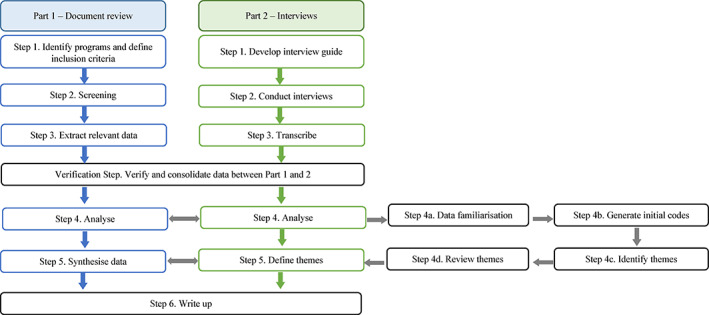
Flow diagram for a descriptive study of behaviour change science in Australian and New Zealand dietetics education programs (Source: Part 1 adapted from Rohwer and colleagues 12 and Part 2 included structured interviews and thematic analysis with program directors 13 )
Terminology used to define degrees and the unit of teachable work varies across universities. For consistency, this study used “program” to refer to the dietetics university degree and “course” for the subject/unit of learning within each teaching period (semester/trimester). The term “course outline” refers to any information regarding a course and its requirements that are taught within the curriculum (ie, learning objectives, curriculum outline and assessment).
First, the dietetics programs accredited in Australia and registered in New Zealand at the time (2020) were identified through the relevant professional association websites. Next, the research team developed a list of key terms using search terms previously applied in a recently published systematic review, 5 and accreditation standards of dietetics education programs 9 , 14 (Supplementary Table A1). Next, the lead researcher screened the publicly available course outlines for behaviour change science concepts using the key terms. Courses related to human biosciences and food science (ie, biochemistry, human biology, physiology) 9 were excluded from the screening as they were not expected to contain behaviour change science content. Professional placement courses (ie, learning experiences conducted outside the university environment) were also excluded as our focus was to explore how behaviour change science is taught within the university coursework context in a consistent way for all students within the program. The courses that explicitly included any of the primary key terms in the course outline were included for further analysis.
Data were extracted into a purpose‐developed Microsoft Excel file. A coding system anonymised identifying information. The course categorisation was developed and cross‐checked by the research team for consistency. Extracted data were collated to describe the topics related to behaviour change science. Topics directly related to behaviour change theories/models/techniques were categorised according to whether they were covered by most of the 18 universities (n = 12‐18), moderate (n = 5‐11) or minimal (n ≤ 4) number. Topics of communication and counselling skills were categorised as “secondary” as they assist in applying knowledge in behaviour change science. Learning outcomes addressing behaviour change science were reviewed against Bloom's taxonomy of cognitive learning objectives to assess the different complexities of cognitive processes required to demonstrate certain skills and abilities. 15
In Part 2, qualitative research methods were used to interview university Program Directors or their representatives. The lead researcher who conducted the interviews is a female PhD candidate and Accredited Practising Dietitian with post‐graduate experience in qualitative research, whose current research is in behavioural science in dietetics, which may have influenced the interpretation of results. She had no prior relationships with the participants except with the university's program director through which the study was conducted. The Consolidated criteria for Reporting Qualitative research checklist 16 and the APA Journal Article Reporting Standards for qualitative research 17 guided Part 2 (see Supplementary Table B1). Part 2 was approved by the Griffith University Human Research Ethics Committee (reference 2020/341).
Contact details of the Program Directors were obtained through the university websites and researcher contacts. They were emailed to invite participation, including the information and consent form detailing their requirements for the study. Program Directors were invited to participate or nominate an appropriate academic member who could best address behaviour change science content. The interview questions and summary of information found in Part 1 were sent in subsequent emails to prepare the participant for the interview. Data were collected from August 2020 to November 2020. Interviews were conducted through Microsoft Teams, Zoom or telephone. Audio data were transcribed verbatim by the lead researcher into a Word document and an automatic transcription platform, 18 and were extracted to an Excel file for analysis. Field notes were made throughout the interview process. The recruitment and interview process were pilot tested with one university to improve the interview process and guide.
The interview guide (Supplementary Table C1) was designed for the Program Directors to verify and extend findings from Part 1. Individualised questions addressed gaps in this data to describe the teaching methods and assessments available to students and the behaviour change science content of those activities. All participants were provided with the study definition of behaviour change science and invited to comment: “Behaviour change science encompasses the facilitating and influential factors that lead to a change in behaviour. This encompasses behaviour change theories and models, and the techniques and strategies that we use on a more everyday basis to support people to make changes”. 1 , 2 The four areas of inquiry adapted from Rohwer 12 that guided the interview were (1) importance/value/role of behaviour change science to dietetics education and practice; (2) what is taught; (3) what is assessed and (4) future directions. No repeat interviews were required. The transcripts were returned to participants for comment and corrections which were incorporated into a finalised transcript.
The thematic analysis involved data familiarisation, generation of codes, then to identify, review and define themes suggested by the data 13 (Figure 1), also ensuring the themes fit within the main areas of inquiry adapted from Rohwer. 12 Coding and thematic analysis were performed in Microsoft Excel by the lead researcher and cross‐checked by two other research members who were senior academic dietitians, which may have deepened and influenced the interpretation of results. Variances were discussed and conclusions made together. All authors were involved in the interpretation of the results—the two others were a senior academic dietitian (with a long history of dietetics curriculum development) and a senior behavioural scientist. After each interview transcript was finalised, the lead researcher conducted another verification process to consolidate the data from Part 1 and 2 into a cohesive table in Microsoft Excel.
3. RESULTS
In 2020, a total of 20 dietetics education programs (14 Master and 6 Bachelor) from 18 universities held full accreditation (Australia; n = 15) or registration (New Zealand; n = 3) and were included in this study (see Table 1). Within these programs, 25 courses were identified that taught behaviour change science, and 22 of these were verified through interviews. Interviews were conducted with representatives of 15 universities (12 in Australia; 3 in New Zealand). Three Australian universities did not respond to repeated recruitment efforts. Participants were all academics responsible for planning and creating course content and delivery. Interviews lasted between 23 and 56 minutes (mean 36 minutes).
TABLE 1.
Characteristics of reviewed dietetics degrees, types of courses and interviews conducted in a study exploring behaviour change science within education programs across Australia and New Zealand
| n | |
|---|---|
| University dietetics program a | |
| Masters | 14 |
| Bachelor | 6 |
| University academic interviews | |
| Interview conducted | 15 |
| Did not respond | 3 |
| Courses with BCS | 25 |
| Dietetics practice | 19 |
| Nutrition education | 3 |
| Public health nutrition | 2 |
| Interpersonal skills | 1 |
| Teaching method | |
| Workshops/simulations | 15 |
| Lectures | 14 |
| Student‐led clinic | 4 |
Abbreviation: BCS, behaviour change science.
Some universities offered both bachelor and master level programs.
Behaviour change science was primarily taught in courses relating to Dietetics Practice (ie, communication and counselling or dietetics professional skills). Some behaviour change science was integrated across other courses, such as Nutrition Education and Public Health Nutrition, with one course on Interpersonal Skills. The textbooks most used included Bauer and Liou, Nutrition counselling and education skill development, and Holli and Beto, Nutrition counseling and education skills: A guide for professionals (see Supplementary Table D1 for a complete list of textbooks).
Relevant behaviour change science topics addressed in the courses are detailed in Table 2. Topics related to behaviour change theories/models and how to implement them, counselling therapies, dietetics consultation and group nutrition education. Other topics considered secondary to behaviour change science yet still important to the application of behaviour change science included communication and counselling skills.
TABLE 2.
Summary of the behaviour change science content and teaching methods in the courses that primarily teach behaviour change science within dietetics education programs across Australia and New Zealand
| Covered mostly (12‐18 universities) | Covered moderately (5‐11 universities) | Covered minimally (4 or less universities) | |
|---|---|---|---|
| Topics and content | |||
| Behaviour change theory/models and how to implement them | TTM, stages of change. | Adult learning and education theory; health belief model; social cognitive theory. | COM‐B; control theory; dialect behavioural therapy; Michie's behaviour change wheel; operant classic and operant conditioning; process of change; psychodynamic theory; SDT; sociology and human behaviour; TPB. |
| Counselling therapies | Motivational interviewing. | CBT. | ACT; mindfulness; HAES; solution‐focused therapy. |
| Dietetics consultation | Communication and counselling skills. | NCP; Cultural awareness/ competence. | AIDET, ISBAR, DIET‐COMMS; Behaviour change technique taxonomy. |
| Group nutrition education | Small group education, facilitating education and learning for groups. | Behaviour change theories/frameworks at a group, community, public health and policy level; group development theory; socio‐ecological model for public health/ environment. | |
| Teaching methods | |||
|
Lectures Case studies: motivational interviewing; using COM‐B to understand behavioural problems; TTM; cases utilising different stages of change/motivation levels. |
Role‐plays/ simulations: practice dietetics consultations using: theories; motivational interviewing; OARS, CBT, goal setting, negotiating with client; for specific health conditions. |
Small group education planning workshops: plan small group education program, use theories and relate strategy to theory, share to class (not assessed); group education programs for specific health conditions. Student clinic: behaviour change technique taxonomy embedded; develop communication skills and individualised care plans. |
|
Abbreviations: ACT, acceptance and commitment therapy; AIDET, acknowledge, introduce, duration, explanation and thank you; CBT, cognitive behaviour therapy; COM‐B, capability, opportunity, motivation, behaviour; DIET‐COMMS, tool for measuring communication skills in patient consultations; HAES, health at every size; ISBAR, introduction, situation, background, assessment and recommendation; NCP, nutrition care process; OARS, open questions, affirmations, reflective listening, summary reflections; SDT, self‐determination theory; TPB, theory of planned behaviour; TTM, trans‐theoretical model.
Most universities (n = 12‐18) covered the trans‐theoretical model, or “stages of change”, motivational interviewing, communication and counselling skills and small group education. Between 5 and 11 universities taught adult learning and education theories, the health belief model and social cognitive theory. Some universities covered counselling therapy such as cognitive behaviour therapy and the nutrition care process, and cultural awareness/competence. The least taught (n ≤ 4) were theory of planned behaviour and self‐determination theory. Other behavioural‐related theories/models included the behaviour change wheel, COM‐B model and process of change. Few universities addressed specific counselling therapies and communication tools such as acceptance and commitment therapy and DIET‐COMMS. 19 Only two courses addressed behaviour change theory at a group, public health or policy level, and these were within Public Health Nutrition‐related courses identified.
Most universities (n = 12‐18) addressed behaviour change science topics within workshops, which focused on drawing on behaviour change theories/models/techniques and applying them to case studies (Table 2). Other examples included identifying appropriate behaviour modification techniques for clients. Between 5 and 11 universities used roleplaying to facilitate learning, including practical and simulated patients, where students played a dietitian and patients. Some roleplay included motivational interviewing, cognitive behaviour therapy and counselling simulations for various health conditions or focused on communication and counselling skills. Few universities (n ≤ 4) integrated a student‐led clinic where students developed communication skills. One university had specifically embedded a behaviour change technique taxonomy within the clinic, where students had to connect to the techniques they used.
Table 3 lists the types of assessment directly or indirectly assessing behaviour change science content in the relevant courses (see Supplementary Table E1 for further assessment details). Most universities (n = 12‐18) directly and indirectly assessed behaviour change science. Direct assessments meant the data made direct links with behaviour change science and assessments. Indirect meant the data did not explicitly state the link between behaviour change science and assessment; however, the use was implied or expected. A moderate number of universities (n = 5‐11) directly assessed behaviour change science by creating and delivering small group education sessions where students were asked to specify the behaviour change techniques and theories used or develop education plans using behaviour change theory. Other assessments included observing how well students use behaviour change techniques in student clinics. A moderate number of universities indirectly assessed behaviour change science through dietetics counselling consultations where students were required to video record a consultation, apply interpersonal skills and reflect on how to improve.
TABLE 3.
List of the assessment types where behaviour change science is assessed directly or indirectly in the courses that teach behaviour change science within dietetics education programs across Australia and New Zealand
| Assessment | Examples of how BCS is assessed | Directly a | Indirectly b |
|---|---|---|---|
| Create/deliver small group education | 10 | 1 c | |
| Test/Quizzes/exam on theoretical knowledge | 4 | 0 | |
| Simulated patients | |||
| OSCE/simulation exam | 4 | 5 | |
| In‐class consultations | 1 | 3 | |
| Case study | |||
| Nutrition education resource | 1 | 2 | |
| Final exam | 1 | 0 | |
| Dietetics consultation | |||
| Video record a consultation | 1 | 4 | |
| Other assessments/ assignments | |||
| Student clinic performance using techniques | 1 | 0 | |
| Creative assessment | 1 | 0 | |
| Personally follow a prescribed diet | 1 | 0 | |
| Total universities | 15 d | 15 | |
| Total universities with direct only | 3 | n/a e | |
| Total universities with indirect only | n/a | 3 | |
Directly: publicly available content and participants made direct links with behaviour change science and assessments.
Indirectly: publicly available content and participants did not explicitly state the link between behaviour change science and assessment, however, the use is implied or expected.
One university reported insufficient information available online to conclude whether the small group education assessment makes direct links to behaviour change theories/models and techniques.
Some universities had more than one directly related assessment.
n/a, not applicable for that row.
BCS, behaviour change science; OSCE, objective structured clinical examination
Few universities (n ≤ 4) reported assessing theoretical knowledge of behaviour change theories/models and motivational interviewing. Assessment of this theory included multiple‐choice questions, end of trimester exams or weekly quizzes. While Objective Structured Clinical Examinations (OSCE) were conducted, few directly addressed behaviour change science through assessing behaviour change counselling, using readiness to change, goal setting, confidence scales or stages of change. In most OSCEs, the assessment of behaviour change science was implied rather than explicitly making links to theories/models, as students were marked on patient‐centredness or their communication and counselling skills. Few universities used assessments through in‐class simulated patient consultations where students conducted a consultation using communication and counselling strategies or demonstrated counselling or communication skills.
There were 141 publicly available learning objectives across the 25 courses (Table 4). The learning objectives that directly related to behaviour change science accounted for 16.3% of all objectives. They were mostly at the “apply” cognitive level of Bloom's taxonomy, with a few at higher levels related to creating nutrition group education plans. Almost half of the learning objectives related to communication and counselling skills (47.6%).
TABLE 4.
A total number of universities with learning objectives directly related to behaviour change and level of Bloom's Taxonomy in the courses that teach behaviour change science within dietetics education programs across Australia and New Zealand
| Total university | ||
|---|---|---|
| Learning objectives directly related to behaviour change theories/ models/ techniques a | 14 | |
| Example learning objectives | ||
| Remember | Describe behaviour change and counselling techniques that relate to the dietetics consultation | 3 |
| Understand | n/a | 0 |
| Apply | Employ principles of behaviour change, counselling and learning in the provision of nutrition care for individuals and groups | 11 |
| Analyse | Critically analyse behaviour change theory in food and nutrition contexts | 3 |
| Evaluate | Describe and compare individual and environmental models explaining health behaviour | 1 |
| Create | Develop group education programs centred on behaviour change theory | 3 |
| Learning objectives related to communication and counselling skills b | 18 | |
| Example learning objectives | ||
| Remember | Describe the principles and styles of communication, including elementary counselling with individuals, groups, populations and other professionals. | 2 |
| Understand | Communicate specialist knowledge effectively with a diverse range of clients and colleagues | 3 |
| Apply | Display effective active listening, interviewing and interpersonal skills. | 15 |
| Analyse | Assess the effectiveness of communication and counselling approaches. | 1 |
| Evaluate | Evaluate varying nutritional needs, growth and development and human behaviour across the lifespan consistent with the best available evidence. | 3 |
| Create | Create individualised nutrition care plans for a diverse range of individuals. | 8 |
Exact key terms extracted from the learning objectives related to behaviour change theories/ models/ techniques: adult learning/education theory, behaviour change theory, behaviour change and counselling techniques, counselling strategies, health promotion theoretical frameworks, individual and environmental models explaining health behaviour, motivational models of counselling, nutrition counselling strategies and techniques grounded in learning and behaviour change theories, nutritional counselling theory, nutrition education program development and behaviour change management.
Exact key terms extracted from the learning objectives related to communication and counselling skills: client‐centred communication and counselling, client‐centred oral and written communication strategies, communication skills, counselling skills, translate technique scientific information.
The behaviour change science definition provided in the interview (see Methods) was perceived by some participants to be broad yet comprehensive, with additional suggestions offered. One participant mentioned, “I see it as much more about the application of those [behaviour change theories/models] more so than just understanding others” (P09), and another mentioned, “educational theories” (P13) being important as well. One participant said it might be context‐specific, “how we might incorporate that into dietetics may mean a different thing in the context of dietetics versus as if it was in the context of a psychology degree” (P07), illustrating the importance of understanding and defining behaviour change science in the context of the dietetics profession.
Five themes were identified from the 15 interviews with dietetics academics, describing their perspectives on behaviour change science and dietetics. In theme 1, behaviour change science should be foundational, all participants strongly advocated the importance of behaviour change science to the dietetics profession, saying it is fundamental to education and that “it should be foundational” (P10). Some academics discussed patient‐centredness and the role of dietitians in providing individualised care. These participants said students need to learn the skills to understand patients and see that behaviour change science is embedded within that interaction. One mentioned, “It's not emphasised enough as a role as a dietitian and not taught enough within the degree” (P12). One aspect that stood out was the common understanding that behaviour change science extends beyond working with individual clients and is an essential skill that is “applicable to every human engagement that you have as a professional” (P01). One participant said, “It's not just about being told what to eat, and it's not just about nutrition. It has a very strong place in dietetics practice because that's a skill that we can actually offer to the community” (P04). Several participants mentioned that dietitians might intuitively use behaviour change strategies, but understanding the science behind it might be lacking, or that “we as dietitians don't delve enough into the science of it” (P12).
In theme 2, integrate and scaffold within curricula, participants most consistently reported the need for scaffolding behaviour change science teaching from the beginning to the end of the degree. The university programs that scaffolded the content did so by introducing basic concepts and theories, which were then expanded on in subsequent courses and used in different contexts (ie, individual or groups, individual case management or public health). Some mentioned wanting to assess behaviour change science more directly by adjusting marking guides for simulations or assessments to include more self‐recorded interviews with accompanying reflections on performance. One participant suggested integrating dietetics learning with psychology, where students could complete a short certificate qualification additional to their dietetics degree.
Theme 3 was structural limitations within curricula. There was a consensus that participants wanted to do more with curricula teaching of behaviour change science but mentioned experiencing limitations or barriers. The most prominent barrier discussed was time constraints of the program, especially in Master level degrees, stating the curricula are “overloaded”, “tight” and that “there isn't room in the curriculum to add it in” (P08). Some participants described how adding more content is limited by the structure of the university or only having room for one course, “I think it is something that could definitely be expanded if we had more time and if we didn't have to do everything else” (P03). The knowledge of the academics/educators was also mentioned as a barrier to confidently teaching behaviour change science. Others emphasised the need for a global appreciation for behaviour change science amongst colleagues and the profession to continue conversations on these topics. Some participants discussed financial barriers to including simulated patient activities. A couple mentioned there was already sufficient emphasis due to behaviour change science content and assessment being integrated and scaffolded across the years and not dedicated to one course. A common opinion discussed was the sense of limited control to make curricula changes which they felt stemmed from needing to meet accreditation standards. However, the specifics of these challenges were not further discussed, “We are really tied to meeting the guidelines that the DAA [sic] accreditation board mandates from us” (P12).
In theme 4, challenging for students, most of the perceived challenges described by participants involved placement. Participants discussed the limited exposure students have on clinical placements, which are primarily conducted in acute care settings where there were few opportunities for behaviour change counselling compared with private practice or outpatient settings. Another challenge involved the ability of academic staff to ensure that supervisors reinforce behaviour change science to the students: “How much are students going to be able to practise the skills they've learnt and be prompted to as well, and reinforced around it, it is going to depend a lot on supervisors that they have” (P14). Finally, a few participants talked about how students' focus and emphasis on the nutrition assessment process (ie, anthropometry, biochemistry, social history) means less focus on communication and counselling.
One participant mentioned that students do not see the application and importance of what they have learnt until placement, “I think the challenge is teaching it in a way that's going to engage the students where they really see that relevance” (P02). Another wanted to provide students with more personal experiences at university; however, large classes limited their ability to do so. The university setting was seen as being most appropriate to practise and assess the skills before placements, “It's easier for us to assess whether or not they are actually using this stuff they learned the year before in the clinic setting because then we can observe that more closely” (P15).
Theme 5 involved recommendations for competencies. Participants mentioned that dietetics competencies are “broad”, and the role of dietitians is complex. All the participants agreed that behaviour change science should be part of the competencies, either explicitly stated or integrated somehow. Some participants discussed that students demonstrate competence within assessments; therefore, having behaviour change science within competencies could allow assessments to be more explicit or direct. One participant discussed the importance of students self‐reflecting in the final stages of their degree to solidify the behaviour change science learning in their foundational years and demonstrate how they have applied it in practice. However, specific strategies to increase behaviour change science or address gaps within the current competencies were not raised by participants.
4. DISCUSSION
This paper adds to the literature on behaviour change science in allied health professional curricula 10 and broadens the evidence base by exploring all Australian and New Zealand dietetics education programs. The curricula reviewed in this study showed the range of behaviour change science topics and teaching methods across all university programs, including the wide variety of assessment types. The interviews highlighted potential areas in curricula where behaviour change science can be enhanced; however, the participants discussed barriers to embedding more content.
Participants advocated behaviour change science as being relevant beyond individual dietetics care. While behaviour change science was primarily addressed in courses related to Dietetics Practice, it also appeared in public health nutrition. Many participants discussed the need to “scaffold” the content earlier and integrate it across several courses. As dietetics is focused on demonstrated competence, 3 , 4 there are uncertainties as to whether behaviour change science concepts must be taught before students demonstrate application and are assessed. Integrating behaviour change science content across curricula is possible, having been achieved in the context of physiotherapy 10 and evidence‐based medicine for medical schools. 20 Behavioural medicine competencies and content were successfully scaffolded within the physiotherapy curricula by focusing on foundational knowledge (first year), assessment of clients (second year), then treatment and evaluation (third year). 10 Some of the dietetics programs in this study seemed to be teaching and assessing more content than others. Those universities with less content could follow a similar format, where students learn behaviour change science concepts across multiple courses in their degree and apply that knowledge to various contexts to consolidate learning.
Most of the learning activities regarding behaviour change science took place within workshops using roleplays and simulated patients. The majority of learning objectives related to behaviour change science was at the level of apply or higher in Bloom's taxonomy (rather than requiring a level of remembering or understanding), which encourages demonstrated learning and practical‐based tasks 15 and is reflective of the competency standards. 3 , 4 An observational study of third‐year dietetics students found that repeated simulated patient engagements resulted in modest improvements in student communication skills. 21 However, the cost and resources involved in hiring simulated patients may challenge the ability to provide frequent practice opportunities. 21 Participants discussed financial barriers, particularly associated with reduced course budgets due to the COVID‐19 pandemic. Therefore, including more peer‐assisted and roleplay learning may be a cost‐effective alternative allowing students to learn and apply these skills.
The predominant theories and counselling approaches of the transtheoretical model and motivational interviewing were taught in most of the included programs. In contrast, social cognitive theory and self‐determination theory were not covered extensively. The systematic review of theory‐based dietetic randomised controlled trials by Rigby and colleagues' published in 2020 identified that social cognitive theory underpinned 79% of included study interventions 5 ; compared with a review a decade earlier, where only two of 89 included studies were informed by social cognitive theory. 22 Rigby and colleagues found a fair grade of evidence for social cognitive theory to underpin intervention design by dietitians, with 73% of studies showing positive intervention effects. 5 Social cognition models lend themselves well to group settings. 23 Dietetics academics may wish to consider incorporating social cognitive‐type theories into the curricula as the assessments for small‐group education identified in this study required students to draw on theories learnt in class. Teaching theories on volitional phases (ie, Health Action Process Approach) or implicit processes (ie, habit theory) are beneficial as they extend common motivational theories. 24 Learning theories have also been found to be important in underpinning simulated‐based learning in dietetics education. 25 These results suggest that academics need to remain current with developments in behaviour change science theory in order to teach models that are at the cutting edge of practice. Liaising with psychology academics who are familiar with the latest behaviour change science literature could assist in this process.
Behaviour change science was viewed as fundamental to dietetics with some participants reporting they wanted to add behaviour change science content but felt their curriculum was already overloaded. The use of concept‐based approaches, which are “mental constructs of one or two‐word nouns, or short phrases”, 26 (p2) would allow behaviour change science content to be added without overloading curricula. Some participants expressed a lack of confidence in teaching behaviour change science. One way to enhance confidence may be to add expertise from psychology and human behaviour. The few participants who already had the input of psychologists reported they valued their expertise, again suggesting there is an opportunity to liaise with psychology/behavioural science academics for dietetics curricula development. Another means to increase educator confidence and currency of models would be the use of a resource such as the 2020 'Handbook of Behavior Change'. 27
Participants described behaviour change science as important to dietetics education and practice and felt that it should be reflected in the dietetics competency standards, but views on how this could be best achieved varied. Competency standards were seen as broad and aimed at capturing demonstrated learning. 3 , 4 The New Zealand dietetics competency standards address behaviour change science in the statement “apply principles of behavioural psychology, counselling and learning” (Standard 2.2.1). 4 Other allied health professions, such as exercise physiology, 28 and social work, 29 have incorporated behaviour change science‐related terms into their practice or professional standards. There is the opportunity to embed behaviour change or psychology practices into the dietetics National Competency Standards more explicitly to influence curricula development. The next revision of the Australian National Competency Standards will be released in 2021. 3
The document review of 18 university curricula and 15 interviews with dietetics academics enabled a detailed overview of behaviour change science in dietetics education programs. However, it is acknowledged that the results are a description of the content taught within the 25 specific courses where the foundational knowledge of behaviour change science was identified to be taught and is not reflective of all dietetics content. Data from three of the 25 identified courses could not be verified due to non‐participation in interviews. There was the possibility of response bias, as all participants were involved with teaching the courses and strongly advocated for behaviour change science, resulting in favourable answers. Not all components of Rohwer's triangulation 12 were completed, as interviews with students were not conducted. Future research needs to explore how students practise on placement or whether student and graduate dietitians take the initiative to upskill in behaviour change counselling during or after their dietetics degree. An interpretive study grounded in social constructivism could explore how behaviour change science has been constructed within university curricula from academics' perspectives. We suggest such a study be conducted from people with a more independent positioning on dietetics curricula.
This study has provided a comprehensive picture of how behaviour change science is currently addressed within the curricula of dietetics education programs in Australia and New Zealand. It is apparent that behaviour change science is valued by academic professionals and seen as playing an essential role in dietetics education and practice. Further opportunities to strengthen curricula have been identified. Ensuring that students have an adequate understanding of behaviour change science through teaching, learning and assessment within their dietetics education programs can generate graduates with the confidence to approach patients to help facilitate behaviour change for a range of health‐related conditions.
CONFLICT OF INTEREST
Lauren Williams is a member of the Australian Dietetic Council responsible for accrediting dietetics programs in Australia.
AUTHOR CONTRIBUTIONS
Roshan Rigby contributed to the conception and design of the research, the collection and analysis of the data and created the original draft and reviewed and edited subsequent versions. All authors contributed to the design of the research, to the analysis and interpretation of the data and to writing, reviewing and editing. All authors agree with the final manuscript being submitted.
Supporting information
Supplementary Table A1: The primary and secondary key terms used in the second screening stage of a document analysis of behaviour change science content delivered in Australian and New Zealand dietetics education programs.
Supplementary Table B1: Consolidated criteria for reporting qualitative studies (COREQ): 32‐item checklist for a qualitative investigation of behaviour change science content delivered in Australian and New Zealand dietetics education programs.12
Supplementary Table C1: Interview guide investigating behaviour change science content delivered in Australian and New Zealand dietetics education programs.
Supplementary Table D1: List of only the most recent versions of recommended textbooks required for each course type in the courses that teach behaviour change science within dietetics education programs across Australia and New Zealand.
Supplementary Table E1: Details of the assessment types and examples of how behaviour change science is assesed directly or indirectly through application in the courses that teach behaviour change science within dietetics education programs across Australia and New Zealand.
Rigby RR, Williams LT, Ball L, Hamilton K, Mitchell L. Is there enough behaviour change science in nutrition and dietetics curricula in Australia and New Zealand? A descriptive study. Nutrition & Dietetics. 2022;79(5):636-646. doi: 10.1111/1747-0080.12704
REFERENCES
- 1. Michie S, Johnston M. Theories and techniques of behaviour change: developing a cumulative science of behaviour change. Health Psychol Rev. 2012;6(1):1‐6. [Google Scholar]
- 2. Michie S, West R, Campbell R, Brown J, Gainforth H. ABC of Behaviour Change Theories. Sutton: Silverback Publishing; 2014. [Google Scholar]
- 3. Dietitians Australia. National Competency Standards for Dietitians in Australia: Dietitians Australia; 2015. https://dietitiansaustralia.org.au/wp-content/uploads/2020/11/NCS-Dietitians-Australia-with-guide-1.0.pdf.
- 4. Dietitians Board . Professional Competencies & Standards for Dietitians Wellington: Dietitians Board; 2017. https://www.dietitiansboard.org.nz/Portals/12/Professional%20Standards%20and%20Competencies%20for%20Dietitians%20Web%20Version.pdf.
- 5. Rigby RR, Mitchell L, Hamilton K, Williams LT. The use of behavior change theories in dietetic practice in primary health care: a systematic review of randomized controlled trials. J Acad Nutr Diet. 2020;120(7):1172‐1197. [DOI] [PubMed] [Google Scholar]
- 6. Rapoport L, Perry KN. Do dietitians feel that they have had adequate training in behaviour change methods? J Hum Nutr Diet. 2008;13(4):287‐298. [Google Scholar]
- 7. Zinn C, Schofield G, Hopkins WG. Management of adult overweight and obesity: consultation characteristics and treatment approaches of private practice dietitians. Nutr Diet. 2012;70(2):113‐119. [Google Scholar]
- 8. Victorian Department of Health and Human Services . Dietetics Workforce Report. Melbourne; 2018. [Google Scholar]
- 9. Dietitians Association of Australia . Accreditation Standards for Dietetics Education Programs Version 2.0. Deakin, Australia: Dietitians Association of Australia; 2017. https://daa.asn.au/wp-content/uploads/2016/06/DAA-Accredition-Standards-2017-1.pdf. [DOI] [PubMed] [Google Scholar]
- 10. Sandborgh M, Dean E, Denison E, et al. Integration of behavioral medicine competencies into physiotherapy curriculum in an exemplary Swedish program: rationale, process, and review. Physiother Theory Pract. 2018;36(3):365‐377. [DOI] [PubMed] [Google Scholar]
- 11. Bradshaw C, Atkinson S, Doody O. Employing a qualitative description approach in health care research. Global Qual Nurs Res. 2017;4:1‐8. [DOI] [PMC free article] [PubMed] [Google Scholar]
- 12. Rohwer A, Schoonees A, Young T. Methods used and lessons learnt in conducting document reviews of medical and allied health curricula—a key step in curriculum evaluation. BMC Med Educ. 2014;14(1):236. [DOI] [PMC free article] [PubMed] [Google Scholar]
- 13. Braun V, Clarke V. Using thematic analysis in psychology. Qual Res Psychol. 2006;3(2):77‐101. [Google Scholar]
- 14. Dietitians Board . Accrediation Standards for New Zealand Dietetic Education Programmes: Wellington, New Zealand: Dietitians Board; 2018. https://www.dietitiansboard.org.nz/wp-content/uploads/2019/04/NZDB-Accred-Standards-Online.pdf. [Google Scholar]
- 15. Krathwohl DR, Anderson LW. A Taxonomy for Learning, Teaching, and Assessing: A Revision of Bloom's Taxonomy of Educational Objectives. New York, NY: Longman; 2009. [Google Scholar]
- 16. Tong A, Sainsbury P, Craig J. Consolidated criteria for reporting qualitative research (COREQ): a 32‐item checklist for interviews and focus groups. Int J Qual Health Care. 2007;19(6):349‐357. [DOI] [PubMed] [Google Scholar]
- 17. Levitt HM, Bamberg M, Creswell JW, Frost DM, Josselson R, Suarez‐Orozco C. Journal article reporting standards for qualitative primary, qualitative meta‐analytic, and mixed methods research in psychology: the APA publications and communications board task force report. Am Psychol. 2018;73(1):26‐46. [DOI] [PubMed] [Google Scholar]
- 18. Otter.ai . My Conversations. California (US); 2021. https://otter.ai/. [Google Scholar]
- 19. Whitehead KA, Langley‐Evans SC, Tischler VA, Swift JA. Assessing communication skills in dietetic consultations:the development of the reliable and valid DIET‐COMMS tool. J Hum Nutr Diet. 2014;27:321‐332. [DOI] [PubMed] [Google Scholar]
- 20. Blanco MA, Capello CF, Dorsch JL, Perry GJ, Zanetti ML. A survey study of evidence‐based medicine training in US and Canadian medical schools. J Med Libr Assoc. 2014;102(3):160‐168. [DOI] [PMC free article] [PubMed] [Google Scholar]
- 21. Gibson S, Davidson Z. An observational study investigating the impact of simulated patients in teaching communication skills in preclinical dietetic students. J Hum Nutr Diet. 2016;29(4):529‐536. [DOI] [PubMed] [Google Scholar]
- 22. Spahn JM, Reeves RS, Keim KS, et al. State of the evidence regarding behavior change theories and strategies in nutrition counseling to facilitate health and food behavior change. J Am Diet Assoc. 2010;110(6):879‐891. [DOI] [PubMed] [Google Scholar]
- 23. Bandura A. Social foundations of thought and action. The Health Psychology Reader. Englewood Cliffs, NJ: Prentice Hall; 1986:94‐106. [Google Scholar]
- 24. Schwarzer R, Hamilton K. Changing behavior using the health action process approach. In: Hamilton K, Cameron LD, Hagger MS, Hankonen N, Lintunen T, eds. The Handbook of Behavior Change. Cambridge Handbooks in Psychology. Cambridge: Cambridge University Press; 2020:89‐103. [Google Scholar]
- 25. O'Shea MC, Williams LT, Rogers G, Palermo C, Cardell E. It's time to link theory to practice in simulation‐based learning: lessons from learning theories. J Acad Nutr Diet. 2021. 10.1016/j.jand.2021.06.011 [DOI] [PubMed] [Google Scholar]
- 26. Tweedie J, Wright HH, Palermo C, Pelly FE. Key concepts for dietetic curriculum: an observational study of Australian dietitians' perceptions. Nutr Diet. 2021;1‐9. [DOI] [PubMed] [Google Scholar]
- 27. Hagger MS, Cameron LD, Hamilton K, Hankonen N, Lintunen T. Handbook of Behavior Change. New York, NY: Cambridge University Press; 2020. [Google Scholar]
- 28. ESSA . Accredited Exercise Physiologist Professional Standards 2015. https://www.essa.org.au/wp-content/uploads/2016/12/AEP-Professional-Standards-with-coverpage_approved.pdf.
- 29. Australian Association of Social Workers . Practice Standards. 4 Knowledge for Practice. Canberra: Australian Association of Social Workers; 2013. [Google Scholar]
Associated Data
This section collects any data citations, data availability statements, or supplementary materials included in this article.
Supplementary Materials
Supplementary Table A1: The primary and secondary key terms used in the second screening stage of a document analysis of behaviour change science content delivered in Australian and New Zealand dietetics education programs.
Supplementary Table B1: Consolidated criteria for reporting qualitative studies (COREQ): 32‐item checklist for a qualitative investigation of behaviour change science content delivered in Australian and New Zealand dietetics education programs.12
Supplementary Table C1: Interview guide investigating behaviour change science content delivered in Australian and New Zealand dietetics education programs.
Supplementary Table D1: List of only the most recent versions of recommended textbooks required for each course type in the courses that teach behaviour change science within dietetics education programs across Australia and New Zealand.
Supplementary Table E1: Details of the assessment types and examples of how behaviour change science is assesed directly or indirectly through application in the courses that teach behaviour change science within dietetics education programs across Australia and New Zealand.