



Abstract
Purpose:
Several factors influence medical students to choose a specialty branch for post-graduate training, and it is important to understand them so that strategies can be made to make it more attractive and hence the shortage in the workforce can be addressed. This study aimed to identify the factors that influenced under-graduate medical students to choose ophthalmology as their specialty for post-graduate training.
Methods
It was a descriptive, cross-sectional, questionnaire-based study, carried out among medical students at a tertiary academic institute in eastern India. In this survey tool, 25 questions were divided into different sections: demographic data, factors influencing the choice and perceptions about ophthalmology as a career option, and the impact of rotatory internship posting on the choice of subject. The various factors were then scored and indexed appropriately.
Results
There were 515 participants. The median age was 23 years. The major influencing factor for choosing ophthalmology was “adequate time” (52.04%), and the discouraging factor was “steep learning curve” (58.64%). Age had an odds ratio of 0.781, showing that the lower the age, the higher the chances of being positively inclined toward ophthalmology as a career choice. Similarly, major deciding factors, perceptions, and experiences in ophthalmology had odds ratios of 1.841, 1.725, and 2.057, respectively, showing a positive inclination.
Conclusion
The study states that a steep learning curve, personal attitudes, and misconceptions may dissuade the students from taking this subject, but adequate clinical exposure and experience, as well as role models during the internship, can create a positive impact on career choice.
Keywords: Career, internship, lifestyle, medical graduates, ophthalmology
Medical science is a dynamic field with expanding knowledge, fast advancements in technology, innovations, and research.[1] This has inevitably led to specialization and super-specialization in various fields, and it is also assumed that medical students make their choice after graduation.[2] Recent literature reports a changing trend in the preferred choice of medical students toward training in non-surgical fields such as radiology, dermatology, and psychiatry other than general surgery and internal medicine.[2] This transition reflects their lifestyle changes with a preference for a more personal time, flexible working hours, financial aspirations, non-rural postings, corporate practice, and job security. Common factors such as personality and gender also affect the choice of sub-specialty among medical students, but the extent of its influence is still to be explored.[3,4]
Ophthalmology is an attractive surgical branch with a competitive entry for training.[4] Despite its popularity, there are various factors such as limited exposure during the under-graduate curriculum, different teaching styles, and the lack of role models and supportive societies, which act as barriers to purse it as career growth.[5,6,7,8] Furthermore, ophthalmology is also an innovative specialty with fast growth in technology and ever-evolving advancements, which requires a long learning curve for success.
There is an imbalance in the specialist-trained physicians in different countries more marked in developing countries. Around one-fifth of the world’s blind population live in India. This becomes a greater problem in a country such as India, where there are only 25,000 ophthalmologists who mainly practice in urban areas.[9] In USA, the ratio of an ophthalmologist to the population is 1: 15,800, whereas in India, it is 1:1,00,000 per person.[9,10] This reflects the state of unequal distribution and shortage of ophthalmologists for eye care services in India. In the western world, ophthalmology is looked upon as a specialty with good career and job opportunities as well as financially rewarding. The question that arises is whether this is the real reason or if there is more in this scenario that needs to be explored. Also, there is a paucity of literature to state the facts on the attitude and preference pattern for sub-speciality choice, especially in India; hence, there is a need for conducting this study.
A lot of research studies are being conducted to figure out the career choices among medical under-graduates and find the link with their personality traits, academic interest, competency skills, and other background factors affecting their choices.[6,7,8,11,12] This study will therefore help to find the factors motivating and dissuading the under-graduate medical students from choosing ophthalmology as their subject of specialization. Furthermore, these data can be the basis to bring certain changes during internship rotation postings to develop interest and also create awareness about the job market and research opportunities in ophthalmology.
Methods
It was a descriptive, cross-sectional, questionnaire-based study, carried out in a central institute and adjoining state medical colleges in the eastern part of India. The data were collected for a period of 6 months from January 2021 to August 2021. All under-graduate medical students who had completed or underwent rotatory internship posting in ophthalmology were eligible for this study.
A questionnaire-based survey tool was designed for this study after consultation with experts and adapted from similar studies conducted worldwide.[5,8,11,13] In this survey tool, there were 25 questions which were divided into five sections:
Demographic data of participants
Factors influencing the choice of ophthalmology as a career option
Perception of ophthalmology as a career option and field of practice
Previous experience concerning research and community service in ophthalmology
Impact of rotatory internship posting on the choice of subject.
The survey was subjected to a pilot trial on 20 medical students doing internships at the author’s institute after it was validated by external experts on the subject. An e-mail survey was conducted on the medical students of the author’s institute and also sent to medical students who had completed or were doing an internship in different institutes in eastern India. A reminder e-mail was sent after 3 months, and written consent was obtained from the participants.
A total of 515 medical graduates who completed the survey were included in the study. This study was approved by the Institutional Ethics Committee and was conducted as per the rules of the Declaration of Helsinki.
Statistical analysis
The data entry was performed using MS Excel (ver. Office 365). All statistical analyses were performed using SPSS version 26 (IBM Corporation, New York, USA). Based on the questionnaire, the data collected from the medical students were categorized into four broad categories with group-wise total scores of the following:
Major deciding factors for opting for ophthalmology as a career: Questions 10 and 11 [maximum possible score (MPS): 8]
Influencing factors for opting for ophthalmology as a career: Questions 11–31 (MPS: 18)
Perception toward ophthalmology as a career: Questions 32 and 33 (MPS: 18)
Experiences in ophthalmology during UG posting/rotation: Questions 34–41 (MPS: 16).
The basic demographic profile, information on under-graduate (UG) college and batch, the presence of any relative in the medical profession, and influence of parents on professional choices were factored individually.
Any choice higher than or equal to the third choice in favor of ophthalmology was considered a positive inclination toward ophthalmology as a career. For individual questions, the answers were grouped as favorable toward ophthalmology as a career choice and were indexed as 1 if positive or 0 if negative. Similarly, for each category, a score was calculated. Consequently, a category index was computed as a binary variable (1 or 0 for a positive inclination or negative inclination, respectively) by considering a score of more than 50% of the maximum possible score for the category as a positive inclination.
Data were expressed in terms of the median [inter-quartile range (IQR)], and non-parametric tests were used. Kendall’s tau and Spearman’s rho were used to determine the correlation between the various scores and other factors. The Chi-Square test was used to determine any significant differences in the two groups for dichotomous data, and the Mann–Whitney U test was used for continuous data. Logistic regression was performed to find the significant model to determine the choice of career along with the odds ratio.
Results
A total of 515 medical students participated in this study. The median age of the study population was 23 years (ranging from 22 to 24 years). Around 306 (59.4%) of the participants were from different state medical colleges, whereas 209 (40.6%) were from the central institute. There were 341 (66.2%) of the students who did not have a doctor in the family, and only a few students (n = 179, 34.8%) were influenced by their parents to choose a specialty. Only eight (1.6%) were self-motivated to choose ophthalmology as their first career option, whereas 70 (13.6%) did not want to pursue it at all. The other demographic data are described in Table 1.
Table 1.
Demographic Data of the Study Population
| n [N=515] | % | |
|---|---|---|
| Gender | ||
| Male | 283 | 54.9 |
| Female | 232 | 45.1 |
| Affiliation | ||
| State Government/Private | 306 | 59.4 |
| Central Government | 209 | 40.6 |
| State of College | ||
| Odisha | 337 | 65.4 |
| West Bengal | 52 | 10.1 |
| Assam | 51 | 9.9 |
| Andhra Pradesh | 25 | 4.9 |
| Chhattisgarh | 16 | 3.1 |
| Jharkhand | 34 | 6.6 |
| Marital Status | ||
| Married | 4 | 0.8 |
| Unmarried | 511 | 99.2 |
| Location of Institute | ||
| Rural | 36 | 7.0 |
| Urban | 479 | 93.0 |
| Are there any doctors in family? | ||
| No | 341 | 66.2 |
| Yes | 174 | 33.8 |
| Do your parents influence your PG choice? | ||
| No | 336 | 65.2 |
| Yes | 179 | 34.8 |
| Preference to join ophthalmology in counseling | ||
| Do Not Want To Join | 70 | 13.6 |
| First Choice | 8 | 1.6 |
| Second Choice | 69 | 13.4 |
| Third Choice | 60 | 11.7 |
| Fourth Choice | 82 | 15.9 |
| No Preference, But Will Join If Selected | 226 | 43.9 |
The major deciding factors for choosing ophthalmology were based on the choices the students made when surveyed as to why or why not they preferred ophthalmology as a subject for post-graduation. The reason that was the most against ophthalmology was that it had a steep learning curve (n = 302, 58.6%). However, it is also a subject that will offer ample personal time (n = 268, 52.0%) while providing for a good financial scope (n = 247, 47.9%), which were the reasons for choosing it as detailed in Fig. 1. Only a few agreed to the question that getting into the PG Ophthalmology course was easy (n = 100, 19.4%), whereas a majority believed that there is an increased workload during the residency training (n = 352, 68.4%).
Figure 1.

Major deciding factors for choosing ophthalmology as a career
The factors mostly influencing choosing ophthalmology were mostly the uniqueness of the branch offering both medical and surgical opportunities which can be gratifying (n = 480, 93.2%). There was a scope to work in the urban area (n = 480, 93.2%) and start private practice (n = 444, 86.2%) as well as hold a prestigious job in medical colleges and institutions (n = 421, 81.8%). Role models and mentors also had an impact on students’ choices (n = 449, 87.2%). The other factors studied have been summarized in Fig. 2.
Figure 2.

Factors influencing choice of ophthalmology as a career among the students
Perceptions regarding ophthalmology and the various other factors affecting it were also studied. The requirement of fine motor skills, stereoscopic depth perception, and rapidly advancing surgical techniques were certain pre-conceived notions that were the major driving factors that influenced the decision making most. Furthermore, medical graduates agreed that ophthalmology is a broad specialty with multiple sub-specialties in it (n = 360, 70.0%). They also agreed that it needs to be integrated with primary health care services routinely as shown in Fig. 3.
Figure 3.

Perception of students toward ophthalmology as a career choice and a field for future practice
The majority of participants did not have adequate experience in working and learning in ophthalmology as evidenced by almost 80.0% of participants saying that they did not have the opportunity to do research work, 69.0% did not have any chance of working in project work, and 79.0% never participated in community service activity. Even though 62.0% of participants feel that their training was more than average, only 31.0% were interested and attended ophthalmology-related seminars and grand rounds. However, only 10.5% of the students rated their experience during rotation as poor, and the rest viewed it positively. The effects of experiences based on participation in department-related activities as well as the impact are shown in [Fig. 4a and b].
Figure 4.

(a and b) Experiences gained during ophthalmology compulsory internship rotation for the students
Using Spearman’s correlation coefficient, the correlation between the various parameters and the cumulative score of the career option index was performed. Age had a negative correlation, meaning that younger students were more interested in picking up ophthalmology as a career in this study. Similarly, a positive correlation was found for all the three indices that were calculated. This has been tabulated in Table 2.
Table 2.
Correlation Matrix for Various Variables with Ophthalmology As a Career Option Index
| Variable | Correlation Coefficient | P |
|---|---|---|
| Age | -0.118 | 0.008 |
| Gender | -0.042 | 0.345 |
| Marital Status | 0.003 | 0.942 |
| Location Of Institution | -0.007 | 0.869 |
| Any Doctor In Family? | 0.044 | 0.321 |
| Parents Influencing PG Choice | -0.033 | 0.449 |
| Score for Major Deciding Factor For Opting Ophthalmology As A Career |
0.157 | < 0.001 |
| Index for Major Deciding Factor For Opting Ophthalmology As A Career |
0.133 | 0.003 |
| Score for Influencing Factor For Opting Ophthalmology As A Career |
0.062 | 0.157 |
| Index for Influencing Factor For Opting Ophthalmology As A Career |
0.034 | 0.445 |
| Score for Perception Toward Ophthalmology As A Career: |
0.084 | 0.056 |
| Index for Perception Toward Ophthalmology As A Career |
0.116 | 0.009 |
| Score For Experiences In Ophthalmology During UG Posting/Rotation |
0.153 | <0.001 |
| Index For Experiences In Ophthalmology During UG Posting/Rotation |
0.139 | 0.002 |
As per the scores obtained in the various indices, logistic regression was performed to determine the odds of the indices with the inclination of the students toward choosing ophthalmology as a future career as well as a post-graduation residency option. Age had an odds ratio of 0.781 (0.662–0.921 CI), showing that the lower the age, the higher the chances of being positively inclined toward ophthalmology as a career choice. Similarly, the major deciding factors, perceptions of ophthalmology, and experiences in ophthalmology had odds ratios of 1.841 (1.236–1.735 CI), 1.725 (1.145–2.600 CI), and 2.057 (1.308–3.235 CI), respectively, which showed a positive inclination for the subject. The binary logistic regression of parameters with adjusted and unadjusted odds ratios has been detailed in Table 3.
Table 3.
Binary Logistic Regression of parameters with unadjusted and adjusted Odds Ratio
| Parameter | B | P | Unadjusted Odds Ratio (95% CI) | Adjusted Odds Ratio (95% CI) |
|---|---|---|---|---|
| Age | -0.260 | 0.002 | 0.781 (0.662-0.921) | 0.771 (0.52-0.911) |
| Index for Major Deciding Factor For Opting Ophthalmology As A Career | 0.754 | 0.000 | 1.841 (1.236-1.735) | 2.126 (1.401-3.222) |
| Index for Perception Toward Ophthalmology As A Career: | 0.617 | 0.001 | 1.725 (1.145-2.600) | 1.854 (1.204-2.854) |
| Index For Experiences In Ophthalmology During UG Posting/Rotation | 0.612 | 0.005 | 2.057 (1.308-3.235) | 2.262 (1.403-3.614) |
The end point of the analysis of the questionnaire scores was based on whether a particular participant has an overall positive or negative inclination toward the ophthalmology. When the cumulative scores of all the questions in the sub-grouping of the questionnaire, which aimed at determining “External Influences” and “Perception Toward Ophthalmology”, were analyzed, no significant difference in these scores was found between the two groups. However, experiences drawn from the under-graduate career were significantly different. When the major deciding factors as per the questionnaire were considered, they were also significantly different between groups divided according to their inclination. The various indices were also compared to see for correlation among them using Kendall’s tau. The only significant correlation was between the deciding index and perception index (-0.126, P < 0.001). The rest have been summarized in Fig. 5.
Figure 5.
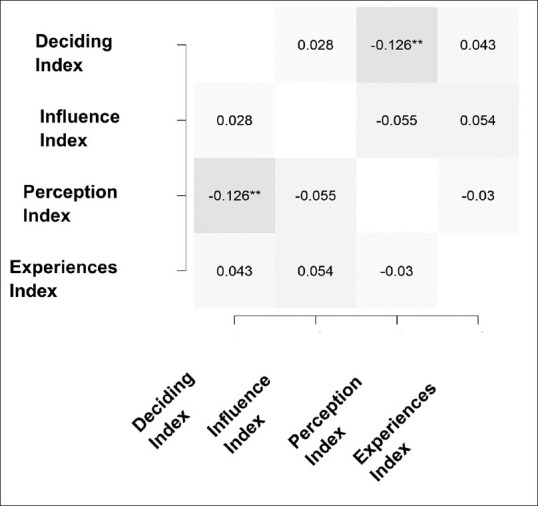
Heatmap of correlation between the various calculated and assessed indices
Discussion
Our study aimed at analyzing the trend of choices among under-graduate medical students regarding their interest in opting for ophthalmology as a post-graduate specialization and career choice. Age was an important deciding factor as the year of age increased the students’ choice of ophthalmology gradually decreased (B = -0.260, OR = 0.771, P = 0.002). Various studies have reported gender differences in the selection of specialty branches. The study by Madani et al. and Hamid et al. reported that female medical students showed a preference for ophthalmology more than males, whereas Iftikar et al. did not find any gender preference in their study which is similar to our findings.[13,14,15]
This study further reported that the majority of students did not prefer ophthalmology as a primary choice but will join if selected, whereas only 1.6% opted for it as their first choice, and 13.6% of the students did not want to pursue this subject at all. This is similar to a study by Adeboye et al.,[16] who reported that only 6.6% chose ophthalmology as a first career choice. This is in contrast to the findings by Savur et al.,[17] who reported that ophthalmology ranked among the top three choices in 60% of medical interns. The study by Abdulghani et al.[8] also reported that ophthalmology was one of the top preferred choices. Furthermore, the READS I study by Gogate et al. also reported ophthalmology among top three choices for specialization.[18] In our study, a steep learning curve and the subject being difficult to understand were the two most cited reasons for not choosing ophthalmology as a career. When asked, however, if they would choose ophthalmology, what would be the reason, then an adequate personal time and monetary scope were the most chosen ones. This finding is similar to the study conducted by Newton et al.,[6] who reported that the choice of sub-speciality was influenced by both lifestyle and money. They reported that students with an inclination to earn money over a quality lifestyle usually chose orthopedics, obstetrics and gynecology, surgery, and internal medicine the most. Furthermore, the study from Japan by Takeda et al.[7] reported that students who wanted job security and a fulfilling life usually chose ophthalmology as a career option. In India, the cost of residency training in a government setting is minimal and usually borne by parents unlike in USA, where students take loans for studying and hence can be a major deciding factor for subject choice.
The residency workload hours and the need for extra training following post-graduation such as fellowship programs are a deterrent to the choice that a student makes. However, on a positive note, a remarkably high number of students also recognize its future potential, the scope of advancements, and ample opportunities to practice privately with adequate financial rewards and social stature. Even though a higher number of participants felt that it possesses difficulties related to instruments and learning, they also agreed that it has ample academic as well as clinical possibilities, while being ambivalent about their compatibility with the subject. The studies by Kolcic et al. and Dikici et al. reported that medical students are recently opting for medical branches where they can have a ‘work control’ environment and also ‘easiness of the subject’.[19,20]
As a career option, in our study, most agreed that ophthalmology is a highly sub-speciality-based subject with an increased frequency of work and rapidly advancing surgical techniques requiring fine motor skills and good stereoscopic depth perception. The need for an efficient team and the cost of procurement of instruments were also deterrents. These findings of our study are similar to the data by Savur et al.,[17] who reported that 41–56% of medical interns did not want to study ophthalmology because of dependency on diagnostic equipment, the high cost for the practice setup, and the frequent need for skill development. A general lack of awareness of patients regarding ocular issues and availability of treatment is a major factor that participants agree plagues the future practice. Most also agree that ophthalmology consultation should be a part of the primary care system and not just a measure to correct refractive errors. There are certain misconceptions among the medical students, and these need to be clarified for making this one of the top-ranking choices.
Experiences gained in the department of ophthalmology during the under-graduate period including internship are the factors that affect the choice of career the most (B = 0.612, OR = 2.262, P = 0.005). Furthermore, these experiences gained during their training period also had some significant impact on the students’ mindset toward the subject improving their knowledge, developing interest, and dispersing their apprehensions about the subject. Hence, this study suggests that rotational posting during under-graduate training as well as internship will have a positive impact on the students. It amply increased scientific curiosity, academic interest, and knowledge in the majority of students. These made most of the students like the subject and also created role models within the department. These findings are similar to the study by Hsiao et al.,[21] who reported that the quality of training is more effective than just extending the duration of exposure during the internship. The study by Mehmood et al. and Yamane et al. reported that clinical rotation posting influences the choice of specialty.[22,23] The study by Linz et al.[24] also reported that lack of exposure, an insufficient time, and a too specialized branch were the reasons for not opting for ophthalmology. The studies from the UK report that the Royal College of Ophthalmologists is pro-active in conducting various prize examinations (e.g., the Duke-Elder prize and the Trevor-Roper Travel award) to encourage the medical students to take interest in ophthalmology from an early phase.[21] The study by Nour et al.[25] on EPOD (ENT, Plastic surgery, Ophthalmology, and Dermatology) prize examination also reported that students gained adequate knowledge in the subjects, and it also helped them to cultivate interest in the subject. Therefore, strategies must be included in the curriculum and training programs to focus on developing interest in ophthalmology.
Medical students’ choice of a particular specialty varies according to their grades and the curriculum.[26] The study reported by Kim et al. and Cleland et al. further reported that the choice of subject preferences changed in different years of medical education.[26,27] Therefore, longitudinal studies are required to be conducted to understand how curriculum modification, quality of learning environment, and personal perceptions influence the subject choice of the students to maintain an adequate supply and demand workflow for optimum patient care.[28,29,30,31]
The limitation of the study was the lack of data describing the perceptions toward ophthalmology from all the years (the first to the fourth year) of medical education. Second, the choice of career subject is a complex process, and factors beyond the questionnaires may need to be explored. Third, we did not evaluate the personality preferences of medical students and their influence on sub-speciality choices. Further studies are required to make it more generalized. Therefore, multi-centric studies from all over the country can be useful for formulating new recruitment strategies, curriculum modification, and uniformity in teaching patterns.
Conclusion
The factors which affected the medical students from choosing ophthalmology as a career were varied. The study states that a steep learning curve, personal attitudes, and pre-conceptions may dissuade them from taking this subject, but adequate clinical exposure and experience as well as role models during the internship can create a positive impact on career choice. Therefore, periodic orientation and correct counseling at different stages of medical education will help in making ophthalmology an attractive subject despite the ranking and high level of competition.
Financial support and sponsorship
Nil.
Conflicts of interest
There are no conflicts of interest.
References
- 1.Schwartz RW, Jarecky RK, Strodel WE, Haley JV, Young B, Griffen WO., Jr Controllable lifestyle: A new factor in career choice by medical students. Acad Med. 1989;64:606–9. [PubMed] [Google Scholar]
- 2.Lind DS, Cendan JC. Two decades of student career choice at the University of Florida: Increasingly a lifestyle decision. Am Surg. 2003;69:53–5. [PubMed] [Google Scholar]
- 3.Correia Lima de Souza L, Mendonca VR, Garcia GB, Brandão EC, Barral- Netto M. Medical specialty choice and related factors of Brazilian medical students and recent doctors. PLoS One. 2015;10:e0133585. doi: 10.1371/journal.pone.0133585. [DOI] [PMC free article] [PubMed] [Google Scholar]
- 4.Uemoto A, Kawamoto R, Abe M, Kusunoki T, Kohara K, Miki T. The differences in speciality preferences and career determinant factors between first- and fifth-year medical school students. Nihon Ronen Igakkai Zasshi. 2015;52:48–54. doi: 10.3143/geriatrics.52.48. [DOI] [PubMed] [Google Scholar]
- 5.DeZee KJ, Byars LA, Magee CD, Rickards G, Durning SJ, Maurer D. The R.O.A.D. confirmed: Ratings of specialties’ lifestyles by fourth-year US medical students with a military service obligation. Fam Med. 2013;45:240–6. [PubMed] [Google Scholar]
- 6.Newton DA, Grayson MS, Thompson LF. The variable influence of lifestyle and income on medical students’ career specialty choices: Data from two U.S. medical schools, 1998-2004. Acad Med. 2005;80:809–14. doi: 10.1097/00001888-200509000-00005. [DOI] [PubMed] [Google Scholar]
- 7.Takeda Y, Morio K, Snell L, Otaki J, Takahashi M, Kai I. Characteristic profiles among students and junior doctors with specific career preferences. BMC Med Educ. 2013;13:125. doi: 10.1186/1472-6920-13-125. [DOI] [PMC free article] [PubMed] [Google Scholar]
- 8.Abdulghani HM, Al-Shaikh G, Alhujayri AK, Alohaideb NS, Alsaeed HA, Alshohayeb IS, et al. What determines the selection of undergraduate medical students to the specialty of their future careers? Med Teach. 2013;35:S25–30. doi: 10.3109/0142159X.2013.765548. [DOI] [PubMed] [Google Scholar]
- 9.Awan H, Khan MD, Felch W, Spivey B, Taylor H, Resnikoff S, et al. Status of ophthalmic education and the eye health workforce in south asian association for regional cooperation countries. Asia Pac J Ophthalmol (Phila) 2014;3:74–82. doi: 10.1097/APO.0000000000000037. [DOI] [PubMed] [Google Scholar]
- 10.Feng PW, Ahluwalia A, Feng H, Adelman RA. National trends in the united states eye care workforce from 1995 to 2017. Am J Ophthalmol. 2020;218:128–35. doi: 10.1016/j.ajo.2020.05.018. [DOI] [PubMed] [Google Scholar]
- 11.Kaliyadan F, Amin TT, Qureshi H, Al Wadani F. Specialty preferences of 1(st) year medical students in a Saudi Medical School-Factors affecting these choices and the influence of gender. Avicenna J Med. 2015;5:134–9. doi: 10.4103/2231-0770.165120. [DOI] [PMC free article] [PubMed] [Google Scholar]
- 12.Khamees A, Awadi S, Al Sharie S, Faiyoumi BA, Alzu'bi E, Hailat L, et al. Factors affecting medical student's decision in choosing a future career specialty: A cross-sectional study. Ann Med Surg (Lond) 2022;74:103305. doi: 10.1016/j.amsu.2022.103305. [DOI] [PMC free article] [PubMed] [Google Scholar]
- 13.Madani FM, Alasiri R, Howldar S, Zagzoog F, Alhibshi N. Perceptions and career expectation in ophthalmology among saudi undergraduate medical students. Middle East Afr J Ophthalmol. 2018;25:142–9. doi: 10.4103/meajo.MEAJO_261_17. [DOI] [PMC free article] [PubMed] [Google Scholar]
- 14.Hamid S, Ali Inam SH, Jamil H, Zeb R. Speciality preference with respect to gender among medical students of Pakistan. J Pak Med Assoc. 2019;69:1190–3. [PubMed] [Google Scholar]
- 15.Iftikhar R, Alkhail BA, Alkhail YB, Alkhail MB. More internists, family physicians, and paediatricians and less obstetricians/gynaecologists: Challenges to the workforce. Life Sci J. 2015;12:1–7. [Google Scholar]
- 16.Adeboye A, Ayanniyi AA, Ademola-Popoola DS, Owoeye JF. The choice of ophthalmology as a career among Nigerian medical interns. Afr J Med Med Sci. 2006;35:321–3. [PubMed] [Google Scholar]
- 17.Savur SA. Chasing a postgraduate degree in ophthalmology: The medical intern's perspective. J Clin Diagn Res. 2012;6:1034–7. [Google Scholar]
- 18.Gogate P, Biswas P, Natarajan S, Ramamurthy D, Bhattacharya D, Golnik K, et al. Residency evaluation and adherence design study. Young ophthalmologists’ perception of their residency programs- clinical and surgical skills. Indian J Ophthalmol. 2017;65:452–60. doi: 10.4103/ijo.IJO_643_16. [DOI] [PMC free article] [PubMed] [Google Scholar]
- 19.Kolcić I, Polasek O, Mihalj H, Gombac E, Kraljević V, Kraljević I, Krakar G. Research involvement, specialty choice, and emigration preferences of final year medical students in croatia. Croat Med J. 2005;46:88–95. [PubMed] [Google Scholar]
- 20.Dikici MF, Yaris F, Topsever P, Tuncay Muge F, Gurel FS, Cubukcu M, et al. Factors affecting choice of specialty among first-year medical students of four universities in different regions of Turkey. Croat Med J. 2008;49:415–20. doi: 10.3325/cmj.2008.3.415. [DOI] [PMC free article] [PubMed] [Google Scholar]
- 21.Hsiao AM, Tatham AJ. Factors at medical school influencing students'decisions to pursue a career in ophthalmology. Eye (Lond) 2018;32:1005–7. doi: 10.1038/s41433-018-0025-3. [DOI] [PMC free article] [PubMed] [Google Scholar]
- 22.Mehmood IS, Kumar A, Al-Binali A, Borleffs JCC. Specialty preferences: Trends and perceptions among Saudi graduate medical students. Med Teach. 2012;34:S51–60. doi: 10.3109/0142159X.2012.656753. [DOI] [PubMed] [Google Scholar]
- 23.Yamane MLM, Kassotis AS, De Moraes CG, Dagi Glass LR. Correlating ophthalmology exposure in medical school to applying and matching into an ophthalmology residency. Acad Med. 2020;95:1770–6. doi: 10.1097/ACM.0000000000003448. [DOI] [PubMed] [Google Scholar]
- 24.Linz MO, Jun AS, Clever SL, Lawson SM, Sanyal A, Scott AW. Evaluation of medical students'perception of an ophthalmology career. Ophthalmology. 2018;125:461–2. doi: 10.1016/j.ophtha.2017.10.032. [DOI] [PubMed] [Google Scholar]
- 25.Nour R, Jobling K, Mayer A, Babikir S. How does participation in a voluntary prize exam affect medical students'knowledge and interest in ENT, plastic surgery, ophthalmology and dermatology? BMC Med Educ. 2020;20:387. doi: 10.1186/s12909-020-02314-y. [DOI] [PMC free article] [PubMed] [Google Scholar]
- 26.Kim YY, et al. Factors associated with the speciality choice of Korean medical students: A cross-sectional survey. Hum Resour Health. 2016;14:45. doi: 10.1186/s12960-016-0141-8. [DOI] [PMC free article] [PubMed] [Google Scholar]
- 27.Cleland A J, et al. A survey of factors influencing career preference in new-entrant and existing medical students from four UK medical schools. BMC Med Educ. 2014;14:151. doi: 10.1186/1472-6920-14-151. [DOI] [PMC free article] [PubMed] [Google Scholar]
- 28.Chang PY, Hung CY, Wang KI, Huang YH, Chang KJ. Factors influencing medical students'choice of specialty. J Formos Med Assoc. 2006;105:489–96. doi: 10.1016/s0929-6646(09)60189-3. [DOI] [PubMed] [Google Scholar]
- 29.Khader Y, Al-Zoubi D, Amarin Z, Alkafagei A, Khasawneh M, Burgan S, et al. Factors affecting medical students in formulating their specialty preferences in Jordan. BMC Med Educ. 2008;23:32–9. doi: 10.1186/1472-6920-8-32. [DOI] [PMC free article] [PubMed] [Google Scholar]
- 30.Cui D, Wingert MA, Scott UI. Factors influencing choice of medical specialty among ophthalmology and non-ophthalmology residency applicants. J Acad Ophthalmol. 2021;13:e129–37. doi: 10.1055/s-0041-1728644. [DOI] [PMC free article] [PubMed] [Google Scholar]
- 31.Abdulrahman M, Makki M, Shaaban S, Al Shamsi M, Venkatramana M, Sulaiman N, et al. Specialty preferences and motivating factors: A national survey on medical students from five UAE medical schools. Educ Health. 2016;29:231–43. doi: 10.4103/1357-6283.204225. [DOI] [PubMed] [Google Scholar]