



Abstract
d‐Amino acids (d‐AAs) are key components of the peptidoglycan matrix in bacterial cells. Various bacterial species are known to produce d‐AAs by using different enzymes, such as highly specific and broad‐spectrum racemases. Miyamoto et al. studied the biosynthesis of d‐glutamate in the hyperthermophile and anaerobic Gram‐negative bacterium, Thermotoga maritima, which does not possess a broad‐spectrum racemase. The investigated TM0831 enzyme catalyzes both a d‐amino acid aminotransferase reaction producing d‐glutamate and an amino acid racemase activity aimed at generating d‐aspartate and d‐glutamate from the corresponding l‐enantiomers. TM0831 represents an example of natural molecular evolution process favoring the enzyme versatility.
Comment on: https://doi.org/10.1111/febs.16452
Keywords: d‐glutamate, enzyme promiscuity, peptidoglycan, PLP‐containing enzymes
The synthesis of peptidoglycan in the hyperthermophile and anaerobic Gram‐negative bacterium Thermotoga maritima requires the d‐enantiomer of the amino acid glutamate. Since this bacterium does not possess a broad‐spectrum racemase to convert l‐amino acids into d‐amino acids, a versatile enzyme, named TM0831, evolved the ability to catalyse both a d‐amino acid aminotransferase reaction producing d‐glutamate and an amino acid racemase activity aimed at generating d‐aspartate and d‐glutamate from the corresponding l‐enantiomers.
Comment on: https://doi.org/10.1111/febs.16452

Abbreviations
- Bsr
broad‐spectrum racemase
- d‐AAs
d‐amino acids
- d‐Ala
d‐alanine
- d‐Asp
d‐aspartate
- d‐Glu
d‐glutamate
- d‐Lys
d‐lysine
- d‐Ser
d‐serine
- NCDAAs
non‐canonical d‐amino acids
- PG
peptidoglycan
- PLP
pyridoxal 5′‐phosphate
Introduction
Amino acids have an α‐carbon that is a stereocenter (or chiral center) since it is connected to four different functional groups: an amine group, a carboxyl group, hydrogen, and a side chain; only glycine does not possess a chiral center. Depending on the spatial arrangement of these four groups, two enantiomers exist: the levorotatory (l‐) and the dextrorotatory (d‐), which are not superimposable images to each other. At difference from the interest attracted by the l‐amino acids, the biological function of d‐amino acids (d‐AAs) in bacteria remained mysterious and mainly reduced to their presence in peptidoglycan (PG) and in some nonribosomal peptides. The use of more sensitive analytical techniques allowed to establish that many foods contain considerable amounts of d‐AAs, often because of bacterial growth [1].
Role of d‐amino acids in peptidoglycan
Several investigations have revealed that d‐AAs play various roles in bacteria. The PG exoskeleton, a tough multi‐task matrix that envelopes the cell, fortifies the cytoplasmic membrane and protects it from osmotic rupture, confers cell shape, and serves as a scaffold for anchoring other cell envelope components. PG consists of a basic unit made of the disaccharide N‐acetyl‐glucosamine‐N‐acetyl‐muramic acid bound to a peptide moiety which contains two d‐AAs, that is, d‐alanine (d‐Ala) and d‐glutamate (d‐Glu) [2]. The presence of d‐AAs in the PG stem peptides makes the cell wall resistant to most proteases (designed to cleave the peptide bonds between l‐amino acids). Alternative d‐AAs, such as d‐aspartate (d‐Asp) or d‐serine (d‐Ser), are often present at the terminal position of the stem peptide providing tolerance to certain bactericidal agents [3]. Various bacterial species are known to produce and release into the environment different groups of d‐AAs (the so‐called non‐canonical d‐amino acids or NCDAAs) in millimolar concentrations [4]. d‐AAs control PG chemistry, density, and strength in d‐AA‐producing and non‐producing bacteria [5], as well as regulate spore germination and biofilm dispersal in certain species [6].
Synthesis of PG requires various enzymes and takes place both in the cytosol and the periplasm/extracytoplasm. d‐Ala and d‐Glu are synthesized by racemases from the corresponding l‐amino acids, and the d‐alanyl‐d‐alanine dipeptide is then generated by d‐alanyl‐d‐alanine ligase. d‐AAs are produced by both highly specific and broad‐spectrum racemases (Bsr) in bacteria [7]: the latter (mainly produced by Gram‐negative bacteria) can produce d‐AAs from a wide range of both proteinogenic and non‐proteinogenic l‐amino acids. Indeed, PG is a dynamic polymer: both the glycan chains and peptide crosslinks are cleaved by glycosylases and peptidases to permit expansion during cell growth [8]. PG is often modified as cells enter stationary phase, a moment at which diverse bacteria release distinct sets of NCDAAs, thus regulating the chemistry, amount, and strength of PG.
d‐Amino acid aminotransferase in the hyperthermophile Thermotoga maritima
Thermotoga maritima is a hyperthermophilic and anaerobic Gram‐negative bacterium that optimally grows at 80 °C. The PG structure is peculiar: It contains an atypical d‐lysine (d‐Lys) in addition to d‐Ala and d‐Glu components, and its typical structures are N‐acetylglucosamine‐N‐acetylmuramic acid linked to l‐Ala‐d‐Glu‐l‐Lys‐d‐Ala and l‐Ala‐d‐Glu‐d‐Lys [9], but meso‐diaminopimelate is not part of the PG stem peptides.
Thermotoga maritima possesses a peculiar set of enzymatic activities related to d‐AAs synthesis: (a) a Lys racemase with high activity toward Lys and ornithine, involved in d‐Lys production; (b) a meso‐diaminopimelate epimerase associated with l‐Lys biosynthesis, which also shows a weak Lys racemase activity [10]; (c) a threonine dehydratase associated with the first step of the l‐isoleucine biosynthetic pathway [11]; and (d) an acetylornithine aminotransferase likely involved in the l‐arginine biosynthesis, which also possesses three different activities including racemase and lyase activities [12].
The work presented by Miyamoto et al. [13] in The FEBS Journal is aimed at elucidating the biosynthetic pathway of d‐Glu in T. maritima. The d‐AA components of PG are commonly produced from the corresponding l‐amino acids by Ala and Glu racemases, but the gene encoding the latter enzyme is absent in the T. maritima genome. In addition to Bsr, some bacteria possess a d‐amino acid aminotransferase (EC 2.6.1.21) that catalyzes transamination between d‐AA and 2‐oxo acid. In the present work, the enzymatic activity of the recombinant TM0831 gene product from T. maritima was investigated. TM0831 has an aminotransferase activity toward d‐AAs as amino donors in the presence of amino acceptors, mainly 2‐oxoglutarate with the production of d‐Glu (Fig. 1B). The aminotransferase activity is strictly enantioselective toward d‐AA as donors (no activity toward l‐amino acids was observed). On the contrary, TM0831 shows a remarkable broad substrate specificity being able to catalyze the transamination of 23 different d‐AAs (included all the proteinogenic amino acids with the sole exception of d‐Pro). For this reason, TM0831 represents an example of an “ancestral‐like” promiscuous enzyme, in which a broad substrate specificity was achieved (or retained) at the expense of a lower enzymatic efficiency (i.e., in comparison with other bacterial d‐amino acid aminotransferases) [14]. On the contrary, its acceptor substrate specificity is distinct from those of d‐amino acid aminotransferase from Bacillus spp., that is, TM0831 shows 30‐fold higher activity for 2‐oxoglutarate than for 2‐oxobutyrate. This perfectly fits with the proposed physiological role of TM0831: since in T. maritima there is not a specific Glu racemase, the synthesis of d‐Glu, required for the PG production, is promoted by TM0831 via transamination of various d‐AAs, including d‐Ala or d‐Asp (the latter produced from TM0831 itself owing to its racemase activity, see below), using 2‐oxoglutarate as amino acceptor or via direct racemization of l‐Glu.
Fig. 1.
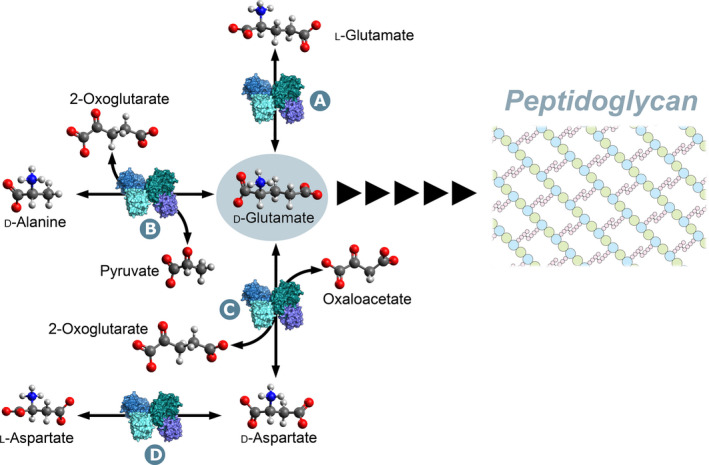
Reactions catalyzed by TM0831 from Thermotoga maritima. (A, D) Racemization reactions of selected amino acids; (B, C) transaminase reactions using a d‐AA as amino donor.
Indeed, TM0831 exhibits an amino acid racemase activity toward four amino acids (Fig. 1A,D). Notably, the kinetic efficiency (k cat/K m ratio) for racemase activity on l‐Asp is close to that for aminotransferase activity with oxaloacetate. Therefore, TM0831 presumably produces d‐Asp from l‐Asp, and d‐Asp is then used as a substrate for d‐Glu production via transamination. Furthermore, by using a Glu racemase‐deficient Thermus thermophilus strain, it was demonstrated that TM0831 is also involved in d‐Glu production. d‐Glu can be preferentially produced from l‐Glu via the racemase reaction of TM0831 (Fig. 1A), whereas the kinetic efficiency value for l‐Glu was threefold lower than for l‐Asp.
The aminotransferase and racemase activities show a different pH profile: TM0831 can thus work as an aminotransferase and a racemase to convert the l‐ to the d‐enantiomer under normal growth conditions, since T. maritima grows at pH value between 5.5 and 9.
TM0831 is a tetrameric pyridoxal 5′‐phosphate (PLP)‐containing enzyme. The structure‐function relationships analysis, based on the 3D structure of the enzyme (PDB ID: 3CSW), supports the functional differences observed between TM0831 and other bacterial d‐amino acid aminotransferases (e.g., the one from Bacillus sp. YM‐1) [15]. Specifically, the residues involved in the binding of the PLP cofactor (Arg50, Arg144, Glu164, Ile191, Thr192, and Thr228) are almost strictly conserved, while the structural determinants that play a crucial role in the interaction with the substrate in the homologous enzymes are poorly conserved. In particular, the short four‐residue region (227–230) forms the substrate specificity pocket. In addition, a twelve‐residue long region (91–102 in Bacillus sp. YM‐1 protein) which contains two key residues for substrate interaction is absent in TM0831.
Conclusions
TM0831 represents an ingenious example of a molecular evolution process in which Nature favored the enzyme versatility (in terms of both substrate scope and catalyzed reactions) at the expense of its catalytic efficiency. In this way, TM0831 can overcome the absence of a specific glutamate racemase in T. maritima by playing a key role in three interlinked metabolic pathways that produce d‐Glu for the biosynthesis of PG (Fig. 1). As a general rule, the promiscuity of PLP‐dependent enzymes allows to play different roles at the cellular level, especially when the enzymatic activities differ in pH dependence, as shown here for TM0831. In addition, from a biocatalytic point of view, synthesis of d‐AAs is a topic of increasing relevance since it is related to the production of amino acid derivatives used in different fields [16]. Concerning T. maritima, future studies are now required to elucidate the d‐Ala biosynthetic pathway and to contribute to elucidating the conundrum of d‐AAs biosynthesis.
Conflict of interest
The authors declare no conflict of interest.
Author contributions
LP and GM wrote the manuscript. Both authors have read and agreed to the published version of the manuscript.
Acknowledgement
The work of LP and GM is supported by Università degli studi dell'Insubria, grant “Fondo di Ateneo per la Ricerca.” Open Access Funding provided by Universita degli Studi dell'Insubria within the CRUI‐CARE Agreement.
Data availability statement
Data sharing not applicable – no new data generated.
References
- 1. Marcone GL, Rosini E, Crespi E, Pollegioni L. D‐amino acids in foods. Appl Microbiol Biotechnol. 2020;104:555–74. [DOI] [PubMed] [Google Scholar]
- 2. Vollmer W, Blanot D, de Pedro MA. Peptidoglycan structure and architecture. FEMS Microbiol Rev. 2008;32:149–67. [DOI] [PubMed] [Google Scholar]
- 3. Aliashkevich A, Alvarez L, Cava F. New insights into the mechanisms and biological roles of D‐amino acids in complex eco‐systems. Front Microbiol. 2018;9:683. [DOI] [PMC free article] [PubMed] [Google Scholar]
- 4. Lam H, Oh D‐C, Cava F, Takacs CN, Clardy J, de Pedro MA, et al. D‐Amino acids govern stationary phase cell wall remodeling in bacteria. Science. 2009;325:1552–5. [DOI] [PMC free article] [PubMed] [Google Scholar]
- 5. Cava F, de Pedro MA, Lam H, Davis BM, Waldor MK. Distinct pathways for modification of the bacterial cell wall by non‐canonical D‐amino acids. EMBO J. 2011;30:3442–53. [DOI] [PMC free article] [PubMed] [Google Scholar]
- 6. Bucher T, Oppenheimer‐Shaanan Y, Savidor A, Bloom‐Ackermann Z, Kolodkin‐Gal I. Disturbance of the bacterial cell wall specifically interferes with biofilm formation. Environ Microbiol Rep. 2015;7:990–1004. [DOI] [PubMed] [Google Scholar]
- 7. Hernández SB, Cava F. Environmental roles of microbial amino acid racemases. Environ Microbiol. 2016;18:1673–85. [DOI] [PubMed] [Google Scholar]
- 8. Vollmer W, Joris B, Charlier P, Foster S. Bacterial peptidoglycan (murein) hydrolases. FEMS Microbiol Rev. 2008;32:259–86. [DOI] [PubMed] [Google Scholar]
- 9. Boniface A, Parquet C, Arthur M, Mengin‐Lecreulx D, Blanot D. The elucidation of the structure of Thermotoga maritima peptidoglycan reveals two novel types of cross‐link. J Biol Chem. 2009;284:21856–62. [DOI] [PMC free article] [PubMed] [Google Scholar]
- 10. Miyamoto T, Katane M, Saitoh Y, Sekine M, Homma H. Elucidation of the D‐lysine biosynthetic pathway in the hyperthermophile Thermotoga maritima . FEBS J. 2019;286:601–14. [DOI] [PubMed] [Google Scholar]
- 11. Miyamoto T, Katane M, Saitoh Y, Sekine M, Sakai‐Kato K, Homma H. Identification and biochemical characterization of threonine dehydratase from the hyperthermophile Thermotoga maritima . Amino Acids. 2021;53:903–15. [DOI] [PubMed] [Google Scholar]
- 12. Miyamoto T, Saitoh Y, Katane M, Sekine M, Sakai‐Kato K, Homma H. Acetylornithine aminotransferase TM1785 performs multiple functions in the hyperthermophile Thermotoga maritima . FEBS Lett. 2021;595:2931–41. [DOI] [PubMed] [Google Scholar]
- 13. Miyamoto T, Moriya T, Katane M, Saitoh Y, Sekine M, Sakai‐Kato K, et al. Identification of a novel d‐amino acid aminotransferase involved in D‐glutamate biosynthetic pathways in the hyperthermophile Thermotoga maritima . FEBS J. 2022;289:5933–46. [DOI] [PubMed] [Google Scholar]
- 14. Khersonsky O, Roodveldt C, Tawfik DS. Enzyme promiscuity: evolutionary and mechanistic aspects. Curr Opin Chem Biol. 2006;10:498–508. [DOI] [PubMed] [Google Scholar]
- 15. Lee SG, Hong SP, Song JJ, Kim SJ, Kwak MS, Sung MH. Functional and structural characterization of thermostable D‐amino acid aminotransferases from Geobacillus spp. Appl Environ Microbiol. 2006;72:1588–94. [DOI] [PMC free article] [PubMed] [Google Scholar]
- 16. Pollegioni L, Rosini E, Molla G. Advances in enzymatic synthesis of D‐amino acids. Int J Mol Sci. 2020;21:3206. [DOI] [PMC free article] [PubMed] [Google Scholar]
Associated Data
This section collects any data citations, data availability statements, or supplementary materials included in this article.
Data Availability Statement
Data sharing not applicable – no new data generated.