



Abstract
Substitution reactions of acyclic β-alkoxy acetals proceeded with generally high diastereoselectivities (>90:10) to form the anti product. Mechanistic experiments supplemented with computational studies suggest that, upon activation of the acetal, the resulting oxocarbenium ion is electrostatically stabilized by the β-alkoxy group. This stabilization defines the conformation of the reactive intermediate, which can be attacked preferentially from the more exposed face, leading to the observed products.
Graphical Abstract

The choice of protecting groups in carbohydrate chemistry has consequences on the stereochemical courses of substitution reactions.1–4 Acyloxy groups on the neighboring carbon atom can control stereoselective reactions of carbohydrates by forming fused bicyclic dioxocarbenium ion intermediates that are subsequently opened by a nucleophile.1-6 Participation by a neighboring acyloxy group can also control the stereoselectivities of reactions involving acyclic acetals.7 By contrast, alkoxy groups are generally considered to not participate in substitution reactions of carbohydrates through formation of onium ions4,8-11 because these intermediates would not be stabilized by electron delocalization as observed for acyloxy groups, and, many cases, such onium ion intermediates would be strained.12
In this manuscript, we demonstrate that alkoxy groups two carbon atoms away from an acetal can control the stereochemical course of substitution reactions. Substitution reactions of acetals bearing β-alkoxy groups proceeded with high diastereoselectivities (dr >90:10) in many cases (eq 1). The products would be the same as those expected from chelation-controlled additions to β-alkoxy, α-substituted aldehydes,13-15 but such intermediates cannot be invoked in the case of acetal substitution reactions. The alkoxy groups appear to stabilize the oxocarbenium ion intermediates by electrostatic interactions to form four-membered-ring structures resembling 2. This participation defines the conformation of the intermediate and thus establishes which face of the oxocarbenium ion is attacked.

The influence of a β-alkoxy group on the stereoselective substitution reactions of acetals was first observed for the Lewis acid-mediated reaction of acetal 4, which possesses a β-benzyloxy group, with a nucleophile, the silyl ketene acetal 5 (Table 1). The anti stereoisomer 6, whose structure was established by X-ray crystallography of a derivative,16 was favored regardless of solvent, temperature, or Lewis acid. Reactions in more and less polar solvents gave the product with similar diastereoselectivity.17,18 The reactions were the cleanest and highest-yielding using Me3SiOTf and EtCN at −78 °C, however. Although nitrilium-ion intermediates17,19 or covalent triflates could be responsible for stereoselectivity,19 the consistent selectivities observed under all conditions suggest that these intermediates are not involved in these reactions.
Table 1.
Optimization of reaction conditions.

| |||
|---|---|---|---|
| solvent | Lewis acid | temp (°C) | dr (anti:syn) |
| EtCN | Me3SiOTf | −78 | 91 : 9 |
| EtCN | BF3·OEt2 | −78 | 90 : 10a |
| EtCN | TiCl4 | −78 | 88 : 12b |
| EtCN | SnC14 | −78 | 90 : 10 |
| EtCN | TfOH | −78 | 88 : 12b |
| EtCN | BC13(1 M in C6H14) | −78 | 91 : 9 |
| EtCN | AlCl3 | −78 | 91 : 9 |
| EtCN | Me3SiOTf | −40 | 91 : 9 |
| CH2Cl2 | Me3SiOTf | −78 | 90 : 10 |
| CH2Cl2 | Me3SiOTf | −40 | 82 : 18 |
| MePh | Me3SiOTf | −78 | 88 : 12 |
| C6Hl4 | Me3SiOTf | −78 | 88 : 12 |
Reaction conducted using 4 equiv of BF3·OEt2 and proceeded to 40% conversion.
Reaction produced multiple side products.
Experiments to evaluate the generality of the stereoselective substitution reactions involved determining the optimal acetal and protecting group for the β-hydroxyl group. These β-alkoxy acetals were sensitive to handling and storage, suggesting some interaction between the alkoxy group and the acetal functional group.20-22 Ethyl acetals, because of their ease of synthesis, purification, and lower sensitivity to hydrolysis than methyl acetals,23 proved to be optimal. Methyl or benzyl acetals were particularly sensitive to handling and storage,24 which primarily led to decomposition and low conversion using these substrates. In contrast to specificity with respect to the acetal, the reactions were general for several β-alkoxy groups. Reactions of alkyl-, benzyl-, and silyl-protected β-hydroxy acetals afforded the anti products with >90:10 diastereomer ratios (Scheme 1).16 The stereoselectivity was sensitive to the electron-donating ability of the benzyloxy group, however.25,26 Substitution of acetal 8 bearing a PMB-protected hydroxyl group produced the product as a single diastereomer (dr >99:1), which is higher stereoselectivity than that observed for the benzyl-protected acetal 4 (dr = 91:9).27 By contrast, when the benzyl group was substituted with an electron-withdrawing nitro group, lower stereoselectivity (dr = 82:18) was observed.27 Considering that the size of the protecting group does not affect stereoselectivity, it is unlikely that a steric interaction between the nucleophile and the protecting group is involved. Instead, an electronic interaction between the oxygen atom of the alkoxy group and the electrophilic oxocarbenium ion carbon8,20,28 is most likely responsible for the observed diastereoselectivity.29
Scheme 1. Influence of alkoxy group on diastereoselectivity.

Although the anti stereochemistry of the product is consistent with chelation-controlled reactions involving the oxygen atom of the protecting group and the acetal group, chelation is not possible. These reactions, which likely involve oxocarbenium ion intermediates,13,14,30 would require the Lewis acid to complex to the formally positively charged oxygen atom.31 In the case of acetal 7, chelation would require complexation to a silyloxy group, which is generally disfavored.14,32
Reactions of benzyloxy acetal 4 with different nucleophiles showed that diastereoselectivity depends on the size of the nucleophile.12,33 Unlike the reactions of other acetals,20,29,31,34,35 the reactivity of the nucleophile, as defined by the N parameter,36,37 does not correlate consistently with stereoselectivity. Comparisons of sterically similar nucleophiles with different reactivities shows either small increases or decreases in stereoselectivity. By comparison, stereoselectivity correlates more strongly with the size of the nucleophile. Reactions with silyloxy-substituted alkenes with substituents at the nucleophilic carbon atom gave the highest stereoselectivities (Table 2, entries 1 and 2). Nucleophiles without those substituents showed lower stereoselectivity (entry 6), even though the absence of such groups would not change the reactivity of the carbon–carbon double bond.36,37 Methallylmetal nucleophiles gave similar stereoselectivities regardless of their different reactivities (entries 3 and 5). In all cases, reactions with monosubstituted alkenes occurred with lower selectivities (entries 4 and 7). These trends do not follow what would be expected based upon any correlation between reactivity and selectivity.12 Instead, steric interactions play a larger role in determining diastereoselectivity in this series.
Table 2.
Influence of nucleophilicity and size on diastereoselectivity.

| |||||
|---|---|---|---|---|---|
| Entry | N–[M] | N 36,37 | Prod. | dr (anti:syn) | % yield |
| 1 | Me2C=C(OMe)(OTBS), 5 | 9.1a | 6 | 91 : 9 | 94 |
| 2 | Me2C=C(Ph)(OTBS) | N/A | 19 | 93 : 7 | 54 |
| 3 | H2C=C(Me)CH2SnBu3 | 7.48 | 20 | 73 : 27 | 62 |
| 4 | H2C=CHCH2SnBu3 | 5.46 | 21 | 58 : 42 | 68 |
| 5 | H2C=C(Me)CH2SiMe3 | 4.41 | 20 | 74 : 26 | 77 |
| 6 | H2C=C(tBu)(OTBS), 23 | 3.78a | 22 | 66 : 34 | 69 |
| 7 | H2C=CHCH2 SiMe3 | 1.68 | 21 | 52 : 48 | 84 |
N parameter for the corresponding Me3Si-protected nucleophile.
An experiment was performed to confirm that the stereoselectivities of the reactions were not governed by rates of diffusion.38 A competition experiment where two nucleophiles competed for the oxocarbenium ion intermediate formed from benzyloxy acetal 4 gave only the product from the more reactive alkene nucleophile, 5 (eq 2). The product ratio is consistent with a five-orders-of-magnitude difference in reactivity, indicating that these reactions likely occur below the diffusion rate limit.38,39 This observation contrasts with the results for cyclic oxocarbenium ions, where π-systems of different nucleophilicity reacted with oxocarbenium ion intermediates at similar rates, suggesting that these rates were limited by diffusion.38

The isolation of side products from the substitution reaction of p-methoxybenzyl-substituted acetal 8 suggested the origin of stereoselectivity. In addition to forming the substitution product 14, the reaction of acetal 8 gave products 28–30 (Scheme 2). Such products were not formed with the benzyl ether 4 or the p-nitrobenzyl ether 11. When the reaction was repeated in more dilute solutions (0.01 M), no substitution product 14 was formed, and only compounds 28–30 could be identified. The major side product was oxetane 30. Formation of this oxetane would require loss of both ethoxy groups of the acetal 8, possibly through oxetanium ion 25: one ethoxy group by substitution with the β-oxygen atom accompanied by loss of the p-methoxybenzyl group,40-42 and the other ethoxy group by substitution by the nucleophile, 5, on acetal 27. Side products 28 and 29 resulted from transfer of the p-methoxybenzyl group lost from the starting material to a nucleophile. The Ritter product,43 28, would be formed upon reaction with the solvent, EtCN, and ester 29 would be formed by reaction with the silyl ketene acetal 5. Because amide 28 and ester 29 must be formed by reactions of less reactive, neutral nucleophiles,37,43 it is likely that formation of these products requires reactions with a highly electrophilic intermediate such as a carbocation, 26.44
Scheme 2. Reactive pathways of the electrostatically stabilized oxocarbenium ion intermediate 24.

aYield reported of impure compound.
The formation of products 28 and 29 from the p-methoxybenzyl-protected acetal 8 cannot be attributed to initial deprotection of the acetal followed by subsequent reactions of the resulting products (Scheme 2).45 If deprotection occurred first to give the deprotected alcohol, 10, substitution should have occurred to form ester 16 instead (Scheme 1). This product was not formed. Deprotection can also be discounted because treatment of PMB-protected menthol, 31, under the reaction conditions gave p-methoxybenzyl alcohol (32) and menthol and no other products (eq 3).45 Because the addition products, 28 and 29, were not observed in this reaction, the deprotection of PMB-protected alcohols45 likely does not form the same reactive intermediate, a benzylic carbocation, 26.

The formation of products 28–30 can be explained by considering the formation of an oxetanium ion intermediate 25 in the case of the p-methoxybenzyl-substituted acetal 8 (Scheme 2). This oxetanium ion intermediate, which may or not be the major intermediate formed, could react by direct displacement to form the substitution product 14, or it could undergo fragmentation to give the p-methoxybenzyl cation 26 and oxetane 27.41,46 The cation 26 could be trapped by the weaker nucleophiles to form the amide 28 and the ester 29. The oxetane 27, in turn, could undergo Lewis acid-catalyzed nucleophilic substitution to give oxetane 30. The formation of 14 at higher concentrations is consistent with the proposal that the reaction to give 14, Pathway A, is a bimolecular reaction of an intermediate such as 24. By contrast, the formation of products 28–30 would result from initial intramolecular fragmentation of 25 (Pathway B) to give a carbocationic intermediate such as 26. At lower concentrations, Pathway A would be slower, leading to more products formed from Pathway B.
Studies with a related substrate, a β-hydroxy acetal with an isopropyl group, 33,47 provided additional insight into what factors might contribute to stereoselectivity. The reaction with the nucleophile 5 gave the substitution product 34 with low stereoselectivity (eq 4). This result suggests that, with the acetal 4, the alkoxymethyl group likely adopted a position in the reactive intermediate where it was the larger group at the α-carbon atom, while the methyl group was the smaller substituent. In the case of acetal 33, the isopropyl group may occupy a similar space as the hydroxymethyl group would, leading to the low diastereoselectivity observed.

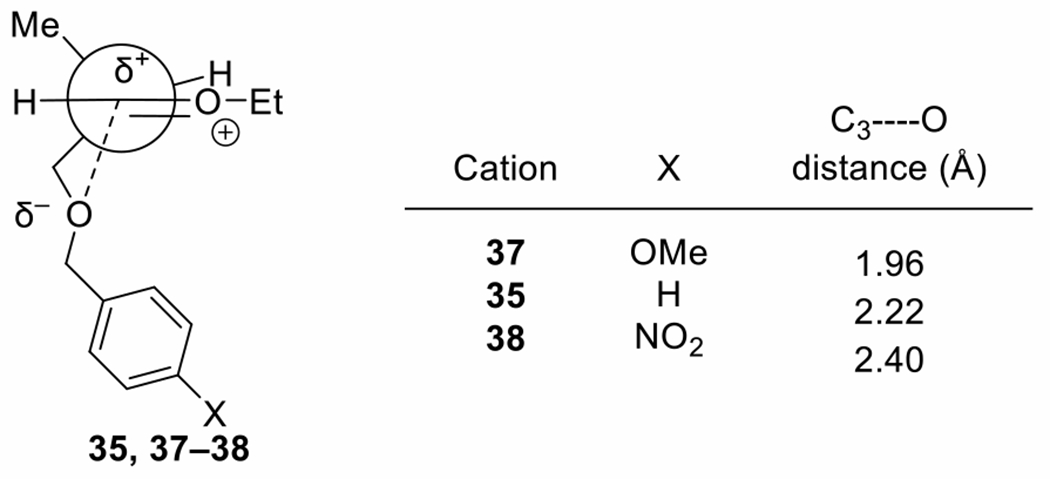
A model can be proposed that accommodates these experimental results. Computational studies (B3LYP/6-31G*)48 suggest that the oxocarbenium ion derived from acetal 4 adopts a conformation resembling 35. This conformation, with the four-membered-ring core structure, is flattened compared to the structure of a cyclobutane, a general trend observed for the conformations of four-membered-ring ethers.49 Other conformers, such as the conformer 36 where the two hydrogen atoms are eclipsed, are considerably higher in energy, suggesting that transition states through such intermediates would be inherently high energy. Both conformers 35 and the more sterically hindered conformer 36 place the oxygen atom of the alkoxymethyl group about 2.2 Å from the cationic carbon atom.48 This distance is considerably greater than the carbon–oxygen bond lengths of trivalent oxonium ion such as the Et3O+ cation (1.5 Å).50 The sum of the bond angles at the cationic carbon atom is 360°, which indicates that this atom is trigonal, not tetrahedral, so a new covalent bond has not been formed in this intermediate. Instead, this four-membered arrangement of atoms maximizes electrostatic interactions between the cationic carbon atom and the oxygen atom, as illustrated for 35. This electrostatic stabilization29,48 has been suggested computationally for β-alkoxy oxocarbenium ions,25 but it has only been identified experimentally for γ-alkoxy oxocarbenium ions through a five-membered arrangement of atoms.12 The conformation of oxocarbenium ion 35 resembles the structure observed in the solid state for β-alkoxy aldehydes,21,22 which would also have considerable positive charge on the carbonyl group’s carbon atom.21,22 The electrostatic interaction between the carbon atom of 35 and the alkoxy group makes the face bearing the alkoxy group less sterically accessible than the face with the methyl group. In the case of small nucleophiles, minimal steric interactions develop upon attack at either diastereoface, leading to low diastereoselectivity. As the nucleophile becomes larger, however, interactions with the alkoxy group become more significant, leading to preferential attack from the side of the smaller methyl group, as illustrated in transition state 35. In the case of the isopropyl-substituted substrate 33, the two faces of the intermediate become more similarly sterically hindered, leading to lower stereoselectivity.
The trend of diastereoselectivity for the benzyl-protected acetals is consistent with an electrostatic interaction controlling diastereoselectivity. Computational studies (B3LYP/6-31G*)48 indicate that, among the three benzyloxy-substituted oxocarbenium ions, the distance between the carbon atom of the oxocarbenium ions and the oxygen atom of the alkoxy group is shortest for the p-methoxy-substituted oxocarbenium ion, 37, and longest for the p-nitro-substituted one, 38 (Figure 1). The close interaction in the p-methoxy-substituted oxocarbenium ion 37 would be more likely to lead to formation of an oxetanium ion, which is consistent with the experimental observation of products obtained in that reaction (Scheme 2). The longer distance in carbocation 38 changes the conformation of the oxocarbenium ion enough that the two faces are no longer as well differentiated and the face bearing the alkoxy group is no longer as sterically hindered. As a result, the nitro-substituted acetal would react with lower diastereoselectivity.
Figure 1. Conformations of the oxocarbenium ion derived from acetal 4.

In summary, β-alkoxy groups can control the stereochemical outcomes of substitution reactions of acyclic acetals by stabilizing an oxocarbenium ion intermediate electrostatically. This stabilized intermediate, which has diastereofaces with different steric requirements, underwent nucleophilic addition with sterically larger nucleophiles to form the products with high diastereoselectivity. These reactions can be used to control the facial selectivities of substitution reactions, which should make them useful in stereoselective synthesis.51,52
Supplementary Material
Figure 2. Change in distance between C3 to O with aryloxy groups of varying electron-donating ability.
ACKNOWLEDGMENT
This research was supported by National Institutes of Health, National Institute of General Medical Sciences (1R01GM129286). We acknowledge NYU’s Shared Instrumentation Facility and the support provided by NSF award CHE-01162222 and NIH award S10-OD016343. We thank Dr. Chin Lin (NYU) and Dr. Chunhua (Tony) Hu (NYU) for their help with NMR and X-ray data, respectively.
Footnotes
Supporting Information
The Supporting Information is available free of charge on the ACS Publications website.
Experimental procedures, characterization of new compounds, stereochemical proofs, kinetic data, X-ray data, and 1H and 13C NMR spectra of new compounds (PDF)
Crystallographic files for compound S20 (CIF)
Accession Codes
CCDC 2159762 contains the supplementary crystallographic data for this paper. These data can be obtained free of charge via www.ccdc.cam.ac.uk/data_request/cif, or by emailing data_re-quest@ccdc.cam.ac.uk, or by contacting The Cambridge Crystallographic Data Centre, 12 Union Road, Cambridge CB2 1EZ, UK; fax: +44 1223 336033.
The authors declare no competing financial interest.
REFERENCES
- 1.Williams RJ; McGill NW; White JM; Williams SJ Neighboring Group Participation in Glycosylation Reactions by 2,6-Disubstituted 2-O-Benzoyl groups: A Mechanistic Investigation. J. Carbohydr. Chem 2010, 29, 236. [Google Scholar]
- 2.Bérces A; Enright G; Nukada T; Whitfield DM The Conformational Origin of the Barrier to the Formation of Neighboring Group Assistance in Glycosylation Reactions: A Dynamical Density Functional Theory Study. J. Am. Chem. Soc 2001, 123, 5460. [DOI] [PubMed] [Google Scholar]
- 3.Nukada T; Bérces A; Zgierski MZ; Whitfield DM Exploring the Mechanism of Neighboring Group Assisted Glycosylation Reactions. J. Am. Chem. Soc 1998, 120, 13291. [Google Scholar]
- 4.Guberman M; Seeberger PH Automated Glycan Assembly: A Perspective. J. Am. Chem. Soc 2019, 141, 5581. [DOI] [PMC free article] [PubMed] [Google Scholar]
- 5.Crimmins MT; Dechert A-MR Enantioselective Total Synthesis of (−)-Pironetin: Iterative Aldol Reactions of Thiazolidinethiones. Org. Lett 2009, 11, 1635. [DOI] [PMC free article] [PubMed] [Google Scholar]
- 6.Hansen T; Elferink H; van Hengst JMA; Houthuijs KJ; Remmerswaal WA; Kromm A; Berden G; van der Vorm S; Rijs AM; Overkleeft HS; Filippov DV; Rutjes FPJT; van der Marel GA; Martens J; Oomens J; Codée JDC; Boltje TJ Characterization of glycosyl dioxolenium ions and their role in glycosylation reactions. Nat. Commun 2020, 11, 2664. [DOI] [PMC free article] [PubMed] [Google Scholar]
- 7.Ramdular A; Woerpel KA Using Neighboring-Group Participation for Acyclic Stereocontrol in Diastereoselective Substitution Reactions of Acetals. Org. Lett 2020, 22, 4113. [DOI] [PMC free article] [PubMed] [Google Scholar]
- 8.Suga S; Suzuki S; Yoshida J.-i. Intramolecular Participation in Alkoxycarbenium Ion Pools. Org. Lett 2005, 7, 4717. [DOI] [PubMed] [Google Scholar]
- 9.Shivatare SS; Wong C-H Synthetic Carbohydrate Chemistry and Translational Medicine. J. Org. Chem 2020, 85, 15780. [DOI] [PMC free article] [PubMed] [Google Scholar]
- 10.Njeri DK; Pertuit CJ; Ragains JR 1,2-cis-Selective glucosylation enabled by halogenated benzyl protecting groups. Org. Biomol. Chem 2020, 18, 2405. [DOI] [PubMed] [Google Scholar]
- 11.Mydock LK; Kamat MN; Demchenko AV Direct Synthesis of Diastereomerically Pure Glycosyl Sulfonium Salts. Org. Lett 2011, 13, 2928. [DOI] [PMC free article] [PubMed] [Google Scholar]
- 12.Garcia A; Sanzone JR; Woerpel KA Participation of Alkoxy Groups in Reactions of Acetals: Violation of the Reactivity/Selectivity Principle in a Curtin–Hammett Kinetic Scenario. Angew. Chem., Int. Ed 2015, 54, 12087. [DOI] [PMC free article] [PubMed] [Google Scholar]
- 13.Evans DA; Dart MJ; Duffy JL; Yang MG A Stereochemical Model for Merged 1,2- and 1,3-Asymmetric Induction in Diastereoselective Mukaiyama Aldol Addition Reactions and Related Processes. J. Am. Chem. Soc 1996, 118, 4322. [Google Scholar]
- 14.Evans DA; Allison BD; Yang MG; Masse CE The Exceptional Chelating Ability of Dimethylaluminum Chloride and Methylaluminum Dichloride. The Merged Stereochemical Impact of α- and β-Stereocenters in Chelate-Controlled Carbonyl Addition Reactions with Enolsilane and Hydride Nucleophiles. J. Am. Chem. Soc 2001, 123, 10840. [DOI] [PubMed] [Google Scholar]
- 15.Lo A; Gutierrez DA; Toth-Williams G; Fettinger JC; Shaw JT 1,3-Asymmetric Induction in Diastereoselective Allylations of Chiral N-Tosyl Imines. J. Org. Chem 2022, 87, 2773. [DOI] [PubMed] [Google Scholar]
- 16.Details of the stereochemical proof are provided as Supporting Information.
- 17.Crich D; Patel M On the nitrile effect in L-rhamnopyranosylation. Carbohydr. Res 2006, 341, 1467. [DOI] [PMC free article] [PubMed] [Google Scholar]
- 18.Schmidt RR; Reichrath M; Moering U 1-O-Alkylation of D-Glucopyranose. J. Carbohydr. Chem 1984, 3, 67. [Google Scholar]
- 19.Nigudkar SS; Demchenko AV Stereocontrolled 1,2-cis glycosylation as the driving force of progress in synthetic carbohydrate chemistry. Chem. Set 2015, 6, 2687. [DOI] [PMC free article] [PubMed] [Google Scholar]
- 20.Molander GA Novel Approach to Remote Asymmetric Induction in Carbonyl Addition and Related Reactions. J. Am. Chem. Soc 1993, 115, 40. [Google Scholar]
- 21.Narkevitch V; Megevand S; Schenk K; Vogel P Development of a New Carbon–Carbon Bond Forming Reaction. New Organic Chemistry of Sulfur Dioxide. Asymmetric Four-Component Synthesis of Polyfunctional Sulfones. J. Org. Chem 2001, 66, 5080. [DOI] [PubMed] [Google Scholar]
- 22.Kim SM; Yang HS; Eum H; Ha H-J; Yang JW Mixed Monosilyl Acetals and Catalyst-Dependent Chemoselective Mukaiyama Aldol Reactions. Chem. Eur. J 2017, 23, 16432. [DOI] [PubMed] [Google Scholar]
- 23.Taft RW Polar and Steric Substituent Constants for Aliphatic and o-Benzoate Groups from Rates of Esterification and Hydrolysis of Esters. J. Am. Chem. Soc 1952, 74, 3120. [Google Scholar]
- 24.Watahiki T; Akabane Y; Mori S; Oriyama T Iron(III) Chloride-Catalyzed Convenient One-Pot Synthesis of Homoallyl Benzyl Ethers Starting from Aldehydes. Org. Lett 2003, 5, 3045. [DOI] [PubMed] [Google Scholar]
- 25.Woods RJ; Andrews CW; Bowen JP Molecular Mechanical Investigations of the Properties of Oxocarbenium Ions. 2. Application to Glycoside Hydrolysis. J. Am. Chem. Soc 1992, 114, 859. [Google Scholar]
- 26.Winstein S; Allred E; Heck R; Glick R Neighboring methoxyl participation in solvolytic nucleophilic substitution. Tetrahedron 1958, 3, 1. [Google Scholar]
- 27.Fernandes L; Francisco AP; Iley J; Rosa E Triazene drug metabolites. Part 14. Kinetics and mechanism of the acid-catalysed hydrolysis of 3-alkoxymethyl-3-alkyl-1-aryltriazenes. J. Chem. Soc., Perkin Trans 2 1994, 2313. [Google Scholar]
- 28.Allred EL; Winstein S Role of Neighboring Groups in Replacement Reactions. XXVII. 5-Methoxyl Participation in Some Solvolysis Reactions. J. Am. Chem. Soc 1967, 89, 3991. [Google Scholar]
- 29.Chamberland S; Woerpel KA Using Nucleophilic Substitution Reactions to Understand How a Remote Alkyl or Alkoxy Substituent Influences the Conformation of Eight-Membered Ring Oxocarbenium Ions. Org. Lett 2004, 6, 4739. [DOI] [PubMed] [Google Scholar]
- 30.Braun M, Selected Diastereoselective Reactions: Additions of Achiral Carbanions to Chiral Aldehydes and Ketones. In Comprehensive Chirality, Carreira EM; Yamamoto H, Eds. 2012; pp 346. [Google Scholar]
- 31.Smith DM; Woerpel KA Electrostatic interactions in cations and their importance in biology and chemistry. Org. Biomol. Chem 2006, 4, 1195. [DOI] [PubMed] [Google Scholar]
- 32.Evans DA; Cee VJ; Siska SJ Asymmetric Induction in Methyl Ketone Aldol Additions to α-alkoxy and α,β-Bisalkoxy Aldehydes: A Model for Acyclic Stereocontrol. J. Am. Chem. Soc 2006, 128, 9433. [DOI] [PubMed] [Google Scholar]
- 33.Shaw JT; Woerpel KA Divergent Diastereoselectivity in the Addition of Nucleophiles to Five-Membered-Ring Oxonium Ions. J. Org. Chem 1997, 62, 6706. [Google Scholar]
- 34.Beaver MG; Woerpel KA Erosion of Stereochemical Control with Increasing Nucleophilicity: O-Glycosylation at the Diffusion Limit. J. Org. Chem 2010, 75, 1107. [DOI] [PMC free article] [PubMed] [Google Scholar]
- 35.van der Vorm S; van Hengst JMA; Bakker M; Overkleeft HS; van der Marel GA; Codée JDC Mapping the Relationship between Glycosyl Acceptor Reactivity and Glycosylation Stereoselectivity. Angew. Chem., Int. Ed 2018, 57, 8240. [DOI] [PMC free article] [PubMed] [Google Scholar]
- 36.Mayr H; Patz M Scales of Nucleophilicity and Electrophilicity: A System for Ordering Polar Organic and Organometallic Reactions. Angew. Chem., Int. Ed. Engl 1994, 33, 938. [Google Scholar]
- 37.Mayr H; Bug T; Gotta MF; Hering N; Irrgang B; Janker B; Kempf B; Loos R; Ofial AR; Remennikov G; Schimmel H Reference Scales for the Characterization of Cationic Electrophiles and Neutral Nucleophiles. J. Am. Chem. Soc 2001, 123, 9500. [DOI] [PubMed] [Google Scholar]
- 38.Krumper JR; Salamant WA; Woerpel KA Correlations Between Nucleophilicities and Selectivities in the Substitutions of Tetrahydropyran Acetals. J. Org. Chem 2009, 74, 8039. [DOI] [PMC free article] [PubMed] [Google Scholar]
- 39.Mayr H; Ofial AR The Reactivity–Selectivity Principle: An Imperishable Myth in Organic Chemistry. Angew. Chem., Int. Ed 2006, 45, 1844. [DOI] [PubMed] [Google Scholar]
- 40.Hsieh H-W; Davis RA; Hoch JA; Gervay-Hague J Two-Step Functionalization of Oligosaccharides Using Glycosyl Iodide and Trimethylene Oxide and Its Applications to Multivalent Glycoconjugates. Eur. J. Org. Chem 2014, 20, 6444. [DOI] [PMC free article] [PubMed] [Google Scholar]
- 41.Cribiù R; Eszter Borbas K; Cumpstey I On the synthesis of vinyl and phenyl C-furanosides by stereospecific debenzylative cycloetherification. Tetrahedron 2009, 65, 2022. [Google Scholar]
- 42.Dehmlow H; Mulzer J; Seilz C; Strecker AR; Kohlmann A Stereocontrolled formation of Polysubstitued tetrahydorfurans by debenzylating cycloetherification. Tetrahedron Lett. 1992, 33, 3607. [Google Scholar]
- 43.Shi F; Cui X, Chapter 7 - N-Alkyl Amine Synthesis With Nitroarene/Benzonitrile and Alcohol. In Catalytic Amination for N-Alkyl Amine Synthesis, Shi F; Cui X, Eds. Academic; 2018; pp 181. [Google Scholar]
- 44.Ishihara K; Hanaki N; Yamamoto H Highly Diastereoselective Acetal Cleavages Using Novel Reagents Prepared from Organoaluminum and Pentafluorophenol. J. Am. Chem. Soc 1993, 115, 10695. [Google Scholar]
- 45.Jung ME; Koch P Mild, selective deprotection of PMB ethers with triflic acid/1,3-dimethoxybenzene. Tetrahedron Lett. 2011, 52, 6051. [Google Scholar]
- 46.Pote AR; Vannam R; Richard A; Gascón J; Peczuh MW Formation of and Glycosylation with Per-O-Acetyl Septanosyl Halides: Rationalizing Complex Reactivity En Route to p-Nitrophenyl Septanosides. Eur. J. Org. Chem 2018, 2018, 1709. [Google Scholar]
- 47.Attempts to prepare protected versions of alcohol 32 following the same synthetic route led to decomposition, presumably due to base-induced elimination reactions. [Google Scholar]
- 48.Details of computations are provided as Supporting Information. [Google Scholar]
- 49.Bull JA; Croft RA; Davis OA; Doran R; Morgan KF Oxetanes: Recent Advances in Synthesis, Reactivity, and Medicinal Chemistry. Chem. Rev 2016, 116, 12150. [DOI] [PubMed] [Google Scholar]
- 50.Watkins MI; Ip WM; Olah GA; Bau R Structure of Oxonium Ions: An X-ray Crystallographic Study of Triethyloxonium Hexafluorophosphate and Triphenyloxonium Tetraphenylborate. J. Am. Chem. Soc 1982, 104, 2365. [Google Scholar]
- 51.Kim J; Thomson RJ Enantioselective Total Synthesis of the Osteoclastogenesis Inhibitor (+)-Symbioimine. Angew. Chem. Int. Ed 2007, 46, 3104. [DOI] [PubMed] [Google Scholar]
- 52.Huang W; Ren R-G; Dong H-Q; Wei B-G; Lin G-Q Diverse Synthesis of Marine Cyclic Depsipeptide Lagunamide A and Its Analogues. J. Org. Chem 2013, 78, 10747. [DOI] [PubMed] [Google Scholar]
Associated Data
This section collects any data citations, data availability statements, or supplementary materials included in this article.