



Abstract
Toluene is one of the hydrocarbons that contaminate soil and groundwater, and has a high cost to remediate, which makes it an environmental pollutant of concern. This study aimed to find bacterial distribution from nonwoven geotextile (GT) fabric specimens in a pilot-scale permeable reactive barrier (PRB). Upon 167 days of incubation with the addition of toluene, the microbial community on the GT surfaces (n = 12) was investigated by the 16S rRNA metagenome sequencing approach. According to taxonomic classification, the Proteobacteria phylum dominated the metagenomes of all the geotextile samples (80–90%). Kyoto Encyclopedia of Genes and Genomes (KEGG) Pathway database search of the toluene degradation mechanism revealed the susceptible toluene-degrading species. For the toluene-to-benzoate degradation, the Cupriavidus genus, particularly C. gilardii, C. metallidurans, and C. taiwanensis, are likely to be functional. In addition to these species, the Novosphingobium genus was abundantly localized in the GTs, in particular Novosphingobium sp. ABRDHK2. The results suggested the biodegradation potential of these species in toluene remediation. Overall, this work sheds light on the variety of microorganisms found in the geotextile fabrics used in PRBs and the species involved in the biodegradation of toluene from several sources, including soil, sediment, and groundwater.
Supplementary Information
The online version contains supplementary material available at 10.1007/s13205-023-03460-y.
Keywords: Metagenome, Permeable reactive barrier, Toluene, Geotextile, Microorganism
Introduction
Permeable Reactive Biobarriers (PRBs) are a novel in situ technology for the remediation of contaminated groundwater. This technology has been commonly used in both USA and Europe to replace traditional pump and treat systems. Groundwater resources are particularly susceptible to contamination from events such as spills, inadequate disposal of chemicals, and agricultural and mining activities. PRBs are passive systems that rely on placing a permeable reactive medium to stop the contaminant and convert the pollutants into less harmful forms. The choice of filler material, biomass, the type and amount of nutrient/electron acceptors, and the size and configuration of the bioremediation zone are key design factors for the performance of this technology (Careghini et al. 2015).
When pollutants containing hydrocarbons spill onto land, degradation by native microorganisms is slow due to the nominal microbial population and activity. Bioremediation is one of the most inexpensive remediation processes for treating soil and groundwater. Total petroleum hydrocarbons are comprised of aliphatic, aromatic, and polar hydrocarbons. Toluene, one of the gasoline compounds, is a clear and colorless compound that evaporates at room temperature. Paints, metal cleaners, adhesives, and gasoline are some of the products that contain toluene. Microorganisms that break down crude and refined petroleum products, such as diesel and gasoline, are eukaryotic or prokaryotic organisms (Balba et al. 1998). Various research studies have been carried out on the remediation of hydrocarbons by different microorganisms (Polyak et al. 2018; Ali et al. 2020; Eze 2021; Eze et al. 2022a). Some microorganisms that are effective in the biodegradation of petroleum hydrocarbons are Pseudomonas, Acinetobacter, Flavobacterium, Achromobacter, Rhodococcus, Mycobacterium, Bacillus, Alcaligenes, Aspergillus, Mucor, Penicillium, and Candida genera (Nwankwegu et al. 2017).
Metagenome analysis is an approach to classify microorganisms in a community that gives insights into their functions. The assay is based on the DNA extraction of the microorganisms and sequencing the 16S rRNA gene. The alignment of those sequences with the databases reveals the species distribution and metabolic function. This strategy has recently been utilized to find microorganisms that can degrade contaminants like hydrocarbons (Saxena et al. 2017; Schweitzer et al. 2022), phenol (Silva et al. 2012; Hou et al. 2022), aniline (Peng et al. 2021), azo dye (Gu et al. 2021), xenobiotic (Yadav et al. 2021), etc. There are limited studies on metagenomic analyzes of microorganisms involved in toluene degradation (Kim et al. 2014; Bouhajja et al. 2017; BenIsrael et al. 2019). This study aims to identify the microbial community on the PRB to degrade toluene.
Identifying bacterial communities and their diversity analysis using Illumina Miseq technology is expected to provide valuable information for developing a new PRB process for the bioremediation of groundwater contaminated with hydrocarbons, especially toluene. The first part of this study that focused on the bioremediation of simulated groundwater contaminated with toluene was published previously (Yaman et al. 2021). The goal of the current study, which builds on our earlier research, is to examine the population of microorganisms in geotextile fabrics employed in PRBs for the in situ bioremediation of hydrocarbons in groundwater.
Materials and methods
Bioreactor setup
Figure 1 shows the PRB setup with the reactor containing 12 layers of nonwoven geotextile fabric placed horizontally at 5 cm intervals. The filling material for the PRB column contained 25% of silica sand (average diameter (AD) = 1–2 mm), 25% of silica sand (AD = 2–3 mm), 25% of silica sand (AD = 3–6 mm), and 25% of silica gravel (AD = 8–12 mm). After washing, clean filler materials were evenly mixed in a container and placed in the PRB column. The reactor was inoculated with specific bacteria supplemented with NH4Cl and KH2PO4 as nitrogen (N) and phosphorus (P) sources, respectively. The microbial source used in this study was manufactured as a combination of naturally occurring species, as described earlier (Yaman 2020). To maintain aerobic conditions, the inlet water tank for the PRB was aerated. Considering the initial concentrations of toluene as 5, 15 and 25 mg/L, the amount of oxygen required were calculated as 0.0156 g, 0.0469 g, and 0.0782 g oxygen, respectively. The oxygen necessary was provided by ambient air through aeration.
Fig. 1.

Schematic representation of the PRB setup. The PRB column is filled with sand and gravel, and the geotextile layers are placed at 5 cm intervals. A pump provides nutrients, bacteria, toluene, and air into the column
In the PRB tank, layer 1 is the first layer at the bottom, and layer 12 is the last layer at the top (GT1–GT12). Geotextile fabrics are expected to provide a suitable environment for toluene-degrading bacteria in their internal structures. The properties and locations of geotextile fabrics used in the PRB are presented in Table 1.
Table 1.
The characteristics of geotextile (GT) filters
| Geotextile (GT) name | Thickness @ 2 kPa (mm) | Apparent Opening Size (AOS) (µm) | Permeability (mm/sec) | Polymer Type* | Production method |
|---|---|---|---|---|---|
| GT1–GT2 | 1.95 | 116.75 | 115.00 | PP | Needle punch |
| GT3–GT4 | 1.91 | 112.38 | 113.11 | PP | Needle punch |
| GT5–GT6 | 2.04 | 107.40 | 92.60 | PP | Needle punch |
| GT7–GT8 | 1.04 | 101.17 | 96.83 | PP | Aqua jet |
| GT9–GT10 | 1.20 | 88.00 | 80.00 | PET | Needle punch |
| GT11–GT12 | 1.40 | 84.00 | 60.00 | PET | Needle punch |
*PP polypropylene, PET polyester
Sample collection and scanning electron microscopy (SEM) analysis
After 167 days of operation, each of the 12 geotextile fabrics was removed from the reactor. Then, two 1 cm × 1 cm geotextile samples were cut from each sample for scanning electron microscopy (SEM) and microbial analysis. The GT specimens were gold-plated before the SEM analysis, which was conducted with the Philips XL30S-FEG device. 1 cm2 geotextile sample was cut in a sterile environment and transferred to tubes filled with sterile glycerol. All sample tubes were kept at − 40 °C until DNA extraction and library preparation.
Metagenomic DNA extraction
The metagenomic DNA is extracted using Quick-DNA TM Fecal/Soil Microbe Miniprep Kit (Zymo Research, Cat. No: D6010). The DNA quality and quantity were measured spectrophotometrically by NanoDrop™ 2000/2000c (Thermo Fisher) and fluorometrically using a Qubit 2.0 fluorometer (Invitrogen). In addition, the DNA integrity was checked on agarose gel electrophoresis (1%) stained with SYBR green.
16S rRNA V3–V4 region amplification
16S rRNA gene was amplified with 341F-805R primer set using SimpliAmp Thermal Cycler. V3–V4 regions were used in species identification. The primer sequences of the forward and reverse primers are CCTACGGGNGGCWGCAG and GACTACHVGGGTATCTAATCC, respectively. The PCR condition was set to 95 °C 10 min (initial denaturation with hot start activity), 35 cycles of 95 °C for 45 s (denaturation), 53–50 °C for 45 s (annealing), and 72 °C for 60 s (extension), and a final extension at 72 °C for 3 min.
Library preparation and next-generation sequencing (NGS)
16S rRNA V3–V4 amplicons were purified using ABMGood column-pure PCR Clean-Up Kit (Cat. No.: D509). NGS libraries and indexing, respectively, were prepared using Illumina Nextera XT DNA Library Prep Kit (Cat. No.: FC-131-1096) and TG Nextera XT Index Kit v2 Set A (96 Indices, 384 Samples; Cat. No.: TG-131-2001). Sequencing was carried out with the Illumina Miseq platform as paired-end (PE) 2 × 150 bases.
Bioinformatics analysis
Raw NGS reads were quality checked, trimmed (if necessary), and classified based on operational taxonomic unit (OTU) criteria using Kraken metagenomics system (Wood and Salzberg 2014). This system assigns taxonomic labels to the short DNA sequences with high precision and speed. Bacterial distributions in samples were prepared as a report, and additional files such as complete OTU distribution per sample, and various diversity analyses were obtained.
Biodiversity analysis
For the biodiversity analyses, Simpson's Diversity Index, The Shannon Diversity Index, the Yue & Clayton distance, and The Jaccard Index were computed. Simpson's Diversity Index is a measure of diversity that gives an idea of the number of species present and the relative abundance of each species. In a population, species richness and evenness are considered to be in direct proportion to biodiversity. The Shannon Diversity Index (sometimes called the Shannon–Wiener Index) indicates the diversity of the species in a given community. It is denoted by the symbol H. The lower the value of H, the lower the diversity. The diversity curve shows the minimum, average and maximum number of total OTUs in the samples. This chart can be used to assess the diversity between similar or different data sets. This analysis can be applied to two samples and more.
The Jaccard Index computes the distance between two communities. The formulas for calculating the Jaccard Index and Yue & Clayton similarity measure were adopted from the Mothur wiki page (https://mothur.org). These measures were used to assess the beta diversity between the samples. A KRONA map was generated to visually analyze the results of species annotation between the groups according to OTU tags.
PCoA plot is a two-dimensional graph showing similarities and differences between samples. This analysis can be applied on two samples and more. The rarefaction curve is a widely used technique in OTU analysis in ecological studies. This plot shows the expected number of OTUs (Y-axis) in NGS readings (X-axis). This curve aims to show whether the sequencing coverage is depth enough to determine the total number of OTUs in a given sample. If this curve reaches the plateau, it indicates the species diversity in given samples.
Results and discussion
SEM analysis
Numerous types of microorganisms live in the subsurface environment, especially in groundwater. The structure and classification of these microbial communities are highly complex due to their high physical and chemical abundance in the subsurface environment. Previous studies have shown that biomass can accumulate within the porous structure of nonwoven geotextiles (Korkut et al. 2006; Yaman et al 2005, 2021). In addition, toluene holding/biodegradation efficiencies of geotextiles (GT) varied between 98.0 and 99.3% (Yaman et al. 2021). Therefore, GTs were selected to determine the microbial community. After 167 days of operation, some microbial biomass formation was expected in the GT filters. Scanning electron microscopy (SEM) analysis was conducted at different magnifications from the GT samples previously removed from the reactors to monitor the biomass. GT samples (GT3 and GT6) showed a complex biomass structure developed between and on geotextile fibers (Fig. 2).
Fig. 2.

SEM images show microbial community formation on geotextile a–c GT3 and d–f GT6
Sequencing and microbial community analysis
The V3–V4 region of the bacterial 16S rRNA gene was sequenced using Illumina MiSeq 100 platform to investigate the microbial community in the geotextile microcosm. The sequencing statistics (average read length (nt), reads per sample, and classified groups) are shown in Table 2. Accordingly, the average of raw reads per sample is 160,675, and the read length (nt) per sample ranges between 106.7 (GT9) and 116.7 nt (GT6), in an average of 112.9 nt.
Table 2.
Sequencing statistics
| Sample | Avg read length (nt) | Reads/classified (%) |
|---|---|---|
| GT1 | 114 | 128,052/100 |
| GT2 | 116.4 | 218,42/0100 |
| GT3 | 115.8 | 216,021/100 |
| GT4 | 115.6 | 378,008/100 |
| GT5 | 116.5 | 51,351/100 |
| GT6 | 116.7 | 205,532/100 |
| GT8 | 115.3 | 93,208/100 |
| GT9 | 106.7 | 179,050/100 |
| GT10 | 108.5 | 45,067/100 |
| GT11 | 107.3 | 339,980/100 |
| GT12 | 108.8 | 35,307/100 |
In Fig. 3, the top 10 species with the highest species reading counts of geotextiles placed in upper (GT1), middle (GT6), and bottom (GT12) of the PRB reactor are shown. Accordingly, Novosphingobium sp. ABRDHK2 is the most frequent 16S rRNA sequence in GT1 (6.87%), followed by Variovorax sp. PMC12 (5.93%), Flavihumibacter sp. SB-02 (4.92%), and Escherichia coli (4.53%) (Fig. 3a). In the GT6 microcosm, Mesorhizobium terrae is the most abundant species (10.6%), followed by Escherichia coli (6.36%), Novosphingobium sp. ABRDHK2 (3.93%), and Salmonella enterica (3.18%) (Fig. 3b). The most frequent microbial community in the GT12 is determined as Desulfosporosinus meridiei (7.49%), Mycoavidus cysteinexigens (7.46%), Escherichia coli (5.45%), and Gilliamella apicola (4.52%) (Fig. 3c). The species-level taxonomic distribution for the other GT specimens are listed in Table S1. Moreover, all species identified in the analyses was given in Table S2.
Fig. 3.

The top 10 species at the highest species reading counts of a GT1, b GT6, and c GT12
Novosphingobium is one of the top genera identified in all GT specimens. They grow in the sea, soil, sediments, and other groundwater and are associated with the degradation of various xenobiotic aromatic compounds (Sheu et al. 2018; Wang et al. 2018). Furthermore, they can degrade two–five rings of aromatic compounds such as phenol, aniline, phenanthrene, and nitrobenzene (Sohn et al. 2004; Liu et al. 2005). For instance, Novosphingobium sp. MBES04 and Novosphingobium sp. B-7 help to degrade lignin-related compounds, Novosphingobium pokkalii L3E4T enhanced plant growth; and other Novosphingobium strains play an essential role in the degradation of xenobiotic aromatic compounds (Tiirola et al. 2002; Hashimoto et al. 2010; Notomista et al. 2011; Choi et al. 2015; Wang et al. 2018). In addition, Novosphingobium sp. THN1 effectively degrades microcystin-LR (MC-LR), eliminating 91.2% of the MC-LR in 12 h and altogether removing it after 60 h (Jiang et al. 2011). Recently, a comparative genome analysis of 22 degradative Novosphingobium species showed that their genomes harbor 674 core genes, most involved in degradation pathways (21–50%) and located on plasmids (Wang et al. 2018). The findings of the same study pointed out the genomic and functional plasticity of the Novosphingobium species, which leads to genomic rearrangement according to environment variations for better adaptation (Wang et al. 2018). Toluene is an aromatic hydrocarbon, and its degradation pathway by Novosphingobium sp. EMRT-2 has been clarified previously (KEGG pathway ID: 00623). In this study, the metagenome analysis of the GT samples revealed a total of nine Novosphingobium species. Among them, Novosphingobium sp. ABRDHK2 is the most predominant one. In the Novosphingobium genus, 92.5% of the identified sequences belong to Novosphingobium sp. ABRDHK2, 4.6% is Novosphingobium sp. Gsoil 351, 2.5% is Novosphingobium sp. THN1, and 0.2% is Novosphingobium aromaticivorans (Table S3). These results show the biodegradation potential of the Novosphingobium genus, particularly Novosphingobium sp. ABRDHK2, which can be used in toluene remediation in soil, sediments, and groundwater. Further studies are needed to identify its function in hydrocarbon/toluene degradation with the toluene-degrading responsible genes.
While Novosphingobium sp. dominated in GT1 and GT6, Mesorhizobium terrae and Desulfosporosinus meridiei dominated in GT6 and GT12, respectively. In addition, other genera and species such as Variovorax, Escherichia, Mycoavidus, and Paraburkholderia were highly represented. For example, recent studies have pointed out the role of Paraburkholderia sp. in hydrocarbon, xenobiotic, and phenolic acid biodegradation (Chain et al. 2006; Lee and Jeon 2018; Wilhelm et al. 2020). Functional analysis revealed that the Paraburkholderia tropica genome harbors hydrocarbon degradation-associated genes, which encode for hydrocarbon-degrading enzymes such as monooxygenases and dehydrogenases (Eze et al. 2022b). The same study revealed that Paraburkholderia undoubtedly responsible for the growth enhancement of alfalfa (Medicago sativa) and related diesel fuel degradation in the soil. Rajamanickam et al. (2017) found that a bacterial community dominated by Pseudomonas species, Bacillus species, and Escherichia coli contributed to the removal of toluene with an efficiency of 84%. Other studies showed that Variovorax sp. is very efficient in BTEX biodegradation (Benedek et al. 2021; Szentgyörgyi et al. 2022). The genus Variovorax is known for its aromatic compound metabolism. They are adapted to extreme conditions and contribute to xenobiotic and aromatic hydrocarbon degradation (Posman et al. 2017; Ghimire et al. 2022). Besides, Mesorhizobium terrae was the most dominant species in GT6 (10.6%). A recent study showed that Mesorhizobium was one of the most abundant genera in the production water of a high-temperature offshore oilfield (Zhou et al. 2020). Overall, these results suggest the potential role of these species in toluene and hydrocarbon bioremediation.
The diversity of phyla, classes, and genera in geotextile samples
The predominant phylum in all geotextile samples is Proteobacteria (80–90%), followed by Bacteroidetes (5–7%) and Firmicutes (2–9%) (Fig. 4a; Table S4). In addition, Actinobacteria, Verrucomicrobia, Acidobacteria, Cyanobacteria, Planctomycetes, Synergistetes, and Fusobacteria are the minor phylum enriched in the GTs. A high abundance of Proteobacteria, Bacteroidetes, and Actinobacteria phyla was observed in the Gulf of Mexico during and after the influx of petroleum hydrocarbons (Beazley et al. 2012). Whereas, after the hydrocarbon remediation, Firmicutes abundance was raised again. In line with the current results, Proteobacteria phylum harbor oil-degrading species and are the most abundant phylum in an environment contaminated with petroleum muck (Joshi et al. 2014). A recent metagenome study from asphalt lakes in Wietze—the site of the first petroleum exploration in Germany—also found Proteobacteria, specifically Alphaproteobacteria and Gammaproteobacteria, as the predominant consortium (Eze et al. 2021). Among the Proteobacteria phyla, Alphaproteobacteria, Betaproteobacteria, and Gammaproteobacteria are the most abundant classes distributed in all GT samples (Fig. 4b). Clostridia, Chitinophagia, Bacilli, Actinobacteria, Deltaproteobacteria, Flavobacteriia, and Acidobacteriia are the other classes detected in the metagenome analyses. The genus classification revealed Sphingomonas as the richest genus almost in all GT specimens (6–15%), followed by Cupriavidus (27–12%), and Sphingomonas (6–15%) (Fig. 4c). In addition, 3–9% of the microbial community is composed of Novosphingobium genus.
Fig. 4.

Diversity (%) of a Phyla, b Class, and c Genus in GT1, GT6, and GT12 specimens
Taxonomic identification and bacterial diversity analysis
The α-Diversity index of each microbiome, which measures the variability of species within a sample, is given in Table 3. Shannon index was found to be in the range of 4.75–5.32, and Simpson Index was found to be between 0.976 and 0.985. In general, the diversity of the species is more in the geotextile samples placed at the bottom of the reactor, starting from GT8. On the other hand, Fig. 5a shows the community composition of identified OTUs across all samples. To assess the alpha diversity of the samples, the rarefaction curve that describes the number of OTUs observed as a function of sampling effort was utilized. Mothur v1.45.3 (Schloss et al. 2009) pipeline and protocol for MiSeq SOP was adopted for the generation of the intra-sample rarefaction curve. The default diversity measure (observed species richness) was used. Figure 5b illustrates the rarefaction curve, indicating the confidence of the covered level of richness in sampling. Also, rarefaction measures based on observed OTUs indicated that samples GT11 and GT4 showed a relatively high abundance compared to other samples.
Table 3.
Estimation of the α-Diversity index at the species level
| Sample | Shannon Index (H) / (H/LN(N))* | Simpson Index (1-D)** |
|---|---|---|
| GT1 | 4.822 / 0.7173 | 0.9789 |
| GT2 | 4.874 / 0.7038 | 0.9763 |
| GT3 | 4.81 / 0.685 | 0.9772 |
| GT4 | 4.75 / 0.6678 | 0.9777 |
| GT5 | 4.98 / 0.7737 | 0.9834 |
| GT6 | 4.869 / 0.6985 | 0.9748 |
| GT8 | 5.215 / 0.7688 | 0.9849 |
| GT9 | 5.32 / 0.7392 | 0.9844 |
| GT10 | 5.23 / 0.7838 | 0.9824 |
| GT11 | 5.25 / 0.7059 | 0.9798 |
| GT12 | 4.972 / 0.7551 | 0.9776 |
*Shannon index usually takes a value between 1.5 and 3.5; as this index increases, the diversity increases
**D indicates Simpson`s diversity index, the diversity of species in samples. Simpsons index takes a value between 0 and 1. 1 indicates diversity while 0 indicates no diversity
Fig. 5.
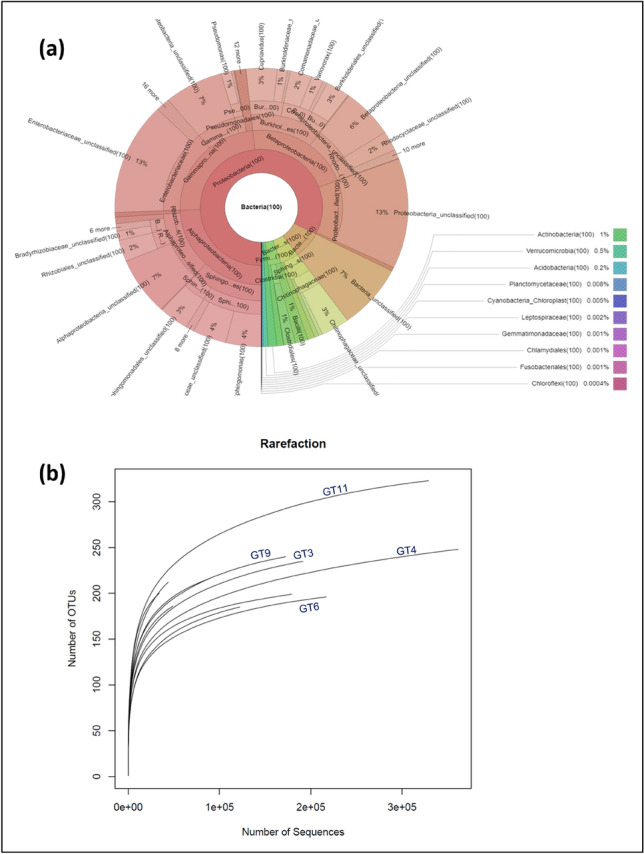
a Community structure of all geotextile metagenomes. b Rarefunction plot of the samples
Moreover, beta diversity analysis was performed to measure the similarity between different samples. Two similarity measures were adopted; the Jaccard index and the Yue and Clayton measure (2005). Mothur protocol was used to rarefy the data to a standard number of sequences using the two similarity measures. After that, dendrograms to describe the similarity of the samples to each other were generated. In these dendrograms, samples are clustered using the distance between samples computed with the Jaccard index and the Yue & Clayton similarity measures. Figure 6 displays the two dendrograms corresponding to the two similarity measures. The Jaccard index seems to reflect the correlation between the geotextile type in terms of pore size, permeability, and polymer type. For instance, the geotextiles with high porosity and permeability (from GT1 to GT6) grouped in the same clade of the dendrogram according to the Jaccard index, revealing the importance of the geotextile characteristics on bacterial distribution.
Fig. 6.

Dendrograms for beta diversity analysis using a Jaccard index, and b Yue & Clayton similarity measure, respectively
Functional analysis (KEGG) of species in the toluene degradation pathway
Kyoto Encyclopedia of Genes and Genomes (KEGG) Pathway database search of the toluene degradation mechanism revealed the susceptible toluene-degrading species in the metagenome analysis (Table S5). In the KEGG database, the toluene degradation pathway is divided into three categories based on the product upon toluene degradation: degradation of toluene to (1) benzoyl-CoA (KEGG ID: M00418), (2) benzoate (KEGG ID: M00538), and (3) 3-methylcatechol (KEGG ID: M00547). The most prevalent bacterial species that are functional in those pathways are listed in Table S5. For instance, Azoarcus sp. DN11, Azoarcus sp. SY39, and Thauera chlorobenzoica are the most abundant species, which metabolize toluene and convert it to benzoyl-CoA (Table S5). For the toluene-to-benzoate degradation, Cupriavidus genus is likely to be functional, where C. gilardii, C. metallidurans, C. taiwanensis, C. pauculus, C. pinatubonensis, C. basilensis, C. metallidurans, C. oxalaticus, and C. malaysiensis were plentiful. The toluene biodegradation capability of Cupriavidus genus is known (Mergeay et al. 1978). Studies on C. metallidurans CH34 genome revealed that the toluene monooxygenase operon (tmo) harbors five consecutive genes namely, tmoA, tmoB, tmoC, tmoD, and tmoE (Janssen et al. 2010). The tmoA is known as a marker gene to assess the bacterial community dynamics in hydrocarbon-polluted environments (Bouhajja et al. 2017). A recent functional analysis demonstrated their roles in toluene degradation (Bouhajja et al. 2017). The metagenome analyses of the current study are in line with the previous findings. The Cupriavidus genus and species are likely to play an essential role in toluene biodegradation. In addition, Bradyrhizobium sp. BTAi1 and Rhodococcus sp. SGAir0479 is the other wealthiest species functional in the toluene-to-benzoate breakdown. Another possible product upon toluene degradation is 3-methylcatechol. Bordetella and Pseudomonas are this pathway's most abundant genus found in the GT microcosms. For instance, Bordetella parapertussis, Rhodopseudomonas palustris, Pseudomonas sp. BJP69, Pseudomonas aeruginosa, and Pseudomonas fluorescens are the most prosperous species (Table S5).
Toluene is one of the non-halogenated petroleum hydrocarbons and a common subsurface contaminant around gas stations and industrial sites globally. Once released and reach the water table, it can float and spread laterally because of its low density, leading to persistent contamination in plumes (ITRC 2009; BenIsrael et al. 2019). Geotextiles and geo-membranes have been used to decontaminate soil and water. Kanilovich et al. (2008) used PRB at the Canadian Arctic for the remediation of soils and water contaminated with polychlorinated biphenyls (PCBs) and suggested nonwoven geotextile filters as the efficient PRB system. In this study, polypropylene (PP) and polyester (PET) type geotextiles are used, which have the capacity to improve surface water quality by removing nutrients and suspended particles (Pereira et al. 2020; McWatters et al. 2014). In a recent study, Yaman et al. (2021) showed the PP and PET geotextiles holding capacity in a PRB system, with a toluene-removal rate of 98–99.3%. Although the filters themselves can sponge the injected toluene, the bacterial community, in particular, the toluene-degrading population on the geotextiles, can play a role in this remediation. To find out the bacterial distribution and diversity in the geotextiles placed in the PRB system, the 16S rRNA metagenome sequencing approach is utilized. The metagenome technique is a powerful tool for deciphering the distribution of degrading bacteria and their associated marker genes. It has been successfully applied to identify the bacterial populations that grow up in the environments polluted by various contaminants, such as hydrocarbons (Saxena et al. 2017; Schweitzer et al. 2022), phenol (Silva et al. 2012; Hou et al. 2022), aniline (Peng et al. 2021), azo dye (Gu et al. 2021), xenobiotic (Yadav et al. 2021), etc. However, the studies on metagenome profiling of the population to degrade the toluene are limited (Kim et al. 2014; Bouhajja et al. 2017; BenIsrael et al. 2019). Also, no research has been undertaken to decipher the bacterial toluene-degrading population in the PRB system using nonwoven geotextiles.
Recently, BenIsrael et al. (2019) applied metagenome and toluene-specific stable carbon isotope assays to determine the toluene degradation ratio and toluene degrader population in the vadose zone of poplar trees. The abundances of the aerobic and anaerobic degradation-related genes such as toluene dioxygenase (TOD), ring-hydroxylating monooxygenase (RMO), phenol hydroxylase (PHE), and benzyl succinate synthase alpha subunit (bssA), were determined in the rhizosphere soil and poplar root as well, where the toluene degraders were detected. The relative abundance of the toluene-degrading genes, as proportions of total bacteria, increases as the depth of the soil increase. The enrichment of degraders in a contaminated environment is a known phenomenon (Lovley 2003). Due to the nutrient limitation at depth, where the toluene concentration is relatively higher, the abundance of toluene degraders is more likely. In parallel, the read numbers of 16S rRNA genes are expected to be higher in the geotextiles located at the bottom of the PRB column (i.e., GT1, GT2, and GT3), which is close to the toluene injection site, and the toluene degraders meet relatively abundant toluene compared to the upper part of the PRB. Therefore, organisms are more likely to grow up and degrade toluene due to competitive advantage. It should also be noted that the toluene-degrading genes, such as toluene 4-monooxygenase (tmoA), are primarily found in the extrachromosomal genetic elements such as plasmids, the most well-known is incompatibility plasmid (IncP) (Bouhajja et al. 2017). Through horizontal gene transfer and genetic recombination, they can help to gain toluene biodegradation capability for other microbes. Furthermore, this experiment was implemented on a PRB prototype. However, different results can be obtained in a pilot soil or groundwater application considering the interactions between the living beings and environmental dynamics such as plant–microbe interaction, temperature regime, UV-effect, nutritional status, etc.
Conclusion
This study determines the microbial community on nonwoven geotextiles in a PRB system supplemented with a hydrocarbon pollutant, toluene. Upon 167 days of inoculum, scanning electron microscopy and metagenome analyses were conducted. The bacterial species on the geotextile surface exhibiting toluene degradation potential were identified for the first time using the metagenome screening. In particular, Novosphingobium and Cupriavidus genera were dominant in all tested geotextiles. Also, Proteobacteria (80–90%) was the predominant phylum known to be the most prevalent group in petroleum-contaminated areas. Further studies can be conducted to quantify toluene-degrading responsible genes in the soil/groundwater using RNA isolation and metagenome analysis. Furthermore, the dynamic and spatial distribution of the microorganisms can be determined in a toluene-contaminated environment, where bacteria-bacteria and bacteria–plant interactions could play an important role in horizontal gene transfer and, thus, toluene biodegradation.
Supplementary Information
Below is the link to the electronic supplementary material.
Author contributions
CY conceptualized the study. CY, ABY, and IA setup the bioreactor system. IA, OA and STG analyzed the toluene content. EC conducted scanning electron microscopy. HT and AQ extracted the bacterial genome and worked on metagenome sequencing. HT and IB analyzed the metagenome data. HT, CY, OA, and IB wrote the manuscript. All authors read and commented on the manuscript.
Funding
This research was funded by Imam Abdulrahman bin Faisal University (IAU) (Project No. 2019-037-Eng) through the Deanship of Scientific Research (DSR).
Data availability
All data generated or analyzed during this study are included in this published article. The metagenome data are submitted to NCBI BioSample (SAMN28991445, SAMN28991445, SAMN28991446, SAMN28991447, SAMN28991448, SAMN28991449, SAMN28991450, SAMN28991451, SAMN28991452, SAMN28991453, and SAMN28991454) and BioProject (SUB11233613) databases.
Declarations
Conflict of interest
On behalf of all authors, the corresponding author states that there is no conflict of interest.
Ethics approval
Not applicable.
References
- Ali N, Dashti N, Khanafer M, Al-Awadhi H, Radwan S. Bioremediation of soils saturated with spilled crude oil. Sci Rep. 2020;10(1):1–9. doi: 10.1038/s41598-019-57224-x. [DOI] [PMC free article] [PubMed] [Google Scholar]
- Balba M, Al-Awadhi N, Al-Daher R. Bioremediation of oil-contaminated soil: microbiological methods for feasibility assessment and field evaluation. J Microbiol Methods. 1998;32:155–164. [Google Scholar]
- Beazley MJ, Martinez RJ, Rajan S, Powell J, et al. Microbial community analysis of a coastal salt marsh affected by the Deepwater Horizon oil spill. PLoS ONE. 2012;7(7):e41305. doi: 10.1371/journal.pone.0041305. [DOI] [PMC free article] [PubMed] [Google Scholar]
- Benedek T, Szentgyörgyi F, Gergócs V, Menashe O, et al. Potential of Variovorax paradoxus isolate BFB1_13 for bioremediation of BTEX contaminated sites. AMB Express. 2021;11(1):1–17. doi: 10.1186/s13568-021-01289-3. [DOI] [PMC free article] [PubMed] [Google Scholar]
- BenIsrael M, Wanner P, Aravena R, Parker BL, Haack EA, Tsao DT, Dunfield KE. Toluene biodegradation in the vadose zone of a poplar phytoremediation system identified using metagenomics and toluene-specific stable carbon isotope analysis. Int J Phytoremed. 2019;21(1):60–69. doi: 10.1080/15226514.2018.1523873. [DOI] [PubMed] [Google Scholar]
- Bouhajja E, McGuire M, Liles MR, Bataille G, Agathos SN, George IF. Identification of novel toluene monooxygenase genes in a hydrocarbon-polluted sediment using sequence-and function-based screening of metagenomic libraries. App Microbiol Biotech. 2017;101(2):797–808. doi: 10.1007/s00253-016-7934-5. [DOI] [PubMed] [Google Scholar]
- Careghini A, Saponaro S, Sezenna E, Daghio M, Franzetti A, Gandolfi I, Bestetti G. Lab-scale tests and numerical simulations for in situ treatment of polluted groundwater. J Hazard Mater. 2015;287:162–170. doi: 10.1016/j.jhazmat.2015.01.028. [DOI] [PubMed] [Google Scholar]
- Chain PSG, Denef VJ, Konstantinidis KT, Vergez LM, Agulló L, et al. Burkholderia xenovorans LB400 harbors a multi-replicon, 9.73-Mbp genome shaped for versatility. Proc Natl Acad Sci USA. 2006;103:15280–15287. doi: 10.1073/pnas.0606924103. [DOI] [PMC free article] [PubMed] [Google Scholar]
- Choi DH, Kwon YM, Kwon KK, Kim SJ. Complete genome sequence of Novosphingobium pentaromativorans US6-1(T) Stand Genomic Sci. 2015;10:107. doi: 10.1186/s40793-015-0102-1. [DOI] [PMC free article] [PubMed] [Google Scholar]
- Eze MO. Metagenome analysis of a hydrocarbon-degrading bacterial consortium reveals the specific roles of BTEX biodegraders. Genes. 2021;12(1):98. doi: 10.3390/genes12010098. [DOI] [PMC free article] [PubMed] [Google Scholar]
- Eze MO, Hose GC, George SC, Daniel R. Diversity and metagenome analysis of a hydrocarbon-degrading bacterial consortium from asphalt lakes located in Wietze, Germany. AMB Express. 2021;11(1):1–12. doi: 10.1186/s13568-021-01250-4. [DOI] [PMC free article] [PubMed] [Google Scholar]
- Eze MO, Thiel V, Hose GC, George SC, Daniel R. Enhancing rhizoremediation of petroleum hydrocarbons through bioaugmentation with a plant growth-promoting bacterial consortium. Chemosphere. 2022;289:133143. doi: 10.1016/j.chemosphere.2021.133143. [DOI] [PubMed] [Google Scholar]
- Eze MO, Thiel V, Hose GC, George SC, Daniel R. Bacteria-plant interactions synergistically enhance biodegradation of diesel fuel hydrocarbons. Commun Earth Environ. 2022;3(1):1–10. [Google Scholar]
- Ghimire N, Kim B, Lee CM, Oh TJ. Comparative genome analysis among Variovorax species and genome guided aromatic compound degradation analysis emphasizing 4-hydroxybenzoate degradation in Variovorax sp PAMC26660. BMC Genom. 2022;23(1):1–16. doi: 10.1186/s12864-022-08589-3. [DOI] [PMC free article] [PubMed] [Google Scholar]
- Gu M, Yin Q, Wu G. Metagenomic analysis of facilitation mechanism for azo dye reactive red 2 degradation with the dosage of ferroferric oxide. J Water Process Eng. 2021;41:102010. [Google Scholar]
- Hashimoto T, Onda K, Morita T, Luxmy BS, Tada K, Miya A, et al. Contribution of the estrogen-degrading bacterium Novosphingobium sp strain JEM-1 to estrogen removal in wastewater treatment. J Environ Eng Asce. 2010;136:890–896. [Google Scholar]
- Hou Y, Zeng Q, Li H, Wu J, Xiang J, Huang H, Shi S. Metagenomics-based interpretation of the impacts of silica nanoparticles exposure on phenol treatment performance in sequencing batch reactor system. Chem Eng J. 2022;428:132052. [Google Scholar]
- ITRC (2009) Evaluating natural source zone depletion at sites with LNAPL. The Interstate Technology & Regulatory Council, LNAPLs Team, 76
- Janssen PJ, Van Houdt R, Moors H, Monsieurs P, Morin N, Michaux A, Benotmane MA, Leys N, Vallaeys T, Lapidus A, Monchy S, Medigue C, Taghavi S, McCorkle S, Dunn J, van der Lelie D, Mergeay M. The complete genome sequence of Cupriavidus metallidurans strain CH34, a master survivalist in harsh and anthropogenic environments. PLoS ONE. 2010;5(5):e10433. doi: 10.1371/journal.pone.0010433. [DOI] [PMC free article] [PubMed] [Google Scholar]
- Jiang Y, Shao J, Wu X, Xu Y, Li R. Active and silent members in the mlr gene cluster of a microcystin-degrading bacterium isolated from Lake Taihu, China. FEMS Microbiol Lett. 2011;322:108–114. doi: 10.1111/j.1574-6968.2011.02337.x. [DOI] [PubMed] [Google Scholar]
- Joshi MN, Dhebar SV, Dhebar SV, Bhargava P, Pandit A, Patel RP, et al. Metagenomics of petroleum muck: revealing microbial diversity and depicting microbial syntrophy. Arch Microbiol. 2014;196(8):531–544. doi: 10.1007/s00203-014-0992-0. [DOI] [PubMed] [Google Scholar]
- Kalinovich I, Rutter A, Rowe RK, McWatters R, Poland JS. The application of geotextile and granular filters for PCB remediation. Geosyn Int. 2008;15(3):173–183. [Google Scholar]
- Kim SJ, Park SJ, Cha IT, Min D, Kim JS, Chung WH, et al. Metabolic versatility of toluene-degrading, iron-reducing bacteria in tidal flat sediment, characterized by stable isotope probing-based metagenomic analysis. Environ Microbiol. 2014;16(1):189–204. doi: 10.1111/1462-2920.12277. [DOI] [PubMed] [Google Scholar]
- Korkut EN, Martin JP, Yaman C. Wastewater treatment with biomass attached to porous geotextile baffles. J Environ Eng. 2006;132:284–288. [Google Scholar]
- Lee Y, Jeon CO. Paraburkholderia aromaticivorans sp. nov., an aromatic hydrocarbon-degrading bacterium, isolated from gasoline-contaminated soil. Int J Syst Evol Microbiol. 2018;68:1251–1257. doi: 10.1099/ijsem.0.002661. [DOI] [PubMed] [Google Scholar]
- Liu ZP, Wang BJ, Liu YH, Liu SJ. Novosphingobium taihuense sp. nov, a novel aromatic-compound-degrading bacterium isolated from Taihu Lake, China. Int J Syst Evol Microbiol. 2005;55(3):1229–1232. doi: 10.1099/ijs.0.63468-0. [DOI] [PubMed] [Google Scholar]
- Lovley DR. Cleaning up with genomics: applying molecular biology to bioremediation. Nat Rev Microbiol. 2003;1(1):35–44. doi: 10.1038/nrmicro731. [DOI] [PubMed] [Google Scholar]
- McWatters RS, Wilkins D, Spedding T, Hince G, Snape I, Rowe RK, et al (2014) Geosynthetics in barriers for hydrocarbon remediation in Antarctica. In: International Conference on Geosynthetics (pp1384–1391) Deutsche Gesellschaft fur Geotechnik eV
- Mergeay M, Houba C, Gerits J. Extrachromosomal inheritance controlling resistance to cadmium, cobalt, copper and zinc ions: evidence from curing in a Pseudomonas. Arch Int Physiol Biochim. 1978;86(2):440–442. [PubMed] [Google Scholar]
- Notomista E, Pennacchio F, Cafaro V, Smaldone G, Izzo V, Troncone L, et al. The marine isolate Novosphingobium sp PP1Y shows specific adaptation to use the aromatic fraction of fuels as the sole carbon and energy source. Microbial Ecol. 2011;61:582–594. doi: 10.1007/s00248-010-9786-3. [DOI] [PubMed] [Google Scholar]
- Nwankwegu AS, Onwosi CO. Bioremediation of gasoline contaminated agricultural soil by bioaugmentation. Environ Technol. 2017;7:1–11. [Google Scholar]
- Peng H, Zhang Q, Tan B, Li M, Zhang W, Feng J. A metagenomic view of how different carbon sources enhance the aniline and simultaneous nitrogen removal capacities in the aniline degradation system. Bioresour Technol. 2021;335:125277. doi: 10.1016/j.biortech.2021.125277. [DOI] [PubMed] [Google Scholar]
- Pereira AC, Palakkeel Veetil D, Mulligan CN, Bhat S (2020) On-site nonwoven geotextile filtration method for remediation of lake water. In: CSCE Annual Conference
- Polyak YM, Bakina LG, Chugunova MV, Mayachkina NV, Gerasimov AO, Bure VM. Effect of remediation strategies on biological activity of oil-contaminated soil—a field study. Int Biodeterior Biodegradation. 2018;126:57–68. [Google Scholar]
- Posman KM, DeRito CM, Madsen EL. Benzene degradation by a Variovorax species within a coal tar-contaminated groundwater microbial community. Appl Environ Microbiol. 2017;83(4):e02658–e2716. doi: 10.1128/AEM.02658-16. [DOI] [PMC free article] [PubMed] [Google Scholar]
- Rajamanickam R, Kaliyamoorthi K, Ramachandran N, Baskaran D, Krishnan J. Batch biodegradation of toluene by mixed microbial consortia and its kinetics. Int Biodeterior Biodegr. 2017;119:282–288. [Google Scholar]
- Saxena R, Dhakan DB, Mittal P, Waiker P, Chowdhury A, Ghatak A, Sharma VK. Metagenomic analysis of hot springs in Central India reveals hydrocarbon degrading thermophiles and pathways essential for survival in extreme environments. Front Microbiol. 2017;7:2123. doi: 10.3389/fmicb.2016.02123. [DOI] [PMC free article] [PubMed] [Google Scholar]
- Schloss PD, Westcott SL, Ryabin T, Hall JR, Hartmann M, Hollister EB, Lesniewski RA, Oakley BB, Parks DH, Robinson CJ, Sahl JW, Stres B, Thallinger GG, Van Horn DJ, Weber CF. Introducing mothur: open-source, platform-independent, community-supported software for describing and comparing microbial communities. Appl Environ Microbiol. 2009;75(23):7537–7541. doi: 10.1128/AEM.01541-09. [DOI] [PMC free article] [PubMed] [Google Scholar]
- Schweitzer HD, Smith HJ, Barnhart EP, McKay LJ, Gerlach R, Cunningham AB, et al. Subsurface hydrocarbon degradation strategies in low-and high-sulfate coal seam communities identified with activity-based metagenomics. NPJ Biofilm Microbiom. 2022;8(1):1–10. doi: 10.1038/s41522-022-00267-2. [DOI] [PMC free article] [PubMed] [Google Scholar]
- Sheu SY, Huang CW, Chen JC, Chen ZH, Chen WM. Novosphingobium arvoryzae spnov, isolated from a flooded rice field. Int J Syst Evol Microbiol. 2018;68:2151–2157. doi: 10.1099/ijsem.0.002756. [DOI] [PubMed] [Google Scholar]
- Silva CC, Hayden H, Sawbridge T, Mele P, Kruger RH, Rodrigues MV, et al. Phylogenetic and functional diversity of metagenomic libraries of phenol degrading sludge from petroleum refinery wastewater treatment system. AMB Express. 2012;2(1):1–13. doi: 10.1186/2191-0855-2-18. [DOI] [PMC free article] [PubMed] [Google Scholar]
- Sohn JH, Kwon KK, Kang JH, Jung HB, Kim SJ. Novosphingobium pentaromativorans spnov, a high-molecular-mass polycyclic aromatic hydrocarbon-degrading bacterium isolated from estuarine sediment. Int J System Evol Microbiol. 2004;54(5):1483–1487. doi: 10.1099/ijs.0.02945-0. [DOI] [PubMed] [Google Scholar]
- Szentgyörgyi F, Benedek T, Fekete D, Táncsics A, Harkai P, Kriszt B. Development of a bacterial consortium from Variovorax paradoxus and Pseudomonas veronii isolates applicable in the removal of BTEX. AMB Express. 2022;12(1):1–14. doi: 10.1186/s13568-022-01349-2. [DOI] [PMC free article] [PubMed] [Google Scholar]
- Tiirola MA, Mannisto MK, Puhakka JA, Kulomaa MS. Isolation and characterization of Novosphingobium sp strain MT1, a dominant polychlorophenol-degrading strain in a groundwater bioremediation system. Appl Environ Microbiol. 2002;68:173–180. doi: 10.1128/AEM.68.1.173-180.2002. [DOI] [PMC free article] [PubMed] [Google Scholar]
- Wang J, Wang C, Li J, Bai P, Li Q, Shen M, et al (2018) Comparative genomics of degradative Novosphingobium strains with special reference to microcystin-degrading Novosphingobium spTHN1. Front Microbiol 2238 [DOI] [PMC free article] [PubMed]
- Wilhelm RC, Murphy SJ, Feriancek NM, et al. Paraburkholderia madseniana sp. nov., a phenolic acid-degrading bacterium isolated from acidic forest soil. Int J Syst Evol. 2020;70(3):2137–2146. doi: 10.1099/ijsem.0.004029. [DOI] [PubMed] [Google Scholar]
- Wood DE, Salzberg SL. Kraken: ultrafast metagenomic sequence classification using exact alignments. Genome Biol. 2014;15(3):R46. doi: 10.1186/gb-2014-15-3-r46. [DOI] [PMC free article] [PubMed] [Google Scholar]
- Yadav R, Rajput V, Dharne M. Functional metagenomic landscape of polluted river reveals potential genes involved in degradation of xenobiotic pollutants. Environ Res. 2021;192:110332. doi: 10.1016/j.envres.2020.110332. [DOI] [PubMed] [Google Scholar]
- Yaman C. Performance and kinetics of bioaugmentation, biostimulation, and natural attenuation processes for bioremediation of crude oil-contaminated soils. Processes. 2020;8(8):883. [Google Scholar]
- Yaman C, Martin JP, Korkut E. Use of layered geotextiles to provide a substrate for biomass development in treatment of septic tank effluent prior to ground infiltration. J Environ Eng. 2005;131:1667–1675. [Google Scholar]
- Yaman C, Rehman S, Ahmad T, Kucukaga Y, Pala B, AlRushaid N, Riyaz Ul Hassan S, Yaman AB. Community structure of bacteria and archaea associated with geotextile filters in anaerobic bioreactor landfills. Processes. 2021;9:1377. [Google Scholar]
- Yue JC, Clayton MK. A similarity measure based on species proportions. Commun Stat-Theory Meth. 2005;34(11):2123–2131. [Google Scholar]
- Zhou L, Wang DW, Zhang SL, et al. Functional microorganisms involved in the sulfur and nitrogen metabolism in production water from a high-temperature offshore petroleum reservoir. Int Biodeterior Biodegr. 2020;154:105057. [Google Scholar]
Associated Data
This section collects any data citations, data availability statements, or supplementary materials included in this article.
Supplementary Materials
Data Availability Statement
All data generated or analyzed during this study are included in this published article. The metagenome data are submitted to NCBI BioSample (SAMN28991445, SAMN28991445, SAMN28991446, SAMN28991447, SAMN28991448, SAMN28991449, SAMN28991450, SAMN28991451, SAMN28991452, SAMN28991453, and SAMN28991454) and BioProject (SUB11233613) databases.