



Abstract
A Vitamin or mineral supplement is a kind of adjunct that aims to supplement the diet and it comprises a wide range of Vitamins, minerals, herbs, etc., that amplifies different nutrient levels. People intake such supplements for protection against health illnesses such as stress, cold, flu, osteoporosis, heart attacks, tooth decay, cancer, and neural tube defects in infants, etc. Anyhow, intake of large amounts without proper medical consideration can have severe negative consequences. This study aimed to assess the awareness on Vitamin and mineral supplements among College students. An online cross-sectional questionnaire was made using Google Forms and distributed among 100 College students. The data collected were analyzed using SPSS software. Descriptive analysis and Chi-square tests were done. Results showed that the majority of 63.43% of UG students and 21.64% of PG students believed that its consumption was beneficial and in general awareness was more among UG students. When asked about the Vitamin that should be avoided during pregnancy, a majority of 20.30% of UG students opted for Vitamin E and 7.52% of PG students opted for Vitamin A which shows that both were feasible options as they were fat-soluble vitamins capable of causing congenital defects. The most probable issue related with the use of dietary supplements is that the people who include them in their diet might see it as a substitute, in lieu of a supplement, thus, more people should be made aware of the proper consumption and side effects of Vitamin and mineral supplements.
Keywords: Innovative study, innovative technology, minerals, novel method, protection, supplementation, Vitamins
INTRODUCTION
Vitamins and minerals are widely used as dietary supplements among the general public. Medical physicians usually prescribe it as an auxiliary medication intended for the betterment of mild to severe chronic illnesses. Studies suggest that they aid in amplifying immunity and speedy recovery from illnesses.[1] Vitamins are basically organic in nature which comes in the form of Vitamin A, B, C, D, E, K, etc., and minerals are chemical compounds such as magnesium, iron, and zinc. These substances must be prescribed in low amounts from the environment only if they cannot be synthesized de novo in the human body or if the rate of formation is deficient for the upkeep of health. Most people self-prescribe and consume it for their health, nutrition supplementation, and disease prevention.[2]
It has been studied that the most common supplement included among the diet of students of the U.S, is a multivitamin supplement. They conducted a large-scale study consisting of over 3000 participants of population, it was seen that more than 59% of the subjects were using these micronutrient dietary supplements. The use of these supplements kept increasing with the “intention to eat healthy” and age.[3] Recently, a drug utilization study was conducted in secondary care hospitals and colleges in Maharashtra, India, where it was observed that in 16% of the prescriptions given by doctors, a multivitamin product was also prescribed and among 2% of the prescriptions, it was seen that more than one Vitamin supplement prescribed.[4] The prevalence of intake of Vitamin and mineral supplements among colleges has increased. Most students have a high chance of experiencing adverse events, however, the awareness of Vitamin and mineral supplements among college students remains restricted and finite, even among medical students.[5] For instance, consumption of larger doses of Vitamin A or C and megadoses of minerals can cause severe complications. When taken as directed by a physician then multivitamins and minerals are not expected to cause serious side effects.[6]
The use of Vitamin and mineral supplements, across India, including multivitamins has enhanced in the past 50 years. In some developed countries, approximately 20%–30% of the population use Vitamin and mineral supplements in their day-to-day life.[7] Industries that are involved in the manufacture of these supplements have become one of the world's rapidly developing industries. Even though the consumption of Vitamin and mineral supplements may impart several advantages in terms of high nutrient consumption, there are complicated side effects that can be harmful due to increased intake.[7] However, a few advantages, like that of folic acid supplementation, could be used for protection against neural tube defects and other supplements could potentially reduce the risk of cardiovascular diseases such as stroke or myocardial infarction.[8]
In today's scheme with people who are advanced in literacy and those who are health conscious, the awareness of the side effects due to high consumption is reduced as there is the easy and wide availability of such supplements as over-the-counter products.[9] Most nutrition and medical experts have stipulated that it could be judicious for adults to take the multivitamin supplement on a daily basis along with an additional quantity of few specific nutrients, to make sure of sufficient intake and help in the prevention of diseases, thus, it is an unfolded question whether research that study and determine the safety of these supplements make a practical difference, specifically since their use is mostly not properly guided by a health-care professional. Our research and knowledge have resulted in high-quality publications from our team.[10,11,12,13,14,15,16,17,18,19,20,21,22,23]
The aim and rationale behind the study are to assess the awareness on Vitamin and mineral supplements among college students.
MATERIALS AND METHODS
An online cross-sectional questionnaire was made using Google Forms and distributed among 100 College Students from Saveetha Dental College. A signed consent form stating the willingness to participate in the survey was obtained from all the participants. The data collected from subjects were tabulated in Excel and imported to SPSS software (version 19, IBM, India). Descriptive analysis was performed, and a Chi-square test was done for comparison among the groups. The significance level was set at 0.05.
RESULTS
The responses received through the questionnaire was statistically analyzed to and the results obtained are represented as bar graphs [Figures 1-5].
Figure 1.
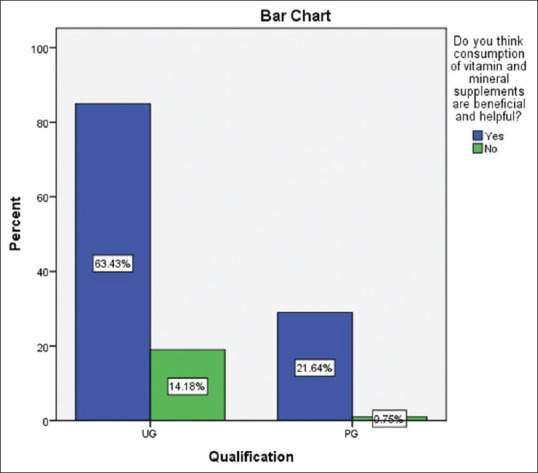
The graph shows the percentage of UG and PG students who believe consumption of vitamin and mineral supplements are beneficial where the X-axis indicates qualification and Y-axis indicates percentage response. Pearson's Chi-square = 0.024 (P < 0.05) which is significant statistically
Figure 5.
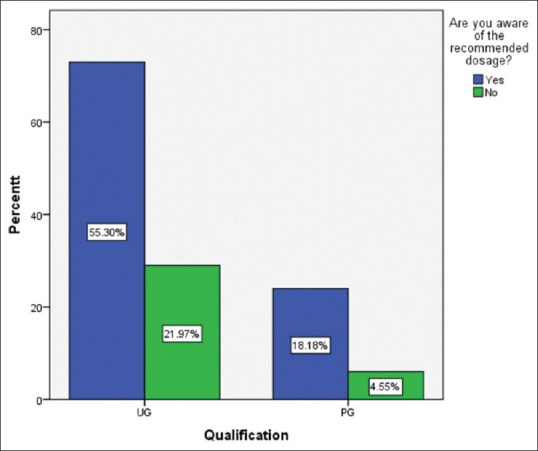
This graph shows the percentage of UG and PG students who are aware of the recommended dosage of supplementation. X-axis indicates qualification and Y-axis indicates percentage response to the given options. Pearson's Chi-square = 0.043 (P < 0.05) which is significant statistically
Figure 2.
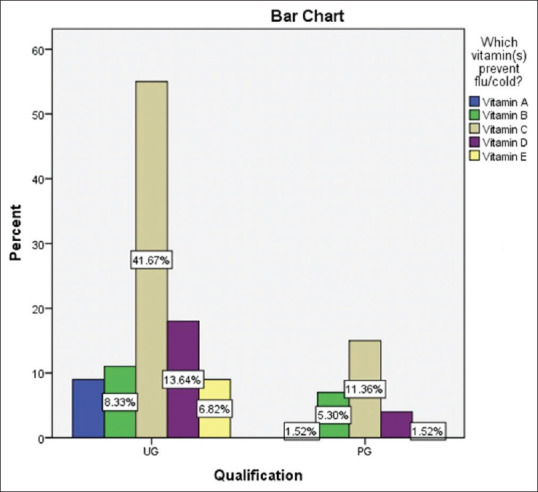
The graph represents the percentage of UG and PG students who are aware of the particular Vitamin that helps prevent colds and flu where the X-axis indicates qualification and Y-axis indicates percentage response to the question. Pearson's Chi-square = 0.032 (P < 0.05) which is significant statistically
Figure 3.
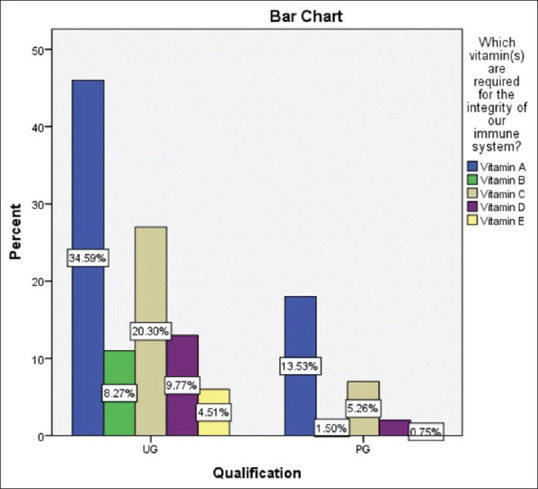
The graph represents the percentage of UG and PG students who are aware of the vitamin required for immune system integrity where the X-axis indicates qualification and Y-axis indicates percentage response to the given Vitamin options. Pearson's Chi-square = 0.043 (P < 0.05) which is significant statistically
Figure 4.

The graph shows the percentage of UG and PG students who are aware of the Vitamin that should be avoided during pregnancy where the X-axis indicates qualification and Y-axis indicates percentage response to the given vitamin options. Pearson's Chi-square = 0.022 (P < 0.05) which is significant statistically
DISCUSSION
Vitamin and mineral supplements are the most commonly sold as over-the-counter agents and it may be taken often daily more than once. Sometimes, more than one particular type of multivitamin can be taken. Provided the circumstances are favorable as pregnancy and other health problems could pose a major threat to the consumption of particular supplements.[24] From the results of our study, it was found that a majority of 63.43% of UG students and 21.64% of PG students believed that its consumption was beneficial among which percentage of undergraduate students was more. Recently, in a national large-scale survey that was conducted by Park et al., it was shown that the intake of Vitamin and mineral supplements had enhanced from 23.2% to 33.9% in a period of 1987 to 2000 among all races, both males and females along with ethnic groups because they are under the belief of its multifaceted advantages.[25]
Our result on the awareness of the particular Vitamin that helps prevent colds and flu showed that the majority of 41.67% of UG students and 11.36% of PG students opted for Vitamin C which indicated more awareness among the UG subjects, although <50% of the subjects opted for the correct Vitamin. In another large multiethnic cohort study by Chugh and Lhamo, about 50% of the participants reported usage of a Vitamin C supplement at least once weekly to prevent flu and allergies which shows that a good majority of their subjects were aware of it as a possible prevention for cold.[26]
Our result showed that 34.59% of UG students and 13.53% of PG students opted for Vitamin A as the Vitamin required for immune system integrity. This indicates that more UG students were aware of this than PG students.
In a similar study conducted by Lippman SM, 84% of the subjects were unaware of the role of Vitamin A in the immune system and its deficiency consequences. It was deduced that Vitamin A supplementation is more important for infants aged 6–24 months who are hospitalized as it reduces mortality rates.[27]
Our result on the awareness of the Vitamin that should be avoided during pregnancy showed that a majority of 20.30% of UG students opted for Vitamin E and 7.52% of PG students opted for Vitamin A.
Klein EA suggested that it was best not to take foods that may be very rich in Vitamin A, which includes liver and liver products. However other studies also suggest avoiding high doses of Vitamin E during pregnancy as both these Vitamins are fat soluble and get stored in the liver. The fetal hepatic store levels for these are low and an increase in its reserves can cause teratogenicity.[28]
From the result, it was clear that the majority of 55.30% of UG students and 18.18% of PG students were aware of the recommended dosages which are a statistically good result.
Study conducted in Delhi, many students and athletes consumed dietary supplements. The original safety and effectiveness of these products depend on the recommended dosages. Then such supplements are free of any harm and safe. For example, consumption of larger quantities of Vitamin D will lead to disorders such as osteoporosis and muscle weakness if not consumed in its recommended dose of 5 μg.[29]
From the above-conducted study, we can extrapolate that the mild incomprehension of the subjects regarding the potential harmful side effects of over-supplementation shows that they have a flawed belief that these medications are safe which increases their ignorance to the given issue.[29] Thus, physicians and health experts must ask straight questions to the patients related to the self-prescribed use of Vitamin and mineral supplements and instruct them toward the awareness of damaging side effects and potential drug interactions with other drugs consumed. For instance, an association of Vitamin E supplements and the commonly prescribed “aspirin” leads to a cumulative anti-thrombotic effect. Similarly, between Vitamin E and warfarin, there is an elevated chance of bleeding that can be caused as per literature.[30]
However, further research and surveys must be conducted among larger populations so as to spread awareness that Vitamin and mineral supplements should only be viewed as an enhancer of healthy body functions and not a substitute to consume instead of solid healthy foods.
CONCLUSION
From our study, we can derive that the most probable issue related to the use of dietary supplements is that users self-prescribe these supplements instead of naturally consuming fruits and vegetables which are particularly rich in those Vitamins and minerals. Most of these people may not know the severe side effects of overdosage. Hence, more people should be made aware of the proper intake of Vitamin and mineral supplements.
Financial support and sponsorship
The present study is sponsored by:
Saveetha INSTITUTE OF MEDICAL AND TECHNICAL SCIENCES
Saveetha Dental College and Hospitals
Saveetha University
Diamond Art General Trading LLC, United Arab Emirates.
Conflicts of interest
There are no conflicts of interest.
Acknowledgment
The authors are thankful to Saveetha Institute of Medical and Technical Sciences for providing a platform to express our knowledge.
REFERENCES
- 1.Conway RE, Rigler FV, Croker HA, Lally PJ, Beeken RJ, Fisher A. Dietary supplement use by individuals living with and beyond breast, prostate, and colorectal cancer: A cross-sectional survey. Cancer. 2022;128:1331–8. doi: 10.1002/cncr.34055. [DOI] [PubMed] [Google Scholar]
- 2.El-Kadiki A, Sutton AJ. Role of multivitamins and mineral supplements in preventing infections in elderly people: Systematic review and meta-analysis of randomised controlled trials. BMJ. 2005;330:871. doi: 10.1136/bmj.38399.495648.8F. [DOI] [PMC free article] [PubMed] [Google Scholar]
- 3.Foote JA, Murphy SP, Wilkens LR, Hankin JH, Henderson BE, Kolonel LN. Factors associated with dietary supplement use among healthy adults of five ethnicities: The multiethnic cohort study. Am J Epidemiol. 2003;157:888–97. doi: 10.1093/aje/kwg072. [DOI] [PMC free article] [PubMed] [Google Scholar]
- 4.van der Horst K, Siegrist M. Vitamin and mineral supplement users. Do they have healthy or unhealthy dietary behaviours? Appetite. 2011;57:758–64. doi: 10.1016/j.appet.2011.08.020. [DOI] [PubMed] [Google Scholar]
- 5.Sesso HD, Christen WG, Bubes V, Smith JP, MacFadyen J, Schvartz M, et al. Multivitamins in the prevention of cardiovascular disease in men: The physicians'health study II randomized controlled trial. JAMA. 2012;308:1751–60. doi: 10.1001/jama.2012.14805. [DOI] [PMC free article] [PubMed] [Google Scholar]
- 6.Liang W, Lee AH, Binns CW. Dietary supplementation by older adults in Southern China: A hospital outpatient clinic study. BMC Complement Altern Med. 2009;9:39. doi: 10.1186/1472-6882-9-39. [DOI] [PMC free article] [PubMed] [Google Scholar]
- 7.Qidwai W, Samani ZA, Azam I, Lalani S. Knowledge, attitude and practice of vitamin supplementation among patients visiting out-patient physicians in a teaching hospital in Karachi. Oman Med J. 2012;27:116–20. doi: 10.5001/omj.2012.24. [DOI] [PMC free article] [PubMed] [Google Scholar]
- 8.US Preventive Services Task Force. Mangione CM, Barry MJ, Nicholson WK, Cabana M, Chelmow D, et al. Vitamin, mineral, and multivitamin supplementation to prevent cardiovascular disease and cancer: US preventive services task force recommendation statement. JAMA. 2022;327:2326–33. doi: 10.1001/jama.2022.8970. [DOI] [PubMed] [Google Scholar]
- 9.Fairfield KM, Fletcher RH. Vitamins for Chronic Disease Prevention in Adults: Scientific Review. JAMA. 2002;287:3116–26. doi: 10.1001/jama.287.23.3116. [DOI] [PubMed] [Google Scholar]
- 10.Nambi G, Kamal W, Es S, Joshi S, Trivedi P. Spinal manipulation plus laser therapy versus laser therapy alone in the treatment of chronic non-specific low back pain: A randomized controlled study. Eur J Phys Rehabil Med. 2018;54:880–9. doi: 10.23736/S1973-9087.18.05005-0. [DOI] [PubMed] [Google Scholar]
- 11.Mohanavel V, Ashraff Ali KS, Prasath S, Sathish T, Ravichandran M. Microstructural and tribological characteristics of AA6351/Si3N4 composites manufactured by stir casting. J Mater Res Technol. 2020;9:14662–72. [Google Scholar]
- 12.Vijayashree Priyadharsini J, Smiline Girija AS, Paramasivam A. An insight into the emergence of Acinetobacter baumannii as an oro-dental pathogen and its drug resistance gene profile – An in silico approach. Heliyon. 2018;4:e01051. doi: 10.1016/j.heliyon.2018.e01051. [DOI] [PMC free article] [PubMed] [Google Scholar]
- 13.Packiri S, Gurunathan D, Selvarasu K. Management of paediatric oral Ranula: A Systematic review. J Clin Diagn Res. 2017;11:ZE06–9. doi: 10.7860/JCDR/2017/28498.10622. [DOI] [PMC free article] [PubMed] [Google Scholar]
- 14.Babu S, Jayaraman S. An update on b-sitosterol: A potential herbal nutraceutical for diabetic management. Biomed Pharmacother. 2020;131:110702. doi: 10.1016/j.biopha.2020.110702. [DOI] [PubMed] [Google Scholar]
- 15.Rajakumari R, Volova T, Oluwafemi OS, Rajesh Kumar S, Thomas S, Kalarikkal N. Grape seed extract-soluplus dispersion and its antioxidant activity. Drug Dev Ind Pharm. 2020;46:1219–29. doi: 10.1080/03639045.2020.1788059. [DOI] [PubMed] [Google Scholar]
- 16.Ramamoorthi S, Nivedhitha MS, Divyanand MJ. Comparative evaluation of postoperative pain after using endodontic needle and EndoActivator during root canal irrigation: A randomised controlled trial. Aust Endod J. 2015;41:78–87. doi: 10.1111/aej.12076. [DOI] [PubMed] [Google Scholar]
- 17.Iswarya Jaisankar A, Smiline Girija AS, Gunasekaran S, Vijayashree Priyadharsini J. Molecular characterisation of csgA gene among ESBL strains of A baumannii and targeting with essential oil compounds from Azadirachta Indica. J King Saud Univ Sci. 2020;32:3380–7. [Google Scholar]
- 18.Wadhwa R, Paudel KR, Chin LH, Hon CM, Madheswaran T, Gupta G, et al. Anti-inflammatory and anticancer activities of naringenin-loaded liquid crystalline nanoparticles in vitro. J Food Biochem. 2021;45:e13572. doi: 10.1111/jfbc.13572. [DOI] [PubMed] [Google Scholar]
- 19.Mudigonda SK, Murugan S, Velavan K, Thulasiraman S, Krishna Kumar Raja VB. Non-suturing microvascular anastomosis in maxillofacial reconstruction –A comparative study. J Craniomaxillofac Surg. 2020;48:599–606. doi: 10.1016/j.jcms.2020.04.005. [DOI] [PubMed] [Google Scholar]
- 20.Paramasivam A, Priyadharsini JV, Raghunandhakumar S. Implications of m6A modification in autoimmune disorders. Cell Mol Immunol. 2020;17:550–1. doi: 10.1038/s41423-019-0307-0. [DOI] [PMC free article] [PubMed] [Google Scholar]
- 21.Barabadi H, Mojab F, Vahidi H, Marashi B, Talank N, Hosseini O, et al. Green synthesis, characterization, antibacterial and biofilm inhibitory activity of silver nanoparticles compared to commercial silver nanoparticles. Inorg Chem Commun. 2021;129:108647. [Google Scholar]
- 22.Tahmasebi S, Qasim MT, Krivenkova MV, Zekiy AO, Thangavelu L, Aravindhan S, et al. The effects of oxygen-ozone therapy on regulatory T-cell responses in multiple sclerosis patients. Cell Biol Int. 2021;45:1498–509. doi: 10.1002/cbin.11589. [DOI] [PubMed] [Google Scholar]
- 23.Markov A, Thangavelu L, Aravindhan S, Zekiy AO, Jarahian M, Chartrand MS, et al. Mesenchymal stem/stromal cells as a valuable source for the treatment of immune-mediated disorders. Stem Cell Res Ther. 2021;12:192. doi: 10.1186/s13287-021-02265-1. [DOI] [PMC free article] [PubMed] [Google Scholar] [Retracted]
- 24.Briançon S, Boini S, Bertrais S, Guillemin F, Galan P, Hercberg S. Long-term antioxidant supplementation has no effect on health-related quality of life: The randomized, double-blind, placebo-controlled, primary prevention SU.VI.MAX trial. Int J Epidemiol. 2011;40:1605–16. doi: 10.1093/ije/dyr161. [DOI] [PubMed] [Google Scholar]
- 25.Park SY, Murphy SP, Martin CL, Kolonel LN. Nutrient intake from multivitamin/mineral supplements is similar among users from five ethnic groups: The multiethnic cohort study. J Am Diet Assoc. 2008;108:529–33. doi: 10.1016/j.jada.2007.12.011. [DOI] [PubMed] [Google Scholar]
- 26.Chugh PK, Lhamo Y. An assessment of vitamin supplements in the Indian market. Indian J Pharm Sci. 2012;74:469–73. doi: 10.4103/0250-474X.108431. [DOI] [PMC free article] [PubMed] [Google Scholar]
- 27.Lippman SM, Klein EA, Goodman PJ, Lucia MS, Thompson IM, Ford LG, et al. Effect of selenium and Vitamin E on risk of prostate cancer and other cancers: The Selenium and Vitamin E cancer prevention trial (SELECT) JAMA. 2009;301:39–51. doi: 10.1001/jama.2008.864. [DOI] [PMC free article] [PubMed] [Google Scholar]
- 28.Klein EA, Thompson IM, Jr, Tangen CM, Crowley JJ, Lucia MS, Goodman PJ, et al. Vitamin E and the risk of prostate cancer: The Selenium and Vitamin E cancer prevention trial (SELECT) JAMA. 2011;306:1549–56. doi: 10.1001/jama.2011.1437. [DOI] [PMC free article] [PubMed] [Google Scholar]
- 29.Gordon NP, Schaffer DM. Use of dietary supplements by female seniors in a large Northern California health plan. BMC Geriatr. 2005;5:4. doi: 10.1186/1471-2318-5-4. [DOI] [PMC free article] [PubMed] [Google Scholar]
- 30.Kobayashi E, Sato Y, Umegaki K, Chiba T. The prevalence of dietary supplement use among college students: A nationwide survey in Japan. Nutrients. 2017;9:1250. doi: 10.3390/nu9111250. [DOI] [PMC free article] [PubMed] [Google Scholar]