



Abstract
Background:
With an increasing array of contraceptives in the market, it is important to understand how users perceive them and how their interests evolve over time.
Objectives:
In this analysis, we aimed to examine the contraceptive interests of women and couples in Germany using data derived from social media posts.
Study Design:
Social listening analysis.
Methods:
Posts from Urbia—a German Internet community—mentioning at least one reversible contraceptive method between April 2006 and April 2021 were carefully selected by searching for a defined set of keywords and phrases. The frequency of mention of each method was studied and their trend over the last 5 years was analyzed. The significance of trends was evaluated using Mann–Kendall test. Additionally, 656 random posts were individually assessed for method transitions and problems associated with specific contraceptives.
Results:
The contraceptive pill was the most frequently mentioned method of contraception followed by natural family planning methods, condom, hormonal coil, and copper/gold coil. Although general interest in hormonal contraception was higher compared to non-hormonal, interest in the pill decreased and interest in natural family planning and copper/gold coil increased. Most women switched from the pill to non-hormonal methods, almost half of them using a condom. Almost all migrations to natural family planning were from the pill and most migrations to non-hormonal intrauterine devices such as the coil were from hormonal methods. The common problem associated with most contraceptives was side effects.
Conclusion:
Social media provides valuable information about contraceptive experiences that can be used to monitor contraceptive prevalence patterns and attitudes within a large population in a very short span of time. A good understanding of how various contraceptives are currently perceived helps in identifying strategies for improving existing family planning policies.
Plain language summary
Currently, there are a variety of contraceptive products available in the market. To understand how users perceive them and how their interest evolves over time, we analyzed social media posts from Urbia, a German Internet platform. We scraped posts between 2016 and 2021 from the “child-desire” and “contraception” forums and analyzed the relative frequency of mentions of different contraceptive methods. We also looked at 1000 individual posts from 1000 different users, analyzed method switches and the problems associated with individual methods of use. The oral pill was the most frequently mentioned method of contraception followed by natural family planning methods, condom, hormonal coil, and copper/gold coil. Over the last 5 years however, the mention of the pill dropped, whereas the mentions of natural family planning and copper or gold coil increased. Further analysis of individual posts showed most women migrating from the pill to other non-hormonal methods such as natural family planning and condom. Almost all migrations to natural family planning were from the pill and most migrations to non-hormonal intrauterine devices such as the coil were from hormonal methods. The most common problem associated with the pill and non-hormonal intrauterine devices was side effects. Through this analysis we show that social media serves as a useful tool to monitor contraceptive prevalence and attitudes within a large population in a very short span of time. Our findings give policy makers an idea on the topics where more counseling and education may be required to help women and couples find their best suited method of contraception.
Keywords: contraception, hormonal contraception, natural family planning, non-hormonal contraception, oral contraceptive pill
Introduction
Ever since the invention of the oral contraceptive pill in early 1960s,1,2 there have been significant advancements in the range of contraceptive products available. Within the realm of hormonal contraceptives, long-term hormonal intrauterine devices (IUDs), contraceptive patches, vaginal rings, and injections were launched.3–5 On the other hand, non-hormonal alternatives such as condoms, modern natural family planning (NFP) methods, non-hormonal IUDs (copper chain, copper/gold coil), and spermicides were also introduced.6–8 The wide range of reversible contraceptives enabled women/couples to choose an appropriate contraceptive that suited their lifestyle and personal requirements allowing them to gain more control over their life and plan a child when desired. Additionally, the use of contraception resulted in a reduced maternal and infant mortality rate9–11 and improved social and economic outcomes for women/couples and their families.
In 2018, 67% of women in Germany between 15 and 49 years of age use contraception.12 However, approximately 95,000–105,000 abortions take place in Germany each year,13 of which the vast majority is conducted as part of pregnancy termination after pregnancy counseling.13,14 A study in 2016 by the Federal Centre for Health Education (Bundeszentrale für gesundheitliche Aufklärung) stated that 33.7% of pregnancies in Germany are unintended, of which 17.7% are terminated.15 Since contraception plays a key role in reducing the number of unintended pregnancies,16,17 it is evident that there is scope to improve existing family planning strategies and awareness programs that instigate proper and consistent use of contraception.
With changing policies, improvements in existing technologies, and the development of new ones, it is extremely important to periodically assess variations in population behavior and method preferences. In the past decade, several surveys were conducted in Germany and/or other member states of the European Union to study the prevalence of contraceptives and the contraceptive attitude of women.18–22 In all cases, a traditional questionnaire-based approach was used to obtain relevant information from women. This is laborious, time-consuming, and expensive. Although social media provides valuable information about contraceptive experiences,23,24 its use as an alternative data source for such studies has rarely been explored, especially in Germany.
In this exploratory analysis, we aimed to ascertain the value of social media as an alternative source to examine population behavior and contraceptive preferences. Using social media posts from Urbia (a dedicated German platform that provides comprehensive information regarding various family topics including contraception),25 we analyzed the change in interest in different contraceptive methods over time in Germany. Additionally, at an individual level, we characterized user-reported reasons that are primarily responsible for this change.
Methods
Data source
In our descriptive retrospective analysis on opinions of contraceptive methods, forum posts from the website “Urbia” were analyzed. Urbia is an online German platform that provides information regarding various family matters such as contraception, the desire to bear a child, pregnancy, childbirth, and time after birth.25 Members of this platform have an opportunity to share personal experiences, discuss current challenges, and support one another with advice and, from the members point of view, suitable suggestions. The advice shared by the users is not medically verified by us or the host of the forum. This information served as a starting point to perform large-scale analysis on contraceptive preferences and user behavior. In our analysis, we scraped posts from two specific forums: “The child-desire (Kinderwunsch)” and “Contraception (Verhütung)” forums using a self-developed web scraper (see section “Software and tools”). We obtained special permission from Gruner + Jahr, the operator and legal owner of the Urbia platform, for the current analysis.
Data processing and analysis
A total of 1,131,241 scraped posts (1,112,720 from the “Kinderwunsch” and 18,521 posts from the “Verhütung” forum) between April 2006 and April 2021 were included in our analysis. These posts were processed in multiple stages as described in the following paragraphs.
Stage 1: relevant post selection (pre-processing)
To select relevant posts from the scraped collection, a list of German terms that best describe commonly used contraceptive products such as generic names, brand names, abbreviations or in some cases, methods was manually curated and compiled (Supplementary Table 1). It contained 65 case-insensitive keyword combinations, which mapped to 45 different contraceptive products or methods. To ease analysis and interpretation, each of these products was further classified into parent method categories based on the type of contraception (Supplementary Table 1). Posts containing at least one keyword were selected, grouped into specific parent categories, and processed further for analysis.
Data analysis
We divided our analysis into two parts. First, we studied the change in interest in various methods of contraception over the course of the last 5 years by analyzing the time-series trends in the frequencies of mention of different contraceptive methods in posts. Second, we sampled a random set of posts to identify the individual reasons against a particular contraceptive that could have led to a transition from one method of contraception to another. For each part, relevant posts from Stage 1 were independently processed and examined.
Stage 2: trend and correlation analysis
To evaluate the relative frequencies of mention of different methods of contraception in the last 5 years, relevant posts from stage 1 were used. Of the 56,258 posts from stage 1, 24,818 (from 10,186 users) were posted between April 2016 and April 2021. Posts from each method category were accumulated and the frequencies of mention of keywords per post were calculated. A keyword is counted if it appears at least once in a post. In order to reduce bias due to repetition, multiple mentions of a keyword in a single post were counted once. Keywords belonging to a particular method category (Supplementary Table 1) were considered to be the same and hence were also counted only once. The metric was used to calculate the relative monthly frequencies of mention. The corresponding trends were extracted using Seasonal and Trend decomposition using Loess (STL) method. Additionally, method categories were further grouped into hormonal and non-hormonal methods of contraception (Table 1) and their trends were also analyzed. Mann–Kendall (MK) test26 was used to quantify the trends (see section “Statistical analysis”).
Table 1.
Types of contraception and their associated methods.
| Methods of contraception (method category) | Types of contraception |
|---|---|
| Natural family planning (NFP) | Non-hormonal |
| Condom | |
| Copper/gold coil | |
| Copper chain | |
| Diaphragm/pessary | |
| Spermicide | |
| Contraceptive pill | Hormonal |
| Hormonal coil | |
| Vaginal ring | |
| 3-month injection | |
| Hormonal implant |
German translations of methods: Natural family planning = Natürliche Familienplanung; Condom = Kondom; Copper/Gold coil = Kupferspirale/Goldspirale; Copper chain = Kupferkette; Diaphragm/Pessary = Diaphragma/Pessar; Spermicide = Spermizid; Contraceptive pill = Pille; Hormonal coil = Hormonspirale; 3-month injection = Dreimonatsspritze; Hormonal implant = Hormonimplantat.
To understand if an increase/decrease in interest in one method can be correlated with a corresponding decrease/increase in another method of contraception, relative monthly mentions of different contraceptive methods were further aggregated into a correlation matrix and Kendall’s rank analysis was performed (see section “Statistical analysis”).
Stage 3: monitoring contraceptive preferences of users
To determine method switches or preferences and associated problems/reasons, stage 1 posts between April 2016 and April 2021 were further scrutinized. As one of the heuristics to find posts that specifically mentioned a method change, posts containing at least two different methods of contraception (i.e. two different keywords: products or methods) were selected. Of the 56,258 selected posts from stage 1, 5123 posts mentioned more than one contraceptive method. Of these, posts referring to the contraceptive pill, NFP, or copper/gold coil (methods in which significant changes in interest were observed in the last 5 years) were retained. A random set of 1000 posts (from 1000 unique users) were manually evaluated by six human raters divided in groups of two. Each rater from a group independently curated the same set of posts. After a short introduction to the task, 333 posts were assigned to each group. A web-based open-source tool (Label Studio (version 1.0.1), normally used for labeling training data for machine learning) with a predefined set of contraceptive methods (as enlisted in Table 1, currently prevalent methods in Germany) and possible reasons (Supplementary Table 2) was set up to ease the curation workflow. A rater could select the method and reason(s) based on user-defined information in each post. If the reason for transition is unclear, then the “unknown” category could be selected. To accommodate reasons that are not a part of our predefined parent set, the “other reasons” category was introduced. In case a post specified multiple transitions and corresponding reasons, three most recent transitions were individually documented.
Labeled data from this tool was carefully processed and the information from each rater of a group was compared. Posts where the method of use was unclear or unknown were excluded. The following guidelines were used to process data, particularly in the case of conflicting information for a particular post within a group:
If Rater 1 and Rater 2 reported the same methods but different reasons for a method switch, then the reasons were combined.
If Rater 1 identified three transitions and Rater 2 identified only two, but the data curated for these were similar, then all transitions were aggregated.
If Rater 1 and Rater 2 reported different methods, then a validator from another group reviewed the post to resolve conflict.
Processed data was used to calculate the percentage of posts with similar method mentions or transitions. Similar method transitions were aggregated, and the percentage contribution of each reported problem or reason was calculated. Since the number of posts analyzed was very small compared to the total number of posts in Urbia, we did not perform any statistical tests with this dataset. Descriptive analytics were used to characterize data and group user-reported problems associated with different contraceptive methods.
Software and tools
To scrape posts from the forums, we developed our own web scraper using Python framework scrapy (version 2.5.0). STL decompositions and trend analysis were performed in R (version 3.5.0) using packages such as funtimes (functions for time-series analysis, version 8.0), forecast (version 8.15), and stats (Version 3.5.0). Python (version 3.9.6) was used to filter posts and to explore user journeys. For tokenization (i.e. to split text in posts into words) and lemmatization (getting the base form of verbs), spaCy (version 3.1.0), a free open-source natural language processing (NLP) library, and the pre-trained German language model (de_core_news_lg, version 3.0.0) were used.
Statistical analysis
Mann–Kendall (MK) test was performed to determine a significant upward or downward trend in interest in different contraceptive methods.26 The autoregressive order of each time-series model for this test was estimated using Akaike information criterion (AIC). The test statistic, MKtau, can assume a value between −1 and +1. A value close to −1 suggests a downward trend, +1 suggests an upward trend, and 0 indicates no trend. The presence of any serial correlation in trends was accommodated using sieve bootstrapping.27 A total of 10,000 samples were generated, and a p-value less than 0.05 was considered to be significant.
Correlations between relative monthly mentions of different contraceptive methods were analyzed using Kendall’s rank correlation. Kendall’s τb coefficient can assume a value between −1 and +1.28 A value close to −1 suggests a negative correlation, +1 suggests a positive correlation, and 0 indicates no correlation.
Results
Our analysis was divided into two parts. In the first part, we characterized posts based on different methods of contraception, analyzed their frequencies of mention, and compared their trends over the last 5 years. In the second part, we focused on understanding the underlying cause that could have led to a change in contraceptive interests. We analyzed changes in the contraceptive behavior of women in a subset of posts and further identified user-reported problems or discomfort associated with the use of a specific contraceptive. Overall, we aimed to study the contraceptive behavior and attitude of women through these posts.
Characterization of posts related to contraception
In the first part of our analysis, we focused on understanding general contraceptive interests in Germany by examining relative frequencies of mention of different hormonal and non-hormonal methods of contraception over the last 5 years. A total of 27,336 keyword mentions were observed in 24,818 posts that discussed at least one method of contraception. Of the total mentions, 21,163 (77.4%) were about hormonal methods of contraception and 6173 (22.6%) were about non-hormonal methods of contraception. As shown in Figure 1, the contraceptive pill (Pille) was the most frequently discussed method of contraception with 18,894 (69.1%) mentions, followed by NFP (Natürliche Familienplanung) with 2510 (9.2%) mentions. Third most frequent mention was the condom (Kondom) (7.1%).
Figure 1.
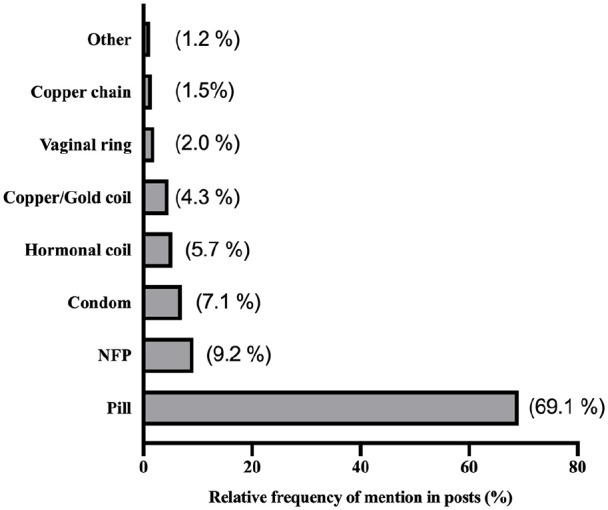
General interest in various methods of contraception. The bar graph above represents the relative frequencies (%) of mention of different contraceptive methods in posts in the last 5 years (2016–2021). Methods whose mentions were below 1% are groups under “Other.”
Based on the type of contraception, these methods were further grouped into hormonal and non-hormonal methods of contraception. Table 2 shows the percentage of mention of each method of contraception within a group.
Table 2.
Percentage mentions of each method of contraception based on the type of contraception.
| Types of contraception | Methods of contraception | Percentage within the group |
|---|---|---|
| Non-hormonal (6173 mentions) |
Natural family planning (NFP) | 40.7 |
| Condom | 31.6 | |
| Copper/gold coil | 19.1 | |
| Copper chain | 6.5 | |
| Diaphragm/Pessary | 1.9 | |
| Spermicide | 0.3 | |
| Hormonal (21,163 mentions) |
Contraceptive pill | 89.3 |
| Hormonal coil | 7.3 | |
| Vaginal ring | 2.6 | |
| 3-month injection | 0.5 | |
| Hormonal implant | 0.3 |
Trend analysis
To study the time-series trends of different contraceptive methods in Germany, we calculated the relative frequencies of mention versus time and plotted their trend. We observed a gradual decrease in the frequencies of mention of hormonal methods (MKtau = −0.52, p = 0.008) and a corresponding increase in the frequencies of mention of non-hormonal methods of contraception in posts (MKtau = +0.52, p < 0.001; Figure 2).
Figure 2.

Time-series trends of hormonal and non-hormonal methods of contraception in Germany. Relative frequencies of mention of hormonal (MKtau = −0.52, p = 0.008) and non-hormonal (MKtau = 0.52, p < 0.001) methods of contraception in posts, in the last 5 years.
To further investigate which method(s) of hormonal and non-hormonal contraception were responsible for the trends observed in Figure 2, we studied the trends of the top three candidates within the hormonal and non-hormonal contraception groups. The contraceptive pill—which is most discussed—showed a decreasing trend in its frequency of mention (MKtau = −0.4, p = 0.036, Figure 3(a)). The frequencies of mention of other hormonal methods of contraception such as the hormonal coil (MKtau = −0.07, p = 0.61, Figure 3(b)) and vaginal ring (MKtau = −0.09; p = 0.333, Figure 3(c)) remained unaltered. Therefore, the downward trend observed in the frequency of mention in the hormonal contraception group can be attributed to the decreasing mentions of the pill.
Figure 3.

Time-series trends of top three hormonal methods of contraception: (a) pill (MKtau = −0.4, p = 0.036), (b) hormonal coil (MKtau = −0.07, p = 0.61), and (c) vaginal ring (MKtau = −0.09, p = 0.333).
Among non-hormonal methods, NFP gained considerable interest with a significant upward trend in the last 5 years (MKtau = 0.67, p < 0.001, Figure 4(a)). Moreover, the frequency of mention of copper or gold coil also increased (MKtau = 0.29, p = 0.017, Figure 4(b)). On the other hand, the frequency of mention of the condom remained unaltered (MKtau = 0.2, p = 0.161, Figure 4(c)). Therefore, the gain in curiosity or the upward trend observed in the non-hormonal group is most likely attributed to NFP and copper or gold coil.
Figure 4.

Time-series trends of top three non-hormonal methods of contraception: (a) natural family planning (MKtau = 0.67, p < 0.001), (b) condom (MKtau = 0.2, p < 0.161), and (c) copper/gold coil (MKtau = 0.29, p < 0.017).
Correlation analysis
Since the pill, NFP, and copper or gold coil contributed significantly to the trends observed in Figure 2, we further investigated their correlations using Kendall’s rank analysis (Table 3). We observed that the pill negatively correlated with NFP (τ = −0.49, p < 0.001) and copper or gold coil (τ = −0.56, p < 0.001), whereas NFP positively correlated with copper or gold coil (τ = 0.36, p < 0.001). This showed that a decrease in interest in the pill was associated with an increase in interest in NFP or copper/gold coil, and an increase in interest in NFP was associated with an increase in copper/gold coil.
Table 3.
Correlation matrix of the pill, NFP, and copper/gold coil.
NFP: natural family planning.
The number represents Kendall’s correlation coefficient, tau (*p < 0.001).
Contraceptive behavior and attitude of women
In the next stage of our analysis, we studied the contraceptive behavior of women by analyzing their transition patterns and common problems related to a specific contraceptive in use or previously used. Since interest in the pill, NFP, and copper/gold coil changed significantly in the last 5 years, we scrutinized 656 relevant posts that specifically mentioned any of these contraceptive methods of which 149 posts mainly highlighted problems related to a specific contraceptive, and 507 posts specifying one or more reasons for switching from one contraceptive method to another. Of these, 385 posts (75.9%) described a switch from the pill, 9 posts (1.7%) described a switch from NFP methods, and 40 posts (7.8%) described a switch from non-hormonal IUDs (copper/gold coil or chain). Conversely, 88 posts (17.4%) described a switch to the pill, 63 posts (12.4%) described a switch to NFP methods, and 85 posts (16.8%) described a switch to non-hormonal IUDs. As each post is from one individual, a total of 297 women stopped using the pill, 54 women started using NFP methods, and 45 women started using non-hormonal IUDs. These results hint that the change in interest in these contraceptive methods could be due to a corresponding change in their prevalence patterns.
To understand the contraceptive behavior of women who used the pill, NFP, or non-hormonal IUDs, we first analyzed their transition patterns in relevant posts (Table 4). As illustrated in Figure 5 and listed in Table 4, of all women who migrated from the pill, 42% migrated to a condom, 15% migrated to NFP methods, 13.2% migrated to non-hormonal IUDs, and 10% migrated to a hormonal coil. In total, almost 70% switched from the pill to other non-hormonal methods of contraception. Conversely, both hormonal and non-hormonal contraceptive women switched to the pill. Of all women who migrated to the pill, 15.9% migrated from a condom, 13.6% migrated from unspecified IUDs, 18.2% migrated from a hormonal coil, 17% migrated from non-hormonal IUDs, and 19.3% switched to a different pill. All other migrations from and to the pill were less than 10%.
Table 4.
Proportions of method transitions in relevant posts.
| Method (migrated from) | Method (migrated to) | Number of migrations (percentage) |
|---|---|---|
| Pill (385 posts) | Condom | 162 (42.1%) |
| NFP | 58 (15.1%) | |
| Non-hormonal IUD | 51 (13.2%) | |
| Hormonal coil | 39 (10.1%) | |
| Vaginal ring | 31 (8.1%) | |
| Unspecified IUD | 23 (6%) | |
| Another pill | 17 (4.4%) | |
| 3-month injection | 5 (1.3%) | |
| Diaphragm | 2 (0.5%) | |
| Other | 2 (0.5%) | |
| Unknown | 3 (0.8%) | |
| NFP (9 posts) | Non-hormonal IUD | 3 (33.3%) |
| Pill | 3 (33.3%) | |
| Hormonal coil | 1 (11%) | |
| Vaginal ring | 1 (11%) | |
| Diaphragm | 1 (11%) | |
| Non-hormonal IUD (40 posts) | Pill | 15 (37.5%) |
| Condom | 10 (25%) | |
| Hormonal coil | 6 (15%) | |
| Another non-hormonal IUD | 5 (12.5%) | |
| Diaphragm | 2 (5%) | |
| NFP | 1 (2.5%) | |
| Vaginal ring | 1 (2.5%) | |
| Unknown | 1 (2.5%) | |
| Condom (29 posts) | Pill | 14 (50%) |
| Non-hormonal IUD | 8 (28.5%) | |
| Hormonal coil | 4 (14.3%) | |
| 3-month injection | 1 (3.5%) | |
| NFP | 1 (3.5%) | |
| Unspecified IUD | 1 (3.5%) | |
| Hormonal coil (40 posts) | Pill | 16 (40%) |
| Non-hormonal IUD | 10 (25%) | |
| Condom | 6 (15%) | |
| Vaginal ring | 3 (7.5%) | |
| Another hormonal IUD | 1 (2.5%) | |
| NFP | 1 (2.5%) | |
| Other | 1 (2.5%) | |
| Unknown | 2 (5%) | |
| Vaginal ring (20 posts) | Pill | 7 (35%) |
| Condom | 6 (30%) | |
| Non-hormonal IUD | 4 (20%) | |
| Hormonal coil | 1 (5%) | |
| NFP | 1 (5%) | |
| Unspecified IUD | 1 (5%) | |
| 3-month injection (8 posts) | Pill | 5 (62.5%) |
| Condom | 2 (25%) | |
| Hormonal coil | 1 (12.5%) | |
| Unspecified IUD (14 posts) | Pill | 12 (85.7%) |
| NFP | 1 (7.1%) | |
| Vaginal ring | 1 (7.1%) | |
| Diaphragm (1 post) | Pill | 1 (100%) |
| Hormonal implant (1 post) | Condom | 1 (100%) |
| Unknown (6 posts) | Non-hormonal IUD | 5 (83.3%) |
| NFP | 1 (16.7%) |
NFP: natural family planning; IUD: intrauterine device.
The number of migrations can be greater than the total number of posts as some posts discussed multiple switches or migrations.
Figure 5.
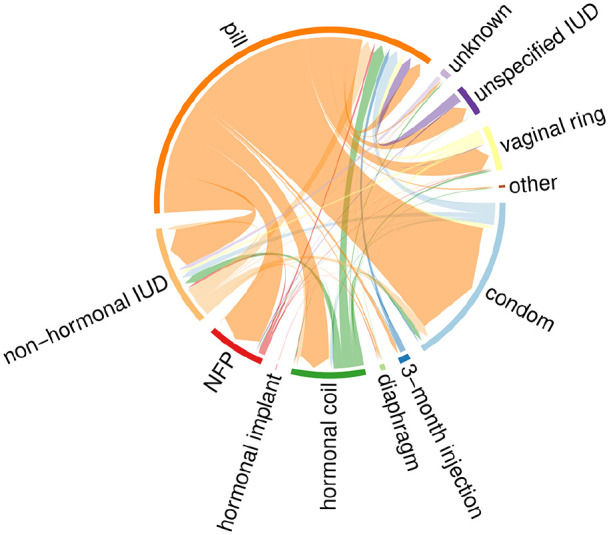
Changes in the contraceptive behavior of women. The chord diagrams above depict migrations from and to different methods of contraception. Each method is represented by a specific color. The arrowhead indicates the method women switched to. The thickness of the arrow indicated the proportion of women who switched from one method to another.
Of nine women who migrated from NFP methods, 33% migrated to the pill and 33% to the copper/gold coil (Table 4). Isolated transitions to the diaphragm, hormonal coil, and vaginal ring were also observed. On the other hand, 90% of migrations to NFP methods were from the pill (Figure 5). Finally, of the women who migrated from non-hormonal IUDs, 37.5% migrated to the pill, 25% migrated to a condom, 15% migrated to a hormonal coil, and 12.5% switched to a different type of non-hormonal IUD (Table 4). On the other hand, of all women who migrated to non-hormonal IUDs, 60% migrated from the pill, 11.8% migrated from hormonal IUD, 9.4% migrated from a condom, and 5.9% switched to a different type of non-hormonal IUD (Figure 5). All other changes in non-hormonal IUD usage were less than 5%.
To further identify the possible reasons that could have prompted the aforementioned migrations, we compiled a list of commonly stated problems related to these contraceptives from all relevant posts. A total of 459 women reported problems related to the use of the pill. As shown in Figure 6, common issues reported by pill users were side effects (38.4%) and general health concerns related to hormonal intake (14%). Almost 15% of women stopped using a pill as they planned to have a child. In 41.6% of cases, the exact reason against the use of the pill was unknown or unclear.
Figure 6.

Problems related to the use of the pill. The bar graph shows the common problems stated by women using/who used a pill (n = 456).
Although 22.5% of women did not explicitly define their side effects, menstrual problems (6.8%), depression or emotional side effects (5.9%), hormonal imbalance (4%), migraine or headache (3.8%), loss of libido (3.5%), and skin problems (3.4%) were among the most frequently defined side effects (Table 5).
Table 5.
A list of side effects reported by women who used the contraceptive pill.
| Side effect | Percentage of women |
|---|---|
| Other side effects | 22.57 |
| Menstrual problems | 6.75 |
| Emotional side effects (e.g. depression) | 5.91 |
| Hormonal imbalance | 4.01 |
| Migraine/headache | 3.8 |
| Loss of libido | 3.59 |
| Skin problems | 3.38 |
| Other form of pain | 2.11 |
| Weight problems | 1.27 |
| Fatigue | 0.63 |
| Blood clotting | 0.42 |
| Breast tenderness/enlargement | 0.42 |
| Inflammation | 0.21 |
| Water retention | 0.21 |
A total of 21 women reported problems related to NFP methods. Reliability (47.6%), difficulty in strictly following the method (28.5%), and other usage-related issues (14.3%) were among the commonly stated problems associated with NFP (Figure 7).
Figure 7.
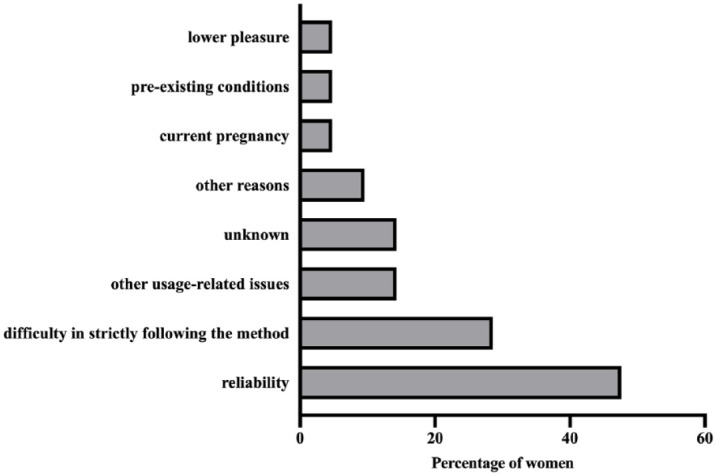
Problems related to the use of NFP. The bar graph shows the common problems reported by women using/who used NFP methods (n = 21).
Sixty-eight women reported problems related to non-hormonal IUDs (Figure 8). These included side effects (49.3%), displaced IUD (10.2%), reliability (8.7%), and high costs (7.3%). Some women (5.8%) stopped using this method as they planned to have a child. As listed in Table 6, menstrual problems (42%), pain (14.5%), and inflammation (4.3%) were among the frequently mentioned side effects.
Figure 8.
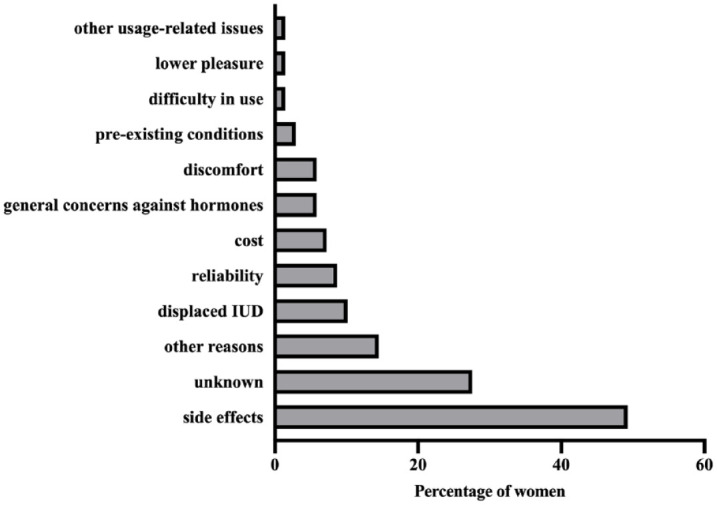
Problems related to the use of non-hormonal IUDs. The bar graph shows the common problems reported by women using/who used non-hormonal IUDs (n = 21).
Table 6.
A list of side effects reported by women who used a non-hormonal IUD.
| Side effect | Percentage of women |
|---|---|
| Menstrual problems | 42 |
| Pain | 14.5 |
| Other side effects | 13 |
| Inflammation | 4.3 |
IUD: intrauterine device.
Discussion
In this retrospective, descriptive analysis, we explored social media posts to obtain useful insights about contraceptive trends and user behavior in Germany. Despite the global interest in hormonal contraceptive methods, we observed a gradual decline in Germany in the last 5 years. At the same time, a corresponding rise in interest in non-hormonal contraceptive methods was observed. Correlation analysis also confirmed that the mention of the pill was negatively associated with the mention of NFP methods or the copper/gold coil. On the other hand, the mention of NFP was also positively associated with the mention of copper/gold coils.
The general interests observed in different types of hormonal and non-hormonal methods of contraception mostly followed the recent contraceptive prevalence pattern in Germany. The pill is one of the oldest, reliable, and the most evolved methods of contraception.29,30 It has been the predominant method of contraception for years.18–21 Given the high number of pill users, a large proportion of posts mentioning or discussing it was anticipated. Over the last 5 years, however, we observed a decrease in the number of posts mentioning it. This could be due to a decrease in the popularity of the pill in Germany. A 2011 survey conducted by the Federal Centre for Health Education (Bundeszentrale fuer gesundheitliche Aufklaerung-BZgA) in 997 sexually active individuals in Germany showed the pill to be the most prevalent contraceptive (53%) followed by the condom (37%), coil (10%), NFP (2%), and vaginal ring (2%).31 However, the follow-up study in 2018 in 705 individuals showed the pill and the condom (around 47%) to be almost equally prevalent, irrespective of their exclusive use.32 This comparative analysis showed that the prevalence of the pill (a hormonal contraceptive) decreased through the years with a corresponding rise in the prevalence of a non-hormonal contraceptive, in this case a condom. In our analysis, a decrease in interest in the pill was associated with an increase in interest in non-hormonal contraceptives such as NFP and copper/gold coil. We believe that this could be due to occasional or irregular discussions about a condom in the forum. Additional studies may be required to further confirm these findings and understand their relevance. In summary, considering our results from trend analysis and contraceptive behavior analysis, we can confirm that the popularity in the pill is gradually falling.
Every individual responds differently to the pill. While some do not experience any side effects, the others experience them either immediately or over time and to varying extents. In our analysis, 495 women (of 656 women) reported problems related to the use of a pill. Side effects and general health concerns related to hormonal intake were frequently stated. Although in 22% of cases the exact side effects were not defined, many reported menstrual problems, hormonal imbalance, emotional issues such as depression, migraine, and/or loss of sexual desire as key side effects of the pill. Additionally, 15% also stopped using a pill as they planned to have a child. Therefore, perceived side effects, probable fear of side effects, and imminent plans to have a child could somewhat contribute to decreasing pill users, which in turn explain the decrease in interest observed. There have been reports stating that the pill could be associated with high risk of blood clotting,33 reduction of libido,34,35 and limited emotional recognition.36 Whether migraine patients face an increased risk of stroke is yet to be confirmed.37 However, its association with mood effects and weight gain have not yet been satisfactorily established with new-generation pills.38–42 A review in 2019 stated that its effect on mood is context dependent.43 It is interesting to observe that these side effects—although not yet clinically associated—are still listed as side effects by pill users. This indicates that women are not clearly informed about the different types of pills and their associated risks. With the help of healthcare providers, it is necessary to choose the right combination of hormones and concentrations based on individual body type to minimize associated side effects.
NFP is a natural, hormone-free method of contraception that enables couples to identify a woman’s fertile days by monitoring markers such as basal body temperature and cervical mucus.44 In our analysis, it ranked second in its frequency of mentions. This did not follow the recent prevalence pattern in Germany. A relatively low proportion of couples have been using NFP methods for contraception.21,32 It may be due to issues related to reliability, self-discipline, effort, and time required to accurately practice this method.45 In recent years, several applications have been developed to ease fertility monitoring, especially for pregnancy. The first such for contraception was approved in 2017.46 After the launch of this and many more applications, general interest in NFP may have spiked. This partly explains the significant rise in post mentions especially after June 2017. Another reason could be the use of NFP for planned pregnancy as well as contraception. As posts from the “child desire” and “contraception” forum were included in this analysis, a small proportion of posts could have also been related to planned pregnancy. Individual analysis of our sample set, however, showed 54 women to have started using NFP as a contraceptive. Couples may choose NFP as a method of contraception as it is known to improve a couple’s relationship and sex life.47 Additionally, with age most women/couples would prefer to avoid the continuous use of hormones due to age-related health risks. These factors could have prompted women/couples to start following NFP-based contraception. Further analysis of individual posts showed reliability, compliance, and usage-related issues to be top concerns of those following NFP. This shows that couples need to be better informed about the different types of NFP methods, their actual failure rate if followed accurately, associated advantages, disadvantages, and probable suggestions to improve long-term use of this method.
A condom is a hormone-free, barrier method of contraception, which is easy to use, readily available, and protects from sexually transmitted infections. It mostly ranked second in contraceptive prevalence.19–22 In the 2018 Federal Health Centre survey, the condom was as prevalent as the pill. They observed a 9% increase in its use.32 In our analysis, condom ranked third in its frequency of mentions. Furthermore, we did not observe any change in its interest, during our observation period. This could be due to minimal or no side effects of the condom. Although reliability is a huge problem, the health-related risk associated with its use is low. As a result, the probability of it being discussed in a forum to understand varying experiences and seek advice is low. Additionally, women/couples could use a condom as a secondary contraceptive in combination with the pill or NFP. Thus, the likelihood of it being mentioned or discussed as a primary method of contraception may be low in many cases. This is especially true in the case of NFP as a condom is commonly used during the fertile period. Finally, although research showed interesting innovations that could improve the reliability of a condom,48 these are not yet available on the market. Such innovations could spike interest in the future. These factors together explain unaltered interest in the condom.
IUDs such as hormonal coil, non-hormonal coil, or chain are long-term, reversible contraceptives that are not yet widely used. Around 10% of women in Germany use IUDs.21,32 Among the different types, the hormonal coil is comparatively more popular compared to the non-hormonal coil or chain.21 A similar pattern was also observed in the frequency of post mentions in our analysis. Many posts mentioned hormonal coil compared to copper/gold coil or copper chain. We believe that its prevalence pattern explains the frequency of mentions in posts. The Medicines Commission of the German Medical Association in 2009 reported several cases with adverse reactions to hormonal IUDs.49 Its cost, reported side effects,50,51 concerns related to future pregnancy, and probable fear of discomfort or pain while being inserted or used could probably prevent many from opting it as their contraceptive. As interest in hormonal coils remained unaltered in the last 5 years, we did not further investigate this method or interpret associated problems. However, since we observed an increase in interest in copper or gold coils, we further investigated 656 individual posts to understand the contraceptive attitude of women using non-hormonal IUDs. Forty-five women started using the copper/gold coil. Most women who switched to non-hormonal IUDs migrated from the pill or hormonal IUD. Given that non-hormonal IUDs are hormone-free and long-term, there would be many opting for it over hormonal contraception. This probably explains the significant rise in interest in non-hormonal IUDs such as copper/gold coils. In-depth assessment of posts further revealed side effects (menstrual problems, pain, and inflammation), displaced IUDs, and cost to be the main problems associated with the use of non-hormonal IUDs. This shows that women need to be provided with additional information especially in case of adverse effects and possible mitigation strategies. Although our results present very valuable insights, our findings are based on personal descriptions only. Especially regarding side effects, there are many more factors such as pre-existing diseases, alcohol, or tobacco use that would influence the severity of side effects. Also, socio-demographic characteristics, including level of sex education, are not represented in this analysis.
Limitations of the work and outlook
Although we obtained very interesting insights from social media posts, our analysis did have certain limitations. First, the inherent bias of social media cannot be neglected. We observed the contraceptive trends in women and couples who specifically use the Urbia forum. This may include women with distinct socio-demographic characteristics. The lack of socio-demographic data limited further exploration. As a result, these observations only provide an estimate of the contraceptive trends in Germany. Second, posts containing misspelled contraceptive methods, uncommon abbreviations, or unfamiliar brands were not a part of our keyword list and therefore were not identified by our algorithm. As a result, we may have missed a small proportion of posts in our analysis. Finally, to ensure maximum accuracy while monitoring user behavior, we manually studied a representative set of only 1000 posts and did not perform a calculation of the sample size. This limited us from confirming the popularity of different contraceptive methods in a large sample set. For large-scale analysis, we could automate at least parts of the labeling/annotation process using NLP algorithms in future. For instance, we could train a classifier that learns to detect posts that mention a transition between contraception methods. Although it would still be necessary to review these results manually, it potentially speeds up the process significantly.
Conclusion
Our results demonstrated the usability of social media as an alternative source to survey contraceptive trends and user behavior in Germany. In the last 5 years, mentioning of hormonal contraception decreased and mentioning of non-hormonal contraception increased. This is mainly due to the decreasing popularity of the pill, with a corresponding increase in the popularity of NFP and copper/gold coils. Most women switched from the pill to other non-hormonal contraceptives such as condoms (as in almost half of the cases), NFP, and copper/gold coils. Adverse effects were commonly reported as the reason for a switch. This indicates that the contraceptive needs of women are not satisfactorily met, highlighting the need for additional counseling and education.
Social media posts serve as a useful tool in studying contraceptive prevalence and preferences in a large population over extended periods of time. It provides real-world user insights into various contraceptives that help in identifying primary pain-points in existing family planning strategies. Further studies could assist in determining the appropriate family planning strategy in different life stages and family constellations.
Supplemental Material
Supplemental material, sj-docx-1-whe-10.1177_17455057221147390 for Perception and use of reversible contraceptive methods in Germany: A social listening analysis by Preetha Balakrishnan, Christian Kroiss, Taoufik Keskes and Benjamin Friedrich in Women’s Health
Acknowledgments
We thank Nicol Perthel, Barbara Riedl, Christian Gonzalez, Ioannis Karakasidis, Ines Pohlmann, and Maximilian Steigenberger for their help in manually labeling posts. We extend our gratitude to Nicol Perthel for further reviewing posts whenever necessary. We also thank Elizabeth Jacyshyn-Owen for proofreading the manuscript.
Footnotes
ORCID iD: Benjamin Friedrich  https://orcid.org/0000-0002-2198-9925
Supplemental material: Supplemental material for this article is available online.
Declarations
Ethics approval and consent to participate: Since the data analyzed in our analysis are available in the public domain, and users consent to its usage, ethical approval was not sought. Additionally, we obtained special permission from Gruner + Jahr, the operator and legal owner of the Urbia platform, for the current analysis.
Consent for publication: We obtained special permission from Gruner + Jahr, the operator and legal owner of the Urbia platform, for the current analysis.
Author contribution(s): Preetha Balakrishnan: Conceptualization; Writing – original draft; Writing – review & editing.
Christian Kroiss: Conceptualization; Data curation; Formal analysis; Writing – review & editing.
Taoufik Keskes: Conceptualization; Data curation; Formal analysis; Writing – review & editing.
Benjamin Friedrich: Conceptualization; Project administration; Supervision; Writing – review & editing.
Funding: The author(s) received no financial support for the research, authorship, and/or publication of this article.
The author(s) declared no potential conflicts of interest with respect to the research, authorship, and/or publication of this article.
Availability of data and materials: The data presented in this analysis are from an online public forum. These data are also available on request from the corresponding author.
References
- 1. Crocker KM, Stitt WD. Ovulation inhibitors. Can Med Assoc J 1964; 90: 713–716. [PMC free article] [PubMed] [Google Scholar]
- 2. Junod SW, Marks L. Women’s trials: the approval of the first oral contraceptive pill in the United States and Great Britain. J Hist Med Allied Sci 2002; 57: 117–160. [DOI] [PubMed] [Google Scholar]
- 3. Annovera—a new contraceptive vaginal ring. Med Lett Drugs Ther 2019; 61: 197–198. [PubMed] [Google Scholar]
- 4. Twirla—a new contraceptive patch. Med Lett Drugs Ther 2021; 63: 17–18. [PubMed] [Google Scholar]
- 5. New contraceptive launched. Fam Plann Today 1995: 1. [PubMed] [Google Scholar]
- 6. Cheung VYT. The GyneFix intrauterine device. J Obstet Gynaecol Can 2006; 28: 1069. [DOI] [PubMed] [Google Scholar]
- 7. Grimes DA, Lopez LM, Raymond EG, et al. Spermicide used alone for contraception. Cochrane Database Syst Rev 2013; 12: CD005218. [DOI] [PubMed] [Google Scholar]
- 8. Wiesner C. Natural family planning. Dtsch Arztebl Int 2020; 117: 251. [DOI] [PMC free article] [PubMed] [Google Scholar]
- 9. Ahmed S, Li Q, Liu L, et al. Maternal deaths averted by contraceptive use: an analysis of 172 countries. Lancet 2012; 380: 111–125. [DOI] [PubMed] [Google Scholar]
- 10. Rutstein S, Winter R. Contraception needed to avoid high-fertility-risk births, and maternal and child deaths that would be averted. Rockville, MD: ICF International, 2015. [Google Scholar]
- 11. Cleland J, Conde-Agudelo A, Peterson H, et al. Contraception and health. Lancet 2012; 380: 149–156. [DOI] [PubMed] [Google Scholar]
- 12. Contraceptive prevalence, any method (% of women ages 15—49)—Germany, https://data.worldbank.org/indicator/SP.DYN.CONU.ZS?locations=DE (accessed 5 August 2021).
- 13. Statistisches Bundesamt. Anzahl der Schwangerschaftsabbrüche in Deutschland nach rechtlicher Begründung, n.d., https://www.destatis.de/DE/Themen/Gesellschaft-Umwelt/Gesundheit/Schwangerschaftsabbrueche/Tabellen/03-schwangerschaftsabbr-rechtliche-begruendung-schwangerschaftsdauer_zvab2012.html (accessed 19 September 2022).
- 14. Pregnancy Counselling § 218 n.d.:60. [Google Scholar]
- 15. Helfferich C, Klindworth H, Heine Y, et al. Frauen leben 3—Familienplanung im Lebenslauf von Frauen: Schwerpunkt: ungewollte Schwangerschaft: eine Studie. Auflage: 1.1.10.16. Köln: Bundeszentrale für gesundheitliche Aufklärung (BZgA), 2016. [Google Scholar]
- 16. Kallner HK, Danielsson KG. Prevention of unintended pregnancy and use of contraception—important factors for preconception care. Ups J Med Sci 2016; 121: 252–255. [DOI] [PMC free article] [PubMed] [Google Scholar]
- 17. Birgisson NE, Zhao Q, Secura GM, et al. Preventing unintended pregnancy: the contraceptive CHOICE project in review. J Womens Health 2015; 24: 349–353. [DOI] [PMC free article] [PubMed] [Google Scholar]
- 18. de Irala J, Osorio A, Carlos S, et al. Choice of birth control methods among European women and the role of partners and providers. Contraception 2011; 84: 558–564. [DOI] [PubMed] [Google Scholar]
- 19. Skouby SO. Contraceptive use and behavior in the 21st century: a comprehensive study across five European countries. Eur J Contracept Reprod Health Care 2010; 15: S42–S53. [DOI] [PubMed] [Google Scholar]
- 20. Johnson S, Pion C, Jennings V. Current methods and attitudes of women towards contraception in Europe and America. Reprod Health 2013; 10: 1–9. [DOI] [PMC free article] [PubMed] [Google Scholar]
- 21. Oppelt PG, Baier F, Fahlbusch C, et al. What do patients want to know about contraception and which method would they prefer? Arch Gynecol Obstet 2017; 295: 1483–1491. [DOI] [PubMed] [Google Scholar]
- 22. Oppelt PG, Fahlbusch C, Heusinger K, et al. Situation of adolescent contraceptive use in Germany. Geburtshilfe Frauenheilkd 2018; 78: 999–1007. [DOI] [PMC free article] [PubMed] [Google Scholar]
- 23. Dehlendorf C, Fox E, Sharma AE, et al. Birth control connect: a randomized trial of an online group to disseminate contraceptive information. Contraception 2020; 101: 376–383. [DOI] [PMC free article] [PubMed] [Google Scholar]
- 24. Nguyen BT, Allen AJ. Social media and the intrauterine device: a YouTube content analysis. BMJ Sex Reprod Health 2018; 44: 28–32. [DOI] [PubMed] [Google Scholar]
- 25. Urbia—Wir lieben Familie—urbia.de, n.d., https://www.urbia.de/ (accessed 23 July 2021).
- 26. Himalayan University, Kamal N, Pachauri S. Mann-Kendall test—a novel approach for statistical trend analysis. IJCTT 2018; 63: 18–21. [Google Scholar]
- 27. Noguchi K, Gel YR, Duguay CR. Bootstrap-based tests for trends in hydrological time series, with application to ice phenology data. J Hydrol 2011; 410: 150–161. [Google Scholar]
- 28. Puth M-T, Neuhäuser M, Ruxton GD. Effective use of Spearman’s and Kendall’s correlation coefficients for association between two measured traits. Anim Behav 2015; 102: 77–84. [Google Scholar]
- 29. Burkman R, Bell C, Serfaty D. The evolution of combined oral contraception: improving the risk-to-benefit ratio. Contraception 2011; 84: 19–34. [DOI] [PubMed] [Google Scholar]
- 30. Golobof A, Kiley J. The current status of oral contraceptives: progress and recent innovations. Semin Reprod Med 2016; 34: 145–151. [DOI] [PubMed] [Google Scholar]
- 31. BZgA. Sexualaufklärung, n.d., https://www.bzga.de/infomaterialien/sexualaufklaerung/verhuetungsverhalten-erwachsener-2011/ (accessed 5 September 2021).
- 32. Forschung Sexualaufklärung. Verhütungsverhalten Erwachsener 2018, n.d., https://www.forschung.sexualaufklaerung.de/verhuetung/verhuetungsverhalten-2018 (accessed 20 July 2021).
- 33. Vinogradova Y, Coupland C, Hippisley-Cox J. Use of combined oral contraceptives and risk of venous thromboembolism: nested case-control studies using the QResearch and CPRD databases. BMJ 2015; 350: h2135. [DOI] [PMC free article] [PubMed] [Google Scholar]
- 34. Malmborg A, Persson E, Brynhildsen J, et al. Hormonal contraception and sexual desire: a questionnaire-based study of young Swedish women. Eur J Contracept Reprod Health Care 2016; 21: 158–167. [DOI] [PubMed] [Google Scholar]
- 35. Casado-Espada NM, de Alarcón R, de la Iglesia-Larrad JI, et al. Hormonal contraceptives, female sexual dysfunction, and managing strategies: a review. J Clin Med 2019; 8: 908. [DOI] [PMC free article] [PubMed] [Google Scholar]
- 36. Pahnke R, Mau-Moeller A, Junge M, et al. Oral contraceptives impair complex emotion recognition in healthy women. Front Neurosci 2019; 12: 1041. [DOI] [PMC free article] [PubMed] [Google Scholar]
- 37. Sacco S, Merki-Feld GS, Ægidius KL, et al. ; European Headache Federation (EHF) and the European Society of Contraception and Reproductive Health (ESC). Hormonal contraceptives and risk of ischemic stroke in women with migraine: a consensus statement from the European Headache Federation (EHF) and the European Society of Contraception and Reproductive Health (ESC). J Headache Pain 2017; 18: 108. [DOI] [PMC free article] [PubMed] [Google Scholar]
- 38. Schaffir J, Worly BL, Gur TL. Combined hormonal contraception and its effects on mood: a critical review. Eur J Contracept Reprod Health Care 2016; 21: 347–355. [DOI] [PubMed] [Google Scholar]
- 39. Poromaa IS, Segebladh B. Adverse mood symptoms with oral contraceptives. Acta Obstet Gynecol Scand 2012; 91: 420–427. [DOI] [PubMed] [Google Scholar]
- 40. Robakis T, Williams KE, Nutkiewicz L, et al. Hormonal contraceptives and mood: review of the literature and implications for future research. Curr Psychiatry Rep 2019; 21: 57. [DOI] [PubMed] [Google Scholar]
- 41. Lopez LM, Ramesh S, Chen M, et al. Progestin-only contraceptives: effects on weight. Cochrane Database Syst Rev 2016; 2016: CD008815. [DOI] [PMC free article] [PubMed] [Google Scholar]
- 42. Gallo MF, Lopez LM, Grimes DA, et al. Combination contraceptives: effects on weight. Cochrane Database Syst Rev 2014; 1: CD003987. [DOI] [PMC free article] [PubMed] [Google Scholar]
- 43. Lewis CA, Kimmig A-CS, Zsido RG, et al. Effects of hormonal contraceptives on mood: a focus on emotion recognition and reactivity, reward processing, and stress response. Curr Psychiatry Rep 2019; 21: 115. [DOI] [PMC free article] [PubMed] [Google Scholar]
- 44. NhsUk. Natural family planning (fertility awareness), 2017, https://www.nhs.uk/conditions/contraception/natural-family-planning/ (accessed 5 September 2021).
- 45. Freundl G, Sivin I, Batár I. State-of-the-art of non-hormonal methods of contraception: IV. Eur J Contracept Reprod Health Care 2010; 15: 113–123. [DOI] [PubMed] [Google Scholar]
- 46. Jex C. Birth control app invented by physicists gets EU approval, 2017, https://sciencenordic.com/a/1443058 (accessed 5 September 2021).
- 47. Unseld M, Rötzer, Weigl R, et al. Use of natural family planning (NFP) and its effect on couple relationships and sexual satisfaction: a multi-country survey of NFP users from US and Europe. Front Public Health 2017; 5: 42. [DOI] [PMC free article] [PubMed] [Google Scholar]
- 48. Lee C. The search to make a perfect condom. BBC, 25 April 2021, https://www.bbc.com/future/article/20210423-how-grass-and-gel-could-make-condoms-better (accessed 23 September 2021).
- 49. Intrauterin-Pessare mit Levonorgestrel: Depressionen unter der Hormonspirale. Dtsch Ärzteebl 2020; 117: A-1858/B-1588. https://www.aerzteblatt.de/archiv/215972/Intrauterin-Pessare-mit-Levonorgestrel-Depressionen-unter-der-Hormonspirale (accessed 24 September 2021). [Google Scholar]
- 50. Slattery J, Morales D, Pinheiro L, et al. Cohort study of psychiatric adverse events following exposure to levonorgestrel-containing intrauterine devices in UK general practice. Drug Saf 2018; 41: 951–958. [DOI] [PubMed] [Google Scholar]
- 51. Association of hormonal contraception with depression. JAMA Psychiat 2016; 73: 1154–1162. https://jamanetwork.com/journals/jamapsychiatry/fullarticle/2552796 (accessed 24 September 2021). [DOI] [PubMed] [Google Scholar]
Associated Data
This section collects any data citations, data availability statements, or supplementary materials included in this article.
Supplementary Materials
Supplemental material, sj-docx-1-whe-10.1177_17455057221147390 for Perception and use of reversible contraceptive methods in Germany: A social listening analysis by Preetha Balakrishnan, Christian Kroiss, Taoufik Keskes and Benjamin Friedrich in Women’s Health