


Abstract
Aim
This study aims to evaluate functional and esthetic outcomes of thumb duplication correction in pediatric age.
Methods
Retrospective study including all pediatric patients with thumb duplication undergoing surgical treatment between 2012 and 2017. We analyzed demographic data, surgical technique, and surgical outcomes considering Tada, Horii, and Tien scores, according to the following parameters: active mobility of the metacarpophalangeal and interphalangeal joints, stability, alignment, and family’s opinion about cosmetic and function of the thumb. The Wassel-Flatt classification was used to classify the duplicated thumbs.
Results
A total of 11 patients were included, predominantly male (ratio 1.8:1), with a median age at time of surgery of 19[10-26] months and a median follow-up time after surgery of 23 [3-63] months. The Wassel- Flatt type IV thumb was the most frequent (73%). The postoperative evaluation revealed that 82% of patients had good results in Tada score, 73% had good results in Horii score, and all patients showed good results in Tien score. We found a relation between lower age and fair postoperative alignment (P = .047) and between fair postoperative alignment and fair final Tada (P = .022), Horii (P = .006), and Tien (P = .009) scores.
Conclusions
Excision and reconstruction procedures are good options in the treatment of thumb duplication providing good clinical results, with excellent parent satisfaction. Timing of surgery is important for favorable esthetic outcomes, while angular deformity is a determining factor that for postoperative dissatisfaction.
Keywords: thumb duplication, surgery, paediatric, functional and aesthetic outcomes
Introduction
Polydactyly of the hand, the most common congenital upper limb anomaly, is characterized by duplication or partial splitting of a digit during development. This malformation, due to abnormal radioulnar axis formation/differentiation of the hand plate, can affects the ulnar side of the hand (postaxial), the most common type, the radial side of the hand (preaxial), also known as radial polydactyly, thumb duplication or split thumb, the second most common type (Figure 1), or the center of the hand (central).1,2
Figure 1.
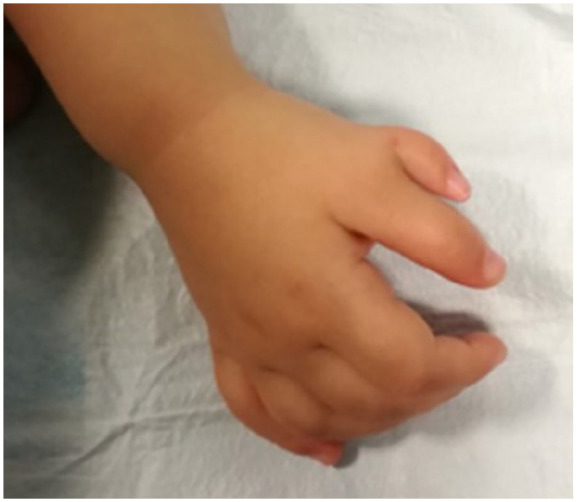
Photograph demonstrating a thumb duplication (Wassel-Flatt type V), with a hypoplastic radial thumb.
Thumb duplication has a highly variable presentation. Wassel-Flatt classification system, based on the skeletal level of duplication from distal to proximal, is the most popular system to differentiate between various presentations (Table 1).3 Classification of the deformity is an important aspect of the evaluation process, as the type of the thumb duplication determines prognosis, surgical approach, operative complications, and post-surgical outcomes.1,4,5
Table 1.
Wassel-Flatt Classification of Radial Polydactyly.
| Type | Description |
|---|---|
| Type I | Bifid distal phalanx |
| Type II | Complete duplication of the distal phalanx |
| Type III | Bifid proximal phalanx with duplicated distal phalanx |
| Type IV | Complete duplication of the proximal and distal phalanges |
| Type V | Bifid first metacarpal with complete duplication of the proximal and distal phalanges |
| Type VI | Complete duplication of the entire thumb ray (ie, metacarpal and proximal/distal phalanges) |
| Type VII | Triphalangeal thumb (ie, metacarpal and 3 phalanges) |
Thumb duplication occurs at a rate of 1.4 per 1000 births and males are twice as likely to be affected as females.6,7 Wassel-Flatt type IV is the most common variant and occurs in 40% of patients.7 Polydactyly is usually unilateral, not associated with familiar inheritance patterns, but may be associated with systemic conditions such as Holt-Oram or Fanconi’s anemia, specifically Wassel-Flatt type VII.1,7
The aim of the treatment is to achieve function nearly normal as possible, with good thumb joint stability, mobility, and strength, while providing an acceptable esthetic appearance.8,9 Considerations prior to surgical intervention include analysis of patient’s bony anatomy, hand physical examination, including thumb alignment, tendons, range of motion, joint stability, and family counseling (particularly asymmetry in thumb size).10
Surgical approaches fall broadly into 3 categories: (1) simple excision of the accessory thumb, (2) excision of the more hypoplastic thumb (often the most radial), with reconstruction of the remaining thumb (collateral ligament reconstruction, osteotomy to correct malalignment/deformity, and soft tissue reconstruction to address anomalous tendon, with or without thenar muscle insertions), or (3) combining symmetrical parts of both thumbs into a single thumb (modified Bilhaut-Cloquet procedure).11 Surgical procedure selection is dictated by complexity and size and location of the anatomical abnormality.7,9
The modified Bilhaut-Cloquet procedure, where distal phalanges and soft tissues are combined, is used on Wassel-Flatt types I to IV, in which the bifid thumbs are relatively symmetric and diminutive.12 This technique requires maintaining the congruity of the nailbed and distal phalanx physis and articular surface.7
In cases where one of the thumbs is better developed proximally while the other is better developed distally, an on-the-top plasty, preserving the neurovascular function of the distal segment, may be used.1
Overall, modern techniques for the reconstruction of thumb duplication have led to acceptable esthetic and functional outcomes.13 A strong association between negative functional outcomes and unfavorable cosmetic appearance and/or residual deformity has been reported.14
The primary goal of thumb reconstruction is to obtain stability, mobility, alignment, proper size, and proper shape, with minimization of scarring and nail deformity for optimum esthetic appearance.4,15
One of the most frequently used scores to assess objective functional results after surgery is the Tada score system.16 Modified versions of this assessment system have been developed, including the Horii’s modified and the Tien’s modified Tada scoring systems, which include subjective items that evaluate esthetic (Horii’s) or cosmetic and function (Tien’s) dimensions.
Reports of outcomes of surgical reconstruction for thumb duplication are sparse17 and have been largely limited to small case series with short clinical follow-up.13,14
The purpose of this study is to evaluate functional and esthetical surgical outcomes of thumb duplication correction in children treated in a single institution.
Patients and Methods
We retrospectively reviewed the clinical files of patients who underwent surgery for thumb duplication in our Institution, between 2012 and 2017. Data about age at surgery, gender, Wassel-Flatt classification, surgical technique, and follow-up time were collected. Postoperative active mobility of the metacarpophalangeal (MCP) and interphalangeal (IP) joints, as well as stability and alignment of the remaining thumb were evaluated and recorded. Family opinion about cosmetic and/or function was noted.
Tada score system was used to evaluate postoperative results, allowing a combined assessment of the range of motion (ROM) of the IP and MCP, stability, and alignment. Based on such criteria a total score ≥4 is considered a good result, a score of 2 or 3 is considered fair, and a score ≤1 indicates a poor outcome.
We also used Horii modification and Tien modification of Tada scoring system.18,19 Tada score modified by Horii adds points to the esthetical result, including thumb shape and surgical scar, according to parents or patients (2 points if acceptable deformity, 1 point if mildly deformed, and 0 point if grossly deformed). Tien’s modification of Tada score rates family opinion regarding the appearance and function of the thumb (2 points if acceptable function and cosmetic results; 1 point if acceptable functional or cosmetic result; 0 point if unacceptable functional and cosmetic results). For both Horii’s and Tien’s modifications of the Tada scoring system, a total score of 5 to 7 is considered a good result, 3 or 4 is considered fair, and 0 to 2 is rated as a poor outcome (Table 2).
Table 2.
Tada Scoring System and Horii and Tien Modified Scoring Systems.
| Criterion | Score (points) |
|---|---|
| Tada score system | |
| ROM (MCP and IP joints) | |
| >70° | 2 |
| 70-50° | 1 |
| <50° | 0 |
| Instability | |
| Absence | 1 |
| Presence | 0 |
| Malalignment | |
| <10° | 2 |
| 10-20° | 1 |
| >20° | 0 |
| Horii modification (Tada score + esthetics) | |
| Esthetics | |
| Acceptable | 2 |
| Mildly deformed | 1 |
| Grossly deformed | 0 |
| Tien modification (Tada score + subjective family opinion) | |
| Subjective family opinion | |
| Acceptable function and cosmetic results | 2 |
| Acceptable functional or cosmetic result | 1 |
| Unacceptable functional and cosmetic results | 0 |
Abbreviations: ROM, range of motion; MCP, metacarpo-phalangeal; IP, interphalangeal.
This paper has not animal and/or human studies. Informed consent was not required in our institution.
Statistical Methods
Numerical variables (age, follow-up time, scores) were not normally distributed and were described as median [minimum − maximum]. Mann–Whitney test or Kruskal-Wallis were used to compare age at surgery and follow-up time between participants with fair and good results in total Tada, Horii, and Tien modified scores, and in individual items of each score. To compare participants with fair and good results, and in individual items of each score, regard gender, Wassel-Flatt classification and surgical technique, qui-squared test was used. Data were analyzed using Statistical Package for Social Sciences (SPSS)®, version 27.
Surgical Technique
Patients were placed in supine position, with the affected extremity resting on a hand table and pneumatic tourniquet was inflated. When accessory thumb was extremely hypoplastic and atrophic, only excision was performed (Figure 2).
Figure 2.

Pre and post-operative appearance of a patient where simple excision of the radial thumb was performed.
When reconstruction was necessary, a racket-shaped incision extended to a Z incision was made around the base of the hypoplastic thumb. When present and not atrophic, extensor pollicis longus and flexor pollicis longus were identified for later reinsertion. The insertions of the abductor pollicis brevis and the collateral ligament of MCP joint were carefully detached and preserved. Then, the radial hypoplastic thumb was ablated. The MCP and IP joints of the remaining thumb were realigned by reducing the proximal and distal phalanges along the longitudinal axis of metacarpal and the final alignment was kept in position by inserting a K wire through the IP and MCP joints. At last, the detached collateral ligament and abductor pollicis brevis was reattached. Capsular repair was performed wherever possible. When necessary, first metacarpal was reshaped by cutting off the overhanging part (Figure 3).
Figure 3.

(A) Pre and postoperative appearance of a Wassel-Flatt type IV pre-axial duplication submitted to an excision of the radial hypoplastic thumb, extra metacarpal facet excision, capsular reefing, radial collateral ligament reconstruction, and abductor pollicis brevis reinsertion. (B) Pre and postoperative radiological view of the thumb.
The modified Bilhaut-Cloquet started with a nail V incision extending to a Z skin incision until interphalangeal zone. Distal phalanges were exposed, and central cortices (extra-articular) were removed to obtain union. Extensor pollicis longus of the radial thumb was reinserted in the ulnar one. Suture with nailbed congruity was made at the end.
Results
From 2012 to 2017, 13 patients with thumb duplication were operated in our department. Two patients were excluded from this analysis, since they were lost for follow-up.
The median age at surgery was 19 [10-26] months and 7 patients (64%) were boys. In all patients, duplication was unilateral. The Wassel-Flatt type IV thumb was the most frequent (n = 8, 73%), followed by type V (n = 2) and 1 patient presented type III (Table 3).
Table 3.
Table of Patients.
| Patient | Age (months) | Gender | Classification | Surgical procedure | Follow-up (months) | MCP + IP ROM (°) | Malalignment (°) | Esthetics | Tada score* | Horii modified score# | Tien modified score# |
|---|---|---|---|---|---|---|---|---|---|---|---|
| 1 | 16 | Female | Wassel-Flatt IV | Excision hypoplastic thumb + collateral ligament reconstruction + abductor pollicis brevis reinsertion + extensor pollicis longus and flexor pollicis longus reinsertion + capsular repair | 44 | >70 | <10 | Acceptable | 5 | 6 | 6 |
| 2 | 11 | Male | Wassel-Flatt IV | Excision hypoplastic thumb | 63 | >70 | 10-20 | Mildly deformed | 4 | 5 | 5 |
| 3 | 12 | Male | Wassel-Flatt IV | Excision hypoplastic thumb + collateral ligament reconstruction + abductor pollicis brevis reinsertion | 46 | 60 | 10-20 | Acceptable | 3 | 4 | 5 |
| 4 | 10 | Male | Wassel-Flatt V | Excision hypoplastic thumb + abductor pollicis brevis reinsertion + extensor pollicis longus and flexor pollicis longus reinsertion + capsular repair | 57 | >70 | 10-20 | Grossly deformed | 4 | 4 | 6 |
| 5 | 20 | Male | Wassel-Flatt IV | Excision hypoplastic thumb + collateral ligament reconstruction + abductor pollicis brevis reinsertion + capsular repair | 23 | >70 | <10 | Acceptable | 5 | 7 | 7 |
| 6 | 26 | Male | Wassel-Flatt IV | Excision hypoplastic thumb + collateral ligament reconstruction + abductor pollicis brevis reinsertion + capsular repair | 3 | >70 | <10 | Acceptable | 5 | 7 | 7 |
| 7 | 18 | Female | Wassel-Flatt IV | Excision hypoplastic thumb + collateral ligament reconstruction + abductor pollicis brevis reinsertion | 4 | >70 | <10 | Mildly deformed | 5 | 6 | 7 |
| 8 | 20 | Male | Wassel-Flatt III | Bilhaut-Cloquet procedure | 42 | 50 | 10-20 | Grossly deformed | 3 | 3 | 5 |
| 9 | 21 | Female | Wassel-Flatt V | Excision hypoplastic thumb + abductor pollicis brevis reinsertion | 4 | >70 | <10 | Acceptable | 5 | 7 | 7 |
| 10 | 24 | Female | Wassel-Flatt IV | Excision hypoplastic thumb | 15 | 60 | <10 | Acceptable | 4 | 6 | 6 |
| 11 | 19 | Male | Wassel-Flatt IV | Excision hypoplastic thumb | 14 | >70 | <10 | Acceptable | 5 | 7 | 7 |
Abbreviations: MCP, metacarpo-phalangeal; IP, interphalangeal; ROM, range of motion.
0-1: poor; 2-3: fair; 4-5: good.
0-2: poor; 3-4: fair: 5-7: good.
In 10 cases, excision of 1 thumb was performed, with reconstruction of the dominant thumb in 7 cases. It was not possible to reconstruct the collateral ligament in 2 patients. Extensor and flexor pollicis longus were reinserted in 3 patients and capsular repair was performed in 4 patients. In 1 patient (Wassel-Flatt type III), a modified Bilhaut-Cloquet procedure was performed.
The median follow-up time was 23 [3-63] months.
Median Tada score was 5 [3-5], with good results in 9 patients (82%) and fair results in 2 patients (18%). Median Horii score was 6 [3-7], with 8 good (73%) and 3 fair results (27%). Median Tien score was 6 [5-7], with all patients showing good results. Nobody showed poor results in total Tada, Horii, or Tien modified scores (Table 3).
We found that children with fair results (1 point) in the alignment item of the Tada score were younger (12 months of age) than children with good results (20 months), P = .047 (Table 4).
Table 4.
Description of Age and Tada/Horii/Tien Scores and Comparison Range of Movement (ROM) and Alignment Individual Scores.
| Total (n = 11) | ROM | P-value | Alignment | P-value | |||
|---|---|---|---|---|---|---|---|
| 1 point (n = 3) | 2 points (n = 8) | 1 point (n = 4) | 2 points (n = 7) | ||||
| Age (months) | 19 [10-26] | 20 [12-24] | 19 [10-26] | .609 | 12 [10-20] | 20 [16-26] | .047 |
| Tada score | 5 [3-5] | 3 [3-3] | 5 [4-5] | .007 | 4 [3-4] | 5 [3-5] | .022 |
| Horii modified score | 6 [3-7] | 4 [3-6] | 7 [4-7] | .049 | 4 [3-5] | 7 [6-7] | .006 |
| Tien modified score | 6 [5-7] | 5 [5-6] | 7 [5-7] | .072 | 5 [5-6] | 7 [6-7] | .009 |
(statistical significant values in bold).
The patient submitted to the modified Bilhaut-Cloquet procedure (Wassel-Flatt type III) showed the poorest score results: Tada/Horii/Tien scores of 3/3/5.
Patients with fair punctuations in the mobility item (1 point) had overall worse Tada (3 vs 5, P = .007) and Horii scores (4 vs 7, P = .049). Moreover, patients with fair punctuations in alignment had worse overall Tada (4 vs 5, P = .022), Horii (4 vs 7, P = .006), and Tien scores (5 vs 7, P = .009) (Table 4).
We found no differences regarding follow-up time, gender, Wassel-Flatt classification, and surgical technique between participants with fair and good results in total Tada, Horii, and Tien modified scores, and in individual items of each score.
Discussion
Previous research has described age at operation as an important prognostic factor and most authors have suggested the 12 to 18 months as an appropriate age range for surgical intervention given the diminishes anesthetic risk, lack of functional pinch, and lack awareness regarding esthetic appearance.4,5,15,20 We found a relation between age and esthetic appearance in children with fair results in alignment being younger than children with good results.
Seven boys and 4 girls were operated (ratio 1.8:1) in our department and the duplication was unilateral in all of them. As it is known, males are twice as often affected as females and thumb duplication is more commonly unilateral.7,8
In our patients, Wassel-Flatt type IV thumb was the most frequent type (73%), which is in agreement with the literature.7
We found good results in Tada score in 82% of the patients and fair results in 18% of the patients, which is in accordance with results reported by Tada et al,16 who reported 76% good, 20% fair, and 4% poor results. More recently, Stutz et al21 noted 79% good and 21% fair results in a group of 43 reconstructed thumbs over 10 years post reconstruction.
The patient submitted to the modified Bilhaut-Cloquet procedure (Wassel-Flatt type III) showed the poorest scores: Tada/Horii/Tien scores of 3/3/5. Generally, outcomes for Wassel-Flatt Type III, V, VI, and VII are worse.20 Furthermore, joint stiffness, marked broadness, and conspicuous scarring of the nail bed and pulp are noted drawbacks of the Bilhaut-Cloquet procedure, which has largely fallen out of favor because of poor outcomes and cosmesis; it often produces a wide, stiff thumb, being now used only for very distal duplications.9,22
Patients with fair punctuations in the alignment category had worse Tada, Horii, and Tien scores. Literature describes angular deformity and nail widths as the most common reasons for suboptimal outcomes, what is also suggested by our results.23
Our small sample size is a limitation of this study. Although we found some relevant outcome differences, a larger sample may have shown additional differences. Also, the retrospective nature of the study leads to inherent bias. Despite these limitations, we feel that this cohort serve as a start for future reports of our group and demonstrates that surgical treatment of thumb duplication has good results.
Conclusion
The general conclusion of this study is that the surgical treatment of thumb duplication yields good results regarding cosmesis and functional status in pediatric patients, with excellent parents’ satisfaction. Timing of surgery is important for favorable esthetic outcomes, and angular deformity leads to postoperative dissatisfaction. Bilhaut-Cloquet procedure is rarely performed in our experience and reserved solely for very distal duplications.
Family counseling is an essential component of treatment and must be completed prior to any surgical intervention.
Further research, in the form of solid prospective studies, is necessary to make relevant conclusions and to aid orientated decision making. Moreover, long-term functional results into adulthood would be helpful to best counsel patients and families.
Footnotes
Author Contributions: All of the authors actively contribute to the work reported. Maria Pia Monjardino, first author, was the one who was involved in the acquisition of the data and wrote the first draft of the article. All of the authors were involved in the study design, analysis and interpretation of the data and substantially and critically reviewed the article.
The author(s) declared no potential conflicts of interest with respect to the research, authorship, and/or publication of this article.
Funding: The author(s) received no financial support for the research, authorship, and/or publication of this article.
ORCID iD: Maria Pia Monjardino  https://orcid.org/0000-0001-8659-3529
References
- 1. Rogers BH, Schmieg SL, Pehnke ME, Shah AS. Evaluation and management of preaxial polydactyly. Curr Rev Musculoskelet Med. 2020;13(4):545-551. doi: 10.1007/s12178-020-09644-w [DOI] [PMC free article] [PubMed] [Google Scholar]
- 2. Goldfarb CA, Shaw N, Steffen JA, Wall LB. The prevalence of congenital hand and upper extremity anomalies based upon the New York congenital malformations registry. J Pediatr Orthop. 2017;37(2):144-148. doi: 10.1097/BPO.0000000000000748 [DOI] [PMC free article] [PubMed] [Google Scholar]
- 3. Wassel HD. The results of surgery for polydactyly of the thumb. A review. Clin Orthop. 1969;64:175-193. [PubMed] [Google Scholar]
- 4. Cabrera González M, Pérez López LM, Martínez Soto G, Gutiérrez de la Iglesia D. Prognostic value of age and Wassel classification in the reconstruction of thumb duplication. J Child Orthop. 2013;7(6):551-557. doi: 10.1007/s11832-013-0534-3 [DOI] [PMC free article] [PubMed] [Google Scholar]
- 5. Comer GC, Potter M, Ladd AL. Polydactyly of the hand. J Am Acad Orthop Surg. 2018;26(3):75-82. doi: 10.5435/JAAOS-D-16-00139 [DOI] [PubMed] [Google Scholar]
- 6. Umair M, Ahmad F, Bilal M, Ahmad W, Alfadhel M. Clinical genetics of polydactyly: an updated review. Front Genet. 2018;9:447. doi: 10.3389/fgene.2018.00447 [DOI] [PMC free article] [PubMed] [Google Scholar]
- 7. Wessel LE, Daluiski A, Trehan SK. Polydactyly a review and update of a common congenital hand difference. Curr Opin Pediatr. 2020;32(1):120-124. doi: 10.1097/MOP.0000000000000871 [DOI] [PubMed] [Google Scholar]
- 8. Dijkman RR, Selles RW, Hülsemann W, et al. A matched comparative study of the Bilhaut procedure versus resection and reconstruction for treatment of radial polydactyly types II and IV. J Hand Surg. 2016;41(5):e73-e83. doi: 10.1016/j.jhsa.2015.12.030 [DOI] [PubMed] [Google Scholar]
- 9. Miller R, Kaempfen A, Moledina J, Sivakumar B, Smith G, Nikkhah D. Correction of thumb duplication: a systematic review of surgical techniques. J Hand Microsurg. 2020;12(2):74-84. doi: 10.1055/s-0039-1700445 [DOI] [PMC free article] [PubMed] [Google Scholar]
- 10. Light T, Green D, Hotchkiss R, Pederson W. Thumb polydactyly. Green’s Oper Hand Surg. 1999;1:432-440. [Google Scholar]
- 11. Bilhaut M. Guerison d’un pouce bifide par un nouveau procede operatoire. Congr Fr Chir. 1890;4:576-580. [Google Scholar]
- 12. Baek GH, Gong HS, Chung MS, Oh JH, Lee YH, Lee SK. Modified Bilhaut-Cloquet procedure for Wassel type-II and III polydactyly of the thumb. Surgical technique. J Bone Joint Surg Am. 2008;90 Suppl 2 Pt 1:74-86. doi: 10.2106/JBJS.G.01104 [DOI] [PubMed] [Google Scholar]
- 13. Ogino T, Ishii S, Takahata S, Kato H. Long-term results of surgical treatment of thumb polydactyly. J Hand Surg. 1996;21(3):478-486. doi: 10.1016/S0363-5023(96)80366-2 [DOI] [PubMed] [Google Scholar]
- 14. de Almeida CEF. Analysis of surgical results and of residual postoperative deformities in preaxial polydactyly of the hand. J Plast Reconstr Aesthetic Surg. 2017;70(10):1420-1432. doi: 10.1016/j.bjps.2017.05.031 [DOI] [PubMed] [Google Scholar]
- 15. Tonkin MA. Thumb duplication: concepts and techniques. Clin Orthop Surg. 2012;4(1):1-17. doi: 10.4055/cios.2012.4.1.1 [DOI] [PMC free article] [PubMed] [Google Scholar]
- 16. Tada K, Yonenobu K, Tsuyuguchi Y, Kawai H, Egawa T. Duplication of the thumb. A retrospective review of two hundred and thirty-seven cases. J Bone Joint Surg Am. 1983;65(5):584-598. [PubMed] [Google Scholar]
- 17. Kemnitz S, De SL. Pre-axial polydactyly: outcome of the surgical treatment. J Pediatr Orthop Part B. 2002;11(1):79-84. doi: 10.1097/00009957-200201000-00013 [DOI] [PubMed] [Google Scholar]
- 18. Horii E, Nakamura R, Sakuma M, Miura T. Duplicated thumb bifurcation at the metacarpophalangeal joint level:factors affecting surgical outcome. J Hand Surg. 1997;22(4):671-679. doi: 10.1016/S0363-5023(97)80127-X [DOI] [PubMed] [Google Scholar]
- 19. Tien Y-C, Chih T-T, Wang T-L, Fu Y-C, Chen J-C. Soft tissue reconstruction for type IV-D duplicated thumb: a new surgical technique. J Pediatr Orthop. 2007;27(4):462-466. doi: 10.1097/01.bpb.0000271315.80374.68 [DOI] [PubMed] [Google Scholar]
- 20. Kozin SH, Zlotolow DA. Common pediatric congenital conditions of the hand. Plast Reconstr Surg. 2015;136(2):241e-257e. doi: 10.1097/PRS.0000000000001499 [DOI] [PubMed] [Google Scholar]
- 21. Stutz C, Mills J, Wheeler L, Ezaki M, Oishi S. Long-term outcomes following radial polydactyly reconstruction. J Hand Surg. 2014;39(8):1549-1552. doi: 10.1016/j.jhsa.2014.05.006 [DOI] [PubMed] [Google Scholar]
- 22. Chu A, Chan J, Baxi O. Congenital deformities of the hands. Pediatr Clin North Am. 2020;67(1):85-99. doi: 10.1016/j.pcl.2019.09.011 [DOI] [PubMed] [Google Scholar]
- 23. Goldfarb CA, Patterson JM, Maender A, Manske PR. Thumb size and appearance following reconstruction of radial polydactyly. J Hand Surg. 2008;33(8):1348-1353. doi: 10.1016/j.jhsa.2008.03.011 [DOI] [PubMed] [Google Scholar]