



Abstract
Recognizing the growing importance of the green energy market—renewable energy stocks and bonds—and its classification as a viable financial asset, this paper examines hedging strategies with brown market instruments—gold, oil, bond and the composite S&P500—on the green energy markets. That is, we examine whether, and to what extent brown assets can provide a hedge for green assets, using variants of the multivariate GARCH framework (DCC, ADCC and GO-GARCH). Our dataset spans the period 01/12/2008 to 30/09/2021. To account for the influence of the COVID-19 pandemic, we split the dataset into two—pre-covid (1/12/2008–10/03/2020) and covid-era (11/03/202–30/09/2021). Two key findings emanate from our results: first, conventional bonds and stocks provide the most consistent hedge for investment in the green markets. Second, the results are sensitive to the state of the market—hedging effectiveness declined during the covid period in the green stock market. Among other things, it is recommended that investors include instruments of the green market in portfolio allocation.
Keywords: Gold, Oil, Stocks, Bond, Renewable energy market, GARCH, Hedging
Introduction
The renewable energy markets have sparked a surge in interest recently, courtesy of concerns about global warming, highly volatile fossil fuel prices and a rapid depletion rate. Another contributory factor is the continuous fall in the cost of clean energy due to technological innovations, fierce competition, and an increase in green energy investments. Understandably, a number of studies have examined the dynamics of green energy markets. The first set of studies looks into the possibility of improving the efficiency of the green market systems (e.g., Shahzad et al. 2020; Naeem et al. 2021; Zhuang and Wei 2022). Moreover, like other financial markets, green energy markets exhibit volatility traits and are not immune to macroeconomic fundamentals, news announcements, and shocks. This has prompted the second strand of the literature to examine the return and volatility spillover between the green and the brown markets1 (see Kumar et al. 2012; Bondia et al. 2016; Pham 2019). The third group of studies examines the hedging potentials of green and brown assets (Sadorsky 2012; Sanchez 2015; Ahmad et al. 2017; Ahmad et al. 2018). Essentially, these studies use the GARCH models to analyse the hedging strategies of conventional assets on green stock. For instance, Ahmad et al. (2018) consider larger hedging instruments (gold, oil, VIX and OVX) and multiple GARCH models (DCC, ADCC, and GO-GARCH) and conclude that VIX provides the best hedging performance.
This paper is related to the third strand of the literature—recent events point in the direction of the need to examine the hedging tendencies of green energy bonds. The importance of green bond cannot be overemphasised due to the following reasons: (i) there has been massive investments in the market leading to the coinage “green bond boom” (Tolliver et al. 2020); (ii) the market has relished governments’ support and patronage; the Paris Agreement ushers massive increase in green investment initiatives (Deschryver and de Mariz 2020); (iii) green bonds are weakly related to equity and energy commodity markets (Reboredo 2018; Saeed et al. 2020). Park et al. (2020) show that green bonds do not respond to shocks in other markets, while Reboredo (2018) concluded that green bonds are more linked to corporate and government bonds; (iv) there has been a massive increase in the volume of transactions and the market capitalisation of this asset (Dutta et al. 2020; Lee et al. 2021). This paper therefore constitutes one of the early attempts to examine the hedging prowess of both green stocks and bonds. The results obtained are of immense importance to investors and policymakers as they are better informed as to which of the markets has the lowest risk.
That said, this paper makes three key contributions. First, the paper dwells on the dynamics of the green market, thus enhancing the existing limited market knowledge. Second, we use multiple green market instruments (i.e. stocks and bonds). Previous studies have focused more on green stocks without adequate consideration for green bonds. Even though both markets are eco-friendly, Ferrer et al. (2021) demonstrate a remarkable difference between green stocks and bonds. According to Kuang (2021a, b), green stocks and bond assets provide diversification benefits to dirty assets, with varying differences in their performance, with the bond market taking the lead. The final contribution dwells on the use of an expanded dataset to reflect on the influence of the current Covid-19 pandemic. While economists do not generally agree on issues, there is a consensus about the attendant negative consequences of the pandemic in all socioeconomic and financial spheres. More so, there is no clear indication of when the pandemic’s consequences will end. Thus, it is safe to assume that the current market situation might linger for a while, confirming the popular phrase “new normal”. As such, analyses of the hedging strategies of both green and brown assets will aid market stakeholders and investors in making portfolio allocation and risk management decisions. It is worth noting that green assets are “relatively” new financial instruments that provide new information as time passes. Since their inception, these instruments have not witnessed any serious shock; hence there is no knowledge of their reaction to shocks.2 To fill this perceived gap, we partition our sample into two—pre-covid and covid periods—and this allows for a comparison of results. Hence, market stakeholders are better informed of green assets’ behaviour during calm and crisis periods. This is another considerable improvement over some of the earlier, similar studies (e.g., see Sadorsky 2012; Sanchez 2015; Ahmad et al., 2017; Ahmad et al. 2018).
Following this introductory section, the rest of the paper is structured as follows: Literature review is presented in Sect. 2. Methodology and data are discussed in Sect. 3. Section 4 focuses on empirical results. Conclusion and policy recommendations are offered in Sect. 5.
Related Literature
The green energy market is relatively a “new kid on the block” as increasing oil prices, rising interest rates, and technological innovations spur interests in green market dynamics. Hence, empirical investigations of this new asset class continue to also assume centre stage (e.g., Henriques and Sadorsky 2008; Kumar et al. 2012; Reboredo 2018; Pham 2019; Sadorsky 2012; Bondia et al. 2016; and Ahmad et al. 2018; Lee et al. 2021; Ferrer et al. 2021; and Kuang 2021a, b).
Moreover, most of these earlier empirical analyses of the green market are largely distinguished by differing econometric tools. For instance, while Henriques and Sadorsky (2008) used a VAR framework to examine the long-run relationship between stock prices of green assets, technology firms, oil price and interest rate, Kumar et al. (2012) validated Henriques and Sadorsky’s results by using a modified VAR-causality framework to show that the performance of carbon prices (global stock) was poor (good). On the other hand, using the GARCH model, Sanchez (2015) finds that the volatility spillover between energy stocks and technology prices is higher than that of energy stocks and oil, implying that technology prices provide a better hedge. Whereas the results of the analysis by Ahmad et al. (2018) reveal that VIX provides the better hedge, over conventional assets such as oil, gold, and OVX, but closely followed by oil. Dutta (2017) concludes that there is a positive and significant effect of OVX on energy stocks, and the effect is stronger during the 2007/08 financial crisis. And introducing the role of structural breaks in the model, Bondia et al. (2016) find that the strong relationship between energy stocks and conventional assets—technology stocks, oil, and interest rate—is limited to the short-run. In a different twist, Reboredo et al. (2017) examines the dependence structure, via wavelets methods, between energy stock and oil prices. Their results reveal strong dependence in the long-run, albeit weak dependence in the short-run.
A number of additional studies also focused on the possible hedging strategies in the green–brown mix of assets. For instance, Sadorsky (2012) finds that a $1 long position in the energy stock could hedge about 20 cents with a short position on the oil future market. Ferrer et al. (2021) studied the interdependence between green financial assets and other major financial assets. They show that the green bond index is tightly linked to corporate bonds. Kuang (2021a, b) examines the comparative risk diversification between green assets (stock and bonds) and dirty energy stocks and concludes that both green assets provide risk diversification for investors in dirty energy stocks.
The major limitation of many of the earlier studies is the disproportionate focus on green energy stock without ensuant attention to the bond market. As previously highlighted, this paper represents an important attempt to connect the missing link; we examine the dynamics of the green market, use multiple green market instruments (i.e., stocks and bonds), and interrogate an expanded dataset to reflect on the influence of the current Covid-19 pandemic on the hedging strategies in financial markets.
Methodology and data
Methodology
The GARCH framework has grown in popularity as a tool for examining the volatility, dynamic correlation and hedging effectiveness between financial assets. It is important to note that there are variants of the GARCH framework: BEKK, CCC, and VARMA GARCH. The BEKK models are associated with the issues of poor likelihood functions, thus making estimation difficult, especially in models with more than two variables. The CCC framework is designed to solve the problem associated with the BEKK model but has some flaws of its own; its inability to account for dynamic and asymmetric features. Studies have shown that when these features exist but are unaccounted for, the results might be skewed (see Salisu and Oloko 2015). This is where the Dynamic conditional correlation (DCC) and the Asymmetric dynamic conditional correlation (ADCC) GARCH models come to the fore.
The Orthogonal GARCH (GO-GARCH) is another common GARCH model, which assumes that the returns are generated by a set of unobserved underlying factors that are conditionally heteroskedastic. GO-GARCH assumes that the unobserved underlying factors are uncorrelated and independent; as a result, the dynamics of the marginal density parameters of those factors may be estimated separately and in parallel without having to be restricted to any particular single model or dynamics. Hence, the GO-GARCH model seems superior to other competing GARCH models (see Basher and Sadorsky 2016).
We use three variants of the GARCH model for the analyses in this paper: DCC (see Engle 2002), ADCC (see Cappiello et al. 2006) and GO-GARCH (see van der Weide 2002) to examine the dynamic conditional correlation and hedge ratios between clean assets—renewable energy green stocks and bonds—and conventional assets (stock, bonds, oil, and gold). This choice is based on several factors: (i) DCC captures persistence in volatility and correlation; (ii) DCC captures time-varying correlation but does not capture spillover effects in volatility; and (iii) DCC is not closed under linear transformation. The GO-GARCH model on the other hand satisfies all these requirements and the modeling starts as follows:
The AR(1) return on an asset is expressed as:
| 1 |
The residuals of the model are generated based on:
| 2 |
where H is the conditional covariance matrix of and is i.i.d error.
To estimate the DCC model, we obtain the conditional correlation estimate using the equation:
| 3 |
where is a n x n conditional covariance matrix; is the conditional correlation matrix and is the diagonal matrix with time-varying standard deviations on the diagonal. , and .
To model GARCH (1,1), the element of is expressed as follows:
| 4 |
is the symmetric positive matrix and is defined as:
| 5 |
where is the n x n unconditional correlation matrix of the residuals ; ; and are positive parameters that are related to the smoothing process used to obtain the dynamic conditional correlations.
The correlation estimation is written as:
| 6 |
The DCC model is expanded to account for asymmetry. Cappiello et al. (2006) added an asymmetric term to the conditional DCC, termed it asymmetric-DCC (ADCC). And it is expressed as:
| 7 |
where is a dummy variable with the value of 1 if > 0 and 0 if otherwise. Positive value of means negative residuals have higher influence variance than the positive residuals. The dynamics of Q in the ADCC model is expressed as:
| 8 |
where A, B, and G are n x n parameters, are zero-threshold standard errors. are the unconditional matrix for , respectively.
The GO-GARCH is expressed as a model where return is a function of conditional mean () and the error term (),
| 9 |
GO-GARCH maps with factors such that,
| 10 |
The mixing matrix A is made up of unconditional covariance matrix and the orthogonal rotational matrix U. That is,
| 11 |
where in the matrix A, the rows are the assets, and the columns are the factors. The factors are defined as:
| 12 |
Combining Eqs. 10–12 and assuming that E() = 0; E() = 1, that E() = 0; E() = 1, we obtain,
| 13 |
The conditional covariance matrix of () is:
| 14 |
GO-GARCH assumes that A is time invariant, and is a diagonal matrix. To obtain GO-GARCH, we constrain A to be orthogonal.
Data
This paper focuses on two green energy market instruments, the green bond and stock indices. The green bond market is proxied by the S&P Green Bond index, issued by governments and multilateral corporations. The green stock market is measured in NASDAQ Clean Edge Green Energy Index. The conventional assets include oil (WTI $/bbl), gold ($/oz), and composite S&P500 index. Data on these indices are sourced from the DataStream and transformed to logarithmic returns. As previously mentioned, to account for the influence of the COVID-19 pandemic, we split the dataset size into two periods: 01/12/2008–10/03/2020 (pre-covid period) and 11/03/2020–30/09/2021 (covid period).3 The full dataset set span the period 01/12/2008–30/09/2021.
Table 1 presents the descriptive statistics, with conventional stock being the most valued asset, as it has the highest mean value, and oil being the most volatile asset. Results of the correlation matrix are presented in Table 2. The table reveals an absence of high correlation among the variables pairwisely. The trend analyses of the data are presented in Figs. 1 and 2.
Table 1.
Summary Statistics
| ESTOCK | EBOND | CSTOCK | CBOND | OIL | GOLD | |
|---|---|---|---|---|---|---|
| Panel B: Pre-Covid | ||||||
| Median | 0.0682 | 0.0020 | 0.0366 | 0.0152 | 0.021 | 0.0187 |
| Mean | 0.0328 | 0.0031 | 0.0429 | 0.0073 | 0.0122 | 0.0258 |
| Std.dev | 1.7603 | 0.5316 | 1.0516 | 0.4567 | 2.3871 | 1.0136 |
| Var | 0.9862 | 0.2826 | 1.1058 | 0.2086 | 5.6983 | 1.0275 |
| Coef.var | 53.6675 | 1.7230 | 24.513 | 62.4630 | 13.568 | 39.2277 |
| Panel C: Covid Era | ||||||
| Median | 0.4192 | 0.0039 | 0.1393 | 0.0001 | 0.1367 | 0.0369 |
| Mean | 0.2487 | 0.0023 | 0.1113 | 0.0167 | 0.2030 | 0.0161 |
| Std.dev | 2.9899 | 0.3607 | 1.6411 | 0.4278 | 1.868 | 1.0924 |
| Var | 8.9397 | 0.1301 | 2.6935 | 0.1830 | 18.684 | 1.1934 |
| Coef.var | 12.1706 | 1.5440 | 14.7447 | −51.7250 | 92.062 | 1.0924 |
Source: Authors’ computation with data sourced from DataStream. ESTOCK and EBOND are renewable stocks and bonds, respectively. CSTOCK and CBOND are conventional stocks and bonds respectively
Table 2.
Pearson Correlation Matrix
| ESTOCK | EBOND | CSTOCK | CBOND | OIL | GOLD | |
|---|---|---|---|---|---|---|
| Panel B: Pre-Covid | ||||||
| ESTOCK | 1 | |||||
| EBOND | 0.2654 | 1 | ||||
| CSTOCK | 0.2651 | 0.8211 | 1 | |||
| EBOND | −0.0244 | −0.3642 | −0.4165 | 1 | ||
| OIL | 0.1987 | 0.3356 | 0.3590 | −0.2935 | 1 | |
| GOLD | 0.3691 | 0.0303 | −0.0135 | 0.1361 | 0.1250 | 1 |
| Panel C: Covid Era | ||||||
| ESTOCK | 1 | |||||
| EBOND | 0.2425 | 1 | ||||
| CSTOCK | 0.2197 | 0.7505 | 1 | |||
| EBOND | 0.2696 | −0.1818 | −0.3300 | 1 | ||
| OIL | 0.0372 | 0.1745 | 0.2136 | 0.0073 | 1 | |
| GOLD | 0.5021 | 0.2426 | 0.2368 | 0.1609 | 0.0622 | 1 |
Source: Authors’ computation with data sourced from DataStream
Fig. 1.

Trend Analysis.
Source: Author’s computation with data sourced from DataStream
Fig. 2.
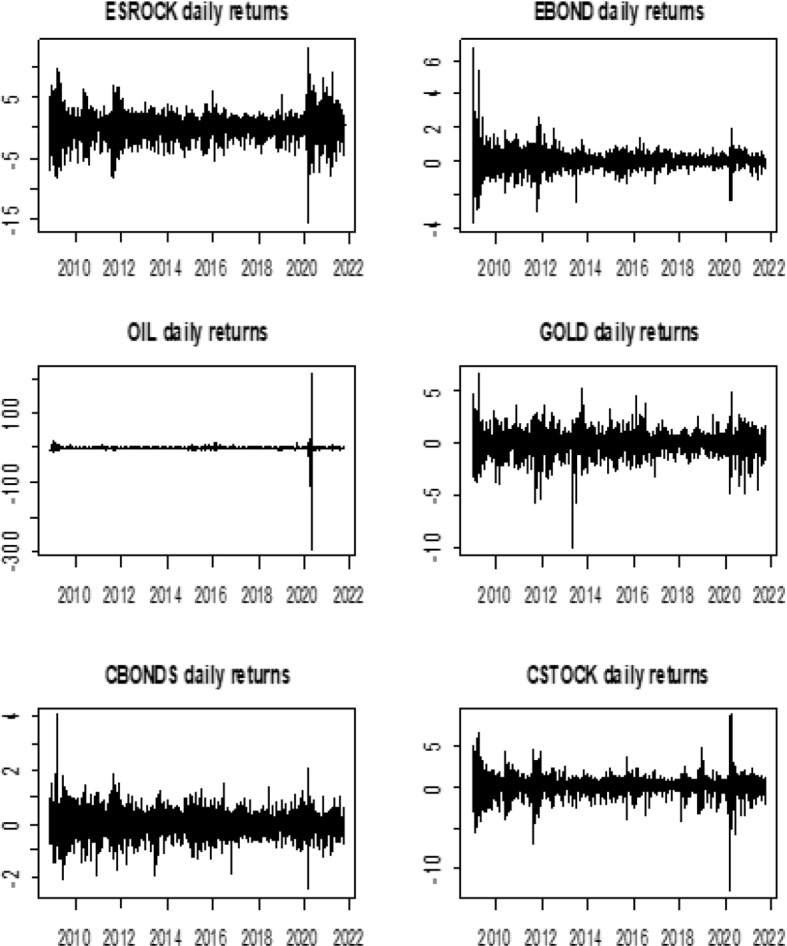
Trend Analysis in Log Returns.
Source: Author’s computation with data sourced from DataStream
Empirical Results
Table 3 presents the results of the conditional spillover effect between the green bond and the conventional assets, based on the DCC and ADCC frameworks. For the pre-covid period, the results reveal an evidence of both short-term and long-run persistence, depicted by and , respectively; with the former consistently lower than the latter. This implies there is volatility clustering in the system. and are the DCC parameters and are estimated to be positive and significant at the 1% level. There is also evidence of mean reverting in the model since the sum of the two parameters is less than one.4 Several studies have reported similar findings (e.g., see Ahmad et al. 2018; Basher and Sadorsky 2016). And according to Basher and Sadorsky (2016 page 239), the Shape parameters equal the degree of freedom such that the higher the Shape parameter, the more the shape of the t-distribution approaches normal. In the results, all the conventional stocks, except for bonds, tend to have relatively lower Shape values (i.e., less than 7). An indication that these assets have heavier tail distribution than the green energy stock market.
Table 3.
DCC/ADDC GARCH Estimates (EBOND)
| Pre-Covid | Covid-Era | Compare | ||||||||
|---|---|---|---|---|---|---|---|---|---|---|
| DCC | ADCC | DCC | ADCC | DCC | ADCC | |||||
| Coeff | SE | Coeff | SE | Coeff | SE | Coeff | SE | ZPBMP | ZPBMP | |
| 0.0952a | 0.0249 | 0.0718a | 0.0259 | 0.3303a | 0.1131 | 0.2950b | 0.1172 | 2.0301c | −0.9355 | |
| 0.0242 | 0.0184 | 0.0274 | 0.0187 | −0.0294 | 0.0442 | −0.0181 | 0.0449 | −1.1195 | 1.3180 | |
| 0.0356 a | 0.0125 | 0.0429 a | 0.0146 | 0.2740 | 0.1940 | 0.4302 | 0.2935 | 1.2263 | −0.9578 | |
| 0.0861 a | 0.0129 | 0.0392 a | 0.0114 | 0.0820 a | 0.0316 | 0.0012 | 0.0380 | −0.1201 | −0.6797 | |
| 0.9053 a | 0.0143 | 0.9047 a | 0.0152 | 0.8813 a | 0.0430 | 0.8682 a | 0.0515 | −0.5296 | 0.6901 | |
| 0.0811 a | 0.0227 | 0.1359 c | 0.0761 | −0.2561 | ||||||
| 7.5155 a | 0.9334 | 7.5941 a | 0.9332 | 7.2930 a | 0.8318 | 7.2760 a | 0.8196 | −0.1780 | 0.6731 | |
| 0.0393 | 0.0293 | 0.0172 | 0.02933 | 0.0676 b | 0.0279 | 0.0444 | 0.0278 | 0.6995 | 0.4215 | |
| −0.02864 | 0.0186 | −0.0310 c | 0.0188 | −0.0217a | 0.0029 | −0.0200 | 0.0181 | 0.3687 | 2.5950 b | |
| 0.0326 b | 0.0146 | 0.0220 a | 0.0081 | 0.0734 a | 0.0234 | 0.0792 a | 0.0205 | 1.4793 | 2.2066 b | |
| 0.0646 a | 0.0137 | 0.0140 c | 0.0073 | 0.1136 a | 0.0139 | 0.0435 a | 0.0112 | 2.5107b | −6.9381 a | |
| 0.9319 a | 0.0141 | 0.9475 a | 0.0072 | 0.8757 a | 0.01308 | 0.851 a | 0.0119 | −2.9221a | 1.8538 | |
| 0.0687 a | 0.0123 | 0.1127 a | 0.0203 | 0.2118 | ||||||
| 5.7644 a | 0.6421 | 6.1797 a | 0.7292 | 5.9452 a | 0.6457 | 6.4019 a | 0.7542 | 0.1985 | 0.1066 | |
| 0.0327 b | 0.0136 | 0.03667 a | 0.0136 | 0.03609a | 0.0228 | 0.0395 | 0.0228 | 0.1277 | 0.0875 | |
| −0.0182 | 0.0158 | −0.0208 | 0.0159 | −0.0170a | 0.0034 | −0.0189 | 0.0148 | 0.0742 | 0.3722 | |
| 0.0077 a | 0.0019 | 0.0079 a | 0.0019 | 0.0086 a | 0.0019 | 0.0089 a | 0.0019 | 0.3349 | 0.0791 | |
| 0.0349 a | 0.0033 | 0.0518 a | 0.0071 | 0.0350 a | 0.0032 | 0.0526 a | 0.0072 | 0.0218 | −0.1030 | |
| 0.9590 a | 0.0007 | 0.9575 a | 0.0087 | 0.9587 a | 0.0006 | 0.9566 a | 0.0008 | −0.3254 | 0.0404 | |
| −0.0293 a | 0.0106 | −0.0287 a | 0.0104 | −0.5616 | ||||||
| 4.0861 a | 0.3263 | 4.2121 a | 0.3342 | 3.9505 a | 0.2717 | 3.9689 a | 0.2754 | −0.3194 | −0.9440 | |
| 0.0082 | 0.0067 | 0.0108 | 0.0069 | 0.0029 | 0.0050 | 0.0027 | 0.0051 | −0.6340 | 1.4080 | |
| −0.0321 c | 0.0193 | −0.0320 c | 0.0193 | 0.0044a | 0.0009 | 0.0044 | 0.0172 | 1.8891 | −0.8321 | |
| 0.0012 a | 0.0003 | 0.0010 a | 0.0003 | 0.0007 a | 0.0002 | 0.0007 a | 0.0002 | −1.3868 | 0.0172 | |
| 0.0394 a | 0.0031 | 0.0488 a | 0.0057 | 0.0507 a | 0.0077 | 0.0490 a | 0.0101 | 1.3613 | −1.6613 | |
| 0.9551 a | 0.0012 | 0.9578 a | 0.0008 | 0.9453 a | 0.0073 | 0.9456 a | 0.0073 | −1.3247 | −3.8049 a | |
| 0.0619 a | 0.0108 | 0.0027 | 0.0112 | −1.7454 | ||||||
| 9.2622 a | 1.4348 | 9.4044 a | 1.5015 | 6.5270 a | 0.6871 | 6.5233 a | 0.6858 | −1.7193 | 0.7443 | |
| 0.0857 a | 0.0107 | 0.0619 a | 0.0108 | 0.1044a | 0.0241 | 0.0821a | 0.0249 | 0.7092 | −1.9449 | |
| −0.0524 a | 0.0179 | 0.0619 a | 0.0108 | 0.0187a | 0.0017 | 0.0224 | 0.0172 | 3.9543 a | 3.5785 a | |
| 0.0196 a | 0.0053 | −0.0416 b | 0.0185 | 0.0343 a | 0.0110 | 0.0379 a | 0.0123 | 1.2039 | 1.9173 | |
| 0.1599 a | 0.0207 | 0.0222 a | 0.0045 | 0.0752 a | 0.0117 | 0.0434 a | 0.0101 | −3.5622 a | 41.0708 a | |
| 0.8390 a | 0.0192 | 0.0057 | 0.0126 | 0.9069 a | 0.0123 | 0.9081 a | 0.018 | 2.9778 a | −25.2400 a | |
| 0.7395 a | 0.0177 | 0.0748 a | 0.0195 | −0.1285 | ||||||
| 4.4245 a | 0.3494 | 4.6916 a | 0.4063 | 4.6848 a | 0.9656 | 4.5698 a | 0.8562 | 0.2535 | 0.2250 | |
| 0.0205 a | 0.0031 | 0.0221 a | 0.0031 | 0.0219 a | 0.0061 | 0.0237 a | 0.0064 | 0.2046 | 0.0000 | |
| 0.9545 a | 0.0095 | 0.9450 a | 0.01135 | 0.9507 a | 0.0123 | 0.9450 a | 0.0125 | −0.2445 | −0.3604 | |
| 0.0038 | 0.0026 | 0.0007 | 0.0082 | −3.9220 | ||||||
| 6.5645 a | 0.3067 | 6.6234 a | 0.3135 | 4.5198 a | 0.4324 | 4.5967 a | 0.4108 | −3.8570 a | −0.9355 a | |
| AIC | 12.5270 | 12.510 | 15.553 | 15.548 | ||||||
| BIC | 12.615 | 12.610 | 15.978 | 16.032 | ||||||
| Shibata | 12.527 | 12.510 | 15.534 | 15.523 | ||||||
| HQ | 12.559 | 12.546 | 15.721 | 15.740 | ||||||
| LL | −18,378 | −18,438 | −3114 | −3107 | ||||||
Source: Authors’ computation with data sourced from DataStream
a, b, and c are the levels of statistical significance at 1%, 5%, and 10%, respectively. To examine the estimates of the two time periods (i.e., Covid vs pre-Covid), we use the bootstrapped version of the Paternoster et al. (1998) approach. The column “compare” shows the z-statistic that is based on the null hypothesis that the COVID-era coefficients are not greater than the pre-COVID coefficients
Results of the ADDC are similar to those previously presented. The distinguishing features relate to the additional parameters in the model. For instance, the asymmetric term () is significant for all the series. Hence, the markets have heterogeneous reactions to positive and negative news. For example, in the case of stock and oil, negative shocks have more effect on these markets than positive shocks of similar magnitudes. There is also an evidence of mean reverting in the asymmetric DCC model. Diagnostic statistics show that ADDC is the preferred model, judging by the AIC, Shibata, Hanan-Quinn, and log-likelihood statistics. Overall, these results are similar to those of earlier studies (see Basher and Sadosky 2016, Ahmad et al. 2018; Hachicha et al. 2021).
The results of the covid era analyses are presented in the second panel of Table 3. Two main distinguishing features could be observed, in comparison to the pre-covid era. First, the prowess of the long-term persistence has reduced, while short-term persistence improved noticeably. Second, the influence of asymmetry has also reduced. These results are intuitive and expected. We can justify the improved performance of the short-term persistence on the ground that the dynamics of the pandemic have been on the rise (i.e., numbers of deaths, hospitalization, and new cases); as such, market stakeholders react to such shock instantaneously. As per the asymmetry results, the covid era could be described as a negative market condition—negative economic shock. Hence, any improvement recorded within this period could be short of what was obtainable during the pre-covid era. That is, distinguishing between “good” and “bad” news might not be effective. Table 4 presents the results of the green stock; an overview of the table shows no major difference between the statistics presented in Tables 3 and 4.
Table 4.
DCC/ADDC GARCH Estimates (ESTOCK)
| Pre-Covid | Covid-Era | Compare | ||||||||
|---|---|---|---|---|---|---|---|---|---|---|
| DCC | ADCC | DCC | ADCC | DCC | ADCC | |||||
| Coeff | SE | Coeff | SE | Coeff | SE | Coeff | SE | ZPBMP | ZPBMP | |
| 0.0014 | 0.0053 | 0.0013 | 0.0054 | 0.0162 | 0.0174 | 0.0139 | 0.0165 | 0.8137 | 0.7258 | |
| −0.0203 | 0.0183 | −0.0203 | 0.0183 | 0.1444b | 0.0645 | 0.1501a | 0.0560 | 2.4565 b | 2.8923 a | |
| 0.0006a | 0.0001 | 0.0006a | 0.0002 | 0.0056 | 0.0165 | 0.0028 | 0.0056 | 0.3030 | 0.3926 | |
| 0.0141 a | 0.0040 | 0.0454 a | 0.0079 | 0.0439 | 0.0993 | 0.0115 | 0.0431 | 0.2999 | −0.7737 | |
| 0.9501 a | 0.0040 | 0.9504 a | 0.0038 | 0.8917 a | 0.2710 | 0.9430 a | 0.1032 | −0.2155 | −0.0717 | |
| 0.0027 | 0.0112 | 0.0191 | 0.0210 | 0.6891 | ||||||
| 6.9741 a | 0.08394 | 6.9661 a | 0.8351 | 4.9836 a | 1.1041 | 5.0360 a | 1.0680 | −1.7976 | −1.4237 | |
| 0.0393 | 0.0293 | 0.0172 | 0.0293 | 0.3379 a | 0.0860 | 0.2911 a | 0.0911 | 3.2866 a | 2.8622 a | |
| −0.0284 | 0.0186 | −0.0310c | 0.0188 | −0.0572 | 0.0508 | −0.0390 | 0.0546 | −0.5324 | −0.1385 | |
| 0.0326 a | 0.0146 | 0.0220 a | 0.0081 | 1.2391 b | 0.5577 | 1.0227 b | 0.4279 | 2.1626 b | 2.3382 b | |
| 0.0646 a | 0.0138 | 0.01402b | 0.0073 | 0.3377 c | 0.1808 | 0.0829 | 0.0775 | 1.5061 | 0.8849 | |
| 0.9319 a | 0.0141 | 0.9475 a | 0.0072 | 0.6253 a | 0.0789 | 0.6694 a | 0.0631 | −3.8253 a | −4.3789 a | |
| 0.0687 a | 0.0123 | 0.3836 c | 02,096 | 0.0002 | ||||||
| 5.7644 a | 0.6425 | 6.1797 a | 0.7296 | 3.0296 a | 0.6227 | 3.1228 a | 0.6716 | −3.0565 a | −3.0827 a | |
| 0.0327 b | 0.0136 | 0.0366 a | 0.0136 | 0.0677 c | 0.0400 | 0.0675 c | 0.0399 | 0.8284 | 0.7330 | |
| −0.0182 | 0.0158 | −0.0208 | 0.0159 | −0.0089 | 0.0497 | −0.0091 | 0.0412 | 0.1783 | 0.2649 | |
| 0.0077 a | 0.0019 | 0.0079 a | 0.0019 | 0.0002 | 0.0312 | 0.00001 | 0.0001 | −0.2399 | −4.1469 a | |
| 0.0349 a | 0.0033 | 0.0518 a | 0.0071 | 0.0157 | 0.0938 | 0.0114 | 0.0387 | −0.2046 | −1.0268 | |
| 0.9590 a | 0.0007 | 0.9575 a | 0.0008 | 0.9830 a | 0.1092 | 0.9834 a | 0.0247 | 0.2198 | 1.0480 | |
| −0.0293 a | 0.0106 | 0.0065 | 0.0225 | 1.4394 | ||||||
| 4.1861 a | 0.3265 | 4.2121 a | 0.3341 | 3.4254 a | 0.4488 | 3.4452 a | 0.4545 | −1.3706 | −1.3595 | |
| 0.0082 | 0.0067 | 0.0108 | 0.0069 | −0.0089 | 0.0159 | −0.0096 | 0.0169 | −0.9911 | −1.1175 | |
| −0.0321 c | 0.0193 | −0.0320 c | 0.0193 | −0.0082 | 0.0526 | −0.0089 | 0.0525 | 0.4266 | 0.4130 | |
| 0.0012 a | 0.0003 | 0.0011 a | 0.0003 | 0.0205 b | 0.0082 | 0.0203 b | 0.0081 | 2.3521 b | 2.3687 b | |
| 0.0394 a | 0.0031 | 0.0488 a | 0.0056 | 0.1565 a | 0.0574 | 0.1360 c | 0.0751 | 2.0371 | 1.1579 | |
| 0.9551a | 0.0012 | 0.9578 a | 0.0008 | 0.7025 a | 0.0831 | 0.7037 a | 0.0847 | −3.0394 a | −2.9999 a | |
| −0.0221 b | 0.0087 | 0.0423 | 0.1112 | 0.5774 | ||||||
| 9.2622 a | 1.4362 | 9.4044 a | 1.5029 | 6.8000 a | 1.7680 | 6.8085 a | 1.7556 | −1.0809 | −1.1233 | |
| 0.0857 a | 0.0107 | 0.0619 a | 0.0109 | 0.1461 a | 0.0330 | 0.1305 a | 0.0349 | 1.7411 | 1.8762 | |
| −0.0524a | 0.0179 | −0.0416 b | 0.0185 | −0.1439a | 0.0488 | −0.1335a | 0.0516 | −1.7603 | −1.6765 | |
| 0.0196 a | 0.0053 | 0.0222 a | 0.0045 | 0.0607 b | 0.0271 | 0.0608 c | 0.0314 | 1.4884 | 1.2169 | |
| 0.1599 a | 0.0207 | 0.0057 | 0.0126 | 0.2036 b | 0.0874 | 0.1099 | 0.0813 | 0.4865 | 1.2666 | |
| 0.8390 a | 0.0192 | 0.8395 a | 0.0177 | 0.7683 a | 0.0716 | 0.7684 a | 0.0966 | −0.9537 | −0.7240 | |
| 0.2930 a | 0.0450 | 0.1823 | 0.1397 | −0.7542 | ||||||
| 4.4245 a | 0.3498 | 4.6916 a | 0.4054 | 4.6484 a | 0.9602 | 4.5401 a | 0.9480 | 0.2191 | −0.1469 | |
| 0.0173 a | 0.0029 | 0.0177 a | 0.0029 | 0.0201 a | 0.0080 | 0.0183 b | 0.0083 | 0.3290 b | 0.0682 | |
| 0.9760 a | 0.0052 | 0.9751 a | 0.0029 | 0.9322 a | 0.0178 | 0.9341 a | 0.0820 | −2.3619 | −0.4997 | |
| 0.0001 | 0.0011 | 0.000 | 0.0367 | −0.0027 | ||||||
| 6.4859 a | 0.2944 | 6.6311 a | 0.3115 | 4.5897 a | 0.4117 | 4.6491 | 0.4037 | −3.7465 a | −3.8870 a | |
| AIC | 10.207 | 10.171 | 11.329 | 11.312 | ||||||
| BIC | 10.295 | 10.171 | 11.753 | 11.796 | ||||||
| Shibata | 10.207 | 10.170 | 11.309 | 11.287 | ||||||
| HQ | 10.239 | 10.207 | 11.497 | 11.504 | ||||||
| LL | −14,966 | −14,907 | −22,570 | −22,470 | ||||||
Source: Authors’ computation with data sourced from DataStream
a, b, and c are the levels of statistical significance at 1%, 5%, and 10%, respectively. To examine the estimates of the two time periods (i.e., Covid vs pre-Covid), we use the bootstrapped version of the Paternoster et al. (1998) approach. The column “compare” shows the z-statistic that is based on the null hypothesis that the COVID-era coefficients are not greater than the pre-COVID coefficients
Results of the GO-GARCH are presented in Tables 5 and 6, which focuses on the rotation matrix (U), mixing matrix (A) and the factor loading (A). Unlike other variants of the GARCH framework, the GO-GARCH estimates factors, hence standard errors are not presented. Like the DCC and AGARCH model moreover, there is evidence of persistence, both in the short- and long-run, with the latter being multiple folds of the former. Also, the summation of both parameters is less than unity. There is no significant difference between the results of green stock (Table 5) and green bond (Table 6).
Table 5.
ESTOCK
| Pre-COVID | COVID | |||||||||
|---|---|---|---|---|---|---|---|---|---|---|
| The Rotation matrix U | ||||||||||
| U(1) | U(2) | U(3) | U(4) | U(5) | U(1) | U(2) | U(3) | U(4) | U(5) | |
| U(1) | −0.028 | −0.176 | −0.197 | 0.624 | −0.734 | −0.001 | −0.005 | 0.0315 | −09,994 | −0.008 |
| U(2) | 0.1107 | −0.023 | 0.4910 | −0.589 | −0.631 | −0.376 | 0.051 | 0.5271 | −0.022 | −0.759 |
| U(3) | −0.118 | −0.971 | −0.053 | −0.156 | 0.1200 | −0.280 | −0.827 | 0.3559 | −0.013 | 0.3301 |
| U(4) | 0.0612 | −0.105 | 0.8390 | 0.4869 | 0.2117 | −0.558 | 0.5427 | 0.3227 | −0.003 | 0.5375 |
| U(5) | −0.098 | 0.1130 | 0.1190 | −0.034 | −0.051 | −0.683 | −0.132 | −0.700 | 0.019 | −0.156 |
| The Mixing Matrix A | ||||||||||
|---|---|---|---|---|---|---|---|---|---|---|
| A(1) | A(2) | A(3) | A(4) | A(5) | A(1) | A(2) | A(3) | A(4) | A(5) | |
| A(1) | 0.1838 | 0.2221 | 1.0757 | −1.360 | 0.0904 | −1.351 | 0.113 | 1.738 | 0.083 | −1.985 |
| A(2) | −0.030 | 0.3324 | 0.0185 | −0.866 | 2.1960 | −0.003 | −0.098 | 0.528 | 17.26 | −0.117 |
| A(3) | 0.0738 | 1.0008 | −0.017 | 0.1290 | 0.0496 | −0.096 | 1.0364 | −0.088 | 0.0303 | −0.310 |
| A(4) | 0.3790 | 0.0070 | −0.021 | 0.2490 | −0.046 | 0.2229 | 0.1715 | 0.2587 | −0.013 | 0.190 |
| A(5) | 0.1496 | 0.1103 | 0.0557 | −1.031 | 0.0059 | 0.1784 | −0.074 | 0.2413 | 0.0355 | −1.483 |
| Go−GARCH Estimates | ||||||||||
|---|---|---|---|---|---|---|---|---|---|---|
| F1 | F2 | F3 | F4 | F5 | F1 | F2 | F3 | F4 | F5 | |
| 0.0098 | 0.0062 | 0.0100 | 0.0203 | 0.0090 | 0.6646 | 0.0007 | 0.1299 | 0.0041 | 0.0224 | |
| 0.0383 | 0.0351 | 0.0516 | 0.1470 | 0.0717 | 0.1947 | 0.0100 | 0.1340 | 0.3921 | 0.1687 | |
| 0.9509 | 0.9586 | 0.9395 | 0.8408 | 0.9206 | 0.1270 | 0.9872 | 0.7112 | 0.6068 | 0.7948 | |
| Skew | −0.103 | −0.075 | 0.0673 | 0.1916 | −0.068 | 0.0517 | −0.230 | −0.138 | −0.292 | 0.3859 |
| Shape | 2.2120 | 0.8918 | 2.0491 | 1.1463 | 1.2501 | 0.1784 | −0.074 | 0.2413 | 0.0355 | −1.483 |
| LL | −18,404 | −3169 | ||||||||
Source: Authors’ computation with data sourced from DataStream
a, b, and c are the levels of statistical significance at 1%, 5%, and 10%, respectively. To examine the estimates of the two time periods (i.e., Covid vs pre-Covid), we use the bootstrapped version of the Paternoster et al. (1998) approach. The column “compare” shows the z-statistic that is based on the null hypothesis that the COVID-era coefficients are not greater than the pre-COVID coefficients
Table 6.
EBOND
| Pre-COVID | COVID | |||||||||
|---|---|---|---|---|---|---|---|---|---|---|
| The Rotation matrix U | ||||||||||
| U(1) | U(2) | U(3) | U(4) | U(5) | U(1) | U(2) | U(3) | U(4) | U(5) | |
| U(1) | 0.0089 | −0.327 | 0.2970 | 0.8923 | 0.0927 | 0.0255 | 0.0089 | −0.012 | −0.999 | −0.010 |
| U(2) | 0.1554 | 0.0423 | 0.551 | −0.084 | −0.814 | −0.404 | 0.0388 | −0.034 | −0.019 | 0.9128 |
| U(3) | −0.139 | −0.489 | 0.6221 | −0.428 | 0.4134 | −0.116 | 0.89511 | −0.417 | 0.0112 | −0.105 |
| U(4) | 0.4010 | 0.7029 | 0.428 | 0.0703 | 0.3957 | 0.8065 | −0.076 | −0.474 | 0.0220 | 0.3434 |
| U(5) | −0.891 | 0.3967 | 0.1940 | 0.0927 | −0.027 | 0.4142 | 0.4374 | 0.7742 | 0.0032 | 0.1942 |
| The Mixing Matrix A | ||||||||||
|---|---|---|---|---|---|---|---|---|---|---|
| A(1) | A(2) | A(3) | A(4) | A(5) | A(1) | A(2) | A(3) | A(4) | A(5) | |
| A(1) | 0.1522 | 0.494 | 0.108 | 0.0024 | −0.060 | 0.294 | −0.043 | 0.169 | −0.008 | −0.021 |
| A(2) | −0.033 | 0.672 | −0.563 | −2.211 | −0.156 | 0.438 | 0.156 | −0.207 | −17.26 | −0.174 |
| A(3) | 0.1373 | 0.205 | 0.172 | −0.062 | −0.965 | 0.277 | −0.917 | 0.443 | −0.028 | −0.031 |
| A(4) | 0.386 | −0.169 | 0.167 | 0.049 | −0.022 | 0.233 | −0.195 | −0.196 | 0.0220 | 0.3434 |
| A(5) | 0.0906 | 0.4701 | −0.931 | −0.043 | −0.037 | 0.585 | 0.192 | −0.104 | −0.021 | −1.380 |
| Go−GARCH Estimates | ||||||||||
|---|---|---|---|---|---|---|---|---|---|---|
| F1 | F2 | F3 | F4 | F5 | F1 | F2 | F3 | F4 | F5 | |
| 0.0094 | 0.0012 | 0.0294 | 0.0080 | 0.0071 | 0.0474 | 0.0125 | 0.6893 | 0.0038 | 0.0339 | |
| 0.0359 | 0.0505 | 0.1581 | 0.0694 | 0.0422 | 0.0884 | 0.0182 | 0.304 | 0.3864 | 0.1497 | |
| 0.9536 | 0.9480 | 0.8151 | 0.9238 | 0.9511 | 0.8426 | 0.9646 | 0.0024 | 0.6125 | 0.7915 | |
| Skew | −0.113 | −0.044 | 0.2135 | 0.0656 | 0.0636 | −0.389 | 0.1824 | 0.0609 | 0.3087 | 0.2782 |
| Shape | 2.2678 | 1.9037 | 1.7971 | 1.2990 | 0.9019 | 4.4075 | 1.0880 | 1.1840 | 0.4835 | 1.7472 |
| LL | −15,105 | −23,180 | ||||||||
Source: Authors’ computation with data sourced from DataStream
a, b, and c are the levels of statistical significance at 1%, 5%, and 10%, respectively. To examine the estimates of the two time periods (i.e., Covid vs pre-Covid), we use the bootstrapped version of the Paternoster et al. (1998) approach. The column “compare” shows the z-statistic that is based on the null hypothesis that the COVID-era coefficients are not greater than the pre-COVID coefficients
Dynamic conditional correlation
In line with the extant literature, we conduct a dynamic conditional correlation one-step out-of-sample forecast, based on a rolling window analysis to address parameter instability, a common phenomenon in forecasting financial series (Basher and Sadorsky 2016). With this approach in mind, we use only the recent observations, to estimate the most appropriate parameters fit for the model to be used in the forecasting process (e.g., see de Rossi 2013).
As stated earlier, this paper uses two datasets. The first dataset, pre-covid, has 2943 observations, while the second dataset, the Covid era, has 409 observations. For the first dataset, we use 1000 one-step ahead dynamic conditional correlations, that is, the GARCH model is refit every 20 observations, and the second dataset uses 100 one-step correlation to refit every 20 observations. The trend of the dynamic conditional correlation is presented in the Appendix Sect. (1 and 3). The figure reveals two striking features. First, the trends of both DCC and ADCC almost mimic each other (see Table 7 for more details). This holds for all the pairwise correlation. This finding is not surprising as ADCC is seen as an extension of DCC by accounting for the role and influence of asymmetry. Second, GO-GARCH behaves very differently from both ADCC and DCC. This difference becomes more obvious in 2020 and beyond. There is a mostly positive correlation in each pair. A strand of the literature has argued that gold’s diversification benefits enable it to correlate positively with other financial assets (e.g., see Raza et al. 2019; Hachicha et al. 2021). The correlation between stock and bond is mostly positive under DCC and GO-GARCH, and it is more volatile for GO-GARCH. Basher and Sadorsky (2016) also argued that the correlation between stock and bonds is due to flight-to-quality as a result of the quantitative easing policies of the US Feds.
Table 7.
Correlations Between Correlations
| Panel A: ESTOCK | ||||||||
|---|---|---|---|---|---|---|---|---|
| Pre-Covid | COVID-Era | |||||||
| 1 | 2 | 3 | 4 | 1 | 2 | 3 | 4 | |
| DCC/ADCC | 0.9908 | 0.9954 | 0.9903 | 0.9792 | 0.9983 | 0.9992 | 0.9909 | 0.9967 |
| DCC/GO−GARCH | 0.2189 | −0.0241 | 0.2614 | 0.7155 | 0.6428 | 0.7842 | 0.6367 | 0.5188 |
| ADCC/GO−GARCH | 0.2440 | −0.0116 | 0.2590 | 0.6952 | 0.6267 | 0.7764 | 0.6347 | 0.5496 |
| Panel B: EBOND | ||||||||
|---|---|---|---|---|---|---|---|---|
| Pre−Covid | COVID−Era | |||||||
| DCC/ADCC | 0.9987 | 0.9997 | 0.9996 | 0.9965 | 0.9836 | 0.9934 | 0.9986 | 0.9988 |
| DCC/GO−GARCH | 0.5446 | 0.7534 | 0.6987 | 0.5429 | 0.1241 | 0.7500 | 0.4126 | 0.0189 |
| ADCC/GO−GARCH | 0.5449 | 0.7539 | 0.7040 | 0.5455 | −0.0133 | 0.6967 | 0.3976 | 0.0312 |
Source: Authors’ computation with data sourced from DataStream
1 = ESTOCK/OIL, 2 ESTOCK/GOLD, 3 = ESTOCK/CBOND, 4 = ESTOCK/CSTOCK
The pairwise correlation in the GARCH framework is presented in Table 7. There is a high correlation between the DCC and ADCC. This finding is not surprising, given that the ADCC is an extension of DCC that considers the role and influence of asymmetry. Second, Go-GARCH has a lower correlation to both DCC and ADCC. There is a higher correlation between the green stock market relative to the green bond market. In the DCC/ADCC framework, the impact of the Covid pandemic appears to have no discernible effect in both markets.
Optimal portfolio and risk management
Some of the statistics investors rely on to make decisions about portfolio allocation and design are the optimal hedge ratios and hedging effectiveness. In this regards, many earlier studies have presented various ways to estimate the optimal hedge ratios (OHR) and the hedging effectiveness (HE) of financial assets. The most commonly used models incorporate the minimized portfolio variance (e.g., see Chen et al. 2003). To ensure reduced risk investments in the portfolios of green energy markets and conventional financial assets, we rely on the estimates of the OHR based on a rolling-window estimation of the GARCH models. OHR is derived from the return equation of investors that take long positions in financial assets as:
| 15 |
where is the return of the unhedged portfolio, and are the returns on the spot and future positions, respectively. is the dynamic hedge ratio that shows the number of future contract that must be sold to hedge against the spot position. The variance of the hedged portfolio is available in the past period and is expressed as:
| 16 |
The OHRs are the and it is expected they will minimise the conditional variance of the hedged portfolio. They are obtained by taking the partial derivative with respect to and setting the resulting equation to 0. That is,
| 17 |
Kroner and Sultan (1993) show that OHR can be calculated using the conditional volatility estimates from the GARCH model. The hedge ratio between future and spot price is expressed as:
| 18 |
where the numerator is the conditional covariance between spot and future returns, and the denominator is the conditional variance of the futures returns. The performance of the OHR can be gauged using HE, which is expressed as:
| 19 |
Theoretically, the higher the HE index, the more effective the assets are, implying a higher risk reduction. The trend analysis of the OHR is presented in Appendix 2 and 4, while Table 8 contains the pairwise correlation. The statistics from the table show a high correlation between DCC and ADCC, again, this is not surprising. The correlation appears to be higher in the pre-covid era than in the covid-era.
Table 8.
Correlations Between Hedge Ratios
| Panel A: ESTOCK | ||||||||
|---|---|---|---|---|---|---|---|---|
| Pre-Covid | COVID-Era | |||||||
| 1 | 2 | 3 | 4 | 1 | 2 | 3 | 4 | |
| DCC/ADCC | 0.9724 | 0.9897 | 0.9749 | 0.8735 | 0.9586 | 0.9957 | 0.9846 | 0.9674 |
| DCC/GO-GARCH | 0.6603 | 0.09658 | 0.7168 | 0.8361 | 0.6047 | 0.8344 | 0.6748 | 0.2003 |
| ADCC/GO-GARCH | 0.6652 | 0.0765 | 0.7230 | 0.7728 | 0.4918 | 0.8515 | 0.6628 | 0.1825 |
| Panel B: EBOND | ||||||||
|---|---|---|---|---|---|---|---|---|
| Pre-Covid | COVID-Era | |||||||
| DCC/ADCC | 0.9910 | 0.9741 | 0.9892 | 0.9887 | 0.9333 | 0.5453 | 0.981 | 0.9886 |
| DCC/GO-GARCH | 0.6104 | 0.6531 | 0.6209 | 0.5341 | 0.2256 | 0.5792 | 0.705 | 0.0851 |
| ADCC/GO-GARCH | 0.6136 | 0.6219 | 0.6162 | 0.5428 | 0.0828 | −0.2529 | 0.751 | 0.0003 |
Source: Authors computation with data sourced from DataStream
1 = ESTOCK/OIL, 2 ESTOCK/GOLD, 3 = ESTOCK/CBOND, 4 = ESTOCK/CSTOCK
The summary statistics of both OHR and HE are presented in Tables 9 and 10. Three striking features in the table are observable. First, the performance of OHR in the period (pre-covid and covid era) is asset specific. For instance, with renewable energy stocks, the average OHR is higher in the pre-covid period. For the DCC model, the average hedge ratio between green energy stock and oil is about 18 and 13 cents for pre-covid and covid periods, respectively. This implies that a long position of $1 in the energy stock market can be hedged for 18(13) cents in the oil market in the pre-covid(covid) period. Similar results have also been reported in earlier studies (see Sadorsky 2012; Sanschez 2015; Ahmad 2017; Ahmad et al. 2018).5 The average hedge between renewable energy stocks, gold and conventional bonds is negative, with the covid period having relative higher performance. The negative OHR implies that investors must take the same position for two assets in the same portfolio. Studies have shown that lower OHR implies a cheaper cost of hedging (e.g., see Akhtaruzzaman et al. 2021; Batten et al. 2021). Thus, oil and conventional stocks were cheaper during the covid period than before the crisis. This might be attributed to the fact that oil prices plunged drastically during the crisis. In fact, for the first time in history, oil prices traded negative around April/May 2020. Another factor might be the containment policies of governments at the onset of the pandemic, which led to the shutting down of business activities, thus impacting the supply chain and consequently negatively affecting stock markets (Raheem 2021). However, gold has higher OHR during the pandemic. Previous studies have also reported this position (e.g., Batten et al. 2021; Chemkah et al. 2021).
Table 9.
Summary of Hedge Ratio and Hedge Effectiveness (ESTOCK)
| Pre-COVID | COVID | Compare | |||||||
|---|---|---|---|---|---|---|---|---|---|
| Mean | Min | Max | HE | Mean | Min | Max | HE | ZPBMP | |
| ESTOCK/OIL | |||||||||
| DCC | 0.1804 | 0.0405 | 0.5310 | 0.1414 | 0.1332 | 0.0283 | 0.2502 | 0.0436 | 0.2509 |
| ADCC | 0.1882 | 0.0306 | 0.6262 | 0.1423 | 0.1576 | 0.0409 | 0.3565 | 0.0487 | 0.1275 |
| GO-GARCH | 0.2280 | 0.0970 | 0.9564 | 0.0807 | 0.1104 | −0.2483 | 0.3660 | 0.0734 | 0.9872 |
| ESTOCK/GOLD | |||||||||
| DCC | −0.0272 | −0.7579 | 0.3135 | 0.0067 | 0.2222 | 0.0216 | 0.5542 | 0.0256 | 3.9119 a |
| ADCC | −0.055 | −0.5665 | 0.3191 | 0.0041 | 0.2152 | −0.0103 | 0.5726 | −0.0247 | 0.0355 |
| GO−GARCH | −0.0582 | −2.0278 | 0.2545 | −0.0693 | 0.2578 | −0.0336 | 0.9153 | −0.0262 | 4.4316 a |
| ESTOCK/CBOND | |||||||||
| DCC | −1.105 | −3.303 | −0.2573 | 0.1284 | −0.4508 | −1.1693 | 0.0576 | 0.0257 | 0.4347 |
| ADCC | −1.076 | −3.286 | −0.1248 | 0.1247 | −0.6027 | −1.3191 | −0.0662 | 0.0297 | 0.4066 |
| GO-GARCH | 1.412 | 1.091 | 1.9526 | 0.6631 | 1.4471 | 0.7715 | 2.3263 | 0.1406 | 1.1211 |
| ESTOCK/CSTOCK | |||||||||
| DCC | 0.1785 | −0.0762 | 0.4956 | 0.0586 | −0.5542 | −1.8989 | 0.7865 | 0.0545 | 0.7057 |
| ADCC | 0.1854 | −0.0965 | 0.3546 | 0.4326 | −0.4126 | −2.1026 | 1.0258 | 0.0668 | 0.6838 |
| GO-GARCH | 0.1659 | 0.0038 | 0.65463 | 0.3115 | −0.7708 | −2.597 | 0.8535 | 0.0456 | 0.6254 |
Source: Authors’ computation with data sourced from DataStream
a, b, and c are the levels of statistical significance at 1%, 5%, and 10%, respectively. To examine the estimates of the two time periods (i.e., Covid vs pre-Covid), we use the bootstrapped version of the Paternoster et al. (1998) approach. The column “compare” shows the z-statistic that is based on the null hypothesis that the COVID-era coefficients are not greater than the pre-COVID coefficients
Table 10.
Summary of Hedge Ratio and Hedge Effectiveness (EBOND)
| Pre-COVID | COVID | Compare | |||||||
|---|---|---|---|---|---|---|---|---|---|
| Mean | Min | Max | HE | Mean | Min | Max | HE | ZPBMP | |
| EBOND/OIL | |||||||||
| DCC | 0.0138 | −0.1716 | 0.0568 | −0.0049 | 0.0074 | 0.0023 | 0.0158 | −0.0034 | 3.5430a |
| ADCC | 0.0138 | −0.0152 | 0.0586 | −0.0049 | 0.0069 | 0.0018 | 0.0139 | −0.0021 | 5.5225 a |
| GO−GARCH | 0.0137 | −0.0440 | 0.1550 | 0.0102 | 0.0001 | −0.0211 | 0.0209 | −0.0263 | 0.4269 |
| EBOND /GOLD | |||||||||
| DCC | 0.1772 | 0.0218 | 0.2981 | 0.3204 | 0.1675 | 0.1412 | 0.1870 | 0.4082 | 3.0107 a |
| ADCC | 0.1760 | 0.0197 | 0.2983 | 0.3244 | 0.1479 | 0.1390 | 0.1763 | 0.4064 | 5.6089 a |
| GO-GARCH | 0.2100 | 0.0083 | 0.4234 | 0.3284 | 0.1420 | 0.0914 | 0.1634 | 0.4025 | 4.3768 a |
| EBOND /CBOND | |||||||||
| DCC | 0.2490 | −0.1004 | 0.5505 | 0.2353 | 0.1711 | 0.0946 | 0.2461 | 0.1238 | 0.6673 |
| ADCC | 0.2484 | −0.0102 | 0.6114 | 0.2364 | 0.1622 | 0.0769 | 0.2435 | 0.1246 | 0.0879 |
| GO-GARCH | −0.0232 | −0.1987 | 0.2277 | 0.0191 | 0.0556 | 0.0037 | 0.1035 | 0.0385 | 3.0107 a |
| EBOND /CSTOCK | |||||||||
| DCC | −0.5655 | −1.8155 | 0.7166 | 0.0644 | −0.5589 | −1.8565 | 0.5989 | 0.0459 | 0.6673 |
| ADCC | −0.5557 | −2.0017 | 0.8266 | 0.0765 | −0.5507 | −1.9875 | 0.6879 | 0.0541 | 0.0879 |
| GO-GARCH | −0.6885 | −2.7445 | 0.1447 | 0.0523 | −0.6835 | −2.7741 | 0.1598 | 0.0439 | 0.4960 |
Source: Authors’ computation with data sourced from DataStream
a, b, and c are the levels of statistical significance at 1%, 5%, and 10%, respectively. To examine the estimates of the two time periods (i.e., Covid vs pre-Covid), we use the bootstrapped version of the Paternoster et al. (1998) approach. The column “compare” shows the z-statistic that is based on the null hypothesis that the COVID-era coefficients are not greater than the pre-COVID coefficients
Furthermore, for the green stock market, the HE is higher in the calm period (i.e., pre-covid era), with oil and conventional bonds being the best hedging products. On the flip side, the green energy bond is immune to the influence of the pandemic, as there is no significant difference in the average values of OHR and HE in the pre-covid and covid periods. It is quite hard to justify this, nevertheless, one can hang on to the intuition that some green bonds have government backing and involvement. For instance, the resultant effect of the Paris Agreement led to the “green bond boom” (Tolliver et al. 2020). It is worth noting too that there are instances in which HE values are negative. This suggests that an unhedged portfolio will produce the most risk-mitigating strategy. In fact, Ahmad et al. (2018) report similar findings for gold and green stock.
Sensitivity analyses6
A strand of the literature has argued that the green/brown compartmentalization for a class of assets is not homogenous (e.g., see Fuentes and Herrera 2020; Kuang 2021a, b). As such, there is the possibility that this classification might have implications for empirical analyses. To verify this supposition, we use alternative indicators: the NYSE Bloomberg Global (WIND), the NYSE Bloomberg Global Energy Smart Technologies Index (EST), the NYSE Bloomberg Global Solar Energy Index (SOLAR) and World Renewable Energy Index (RENIXX).7 The results of the summary hedge ratios and hedge effectiveness are presented in Tables 11, 12, 13 and 14. Our results confirm the hypothesis that the hedging strategies of energy assets are heterogenous, depending on the mode of measurement. The results show that SOLAR and RENIXX have the highest hedging effectiveness compared to other indicators. The heterogeneous nature of the results of these indicators is also reported in Pham (2019).
Table 11.
Summary of Hedge Ratio and Hedge Effectiveness (WIND)
| Pre-COVID | COVID | Compare | |||||||
|---|---|---|---|---|---|---|---|---|---|
| Mean | Min | Max | HE | Mean | Min | Max | HE | ZPBMP | |
| WIND/OIL | |||||||||
| DCC | 0.1064 | 0.0239 | 0.3133 | 0.0834 | 0.0786 | 0.0167 | 0.1476 | 0.0257 | 0.2352 |
| ADCC | 0.1110 | 0.0181 | 0.3695 | 0.0840 | 0.0930 | 0.0241 | 0.2103 | 0.0287 | 0.3727 |
| GO-GARCH | 0.1345 | 0.0572 | 0.5643 | 0.0476 | 0.0651 | −0.1465 | 0.2159 | 0.0433 | 0.6405 |
| WIND/GOLD | |||||||||
| DCC | 0.1053 | −0.0450 | 0.2924 | 0.0346 | −0.3270 | −1.1204 | 0.4640 | 0.0322 | 0.6673 |
| ADCC | 0.1094 | −0.0569 | 0.2092 | 0.2552 | −0.2434 | −1.2405 | 0.6052 | 0.0394 | 0.0879 |
| GO-GARCH | 0.0979 | 0.0022 | 0.3862 | 0.1838 | −0.4548 | −1.5322 | 0.5036 | 0.0269 | 0.496 |
| WIND/CBOND | |||||||||
| DCC | 0.6520 | −1.9488 | 0.1518 | 0.0758 | 0.2660 | −0.6899 | 0.0340 | 0.0152 | 0.1646 |
| ADCC | 0.6348 | −1.9387 | 0.0736 | 0.0736 | 0.3556 | −0.7783 | 0.0391 | 0.0175 | 0.5023 |
| GO-GARCH | 0.8331 | 0.6437 | 1.1520 | 0.3912 | 0.8538 | 0.4552 | 1.3725 | 0.0830 | 0.3436 |
| WIND/CSTOCK | |||||||||
| DCC | 0.1053 | −0.0450 | 0.2924 | 0.0346 | −0.3270 | −1.1204 | 0.4640 | 0.0322 | 0.4897 |
| ADCC | 0.1094 | −0.0569 | 0.2092 | 0.2552 | −0.2434 | −1.2405 | 0.6052 | 0.0394 | 0.0288 |
| GO-GARCH | 0.0979 | 0.0022 | 0.3862 | 0.1838 | −0.4548 | −1.5322 | 0.5036 | 0.0269 | 0.6239 |
Source: Authors’ computation with data sourced from DataStream
a, b, and c are the levels of statistical significance at 1%, 5%, and 10%, respectively. To examine the estimates of the two time periods (i.e., Covid vs pre-Covid), we use the bootstrapped version of the Paternoster et al. (1998) approach. The column “compare” shows the z-statistic that is based on the null hypothesis that the COVID-era coefficients are not greater than the pre-COVID coefficients
Table 12.
Summary of Hedge Ratio and Hedge Effectiveness (EST)
| Pre-COVID | COVID | Compare | |||||||
|---|---|---|---|---|---|---|---|---|---|
| Mean | Min | Max | HE | Mean | Min | Max | HE | ZPBMP | |
| EST /OIL | |||||||||
| DCC | 0.0219 | −0.2728 | 0.0903 | −0.0078 | 0.0118 | 0.0037 | 0.0251 | 0.0054 | 3.5095 a |
| ADCC | 0.0219 | −0.0242 | 0.0932 | 0.0078 | 0.0110 | 0.0029 | 0.0221 | 0.0033 | −0.1737 |
| GO-GARCH | 0.0218 | −0.0700 | 0.2465 | 0.0162 | 0.0002 | −0.0335 | 0.0332 | 0.0418 | 4.3115 a |
| EST /GOLD | |||||||||
| DCC | 0.3959 | −0.1596 | 0.8753 | 0.3741 | 0.2720 | 0.1504 | 0.3913 | 0.1968 | 0.1703 |
| ADCC | 0.3950 | −0.0162 | 0.9721 | 0.3759 | 0.2579 | 0.1223 | 0.3872 | 0.1981 | 0.0502 |
| GO-GARCH | −0.0369 | −0.3159 | 0.3620 | 0.0304 | 0.0884 | 0.0059 | 0.1646 | 0.0612 | 2.7468 a |
| EST /CBOND | |||||||||
| DCC | −0.8991 | −2.8866 | 1.1394 | 0.1024 | −0.8887 | −2.9518 | 0.9523 | 0.0730 | 0.5634 |
| ADCC | −0.8836 | −3.1827 | 1.3143 | 0.1216 | −0.8756 | −3.1601 | 1.0938 | 0.0860 | 0.2492 |
| GO-GARCH | −1.0947 | −4.3638 | 0.2301 | 0.0832 | −1.0868 | −4.4108 | 0.2541 | 0.0698 | 1.2650 |
| EST /CSTOCK | |||||||||
| DCC | 0.2126 | 0.0262 | 0.3577 | 0.3845 | 0.2010 | 0.1694 | 0.2244 | 0.4898 | 4.8488 a |
| ADCC | 0.2112 | 0.0236 | 0.3580 | 0.3893 | 0.1775 | 0.1668 | 0.2116 | 0.4877 | 5.1689 a |
| GO−GARCH | 0.2520 | 0.0100 | 0.5081 | 0.3941 | 0.1704 | 0.1097 | 0.1961 | 0.4830 | 3.1097 a |
Source: Authors’ computation with data sourced from DataStream
a, b, and c are the levels of statistical significance at 1%, 5%, and 10%, respectively. To examine the estimates of the two time periods (i.e., Covid vs pre-Covid), we use the bootstrapped version of the Paternoster et al. (1998) approach. The column “compare” shows the z-statistic that is based on the null hypothesis that the COVID-era coefficients are not greater than the pre-COVID coefficients
Table 13.
Summary of Hedge Ratio and Hedge Effectiveness (SOLAR)
| Pre-COVID | COVID | Compare | |||||||
|---|---|---|---|---|---|---|---|---|---|
| Mean | Min | Max | HE | Mean | Min | Max | HE | ZPBMP | |
| SOLAR /OIL | |||||||||
| DCC | 0.1477 | 0.0182 | 0.2484 | 0.2670 | 0.1396 | 0.1177 | 0.1558 | 0.3402 | 6.3519 a |
| ADCC | 0.1467 | 0.0164 | 0.2486 | 0.2703 | 0.1233 | 0.1158 | 0.1469 | 0.3387 | 6.3378 a |
| GO-GARCH | 0.1750 | 0.0069 | 0.3528 | 0.2969 | 0.1183 | 0.0762 | 0.1362 | 0.3174 | 1.9834 |
| SOLAR /GOLD | |||||||||
| DCC | 0.0077 | −0.0953 | 0.0316 | −0.0027 | 0.0041 | 0.0013 | 0.0088 | −0.0019 | 7.0437 a |
| ADCC | 0.0077 | −0.0084 | 0.0326 | −0.0027 | 0.0038 | 0.0010 | 0.0077 | −0.0012 | 3.7896 a |
| GO-GARCH | 0.0076 | −0.0244 | 0.0861 | 0.0057 | 0.0001 | −0.0117 | 0.0116 | −0.0146 | 0.0999 |
| SOLAR /CBOND | |||||||||
| DCC | 0.3810 | −0.1536 | 0.8423 | 0.3600 | 0.2618 | 0.1447 | 0.3765 | 0.1894 | 1.3735 |
| ADCC | 0.3801 | −0.0156 | 0.9354 | 0.3617 | 0.2482 | 0.1177 | 0.3726 | 0.1906 | 0.7803 |
| GO-GARCH | −0.0355 | −0.3040 | 0.3484 | 0.0292 | 0.0851 | 0.0057 | 0.1584 | 0.0589 | 7.0437 a |
| SOLAR /CSTOCK | |||||||||
| DCC | 0.0487 | −0.6057 | 0.2005 | −0.0173 | 0.0261 | 0.0081 | 0.0558 | −0.0120 | 6.6341 a |
| ADCC | 0.0487 | −0.0537 | 0.2069 | −0.0173 | 0.0244 | 0.0064 | 0.0491 | −0.0074 | 6.6661 a |
| GO-GARCH | 0.0484 | −0.1553 | 0.5472 | 0.0360 | 0.0004 | −0.0745 | 0.0738 | −0.0928 | 0.0081 |
Source: Authors’ computation with data sourced from DataStream
a, b, and c are the levels of statistical significance at 1%, 5%, and 10%, respectively. To examine the estimates of the two time periods (i.e., Covid vs pre-Covid), we use the bootstrapped version of the Paternoster et al. (1998) approach. The column “compare” shows the z-statistic that is based on the null hypothesis that the COVID-era coefficients are not greater than the pre-COVID coefficients
Table 14.
Summary of Hedge Ratio and Hedge Effectiveness (RENIXX)
| Pre-COVID | COVID | Compare | |||||||
|---|---|---|---|---|---|---|---|---|---|
| Mean | Min | Max | HE | Mean | Min | Max | HE | ZPBMP | |
| RENIXX /OIL | |||||||||
| DCC | 1.1656 | −0.4976 | 3.2363 | 0.3827 | −3.6189 | −12.399 | 5.1358 | 0.3559 | 1.4044 |
| ADCC | 1.2107 | −0.6301 | 2.3155 | 2.8249 | −2.6943 | −13.730 | 6.6985 | 0.4362 | 0.1459 |
| GO-GARCH | 1.0833 | 0.0248 | 4.2747 | 2.0341 | −5.0333 | −16.958 | 5.5734 | 0.2978 | 0.6788 |
| RENIXX /GOLD | |||||||||
| DCC | −0.4368 | −1.3055 | −0.1017 | 0.0508 | −0.1782 | −0.4622 | 0.0228 | 0.0102 | 1.1585 |
| ADCC | −0.4253 | −1.2988 | −0.0493 | 0.0493 | −0.2382 | −0.5214 | −0.0262 | 0.0117 | 1.5101 |
| GO-GARCH | 0.5581 | 0.4312 | 0.7718 | 0.2621 | 0.5720 | 0.3049 | 0.9195 | 0.0556 | 0.8103 |
| RENIXX /CBOND | |||||||||
| DCC | −2.4863 | −7.4318 | −0.5789 | 0.2889 | −1.0143 | −2.6309 | 0.1296 | 0.0578 | 0.0591 |
| ADCC | −2.4210 | −7.3935 | −0.2808 | 0.2806 | −1.3561 | −2.9680 | −0.1490 | 0.0668 | 1.1427 |
| GO-GARCH | 3.1770 | 2.4548 | 4.3934 | 1.4920 | 3.2560 | 1.7359 | 5.2342 | 0.3164 | 0.4310 |
| RENIXX /CSTOCK | |||||||||
| DCC | 0.9976 | 0.2240 | 2.9364 | 0.7819 | 0.7366 | 0.1565 | 1.3836 | 0.2411 | 1.3907 |
| ADCC | 1.0407 | 0.1692 | 3.4629 | 0.7869 | 0.8715 | 0.2262 | 1.9714 | 0.2693 | 0.2755 |
| GO-GARCH | 1.2608 | 0.5364 | 5.2889 | 0.4463 | 0.6105 | −1.3731 | 2.0240 | 0.4059 | 1.5003 |
Source: Authors’ computation with data sourced from DataStream
a, b, and c are the levels of statistical significance at 1%, 5%, and 10%, respectively. To examine the estimates of the two time periods (i.e., Covid vs pre-Covid), we use the bootstrapped version of the Paternoster et al. (1998) approach. The column “compare” shows the z-statistic that is based on the null hypothesis that the COVID-era coefficients are not greater than the pre-COVID coefficients
Furthermore, many earlier studies have shown that the renewable energy market is diverse, with heterogeneous diversification benefits with brown assets (see Kuang 2021a, b; Pham 2019). Pham (2019) argues that the heterogeneous interconnection between brown and green assets has important implications for portfolio diversification. To verify these claims, we considered alternative portfolio diversification measures aside from the HE and OHR. Specifically, we explored the use of Sharpe ratio (SRp), Calmar ratio (CRp), Sortino ratio (STp), and Omega ratio (Ωp). That is:
| 20 |
where is the annualised geometric mean return, and is the annualised standard deviation of the portfolio return.
| 21 |
where is the annualised geometric mean return and |MDD| is the absolute value of the maximum drawdown of a portfolio.
| 22 |
where is the target or required rate of return.
And,
| 23 |
where F is the cumulative return distribution function, is the threshold defining the loss versus gains (assumed to be zero).
The results of these measures are presented in Table 15. The table shows that these alternative measures are similar to those presented earlier (i.e. OHR and HE). Summarising the results, portfolio diversification of EBONDS is higher than that of ESTOCK. We also find that the the COVID period outperforms the pre-covid period. And the Omega ratio has the best portfolio diversification measures.
Table 15.
Alternative Measures of Portfolio Diversification
| Pre-COVID | COVID | |||||||
|---|---|---|---|---|---|---|---|---|
| Oil | Gold | CBOND | CSTOCK | Oil | Gold | CBOND | CSTOCK | |
| ESTOCK | ||||||||
| SR | −0.168 | 0.462 | 0.321 | 0.153 | −0.105 | 0.536 | 0.442 | 0.296 |
| CR | −0.046 | 0.210 | 0.100 | 0.045 | −0.039 | 0.199 | 0.200 | 0.058 |
| ST | −0.009 | 0.086 | 0.049 | 0.006 | −0.066 | 0.083 | 0.076 | 0.013 |
| Omega | 0.193 | 0.659 | 0.863 | 0.443 | 1.069 | 1.665 | 0.986 | 1.269 |
| EBOND | ||||||||
| SR | 0.231 | 0.125 | 0.132 | 0.113 | 0.295 | 0.321 | 0.249 | 0.431 |
| CR | 0.088 | 0.023 | 0.019 | 0.009 | 0.098 | 0.118 | 0.086 | 0.186 |
| ST | 0.123 | 0.156 | 0.168 | 0.268 | 0.269 | 0.164 | 0.176 | 0.049 |
| Omega | 1.066 | 1.139 | 0.962 | 0.853 | 1.069 | 0.964 | 1.172 | 1.236 |
Source: Authors’ computation with data sourced from DataStream
As an alternative risk management design, we also used the optimal weights strategy (see Kroner and Ng 1998) in a portfolio with two assets (e.g., i and j) as follows:
| 24 |
Using Eq. (24) we can derive the weight of asset i in a portfolio comprising the assets i and j as where is the conditional correlation between the assets i and j, and and are the conditional variance of the assets i and j, respectively. Tables 16 and 17 report negative results from HE. These indicate the optimal weights strategy, as presented in the tables, will entail a higher risk level for hedged portfolios than unhedged portfolios, except for the diversification of EBOND with CBOND in the pre-COVID era.8
Table 16.
Summary of Optimal Weights and Hedge Effectiveness (ESTOCK)
| Pre−COVID | COVID | Compare | |||||||
|---|---|---|---|---|---|---|---|---|---|
| Mean | Min | Max | HE | Mean | Min | Max | HE | ZPBMP | |
| ESTOCK/OIL | |||||||||
| DCC | 0.7644 | 0.3687 | 1.0000 | −0.0181 | 0.6271 | 0.1610 | 0.9867 | −0.0606 | 0.5948 |
| ADCC | 0.7163 | 0.3131 | 0.9993 | −0.0381 | 0.5791 | 0.0985 | 0.9666 | −0.0741 | 0.1087 |
| GO-GARCH | 0.3102 | 0.0000 | 1.0000 | −0.0070 | 0.7373 | 0.6031 | 0.9414 | −0.0310 | 0.8925 |
| ESTOCK/GOLD | |||||||||
| DCC | 0.6920 | 0.2975 | 0.9795 | −0.0343 | 0.4077 | 0.0753 | 0.6729 | −0.0279 | 4.1955a |
| ADCC | 0.5579 | 0.2503 | 0.7842 | −0.0167 | 0.5774 | 0.0967 | 0.9667 | −0.0064 | 4.0172 a |
| GO-GARCH | 0.2653 | 0.0538 | 0.4929 | −0.0917 | 0.7763 | 0.4342 | 1.0000 | −0.0054 | 5.7564 a |
| ESTOCK/CBOND | |||||||||
| DCC | 0.1262 | 0.0528 | 0.2366 | −0.0238 | 0.5458 | 0.0915 | 0.9576 | −0.0064 | 3.5755 |
| ADCC | 0.1488 | 0.0000 | 0.3662 | −0.0071 | 0.2863 | 0.0214 | 0.4866 | −0.0596 | 3.4951 |
| GO-GARCH | 0.3975 | 0.1415 | 0.5628 | −0.0446 | 0.6604 | 0.1777 | 1.0000 | −0.0078 | 6.9943 |
| ESTOCK/CSTOCK | |||||||||
| DCC | 0.0129 | 0.0000 | 0.6927 | −0.0074 | 0.3553 | 0.1099 | 0.5700 | −0.0882 | 2.4445 |
| ADCC | 0.3407 | 0.1214 | 0.6588 | −0.0284 | 0.2670 | 0.0139 | 0.4760 | −0.0582 | 0.2214 |
| GO-GARCH | 0.3140 | 0.0000 | 1.0000 | −0.0045 | 0.5458 | 0.0915 | 0.9576 | −0.0695 | 1.5870 |
Source: Authors’ computation with data sourced from DataStream
a, b, and c are the levels of statistical significance at 1%, 5%, and 10%, respectively. To examine the estimates of the two time periods (i.e., Covid vs pre-Covid), we use the bootstrapped version of the Paternoster et al. (1998) approach. The column “compare” shows the z-statistic that is based on the null hypothesis that the COVID-era coefficients are not greater than the pre-COVID coefficients
Table 17.
Summary of Optimal Weights and Hedge Effectiveness (EBOND)
| Pre-COVID | COVID | Compare | |||||||
|---|---|---|---|---|---|---|---|---|---|
| Mean | Min | Max | HE | Mean | Min | Max | HE | ZPBMP | |
| EBOND/OIL | |||||||||
| DCC | 0.9897 | 0.9458 | 1.0000 | −0.0026 | 0.9927 | 0.9557 | 1.0000 | −0.0054 | −0.1810 |
| ADCC | 0.9420 | 0.8610 | 0.9999 | −0.0061 | 0.9466 | 0.8600 | 0.9989 | −0.0151 | 0.0667 |
| GO−GARCH | 0.7994 | 0.6926 | 0.8934 | −0.0042 | 0.8033 | 0.7002 | 0.8841 | −0.0298 | −0.0839 |
| EBOND /GOLD | |||||||||
| DCC | 0.9985 | 0.9562 | 1.0000 | −0.0968 | 0.9950 | 0.9900 | 0.9999 | −0.1451 | 0.2214 |
| ADCC | 0.9257 | 0.8724 | 0.9656 | −0.0925 | 0.8413 | 0.7511 | 0.8954 | −0.0835 | 3.3435a |
| GO−GARCH | 0.8365 | 0.7544 | 0.8983 | −0.0256 | 0.9276 | 0.8689 | 0.9632 | −0.0799 | 0.0667 |
| EBOND /CBOND | |||||||||
| DCC | 0.6992 | 0.3061 | 1.0000 | −0.0179 | 0.6993 | 0.4765 | 0.9249 | −0.0841 | 1.9200 |
| ADCC | 0.7966 | 0.5770 | 0.9785 | −0.0137 | 0.7984 | 0.6993 | 0.9481 | −0.0107 | 3.2277a |
| GO−GARCH | 0.5561 | 0.4948 | 0.6152 | 0.0082 | 0.5585 | 0.5104 | 0.6118 | −0.0073 | 0.0592 |
| EBOND /CSTOCK | |||||||||
| DCC | 0.8835 | 0.5972 | 1.0000 | −0.0202 | 0.9844 | 0.9363 | 1.0000 | −0.0778 | 3.2467 |
| ADCC | 0.8889 | 0.6996 | 0.9894 | −0.0018 | 0.9414 | 0.8805 | 0.9953 | −0.0302 | 3.2948 |
| GO−GARCH | 0.8031 | 0.6929 | 0.8971 | −0.0067 | 0.8071 | 0.7056 | 0.8886 | −0.0347 | 7.2871 |
Source: Authors’ computation with data sourced from DataStream
a, b, and c are the levels of statistical significance at 1%, 5%, and 10%, respectively. To examine the estimates of the two time periods (i.e., Covid vs pre-Covid), we use the bootstrapped version of the Paternoster et al. (1998) approach. The column “compare” shows the z-statistic that is based on the null hypothesis that the COVID-era coefficients are not greater than the pre-COVID coefficients
Conclusions
This paper examines the hedging capabilities and strategies of conventional financial assets—gold, oil, the composite S&P500 and the bond index—on green energy market instruments (i.e., green bonds and stocks). To account for the influence of the COVID-19 pandemic, we split the dataset into pre-covid (1/12/2008–10/03/2020) and covid-era (11/03/2020–30/09/2021). We use the multivariate GARCH frameworks—DCC, ADCC, and GO-GARCH—to obtain the optimal hedge ratios (OHR) and the hedging effectiveness (HE). There is evidence of short- and long-term persistence across the estimated multivariate GARCH model. But the results remain unchanged for the two-contrasting timeframes. The dynamic conditional correlation of DCC and ADCC almost mimics each other; however, GO-GARCH behaves differently from these two approaches.
Our results also reveal that the hedging effectiveness depends on asset, time period and the empirical model. We show that conventional bonds and stocks provide the most consistent hedge for investment in the green markets, over time. This result is a new addition to the literature, as previous studies have pitched for oil (see Sadorsky 2012; Sanchez 2015) and VIX (Ahmad et al. 2017). Moreover, these results are to be interpreted, albeit with caution. The fact that conventional bonds and stocks provide the most consistent hedging tool does not mean they provide the best hedging asset. For instance, in the green bond market, gold has higher HE values in both periods (pre-covid and covid), whereas gold is the third best-performing asset in the green stock market. Furthermore, there is no huge difference in the type of hedging assets that is suitable for green energy stocks and bonds.
These results have significant policy implications for investors. The green energy market is on a growing streak with projected robust performance. Hence, it is recommended that investors who are yet to divest into the green energy market should consider redesigning their portfolio allocation to include these new assets. The risk-mitigating function of these new instruments is ascertained, as we have demonstrated in this paper that, like other financial markets, conventional assets provide hedge for the renewable energy market. Finally, there is no rivalry between the green market instruments; hence investors are free to choose either of the assets, conscious that they are both reliable.
Appendix 1
See Fig. 3.
Fig. 3.

Dynamic Conditional Correlations (Pre-COVID)
Appendix 2
See Fig. 4.
Fig. 4.

Optimal Hedge Ratios (Pre-COVID)
Appendix 3
See Fig. 5.
Fig. 5.

Dynamic Conditional Correlations (COVID)
Appendix 4
See Fig. 6.
Fig. 6.

Optimal Hedge Ratios (COVID)
Appendix 5
See Fig. 7.
Fig. 7.

Optimal weights (Pre-COVID)
Appendix 6
See Fig. 8.
Fig. 8.

Optimal weights (COVID)
Declarations
Conflict of interest
There is no conflict of interest among the authors. The manuscript has not been submitted for publication purposes in another journal.
Footnotes
In this paper, the term green market is used to reference the green energy markets. Green energy, renewable energy, clean energy, sustainable energy, and alternative energy have the same meaning and are used interchangeably. The two instruments of the green energy markets are green bond and stock indices. Similarly, the brown market is the typical non-renewable financial markets. We represent this market with oil, gold, conventional stocks and bonds.
Admittedly, data on green asset instruments only dates back to December 2008. That is, the period when the global economy started the recovery from the adverse consequences of the global financial crisis. Hence, there is not enough datapoints to make reasonable and intuitive analyses.
This coincides with the period the World Health Organization officially declared COVID-19 a pandemic. Other studies that also used this approach include Chemkha et al. (2021), and Kuang (2021a, b).
Perhaps it should be pointed out that the sum is close to 1 (i.e., 0.9750). To avoid any confusion and misinterpretation that might arise, we conducted the student t test to test if the sum of $${\widetilde{\theta }}_{1}$$ and $${\widetilde{\theta }}_{2}$$ are less than one or otherwise. Results confirm there is evidence of mean-reverting in the system. For the want of space, we did not present this result but can be made available on request.
These studies put the short position of oil between 20 and 32 cents.
The credit for this sub-section goes to an anonymous reviewer.
The NASDAQ OMX Clean Energy Focused US Index is designed to track the sectors of the Green Economy that specifically enable an advancement of energy generation via non-fossil-based sources. Moreover, due to our research interest, the primary focus of this paper is on the renewable sector. More information on the NASDAQ OMX could be found at https://indexes.nasdaqomx.com/.
Appendices A5 and A6 indicate the dynamics of optimal weights.
Publisher's Note
Springer Nature remains neutral with regard to jurisdictional claims in published maps and institutional affiliations.
Contributor Information
Ibrahim D. Raheem, Email: i_raheem@ymail.com
Oluyele Akinkugbe, Email: Oluyele.Akinkugbe@wits.ac.za.
Agboola H. Yusuf, Email: Yusuf.Ha1@unilorin.edu.ng
Mahdi Ghaemi Asl, Email: m.ghaemi@khu.ac.ir.
References
- Ahmad W. On the dynamic dependence and investment performance of crude oil and clean energy stocks. Res Int Bus Financ. 2017;42:376–389. doi: 10.1016/j.ribaf.2017.07.140. [DOI] [Google Scholar]
- Ahmad W, Sadorsky P, Sharma A. Optimal hedge ratios for clean energy equities. Energy Econ. 2018;72:278–295. [Google Scholar]
- Akhtaruzzaman M, Boubaker S, Lucey BM, Sensoy A. Is gold a hedge or safe-haven asset in the COVID-19 crisis? Econ Model. 2021;102:105588. doi: 10.1016/j.econmod.2021.105588. [DOI] [Google Scholar]
- Basher AS, Sadorsky P. Hedging emerging market stock prices with oil, gold, VIX, and bonds: a comparison between DCC, ADCC and GO-GARCH. Energy Econ. 2016;54:235–247. doi: 10.1016/j.eneco.2015.11.022. [DOI] [Google Scholar]
- Batten JA, Kinateder H, Szilagyi PG, Wagner NF. Hedging stocks with oil. Energy Econ. 2021;93:104422. doi: 10.1016/j.eneco.2019.06.007. [DOI] [Google Scholar]
- Bondia R, Ghosh S, Kanjilal K. International crude oil prices and the stock prices of clean energy and technology companies: evidence from non-linear cointegration tests with unknown structural breaks. Energy. 2016;101:558–565. doi: 10.1016/j.energy.2016.02.031. [DOI] [Google Scholar]
- Chemkha R, Saidab AB, Ghorbelc A, Tayachi T. Hedge and safe haven properties during COVID-19: evidence from Bitcoin and gold. Q Rev Econ Finance. 2021;82:71–85. doi: 10.1016/j.qref.2021.07.006. [DOI] [PMC free article] [PubMed] [Google Scholar]
- Chen S, Lee C, Shrestha K. Futures hedge ratios: a review. Q Rev Econ Finance. 2003;43:433–465. doi: 10.1016/S1062-9769(02)00191-6. [DOI] [Google Scholar]
- Deschryver P, de Mariz F. What future for the green bond market? How can policymakers, companies, and investors unlock the potential of the green bond market? J Risk Financ Manage. 2020;13(3):1–26. [Google Scholar]
- Dutta A. Oil price uncertainty and clean energy stock returns: new evidence from crude oil volatility index. J Clean Prod. 2017;164(15):1157–1166. doi: 10.1016/j.jclepro.2017.07.050. [DOI] [Google Scholar]
- Dutta A, Jan RK, Das D. Do green investments react to oil price shocks? Implications for sustainable development. J Clean Prod. 2020;266:121956. doi: 10.1016/j.jclepro.2020.121956. [DOI] [Google Scholar]
- Ferrer R, Benítez R, Bolós VJ. Interdependence between Green Financial Instruments and Major Conventional Assets: A Wavelet-Based Network Analysis. Mathematics. 2021;9(8):1–20. doi: 10.3390/math9080900. [DOI] [Google Scholar]
- Fuentes F, Herrera R. Dynamics of connectedness in clean energy stocks. Energies. 2020;13:3705. doi: 10.3390/en13143705. [DOI] [Google Scholar]
- Henriques I, Sadorsky P. Oil prices and the stock prices of alternative energy companies. Energy Econ. 2008;30:998–1010. doi: 10.1016/j.eneco.2007.11.001. [DOI] [Google Scholar]
- Khalili T, Nojavan S, Zare K. Optimal performance of microgrid in the presence of demand response exchange: a stochastic multi-objective model. Comput Electrical Eng. 2019;74:429–450. doi: 10.1016/j.compeleceng.2019.01.027. [DOI] [Google Scholar]
- Kroner KF, Ng VK. Modeling asymmetric comovements of asset returns. Revi Financ Stud. 1998;11(4):817–844. doi: 10.1093/rfs/11.4.817. [DOI] [Google Scholar]
- Kuang W. Are clean energy assets a safe haven for international equity markets? J Clean Prod. 2021;302:107006. doi: 10.1016/j.jclepro.2021.127006. [DOI] [Google Scholar]
- Kuang, K (2021a) Which clean energy sectors are attractive? A portfolio diversification perspective. Energy Econ 104(105644)
- Kumar S, Managi S, Matsuda A. Stock prices of clean energy firms, oil and carbon markets: a vector autoregressive analysis. Energy Econ. 2012;34:215–226. doi: 10.1016/j.eneco.2011.03.002. [DOI] [Google Scholar]
- Lee C, Lee C-C, Li Y. Oil price shocks, geopolitical risks, and green bond market dynamics. North Am J Econ Financ. 2021;55:101309. doi: 10.1016/j.najef.2020.101309. [DOI] [Google Scholar]
- Naeem MA, Farid S, Ferrer R, Shahzad SJW. Comparative efficiency of green and conventional bonds pre- and during COVID-19: an asymmetric multifractal detrended fluctuation analysis. Energy Policy. 2021;153:112285. doi: 10.1016/j.enpol.2021.11228. [DOI] [Google Scholar]
- Park D, Park J, Ryu D. Volatility spillovers between equity and green bond markets. Sustainability. 2020;12:3722. doi: 10.3390/su12093722. [DOI] [Google Scholar]
- Paternoster R, Brame R, Mazerolle P, Piquero A. Using the correct statistical test for the equality of regression coefficients. Criminology. 1998;36(4):859–866. doi: 10.1111/j.1745-9125.1998.tb01268.x. [DOI] [Google Scholar]
- Pham L. Do all clean energy stocks respond homogeneously to oil price? Energy Econ. 2019;81:355–379. doi: 10.1016/j.eneco.2019.04.010. [DOI] [Google Scholar]
- Raheem ID. Does bitcoin still exhibits its safe haven property during COVID-19 pandemic? Quart Rev Econ Financ. 2021;81:370–375. doi: 10.1016/j.qref.2021.06.004. [DOI] [Google Scholar]
- Raza N, Ali S, Shahzad SJH, Rehman MU, Salman A. Can alternative hedging assets add value to Islamic-conventional portfolio mix: evidence from MGARCH models. Resour Policy. 2019;61:210–230. doi: 10.1016/j.resourpol.2019.02.013. [DOI] [Google Scholar]
- Reboredo JC. Green bond and financial markets: Co-movement, diversification and price spillover effects. Energy Econ. 2018;74:38–50. doi: 10.1016/j.eneco.2018.05.030. [DOI] [Google Scholar]
- Reboredo JC, Rivera-Castro MA, Ugolini A. Wavelet-based tests of comovement and causality between oil and renewable energy stock prices. Energy Econ. 2017;61:214–252. doi: 10.1016/j.eneco.2016.10.015. [DOI] [Google Scholar]
- Rossi B. Exchange rate predictability. J Econ Literat. 2013;51:1063–1119. doi: 10.1257/jel.51.4.1063. [DOI] [Google Scholar]
- Sadorsky P. Correlations and volatility spillovers between oil prices and the stock prices of clean energy and technology companies. Energy Econ. 2012;34:248–255. doi: 10.1016/j.eneco.2011.03.006. [DOI] [Google Scholar]
- Saeed T, Bouri E, Tran DK. Hedging strategies of green assets against dirty energy assets. Energies. 2020;13(3141):1–17. [Google Scholar]
- Salisu AA, Oloko TF. Modelling oil price-US stock nexus: A VARMA-BEKKAGARCH approach. Energy Econ. 2015;50:1–12. doi: 10.1016/j.eneco.2015.03.031. [DOI] [Google Scholar]
- Sanchez ER (2015) Volatility Spillovers Among Alternative Energy, Oil, and Technology Global Markets. Masters Thesis. Universidad Complutense de Madrid, Spain.
- Shahzad SJH, Bouri E, Kayani GM, Nasir RM, Kristoufek L. Are clean energy stocks efficient? Asymmetric multifractal scaling behaviour. Physica A: Statist Mech Appl. 2020;550:124519. doi: 10.1016/j.physa.2020.124519. [DOI] [Google Scholar]
- Tolliver C, Keeley AR, Managi S. Drivers of green bond market growth: the importance of nationally determined contributions to the Paris agreement and implications for sustainability. J Clean Product. 2020 doi: 10.1016/j.jclepro.2019.118643. [DOI] [Google Scholar]
- Zhuang X, Wei D (2021) Asymmetric multifractality, comparative efficiency analysis of green finance markets: A dynamic study by index-based model. Physica A (127949)