



Dear Editor,
We have read with great interest the article recently published by Dadras et al., 1 who reported generalized pustular psoriasis following COVID‐19 infection in a patient with a childhood history of psoriasis. Another case, with similarities in clinical presentation and serious complications, went as follows.
We report the case of a 21‐year‐old male with a history of pustular psoriasis diagnosed at 12 months of age. Despite previous hospitalizations due to disease flares, he had been in remission for 10 years, under progressively lower etanercept doses (25 mg/month, most recently), with plans for its discontinuation. In September 2021, he presented with tender scaly erythematous patches and pustules, arising 4 days after the second SARS‐CoV‐2 Pfizer® dose and progressing over the course of 20 days. He had injected an extra 50 mg etanercept, with no relief. Upon arrival, he denied flu‐like symptoms or use of other medications, and the COVID‐19 antigen rapid test was negative. Despite a second 50 mg etanercept dose, he exhibited clinical deterioration, with generalized pustular psoriasis, erythroderma, shock, and acute renal injury (Figure 1). Interestingly, a SARS‐CoV‐2 PCR test collected 5 days after admission was positive. Following intensive treatment with vasopressor, wide spectrum antibiotics, fluid restoration, and oxygen support, the patient responded favorably, resumed etanercept administration 19 days into hospital stay (50 mg/week), and was discharged with progressive cutaneous improvement. Cyclosporine was not used owing to the context of renal injury. We opted for the maintenance of the same anti‐TNF agent because the patient had always presented an excellent response and disease control since its introduction at 11 years of age. However, we discussed that, in the absence of a complete response at this moment, the treatment regimen would be changed to an anti‐23 or an anti‐17.
FIGURE 1.
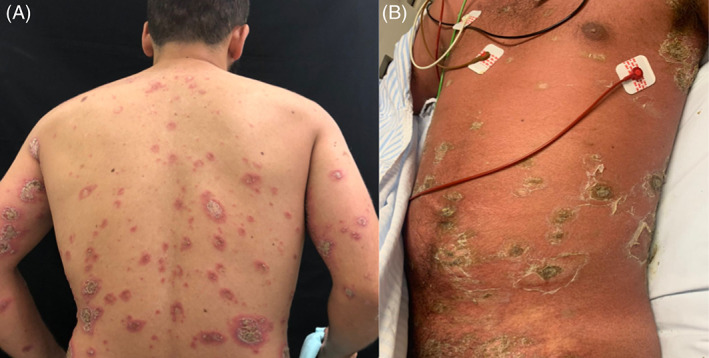
Generalized pustular psoriasis (A) and erythroderma (B). The latter was taken 3 days after the first picture
Considering this case, we question the possibility of an active COVID‐19 infection versus an mRNA vaccine as potential triggers of pustular psoriasis reactivation. Furthermore, an overlap between both factors is also plausible. Regarding COVID‐19 infection, several cutaneous manifestations have been described, but only few studies have suggested a correlation with pustular psoriasis. There are three reported cases of patients with psoriasis in remission, 1 , 2 , 3 and one case in a patient with no personal psoriasis history, but with a positive family record. 4 The development of lesions ranged from 14 to 40 days after the COVID‐19 infection. 1 , 2 , 3 , 4 A recent multicenter study involving 156 generalized pustular psoriasis patients reported COVID‐19 infection as a trigger in two subjects. 5 It has been suggested that toll‐like receptor activation by respiratory viral particles, like Rhinovirus, can initiate an inflammatory cascade with overproduction of several cytokines and chemokines, such as IL‐36 and CXCL8, which have been linked to psoriasis pathogenesis. 6 It is reasonable to suggest that SARS‐CoV‐2 could produce a similar effect.
In the literature, psoriasis reports following the administration of tetanus‐diphtheria and BCG mRNA vaccines are rare. 7 It is thought that these vaccines induce IL‐6 production, which stimulates Th1 and Th17 cells, triggering a cascade of cytokines involved in pustular psoriasis pathophysiology. 7 IL‐22, for example, activates epidermal Stat‐3, a signaling molecule which is essential for the psoriasis epidermal proliferation. 8 Pfizer® COVID‐19 vaccine, also mRNA‐based, could produce a similar mechanism.
In a 14‐case report of psoriasis exacerbation after COVID‐19 vaccination, the flares occurred ~10 days after the second vaccine dose and equally in both groups (mRNA vs. adenovirus vaccine). 9 In this article, three patients had been on biologic agents and, of those, only one had received the mRNA vaccine. However, none of the 14 cases showed a pustular psoriasis form. 9 In addition, the report suggested that systemic treatment of psoriasis conferred some protection against vaccine‐mediated flares, due to the fact that patients on topical treatment or no treatment at all were more susceptible to severe flare‐ups. 9 In contrast, a reply to the previous study described 11 cases of psoriasis exacerbation after COVID‐19 vaccination, in which 55% of the cases were under biologic treatment. 10 Conversely, an Italian report showed no worsening of psoriasis in three patients under biologic treatment after Pfizer® vaccination. 11 Regarding specifically pustular psoriasis, only one article reported this presentation 5 days after the first Pfizer® shot administered to a patient with a topically treated psoriasis. 7
The temporal relationship between pustular psoriasis flare and vaccination suggests a causal role in our report. However, the detection of an active COVID‐19 infection could propose another trigger or even overlap. In addition, it is still unclear whether biologic agents, such as etanercept, play a role in vaccine‐mediated exacerbation. The relevance of this report lies in highlighting the daily clinical challenges faced by dermatologists in a pandemic context. Psoriasis patients should be vaccinated against SARS‐CoV‐2 and be aware of any disease flare, contacting their healthcare provider immediately when necessary.
The patients in this manuscript have given written informed consent to publication of their case details, including images.
AUTHOR CONTRIBUTIONS
All authors were involved in the diagnosis and management of the patient and have been responsible for the clinical part of the manuscript. Rodrigo Oliveira Almeida and Thaísa Hanemann did literature review and drafted the manuscript. Fernanda Lagares Xavier Peres, Gabriela Fortes Escobar, and Renan Rangel Bonamigo were responsible for final editing of the manuscript. All authors have read and approved the final manuscript. Rodrigo Oliveira Almeida is the corresponding author.
CONFLICT OF INTEREST
The authors declare no conflicts of interest.
DATA AVAILABILITY STATEMENT
The data that support the findings of this study are available on request from the corresponding author. The data are not publicly available due to privacy or ethical restrictions.
REFERENCES
- 1. Dadras MS, Diab R, Ahadi M, Abdollahimajd F. Generalized pustular psoriasis following COVID‐19. Dermatol Ther. 2021;34(1):1‐3. [DOI] [PMC free article] [PubMed] [Google Scholar]
- 2. Miladi R, Janbakhsh A, Babazadeh A, et al. Pustular psoriasis flare‐up in a patient with COVID‐19. J Cosmet Dermatol. 2021;20(11):3364‐3368. [DOI] [PMC free article] [PubMed] [Google Scholar]
- 3. Shakoei S, Ghanadan A, Hamzelou S. Pustular psoriasis exacerbated by COVID‐19 in a patient with the history of psoriasis. Dermatol Ther. 2020;33(6):e14462. [DOI] [PMC free article] [PubMed] [Google Scholar]
- 4. Mathieu RJ, Cobb CBC, Telang GH, Firoz EF. New‐onset pustular psoriasis in the setting of severe acute respiratory syndrome coronavirus 2 infection causing coronavirus disease 2019. JAAD Case Rep. 2020;6(12):1360‐1362. [DOI] [PMC free article] [PubMed] [Google Scholar]
- 5. Polat AK, Alpsoy E, Kalkan G, et al. Sociodemographic, clinical, laboratory, treatment and prognostic characteristics of 156 generalized pustular psoriasis patients in Turkey: a multicentre case series. J Eur Acad Dermatol Venereol. 2022;36(8):1256‐1265. [DOI] [PubMed] [Google Scholar]
- 6. Sbidian E, Madrange M, Viguier M, et al. Respiratory virus infection triggers acute psoriasis flares across different clinical subtypes and genetic backgrounds. Br J Dermatol. 2019;181(6):1304‐1306. [DOI] [PMC free article] [PubMed] [Google Scholar]
- 7. Perna D, Jones J, Schadt CR. Acute generalized pustular psoriasis exacerbated by the COVID‐19 vaccine. JAAD Case Rep. 2021;17(10):1‐3. [DOI] [PMC free article] [PubMed] [Google Scholar]
- 8. Takayama K, Satoh T, Hayashi M, Yokozeki H. Psoriatic skin lesions induced by BCG vaccination. Acta Derm Venereol. 2008;88(6):621‐622. [DOI] [PubMed] [Google Scholar]
- 9. Sotiriou E, Tsentemeidou A, Bakirtzi K, Lallas A, Ioannides D, Vakirlis E. Psoriasis exacerbation after COVID‐19 vaccination: a report of 14 cases from a single Centre. J Eur Acad Dermatol Venereol. 2021;35(12):e857‐e859. [DOI] [PMC free article] [PubMed] [Google Scholar]
- 10. Megna M, Potestio L, Gallo L, Caiazzo G, Ruggiero A, Fabbrocini G. Reply to “psoriasis exacerbation after COVID‐19 vaccination: report of 14 cases from a single center” by Sotiriou E Fabbrocini G. J Eur Acad Dermatol Venereol. 2021;36:e11‐e13. [DOI] [PMC free article] [PubMed] [Google Scholar]
- 11. Damiani G, Allocco F, Malagoli P. COVID‐19 vaccination and patients with psoriasis under biologics: real‐life evidence on safety and effectiveness from Italian vaccinated healthcare workers. Clin Exp Dermatol. 2021;46(6):1106‐1108. [DOI] [PMC free article] [PubMed] [Google Scholar]
Associated Data
This section collects any data citations, data availability statements, or supplementary materials included in this article.
Data Availability Statement
The data that support the findings of this study are available on request from the corresponding author. The data are not publicly available due to privacy or ethical restrictions.