



Abstract
Objective
Mentalizing is the ability to interpret one's own and others' behavior as driven by intentional mental states. Epistemic trust (openness to interpersonally transmitted information) has been associated with mentalizing. Balanced mentalizing abilities allow people to cope with external and internal stressors. Studies show that social isolation imposed by the COVID‐19 pandemic was highly stressful for most people, especially for adolescents. Here we examine whether mentalizing and epistemic trust were protective factors in relation to emotional distress during the lockdown.
Method
A total of 131 nonclinical adolescents, aged between 12 and 18 years, were evaluated during the lockdown using the Reflective Functioning Questionnaire for Youth, Inventory of Parent and Peer Attachment, Perceived Stress Scale, and Difficulties in Emotion Regulation Scale.
Results
Results from network analysis showed that epistemic trust and mentalizing were negatively associated with perceived stress and emotion dysregulation. Epistemic trust in fathers was associated with level of perceived stress, and epistemic trust in mothers with emotion dysregulation.
Conclusion
These findings suggest that epistemic trust and the capacity to mentalize were low in adolescents during lockdown, and this was associated with high levels of stress. However, robust levels of epistemic trust and mentalizing may have acted as protective factors that buffered individuals from the risk of emotional dysregulation during the lockdown.
Keywords: adolescence, COVID‐19, epistemic trust, lockdown, mentalizing
1. INTRODUCTION
Mentalizing is the capacity to interpret interpersonal behavior in terms of mental states, such as needs, emotions, beliefs, goals, desires, motivations, and reasons (Bateman & Fonagy, 2016). Mentalizing is a multidimensional capacity that can be organized around four dimensions, with both poles of each dimension subserved by relatively discrete neural circuits. These four dimensions are (a) automatic versus controlled mentalizing, (b) mentalizing with regard to self and about others, (c) mentalizing based on external or internal features of self and others, and (d) cognitive versus affective mentalizing. As such, mentalizing has been described as an “umbrella concept” encompassing several aspects of social cognition, including empathy, mindfulness, theory of mind, psychological mindedness, alexithymia, and insightfulness (Luyten et al., 2020). Mentalizing involves several cognitive and affective skills, namely, emotional‐state understanding, attention, and effortful control, and the capacity to interpret subjective states and to think explicitly about states of mind. This complex and multidimensional process allows individuals to differentiate between inner and external reality, as well as to think about the mental and emotional sides of interpersonal events and people's behavior (Fonagy, Gergely et al., 2007).
The development of mentalizing skills is grounded in secure attachment bonds: in this context, parental mirroring allows children to pay attention to and understand their own experience, an essential the prerequisite for mentalizing (Fonagy & Bateman, 2007). Parental reflective functioning is critical in the development of mentalizing: the child's subjective experience is mirrored by the caregiver's contingent and marked affective feedback, allowing the child to develop second‐order representations of their own experiences (Fonagy & Allison, 2014a; Luyten et al., 2020). Thus, emotion regulation, mentalizing abilities, and attachment relationships are regarded as loosely coupled systems (Fonagy et al., 2017a; 2017b).
During adolescence, the role of these caregiving relationships profoundly alters (Santona et al., 2022). It is well established that one of the parents' functions during infancy is to support the child's ability to regulate their emotions (Santona et al., 2019). Although this function continues to be carried out by caregivers during adolescence, parents need also to support their children to explore the outside world (J. P. Allen & Tan, 2016). Thus, adolescents begin to regulate their emotions partially still counting on their parents' support, but also investing in relationships with peers (Venta et al., 2014) this allows adolescents to experience more relational exchanges and practice their ability to consider others' perspectives (Jewell et al., 2016). Moreover, findings also suggest that the gender of not only the adolescent, but also of the parent, influences the attachment relationship and consequently the ability for self‐ and affect regulation (Keizer et al., 2019). Few studies have investigated the differential influence of attachment to the mother and the father on emotion regulation (Bosmans et al., 2006; Doyle & Markiewicz, 2005; Murray et al., 2014). Although findings suggest that there is a specific association between attachment relationships to father or mother and adolescent emotion regulation (Gallarin & Alonso‐Arbiol, 2012; Wright, 2015), no study to our knowledge appears to have investigated the difference between the two types of influence. Thus, literature shows the relevance of attachment in adolescence in developing both emotion‐regulation abilities and mentalizing, but further research on these constructs, their impact, and how they interrelate in adolescence is needed.
Mentalizing promotes the development of a stable sense of self that permits the developing child to consolidate an understanding of motivations and feelings related to the self and to others and to increase social and interpersonal functioning. Furthermore, Fonagy et al. (2002) theorized that interaction with a reflective caregiver's mind helps infants to experience their own mind or self and, as such, exposure to mentalizing experiences supports the emergence of a sense of the self as an active mental agent. Finally, mentalizing capacity has been found to be associated with affect regulation and with the development of a coherent self‐narrative, while deficits in this capacity have been theorized to increase the risk of psychopathology (Bateman & Fonagy, 2013).
Mentalizing has been theoretically linked to resilience (Fonagy et al., 2017a, 2017b, 2019). It has been proposed that thinking about actions in terms of mental states enables people to manage both everyday problems (Fonagy & Bateman, 2016) and severe challenges in an adaptive way (Ensink et al., 2017; Taubner & Curth, 2013). Being able to mentalize effectively makes it possible for the individual to develop salutogenic social relationships that are a key component of resilient functioning (Fonagy et al., 2019).
While mentalizing is related to resilience in the face of stressors, the capacity to mentalize can be undermined by stress and arousal (Luyten & Fonagy, 2015; Luyten et al., 2012). Indeed, as stress and arousal increase, mentalizing ability decreases, and this is particularly the case when the attachment system is stimulated (Freda et al., 2016; Nolte et al., 2013). Thus, stress‐related conditions may negatively influence mentalizing processes: mentalizing may become inflexible and involve biased and nonreflective ideations about the self and others.
In relation to clinical applications, mentalizing is understood as a common goal and common factor in the mentalization‐based treatment (MBT) approach (Bateman et al., 2018). MBT, which was originally devised as a treatment for borderline personality disorder, has now been adapted for a range of different diagnoses (personality disorders, depression, psychosis, eating disorders; Bateman & Fonagy, 2019a; 2019b) and for working with children, adolescents, families, and couples (Bateman & Fonagy, 2019a; 2019b; Midgley et al., 2017; T. I. Rossouw & Fonagy, 2012). It has further been suggested that improving the capacity to mentalize may be a common factor in many effective forms of psychotherapy (J. G. Allen & Fonagy, 2014; J. G. Allen et al., 2008; Bateman et al., 2018; Goodman et al., 2016; Montgomery‐Graham, 2016).
Under the umbrella of mentalizing theory, growing interest has recently emerged in the concept of epistemic trust (see, e.g., Fonagy & Allison, 2014b; Kamphuis & Finn, 2019; Orme et al., 2019). Epistemic trust is defined as the ability to evaluate incoming information from the social world as accurate, reliable, and relevant (Fonagy & Allison, 2014b). The opening of epistemic trust allows the individual to assimilate information into existing knowledge domains (Fonagy et al., 2015; Sperber et al., 2010). Epistemic trust has been discussed in relation to epistemic vigilance, described by Sperber et al. (2010) as an adaptation that safeguards against misinformation. (Csibra and Gergely, 2009, 2011, Gergely, 2013) suggested that natural epistemic vigilance is overcome by communicative signals from an informant, known as ostensive cues. In human infants, ostensive cues such as turn‐taking, eye contact, and a special vocal tone (“motherese”), allow the communicator to signal to the addressee that the upcoming information can be considered relevant, trustworthy, and generalizable (Csibra & Gergely, 2009). Fonagy et al. (2015) also asserted that the ostension process can be activated through sensitive caregiving, and especially by marked mirroring interactions. These interactions involve the caregiver accurately representing the child's emotional experience in the moment in a regulated way and reflecting back to the child these representations of the child's state in a manageable, nonoverwhelming way. These social exchanges make the baby experience the feeling of being noticed as a self and recognized as an agent: this process reduces epistemic vigilance and opens the path to learning (Fonagy et al., 2015). The social communicative model describes how infants learn cultural knowledge, which includes understandings of how the individual can be in relationships with others (Fonagy & Allison, 2014b; Fonagy et al., 2015).
Recently, Luyten et al. (2020) theorized that complex trauma (i.e., trauma due to abuse and neglect perpetrated in a caregiving context; Asnes & Leventhal, 2011) may disrupt the development of the capacity for epistemic trust. Mentalizing theory suggests that the infant's sense of self is scaffolded by the parent's capacity to imagine the infant's mental state and then, critically, to reflect the infant's experience back to them in marked mirroring interactions. It has been suggested that when an infant in situational distress seeks proximity and reassurance but is met with an abusive or neglectful response, the experience is one in which the distress and dysregulation cannot be handled and processed (Fonagy et al., 2002). There is now an extensive body of evidence that shows that a parent's capacity to mentalize their infant is associated with secure attachment and supporting the development of their child's ability to mentalize (for a review, see Luyten et al., 2020). More recently, it has been argued that such unmirrored emotional experiences may, if experienced consistently, generate a hyperactivation of epistemic vigilance, potentially leading to a position of more entrenched epistemic mistrust (Fonagy et al., 2015; Luyten et al., 2020). In adolescence, attachment relationships appear to influence young people's level of trust towards others, including parents and peers (Gallarin & Alonso‐Arbiol, 2012). Consequently, disruptive experiences in attachment relationships during adolescence have been theorized to have a role in psychopathological outcomes and levels of epistemic trust (Bo et al., 2017).
Preliminary findings on the role of epistemic trust in developmental psychopathology are suggestive. For example, Campbell et al. (2021) highlighted the mediating role of epistemic mistrust (i.e., the rigid suspiciousness toward incoming knowledge) and epistemic credulity (i.e., the inability to discriminate between trustworthy and untrustworthy information) in the association between childhood adverse experiences and psychopathological outcomes. In addition, focusing on adolescent inpatients, Orme et al. (2019) found negative associations between epistemic trust and borderline traits. Thus, it is possible to hypothesize that both mentalizing capacity and epistemic trust play protective roles reducing the risk of developing psychopathology, but further evidence of these associations is needed. The purpose of this study is to investigate the relationship between mentalizing and stress, exploring how challenging circumstances interact with adolescent mentalizing capacity. We sought to explore (a) to what extent the capacity for mentalizing was undermined by exposure to a highly novel and difficult set of circumstances and (b) to what extent the retention of some capacity for balanced mentalizing constitutes a protective factor when faced with such pressures. The study used the natural experiment in stress presented by the rapid onset of the COVID‐19 pandemic and lockdowns in Italy in 2020. In addition, the study sought to investigate the possible relationship between mentalizing, epistemic trust, and emotional dysregulation when examining protective and vulnerability factors in adolescents.
2. METHOD
2.1. Participants
Data were collected with the collaboration of middle and high schools in Italy. Schools were randomly selected from a national list, and school boards were approached to request participation. If participation was agreed, principals and teachers informed parents and adolescents about the research, and individual participants were recruited on a voluntary basis. As data were collected during the very first period of the COVID‐19 Italian lockdown, recruitment was challenging as schools were responding to chaotic and rapidly changing circumstances. We recruited a total of 131 adolescents aged between 12 and 18 years old (M = 15.37, standard deviation = 1.85; 87 female; 114 Caucasian) from private and public schools in Italy. According to a sensitivity analysis performed by using the software GPower 3.1.94 (Faul et al., 2009), this sample size allows the detection, with 80% power, of a correlation as small as r = 0.23 in a two‐tailed test.
The inclusion criteria for this study were as follows: adolescents aged from 12 to 18; Italian native speakers; no intellectual disability or other neuropsychiatric pathologies. To exclude the presence of psychiatric disorders, potential participants' parents completed the Child Behavior Checklist 6–18 Version (CBCL; Achenbach & Edelbrock, 1991). Cut‐offs for discriminating the presence of clinical conditions were based on existing literature for CBCL thresholds (Biederman et al., 2020). Our sample did not include any adolescents who were in foster care or residential settings. Of the sample recruited, no participants were excluded.
The study protocol was approved by the Ethics Committee of the University of Milano‐Bicocca.
2.2. Measures
Reflective Functioning Questionnaire for Youth (RFQ‐Y) (Sharp et al., 2009). The RFQ‐Y consists of 46 items and uses a 6‐point Likert scale. A total of 15 items are scored from level 1 (strongly disagree) to level 6 (strongly agree); 8 items are reverse scored from level 6 (strongly disagree) to level 1 (strongly agree); 23 items are midpoint scored. Subscale A is obtained by calculating the mean of midpoint‐scored items, and subscale B is obtained by calculating the mean of straightforward items. An overall RFQ‐Y score was derived by summing the two scores for the two subscales, with high scores indicating a greater capacity for reflective function. The English questionnaire was translated into Italian by our team and then back translated. Cronbach's alpha for the scale was 0.88 (Ha et al., 2013), although Sharp et al. (2022) have suggested that the psychometric properties of this measure require further work and improvement. As reflective functioning is the operationalization of the mentalizing construct, from this point we will use reflective functioning as equivalent to mentalizing.
Inventory of Parent and Peer Attachment (IPPA; Armsden & Greenberg, 1987). The IPPA is a 75‐item self‐report measure developed to assess the perceived quality of attachment relationships with mother, father, and peers. Items are evaluated on a 5‐point Likert scale (1 = almost never or never true; 5 = almost always or always true) and the scale yields both a total score and three subscales: Communication, Alienation, and Trust. The 10 items of each trust scale measure various dimensions of general trust. Four items, “My mother understands me,” “When we discuss things, my mother cares about my point of view,” “When I am angry about something, my mother tries to be understanding,” and “My mother respects my feelings,” capture the anticipation of attuned, contingent, curious, and understanding communication. Three items, “My mother accepts me as I am,” “My mother trusts my judgment,” and “My mother expects too much from me,” (reverse scored) reflect an expectation of nonjudgment, mutuality, and fairness. The final three items, “I feel my mother does a good job as my mother,” “I wish I had a different mother,” (reverse scored) and “I trust my mother,” address a broader sense of parent reliability. The IPPA has good psychometric properties and the Italian validation of the instrument, performed by San Martini et al. (2009), has shown high internal consistency and construct validity. The IPPA trust subscale measures trust towards parents and peers within an attachment theory context. Although the IPPA trust construct is broader than conceptualizations of epistemic trust, Orme et al. (2019) used this subscale to approximate the measurement of epistemic trust, as up to now no measures has been developed for the assessment of epistemic trust in adolescence. Following this approach, we used the Trust subscale to provide as a proxy measure for epistemic trust.
Perceived Stress Scale (PSS; Cohen et al., 1983). The PSS‐10 is a self‐report instrument consisting of 10 items used to assess how uncontrollable and over‐loaded subjects find their lives. The scale is rated on a 5‐point Likert scale, ranging from 0 (never) to 4 (very often). The PSS‐10 consists of six positively (items 1, 2, 3, 6, 9, and 10; Positive factor) and four negatively (items 4, 5, 7, and 8; Negative factor) worded items. Negatively worded items were recoded during analysis. Total scores range from 0 to 40, with higher scores indicating higher levels of perceived stress.
Difficulties in Emotion Regulation Scale (DERS; Gratz & Roemer, 2004). The DERS is a 36‐item self‐report questionnaire that assesses clinically relevant difficulties in emotion regulation, with a particular emphasis on negative emotions. Items are scored on six scales, labeled Lack of Emotional Awareness (6 items), Lack of Emotional Clarity (5 items), Difficulties Controlling Impulsive Behaviors When Distressed (6 items), Difficulties Engaging in Goal‐Directed Behavior When Distressed (5 items), Nonacceptance of Negative Emotional Responses (6 items), and Limited Access to Effective Emotion Regulation Strategies (8 items). Items are scored on a 5‐point scale ranging from 1 (almost never) to 5 (almost always). Subscale scores are obtained by summing the corresponding items. A total score for emotional dysregulation was obtained by summing each subscale and was used in the analysis as a single variable.
2.3. Procedure
Data were collected online during the first lockdown in Italy between March 15 and April 30, 2020. Italy was one of the first Western countries to adopt restrictive measures against COVID‐19. During this period, a very stringent lockdown was imposed, with individuals largely unable to leave their homes. Specifically, government rules during the lockdown prohibited social gatherings, and people could leave their homes only for essential work or grocery shopping. Consequently, adolescents could not socialize in person with peers, and schooling was moved online: they were physically isolated from their friends and even their neighbors.
Parents were informed about the study's aims and procedures via virtual information meetings organized with their respective schools. No incentive or reward for participation was provided to the families. Parental written consent was required; if parents signaled their interest in participation, they were provided with a more detailed description of the study and asked to give informed consent via electronic acceptance of study materials. Young people also received information about the study aims and procedures. After providing consent, participants were directed to Qualtrics (www.qualtrics.com) to complete the survey. Tasks were administered through two different links. Parents could access the first link to complete the informed consent for data collection and the CBCL; adolescents could access the second link to complete the self‐report battery.
2.4. Data analysis
We used network analysis to test the association between Reflective Functioning, Trust in father, Trust in mother, and Trust in peers (IPPA), total score for PSS, and total score for DERS.
Network analysis operates by representing variables of interest (in our case, psychological constructs) as nodes within a network and then estimating the network's edges, that is, the connections between each node and the others. One of its main advantages lies in providing a parsimonious and clear representation of the complex associations underlying a set of variables. A common model in the estimation of psychological networks is the Gaussian graphical model (GGM), which is a regularized partial correlation network. In other words, the edges' connecting nodes in a GGM correspond to the partial correlations between pairs of variables, penalized by a regularization algorithm that selectively excludes the weaker edges (those likely to be the outcome of noise or measurement error). The result is a relatively sparse and conservative network that improves estimate reliability by reducing the total number of parameters to estimate and facilitates theoretical interpretation.
2.4.1. Network estimation
To control for age and gender differences in measures of reflective functioning, perceived stress, and emotional regulation, before estimating the GGM network we partialled out of all scores the effects of age and gender. To do so, each score was entered as the dependent variable in a linear regression model with age and gender as predictors. The unstandardized residuals of these regressions were then saved as age‐ and gender‐independent scores and transformed to meet the normality assumption (using the function huge.npn of the R package huge). The regularization algorithm used in this analysis is the graphical lasso (Friedman et al., 2008) and the specific regularization parameter was selected through the Extended Bayesian Information Criterion (EBIC; Chen & Chen, 2008; Foygel & Drton, 2010), using the default value of 0.50 for the EBIC hyperparameter.
2.4.2. Network accuracy
The accuracy of the edge weights was assessed by computing nonparametric bootstrapped confidence intervals (CIs) using the R function bootnet (Epskamp et al., 2018) and 2000 bootstrap samples. Importantly, these CIs should be interpreted in terms of their width and overlap, rather than being used to test whether an edge is significantly different from zero, as the regularization algorithm already excluded the smallest edges.
2.4.3. Node centrality and predictability
Besides the overall network configuration, network analysis also offers three measures of node centrality, or relevance within the network. These are the strength of its direct associations with other nodes, its closeness (a measure of indirect connections with other nodes), and its betweenness (the capacity to influence the associations) between other pairs of nodes. In this study, we investigated the three centrality indices and verified their stability through the Correlation‐Stability coefficient (CS‐coefficient), based on case‐dropping bootstrap techniques. The CS‐coefficient computes the proportion of cases that can be dropped before the correlations between centrality indices in the full sample and centrality indices in the smaller bootstrapped samples drop below 0.70 (probability level 95%). Cut‐off values of 0.25 and 0.50 have been suggested to indicate sufficient stability and good stability, respectively (Epskamp et al., 2018).
Finally, a node's predictability is the proportion of variance it shares with other nodes in the network; it can be interpreted as an R 2 and is useful in summarizing the role of a node within the network (Haslbeck & Waldorp, 2018).
2.4.4. Statistical packages
All analyses were performed in R version 4.1.2 (R Core Team, 2021). Network estimation was performed using the function estimateNetwork and accuracy and stability analysis were performed by the function bootnet' all from the package bootnet (Epskamp et al., 2018). Network visualization was obtained through the function qgraph and centrality and predictability estimate from the function centrality, all from the package qgraph (Epskamp et al., 2012).
3. RESULTS
Table 1 reports descriptive statistics and correlations for each of the variables considered in the network, plus age and gender.
Table 1.
Descriptive statistics of observed variables
| Descriptive statistics | Correlations | ||||||||||
|---|---|---|---|---|---|---|---|---|---|---|---|
| Mean | SD | Skewness | Kurtosis | 1 | 2 | 3 | 4 | 5 | 6 | 7 | |
| 1. Age | 15.37 | 1.85 | 0.05 | –1.05 | |||||||
| 2. Sex | 0.66 | 0.47 | –0.70 | –1.54 | 0.07 | ||||||
| 3. RF | 6.44 | 0.54 | –1.68 | 4.63 | 0.08 | 0.12 | |||||
| 4. ET Father | 43.27 | 8.67 | –0.87 | 0.15 | –0.06 | –0.01 | 0.18* | ||||
| 5. ET Mother | 46.08 | 7.46 | –1.23 | 1.65 | –0.18* | 0.00 | 0.12 | 0.41*** | |||
| 6. ET Peers | 42.92 | 6.04 | –1.08 | 0.93 | 0.16 | 0.00 | 0.23** | 0.40*** | 0.29*** | ||
| 7. Stress | 30.15 | 7.22 | 0.11 | –0.91 | 0.09 | 0.37*** | –0.17 | –0.30*** | –0.22* | –0.22* | |
| 8. Dysregulation | 82.50 | 22.45 | 0.41 | –0.81 | 0.07 | 0.23** | –0.29*** | –0.34*** | –0.39*** | –0.29*** | 0.64*** |
Note: Sex was coded 0 for males and 1 for females. Age and Sex were partialled out of all other variables before network estimation.
Abbreviations: ET, Epistemic Trust; RF, Reflective Functioning; SD, standard deviation.
p < 0.05;
p < 0.01;
p < 0.001.
The CIs for network edges are represented in Figure 1. CIs were rather broad and generally overlapping, warranting caution in interpreting the order of edge estimates. The results of the case‐dropping bootstrap indicated that only strength centrality was stable enough to warrant discussion (CS‐coefficient = 0.397), unlike node closeness and betweenness (CS‐coefficient = 0.153 and 0, respectively).
Figure 1.
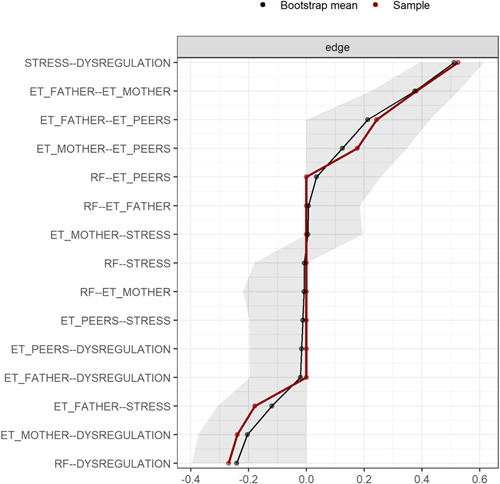
Confidence intervals for network edges. 95% confidence intervals built on 2000 nonparametric bootstrap samples. ET, Epistemic Trust, RF, Reflective Functioning.
The network is presented in Figure 2. The edges indicate regularized partial correlations, that is, the association between two nodes after controlling for all the other nodes in the network. Green solid lines correspond to positive associations, red dashed lines to negative associations. Visual inspection revealed that the three measures of epistemic trust are all positively associated with one another, as are measures of stress and emotional dysregulation. Furthermore, Epistemic Trust towards father is negatively associated with Perceived Stress, and both Epistemic Trust towards mother and Reflective Function are negatively associated with Emotional Dysregulation.
Figure 2.
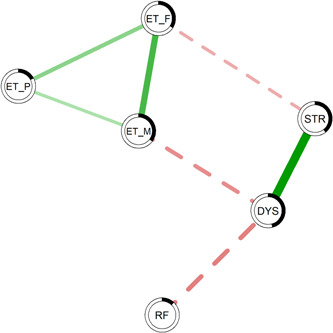
Network of Reflective Functioning, Epistemic Trust (in Mother, Father, and Peers), Perceived Stress, and Emotion Dysregulation Edges represent conditional associations between pairs of nodes. Dashed edges are negative associations. The pie chart around each node represents its predictability. Green solid lines correspond to positive associations, red dashed lines to negative associations. DYS, Emotion Dysregulation; ET_F, Epistemic Trust in Father; ET_M, Epistemic Trust in Mother; ET_P, Epistemic Trust in Peers; RF, Reflective Functioning; STR, Perceived Stress.
The estimates of node centrality are presented in Table 2 and Figure 3. Of note, there were only a few significant differences in terms of node strength: Reflective Function was significantly weaker than Emotional Dysregulation and Epistemic Trust towards mother and father, and Epistemic Trust towards peers was significantly weaker than Dysregulation, but the four strongest nodes did not differ significantly from each other.
Table 2.
Node centrality and predictability estimates
| Strength | Closeness | Betweenness | Predictability | |
|---|---|---|---|---|
| RF | 0.27 | 0.02 | 0 | 0.12 |
| ET father | 0.80 | 0.03 | 1 | 0.34 |
| ET mother | 0.80 | 0.04 | 4 | 0.35 |
| ET peers | 0.42 | 0.02 | 0 | 0.17 |
| Stress | 0.70 | 0.03 | 0 | 0.40 |
| Dysregulation | 1.03 | 0.04 | 5 | 0.46 |
Note: Network of Reflective Functioning (RF), Epistemic Trust (ET) in Mother, Father, and Peers, Perceived Stress (Stress) and Emotion Dysregulation (Dysregulation). Among centrality measures, only Strength was stable enough to warrant further analysis and discussion.
Figure 3.
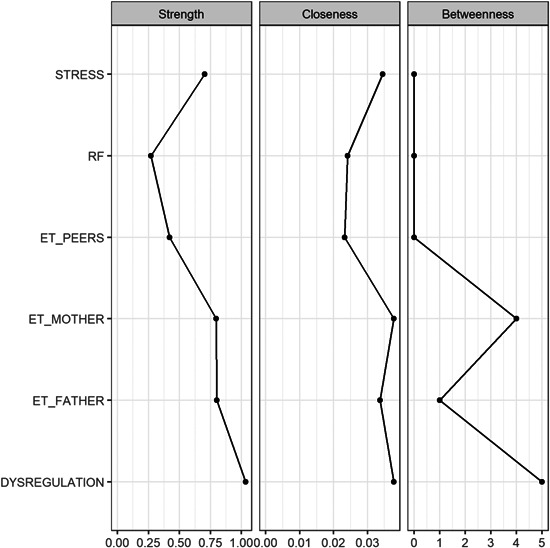
Node Centrality Plot Note: Network of Reflective Functioning (RF), Epistemic Trust (ET) in Mother, Father, and Peers, Perceived Stress (STRESS) and Emotion Dysregulation (DYSREGULATION).
Estimated node predictability is also displayed in Table 2. The nodes with the highest predictability were Emotional Dysregulation (R 2 = 0.46) and Stress (R 2 = 0.40), with 40% or more of their variance being explained by their neighboring nodes.
4. DISCUSSION
The present study aimed to investigate the interaction between mentalizing and epistemic trust in relation to stress perception and the risks associated with emotion dysregulation in adolescents under the stressful circumstances generated by the lockdown instituted in the face of the COVID‐19 pandemic. The lockdown obliged adolescents to stay at home for about 2 months. They attended school online and shared their everyday life with their parents and siblings; all other relationships were virtual. At the beginning of the COVID‐19 pandemic, these difficult circumstances were heightened by fear and anxiety in relation to an uncertain and unknown situation (Fiorillo et al., 2020). We now have clear evidence that the pandemic brought with it an increase in both internalizing and externalizing symptoms, with the frequency and severity of these symptoms being greatest among those with pre‐existing mental health conditions (Bera et al., 2022).
Mentalizing appears to have a unique significant relationship with emotion dysregulation. On the one hand, a robust and balanced capacity to mentalize protects the individual from dysregulating experiences; on the other hand, dysregulation, in particular dysregulating stimulation of the attachment systems, can undermine the capacity to mentalize (Marszał & Jańczak, 2018; Parada‐Fernández et al., 2021). Contrary to the theoretical and empirical literature, mentalizing and trust variables did not emerge as having a significant relationship. This is in contrast to Campbell et al. (2021) finding on the relationship between RFQ score and score on the recently developed Epistemic Trust, Mistrust and Credulity Questionnaire (ETMCQ), which found that higher levels of both Mistrust and Credulity were associated with poorer mentalizing. However, no significant relationship was found in that study between high Trust and mentalizing capacity, leading the authors to suggest that Mistrust and Credulity might be understood as vulnerability factors, rather than Trust being a resilience factor. It is possible that the current study reflects this nuance: the presence of Trust may be a “default mode” and therefore of neutral value, but higher levels of epistemic dysfunction in the form of Mistrust, Credulity, or a combination of both may be of more interest from a clinical perspective.
Epistemic trust, that is, trust towards mother, father, and peers, was found to be associated with other variables of the network. Namely, trust towards mother was negatively associated with dysregulation while not positively associated with mentalizing. Given that no significant relationship was found between mentalizing capacity and epistemic trust, mentalizing and epistemic trust seem to have two distinct and direct links with dysregulation. This finding may be key to considering and untangling the separate roles of mentalizing and epistemic trust in relation to emotion dysregulation—a factor that is consistently implicated in risk for psychopathology (Cole & Hall, 2008; Keenan, 2000). From these preliminary results it is thus possible to hypothesize that not only mentalizing but also epistemic dysfunction may have a specific, direct role in increasing the risk for psychopathology.
Trust towards father was found to have a negative and significant association with stress perception. Adolescents with high levels of trust towards father appear to have been more able to make use of this relationship, thus promoting resilience, during the pandemic. In Italian culture, fathers tend to be less physically available figures for children and adolescents than mothers: the lockdown radically changed this as all family members were required to remain at home (Mangiavacchi et al., 2021; Trumello et al., 2021). The increased continuous presence of the father in everyday life may explain why greater trust in father was found to be negatively associated with stress. An effect in the opposite direction, by which lower trust in fathers was associated with higher levels of stress, may have been particularly pertinent in lockdown conditions, generating increased vigilance, reduced perception of support, and increased stress. Our findings that trust towards mother and trust towards father served differentiated protective roles for adolescents (Keizer et al., 2019) builds on previous research on the distinct influence of the maternal and paternal relationships on emotion regulation (Bosmans et al., 2006; Doyle & Markiewicz, 2005; Gallarin & Alonso‐Arbiol, 2012; Murray et al., 2014; Wright, 2015). Trust in mother seems to specifically influence the capacity for emotion regulation, while trust in father seems to provide an upstream impact in decreasing the subjective effect of stress. Epistemic trust may be connected with resilience (Fonagy et al., 2017a) as epistemic mistrust has been proposed to undermine the resilience which promotes normal social functioning in the presence of stress. Given the robust extant literature showing an association between perceived distress and psychopathological outcomes, the link we found between trust towards father and distress may suggest how epistemic trust might be implicated in the risk of the development of psychopathology (Bernstein et al., 2011).
Trust towards peers was found to be associated with the other targets of epistemic trust: we did not find a specific effect for trust towards peers on emotion regulation or perceived stress. During adolescence, relational changes take place involving the gradual separation from parents and an increased focus on relationships with peers (T. Rossouw et al., 2021). However, during the phase of the pandemic that coincided with our study, young people were obliged to stay at home with their families. The resulting state of isolation from peers might have obstructed the process of increased relational investment in friends (T. Rossouw et al., 2021). In this context, primary attachment relationships may have emerged as the key determinants of epistemic trust, with the result that epistemic trust in parents may have had an unusually impactful influence (Buist et al., 2002).
Taken together, these findings indicate that under conditions of stress, adolescents' social understanding and social functioning can be supported both by access to secure attachment figures and by their own mentalizing capacity. Epistemic trust and mentalizing capacity each had critical roles in the challenging situation during the first lockdown, when adolescents needed to adapt to a new social situation (Bo et al., 2017): a social context at home with parents that was at odds with the developmental need to separate from the family of origin (Andrews et al., 2020; Blakemore, 2018; Brechwald & Prinstein, 2011). The associations observed led us to speculate on the specific roles that epistemic trust and mentalizing may play in regulatory processes that co‐occur in the development of risk for psychopathology. Previous findings (Campbell et al., 2021) and the current results lead us to think that if the individual is stuck in a hypervigilant state characterized by epistemic mistrust, they will not be able to adapt and acquire the relevant strategies to regulate their emotions, which can, in turn, generate psychopathological outcomes. From a therapeutic perspective, this could lead to the need for the therapist to focus on how to reduce a state of mistrust and suspiciousness and assist social processes that counteract epistemic rigidity and petrification (Fonagy et al., 2015). In response to the therapist's mentalizing stance, the patient may feel a sense of connection with the therapist and open up their mind to learning from their social context, that is, develop the belief that it is possible to acquire relational knowledge in therapy (Sharp & Fonagy, 2015).
This study may be considered innovative in its focus on epistemic trust, mentalizing, emotion dysregulation, and psychological distress, a field that requires more empirical data. Moreover, we investigated these dimensions in adolescence, a developmental phase that is of increasing clinical interest (Santona et al., 2019). Last, we explored the associations among the above‐mentioned variables in a very unusual period, namely the COVID‐19 pandemic, and more specifically the Italian lockdown.
The present study presents some limitations. The small sample size influenced the statistical power of our results, and meant that we could focus only on strength indices of the network analysis. The second limitation is represented by some of the measures used in the study. Perhaps the most important limitation is that the IPPA (Armsden & Greenberg, 1987) is a self‐report measure developed to assess attachment styles in adolescence and not specifically designed to measure epistemic trust. A previous study included the IPPA Trust subscale as a preliminary measure for the assessment of epistemic trust (Orme et al., 2019). Although the ETMCQ (Campbell et al., 2021) for the assessment of epistemic trust in adults has subsequently been developed, no such measure is yet available for adolescents. Moreover, data reported here were collected before the ETMCQ was published. Furthermore, the ETMCQ yields three variables (Trust, Mistrust, and Credulity), which enable the examination of quadratic effects that involve both excessively high and low epistemic trust as characterizing psychopathology, in line with epistemic trust theory (Campbell et al., 2021). The IPPA is not designed to be congruent with this theoretical perspective. These findings and discussion may be considered in light of this major limitation. Second, we here propose a perspective in which epistemic trust and mentalizing are linked to emotion dysregulation and stress and could predict psychopathological outcomes. Indeed, several contributions show sound evidence of the association between emotion dysregulation and psychopathology (Beauchaine, 2015; McLaughlin et al., 2011). However, the present study did not include a specific measure to assess psychopathological outcomes.
Nevertheless, these preliminary findings lay the groundwork for further exploration of the phenomenon of epistemic trust and its relationship to mentalizing and indices of psychological wellbeing. More research is needed to explore the relationship between mentalizing and epistemic trust. Indeed, epistemic trust was theorized as a prerequisite for mentalizing, but our findings suggest that epistemic trust may play its own distinct and differentiated role in relation to distress and dysregulation. The present research may also reveal different dynamics that may involve epistemic trust and mentalizing based on developmental age: it may be useful to compare the role of these variables in different phases of the life cycle.
5. CONCLUSION
The present study revealed the associations between epistemic trust, mentalizing, distress, and emotional dysregulation in adolescents during the first lockdown associated with the COVID‐19 pandemic. Our findings reveal that both epistemic trust and mentalizing had critical roles in supporting emotion regulation in these circumstances. More specifically, trust in mother may play a role in the capacity to improve self‐regulation processes, while trust in father may be associated with the level of stress perception. A separate protective factor is provided by the activation of the adolescent's own mentalizing skills, which help to buffer against emotion dysregulation.
CONFLICT OF INTEREST
The authors declare no conflict of interest.
PEER REVIEW
The peer review history for this article is available at https://publons.com/publon/10.1002/jclp.23453
ETHICS STATEMENT
The study was approved by the local ethical committee. Participants were treated in accordance with the ethical principles stated in the Declaration of Helsinki and given their written consent before the study participation.
ACKNOWLEDGMENTS
The present work received no specific grant from any funding agency in the public, commercial, or not‐for‐profit sectors. Open Access Funding provided by Universita degli Studi di Milano‐Bicocca within the CRUI‐CARE Agreement.
Locati, F. , Milesi, A. , Conte, F. , Campbell, C. , Fonagy, P. , Ensink, K. , & Parolin, L. (2022). Adolescence in lockdown: The protective role of mentalizing and epistemic trust. Journal of Clinical Psychology, 1–16. 10.1002/jclp.23453
Contributor Information
Alberto Milesi, Email: a.milesi6@campus.unimib.it.
Laura Parolin, Email: laura.parolin@unimib.it.
DATA AVAILABILITY STATEMENT
Data have not been shared on a repository, but they can be requested to the corresponding author.
REFERENCES
- Achenbach, T. M. , & Edelbrock, C. (1991). Child behavior checklist. Burlington (Vt), 7, 371–392. [Google Scholar]
- Allen, J. G. , Fonagy, P. , & Bateman, A. W. (2008). Mentalizing in clinical practice. American Psychiatric Pub. [Google Scholar]
- Allen, J. G. , & Fonagy, P. (2014). “Mentalizing in psychotherapy”. In American Psychiatric Publishing textbook of psychiatry . In Edited by Hales R. E., Yudofsky S. C. & Roberts L., 6th. American Psychiatric. [Google Scholar]
- Allen, J. P. , & Tan, J. S. (2016). The multiple facets of attachment in adolescence. In Cassidy J. & Shaver P. (Eds.), Handbook of Attachment (pp. 399–415). Guilford. [Google Scholar]
- Andrews, J. L. , Foulkes, L. , & Blakemore, S.‐J. (2020). Peer influence in adolescence: Public‐health implications for COVID‐19. Trends in Cognitive Sciences, 24(8), 585–587. [DOI] [PMC free article] [PubMed] [Google Scholar]
- Armsden, G. C. , & Greenberg, M. T. (1987). The inventory of parent and peer attachment: Individual differences and their relationship to psychological well‐being in adolescence. Journal of Youth and Adolescence, 16(5), 427–454. [DOI] [PubMed] [Google Scholar]
- Asnes, A. G. , & Leventhal, J. M. (2011). Connecting the dots in childhood and adolescent trauma. Archives of Pediatrics & Adolescent Medicine, 165(1), 87–89. [DOI] [PubMed] [Google Scholar]
- Bateman, A. , Campbell, C. , Luyten, P. , & Fonagy, P. (2018). A mentalization‐based approach to common factors in the treatment of borderline personality disorder. Current Opinion in Psychology, 21, 44–49. [DOI] [PubMed] [Google Scholar]
- Bateman, A. , & Fonagy, P. (2013). Mentalization‐based treatment. Psychoanalytic inquiry, 33(6), 595–613. [DOI] [PMC free article] [PubMed] [Google Scholar]
- Bateman, A. , & Fonagy, P. (2016). Mentalization‐based treatment for personality disorders: A practical guide. Oxford University Press. [Google Scholar]
- Bateman, A. , & Fonagy, P. (2019a). A randomized controlled trial of a mentalization‐based intervention (MBT‐FACTS) for families of people with borderline personality disorder. Personality Disorders: Theory, Research, and Treatment, 10(1), 70–79. [DOI] [PubMed] [Google Scholar]
- Bateman, A. , & Fonagy, P. (2019b). Handbook of mentalizing in mental health practice (2nd ed.). American Psychiatric Publishing. [Google Scholar]
- Beauchaine, T. P. (2015). Future directions in emotion dysregulation and youth psychopathology. journal of clinical child and adolescent psychology: The official journal for the society of clinical child and adolescent psychology. American Psychological Association, Division 53, 44(5), 875–896. [DOI] [PubMed] [Google Scholar]
- Bera, L. , Souchon, M. , Ladsous, A. , Colin, V. , & Lopez‐Castroman, J. (2022). Emotional and behavioral impact of the COVID‐19 epidemic in adolescents. Current Psychiatry Reports, 24, 37–46. 10.1007/s11920-022-01313-8 [DOI] [PMC free article] [PubMed] [Google Scholar]
- Bernstein, A. , Marshall, E. C. , & Zvolensky, M. J. (2011). Multi‐method evaluation of distress tolerance measures and construct (s): Concurrent relations to mood and anxiety psychopathology and quality of life. Journal of Experimental Psychopathology, 2(3), 386–399. [Google Scholar]
- Biederman, J. , DiSalvo, M. , Vaudreuil, C. , Wozniak, J. , Uchida, M. , Yvonne Woodworth, K. , Green, A. , & Faraone, S. V. (2020). Can the child behavior checklist (CBCL) help characterize the types of psychopathologic conditions driving child psychiatry referrals. Scandinavian Journal of Child and Adolescent Psychiatry and Psychology, 8(1), 157–165. 10.21307/sjcapp-2020-016 [DOI] [PMC free article] [PubMed] [Google Scholar]
- Blakemore, S.‐J. (2018). Avoiding social risk in adolescence. Current Directions in Psychological Science, 27(2), 116–122. [Google Scholar]
- Bo, S. , Sharp, C. , Fonagy, P. , & Kongerslev, M. (2017). Hypermentalizing, attachment, and epistemic trust in adolescent BPD: Clinical illustrations. Personality Disorders: Theory, Research, and Treatment, 8(2), 172–182. [DOI] [PubMed] [Google Scholar]
- Bosmans, G. , Braet, C. , Leeuwen, K. V. , & Beyers, W. (2006). Do parenting behaviors predict externalizing behavior in adolescence or is attachment the neglected 3rd factor? Journal of Youth and Adolescence, 35(3), 354–364. [Google Scholar]
- Brechwald, W. A. , & Prinstein, M. J. (2011). Beyond homophily: A decade of advances in understanding peer influence processes. Journal of Research on Adolescence, 21(1), 166–179. [DOI] [PMC free article] [PubMed] [Google Scholar]
- Buist, K. L. , Deković, M. , Meeus, W. , & Van Aken, M. A. G. (2002). Developmental patterns in adolescent attachment to mother, father and sibling. Journal of Youth and Adolescence, 31(3), 167–176. [Google Scholar]
- Campbell, C. , Tanzer, M. , Saunders, R. , Booker, T. , Allison, E. , Li, E. , O'Dowda, C. , Luyten, P. , & Fonagy, P. (2021). Development and validation of a self‐report measure of epistemic trust. PLoS One, 16(4), e0250264. [DOI] [PMC free article] [PubMed] [Google Scholar]
- Chen, J. , & Chen, Z. (2008). Extended Bayesian information criteria for model selection with large model spaces. Biometrika, 95(3), 759–771. [Google Scholar]
- Cohen, S. , Kamarck, T. , & Mermelstein, R. (1983). A global measure of perceived stress. Journal of Health and Social Behavior, 24, 385–396. [PubMed] [Google Scholar]
- Cole, P. M. , & Hall, S. E. (2008). Emotion dysregulation as a risk factor for psychopathology. In Beauchaine T. P., & Hinshaw S. P. (Eds.), Child and adolescent psychopathology (pp. 265–298). Wiley. [Google Scholar]
- Csibra, G. , & Gergely, G. (2009). Natural pedagogy. Trends in Cognitive Sciences, 13(4), 148–153. [DOI] [PubMed] [Google Scholar]
- Csibra, G. , & Gergely, G. (2011). Natural pedagogy as evolutionary adaptation. Philosophical Transactions of the Royal Society, B: Biological Sciences, 366(1567), 1149–1157. [DOI] [PMC free article] [PubMed] [Google Scholar]
- Doyle, A. B. , & Markiewicz, D. (2005). Parenting, marital conflict and adjustment from early‐to mid‐adolescence: Mediated by adolescent attachment style? Journal of Youth and Adolescence, 34(2), 97–110. [Google Scholar]
- Ensink, K. , Bégin, M. , Normandin, L. , Godbout, N. , & Fonagy, P. (2017). Mentalization and dissociation in the context of trauma: Implications for child psychopathology. Journal of Trauma & Dissociation: The Official Journal of the International Society for the Study of Dissociation (ISSD), 18(1), 11–30. [DOI] [PubMed] [Google Scholar]
- Epskamp, S. , Borsboom, D. , & Fried, E. I. (2018). Estimating psychological networks and their accuracy: A tutorial paper. Behavior Research Methods, 50(1), 195–212. 10.3758/s13428-017-0862-1 [DOI] [PMC free article] [PubMed] [Google Scholar]
- Epskamp, S. , Cramer, A. O. J. , Waldorp, L. J. , Schmittmann, V. D. , & Borsboom, D. (2012). qgraph: Network visualizations of relationships in psychometric data. Journal of Statistical Software, 48, 1–18. [Google Scholar]
- Faul, F. , Erdfelder, E. , Buchner, A. , & Lang, A. G. (2009). Statistical power analyses using G* Power 3.1: Tests for correlation and regression analyses. Behavior Research Methods, 41(4), 1149–1160. [DOI] [PubMed] [Google Scholar]
- Fiorillo, A. , Sampogna, G. , Giallonardo, V. , Del Vecchio, V. , Luciano, M. , Albert, U. , Carmassi, C. , Carrà, G. , Cirulli, F. , Dell'Osso, B. , Nanni, M. G. , Pompili, M. , Sani, G. , Tortorella, A. , & Volpe, U. (2020). Effects of the lockdown on the mental health of the general population during the COVID‐19 pandemic in Italy: Results from the COMET collaborative network. European Psychiatry, 63(1), e87. 10.1192/j.eurpsy.2020.89 [DOI] [PMC free article] [PubMed] [Google Scholar]
- Fonagy, P. , & Allison, E. (2014a). Mentalization‐based treatment. The Encyclopedia of Clinical Psychology, 1–3. [Google Scholar]
- Fonagy, P. , & Allison, E. (2014b). The role of mentalizing and epistemic trust in the therapeutic relationship. Psychotherapy, 51(3), 372. [DOI] [PubMed] [Google Scholar]
- Fonagy, P. , Allison, E. , & Campbell, C. (2019). Mentalizing, resilience, and epistemic trust, Handbook of mentalizing in mental health practice (pagg, 2nd ed., pp. 63–77). American Psychiatric Association Publishing. [Google Scholar]
- Fonagy, P. , & Bateman, A. W. (2007). Mentalizing and borderline personality disorder. Journal of Mental Health, 16(1), 83–101. [Google Scholar]
- Fonagy, P. , & Bateman, A. W. (2016). Adversity, attachment, and mentalizing. Comprehensive Psychiatry, 64, 59–66. [DOI] [PubMed] [Google Scholar]
- Fonagy, P. , Gergely, G. , Jurist, E. , & Target, M. (2002). Affect regulation, mentalization, and the development of the self. Other Press.
- Fonagy, P. , Gergely, G. , & Target, M. (2007). The parent–infant dyad and the construction of the subjective self. Journal of Child Psychology and Psychiatry, 48(3–4), 288–328. [DOI] [PubMed] [Google Scholar]
- Fonagy, P. , Luyten, P. , & Allison, E. (2015). Epistemic petrification and the restoration of epistemic trust: A new conceptualization of borderline personality disorder and its psychosocial treatment. Journal of Personality Disorders, 29(5), 575–609. [DOI] [PubMed] [Google Scholar]
- Fonagy, P. , Luyten, P. , Allison, E. , & Campbell, C. (2017a). What we have changed our minds about: Part 1. borderline personality disorder as a limitation of resilience. Borderline Personality Disorder and Emotion Dysregulation, 4, 11. 10.1186/s40479-017-0061-9 [DOI] [PMC free article] [PubMed] [Google Scholar]
- Fonagy, P. , Luyten, P. , Allison, E. , & Campbell, C. (2017b). What we have changed our minds about: Part 2. Borderline personality disorder, epistemic trust and the developmental significance of social communication. Borderline Personality Disorder and Emotion Dysregulation, 4, 9. 10.1186/s40479-017-0062-8 [DOI] [PMC free article] [PubMed] [Google Scholar]
- Foygel, R. , & Drton, M. (2010). Extended Bayesian information criteria for Gaussian graphical models. Advances in Neural Information Processing Systems, 23. [Google Scholar]
- Freda, M. F. , González‐Monteagudo, J. , & Esposito, G. (2016). Working with underachieving students in higher education: Fostering inclusion through narration and reflexivity. Routledge. [Google Scholar]
- Friedman, J. , Hastie, T. , & Tibshirani, R. (2008). Sparse inverse covariance estimation with the graphical lasso. Biostatistics, 9(3), 432–441. [DOI] [PMC free article] [PubMed] [Google Scholar]
- Gallarin, M. , & Alonso‐Arbiol, I. (2012). Parenting practices, parental attachment and aggressiveness in adolescence: A predictive model. Journal of Adolescence, 35(6), 1601–1610. [DOI] [PubMed] [Google Scholar]
- Gergely, G. (2013). Ostensive communication and cultural learning: The natural pedagogy hypothesis. In ed. Metcalfe J. & Terrace H. S., In Agency and Joint Attention (pp. 139–151). Oxford Univ. Press. [Google Scholar]
- Goodman, G. , Midgley, N. , & Schneider, C. (2016). Expert clinicians' prototypes of an ideal child treatment in psychodynamic and cognitive‐behavioral therapy: Is mentalization seen as a common process factor? Psychotherapy Research, 26(5), 590–601. [DOI] [PubMed] [Google Scholar]
- Gratz, K. L. , & Roemer, L. (2004). Multidimensional assessment of emotion regulation and dysregulation: Development, factor structure, and initial validation of the difficulties in emotion regulation scale. Journal of psychopathology and behavioral assessment, 26(1), 41–54. [Google Scholar]
- Ha, C. , Sharp, C. , Ensink, K. , Fonagy, P. , & Cirino, P. (2013). The measurement of reflective function in adolescents with and without borderline traits. Journal of Adolescence, 36(6), 1215–1223. [DOI] [PubMed] [Google Scholar]
- Haslbeck, J. M. B. , & Waldorp, L. J. (2018). How well do network models predict observations? On the importance of predictability in network models. Behavior Research Methods, 50(2), 853–861. [DOI] [PMC free article] [PubMed] [Google Scholar]
- Jewell, T. , Collyer, H. , Gardner, T. , Tchanturia, K. , Simic, M. , Fonagy, P. , & Eisler, I. (2016). Attachment and mentalization and their association with child and adolescent eating pathology: A systematic review. International Journal of Eating Disorders, 49(4), 354–373. [DOI] [PubMed] [Google Scholar]
- Kamphuis, J. H. , & Finn, S. E. (2019). Therapeutic assessment in personality disorders: Toward the restoration of epistemic trust. Journal of Personality Assessment, 101(6), 662–674. 10.1080/00223891.2018.1476360 [DOI] [PubMed] [Google Scholar]
- Keenan, K. (2000). Emotion dysregulation as a risk factor for child psychopathology. Clinical Psychology: Science and Practice, 7(4), 418–434. [Google Scholar]
- Keizer, R. , Helmerhorst, K. O. W. , & van Rijn‐van Gelderen, L. (2019). Perceived quality of the mother–adolescent and father–adolescent attachment relationship and adolescents' self‐esteem. Journal of Youth and Adolescence, 48(6), 1203–1217. [DOI] [PMC free article] [PubMed] [Google Scholar]
- Luyten, P. , Campbell, C. , Allison, E. , & Fonagy, P. (2020). The mentalizing approach to psychopathology: State of the art and future directions. Annual review of clinical psychology, 16, 297–325. [DOI] [PubMed] [Google Scholar]
- Luyten, P. , & Fonagy, P. (2015). The neurobiology of mentalizing. Personality Disorders: Theory, Research, and Treatment, 6(4), 366–379. [DOI] [PubMed] [Google Scholar]
- Luyten, P. , Van Houdenhove, B. , Lemma, A. , Target, M. , & Fonagy, P. (2012). A mentalization‐based approach to the understanding and treatment of functional somatic disorders. Psychoanalytic Psychotherapy, 26(2), 121–140. [Google Scholar]
- Mangiavacchi, L. , Piccoli, L. , & Pieroni, L. (2021). Fathers matter: Intrahousehold responsibilities and children's wellbeing during the COVID‐19 lockdown in Italy. Economics and human biology, 42, 101016. [DOI] [PMC free article] [PubMed] [Google Scholar]
- Marszał, M. , & Jańczak, A. (2018). Emotion dysregulation, mentalization and romantic attachment in the nonclinical adolescent female sample. Current Psychology, 37(4), 894–904. [DOI] [PMC free article] [PubMed] [Google Scholar]
- McLaughlin, K. A. , Hatzenbuehler, M. L. , Mennin, D. S. , & Nolen‐Hoeksema, S. (2011). Emotion dysregulation and adolescent psychopathology: A prospective study. Behaviour Research and Therapy, 49(9), 544–554. [DOI] [PMC free article] [PubMed] [Google Scholar]
- Midgley, N. , Ensink, K. , Lindqvist, K. , Malberg, N. , & Muller, N. (2017). Mentalization‐based treatment for children: A time‐limited approach. American Psychological Association. [Google Scholar]
- Montgomery‐Graham, S. (2016). DBT and schema therapy for borderline personality disorder: Mentalization as a common factor. Journal of Contemporary Psychotherapy, 46(1), 53–60. [Google Scholar]
- Murray, K. W. , Dwyer, K. M. , Rubin, K. H. , Knighton‐Wisor, S. , & Booth‐LaForce, C. (2014). Parent–child relationships, parental psychological control, and aggression: Maternal and paternal relationships. Journal of Youth and Adolescence, 43(8), 1361–1373. [DOI] [PMC free article] [PubMed] [Google Scholar]
- Nolte, T. , Bolling, D. Z. , Hudac, C. M. , Fonagy, P. , Mayes, L. , & Pelphrey, K. A. (2013). Brain mechanisms underlying the impact of attachment‐related stress on social cognition. Frontiers in Human Neuroscience, 7, 816. [DOI] [PMC free article] [PubMed] [Google Scholar]
- Orme, W. , Bowersox, L. , Vanwoerden, S. , Fonagy, P. , & Sharp, C. (2019). The relation between epistemic trust and borderline pathology in an adolescent inpatient sample. Borderline Personality Disorder and Emotion Dysregulation, 6, 13. 10.1186/s40479-019-0110-7 [DOI] [PMC free article] [PubMed] [Google Scholar]
- Parada‐Fernández, P. , Herrero‐Fernández, D. , Oliva‐Macías, M. , & Rohwer, H. (2021). Analysis of the mediating effect of mentalization on the relationship between attachment styles and emotion dysregulation. Scandinavian Journal of Psychology, 62(3), 312–320. [DOI] [PubMed] [Google Scholar]
- R Core Team (2021). R: A language and environment for statistical computing. R Foundation for Statistical Computing, Vienna, Austria. https://www.R-project.org/.
- Rossouw, T. , Wiwe, M. , & Vrouva, I. (2021). Mentalization‐Based Treatment for Adolescents: A Practical Treatment Guide. Routledge. [Google Scholar]
- Rossouw, T. I. , & Fonagy, P. (2012). Mentalization‐based treatment for self‐harm in adolescents: A randomized controlled trial. Journal of the American Academy of Child and Adolescent Psychiatry, 51(12), 1304–1313. [DOI] [PubMed] [Google Scholar]
- San Martini, P. , Zavattini, G. C. , & Ronconi, S. (2009). L'Inventario per l'Attaccamento ai Genitori ed ai Pari (IPPA‐Inventory of Parent and Peer Attachment). Un'indagine psicometrica su un campione italiano di adolescenti. Giornale italiano di Psicologia, 36(1), 199–228. [Google Scholar]
- Santona, A. , De Cesare, P. , Tognasso, G. , De Franceschi, M. , & Sciandra, A. (2019). The mediating role of romantic attachment in the relationship between attachment to parents and aggression. Frontiers in Psychology, 10, 1824. [DOI] [PMC free article] [PubMed] [Google Scholar]
- Santona, A. , Milesi, A. , Tognasso, G. , Gorla, L. , & Parolin, L. (2022). Anxiety in attachment and sexual relationships in adolescence: A moderated mediation model. International Journal of Environmental Research and Public Health, 19(7), 4181. [DOI] [PMC free article] [PubMed] [Google Scholar]
- Sharp, C. , & Fonagy, P. (2015). Practitioner review: Borderline personality disorder in adolescence–recent conceptualization, intervention, and implications for clinical practice. Journal of Child Psychology and Psychiatry, 56(12), 1266–1288. [DOI] [PubMed] [Google Scholar]
- Sharp, C. , Steinberg, L. , McLaren, V. , Weir, S. , Ha, C. , & Fonagy, P. (2022). Refinement of the reflective function questionnaire for youth (RFQY) scale B using item response theory. Assessment, 29(6), 1204–1215. 10.1177/10731911211003971 [DOI] [PubMed] [Google Scholar]
- Sharp, C. , Williams, L. L. , Ha, C. , Baumgardner, J. , Michonski, J. , Seals, R. , Patel, A. B. , Bleiberg, E. , & Fonagy, P. (2009). The development of a mentalization‐based outcomes and research protocol for an adolescent inpatient unit. Bulletin of the Menninger Clinic, 73(4), 311–338. [DOI] [PubMed] [Google Scholar]
- Sperber, D. , Clément, F. , Heintz, C. , Mascaro, O. , Mercier, H. , Origgi, G. , & Wilson, D. (2010). Epistemic vigilance. Mind & language, 25(4), 359–393. [Google Scholar]
- Taubner, S. , & Curth, C. (2013). Mentalization mediates the relation between early traumatic experiences and aggressive behavior in adolescence. Psihologija, 46(2), 177–192. [Google Scholar]
- Trumello, C. , Bramanti, S. M. , Lombardi, L. , Ricciardi, P. , Morelli, M. , Candelori, C. , Crudele, M. , Cattelino, E. , Baiocco, R. , Chirumbolo, A. , & Babore, A. (2021). COVID‐19 and home confinement: A study on fathers, father–child relationships and child adjustment. Child: Care, Health and Development, 1–7. [DOI] [PMC free article] [PubMed] [Google Scholar]
- Venta, A. , Shmueli‐Goetz, Y. , & Sharp, C. (2014). Assessing attachment in adolescence: A psychometric study of the child attachment interview. Psychological Assessment, 26(1), 238–255. [DOI] [PubMed] [Google Scholar]
- Wright, M. F. (2015). Cyber aggression within adolescents' romantic relationships: Linkages to parental and partner attachment. Journal of Youth and Adolescence, 44(1), 37–47. [DOI] [PubMed] [Google Scholar]
Associated Data
This section collects any data citations, data availability statements, or supplementary materials included in this article.
Data Availability Statement
Data have not been shared on a repository, but they can be requested to the corresponding author.