



Hierarchy, high‐end competitions, self‐sacrifice that start from medical school and continue throughout the entire medical career and traditional teaching methods have led the way for bullying in Medicine (Figure 1). However, in this particular case, the victims are not weak persons, but promising and skilful achievers. Academic recognition is difficult to obtain; therefore, some might opt for shortcuts such as mistreating their co‐workers. Even more so, indoctrinating doctors‐in‐training into an old and abusive teaching system was until recently ‘the hidden curriculum’ in medical education. 1 , 2 Raising awareness on this hot topic has been a constant and difficult fight within the last decade. ‘Imposter’ syndrome or impostorism is frequently encountered amongst medical students and fellows‐in‐training, representing the fear of asking questions or asking for help since it would imply being ‘incompetent’. Therefore, impostorism would be defined as self‐doubt about ones' abilities and accomplishments, insecurity and fears of being considered a fraud. The competitive medical world and the presence of ‘bullies’ feeds this psychological occurrence. 3 Using Internet, information and communication technologies for bullying purposes represents cyberbullying. Thus, the anonymity of the perpetrator using cyberbullying and the impossibility to remove or avoid cyberspace content makes it more damaging for victims. 4
FIGURE 1.
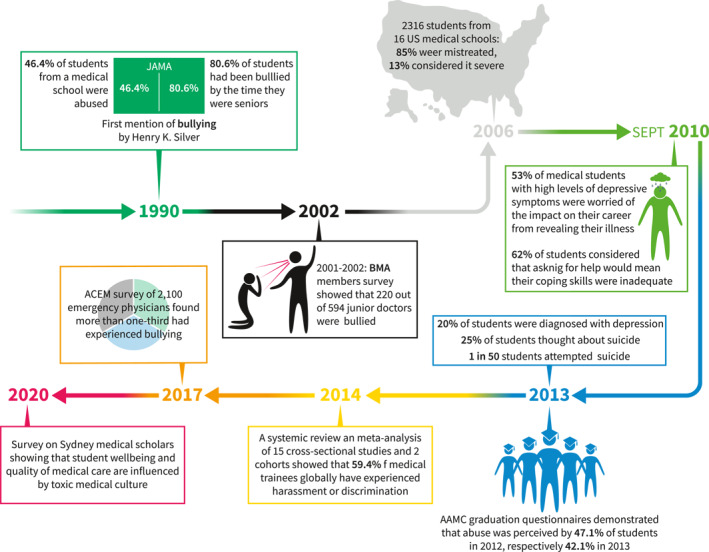
Timeline on reporting bullying in medicine. 1 , 2 , 3 AAMC, Association of American Medical Colleges; ACEM, Australian College for Emergency Medicine; BMA, British Medical Association; JAMA, Journal of the American Medical Association; US, United States.
HOW TO DEFINE CAREER BEASTS (BULLIES)?
Can we define bullying or is it different through each one's perspective? It can portray different forms starting from verbal abuse to perseverant inexplicable criticism, exaggerated sarcasm, persistent ignoring, isolating or belittling and public humiliation. Differentiating bullying from constructive criticism might sometimes be difficult, though necessary. 5
By inhibiting collegiality and cooperation, bullying in medicine will disrupt an entire team, affecting its ability to thrive and evolve (Figure 2). Studies have shown that abuse in a team can be harmful even for bystanders since they would be more likely to avoid the conflicts and take time off.
FIGURE 2.
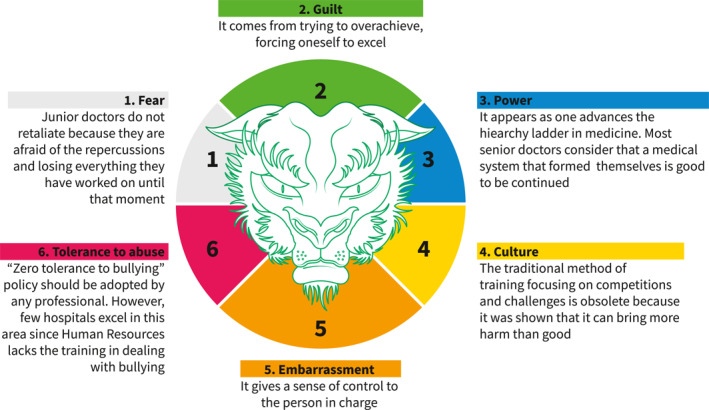
What fuels people to become bullies or career beasts in medicine? 5
Different names can be assigned: career beasts, bullies, perpetrators. However, all have something in common: taking advantage of their position to abuse, intimidate, dominate, coerce colleagues who, although not weak human beings, they as are passive and usually with low self‐esteem. Perpetrators have the intent to humiliate and harm others and steps should be taken within a community to prevent them from gaining power. Continuous feedback, complex debates and brainstorming, constant peer reviewing including performance reviews are three pillars that form a good work environment. Developing a culture of compassion, collegiality and constant support should be taught from the start of the medical career. Since bullying is a learnt behaviour, surrounding oneself with honest and positive people is a first step in preventing a toxic workplace. By developing a good work environment one can contribute even as a bystander to a better and more productive team. Some perpetrators were victims at one point and getting in a position of power gives them the opportunity to abuse colleagues who are lower in the hierarchy. Abusive behaviour cannot be a defence mechanism because it will not protect one from being bullied and will enhance negative attitudes in a working environment. Growing both professionally and personally is essential since insecurity or jealousy can create perpetrators. Aiming to be a better professional would only attract opportunities and taking the way to the top does not imply a rite of passage to bullying, but also contributing to an understanding, forgiving and stress‐free environment.
TEN STEPS ON HOW TO SAFELY CONFRONT CAREER BEASTS
Being a good doctor also means to keep on improving in different ways: be open to new ideas and experiments, stay curious, and communicate to other professionals who have already achieved success in an area of interest. Be enthusiastically sceptical and find better or more efficient ways to do tasks.
Learn from own results, good or bad. Failure is not a taboo subject, and many times it may help people advance. Becoming a master of self‐correction will be an asset in one's portfolio.
Learn to be a team member and a leader because it is better to be prepared if the opportunity presents itself. Studies show that successful climbers are socially warm and accessible. Building communities of expertise is essential because experts in a certain field can evolve faster as a group and many new opportunities might arise afterwards.
Acknowledge personal value and value as a doctor by building confidence and knowledge. Stay relevant by sharing your expertise and bear in mind that being updated might help in nurturing innovation and increasing creativity
Be prepared to reinvent yourself, create new paradigms and take risks. Do not be afraid to change your field of interest.
Be a listener and respect the workplace team. Open talks and brainstorming is not always about having the same opinion. Diversity and difference of opinion are a part of any functional team. Moreover, having more viewpoints would in return help you gain more perspective.
Respect your path and how you got there. One's evolution is paved with effort, dedication and influence by mentors. Appreciating mentoring and paying it forward is the only way a medical system can evolve.
Have an entrepreneurial mind‐set by attracting opportunities and landing them.
Be vocal about your needs and speak out for yourself. Do not be afraid or ashamed to avoid misdemeanours and harassment but find a safe channel to present your complaint and ask for conclusions. One should not fear retribution in their field of work. Learning how to solve conflict should be part of the medical curriculum but also part of a person's education.
Do not let medicine ‘consume’ your identity. Find time to evolve both personally and professionally. This will help you be more efficient without feeling a burden and without risking burn‐out. 3
FIGURING OUT A TOXIC WORK ENVIRONMENT
When the work, the people, and the environment cause difficulties in life, a workplace is referred to as toxic. These disruptions can adversely affect physical health, resulting in sleepless nights, constant vigilant feel, sweaty palms, and a racing heart. When personal battles harm one's productivity, workplace toxicity is identified. There are multiple indicators and alarming signs that help identify such environment as early as possible.
Chronic Stress
If one starts to feel continuously stressed and wakes up in the morning forcing him/herself to go to work, this is one of the earliest signs.
You're‐Overworked
Usually, when employees work in a hostile workplace, they are often overloaded with job responsibilities and no proper work life balance.
Being Bullied
In general, bullying is one of the commonest reflection of a toxic work environment. However, in medical field, there are some specific areas where bullying appears as discrimination. Many reports exist regarding females in surgical specialities being judged and bullied for maternity leaves and not offered equality in leadership. In addition, they are being questioned for their competencies and doubting their potentials. Immigrant doctors in many countries experience overwhelming tension during speciality training and battle for equal chances for proper training. 6 Reports point toward men in academic medicine as promoters of bullying and hostile environments. 7 , 8
Office Gossips (SNITCH)
If such kind of conversation is often heard at the workplace, then this is a sign of toxic culture. Gossips mean lack of clarity and this will ensure future trust problem and will pave the way for problematic intermediary to dominate and play the favouritism game.
Rapid employee turn over
If the place you are going to work can't retain competent employees, this is clearly a red flag.
Being unappreciated or underestimated
Appreciation is one of the core values of healthy work environment. If it is not there, this will lead to overworking, pushing people toward poor work life balance to please their employer.
Favouritism
Equality is one of the pillars of healthy work environment. If certain group gets all the credit and the praise, this is an early indicator of toxic work environment.
Poor communication
Communication is important to maintain clarity and avoid gossips and trust issues. Poor communication with peers and seniors usually indicates that no one in the workplace cares about the work environment or colleagues. This will lead to gossips and pave the way for career beasts to manipulate junior colleagues.
Manipulation and blame games
Healthy work culture is clearly shown during problem solving. If the manager or lead person starts to focus on blaming employees instead of providing solutions and adopting name and shame style, this is a hostile environment.
Continuous fights and arguments
This is the last sign and point of no return where it is clearly proven that this work culture is toxic and will not lead to any progress neither for the person involved nor the place itself.
CONFLICT OF INTEREST
The authors have no conflicts of interest to declare.
ACKNOWLEDGEMENTS
This article is based on a live session with the same title organized by the UEG Equality and Diversity Taskforce (EDTF) and presented during UEG Week 2021. The article is dedicated to the dear memory of Radislav Nakov, UEG EDTF and Young Talent Group member who had the original idea for the session and was instrumental in designing it. 9
Vlăduț C, Elshaarawy O, Tiniakos D. Career beasts and how to cope with them: From toxic workplace culture to healthy competition. United European Gastroenterol J. 2023;11(1):134–7. 10.1002/ueg2.12341
DATA AVAILABILITY STATEMENT
Data sharing is not applicable to this article as no new data were created or analysed in this study.
REFERENCES
- 1. Mentor V. To bully and be bullied: harassment and mistreatment in medical education. Am Med Assoc J Ethics. 2014;16(3):155–60. 10.1001/virtualmentor.2014.16.3.fred1-1403 [DOI] [PubMed] [Google Scholar]
- 2. Baerstein A, Fryer‐Edwards K. Promoting reflection on professionalism: a comparison trial of educational interventions for medical students. Acad Med. 2003;78(7):742–7. PMID: 12857697. 10.1097/00001888-200307000-00018 [DOI] [PubMed] [Google Scholar]
- 3. Colenbrander L, Causer L, Haire B. “If you can't make it, you're not tough enough to do medicine”: a qualitative study of Sydney‐based medical students' experiences of bullying and harassment in clinical settings. BMC Med Educ. 2020;20(1):86. PMID: 32209074; PMCID: PMC7092452. 10.1186/s12909-020-02001-y [DOI] [PMC free article] [PubMed] [Google Scholar]
- 4. Slonje R, Smith PK, Frisen A. The nature of cyberbullying and strategies for prevention. Comput Hum Behav. 2013;29(1):29–32. 10.1016/j.chb.2012.05.024 [DOI] [Google Scholar]
- 5. Adhikari B. Bullying in medicine: a cultural conundrum. linkdin.com. [Online]. 2020 [Cited 2022 Sep 19]. https://www.linkedin.com/pulse/bullying‐medicine‐cultural‐conundrum‐dr‐biplav‐adhikari/
- 6. Camm CF, Joshi A, Moore A, Sinclair HC, Westwood M, Greenwood JP, et al. Bullying in UK cardiology: a systemic problem requiring systemic solutions. Heart. 2022;108(3):212–18. PMID: 34872975. 10.1136/heartjnl-2021-319882 [DOI] [PubMed] [Google Scholar]
- 7. Averbuch T, Eliya Y, Van Spall HGC. Systematic review of academic bullying in medical settings: dynamics and consequences, BMJ Open. 2021;11(7):e043256. PMID: 34253657; PMCID: PMC8311313. 10.1136/bmjopen-2020-043256 [DOI] [PMC free article] [PubMed] [Google Scholar]
- 8. Vogel L. Culture of bullying in medicine starts at the top. Can Med Assoc J. 2018;190(49):E1459–60. 10.1503/cmaj.1095690 [DOI] [PMC free article] [PubMed] [Google Scholar]
- 9. Ianiro G, Heinrich H. Kindhearted, determined firecracker: a tribute to Radislav Nakov. United Eur Gastroenterol J. 2021;9(10):1189–90. PMID: 34850598 PMCID: PMC8672082. 10.1002/ueg2.12180 [DOI] [Google Scholar]
Associated Data
This section collects any data citations, data availability statements, or supplementary materials included in this article.
Data Availability Statement
Data sharing is not applicable to this article as no new data were created or analysed in this study.