



Abstract
Tonsillectomy is an age old surgery especially in pediatric population. Over the last few years, various techniques have been proposed in performing tonsillectomy in an attempt to lower the morbidity and mortality. This study compares the post-operative pain scale of cold dissection method and newer methods like coblation, radiofrequency and bipolar cautery assisted tonsillectomy. In our prospective study, we selected 30 patients and randomly divided them into three groups. We had performed right side tonsillectomy in each divided group of ten with coblation, radiofrequency and bipolar cautery assisted and on left side tonsillectomy dissection and snare method to all subjects. We compared post-operative pain scale on the right and left side in next consecutive 3 post-operative days by using VAS of Wong–Baker. Of these 30 patients mean age is 10 ± 3 years and there is no significant sex distribution. In group 1 right side bipolar cautery (hot) method, pain scale was on 3 consecutive post-operative days (6.1 ± 1.5), (6.0 ± 1.5), (5.2 ± 0.9) when compared to left side cold method (p value 0.06). In group 2 right side coblation (hot) method, post-operative pain scale was (2.9 ± 1.6), (2.4 ± 1.6), (1.2 ± 1.4) which when compared to left side cold method showed that pain was significantly reduced (p value 0.03). In group 3 right side radiofrequency (hot) method post-operative pain scale was (4.6 ± 1.0), (2.5 ± 1.2), (1.5 ± 1.4) when compared to left side cold method pain (p value 0.08). This study revealed that coblation assisted hot tonsillectomy has less pain when compared to other techniques with normal cold method. It also has early recovery.
Keywords: Coblation, Radiofrequency, Bipolar cautery, Tonsillectomy, Wong–Baker pain scale, Cold dissection, Dissection and snare method, Tonsillectomy pain, Hot dissection
Introduction
Tonsillectomy is a commonly performed procedure in pediatric population with recorded morbidity and mortality. The post-operative pain is the most common complaint in tonsillectomy patients which makes the recovery process slow in terms of time [1, 2]. An ideal tonsillectomy should be a painless surgery and allow a more early return to normal diet and daily activity. But there is still a controversy over ‘which is the optimal technique of tonsillectomy with the lowest morbidity rate?’ Over the years it has been proven that cold steel dissection and ties have a significantly lower post-operative bleed rate and less post-operative pain than any other method. Advent of newer technologies and techniques for tonsillectomy have been reduced complication and post-operative stay. A minimally invasive, low thermal technique for effective dissection and precise removal of tissue, coblation technology has been suggested as the method for less post-operative pain than conventional dissection method. [3, 4] While most radiofrequency based on surgical products such as laser and electrosurgical devices use imprecise heat driven process to remove or cut tissue, coblation plasma technology creates a controlled, stable plasma field to precisely remove tissue at a low relative temperature; resulting in minimal thermal damage to surrounding tissue. Some studies have shown that morbidity was less with cold steel method [5].
Electro coagulated diathermy has established an advantage over the ligature technique in reducing intra operative blood loss and in the rise of primary hemorrhage. There have been conflicting reports of increasing pain in post-operative period [6]. Low energy bipolar cautery techniques of 25 W has been used to reduce heat trauma to the tonsillar bed and consequently reduce the post-operative pain.
More recently temperature-controlled radiofrequency has been introduced as a much more effective and safe device for tonsillectomy. This technique generates a plasma field at the probe’s surface, which cause the tissue ablation at relatively low temperature (40–70 °C). This plasma field consisting of highly ionized particles breaks down the molecular bonds of local tissue considerably reducing the heat dissipation to surrounding structure, as opposed to coagulation by diathermic methods, which generates temperatures greater than 500 °C. In addition, the radiofrequency generator can also be used for bipolar coagulation to achieve hemostasis [7].
Methods
A prospective comparative single blinded study was performed in the department of Otorhinolaryngology at Government Stanley medical college, Chennai, India, from January 2018 to December 2018. Informed consent was obtained from the subjects’ parents and the study was approved by the institution’s ethics committee. This study included 30 patients within the age of 5–12 years. The patients were divided into 3 groups and each group consists of 10 subjects. The patients with signs and symptoms of upper airway obstruction due to tonsillar hypertrophy were included. Patients with bleeding disorder, acute tonsillitis, neuropsychiatric disorders and patient on long-term analgesics were excluded. On the day of admission, the patients underwent complete physical, ENT examination and all the basic investigation and coagulation profile were taken. All surgical procedure were performed by a single surgeon and observation documented by a single resident.
In group 1 right side tonsillectomy was performed by bipolar cautery method while left side by dissection snare method. In group 2 right side tonsillectomy was performed by coblation assisted method while left side by dissection snare method. In group 3 right side tonsillectomy was performed by radiofrequency assisted method while left side by dissection snare method.
The subjects were administered the Wong–Baker’s scale to assess the post-operative pain on days—on the day of surgery, days 1,2 and 3 in post-operative period. Documentation was done by a single resident to avoid inter-observer bias. The right side pain relief was observed in reference to cold steel dissection on the left side of the same subject.
Results
We studied 30 patients who were divided equally in 3 groups and the age distribution of these 3 groups were between 5 and 12 years (mean age 8 years).
Figure 1:
Fig. 1.

Age distribution
There was no significant difference in the sex distribution.
Figure 2:
Fig. 2.
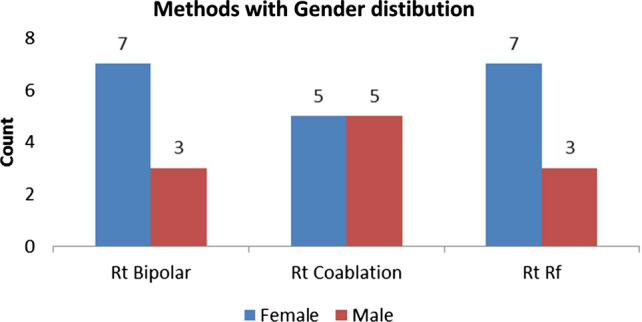
Gender distribution
In the three groups of the patients who had been operated by using three techniques, the post-operative pain scale was assessed by Wong–Baker FACE pain scale and statistically analyzed by Wilcoxon signed rank test.
In group 1 right sided bipolar cautery pain scale on three post-operative consecutive days were (6.1 ± 1.5), (6.0 ± 1.5), (5.2 ± 0.9) which was compared to the left sided conventional method pain scale on all three post-operative consecutive days (5.7 ± 1.2), (3.5 ± 2.2), (2.7 ± 2.1). With this observation bipolar method was found to have more post-operative pain than the conventional method (Table 1).
Table 1.
Comparison between right side bipolar and left cold conventional method
| Mean | N | S.D | Z-value | p value | ||
|---|---|---|---|---|---|---|
| Pair 1 | Right day 1 | 6.1 | 10 | 1.5 | 0.7840 | 0.433# |
| Left day 1 | 5.7 | 10 | 1.2 | |||
| Pair 2 | Right day 2 | 6.0 | 10 | 1.5 | 1.8560 | 0.063# |
| Left day 2 | 3.5 | 10 | 2.2 | |||
| Pair 3 | Right day 3 | 5.2 | 10 | 0.9 | 2.3750 | 0.018* |
| Left day 3 | 2.7 | 10 | 2.1 | |||
#No sig and *Sig at p < 0.05 level
In group 2 right sided coblation method pain scale on three post-operative consecutive days were (2.9 ± 2.0), (2.4 ± 1.6), (1.2 ± 1.4) which was compared to the left sided conventional method pain scale on all three post-operative consecutive days (6.0 ± 2.8), (4.2 ± 1.8), (2.8 ± 1.9). The observation was that coblation method had good post-operative pain relief than the conventional method with a significant p value of -0.033 (Table 2).
Table 2.
Comparison between right coblator and left cold conventional method
| Mean | N | S.D | Z-value | p value | ||
|---|---|---|---|---|---|---|
| Pair 1 | Right day 1 | 2.9 | 10 | 2.0 | 2.4700 | 0.013* |
| Left day 1 | 6.0 | 10 | 2.8 | |||
| Pair 2 | Right day 2 | 2.4 | 10 | 1.6 | 1.5280 | 0.103# |
| Left day 2 | 4.2 | 10 | 1.8 | |||
| Pair 3 | Right day 3 | 1.2 | 10 | 1.4 | 2.1260 | 0.033* |
| Left day 3 | 2.8 | 10 | 1.9 | |||
#No sig and *Sig at p < 0.05 level
In group 3 right sided radiofrequency method pain scale on three post-operative consecutive days were (4.6 ± 1.0), (2.5 ± 1.2), (1.5 ± 1.4) which was compared to the left sided conventional method pain scale on all three post-operative consecutive days (5.0 ± 0.9), (3.4 ± 1.2), (2.6 ± 1.1). Observation was that radiofrequency method has not significantly reduced the post-operative pain than the conventional method (Table 3).
Table 3.
Comparison between right radiofrequency and left cold conventional method
| Mean | N | S.D | Z-value | p value | ||
|---|---|---|---|---|---|---|
| Pair 1 | Right day 1 | 4.6 | 10 | 1.0 | 1.4140 | 0.157# |
| Left day 1 | 5.0 | 10 | 0.9 | |||
| Pair 2 | Right day 2 | 2.5 | 10 | 1.2 | 1.7320 | 0.083# |
| Left day 2 | 3.4 | 10 | 1.2 | |||
| Pair 3 | Right day 3 | 1.5 | 10 | 1.4 | 2.1260 | 0.066# |
| Left day 3 | 2.6 | 10 | 1.1 | |||
#No sig. at p < 0.05 level
Of these three techniques coblation technique had significant post-operative pain control compared to the conventional method. But bipolar and radiofrequency methods had poor post-operative pain control compared to conventional method.
Discussion
Tonsillectomy is the commonest surgical procedure in the pediatric till now; post tonsillectomy pain often affects the family life for more than a week. New tonsillectomy techniques have been emerged to reduce the intra-operative and post-operative complications. There is also likelihood that reduced the pain and more rapid intake of food would reduce the chance of dehydration and secondary infections [8].
In our study, post-operative pain of all three techniques were compared with conventional method with help of Wong–Baker pain scale. Patients who underwent coblation assisted tonsillectomy were observed to have significantly lower postoperative pain (p < 0.05).
Politest et al. measured the postoperative pain into 19 patients on age between 16 and 14 years and have found that postoperative pain on the first day was 3 points lower by using coblation method. On the 2nd and 3rd day the pain was also significantly lower. They measured the pain using visual analogue scale [4].
Noordzji et al. measured postoperative sense of pain into 48 adult patients who were treated with coblation II system Arthrocare Evac70 wand (Smith and Nephew) and monopolar electrocautry. In this study they also found a significant lower pain in the coblation method comparing with the other group [9].
Mohammadreza et al. conducted a double-blind randomized case control study in the period of 2007–2008 with coblator II system Arthrocare and conventional method. They have found statistically significant difference regarding the postoperative pain (p value < 0.01) [10].
Conclusion
This study revealed that the coblation assisted hot tonsillectomy method has better pain relief when compared to conventional cold method. The coblation method has less tissue trauma specifically of the muscles, so recovery is faster than other methods. The other hot methods like radiofrequency and bipolar assisted tonsillectomy method have less pain relief when compared to conventional cold method. Here only three hot methods were compared to cold method. Limitations exist for the need to do further comparative study about various hot methods and to reduce the post-operative morbidity and mortality in terms of equipment availability and adequate sample size with consent.
Funding
Nil.
Compliance with Ethical Standards
Conflict of interest
The authors declare that they have no conflict of interest.
Ethical Approval
Obtained.
Footnotes
Publisher's Note
Springer Nature remains neutral with regard to jurisdictional claims in published maps and institutional affiliations.
References
- 1.Blakley BW, Magit AE. The role of tonsillectomy in reducing recurrent pharyngitis: a systemic review. Otolaryngol Head Neck Surg. 2009;140:291–297. doi: 10.1016/j.otohns.2008.12.013. [DOI] [PubMed] [Google Scholar]
- 2.Burton MJ, Doree C. Coblation verses other surgical techniques for tonsillectomy. Cochrane Database Syst Rev. 2007;18(3):CD004619. doi: 10.1002/14651858.CD004619.pub2. [DOI] [PubMed] [Google Scholar]
- 3.Johnson LB, Elluru RG, Mauer CM., III Complication of adenotosillectomy. Laryngoscope. 2002;112:35–37. doi: 10.1002/lary.5541121413. [DOI] [PubMed] [Google Scholar]
- 4.Polites N, Joniau S, Wabnitz D, Fassina R, Smythe C, Varley P, Carey AS. Postoperative pain following coblation tonsillectomy: randomized clinical trial. ANZ J Surg. 2006;76(4):226–229. doi: 10.1111/j.1445-2197.2006.03700.x. [DOI] [PubMed] [Google Scholar]
- 5.Philpott CM, Wild DC, Mehta D, Banerjee AR. A double blinded randomized controlled trail of coblation versus conventional dissection tonsillectomy on post-operative symptoms. Clin Otolaryngol. 2005;30:143–148. doi: 10.1111/j.1365-2273.2004.00953.x. [DOI] [PubMed] [Google Scholar]
- 6.Mann DG, St George C, Schaefer E, Granoff D, Imper P, Mlynarczyk FA. Tonsillectomy some like it hot. Laryngoscope. 1984;94:677–679. doi: 10.1288/00005537-198405000-00019. [DOI] [PubMed] [Google Scholar]
- 7.Friedman M, LoSavio P, Ibrahim H, Ramakrishnan V. Radiofrequency tonsil reduction: safety, morbidity, and efficacy. Laryngoscope. 2003;113(5):882–887. doi: 10.1097/00005537-200305000-00020. [DOI] [PubMed] [Google Scholar]
- 8.Bolmgren K, Qvarnberg YH, Valtonen HJ. A prospective study on pros and cons of electro dissection tonsillectomy. Laryngoscope. 2001;111:478–482. doi: 10.1097/00005537-200103000-00018. [DOI] [PubMed] [Google Scholar]
- 9.Noordzij JP, Affleck BD. Coblation versus unipolar electrocautry tonsillectomy: a prospective, randomized, single blind study in adult patients. Laryngoscope. 2006;116(8):1303–1309. doi: 10.1097/01.mlg.0000225944.00189.e9. [DOI] [PubMed] [Google Scholar]
- 10.Mohammadreza O, Benhrouz B, Navid O, Ahmad RO, Seyed A, Ghazizadeh H. Coblation versus traditional tonsillectomy: a double blind randomized controlled trial. J Res Med Sci. 2012;17(1):45–50. [PMC free article] [PubMed] [Google Scholar]