



Abstract
Background
People whose skin type is oily have experienced an esthetic and hygienic discomfort due to the excessive secretion of the sebum during the day and night time, and therefore sebum control is required. In this study, we aimed to find out whether the skin status between the oily and nonoily skin indicates a significant difference before and after sleep.
Materials and methods
Forty Korean males and females whose skin type was oily or nonoily participated in this study. To investigate the difference of the skin between oily and nonoily skin before and after sleep, we measured the sebum, skin pore, texture, and redness on their cheek at baseline and after 4‐h sleep. Moreover, the significant level was determined at p < 0.05.
Results
Parameters of sebum and skin pore significantly increased after 4‐h sleep compared with baseline in the oily and nonoily skin (p < 0.05). Moreover, the increment of sebum and pore parameters in the oily skin was significantly higher than those in the nonoily skin (p < 0.05). In the case of skin texture and redness, parameters of them were significantly changed after 4‐h sleep compared with baseline only in the oily skin (p < 0.05), and there was no significant difference among groups.
Conclusions
We found that the change rates of the sebum secretion and skin pore in oily skin were significantly higher than those in nonoily skin after 4‐h sleep. These results suggest the necessity of the skin care depending on the skin type before sleeping.
Keywords: correlation, nonoily skin, oily skin, pore, sebum, sleep
1. INTRODUCTION
Sebum is an oily substance that is secreted to the skin surface through the pore after being produced in sebaceous glands. It is known to protect the skin from an external infection source, such as bacteria and fungi, reduce the trans‐epidermal water loss, and transport the antioxidants. 1 , 2 However, the excessive production of the sebum causes the larger pores, 3 pore blockage, comedone, and that can even cause seborrheic dermatitis.
Many people who have an oily skin type have experienced an esthetic and hygienic discomfort owing to the excessive secretion of the sebum during the day and night time. Therefore, the control of the sebum secretion is their main interest and required. Although it is recommended to try to control the sebum secretion after correctly knowing individual skin type, subjective skin type does not correspond to objective skin type that is classified by instrument. 4 Thus, accurate and objective decision is needed before conducting the skin care.
There are many studies reporting about the change of sebum secretion by the sleep quality and environment, 5 , 6 , 7 , 8 , 9 correlation between the sebum secretion and skin pore, 3 , 10 and the difference of the sebum secretion in oily and nonoily skin. 4 , 11 However, few studies have been conducted to find out the difference on the sebum secretion and other skin changes in oily and nonoily skin during sleep.
In this research, we aimed to measure the sebum secretion and other skin status before and after sleep in oily and nonoily skin and find out whether the skin status depending on the skin types indicates a significant difference before and after sleep.
2. MATERIALS AND METHODS
2.1. Ethical approval
This research was approved by Institutional Review Board designated by Ministry of Health and Welfare. In addition, the approval number is P01‐202206‐01‐030. Moreover, it was conducted in accordance with Helsinki Declaration and Good Clinical Practice Guidelines.
2.2. Participants
Forty Korean males and females aged from 21 to 43 years (28.08 ± 5.41) who met the inclusion and exclusion criteria were recruited. In the research laboratory, they took an explanation about the purpose of the study by principal investigator and voluntarily signed the informed consent form.
They were divided into two groups, the oily and nonoily skin, according to the amount of sebum secretion on the cheek, as follows; oily skin: >66 μg/cm2, nonoily skin: 0–66 μg/cm2.
2.3. Environmental conditions
The research was performed in constant temperature (22 ± 2°C) and relative humidity (50% ± 10%) room. All subjects washed their face with the same cleanser before measurement, and their skin was measured after the acclimation for 30 min in the constant room at baseline. Moreover, the sleeping room was maintained as the same condition with the constant room.
2.4. Instrument measurement
2.4.1. Sebum
Sebum on the cheek was collected by Sebumeter SM815 (Courage and Khazaka, Cologne, Germany) for grouping. For main experiment, the cheek was measured by Sebufix (Courage and Khazaka, Cologne, Germany) and data were analyzed as area (%), area (mm2), and count (ea.) value by Visioscan VC20 Plus (Courage and Khazaka, Cologne, Germany).
2.4.2. Skin pore
For analysis of the skin pore, the cheek was measured by Antera 3D CS (Miravex, Ireland) and affected area value indicating that the degree of skin pore area was analyzed in pore mode.
2.4.3. Skin texture
For analysis of the skin texture, the cheek was measured by Antera 3D CS (Miravex, Ireland) and roughness R a value indicating that the degree of skin roughness was analyzed in texture mode.
2.4.4. Skin redness
For analysis of the skin redness, the cheek was measured by Antera 3D CS (Miravex, Ireland) and a* value indicating that the degree of skin redness was analyzed in color mode.
2.5. Statistical analysis
Data were analyzed using SPSS statistics 25 (SPSS, Inc., USA). For comparisons among time points, paired t‐test was used for parametric, and Wilcoxon signed rank test was used for nonparametric test. Moreover, repeated measures ANOVA (or ANCOVA) was used for comparisons among groups. Significance was determined at p < 0.05.
3. RESULTS
The results of this study were summarized in Tables 1 and 2 and Figures 1 and 2.
TABLE 1.
Information of subjects
| Oily skin | Nonoily skin | |||
|---|---|---|---|---|
| No. | Gender | Age | Gender | Age |
| 1 | M | 32 | M | 26 |
| 2 | M | 29 | M | 35 |
| 3 | M | 35 | M | 25 |
| 4 | F | 29 | M | 31 |
| 5 | F | 35 | F | 26 |
| 6 | M | 39 | F | 43 |
| 7 | M | 27 | F | 21 |
| 8 | F | 34 | F | 27 |
| 9 | F | 23 | F | 33 |
| 10 | M | 21 | M | 25 |
| 11 | M | 25 | F | 37 |
| 12 | F | 29 | M | 27 |
| 13 | F | 35 | F | 24 |
| 14 | F | 22 | F | 23 |
| 15 | F | 21 | F | 27 |
| 16 | F | 22 | F | 25 |
| 17 | M | 30 | F | 26 |
| 18 | M | 22 | F | 27 |
| 19 | M | 26 | F | 26 |
| 20 | F | 22 | F | 31 |
| Average age 27.90 ± 5.66 | Average age 28.25 ± 5.30 | |||
TABLE 2.
Changes of the skin parameters before and after 4‐h sleep (mean ± S.D.)
| Classification | Parameter | Baseline | After 4 h sleep | Change rate (%) | p‐Value* | p‐Value† | |
|---|---|---|---|---|---|---|---|
| Oily skin | Sebum | Area (%) | 0.35 ± 0.50 | 7.87 ± 12.06 | 2148.57 | 0.000 W *** | 0.007 †† |
| Area (mm2) | 0.27 ± 0.39 | 6.07 ± 9.75 | 2148.15 | 0.000 W *** | 0.010 † | ||
| Count (ea.) | 100.15 ± 56.24 | 324.00 ± 180.01 | 223.51 | 0.000*** | 0.000 ††† | ||
| Pore | Affected area (mm2) | 32.81 ± 16.83 | 38.88 ± 19.65 | 18.50 | 0.000*** | 0.026 † | |
| Texture | Roughness R a (A.U.) | 6.62 ± 1.28 | 6.88 ± 1.52 | 3.93 | 0.016* | 0.399 | |
| Redness | a* (A.U.) | 12.61 ± 1.28 | 12.24 ± 1.40 | −2.93 | 0.006** | 0.446 | |
| Nonoily skin | Sebum | Area (%) | 0.04 ± 0.07 | 0.16 ± 0.33 | 300.00 | 0.010 W * | – |
| Area (mm2) | 0.03 ± 0.05 | 0.10 ± 0.16 | 233.33 | 0.010 W * | – | ||
| Count (ea.) | 18.55 ± 20.58 | 52.65 ± 35.24 | 183.83 | 0.000*** | – | ||
| Pore | Affected area (mm2) | 23.22 ± 20.78 | 25.51 ± 21.58 | 9.86 | 0.002** | – | |
| Texture | Roughness R a (A.U.) | 5.69 ± 1.41 | 5.79 ± 1.42 | 1.76 | 0.218 W | – | |
| Redness | a* (A.U.) | 11.92 ± 1.49 | 11.55 ± 1.04 | −3.10 | 0.071 | – | |
*Significantly different at *p < 0.05, **p < 0.01, ***p < 0.001 between time points.
Significantly different at † p < 0.05, †† p < 0.01, ††† p < 0.001 among groups.
Wilcoxon signed rank test.
FIGURE 1.
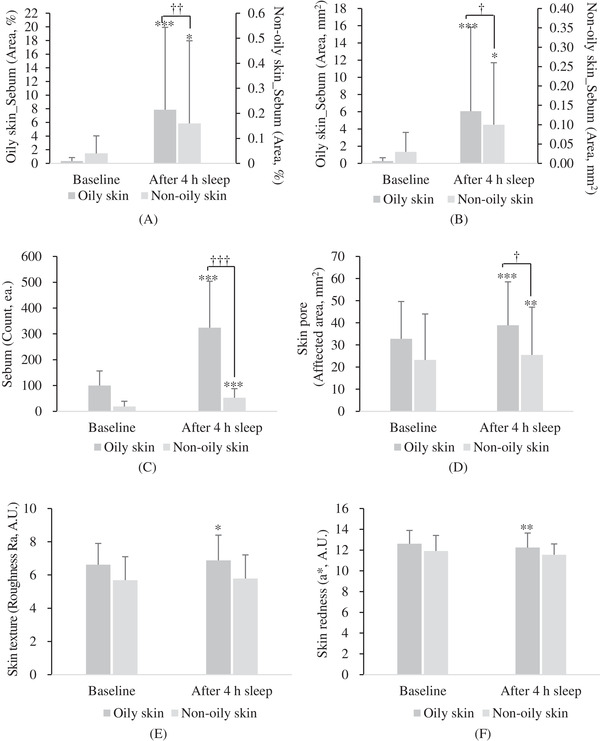
Changes of skin parameters before and after 4‐h sleep (mean + S.D.): (A) sebum (area, %); (B) sebum (area, mm2); (C) sebum (count, ea.); (D) skin pore (affected area, mm2); (E) skin texture (roughness R a, A.U.); (F) skin redness (a*, A.U.) (*,† p < 0.05, **, †† p < 0.01, ***, ††† p < 0.001)
FIGURE 2.
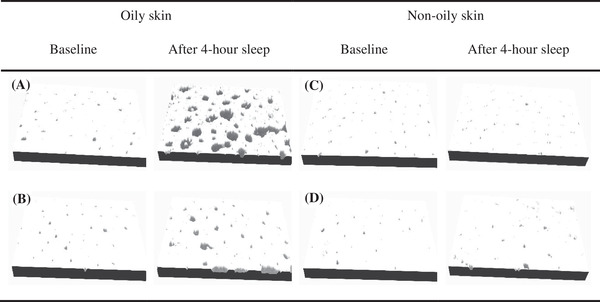
Sebum images before and after 4‐h sleep in oily and nonoily skin: (A) subject 12, (B) subject 16, (C) subject 07, and (D) subject 14
In the case of sebum, all parameters (area (%), area (mm2), and count (ea.)) significantly increased after 4‐h sleep compared with baseline in the oily and nonoily skin (p < 0.05). Moreover, the increment of all sebum parameters in the oily skin was significantly higher than those in the nonoily skin (p < 0.05, Table 2, Figures 1A–C and 2).
In the case of skin pore, the parameter of affected area significantly increased after 4‐h sleep compared with baseline in the oily and nonoily skin (p < 0.05). In addition, the increment of skin pore in the oily skin was significantly higher than those in the nonoily skin (p < 0.05, Table 2, Figure 1D).
As a result of skin texture, the parameter of roughness R a significantly increased after 4‐h sleep compared with baseline in the oily skin (p < 0.05). In addition, there was no significant difference between the oily and nonoily skin (Table 2, Figure 1E).
As a result of skin redness, the parameter of a* significantly decreased after 4‐h sleep compared with baseline in the oily skin (p < 0.05). In addition, there was no significant difference between the oily and nonoily skin (Table 2, Figure 1F).
4. DISCUSSION
In this study, we observed that the sebum and skin pore showed a significant difference between oily and nonoily skin after sleep. The results indicate the need for the daily skin care about the sebum especially in oily skin.
We also have analyzed the correlation among parameters by the skin type to find out the correlated parameters. The results denoted that there was a significant correlation among pore and texture, pore and redness, texture and redness in the oily skin, and pore and texture in the nonoily skin (Table 3).
TABLE 3.
Analysis of correlation in oily and nonoily skin
| Area (%) | Area (mm2) | Count | Pore | Texture | Redness | ||
|---|---|---|---|---|---|---|---|
| Oily skin | Area (%) | 1.000 | 0.990a | 0.364 | 0.197 | 0.285 | 0.110 |
| Area (mm2) | 0.990a | 1.000 | 0.332 | 0.138 | 0.236 | 0.080 | |
| Count | 0.364 | 0.332 | 1.000 | 0.035 | −0.041 | −0.126 | |
| Pore | 0.197 | 0.138 | 0.035 | 1.000 | 0.891a | 0.467b | |
| Texture | 0.285 | 0.236 | −0.041 | 0.891a | 1.000 | 0.685a | |
| Redness | 0.110 | 0.080 | −0.126 | 0.467b | 0.685a | 1.000 | |
| Nonoily skin | Area (%) | 1.000 | 0.988a | 0.559b | −0.151 | −0.112 | −0.317 |
| Area (mm2) | 0.988a | 1.000 | 0.545b | −0.143 | −0.112 | −0.360 | |
| Count | 0.559b | 0.545b | 1.000 | 0.033 | 0.027 | −0.112 | |
| Pore | −0.151 | −0.143 | 0.033 | 1.000 | 0.913a | 0.000 | |
| Texture | −0.112 | −0.112 | 0.027 | 0.913a | 1.000 | 0.109 | |
| Redness | −0.317 | −0.360 | −0.112 | 0.000 | 0.109 | 1.000 |
aCorrelation is significant at the 0.01 level (2‐tailed).
bCorrelation is significant at the 0.05 level (2‐tailed).
The limitation of this study is comparatively short sleeping time considering that the general sleeping time of adults is 7–8 h. 12 , 13 , 14 Therefore, further studies are required to clarify the change of skin after 7–8‐h sleep that is considered normal sleeping time of the adults. In addition, the measuring site was quite restricted. Although there is a study indicating that the amount of sebum secretion from T zone represented a tendency to be high regardless of the skin type, 4 the results in various sites could be more reliable and extend the range of study.
5. CONCLUSION
People who have oily skin type have expressed an esthetic and hygienic discomfort during the day and night time. However, there have been few studies about the difference of skin among skin types before and after sleep.
Through this research, we confirmed that the change rates of the sebum secretion and skin pore in oily skin were significantly higher than those in nonoily skin after 4‐h sleep. This result suggests that the different kinds of skin care are needed depending on the skin type before sleeping.
CONFLICTS OF INTEREST
The authors declare that there is no conflict of interest with regard to this article.
Jo DJ, Shin JY, Na SJ. Evaluation of changes for sebum, skin pore, texture, and redness before and after sleep in oily and nonoily skin. Skin Res Technol. 2022;28:851–855. 10.1111/srt.13224
DATA AVAILABILITY STATEMENT
The data that support the findings of this study are available from the corresponding author upon reasonable request.
REFERENCES
- 1. Cunliffe WJ, Simpson NB. Disorders of the sebaceous gland. In: Textbook of Dermatology. 6th ed. Blackwell science; 1998:1927‐1984. [Google Scholar]
- 2. Endly DC, Miller RA. Oily skin: a review of treatment options. J Clin Aesthet Dermatol. 2017;10(8):49‐55. [PMC free article] [PubMed] [Google Scholar]
- 3. Roh M, Han M, Kim D, Chung K. Sebum output as a factor contributing to the size of facial pores. Br J Dermatol. 2006;155:890‐894. [DOI] [PubMed] [Google Scholar]
- 4. Youn SW, Kim SJ, Hwang IA, Park KC. Evaluation of facial skin type by sebum secretion: discrepancies between subjective descriptions and sebum secretion. Skin Res Technol. 2002;8:168‐172. [DOI] [PubMed] [Google Scholar]
- 5. Jang SI, Han J, Lee M, Seo J, BJ Kim, Kim E. A study of skin characteristics according to humidity during sleep. Skin Res Technol. 2019;24:456‐460. [DOI] [PubMed] [Google Scholar]
- 6. Le Fur I, Reinberg A, Lopez S, Morizot F, Mechkouri M, Tschachler E. Analysis of circadian and ultradian rhythms of skin surface properties of face and forearm of healthy women. J Invest Dermatol. 2001;117:718‐724. [DOI] [PubMed] [Google Scholar]
- 7. Burton JL, Cunliffe WJ, Shuster S. Circadian rhythm in sebum excretion. Br J Dermatol. 1970;82:497‐501. [DOI] [PubMed] [Google Scholar]
- 8. Cunliffe WJ, Burton JL, Shuster S. The effect of local temperature variations on the sebum excretion rate. Br J Dermatol. 1970;83:650. [DOI] [PubMed] [Google Scholar]
- 9. Nam GW, Baek JH, Koh JS, Hwang JK. The seasonal variation in skin hydration, sebum, scaliness, brightness and elasticity in Korean females. Skin Res Technol. 2015;21:1‐8. [DOI] [PubMed] [Google Scholar]
- 10. Kim BY, Choi JW, Park KC, Youn SW. Sebum, acne, skin elasticity, and gender difference – which is the major influencing factor for facial pores? Skin Res Technol. 2011;19;e45‐e53. [DOI] [PubMed] [Google Scholar]
- 11. Thadanipon K, Kitsongsermthon J. Comparative study into facial sebum level, pore size, and skin hydration between oily‐skinned and dry‐skinned Thai women. Skin Res Technol. 2020;26:163‐168. [DOI] [PubMed] [Google Scholar]
- 12. Ferrara M, De Gennaro L. How much sleep do we need? Sleep Med Rev. 2001;5:155‐179. [DOI] [PubMed] [Google Scholar]
- 13. Oginska H, Pokorski J. Fatigue and mood correlates of sleep length in three age‐social groups: school children, students, and employees. Chronobiol Int. 2006;23(6):1317‐1328. [DOI] [PubMed] [Google Scholar]
- 14. Alvarez GG, Ayas NT. The impact of daily sleep duration on health: a review of the literature. Prog Cardiovasc Nurs. 2004;19:56‐59. [DOI] [PubMed] [Google Scholar]
Associated Data
This section collects any data citations, data availability statements, or supplementary materials included in this article.
Data Availability Statement
The data that support the findings of this study are available from the corresponding author upon reasonable request.