



Abstract
The effectiveness of parenting on child outcomes may be dependent on other contextual factors. To date, few studies have focused on the potential moderating effect of maternal stress on the relationship between parenting and youth externalizing behaviors. This study extends prior work by assessing how the relationship between parenting and youth outcomes varies by the presence of maternal stress, while focusing on the developmental period of adolescence and two dimensions of parenting, parental knowledge and maternal warmth. Data were collected from 278 Mother-adolescent dyads (Madolescent age = 14.05; 53.2% females; 61.9% minority) on maternal stress, maternal warmth and parental knowledge, and youth aggression and delinquency. Multi-level regression models found significant two-way interactions between parental knowledge and maternal stress on aggression and between maternal warmth and maternal stress on both outcomes. Parental knowledge was associated with lower aggression in the context of high maternal stress, but warmth only attenuated the risk of youth outcomes among low maternal stress. This study highlights the importance of considering how contextual factors impact the relationship between parenting and youth externalizing behaviors.
Keywords: Child externalizing behaviors, Parental knowledge, Maternal warmth, Maternal stress
Introduction
Parenting plays a vital role in determining the presence or absence of child behavior problems. During adolescence, socialization spheres expand beyond the family unit to peer influence and problem behaviors increase (Solmi et al., 2022); however, parenting is still one of the strongest predictors of externalizing behavior problems, accounting for more variance than economic hardship (Wang et al., 2022) and other family factors (Dekovic et al., 2003). Nevertheless, parenting practices occur within a larger family system. Family stress models highlight that stress experienced in one context can impact other family dynamics, that in turn, have a negative impact on child development (Masarik & Conger, 2017; Zietz et al., 2022). Although numerous studies have examined how parenting practices mediate the effects of family stress on child outcomes, fewer studies have tested whether parenting dimensions are moderated by maternal stress levels, which may increase or decrease the association between parenting and youth externalizing behaviors. This study augments current literature on the effectiveness of parenting on child outcomes by examining how maternal stress may moderate the association between parenting dimensions and youth externalizing behaviors.
Parenting Practices
There are many conceptual ways of defining parenting typologies and numerous measures of parenting practices. Two of the most commonly studied parenting practices are warmth and parental knowledge, which represent aspects of parental support and control, respectively, key dimensions of parenting during adolescence (e.g., Barber et al. 2005; Hoeve et al., 2009). Maternal warmth is the degree to which a child feels loved and accepted by their caregiver (Maccoby & Martin, 1983). The importance of warmth on development has been rigorously explored, beginning with seminal studies of the impact of touch and social isolation on infant rhesus monkeys (Harlow et al., 1965) to decades of human studies looking at the positive relationship between maternal warmth and a range of beneficial child and adolescent outcomes, including decreases in externalizing behaviors and increases in self-esteem (Hoskins, 2014; Yun & Cui, 2020). On the opposite end, maternal detachment is associated with higher internalizing and externalizing behaviors (Conger et al., 1992; McKee et al., 2008). Maternal warmth undergoes a shift during the adolescent period as the relationship becomes more egalitarian in nature (Branje, 2018). However, the interpersonal acceptance-rejection theory posits that humans have a biological need for acceptance and maternal warmth, and because of this biological need, maternal warmth should show universal protective effects across the lifespan (Rohner & Lansford, 2017; Rohner, 2021). Moreover, social control theory (Hirschi, 1969) posits that familial attachment prevents adolescents from engaging in deviant behavior, and their bonds with their parental figures provide motivation to conform to society rules and regulations.
Parental knowledge is defined as the knowledge of one’s child’s activities, such as where they are, who they are with, and what they are doing (Stattin & Kerr, 2000). The coercive family process model (Patterson, 1982) proposes that parental knowledge is a protective factor within the family context that reduces the risk of problem behaviors. During adolescence, as the child gains autonomy, parental knowledge shifts from direct supervision of the child to voluntary youth disclosure of their activities (Laird et al., 2003; Pettit et al., 2007). Despite this change, parental knowledge is still one of the strongest predictors of reduced externalizing problems (Pinquart, 2017), substance use (Lac & Crano, 2009), and other risky behaviors (Dittus et al., 2015) in adolescence. Indeed, research has demonstrated that the level of parental knowledge, rather than active monitoring and supervision, is linked to adolescent behavior (Augenstein et al., 2016; Eaton et al., 2009).
The Role of Maternal Stress
Maternal stress has been routinely associated with increased child behavior and emotional problems (Bagner et al., 2009; Bakoula et al., 2009). Not only does maternal stress have indirect effects on child outcomes through disruptions in parenting practices in early childhood (Crnic et al., 2005; Dau et al., 2019), middle childhood (Van Der Kaap-Deeder et al., 2019), and adolescence (Bülow et al., 2021; Conger et al., 1995), but the stress contagion model also suggests that maternal stress has a direct effect on the dynamic covariation of physiological reactivity in early childhood (Priel et al., 2019) and adolescence (Papp et al., 2009). Moreover, covariation between a mother and child may increase over time (Waters et al., 2014). Furthermore, bidirectional effects of parental stress and child behavior problems have been reported in both child (Neece et al., 2012; Cherry et al., 2019) and adolescent (Goodrum et al., 2021) samples, such that parental stress levels at a particular time point were significantly associated with higher child behavior problems at the subsequent time point, and vice versa.
While many studies have focused specifically on maternal stress associated with child-rearing (i.e., parenting stress), there is evidence that both parenting stress and individual stress have independent effects on child outcomes (Crnic & Coburn, 2020; Spinelli et al., 2020). Recently, pre-pandemic daily maternal stress measured longitudinally using the Perceived Stress Scale had a significant and independent association with children’s emotional problems reported during the SARS-CoV-2 pandemic (Köhler-Dauner et al., 2021). Likewise, using 30-day daily diary data collected from 99 Canadian parent–adolescent dyads, parental daily stress was negatively linked to adolescent negative affect on the next day (Xu & Zheng, 2023). In addition, parental daily stress, but not youth stress, was linked to adolescent perceptions of parental warmth the following day, supporting parent-driven family stress processes in daily lives, but not child-driven effects (Xu & Zheng, 2023).
Although there is strong evidence of the importance of warmth and parental knowledge on adolescent development, researchers generally acknowledge that the effects of parenting are not the same for all youth, and studies examining how relationships between parenting and youth outcomes are moderated by individual or family characteristics are needed to refine existing theoretical models (Bronfenbrenner, 1986; Belsky & Pluess, 2009; Conger et al., 2010). Despite evidence that supportive parenting can buffer the risk effects of family conflict on child and adolescent outcomes (Silva et al., 2020), there are few studies examining interactions between supportive parenting and maternal stress, and results have been inconsistent. One study assessed the interactive effect of maternal attunement, defined as the ability to understand the child’s experiences, and parenting stress on child internalizing problems in a sample of 200 mothers and their children aged 8–12 years old. There was a significant interaction between maternal attunement and maternal stress, such that under conditions of high maternal stress, high maternal attunement resulted in the lowest rate of child internalizing problems, but under conditions of low maternal stress, low maternal attunement resulted in the lowest rate of child internalizing problems (Arbel et al., 2020). In contrast, another study found that under conditions of high maternal parenting stress, high maternal affection showed an increase in both internalizing and externalizing behavior problems in a sample of Finnish adolescents (Silinskas et al., 2020).
Current Study
Although the effectiveness of parenting on child outcomes may be dependent on other contextual factors, few studies have focused on the potential moderating effect of maternal stress on the relationship between parenting and youth externalizing behaviors. Moreover, these studies have primarily looked at one dimension of parenting and have found conflicting evidence. The current study seeks to understand how relationships between parental knowledge and maternal warmth with adolescent delinquency and aggression are impacted by maternal stress. This study is focused on the developmental period of adolescence, a key period during which significant changes in both parent-child relationships and problem behaviors occur. In addition, the study tests the moderating effect of maternal stress on two dimensions of parenting that are important during adolescent development—parental knowledge and maternal warmth. This study therefore adds to prior studies investigating how affectional dimensions of supportive parenting (e.g., maternal warmth, attunement, communication) buffer the adverse effects of family conflict on development. Based on the larger family systems literature, it is hypothesized that the positive effects of parenting on adolescent outcomes will be stronger among youth with higher levels of maternal stress.
Methods
Sample
Participants in this study took part in an in-lab family study at the University of Chicago. The sample was recruited from a larger community-based study of 3,582 urban and suburban youth in the greater Chicago area who had participated in a prior in-school survey of socioemotional behavior among middle school students (Chen et al., 2016). The in-lab study consisted of 378 youth aged 8 to 19 from 241 families, including 137 sibling pairs. More than 85% of families contacted for recruitment agreed to participate in the in-lab assessment, which occurred between March 2010 and August 2012. Exclusion criteria included the presence of severe physical, psychological, or neurological problems in children which would have interfered with study participation (<2% of families contacted) and/or a primary caregiver who could not read or write English (~6% of families contacted). The study protocol was approved by the University of Chicago Institutional Review Board. In accordance with the Declaration of Helsinki, a parent/legal guardian (79.4% biological mothers) provided written informed consent for themselves and their children and youth provided written informed assent. Participants were compensated for their time. Youth and a single caregiver were studied simultaneously in an on-campus research laboratory during a single 3–4-hour visit. Assessments included face-to-face interviews with caregivers and self-report instruments administered to both youth and caregivers.
Analyses were restricted to biological mothers and their children. This reduced the sample to 182 biological mothers ranging from 25 to 57 (Mage = 43, SD = 6.93) and their children, 287 youth, ranging in age from 10 to 19 (Mage = 14, SD = 1.73). The majority of the sample (72%) were early adolescents between ages 10 and 14. Of the 287 youth, there were 137 males and 150 females. The 182 families in this sample included N = 105 sibling pairs; thus, 210 children were studied with a sibling, and 77 were the only children in the family studied. There were approximately equal numbers of youth who identified as white (N = 106, 38.1%) or black (N = 105, 36.6%); there were also Hispanic youth (N = 55, 19.2%) and an “other” category for youth who identified as any other race that did not fall into the above categories, and/or who identified with multiple races (N = 21, 7.3%).
Measures
Demographic covariates
Youth gender
Youth were asked to select whether they identified as male or female. In analyses male = 1 and female = 0.
Youth minority status
Youth were asked whether they were of Hispanic origin and were asked to indicate their racial background. Youth could select more than one racial category. The distribution is described above. For analyses, a single variable for minority status was created where 0 = non-Hispanic, Caucasian and 1 = minority race or ethnicity.
Age
Mothers reported on their birthdate and their child’s birthdate. Youth age and maternal age were calculated as the difference between the date of the lab visit and the respective birthdate.
Family socioeconomic status
The Hollingshead four-factor index of socioeconomic status was used to measure socioeconomic status (SES), which ranges from 8 to 66, with 66 being the highest SES (Hollingshead, 1975). The average socioeconomic status in this sample was 44.60 (SD = 13.46).
Maternal stress
Mothers reported on current maternal stress levels measured by the Perceived Stress Scale (PSS; Cohen et al., 1983). The PSS is a validated scale that measures the degree to which situations in one’s life have been perceived as stressful during the past month. It is a 10-item questionnaire that has a 5-point response scale (e.g., 0 = Never, 1 = Almost never, 2 = Sometimes, 3 = Fairly often, 4 = Very often). Questions are positively framed (e.g., In the last month, how often have you felt that you were unable to control the important things in your life?) and negatively framed (e.g., In the last month, how often have you felt confident about your ability to handle your personal problems?), with negatively framed questions reverse coded so higher scores equate to higher stress levels. Responses were averaged to create a mean composite score with good internal reliability (M = 1.41, SD = 3.4, α = 0.87).
Maternal warmth
Maternal warmth was measured from the perception of the adolescent with the parental bonding instrument (PBI) “care” scale (Parker et al., 1979). This is a 12-item subscale with a 4-point response scale ranging from 0 to 3 (e.g., 0 = very untrue, 1 = moderately untrue, 2 = moderately true, 3 = very true). Questions were positively framed (e.g., my mother speaks to me with a warm and friendly voice) and negatively framed (e.g., my mother does not help me as much as I need). Negatively framed questions were reverse coded, so higher scores reflect higher maternal warmth. Youth responses were summed to create a composite score with good reliability (M = 27.88, SD = 6.24, α = 0.86).
Parental knowledge
Parental knowledge was assessed from the perception of the adolescent utilizing a standardized survey developed from established self-report measures in the Parental Monitoring Scale (Stattin & Kerr, 2000). Youth responded to a 5-item scale assessing how much their primary caregiver knew their whereabouts (e.g., how often does your caregiver know where you are on weekends?) with response options ranging from 1 to 5 (e.g., 1 = Never, 2 = Almost never, 3 = Some of the time, 4 = Most of the time, and 5 = Always). Responses were averaged to create a mean composite score, and the scale had good internal reliability (M = 4.34, SD = 0.55, α = 0.76).
Youth aggression and delinquency
Youth outcomes were assessed using youth report on the Aggressive Behavior and Delinquency subscales from the Child Behavior Checklist (Achenbach, 1991). These subscales identify externalizing behavior problems among youth, with responses ranging from 0 to 3 for how true a statement is about the individual (i.e., 0 = not true, 1 = somewhat or sometimes true, 2 = very true or often true). The aggressive behavior subscale is an 11-item scale composed of positively framed questions (e.g., I get in many fights), so higher scores demonstrate higher aggressive behavior. The aggressive subscale has good internal reliability (M = 0.30, SD = 0.28, α = 0.85). The delinquency subscale is a 15-item scale, and the questions are all positively framed (e.g., I drink alcohol without my parents’ approval), so a higher score demonstrates higher delinquency. The delinquency scale had good internal reliability (M = 0.21, SD = 0.21, α = 0.77).
Analytic Plan
To test whether maternal stress moderates the associations between parenting and youth outcomes, data analyses were run using the Hierarchical Linear Models program. This program accounts for the nested nature of the data set due to sibling pairs, where youth variables are level 1 and maternal factors are level 2 (Raudenbush & Bryk, 2002). Because t-tests revealed significant differences in outcomes and predictors across gender and race/ethnicity, and there were significant correlations between youth age and socioeconomic status with outcomes, these variables were controlled in the models (results available from authors). Maternal age was also controlled for in the models. For comparison with prior studies, Model 1 included the covariates and the main effects of maternal stress, warmth, and parental knowledge. The interaction between each parenting practice and maternal stress was then tested in Model 2 (i.e., maternal warmth × maternal stress, parental knowledge × maternal stress). Regression coefficients for interaction terms that were significant at p < 0.05 were considered evidence of moderation. Youth outcomes and all continuous predictors were standardized to a mean of zero and a standard deviation of one in order to present standardized regression coefficients as indices of effect size. This also served to center the maternal stress and parenting variables prior to creating interaction terms.
Significant interactions were probed using Preacher’s online calculator, following published methods (Preacher et al., 2006). This calculator is specifically set up to interpret statistical interactions among multi-level data. Interpretation of each significant interaction followed two steps. First, the calculator was used to estimate the relationship between parenting and youth outcomes at conditional values of the moderator (i.e., ±1 SD around the mean of maternal stress). In addition, post-hoc significant regions tests identified the levels of maternal stress for which the associations between parenting practices and adolescent externalizing problems were statistically significant.
Results
Descriptive Statistics
The sample included 287 youth, but nine individuals were excluded from analyses due to missing data at the predictor level, leaving a final sample of 278 youth, with a mean age of 14.05 (SD = 1.73) and with half the sample being female (53.2%). This was a diverse sample, with youth self-identifying as white (38.1%), black (37.1%), Hispanic (18.3%), and “Other” (6.5%). Correlations between study variables are shown in Table 1.
Table 1.
Correlations between predictors and outcomes
| Youth age | Maternal age | SES | Youth aggression | Youth delinquency | Parental knowledge | Maternal warmth | Maternal stress | |
|---|---|---|---|---|---|---|---|---|
| Youth age | 1 | – | – | – | – | – | – | – |
| Maternal age | 0.15* | 1 | – | – | – | – | – | – |
| SES | −0.04 | 0.25** | 1 | – | – | – | – | – |
| Youth aggression | 0.13* | −0.08 | −0.12 | 1 | – | – | – | – |
|
Youth Delinquency |
0.36*** | −0.07 | −0.10 | 0.67*** | 1 | – | – | – |
| Parental knowledge | −0.27*** | 0.04 | 0.11 | −0.42** | −0.47** | 1 | – | – |
| Maternal warmth | −0.07 | 0.13* | 0.14* | −0.36** | −0.34** | 0.39*** | 1 | – |
|
Maternal stress |
−0.05 | −0.13* | −0.01 | 0.07 | 0.07 | −0.05 | −0.15* | 1 |
*p < 0.05; **p < 0.01; ***p < 0.001
Hierarchical Linear Models between Maternal Stress and Parenting on Youth Outcomes
Tables 2 and 3 show the results for the hierarchical linear models for delinquency and aggression, respectively. For the main effects models (Model 1), both maternal warmth and monitoring were significantly associated with both youth outcomes. Maternal stress was not significantly related to either outcome. In the moderator models (Model 2), interactions were significant for both parental knowledge and maternal stress (β = −0.13, SE = 0.05, p = 0.006) and maternal warmth and maternal stress for aggression (β = +0.12, SE = 0.05, p = 0.006). The interaction between maternal warmth and maternal stress was also significant for delinquency (β = +0.10, SE = 0.04, p = 0.035).
Table 2.
Hierarchical linear models for parenting characteristics and maternal stress on youth delinquent behaviors
| Model 1 | Model 2 | |
|---|---|---|
| Intercept |
−0.21 (0.17) |
−0.19 (0.17) |
| Gender |
0.09 (0.10) |
0.09 (0.10) |
| Minority |
0.13 (0.12) |
0.11 (0.12) |
| Youth age |
0.26*** (0.06) |
0.25*** (0.06) |
| Maternal age |
−0.04 (0.06) |
−0.03 (0.06) |
| SES |
0.00 (0.06) |
0.00 (0.06) |
| Maternal stress |
0.04 (0.05) |
0.04 (0.05) |
|
Maternal warmth |
−0.15** (0.05) |
−0.16** (0.05) |
| Parental knowledge |
−0.31*** (0.06) |
−0.30*** (0.06) |
| Maternal warmth × maternal stress | – |
0.10* (0.04) |
| Parental knowledge × maternal stress | – |
−0.08 (0.05) |
| Deviance | 708.59 | 712.68 |
| χ2 | 4.09 |
All numbers presented are standardized betas and standard errors.
*p < 0.05; **p < 0.01; ***p < 0.001
Table 3.
Hierarchical linear models for parenting characteristics and maternal stress on youth aggression
| Model 1 | Model 2 | |
|---|---|---|
| Intercept |
−0.77*** (0.17) |
−0.74*** (0.17) |
| Gender |
0.45*** (0.10) |
0.45*** (0.10) |
| Minority |
0.14 (0.13) |
0.12 (0.13) |
| Youth age |
0.04 (0.05) |
0.04 (0.05) |
| Maternal age |
0.00 (0.06) |
0.02 (0.06) |
| SES |
−0.04 (0.07) |
−0.03 (0.06) |
| Maternal stress |
0.02 (0.05) |
0.03 (0.05) |
| Maternal warmth |
−0.18** (0.06) |
−0.19*** (0.05) |
| Parental knowledge |
−0.30*** (0.06) |
−0.27*** (0.06) |
| Maternal warmth × maternal stress | – |
0.12** (0.04) |
| Parental knowledge × maternal stress | – |
−0.13** (0.05) |
| Deviance | 728.33 | 727.96 |
| χ2 | 0.37 |
All numbers presented are standardized betas and standard errors.
*p < 0.05; **p < 0.01; ***p < 0.001
Figure 1a shows the relationship between maternal warmth and delinquency at two conditional values of maternal stress. The relationship between maternal warmth and delinquency was significant at lower levels of maternal stress (i.e., one standard deviation below the sample mean; b = −0.25, p < 0.001), but not higher levels of maternal stress (i.e., one standard deviation above the sample mean; b = −0.06, p = 0.372). Figure 1b shows the parameter estimates for the relationship between warmth and delinquency across the full range of maternal stress, along with the 95% confidence bands. The critical value at which the estimate for warmth becomes significantly associated with delinquency is when maternal stress (standardized) = 0.49. Estimates to the left of this value are all statistically significant, indicating that the relationship between maternal warmth and delinquency was significant for approximately average and below average levels of maternal stress.
Fig. 1.

a Relationships between maternal warmth and delinquency at low and high maternal stress levels. b Confidence intervals around parameter estimates. Note. Parameter estimates and 95% confidence intervals for associations between maternal warmth and delinquency across conditional values of maternal stress, as estimated by the online Preacher calculator (Preacher et al., 2006). The dotted line represents the area of significance; parameter estimates to the left of the dotted line are all statistically significant
Similar interaction patterns between maternal warmth and maternal stress were found for aggression. Figure 2a shows that the relationship between maternal warmth and aggression is significant at lower levels of maternal stress (b = −0.31, p < 0.001), but not at higher levels of maternal stress (b = −0.07, p = 0.355). The relationship between maternal warmth and aggression is significant when maternal stress (standardized) is less than or equal to 0.57 (Fig. 2b).
Fig. 2.
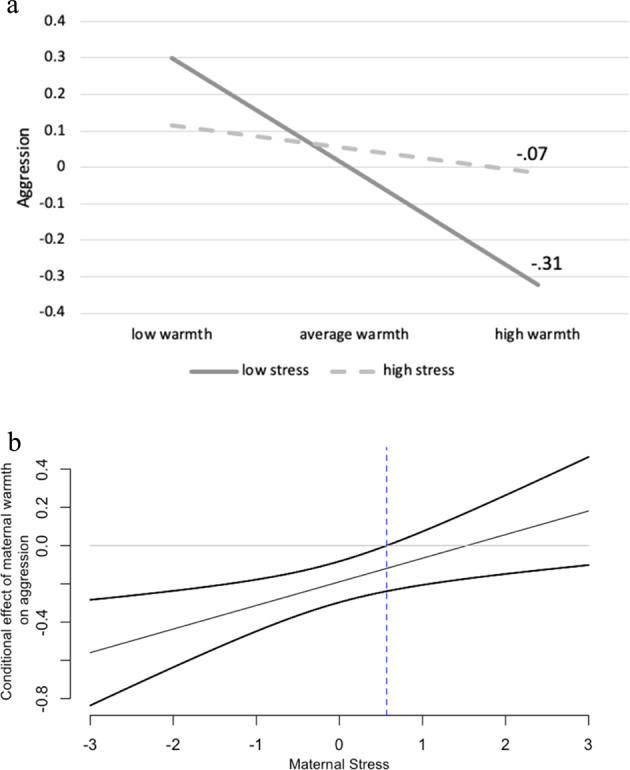
a Relationships between maternal warmth and aggression at low and high maternal stress levels. b Confidence intervals around parameter estimates. Note. Parameter estimates and 95% confidence intervals for associations between maternal warmth and aggression across conditional values of maternal stress, as estimated by the online Preacher calculator (Preacher et al., 2006). The dotted line represents the area of significance; parameter estimates to the left of the dotted line are all statistically significant
The opposite pattern emerged for the interaction between parental knowledge and maternal stress on aggression. The relationship between parental knowledge and aggression was significant at higher levels of maternal stress (b = −0.40, p < 0.001), but not lower levels (b = −0.15, p = 0.072). Figure 3b shows the parameter estimates for the relationship between parental knowledge and aggression across the range of maternal stressors, along with the 95% confidence bands. Relationships between parental knowledge and aggression are significant when maternal stress (standardized) is greater than or equal to −0.93, indicating that parental knowledge is more important at average and above-average levels of maternal stress.
Fig. 3.
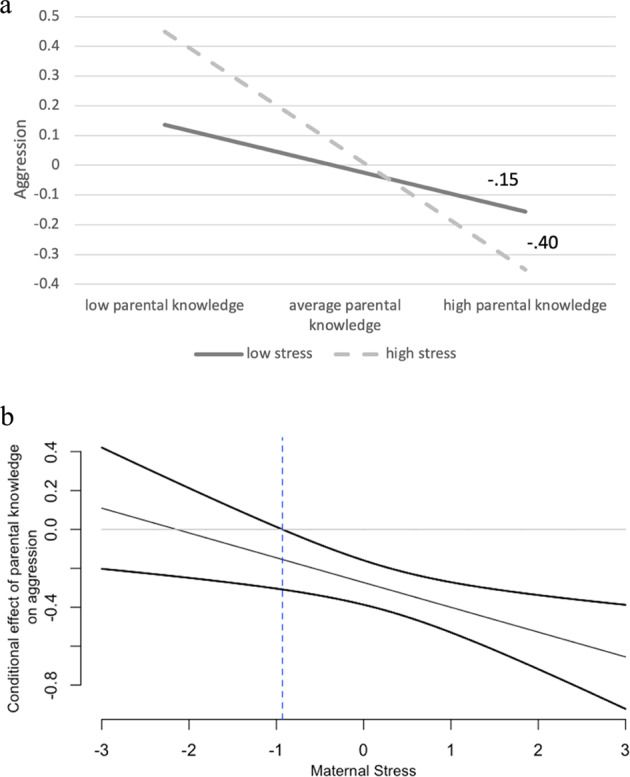
a Relationships between parental knowledge and aggression at low and high maternal stress levels. b Confidence intervals around parameter estimates. Note. Parameter estimates and 95% confidence intervals for associations between parental knowledge and aggression across conditional values of maternal stress, as estimated by the online Preacher calculator (Preacher et al., 2006). The dotted line represents the area of significance; parameter estimates to the right of the dotted line are all statistically significant
Discussion
The effects of parenting are not the same for all youth. Nevertheless, many studies do not consider how contextual characteristics may moderate associations between parenting and child outcomes. Only a handful of studies have specifically looked at the interactive effect of parenting and maternal stress on child outcomes and results have been inconsistent, perhaps because these studies focused only on a single dimension of parenting. The current study extended previous research by examining the moderating effect of maternal stress on the two dimensions of parenting that are most strongly linked to adolescent externalizing behaviors in a socioeconomically diverse community sample. Results indicated that both parental knowledge and maternal warmth interacted with current maternal stress and youth outcomes, but in unique ways. Parental knowledge attenuated the risk of youth outcomes in the context of high maternal stress, while maternal warmth led to better youth outcomes in the context of low maternal stress.
Both parental knowledge and maternal warmth predicted lower behavioral problems when the mother’s contextual factors were not considered. These main effects of parenting have been robustly supported by prior literature (e.g., Hoskins, 2014; Racz & McMahon, 2011; Yun & Cui, 2020); However, the current study also found evidence for significant interactions between maternal stress with each parenting dimension. As hypothesized, when maternal context was considered, the relationship between higher levels of parental knowledge and lower levels of aggressive behaviors was strongest at higher levels of maternal stress. However, at lower levels of maternal stress, parental knowledge had a nonsignificant impact on youth aggression. This finding is consistent with prior studies showing that the impact of positive parenting characteristics on child outcomes was stronger among children with higher levels of risk, such as maternal psychopathology or community violence exposure (Kujawa et al., 2015; Bacchini et al., 2011). Moreover, this finding supports Bronfenbrenner’s bioecological model proposing that the impact of parenting is greatest for the group that is most in need (Bronfenbrenner, 1999).
In contrast, the findings for maternal warmth did not support the hypothesis that effective parenting would attenuate youth outcomes in the context of higher maternal stress. These results are in opposition to the interpersonal acceptance-rejection theory (Rohner & Lansford, 2017; Rohner, 2021), which posits that maternal warmth should have universal protective effects. In the current study, maternal warmth was only significantly associated with lower levels of aggression and delinquency among conditions of low-to-average maternal stress. These results are inconsistent with a prior study of 8–12-year-old children, which reported that the relationship between maternal attunement and lower child internalizing problems was strongest at higher levels of stress (Arbel et al, 2020). However, the results are consistent with a previous study on the interaction between mother-child attachment and marital conflict, such that under conditions of high marital conflict, mother-child attachment had no effect on child externalizing problems in middle childhood (El-Sheikh & Elmore–Staton, 2004). A similar result was also found when looking at maternal attunement and maternal depression on internalizing problems in females, such that under conditions of high maternal depression, there was no relationship between maternal sensitivity and internalizing problems (Garai et al., 2009). Moreover, there are other studies which have suggested that under high levels of maternal distress, greater parent-child attachment or affection may lead to mothers to disclose signs of their distress to the child while simultaneously trying to form an emotional bond, which could lead to confusion on the child’s part and result in greater internalizing and externalizing problems (Silinskas et al., 2020; Aunola & Nurmi, 2005). Because this study did not find that higher levels of maternal warmth actually increased behavioral problems at higher levels of maternal stress, this hypothesis needs to be further evaluated.
Clinical and Policy Implications
This study suggests that maternal stress is an important context to consider when evaluating the impact of parenting on youth outcomes. Differential patterns of interactions with maternal stress depending on parenting dimension were found, which may explain why recent studies on maternal stress have reported inconsistent patterns of results (Arbel et al., 2020; Silinskas et al., 2020). Nevertheless, taken together, these studies examining moderating effects suggest that parenting interventions may need to be tailored to the contextual factors impacting parents. Many parenting intervention programs that focus on parent-child involvement have not been proven to be effective for adolescent outcomes (Terzian & Mbwana, 2009). These programs attempt to increase the maternal bond with the child by increasing maternal warmth; however, the results of this study indicate that attempts to increase warmth among mothers with high levels of stress or other vulnerabilities, such as depression (Goodman & Garber, 2017), should be approached with caution. Moreover, there are examples of parenting interventions that specifically target parental monitoring, such as the Enhanced Triple P–Positive Parenting Program (Sanders, 1999; Sanders et al., 2003), the Parent Management Training-Oregon Model (PMTO; Patterson et al., 2010), and the Informed Parents and Children Together (ImPACT; Li et al., 2002; Stanton et al., 2000) program. These interventions have shown significant improvements in child behavior, parenting skills, and general family functioning. Notably, findings from the PMTO provide evidence that improvements in parental monitoring and appropriate discipline are more effective when compared to other parenting domains (Patterson, 2005). The results of the current study further suggest that enhancing parental knowledge may be particularly effective among families experiencing high levels of stress.
Strengths and Limitations
The present study examined the moderating effects of maternal stress on two different types of parenting practices—maternal warmth and parental knowledge—that have strong and independent effects on adolescent development. The fact that the present study finds different patterns of interactions across parenting practice may account for some of the inconsistencies in prior studies. Another major strength of this study is the use of multi-informants; the mother reported on her own stress levels and youth reported on their own behavioral problems using validated scales. This is especially important in stress research as the literature has shown that maternal psychological stressors can lead to inflation of parent-reported child behavioral problems (Gartstein et al., 2009). This study also used youth reports of parenting behaviors, rather than observations of the parent-child interactions or parent reports. Prior research has reported that while child reports of parenting practices are strong predictors of child externalizing and internalizing problems up to three years later, parent reports on parenting do not show the same associations (Barry et al., 2008; Nichols & Tanner-Smith, 2022). Moreover, the fact that different reporters for maternal stress and parenting practices were utilized suggests that the results of this study are unlikely to be biased by common method variance (Siemsen et al., 2010). Indeed, it is unlikely that any methodological issues could account for the different patterns of results found.
This study had several limitations. One limitation is that paternal stress was not assessed, as this would have restricted analyses to children living in two-parent households, which would have resulted in a significant reduction in sample size and would have limited generalizability. Likewise, the type of household (i.e., single, or joint parent) was not considered. Inadequate parental knowledge is more common in single-mother households (Fisher et al., 2003) and the impact of parental monitoring on adolescent behaviors has been shown to be stronger when mothers work full time (Jacobson & Crockett, 2000). It could be that in two-parent households with maternal stressors, the other caregiver can provide the parenting characteristics for the child. More research is needed to investigate whether the moderating effects of maternal stress on parenting practices replicate across diverse household structures.
There was not a large enough sample to examine three-way interactions, such as interactions between parenting, maternal stress, and child gender. Research shows that maternal stressors can impact child outcomes differently based on gender (Goodman et al., 2011; Cummings et al., 2005). One study found a three-way interaction between child gender, maternal sensitivity, and maternal depression on internalizing problems, such that the two-way interaction between maternal sensitivity and depression was significant for females but not males (Garai et al., 2009). In light of this, more research with larger samples is needed to see if patterns of interactions between maternal stress and parenting are similar across gender. Similarly, the majority of the sample was in early adolescence. The specificity principle states that different settings or periods may elicit different ontological development (Bornstein, 2017). Thus, a different pattern of results may emerge among samples of younger children or older adolescents.
Finally, the authors note that as this was a cross-sectional study, causality is unclear. Research shows that stressors can impact internalizing and externalizing problems (Bagner et al., 2009; Goodman et al., 2011), but internalizing and externalizing problems of children can, in turn, impact current maternal stressors (Bagner et al., 2013; Cherry et al., 2019; Goodrum et al., 2021). Future studies should look at the differential impact of parenting characteristics in a longitudinal study to see if there are changes based on the bidirectional effects of maternal stress and child outcomes.
Conclusion
Few studies to date have explored the moderating effect of maternal stress on parenting and child outcomes. The results have been inconsistent and primarily focused on one dimension of parenting. This study adds to a growing body of work seeking to identify sources of heterogeneity in the effects of parenting on youth outcomes by exploring the role that maternal stress plays in determining the effectiveness of two independent parenting dimensions on youth externalizing behaviors. The results of this study showing different patterns of interactions for different parenting practices illustrate the complexities in how contextual factors can influence family dynamics. Additionally, results suggest directions for future empirical studies that can lead to refinements of theoretical models on stress and family processes across development.
Acknowledgements
The authors would like to thank the participants that devoted their time and psychological material for the study. In addition, we acknowledge Ms. Crystal Johnson, Ms. Kristen Jezior, and Ms. Bing Chen, for their assistance with this project.
Authors’ Contributions
K.N.M. performed the statistical analyses and drafted the manuscript; K.C.J. participated in the design and coordination of the study and helped to draft the manuscript. All authors read and approved the final manuscript.
Funding
This work was funded by the National Institutes of Health through the NIH Director’s New Innovator Award Program, Grant number DP2OD003021 to Dr. Jacobson. Information on the New Innovator Award Program, which is part of the NIH Roadmap for Medical Research, is online at: http://grants.nih.gov/grants/new_investigators/innovator_award/. The content is solely the responsibility of the authors and does not necessarily represent the official views of the National Institutes of Health.
Data Sharing and Declaration
Under the IRB protocol, individual level data are not allowed to be shared with anyone outside of the original investigative team. Copies of aggregate statistics, data analytic code, and copies of all results output are available upon request. Please send an email to Dr. Kristen Jacobson at kjacobso@bsd.uchicago.edu.
Biographies
Kristen N. Miller
was a master’s student at the University of Chicago and is currently affiliated with Johns Hopkins University. Her major research interests include contextual factors that promote resiliency in at-risk youth.
Kristen C. Jacobson
is an Associate Professor at the University of Chicago. Her major research interests include the individual differences in youth socioemotional behavior.
Data Availability
Under the IRB protocol, individual level data are not allowed to be shared with anyone outside of the original investigative team. Copies of aggregate statistics, data analytic code, and copies of all results output are available upon request. Please send an email to Dr. Kristen Jacobson at kjacobso@bsd.uchicago.edu.
Compliance with Ethical Standards
Conflict of Interest
The authors declare no competing interests.
Ethical Approval
The study protocol was approved by the University of Chicago Institutional Review Board. In accordance with the Declaration of Helsinki, a parent/legal guardian (79.4% biological mothers) provided written informed consent for themselves and their children and youth provided written informed assent.
Footnotes
Publisher’s note Springer Nature remains neutral with regard to jurisdictional claims in published maps and institutional affiliations.
References
- Achenbach, T. M. (1991). Manual for the child behavior checklist/4-18 and 1991 profile. Department of Psychiatry, University of Vermont.
- Arbel R, Margolin G, O’Connor SG, Mason TB, Leventhal AM, Dunton GF. The curvilinear effect of mothers’ parenting stress and attunement on children’s internalizing symptoms: A six wave study of mother–youth dyads across the transition to adolescence. Developmental Psychology. 2020;56(7):1316–1330. doi: 10.1037/dev0000932. [DOI] [PubMed] [Google Scholar]
- Augenstein TM, Thomas SA, Ehrlich KB, Daruwala S, Reyes SM, Chrabaszcz JS, De Los Reyes A. Comparing multi-informant assessment measures of parental monitoring and their links with adolescent delinquent behavior. Parenting. 2016;16(3):164–186. doi: 10.1080/15295192.2016.1158600. [DOI] [PMC free article] [PubMed] [Google Scholar]
- Aunola K, Nurmi JE. The role of parenting styles in children’s problem behavior. Child Development. 2005;76(6):1144–1159. doi: 10.1111/j.1467-8624.2005.00841.x. [DOI] [PubMed] [Google Scholar]
- Bacchini D, Concetta Miranda M, Affuso G. Effects of parental monitoring and exposure to community violence on antisocial behavior and anxiety/depression among adolescents. Journal of Interpersonal Violence. 2011;26(2):269–292. doi: 10.1177/0886260510362879. [DOI] [PubMed] [Google Scholar]
- Bagner DM, Pettit JW, Lewinsohn PM, Seeley JR, Jaccard J. Disentangling the temporal relationship between parental depressive symptoms and early child behavior problems: A transactional framework. Journal of Clinical Child & Adolescent Psychology. 2013;42(1):78–90. doi: 10.1080/15374416.2012.715368. [DOI] [PMC free article] [PubMed] [Google Scholar]
- Bagner DM, Sheinkopf SJ, Miller-Loncar C, LaGasse LL, Lester BM, Liu J, Bauer CR, Shankaran S, Bada H, Das A. The effect of parenting stress on child behavior problems in high-risk children with prenatal drug exposure. Child Psychiatry and Human Development. 2009;40(1):73–84. doi: 10.1007/s10578-008-0109-6. [DOI] [PMC free article] [PubMed] [Google Scholar]
- Bakoula C, Kolaitis G, Veltsista A, Gika A, Chrousos GP. Parental stress affects the emotions and behaviour of children up to adolescence: A Greek prospective, longitudinal study. Stress. 2009;12(6):486–498. doi: 10.3109/10253890802645041. [DOI] [PubMed] [Google Scholar]
- Barber BK, Stolz HE, Olsen JA. Parental support, psychological control, and behavioral control: assessing relevance across time, culture, and method. Monographs of the Society for Research in Child Development. 2005;70(4):1–13. doi: 10.1111/j.1540-5834.2005.00365.x. [DOI] [PubMed] [Google Scholar]
- Barry CT, Frick PJ, Grafeman SJ. Child versus parent reports of parenting practices: Implications for the conceptualization of child behavioral and emotional problems. Assessment. 2008;15(3):294–303. doi: 10.1177/1073191107312212. [DOI] [PubMed] [Google Scholar]
- Belsky J, Pluess M. Beyond diathesis stress: Differential susceptibility to environmental influences. Psychological Bulletin. 2009;135(6):885–908. doi: 10.1037/a0017376. [DOI] [PubMed] [Google Scholar]
- Bornstein MH. The specificity principle in acculturation science. Perspectives on Psychological Science. 2017;12(1):3–45. doi: 10.1177/1745691616655997. [DOI] [PMC free article] [PubMed] [Google Scholar]
- Branje S. Development of parent-adolescent relationships: Conflict interactions as a mechanism of change. Child Development Perspectives. 2018;12(3):171–176. doi: 10.1111/cdep.12278. [DOI] [Google Scholar]
- Bronfenbrenner U. Ecology of the family as a context for human development: Research perspectives. Developmental Psychology. 1986;22(6):723–742. doi: 10.1037/0012-1649.22.6.723. [DOI] [Google Scholar]
- Bronfenbrenner, U. (1999). Growing chaos in the lives of children youth and families: how can we turn it around? Parenthood in America. https://parenthood.library.wisc.edu/Bronfenbrenner/Bronfenbrenner.html#ref4
- Dau ALBT, Callinan LS, Smith MV. An examination of the impact of maternal fetal attachment, postpartum depressive symptoms, and parenting stress on maternal sensitivity. Infant Behavior & Development. 2019;54:99–107. doi: 10.1016/j.infbeh.2019.01.001. [DOI] [PubMed] [Google Scholar]
- Bülow A, Keijsers L, Boele S, van Roekel E, Denissen JJA. Parenting adolescents in times of a pandemic: Changes in relationship quality, autonomy support, and parental control. Developmental Psychology. 2021;57(10):1582–1596. doi: 10.1037/dev0001208. [DOI] [PubMed] [Google Scholar]
- Chen P, Voisin DR, Jacobson KC. Community violence exposure and adolescent delinquency: Examining a spectrum of promotive factors. Youth & Society. 2016;48(1):33–57. doi: 10.1177/0044118X13475827. [DOI] [PMC free article] [PubMed] [Google Scholar]
- Cherry KE, Gerstein ED, Ciciolla L. Parenting stress and children’s behavior: Transactional models during early head start. Journal of Family Psychology. 2019;33(8):916–926. doi: 10.1037/fam0000574. [DOI] [PubMed] [Google Scholar]
- Cohen S, Kamarck T, Mermelstein R. A global measure of perceived stress. Journal of Health and Social Behavior. 1983;24(4):385. doi: 10.2307/2136404. [DOI] [PubMed] [Google Scholar]
- Conger RD, Conger KJ, Elder GH, Lorenz FO, Simons RL, Whitbeck LB. A family process model of economic hardship and adjustment of early adolescent boys. Child Development. 1992;63(3):526. doi: 10.2307/1131344. [DOI] [PubMed] [Google Scholar]
- Conger RD, Conger KJ, Martin MJ. Socioeconomic status, family processes, and individual development. Journal of Marriage and Family. 2010;72(3):685–704. doi: 10.1111/j.1741-3737.2010.00725.x. [DOI] [PMC free article] [PubMed] [Google Scholar]
- Conger RD, Patterson GR, Ge X. It takes two to replicate: A mediational model for the impact of parents’ stress on adolescent adjustment. Child Development. 1995;66(1):80. doi: 10.2307/1131192. [DOI] [PubMed] [Google Scholar]
- Crnic, K. A., & Coburn, S. S. (2020). Stress and parenting. In M. H. Bornstein (Ed.), Psychological Insights for Understanding COVID-19 and Families, Parents, and Children (1st ed., pp. 103–130). Routledge. 10.4324/9781003136811-3
- Crnic KA, Gaze C, Hoffman C. Cumulative parenting stress across the preschool period: Relations to maternal parenting and child behaviour at age 5. Infant and Child Development. 2005;14(2):117–132. doi: 10.1002/icd.384. [DOI] [Google Scholar]
- Cummings EM, Keller PS, Davies PT. Towards a family process model of maternal and paternal depressive symptoms: Exploring multiple relations with child and family functioning. Journal of Child Psychology and Psychiatry. 2005;46(5):479–489. doi: 10.1111/j.1469-7610.2004.00368.x. [DOI] [PubMed] [Google Scholar]
- Dekovic M, Janssens JMAM, As NMC. Family predictors of antisocial behavior in adolescence. Family Process. 2003;42(2):223–235. doi: 10.1111/j.1545-5300.2003.42203.x. [DOI] [PubMed] [Google Scholar]
- Dittus PJ, Michael SL, Becasen JS, Gloppen KM, McCarthy K, Guilamo-Ramos V. Parental monitoring and its associations with adolescent sexual risk behavior: A meta-analysis. Pediatrics. 2015;136(6):e1587–e1599. doi: 10.1542/peds.2015-0305. [DOI] [PMC free article] [PubMed] [Google Scholar]
- Eaton NR, Krueger RF, Johnson W, McGue M, Iacono WG. Parental monitoring, personality, and delinquency: Further support for a reconceptualization of monitoring. Journal of Research in Personality. 2009;43(1):49–59. doi: 10.1016/j.jrp.2008.10.006. [DOI] [PMC free article] [PubMed] [Google Scholar]
- El-Sheikh, M., & Elmore–Staton, L. (2004). The link between marital conflict and child adjustment: Parent–child conflict and perceived attachments as mediators, potentiators, and mitigators of risk. Development and Psychopathology, 16(03). 10.1017/S0954579404004705 [DOI] [PubMed]
- Fisher PA, Leve LD, O’Leary CC, Leve C. Parental monitoring of children’s behavior: Variation across stepmother, stepfather, and two-parent biological families. Family Relations. 2003;52(1):45–52. doi: 10.1111/j.1741-3729.2003.00045.x. [DOI] [Google Scholar]
- Garai EP, Forehand RL, Colletti CJM, Reeslund K, Potts J, Compas B. The relation of maternal sensitivity to children’s internalizing and externalizing problems within the context of maternal depressive symptoms. Behavior Modification. 2009;33(5):559–582. doi: 10.1177/0145445509342581. [DOI] [PMC free article] [PubMed] [Google Scholar]
- Gartstein MA, Bridgett DJ, Dishion TJ, Kaufman NK. Depressed mood and maternal report of child behavior problems: Another look at the depression–distortion hypothesis. Journal of Applied Developmental Psychology. 2009;30(2):149–160. doi: 10.1016/j.appdev.2008.12.001. [DOI] [PMC free article] [PubMed] [Google Scholar]
- Goodman SH, Garber J. Evidence-based interventions for depressed mothers and their young children. Child Development. 2017;88(2):368–377. doi: 10.1111/cdev.12732. [DOI] [PMC free article] [PubMed] [Google Scholar]
- Goodman SH, Rouse MH, Connell AM, Broth MR, Hall CM, Heyward D. maternal depression and child psychopathology: A meta-analytic review. Clinical Child and Family Psychology Review. 2011;14(1):1–27. doi: 10.1007/s10567-010-0080-1. [DOI] [PubMed] [Google Scholar]
- Goodrum NM, Armistead LP, Masyn K, Schulte M, Murphy DA. Longitudinal bidirectional relations among parenting quality, parenting stress, and child functioning in HIV-affected families. Journal of Youth and Adolescence. 2021;50(8):1663–1678. doi: 10.1007/s10964-021-01444-w. [DOI] [PMC free article] [PubMed] [Google Scholar]
- Harlow HF, Dodsworth RO, Harlow MK. Total social isolation in monkeys. Proceedings of the National Academy of Sciences. 1965;54(1):90–97. doi: 10.1073/pnas.54.1.90. [DOI] [PMC free article] [PubMed] [Google Scholar]
- Hirschi T. Causes of delinquency. Berkeley: University of California Press; 1969. [Google Scholar]
- Hoeve M, Dubas JS, Eichelsheim VI, van der Laan PH, Smeenk W, Gerris JRM. The relationship between parenting and delinquency: A meta-analysis. Journal of Abnormal Child Psychology. 2009;37(6):749–775. doi: 10.1007/s10802-009-9310-8. [DOI] [PMC free article] [PubMed] [Google Scholar]
- Hollingshead, A. A. (1975). Four-factor index of social status. Unpublished manuscript, Yale University, New Haven, CT.
- Hoskins DH. Consequences of parenting on adolescent outcomes. Societies. 2014;4(3):506–531. doi: 10.3390/soc4030506. [DOI] [Google Scholar]
- Jacobson KC, Crockett L. Parental monitoring and adolescent adjustment: An ecological perspective. Journal of research on adolescence. 2000;10:65–97. doi: 10.1207/SJRA1001_4. [DOI] [Google Scholar]
- Köhler-Dauner F, Clemens V, Lange S, Ziegenhain U, Fegert JM. Mothers’ daily perceived stress influences their children’s mental health during SARS-CoV-2-pandemic—an online survey. Child and Adolescent Psychiatry and Mental Health. 2021;15(1):31. doi: 10.1186/s13034-021-00385-3. [DOI] [PMC free article] [PubMed] [Google Scholar]
- Kujawa A, Proudfit GH, Laptook R, Klein DN. Early parenting moderates the association between parental depression and neural reactivity to rewards and losses in offspring. Clinical Psychological Science. 2015;3(4):503–515. doi: 10.1177/2167702614542464. [DOI] [PMC free article] [PubMed] [Google Scholar]
- Lac A, Crano WD. Monitoring matters: Meta-analytic review reveals the reliable linkage of parental monitoring with adolescent marijuana use. Perspectives on Psychological Science. 2009;4(6):578–586. doi: 10.1111/j.1745-6924.2009.01166.x. [DOI] [PMC free article] [PubMed] [Google Scholar]
- Laird RD, Pettit GS, Bates JE, Dodge KA. Parents’ monitoring-relevant knowledge and adolescents’ delinquent behavior: Evidence of correlated developmental changes and reciprocal influences. Child Development. 2003;74(3):752–768. doi: 10.1111/1467-8624.00566. [DOI] [PMC free article] [PubMed] [Google Scholar]
- Li X, Stanton B, Galbraith J, Burns J, Cottrell L, Pack R. Parental monitoring intervention: Practice makes perfect. Journal of the National Medical Association. 2002;94(5):364–370. [PMC free article] [PubMed] [Google Scholar]
- Maccoby, E. E., & Martin, J. A. (1983). Socialization in the context of the family: Parent-child interaction. In P. H. Mussen, & E. M. Hetherington (Eds.), Handbook of Child Psychology: Vol. 4. Socialization, Personality, and Social Development (pp. 1–101). New York: Wiley.
- Masarik AS, Conger RD. Stress and child development: A review of the family stress model. Current Opinion in Psychology. 2017;13:85–90. doi: 10.1016/j.copsyc.2016.05.008. [DOI] [PubMed] [Google Scholar]
- McKee L, Colletti C, Rakow A, Jones DJ, Forehand R. Parenting and child externalizing behaviors: Are the associations specific or diffuse. Aggression and Violent Behavior. 2008;13(3):201–215. doi: 10.1016/j.avb.2008.03.005. [DOI] [PMC free article] [PubMed] [Google Scholar]
- Neece CL, Green SA, Baker BL. Parenting stress and child behavior problems: A transactional relationship across time. American Journal on Intellectual and Developmental Disabilities. 2012;117(1):48–66. doi: 10.1352/1944-7558-117.1.48. [DOI] [PMC free article] [PubMed] [Google Scholar]
- Nichols LM, Tanner-Smith EE. Discrepant parent-adolescent reports of parenting practices: Associations with adolescent internalizing and externalizing symptoms. Journal of Youth and Adolescence. 2022;51(6):1153–1168. doi: 10.1007/s10964-022-01601-9. [DOI] [PMC free article] [PubMed] [Google Scholar]
- Papp LM, Pendry P, Adam EK. Mother-adolescent physiological synchrony in naturalistic settings: Within-family cortisol associations and moderators. Journal of Family Psychology. 2009;23(6):882–894. doi: 10.1037/a0017147. [DOI] [PMC free article] [PubMed] [Google Scholar]
- Parker G, Tupling H, Brown LB. A parental bonding instrument. British Journal of Medical Psychology. 1979;52(1):1–10. doi: 10.1111/j.2044-8341.1979.tb02487.x. [DOI] [Google Scholar]
- Patterson GR. Coercive family process. Eugene, OR: Castalia; 1982. [Google Scholar]
- Patterson GR. The next generation of PMTO models. The Behavior Therapist. 2005;28(2):27–33. [Google Scholar]
- Patterson GR, Forgatch MS, DeGarmo DS. Cascading effects following intervention. Development and Psychopathology. 2010;22(4):949–970. doi: 10.1017/S0954579410000568. [DOI] [PMC free article] [PubMed] [Google Scholar]
- Pettit GS, Keiley MK, Laird RD, Bates JE, Dodge KA. Predicting the developmental course of mother-reported monitoring across childhood and adolescence from early proactive parenting, child temperament, and parents’ worries. Journal of Family Psychology. 2007;21(2):206–217. doi: 10.1037/0893-3200.21.2.206. [DOI] [PMC free article] [PubMed] [Google Scholar]
- Pinquart M. Associations of parenting dimensions and styles with externalizing problems of children and adolescents: An updated meta-analysis. Developmental Psychology. 2017;53(5):873–932. doi: 10.1037/dev0000295. [DOI] [PubMed] [Google Scholar]
- Preacher KJ, Curran PJ, Bauer DJ. Computational tools for probing interactions in multiple linear regression, multilevel modeling, and latent curve analysis. Journal of Educational and Behavioral Statistics. 2006;31(4):437–448. doi: 10.3102/10769986031004437. [DOI] [Google Scholar]
- Priel A, Djalovski A, Zagoory-Sharon O, Feldman R. Maternal depression impacts child psychopathology across the first decade of life: Oxytocin and synchrony as markers of resilience. Journal of Child Psychology and Psychiatry. 2019;60(1):30–42. doi: 10.1111/jcpp.12880. [DOI] [PubMed] [Google Scholar]
- Racz SJ, McMahon RJ. The relationship between parental knowledge and monitoring and child and adolescent conduct problems: A 10-year update. Clinical Child and Family Psychology Review. 2011;14(4):377–398. doi: 10.1007/s10567-011-0099-y. [DOI] [PubMed] [Google Scholar]
- Raudenbush, S. W., & Bryk, A. S. (2002). Hierarchical linear models: Applications and data analysis method (2nd ed.). Newbury Park, CA: Sage.
- Rohner, R. P. (2021). Introduction to interpersonal acceptance-rejection theory (IPARTheory) and evidence. Online Readings in Psychology and Culture, 6(1). 10.9707/2307-0919.1055
- Rohner RP, Lansford JE. Deep structure of the human affectional system: Introduction to interpersonal acceptance-rejection theory: Interpersonal acceptance-rejection theory. Journal of Family Theory & Review. 2017;9(4):426–440. doi: 10.1111/jftr.12219. [DOI] [Google Scholar]
- Sanders MR. Triple p-positive parenting program: Towards an empirically validated multilevel parenting and family support strategy for the prevention of behavior and emotional problems in children. Clinical Child and Family Psychology Review. 1999;2(2):71–90. doi: 10.1023/A:1021843613840. [DOI] [PubMed] [Google Scholar]
- Sanders MR, Markie-Dadds C, Turner KMT. Theoretical, scientific and clinical foundations of the Triple P-Positive Parenting Program: A population approach to the promotion of parenting competence. Parenting Research and Practice Monograph. 2003;1:1–21. [Google Scholar]
- Siemsen E, Roth A, Oliveira P. Common method bias in regression models with linear, quadratic, and interaction effects. Organizational Research Methods. 2010;13(3):456–476. doi: 10.1177/1094428109351241. [DOI] [Google Scholar]
- Silinskas G, Kiuru N, Aunola K, Metsäpelto R-L, Lerkkanen M-K, Nurmi J-E. Maternal affection moderates the associations between parenting stress and early adolescents’ externalizing and internalizing behavior. The Journal of Early Adolescence. 2020;40(2):221–248. doi: 10.1177/0272431619833490. [DOI] [Google Scholar]
- Silva K, Ford CA, Miller VA. Daily parent–teen conflict and parent and adolescent well-being: The moderating role of daily and person-level warmth. Journal of Youth and Adolescence. 2020;49(8):1601–1616. doi: 10.1007/s10964-020-01251-9. [DOI] [PubMed] [Google Scholar]
- Solmi M, Radua J, Olivola M, Croce E, Soardo L, Salazar de Pablo G, Il Shin J, Kirkbride JB, Jones P, Kim JH, Kim JY, Carvalho AF, Seeman MV, Correll CU, Fusar-Poli P. Age at onset of mental disorders worldwide: Large-scale meta-analysis of 192 epidemiological studies. Molecular Psychiatry. 2022;27(1):281–295. doi: 10.1038/s41380-021-01161-7. [DOI] [PMC free article] [PubMed] [Google Scholar]
- Spinelli M, Lionetti F, Pastore M, Fasolo M. Parents’ stress and children’s psychological problems in families facing the COVID-19 outbreak in Italy. Frontiers in Psychology. 2020;11:1713. doi: 10.3389/fpsyg.2020.01713. [DOI] [PMC free article] [PubMed] [Google Scholar]
- Stanton BF, Li X, Galbraith J, Cornick G, Feigelman S, Kaljee L, Zhou Y. Parental underestimates of adolescent risk behavior: a randomized, controlled trial of a parental monitoring intervention. Journal of Adolescent Health. 2000;26(1):18–26. doi: 10.1016/S1054-139X(99)00022-1. [DOI] [PubMed] [Google Scholar]
- Stattin H, Kerr M. Parental monitoring: A reinterpretation. Child Development. 2000;71(4):1072–1085. doi: 10.1111/1467-8624.00210. [DOI] [PubMed] [Google Scholar]
- Terzian, M., & Mbwana, K. (2009). What works for parent involvement programs for adolescents: Lessons from experimental evaluations of social interventions. Child Trends. https://www.childtrends.org/
- Van Der Kaap-Deeder J, Soenens B, Mabbe E, Dieleman L, Mouratidis A, Campbell R, Vansteenkiste M. From daily need experiences to autonomy-supportive and psychologically controlling parenting via psychological availability and stress. Parenting. 2019;19(3):177–202. doi: 10.1080/15295192.2019.1615791. [DOI] [Google Scholar]
- Wang Z, Li C, Ai K. Family economic strain and adolescent aggression during the COVID-19 pandemic: Roles of interparental conflict and parent–child conflict. Applied Research in Quality of Life. 2022;17(4):2369–2385. doi: 10.1007/s11482-022-10042-2. [DOI] [PMC free article] [PubMed] [Google Scholar]
- Waters SF, West TV, Mendes WB. Stress contagion: Physiological covariation between mothers and infants. Psychological Science. 2014;25(4):934–942. doi: 10.1177/0956797613518352. [DOI] [PMC free article] [PubMed] [Google Scholar]
- Xu J, Zheng Y. Parent- and child-driven daily family stress processes between daily stress, parental warmth, and adolescent adjustment. Journal of Youth and Adolescence. 2023;52(3):490–505. doi: 10.1007/s10964-022-01691-5. [DOI] [PMC free article] [PubMed] [Google Scholar]
- Yun HJ, Cui M. The effects of parental warmth on adolescent delinquency in the United States and South Korea: A cross-cultural perspective. Journal of Youth and Adolescence. 2020;49(1):228–237. doi: 10.1007/s10964-019-01078-z. [DOI] [PubMed] [Google Scholar]
- Zietz S, Lansford JE, Liu Q, Long Q, Oburu P, Pastorelli C, Sorbring E, Skinner AT, Steinberg L, Tapanya S, Tirado LMU, Yotanyamaneewong S, Alampay LP, Al-Hassan SM, Bacchini D, Bornstein MH, Chang L, Deater-Deckard K, Di Giunta L, Gurdal S. A longitudinal examination of the family stress model of economic hardship in seven countries. Children and Youth Services Review. 2022;143:106661. doi: 10.1016/j.childyouth.2022.106661. [DOI] [PMC free article] [PubMed] [Google Scholar]
Associated Data
This section collects any data citations, data availability statements, or supplementary materials included in this article.
Data Availability Statement
Under the IRB protocol, individual level data are not allowed to be shared with anyone outside of the original investigative team. Copies of aggregate statistics, data analytic code, and copies of all results output are available upon request. Please send an email to Dr. Kristen Jacobson at kjacobso@bsd.uchicago.edu.