



Abstract
A mechanical obstruction is not a physiological entity, and when it occurs within the 30-day postoperative period, it is called an early postoperative small bowel obstruction. Kinking of small bowel segments at the ileostomy outlet secondary to a distended bladder is an unusual source of early postoperative small bowel obstruction. A 36-year-old female underwent a redo J-Pouch surgery and creation of loop ileostomy after pouch failure related to recurrent small bowel obstruction and perianal fistulae. Her foley catheter was removed on postoperative day 3 and she passed a trial of void test. On postoperative day 6, the abdomen became progressively more distended. Computerized tomography (CT) imaging with IV contrast showed small bowel distension extending to the midline anterior to the urinary bladder where it demonstrated a narrowed lumen. These findings were thought to be the cause of small bowel obstruction at this level before the ileostomy. Immediately after CT, a foley catheter was applied with which 2 L of urine was removed, and consequently, gas and stool were observed in the ostomy soon thereafter. Although rare, urinary retention may cause intestinal obstruction, especially in the presence of a loop ileostomy in close proximity.
Keywords: Urinary retention, Bowel obstruction, Diverting loop ileostomy, Fistula, J-pouch, Surgery
Introduction
Temporary loop ileostomies are usually created as an integral part of surgical management of several gastroenterological diseases in order to divert fecal flow. One indication is the protection of a distal anastomosis such as an ileal pouch anal anastomosis in the setting of inflammatory bowel disease [1]. Physiological postoperative ileus – a common form of gastrointestinal dysmotility – is an inevitable response to peritoneal irritation during any abdominal surgery and may present with abdominal distention, pain, nausea, vomiting, and intestinal cramping [2]. The dysmotility commonly resolves within 2–3 days in the aftermath of the surgery. On the other hand, a mechanical obstruction, which may also result in the disruption of regular bowel movements, is not a physiological entity, and when it occurs within the 30-day postoperative period, it is called an early postoperative small bowel obstruction and carries a rare risk of strangulation [3]. Its diagnosis requires confirmation with plain radiographs or computerized tomography (CT) scanning [4]. To the best of our knowledge, unusual kinking of small bowel segments at the ileostomy outlet secondary to a distended bladder has never been reported as a source of mechanical obstruction. This case report defines the first case of the resolution of early postoperative small bowel obstruction with foley insertion.
Case Presentation
A 36-year-old female with a history of complicated ileal J-pouch presented to our clinic due to pouch failure related to recurrent small bowel obstruction and perianal fistulae. She was originally diagnosed with ulcerative colitis as a 22 year old when she initially presented to an outside clinic with abdominal pain and bloody diarrhea. Her disease became progressively more severe, and she underwent a 3-stage J-Pouch procedure. After her initial J-Pouch surgery 5 years prior to this hospitalization, she repeatedly presented to outside hospitals and underwent an extensive workup for chronic spasms, tenesmus, and urgency. The physical exam in her previous hospitalization revealed perianal fistulae that raised a question for a possibility of Crohn’s disease. However, in this patient’s situation, there were clear mechanical issues that needed to be addressed, and pouchoscopy and histopathologic evaluation were inconclusive for Crohn’s. Flexible pouchoscopy showed pouchitis, a long rectal cuff, and significant cuffitis refractory to medical therapy. Due to the fact that her symptoms were likely to be the result of a mechanical complication, a three-stage redo ileal pouch – anal anastomosis – was offered. After 6 months of fecal diversion with loop ileostomy for physical and mental reconditioning, and a multidisciplinary agreement based on the findings from the latest (2 months before the redo-pouch surgery), she underwent a redo J-Pouch surgery and creation of a new loop ileostomy. After she passed a trial of void test, her foley catheter was removed on postoperative day 3. On postoperative day 4, the patient developed persistent pain, nausea, and a continued lack of ostomy function. The patient’s pulse, blood pressure, abdominal pain, blood count, and blood chemistry were assessed. She was febrile (temperature 37.2°C) and hemodynamically stable (heart rate 85 beats/min, blood pressure 131/71 mm Hg). Laboratory workup showed the following: an increasing white blood cell count, trending from 14.0 × 10⁹/L to 17.0 × 10⁹/L; hemoglobin, 8.5 g/dL; platelet count, 357 × 109/L. By postoperative day 6, the abdomen had become progressively more distended, and an abdominal X-ray was ordered. The urinary output on a 24-h basis was 1,800 mL on postoperative day 5 and 2,700 mL on postoperative day 4. No abnormal micturition patterns were noted during this time. A water-soluble contrast enema study showed numerous dilated loops of the small bowel without an obvious transition point. These findings gave rise to a delayed postoperative ileus or an early short bowel obstruction at a possible location immediately adjacent to the ostomy (Fig. 1) and a nasogastric feeding tube was placed. CT imaging with IV contrast showed small bowel distension extending to the midline anterior to the urinary bladder where it demonstrated a narrowed lumen. These findings were thought to be the cause of small bowel obstruction at this level before the ileostomy (Fig. 2). Immediately after CT, a foley catheter was applied with which 2 L of urine was removed, and consequently, gas and stool were observed in the ostomy soon thereafter. A consequent abdominal X-ray the next day confirmed the relief of the mechanical obstruction caused by the overdistended bladder (Fig. 3). Foley catheter was removed on postoperative day 17 and a clean intermittent catheterization was initiated because of a noncompliant bladder. The bladder had recovered its function after about 1 month. No other episode of small bowel obstruction occurred. She even had a successful pregnancy resulting from in vitro fertilization one and a half years postoperatively.
Fig. 1.
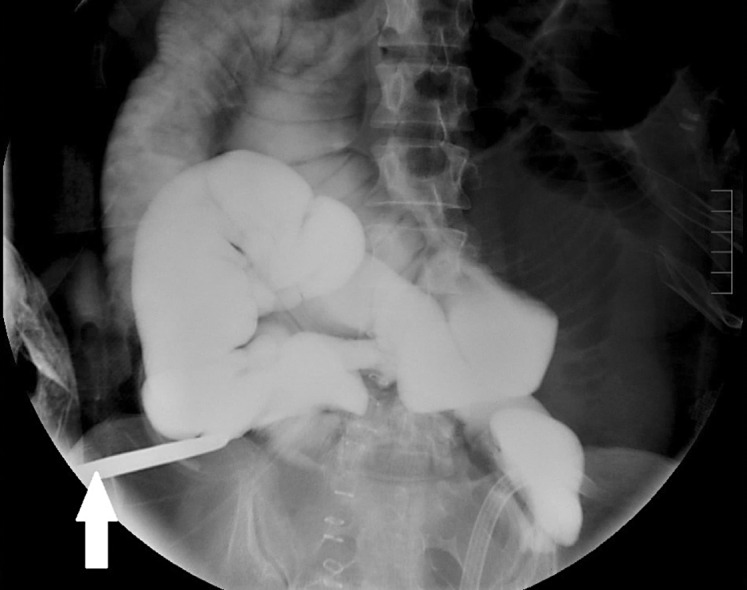
Barium enema image on postoperative day 6. Arrow points to the contrast injecting catheter in the proximal limb of loop ileostomy.
Fig. 2.

CT images with IV contrast on postoperative day 7. Arrow points to the distended bladder mechanically compressing the ileal segments at the abdominal wall aperture of the loop ileostomy.
Fig. 3.

Abdominal X-rays before (left, postoperative day 4) and after (right, postoperative day 8) urinary catheterization on postoperative day 7, which relieved the mechanical obstruction caused by overdistended bladder.
Conclusion
Imminent resolution of obstruction symptoms with a foley application clearly delineated the diagnosis of an early postoperative small bowel obstruction secondary to a distended bladder. Acute postoperative urinary retention is a common complication after major abdominal operations; surgical trauma to the pelvic nerves or the bladder, pain-induced reflex spasm of the urethral sphincters, anesthetic agents, or opioids may be responsible [5]. As the bladder gets overstretched, it occupies a larger space inside the abdomen. Elevating the pouch of Douglas, it directly displaces other intra-abdominal adjacent structures including a newly fashioned diverting loop ileostomy complex cranially.
Younger age, thick rectus abdominis muscle, and high stoma output are independent risk factors for outlet obstruction in diverting loop ileostomy patients [6], all of which applied to our patient. Although both postoperative urinary retention and intestinal obstruction are relatively common clinical diagnoses, cases where a causal effect is found between the two are rare [7, 8]. Hypertrophy of the prostate in elderly males and prolonged use of tricyclic antidepressants have been cited as contributing factors in the few cases reported in literature [9, 10]. Immediate relief and return of bowel function following urinary decompression in this case shows a cause-effect relationship between the two.
Although diagnosis of Crohn’s disease and ulcerative colitis may be ambiguous in the setting of pouch procedures, there were clear mechanical issues observed in the pouchoscopy-long rectal cuff, and surgery decision was based on a multidisciplinary agreement. Still, pathologic findings were inconclusive, and it may not be possible to rule out Crohn’s disease with a 100% accuracy. Although Crohn’s disease may also be a cause of small bowel obstruction, due to imminent resolution of obstruction symptoms with the application of a foley, it is unlikely to have been the primary cause in this case. Particularly in the setting of J-Pouch procedures, 2–7% of diagnoses may eventually be phenotypically converted to resemble Crohn’s disease [11]. If the diagnosis was conclusive for Crohn’s, patient would most likely have an end ileostomy which could still be obstructed by a distended bladder.
Herein, we presented a unique case in which urinary retention was the primary etiology of early postoperative small bowel obstruction that responded to conservative therapy with foley insertion. Ability to urinate does not rule out urinary retention. A distended bladder is still possible, depending on the post-mictional residual urine. Although rare, urinary retention may cause intestinal obstruction, especially in the presence of a loop ileostomy in close proximity. The CARE Checklist has been completed by the authors for this case report and is attached as online supplementary material (for all online suppl. material, see www.karger.com/doi/10.1159/000529481).
Statement of Ethics
Written informed consent was obtained from the patient for publication of this case report and any accompanying images. A copy of the written consent is available for review by the editor-in-chief of this journal. Ethical approval is not required for this study in accordance with local or national guidelines.
Conflict of Interest Statement
The authors have no conflicts of interest to declare.
Funding Sources
This research received no specific grant from any funding agency in the public, commercial, or not-for-profit sectors.
Author Contributions
Feza Remzi and Eren Esen conceived the case report. Umut Akova and Volkan Doğru were the major contributors to the writing of the manuscript. Feza Remzi, Eren Esen, Umut Akova, and Volkan Doğru were the major contributors to critical revision of the manuscript for important intellectual content. Feza Remzi provided expert opinion and final approval of the version to be published.
Funding Statement
This research received no specific grant from any funding agency in the public, commercial, or not-for-profit sectors.
Data Availability Statement
All authors read and approved the final manuscript. All the generated data are included in this article and its online supplementary material. Further inquiries can be directed to the corresponding author.
Supplementary Material
References
- 1. Martin ST, Vogel JD. Intestinal stomas: indications, management, and complications. Adv Surg. 2012 Sep;46(1):19–49. 10.1016/j.yasu.2012.04.005. [DOI] [PubMed] [Google Scholar]
- 2. Miedema BW, Johnson JO. Methods for decreasing postoperative gut dysmotility. Lancet Oncol. 2003 Jun;4(6):365–72. 10.1016/s1470-2045(03)01118-5. [DOI] [PubMed] [Google Scholar]
- 3. Sencan A, Sencan A, Taneli C, Gunsar C, Genc A, Ayhan S, et al. Early postoperative small bowel obstruction is a different clinical entity than postoperative adynamic ileus. J Dr Behcet Uz Child Hosp. 2011 Aug;1(2):79–83. 10.5222/buchd.2011.079. [DOI] [Google Scholar]
- 4. Ong AW, Myers SR. Early postoperative small bowel obstruction: a review. Am J Surg. 2020 Mar;219(3):535–9. 10.1016/j.amjsurg.2019.11.008. [DOI] [PubMed] [Google Scholar]
- 5. Darrah DM, Griebling TL, Silverstein JH. Postoperative urinary retention. Anesthesiol Clin. 2009 Sep;27(3):465–84. 10.1016/j.anclin.2009.07.010. [DOI] [PubMed] [Google Scholar]
- 6. Abe T, Nishimura J, Yasui M, Matsuda C, Haraguchi N, Nakai N, et al. Risk factors for outlet obstruction in patients with diverting ileostomy following rectal surgery. J Anus, Rectum Colon. 2021 Jul;5(3):254–60. 10.23922/jarc.2021-007. [DOI] [PMC free article] [PubMed] [Google Scholar]
- 7. Shaked G, Czeiger D. Distended urinary bladder and diverticulum-a rare cause of large-bowel obstruction. Am J Surg. 2009 Feb;197(2):e23–4. 10.1016/j.amjsurg.2008.02.012. [DOI] [PubMed] [Google Scholar]
- 8. Papeš D, Altarac S, Arslani N, Rajković Z. Urinary retention presenting as complete bowel obstruction. Can Urol Assoc J. 2013 Sep-Oct;7(9–10):E637–9. 10.5489/cuaj.347. [DOI] [PMC free article] [PubMed] [Google Scholar]
- 9. Fujisaki T, Fujita Y, Mizuta H, Niina N, Miyazaki N, Tashiro A, et al. Large bowel obstruction caused by urinary retention from benign prostate hyperplasia. Radiol Case Rep. 2019 Feb;14(2):213–6. 10.1016/j.radcr.2018.10.031. [DOI] [PMC free article] [PubMed] [Google Scholar]
- 10. Mac Giobuin S, Kavanagh DO, Ryan R, Kinsella A, Myers E, Evoy D, et al. Acute colonic obstruction due to benign prostatic hypertrophy. Ir Med J. 2009 Feb;102(2):52–3. [PubMed] [Google Scholar]
- 11. Hartley JE, Fazio VW, Remzi FH, Lavery IC, Church JM, Strong SA, et al. Analysis of the outcome of ileal pouch-anal anastomosis in patients with Crohn’s disease. Dis Colon Rectum. 2004 Nov;47(11):1808–15. 10.1007/s10350-004-0644-6. [DOI] [PubMed] [Google Scholar]
Associated Data
This section collects any data citations, data availability statements, or supplementary materials included in this article.
Supplementary Materials
Data Availability Statement
All authors read and approved the final manuscript. All the generated data are included in this article and its online supplementary material. Further inquiries can be directed to the corresponding author.