



Abstract
As of May 2022, a new outbreak of the human monkeypox (MPOX) disease appeared in multiple countries, where the 2022 human MPOX disease spread to more than 109 cases, excluding the suspected cases up to the end of 2022. The deaths of the 2022 human MPOX exceeded 200 cases up to the same date. The human MPOX is not a new disease, this disease was once endemic in some countries on the African continent. Despite this, this disease began to spread in a number of countries around the world in 2022. The first case of the 2022 human MPOX was recorded in the United Kingdom in May. After that date, this disease began to become a pandemic in a number of other countries, such as the United States, Spain, and Brazil. The 2022 human MPOX is a type of viral disease caused by a viral virus, the MPOX virus, and this virus causes rashes and lesions over the skin of the patient, as well as in the mouth of the patient. Multiple effective indicators are employed for the study of the 2022 of the human MPOX, such as the herd immunity of the human MPOX (HIhMPOX), the basic reproduction number of the human MPOX (BRNhMPOX), and the infection period of the human MPOX. This study focuses on the study of the herd immunity of, and the basic reproduction number of the 2022 outbreak of human MPOX in multiple countries around the world. This study employed the semianalytical method of the Susceptible compartment S, Infectious compartment I, Recovered compartment R (SIR) pandemic model including the mortality for the study of the herd immunity, and the basic reproduction number of the 2022 human MPOX disease. It is found that the average value of the herd immunity for the human MPOX disease in 2022 equals to 0.2194, that is, 21.94% for multiple countries, and equals to 35.52% for the United States, and 30.99% for Spain. Also, it is found that the average value of the basic reproduction number of the 2022 human MPOX disease equals to 1.2810 for multiple countries. It is concluded from these values that 21.94% of the total susceptible population has to be immunized in an effective way to prevent the spreading of the disease. Also, based on the previous values, it is concluded that the status of the 2022 MPOX disease is spreading as a pandemic.
Keywords: disease outbreak, epidemic, gay, herd immunity, human monkeypox, models, MPOX, MSM, pox viruses, the basic reproduction number
Introduction
The human monkeypox (MPOX) is a specific type of viral virus caused by a viral infection called the monkeypox virus. Recently, the human MPOX began to spread over a number of the countries from May 2022. This outbreak of the disease is named the ‘2022 human MPOX disease’. The WHO has relied on naming it the 2022 human MPOX, and we use this term in the study1. Multiple studies discussed the 2022 human MPOX status, for example; it is found a detection of traces of the MPOX in wastewater with sparse sampling from a Asian densely populated areas2. Also, some studies discussed applying the epidemic models, including the fractional models, and other control models3–5. Other studies discussed the possible vaccinations of the 2022 human MPOX, such as the studies6–9. Also, some studies discussed some of the indicators of the 2022 human MPOX disease, such as the infection period of the pandemic and other indicators10,11. Besides, some studies concern the case of the MPOX in a specific country, such as Pakistan12. Also, some studies discussed the case of the disease with pregnancy13. Although, the WHO, and centers for disease control and prevention states that more than of the ninety per cent of the confirmed cases of the 2022 human MPOX disease reported in the persons who have sex men to men (MSM) such as gays people1,14, some studies discussed the cases of the 2022 human MPOX disease in women15. Some studies discussed the case of the 2022 MPOX disease with HIV disease16. Another study discussed the possible risk during the 2022 FIFA (Federation International Football Association) World Cup17. Also, a study discussed the detection of traces of the disease in clinical samples18. Some studies showed specific reviews about the MPOX disease in 2022 or compared with other diseases19,20. The 2022 outbreak of the human MPOX disease began to spread over 111 countries around the world (including the suspected cases) as of the middle of December 2022. First, the first human case of MPOX in 2022 was reported in the United Kingdom in a traveler returning from Africa on 6 May 2022. After that date, a lot of confirmed cases were reported from multiple countries around the world. For example, in the north American countries, the United States reported its first case of the 2022 human MPOX at 18 May 2022, and the total confirmed cases are 29 643 cases up to 13 December 202214,21, and Canada reported its first case of the 2022 human MPOX at 19 May 2022, and the total confirmed cases are 1459 cases up to 7 December 202222–25. In South American; Brazil reported its first case of the 2022 MPOX on 17 June 2022, and up to the middle of December 2022, Brazil was the second country with 10 264 confirmed cases26. Also, in the south America, Argentine reported its first case at 27 May 2022, and as of 8 December 2022 it reported a total number of 972 confirmed cases of the 2022 MPOX disease27, and Colombia reported 3880 confirmed cases28 to the same date. Also, up to the same date, Australia reported 144 total confirmed cases29 of the 2022 human MPOX disease. In the European countries up to the middle of December 2022, Austria reported 327 total confirmed cases, Bulgaria reported six total confirmed cases, and Hungary reported 80 total confirmed cases14. Also, on the European continent, and up to the same date, Belgium reported 790 confirmed cases of the 2022 human MPOX disease30. France reported 4110 total confirmed cases of the 2022 human MPOX disease31. Italy reported 927 total confirmed cases of the 2022 human MPOX disease32. While in the United Kingdom, where the first case of the 2022 outbreak of the human MPOX was reported, there were about 3730 cases (https://www.gov.uk/government/publications/monkeypox-outbreak-epidemiological-overview) up to the same date. Spain is the country with the highest number of the total confirmed cases of the 2022 human MPOX where it reported 7408 total confirmed cases33. Although Asia is the biggest continent, it reported the lowest number of the total confirmed cases of the 2022 human MPOX disease among all of its countries. For instance, the United Arab Emirates reported 16 total confirmed cases34, People Republic of China reported one confirmed case35, and Lebanon reported 24 total confirmed cases14 of the 2022 human MPOX disease to the same date. The total confirmed number of the 2022 human MPOX disease reached about 92 711 cases, including the suspected cases. Some countries applied multiple procedures for limiting the spreading of the 2022 human MPOX. The use of the epidemic models36–39 for the study of the 2022 MPOX disease spreading is an important tool because these models include lots of important indicators of the disease. Although lots of the recent studies about the outbreak of the 2022 human MPOX diseases focused on the reporting of cases or possible prevention of the disease40–48, in this study, the simple SIR (Susceptible compartment S, Infectious compartment I, Recovered compartment R) model with mortality is employed for the discussion of herd immunity and the basic reproduction number of the 2022 human MPOX disease. The Runge–Kutta simulation techniques49 are employed for the fitting of the parameters of the model. This study focuses on finding the indicators of the 2022 human MPOX disease for multiple countries with more focusing on two countries which are the United States, and Spain. The reason for choosing these two countries is that the United States has the highest number of 2022 human MPOX cases in the world, and Spain has the highest number of 2022 human MPOX cases among the European countries. In the second section of this article, the method used is explained. In the third section, the results of the study, in addition to the discussion, are illustrated, while the conclusion of this study is illustrated in the last section of the article.
Methods
This section of the article deals with the method that is used for finding the basic reproduction number and the herd immunity of the 2022 human MPOX disease. We begin with the main four equations of the SIR model with mortality or death (Death compartment D), that is, the SIRD model. The first equation of the model describes the rate of the susceptible compartment S(t) with respect to time t, and this equation is:
| (1) |
The second equation of the model describes the rate of the infectious compartment I(t) with respect to time, and this equation is:
| (2) |
The third equation of the model describes the rate of the recovered compartment R(t) with respect to time, and this equation is:
| (3) |
While the last equation of the model describes the rate of the mortality compartment D(t) with respect to time, and this equation is:
| (4) |
The simple SIR model excluding the mortality is given only by three differential equations without the fourth one, and without the third term in the right side of the second equation of the model; this study, however, takes the mortality into account where we use the four compartments of the model.
The fourth compartment of the SIR model is illustrated in Figure 1 as a schematic graph excluding the mortality compartment and in Figure 2 including the mortality compartment.
Figure 1.
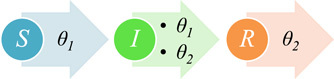
Schematic graph of the Susceptible compartment S, Infectious compartment I, Recovered compartment R (SIR) model excluding the mortality population.
Figure 2.
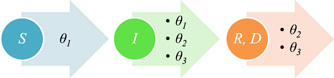
Schematic graph of the Susceptible compartment S, Infectious compartment I, Recovered compartment R (SIR) model including the mortality population.
The three parameters illustrated in the SIRD model describe the coefficients of each compartment. Based on these three parameters, we can find the basic reproduction number of the 2022 human MPOX disease, which is given as follows:
| (5) |
While the herd immunity of the 2022 human MPOX disease is derived from the basic reproduction number as follows:
| (6) |
As we see from Equation 5 and the Equation 6, the determination of the herd immunity and the basic reproduction number of the 2022 human MPOX disease requires the finding of the three parameters of the SIRD model. Where we find these three parameters depends on the seminumerical, or semianalytical method of the model. Where we use the Runge–Kutta simulation for the fitting of the reported total confirmed cases of the 2022 human MPOX disease for each country. From this fitting, we determine the three parameters of the 2022 human MPOX disease. After that, we use Equation 5 for purpose of finding the basic reproduction number of the 2022 human MPOX disease. At each step of the simulation, we apply the conservation condition of the total four population compartments, which is:
| (7) |
where the derivatives in the last equation are with respect to the time.
Figure 3 includes an explanation of the method that we apply for the purpose of finding the herd immunity of the 2022 human MPOX disease and the basic reproduction number of the human MPOX disease. As we see from this schematic figure, first we set the time step of the simulation procedures, and after that, we put the considered dates of the disease. In the next step, we recorded the total confirmed cases of the 2022 MPOX disease, including the mortality confirmed cases, and then we applied the Runge–Kutta simulation method based on the semianalytical procedure of the model. Where we apply the condition of the total population at each step of the time. After that, we determine the coefficients of recovery and mortality, and then we determine the coefficient of the infection. Finally, based on the three coefficients of the SIRD model, we find the basic reproduction number and the herd immunity of the 2022 MPOX disease based on the two related equations, that is, Equation 5 and Equation 6. The method itself requires the determination of the date of the first confirmed case of the 2022 MPOX disease, as well as the date of the first mortality case of the disease.
Figure 3.
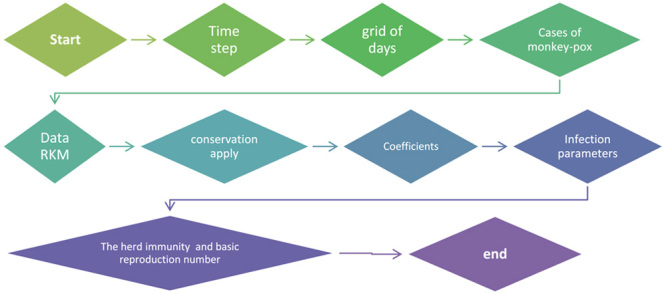
Schematic graph of the simulation algorithm of the study.
Results and discussion
Herein, we illustrate the results of the basic reproduction number and the herd immunity of the 2022 human MPOX disease. We focused on multiple countries for the study, and here we mentioned two countries as examples which are the United States, and Spain because these two countries have the highest reported number of the total confirmed cases of the 2022 human MPOX disease over the world, and over the European continent. For finding these results, first we determined the date of the first confirmed case of the 2022 human MPOX disease in the United States, which was on 18 May 2022, while the first confirmed mortality case was reported in Texas on 30 August 202214,21, and there were 20 confirmed mortality cases up to the middle of December 2022. We used the previous two dates, 18 May and 30 August as the initial conditions of the method for the United States. Based on the method, it is found that the three coefficients of the model for the United States are as follows: the infectious coefficient is 0.1022 per day, the recovery coefficient is 0.0659 per day, and the mortality coefficient is less than 0.0001 per day. Also, the same procedure was applied for Spain, where the first case of the 2022 human MPOX disease was recorded on the same day as the first case in the United States14,33, while the first confirmed mortality case in Spain was recorded on 29 July 2022. We took these 2 days as an initial condition of the method for Spain. Based on the method, it is found that the three coefficients of the model for Spain are as follows: the infectious coefficient is 0.0507 per day, the recovery coefficient is 0.0338 per day, and the mortality coefficient is about 0.0001 per day. Based on these calculations, it is found that the herd immunity of the 2022 MPOX disease for the United States equals to 0.3552 and the basic reproduction number of the disease equals to 1.5508 for the United States. Also, based on the previous calculations, it is found that the herd immunity of the 2022 MPOX disease for Spain equals to 0.3099, and the basic reproduction number of the disease equals to 1.4490 for Spain. By applying the same method of the fitting of the coefficients of the model for multiple countries where we considered one country of each continent, it is found that the average herd immunity of the 2022 human MPOX disease equals to 0.2194, and it is found that the average basic reproduction number of the 2022 human MPOX disease equals to about 1.2810. Multiple points can be concluded from these values of the two indicators for the outbreak of MPOX disease in 2022, such as the status of the disease and the average percentage of the total susceptible population that has to be immunized in an effective way. For instance, we see that the total susceptible populations that have to be immunized in an effective way are 35.52% in the United States and 30.99% in Spain.
Conclusion
This communication focused on discussing the 2022 human MPOX disease using the epidemiologic models. The simple SIR model, including mortality, was applied for this purpose, and two important indicators were found for the 2022 spreading of the human MPOX disease. The two indicators that were found the herd immunity and the basic reproduction number of the 2022 human MPOX disease. The two indicators of the 2022 human MPOX disease were estimated based on the semianalytical method and the Runge–Kutta simulation for fitting the reported data of the 2022 human MPOX disease.
The study focused on the status of the 2022 human MPOX in two countries: the United States and Spain because one of these two countries has the highest number of the total confirmed 2022 human MPOX cases over the world, which is the United States, and the other has the highest number of the total confirmed 2022 human MPOX cases over the European countries, which is Spain. Also, the study was generalized to other countries to find the average values over multiple continents around the world. It is found that the basic reproduction number values of the 2022 human MPOX for the United States are 1.5508 and for Spain are 1.4490, while the average value of the 2022 MPOX disease basic reproduction number for multiple countries is about 1.2810. The most important conclusion about this value which affects the population is that the infection of the 2022 human MPOX disease starts to spread, that is, the 2022 human MPOX disease is a pandemic in its 2022 outbreak. This can be compared with the previous problem, which is the 2019 coronavirus disease19,50–53 where it is seen that the spreading rhythm of the 2022 human MPOX disease is less than that of the 2019 coronavirus disease. Also, it is found that the values of herd immunity for the 2022 human MPOX disease are 35.52% for the United States and 30.99% for Spain. Based on this values, it is concluded that about 36% of the total susceptible population in the United States, and about 31% of the total susceptible population in Spain have to be immunized in an effective way to prevent the spreading of the disease. Besides, it is found that the average value of the herd immunity for multiple countries when the same method is applied is 21.94%, which means that about 22% of the total susceptible population has to be immunized in an effective way to prevent the spreading of the MPOX virus disease in 2022. The method can be expanded for the study of the status of the human MPOX disease in 2022 across multiple other countries.
Ethical approval
Not applicable.
Consent
Not applicable for the study.
Sources of funding
Not applicable.
Authors’ contributions
M.A.-R.: conceptualization, methodology, and derivation of the algorithm, software, visualization, writing, and editing.
Conflicts of interest disclosure
The author has no conflict of interests.
Research registration unique identifying number (UIN)
None.
Guarantor
Marwan Al-Raeei.
Availability of data and materials
The author confirm that the data available for noncommercial using.
Provenance and peer review
Not commissioned, externally peer reviewed.
Acknowledgments
Not applicable.
Footnotes
Sponsorships or competing interests that may be relevant to content are disclosed at the end of this article.
Published online 7 February 2023
References
- 1. World Organization Health, monkey pox outbreak; 2022.
- 2. Wannigama DL, Amarasiri M, Hongsing P, et al. Multiple traces of monkeypox detected in non-sewered wastewater with sparse sampling from a densely populated metropolitan area in asia. Sci Total Environ 2023;858:159816. [DOI] [PMC free article] [PubMed] [Google Scholar]
- 3. Peter OJ, Madubueze CE, Ojo MM, et al. Modeling and optimal control of monkeypox with cost-effective strategies. Model Earth Syst Environ 2022. doi: 10.1007/s40808-022-01607-z [DOI] [Google Scholar]
- 4. Khan A, Sabbar Y, Din A. Stochastic modeling of the monkeypox 2022 epidemic with cross-infection hypothesis in a highly disturbed environment. Math Biosci Eng 2022;19:13560–81. [DOI] [PubMed] [Google Scholar]
- 5. Peter OJ, Oguntolu FA, Ojo MM, et al. Fractional order mathematical model of monkeypox transmission dynamics. Phys Scr 2022;97:084005. [Google Scholar]
- 6. Duffy J, Marquez P, Moro P, et al. Safety monitoring of JYNNEOS vaccine during the 2022 mpox outbreak – united states, May 22–October 21, 2022. MMWR Morb Mortal Wkly Rep 2022;71:1555–9. [DOI] [PMC free article] [PubMed] [Google Scholar]
- 7. Winters M, Malik AA, Omer SB. Attitudes towards monkeypox vaccination and predictors of vaccination intentions among the US general public. PLoS One 2022;17:e0278622. [DOI] [PMC free article] [PubMed] [Google Scholar]
- 8. Bhattacharya M, Dhama K, Chakraborty C. A call for a novel and next-generation vaccine against monkeypox disease. Ann Med Surg 2022;84:104968. [DOI] [PMC free article] [PubMed] [Google Scholar]
- 9. Buchman GW, Cohen ME, Xiao Y, et al. A protein-based smallpox vaccine protects non-human primates from a lethal monkeypox virus challenge. Vaccine 2010;28:6627–36. [DOI] [PMC free article] [PubMed] [Google Scholar]
- 10. Al-Raeei M. The infection and recovery periods of the 2022 outbreak of monkey-pox virus disease. IOPSciNotes 2022;3:044001. [Google Scholar]
- 11. Al-Raeei M. The basic reproductive ratio of the 2022 outbreak of the monkey pox virus disease for the united kingdom, canada, brazil, the united arab emirates, and nigeria. Beni-Suef Univ J Basic Appl Sci 2022;11:135. [DOI] [PMC free article] [PubMed] [Google Scholar]
- 12. Shuja MH, Shakil F, Vijay S. Monkeypox virus: a potential concern for pakistan. J Pak Med Assoc 2022;72:2587. [DOI] [PubMed] [Google Scholar]
- 13. Cuérel A, Favre G, Vouga M, et al. Monkeypox and pregnancy: latest updates. Viruses 2022;14:2520. [DOI] [PMC free article] [PubMed] [Google Scholar]
- 14. Centers for Disease Control and Prevention. 2022 Monkeypox Outbreak Global Map. Accessed 17 December 2022. https://www.cdc.gov/poxvirus/monkeypox/response/2022/world-map.html.
- 15. Thornhill JP, Palich R, Ghosn J, et al. Share-Net Writing Group. Human monkeypox virus infection in women and non-binary individuals during the 2022 outbreaks: a global case series. Lancet 2022;400:1953–65. [DOI] [PMC free article] [PubMed] [Google Scholar]
- 16. Boesecke C, Monin MB, van Bremen K, et al. Severe monkeypox-virus infection in undiagnosed advanced HIV infection. Infection 2022;50:1633–4. [DOI] [PMC free article] [PubMed] [Google Scholar]
- 17. Subedi D, Pantha S, Chandran D, et al. FIFA world cup 2022 and the risk of emergence of zoonotic diseases. J Pure Appl Microbiol 2022;16:2246–58. [Google Scholar]
- 18. Hasso M, Perusini S, Eshaghi A, et al. Monkeypox virus detection in different clinical specimen types. Emerg Infect Dis 2022;28:2513–5. [DOI] [PMC free article] [PubMed] [Google Scholar]
- 19. Roushdy T. SARS-CoV-2 and monkeypox: what is common and what is not in a present pandemic versus a potential one—a neuropsychiatric narrative review. Egypt J Neurol Psychiatry Neurosurg 2022;58:127. [DOI] [PMC free article] [PubMed] [Google Scholar]
- 20. Hraib M, Jouni S, Albitar MM, et al. The outbreak of monkeypox 2022: an overview. Ann Med Surg 2022;79:104069. [DOI] [PMC free article] [PubMed] [Google Scholar]
- 21. Reuters. Texas reports first US death in person with monkeypox. Accessed 17 December 2022. https://www.reuters.com/world/us/texas-reports-first-us-death-person-with-monkeypox-2022-08-30/ .
- 22. Monkeypox. Accessed 17 December 2022. http://www.bccdc.ca/health-info/diseases-conditions/monkeypox
- 23.https://www.publichealthontario.ca/-/media/Documents/M/2022/monkeypox-episummary.pdf?sc_lang=enhttps://web.archive.org/web/20220616005731/https://www.publichealthontario.ca/-/media/Documents/M/2022/monkeypox-episummary.pdf Epidemiological Summary Monkeypox in Ontario. PublicHealth Ontario. Accessed 23 August 2022. . Archived (from the original):
- 24.https://www.quebec.ca/en/health/health-issues/a-z/monkeypoxhttps://web.archive.org/web/20220602165228/https://www.quebec.ca/en/health/health-issues/a-z/monkeypox Government of Quebec. Simian pox. Accessed 30 August 2022. . Archived (from the original 2 June 2022).
- 25.https://www.canada.ca/en/public-health/services/diseases/monkeypox/outbreak-update.html#a1https://web.archive.org/web/20220525235003/https://www.canada.ca/en/public-health/services/diseases/monkeypox.html#a1 Monkeypox: outbreak update. Government of Canada. Accessed 26 August 2022. . Archived from the original 25 May 2022.
- 26. RJ confirma primeira morte por varíola dos macacos no estado. G1 (in Portuguese). Accessed 17 December 2022. https://g1.globo.com/rj/rio-de-janeiro/noticia/2022/08/29/rj-confirma-primeira-morte-por-variola-dos-macacos.ghtml
- 27. Se confirmaron 221 casos de Viruela del mono en Argentina. La Union. Accessed 17 December 2022. https://www.launion.digital/sociedad/se-confirmaron-221-casos-viruela-mono-argentina-n105794
- 28. Viruela del mono: solo 10 de 1.260 casos son de mujeres. El Colombiano (in Spanish). Accessed 17 December 2022. https://www.elcolombiano.com/colombia/la-viruela-del-mono-sigue-en-aumento-y-ya-llego-a-1260-casos-de-los-que-solo-10-mujeresestan-contagiadas-EN18622363
- 29. Monkeypox (MPX) health alert. Department of Health and AgedCare. Accessed 17 December 2022. https://www.health.gov.au/health-alerts/monkeypox-mpx/about
- 30. Variole du singe (MPX) Situation épidémiologique au 30 août2022. Sciensano. Accessed 17 December 2022. https://www.sciensano.be/sites/default/files/mpx_update_30082022_fr.pdf
- 31. Cas de variole du singe : point de situation au 1er septembre2022. Santé publique France. Accessed 17 December 2022. https://www.santepubliquefrance.fr/les-actualites/2022/cas-de-variole-du-singe-point-de-situation-au-1er-septembre-2022
- 32.https://www.reuters.com/business/healthcare-pharmaceuticals/italy-reports-first-case-monkeypox-infection-two-moresuspected-2022-05-19/https://web.archive.org/web/20220519131733/https://www.reuters.com/business/healthcare-pharmaceuticals/italy-reports-first-case-monkeypox-infection-two-more-suspected-2022-05-19/ Italy reports first case of monkeypox infection, two moresuspected. Accessed 19 May 2022. Archived from the original on 19 May 2022.
- 33. Faus J. Spain reports second monkeypox-related death in Europe. Accessed 30 July 2022. https://www.reuters.com/world/europe/spain-confirms-first-monkeypox-related-death-country-reports-2022-07-29/
- 34.https://www.wam.ae/en/details/1395303068657 MoHAP announces three new monkeypox cases. Ministry of Health (UnitedArab Emirates).
- 35. 重庆市发现1例境外输入猴痘病例. People’s Daily Online (in Chinese). Accessed 16 September 2022. http://cq.people.com.cn/n2/2022/0916/c365401-40127774.html.
- 36. Al-Raeei M. Numerical simulation of the force of infection and the typical times of SARS-CoV-2 disease for different location countries. Model Earth Syst Environ 2022;8:1443–8. [DOI] [PMC free article] [PubMed] [Google Scholar]
- 37. Alharbi R, Jan R, Alyobi S, et al. Mathematical modeling and stability analysis of the dynamics of monkeypox via fractional-calculus. Fractals 2022;30:2240266. [Google Scholar]
- 38. Al-Raeei M. The incubation periods, the critical immunisation threshold and some other predictors of SARS-CoV-2 disease for different location and different climate countries. Engg Appl Sci Lett 2021;4:36–42. [Google Scholar]
- 39. Eid MM, El-Kenawy E-M, Khodadadi N, et al. Meta-heuristic optimization of LSTM-based deep network for boosting the prediction of monkeypox cases. Mathematics 2022;10:3845. [Google Scholar]
- 40. Alshahrani NZ, Assiri AM, Al-Tawfiq JA, et al. The human monkeypox in saudi arabia and global tourism. Ann Med Surg 2022;82:104686. [DOI] [PMC free article] [PubMed] [Google Scholar]
- 41. Ibrahim PK, Abdulrahman DS, Ali HM, et al. The 2022 monkeypox outbreak – special attention to nurses’ protection should be a top priority. Ann Med Surg 2022;82:104615. [DOI] [PMC free article] [PubMed] [Google Scholar]
- 42. Petersen E, Zumla A, Hui DS, et al. Vaccination for monkeypox prevention in persons with high-risk sexual behaviours to control on-going outbreak of monkeypox virus clade 3. Int J Infect Dis 2022;122:569–71. [DOI] [PMC free article] [PubMed] [Google Scholar]
- 43. Bajrai LH, Alharbi AS, El-Day MM, et al. Identification of antiviral compounds against monkeypox virus profilin-like protein A42R from plantago lanceolata. Molecules 2022;27:7718. [DOI] [PMC free article] [PubMed] [Google Scholar]
- 44. Ulloque-Badaracco JR, Alarcón-Braga EA, Hernandez-Bustamante EA, et al. Acceptance towards monkeypox vaccination: a systematic review and meta-analysis. Pathogens 2022;11:207. doi: 10.3390/pathogens11111248 [DOI] [PMC free article] [PubMed] [Google Scholar]
- 45. Khatri G, Mir SL, Priya, et al. Outbreak of monkeypox in south east asia; spotlight on bangladesh, pakistan and india. Ann Med Surg 2022;82:104361. doi: 10.1016/j.amsu.2022.104361 [DOI] [PMC free article] [PubMed] [Google Scholar]
- 46. Dibia EO, Olaoye DQ. Strengthening monkeypox diagnostics and healthcare amidst covid-19 realities: a call to action. Ann Med Surg 2022;84:104898. [DOI] [PMC free article] [PubMed] [Google Scholar]
- 47. Sallam M, Al-Mahzoum K, Al-Tammemi AB, et al. Assessing healthcare workers’ knowledge and their confidence in the diagnosis and management of human monkeypox: a cross-sectional study in a middle eastern country. Healthcare (Switzerland) 2022;10:1722. [DOI] [PMC free article] [PubMed] [Google Scholar]
- 48. El Eid R, Allaw F, Haddad SF, et al. Human monkeypox: a review of the literature. PLoS Pathog 2022;18:e1010768. [DOI] [PMC free article] [PubMed] [Google Scholar]
- 49. Al-Raeei M. Applying fractional quantum mechanics to systems with electrical screening effects. Chaos Solitons Fractals 2021;150:111209. [Google Scholar]
- 50. Swed S, Alibrahim H, Alzabibi MA, et al. Knowledge and attitudes about influenza and the common cold in syria post COVID-19: a qualitative study. Ann Med Surg 2022;80:104166. [DOI] [PMC free article] [PubMed] [Google Scholar]
- 51. Okeke SR, Idriss-Wheeler D, Yaya S. Adolescent pregnancy in the time of COVID-19: What are the implications for sexual and reproductive health and rights globally? Reprod Health 2022;19:207. [DOI] [PMC free article] [PubMed] [Google Scholar]
- 52. Al-Raeei M. The basic reproduction number of the new coronavirus pandemic with mortality for India, the Syrian Arab Republic, the United States, Yemen, China, France, Nigeria and Russia with different rate of cases. Clin Epidemiology Glob Health 2021;9:147–9. [DOI] [PMC free article] [PubMed] [Google Scholar]
- 53. Gong Y, Li Y, Zhang L, et al. Threats of COVID-19 arouse public awareness of climate change risks. IScience 2022;25:105350. [DOI] [PMC free article] [PubMed] [Google Scholar]
Associated Data
This section collects any data citations, data availability statements, or supplementary materials included in this article.
Data Availability Statement
The author confirm that the data available for noncommercial using.