



Abstract
Background:Thousands of patients die every year from opioid overdose. Naloxone is a lifesaving medication FDA approved for opioid overdose reversal. Many patients may present to the emergency department (ED) and require naloxone administration. The purpose of this study was to evaluate parenteral naloxone usage in the ED. It assessed parenteral naloxone indication of use and the patient population requiring its administration in order to support the need of a take home naloxone distribution program. Methods: This study was a retrospective, randomized, single center, chart review that took place at a community hospital ED. A computerized report was generated to identify all patients 18 years of age or older who were administered naloxone in the ED from June 2020 to June 2021. The charts of 100 patients randomly selected from the generated report were reviewed to collect the following information: gender, age, indication for use, dosing, drug being reversed, risk factors for overdose, ED revisits within 1 year. Results: Out of the 100 patients randomly reviewed, 55 (55%) patients were administered parenteral naloxone for overdose indication. Eighteen (32%) of overdose patients revisited the hospital within 1 year for overdose. Thirty-six (65%) of patients administered naloxone for overdose had history of substance abuse with 45 (82%) being under the age of 65 years. Conclusion: These results support the need for a take home naloxone distribution program to be implemented for patients at risk for opioid overdose or individuals at risk of witnessing a drug overdose.
Keywords: naloxone, opioids, overdose, emergency department
Introduction
The opioid pandemic has led to many fatal overdoses and relentless social economical strain across the United States (U.S.). Over half a million patients in the U.S. have died due to opioid related overdoses in the last 20 years. 1 Over this period, the opioid epidemic developed through the combination of over prescribing opioids, an increase in deaths from the abuse of heroin, and an increase in deaths from overdose of synthetic opioids, such as fentanyl. 1 Although recently there has been a decrease in opioid prescribing and prescription opioid misuse, along with more than a 50% reduction in first time heroin users, emergency department (ED) patient visits involving opioid overdose continue to rise. Almost a million nonfatal opioid overdose cases were reported and treated in 2017, with almost 47 000 fatalities due to opioid overdose in 2018.1,2 In the state of Florida, there were 4698 reported drug overdose fatalities in 2018. 3 Opioid medication related overdoses accounted for almost 68% of mortalities, this being 3189 patients. 4 Opioid overdose represents a massive economic strain that resulted in $550 billion spent in 2017 due to fatal overdoses. 2 Across 38 states, Florida was second only to Ohio in terms of combined costs of opioid use disorder, fatal opioid overdose, and fatal opioid overdose cases. 2
In light of millions of deaths from opioid overdose, naloxone is a lifesaving medication approved for the complete or partial reversal of synthetic or natural opioids. It antagonizes the action of opioid medications at the µ-opioid receptors in the central nervous system. This action reverses the deadly respiratory depressive side effects associated with opioids. Naloxone is able to be delivered in various ways, including intramuscular (IM) or subcutaneous (SUBQ) injections, intranasal spray, and intravenous (IV) delivery. Supplied in various formulations, its onset of action can be within 2 minutes with IV administration or 8 minutes with intranasal use. 5
There has been inconsistent data regarding the usage of naloxone in the ED and the effects of increasing patient access to it. Some studies have also shown that the availability of an antidote may encourage drug use by providing a safety net and sense of security among opioid abusers.6,7 This was exhibited in Ohio where rates of naloxone administration correlated with an increase in opioid addiction.6,7 However, based on evidence from many systematic reviews, and reports from the National institute on Drug Abuse, there is an overwhelming support of take-home naloxone programs.8 -11 In fact, in 30 states that have implemented naloxone access laws in combination with Good Samaritan laws between 2000 and 2014, there was a 14% reduction in incidences of opioid overdose mortality. 9 Naloxone distribution programs provide access to naloxone kits to opioid users, their family and friends, and others who may find themselves in a position to save the life of someone at risk of an opioid overdose. Intranasal naloxone programs have decreased mortality in the communities they are implemented in. 11 However, there is still limited data on how naloxone is utilized in the ED and on the identification of patients requiring its administration based on risk factors. Patients who overdose have a high risk of repeat overdose. It is important that more studies be conducted on parenteral naloxone usage in the ED as well as on identifying the patients with risk factors for overdose. These studies will justify the implementation of an intranasal naloxone program. The purpose of this study was to evaluate the usage of parenteral naloxone in the ED at a community hospital. Primary outcomes of this study was to identify indication of use of parenteral naloxone and identifying patients requiring its administration. A secondary outcome included repeat ED visits due to overdose.
Materials and Methods
Study Design and Setting
The Institutional Review Board (IRB) approved this retrospective chart review. Data was collected through electronic health records at our institution, which is a not-for-profit hospital that houses 147 adult beds and an ED that sees almost 90 000 patients a year.
Patients
Patients were eligible for study if they were at least 18 years of age and were administered parenteral naloxone in the ED. Patients were excluded if any of these conditions occurred: patients being under 18 years of age and patients who were administered parenteral naloxone outside of the ED. A computerized report was generated to identify all patients who met the aforementioned criteria from June 2020 to June 2021. One hundred patients were randomly selected based on inclusion and exclusion criteria out of 300 patient charts that were reviewed.
Data Collection and Study Outcomes
Data collected included the following: electronic patient identification number, gender, ethnicity, age, indication for use, dosage of parenteral naloxone administered, medication being reversed, response to parenteral naloxone, overdose indication by age, presence of history of substance abuse, polysubstance abuse, co-prescribed benzodiazepines, co-prescribed opioids for chronic pain, psychiatric illness/co-prescribed antidepressants, adverse drug reactions to parenteral naloxone administration, repeat ED visits due to overdose, and by gender.
Statistical Analysis
Descriptive analysis were used to determine central tendencies of the patient population requiring parenteral naloxone usage.
Results
Of the 300 patients who were administered parenteral naloxone in the ED, 100 patients were randomized from this group to be included in the study (Figure 1). Baseline gender and ethnic characteristics included a predominantly male population (62%) versus women (38%), with ethnicities including Hispanic, Caucasian, and African Americans. The median age was 53 years with the interquartile range being 35 to 66 years (Table 1).
Figure 1.
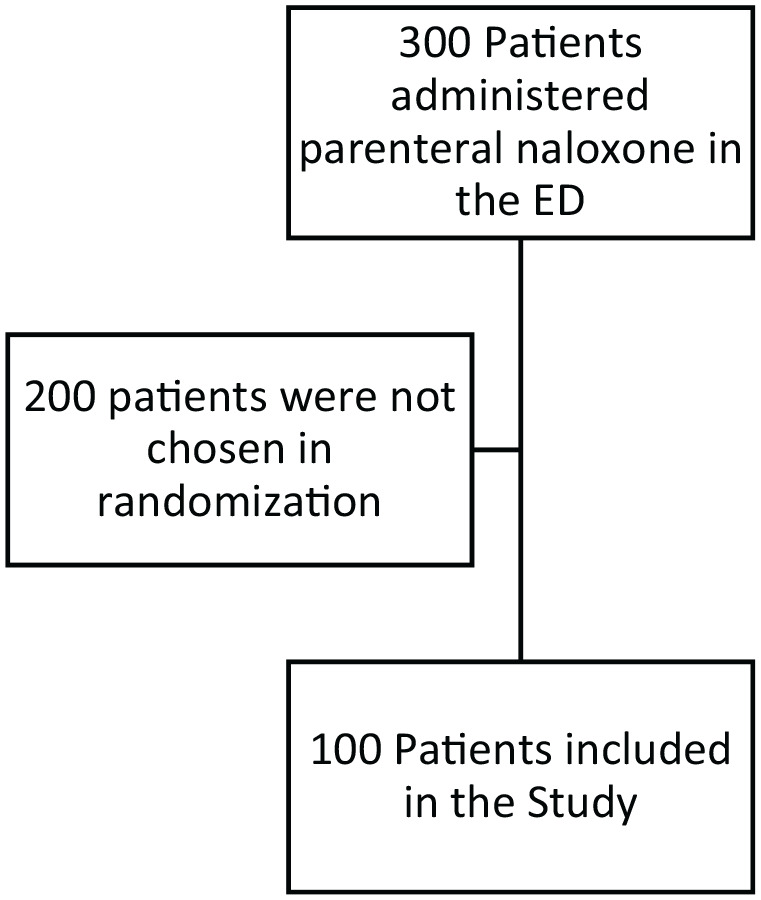
Patient inclusion and exclusion.
Table 1.
Baseline Characteristics.
| Patient demographics N = 100 | |
| Male, n (%) | 62 (62) |
| Female, n (%) | 38 (38) |
| Ethnicity N = 100 | |
| Hispanic, n (%) | 39 (39) |
| Caucasian, n (%) | 31 (31) |
| African American, n (%) | 25 (25) |
| Unidentified, n (%) | 5 (5) |
| Age | |
| Median age, y (IQR) | 53 (age range 35-66) |
Out of the 100 patients who received parenteral naloxone in this study, 55% of the patients received parenteral naloxone with an overdose diagnosis (Table 2). The most common dosage that was utilized was 0.4 mg, which was administered in 47% of the patients being reviewed (Table 3). Other dosages included 2 mg (26%), 0.8 mg (23%), and 0.2 mg (4%). Most of the patients did not respond to parenteral naloxone administration (60%) (Table 4). This is due to other medications being present in some of the patients’ serum after positive toxicology screening. These substances included cocaine, benzodiazepines, cannabinoids, and stimulants, such as methamphetamine. Forty percent of the patients still responded to parenteral naloxone therapy. Opioid medications that were reversed included oxycodone, heroin, hydrocodone, and fentanyl (Table 4).
Table 2.
Indications of Parenteral Naloxone Administration.
| Indications of parenteral naloxone administration N = 100 | |
| Overdose, n (%) | 55 (55) |
| Altered mental status, n (%) | 12 (12) |
| Hypoxemia, n (%) | 11 (11) |
| Alcohol intoxication, n (%) | 10 (10) |
| Cardiac arrest, n (%) | 4 (4) |
| NSTEMI, n (%) | 2 (2) |
| Hypoglycemia, n (%) | 2 (2) |
| Stroke, n (%) | 1 (1) |
| Syncope, n (%) | 1 (1) |
| Unresponsiveness, n (%) | 1 (1) |
| Lethargy, n (%) | 1 (1) |
Table 3.
Initial Parenteral Naloxone Dosage.
| Initial parenteral naloxone dosage N = 100 | |
| 0.4 (mg), n (%) | 47 (47) |
| 2 (mg), n (%) | 26 (26) |
| 0.8 (mg), n (%) | 23 (23) |
| 0.2 (mg), n (%) | 4 (4) |
Table 4.
Medication Reversed and Patient Response.
| Medication reversed N = 100 | |
| Non-opioid, n (%) | 44 (44) |
| Opioid, n (%) | 39 (39) |
| Unidentified, n (%) | 17 (17) |
| Patient response to parenteral naloxone N = 100 | |
| No, n (%) | 60 (60) |
| Yes, n (%) | 40 (40) |
The 55 patients who received parenteral naloxone due to an overdose were extrapolated and separated according to age. The most common age group associated with an overdose indication were patients under the age of 40 (42%) followed by the age group of 40 to 64 (40%) (Table 5). A small number of geriatric patients (18%) were identified. Overall, the average age for patients who overdosed was 43 years (Table 5).
Table 5.
Overdose Naloxone Diagnosis by Age.
| Overdose by age N = 55 | |
| Age (y) n (%) | |
| ≤40 | 23 (42) |
| 40-64 | 22 (40) |
| ≥65 | 10 (18) |
| Average age overdose patients (y) | 43 |
Of the 55 patients, 18 (32%) returned to the ED for the same diagnosis (Table 6).
Table 6.
Repeat ED Visits.
| Repeat ED visits for opioid overdose N = 55 | |
| No, n (%) | 37 (68) |
| Yes, n (%) | 18 (32) |
| Repeat overdose ED visit by gender within 1 y N = 55 | |
| Male, n (%) | 40 (73) |
| Female, n (%) | 15 (27) |
Discussion
Over half of the patients reviewed were administered parenteral naloxone with a diagnosis of overdose. After reviewing known risk factors for overdose in patients with an overdose diagnosis, it was discovered that well over half of these patients had a history of substance abuse. Thirty-two percent of patients revisited the ED within 1 year for overdose (Table 6). The average age of patients with an overdose diagnosis was 43 years.
In this study there were several limitations. The study overall had a small patient population that was narrowed down from 300 patients. Another limitation was that this retrospective review was a single center study. Incorporating more hospital EDs in this study could have potentially broadened the patient population to include a more diverse group in terms of ethnicity, gender, and past medical histories. In addition, with this study being retrospective, it involved the complete reliance on the accuracy of proper documentation in the patient’s profile by various healthcare professionals. This creates a wide margin for error in which omission and incorrect documentation can occur. Patients with an alternate diagnosis from overdose could have had risk factors for overdose but these patients were not reviewed for risk factors due to them not receiving an overdose diagnosis. The number of parenteral naloxone administrations were not accounted for in the study only initial doses. The possibility remains that patients could have required multiple doses for an adequate response. Over half of the patients administered parenteral naloxone did not respond to therapy, with other measures taken to stabilize these patients. This result was mostly seen among patients testing negative for the presence of opioids according to urinalysis and toxicology screenings. Nevertheless, there were patients who responded to therapy where multiple illicit drugs or prescription medications were present in their systems, which drove the results of patients responding to parenteral naloxone administration. Fatalities due to opioid overdose were not reported. We could not link any deaths that occurred in the study directly to opioids.
Conclusion
In this study, we were able to evaluate the utilization of parenteral naloxone in the ED as well as identify patients and patient risk factors associated with its use. Our results revealed that more than 50% of parenteral naloxone administration was for the management of opioid overdose. Based on these results, an intranasal naloxone distribution program was deemed necessary. Although there are a lack of studies evaluating the utilization of parenteral naloxone in the ED, there is data that supports benefit of implementing an intranasal naloxone distribution program in the community.9 -11 This has been shown to not only reduce mortality rates of opioid related deaths but to be cost effective as well. This cost-effective benefit occurs due to the prevention of opioid overdose deaths, further decreasing healthcare costs.9 -11
Footnotes
The author(s) declared no potential conflicts of interest with respect to the research, authorship, and/or publication of this article.
Funding: The author(s) received no financial support for the research, authorship, and/or publication of this article.
ORCID iD: Ryan P. Watts  https://orcid.org/0000-0002-5756-9228
References
- 1. CDC. Understanding the Epidemic | CDC’s Response to the Opioid Overdose Epidemic | CDC. www.cdc.gov Published June 17, 2021. https://www.cdc.gov/opioids/basics/epidemic.html. Accessed October, 2021.
- 2. Luo F. State-level economic costs of opioid use disorder and fatal opioid overdose—United States, 2017. MMWR Morb Mortal Wkly Rep. 2021;70(15):541-546. doi: 10.15585/mmwr.mm7015a1 [DOI] [PMC free article] [PubMed] [Google Scholar]
- 3. National Institute on Drug Abuse. Florida: opioid-involved deaths and related harms. National Institute on Drug Abuse, April 3, 2020. nida.nih.gov/drug-topics/opioids/opioid-summaries-by-state/florida-opioid-involved-deaths-related-harms. Accessed October, 2021.
- 4. Liu S. Nonfatal drug and polydrug overdoses treated in emergency departments—29 states, 2018–2019. MMWR Morb Mortal Wkly Rep. 2020;69:1149-1155. doi: 10.15585/mmwr.mm6934a1 [DOI] [PMC free article] [PubMed] [Google Scholar]
- 5. Jordan MR, Morrisonponce D.Naloxone. Nih Gov, StatPearls Publishing; 2019. www.ncbi.nlm.nih.gov/books/NBK441910/. Accessed October, 2021.
- 6. Massatti R. Naloxone (Narcan®) Administration in Ohio 2003–2012. Ohio Department of Mental Health and Addiction Services; 2013. [Google Scholar]
- 7. Massatti R, Beeghly C, Hall O, Kariisa M, Potts L. Increasing Heroin Overdoses in Ohio: Understanding the Issue. Ohio Department of Mental Health and Addiction Services; 2014. [Google Scholar]
- 8. Chimbar L, Moleta Y. Naloxone effectiveness: a systematic review. J Addict Nurs. 2018;29(3):167-171. doi: 10.1097/JAN.0000000000000230 [DOI] [PubMed] [Google Scholar]
- 9. McClellan C, Lambdin BH, Ali MM, et al. Opioid-overdose laws association with opioid use and overdose mortality. Addict Behav. 2018;86:90-95. doi: 10.1016/j.addbeh.2018.03.014 [DOI] [PubMed] [Google Scholar]
- 10. Naumann RB, Durrance CP, Ranapurwala SI, et al. Impact of a community-based naloxone distribution program on opioid overdose death rates. Drug Alcohol Depend. 2019;204:107536. doi: 10.1016/j.drugalcdep.2019.06.038 [DOI] [PMC free article] [PubMed] [Google Scholar]
- 11. Walley AY, Xuan Z, Hackman HH, et al. Opioid overdose rates and implementation of overdose education and nasal naloxone distribution in Massachusetts: interrupted time series analysis. BMJ. 2013;346:f174. doi: 10.1136/bmj.f174 [DOI] [PMC free article] [PubMed] [Google Scholar]