



Abstract
BACKGROUND—Development of gastric mucosa associated lymphoid tissue (MALT) lymphoma is thought to be closely associated with host immune reactions to Helicobacter pylori. AIM—To investigate humoral immune responses in patients with MALT lymphoma to antigens shared by H pylori and human gastric epithelial cells. METHODS—Sera were obtained from H pylori positive patients with MALT lymphoma (n = 11) or other gastroduodenal diseases (peptic ulcer, n = 40; non-ulcer dyspepsia, n = 20) and from H pylori negative healthy control subjects (n = 10). Antibodies to HGC-27 human gastric epithelial cells and human recombinant heat shock protein (Hsp) 60 were examined using an enzyme linked immunosorbent assay (ELISA) and immunoblotting. RESULTS—Antibody titres to HGC-27 cells were significantly elevated in H pylori positive patients with MALT lymphoma when compared with titres in patients with other gastroduodenal diseases and in healthy subjects. Immunoblotting of sera from patients with MALT lymphoma often detected a band with a molecular mass corresponding to Hsp60, and both ELISA and immunoblotting showed elevated antibody titres to the recombinant human Hsp60. Antigenic similarity between Hsp60 and H pylori HspB was documented by immunoblotting experiments. CONCLUSIONS—Autoantibodies reactive with host gastric epithelial cells are often increased in MALT lymphoma, and Hsp60 is a major target antigen. Immune responses induced by immunological cross reactivity between H pylori HspB and human Hsp60 in gastric epithelium may be involved in the development of MALT lymphoma. Keywords: Helicobacter pylori; mucosa associated lymphoid tissue lymphoma; heat shock protein; autoantibody
Full Text
The Full Text of this article is available as a PDF (121.9 KB).
Figure 1 .

Serum antibody titres to HGC-27 cells in patients with mucosa associated lymphoid tissue mucosa associated lymphoid tissue (MALT) lymphoma, gastric ulcer, duodenal ulcer, or non-ulcer dyspepsia, and control healthy subjects. Serum antibodies to HGC-27 human gastric epithelial cells were measured using cell ELISA with plates seeded with HGC-27 cells. ***p<0.001 (Student's t test).
Figure 2 .

Immunoblots of HGC-27 cells allowed to react with serum from various patient and control groups. Lysates of HGC-27 cells were fractionated on 10% polyacrylamide gels and then immunoblotted. (A) Lane A, The membrane strip was allowed to react with LK-2 mouse monoclonal antibody to human Hsp60. Lanes 1-7, the strips were allowed to react with serum from patients with mucosa associated lymphoid tissue (MALT) lymphoma. Bands with an approximate molecular mass of 60 kDa which correspond to Hsp60 are indicated by an arrow. (B) The membrane strip was allowed to react with serum from patients with non-ulcer dyspepsia (lanes 1-3), gastric ulcer (lanes 4-6), or duodenal ulcer (lanes 7 and 8), and from a healthy control subject (lane 9). Lane A, LK-2.
Figure 3 .

Immunoblots of recombinant human Hsp60 allowed to react with sera from patients with mucosa associated lymphoid tissue (MALT) lymphoma. Recombinant human Hsp60 proteins were fractionated on 10% polyacrylamide gels and then immunoblotted. Lane A, the membrane strip was allowed to react with LK-2 mouse monoclonal antibody to human Hsp60. Lanes 1-11, the strips were allowed to react with sera from patients with MALT lymphoma. Bands with approximate molecular mass 60 kDa, which correspond to Hsp60, are present in lanes 1-10 (arrow).
Figure 4 .

Serum antibody titres to recombinant human Hsp60 in patients with mucosa associated lymphoid tissue (MALT) lymphoma, gastric ulcer, duodenal ulcer, or non-ulcer dyspepsia, and control healthy subjects. Serum antibodies to human Hsp60 were measured using ELISA with plates coated with recombinant human Hsp60. *p<0.001 (Student's t test).
Figure 5 .
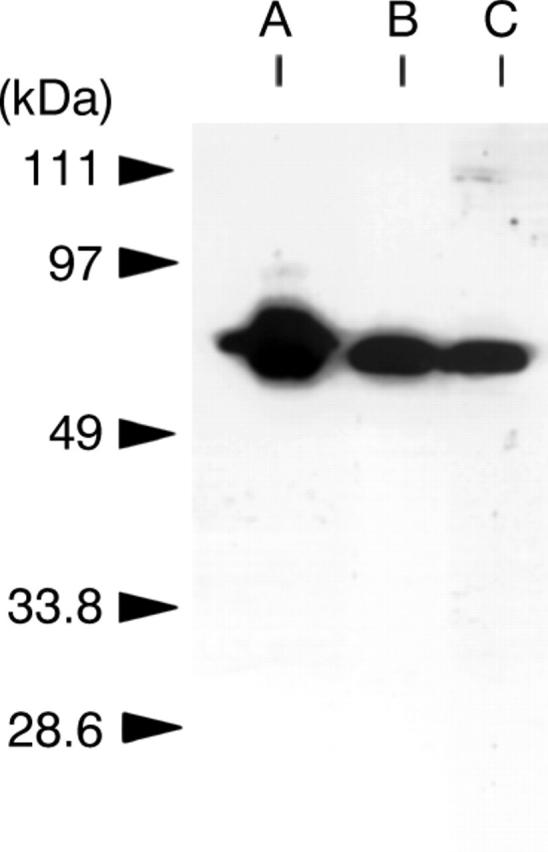
Immunoblots with LK-2 mouse monoclonal antibody to human Hsp60. Recombinant human HSP60 (lane A), lysates of HGC-27 cells (lane B), and sonicates of H pylori (lane C) were fractionated on 10% polyacrylamide gels and then immunoblotted. The membrane strip was allowed to react with LK-2 mouse monoclonal antibody to human Hsp60. Bands with approximate molecular mass 60 kDa (Hsp60 in lane A) are also present in lanes B and C.
Selected References
These references are in PubMed. This may not be the complete list of references from this article.
- Akagi T., Kimoto T. Human cell line (HGC-27) derived from the metastatic lymph node of gastric cancer. Acta Med Okayama. 1976 Jun;30(3):215–219. [PubMed] [Google Scholar]
- Appelmelk B. J., Negrini R., Moran A. P., Kuipers E. J. Molecular mimicry between Helicobacter pylori and the host. Trends Microbiol. 1997 Feb;5(2):70–73. doi: 10.1016/S0966-842X(96)10084-6. [DOI] [PubMed] [Google Scholar]
- Bayerdörffer E., Neubauer A., Rudolph B., Thiede C., Lehn N., Eidt S., Stolte M. Regression of primary gastric lymphoma of mucosa-associated lymphoid tissue type after cure of Helicobacter pylori infection. MALT Lymphoma Study Group. Lancet. 1995 Jun 24;345(8965):1591–1594. doi: 10.1016/s0140-6736(95)90113-2. [DOI] [PubMed] [Google Scholar]
- Boog C. J., de Graeff-Meeder E. R., Lucassen M. A., van der Zee R., Voorhorst-Ogink M. M., van Kooten P. J., Geuze H. J., van Eden W. Two monoclonal antibodies generated against human hsp60 show reactivity with synovial membranes of patients with juvenile chronic arthritis. J Exp Med. 1992 Jun 1;175(6):1805–1810. doi: 10.1084/jem.175.6.1805. [DOI] [PMC free article] [PubMed] [Google Scholar]
- Eck M., Schmausser B., Haas R., Greiner A., Czub S., Müller-Hermelink H. K. MALT-type lymphoma of the stomach is associated with Helicobacter pylori strains expressing the CagA protein. Gastroenterology. 1997 May;112(5):1482–1486. doi: 10.1016/s0016-5085(97)70028-3. [DOI] [PubMed] [Google Scholar]
- Eidt S., Stolte M., Fischer R. Helicobacter pylori gastritis and primary gastric non-Hodgkin's lymphomas. J Clin Pathol. 1994 May;47(5):436–439. doi: 10.1136/jcp.47.5.436. [DOI] [PMC free article] [PubMed] [Google Scholar]
- Engstrand L., Scheynius A., Påhlson C. An increased number of gamma/delta T-cells and gastric epithelial cell expression of the groEL stress-protein homologue in Helicobacter pylori-associated chronic gastritis of the antrum. Am J Gastroenterol. 1991 Aug;86(8):976–980. [PubMed] [Google Scholar]
- Harris N. L., Jaffe E. S., Stein H., Banks P. M., Chan J. K., Cleary M. L., Delsol G., De Wolf-Peeters C., Falini B., Gatter K. C. A revised European-American classification of lymphoid neoplasms: a proposal from the International Lymphoma Study Group. Blood. 1994 Sep 1;84(5):1361–1392. [PubMed] [Google Scholar]
- Hussell T., Isaacson P. G., Crabtree J. E., Spencer J. The response of cells from low-grade B-cell gastric lymphomas of mucosa-associated lymphoid tissue to Helicobacter pylori. Lancet. 1993 Sep 4;342(8871):571–574. doi: 10.1016/0140-6736(93)91408-e. [DOI] [PubMed] [Google Scholar]
- Kansau I., Labigne A. Heat shock proteins of Helicobacter pylori. Aliment Pharmacol Ther. 1996 Apr;10 (Suppl 1):51–56. doi: 10.1046/j.1365-2036.1996.22164005.x. [DOI] [PubMed] [Google Scholar]
- Kobayashi K., Yokota K., Yoshino T., Kawahara Y., Dey A., Hirai Y., Oguma K., Akagi T. Detection of Helicobacter pylori associated antigen and heat shock protein 60 on follicular dendritic cells in the germinal centres of low grade B cell lymphoma of gastric mucosa associated lymphoid tissue (MALT). J Clin Pathol. 1998 May;51(5):396–398. doi: 10.1136/jcp.51.5.396. [DOI] [PMC free article] [PubMed] [Google Scholar]
- Macchia G., Massone A., Burroni D., Covacci A., Censini S., Rappuoli R. The Hsp60 protein of Helicobacter pylori: structure and immune response in patients with gastroduodenal diseases. Mol Microbiol. 1993 Aug;9(3):645–652. doi: 10.1111/j.1365-2958.1993.tb01724.x. [DOI] [PubMed] [Google Scholar]
- Negrini R., Savio A., Poiesi C., Appelmelk B. J., Buffoli F., Paterlini A., Cesari P., Graffeo M., Vaira D., Franzin G. Antigenic mimicry between Helicobacter pylori and gastric mucosa in the pathogenesis of body atrophic gastritis. Gastroenterology. 1996 Sep;111(3):655–665. doi: 10.1053/gast.1996.v111.pm8780570. [DOI] [PubMed] [Google Scholar]
- Wotherspoon A. C., Doglioni C., Diss T. C., Pan L., Moschini A., de Boni M., Isaacson P. G. Regression of primary low-grade B-cell gastric lymphoma of mucosa-associated lymphoid tissue type after eradication of Helicobacter pylori. Lancet. 1993 Sep 4;342(8871):575–577. doi: 10.1016/0140-6736(93)91409-f. [DOI] [PubMed] [Google Scholar]
- Wotherspoon A. C., Ortiz-Hidalgo C., Falzon M. R., Isaacson P. G. Helicobacter pylori-associated gastritis and primary B-cell gastric lymphoma. Lancet. 1991 Nov 9;338(8776):1175–1176. doi: 10.1016/0140-6736(91)92035-z. [DOI] [PubMed] [Google Scholar]
- Wotherspoon A. C., Pan L. X., Diss T. C., Isaacson P. G. A genotypic study of low grade B-cell lymphomas, including lymphomas of mucosa associated lymphoid tissue (MALT). J Pathol. 1990 Oct;162(2):135–140. doi: 10.1002/path.1711620206. [DOI] [PubMed] [Google Scholar]
- Yokota K., Hirai Y., Haque M., Hayashi S., Isogai H., Sugiyama T., Nagamachi E., Tsukada Y., Fujii N., Oguma K. Heat shock protein produced by Helicobacter pylori. Microbiol Immunol. 1994;38(5):403–405. doi: 10.1111/j.1348-0421.1994.tb01799.x. [DOI] [PubMed] [Google Scholar]
- Yokota K., Oguma K., Yoshida H., Takayama Y., Sugiyama T., Yabana T., Yachi A., Kurebayashi Y., Isogai H., Isogai E. [Comparison of three methods for detecting Campylobacter pylori and measurement of human antibody titers against the whole organisms]. Kansenshogaku Zasshi. 1990 May;64(5):597–603. doi: 10.11150/kansenshogakuzasshi1970.64.597. [DOI] [PubMed] [Google Scholar]