



Abstract
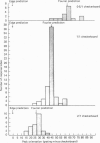
1. Cells in visual cortex have been alternately considered as bar and edge detectors, or as spatial-frequency filters responding to the two-dimensional Fourier component of patterns. 2. The responses to gratings and to checkerboards allow one to test these alternate models: the Fourier components of a checkerboard pattern do not occur at the same orientation as the edges, nor do the checkerboard spatial frequencies correspond to the check widths. 3. Knowing the orientation tuning of a cell for gratings, one can precisely predict its orientation tuning to checkerboards from the orientation of the fundamental Fourier components of the patterns, not from the orientation of their edges. This was found for both square and rectangular checkerboards, and held for both simple and complex cortical cells. 4. Knowing the spatial tuning of a cell for sine-wave gratings, one can precisely predict its spatial tuning to square and rectangular checkerboards from the spatial frequencies of the fundamental Fourier components of the patterns, not from the widths of their checks. 5. When presented with checkerboards in which not the fundamental but the upper harmonics were within its spatial bandpass, a cell's orientation tuning was found to be predictable from the (quite different) orientation of the higher Fourier harmonic components, but not from the orientation of the edges. 6. Knowing a cell's contrast sensitivity for gratings, one can predict the cell's contrast sensitivity for checkerboards much more accurately from the amplitudes of the two-dimensional Fourier components of the patterns than from the contrasts of the patterns. 7. The orientation tuning, spatial-frequency tuning and responsiveness of cells to a plaid pattern were also found to be predictable from the pattern's two-dimensional Fourier spectrum. 8. Both simple and complex striate cortex cells can thus be characterized as two-dimensional spatial-frequency filters. Since different cells responsive to the same region in the visual field are tuned to different spatial frequencies and orientations, the ensemble of such cells would fairly precisely encode the two-dimensional Fourier spectrum of a patch of visual space.
Full text
PDF


Images in this article

Selected References
These references are in PubMed. This may not be the complete list of references from this article.
- Bishop P. O., Coombs J. S., Henry G. H. Interaction effects of visual contours on the discharge frequency of simple striate neurones. J Physiol. 1971 Dec;219(3):659–687. doi: 10.1113/jphysiol.1971.sp009682. [DOI] [PMC free article] [PubMed] [Google Scholar]
- Bishop P. O., Coombs J. S., Henry G. H. Responses to visual contours: spatio-temporal aspects of excitation in the receptive fields of simple striate neurones. J Physiol. 1971 Dec;219(3):625–657. doi: 10.1113/jphysiol.1971.sp009681. [DOI] [PMC free article] [PubMed] [Google Scholar]
- Campbell F. W., Green D. G. Optical and retinal factors affecting visual resolution. J Physiol. 1965 Dec;181(3):576–593. doi: 10.1113/jphysiol.1965.sp007784. [DOI] [PMC free article] [PubMed] [Google Scholar]
- Campbell F. W., Robson J. G. Application of Fourier analysis to the visibility of gratings. J Physiol. 1968 Aug;197(3):551–566. doi: 10.1113/jphysiol.1968.sp008574. [DOI] [PMC free article] [PubMed] [Google Scholar]
- Enroth-Cugell C., Robson J. G. The contrast sensitivity of retinal ganglion cells of the cat. J Physiol. 1966 Dec;187(3):517–552. doi: 10.1113/jphysiol.1966.sp008107. [DOI] [PMC free article] [PubMed] [Google Scholar]
- HUBEL D. H., WIESEL T. N. Receptive fields of single neurones in the cat's striate cortex. J Physiol. 1959 Oct;148:574–591. doi: 10.1113/jphysiol.1959.sp006308. [DOI] [PMC free article] [PubMed] [Google Scholar]
- HUBEL D. H., WIESEL T. N. Receptive fields, binocular interaction and functional architecture in the cat's visual cortex. J Physiol. 1962 Jan;160:106–154. doi: 10.1113/jphysiol.1962.sp006837. [DOI] [PMC free article] [PubMed] [Google Scholar]
- Kelly D. H. Pattern detection and the two-dimensional fourier transform: flickering checkerboards and chromatic mechanisms. Vision Res. 1976;16(3):277–287. doi: 10.1016/0042-6989(76)90111-5. [DOI] [PubMed] [Google Scholar]