



Abstract
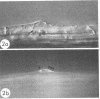
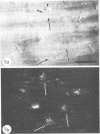
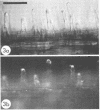
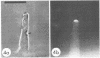
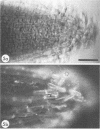
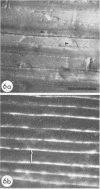
Ten fluorescein isothiocyanate-labeled lectins were tested on the roots of the tropical legume Macroptilium atropurpureum Urb. Four of these (concanavalin A, peanut agglutinin, Ricinis communis agglutinin I [RCA-I], wheat germ agglutinin) were found to bind to the exterior of root cap cells, the root cap slime, and the channels between epidermal cells in the root elongation zone. One of these lectins, RCA-I, bound to the root hair tips in the mature and emerging hair zones and also to sites at which root hairs were only just emerging. There was no RCA-I binding to immature trichoblasts. Preincubation of these lectins with their hapten sugars eliminated all types of root cell binding. By using a microinoculation technique, preincubation of the root surface with RCA-I lectin was found to inhibit infection and nodulation by Rhizobium spp. Preincubation of the root surface with the RCA-I hapten β-d-galactose or a mixture of RCA-I lectin and its hapten failed to inhibit nodulation. Application of RCA-I lectin to the root surface caused no apparent detrimental effects to the root hair cells and did not prevent the growth of root hairs. The lectin did not prevent Rhizobium sp. motility or viability even after 24 h of incubation. It was concluded that the RCA-I lectin-specific sugar β-d-galactose may be involved in the recognition or early infection stages, or both, in the Rhizobium sp. infection of M. atropurpureum.
Full text
PDF


Images in this article
Selected References
These references are in PubMed. This may not be the complete list of references from this article.
- Bhuvaneswari T. V., Bauer W. D. Role of Lectins in Plant-Microorganism Interactions: III. Influence of Rhizosphere/Rhizoplane Culture Conditions on the Soybean Lectin-binding Properties of Rhizobia. Plant Physiol. 1978 Jul;62(1):71–74. doi: 10.1104/pp.62.1.71. [DOI] [PMC free article] [PubMed] [Google Scholar]
- Bhuvaneswari T. V., Pueppke S. G., Bauer W. D. Role of lectins in plant-microorganism interactions: I. Binding of soybean lectin to rhizobia. Plant Physiol. 1977 Oct;60(4):486–491. doi: 10.1104/pp.60.4.486. [DOI] [PMC free article] [PubMed] [Google Scholar]
- Bhuvaneswari T. V., Turgeon B. G., Bauer W. D. Early Events in the Infection of Soybean (Glycine max L. Merr) by Rhizobium japonicum: I. LOCALIZATION OF INFECTIBLE ROOT CELLS. Plant Physiol. 1980 Dec;66(6):1027–1031. doi: 10.1104/pp.66.6.1027. [DOI] [PMC free article] [PubMed] [Google Scholar]
- Bohlool B. B., Schmidt E. L. Lectins: a possible basis for specificity in the Rhizobium--legume root nodule symbiosis. Science. 1974 Jul 19;185(4147):269–271. doi: 10.1126/science.185.4147.269. [DOI] [PubMed] [Google Scholar]
- Dazzo F. B., Hubbell D. H. Cross-reactive antigens and lectin as determinants of symbiotic specificity in the Rhizobium-clover association. Appl Microbiol. 1975 Dec;30(6):1017–1033. doi: 10.1128/am.30.6.1017-1033.1975. [DOI] [PMC free article] [PubMed] [Google Scholar]
- Dazzo F. B., Yanke W. E., Brill W. J. Trifolin: a Rhizobium recognition protein from white clover. Biochim Biophys Acta. 1978 Mar 20;539(3):276–286. doi: 10.1016/0304-4165(78)90032-6. [DOI] [PubMed] [Google Scholar]
- Halverson L. J., Stacey G. Host recognition in the Rhizobium-soybean symbiosis : evidence for the involvement of lectin in nodulation. Plant Physiol. 1985 Mar;77(3):621–625. doi: 10.1104/pp.77.3.621. [DOI] [PMC free article] [PubMed] [Google Scholar]
- Halverson L. J., Stacey G. Host recognition in the Rhizobium-soybean symbiosis: detection of a protein factor in soybean root exudate which is involved in the nodulation process. Plant Physiol. 1984 Jan;74(1):84–89. doi: 10.1104/pp.74.1.84. [DOI] [PMC free article] [PubMed] [Google Scholar]
- Morrison N. A., Hau C. Y., Trinick M. J., Shine J., Rolfe B. G. Heat curing of a sym plasmid in a fast-growing Rhizobium sp. that is able to nodulate legumes and the nonlegume Parasponia sp. J Bacteriol. 1983 Jan;153(1):527–531. doi: 10.1128/jb.153.1.527-531.1983. [DOI] [PMC free article] [PubMed] [Google Scholar]
- Stacey G., Paau A. S., Brill W. J. Host recognition in the Rhizobium-soybean symbiosis. Plant Physiol. 1980 Oct;66(4):609–614. doi: 10.1104/pp.66.4.609. [DOI] [PMC free article] [PubMed] [Google Scholar]
- Stanley P., Sudo T. Microheterogeneity among carbohydrate structures at the cell surface may be important in recognition phenomena. Cell. 1981 Mar;23(3):763–769. doi: 10.1016/0092-8674(81)90440-2. [DOI] [PubMed] [Google Scholar]
- Turner M. How trypanosomes change coats. Nature. 1980 Mar 6;284(5751):13–14. doi: 10.1038/284013a0. [DOI] [PubMed] [Google Scholar]