



Abstract
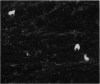
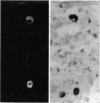
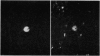
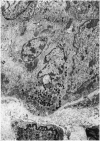
The endocrine polypeptide (APUD) cells responsible for the production and storage of secretin have been demonstrated, in canine duodenum, by the application of an indirect immunofluorescence technique, using anti-pure porcine secretin, to carbodiimide-fixed cryostat sections. The cells are identified, by the use of parallel cytochemical and ultrastructural preparations, as the small granular S cells. These are essentially restricted to the transitional zone of the duodenal mucosa, with whose lumen their apical projections probably always make contact. There is no need to alter the title of the cells since S can now stand for secretin instead of for small.
Full text
PDF


Images in this article
Selected References
These references are in PubMed. This may not be the complete list of references from this article.
- Bayliss W. M., Starling E. H. The mechanism of pancreatic secretion. J Physiol. 1902 Sep 12;28(5):325–353. doi: 10.1113/jphysiol.1902.sp000920. [DOI] [PMC free article] [PubMed] [Google Scholar]
- Bussolati G., Pearse A. G. Immunofluorescent localization of the gastrin-secreting G cells in the pyloric antrum of the pig. Histochemie. 1970;21(1):1–4. doi: 10.1007/BF00304798. [DOI] [PubMed] [Google Scholar]
- COONS A. H., LEDUC E. H., CONNOLLY J. M. Studies on antibody production. I. A method for the histochemical demonstration of specific antibody and its application to a study of the hyperimmune rabbit. J Exp Med. 1955 Jul 1;102(1):49–60. doi: 10.1084/jem.102.1.49. [DOI] [PMC free article] [PubMed] [Google Scholar]
- Capella C., Solcia E., Vassallo G. Identification of six types of endocrine cells in the gastrointestinal mucosa of the rabbit. Arch Histol Jpn. 1969 Aug;30(5):479–495. doi: 10.1679/aohc1950.30.479. [DOI] [PubMed] [Google Scholar]
- Cavallero C., Capella C., Solcia E., Vassallo G., Bussolati G. Cytology, cytochemistry and ultrastructure of glucagon-secreting cells. Acta Diabetol Lat. 1970 Jul-Aug;7(4):542–passim. doi: 10.1007/BF01556805. [DOI] [PubMed] [Google Scholar]
- De Grandi P. The routine demonstration of C cells in human and animal thyroid glands. Value of a simple silver stain. Virchows Arch B Cell Pathol. 1970;6(2):137–150. doi: 10.1007/BF02899119. [DOI] [PubMed] [Google Scholar]
- GROSSMAN M. I. The physiology of secretin. Vitam Horm. 1958;16:179–203. doi: 10.1016/s0083-6729(08)60317-9. [DOI] [PubMed] [Google Scholar]
- JORPES J. E., MUTT V. The gastrointestinal hormones, secretin and cholecystokinin-pancreozymin. Ann Intern Med. 1961 Sep;55:395–405. doi: 10.7326/0003-4819-55-3-395. [DOI] [PubMed] [Google Scholar]
- Krawitt E. L., Zimmerman G. R., Clifton J. A. Location of secretin in dog duodenal mucosa. Am J Physiol. 1966 Oct;211(4):935–938. doi: 10.1152/ajplegacy.1966.211.4.935. [DOI] [PubMed] [Google Scholar]
- McGuigan J. E. Gastric mucosal intracellular localization of gastrin by immunofluorescence. Gastroenterology. 1968 Sep;55(3):315–327. [PubMed] [Google Scholar]
- Mutt V., Jorpes J. E., Magnusson S. Structure of porcine secretin. The amino acid sequence. Eur J Biochem. 1970 Sep;15(3):513–519. doi: 10.1111/j.1432-1033.1970.tb01034.x. [DOI] [PubMed] [Google Scholar]
- Pearse A. G., Bussolati G. Immunofluorescence studies on the distribution of gastrin cells in different clinical states. Gut. 1970 Aug;11(8):646–648. doi: 10.1136/gut.11.8.646. [DOI] [PMC free article] [PubMed] [Google Scholar]
- Pearse A. G. Common cytochemical and ultrastructural characteristics of cells producing polypeptide hormones (the APUD series) and their relevance to thyroid and ultimobranchial C cells and calcitonin. Proc R Soc Lond B Biol Sci. 1968 May 14;170(1018):71–80. doi: 10.1098/rspb.1968.0025. [DOI] [PubMed] [Google Scholar]
- Pearse A. G., Coulling I., Weavers B., Friesen S. The endocrine polypeptide cells of the human stomach, duodenum, and jejunum. Gut. 1970 Aug;11(8):649–658. doi: 10.1136/gut.11.8.649. [DOI] [PMC free article] [PubMed] [Google Scholar]
- Pearse A. G. The cytochemistry and ultrastructure of polypeptide hormone-producing cells of the APUD series and the embryologic, physiologic and pathologic implications of the concept. J Histochem Cytochem. 1969 May;17(5):303–313. doi: 10.1177/17.5.303. [DOI] [PubMed] [Google Scholar]
- Polak J. M., Bloom S., Coulling I., Pearse A. G. Immunofluorescent localization of enteroglucagon cells in the gastrointestinal tract of the dog. Gut. 1971 Apr;12(4):311–318. doi: 10.1136/gut.12.4.311. [DOI] [PMC free article] [PubMed] [Google Scholar]
- Solcia E., Capella C., Vassallo G. Lead-haematoxylin as a stain for endocrine cells. Significance of staining and comparison with other selective methods. Histochemie. 1969;20(2):116–126. doi: 10.1007/BF00268705. [DOI] [PubMed] [Google Scholar]
- Solcia E., Vassallo G., Capella C. Studies on the G cells of the pyloric mucosa, the probable site of gastrin secretion. Gut. 1969 May;10(5):379–388. doi: 10.1136/gut.10.5.379. [DOI] [PMC free article] [PubMed] [Google Scholar]
- Solcia E., Vassallo G., Sampietro R. Endocrine cells in the antro-pyloric mucosa of the stomach. Z Zellforsch Mikrosk Anat. 1967;81(4):474–486. doi: 10.1007/BF00541009. [DOI] [PubMed] [Google Scholar]
- Vassallo G., Solcia E., Capella C. Light and electron microscopic identification of several types of endocrine cells in the gastrointestinal mucosa of the cat. Z Zellforsch Mikrosk Anat. 1969;98(3):333–356. doi: 10.1007/BF00346679. [DOI] [PubMed] [Google Scholar]
- Weinstein B. On the relationship between glucagon and secretin. Experientia. 1968 Apr 15;24(4):406–408. doi: 10.1007/BF02140850. [DOI] [PubMed] [Google Scholar]
- Young J. D., Lazarus L., Chisholm D. J., Atkinson F. F. Radioimmunoassay of secretin in human serum. J Nucl Med. 1968 Dec;9(12):641–642. [PubMed] [Google Scholar]