


Dear Editor,
In severe trauma, in 1% to 3% of the patients can be verified vascular injuries in neck vessels.[1] Recent studies have described a higher prevalence of blunt cervical vascular injury.[2,3] Death associated with internal carotid pseudoaneurysm is 20% to 30% of the cases.[4] Most of these injuries are associated with high-energy trauma in motor vehicle accidents.[3] However, carotid artery dissection and pseudoaneurysm in mild trauma is a very rare disease.
A 27-year-old female patient, admitted after a car accident, with bruise in the neck and 14 points in the Glasgow Coma Scale (GCS) with normal skull computed tomography. She remained with significant neck pain, and then, we performed cervical angiotomography [Figure 1] that revealed an internal carotid artery (ICA) pseudoaneurysm. An angiography [Figure 2] confirmed pseudoaneurysm and dissection. The patient was treated with carotid stenting, uneventful. She was discharged with 15 points in the GCS, without motor deficits.
Figure 1.
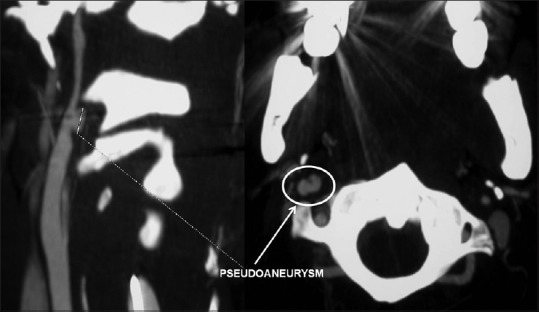
Computed tomography angiography showed pseudoaneurysm in the right internal carotid artery
Figure 2.

Digital angiography image. In (a) preoperative image showing pseudoaneurysm and dissection in internal carotid aneurysm and (b) postoperative image showing improve of dissection segment with stent
Traumatic lesions of the ICA may occur associated with only cervical pain[5,6] as in our patient. However, this is a special case because involves low-energy trauma. A great number of dissections can be treated with medical therapy and <10% progress to a pseudoaneurysm. In vascular injuries like in our patient, the endovascular intervention is indicate to occlude the pseudoaneurysm to decrease the risk of future hemorrhages and neurological deficits.[3] The important point that we observed with this rare clinical case is that clinical suspicion is necessary for carotid artery injury, even in traumas without decrease of the level of consciousness.
Financial support and sponsorship
Nil.
Conflicts of interest
There are no conflicts of interest.
REFERENCES
- 1.Spanos K, Karathanos C, Stamoulis K, Giannoukas AD. Endovascular treatment of traumatic internal carotid artery pseudoaneurysm. Injury. 2016;47:307–12. doi: 10.1016/j.injury.2015.09.015. [DOI] [PubMed] [Google Scholar]
- 2.Rathlev NK. Penetrating neck trauma: Mandatory versus selective exploration. J Emerg Med. 1990;8:75–8. doi: 10.1016/0736-4679(90)90392-9. [DOI] [PubMed] [Google Scholar]
- 3.Wang A, Santarelli JG, Stiefel MF. Traumatic cervical internal carotid artery pseudoaneurysm in a child refractory to initial endovascular treatment: Case report and technical considerations. Childs Nerv Syst. 2016;32:2459–64. doi: 10.1007/s00381-016-3171-6. [DOI] [PubMed] [Google Scholar]
- 4.Miller PR, Fabian TC, Croce MA, Cagiannos C, Williams JS, Vang M, et al. Prospective screening for blunt cerebrovascular injuries: Analysis of diagnostic modalities and outcomes. Ann Surg. 2002;236:386–93. doi: 10.1097/01.SLA.0000027174.01008.A0. [DOI] [PMC free article] [PubMed] [Google Scholar]
- 5.Biffl WL, Moore EE, Offner PJ, Brega KE, Franciose RJ, Elliott JP, et al. Optimizing screening for blunt cerebrovascular injuries. Am J Surg. 1999;178:517–22. doi: 10.1016/s0002-9610(99)00245-7. [DOI] [PubMed] [Google Scholar]
- 6.Biffl WL, Moore EE, Offner PJ, Burch JM. Blunt carotid and vertebral arterial injuries. World J Surg. 2001;25:1036–43. doi: 10.1007/s00268-001-0056-x. [DOI] [PubMed] [Google Scholar]